Don Schumacher Motorsports—the manufacturing arm of Don Schumacher Racing—has announced plans for a $10.5 million expansion in Brownsburg, Indiana, according to published reports.
A total of $7 million will be used to add manufacturing equipment to its already existing 20,000-square-foot space, while $3.5 million has been allotted to create a complementary 32,500-square-foot building adjacent to the current operations. Both expansions are expected to create 42 new jobs by 2025.
“We’re now excited for this next phase as we continue to expand our motorsports, aerospace, and defense manufacturing infrastructure,” DSM President Chad Osier said in written remarks. “Brownsburg has proven to be a great location for us, with access to top talent and proximity to our customers.”
DSM currently employs 25 people and operates nearly thirty multi-axis mill/turn machines, two multi-axis lathes, one SWISS Turn machine, two 3D printers, and four coordinate measuring machines (CMM).
Officials expect to break ground on the new building in May and to be running by October.
Team Allied Distribution—the Benicia, California-based independent warehouse distributor of automotive exhaust components—has announced the opening of its fifth Californian location.
The new Stockton, California facility is a fully integrated warehouse formerly operated as Wicked Flow’s Northern California distribution center. Earlier this year, Team Allied entered a definitive agreement to acquire Wicked Flow’s Nor-Cal facility, warehouse equipment, distribution operations, assets, and onsite inventory.
Team Allied will extend permanent positions “to a majority of the talented staff already in place.”
Team Allied has over 20 locations in the US. For a complete list, visit here.
Tracking legal, legislative, and regulatory developments impacting the racing and performance industry.
PRI’s Washington, DC-based legal and advocacy teams work continuously to protect and support motorsports venues, sanctioning bodies, and businesses around the nation. We are tracking several initiatives this month, including new regulations for R&D investments, new legislation designed to better race track operations in West Virginia, and a “win” for internal combustion engines in Virginia.
R&D Tax Credit and Bonus Depreciation For Businesses
When the 2017 tax law was enacted, it allowed companies to amortize certain tax deductions over one year, but the benefit was only temporary. The business community urged Congress to extend the provisions in 2022, but this did not occur despite widespread support in Congress. PRI’s DC-based advocacy team will be making a push in 2023 to get Congress to reinstate the 2017 provisions for R&D expenditures and the bonus depreciation.
Of particular interest:
• From 2017 through 2021, companies could take a 100% tax deduction for R&D spending in the year it occurred. Starting with the 2022 tax returns, companies have to deduct their R&D expenses over a five-year period.
• Under the 2017 law, a company could expense 100% of the cost of any Section 179 property—such as equipment, vehicles, and software—and deduct it in the year the property was placed in service (applicable between September 28, 2017, and December 31, 2022). The law increased both the maximum deduction to $1 million and the phase-out threshold to $2.5 million, adjusted for inflation. The Section 179 deduction now phases out over the next four years: 80% in 2023, 60% in 2024, 40% in 2025, and 20% in 2026.
• Unless the law is changed by 2027, the bonus deduction will disappear, and companies will have to return to spreading out the depreciation over many years.
“Motorsports businesses make significant investments in equipment along with R&D, which are necessary to provide racers with technology that allows them to win. It’s important that Congress provides small businesses with a predictable, forward-looking tax structure that rewards companies that make long-term investments and plan for the future,” said Eric Snyder, Senior Director, Federal Government Affairs.
West Virginia Introduces Motorsport Responsibility Act
West Virginia lawmakers have introduced the PRI-supported Motorsport Responsibility Act (H.B. 2569/S.B. 236), which is designed to help motorsports facility operators and owners by defining areas of responsibility and assumed risks by participants.
“Motorsports venues and recreational areas are major contributors to the West Virginia economy. Clearly defining the obligations and responsibilities—for both participants and race tracks—will make the state more enticing for racers, promoters, and future facilities,” said Christian Robinson, Senior Director, State Government Affairs & Grassroots.
H.B. 2569 has passed the House of Delegates while S.B. 236 is currently pending in the Senate Judiciary Committee. To contact lawmakers in support of the Motorsport Responsibility Act, visit https://p2a.co/S9lLlWt.
Voice Your Support: Virginia Governor Pledges To Repeal ICE Ban
Virginia lawmakers have introduced PRI- and SEMA-supported legislation (H.B.1378) to repeal the law tying the state to California’s motor vehicle emission standards. Under current law, sales of new gas- and diesel-powered vehicles will be banned starting in 2035.
“It defies common sense that in 2021, lawmakers decided that instead of writing our own electric vehicle laws, Virginia would simply do whatever California decided to do,” said Virginia Governor Glenn Youngkin. “Because lawmakers outsourced their responsibilities and surrendered our values to California, Virginians face a mandate starting in 2024 that limits and eventually bans the buying of gas-powered cars or trucks. Unless we act, Virginia is hostage to the extreme policies of California. Common sense says that the law of Virginia should be written by elected leaders here, not outsourced to radical bureaucrats in California.”
Virginia Governor Glenn Youngkin
“PRI and SEMA support legislation in Virginia to repeal the law tying the state to California’s motor vehicle emission standards,” said Robinson. “PRI and SEMA also do not believe that the government—Virginia’s or California’s—should be choosing winners and losers in the automotive market. Virginians should decide what vehicles are best for them and their families.”
To voice your support and contact Virginia lawmakers in support of the bill, visit https://p2a.co/milPoek.
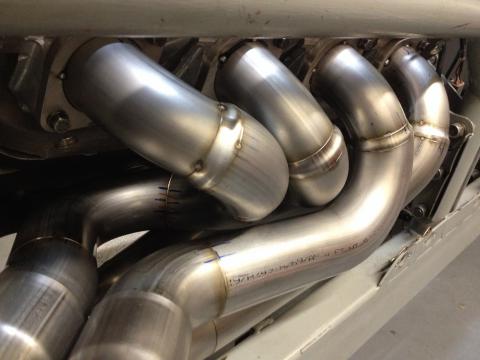
Most stepped headers feature sharp steps. This Bonneville big block header uses smooth transitions that are required for thin wall exhausts (0.035-inch wall or less).
While stepped headers may offer improved power and power band, some applications are nonetheless better suited to a straight design.
How do you get maximum performance out of your exhaust header?
For starters, an effective exhaust system optimizes the movement of the pressure waves occurring within it. Pressure wave management helps maximize “mass-flow.” Mass-flow is the process of moving the largest amount of exhaust gas out of the header as efficiently as possible. Performance header design focuses on optimizing mass-flow.
During camshaft overlap in the cylinder head, vacuum waves resulting from pressure wave reflections in the engine’s exhaust ports function to extract exhaust gas out of the cylinder. To maximize mass-flow, there are key aspects of header design that affect both the timing and strength of these pressure waves. They include:
• primary length
• primary diameter
• collector size
• tail pipe size
These components are 95% of the qualitative game.
The question now becomes, “What exhaust header design offers the best performance—stepped or straight?” Let’s first break down their differences.
Straight-tube headers have constant diameter tubes that flow exhaust from the engine to the atmosphere. By contrast, a stepped header has exhaust tubes that increase in size as they get farther from the exhaust ports. These “steps” are typically spaced in 1/8-inch increments.
Stepped headers may provide another 5% of improved power and power band by further managing the flow and wave dynamics. That’s not to say you will see a 5% increase in max power output, but rather an increase of 5% in the total of any performance gained from the entire exhaust system.
Pressures and Wavelengths
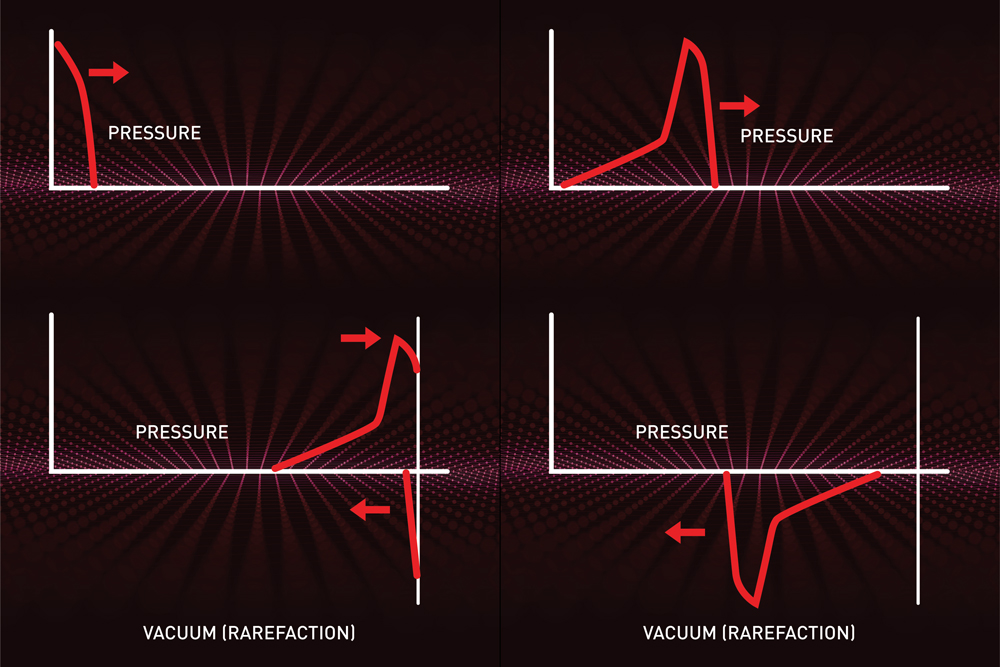
To explain how stepped design improves flow and power range, let’s review what happens in the header. As the exhaust valve opens following the power stroke, a pressure wave and a mass of exhaust gas flows from the cylinder into the header primary. The graphs on page 97 help to illustrate this process.
The pressure wave generated travels at near the speed of sound. In the case of a constant diameter tube without a collector, the wave hits the end of the tube, and a negative pressure (i.e. vacuum) wave reflects up the tube. The reflected negative wave is the result of the “boundary condition.” This is the constraint point at the physical end of the system. In this case, it is the exhaust tip(s) or exit point of the tube. At this boundary, the pressure must equal atmospheric pressure, giving rise to a balancing negative pressure wave.
Using the speed of sound value calculated by the temperature and composition values of the exhaust gas flow, we can understand the time required for a pressure wave to travel the total length of the tube.
The goal is to time the exact speed the pressure waves will travel from the exhaust valve to the end of the pipe. That value is then combined with the value of the resulting vacuum wave traveling back to the exhaust port. When these two combined values are equal to the time of one crankshaft revolution for a set engine speed, it is known as the “tuned rpm.”
Tuned RPM and Exhaust Scavenging
At the tuned rpm, this wave will enter the cylinder during the cam overlap period. This will “suck,” or scavenge, residual exhaust out of the cylinder, helping the intake charge to fill the cylinder. A straight open-ended tube for each cylinder will create the strongest possible wave reflection from the end of the tube.
However, a problem arises when the engine rpm is “off” the tuned rpm of the pipe. The wave reflections can disrupt the cylinder from scavenging and filling. Consider: At an off-tuned rpm, vacuum waves may reach the exhaust port when the valve is closed. This results in a positive wave reflecting from the end of the tube. If this wave arrives at the valve during cam overlap, the exhaust gas flow becomes restricted. The result is a narrow tuning range resulting in a “peaky” power band.
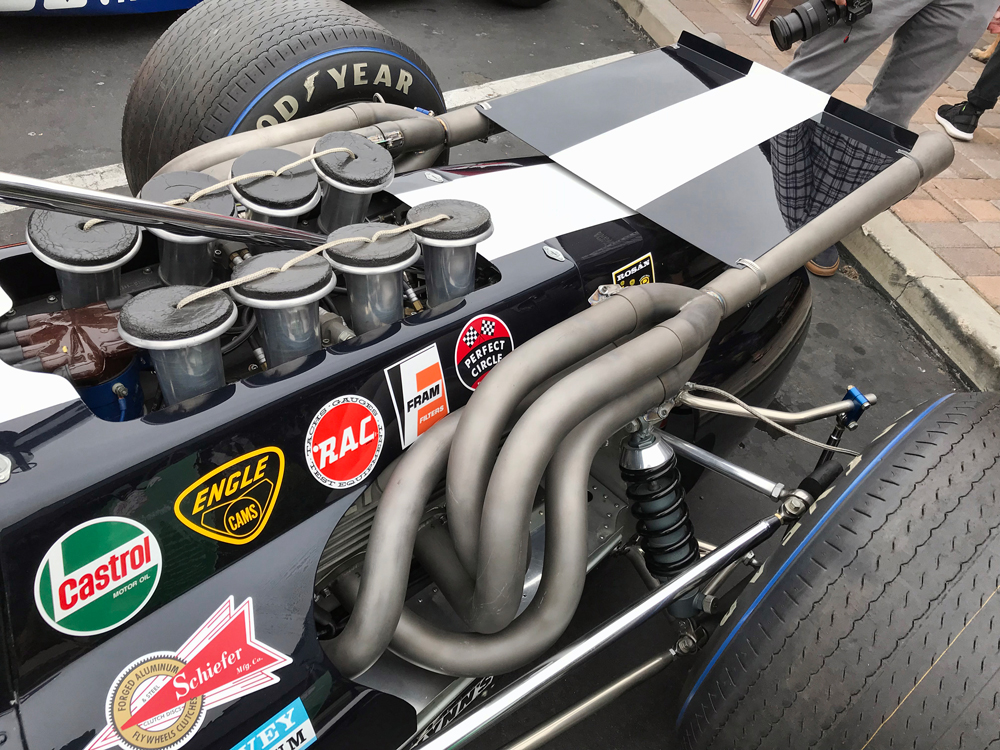
While stepped-header tubes are often the best solution for specific race engines, they are also more difficult and more expensive to fabricate than straight-tube headers. This set of straight headers from a 1968 Gurney Weslake Indy car were likely sand-bent exhaust headers, according to Vince Roman of Burns Stainless.
With a stepped header, the smaller tube size near the port provides a higher gas velocity. This allows the exhaust to evacuate further while the exhaust valve is open. The larger tube size downstream reduces the pressure drop through the header, thereby improving mass-flow through the tube.
Creating Broader Power Bands
In addition to the above, the stepped design also creates multiple wave reflection points. These smaller vacuum waves help evacuate exhaust from the cylinder at different engine speeds. This results in improved torque across the power band.
These multiple reflections also reduce the strength of the positive wave traveling to the end of the tube. This results in a smaller-sized primary scavenge wave.
Due to the amplifying effect of frequency resonance, these waves will still have enough scavenging strength at the tuned engine speed. Yet, the reduced strength of the waves will cause less havoc at other engine speeds. This again results in an increased range of the power band. In a perfect world, a constantly tapered exhaust primary tube would be ideal. This would distribute the reflected waves infinitely over the length of the primary tube.
As the pressure wave formed at the exhaust valve travels down the tube, a negative wave is formed and reflected toward the engine, as shown at left. As the cylinder pressure drops, the pressure wave develops the shape at top right. As the pressure wave reaches the end of the pipe, at left, the pressure is atmospheric, and in order to meet the boundary condition, a rarefaction wave must develop to cancel positive pressure. The result, at right, is a rarefaction wave that forms and travels back up the pipe toward the exhaust valve.
Bigger Isn’t Always Better
There are many benefits to a stepped exhaust header. One practical benefit is that the exhaust tube is smaller at the cylinder head. This is often easier to package in a full chassis car. It’s the reason racers likely developed this design in the first place. Yet, the most important benefit is its performance improvement over straight-tube designs.
So, when money is no object, then a stepped pipe is better, right? Well, no, not always.
Remember what we said earlier: Two of the most important aspects are the primary and collector diameters. Oftentimes, engines have exhaust ports that are too large. This is especially true in vintage engines and lower-performance modern engines.
In general, engines dislike tubes that are reduced in diameter. If the exhaust port is larger than the ideal primary size, building a stepped pipe will result in the primary and collector being too large. This results in inferior performance.
Cost and Application Considerations
Stepped-header tubes are also more difficult and more expensive to fabricate than straight-tubed headers. So, if you do not need to extract all the power available, then a straight-tube header is going to get the job done.
Which is to say that stepped headers are often—but not always—the best solution.
We do find that for well-developed modern race engines with properly sized exhaust ports, a three-stepped exhaust primary is best. For example, the ideal header size for an LS7 crate motor would be a 1 3/4-inch + 1 7/8-inch + 2-inch OD stepped primary. In comparison, a lower-performance LS3 crate engine with similar-sized ports is 1 3/4-inch OD.
The fluid dynamics and thermodynamics occurring in the exhaust of an internal combustion engine are extremely complex. Explaining them fully in this space is simply not possible. Instead, the goal here is to help you develop a visual understanding of what is occurring in the exhaust system and assist in guiding you to the best solution for your performance build. P
As the owner of Burns Stainless, a manufacturer of racing exhaust components, Vince Roman has designed exhaust systems for more than 20 years. Prior to working at Burns Stainless, he was a research engineer working in combustion phenomenon and air pollution control. Roman has a BS and MS in Mechanical Engineering from the University of California Irvine.
Queensland Speedway Spares is a subsidiary of Bill Mann’s Performance Wholesale Australia, marketing pure race components to Australia’s enthusiastic motorsports community.
The call for “a strong, united voice in the future of motorsports” comes from Australia’s largest provider of custom and off-the-shelf engine parts.
What does the lonely work at cattle and sheep stations in the outback of Australia have to do with the world of automotive high performance? Plenty, because that’s where founder Bill Mann cut his teeth. He worked in rural farming before starting out in a series of speed-related enterprises that culminated in 1986, when Mann established Performance Wholesale Australia Pty Ltd. Today it’s the Southern Cross’ largest provider of custom and off-the-shelf engine parts from a galaxy of manufacturers, including many based in North America.
American-style high performance and motorsports are extremely popular Down Under, with enthusiasts in Australia amped on everything from muscle cars for the street to drag racing, sprint cars, and midgets (or as they’re known in Australia, “speedcars”). It’s a rich environment that saw Mann spin his first wrenches at age 14 at a local repair shop that dismantled and fixed junk vehicles, among other things. While working full time, Mann successfully completed correspondence courses in mechanical engineering, driving combines to pick up extra cash. His career as an independent business owner dates to 1976, when Mann opened Bill Mann Performance as a machine shop building racing engines, primarily for the dirt track scene in Australia, plus dragsters and performance boats.
That was when Mann first started importing engine parts from the United States to evaluate and sell. The parts-importing end of his business grew exponentially, leading him to open Performance Wholesale Australia in Brisbane, Queensland, Australia, as a means to supply the best engine parts available from anywhere for sale in Australia, for every motorsports or enthusiast application. The firm employs a full force of sales and technical specialists, much like a US-based performance retailer would. Some have been with the company for 25 years or more. The listing of product categories and suppliers that sell through Performance Wholesale Australia easily reaches into the dozens.
The firm continues to test and evaluate components. For specialized fabrication of parts, it operates multiple five-axis CNC machines, two Newen Contour computerized cutting machines, an engine dyno, and flow benches. The firm also operates Queensland Speedway Spares as a subsidiary, marketing pure race components. As Mann puts it today, “The company is driven and fueled on basically one word, that being ‘passion.’” Maintaining employee enthusiasm in the face of global challenges is a never-ending priority, he said.
Performance Wholesale Australia has had to drastically increase its stock to survive, Bill Mann said. “It is not uncommon to have product on order for up to two years, and the average supply lead time is 52 weeks,” he said.
“With the purchases of household name brands in the performance industry by venture capital companies, it is all about bean counters and profit,” he said. “Companies have lost their passion as the originators sell out, retire, or pass away. It is a very sad situation, and most of these so-called new companies carry very little stock and have very few people that have any knowledge or passion except for staff who want to have a business card with some important words on it. I plead with the investment groups to keep good staff, with knowledge and passion to take their companies forward. Our industry is founded on passion, not spreadsheets.
“Companies like ours have had to increase their stock by 100% to survive, and to make up for the inadequate ability of these companies to carry stock,” he continued. “It is not uncommon to have product on order for up to two years, and the average supply lead time is 52 weeks. Most small-owner personal companies all have good supply.”
A consistent, experienced staff has enabled Performance Wholesale Australia to better navigate the buffeting caused by global supply challenges, Mann said. “We’ve been able to survive in an extremely difficult time by putting our entire livelihood into our company. The dedication of key staff to go way beyond their call of duty to make it happen, and to achieve incredible sales growth, has been key to us. It is all about people.”
Finding the right people to staff the operation is a daily part of running the business, Mann explained, noting that “the biggest single challenge of businesses all over the world is the ability to hire staff that are old school, extremely passionate, and are prepared to give an honest day’s work for an honest day’s pay. Modern-day phones and social media, in all their might, have destroyed the ability for most workers and families to think and communicate verbally for themselves. They are led along like sheep and are joined at the hands with that screen that they call life.”
Performance Wholesale Australia is relatively new to PRI as a Founding Member, but Mann said the experience and the benefits have consistently been invaluable to the company. “The PRI Membership is new, but I have attended every PRI Show since its beginning,” he said. “I have joined as a Founding Member as I feel there needs to be a strong, united voice in the future of motorsports [on] the reduction of emissions and the development of electric cars. I believe SEMA and PRI will be creative in their benefits to Members in the future. It’s been a good decision by SEMA and PRI to head this way. We owe a lot to Steve Lewis and his original crew who had the vision for PRI.”
Couple of things I think ahead of this month’s NHRA Camping World Drag Racing Series season opener in Gainesville:
1) I think that all content creators aren’t—for lack of a better term—created equal. And this month’s Special Report by contributor Steve Statham, titled “More Than Just Pretty Faces,” makes that clear in revealing the skills and capabilities possessed by some of motorsports’ most visible and influential social media personalities. Obviously, there’s value in looking good on camera, but for every TikTok or Instagram “star” whose connection to their audience is only skin deep, there exists a handful of truly dedicated—and talented—craftsmen and women of substance. Beginning on page 32, Statham’s piece provides a behind-the-scenes look at the paths of David Patterson, Skye Romanoff, Chelsea VanCleave and Blake Wilkey, and how each has leveraged their passion for racing into powerful platforms to achieve a variety of different objectives. Based on the West Coast, Romanoff heads up the California Rallycross Association while getting her hands dirty underneath a WRX (among other race vehicles) that takes a healthy dose of abuse across punishing terrain, as evidenced via her Instagram page at blancoracingwrx_05. But there’s yet another purpose behind the presentation: “What I try to do for content, I like to show other people—especially other women because I’m a really big promoter of women in this industry—that they can do it as well. So they’re seeing me do a brake job, or I re-do my coilovers and get an alignment, and they see me doing it hands-on personally. Then they feel like they have the capability of doing it themselves,” Romanoff explained. “Not only can I do my own work, and I try to promote that, but I also try to show other girls that I’m doing my own work, and I’m going out to the track the next day. So it shows that it’s doable.”
2) I think any grassroots road
racer who’s serious about his or her program could benefit from the insights offered in our feature “Drag vs. Downforce,” which begins on page 46. For the piece, author Drew Hardin connected with several of the industry’s leading fabrication and engineering shops to discuss the latest developments and cutting-edge solutions for some of the quickest Supras, FRS’s, GR86s, S2000s, Corvettes and more on track today. What these innovators are devising, and achieving, is nothing short of remarkable. Take the team at LYFE Motorsport, whose recent aero adjustments for its time attack GT-R resulted in a 4-second gain around a 2-plus mile road course. “We bolted on four seconds with the same power level,” Cole Powelson told us, “and that was pretty true to every circuit we went to after that.” Elsewhere, seconds were shaved off a 2004 Cobra’s Global Time Attack run when Caliber Customs’ Matthew Lambrecht “changed the design to where the diffuser had a curvature to it as opposed to having just a flat angle to further minimize the [air] delamination.... I maxed it out with the splitter, underbelly, diffuser, and not a wing but just a rear spoiler.” Granted, I’m not winning the Nobel Prize in Mathematics anytime soon, but I am fairly certain that in road race, time attack, autocross, hill climb, etc., subtraction in lap times is typically a very good thing.
Still rebounding from pandemic-related supply chain and labor issues, race tire manufacturers are working to meet current demand while bringing new product to market.
There’s a reason the old adage, “where the rubber meets the road,” is explicitly about tires. The saying is all about putting someone’s efforts to the test, making them real—and that’s exactly a race tire’s role. All the powertrain engineering, chassis development, and driver skill in the world won’t win a race without the right racing rubber joining them with the track’s surface.
As we learned from speaking with various tire companies, developing a new race tire is far more complex than just formulating the next sticky tread compound. “Sometimes in order to be first, you don’t have to be fastest,” said Justin Fantozzi of Goodyear Racing, Akron, Ohio. “Maybe you have to be the most durable, or you have to make sure you have enough speed and then balance that with the way the vehicle feels in order to make very consistent lap times or passes on the drag strip.”
Rising horsepower is an ongoing challenge. “Cars are getting faster and faster, and we need to consider their capabilities,” said Cameron Parsons of Toyo Tire USA, Costa Mesa, California. “Take a Nissan GT-R for example. If someone decided to track a modified 800-horsepower car at Road America, Road Atlanta, Daytona, or similar, we need to ensure that our tires perform safely and effectively on road courses and ‘rovals’ where cars reach up to 180 miles per hour. It’s a challenge that comes with the modern sports car market, as we work to meet these power and speed requirements while also meeting the rules of the racing sanctioning bodies.”
Adding to the design and engineering challenges are nagging problems left over from the pandemic years.
“I hesitate to call it the ‘new normal,’ but the realities we face as manufacturers is not changing,” said Mike Edmiston of Hoosier Racing Tire, Lakeville, Indiana. “The labor market is generationally tight; we’re not seeing a whole lot of relief in that area. We still see supply chain and shipping logistics disruptions. Getting certain materials that were never a problem in the past is now more problematic, and trying to coordinate all the production efforts around that can be incredibly difficult.” Plus, “no one in our company has seen this level of material pricing volatility in our entire history. That’s made it really challenging, and all the more reason to focus where we can when we can to shore up the supply for the customers.”
How are tire manufacturers keeping up with rising power levels? “If there’s a new application, a new series, or a new car that comes to market, we do extensive speed testing to ensure the integrity of that tire is suitable to the specification of the car,” said Hoosier’s Mike Edmiston.
Despite these circumstances, demand continues to grow, and race tires need to evolve to keep pace with increasing horsepower, suspension and aerodynamic developments, and newly popular race disciplines. What follows is a look at new race tire products and emerging trends that are influencing how these makers do business.
National Late Model Tire
Hoosier’s new National Late Model Tire (NLMT) program is a direct result of the company’s circumstances. “In a nutshell, it’s a lot of not only what we’re doing but what a lot of other manufacturers are doing as well,” Edmiston said.
According to Hoosier, the NLMT program “consolidates Hoosier’s current selection of dirt super late model tires to just three 90-inch tires and three 92-inch tires.” The new program will enable teams to “carry a lower inventory and will decrease their supply of wheels kept on hand. Another key benefit of the NLMT program focuses on the less aggressive compounds utilized, which should allow teams to consume fewer tires.”
“Materials prices have gone through the roof, and getting a consistent supply of textiles has been a problem,” Edmiston explained. “So a lot of what we and other manufacturers are doing is trying to automate what we can, so we don’t have to rely on the labor as much. We’re also trying to reduce complexities where we can, so we can offer the capacity and supply to our customers so they can continue their racing series.”
The tires in the NLMT program aren’t wholly new, Edmiston pointed out. “They’re still using the same materials and the same compounds our customers have demanded in the past. There are just not quite as many options to try. We’re using serial production materials that we have been using in our race products for years, but we’re selecting certain ones for a strategic purpose to get the supply at a level that is going to satisfy the market.”
Hoosier has been developing manufacturing equipment “that hasn’t existed, that’s not used anywhere else, so we can automate a little bit more and have the capability to build tires that don’t consume as much material. All those things work hand-in-hand, and the NLMT is an example of that. But we’re working behind the scenes to develop even further in that regard to give us the capability to still meet the performance standards that our customers demand but be able to do that in a way where it’s more efficient and consumes fewer of the materials that are much harder to get nowadays.”
New UTV Tires, DOT Drag Radial
Atturo Tire Corporation in Waukegan, Illinois, recently released a new line of UTV tires. “That’s a very fast-growing segment in off-road racing,” observed Michael Mathis, “and a core piece of our marketing of that product will be through sponsorship and contingency programs for a number of off-road racing series.”
In response to more powerful UTVs, Atturo Tire has introduced a new line of UTV tires “made like a modern light truck performance tire,” said Michael Mathis. Atturo will market the new tires “through sponsorship and contingency programs for a number of off-road racing series.”
Mathis noted, “The trend we are seeing with UTVs is that they are getting much higher horsepower. They are all 100-plus horsepower, and Polaris just released a vehicle that makes 200 horsepower. They are coming with active live suspension systems on them like you would find on a Ford Raptor. But they are still running on tires that are built for how they were in the 1990s. We are bringing a product to market made like a modern light truck performance tire, with the same type of build equipment, molds, quality control, uniformity standards, and construction type. It has all steel-belt construction, where other UTV tire brands only use nylon. It’s a tire that is able to take full advantage of the power and the suspension these machines have. It’s stronger, more uniform, and can maintain its contact patch with the ground. It can translate all that feedback through the suspension and let the suspension do its magic.”
Atturo also recently released a DOT drag radial “targeted at modern muscle cars—Camaro, Challenger, Charger, Mustang type applications,” Mathis said. “We think there’s continued opportunity in building out product for those types of owners, the ultra-enthusiast who wants to drive one of these vehicles to and from the drag strip and be able to compete on the same tires that got them there.”
Pro Mod Slick
Goodyear has recently released a new Eagle drag slick for Pro Mod racers. “We looked at different points of view for what is available and what isn’t and tried to fill the gap,” Fantozzi said. When asked what was changed specifically for this class, he said, “the big change was the geometry—that’s mold shape, sidewall length, and how it sits on the wheel. We needed to look at the ratio of moving forward versus what the spring rate was. We looked at how it was drawn up, how the sidewall shape is, and that made a big difference. There are some inner workings that we can’t talk about that we also were able to change.” Initially the tire will be available in one size—36.0x17.0-16—and one compound, “but if necessary, we’ll take these learnings and apply them to different sizes,” he said. “We spoke to many racers at the PRI Trade Show, and they were very excited to see the new tire coming out for the Pro Mod guys.” The new tire “could also have some legs for alcohol Funny Car.”
The geometry and construction of Goodyear’s newest drag slick were specifically designed for Pro Mod racers, though the tire “could also have some legs for alcohol Funny Car,” said Justin Fantozzi.
Goodyear is also working with NASCAR and Hendrick Motorsports to develop tires for the Garage 56 project, a NASCAR Camaro ZL1 that will compete at Le Mans this year. When we spoke with Fantozzi he was at Sebring while the car was undergoing testing. He could not reveal much about the tires, only to say that they were “all new” and not a version of an existing race product. “The rules and regulations are different enough from a technology point of view that new was the best approach.”
Goodyear is working with NASCAR and Hendrick Motorsports to develop tires for the Garage 56 Camaro ZL1 that will race at Le Mans this year. The rules of running Le Mans are such that developing an all-new tire “was the best approach” rather than using an existing tire, said Justin Fantozzi. Photo courtesy of NASCAR.
The 200-Treadwear Trend
Parsons said Toyo was currently in the process of developing “a refreshed line of racing tires, some of which we expect to introduce at the next PRI Show.” He had no details to share, but he did say the “number-one question we were asked at the PRI and SEMA shows was about 200-treadwear tire options. We’ve seen this trend pick up over the years. The 200-treadwear market is expanding so much, some manufacturers are trying to make a do-it-all tire, while others are trying to make specialties for autocross, time attack, or endurance racing.” He admitted that “it’s difficult to make a product that pleases everybody just because of the UTQG rating. Especially because this whole segment is becoming so popular that now there are specialized subcategories within this segment.”
When people think of racing tires, “we tend to think of slick tires, but the tires in the street category are the ones that are picking up the most,” Parsons added. “I think it’s because people want to race on a budget.” As an example, a set of dedicated racing slicks “for a race-only Porsche, BMW, or similar, depending on the tire brand, can cost anywhere from $1,800–$3,000. If you’re talking the 200-treadwear market, now your cost might be $800–$1,600, and you’ll get a lot more life out of the tires.
“People are really thinking about affordability and sustainability,” Parsons said. “Drivers don’t want to dump all their money on a $20,000 race weekend once a year, when instead they can get together with friends and split a seat for an endurance ride multiple times throughout the year.”
Tire Durability
When talking about racing tires, “sustainability” has multiple meanings. On one hand, the term refers to tire durability, “and that’s our reputation,” Parsons said. “Admittedly, when it comes to a slick race tire, a DOT slick, or a 200-treadwear tire, our tires usually are not the fastest out of the gate. But our tires last better than the competition, and on top of that they come out at a better price point.” Toyo’s Proxes RR tire, he noted, “holds its performance until it’s completely done. With some club racing tires and DOT slick tires, you might get a magic lap in the first laps of the heat cycle, then every lap after that is going to be slower. But with most of our products, especially the RR, you run it and get the same result every time until the tire reaches its end of life. You’ll see the performance start to degrade way further into its lifespan instead of early on.”
Demands on a tire for off-road racing in the West—as in the Baja 400 seen here—are very different from the short courses in the East, said Toyo Tire’s Cameron Parsons. “For the most part, West Coast tracks are in desert climates, so there’s more hard-packed dirt. East Coast racing surfaces are a lot softer.”
“The key to longevity is how to get multiple heat cycles out of a tire so it continues to repeat over time—how many repeat heat cycles can I get that generate grip in the tire,” said Scott Junod of American Racer, Indiana, Pennsylvania. Grip, he explained, comes in two forms: physical grip, or “how the rubber conforms to the surface of the track,” and chemical grip. “Certain friction levels generate temperatures in the tread of the tire that melt and activate chemicals in the tread. When you hear a racer talk about a tire ‘firing,’ that’s what that is—when the tire gets warm and all of a sudden creates a noticeable increase in grip. There’s this happy medium you have to find where you balance wear, physical grip, and chemical grip, and how that translates to the repeatability of the tire. That’s the whole science of what we do.”
To make a longer-lasting tire “you have to balance the construction of the tire with the compound in a way that gives them a consistent feel,” said Hoosier’s Edmiston. “You have to have a more durable compound, but overall the end product still has to be competitive, it has to be confidence inspiring. That is a real challenge from a compounding perspective to give consistent performance within one or two tenths per lap, heat cycle after heat cycle. In the last 10 years or so, we’ve made more gains and progress in how to achieve those types of properties, but it takes a lot of lab testing, a lot of track testing, and a lot of cooperation with customers and suppliers to make all that happen.”
Renewable Materials
Sustainability can also refer to emerging trends in tire materials.
Regarding the materials Goodyear uses, “we look at [sustainability] across all tires,” Fantozzi said. “We have a sustainability group, and there’s a lot of motion on that.” Goodyear has set a goal to have a tire with 100% sustainable materials by 2030. In January, it unveiled a demonstration tire made up of 90% sustainable materials that passed regulatory testing for road use. Among the sustainable materials in the demonstration tire were soybean oil, silica from rice husk waste residue, recycled polyester, pine tree resins, steel with high-recycled content, and four different kinds of carbon black produced from low carbon emissions sources.
“There are sanctioning bodies that are requiring sustainability, but that shouldn’t be the reason to do it,” Fantozzi continued. “You should be out front looking at it. We want to go fast, and we want to have fun, but we want to make sure that we leave the paddock looking better than when we got there.”
The focus on renewable materials and sustainability “is a key driver for Continental AG, which is our parent company,” Edmiston said. “We see this as an opportunity to look for ways in which we can utilize renewable materials in our product. We have already performed some trials internally, and there are some materials that are available today in production that we can start using. We want to continue to seek out and evaluate materials incorporating what we can into our products while maintaining and improving the performance of our tires.”
Material sustainability can also refer to the ability to procure the materials needed to make a race tire. “There are materials within motorsports that all the manufacturers use in order to get the desired speeds, or get the degradation to hit the right box,” Fantozzi said. “If they’re single sourced, and that supplier is no longer able to supply for whatever reason, then you need to be out ahead of that, truly recognize that supply can be an issue. If you’re single source, then you have to make sure that you de-risk the plan.”
“Did we make any substitutions based on raw materials tightness in the market and shortages over the last couple of years? The answer to that is ‘no,’” said Junod. “We have not made product substitutions to compensate for not being able to get a raw material. We managed even through the tightness of that, and there were some tough times. Our customers know that, and the industry knows that. We were able to maintain our present specs through that whole process until the raw material supply chain loosened up. We are in a good spot regarding raw materials versus where we were at this time last year.”
More Power
When asked how tire makers are responding to increases in power levels and speeds on the track, Edmiston pointed to Hoosier’s “extensive history and background of testing. We have test equipment in-house in our lab, so if there’s a new application, a new series, or a new car that comes to market, we do extensive speed testing to ensure the integrity of that tire is suitable to the specification of the car. If the materials we have aren’t sufficient for that, there are ways we can go to a supplier, work hand-in-hand with them, to develop a material that’s stronger.”
In Junod’s world—“we’re in the short-track business,” he said of the American Racer brand—“we’re not out there trying to build a tire that goes faster. We’re trying to build a tire that is very good, very responsive, feels good to the driver, is as safe as it could be, and lasts a while, so they’re not going broke buying new tires every time they want to go out. That’s our DNA.”
At American Racer, “we’re trying to build a tire that is very good, very responsive, feels good to the driver, is as safe as it could be, and lasts a while, so they’re not going broke buying new tires every time they want to go out,” said Scott Junod. “That’s our DNA.”
In fact, “I don’t know that we’re seeing higher speeds,” he offered. “Promoters aren’t necessarily looking for higher speeds. They’re looking for a more competitive show. They’re in show business.” If anything, “we are often the restrictor plate in the chain of speed,” he said, laughing. “It costs money to tech cars. It can be very complicated, with sophisticated rules packages about certain high-horsepower motors. So if a track doesn’t have the time, money, or expertise to do all that tech work, it’s pretty commonplace for them to say, ‘Give me a tire that won’t go very fast, so you can only deliver so much horsepower to the race track.’ That limits the field, and it levels the field.
“When that’s the case, you have to make a tire that’s very durable from a casing standpoint, because people are going to try to apply a great deal of torque to the tire, to try to get more speed,” Junod said. “Yet the grip levels are going to be such that they’re not necessarily going to be able to do that, but you still have to engineer the tire to take that kind of pounding.”
Big power and minimal restrictions equate to some seriously fast machines in half-mile and roll racing.
Over the past few years, half-mile and roll racing have carved out their own niches in the world of drag racing. While both have roots in illicit street events, organizers like Shift-S3ctor and TX2K have made significant strides in their quests to legitimize these unique formats while also making them safer and more accessible.
Both half-mile and roll racing tend to attract competitors with production-based, street-driven vehicles. With minimal rules outside of safety equipment, the appeal tends to be less about perfecting technique and more about discovering what man and machine are capable of when unburdened by conventional track lengths and sanctioning body mandates. That means the shops that support half-mile and roll racing are tuning for power, stability, and above all else, outright speed.
Gintani
Alex Marukian of Gintani in Van Nuys, California, said that late-model sports cars like the Chevrolet Corvette, Porsche 911, Nissan GT-R, Audi R8, and Lamborghini Huracán tend to be common sights at these events. While some competitors show up with cars that are essentially showroom stock, those who are pushing the envelope are typically working with horsepower levels that can push these cars beyond 200 miles per hour before the end of a pass.
“Because of the power we’re making, the fastest cars tend to be all-wheel drive,” Marukian explained. “And because of the speeds that these cars are hitting at the top end, tire choice is also really important. If you try to use a big drag radial, it can get pretty sketchy at the top end.” Instead, Marukian said competitors tend to gravitate toward DOT-legal road course tires like the Toyo Proxes R888 for a better balance of grip and high-speed stability.
He cited the shop’s recent Lamborghini Huracán EVO build as an example of how purpose-built half-mile and roll racing cars tend to differ from traditional drag racing builds. Outfitted from the factory with a naturally aspirated 5.2-liter V10 making more than 630 horsepower, a stout dual-clutch gearbox, and an all-wheel-drive system that was developed to tolerate repeated hard launches—along with aerodynamics and suspension systems that were developed specifically for high-speed stability—the platform is ideal for this type of racing. But for shops like Gintani, it’s just a good place to start.
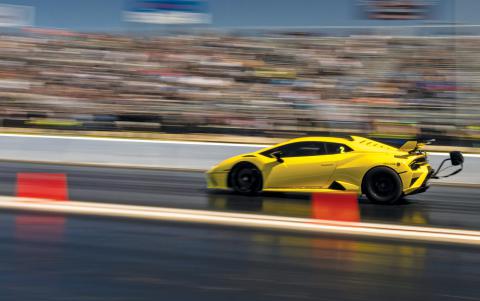
The V10 in Gintani’s Lamborghini Huracán EVO produced 630 hp in stock trim. Now twin turbocharged, the engine makes closer to 1,600 hp. It powered the Lamborghini to a blistering, 220-mph run in the standing half-mile last year.
Now packing a pair of turbochargers, the V10 is churning out upwards of 1,600 hp while retaining the stock bottom end, a combination that helped catapult the car to a record-setting 220-mph run in the standing half-mile last year. While Gintani offers factory ECU tuning for vehicles like the Huracán and other platforms, Marukian said that bigger builds tend to move over to standalone systems from companies like MoTeC and Syvecs. “That adds features like anti-lag, boost-by-gear, and full traction control adjustability.”
He also noted that due to the nature of half-mile racing, which sees these cars operating at wide-open throttle for a significantly longer period of time than in quarter-mile drag racing, the shop tends to focus less on big dyno numbers and more on overall efficiency. “It’s fairly easy to strap the car on the dyno and get that 1,600 wheel hp number on a glory pull. Heat soak is the biggest challenge here, so what’s important to us is making sure that we’re maintaining that 1,600 whp all the way through the half-mile.”
According to Alex Marukian of Gintani, late-model sports cars—Corvettes, Porsches, Audi R8s, and Lamborghini Huracáns—are popular entries at half-mile races. While some of the vehicles are essentially stock, others produce enough horsepower to reach speeds in excess of 200 mph.
To get that consistency, Gintani uses bigger turbos than are required to reach a specific horsepower number, and they are paired with oversized intercoolers to keep temperatures in check throughout the run. “When you go to these events, you’ll see people constantly going into the pits and swapping out ice packs,” Marukian explained. “We don’t use ice tanks. Instead, we run the freon from the air conditioning system through a water tank. When people are sitting there in the staging lanes with their cars shut off so the ice doesn’t melt, we’re enjoying the AC in our car, and the water going through the system is still freezing cold.”
Vengeance Racing
“When half-mile first started, it was purely street cars going out on abandoned runways to see how fast they could go, and the speeds were maybe 150–160 mph,” said Ron Mowen of Vengeance Racing, Cumming, Georgia. “But as the sport gained popularity, we started seeing people coming out with more purpose-built cars with aero and gearing that had been dialed in for half-mile. Now at pretty much any event you’ll see Corvettes, Mustangs, and Vipers with 2,000 or 3,000 hp, and cars cracking the 250-mph barrier. We’ve even seen a Pro Mod out there.”
But maximum horsepower and sheer velocity aren’t always the name of the game. With builds like Vengeance Racing’s own C5 Corvette Z06, the target has been a bit more specific. “We’ve been campaigning that car since about 2008,” Mowen explained. “It started by just putting a big naturally aspirated motor in it. We really didn’t know what to do with the car at that point, so we decided to take it out to a half-mile event, and we ended up winning the naturally aspirated class.” The build has evolved significantly in the years since, and the team is currently gunning for 200 mph in the half-mile without the aid of any power adders.
Ron Mowen describes the engine in the Vengeance Racing Corvette as “a miniature Pro Stock motor.” The 451-cubic-inch LS engine produces about 1,140 hp and has propelled the car to a 199.7-mph top speed—so far.
To get there, Vengeance Racing equipped the Z06 with a 451-cubic-inch LS engine that Mowen described as a “miniature Pro Stock motor.” The combination consists of a filled LSR block with aluminum rods, Mozez canted valve heads, and a valvetrain that was designed to keep the motor happy at 10,000 rpm. The result is an NA motor that dishes out 1,140 hp. With the help of a six-speed sequential gearbox, significant weight reduction, and other strategic upgrades, it has propelled the Z06 to 199.7 mph on three separate occasions.
Despite not quite hitting the goal yet, Mowen said this Z06 is by far the fastest naturally aspirated LS-powered car being used for this type of racing. “Moving to the sequential transmission allowed us to pick up some pretty substantial mph,” he added. “It has a sixth gear 1:1 instead of fourth gear being 1:1, so we’re able to keep the engine revs within 500 rpm of peak power at all times.”
Vengeance Racing has a specific goal for its C5 Corvette Z06: 200 mph in the half-mile without the use of power adders. “We’ve been campaigning that car since about 2008,” said Ron Mowen, and the build has evolved significantly since.
A single-piece front end makes maintenance easier while also removing some pounds, and a drag wing is installed out back to keep the rear stable at high speeds. “In terms of aero, ideally you want to block off as much of the nose as you can to prevent air from getting into the engine bay without a place to escape, because that will create a lot of drag on the car,” he said. “Some folks will also remove their mirrors and tape up hood and fender gaps with racer’s tape to make the car as slippery as possible. If you have an intercooler and you have to let some airflow in up front, you want to make sure there’s a way for that air to escape from the engine bay in order to minimize that drag.”
The C5 is also equipped with a full rollcage, racing seats, harnesses, and a fire suppression system. “Shift S3ctor is one of the more popular half-mile event organizers out there, and it does require safety equipment based on your speeds,” Mowen said. “At 150 mph, it’s pretty basic stuff—long sleeves, pants, and a Snell-approved helmet that’s in accordance with current regulations. When you get up to 180 mph, you’re in a fire suit, you must have a rollbar—similar to the things you’d expect to see in a 10-second car at an NHRA event. But, outside of that, we’ve taken additional steps on our own that go beyond what’s required. We were racing at another organizer’s event several years ago and a racer was killed, so we implemented our own safety standards at that point. Anyone who races under our umbrella with our support is required to have a harness bar with safety harnesses, a full fire suit, a Snell-approved helmet and a HANS device, and fire suppression at a minimum.”
English Racing
Considering the array of high-buck exotics that normally attend half-mile and roll race events, it can be tough for a team to really stand out in the crowd, but English Racing in Camas, Washington, manages to turn heads wherever it competes.
“When I first started campaigning this car, it was like, ‘What’s going to happen at 200 mph in an Acura Integra? Probably a lot of things,’” said Myles Kerr with a laugh. “So we started out slow. At the first half-mile event we went to with it, I think I only did 160 mph.”
Hitting 160 mph in a standing half-mile in a third-generation Integra is still pretty impressive in its own right, but these days the Acura regularly shames all manner of hardcore sports cars, having gone as fast as 216 mph at an event in 2021. “When we started moving in this direction with the build, it was a 700-hp street car. Sort of a weekend toy—there was no aero on it or anything like that.”
English Racing regularly turns heads at half-mile races with its Acura Integra. Boasting a 1,400-plus-hp turbocharged GSR engine and an AWD conversion, the Acura has been clocked as fast as 216 mph.
These days the Integra is dishing out in excess of 1,400 hp thanks to its four-cylinder, 1.9-liter GSR powerplant, which has been outfitted with Darton sleeves, BME rods and pistons, a ported head, cams and valvetrain upgrades from GSC Power Division, and a Precision Next Gen 7685 turbo that’s running roughly 70 pounds of boost.
Although it’s a front-wheel-drive platform, the Integra now puts power down to all four corners by way of a five-speed manual transmission out of a Honda CRV that has been upgraded with a billet bellhousing and a billet transfer case (along with other strengthening measures), as well as the rear differential from a 1990s Honda Civic wagon, a model that was available with factory four-wheel drive.
“Previously it would have required fabrication to make this all work,” Kerr added. “But a lot of people are starting to race these cars in the drag world, so manufacturers are starting to make parts for this conversion—it’s basically a kit now.” To hold all the power, the Integra is also outfitted with a two-piece carbon driveshaft from Driveshaft Shop, along with upgraded front and rear axles.
During this Integra’s early racing days, Myles Kerr of English Racing noticed a tendency for it to wander from side-to-side at 170 mph. Aerodynamic work, including a front splitter, flat belly pan, rear diffuser, and a rear wing, improved high-speed stability.
Making the power and putting it to the ground were only part of the equation, though. “Early on with half-mile stuff, I noticed that the car would start to wander from side-to-side across the track at about 170 mph,” Kerr said. “It was clear that we needed to do some aero work.” The team put together a front splitter and flat-bottomed the car before later adding a rear diffuser and a rear wing with a wicker bill to complete the package, upgrades that immediately improved high-speed stability. But without the benefit of wind tunnel testing, Kerr said that a lot of it came down to trial and error.
“I learned the hard way that I needed a hood vent, too,” he added. “When I first built the front splitter I had a big opening in the front bumper from the intercooler. The first pass was over 180 mph and it blew the splitter off. My fix at the time was cutting a hole in the hood to let air out of it. But, when air comes in it must find a way out!”
Carrying speeds far beyond what the factory ever expected for the platform with much more downforce, the suspension needed to be stiffened in order to prevent the car from squatting to the bump stops at speed, too. The car is currently equipped with a set of coilovers with 1,200-pound spring rates up front and 1,000-pound rates in the rear to firm things up at speed. Shock position sensors also allow the team to review data after a run to see how the system is reacting to adjustments.
Kerr noted that English Racing provides full track support for its customers, a service that includes the maintenance and data analysis required to eke every last ounce of performance out of their cars. “If you’re doing 210 or 220 mph in the half-mile, stuff is going to need to be looked at between rounds. At a certain point, these cars really need a team behind them rather than just an individual.”
Specializing in a growing grassroots category, this Northern California-based shop builds cars with a no-frills focus on speed while earning respect as active, knowledgeable, and always-helpful members of the Spec E46 community.
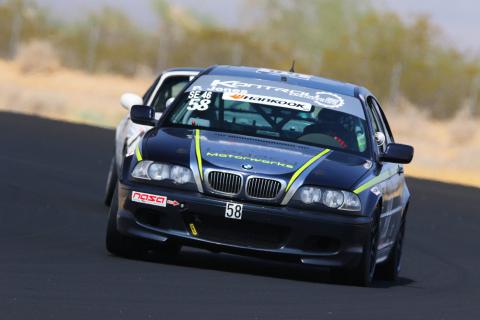
Spec E46 is a fast-growing class in grassroots road racing, and Legacy Motorworks of Elk Grove, California, has carved out a niche as a specialist builder. “We’re sought out for our E46s in particular,” reported Peter Jones, who co-owns Legacy with his wife Lauren. “We field quite a few of the Spec E46 cars in NASA’s NorCal and SoCal regions. We have also sold cars on the East Coast and in the Pacific Northwest, and they all have done well in their fields. Two of the top three cars at the 2022 Nationals were Legacy Motorworks E46s.” The 2022 NorCal and SoCal class champions were both Legacy customers, also.
Jones readily links the company’s success to that of the class, which in turn rides on the substantial bang-for-the-hard-earned-buck provided by the E46 platform. (For those not familiar with BMW insider-speak, E46 refers to the generation of “3-Series” sedans produced for model years 2001–2005, and to coupes for 2001–2006.) In Legacy’s first effort at the 25 Hours of Thunderhill, in 2021, Jones’ team finished third in class and eighth overall, bettered only by other E46s and Prototype-class cars.
Jones had just returned from another eighth overall (and fourth in class) at the 2022 event when we spoke in mid-December. “We beat ourselves with a couple of penalties,” he admitted. “But we still finished in front of a lot of teams that were more heavily funded, with much faster cars. They also had professional drivers and professional crews. They ran in classes that allowed them to take four tires per stop, and more fuel from faster fueling systems. But the E46 is easier on tires, brakes, and fuel; it is fast enough, without burning up parts.”
So it’s hardly surprising that the Spec E46 class “is absolutely growing. In three years, the SoCal field has expanded from three cars to 18–24, depending on the weekend. Once you get three cars on the track, other folks see that the racing is very tight, and yet very appealing from a cost standpoint.” Car counts in the NorCal region are similar and have been “solid for a while.”
Peter and Lauren Jones grew Legacy Motorworks “very organically, with trackside support, helping other racers improve their cars and excel,” Peter Jones said.
Legacy builds six to eight cars per year, and currently maintains six more. “We are fortunate that the class allows for so many garage builds,” Jones commented, “because at some point those folks realize that they can handle most, but not all of it. And that’s when they come to us.”
Jones believes that one of Legacy’s best business decisions was to “start very organically, with trackside support, helping other racers improve their cars and excel. I will give you my setup, I will sell you my car, because I’m happy to race you in a car that I was racing the weekend before. If you beat me, you beat me. I have no problem with that whatsoever. That’s what really put us on the map as legitimate builders. People appreciate the fact they can buy one of our cars and turn the same lap times as any member of our team.”
Jones has definitely gone to some lengths to assist his fellow racers. “Some folks had come down from the Pacific Northwest, which is about a 14-hour tow. We’d never run with them previously, but when they lost a motor on Friday, we sent them back to our shop, where our daughter met them and pointed them to a motor we had on a stand. We loaned them our engine hoist and we helped them put the motor in their car. They got back on the track, raced the whole weekend—and I believe they finished on-podium in front of us.”
Faster, Not Fancier
Like many others in this industry, Jones “grew up around motorsports,” racing shifter karts “for quite a few years” before he “got into motorcycles.” He was road racing a Honda RC51 and an Aprilia RSV4 when he married Lauren Buffington, whose father and brother, Phil Sr. and Phil Jr., raced four-wheeled BMWs. “My father-in-law pushed me to get off the motorcycle, and to get into something with a cage. It took a while for me to explore that option, but after a pretty good off on the motorcycle, I decided to explore it a little further.”
The Buffingtons campaigned an E36 (1992–1998), but Jones decided that “there were some interesting aspects to the E46. The availability of parts, with newer and better technology” made it “a better jumping-off point.”
More fundamentally, perhaps, Jones was intrigued by the Spec concept, “which allows an individual to build out of their garage—that included myself, initially—to a spec level with the exact same components as every other competitor. That really turns it into a driver-on-driver race.” Build quality might vary, and could make a car more or less reliable, “or simply prettier to look at. But those things don’t make you faster.”
“We field quite a few of the Spec E46 cars in NASA’s NorCal and SoCal regions,” Peter Jones said, “and all have done well in their fields.” The 2022 NorCal and SoCal class champions were both Legacy customers.
Building strictly to go faster, and eschewing what only looks faster, became Legacy’s mantra. “Our builds are not necessarily ‘no expense spared,’” Jones noted, “but they are ‘no stone unturned.’ That’s what sets us apart. We strip the cars down to the bare tub and build them back up very efficiently, spending money on things that make them faster, and not all the bells and whistles that might make you feel like you are in a Formula 1 car, but that aren’t making your car any faster than the one next to you. I look at other cars in the paddock, and they have buttons on the steering wheel to start the car, and buttons to turn it off. We’ve also built cars with buttons on the steering wheel, and with cool-looking data-acquisition dashes, but we try not to spend money frivolously.” Legacy customers know exactly what they are buying. “We’ve always been honest and open about our product,” Jones added.
The Legacy
Significantly, Jones listed the “founding members” of Legacy Motorworks as Lauren and himself; his father, Tom Jones; and Lauren’s brother Phil Buffington; but he could not point to a definitive founding date. “I just gradually allowed my passion to turn into a business. It started out trackside, helping fellow racers. And because I showed up prepared and was taking care of my own cars and performing very well, people started asking me for help and assistance and direction. From there I started selling my personal cars, and then I had commissioned builds. Before I knew it, something that was just happening out of my garage was needing its own facility.”
Jones allowed that his “garage” was on 2 1/2 acres, where he parked “15 donor cars, six trailers, several customer cars, and three or four of our own race cars.” But as annual production increased from two cars to five, Peter and Lauren shuttered their general contracting business to focus solely on Legacy Motorworks.
“I had to make a decision about how I was going to use my time,” Jones recalled. “I couldn’t do both things.” Just last spring Legacy moved into an industrial complex, where it now occupies a 4,500-square-foot warehouse, an additional 1,500 square feet of office space, and 12,000 square feet of open yard.
Legacy Motorworks’ strategy in building a Spec E46 race car begins with stripping the car to the bare tub and building it back up “very efficiently, spending money on things that make them faster,” Peter Jones said.
Even the name of the company has evolved: “Initially we called ourselves Legacy Racing, and that kind of morphed into Legacy Motorworks.” But the name has always recognized the influence, assistance, and participation of family—“a family legacy of motorsport.”
The Engine Enterprise
In addition to building new race cars, Legacy repairs wrecks and offers “motor services” for the BMW M54B30 inline-six, including reconditioned heads, rebuilt bottom ends, and re-tapping the aluminum block with steel threads to better secure the head bolts. “We started doing engine work for our personal builds,” Jones recalled, “but now we see cars that we’ve never touched except for the engine. One of the cars that beat us this weekend had one of our engines; we had also built them a backup engine prior to the race.”
Jones estimated that “probably 30% of our business is straight engine work,” which not only supports Legacy’s car builds but also helps keep the shop busy year-round. “The off-season is a time for preparing and having motors built, and then during the season people crash and need cars built. So throughout the year it’s a little bit of this and a little bit of that.”
Jones found “another way to augment our business” just last year, when “we ventured into the PCA world, where we have friends,” and built their first two Spec Boxsters. “It just so happens that they race on different weekends, so the Boxsters also help fill out our year and keep our employees busy.”
Peter Jones reported that nearly a third of Legacy Motorworks’ business is “straight engine work.” That not only supports Legacy’s car builds, it also helps keep the shop busy year-round.
Legacy employs three people full time, plus “part-time folks for trackside support and weekend work,” he said. All are carefully chosen. “My wife and I have been in business for a very long time”—more than 25 years as general contractors—“so we are very particular about who we take on. We get to know an individual before we offer them an opportunity.” Most “come from the racing community,” and Jones understands that they may not stay. “We’ve found that there is a pathway in motorsport, where we may not be their final stop. They may find work with a bigger team that offers them more opportunities—and that’s just fine with us.”
The Champions
As we mentioned at the outset, the 2022 NASA NorCal and SoCal Spec E46 class champions are both Legacy customers.
Jones described SoCal champ Lucas Weisenberg of Orange, California, as “an up-and-coming, talented young driver.”
“My dad and I have always been into cars,” said Weisenberg, who started running time trials in his Porsche Cayman less than three years ago. He earned his NASA license in February 2021 and rented an E46 sedan for an event at Buttonwillow Raceway Park. “It was just an awesome platform,” Weisenberg recalled, “so we bought the car. It was a tired-out six-year-old chassis with a junkyard motor, but in our first race at Willow Springs I got the pole.” That’s also where Weisenberg met Jones, who agreed to garage and transport the car, in addition to providing trackside support.
“We ran half a season with SoCal,” Weisenberg continued, “and some NorCal events, too,” before deciding that “we needed better equipment. We had seen the work that Peter was doing, so we bought a Legacy car. And we’ve been winning a lot ever since. The car is really sorted. It’s super-stable, with a super-stiff chassis. It has a super-clean interior with a really nice cage. I feel safe in it; I trust it. And it’s fast”—on average, about a second quicker around most tracks than the car it replaced.
Weisenberg is equally pleased with Legacy’s “great support at the track. Any time that we have questions, whether about mechanics, electronics, or setup, Peter always gives great advice. He always knows exactly what the issue is. He has given us a better understanding of the platform, and that allowed us to do what we did [last] year.”
NorCal Champ Casey Mashore of Brentwood, in California’s East Bay region, started racing in 2015, “as soon as I got my driver’s license.” Initially he ran LeMons enduros in an E34 built by his father. “But we wanted something more competitive, more professional.” So they moved up to the Lucky Dog Racing League, installed an E36 M3 motor, “and started getting competitive.”
At Willow Springs, the Mashores struck up a conversation with a Spec E46 driver and decided that class should be their next step up the ladder. Mashore Senior built a car in 2020, completing it in time for a weekend of NASA sprints at Thunderhill—where by sheer random chance the Mashores parked next to Jones. “We didn’t know who he was—or how anything worked. But Pete answered all of my questions. He explained the rules of the series. And he said that if I needed any help, he was right there.”
The Legacy Motorworks team finished eighth overall and fourth in class at the 2022 25 Hours of Thunderhill endurance race. “We finished in front of a lot of teams that were more heavily funded, with much faster cars,” Peter Jones said, “but the E46 is easier on tires, brakes, and fuel; it’s fast enough, without burning up parts.”
In 2021, Jones invited Mashore to co-drive Legacy’s inaugural entry in the 25 Hours of Thunderhill, along with Phil Buffington Jr. and Gary Baker. Mashore was impressed with Jones’ and Buffington’s mastery of endurance racing strategy. “They are very analytical. They know how long the tires were going to last, and how much fuel they are going to use.”
Mashore recalled an earlier incident at Willow Springs, when he had broken four wheel studs, and Jones “was quick to help me drill them out, and torch them and put new studs in. Another time I’d bent a wheel and needed an alignment, and Pete was able to string up the car and square it up right at the track, which was a huge deal.
“He’s a great guy who wants to help everybody,” Mashore continued. “Countless times he’s been under a car, and somebody comes up and asks, ‘Can you help me with this?’ And soon he’s helping seven people at one time.”
The way Jones sees it, helping his fellow racers is the best possible promotion. “We have a small social media presence,” he noted, and he doesn’t see the need for more traditional advertising. “We are trackside. We are visible. We’re racing alongside customers and potential customers. We’re helping people in the paddock. And we have a very loyal following. The folks who know us see us as leaders in the Spec E46 community. So when they know somebody is looking to get into road racing, they send them our way.
“And whether we end up doing business together or not, we certainly point them in the right direction,” Jones concluded.
As more and more battery-powered vehicles enter the automotive market, racers are starting to figure out where the bourgeoning technology can shine in road racing disciplines. Now road courses and sanctioning bodies are responding in turn.
With the auto industry’s EV ramp-up well underway, increasing numbers of racers and enthusiasts are bringing battery-powered vehicles to road courses across the country. Although we probably won’t see car counts high enough to warrant initiatives like a production-based EV spec series for some time, the rising presence of this new technology at high-performance driving events (HPDEs) and other track events presents an opportunity for organizers, and many are responding in-turn.
“Attendance and demand have definitely grown over the past few years,” said Steven Sewell of Lime Rock Park, Lakeville, Connecticut. “There is a clear need to accommodate both the racers and the consumers who’re embracing BEVs (battery electric vehicles), and our goal is just that. We want to stay current.”
But as this gradual transition unfolds, tracks and sanctioning bodies are tasked with finding a way to support this new tech in a meaningful way that’s also pragmatic and financially viable. While the fluidity of the situation makes this challenging, a general strategy is beginning to take shape.
Buttonwillow Raceway Park
Les Phillips of Buttonwillow Raceway Park (BRP) in Buttonwillow, California, told us that he’s seen a perceptible increase in EV entries at Buttonwillow events over the past few years. “Right now, it’s less on the racing side and more focused on track days. But there are some regulars who’re starting to pop up, and they tend to bring a following with them.”
Considering the fact that the vast majority of performance-tuned production EVs have been introduced over the past five years or so, it makes sense that most drivers would gravitate toward high-performance driving events that cater to street cars, but EVs are finding niches in competition as well. “We’ve seen a really fast Tesla Model S Plaid at time attack events here—I believe it’s the same car that ran at Pikes Peak. We’re starting to see a few of them at time trial competitions,” Phillips said.
As part of a facility expansion program, Buttonwillow Raceway Park partnered with Tesla to install 16 Supercharger stations at the track. Les Phillips has noted an uptick in EV entries—primarily for track day events—so the stations will serve them as well as the EVs that transport participants and spectators to and from the track.
Then there are the EVs that are being used to transport racers and spectators to and from the track, as well as the ones that are simply passing by while heading through central California. To support these vehicles, Buttonwillow partnered with Tesla to install 16 Supercharger stations at the track.
“Things have been pretty busy here; we ran 335 days last year,” said Phillips. “To meet the demand, we’re building a second, 2.5-mile road course at the facility with a 9,000-square-foot tower, garages, and everything else that comes with that. We’re putting in 32 more RV spaces as well. And as part of this expansion process, we also added those Supercharger stations.”
Phillips said that Tesla covered the majority of the costs associated with the installation of the Supercharger stations, so that kept the track’s financial burden to a minimum. The caveat is that Tesla’s Supercharger network is exclusive to the automaker’s vehicles, which means owners of EVs made by other brands cannot use the system. While the RV park can provide charging capability to any EV owner, the rate is limited to the speeds that a traditional 120-volt outlet can deliver, so those folks would need to be posted up at the outlet for significant amounts of time in order to add a meaningful amount of charge to their vehicles. When asked about whether Buttonwillow plans to install universal level 2 EV chargers in the future, Phillips said it largely boils down to the potential for return on investment.
“We’d like to do that, but we’ll have to see what the cost looks like when we reach a point where it looks like that is needed,” Phillips responded. “At the moment we have to react to the demand that we’re seeing.”
Virginia International Raceway
“It has become very common to see EVs show up for HPDE weekends,” said Kerrigan Smith of Virginia International Raceway, Alton, Virginia. “They’re showing up often enough that awareness is building in general.”
Smith said that part of that awareness has come from a concerted push by OEMs like Porsche, who partnered with the facility to install a pair of 19.2 kW level 2 chargers at the track. “Porsche wants to make sure its customers are taken care of, and that’s especially important for a performance brand to have that capability at various race tracks. We worked with them to provide that infrastructure here.”
Smith said that series like Formula E and IMSA are currently leading the way in terms of best practices when it comes to EV training and overall safety. “There’s a lot of conversation happening right now regarding what the race tracks need to do to build our infrastructure around supporting this technology,” Smith explained. “Our first responders go through training every year at VIR, and we’ve added electric vehicle response into that program. But the industry has also gotten ahead of itself in some ways, so we’re often looking to Formula E and IMSA’s [hybrid-powered] GTP-class racing for insight in this realm.”
Beyond charging capability and safety considerations, Smith said that VIR is upgrading other elements of the facility in anticipation of EV growth in the marketplace. “We’re currently assessing what our long-term needs are as part of the expansion that we’re currently doing. Updating our fiber lines and improving the Wi-Fi infrastructure are part of that master plan. We want to accommodate the person who is waiting—either for their run group to be called, or for their vehicle to charge. And we expect there to be a greater need for that as time goes on,” Smith added.
Lime Rock Park
Lime Rock Park installed its first EV chargers in 2018 with direct OEM support. While EV participation at HPDE and other track day-style events is rising, Sewell pointed out that the strongest demand is currently coming from the OEMs themselves. “That mainly stems from things like dealer days and media launches, but it’s also about supporting their customers. When we installed those pedestals in 2018, one of the requests from the OEMs was that they needed to be available to the public. For them, it’s as much about expanding their charging network as it is about specifically supporting cars that are at the track.”
Steven Sewell noted that demand for EV infrastructure at Lime Rock Park has come largely from automakers: “When we installed those pedestals in 2018, one of [the OEMs’] requests was that they needed to be available to the public. For them, it’s as much about expanding their charging network as it is about specifically supporting cars that are at the track.”
Lime Rock installed the charging stations between the facility’s autocross course and the main track. “That was a conscious decision,” said Sewell. “We wanted to make sure access was convenient for the general consumer during our major spectator events while also being easy for the folks who’re using their EVs on our race courses.”
A second group of chargers was installed in 2021 with manufacturer support as well. Sewell said that the current focus is accommodating consumers, and that largely comes from the needs of OEMs. “EVs are high on the radars of many tracks right now, but everyone’s approaching it a little bit differently. Wholesale electric vehicle racing would be a significant infrastructure investment for a facility, and that’s still a bit of a moving target. For Lime Rock, the OEM presence is a big factor right now. If we can accommodate those programs here—particularly for vehicle launches—it becomes an important part of our business model.”
National Auto Sport Association
Although the vast majority of EVs are getting track time at time attack events and HPDEs, Brett Becker of National Auto Sport Association (NASA) in Las Vegas, Nevada, noted that the technology is now making its way into general wheel-to-wheel competition. “A few months ago, a company called Scalar Performance reached out to NASA about developing an electric race car, and we’ve been working with them to find a home for it within our Super Touring category,” he said.
The vast majority of EVs at NASA events are in time attack events and HPDEs, but NASA has seen enough interest from EV racers to justify the creation of a bespoke TTEV class in its Time Trials category. “Right now, it’s still an emerging technology,” said Brett Becker, “and it’s emerging as quickly as the technology and the economics will allow.”
Based on the Toyota GR86, Scalar’s car offers roughly 330 horsepower and 345 pound-feet of torque from a bespoke electric powertrain that was designed for motorsports use. With a curb weight of 3,040 pounds and the ability to run at race pace for 45 minutes at a time, the EV should be able to give the Corvettes and 911s in the ST classes a serious run for their money.
NASA has also seen enough interest from EV racers to justify the creation of a bespoke class in its Time Trials category with TTEV. Becker expects interest stemming from this burgeoning automotive segment to maintain its rising trajectory in the coming years, and that tracks will adapt based on the perceived demand.
“The market is beginning to flood with electric options, and with race tracks being the businesses that they are, I think you are going to see them offering more places to plug in EVs in much the same way that you would at an airport or a shopping center,” Becker explained. “Many of these tracks have RV parks, so they have a lot of the infrastructure in the ground already. If they charge for the electricity, that’s another potential revenue stream for them. At this point, the cars are starting to creep in, and I expect that to continue. But right now, it’s still an emerging technology, and it’s emerging as quickly as the technology and the economics will allow.”
 MEMBERSHIP LOGIN