Drag vs. Downforce

Submitted by johnc on Thu, 02/16/2023 - 09:29
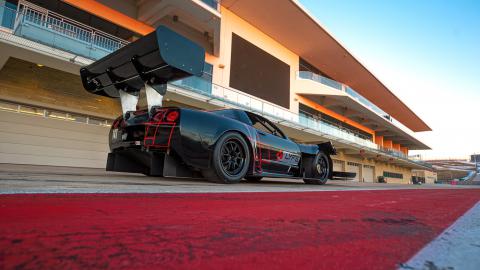
image 1


As in so many motorsports, aerodynamic trends are trickling down from the highest professional tiers to the grassroots, but none more so than in road racing.

“Everybody knows the reason Formula 1 cars are so fast is because of their aerodynamics,” observed Paul Lucas of Verus Engineering, Indianapolis, Indiana. “Aerodynamics is a huge part of those teams. It’s the foundation of the cars. If you don’t get the aerodynamics right, you’re not going to be a top-level car that year.”

Road race drivers—and by extension racers in time attack, at Pikes Peak, and in other road-course events—tend to be Formula 1 fans, Lucas said, which exposes them to wind-cheating principles they can explore and modify for their own cars.

“A lot of times, they know the aero makes them faster, but they don’t know why, and they don’t know what kind of aero,” said Lucas. “That’s what drives them to us to get a better understanding of what they need and how to go faster with it.”

“The most challenging part of aerodynamics is not building the aero, but getting the car to work around it,” said Cole Powelson of LYFE Motorsport, Salt Lake City, Utah. “You have your car on aero and your car off aero. At low speeds, say below 60 mph, you have a pretty generic car, but beyond that your car is changing exponentially as the speeds increase.”

When the LYFE Motorsport crew sorted out the aero on its time attack Nissan GT-R, “it was worth four seconds around a standard 2–2.5-mile road course circuit. We bolted on four seconds with the same power level, and that was pretty true to every circuit we went to after that.”

Given the potential for lap time improvements, it’s no wonder road racers at every level are seeking the ideal aerodynamic profile for their cars.


Trends in Development

Getting to that ideal profile seems to be going in two directions. One takes advantage of increases in computing power.

“We do a lot of CFD [computational fluid dynamics] work which, when we started, was pretty rare in our industry,” Lucas said. “I wouldn’t say it’s rare now. There are quite a few companies that offer services similar to what we do. A lot of that comes from the fact that computers have gotten significantly more powerful. A computer that an average person can buy today can run a full car analysis in CFD. Ten to 15 years ago that wasn’t the case. You would need servers and things like that. We use servers so we can turn around things quicker, but you can get it done with your average gaming PC today. That’s a big driving factor of moving that kind of technology more into the mainstream.”

“In an age where information is more readily available, we’re starting to see more trickle down from the motorsports side,” said Kelvin Yong of Evasive Motorsports, Cerritos, California. “3D printing and accessibility to CAD and modeling type software is much easier now. You see it more in the DIY track day side. People are starting to experiment more with things they might see on an LMP or GT3 car, trying to emulate that and see if it works.”

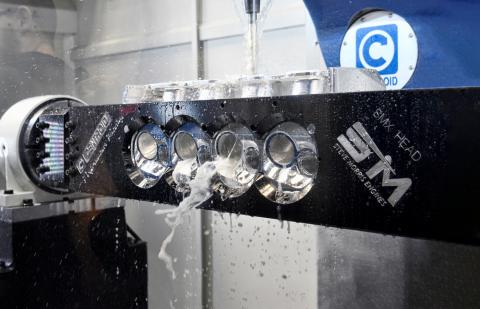
image 2
At Caliber Customs, building a custom aerodynamics package begins “by figuring out the rake of car,” said Matthew Lambrecht. “We want to have a certain amount of rake front to rear, as that helps with creating the downforce.”

“The state-of-the-art processes that we incorporate in our R&D, manufacturing, and prototyping processes—we have a three-axis and five-axis CNC—allow us to create different types of molds or mill out different types of molds to make more complex shapes possible, rather than just a generic airfoil shape or generic splitter shape,” explained Caleb Sok of Sayber Design, South El Monte, California. “We can get pretty clever with the five-axis, and we do basic CFD on the CAD program.”

At the “higher, higher end” of the competition hierarchy, machine learning will become more commonplace, Lucas said. “CFD creates a lot of data, and machine learning is great at taking a lot of data and making sense of it. It’s a lot more difficult for humans to do that. We’re really good at coming up with creative solutions, but looking at large chunks of data and coming to a conclusion is much more difficult for the human. Machine learning takes that on, simplifies it, and figures out those kinds of things better. I’m not sure when that will come, if that’s five, 10, 15 years down the road, but machine learning will be there.”

The second approach to aerodynamic design is less computer-centric. “Nothing beats trying it on the track,” Sok said. “When we were testing different airfoils on my Supra, we took all the airfoils to Buttonwillow [Raceway Park], set up our front splitter and our rear wing, went out and did two hot laps, came in, switched the airfoil, and did two more laps to see what the times were and how the car was doing. This way I can confidently tell our customers, ‘This is what I experienced, and this is what I would recommend for what you’re trying to do.’ You can do all the computer testing that you want, but especially if the customer has the same car, they feel like they can trust me.”

“We don’t really use CFD,” said Matthew Lambrecht of Caliber Customs, Madera, California. “We do have our own CNC table, and we design 2D parts on that, like uprights for a wing or even canards. We’re not experts when you compare us to higher levels of racing, but we understand the basic principles of how these parts are supposed to work, how the canards are supposed to create turbulence along the side of the car in order to prevent spill over to the underbelly, for example. We visualize how it should work, put them on there, hope they work, and go out and test them. If it works, awesome. If not, we start making adjustments.”


Bestsellers

At Verus Engineering, which sells both fully custom and off-the-shelf aero pieces, “the biggest thing for us is rear wings,” said Lucas. “The bang-for-the-buck is really there. Some other products may be fairly reasonably priced, but the average person might not feel the benefit immediately. A rear wing is a huge one that you immediately feel. It can immediately make you faster on track. Some racers, especially amateurs, like a little bit more rear bias on the aero balance, and the rear wing gives them that. A lot of people really like the way they look, so that’s an added benefit.”

Evasive Motorsports, the US distributor for Japan’s Voltex aero components, sells “a fair number of wide-body kits, some full aero kits for the Honda S2000 and Toyota FRS, but the wing is still the top seller,” said Yong. In his experience, a lot of customers will “throw a wing on and then come back to us and say, ‘We need better balance.’ Aerodynamic balance is more than just the wing, no matter what car you’re driving. A lot of people will start with a wing and end up asking for more: a front splitter, canards. If they decide they want to go really deep, they’ll go for the whole package of fenders, underbody, hood, things like that.”

(Widebody fenders are more about tire fitment than aerodynamics, Yong reported. “The S2000 is really small, so fitting a 280- or 300-width tire is going to be really hard” without them.)

Sayber Design, which concentrates on Toyota GR Supra and GR86 models, offers “a general aero package—front splitter, rear wing—mainly for club level, time attack, track days, local challenges,” said Sok. “That’s what clients usually look for when they start seriously tracking and want more downforce.”

At last year’s SEMA Show, Sayber Design introduced a “full aero widebody kit for the GR86,” Sok said. “Because we knew the GR86 is a lightweight car with not too much power from the factory, we developed an entirely new, ultra-low drag package for it. We knew the client was taking it to Global Time Attack, and we didn’t want to add a giant wing that had a lot of drag to slow the car down. So we developed a new, ultra-low-drag airfoil profile, paired with a splitter to balance out the rearend.”

“You have to do the whole package to optimize the whole aero,” Lambrecht said. “If you add just the rear wing, you’re going to get some downforce, but you’re only going to get it in the rear, and you’re going to create lift in the front from the teeter-totter factor.”

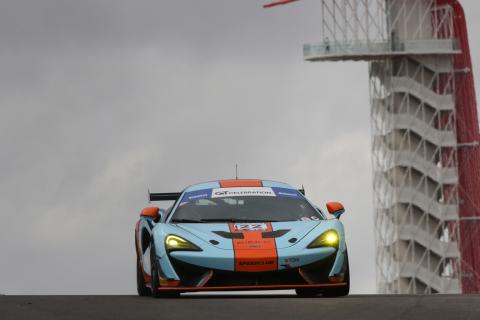
image 3
“Our bread and butter is making stuff for the average person who tracks their car on the weekends,” said Paul Lucas of Verus Engineering, “but we also do custom applications.” Verus engineered the custom aerodynamic components for Hoonigan Racing’s Hoonipigasus Porsche.

Lambrecht recalled a twin-turbo Corvette Caliber Customs built for a customer, with “nothing extravagant as far as aero goes, just a basic AJ Hartman front splitter with our underbelly and an AJ Hartman rear diffuser and wing. We were able to maintain low speed on the Riverside turn at Buttonwillow of 118 mph. That is not a super light car—it’s 3,100 pounds—and I’ve never seen anyone maintain that as a low speed around that turn. It’s not necessarily about having massive aero, it’s more about getting something that’s all going to work together.”

image 4
Sayber Design recently debuted a full widebody kit for Toyota’s GR86 that Caleb Sok describes as an “entirely new, ultra-low drag package” for the lightweight car. “We didn’t want to add a giant wing that had a lot of drag to slow the car down,” he said.

Where you will see “huge aero” is at Pikes Peak, Lambrecht said. For racing there, the aerodynamics “are designed more for the top of the hill at 14,000 feet. The air is so much thinner up there, you need that big aero. Normal size aero just isn’t going to get the job done at that elevation. At the bottom of the hill they probably have too much drag to be optimal. But it’s a balancing act, drag versus downforce. The car would probably be faster with less downforce, but they have to compromise so it still has something going on at the top of the hill.”


Splitter Evolution

“Minus the rear wing, 80% of the total downforce of the car is dictated by what happens at the nose,” Powelson said. “Air coming across the front of the car is clean air, it’s predictable. You now have just raw air you’re shoving through the car to perform different functions and go different places. So controlling the clean air at the front—so critical to the total downforce of the car and the aero efficiency—is a big priority for us.”

One of the “coolest innovations” he’s seen in the past few years “is called an infinity wing. It takes a traditional front splitter with end plates on it and makes the splitter a dual element, to where you have a wing element above your splitter with an air gap underneath. That can achieve similar downforce levels with less drag.”

“In motorsports and the racing team space, everyone knows you want a splitter with a diffuser to optimize front-end downforce,” explained Sok. “In the time attack space, I’ve seen a lot of customers looking for splitters with diffusers incorporated into them. And I’m seeing more and more regular, club-level customers looking for those diffusers.”

But, he added, it can be challenging to incorporate a splitter with a diffuser into a factory car. “A lot of these cars are turbocharged, which means they have a lot of coolers up front. Those extra coolers tend to block any free real estate we might have to incorporate a diffuser.”

Several years ago, Lambrecht was experimenting with the design of the front splitter/diffuser on his 2004 Cobra. “I changed the design to where the diffuser had a curvature to it as opposed to having just a flat angle to further minimize the [air] delamination. That’s when I was running a street class in Global Time Attack with a 200-treadwear, 285-width tire. I maxed it out with the splitter, underbelly, diffuser, and not a wing but just a rear spoiler. At the next event I ended up going three seconds faster. How much of that was aero related I couldn’t tell you for sure, but it definitely went faster after doing that adjustment to the car.”

image 5
After a wreck at the Pikes Peak International Hill Climb caused by a broken splitter, LYFE Motorsport now builds the splitter for its GT-R from carbon fiber with steel tubing inside of it. “It’s nice to have it light weight, but I am erring on the side of strength,” said Cole Powelson.

In addition to getting the splitter design right, another challenge is properly making and mounting it. “Some of these cars can do 180 mph, so it’s not uncommon to have a front splitter making 2,000 pounds of downforce at speed,” said Lucas. “You’re talking about basically hanging half a car off the end of a splitter, so you need to be able to make that strong, and the mounting provision is very, very critical.”

Common materials for building a front splitter range from plywood at the DIY end to fiberglass, Alumalite, and carbon fiber. After a wreck Powelson had at Pikes Peak caused by a broken splitter, LYFE Motorsport now builds the GT-R’s splitter from carbon fiber with steel tubing inside of it. “I was stuck between two things: trying to make it light as possible, but we’re also going to ram this 3,500-pound car into the ground repeatedly for a week on this hill climb. It’s nice to have it light weight, but I am erring on the side of strength.”


The Belly of the Beast

Underbelly pans are a “big thing” for Caliber Customs, Lambrecht said. “We build full flat floors so we can optimize the operation of diffusers and splitters. When we get everything to work together, getting the diffuser to feed up toward the rear wing, to evacuate the air underneath the car, that really does tie everything together.”

All of the flat floors Caliber Customs builds are “custom designed from scratch,” Lambrecht explained. “We start off by figuring out the rake of car. We want to have a certain amount of rake front to rear, as that helps with creating the downforce. Once we do that, we have to take into account control arms, transaxles, differentials. We ideally want to hit a certain rake to create the maximum downforce without having delamination of the airflow, but sometimes we can’t hit that without having obstructions, like a transaxle or a differential. Then you have to take into account whether the trade-off is worth it. Do we want to hit that optimum rake angle, or are we going to lower it down a little bit to prevent turbulence and delamination?”

Like Lambrecht, Powelson sees ride height and rake as among “the biggest changes we can make aerodynamically. You can tweak the little wing elements, remove little elements here and there, but ride height and rake dramatically change the performance of the car on a well-done system. If you want to change the center of pressure, if you want to change total downforce and total drag, there’s way more adjustment in ride height and rake than there is in just trimming out a single wing element on the rear wing.”

image 6
In November 2022, Evasive Motorsports set the Honda S2000 record at Buttonwillow Raceway Park using a Voltex time attack aero package. “That kit is made specifically for racing only,” said Tony Kwan. “You can’t drive it on the street because it produces so much downforce.”

A flat floor “can add a lot of complications,” Lambrecht admitted. “In time attack it isn’t as bad because we’re trying to do just one lap, but we do this setup on endurance cars as well, and it’s a matter of figuring out heat management. We can’t have any stagnant air around hot parts, because it will just expand until it starts damaging stuff.” One solution he has found is adding NACA ducts to the floor “to keep the airflow moving.”


Aerodynamics and Engine Power

The general trend to more power in race cars is “good and bad” in its effect on aerodynamics, Yong said. “When you have a ton of power you can get a little bit lazy. Drag isn’t as big of a deal; you can power through it. With 1,200 horsepower drag doesn’t matter. The trick is to get the right amount of power and downforce, rather than just sledgehammering your way to the podium with 2,000 horsepower and 3,000 pounds of downforce. The challenge is getting a very efficient package, where power and grip are all in the right window.”

As an example of that, in November 2022, Evasive Motorsports set the Honda S2000 record at Buttonwillow (a 1:41.20 lap with Dai Yoshihara at the wheel) using a Voltex time attack aero package. “That kit is made specifically for racing only,” said Evasive’s Tony Kwan. “You can’t drive it on the street because it produces so much downforce. It has a big wing, big splitter, and a complete flat underbelly.” Initial tests with the kit were done when the S2000 was producing “around 400” horsepower, Kwan said, “and it was almost too much downforce for the car.” A new turbocharger setup raised power to 640, and now “the power is actually utilizing the downforce, working in tandem. It’s more balanced now and it’s working great.”

Higher power levels require additional cooling, and the right aero can help there, too. “Aerodynamics plays a big part in heat management, not just downforce,” Lambrecht said. At Caliber Customs, “we often box in radiators so any air that enters the grille has to go through the radiator. We also make extractor vents. As soon as the engine bay becomes a high-pressure zone, it doesn’t matter how big your grille is—if you can’t extract the air from the engine bay, it’s not going to let any more air in. Adding something simple like a Gurney flap at the leading edge of the vent has a profound effect on the amount of air you’re able to pass through the radiator, intercooler, oil cooler, and parts like that.”


A Matter of Balance

“Aerodynamic balance is key to making people go faster,” said Lucas. “If you get the aerodynamic balance off, it either makes the car push, or you can have a driver who is very uncomfortable in the car because the back end wants to step out. You need to be able to level the kit out, so it’s balanced for who is going to drive the car. That’s where a lot of our custom work will come in—fine-tuning the higher downforce kit specifically for that end user.”

image 7
“Aerodynamics plays a big part in heat management, not just downforce,” Matthew Lambrecht said. Caliber Customs often builds custom boxes around the radiator “so any air that enters the grille has to go through the radiator.”

“My biggest piece of advice for people who want to do serious aerodynamic development is get with an engineer or aerodynamicist and have something professionally designed,” said Powelson. “It is the best money we’ve spent on our program. Do it once for your car and your configuration, and it’s the gift that keeps on giving. But it has to be specific to your car, your tire, your track width. Everything is so critical for the entire aero package to work together.”

SOURCES

Caliber Customs
calibercustoms.com

Evasive Motorsports
evasivemotorsports.com

LYFE Motorsport
lyfemotorsport.com

Sayber Design
sayberdesign.com

Verus Engineering
verus-engineering.com

March 2023
By
Drew Hardin

WISSOTA Names New Director Of Operations, Executive Assistant

Submitted by laurap on Wed, 02/15/2023 - 18:46
WISSOTA logo


St. Cloud, Minnesota-based WISSOTA Promoters Association has announced longtime employee Callie Sullivan has been named director of operations. 

Sullivan, from Dassel, Minnesota, has been employed with WISSOTA since 2001 and was the organization’s first full-time employee in 2007 when she was named office administrator and points and licensing director—roles she’s held since the recent appointment. 

She began as Midwest Modified point director before later assuming the role of Sprint Car and Late Model point director as well.

“Callie has a wealth of knowledge in every aspect of the operations at WISSOTA and was long overdue for this promotion,” said WISSOTA Executive Director Rod Lindquist. 

In addition, Kayla Siercks has been named executive assistant. Her primary focus will be in partner/sponsor follow-through, support, and relations. She will also be instrumental in the Structural Buildings WISSOTA Challenge Series,  the WISSOTA 100, and the 2023 EXPO, which will be held during the Annual Meetings and National Awards Banquet in November.

For more information, visit wissota.org.

February 2023

BorgWarner Announces New Aftermarket Segment Spin-Off, CEO And CFO

Submitted by laurap on Wed, 02/15/2023 - 18:30
Brady Ericson, Chris Gropp, and BorgWarner logo


BorgWarner—the American automotive supplier based in Auburn Hills, Michigan—has announced its spin-off fuel system and aftermarket segment will be a separate, publicly traded company named “PHINIA Inc.” 

PHINIA is designed to provide fuel systems, starters, alternators, and aftermarket distribution components among commercial vehicle, light vehicle, and aftermarket end markets. The proposed spin-off is expected to be completed in late 2023, subject to customary conditions.

In addition, Brady Ericson will serve as president and chief executive officer (CEO), while Chris Gropp will serve as executive vice president and chief financial officer (CFO).

“Brady and Chris are well-rounded and respected leaders at BorgWarner and in the industry. They each possess a breadth of knowledge and experience that will be required to guide PHINIA as an independent company and pursue its continued success,” said Frédéric B. Lissalde, president and CEO of BorgWarner. 

Ericson began his career at BorgWarner in 2000 and has served as VP of BorgWarner and president and general manager of BorgWarner Fuel Systems and Aftermarket since March 2022.

Gropp began her career at BorgWarner in 2001, serving most recently as VP of Finance for Fuel Systems and Aftermarket since October 2020. 

For more information, visit borgwarner.com.

February 2023

Skilled Workforce

Submitted by jeffreyc on Wed, 02/15/2023 - 16:15


More engine shops and aftermarket manufacturers are embracing new CNC machines and their cost-saving, production-boosting features.

The speed and precision that CNC machines offer are not lost on the speed community. An early pioneer was Robert Yates, who installed a CNC machine in a secret Virginia location in the early 1990s to develop the famed C3 head for Ford’s NASCAR teams. CNC machines quickly became the winning advantage for teams and parts manufacturers who needed consistency and flexibility in their operations. 

The holdouts have always had their reasons. Cost, of course, is a valid point, but crunching the numbers today is becoming more favorable due to labor issues. Another well-sounded excuse is fear of computer programing. Yet, that is another myth quickly fading.

Consider the call that Anthony Usher of MEC CNC in San Clemente, California, received from a Pennsylvania automotive machine shop with strong ties to a strict religious order. The employees had no cell phones or computer experience and specifically requested a manual machine.

“We delivered a CNC machine but didn’t tell them it was CNC,” recalled Usher. “Once I had it on the floor and a chance to show them, they loved it. It’s a proper CNC machine, but they didn’t realize it because it has such a simple interface.”

To be sure, there are still iron-willed disciples of the Industrial Age in automotive circles who simply prefer the meticulous art of manual machines. Give a master machinist a WWII lathe and Bridgeport and plenty of time, and they can still turn out many of the components needed in a winning race car.

However, the number of skilled machinists and those aspiring to the trade are dwindling fast in the racing market—mostly through retirement but also due to lack of interest in younger generations to take the places of experienced workers. Helping to fill that void has been CNC machines. 

“We’re making these machines today very easy to learn so that anyone can operate them with minimal training,” said Usher. “Customers need CNC machines, but they want them with only two or three buttons—and so we’re developing them.”

PRI sampled seven shops that recently purchased a CNC machine. All are associated with engine building or manufacturing of performance parts. For some it was the shop’s first CNC purchase, and for others the acquisition was added to expand product offerings or increase current production.

These case-study capsules revealed real-world topics of labor, training, logistics, business-plan direction, and other industry dynamics. Looking ahead, CNC machine manufacturers are designing next-generation features to address future needs of the customer. A key factor will be integrating advanced AI or artificial intelligence.

“Researching the use of AI in optimization is already in full swing,” said John Cowher of Centroid, Howard, Pennsylvania. “The biggest benefit will be in optimizing strategies for a number of different applications. For CNC machine tools, generating better and more efficient tool-path strategies is always on the minds of the software developers producing the CAM software that is required for today’s high-speed machining.

“CNC machine tools themselves may be able to benefit from on-the-fly smoothing applications that might be able to take advantage of AI helping to improve surface finish and improving accuracy of the final part through improved motion control,” added Cowher. 

Also, the future may see CNC machines incorporate additive manufacturing. “An example of an application might be to 3D print a prototype part on the CNC and machine it to the proper tolerance prior to going to production casting,” said Cowher.

Shop: Advanced Product Design

Machinery: Haas UMC-750

Although the company has earned much of its reputation for manufacturing drag racing carburetors, Advanced Product Design (APD) in Genoa, Ohio, also offers belt-driven fuel systems, cylinder heads, and other private-label products. In early 2022, APD purchased a Haas UMC-750 five-axis CNC machine from Haas Automation in Elk Grove Village, Illinois, to help expand the production of rocker arms.

“I would have to say it’s the most turnkey machine I’ve ever seen. We were making parts on day one,” said John Kyle. “The main parts and components we have run on the Haas at this point are pretty diverse. We’ve run anything from 4340 steel, cold-roll steel, 6061, and 7075 aluminum. The steel was a concern with a five-axis trunnion table, but we’ve had zero rigidity issues. We make parts in incredible time.”

2
John Kyle, owner of Advanced Product Design, operates the company’s Haas UMC-750 five-axis machining center. He has found the five-axis configuration speeds up overall production time, such as these rocker arms being machined inside the Haas UMC-750, which take less than 10 minutes, compared to an older machining center that produced a rocker arm every 18 minutes. 

An older machining center produced a rocker arm every 18 minutes. With the Haas, that production time is now less than 10 minutes. Production times of other parts are also down, as is the transition time between jobs.

“This machine has made short runs much easier because of its ability to set up a job quickly without having to indicate a part, having the probing system and the dynamic work offset, you’re only losing at most an hour from job to job versus typically sometimes as much as six hours,” explained Kyle, noting that the five-axis configuration also speeds up overall production time. “Once again, in the five-axis machining world, that part can be produced with one hit of the cycle start button. That part I would say in a three-axis milling application would be well over a five-hour part. In a five-axis application on this style Haas UMC, you’re looking at a 45-minute cycle time.”

For complex jobs, the Haas has features to streamline fixturing and produce completed parts much quicker. An order may call for 1,000 parts, but there are three or more different setups, then a finished part isn’t available until the last setup.

“In our business that’s a problem because that can delay weeks before a customer sees a part,” added Kyle. “We’ve really tried with five-axis machining to go every time you hit the cycle start button, you have a finished part or multiple finished parts coming off complete.”

Shop: Baldwin Racing Engines

Machinery: Rottler F69A

Jeff Baldwin already had a Rottler F65M manual block-machining center at Baldwin Racing Engines in Friedheim, Missouri, but the loss of an employee prompted the step up to the automated F69A.

“As bad as it sounds, we let a guy go for quality reasons, and it’s hard to find people right now,” explained Baldwin. “The reality of it is, this CNC machine doesn’t call in sick, doesn’t have girlfriend problems. It just shows up to work on time every day. That’s how we’ve approached it.”

Some accommodations were necessary to fit the machine in the shop to utilize the existing crane system. Marty Merz from Rottler in Kent, Washington, helped with the installation and training.

3

“It helped that I already had the Rottler H85AX honing machine, so I was familiar with how they approached machining,” said Baldwin. “But they’ve got it very user friendly.”

Baldwin uses the F69A for line honing, cylinder boring, surfacing the decks, and lifter bores. He can also lighten the blocks and add logos.

“We’ve got a Renishaw probe. That speeds up the process so much—just being able to measure and locate everything. Also, Rottler’s strong point is the fixturing. They either have a fixture for the job, or it’s easy to come with something that will work,” said Baldwin.

The F69A allows Baldwin to maintain the previous production level with one fewer person on staff in addition to increasing the types of machining operations not available on the previous manual machine.

“I’ve got it positioned next to my hone. I can bounce back and forth between the two machines. Today in the ’69 I’m boring the cam tunnel out for a 50-mm cam, and I’ve already done two or three blocks in the hone. Doubling up on time is where this really shines,” said Baldwin, noting that installing lifter bushings is extremely easy with the F69A. “I just hit the go button, and it’ll do all 16 bushings in one run. Before, I had to move it manually from bore to bore. What used to take five hours now takes 45 minutes on the new machine.”

Shop: Chaos Fabrication

Machinery: Centroid A560 XL

Developing its own cylinder head for diesel inline-six applications prompted Chaos Fabrication in Washington, Pennsylvania, to purchase the Centroid A560 XL CNC machine last November in order to expand the shop’s operation.

“It wasn’t efficient to try and do on our other machines,” reported Kevin Campbell, adding that the shop also developed its own billet cylinder blocks. “There really wasn’t much of a challenge in setting it up. We told Centroid what we were doing with it, and they provided all the fixtures for those applications.”

Since Campbell’s techs had previous experience with CNC machines, the training sessions went quickly, and the team was up to speed in short order. The main advantage of the A560 XL for Chaos is its size, which can accommodate Cummins and International applications.

4
For Chaos Fabrication, the main advantage of the Centroid A560 XL machining center is its size, which can accommodate the large blocks and heads used in Cummins and International applications. “We take a lot of material out of the head to get it lighter,” said Kevin Campbell. Each head starts as a 600-pound piece of metal, and the finished product weighs 275–300 pounds.

“For six-cylinder heads and blocks, they’re just so big and long. You’ve got to have a large machine to be able to work on them. It’s not like a V8 head,” said Campbell, noting that machining a head from billet steel takes up to 80 hours. “But the reason the heads take so long is because of their physical size. They’re probably the size of a couple Chevy heads end to end. We also take a lot of material out of the head to get it lighter.”

Each cylinder head starts out as a 600-pound chunk of 1018 or A36 metal, and the finished product weighs around 275–300 pounds. It is heat-treated after machining.

“The way it’s able to lay out port designs made it a better fit for what we’re doing than our other CNC machines,” added Campbell, noting that currently all the heads are machined for dry applications such as drag racing or tractor pulling.

Shop: ProTorque

Machinery: Mazak HC-5000 & Mazak QTU-350MSY

Nitro dragsters and Funny Cars go through clutch floater plates about as fast as ProTorque in Yeadon, Pennsylvania, a division of Boninfante Friction, can make them on its new Mazak HC-5000 horizontal machining center from Mazak in Florence, Kentucky.

“We make roughly 20,000 parts a year to fill the demand,” said Elliott Pickett, noting that the HC-5000 is needed for precision and consistency. “There’s a lot that we have to do as far as concentricity. The groove count and the groove quality are something that we work on very hard. For the most part, all the teams run the same style clutch, but everyone runs a different groove package, anywhere from one to eight grooves and at varying widths.”

ProTorque machinists have developed numerous macro programs based off customer needs, and the HC-5000 is a steady production machine that can turn out thousands of parts with the only variable being the grooves. A typical nitro clutch uses five floater plates and six friction discs. All five floaters are discarded after each run, while the friction discs can survive two runs. The groove package may change during a season, so the machine orders have to be flexible and react as needed.

5
When ProTorque’s Mazak QTU-350MSY small-footprint CNC turning center was installed, “our main guy on the floor had no programming experience,” said Elliott Pickett. “Within a couple of days, he had parts coming off. That’s a testament to the people that Mazak has in training.”

“If a disc is not wearing as much, they might put a couple extra grooves in. If it’s wearing too much, they might take a couple grooves out. A lot depends on the season and how they’re prepping the track,” said Pickett. 

Other Mazaks on the floor are the QTU-350 and QTU-350MSY. The former is for machining nitro input shafts out of a proprietary steel that can handle the 12,000 lbs.-ft. of torque fuel engines are estimated to produce. The other QTU machine can be set up for torque converter stators and other parts. 

“Our main guy on the floor had no programming experience, and he was able to go through the training when we first introduced the QTU,” said Pickett. “Within a couple of days he had parts coming off. That’s a testament to the people that Mazak has in training.”

Shop: Ross Automotive Machine

Machinery: MEC Robins SG8-XL & MEC Robins RubiSurf 1.9

A full-service engine machine shop that includes dyno services, Ross Automotive in Lapeer, Michigan, stepped up to CNC machines as business was outpacing the aging manual machines in use. One of the upgrades was a MEC RubiSurf CNC surfacing center used for cylinder heads.

“We went from 45 minutes on and off with the head to about 10 minutes with the RubiSurf,” said Brendan McInerney, noting that the RubiSurf can also be used for exhaust and intake manifolds. “It’s a huge time saver for us. When you click start, we let it run, and walk away until you come back to put on the next head.”

McInerney admitted that there was apprehension among the employees with the arrival of two CNC machines. But he had previous CNC training on a Haas that is used to make custom parts like pulleys. McInerney also handles the design work using Fusion 360 software.

“Some of the older guys were a little uneasy, but they actually like it now,” said McInerney.

The SG8-XL handles valve guides, seats, rocker studs, and other head-related chores. It will perform valve jobs, from one- to three- to five-angle options.

6
An operator at Ross Automotive Machine runs the MEC SG8-XL seat-and-guide machine. This and another MEC CNC machine have “saved time and money for us,” said Brendan McInerney. “I’d say we’re 60% faster than before.”

“We just got this machine, so we’re designing some of our own cutters for custom port jobs,” said McInerney. “For the moment, however, we’re using the supplied cutters.”

The shop previously had the equipment to surface heads and offer valve jobs, but the new machines have improved efficiency.

“It’s pretty much to save time and money for us. I’d say we’re 60% faster than we were before,” said McInerney. “Maintenance is super easy.”

Workflow focuses on all employees trained to run all the machines. “Everything here is custom. When we do a set of heads, we like to keep one guy doing that set of heads. Then there are three or four other guys behind him. Everybody can use the machine, so its fluid, not just one guy trying to keep up with everyone else’s workload,” explained McInerney.

Shop: Scorpion Racing Products

Machinery: Star SR-32

The manufacturing center for Scorpion Racing Products in Ocala, Florida, could be a showroom for Star CNC Machine Tool in North Olmsted, Ohio.

“We have two SB-16s, three SR-20s, and one SR-32,” said Zac Collins, noting that the oldest is a 2005 model and the newest arrived in 2022. “In our line of work—rocker arm and valvetrain manufacturing—we use the Stars for all of the steel sub-assembly components. They make everything from our Polylocks and lock nuts to our pedestals for the Ford and LS rockers. Also pushrods, seat inserts, pins, rollers, fulcrums or trunnions for the rocker assemblies. Basically, anything steel goes through those machines to supply all of the steel components for our rocker assemblies.”

Scorpion was running three shifts, six days a week, and still found the need for additional machinery due to increasing private-label orders.

“Basically, we looked at the numbers and said there just weren’t enough hours in the day, even at three shifts,” recalled Collins. “That’s when we justified purchasing another machine. The Stars are so consistent, they hold tolerance very well, even when we cut several different materials on them. They’re holding plus or minus half a thousandth of an inch.”

7
Pictured is the Star SR-32 CNC sliding-head lathe with the automatic bar feeder at Scorpion Racing Products. “The Stars are so consistent, they hold tolerance very well, even when we cut several different materials on them,” said Zac Collins. “They’re holding plus or minus half a thousandth of an inch.”

Scorpion has one operator to run all six of the Star machines in addition to a pair of twin-turret lathes. 

“Once you get them running, you don’t have any issues with feeds, or speeds, or any of the programming,” added Collins. “They run as long as you feed them with material.”

Collins said transitioning to the newer machines was easy, as many of the fixtures and programming carried over. In-process inspections are routinely held to check critical measurements, but otherwise the machines run without operators.

“The main benefit is not to rely on an operator,” continued Collins. “You put a 12-foot bar on it and walk away. And you can get a bar feeder that will hold eight or 10 bars and you’re loaded up for hours.”

One feature Collins would like to see in the future is offsite communication where if a machine goes out of tolerance or there’s an alarm on the machine, company officials are immediately notified and can return to the shop to address the problem.

“It would be great to go fully lights out and still have visibility on the machine,” he said.

Shop: Unlimited Diesel Performance

Machinery: RMC V50

Nate Bailor was rather new to CNC machines when he started training his staff at Unlimited Diesel Performance in Bremen, Ohio, on a V50 block machining center he purchased in March 2021 from RMC Engine Rebuilding Equipment in Saginaw, Michigan.

“We were doing block work with older equipment,” explained Bailor. “It would take us an entire day to bore and resurface a block. When we bought the V50, I can bore eight cylinders in about eight minutes. The longest part of the job is the setup. The entire job is done in two hours. It definitely has increased our productivity.”

Bailor has yet to run the V50 himself but has one machinist fully trained. “I can tell you, the guys from RMC have a great software package,” he said. “When we trained with them, it was very easy to learn. They do it in such a way that they can take someone who has never run a CNC machine, and by the time you leave their facility, you’re really confident in what you’re doing with it.”

8
BJ Collins at Unlimited Diesel Performance watches the probe measuring the deck height on the RMC V50 machine center. Using its older equipment, “it would take us an entire day to bore and resurface a block,” said Nate Bailor. “When we bought the V50, I can bore eight cylinders in about eight minutes.”

Bailor said the operating system has plenty of safeguards built in to avoid costly mistakes, and the customer service is always helpful when there is a new application or a new procedure they want to try.

“As for the setup, it does take a large footprint for sure,” said Bailor. “But with all the extra work we’ve taken on, it feels like it’s taking up even more room. Actually, we had to take one of the lifts out of the shop to locate this machine. We went from a three-bay shop to a two-bay, but it was definitely worth it in the long run.”

Value of After-sales Service

Convincing a race shop, engine builder, or manufacturer to purchase a CNC machine may be the easy part. Keeping that operation as a customer requires a cmmitment to service all the parts and repair needs. Following are thoughts on this topic from a few of this story’s sources:


“It’s not just the machine with Haas. It’s everything from the financing. Financing was way easier than I ever did with a bank. We’ve only had one problem with the machine. There was a filter that was causing a pump to cavitate a little bit. Another amazing thing about Haas is its huge online portal where you can see other people’s problems. Within minutes we figured out that stone filter has the ability to clog up. We just removed that filter and fixed the problem. One phone call. The ability to get parts is a huge, huge plus on the machine. —John Kyle, Advanced Product Design

“We’ve been in contact with Anthony [MEC sales rep Anthony Usher], and he’s always been responsive. He’s sent us care packages with parts that came out after the sale. We had a couple of issues, and he’s come up with new fixtures to solve those problems. Now we can cover a wider range of cylinder heads, and we can run two big block Chevy heads at the same time. —Brendan McInerney, Ross Automotive Machine

“The Rottler F69A uses the main journals and the cam tunnel for location, and we had ordered the basic pucks to locate everything. After I got the machine and started going through it, I found things I needed or extras I wanted. You call them and they’re very good about getting the parts out right away. I also purchased their R-Cam software that can be used to machine logos. Ryan Thompson (of Rottler) came down and trained with me, but it’s something I don’t use every day. Literally almost a year went by before I wanted to put logos on valve covers again, so I was at a loss. I called Ryan, and he logged in with his computer on the machine and he was able to walk me back through. I was putting logos on within an hour. It’s amazing to work over the Internet. They can literally run my machine from Washington. If that would have been just a conversation over the phone, that would have been very hard to navigate.” —Jeff Baldwin, Baldwin Racing Engines

9
Jeff Baldwin worked with Rottler on the phone and over the Internet to retrain using the F69A to engrave his logo on valve covers and intake manifolds.

Sources

Advanced Product Design
apdracing.com

Baldwin Racing Engines
baldwinengines.com

Centroid
centroidcnc.com

Chaos Fabrication
chaosfabrication.com

Haas Automation
haascnc.com

Mazak
mazakusa.com

MEC CNC
meccnc.com

ProTorque/Boninfante Friction
protorque.com

RMC Engine Rebuilding Equipment
rmcengine.com

Ross Automotive Machine
rossautomotivemachine.com

Rottler Manufacturing
rottlermfg.com

Scorpion Racing Products
scorpionracingproducts.com

Star CNC Machine Tool
starcnc.com

Unlimited Diesel Performance
unlimiteddiesel.com

March 2023
By
Mike Magda

On A Roll

Submitted by johnc on Wed, 02/15/2023 - 16:05
image 1


From the entry-level ranks to premier road race events across America, car counts have rebounded to—or even exceeded—
pre-pandemic levels. Here’s how the momentum will carry over into 2023.

A good thing has been happening to road racing in North America, almost—but not quite—under people’s noses. It’s been getting bigger. And the growth has been happening at every level. Much of the attention understandably is commanded by IMSA, whose WeatherTech SportsCar Championship is coming off a banner year. A full 61-car grid appeared at the 2023 season-opening Rolex 24 at Daytona, which was also the debut race for IMSA’s new, ultra-tech GTP class. And don’t forget that the United States will host three Formula 1 races annually, with the blowout success of the Miami Grand Prix in 2022 and the highly anticipated 2023 round on the new street circuit in Las Vegas joining the hugely successful US Grand Prix at the Circuit of The Americas (COTA).

Road racing in North America is happily healthy at all levels, with series of all sorts reporting expanded interest from competitors, sponsors, and tracks. There’s pronounced momentum and opportunities for racers just learning their craft or for those with experience hoping to move on to higher plateaus of the sport. PRI Magazine interviewed some of the players in North American road-course competition, who discussed their recent successes and predicted still better times to come.


Trans Am

The historic series for small sedans made some history of its own in 2022, with an overall record season capped by its outing at COTA in Texas, which drew 81 entries, the highest of any Trans Am event ever. The series is fully owned by Parella Motorsports Holdings, and John Clagett said the COTA success was buttressed by the race being the finale of Trans Am’s national championship, plus the culmination of its Western title chase. Clagett squarely laid the credit for the upswing at Trans Am’s TA2 class, which adapts stock car technology to a road racing environment, with a strong base of both chassis and engine providers.

image 2
Trans Am enjoyed record car counts in 2022 in both its national and Western series. “The overall amazing class of TA2 is in and of itself creating a record number of average entries, probably averaging more than 40 cars in at least half the races for TA2,” explained John Clagett.

“Overall, both the national and Western series had record car counts this [past] season,” Clagett said. “I would say that the overall amazing class of TA2 is in and of itself creating a record number of average entries, probably averaging more than 40 cars in at least half the races for TA2.”

Clagett said the origins of the class date back to the demise of the onetime ASA series for short-track stock cars. TA2 uses stock-car type chassis built by suppliers M1 Fabrication, Howe Racing Enterprises, and Mike Cope Race Cars, and bodies now largely furnished by Five Star and Howe for the Ford Mustangs, Chevrolet Camaros, and Dodge Challengers now eligible for TA2 competition. Seven suppliers furnish engines, including the TA2 Choice engine, a modified Chevrolet design that can be used in any body style.

“We developed the TA2 Choice engine over the last two to three years,” Clagett explained. “It was a cheaper engine, and that has been the passage that has really accelerated the growth. It’s a really attractive way to keep the TA2 package affordable. That’s been number one in fueling our growth, our ability to manage costs with inflation and parts availability.” That, in turn, has positioned TA2 as a step up the ladder from Mazda club racing, and has made the series attractive to NASCAR drivers looking to hone their left-and-right skills, with alumni ranging from Christopher Bell to Sam Mayer and Ty Dillon.

For 2023, Trans Am is eyeing new venues including World Wide Technology Raceway outside St. Louis and NOLA Motorsports Park in Louisiana, with the goal of keeping the schedule at around 11 to 13 events that most team budgets can handle. “We try to achieve very limited rules changes. We don’t want people to have to buy new cars because of some kind of homologation rules,” Clagett said. “Clearly, our goal is to nail down a major title sponsor. We really focus on a friendly environment that feels like a home away from home. People have said that about Trans Am for 40 years. The one thing that we aren’t is the showcase where manufacturers show up and spend a tremendous amount of money. That’s not where we are at this point, nor is it where we want to be. Factory works teams have an expiration date. When they go away, you’re in a rebuilding mode. We love manufacturers to be involved on a marketing level, and to participate in our events, but stop short of wanting factory works teams.”


USF Pro Championships

This traditional feeder system that points to Indianapolis exists across three series: USF Juniors, USF2000, and USF Pro 2000, all under Andersen Promotions in Palmetto, Florida. Rob Howden said that “for 2023, our numbers look really good right now,” assigning much of the credit to USF’s use of a shared tub fabricated by Tatuus, based in Italy, across all its competition classes. Those include the Juniors, which will be going to a new Tatuus-produced race car in 2023, the JR23, supplanting the existing Ligier F4 chassis that USF had been using. It’s considered an intermediate step for one of USF’s key sources of competitors, drivers coming out of karting.

“USF2000 is so competitive that it’s a big leap for people coming out of karting,” Howden said. “One of our key components for 2023 is that we have a really good technical platform across all our cars. The same tub is the beauty. The competition was so tough that we started the Juniors for 2022, where the drivers can learn our culture and procedures, and what we demand in terms of driver quality and driver racecraft. Maybe 30% of the Juniors drivers will move up to USF2000. The new cars in our other classes, with the shared tub, have helped us to build our momentum.”


SRO Motorsports America

Presenting GT-style races across a broad array of categories and car types, and looking to bounce back from pandemic woes, SRO Motorsports America in Austin, Texas, attracted more than 200 drivers in 2022, “all seeking high-value experiences to feed their motorsports passion,” Greg Gill said. “Ticket sales were up in all markets, as our fans had the desire to do more outdoors, and sports car racing offered a relatable motorsports experience. Mother Nature was a challenge this past year, with rain at several events hurting the walk-up attendance—that’s always a risk with any outdoor sporting event. But being road racers, the show must go on, and we raced.”

image 3
SRO Motorsports America presents GT-style races across a broad array of categories and car types. More than 200 drivers participated in SRO Motorsports America races in 2022, “all seeking high-value experiences to feed their motorsports passion,” said Greg Gill.

SRO has more than a dozen separate series in Europe and North America, for both GT and production-based classes. “We’ve worked hard to be consistent in series regulations and format, establishing strong series identities for teams and drivers,” Gill explained. ”This makes it easier for our teams to develop their own multi-year plans. We also benefit from great long-term partners like Pirelli, Fanatec, AWS, Skip Barber, and CrowdStrike. Our industry-leading global eSports programs continue to grow visibility in a younger demographic, bringing new fans to the track.”

Gill made a special point to credit SRO’s strong social-media presence on YouTube, Facebook, and Twitch with introducing its myriad classes to both new fans and potential competitors, especially women. “Our enhanced content creation has been focused on video driving social engagement,” he said. “Our paddock is diverse in terms of both hardware and people. I believe we have more women racing with us than any other professional road racing series in North America.”

SRO closed out 2022 with a visit to a new venue, NOLA Motorsports Park, with Gill calling it a highly positive experience and looking for a repeat performance there in 2023. The biggest news for the coming season is Toyota’s selection of SRO to manage its all-new North American GR Cup for production-based GR86 race cars. In other technology news, SRO will welcome three new GT3 platforms for 2023: the Ferrari 296 GTE, Lamborghini Huracán GT3 Evo, and the Porsche 911 GT3 R.

image 4
The SRO Motorsports paddock is diverse in terms of both hardware and people. “I believe we have more women racing with us than any other professional road racing series in North America,” Greg Gill said.

“The GR Cup will be an amazing talent showcase for aspiring pro racers,” Gill said. “We’ll increase our big weekends to a massive 10 races, including five doubleheaders. We are expanding our eSports offerings and will have enhanced event experiences with additional fan activities. Our teams are also excited about our return to COTA in Austin this May. If you love GT and touring car racing, either as a participant or a fan, SRO is where you want to be.”


US Touring Car Championship

Before he decided to run a road racing sanctioning group, Ali Arsham was an amateur racer himself, who quickly learned the hard way that racing costs money, regardless of the competition level. Arsham is now the managing director of the United States Touring Car Championship (USTCC), based in Napa, California, which markets itself as a way for aspiring drivers to race without going bankrupt, having fixed entry fees and race payouts for the majority of its classes. “Our niche is kind of in the middle from club racing to full-blown pro,” he explained. “They’re using us to train on the way up, or else they used to do racing at a higher level and now want to do something a little lower key.”

Arsham said USTCC averaged around 40 cars at each of its North American events in 2022, and he expects a major incentive to help that number further in 2023. Previously, USTCC had a partnership with a European series that allowed the USTCC champion to win a test in Europe, a program that eventually faded away. Arsham said it’s going to be back for 2023, with a significant, and positive, twist: The USTCC champion will get an opportunity to actually race—not just test—at either Zandvoort, the Nürburgring, or at Spa, three landmark European circuits. As he put it, “If you told me I’d get to go race there at those places for free, I’d be jumping up and down.”

image 5
With fixed entry fees and race payouts, the USTCC markets itself as a cost-effective way to go racing. “Our niche is kind of in the middle from club racing to full-blown pro,” explained Ali Arsham.

USTCC has West Coast and, more recently, East Coast divisions, with the western contingent having experienced a very successful doubleheader weekend with IndyCar in 2022 at WeatherTech Raceway Laguna Seca that the group hopes to repeat. “It was pretty incredible and attracted a lot of attention,” Arsham said, adding that new partnerships also present positive possibilities for 2023.

Arsham cited a tire partnership with Hankook Tire, and “we also have a partnership with Kenwood, which provides TV cameras for in-car coverage. This [past] year, we had two championships decided by less than five points, and we’re now adjusting our point structure because you can now get points for extracurricular activities: If you do press releases about your team, for instance, you get extra points. In our series your return on investment is much better. We allow data acquisition on board, which is not that expensive, it’s just the convenience factor.”


National Auto Sport Association

Not every form of road racing involves fender-rubbing competition, and a look at the numbers helps explain the success of the National Auto Sport Association. In 2022, the group had more than 20,000 members who racked up 300-plus track days at 47 tracks, across 18 racing series and eight time-trial classes. NASA, as it calls itself, literally has a branch of road racing for practically everyone, starting with its spec series for the Mazda Miata and climbing through other spec series for the Nissan Z and several vintage BMW platforms, just for openers.

As NASA’s Brett Becker said, “It all starts with Spec Mazda, which is as popular as it’s ever been. That’s a function of the car and the Mazda support as much as NASA’s active promotion. One of our efforts is the Teen Mazda Challenge. It’s open to drivers aged 13–20. You have to be no older than 20 at the beginning of the season. We’ve had drivers as young as 13 come into the series and move to MX-5 Cup Shootout. We’ve had some dirt drivers come in through Teen Mazda Challenge. Basically, it gets them in a real car, and a very good car, for the same money as they were participating in karting. It’s growing organically.”

image 6
Membership in NASA “grew by about 10% in 2022, and we expect the same kind of growth for 2023,” said Brett Becker. NASA sanctions several spec series for its racers, including Spec Mazda, “which is as popular as it’s ever been.”

Echoing others, Becker said that all signs indicate a continuation of growth for NASA going forward. “Our membership grew by about 10% in 2022, and we expect the same kind of growth for 2023. We are emerging from the COVID lockdowns, and there’s a surge in popularity of what we’re doing, now going back to pre-COVID levels. Attendance is very solid. It’s healthy.

“We think road racing, overall, is looking pretty good, certainly in the upper-level series,” Becker continued. “Anyone coming in has to start somewhere, and NASA is happy to provide them with a way to start. Our sponsorship is an ongoing effort. We added three new national partners in 2022: Hagerty, Yokohama Tire, and Lifeline Fire Systems. In terms of rules, we are sort of just doing some housekeeping to keep classes fair and keep our competitors happy. We also now have a program with Toyota Gazoo Racing. When you buy a Supra, Toyota pays for a yearlong membership with NASA and one free track day. You also get 50% off your second day of instruction. For 2023, the program has been extended to the Toyota GR86, and to the new GR Corolla as well.”

SOURCES

National Auto Sport Association (NASA)
drivenasa.com

SRO Motorsports
sro-motorsports.com

Trans Am Series
gotransam.com

USF Pro Championships
usfpro2000.com

US Touring Car Championship
ustcc.com

March 2023
By
Jim Donnelly

Featured Vehicles

Submitted by johnc on Wed, 02/15/2023 - 15:27
image 1


From the Salt Flats of Bonneville to the autocross course, race trucks are producing bigpower and clocking impressive times and finishes across some grueling proving grounds.

image 2

1993 Toyota X-cab pickup

Scott Birdsall | Santa Rosa, California

Race series/class: Bonneville Speed Week, Modified Mini/Midsize pickup

Engine: 3.0-liter Toyota 2JZ-GTE inline six-cylinder built by ALC Racing Engines in Santa Rosa, California

Car: Built by Scott Birdsall/Chuckles Garage

Features: 1,300 hp using all Brian Crower internals; 88-mm Garrett Motion G55-1950 turbocharger; will run on methanol, E85, or gasoline, which will qualify it for attempting several records on the salt; fuel delivery is handled by Radium Engineering components; engine and system controls are handled by Haltech; tubing, fittings, fuel, and fluid lines are Vibrant Performance; Amsoil lubricants will be used throughout.

Facts: The livery on the truck is a nod to Ivan “Ironman” Stewart’s Trophy Truck from the same era.


image 3

1974 Chevrolet Blazer

David Carroll | Morgan Hill, California

Race series/class: Ultimate Street Car Challenge, Goodguys AutoCross, NMCA WEST Auto-X, Holley LS Fest

Engine: Chevrolet GEN V LT L83 5.3 (stock internals for now) featuring twin 56-mm turbochargers

Car: Built by David Carroll and the NorCal Garage team

Features: No Limit suspension, Viking Performance coilovers, Wilwood Disc Brakes, Ron Davis Racing radiator, full mandrel bent MagnaFlow exhaust, Falken RT660 tires, Jongbloed Racing wheels

Facts: Carroll finished first in the GTT (truck) class for the Ultimate Street Car Invitational during the 2022 SEMA Show, where he competed against 13 other trucks. He also took first place in GTT during the Ultimate Street Car Challenge at Sonoma Raceway, as well as first at Utah Motorsports Campus, and won several Goodguys autocross events in the truck class, among other accomplishments.

March 2023

Editors' Choice

Submitted by johnc on Wed, 02/15/2023 - 14:57
image 1


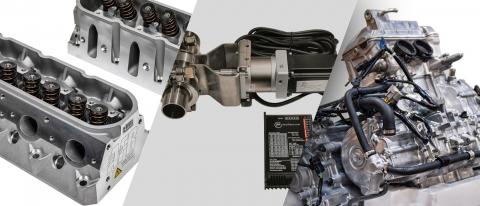
Hundreds of new product announcements cross the desks of PRI editors each month. Following are our top picks for March.

Talon Crate Engine

Honda Performance Development
hpd.honda.com

image 2

The same engine that the Honda off-road factory race team used to win the UTV Stock NA class at the 2022 King of the Hammers is now available as a crate engine.

“The intention of this engine offering is to provide a source for new engine assemblies to Talon racers,” explained Andrew Salzano of Honda Performance Development (HPD), Santa Clarita, California. “HPD pursued sourcing of these factory stock engines because we heard from Talon racers that it has been difficult to find replacement parts for engine rebuilds due to supply chain challenges. Some racers also have a desire to start racing with a completely new and fresh engine or may want to have a spare engine ready to go.”

The Talon crate offering is a liquid-cooled Unicam (overhead cam) parallel-twin four-stroke engine with four valves per cylinder. It displaces 999cc and has a 10.0:1 compression ratio. It’s equipped with an electric starter and is paired with a six-speed automatic, dual-clutch transmission with reverse.

Included with the engine is a comprehensive service manual to help with the installation.

“What we were able to do was acquire brand new, factory-built stock Talon engines that racers can use for direct replacement or to do their own racing engine development,” added Salzano. “As such they are offered for competition use only and without any warranty.” —Mike Magda


Supercharger Belt

Dayco
daycoaftermarket.com

image 3

Dayco in Roseville, Michigan, is now offering relief to Factory Super Stock racers who have problems keeping the supercharger belt in place on their late-model cars. Designed for extreme-duty use, these belts have been engineered with a proprietary EPDM construction using aramid fibers. They are available with eight or 10 ribs, depending on the application.

Dayco engineers partnered with Watson Racing and Chris Duncan Racing to develop a belt suited for racing.

“We worked closely with the Dayco tech guys this year, testing their new supercharger belt, and the results have been incredible,” said Chuck Watson II, driver of the 2019 Cobra Jet Mustang that won the NMCA Factory Super Cars championship. “The belt’s design is definitely better than what we used previously. We noticed a huge difference under boost conditions because the belt was able to keep its grip.”

Some of the popular applications include Ford Mustang GT500, Chevy Camaro ZL1, Dodge Challenger Demon, Ford Lightning, and Chevy Corvette Z06. The belt also enhances under-hood aesthetics with an imprinted Dayco racing logo.

In addition to the supercharger belt, Dayco brought an 8-mm blower belt to the racing circuit this past year. It features high-strength Teflon coated teeth for cogged drive pulleys and a carbon cord construction. It comes in multiple lengths and 50-, 75-, and 84-mm widths. —Mike Magda


Automated Load-control Valve

YourDyno
yourdyno.com

image 4

Engine builders seeking more consistency and repeatability out of their dynamometers should take a look at the automated load-control valves and complementary software now available from YourDyno in Nesbru, Norway. The valves are offered in 1.00-, 1.25-, and 2.00-inch sizes to fit most popular water brakes.

“An effective automated load control setup is essential for water brakes and takes the human out of loading your engine consistently, run after run,” said Kevin Hamilton.

Coupled with the valve is a special water brake control mode called Load Control. This algorithm allows the engine to accelerate faster where it is strong and less where it is weaker.

“This allows for a more natural sweep through the rpm range, compared with traditional PID control,” noted Hamilton. “This natural sweep is more repeatable and much less likely to oscillate, in particular with engines with an abrupt torque curve.”

The valve is constructed from stainless steel and is designed to work even in harsh environments. It includes a fast-reacting servo driver and the load-control software.

“Installation is simple. We offer the option of a female NPT-style connector or a hose-nipple style. Either of these would be spliced into your existing plumbing, or you could use metal or PVC for a new install. Electronics are plug-and-play, and we do include detailed installation instructions,” added Hamilton. —Mike Magda


Upgraded IRS Components

Mark Williams Enterprises
markwilliams.com

image 5

When vintage racers running C2 and C3 Corvettes were having reliability problems with the independent rear suspensions, they asked Mark Williams Enterprises (MW) in Louisville, Colorado, for help.

“Our task was to beef up the components wherever possible,” said Mark Williams.

These Vettes came with 17-spline inboard yoke shafts that were prone to failure under stress. The MW replacements have a stronger, 30-spline design and are CNC machined from 300M steel. Other enhancements include axle hub kits, a pinion yoke, and 1350 series half-shafts.

“Carl Greatches of ACG Enterprises, a well-known SVRA prep shop, installed the MW components in his team cars, and they are winning races with no problems,” reported Williams. “Other racers have noticed and are coming aboard. We have also developed upgrades for Jaguar, Viper, and Pantera IRS drivelines.”

Another of the Corvette upgrades involves the ring-gear carrier for the positraction unit. Under racing conditions, the cast-iron carrier will crack and last only a few races.

“We resolved the problem by making the short stub axles out of aircraft-alloy forgings and upgrading to the 30-spline tooth count,” explained Williams. “The original carrier was made of a cast-iron material, which is common at about 40,000-pound tensile strength. We produced a new carrier from a billet bar that is heat-treated to more than 230,000-pound strength.” —Mike Magda


Extra-tall Cleanable Oil Filter

System 1 Filtration Products
system1filters.com

image 6

Racers can now opt for an extra-tall oil filter from System 1 Filtration Products in Tulare, California. The new model measures 7.750 inches in length and 3.750 inches in diameter. The reusable, cleanable filter is equipped with a 35-micron stainless-steel element that provides excellent filtration for up to 20W-50 oil viscosities while offering unrestricted flow.

“The primary benefit is that the engine oil can easily be examined and potential problems nipped in the bud,” explained Mark Mittel. “The stainless-steel mesh filter elements are cleanable, eliminating ongoing replacement costs. A typical oval track racer might use two replaceable filters in a weekend. It adds up quickly. A System 1 cleanable filter eliminates these ongoing expenses.”

The filter case is machined from billet aluminum and black anodized. The system is sealed with O-rings. Fittings are available for all popular applications, including metric.

“There are many race teams that have been relying on System 1 products for quite some time. They include Kalitta Motorsports in drag racing, the McMillin Racing clan in off-road, plus pulling teams like Midnight Motorsports. They are very popular among modified racers, too,” said Mittel. “In addition to its drag racing roots, System 1 filtration systems are employed by off-road racers, tractor pullers, in various oval track venues, endurance racing, and marine applications.” —Mike Magda


Race Bearings for Can-Am X3

King Engine Bearings
kingbearings.com

image 7

King Engine Bearings in Livingston, New Jersey, has designed the new Can-Am X3 bearings specifically for off-road applications.

“High-performance Polaris and Can Am engines needed a stronger bearing to keep up with the added horsepower and torque,” explained Ron Sledge. “OE-style bearings were simply not good enough.”

King Engine Bearings was approached by rod and crankshaft supplier Brian Crower to produce race-ready bearings. Utilizing King’s pMaxKote polymer layer construction, the bearings are more suited to high loads and will resist seizure.

“The Polaris and Can-Am racing bearings feature pMaxKote bearing material and will take the heavy loading while also providing extra lubrication and conformability,” said Sledge. “This product is also offered in undersizes, so expensive crankshafts can be salvaged.”

Sledge said testing with more than 200 installed units in Polaris engines has not shown any signs of wear. So far, feedback is not available from the relatively new Can-Am applications.

“We are expecting similar results as the Polaris,” added Sledge. —Mike Magda


5.3L LS1 Enforcer Cylinder Heads

Air Flow Research (AFR)
airflowresearch.com

image 8

The new AFR LS1 Enforcer cylinder head is a budget-friendly design with 210cc intake port volume and 2.000/1.570 valves sizes.

“This item can apply to a few different forms of racing and classes, such as grudge, no-prep, autocross, drifting, and more,” said Tim Torrecarion of Air Flow Research, Valencia, California. “It was designed for the small-bore (3.780-inch) LS enthusiast, specifically the 5.3- and 4.8-liter engines.”

The Enforcer features AFR’s permanent mold “as-cast” technology on the intake runner, exhaust port, and combustion chamber surfaces. This allows for accurate and repeatable port location and flow performance. The valves are set at 15 degrees, and the deck thickness is .425-inch. The cylinder head comes with a 66cc combustion chamber, and the intake and exhaust ports are in the stock location so that typical intake manifolds and exhaust headers will fit.

Other features include competition five-angle valve job, PAC 1.290-inch valve springs (140 pounds on the seat) and seven-degree chromoly retainers. The head is cast from A356 aluminum.

“There are not a lot of options when it comes to cylinder heads for the customer that is starting with a Vortec 5300 engine,” said Torrecarion. “Based upon flow numbers, this head can support 530 horsepower, normally aspirated. With a power adder it will be closer to 1,000 horsepower.” —Mike Magda

March 2023

Stop Doing That…Do This Instead: Improper Carb Tuning

Submitted by johnc on Wed, 02/15/2023 - 14:36
image 1
image 2
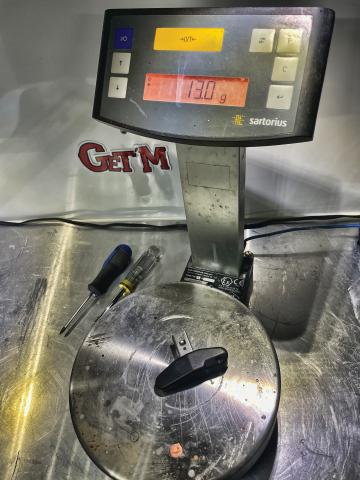
Get’M Performance weighs the floats on its carburetors and marks the reading on a spec sheet before the part is sent out. That allows easy comparison of the measurements if a carburetor comes back to the shop for a refresh.

Avoid leaving power on the table by following these tips from two of the industry’s leading authorities on carburetor performance.

Although the technology has been around for well over a century, maximizing the efficiency of a carbureted setup is still a bit of a dark art. There’s a wide range of factors that can have a significant effect on the end result, and that makes it all-too-easy to give up horsepower without even knowing it. Fortunately for us (and you, dear reader), the sorcerers at Braswell Carburetion and Get’M Performance have some simple tuning advice that can assist you in retrieving those missing ponies.

Mind Your Alcohol

“Over time, floats will often start to get heavy—particularly if you’re running alcohol,” said Trevor Wiggins of Get’M Performance, Alvaton, Kentucky. “Certain fuels will cause this more than others. If a carburetor hasn’t been looked over in three or four years, and it’s in certain types of fuel, the floats will make the motor run like it’s really fat.”

Wiggins said this issue typically comes down to deferred maintenance, so the easiest way to prevent it is to simply have the carburetor gone through by a specialist in regular intervals. Those intervals should be measured by time rather than by the number of passes or the operating hours that the engine has seen. “With stuff like Q16 and X14, the fuels have become a lot more volatile in recent years. They don’t contain as much lead as they used to, and they’re eating up nitrophyl floats as a result.”

He noted that Get’M Performance weighs the floats on its carburetors and marks the reading down on a spec sheet before the part is sent out to a customer. That allows easy comparison of the measurements if a carburetor comes back to the shop for a refresh down the road. “If a float is, say, 128 grams when it goes out, and it’s up to 135 grams when it comes back, we know that it needs to be replaced.”

Slow the Flow

“The biggest issue we see is folks running too much fuel pressure for the application,” said Dave Braswell of Braswell Carburetion, Tucson, Arizona. “There’s a misconception that you have to run like eight or nine pounds of fuel pressure to keep the engine properly fed, but with most of our stuff we just put larger needles and seats in. There are very few carburetors that we make for gasoline that run more than 6 1/2 pounds of fuel pressure, maybe seven at the most.”

image 3
Braswell Carburetion will often run two—and sometimes three—high speed bleeds on its motorsports carburetors to balance fuel pressure and volume. “We started doing that in Pro Stock racing in the 1990s, and we’ve carried it over to Competition Eliminator and even the dirt track stuff,” said Dave Braswell.

Braswell pointed out that lower fuel pressures can improve the quality of the fuel in the bowl, which will improve the carburetor’s efficiency in turn and likely free up some power in the process. “If you put a nozzle on a hose and spray water into a bucket under pressure, you’re going to end up with all this aerated water. But if you just pour water out of the end of the hose into the bucket, the water will be fine. The same concept applies here.”

Determining the proper fuel pressure and needle and seat configuration for a given combination typically comes down to horsepower levels and the needs of the application, he said. “Over-fueling will cause the engine to go overly rich at higher rpm. It doesn’t allow the fuel level to drop in the bowl, so the emulsion system on the carburetor can’t function properly. Of course, if you’re running in a racing format where it’s wide-open throttle all the time, you’re going to need more fuel pressure than you would if you’re on and off the throttle a lot. You get to fill the bowls when you lift.”

To dial in this balance, Braswell will often run two high-speed bleeds on its hardcore motorsports carburetors. “We started doing that in Pro Stock racing in the 1990s, and we’ve carried it over to Competition Eliminator and even the dirt track stuff. In some scenarios we’ll even use three high-speed bleeds—we call them five-circuit carburetors. Splitting the emulsion system into two or three sections allows you to more precisely control the fueling by addressing those sections individually.”

One Setup Does Not Fit All

“Another big mistake we see is people assuming that a carburetor that worked great in one application will work great in another without some changes,” said Wiggins. “They end up wondering why this setup that was awesome in their drag car isn’t working well in their pulling truck.”

In order for a carburetor that was originally tuned for one racing discipline to work properly somewhere else, it needs to be configured for the specific demands of that new discipline.

“It’s something we see a lot when people buy used carburetors—people will buy something without really knowing what it’s set up for,” Wiggins said. “We build a throttle stop carburetor very differently than, say, a nitrous carburetor. We want to be as application-specific as we can be. In truck and tractor pulling, the fuel curve is going to spike up really high and then go down rather than come up, and that’s not what the engine is going to see in a drag racing application. Even the fuel curve for a carburetor being used in eighth-mile racing is going to be different than one being used in quarter-mile racing. So it needs to be looked at by someone who knows how to make those adjustments. It’s usually not as easy as changing a jet, and there can be situations where other parts need to be installed or swapped out in order to really get it where it needs to be.”

SOURCES

Braswell Carburetion
braswell.com

Get’M Performance
getmgarage.com

March 2023
By
Bradley Iger

Shock Value

Submitted by jeffreyc on Wed, 02/15/2023 - 14:06


How today’s suspension specialists have become a critical conduit between manufacturers’ product offerings and the exacting setup requirements of top-performing racers.

A winning race team is a relentless machine. The ones standing on the podium have looked under every greasy bolt, every battered panel, and every tangled wire for ways to go faster. 

You can bet they’ve put a lot of thought into shock absorbers, or dampers, too. This simple-looking set of tubes can change more aspects of a car than someone might imagine any one component could.

Even so, many racers still don’t think much about shocks. They buy a set of dampers, bolt them in, and then basically forget about them. It’s an unfortunate oversight; effective shock tuning can vastly improve grip, aero, and the overall feel of a car, all of which can translate into significant gains come race day. 

That’s why racers of all types increasingly rely on the work of shock specialists to set up shocks and tune them for their exact needs, expectations, and requirements. For many teams, these gurus have become a secret weapon that gives them the edge they need on race day.

The Shock Doctors

Shock specialists are experts at interpreting what racers are trying to do with their cars and then translating that information into the shock absorber setup. For the most part, they’re in the business of taking off-the-shelf aftermarket components and tailoring them to the exact needs of racers to make them faster.

“Manufacturers do a good job building stuff, but their parameters are really wide, because they’re just trying to produce shocks to sell,” said Mike Leary of Leary Racing Products & Shock Shop, Denver, Colorado. “We’re more specific. We can take all day to build a shock, where obviously a manufacturer couldn’t. Our tolerances are really tight. Our stuff is really accurate and repeatable.”

This approach of customizing off-the-shelf aftermarket shocks has led most shock specialists to forge close relationships with manufacturers, fostering a give-and-take sharing of information as needed. “I worked at Penske Racing Shocks for 10  years,” explained JJ Furillo of Ultimate Performance, Concord, North Carolina. “And then after I left, I helped found JRi Shocks. So when I find things that need to be addressed or I see a direction that we need to go, I share that with them.”

“We’ve been working closely with a lot of companies for a long time,” added Angelo Zarra of ANZE Suspension, Jupiter, Florida. “For instance, we were helping Penske in the SCCA ranks in sports car racing. Öhlins came to us and asked if we could help their customers. Then SACHS came to us and asked if we could help their customers, too. So we’ve been working with all the major brands for a long time.”

2
“My customers get a lot of information from me, because I’ve been racing my whole life,” said Mike Leary of Leary Racing Products & Shock Shop. “Not only can I help them with shocks, but I can help them with spring and sway bar selections and some suspension settings.”

As far as what kinds of cars shock specialists work on, some are more specialized than others. For instance, Furillo of Ultimate Performance focuses entirely on road racing. “If you’re not living a particular world of racing, you can’t keep up with it, and it’s a longer learning curve to figure out what’s needed,” he explained. “The world I live in is road racing.”

Other shock specialists don’t specialize in a particular type of racing, but instead focus on one brand of car, such as TC Kline Racing in Hilliard, Ohio, which is exclusively devoted to BMW cars. This indirectly dictates a relatively narrow range of motorsports for it to work with. “We decided to focus on BMW,” said TC Kline, “and I still feel like that was the right decision, even though pretty much all of our competitors do multiple brands. So road racing, driver schools, autocross, and street is our market.”

In sharp contrast to the tightly focused niches of Ultimate Performance and TC Kline, most shock specialists are highly general in terms of what types of cars and what motorsports they’ll tackle. The prevailing thought among most in the business is that the basic methodology and principles of shock setup are the same no matter what particular surface or type of driving a car is doing. This leads many shock specialists to have a colorful and diverse array of customers at any given time. 

“It’s all four patches and a steering wheel,” said Zarra. “So, in the room right now we have Formula Ford, drag racing, Neon, Porsche Cayman Cup, and Aston Martin GT4. That’s where we’re at.”

“We pretty much cover the gamut,” added Leary. “Circle track is my major realm, but we do road racing and a lot of drag racing. And Pikes Peak Hill Climb—we’ve won it nine or 10 times. We even do ice racing.”

For equipment, the shop owners and operators we spoke with primarily rely on Roehrig shock dynos, which can be found doing the bulk of the work at Ultimate Performance, ANZE Suspension, and Leary Racing Products. Since TC Kline Racing uses shock dynos mainly when developing new shock designs, it instead relies on an outside source for its shock dyno work. 

Great Expectations

Effective shock tuning can do a lot for a car, but there are limits. All of the experts we spoke with agree that shock work is the icing on the cake—the final tuning of the suspension. “There’s a lot of other suspension tuning that needs to be done before you start changing the shocks,” said Leary. “The shocks finish it up.”

Even the best shock gurus usually can’t make a last-place car into a winner with just shock changes. A lot of it comes down to expectations. “If you’re doing pole-winning times, knocking two seconds off a lap isn’t going to happen,” explained Zarra. “But if you’re running 33rd, putting you in the middle of the field is really possible, if the chassis is sorted and we’ve got good bones to work with.”

That’s not to say that good shock tuning can’t sometimes have dramatic results. Although shock specialists tend to think of their work as complementing an already effective suspension setup, there are times when nothing more than a shock change has indeed transformed a car and brought radically better results.

3
ANZE Suspension customers represent a diverse array of racing disciplines. “It’s all four patches and a steering wheel,” said Angelo Zarra. “So, in the room right now we have Formula Ford, drag racing, Neon, Porsche Cayman Cup, and Aston Martin GT4.”

“I had a drag racing customer come in, and we improved his 60-foot time by two-tenths—night and day,” recounted Leary. “And I have had some road racers bring shocks in, and they pick up a second or two over the whole course.”

“During my career in NASCAR, I was approached by a team before a race at Dover,” added Furillo. “They considered themselves junk. I built them a set of shocks, and along with a host of other changes, they won the race. That’s just one example, but it happens.”

As tightly focused of a niche as shock tuning is, the work can sometimes spiral out to incorporate almost all aspects of a car. Shock specialists often make recommendations on practically any part of the suspension. “A good shock specialist understands the entire dynamics of the car,” said Furillo. “What the car wants or what the driver is looking for isn’t always a shock adjustment. It could be a spring change. Or it could be a sway bar change. Knowing that and moving forward with those changes is what makes a good shock specialist.”

“My customers get a lot of information from me, because I’ve been racing my whole life,” added Leary. “Not only can I help them with shocks, but I can help them with spring and sway bar selections and some suspension settings.”

This big-picture approach may even include a car’s aerodynamics. Although most racers think of shock changes for strictly handling and overall-feel improvements, shocks can also make significant changes in a car’s aero. “We can run enough shock that we can hold the attitude of the car where it needs to be,” said Furillo. “That can sometimes help to get around certain aero rules.”

4
TC Kline Racing “always includes a setup sheet with our shocks,” said TC Kline. Racers who follow those guidelines will be “within 2% of optimal all the time,” so they can “fine-tune once they get used to driving the car with our setup.”

Even with the many potential advantages to be gained with effective shock tuning, getting those great final results may not be as direct as racers might expect. In some cases, shock experts analyze what a car is doing and recommend addressing other aspects of the car before even attempting to set up the shocks. 

“It’s not always just the shocks,” noted Zarra. “For example, we just won the Pan American Nationals in drag racing. That process started years and years ago. We built a set of shocks for the guy, and he sent me a video. I said, ‘Look at how the rear wheel ratchets—it winds and unwinds. That’s not shocks. You’ve got a driveline issue.’ So he fixed that and some other things, and then ‘boom’—championship.”

No matter what underlying issues shock specialists have to deal with to get a particular car where it needs to be, the primary measuring stick for success is how the car feels for the driver. This is both the starting point and the end goal for shock specialists.

“For most really good drivers, feel correlates to speed,” said Zarra. “If the driver is comfortable, he’s going to be fast. We call that confidence-inspired grip. At a subconscious level, the driver says, ‘I keep asking for more, and it just keeps giving it to me.’”

That said, there are times when the best-feeling setup for a car isn’t the fastest around the track. This is relatively rare, according to our experts, but it does happen. Many times, such mismatches are rooted in the experience and skill of the racer. 

“Racers form habits, and they know what they like,” explained Leary. “But that may not always be the fastest way. Actually, young drivers are usually easier for us to work with—they don’t know what the car should feel like. They get in the car and think, ‘Okay, this is what it’s supposed to be like,’ and they drive it.”

A lot of it comes down to learning each driver’s preferences over time and knowing how to serve those needs best. “It’s easier if you’ve worked with a driver for a period of time to really zero in on what they need,” noted Furillo. “Because you have a relationship with them, you know what they’re looking for, and the communication is good. When it’s somebody new, you have to say, ‘Here’s a good starting point, then we can progress from there on how to fine-tune that to your needs.’”

Getting to Know You

When starting that relationship, first, lay some groundwork. Racers need to begin by looking at their cars closely and making sure everything is correct to begin with. If there are misaligned pieces, worn components, or damaged structure, the work of a shock specialist will, at best, be a bandage on those problems. 

Chances are, the shock specialist won’t even want to begin the process until these other issues are addressed. “I want to know about the chassis setup,” said Zarra. “Is it pitched? Is it tilted? Is it bent? Is it welded crooked? Is it cracked in half? Has it been rolled over 17 times?”

After carefully inspecting the car, then it’s time to gather plenty of information about the current setup. Generally, the more detail a racer can provide, the better. Along with that, videos can offer valuable insight as well.

5
Ultimate Performance focuses its expertise purely on road racing, said JJ Furillo. “If you’re not living a particular world of racing, you can’t keep up with it, and it’s a longer learning curve to figure out what’s needed,” he said.

“The more feedback we get, the more areas we can dive into,” explained Zarra. “It starts with the basics. What’s your ride height? What’s your corner weights? If you can go deeper, what’s your motion ratio, and wheel rate? 

“And videos, too,” continued Zarra. “Inside videos are good—we get to see the steering wheel and the driver. But boy, sometimes outside video is amazing. I just got three videos yesterday of a front-drive drag car. So I can watch it in slow motion and see how the car squats, rotates, and what it does. So just through simple video analysis and driver feedback, we can get a pretty decent idea of what’s happening.”

Next, customers need to think about what they’re feeling when they drive their cars, and what they’re dissatisfied with. This is obviously subjective. They need to discuss their preferences with the shock specialist, who can properly customize to their requests. This often requires a nuanced conversation between the driver and the shock specialist. Good shock specialists are experts at getting to the heart of what drivers are really feeling.

“A lot of times I’ll ask the same question to the driver three different ways to make sure that’s exactly what he’s feeling,” said Furillo. “Because sometimes, what they’re describing as the problem is just the end result—the actual problem is somewhere else. For example, the big thing we hear is the driver saying, ‘I’m loose off.’ Okay, well, we can try to fix that. But more than likely, the problem is happening at the corner entry to the middle of the corner.”

In these conversations, racers need to be completely open and honest about what they’re actually trying to do—how often they plan to race, what resources they have from week to week, and what level of success they’re aiming for. “Every driver, every race mechanic, every team needs to admit what they’re really after,” said Zarra. “Maybe that’s, ‘Hey, we’re going to run four races a year, and we’re going to try to zing it up front and beat the factory teams.’ And then I can say, ‘In only four races? All right. It’s going to be tough, but we’ll try to get you there.”

Armed with information like this, shock specialists will work to provide the optimum initial setup for a car, with an eye toward the team’s long-term goals and the available resources. Along with that initial setup, shock specialists typically provide guidelines for ongoing changes. 

6
Most shock specialists develop close working relationships with shock manufacturers so they can share information as needed. Angelo Zarra said ANZE Suspension has collaborated with Penske, Öhlins, and SACHS, among others. “We’ve been working with all the major brands for a long time.”

“We always include a setup sheet with our shocks,” noted Kline. “If you follow our guidelines, you’re going to be within 2% of optimal all the time. So you can fine-tune once you get used to driving the car with our setup, and you’re very familiar and comfortable with it.”

No matter how well a shock specialist sets up the shocks, remember, nothing stays the same forever. Rules, technology, and tracks can vary wildly over time. The initial work with a shock specialist will likely be the first contact in an ongoing relationship.

“This isn’t set-it-and-forget-it type stuff,” said Furillo. “Setups change, aerodynamic packages change, tires change, brake packages change. As one thing changes, it’s very much a chain event. It impacts other parts of the car. So we need to keep up with that. We continue to evolve to try to make things better.”

Even if rules and setups are relatively stable for a particular type of racing, shocks still need ongoing maintenance. Many racers bolt in new shocks and forget about them, but like anything else on a car, the performance of shocks degrades. Sometimes the change is so gradual racers don’t notice.

“Think about if every time you take the car out, it’s 1% less crisp,” said Zarra. “If you do 21 track days, imagine being 21% worse on horsepower. Now, with shocks, it’s not necessarily that number, but you get the idea. It creeps up on you.”

What’s more, like other parts of a car, neglecting shocks can make them harder to save when the customer finally brings them in for work. It’s likely to be far more cost-effective in the long run to take care of the shocks during the season rather than neglecting them until they’re unsalvageable.

“If you think about it, when do you change the oil in your engine?” asked Zarra. “When you shove a rod through the block? When the pistons are scored? It’s your choice. We’re budget-minded, but when you send in dampers that haven’t been serviced in 15 years, there’s only so much we can do. Stuff we serviced just last year is fairly crisp, everything’s good, the service goes easier, and the parts bill is less.”

How often should racers have their shocks serviced? The experts we talked to said shocks should come in for service at least once a season. But they quickly pointed out that this is a very general minimum. The ideal interval for servicing shocks can vary greatly. 

“Shocks need to be serviced at least every year,” explained Zarra. “How do you know if the sealed black tube on the corner works or not? You send it across the dyno. Every championship we’ve ever won, the shocks came back here for revalving and tuning two or three times within the year.” 

“It depends on what’s actually going on,” added Furillo. “In some series, shocks may run 10 or 12 races, so you can get away with doing it once a year. But even that depends. If you’re a Saturday-night racer and you race 25-lap main events, your rebuild isn’t the same as the guy running 100-lap main events.”

With the help of shock specialists, racers can see big gains in all aspects of a car. No, these experts generally can’t transform a struggling back marker into a podium star. But they could very well be the elixir that elevates a race car that little bit extra from good to great. 

In the process, customers almost certainly end up with cars they enjoy driving more. That is, after all, one of the key aims of shock tuning—to make the driver feel good behind the wheel. Doing so almost always translates to better on-track performance. 

“When the car handles really well, you’re buried in the throttle all the time,” said Kline. “And that’s the essence of our focus—your ability to use power with total confidence.”

Sources

ANZE Suspension
anzesuspension.com

Leary Racing Products & Shock Shop
learyracingproducts.com

TC Kline Racing
tcklineracing.com

Ultimate Performance
upspeedshop.com

March 2023
By
David Bellm

Ask the Experts: How to Maximize Contingency Programs

Submitted by johnc on Wed, 02/15/2023 - 13:33
image 1

The Contingency Connection Racer Rewards program serves as “a middleman between sponsors and race tracks,” said Jackie Ressa. It ensures sponsors’ contingency awards reach grassroots racers, like Aaron Guinn, across the country.


Getting the most from these racer rewards goes far beyond placing a decal on the car.

On one level, a successful contingency program is about the racers, “keeping race cars at race tracks and putting on a high level of entertainment for the fans,” said Carson Becker-Gramm of IMCA, Vinton, Iowa. From the program sponsor’s point of view, “the whole point is to drive customers to their place of business and make sure those certificates are being redeemed. Then, hopefully, they can grow a longtime customer.”

The benefit to a sponsor can go beyond sales. Contingency programs enable QA1 in Lakeville, Minnesota, “to go to the next step in building relationships with the racers,” said Dave Kass. “Those relationships can give us opportunities for product improvement and give us real-world feedback from guys using our products in race cars. We are constantly looking for new problems to solve, but we can only do so much internally without putting parts on a race car. So we see great value in these programs.”

How, then, can contingency sponsors optimize their programs to get the “great value” Kass described?

Not Too Contingent

“One thing we like to be very careful about is making sure these programs aren’t too contingent for the racer,” said Becker-Gramm.

For example, if a sponsor is “something like a parts warehouse, the racer can buy whatever they want” with the contingency award, he said. “One of our great marketing partners, Speedway Motors, has so many different products that they’re almost universally allowed. Those certificates seem to have a higher redemption rate because there are so many different options for the driver to purchase.”

A manufacturer with a more specific component line, however, should be aware of “all the different divisions” that a sanctioning body has “and the different rules in those divisions. Not all the products that XYZ Company may carry are allowed in that driver’s division.” Narrowing contingency choices too much “makes it more difficult” for the racer to redeem the award.

Compounding the difficulty are the terms sometimes set on the awards, Becker-Gramm added. If a product discount requires a minimum purchase, “say for example that a $100 certificate is off the purchase of $500 or more, a grassroots driver then has to weigh their budget, not just the racing budget but also their personal budget and anything that may affect their racing budget” in deciding to redeem the certificate. It would be better, he said, to structure the contingency award more like a gift card. “A $10 Starbucks gift card isn’t contingent on you spending $100 at Starbucks to use it.”

IMCA, Becker-Gramm explained, works to “make sure the sponsor does have a great redemption rate, so we’re going to do all we can to put together a program with the sponsor to drive customers to their business.”

Is Cash King?

Cash contingency awards give racers the ultimate flexibility to spend the award as they choose, but cash isn’t always the best option for the sponsor. QA1 offers cash and award certificates in its programs, Kass said, depending on the racing series. With a cash award, though, “we don’t know where the cash is going to be used. We have no direct line to correlate where the award is being redeemed.” QA1’s contingency certificates are serialized, “so we can see if they are being redeemed at a speed shop or through a direct purchase through QA1. That helps us to track the certificate and helps us understand those channels and what the certificate is being redeemed against.”

Spread the Wealth

One way contingency sponsors can drive more racers to their businesses is to expand their awards beyond race winners. “We’ve done that in quite a few instances,” Kass said, “granting awards for the fastest 60-foot time at a drag strip, or the fastest lap of the night at a circle track, or whoever passed the most cars that night. Everybody has a chance at something like that.

image 2
Tracks enrolled in the Contingency Connection Racer Rewards program receive books with manufacturer product certificates. “The contingency book doesn’t necessarily always go to the winner of an event,” Jackie Ressa said. “Track owners want to spread the wealth and pay as many racers as they can.”

“Front-runners night-in and night-out can be more accustomed to seeing contingency payouts or other forms of sponsorship,” Kass continued, “so someone new to the sport, or trying to navigate their way through the pack, may be just as, if not more, deserving of recognition.”

“The Racer Rewards contingency book doesn’t necessarily always go to the winner of an event because the track owners want to spread the wealth and pay as many racers as they can,” observed Jackie Ressa of Contingency Connection, Kingsport, Tennessee. “They might give it to the number-five finisher or the number-10 finisher. Some tracks may present the Racer Rewards book as a hard-luck award to somebody who went out in the first round. The program is more effective when track owners allow the awards to trickle down through the ranks to as many racers as possible.”

Becker-Gramm sees the “spread the wealth” concept as a shift in how some sponsors think about contingency awards. “It’s gone from sponsors saying, ‘I want it to go to the champion,’ to, ‘Hey, how can we support everybody?’ What we see are a lot of very happy racers as you get further down the ranks. If they’re handed a $50 certificate, it goes a long way to keeping them coming back to the track.”

The Contingency Connection Model

For 30 years, Contingency Connection has served as “a middleman between sponsors and race tracks” delivering national contingency awards to local race tracks. “We’re a marketing arm for manufacturers allowing them to be where they cannot always be—at local, grassroots race tracks nationwide.”

Instead of individual award certificates, the Contingency Connection provides 50 Racer Rewards Books full of manufacturer product certificates—about $4,000 worth of discounts in each—to tracks enrolled in the program. Ressa said there are 40–50 tracks enrolled across the country, representing about 1,500 events annually and reaching some 18,000 racers weekly.

“We deliver a $100,000 contingency program to each member track,” Ressa said. “Track operators love it because we connect them with national manufacturers. Manufacturers love it because it’s an inexpensive way to reach the huge target market of grassroots end-users. Racers love it because we help them pay their racing expenses so they can race more often. It’s a win-win-win for everybody involved.”

SOURCES

Contingency Connection
contingencyconnection.com

IMCA
imca.com
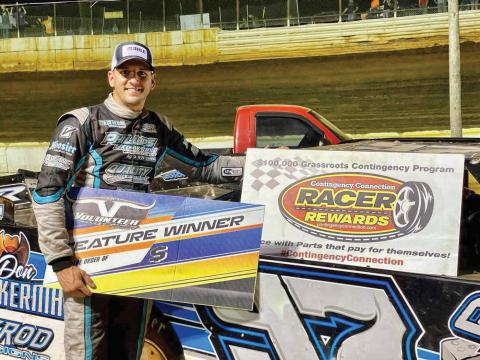
QA1
qa1.net

March 2023
By
Drew Hardin