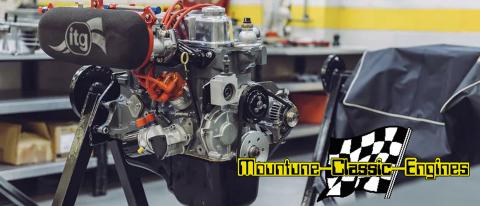
Mountune Racing—the designer and manufacturer of race engines and performance parts with locations in the US and UK—has announced a new division to support a range of historic race engine builds, component design services, and classic engine builds and restoration work.
The announcement follows the recent acquisition of its Essex, United Kingdom operation by David Mountain, the founder of Mountune, and a group of racing industry investors.
“Whilst our reputation has been forged on the back of designing and building race-winning engines incorporating the latest technology and principles, it’s easy to forget that we’ve also been developing and building a wide variety of customer engines to the highest level for over 40 years, which means we have built up a vast wealth of knowledge that can be applied to almost any application,” Mountain said.
Mountune Classic Engines will primarily work with Ford engines, along with a number of other makes, “whether it be a classic Jaguar XK or a Ferrari,” Mountain said, adding stand-out engines include XFlow, Twin-Cam, BDA, BDT, and YB.
Engine rebuilds, redesigns, and remanufacturing of components will also be available. Engine dynamometer tests will also be available to Mountune customers, and its dyno facility will be open for rent.
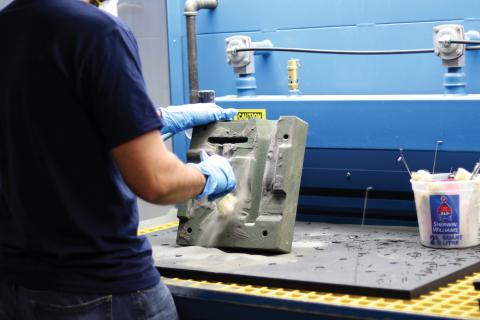
Additive manufacturing has helped level the playing field in motorsports, as our source from Hoosier Pattern explained, “3D printing lets the little guys compete.... [It] lets you get a prototype built without spending hundreds of thousands of dollars in tooling.”
Learn why this vibrant industry is “just getting started,” and how more racing businesses can prosper by using additive manufacturing in their operations.
Top-tier teams are notoriously secretive about their R&D processes, but even given that veil of secrecy, it’s clear that 3D printing—and the other processes that fall under the umbrella of additive manufacturing—is becoming more prevalent in racing.
“In the last three years, the Indy car that won the Indy 500 was the one with the most 3D-printed parts on it,” said Pat Carey of Stratasys, Eden Prairie, Minnesota, which has a long history of working with marquee names like Penske, Andretti, and McLaren. “There will be even more composites in racing when NASCAR makes the switch from sheet metal to composites. We’ll see a big uptick in 3D printing when they go.”
Carey and other experts interviewed for this story agreed that the benefits of additive manufacturing aren’t limited to just the highest racing echelons. But questions and misperceptions remain about what those benefits are and how teams and race shops can best use the processes.
Why should small shops consider 3D printing or rapid prototyping?
“It allows them to have almost immediate prototypes and test multiple different configurations without having to make the investment in tooling and fabricating the part,” said Jay Schaumberg of Online Resources, Lebanon, Indiana.
“3D printing lets the little guys compete,” added Dave Rittmeyer of Hoosier Pattern, Decatur, Indiana. “It’s kind of like when the Colt [pistol] came out. It was the great equalizer. It didn’t matter if you were a five-foot-tall, 100-pound woman or some 450-pound guy. It does the same thing, and you both can use it. Some of the smaller companies have better ideas anyway, and 3D printing lets you get a prototype built without spending hundreds of thousands of dollars in tooling.”
A major benefit of 3D printing is its ability to “print very difficult parts that would be tough to manufacture otherwise,” said Schaumberg.
Hoosier Pattern “prints a lot of cores for Mast Motorsports for its heads,” Rittmeyer said, and utilizing 3D printing for those cores allows the company to “design features that traditional tooling is not able to produce. You can put water jackets in a cylinder head that could never be made with traditional tooling or get air passages exactly how you want to optimize airflow. You can avoid a lot of the constraints that traditional manufacturing has.”
After Indy car drivers experienced adverse effects from excessive heat with the installation of the aero screen in 2020, the NTT IndyCar Series responded quickly by designing this thin cockpit cooling duct on top of the aero screen to provide additional airflow to cool drivers, which was then produced by Stratasys and is seen here installed on the No. 28 DHL Honda of Andretti Autosport driven by Ryan Hunter-Reay. Photo courtesy of Spacesuit Media / Andretti 2020.
“Anybody who’s doing any type of vehicle development can absolutely benefit from it,” said Allen Kreemer of Stratasys, noting that the company offers some “30 different printer models, so there’s one for every price range and shop size.”
If a shop wanted to get into additive manufacturing but didn’t want to invest in a printer, it could send a CAD file “to a service bureau and have it print the part,” Carey added.
How can shops improve their 3D printing processes?
“The key to any additive manufacturing is a good 3D model,” said Rittmeyer. “Some people think a picture on a PDF file is the CAD file, and it’s not. You need a good, solid model, what we call a ‘water tight’ model, with no open edges.”
Schaumberg agreed that companies need to have a means of creating the computer model that’s sent to the 3D printer. And while one method is to create the model in CAD, “often there is not CAD data available,” he said, noting that 3D scanning offers another way to create the model. “A good quality 3D scanner can capture the part shape to a high degree of accuracy, and that scan output can be sent directly to the printer for printing. To close the manufacturing loop, a 3D scanner can also scan an already printed part in order to compare the printed part back to the original model, assuring the user that they have indeed created the part that they expected.”
What’s more, he added, “If you’re sending your part to a service vendor, pay attention to things like wall thickness. In a stronger metal you might be able to get away with a thinner wall thickness, whereas to get that same strength with plastic it might need to be thicker.”
“Design for the process is still making its way into the industry,” Kreemer said. “Too often they copy and paste, use an existing design for sheet metal that they send to a printer. That’s really setting themselves up for failure. That wouldn’t happen in any other industry. If a part were designed to be machined, and now you’re going to make it out of sheet metal, you would completely change the design.”
While race teams have been using additive manufacturing for years, “we are just at the beginning of this industry,” Carey said. “We’re seeing innovation accelerate quite quickly around the materials and the processes, phenomenal development on the plastic and metal side and more changes coming. We’re just getting started.”
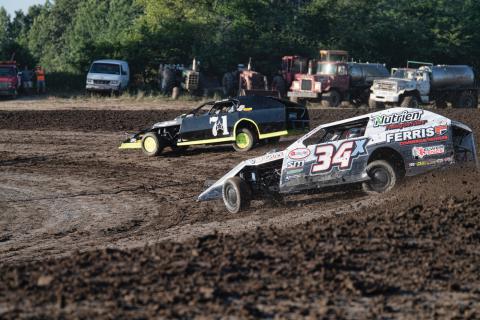
Suppliers are leveraging the latest technology and machinery to up the ante in the dirt modified market, from the entry-level ranks to the upper echelons.
Dirt modifieds are a delicate balancing act. With gobs of power, little tires, and car counts resembling rush-hour traffic, the difference between victory and defeat can be smaller than a gnat’s haircut.
And that balancing act isn’t just on the track. In presenting one of America’s most popular forms of racing, dirt modified sanctioning bodies have to walk an equally fine line between serious competitors with big budgets and entry-level racers looking to have a good time on hamburger money.
The results of this dynamic are cars that don’t really change much in the broad brushstrokes, but rather go through frequent changes in their details—particularly regarding engines.
We recently caught up with our sources in the dirt modified market to better understand these trends and learn more about today’s key developments, as well as to share a glimpse of where the sport should, and could, be headed.
Engines
Our sources confirmed that engines are indeed responsible for much of the current movement in dirt modifieds, with developments lately being driven primarily by new components. “For modifieds, probably the biggest changes we’ve seen lately are in the valvetrain—new cam designs, lighter components, and stiffer rockers and pushrods,” noted Jack Cornett of Cornett Racing Engines, Somerset, Kentucky.
These increasingly sophisticated valvetrain components are allowing engine builders to put motors together with power curves that more precisely suit the needs of racers and the tracks they run on. At the same time, modified teams are getting more advanced in their chassis setup, often employing spring smashers, data acquisition, and other exacting equipment. The resulting setups are highly capable and provide new opportunities for savvy engine builders to create more effective powerplants.
Lighter valvetrain components, sophisticated honing, and a move to the LS platform are reshaping the dirt-modified engine market. Photo courtesy of Baldwin Racing Engines.
“We’re putting a lot of torque into these modified engines, because the chassis have gotten so much better,” said Jeff Baldwin of Baldwin Racing Engines, Friedheim, Missouri. “We’ve broadened the torque curve out a lot. That’s allowed them to restart a lot lower in the rpm range. Even though they’re on a little eight-inch tire, the chassis can handle it.”
At the same time, modified engine builders we spoke with are investing in advanced machining equipment, which is launching a revolution in cylinder preparation. “The biggest thing right now is honing and piston rings,” said Baldwin. “Everything is going to a steel ring or tool-steel ring—a really hard ring. Well, the problem with that is if you don’t have diamond honing equipment, you just have so much trouble sealing the new hard rings, because they don’t store oil like the old moly and cast-iron rings did. They were like a sponge. They held all the oil so you didn’t need to have your cylinder walls all that good. Now your cylinder walls have to be very, very good to make the new rings work.
“With the diamond hone, rings break in almost instantly now, versus before it would take forever,” Baldwin continued. “We haven’t had a chance to dyno an engine with the new honing, but the guys that I’ve talked to are seeing 15 to 20 horsepower gains. And if it prevents the side of the piston from scuffing, we could run the pistons twice as long—get an extra freshen out of it. That’s a win for everybody.”
Dirt modifieds are simple, fun, and relatively inexpensive, making them enormously popular, as races are typically a mix of spendy teams and hobbyist racers.
And while these new developments are reshaping how engines are built, there’s also a move toward an entirely different engine, namely the LS platform. “The LS really started taking off in 2017,” observed Baldwin. “The torque is just so much smoother on LS’s, because of how the cylinder head platform and the intakes are on them. We can make quite a bit more power with an LS using off-the-shelf parts—not anything custom. We can also build them a lot cheaper than a wide bore or something like that and make almost the same power.”
Alongside engines like the LS, there’s a noticeable trend toward crate engines and tightly regulated spec engines among several sanctioning bodies. But even in those series that focus on spec engines, there’s still plenty of room for development.
“For modifieds, we only do the USMTS (United States Modified Touring Series) spec engine, which runs the Brodix spec head,” said Andy Durham of Durham Racing Engines, High Point, North Carolina. “A lot of people think that because that engine has an unported head, it doesn’t do any good to port that manifold. But we found that absolutely isn’t true. It does make a big difference to port the manifold. And then we play with a lot of stuff in the valvetrain, trying to optimize the exhaust valve opening and the intake valve closing events—trying to trick the head, so to speak. We want to fill the cylinder up and get as much packed into it as we can before we crack on that exhaust valve, to where we’re not blowing it out the pipe.”
As with most series, the USMTS rulebook dictates most of the trends its racers can pursue in engine development. And with that as the driving force, engine preferences change quickly and often.
“Last year, USMTS took the motors that were bigger than 372 inches and told them they could only run 7,800 rpm,” stated Durham. “So then guys started building smaller-cubic-inch motors, like 365 and 370 cubic inches. Well, that seemed to be a little bit of an advantage last year. Then this year, they went back and allowed the big motors to run higher rpm’s again. So now, we don’t really know if it’s going to be an advantage to have a little motor.”
Modified racers generally don’t seem to be spending more on engines lately, according to our contacts. But that may soon change. “I didn’t really see a big increase in spending last year, though we’re kind of on the higher end of the pricing for those motors,” said Durham. “But sanctioning bodies are upping purses this year. They’re going to have a lot of $10,000-to-win shows. So I suspect there will be more thought put into motors.”
Some sources fear rising costs could eventually hurt the appeal of dirt modifieds. But for now, the class remains one of the most popular types of dirt racing in America.
That leads us back to the age-old bind for modified racers—how restrictive should rules be? Some engine builders feel they’re currently too open. “Honestly, some of these rules, the way they’re written, they don’t put any restrictions on engines,” said Baldwin. “I hate it for the customer, because it’s so expensive. To build an open B-Mod engine, where we don’t have cubic-inch rules, the only real rule is steel head, steel block. That’s an $18,000 build.”
And oftentimes having relatively unrestricted engine rules can result in higher costs for other, less obvious reasons, according to Durham: “Right now, USMTS has that spec motor. They’ve got a crate motor. They’ve got a 525 engine. And you can still run an open engine. It’s crazy. Some guys use all these engines depending on what track they’re going to. It would be better if USMTS just told everybody, ‘Hey, you’re going to have a five-inch spoiler, you’re going to weigh 2,450 pounds, and we’ll all run this spec head.’”
Body and Chassis
For the most part, dirt modified bodies and chassis don’t appear to be experiencing the same sort of dramatic shifts that engine building has lately, with the exception of suspension. “The last two years, the suspension has changed a lot,” said Bobby Hearn of TEO Fabrication, Vernon Township, New Jersey. “We went from mostly torsion-bar cars to now it’s mostly coil cars. It just kind of exploded in the last few years. Once a couple guys got going really good with some coil cars, everybody changed their focus to go that direction.”
Although there seems to be somewhat of a follow-the-leader aspect to this shift in suspension technology, it’s also likely that the move can be at least partially attributed to the increasing sophistication of modified teams. With widespread use of data acquisition and other suspension tuning tools, teams are better equipped to take advantage of the greater setup options afforded by coil-spring suspension.
Chassis builders are increasingly using CAD/CAM to design and build parts, resulting in more precise assembly. “Everything’s computer generated now,” said our source at TEO Fabrication.
Unlike the chassis, however, bodies of dirt modified cars are essentially unchanged. Some feel that this lack of progress detracts from the sport as a whole. “I kind of wish we would change the body rules a little bit,” stated Hearn. “I know, nobody wants to hear that. But we’ve had the same body rules for 20 years or more. I’d like to open the rules up. That way fans can see the difference between classes.”
For now, manufacturers are making mostly small detail changes to modified bodies, typically in response to racers pushing rules to gain an advantage. “The only thing we changed this year was on the sail panels,” said Neal Cullum of GRT Race Cars, Greenbrier, Arkansas. “Some guys were bowing them so much, trying to catch air on the left side.”
Manufacturing
While racers in the dirt modified world are becoming more sophisticated, so too are the companies producing components for them. In particular, the use of CAD/CAM equipment is increasingly being perceived as vital to a shop’s long-term survival. “Shops that don’t invest in CNC are going to be in trouble,” said Baldwin. “The only downside to the equipment is paying for it. But I’ll get it back in labor savings. On our new CNC honing machine, what used to take us four-and-a-half hours—literally the guy standing in front of the machine the whole time—now takes us an hour and a half. And the guy is in front of the machine for about five minutes.”
More fabricators are getting on board with this trend, too. One of them, Troyer Dirt Cars in Spencerport, New York, recently underwent an extensive revamp of its entire company. The top-to-bottom reorganization has allowed Troyer to bring advanced technologies to its classic chassis designs. “Over [the] last year, we’ve gone through and done CAD drawings on the car,” said Mark Lipari. “So now the car has been completely engineered in CAD drawings. And we’re actually re-fixturing our build process to bring it up to the next standard.”
At Troyer Dirt Cars in Spencerport, New York, an extensive company revamp has brought advanced technologies to its classic chassis designs.
A similar process is underway at TEO Fabrication, as the company looks to maximize the efficiency of its workforce while simultaneously improving the quality and consistency of its cars. “We have 12 guys. We’ll probably build about 100 cars this year,” said Hearn. “The biggest thing for us is we’ve invested in a lot of new equipment to make sure we have enough CNC tubing benders and CNC cutters. So we’re excited about that. Everything’s computer generated now. Nothing is done by hand like it was.”
A Balancing Act
Overall, the dirt modified market is experiencing many of the same transitions and growing pains as other forms of motorsports. At the center of this is the ongoing question of which wing of the sport will ultimately dominate—the serious, high-end side of racing or the more entry-level hobbyist crowd.
That debate makes the work of sanctioning bodies even tougher than it already was. In any form of racing, there’s the seemingly inevitable upward spiral of costs, commitment, and intensity. Will the evolution of dirt modifieds someday put them out of reach for the grassroots enthusiasts that make up the core of the sport?
It could happen. But many of our sources made it clear how important it is to control these potentially damaging developments to ensure the long-term health of this popular, relatively easy-to-enter segment.
“The great thing about modifieds is that the whole division was built years ago as a cheaper way to go racing,” said Tom Sandal of Carolina Racing Supply, Mooresville, North Carolina. “Let’s not forget that.”
Following the company’s recent announcement of its acquisition of Cooper Tire, Goodyear has announced that Ryan Patterson, currently president of its Asia Pacific business unit, will lead the integration effort as senior vice president, business integration. Nathaniel Madarang, currently managing director of Goodyear China, will succeed Patterson as president of Goodyear Asia Pacific.
Prior to his role in Asia Pacific, Patterson was president of Goodyear’s North America Consumer business, where he developed the company’s consumer strategy and its focus on high-value segments. Goodyear says he led the creation and implementation of the company’s aligned distribution model in North America, and launched goodyear.com, driving e-commerce sales for distributors and dealers.
Prior to his work in North America, Patterson worked in several roles of increasing responsibility in Latin America since joining the company in 2002. He is a graduate of Brigham Young University, where he earned his Bachelor’s Degree in accounting, and Harvard Business School, where he earned his MBA.
Madarang has been with Goodyear since 2008. Prior to his role as managing director of Goodyear China, he was vice president of finance for Goodyear’s Asia Pacific business, and prior to that, vice president of Goodyear’s China Consumer business and finance director for Goodyear China. Prior to joining Goodyear, he served in several leadership roles for Procter & Gamble in China and ASEAN.
It’s well worth the effort to understand what different material, design, gap, and heat range options are available and ideal for your combination.
Spark plugs are some of the most debated performance parts around. And like many parts in the performance world, I’ve found that choosing the right spark plug can vary substantially. It usually comes down to the user committing to following a learning and testing process to get it right.
To be candid, this is part of what separates the winners from the rest in many races, because the winner somehow has just a few more horsepower than the rest; or their engine lasts longer.
It’s not magic, and there isn’t one miraculous spark plug brand or material that’s superior to all the rest across the board. Rather, the solution often comes by way of knowledge and some experimentation.
The process to end up with the best spark plugs that we recommend has a few steps, but it is worth the effort. Before we get to testing, though, it’s important to understand a few key points about their designs that differ from plug to plug.
Heat range: This is often dictated by the build of the engine, meaning that your build may require a colder or hotter plug than the factory specified. The heat range will dictate how fast the plug tip will dissipate heat from combustion. According to Brisk Racing and Performance Spark Plugs, a change of just one heat range impacts the tip temperature by between 75 and 100 degrees Celsius. With heat ranges, your goal is to keep the spark plug in the “self-cleaning zone.” This is the middle range of temperature—below the “self-ignition zone” (too hot, causing harmful self-ignition of fuels) and hot enough to stay above the “deposit zone,” which happens when a plug is too cold and then subsequently fouls because it is not hot enough to remain clean.
The top chart at left shows electrical conductivity, or how easily an electric current passes through metal. Silver is the best performing metal, meaning your ignition system would deliver more of its charge with silver than a lesser metal. The bottom chart at left shows thermal conductivity, or the rate at which heat passes through a material. Ideally, you want a metal that both conducts heat away fast and conducts current well. This means the spark plug would provide the best ignition and then conduct the residual tip heat out through the cylinder head quickly as well, for maximum performance and detonation resistance. All images courtesy of Brisk USA Spark Plugs.
Gap: A known plug gap for your combination (typically .025–.060 inches depending on your application and build) is where we like to begin. Forced induction typically is on the lower side of that range (to prevent spark “blowout”) and naturally aspirated is typically middle or on the higher side of the range.
Material: Many choices are available—here are a few of the more popular ones.
Copper: The traditional racers’ choice, with excellent thermal and electrical conductivity (second only to silver) but a shorter lifespan (typically 20,000 miles). Often the choice for forced induction and racers who don’t mind changing plugs frequently, and typically the least expensive. Copper does an excellent job of conducting heat away from where it shouldn’t be and accepting electrical energy to fire the charge.
Platinum: A less popular design for racers, this is often the choice for applications with long intervals between changing plugs. OEMs choose this material for up to 100,000 miles between changes. Platinum has one of the worst electrical conductivity and thermal conductivity ratings, making it hard to ignite and hard to dissipate heat.
Iridium: A more popular design for racers with longer intervals between changing plugs (for those with hard-to-reach plugs, for example). This is also a popular choice because iridium is much harder and stronger than platinum yet is also better at accepting electrical conductivity and dissipating heat than platinum, but not as good as copper or silver.
Silver: Silver is the most expensive (typically) but also one of the most electrically conductive and thermally conductive plug materials available. Surpassing even copper, this metal very easily accepts energy to fire the charge and dissipates the heat away; in short, it’s a great material to consider. High boost and hard-to-ignite fuels are an excellent application for this plug material.
Shifting the insular tip of the spark plug farther out (A vs. B) into the combustion chamber provides better access and ignition of the air-fuel mixture.
Design: The overall design of the plug and electrode is a hotly debated topic. Spending time reading about what plugs people have successfully used on your application will save countless hours in this area—because there’s a huge variety of plug designs to choose from. Single-spark, multi-spark, continual-360-degree designs, and more.
Testing and Tuning Process
The goal is to find out what heat range, what gap, and what material work best for your engine combination. You do this through engine tuning using your favorite tuning software (or carb).
Picking a set of spark plugs to start with: We recommend starting with a common copper spark plug from your favorite brand and setting the plugs with a known gap that works for your build. Forced induction is typically on the lower side of the gap range (the aforementioned .025–.060 inches) while naturally aspirated is typically on the middle or higher side.
Tuning process: Chassis or dyno tuning is preferred, as we can accurately judge performance gains and watch for knock retard in a controlled environment to find the maximum safe performance, noting what our key indicators are telling us. These include:
Boost—If equipped, how much will it tolerate before knocking?
Spark advance—How much will it tolerate before knocking, and did we reach maximum power before we found knock? The right plugs will allow the best spark tolerance before knock will occur on the fuel you are using.
Air/fuel ratio or Lambda—Did the engine prefer a much richer mix to quench knock? If so, is the plug too hot?
These key indicators will drive which way you go with spark plug heat range, gap, and material selection. For example, testing a colder plug may be indicated if you cannot reach a high enough spark advance before encountering knock on the fuel you intend to use. Conversely, trying a hotter plug may be indicated if you can run more spark advance than the engine needs to make maximum power before encountering knock. The ideal spark plug will help you reach maximum power before encountering knock retard.
We answer these questions by monitoring the data from the scanner of your favorite tuning software. In fact, we often teach this as a founding principle of how to become a good tuner; you must know what the engine is telling you through the scanner to make smart decisions. Repeat this process to find the best spark plugs for your engine.
Bob Morreale is president and founder of The Tuning School. He also serves on the SEMA ETTN (Emerging Trends and Technology Network) Select Committee, and enjoys road racing, drag racing, and developing new tuning technologies and processes.
How asphalt modified event organizers are working to keep car counts up while smoothing out any rough edges.
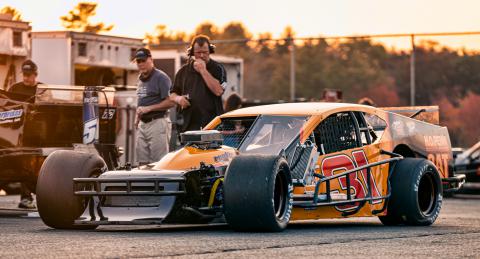
Asphalt modified racing is undoubtedly a hot commodity these days. Despite the turmoil of 2020, various series have seen strong car counts in a number of different divisions, and from the looks of it, it’s a trend that will carry additional momentum going into the 2021 season.
“We had a 50% capacity restriction last year due to COVID,” said Michelle Cloutier of Monadnock Speedway, Winchester, New Hampshire. “But thankfully, it didn’t really affect our bottom line—in fact, it was one of our best seasons in years. There were only so many things open in our area, so that translated to a lot of new faces. And, of course, the hope is that it continues through this year, with the expectation that more people will be able to come back to the race track.”
But the popularity of these tube chassis oval track racers didn’t happen by accident, nor did it appear overnight. The success of asphalt modified racing, particularly in the eastern regions of the United States, has been the result of concerted efforts by tracks, promoters, and racers to shape this into an inclusive and adaptable racing discipline.
“These guys can put together a car and run it at a variety of different tracks with a number of different series and divisions with minimal adjustment,” noted Kyle Souza of the Tri Track Open Modified Series, Seekonk, Massachusetts. “And that’s incredibly appealing to a driver—I have drivers who’ve run 10 to 12 different tracks using the same car with five or six different series. They’re able to go out there, have fun trying different things, and come back to race at their local tracks close to home when they want to.”
Despite a rocky 2020, asphalt modified racing is on a winning streak, as our source at Stafford Motor Speedway reports car counts as high as 50 entries for a single race.
But that doesn’t mean there aren’t also significant challenges that have the potential to create headwinds. “The teams are pretty excited about what’s going on right now,” said Mark Arute of Stafford Motor Speedway, Stafford Springs, Connecticut. “But the thing that’s always been a big concern is the economy. That, of course, affects both the teams and the tracks, and how that will shake out over the next few years is still a big unknown. But there’s a lot of optimism right now.”
To ensure the ongoing health of the sport, organizers and racers continue to work together to refine the rough edges where they exist. And as we all know, when it comes to racing, appeasing all parties involved can be a very delicate balance. Yet in the case of asphalt modifieds, the strategies appear to be working.
Strength In Numbers
“Asphalt modified racing is going through kind of an evolutionary period at the moment, and we’re seeing that tour-type modifieds are kind of the thing right now,” said Souza. “It allows a variety of different competitors to come from a variety of different places. Teams don’t want to spend tons of money to run full-time in the NASCAR Whelen Modified Tour and are instead coming to run in series like ours, where we have six or seven races a season, or they’re competing in series operated by their local tracks.”
And Stafford Motor Speedway’s Open Modified Series serves as a good example of the latter. “A few years ago, we decided that we wanted to run our own series of open races where we tech the cars, and it quickly became very popular,” Arute said. “Our purses paid out a comparable amount to our competitors versus the Whelen tour, but we were able to contain our expenses within our own group. It’s incredible what has happened with these Open cars—there’s been a big shift toward them. We had a Tri Track event here last fall where we had over 50 entries for one race in that one division.”
Cost control often drives rule changes. Tracks like Monadnock Speedway, for example, have adopted a strict tire rule in which racers buy eight tires for the season and can replace two tires per week.
And, as Cloutier explained, the widespread adoption of GM’s durable 604 crate engine package has been a significant factor in that. “Our weekly Division I races in NHSTRA Modifieds continually see a lot of interest. We have three tracks that regularly run them, and we’re all on the same 604 crate. Ever since we moved to the 604 package a few years ago, the fields have definitely continued to grow. The 604 is a legitimate race engine, and it has helped these drivers be competitive across a number of different series. A number of our drivers also compete in Tri Track events with their 604s and do quite well.”
The prospect of significant payouts is also an incentive that keeps racers at all levels of competitiveness involved. “I think the purse structures are really good right now,” Souza told us. “With the Tri Track series, our purse is over $40,000 for one race, and we pay 26 cars to start the race. So even if you finish in 26th place, you’re still awarded $1,000. We’re also paying out even if you don’t make it into the race—we’re averaging somewhere between 35 to 40 cars, roughly. Even the racers that don’t qualify go home with at least 300 bucks. And that’s not just us, either—these local tracks have really good purses for their asphalt modified races, too. The drivers know that they’re probably not going to make a bunch of money through racing, but they’re more comfortable getting involved when they see these purse structures and realize that they’re not potentially going to lose a lot of money if they go run a certain race, even if they don’t finish well.”
Striking A Balance
Even with generous payouts, asphalt modified racing can be a costly endeavor for drivers. But as technology improves and the competition gets fiercer, organizers also have to find ways to keep performance in parity amongst the field without forcing racers’ significant investments into obsolescence—or allow teams with deeper pockets to out-spend the competition in order to move to the front of the pack.
Asphalt modified racers are leaning toward small, relatively local series over big tours, according to our source at Tri Track Open Modified Series, where standardized rules have made it appealing to run multiple series.
“You don’t go to the junkyard for any of this stuff, so it can be very expensive,” said Arute. “So we do have some pretty stringent tire rules here. Most of these guys can’t afford to continually bolt on a new set of tires every week. So basically, you start off the season with an inventory of tires, and after every race you can swap two of them. That can be frustrating to some competitors because they feel they could run faster. But what some of them fail to realize is that, if everyone had a new set of tires every week, we’d just be right back where we started in terms of competitiveness. Everyone would just be spending more money to get there.”
Cloutier told us that Monadnock Speedway has adopted this tire rule as well. “In the last few years we’ve done some small changes, and the focus has been on keeping the costs down. The two-tire rule was implemented to make sure people can’t out-spend each other on those. At the beginning of the season we allow the competitors to buy eight tires for inventory, and they’re allowed to replace two tires per week for the season. And if the teams do it right, they should have good tires throughout the year.”
Better communication between promoters and a willingness to work together on scheduling has been a boon to modified racing—and drivers—in recent years, according to our sources. Photo courtesy of Stafford Motor Speedway.
Souza said the adoption of a more standardized rule set across various series is a big part of asphalt modified racing’s recent evolution. “Over the last three to four years, Tri Track has kind of taken the lead on putting together a generalized rule set that would be able to conform to what everyone wants to do,” he explained. “And I think that, as far as rule sets go, that’s been the biggest change—the rule sets are all now much closer to one another, and series are now more likely to work with each other to make sure that everyone can run with the same car across a number of different events with minimal changes.”
Souza added that improving the lines of communication has been another key factor in the asphalt modified success story. “Honestly, the biggest change to me is the fact that the promoters are willing to work together,” he admitted. “Previously, the promoters typically didn’t talk with one another, but the promoters up here get along really well now—they’re willing to work with each other and make sure they’re not stepping on one another. That’s a big shift from five years ago or so when the promoters didn’t get along, and that made it more difficult not only for the promoters, but the drivers and tracks as well. When the promoters don’t talk, you end up with situations where there are two big modified races within three hours of each other on the same night. That doesn’t benefit anyone.”
The Road Ahead
Though all agree that asphalt modified racing is in a good place right now, there’s some trepidation about allowing the pendulum to swing too far in the opposite direction as restrictions are lifted and racers return to the track in increasing numbers.
“It’s been something we’ve had to keep our eye on for the last couple of years, actually,” Cloutier recalled. “You have MRS (Modified Racing Series), you have Tri Track, you have Whelen Modifieds, and now everybody’s trying to schedule things where it’s not conflicting with another event because they’re sharing drivers. Choice is great, but at a certain point it’s not special anymore. And that affects the fanbase, too. There’s only so many events you can do in a season.”
The success of asphalt modifieds brings concerns of over-saturation, with too many events for racers to choose from. But it’s a feast for fans, and the sport overall is enjoying vibrant health. Photo courtesy of Tri Track Open Modified Series.
It’s an issue that Souza characterized as over-saturation. “I think the market for 2021 is a little bit flooded. Right now, from April to October, there’s over 40 open modified races that are scheduled from New York to Maine, and that translates to just three weekends where there isn’t an event. So from a driver’s perspective, they’re going to have to pick and choose what races they’re going to compete in—it’s just not feasible to say that you’re going to run 40 races in a season. You can’t run every weekend like that. So that’s a new challenge that’s coming onto the scene here kind of inadvertently. But from a fan’s perspective, it’s shaping up to be phenomenal year for asphalt modified racing. So we’ll see how it goes for 2021, and that will kind of guide the way going into 2022,” he concluded.
From working with big-name brands like BMW, Michelin, and The Harlem Globetrotters—plus specialty brands like Trijicon, AEM Performance, and Vision Wheel, Jackson Marketing Motorsports & Events Group seems to have done it all.
The PRI Road Tour caught up with Darrell Jackson, the Jackson Marketing president and CEO, during our visit to its Santee, California-based operations.
Take a look inside this unique company, which does everything from mounting race tires to running race day events, and everything in between.
Building winners for nearly three decades, GRT Race Cars has emerged from recent tragedy with renewed focus.
When your company slogan is “We Build Winners,” there isn’t much wiggle room for missing the target. Over nearly three decades, GRT Race Cars of Greenbrier, Arkansas, has built a stellar reputation and can point to a long list of racing wins, championships, and star drivers among its accomplishments. Most recently, GRT won IMCA’s 2020 Manufacturers’ Cup competition, earning 49 points to the second-place builder’s 34.
The latest accolade came as a welcome spirit booster as GRT moves forward from the tragic death of founder Joe Garrison in 2019. Many racers could share stories of their camaraderie with Garrison over the decades. His widow, Katie Garrison, recently stepped away from the business to deal with her own health concerns.
Wesley Wise, a dirt driver since age 14 and someone who’s been enjoying his own success with GRT-built modifieds, stepped in to manage the business in early 2020. He recently told us that his top priority is to maintain the company’s renowned build quality while driving growth in both car production and parts sales.
Humble Beginnings, Big Impact
Like many builders across the racing spectrum, GRT began in its founder’s garage. Today, the business occupies three buildings with a nearly 20,000-square-foot presence, including a 5,000-square-foot parts warehouse. Indeed, parts sales remains a major component of the business, with the teamgrt.com website touting about 100 race and performance brands. Although customers cannot yet order parts through the site, Wise said that service will be available before too long.
The main business, of course, is building race cars. And they’ve built a lot of them—more than 3,200 dirt late models and 1,700 modifieds over the company’s history.
The front shop handles the interior and jig work, and also houses the main office and parts operation. Another building houses the machine shop, CNC lathe, welding, and related work. In between is the powder coating shop.
The facility has built a little over 100 dirt modifieds a year for the past few years, according to Neal Cullum. A GRT veteran, Cullum returned to the business five years ago after a long stint running and then selling his own body shop supply business. He said GRT also builds a small number of dirt late models per year, and built about a dozen stock cars in 2020.
GRT Race Cars is in transition after the 2019 death of founder Joe Garrison, but output remains strong—over 100 modifieds, about a dozen stock cars, and a few dirt late models per year.
Cullum said the production mix has changed over the years, with modifieds and dirt late models essentially swapping positions in their share of production. He pointed out, though, that dirt late model production has been edging upward recently. He called the jig the most important piece of equipment in the shop, since, of course, you cannot build a car without it.
Wise indicated that GRT was aiming to increase annual production but did not give a specific target, simply saying they wanted to “build as many as we can sell.”
GRT modified drivers have captured wins in a number of high-profile events over the years, including the $100,000-to-win Modified Special and the World Modified Championship at Batesville Speedway (Arkansas), the Xtreme Modified Super Nationals at State Fair Speedway (Oklahoma), the Justin Stanfill Memorial and Show-Me Championship at West Plains Motor Speedway (Missouri), and many more.
Staff Growth
GRT currently employs about a dozen people, having recently hired a few new techs for production. Cullum explained this was not a common scenario for the company, and that turnover has not historically been an issue for GRT.
“Most employees have been here many years,” he said. “Some older employees, including me, have come back.”
Cullum added that finding the right balance in an employee can sometimes be a challenge. “They have to have some good sense about them, because it’s repetitive work,” he said. “You have to want to work, and you have to have the care factor.”
Decades of Expertise
Cullum and Wise are quick to credit their builders for maintaining high quality standards at GRT. Tim Macomber, the main welder, has been with GRT for more than 25 years. Mike Strope, the interior and deck man, has been with the company for 20-plus.
“They’re very meticulous,” said Cullum, who handles body and mechanical work. “I’m pretty picky myself. We get a lot of compliments on our work. When racers pick them up, they’re always pleased with the sheet metal work. Then, when they get the car home, they see what’s under it and it makes them even happier.”
He again emphasized personal commitment as critical to quality. “You have to have people that care,” he said. “Tim has a couple of new guys helping. They all take their time.”
Macomber emphasized that he inspects all of the work done by those he supervises to ensure quality, and that nothing is taken for granted. “We’re always working to build a better quality car,” he said.
Nationwide Dealers
Most GRT cars are sold through about 35 dealers in two dozen states. The newest addition, Speciale Engines in Frederick, Maryland, took delivery of its first GRT dirt late model in late January. Local racers usually order directly from GRT, Cullum said.
Wise explained that dealers or customers will pick up the cars themselves or send someone to haul them. Dealers commonly pick up three at a time.
Many of the dealers are also drivers, including fan favorites Jordan Grabouski in Nebraska and Terry Phillips in Missouri. Phillips has been a certified GRT dealer for more than 20 years and has been driving GRT cars for even longer; decades ago, his father became good friends with Garrison after meeting him at a race in Florida.
Four-time national modified champion Jordan Grabouski has owned “about 20” GRT cars during his racing career. “Their quality and craftsmanship are second to none,” he said.
As Phillips explained, his father was unhappy with his car at the time, and Garrison helped him take the parts off a show car he’d brought to the races and install them on his car. Pleased with the results, the elder Phillips switched to driving GRT cars. When Terry was still in high school in the 1980s and driving another builder’s car, he’d gotten to work on his father’s GRT car, and the experience was an eye-opener for him.
“I saw how well they were made and began driving for them,” recalled the 2020 National Dirt Late Model Hall of Fame inductee.
Phillips began with a series of GRT dirt late models and then switched over to modifieds in 2005, winning the $100,000 Modified Special at Batesville Speedway that year. He has been driving and selling GRT modifieds since.
Phillips said his most memorable wins included the $33,000 Show-Me 100 in 1999 and the $100,000 Modified race in 2005.
“We sell quite a few,” he told PRI about the GRT cars.
Most of GRT Race Cars’ chassis are sold through about 35 dealers in two dozen states. Local racers usually order directly, said a company source.
Phillips’ close friend and fellow racer Grabouski, also a frequent visitor to the podium, has been racing GRT cars full-time since 2013. “I’ve had good luck in GRT race cars,” the four-time national modified champion said with casual modesty. He also was instrumental in GRT’s IMCA Manufacturers’ Cup last year, taking the Jet Racing Central Region crown for the fifth time.
Grabouski began racing at age 11 in a mini-sprint and has seen enough cars during his career to compare quality. “I’ve had about 20 GRT cars,” he said. “Their quality and craftsmanship are second to none. It’s just one of the best cars on the market. The quality and consistency are as good today as they were 20 years ago.”
Modernizing Parts Sales
As mentioned, GRT’s parts business handles more than 100 brands, according to the website, and that keeps its shippers plenty busy.
“We have a big parts business,” confirmed Wise. “It’s a critical part of GRT. We’re working on keeping enough inventory so that when someone calls, we can ship it out that day.”
All parts inventory is located at company headquarters. There are no other warehouses around the country, though some dealers keep parts in stock. The most common parts GRT ships are front suspension and bumpers, and the largest parts shipped on a regular basis are body and interior kits. Those large pieces ship via FedEx Freight, and the rest go by UPS.
Neal Cullum handles body and mechanical work, focusing on craftsmanship and personal pride in the cars GRT builds. “We get a lot of compliments on our work.”
While GRT can provide same-day shipping, it is the ordering process that Wise wants to modernize. Right now, most orders come in over the phone; some others arrive through email. While phone is a good way to keep in touch with racers, Wise understands that what they really want is online ordering. A website update to add that service is among his near-term goals.
Change on the Horizon
Wise said he is looking forward to the opportunities ahead for GRT. The business is growing, and not only because of the start of racing season. While the company is busy filling a backlog of car orders, Wise quipped that he wants to implement “a million things.”
New hires will help the company meet increasing demand, and Wise also has some ideas for the cars. “We want to focus on making our cars as customer-friendly as possible, to make it simpler for them to dial themselves in rather than dial themselves out,” he said.
As for marketing and promotion, GRT maintains and updates a Facebook page, showcasing its racers’ success as well as its own business news. Cullum said there is an occasional class sponsorship at a track, and that dealers advertise their GRT affiliation. The company, though, relies mostly on winning races to stay top-of-mind and drive sales.
“Our reputation and word-of-mouth are the biggest business drivers,” Wise said. “Our product speaks for itself.”
Meyer Distributing, Inc, the automotive specialty products marketing and distribution provider, has announced the addition of its Bear, Delaware location. The cross-dock will have a direct, next-day feed from Meyer’s East Hanover, New Jersey-based distribution hub, which houses one of the largest inventories of automotive accessories, exhaust, and related parts in the region.
“Delaware has always been a difficult market for us to reach,” Meyer Distributing Director of Sales Cody Ziegler said. “With this new cross-dock, we look forward to doubling the frequency to cities in the state and dramatically improving our service levels.”
“It’s been quite a year for logistics companies trying to maintain reasonable service levels with such day-to-day unpredictability on driving staff,” Meyer Distributing CEO Jeff Braun said. “But we’re optimistic for improving stability in the months ahead and looking forward to focusing on growth initiatives again. We have lots of new routes, trucks, and drivers being added to the roster, and as always, we appreciate the customers who send us driver referrals.”
A veteran promoter shares how he drew fans to his three Texas tracks last year, all while keeping everyone safe and at an adequate “social distance.”
THE Problem: How to effectively maintain social distancing among attendees at the race track
THE Solution: Utilize remote, text-based concession ordering and pickup; incentivize advance ticket sales for easier admissions
Leave it to a lefty to see the coronavirus pandemic as an opportunity.
“The second this COVID-19 thing came along,” explained promoter (and proud southpaw) Darin Short, “and I knew we were going to be down for a little bit, I thought, ‘Okay, let’s gear up on merchandise and online sales, and just go with the flow. But let’s also look at what opportunities we can have once this thing opens up.’”
That led Short, who runs his own marketing firm and promotes several dirt-track racing series at Texas-based venues like 82 Speedway, Kennedale Speedway Park, and Monarch Motor Speedway, to develop some inventive solutions to coronavirus-safety challenges, chief among them the need to maintain social distancing.
Text-Based Concession Ordering
The first of Short’s coronavirus-driven innovations is a simple, inexpensive text-based ordering system that eliminates lines at concession stands. Rather than using a complex, pricey app with credit card processing, his method instead relies on a low-cost app-based secondary smartphone line. This provides a dedicated business phone number to any smartphone running the app. Concession stand employees assigned to text-order duty can therefore use their own phone to handle text orders without having to give out their personal phone number.
For this, Short uses GoDaddy’s $9.99-per-month SmartLine service (godaddy.com/smartline), but other companies such as Sideline (sideline.com) and eVoice (evoice.com) offer similar packages.
“You simply give the SmartLine app and login to the employee of your choice manning that segment of your sales that night,” Short told us. “Customers just text and say, ‘I want a Sprite and a Snickers.’ Then the concession person quickly texts them back saying, ‘Order received, we’ll let you know when to come down.’ When the order is ready for pickup, they’re texted again. Customers then pick up their orders, pay for them, and go back to the stands.”
The menu for food items is posted on the track’s website, while signs throughout the track give fans the number to text and encourage them to order remotely. Although simple and inexpensive, the system has been a big hit, not only improving coronavirus-safety compliance, but providing a better customer experience as well. “The fans go crazy over it,” Short noted.
To eliminate lines at concession stands, Darin Short and the team at Monarch Motor Speedway in Wichita Falls, Texas, instituted an inexpensive, text-based ordering system that allows fans to place their food and drink order from their grandstand seat, and then receive a text when the order is ready for pickup.
Spacing in the Stands, at Entrances
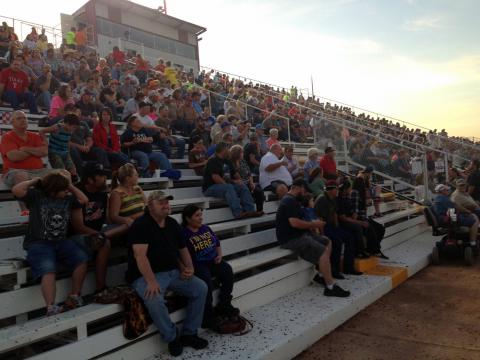
Short’s approach also fits well in solving the need for social distancing during races. To enforce the recommended six-foot guideline, Short simply blocks off every other row of the grandstands, then reminds fans about it several times via PA announcements. In doing so, he has turned a negative situation into a positive for attendees. “Fans look at this seating arrangement like it’s more of a VIP experience,” said Short. “It’s so much more relaxed with the extra room.”
To solve the potential problem of lines at entrances, Short has developed a method that emphasizes advanced ticket sales and carefully orchestrates entering the facility. It begins by enticing attendees to order online, which is done by discounting advanced tickets a few dollars, not charging additional fees, and allowing online ordering up until the day before the race.
It has proven to be an effective system, but implementing it is ultimately the job of those who manage the facility itself. “Track owners Shannon and Misty Kelton at Monarch Motor Speedway do a fantastic job operationally,” said Short. “We stay in touch multiple times a day as ticket sales come in to get ourselves organized for race day. Then, the afternoon of the race, they have a staff of people outside at the parking entrance, each with an accordion folder that has advanced ticket holders filed A to Z. That person just asks each carload, ‘Do you have advanced tickets?’ If the answer is ‘yes,’ the staff member checks the list and gives them wristbands. If the answer is ‘no,’ then they’re told to grab a parking spot until the ticket window opens. They basically take people by the hand. And then the fans literally walk in the gate, grab their beer, sit down, and enjoy the races.”
According to Short, the system has nearly eliminated crowds and ticket lines for large events. “There was some legwork,” he told us. “It took more time for people at the race track to do this. But it was free for the race track. And the fans went nuts for it. It could be 97 degrees that day, and they got to stay in their car with the air conditioning on.”
Unsurprisingly, Short views these measures as part of a larger effort to leverage the pandemic as an opportunity for auto racing. “This is the time for outdoor motorsports to shine,” he said. “The stick-and-ball folks can’t do their thing. So now that opens the door for auto racing venues to grab new customers. People can say, ‘Hey, this is a safe place for our family to go at this troubling time.’”
 MEMBERSHIP LOGIN