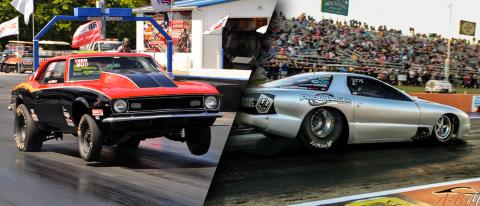
Officials with Charlotte Motor Speedway have announced a limited capacity for the NGK NTK NHRA 4-Wide Nationals event, set to return to zMAX Dragway on May 14-16.
“Through our successful efforts to bring NASCAR back to Charlotte Motor Speedway and with additional key learnings from several of our sister tracks, we feel confident, with the fans’ help, we can once again execute a safe race weekend and bring NHRA drag racing back in a big way,” said Charlotte Motor Speedway Executive Vice President and General Manager Greg Walter.
Under state and local restrictions, new safety protocols will be in place to ensure the health and wellbeing of those in attendance. These protocols include health screenings for fans, contactless ticketing, socially distanced grandstand seating, and cashless purchases.
Attendees will also be required to wear approved face coverings at all times, except while actively eating and drinking. Limited grandstand seating will be in groups of up to six people properly socially distant from any other group. There will also be no trackside viewing along the fencing as part of this event.
zMAX Dragway’s modified race day protocols also include: social distancing in concession and bathroom lines; enhanced cleaning and sanitation in high-touch, high-traffic public areas; added hand-sanitizer stations; and limited guests in suites.
External surge tanks have become popular with racers who suffer fuel starvation during extreme cornering or demanding activities, such as drifting or sudden acceleration in drag racing. However, that type of tank requires a dedicated mounting location and additional plumbing.
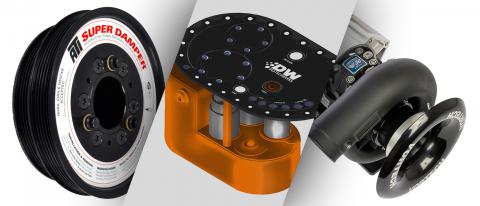
DeatschWerks is now offering a surge tank designed to fit inside a racing fuel cell.
“One of the biggest issues with keeping a motor alive on the track is fuel slosh and starvation,” said Dakota Bowman. “This is designed to prevent starvation and get full use of a tank.”
The DeatschWerks surge tank has a standard 8- x 10-inch, 24-bolt fill plate and features a -10AN outlet and -6 return. It’s configurable for single- or dual-stage, and it will support up to four fuel pumps.
“You never want an instance where the pump isn’t getting fuel. If you’re on power or in boost and go lean, most likely it will be detrimental,” said Bowman. “You may lose the whole motor and not just the race. This two-liter surge tank acts as a cushion for the fuel system.”
The surge tank is constructed of hard-anodized aluminum and is safe for all types of race fuel. It includes a rollover check valve and is rated up to 2,500 horsepower. —Mike Magda
As the base gas engine in the new Ford Super Duty pickups, the 7.3-liter pushrod V8 embraces time-honored performance attributes: big-bore iron cylinder block, aluminum heads, composite intake manifold, forged-steel crank, and header-style exhaust manifolds.
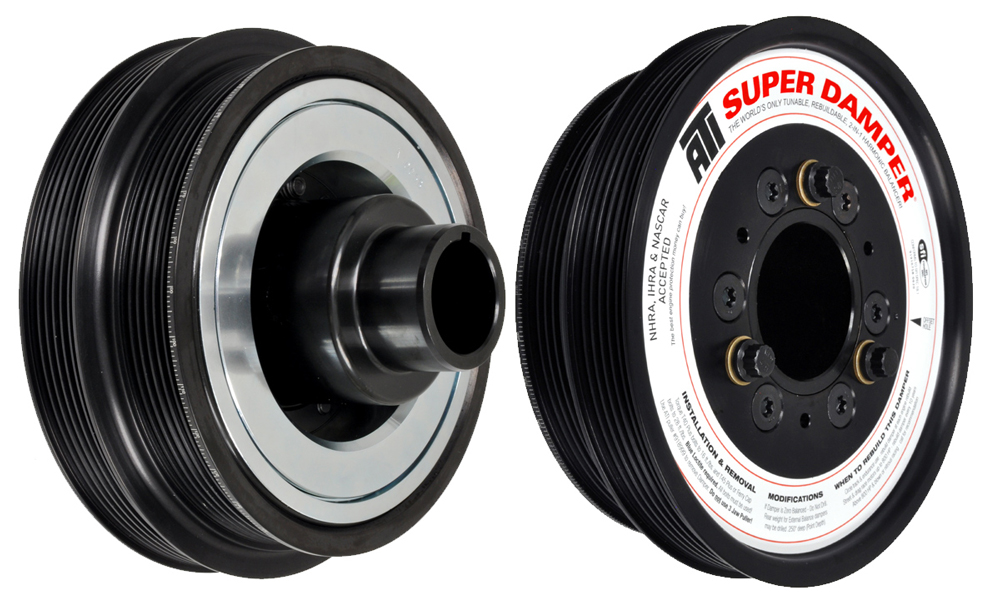
As a 430-horsepower crate engine nicknamed Godzilla, it has hot rodders and engine builders slobbering over each other to see who can double or even triple that power output. With so much potential, ATI Performance developed a Super Damper to replace the factory unit.
The ATI Super Damper shell is constructed from billet aluminum with a 4140 heat-treated steel hub. It comes in the factory 6-inch diameter and features a 5-inch inertia weight. Other features include laser-etched timing marks and a single 3/16-inch keyway; and it exceeds SFI 18.1 safety certification.
“We have already done a few overdriven versions for Whipple Superchargers to make some serious power,” said JC Beattie Jr. “Otherwise the main customers are going with us, not so much just for the mandatory SFI, but since they know it’s a better built, functioning part than the stock bonded damper.
“With our modular design and being able to adapt to many different belt profiles, additions, subtractions, and spacing, the ATI Super Damper is very capable of handling all the engine swaps,” Beattie added. —Mike Magda
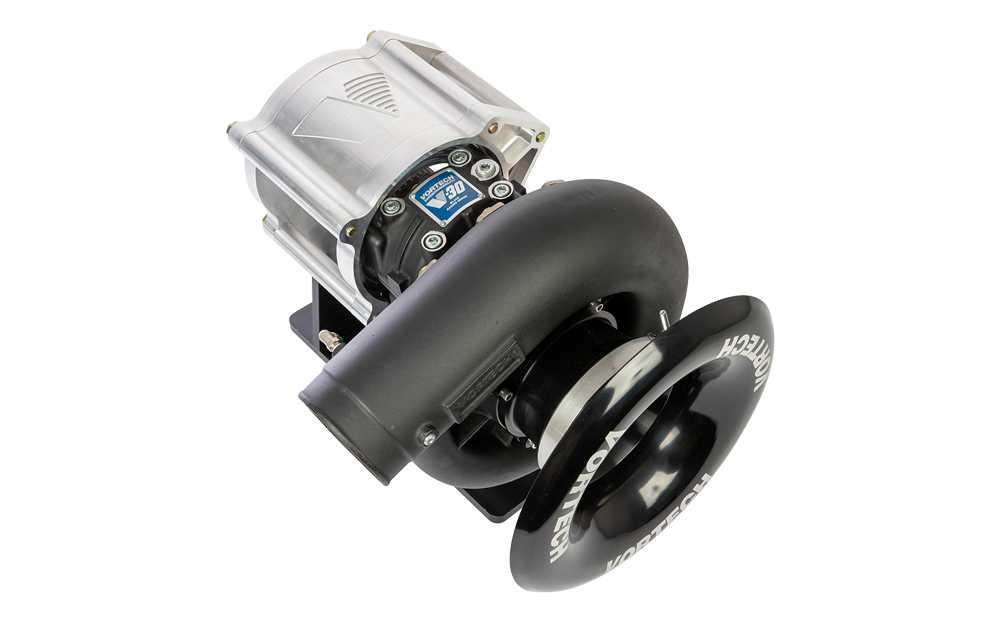
Big block Chevy racers who favor the popular Vortech V-30 series centrifugal supercharger will have a unique mounting option with the company’s new billet aluminum bracket assembly.
The twin-plate construction fits both 9.8- and 10.2-inch deck height blocks. Features include dual-bearing, hard-anodized billet aluminum idler with flanges, drive-belt idler adjustment screw, billet water crossover assembly, and a billet aluminum 50-mm cog drive. The assembly also comes with high-grade mounting hardware.
“We continue to focus on sanctioned drag racing classes with the V-30 supercharger, as well as auto enthusiasts, by offering belt-driven billet race-mount bracket assemblies for big block Chevys along with small block Fords and LS Engines,” said Brian Cox.
The V-30 is well-regarded in the boost community with kits designed to deliver from 1,500 up to 2,800 horsepower. It offers maximum flow of 4,000-plus CFM and can provide 45 pounds of boost. The modular design allows a wide range of compressor stages for those racers who switch between classes at select events, or between sanctioning bodies during the season. —Mike Magda
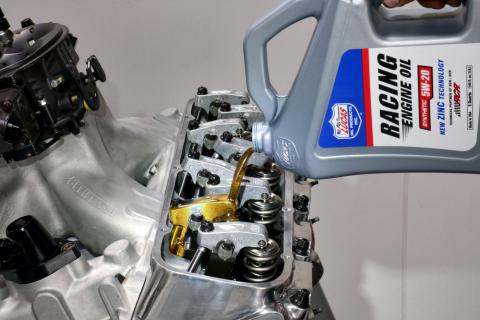
How lubrication companies are adapting to changes in the performance industry, and the products they’re bringing to market.
Some oil and lubricant companies are finding themselves at a crossroads, their product development teams being pulled by opposing market forces. On one hand, the lubrication needs of passenger cars are being driven by ever-present pressures to increase fuel economy. One result of this trend is the formulation of thinner and thinner oils, with viscosity “down to dangerous levels if you aren’t using an oil with high film strength,” said Len Groom of AMSOIL, Superior, Wisconsin. It’s not uncommon to see manufacturers recommend multigrade oils with the winter weight in the single digits—or less. “When you’re talking about 0W-16 or 0W-20s, you need to really pay attention to what you’re doing so you don’t get bearing wear.”
“We actually have a 0W-0 in R&D right now,” added Kyle Fischer of Hot Shot’s Secret, Mt. Gilead, Ohio. “It looks like the consistency of water.”
On another front, the American Petroleum Institute (API) recently drafted a new SP oil specification to help prevent low-speed pre-ignition (LSPI), which is “the tendency for a turbocharged engine to detonate at low rpm but high boost pressure,” Groom explained. “In order to get the mileage they’re looking for, [automakers] have to tune the timing and fuel map at a place where it gets close to detonating the piston. A properly formulated racing oil is going to have a tough time passing that spec due to the way oils are put together.”
And there’s the crossroads: “To make some of the mileage requirements, you have to do things to the product that won’t be great for a race engine,” Groom said. “There was a time when an oil could do both jobs, but now the passenger car world and the racing world have gotten so specialized, it’s almost impossible to do both jobs with one product.”
Some lubrication companies have found a way to do both, while others choose to concentrate purely on the racing side of the industry. What follows is a look at some of the latest oil and lubrication products formulated to meet racing’s high-powered, high-pressure demands.
“Our Oil in Everything”
TriboDyn in Mooresville, North Carolina, is launching “a whole new generation of engine oils,” said Mark Wheatley. Where the company previously had just one high-performance fully synthetic lubricant, it will now have two, TRI-EX and TRI-EX2.
TRI-EX2 is “an improved formula of our original product,” Wheatley explained. The patented ceramic lubricant forms “a ceramic coating on the substrate during extreme conditions. It’s designed to adhere right before micro-welding or galling and stop those things.” Many racing oils tout their ability to withstand extreme pressure, but Wheatley has independent testing to back up the claim, showing the oil maintains its film strength at pressures above 300,000 psi. The new TRI-EX2 formulation still comes out of the bottle in its distinctive blue color, though there is less dye in the new formulation to help avoid stains.
TriboDyn’s all-new TRI-EX has a proprietary synthetic formula that “treats the metal,” Wheatley said. “It embeds itself in the metal to fill in the pores and make it smoother, slipperier.” Early testing of the oil indicates that the friction-reducing properties from its metal treatment only improve over time. An Australian superbike rider tried the new oil in his Honda CBR1000RR and compared it with another oil brand. Not only did the engine make more power on the dyno with the TriboDyn oil, but it also kept “getting better and better on the road,” the rider told Wheatley. A year and about 3,000 miles after first putting the TRI-EX in, the Honda made even more power on the dyno.
Both new TriboDyn oils meet or exceed API specs, Wheatley said. “I want our oil to go into everything. It will lower operating temperatures and protect the engine, but you can also put it in a race car. That’s what it’s really built for, but why not have better oil in your daily driver?”
Wheatley plans to introduce the new TRI-EX oil in the spring, at a price point of around $12.50 per quart. TRI-EX2 will phase in at about the same time, priced at between $16 and $17 per quart. Both oils will be manufactured in Mooresville and will be available in quarts and gallons, “but we can special-order pails and drums,” he said.
Efficiency
Lubrication companies have various ways of describing their products’ relationship to power—how an oil can “make” power or “free” power. The key factor here is efficiency: Engine output will increase as its efficiency increases.
Engine efficiency loss is primarily due to friction between its hardware components. Data collected by VP Racing Fuels in San Antonio, Texas, show that most of that loss comes from the main bearings, followed by the piston rings. By reducing this metal-to-metal friction with properly formulated oils, an engine will see increases in horsepower, torque, and fuel economy, as well as lower operating temperatures—all signs of improved engine efficiency.
VP’s approach to formulating a high-performance lubricant is three-fold, a company source said: Improve the ability of the oil to cling to metal components by improving viscosity using select base oils with polar characteristics; add anti-wear chemistries beyond ZDDP that create a protection layer on the metal surfaces; and add friction modifiers to reduce surface friction between the oil and moving metal components and reduce fluid-to-fluid friction.
VP has quantified its efforts by working with several engine builders who have seen “real horsepower gains” during dyno tests of VP’s oils, the rep noted. Many of these builders have also documented engine tear-downs to inspect for wear and have found engine internals that look “virtually new” and can be reused beyond their traditional replacement intervals.
In fact, VP has formulated several lubricants for the racing community. Among them is its Nitro Hi-Performance oil, a conventional 70-weight oil designed for the “extremely stressed” engines used in drag racing and tractor pulling. Its heavy viscosity and high levels of ZDDP provide “critical protection” for high-load, high-torque applications. It can be used with gasoline, diesel, alcohol, or nitromethane fuels. At a weight of 0W-50, VP’s full synthetic EX HP Hi-Performance Oil is blended to protect an engine at high and low temperatures, provide fast flow to critical engine components, and prevent high-temperature shear. High levels of ZDDP in the formulation protect flat-tappet and roller camshafts.
Tenacious Cling
The new GP-1 Assembly Gel from Driven Racing Oil in Memphis, Tennessee, is “really revolutionary,” said Kyle Fickler.
“It’s not really a complete fluid like a lube oil, but also not quite as thick as a grease,” added David Chamberlain. Comparisons to hair gel are apt, they said, since the company supplying the gel base “makes products for the health and beauty industry,” Chamberlain explained. “We add our zinc additive, our moly, and a few other things that are suspended by that gel compound to make a unique anti-wear formulation for initial dry start-ups.”
Engine builders who have used the gel appreciate the fact that “it stays where you apply it,” said Chamberlain. “It has a tenacious cling to it.” That’s important, he said, because so many engines aren’t started immediately after assembly. “I would estimate 80% of builds aren’t getting fired within the first month. For that reason, engine builders would have gone with our assembly grease in the past because it hangs on.”
Driven Racing Oil’s new GP-1 Assembly Gel is said to cling like grease for extended periods before startup while still being thin enough for easy hand rotation of engines.
The gel hangs on, too, with an added benefit. “Some engine builders don’t like to use grease on the bearings because it gets a little sticky and won’t provide a great feel when rotating the motor over by hand,” Chamberlain said. “The gel isn’t as thick and won’t be as resistant, so you’ll get a better feel by hand.”
Driven sells the GP-1 Assembly Gel in one-ounce packets, enough to assemble a complete engine, Fickler said. “When you first grab it as an engine builder, you wonder how many packets you’ll need to do the engine. But as you start working with it and realize how good of a lube it is, you’ll use less of it than you would a grease because of the feel it gives you.”
Sweet Crude
While best known as a synthetic oil company, Driven took a different approach with its GP-1 line of racing oils.
“GP-1 is essentially what an advanced Kendall GT-1 would be today,” said Chamberlain. “What made that oil so good was the base oil,” a sweet crude from Pennsylvania “with unique anti-wear properties. It wasn’t just marketing fluff. There really was something about the base oil from there that made it special.”
To formulate GP-1, Driven blends the Pennsylvania crude with a synthetic base oil and “an additive package we developed in the [Joe] Gibbs days,” Chamberlain said. Additives include Driven’s proprietary ZDDP package and a moly Chamberlain described as an “anti-wear additive, but not in the same sense as zinc. It’s an extreme-pressure additive that complements the ZDDP, but it’s also a friction modifier. It frees up a little bit of power with a little lower coefficient of friction.”
GP-1 “also has the same tenacious cling as the assembly gel,” he added. “When you talk to someone familiar with using it or any legacy Pennsylvania base-oil product, the thing you hear is, ‘the cling.’ They’ll describe pulling a motor apart that’s been sitting for some time, and the valvetrain and other key components were still wet. They have a hard time cleaning if off their hands after they’ve been touching it.”
Chamberlain admitted that before formulating GP-1, “we were synthetic guys. And synthetics have their place. In really high-temperature situations, like endurance racing or road racing, that’s where you want our XP full synthetics. But for the majority of racers, especially at the grassroots level, who aren’t putting that extended use on their applications and are changing oil earlier, that’s where the GP-1 synthetic blend can have some benefit and be more cost effective.”
In addition to its GP-1 multi-grade engine oils, Driven plans to introduce “a couple of monograde oils, including a straight 40- and 50-weight for drag racers who want that instead of a 20W-50,” Chamberlain said. The company is also rolling out a new 20W-50 GP-1 break-in oil in the near future.
Building Blocks
The trend toward thinner oils applies to racing as well as street cars, “because the thinner it is, the more power it will make,” Groom said. “But at the same time, we have massive valve spring pressures, massive engine speeds, and huge boost pressures in some of these engines. So, your building blocks have to be strong, and you have to start by using a really good base oil. A lot of an oil’s film strength comes from its base oil, and especially with turbochargers, superchargers, and nitrous engines, film strength is key.”
AMSOIL “tends to lean toward a higher-end base oil construction because we design and manufacture several oils recommended for extended drain intervals, Groom continued. “We can use some of those base oils to build our racing oils. Since we’re using an inherently stronger backbone, you get much better protection. The engine looks so much better even after you beat it up.”
Will Not Shear
Fischer used an evocative visual analogy to describe the molecular structure of the synthetic poly-a-olefin (PAO) base oil used in Hot Shot’s Secret Adrenaline Racing Oil. “Imagine you want to slide across a room full of balls. With a conventional oil, those balls are all different sizes—baseballs, basketballs, golf balls. You don’t slide very well.” A conventional synthetic, he said, is like a room full of baseballs and golf balls. “It’s a little more consistent and easier to slide across.”
In the case of the PAO oil, because “we have synthesized the molecular structure of the oil itself, now the entire room is full of tiny BBs. They are 100-percent identical, wall-to-wall, so you can run and slide freely, and not get hung up on different sizes of molecules. Not only can it theoretically not shear, it will not shear.”
Yet the base oil “is only half of the equation,” Fischer said. “We don’t take our foot off the pedal with the additive package.” That package includes a sulfur-based zinc additive; calcium; antimony (“which supercharges the zinc and its protection properties”); and the company’s patented FR3 Friction Reducer, with carbon nano spheres “that find every single little tolerance in the engine and fill those voids until there’s a completely flat film layer. The flatter the film layer, the more efficient it can be as a lubricant.”
Hot Shot’s Secret Adrenaline Racing Oil uses a synthetic poly-a-olefin base oil. Its consistent molecular structure is said to eliminate shear and reduce friction.
In the Hot Shot’s Secret product timeline, the FR3 Friction Reducer predated the Adrenaline Racing Oil and was sold as an oil additive. “We knew we had something really good,” Fischer said, “but we wanted some hard data to show people why and how our product worked.”
While looking for an R&D partner in the racing world, the company came across Firepunk Diesel of nearby Plain City, Ohio. What began as a request for dyno time at the diesel motorsports shop has since become a tight-knit racing partnership. Firepunk’s S-10 pickup, wearing Hot Shot’s Secret livery, has earned the title “world’s fastest diesel truck” with a record 3.998/182.67-mph eighth-mile pass during Lights Out 12 at South Georgia Motorsports Park in late February.
Ring Seal
Now that the problem of flat-tappet camshaft break-in “for the most part has been solved,” said Lake Speed Jr. of Total Seal, Phoenix, Arizona, what’s popping up now on his radar are problems with piston ring sealing. It has become an issue, he said, as engine builders move away from ductile-iron, moly-coated rings to steel rings with physical vapor deposition (PVD) coatings for use in high-power, high-cylinder-pressure applications.
“The moly coating on a ductile-iron ring is porous and can hold oil like a sponge,” Speed explained. “That oil is the gasket between the ring and the cylinder wall. With an old-school moly ring that could hold oil, cylinder-wall finish didn’t matter as much, and the break-in oil used didn’t matter as much because the ring held plenty of oil. Now, the steel rings with the PVD coatings don’t hold any oil. The cylinder wall has to hold all the oil. Cylinder-wall finish becomes really important, and since that cylinder finish is what’s holding the oil, the oil plays a critical role in the break-in process for the ring.”
Complicating the matter is the diversity of cylinder-bore materials used by racers. “For example, a gray cast-iron, regular engine block will like a mineral-based oil that’s higher in ZDDP, lower in detergent, and with no friction modifiers,” Speed said. “That package builds a very thick anti-wear film.”
Total Seal’s Quick Seat dry assembly lube is formulated to protect piston rings during break-in. The product reacts with clean metal, turning cylinder bores green.
On the other end of the spectrum “is something like Nikasil, an incredibly hard nickel silicon carbide plating. Nikasil has a very smooth finish, so you don’t want the same kind of break-in oil as would be used with cast iron, as it will make the surface too smooth. If it’s too smooth it can’t hold any oil, and now the ring seal will be bad.”
The solution, Speed said, “when you get into higher strength, harder materials like SUMEbore or Nikasil, is to use a mineral-based break-in oil with no friction modifiers, a moderate level of ZDDP, and a higher level of detergent, because it’s important to not build too thick of an anti-wear film. That would not be good for the ring.”
Applying Total Seal’s Quick Seat dry assembly lube to the bore also helps the process, he has found. “It works great, especially in a Nikasil application where you need something to protect the ring and help the break-in process. It’s a dry film, with no oil in it, that provides initial anti-scuff protection to protect the ring at start-up.”
Quick Seat will turn the cylinder walls green, but that’s a good thing, Speed said. “If it doesn’t turn green it means the cylinder bore isn’t clean. Any kind of residual honing oil or products like that tend to be acidic, and a chemical reaction with the Quick Seat leaves the bore black. If the bore is clean the Quick Seat reacts with the metal and it turns green.”
Beyond the Engine Block
“We focus on the heavy stuff,” said Danny Vaca of LAT Racing Oils, Orange, California. “Our niche is turbochargers, ProChargers, and even nitromethane. Every year they’re making more and more power, so you have to keep on top.”
A year ago, the company came out with its R-series of synthetic racing oils, “the second generation of our 20- and 30-weight oils to be more aggressive with ring seal,” Vaca explained. “It has high lubricity, but you don’t want to make something too slippery, or some of the ring seal might not hold very well.”
LAT Racing Oils focuses on “the heavy stuff,” such as boosted and nitromethane engines; its gear oils use advanced LFR additives for maximum protection.
LAT has also formulated a line of automatic transmission fluids specifically targeted at turbocharged drag cars, Vaca said. “When you’re talking turbochargers, you’re talking 3,000, 3,500, 4,000 horsepower. Obviously, the transmission builders have to build a more efficient converter so the transmission will hold up. Our formula is so aggressive, it holds the power in the transmission. Even when the transmissions get hot, our ATF doesn’t shear.”
LAT offers its ATF in three versions. “Pro Lite is for sportsman and nitrous, Pro ATF is for turbocharged cars, and Pro Max is for higher horsepower turbo, ProCharger, and blower cars,” Vaca explained. “It’s been a really good product for us, almost our number-one product.”
On the Horizon
Morgan Lucas of Lucas Oil Products in Corona, California, described the company’s new-product development as a “see-a-need, fill-a-need process. We’re looking at problems in the market, or ways to improve our products. We are also focusing on new markets, and new approaches to new markets.”
Lucas Oil recently brought Brandon Bernstein aboard “to head up our motorsports marketing efforts,” Lucas said. That addition has allowed Tom Bogner, Lucas Oil’s director of research development, “to spend more time in the lab working with chemists to look at the needs of racers.”
As an example, Lucas said Bogner has been working on “a fuel treatment to focus on ethanol- or alcohol-burning engines. It is really interesting technology, and we’re looking at how we can apply that best to the industry.” Lucas didn’t discuss specifics but did say the product “has been tested, and it works very well. We’re trying to understand the overall volume of business there. We may take some of the technology developed in the process and apply it to existing product to serve two different purposes for two different marketplaces.”
Our source at Lucas Oil Products described the company’s approach to new-product development as “see a need, fill a need…. We’re looking at problems in the market, or ways to improve our products.”
For some lubrication companies, the future is as much about new racing venues as it is new oil products. Groom, for example, talked about how sales of ATV and UTV oils “went crazy” during the COVID-19 pandemic. “Nobody was racing, but everybody was riding their dirt bikes and UTVs. Racing keeps going along, but ATVs and UTVs are making a huge surge. If you look at any of the racing series that are doing well, they are adding a UTV aspect to it. And those classes aren’t necessarily for a full-on race car, but something more affordable.”
Fischer said that Hot Shot’s Secret is expanding its involvement in motorsports beyond diesel racing to “the gas side. We have a big reach in the no-prep scene, and we have new cars running in the small-tire, X275, Radial vs. the World type of environment. It will take a couple years to get into the gas side of things and let this world know what we have, but I’m confident we can replicate the plan we did on the diesel side. It’s a lot bigger world, but we have the product and technology to really advance things.”
With grassroots credibility, big payouts, and the prospect of television notoriety, it’s no surprise that interest in no prep-style racing has skyrocketed over the past few years. Born out of street racing, for many it’s seen as a counterpoint to the high costs and strict regulations of series operated by the “old guard” sanctioning bodies. To others, it’s a risky alternative that prioritizes high-stakes drama over safety. But as our advocates illustrate here, the differences between prepped and no-prep racing ultimately seem to point to different ideological perspectives about what makes drag racing compelling.
PREPPED DRAG RACING ADVOCATE:
ROGER CONLEY,
RC2 MOTORSPORTS
–
The reality is that an unprepped surface is a lot more dangerous than a prepped one is. That’s just the nature of the beast. The level of grip is much lower, and because of that, it’s a lot easier to lose control of the car.
I’d also argue that a prepped surface is easier on parts. You’re using the car as it was designed to be used, and there really isn’t a template for a no-prep car design (other than making the car as light as you can).
More often than not the engine, transmission, suspension, and other components of a purpose-built race car have been developed to be used on a prepped track. You have to manipulate those parts to make them work on an unprepped track—you have to change torque converters, tires, suspension setups, and so on to get that car to work on a surface it wasn’t originally designed for.
No prep is also attractive to a lot of folks as this is a budget-friendly alternative to traditional prepped drag racing, and while that might be true at the ground floor, the costs quickly go up as you climb the ranks and the stakes are raised. At a certain point it becomes about bringing as much power to the table as you can while being able to manage it, and sometimes that’s a tall order. When you watch this kind of racing on TV, you start to notice that they wreck a lot of high-end cars at these events.
I think there will always be an audience for no-prep racing, but in my opinion, you’ll never see it eclipse traditional prepped drag racing. Part of the reason for that is because, unless they’re on TV, you’re not going to find a no-prep guy who can attain professional-level sponsorship. For example, if a turbocharger company like Harts wants to break into the drag racing world, how do they do that through no-prep racing? Potential customers want to know and understand the performance advantage of the product, and without ETs, there’s no evidence of the benefits.
Without numbers, the no-prep guys are just really limited in terms of what they can do for their sponsors. They might be winning, but when it comes to a customer’s $10,000 investment, those customers aren’t going to just rely on someone’s reputation or how well they did at one event. They want to see racers who are running similar combinations to their own, but their trap speed is five miles per hour faster. That’s what makes them say, “I need that.”
And from the perspective of track operators, no-prep events have the advantage of, well, minimal track prep. You’re not on the hook for four or five 55-gallon drums of traction compound, and there’s less staff needed in general.
But the flip side is that the crowds are typically smaller—it’s more of a niche audience who are really into this style of racing. Without ETs or any kind of information about the runs, the appeal isn’t very strong for someone who isn’t already very familiar with how these cars operate. For your average spectator at an NHRA event, they at least have some context to understand the performance. “Wow, that guy just went 200 miles per hour in a quarter-mile!”
I think both prepped and no-prep drag racing will continue to run and evolve concurrently, but the crossover interest for racers, organizers, and fans is pretty minimal.
NO-PREP DRAG RACING ADVOCATE:
SCOTT TAYLOR,
DIRTY SOUTH NO-PREP SERIES
–
A lot of street racers are drawn to no-prep racing because it feels like familiar territory. For me, progressing from the street stuff, this just felt like a good place to compete with a solid field of cars and a supportive audience. It’s a balance between an NHRA-style environment and pure street racing. It’s more organized. And, of course, it also doesn’t hurt that the payouts have been huge at some of these events.
A lot of people frown on no-prep racing, but I’ve raced on both sides of the fence and, in some ways, I think prepped surfaces can be more dangerous at times. I know that sounds crazy, but hear me out: When you have a prepped race track, it can give you a false sense of security that nothing can go wrong—the car is not going to move around on you. But that’s not always the case, and if you come across a spot on the track that isn’t good, it can catch you off-guard. That’s rarely the case in no prep; you’re always paying close attention to how much grip you have. In my opinion, no-prep racing really is not as dangerous as it’s made out to be.
The fans are also a huge element of no prep’s appeal—there’s just a closer connection, and our personalities can come out a little bit more in the no-prep scene. As soon as we get back to the pits we’re out there talking to the fans, and I think that makes a huge difference. Obviously, the television coverage has had a huge impact on no prep’s visibility over the years, too, and that has helped bring the fans out to the track and inspired some of them to get to work on their own hot rods.
And because we’re running on an unprepped surface, it’s a test of both the driver and the tuner. There’s a lot of strategy involved with evaluating the surface and deciding how much power to put down, and I think the racing is a lot closer because of that. Organizers are also doing a lot to ensure parity among the car classes, and that seems to be paying off. Last year the first-place car was twin-turbo, second place was a nitrous car, and third was a car running a ProCharger. So the balance of performance is there.
At the end of the day, these fans are seeing this stuff going on out on the street, and then they notice that folks like us are doing no-prep events, and that’s why no-prep racing continues to grow. It’s breathing new life into the sport, and everyone is benefiting from it. When I first started doing this, I never could have imagined that it would get as big as it has, or that we’d be running for $100,000 at a one-day event. No prep has definitely hit its stride, and it’s not going away any time soon.
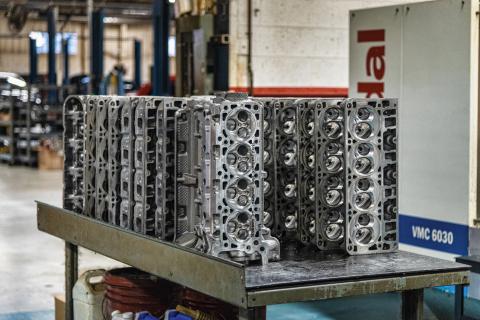
Cylinder head development drives winning engine combos, and manufacturers are busier than ever feeding the demand for performance.
Cylinder head manufacturers, while keeping up with the frantic sales pace experienced by many speed merchants during the pandemic, also found time to develop new products and branch out to design supporting components.
Following one of the craziest years on record in terms of sales versus restricted racing opportunities, new engine applications along with the tenacious growth in Outlaw and other doorslammer drag racing classes, as well as the continued popularity of classic platforms, are pushing development into exciting new territories.
“We’ve been busier than ever, by far,” said Keith Petelle of High Velocity Heads, Knoxville, Tennessee. “We are really grateful for that, but it’s been an amazing year, and right now it’s wild.”
High Velocity Heads doesn’t manufacture its own heads; rather, the shop modifies existing castings or works directly with manufacturers to improve the flow of a casting that can then be private labeled, or otherwise sold through the original manufacturer or directly from High Velocity. One of its current projects offers big block Chevy racers another choice in a very crowded market for that platform.
“We’re working with World Products on an exclusive for their big block iron head,” said Petelle. “It’s got a 360cc intake runner. We also do our own smaller version in a 340cc runner. A lot of those customers are boaters and truck pullers.”
Jack McInnis of World Products in Louisville, Kentucky, confirmed the collaborative effort. “We are developing new CNC porting programs for our iron small and big block heads. It’s been a while since we’ve offered ported iron, and these new programs flow a lot of air,” McInnis promised. “They will be great choices for marine use where salt corrosion is a big concern with aluminum heads, and for circle track and pulling applications, as well as heads-up and bracket racing in situations where weight is not a top priority.”
World Products and High Velocity Heads are developing a new ported iron big block Chevrolet head for circle track, pulling, marine, and drag applications where weight isn’t a primary issue.
“We have another deal with World Products by CNC porting their Motown 220cc small block Chevy head out to 230cc,” added Petelle, who noted that some SBC castings are getting hard to find because the Chevy is still so popular. “We bought up the last of the EQ iron 200cc heads so we would have some heads to port and sell.”
High Velocity Heads recently purchased a new CNC machine to work with both iron and aluminum heads. “The aluminum goes a little faster but it’s not tremendously different,” said Petelle. “We’ve got pretty good tooling for the iron and we’ve really got it figured out. A lot of people won’t cut cast iron, and that’s kind of why we got into it. Some of the markets are so competitive, so we wanted that niche.”
Also riding the wave of BBC popularity is Dart Machinery, which recently overhauled its 20-degree head for big blocks. “We have a couple different versions,” said Steve Arent of the Troy, Michigan-based supplier. “In one of them we shrunk down the port—from 451cc down to 409cc. Obviously the airflow was affected, but with the smaller runner the velocity in the port is just fantastic. We’re having really good success with customers building in the 470- to 525-cubic-inch range.”
Arent said off-road trucks are making more than 900 horsepower with naturally aspirated 470-cubic-inch engines using this head. “It has low-end torque and [is] making more power throughout the entire bandwidth,” said Arent. “We have another customer who has bolted these heads on his supercharged marine engines and he’s picking up 75 horsepower.”
It’s not just Chevy big blocks drawing attention from cylinder head manufacturers. Edelbrock, which recently moved its headquarters from California to Olive Branch, Mississippi, is releasing an improved version of its big block Oldsmobile head in 2021. Upgrades include modifications to the combustion chamber and ports in addition to providing flexibility for racers to raise the ports with their own designs for more performance.
“We will follow that shortly with the release of a new head for the Olds small block, an item not previously in our product line,” said Matt Gamble. “Design features mimic the BBO head, but with a chamber sized for the small block. Both heads feature a fuel pump relief machined into the casting, allowing for the use of a mechanical fuel pump.”
Even with the popularity of traditional platforms, the LS engine continues to drive development for late-model customers. Edelbrock’s sister company, Racing Head Service (RHS) in Memphis, Tennessee, now offers a Pro Elite LS3 head and a small-bore cathedral-port head.
Dart has revamped its 20-degree big block Chevy heads. One version has smaller ports designed to improve velocity, and they’re said to be well-suited for 470- to 525-cubic-inch engines.
“No longer will you need to scour the salvage yards looking for used 243 or 799 heads,” said Gamble. “You can get better performance and more reliability with new Pro Action cathedral port heads. And the LS3 head utilizes the six-bolt head design, making them compatible with RHS LS race block and GM LSX block.”
Just don’t count out the venerable Gen I Chevy small block. “Even with the LS hype, small block Chevy has never given away its top spot,” said Tim Torrecarion of Air Flow Research (AFR), Valencia, California. “Our most common builds are 383, 408, 418, and 427 cubic inch. For us, that’s anywhere from a 195cc intake runner head up to 220cc. And right behind that series in popularity is the small block Ford.”
“Our most popular head is the 11R for the small block Ford,” echoed Josh Cook of Trick Flow Specialties, Tallmadge, Ohio. “We offer different options in port volume and chamber size. For value and performance on the dollar, it’s as good as you can get.”
Trick Flow and AFR are two companies that in addition to offering new or improved cylinder heads, are designing supporting components to help the customer assemble an optimum package.
Trick Flow recently released three intake manifolds designed to match corresponding heads from three different engine families. “We want to offer the appropriate intake options,” said Cook, adding that intakes are available for the Ford FE tunnel wedge, small block Mopar, and small block Chevy.
AFR has three new camshafts designed to work with its LS3 Mongoose head. “These are all streetable cams,” said Torrecarion, noting that dyno testing produced power levels from 560 up to 590 horsepower with between 19.8 to 17.1 inches of vacuum at idle. “We’re just trying to make it easier for the customer to make power.”
Making power—that’s what’s happening in Pro Mod and other professional classes. Alan Johnson Performance Engineering in Santa Maria, California, just released its Stage 6 Muscle Head for the Chrysler Hemi platform.
“It’s designed for the Pro Mod arena,” said Rick Wilkinson. “Whether using a ProCharger, supercharger, screw charger—any boosted setup. We’ve moved the valves around and improved the port flow. Also reduced the chamber size. It’s basically small iterations we’ve learned over the years from the earlier versions. We sent the first versions to Proline Racing for dyno testing, and they showed a substantial increase in power.”
Although high-end racing classes will draw much of the attention in engine and cylinder head development, appealing to the budget racer is still on the minds of leading manufacturers. Brodix recently released its 23-degree IK 215 for the small block Chevy. It features a 215cc intake port and 64 or 70cc combustion chambers that can accommodate different fuels.
“IK, like in Iron Killer,” explained Mark Fretz from the Mena, Arkansas-based company. “It’s a budget race head for those who want to make 575 horsepower and go bracket racing.”
The IK 215 is designed to fill a gap between the upper end Dragonslayer 225 head and the IK 200. It comes assembled with stainless steel 2.08/1.60 valves, and spring options are designed to accommodate both solid and hydraulic roller camshafts.
One cylinder-head specialist is taking his product to the track to help develop more power. Mike Weinle of Weinle Motorsports in Cleves, Ohio, bought an unused Sonny Leonard mountain motor to go Pro Stock racing, but first he’s hitting the dirt tracks with a new Rocket car powered by a small block Chevy with a modified R0X head from 1 Way Technologies in Washington, Indiana.
Manufacturers often shape ports by hand, then scan them for further CAD development. But ultimately, the proof is in real-world dyno testing, said a source at Trick Flow Specialties.
“We did some work with it,” said Weinle. “I got a new port for it that’s 20 to 30 cfm better and got the shape to where we like it. Also made changes to a billet intake for it, and now I’m working on a cam for it. What I’ve found in my dirt car is that the most important thing is acceleration. I can look at two motors making the same power on the dyno, and one is three car lengths faster than the other on the track.”
For the Pro Stock engine, Weinle is focusing on the exhaust ports and also taking advantage of a 75-mm camshaft core and “giant” lifters.
“So we can make a more aggressive camshaft,” he added. “We’re getting ready to put it on the dyno. I’m looking for 2,150 to 2,200 horsepower.”
The Leonard head is a hemi design, and Weinle is also looking at building a mountain motor with an AJPE wedge-style head—but those plans are hush-hush at this point.
At 1 Way Technologies, engineers are developing a new midget head to compete against the Toyota and Stanton engines.
“We’ve redesigned a CNC program for the All-Pro 10-degree casting,” explained Chris Grace. “We’re able to get the blocks from Australia and then put our head on it. We took the baseline for what we do to the heads on a 410 sprint car and modified that shape. It’s actually a casting we have All Pro machine to our specs. It’s advertised as an 11-degree head and we have them move it to 10 degrees for us.”
Called the Type 71, this cylinder head made its debut at January’s Chili Bowl with “pleasing” results for the first customer.
“We’re very close with a few things we’re going to tweak on it,” said Grace.
The newly developed Type 71 midget head by 1 Way Technologies has ports derived from the company’s 410 sprint car head, and is built on an All-Pro 10-degree casting.
As mentioned earlier, 1 Way has an ROX head made from their own original hybrid casting. “We engineered a single casting that can be machined either as a SB2.2 with a 4.400-inch bore center or the ROX with a 4.500-inch bore center,” Grace added.
Nostalgia gassers are also getting attention from 1 Way, which teamed with Brodix on the -10 SR I 21-degree head for small block Chevys. It was approved by the Southeast Gassers Association (SEGA) and was on the engines of the 2020 A/Gas and B/Gas champions.
“We requested Brodix to modify an existing casting and qualify them to 1 Way specifications so we could CNC port the castings to our design,” explained Grace about the -10 SR I casting. “We worked very closely with SEGA on that head, and we are the title sponsor of the annual race at Wagler Motorsports Park in Lyons, Indiana.”
Limited Development
Cylinder head development is a main driver of today’s ever-escalating power increases—even when boost is involved. Which is why sanctioning bodies are always tightening the envelope that manufacturers can design around.
“Everybody’s trying to increase power, but in a lot of it you’re always constrained by the rules,” said Wilkinson. “For our Top Fuel heads, the window is so small for improvement. We’re basically making the same product we’ve made for the last seven years.”
Even in the Outlaw classes where it seemed at one point there were no rules, promoters are starting to strangle engine builders with limits or piling on weight to the cars that show promise.
“We do a lot of heads for the heads-up street race-type classes,” said Fretz. “We’ve done both 4.5 and 4.4 bore centers. One of the most popular heads right now is the BD 2300 on our 500-plus cubic-inch engines. But I have to be careful. These heads-up guys are real secretive on what they do.”
Of course, some rules are meant to be stretched. High Velocity Heads is often approached by racers required to run stock-style iron heads.
“Yeah, we can port them and disguise them,” said Petelle. “We do the crate engines and the spec heads. You’re looking at 20 to 25 more horsepower.”
Even some of the manufacturers are holding their cards close to the vest. Dart is hinting that a Big Chief 3 cylinder head is in development with a “bigger runner, bigger exhaust port, and smaller combustion chamber.” The head will also feature revised rocker-arm mounting.
“It’s a pretty bad-ass piece, the way it’s coming together,” said Arent. “We’re just teasing people with it right now. It should come out late third quarter, early fourth quarter.”
Although LS engines grab headlines these days, Edelbrock sees strong demand for legacy engines such as big block Chevy, Gen-I small block Chevy, and small block Oldsmobile.
Another Dart exclusive done in conjunction with a “really big-name engine builder” is the 20X cylinder head that works with a revised lifter-bore pattern that straightens out the pushrod angle. It also allows for a single rocker shaft instead of individual rocker stands.
“It really helps stabilize the valvetrain,” added Arent.
Finally, manufacturing and development are getting a boost from the latest tech.
“Newer technologies like the ability to 3D print sand cores helps shorten development times for castings, and we can also refine the designs before committing to expensive foundry tooling,” said McInnis. “We have made it a priority to keep all of our development and manufacturing in the United States. We believe this is important for our customers and allows us more immediate control over manufacturing.”
“While not really a new process, the bedrock of CAD/CAM is essential to being able to deliver high-quality, high-performance products at a competitive price point,” said Gamble. “Also, there are some really interesting things going on with 3D printing. We will likely see the adoption of more 3D printing processes, from printed sand molds to topology optimization, influencing the future of cylinder head design.”
“We’ll develop a port by hand, then laser scan it and continue the development in CAD. We can also scan a stock head to get a baseline of valve locations and other data to reverse engineer,” Cook told us. “Then there’s no replacement for flow bench testing to fine-tune that port. But flow numbers don’t always equal real-world performance. Great numbers may not mean horsepower for your application. That’s why we also test heads on the dyno.”
Businesses in the racing industry can now secure their booth space for the 2021 Performance Racing Industry (PRI) Trade Show, in what promises to be a can’t-miss event for the motorsports industry. The level of excitement continues to grow, as racers, manufacturers, and buyers look forward to getting back together in Indianapolis, December 9–11, 2021.
"We know there is a lot of demand for the PRI Trade Show. And while many in the motorsports industry have done well these past 12 months, they still very much need this face-to-face interaction that’s so important to doing business," said Karin Davidson, PRI Trade Show Director. "PRI is fully committed to an in-person Show in 2021, one that may very well be the best and most important PRI Show ever."
Working closely with the city of Indianapolis and local officials, PRI is committed to ensuring that the 2021 PRI Show is as safe and successful as possible.
“Being in front of our customers and dealers with the ability to talk with them face to face at the PRI Show has always been extremely important," said Brian Cox, Vortech Superchargers Content & Brand Marketing Manager. "It not only allows Vortech Superchargers to form new relationships with those attending the Trade Show, it also enables us to grow and strengthen existing relationships."
The PRI Show provides exhibitors with unprecedented access to thousands of attendees—professional race teams, retail shops, warehouse distributors, e-commerce sites, engine builders, fabricators, dealers, installers, jobbers, and media—in the market for the hottest parts, equipment, and services for all types of auto racing.
“The 2021 PRI Show is where pent-up customer demand will meet a year’s worth of new product innovation, all in one building,” said Bob Davis of Sunnen Products Co. Global Communications Manager. “The business and networking Sunnen conducts at the Show and the media exposure our products receive is unparalleled, and it will help set us up for more success in 2022.”
For the first time ever, exhibitors in 2021 will be able to help PRI build, promote, and protect the racing community by becoming a PRI Business Member. In addition to receiving a suite of benefits, including discounted booth space, Business Members will actively support PRI’s Government Affairs team in Washington, DC, as it works to safeguard the industry’s interests at the federal, state, and local levels. Exhibiting companies can join PRI Business Membership seamlessly while reserving their booth. Visit PerformanceRacing.com/Membership for more information.
"For years, the racing industry has relied on the PRI Trade Show to build their businesses, and now PRI Membership will provide the industry with year-round support through legal resources, education programs, market research reports, and more," said PRI President Dr. Jamie Meyer. "By coming together and joining forces, we will have a stronger collective voice and be able to better protect the racing community."
Now in its 33rd year, the PRI Show returns to Indianapolis following last year’s postponement. Since then, the city of Indianapolis has been a nationwide leader in the safe reopening of in-person gatherings, with the entire NCAA basketball tournament taking place in Indiana for the first time ever this month.
“As a city dedicated to motorsports racing, Indianapolis’ team of experts and professionals is committed to welcoming participants at the 2021 PRI Trade Show," said Leonard Hoops, Visit Indy President & CEO. "We are proud of the progress we’ve made by installing hospital-grade filtration systems throughout the Indiana Convention Center, safely hosting more than 50 live events and more than 130,000 visitors to the city since July 2020, and being awarded both the GBAC STAR Accreditation and the NAFA Clean Air Award."
Specific safety guidelines and recommendations for the 2021 PRI Trade Show will be announced at a later date.
To apply for booth space to the 2021 PRI Trade Show, visit PerformanceRacing.com/Exhibit or call 949-499-5413. Companies that apply before May 28 will be included in the initial floor plan.
Bolstered by enhanced functionality and more approachable system design, interest in electronic fuel injection systems has never been higher.
There’s an air of artisanship to tuning. Making a race car perform at its best can often be akin to conducting a symphony of different mechanical systems, each affecting one another in different ways that can only be understood and accurately predicted through decades of knowledge and experience.
Carburetion serves as an excellent example of this. In a world of 5G mobility, it’s an analog anachronism that has nonetheless stood the test of time. Some of that can be attributed to the notion that carb tuning expertise can provide a competitive edge under the right circumstances, but at the end of the day, it’s often a case of old habits dying hard.
“I think for a lot of these guys, it comes down to what they know,” said Evan Perkins of Holley Performance Products, Bowling Green, Kentucky. “We still sell a lot of carburetors, and they work great in a lot of applications. So for certain racing classes and teams that have been running a car competitively the same way for a lot of years, they might not see a huge incentive to make a big change like that.”
For decades, the complexity and cost involved in making the switch to a race-ready EFI system damped the appeal even further. But the story has changed in recent years. “These systems are now available in complete plug-and-play kits, and the self-tuning options do so much more than ever before,” said Mark Campbell of Fuel Air Spark Technology (FAST), Memphis, Tennessee. “They’re designed to be user friendly, and more of a direct bolt-on upgrade.”
And for those that are considering making the switch, the tuning and control benefits of electronic fuel injection typically drive their interest, but it’s the approachability of these systems that will ultimately determine which side of the fence they land on.
With EFI, laptops have become a common tuning tool. Racers see the potential gains and are increasingly comfortable with the systems, noted our source at AEM Performance Electronics.
Breaking Down Barriers
One of the major roadblocks that hampered widespread adoption of EFI for some time was the lack of available options. Like carburetors, EFI is not a one-size-fits-all type of endeavor, and the prospect of taking on the cost and complexity of a system that wasn’t designed to work in a particular application relegated race-ready, high-horsepower EFI systems to more niche-use cases. However, many aftermarket companies have made significant strides in this area and now offer an array of different products that range from affordable, all-in-one carburetor replacement throttle body systems, to sportsman-level solutions with enhanced feature sets and customization options, to hardcore, purpose-built motorsports systems with advanced fueling, tuning, and sensor reading capability.
“I would say on the entry-level end, the leading driver of this trend is the refinement and expansion of the self-learning systems that provide accessibility to the core benefits of EFI, including easier, cleaner cold start, better throttle response, and better air/fuel ratios across the engine’s operating range, all of which are now obtainable with minimal EFI tuning knowledge required,” said Brett Clow of Aeromotive, Lenexa, Kansas. “On the other end of the spectrum, we also have significant advancements in injector flow rates and improvements in ECU programmability, the latter of which allows for things like per-cylinder tuning and fail-safe ignition features to deliver the highest possible power with the safest spark and fuel control.”
The decision to switch to EFI often comes down to what racers know, said our source at Holley Performance Products. To help, many manufacturers offer complete EFI kits that eliminate guesswork.
Tim Jilg of Fuel Injector Clinic in Hobe Sound, Florida, pointed out that for many younger racers who are bringing aftermarket fuel injection into their programs, EFI is where they started. “One of the biggest markets right now for engine platforms across a number of different racing disciplines is the LS. Fuel injection has always been part of that platform, so the folks who’re tuning these engines are familiar with the technology and benefits that EFI offers even before they make that upgrade.”
Data logging has also become something of a gateway drug for many of the carbureted holdouts. “It’s a trend we’ve seen in sportsman-level drag racing in particular; high-horsepower, steel-bodied cars with power adders,” said Lawson Mollica of AEM Performance Electronics, Hawthorne, California. “When we first engaged with these guys a few years ago, a lot of them were running carburetors, and they didn’t come to us looking for EFI—they were looking for data acquisition.
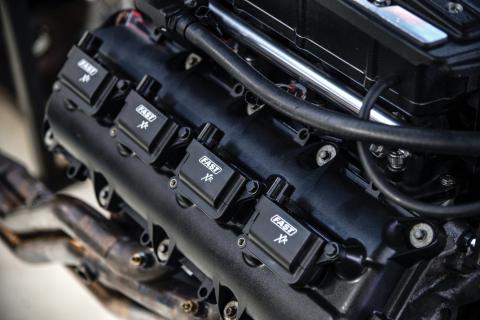
Carburetor-replacement systems like this FAST unit bolt onto existing manifolds and can use a stock-style mechanical fuel pump, simplifying EFI conversions.
“At that point it wasn’t that they lacked the capability to tune on EFI, they simply didn’t have the familiarity,” he continued. “And as these guys have acclimated into the world of data acquisition with a handful of channels that have helped them make improvements pass after pass, they’re not only getting used to the software interface, they’re also seeing where carburetion is limiting what they can do and how integrated their overall setup can be.”
Holistic Hardware
In an effort to eliminate guesswork and reduce the number of steps required to get the system up and running, many EFI manufacturers now offer comprehensive packages that include all of the components needed to make that system operational under a single part number.
“These kits can be bought with the entire fuel system, wiring harness, and all the sensors for a simple plug-and-play install,” Campbell said. “FAST even offers simplified fuel systems with our universal EFI sump fuel kits, which feed off of a stock-style mechanical fuel pump and have an internal high-pressure pump that can supply the right pressure and volume for an EFI system to run.”
For an easier switchover to EFI, our source at Fuel Injector Clinic suggested a two-step process that starts with a self-learning carb replacement system and then progresses into “a more sophisticated system.”
The designs of the EFI systems themselves have become easier to work with as well, both from a packaging standpoint as well as their aesthetics. “Our Sniper products are considered carburetor replacement systems in that they contain the ECU, the required sensors, and the injectors within one device,” Perkins explained. “And we offer these in different carburetor patterns, so a guy who has an Autolite 1100, for instance, can get a Sniper system that not only bolts to the original manifold and works with the existing air cleaner, it also looks like the carburetor it’s replacing and occupies about the same amount of space in the engine bay.”
These simplified and application-specific designs have made EFI conversions more compatible with existing hardware and potentially less costly to do, in turn broadening its appeal to a wider audience of racers. “The fact that these throttle body EFI systems offer self-contained fuel injectors and throttle linkage that can support installation directly onto the existing carbureted intake manifold and connect to existing throttle linkages makes this a minimally invasive upgrade,” said Clow.
Software Refinements
Still, the biggest hurdle facing many would-be EFI converts in the motorsports world isn’t the installation of the new hardware, it’s the perceived learning curve of the software. Fortunately, it’s an issue that EFI manufacturers appear to be keenly aware of.
“There are some systems where it seems like it takes a computer programmer to tune them, but that is not our goal,” said Perkins. “A lot of it really just comes down to the vernacular. So for us, it’s about making sure that the terms we’re using in the software are going to be things they’re familiar with.”
It’s also important to note that the self-tuning functions in the latest batch of EFI systems is impressive tech in and of itself, not only because it can quickly and effectively dial in the system on its own, but because it can start to do so with minimal input from the user if need be. “With the advancements in self-learning software, combined with increasingly effective built-in tuning databases, we find these systems are working better and better across a broader range of engine combinations,” said Clow. “And with a growing database of engine combinations to draw baseline tunes from, the transition is just getting easier and more attractive to do.”
Jens von Holten of Fuel Injector Clinic cited a two-step process that he sees as an effective strategy to make the switch to EFI both approachable and ultimately highly effective. “The first step would be to get a self-learning carburetor replacement system, which have some adjustability but are more or less designed to do what they do right out of the box,” he explained. “And then from learning that whole process and looking at the data, once you’re comfortable with adjustability that no longer comes from replacing a jet or turning a screw, you could be ready to move up to a more sophisticated system to really gain all the benefits that EFI has to offer.”
EFI’s precise control, powerful data-acquisition capabilities, and nearly infinite range of tuneability have made it a natural for boosted engines.
But that isn’t to say there aren’t options for the guys who’re ready to go a bit deeper from the outset. “One of the ways we do that is by providing setup wizards for the various features within our systems,” Mollica said. “The software is going to ask you things like what your cam and crank timing pattern is, what your firing order is, and so on, and once you’ve answered this basic information, you can go to your volumetric efficiency table and put in a baseline number across the entire VE table, turn the key, and the engine is going to turn over and run. Now you’ve got your starting point for dyno tuning.”
Perkins also noted that there are ways to make these systems both approachable and sophisticated through the design of the user interface. “Most racers are not going to leave a self-tuning strategy alone—eventually they’re going to want to get in there and finesse the tune to find every bit of horsepower that’s available, and so there are basically layers of capability within the software,” he said. “All of the layers are there, but an entry-level tuner doesn’t need to dig quite as deep as a professional tuner does to get to the menus that are relevant to them.”
And bridging the gap between accessibility and competition-level capability will only take on greater importance as EFI adoption continues to spread throughout motorsports. “Horsepower levels are soaring across all types of fuel, with EFI engines now producing 5,000-plus flywheel horsepower in some cases, and many engine combinations are now capable of delivering streetable manners in the 1,500 to 2,500 rear-wheel horsepower range,” said Clow. “And with the ever-increasing sophistication in engine fuel management provided by modern EFI systems, this horsepower envelope is continually being pushed higher. Part of that is due to our increasingly detailed, empirical knowledge of engine function regarding air and fuel flow behaviors, and their real-time interaction in the intake manifold and combustion chamber. As this level of knowledge and understanding grows, we see the level of ECU sophistication improving alongside it.”
Enhancing the ease of use of these systems while also providing the technical depth that will allow racers to extract every ounce of performance from their engine combinations could prove to be a tough balancing act going forward, but it’s a challenge that EFI manufacturers are confronting head-on. “It goes back to that layering concept—for instance, our version 6 EFI software has transmission dump valve control, torque converter lockup control, and a number of other features that the grassroots guy might never need to touch,” said Perkins. “But it’s there for the professional tuner and racer if they need it.”
A new racing series designed to lower the cost for young Late Model racers is set to launch this July at Crisp Motorsports Park in Cordele, Georgia. Dubbed the Jr. Late Model Spectacular Series (JRLMSS), the new series aims to provide a driver development program and allow drivers—ages 12 to 16—to drive full-bodies Spec race cars.
JRLMSS will also help develop the drivers’ off-track talent with required bi-monthly webinars to teach the importance of building a brand to attract corporate marketing partners.
The series’ 2021 exhibition race schedule kicks off on July 31, at Crisp Motorsports Park, followed by a visit to Huntsville, Alabama’s Huntsville Speedway, for a 75-lap special on August 21. Then, competitors head to Timmonsville, South Carolina, for a Florence Motor Speedway event on October 16, followed by Veterans Motorplex’s 75-lap event on November 13, in Greenbrier, Tennessee.
A four-race winter schedule in the Midwest and Southeast regions is also in the works, along with a four-race simulation competition hosted on iRacing.
The series was created by Rod Wortham, the founder of Race Face Brand Development, a full-service driver development and marketing agency known for Race Face TV.
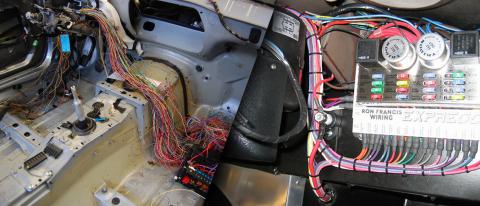
To avoid the bird’s nest, plan ahead when building or rewiring the race car, advised our source from Ron Francis Wiring, who added that going a bit bigger than necessary to start “will allow additions in the future, like nitrous, fuel pumps, and additional fans.”
Several misconceptions have infiltrated the performance spectrum, so we called on a pair of industry veterans to separate the fact from fiction.
Chasing down electrical issues can be among the most frustrating tasks on any car. The racing environment just makes things worse, as heat and vibration seem bent on attacking vulnerable components and less-than-secure connections. Plus, the hurry-up nature of in-the-pits repairs only compounds the situation.
To find out more about what racers are doing wrong with their wiring systems and what they should be doing instead, we spoke with two experts in the field: Dennis Overholser at Painless Performance Products in Fort Worth, Texas, and Scott Bowers at Ron Francis Wiring in Chester, Pennsylvania.
Avoid The Bird’s Nest
At races, Bowers often sees an electrical problem he calls “bird-nesting,” the tangled result of last-minute wiring additions to fix an issue. “That is a big recipe for problems,” he said. “Let’s say you’re in the staging lanes or the pits, and you have a problem that needs a solution in a hurry, and in the process a red wire turns into a blue wire through a butt splice. That kind of fix just complicates the solution, especially if there are multiple hands in the project trying to get you going again. If a fellow racer is helping, they have no idea the red wire turns into the blue wire.”
The solution is “sanitary, common-sense wiring and being smart with the wire paths and flows of circuits,” Bowers continued. “That really helps troubleshooting. Even 10 years after the build you know what you’ve got.”
Another way to avoid the bird-nesting trap is to plan ahead when building or rewiring the car, Bowers reported. “Go with a system that has plenty of room for growth in terms of capacity and fused circuits,” he explained. “The complexity will increase if there aren’t enough circuits and they have to add a piggyback or auxiliary fuse block to gain more fused circuits. Typically, it’s fairly cheap to go a bit bigger than necessary. That will allow additions in the future, like nitrous, fuel pumps, and additional fans.”
Secure Your Connections
The vibration inherent in a race car can wreak havoc on wire connections. For Overholser, the solution is to crimp, not solder, connections.
“Normally when you do a solder joint you crystalize the copper,” he explained. “The vibration will shake it enough to break it. Then you can have a real bad situation because you often can’t tell where the break is.”
Heat affects solder, too, he said. “We make our own battery cables, and we never solder them, especially the end of the cable that goes next to the starter. The headers will get the wire so hot it’ll melt the solder out of it. Then the wire will fall out, and short out. Hopefully, it won’t burn the car down.”
The “best way is to crimp the wires with a non-insulated terminal, whether it’s a splice or ring, then use heat shrink to give it some support,” Overholser added.
Attaching the harness with clamps and wire ties prevents excessive movement and vibration, according to our source at Painless Performance Products.
To Bowers, soldering is fine “unless vibration is of a concern. Then a connector system would be a better solution. The trick with soldering is that it must be done right. It’s one of those areas where more is not better. It does create a rigid area in the wire, but as long as you don’t go overboard with the amount of solder you wick into that joint, in my opinion it’s far superior to a butt splice.”
Another way to fight the effects of vibration is to “make sure there’s some type of support to keep everything rigid so it won’t move around,” Overholser said. Plastic zip ties, Adel clamps, “or any kind of clamp, you can’t use too many of them.” Tying the wires to a drag car’s tube chassis, for example, “helps eliminate the wire from vibrating. It will vibrate with the chassis, but it won’t flop.”
Rely On Relays
“I am a firm believer in fan relays,” Overholser said. “A hot wire run from the fuse block to the toggle switch and then out to the fan will never be efficient. The only thing that will do is overload the switch or the wire, and something’s going to melt. If they’re using a toggle switch not capable of carrying the amperage required, the fan won’t run at maximum speed, and it won’t cool the engine.”
“The switches on the market may or may not be able to handle the load that the controlled item is drawing,” said Bowers. “Relays allow the load to be carried through the relay, and the switch is simply controlling the relay. That is going to improve the life of the switch and create more trouble-free experiences when using those relays.”
Consider Alternator Capacity
“It’s always good to think ahead in terms of alternator capacity, especially if the car is running fans and fuel pumps,” Bowers said. “An alternator only puts out a portion of its rated amperage or current at idle. A 100-amp alternator may only be charging 20 to 30 amps at idle. Racers can get more capacity at idle by playing with the pulley sizes—smaller on the alternator or larger on the crank.”
Another consideration: An alternator “will only put out what it needs to charge to keep the voltage up to where it is expected to be,” Bowers said. Even a 100-amp alternator will be putting out “just the amperage it needs to keep up to the 14.5 or 14.7 volts to keep the system healthy.”
Here is one more alternator tip: Never demand more than 80% of an alternator’s rating for a continuous amount of time, Bowers said.
Holley, the performance automotive aftermarket company based in Bowling Green, Kentucky, will become a public company as part of a definitive merger agreement with Empower Ltd., a publicly-traded special purpose acquisition company. As a result of the agreement, Holley will become a publicly listed company on the New York Stock Exchange (NYSE) under the new ticker symbol “HLLY.”
Holley President and Chief Executive Officer Tom Tomlinson and the current management team will continue to lead the combined company. Empower’s management team is led by Chief Executive Officer Matt Rubel and President Graham Clempson. Rubel is expected to serve as Chairman of the Board of Directors. Holley is controlled by Sentinel Capital Partners, L.L.C., a midmarket private equity firm that will remain Holley’s largest shareholder upon closing.
“Holley was built by automotive enthusiasts for automotive enthusiasts, a passionate and active market that spends on the products that they love. Today’s announcement marks the beginning of the next chapter of Holley’s journey to fuel our customers’ automotive passion,” Tomlinson said in a statement.
Founded in 1903, Holley is the designer, marketer, and manufacturer of high-performance automotive aftermarket products, featuring a large portfolio of iconic brands serving car and truck enthusiasts. Holley’s brands cover electronic fuel injection (Holley EFI), electronic tuning (APR, DiabloSport, Edge, and Superchips), electronic ignition (MSD and ACCEL), carburetion (Holley), exhaust (Flowmaster and Hooker), safety (Simpson and Stilo), among other product categories.
 MEMBERSHIP LOGIN