PerTronix Performance Brands, with key brands in the ignition, exhaust, and fuel delivery segments, has acquired Taylor Cable Products, Inc., located in Grandview, Missouri.
For over 90 years, Taylor Cable Products has provided products to the performance and racing markets, including its line of performance and racing spark plug wires, battery boxes, battery cables, and other accessories for the performance and OEM markets.
“PerTronix looks to partner with only the best businesses in the performance automotive aftermarket. Taylor Cable has a very strong brand in the performance spark plug wire market, making it the perfect complement to our PerTronix Ignition brand,” PerTronix Performance Brands Chief Executive Officer Robyn Hetland said.
The announcement follows PerTronix’s acquisition of Aeromotive, Inc. in November 2020.
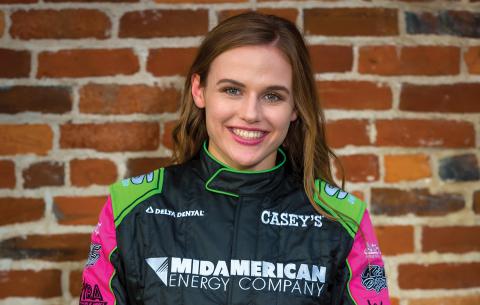
While focused on conquering 410s, this up-and-coming sprint car driver is pursuing long-term goals while sharing her passion with today’s youth.
I own and manage my race team, and am currently racing 410 winged sprint cars throughout the Midwest, competing mainly with the All Star Circuit of Champions and the World of Outlaws, along with local series.
I fell in love with racing after accidentally running into Kasey Kahne in a shopping mall when I was in 3rd grade. That stirred my love for the sport; my passion for dirt track racing came soon after, when I saw my cousin race micro sprints. After years of watching and learning from the stands and saving money, I started racing outlaw karts in 2010, when I was just 13. And I’ve moved my way up to where I am now.
Last year, COVID-19 essentially parked us early on in the season, and we didn’t start up again until May. However, I was able to race until the end of January 2020 in Australia, so I’m even more grateful for that experience looking back now. After that, it was a little tricky to make a schedule we could stick to and figure out what races were going to happen. But overall, I’m grateful for the accommodations the sprint car series and tracks were able to make to allow us to race as much as we did.
Although we’re currently in the offseason, it can sometimes feel like the busiest and most stressful time of year. As a team owner and manager, I spend a lot of the offseason processing financial and legal paperwork, doing tax work, etc.
Beyond that, I work on putting together my marketing deck for the upcoming season and meet with previous sponsors about renewing their partnerships while also seeking new partnerships. My racing is funded solely on my ability to obtain sponsorships, merchandise, and race winnings, which dictates the number of races we are able to race. Historically, we’ve usually raced about 15–30 racers per year, but we are looking to hit 40–50 races in 2021.
We also spend a lot of time going through the race cars, shop, and trailer, reorganizing, replacing, and rebuilding. We want to be as organized and prepared as possible going into the season so we don’t have to spend time on unnecessary tasks throughout the season.
Lastly, I try to work out as much as possible to stay in shape physically over the offseason, even though nothing compares to driving the race car itself.
For 2021, we are planning on our season beginning in April, as we have a lot more work to do over the offseason this year compared to years past. I’m most looking forward to being past my rookie season in 410s and applying everything I learned last year to this year. 410 sprint car racing is so unbelievably competitive and a very difficult level to be successful in, and seat time is everything. I want to get enough seat time to where I’m consistently competitive and have the car control I desire.
I feel that we are positioned to be more successful this year, and I’m really looking forward to seeing how much we learn and grow as a team in 2021.
I’ve won five sprint car features in two different classes at Knoxville Raceway, and those have been some of my biggest accomplishments and favorite memories. My goal is to now win in 410s so I can have wins in all three classes.
In addition to my own racing, I founded Compass Racing Development in 2015 as a way to give a child that wouldn’t receive one otherwise the chance to race. The program grew far beyond my expectations, and today we’ve had countless kids come through the program. Compass is one of the most meaningful and fulfilling parts of my life.
Then, in 2019 I founded a nonprofit to help kids in motorsports nationally called Youth Racers of America, Inc. It provides camps, safety gear, and educational resources for youth racers across the country.
Furthermore, I moved from Iowa to Indianapolis last year in hopes of racing more and gaining stronger racing opportunities. That move has paid off big time, and I’ve made a lot of connections and received some really cool opportunities. My goal is to continue racing more out of Indy and build up a team based out of here.
I love what I do and have really enjoyed racing at new and different race tracks. We, as a team, have come a really long way since I started at 13, and I look forward to seeing what the next 10 years have in store.
Understanding what exactly these parts do and the different types on the market will help guide racers to the right component.
The harmonic damper may be the most important and misunderstood part under the hood—so often mixed up in harmonic balancer nomenclature and keyboard mechanic lore that myths run wild.
Over the past 10 years I’ve produced educational content at a leading provider of powertrain vibration analysis and harmonic damper development. So let’s simplify it down to basics.
What Does It Do?
A harmonic damper provides durability by reducing harmful crankshaft torsional vibration. Torsional vibration is the repetitive end-to-end twisting and rebounding of the crankshaft caused by internal combustion. With optimum torsional vibration damping, engine builders get peak performance over prolonged periods.
At top left is a Chevy big block externally balanced harmonic damper. Note the half-moon shape counterweight built into the hub. At top bottom is a Subaru FA20 internally balanced harmonic damper. Note the zero-balance symmetric shape of the housing.
Torsional vibration is different than unbalanced vibration (corrected by weight balancing the rotating assembly) and axial vibration (corrected with main bearing support plate and thrust bearings). Only if a harmonic damper contains a crankshaft counterweight does it actually contribute to rotating assembly balance. Examples of externally balanced engines are some classic big block Chevy and small block Ford, and today’s Duramax and Power Stroke.
Illustrated above top, unbalanced vibration occurs when weight is not evenly distributed. Vibration happens once per revolution, which is solved by balancing the rotating assembly. Only if a harmonic damper contains an external counterweight does it contribute to balancing the rotating assembly. Above middle, axial vibration occurs with forward and backward movement of the crankshaft. A main bearing support plate and thrust bearings help control this. Above bottom is torsional vibration, or end-to-end twist and rebound of the crankshaft caused by combustion. A damper reduces the vibration.
Why Do You Need It?
Without optimum harmonic damping, torsional vibration will accelerate component wear (such as bearings), affect valve timing, and increase the risk of engine failure. When the torsional vibration frequency aligns with the natural frequency of the rotating assembly, a spike in vibration amplitude will occur. This spike may cause a two-piece crankshaft or oil pump graffiti, like a wine glass fracturing when the right musical pitch is hit.
Some people aren’t concerned with engine life and claim the added weight of a harmonic damper isn’t worth it. The truth is excessive vibration also robs power. It may sound counter-intuitive, but adding harmonic damper mass and optimum vibration control will allow the engine to run more efficiently and put up higher torque and horsepower. See the accompanying graphs on page 21.
When to Upgrade? What Type?
At the professional level, a complete NVH (noise, vibration, and harshness) analysis is performed and a harmonic damper is constructed to meet the goals of the team. This includes modeling the expected torsional vibration across the rpm range given the weights, composition, and spring stiffness of each rotating assembly component. Added factors like damping medium life and operating temperatures are also factored in. For the rest of us, although not as precise, there is a simpler way:
1. Check your damper. Most stock engines use a narrow range elastomer harmonic damper. Narrow range means that it is tuned to a brief frequency of the worse harmonics in the engine’s normal operating rpm. Elastomer dampers use a bonded rubber medium between the crank hub and inertia weight. When elastomer is over-worked it will crack, bulge, and deteriorate. Once this has occurred it has lost its effectiveness. Replace or upgrade if you notice this during routine inspection.
2. Rotating assembly. If you’re building from scratch or modifying the stock rotating assembly, it will affect where the resonant frequency(ies) will occur in the rpm range. Once again, resonant frequency is when a potentially damaging amplitude spike will occur. In this case, go straight to a high-quality broad range harmonic damper. Broad range means that it is designed to reduce torsional vibration across a wide frequency scale. Viscous dampers are broad range. Its effectiveness is the rate a free rotating inertia ring shears through the damping medium. Viscous dampers are common to high-end performance cars from premium brand OEMs.
The test above was conducted on a near stock 2014 Mitsubishi Evo X 2.0L 4B11T engine using a Mustang Dynamometer chassis dynamometer. It depicts the benefits of a quality harmonic damper on even a small-displacement, forced-induction inline four. What you see at left is a damping comparison between an OEM narrow range tuned elastomer damper and a Fluidampr performance damper. The smoother and lower vibration angle (amplitude) line across the rpm range of the Fluidampr highlights its broad range damping capability. At right, as a result of reducing vibration and creating greater efficiency through optimum harmonic damping, the Fluidampr showed consistent average horsepower and torque gains when compared to a stock damper.
Other types of harmonic dampers include multiple durometer elastomer O-ring, spring, and pendulum designs. Each has its advantages and disadvantages in how it minimizes torsional vibration.
Which to Choose?
Safety first. Before ever making a lap, be sure to check if a SFI 18.1 spec harmonic damper is required with your sanctioning body and class. SFI regulates the construction properties of the damper to ensure rotational integrity to 12,500 rpm. If it is, then your field of product options narrows to those designed specifically for motorsports.
Next, you may find harmonic damper offerings in different weights and diameters for the same engine. The general rule is more mass and a larger diameter will provide better damping and durability but prohibit quick revs. A lighter and smaller-diameter damper will allow for quick revs but sacrifice best damping and durability. It is the engine builder’s choice to determine which best suits the goals of the race team.
Inside a viscous damper, as shown in the image below, an inertia ring reduces vibration as it shears through silicone. The resulting heat safely dissipates from the outer housing. This method provides consistent damping over a superior product life.
Lastly, not all harmonic dampers are created equal, even if they’re using the same basic technology. For example, an OEM viscous damper is not SFI 18.1 spec and not designed to preserve its damping medium under professional motorsports conditions. A premium viscous damper brand, such as Fluidampr, can be engineered for superior product life in extreme environments, such as 24-hour endurance racing. Top brands in the performance racing industry conduct extensive research and development toward continuous innovation. They have a stake in ensuring the long-term viability of motorsports through helping teams sustain durability.
When making your decision about what harmonic damper to run, think in terms of what will provide the best quality and longest lasting performance over the life of your engine. A little more investment in the beginning may save lots of expense and heartbreak over time.
Brian LeBarron is a representative of Fluidampr and OEM parent division, Vibratech TVD. He has over 20 years of motorsports product marketing experience and enjoys teaching industry colleagues. Through Fluidampr, he is a member of SEMA, plus SEMA MPMC and SEMA ETTN councils.
Our expert source explains how to get noticed and promote your racing business online even if you don’t have a website.
THE Problem: How to get noticed online if I don’t have a website to promote my business
THE Solution: Take advantage of a user-friendly Google tool while leveraging your social media presence
The Internet—love it, hate it, or can’t live without it, there’s no denying it’s a massive force that influences practically all facets of life. For businesses, it’s a powerful tool that can build brands, command an audience, and energize sales.
And yet about half of all small retail businesses in the performance aftermarket don’t even have a website, according to PRI’s most recent Racing Business Survey (see PRI Magazine, March 2020).
That’s unfortunate indeed. Those businesses are missing out on a powerful range of benefits, starting with the very credibility a company is built on. “What an online presence does in this day and age is it legitimizes your business,” said Jason Dodge of BlackTruck Media + Marketing, Grand Rapids, Michigan. “It’s no different than having a business card.”
So what can you do if you’re not a tech-savvy gadget head—or don’t have the time or resources to spare—but you still want to have some kind of a credible online presence? Dodge recommends a simple approach, starting with registering your company with Google My Business, a free tool for companies to manage their online presence.
Even if your company doesn’t have a website, it’ll still show up in Google search results if you register with Google My Business, a free tool that helps you manage your online presence.
“Really, you could view Google My Business in a lot of situations as the new homepage,” said Dodge. “So if, for example, I’m looking for a chassis builder or somebody that’s building particular types of components, you have the opportunity to be relevant, just simply with a Google My Business profile.”
In addition to providing a listing that shows up in Google search results, Google My Business also gives potential customers essential basic information about your company, such as your street address and business hours. It also lets you post photos, as well as read and respond to customer reviews.
Once you’re set up on Google My Business, Dodge said you should then start establishing a presence on social media. “Facebook would be the next recommendation I would make, strictly from the fact that you have the ability to own and control your brand in that space.”
Along with Facebook, Dodge points to Instagram as a key social media platform for reaching racers and automotive enthusiasts. “Instagram is very lifestyle-oriented. It allows you to tell that story visually, with photos and captions to showcase what you’re doing. And that can be a great resource if you have a phone and a little bit of time to walk around your shop and take some photos.”
Although these steps can build a substantial online presence, Dodge nonetheless still strongly recommends setting up at least a very basic website. For that he suggests several services that make the process as easy and inexpensive as possible. “If you have a Google My Business listing, there’s a thing out there called Google Sites that lets you create your own website. It will be a very basic site, but it’s a step in the right direction. Another easy place to go for a website would be Squarespace or Wix. They’re very user friendly. And they can be very affordable, especially when you consider that it’s all inclusive.”
That said, even this rudimentary web presence can seem like a big job to many business owners. For that reason, Dodge advised an incremental approach, with realistic expectations along the way. “Set yourself up a schedule that’s reasonable.” For example, he believes posting on Facebook or Instagram a couple of times a week is a good goal to start with. “It doesn’t take a lot if all you want to do is get a little bit of a presence out there.
“Don’t overthink it,” he added. “Remember, anything you do can be undone. You didn’t break it. You didn’t throw a billboard up and now you’re stuck with it for 30 days. You can edit it. You can massage it. You can make changes.”
Above all, Dodge urges businesses to simply get started so they can begin to reap the advantages offered by an online presence. “I would equate it to a car—the performance you get out of it is very much based on what you put into it. Your Internet marketing is going to be very similar.”
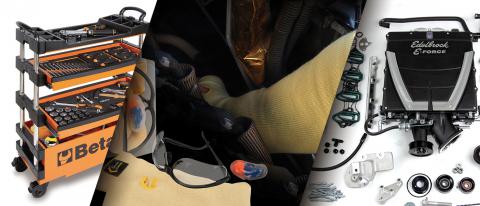
Here’s a handy storage solution for racers that need mobility and quick access around the pit or garage. The Beta Tools C27S folding tool trolley is compact enough to fit in the back of a small SUV, yet holds a wide variety of tools and parts in three storage areas; it also offers a thermoplastic worktop to boot.
“It’s been in the US for about a year and a half now,” said Randy Booth of Beta Tools USA. “It’s had a lot of success with road-racing motorcycle teams. They’ll use it in a garage environment where they don’t want to roll around a large eight-drawer chest.”
The patented design is constructed from a sheet-metal frame and features a pair of fixed 6.30-inch casters on one end and two 3.94-inch lockable steering casters on the other. There is a large (23.15- by 10.90- by 8.66-inch) storage bin on the bottom level. When the folding handles are in place, the worktop and two drawers can be unlocked and moved into position.
“Making the drawers slide out on both sides makes the cart accessible for more than one person,” said Booth. “When collapsed and locked, if for some reason it were to tip over, all your stuff won’t fly out.”
When expanded, the tool trolley stands 36 inches tall. When collapsed, it’s 20 inches tall. It can be ordered in orange, green, or red. The trolley weighs about 44 pounds when empty. —Mike Magda
Working on a hot engine is always potentially dangerous. Mishaps can occur abruptly and lead to serious injuries.
Crew members can keep their eyes, ears, and arms protected with the pit crew safety kit from DEI. It includes protective eyewear, ear plugs, and a Kevlar arm sleeve in one package at an affordable price.
“It’s evolved over the years,” said Mike Buca. “It’s mainly to keep guys from burning their arms while working on the race car.”
The glasses are black-framed, impact-resistant, and provide 100 percent UV protection. They’re also scratch-resistant and available in clear, smoke, or yellow lenses. Offering a noise-reduction rating of 25 db, the ear plugs feature triple flanges for a comfortable one-size-fits-all design. The Kevlar sleeves help workers avoid cuts, slashes, and burns. They withstand temperatures up to 900 degrees F. The design extends past the wrist for added protection in the palm area.
“This kit is popular with sprint car teams because the exhaust is exposed,” added Buca.
The items are also available for individual purchase, and are useful to professional mechanics and DIY’ers as well as racers. —Mike Magda
The new FAST supercharger and camshaft kits are an easy way to build horsepower with the GM LS and Dodge Gen III Hemi platforms. The packages are built around a marriage of Edelbrock’s 2300 TVS supercharger and COMP Cams application-specific camshafts and valvetrain components. FAST engineers dyno-tested various combinations of cam lobes, valve springs, and supercharger pulleys to achieve optimum results—often leveraging lessons learned while developing cams for naturally aspirated engines.
“Knowing how the addition of a blower changes the pressure across the valves at each event, we were able to go directly to new profiles optimized for this system, without repeating all the prior baseline testing,” explained COMP Cams’ Billy Godbold.
The power increases are impressive. For example, a 6.2-liter LS3 achieved 850 horsepower while running E85 fuel, and a 6.4-liter Gen III Hemi peaked at 1,016 horsepower—also on E85. Both engines sported stock cylinder heads.
“Knowing that we wanted a long, nearly flat torque curve, we were able to quickly make a few changes to how we timed exhaust opening and intake closing to get the optimum curve shape for each camshaft grind,” Godbold added.
The kits feature a high-capacity intercooler with a dual bar and plate design that is integrated into the supercharger housing. Included in the kits are two drive pulleys: a pump-gas friendly version for break-in and general performance driving, and a smaller pulley for max power on race gas or E85. —Mike Magda
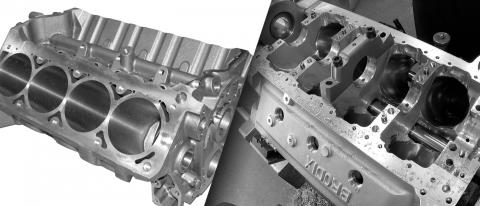
For many racers, choosing which engine block material to invest in often comes down to two factors: cost and strength. But as our two advocates in this month’s column explain, the science behind how these materials behave under the stresses of a motorsports environment—along with steady advances in block design and manufacturing—have introduced other important factors to consider when choosing between cast iron and aluminum.
IRON BLOCK ADVOCATE:
JACK MCINNIS,
WORLD PRODUCTS
–
Cost is a big factor, of course—you’re reducing the cost of the block by about 40% or more by opting for iron over aluminum. And that’s cast aluminum; a billet aluminum block would be an entirely different animal, where we’re talking about multiples of price.
People tend to focus on the weight difference, and obviously that’s a big deal, but it’s important to note that iron is generally going to give you more power because of better ring seal. Because iron is more rigid than aluminum, it won’t deflect and distort as much under high cylinder pressures. So if you were to do a direct comparison with all other variables being the same, you’re typically going to see a little more horsepower from an iron block engine than you would with an equivalent aluminum block. Of course, that’s more obvious in high-stress applications, but isn’t that what motorsports is all about?
Modern aluminum blocks are pretty strong, but a properly built iron block is still ultimately going to be stronger, and that strength offers some benefits that might be less obvious. For instance, if you have a catastrophic engine failure, an iron block is usually going to hold up better to it. We’ve seen instances where people have really seriously blown some stuff up, and while it leaves a few scars on the block, the block is still perfectly good to use without having to get into welding, re-machining, and that sort of thing.
And the rigidity and higher tensile strength of iron makes it inherently better at handling large amounts of power and large amounts of boost than aluminum is. There are plenty of people who’re making lots of power with aluminum engines, but when that threshold is lower, the tune becomes even more critical. Something that might be a bit unhappy in an iron block engine could be devastating in an aluminum one. The margin of error is smaller.
When you start really throwing a lot of boost or a lot of nitrous at it, the whole block can actually twist and move, and that can subsequently lead to other components failing because they don’t have the support they need at that instant. That’s one scenario where an iron block is generally going to allow components to live longer and provide better reliability.
While there are classes across a number of different racing disciplines where iron blocks are required by the rule set, there are also situations where it’s simply a better option for the given application. In classes where the cars are heavy anyway, or marine applications where wake is not a big consideration, what you lose in weight advantage can be compensated for in added power.
But one thing we’ve noticed is that a lot of racers make the mistake of ignoring the benefits of what aftermarket iron engine blocks offer. We see a lot of dirt track guys who will go out of their way to find old factory blocks because they’re a bit lighter, and then they blow up two or three of them over the course of a season, whereas an aftermarket iron block would probably have lasted them several seasons.
They might go that route because they’re saving 40 pounds or something like that, but that additional weight is there for a reason—it’s often additional material that’s strategically placed in the block to strengthen weak points in the block design.
With the old factory small blocks everybody was going after the four-bolt mains, but in truth, the two-bolt blocks are stronger. You’re securing the cap a little bit better with a four-bolt design, but you’re weakening the web in the process. The splayed bolts and thicker pan rails found in modern aftermarket blocks resolve that issue—and then some. And some of that additional weight can also be attributed to the use of higher grades of iron that are denser, and inherently stronger, than the factory iron material is.
ALUMINUM BLOCK ADVOCATE:
MARK FRETZ,
BRODIX
–
Perhaps the most important advantage of aluminum engine blocks over iron blocks is the weight—an aluminum block is going to weigh about half as much as its iron counterpart. That takes weight off of the nose of the car and gives you more freedom to move weight around in the car for better weight distribution. So while an aluminum block doesn’t provide a performance benefit in terms of horsepower, it lightens the overall engine package and provides more ways to optimize the car while meeting the minimum weight for the class you’re running in.
While there are some class rule sets that do not allow aluminum blocks, most provide the option, and the majority of the time the decision is driven by a team’s budget more than anything else. If you can afford an aluminum block and your class allows it, you’re going to run one.
There’s also the repairability factor. When you’ve reached the maximum bore at the end of the life cycle of the engine, you can replace the sleeves and start over with an aluminum block. With an iron block you can sleeve one or two cylinders, but if you need to sleeve the entire block, it’s usually better to simply replace it. The sleeving process is more labor intensive with an iron block, and between parts and labor, the cost savings usually isn’t worth the trouble: Re-sleeving an aluminum block engine might cost you $1,000 versus a $6,500 block replacement cost, but with an iron block, it could cost you $1,400 to $1,600 to sleeve a block that can be replaced for $2,000 to $2,500.
Customizability is also a big advantage you’ll find with aluminum engine blocks. Most iron blocks are manufactured on a large production scale, so you usually don’t have many options as far as configuration goes. But for us, the versatility of having an in-house foundry for our aluminum blocks allows us to make changes to meet a customer’s needs. When we take an order for an aluminum block, there’s about 15 options we provide for the customer—you can choose things like camshaft size, lifter size, and deck height—and that allows engine builders to really tailor an engine to the rule set of a class.
And although iron blocks can handle more power, well-built modern aluminum blocks can be pretty stout as well. So much of it comes down to the tune; some guys will break blocks at 1,800 horsepower, while others make 3,500 horsepower and have 700 passes on a block. Over the last 10 years or so, we’ve taken a lot of feedback from our customers and have improved our aluminum blocks to the point at which their power handling is nearly equal to an iron block.
There’s also a common misconception that aluminum blocks lose a significant amount of horsepower versus an iron block engine because the material isn’t as rigid and the engine moves around. But ring packages, ring materials, and the technology used to finish the cylinders has come a long way over the years. We have engine builders that say the difference they’re seeing between iron blocks and aluminum blocks is as little as 10 horsepower in these kinds of applications.
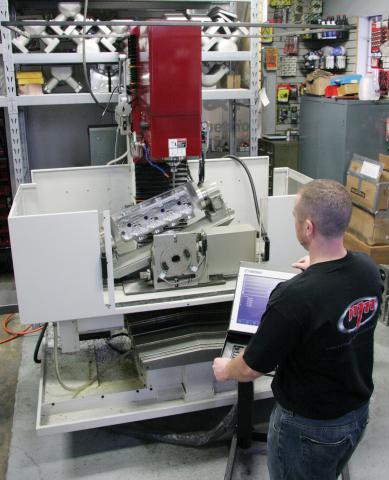
Successful cylinder head port development depends on several critical metrics, according to our source from M&M Competition Engines, whose shop is pictured at left. Valve-to-bowl area percentages, finish texture of the port, and cross-section were all cited as factors directly tied to head performance.
Several misconceptions have infiltrated the performance spectrum, so we called on a pair of industry veterans to separate the fact from fiction.
Engine builders today can take advantage of a variety of off-the-shelf cylinder heads that are specifically designed for the most popular engine platforms.
“That works for the majority of the market,” said Scott Patton of M&M Competition Engines, Franklin, Indiana. But the sheer number of head choices “can be overwhelming for some engine builders,” he noted. Plus, those off-the-shelf heads may not work for “the small percentage of racers who truly need ‘just a little bit more,’” he pointed out. “Engine builders whose clientele needs the cutting-edge advantage that custom cylinder heads provide start to see themselves heading down the proverbial rabbit hole.”
From Patton’s perspective, most engine builders “are not altering cylinder head port development as they once were. They are utilizing existing CNC-ported heads to complete their builds. It seems that the industry is transitioning with the times and segregating engine builders from cylinder head development companies. The two go hand in hand, though, and trying to be successful at one is impossible without at least a small understanding of the other. We try to bring the two worlds back together.”
Cylinder head education is also an important part of the service offered at 1 Way Technologies of Washington, Indiana, said Chris Grace. “Our customers run the gamut from real experienced guys to guys who are just starting out,” Grace explained. “Either way, we try to inform the people we deal with, because we want them to be armed with all the knowledge we can give them for their application.”
It’s often believed that bigger valves invariably translate into more power, noted our source from M&M Competition Engines. In fact, a larger valve, as shown at right, can sometimes create unforeseen problems that will decrease the engine’s power potential. Another area of misunderstanding with big valves, particularly in smaller-displacement engines, is the large valve pocket needed for piston clearance, he added.
Among the recurring issues these companies have observed when it comes to cylinder heads:
Bigger is not always better. “The common thought process is that to make more power requires bigger valves,” said Patton. “But at times, a larger valve could create unforeseen problems that will decrease the engine’s power potential. A larger valve will come closer to the cylinder wall which, in many instances, will decrease airflow because it has a wall to contend with.”
Another issue with big valves, particularly in smaller-displacement engines, is the large valve pocket needed for piston clearance, Patton said. “Some engines—485-inch truck-pull engines are especially susceptible to this—with large cams and bigger head diameters on the valves, require a valve pocket in the piston that makes it next-to-impossible to get any sort of viable compression out of the engine. Just because a cylinder head flows big air doesn’t mean that it will translate into big power on the dyno or quicker ETs at the track.”
Beware the “freshen-up.” “Guys can hurt cylinder heads by doing a freshen-up where the valve job cutter spec is different than what we put on it brand new,” said Grace. “What we’ll see is that the combustion chambers have a big radius in them right above the valve job.” Whoever did the freshening “just used the basic cutter to go in and try to put a valve job on a seat ring. What that’s actually doing is hurting the design aspect and the flow characteristics of the port. We have spec sheets in our catalog of the cylinder heads that we offer, and they have a flow curve that we like to adhere to. That’s why they were designed that way.”
1 Way Technologies fixes the issue by putting the head back in the CNC machine “and re-running the combustion chamber program over the cylinder head,” Grace said. “We’ll do what we call dropping the chamber. We drop the chamber into the head, and it will get it back closer to the spec it was brand new.”
The techs then “analyze the valve job, where the valve actually sits on the valve seat, and the distance from the valve seat to the short turn, because we don’t want to see that distance change drastically,” said Grace. “If it does change drastically, then we will go in and apply a fix to the cylinder head—blend the seats differently, blend the short turns, blend the combustion chamber. Then we’ll put it back on a flowbench and compare that worked-over cylinder head to the brand-new aftermarket piece that we’d like to have sold in the beginning.”
Looks versus performance. Some engine builders “are more concerned with how a head visually looks than how it actually performs,” said Patton. “By that I’m referring to the shape and texture of a port. It is common for engine builders to take an out-of-the box CNC cylinder head and want to, for example, polish the intake to a mirror finish, or open up the bowl area to improve the airflow and power potential of a cylinder head. Only they’ll do the exact opposite. Cylinder head port development success depends upon critical metrics that many don’t quite understand. Valve-to-bowl area percentages, finish texture of the port, and cross-section are just a few areas that either make a head perform or not.”
Port volume versus cross-section. The “cross-section” Patton referred to is the way M&M prefers to measure and compare cylinder head size, as opposed to intake-port volume.
“When you compare different cylinder heads by the minimum cross-section of the port, it provides the end user with information that is more relative to what they are inquiring about,” he explained. “When utilizing volume as your benchmark, it does not take into consideration the port length. So ultimately you can have two heads with the same port volume but wildly different cross-sections. Engine builders using volume to make their cylinder head choices might end up with the incorrect cylinder head to start their project.”
Officials at NMCA and NMRA created a new role specifically for this young professional who describes himself as “the one-stop shop for racers before, during, and after races.”
Racers in the NMCA Muscle Car Nationals and the NMRA Ford Nationals will be seeing a lot more of Gavin Carter this year. Since 2017, he had been the competition director for both series in a part-time role. This past December, however, NMCA/NMRA parent company ProMedia Events & Publishing created the full-time position of racing operations manager for Carter. The new role essentially merged his previous job with managing the series’ contingency program and parking.
Carter, 24, has been working drag racing events for nine years. He didn’t grow up around the sport, but as a teenager he bought a rough and rusty 1968 Mustang and rebuilt it with his father. And, he had a much different career than racing in mind after high school. PRI recently asked Carter to share his vision for the races he’ll soon be managing, as well as a few other interesting tidbits.
PRI: How did you get into the racing industry?
Carter: When I was 15, I got a part-time job at Memphis International Raceway, 15 minutes from my home. I parked cars and worked the concession stands. After a few months, the track manager asked if I wanted to work in race operations. He put me in the staging lanes and taught me how to tech cars, do timeslips, and to work the water box and Compulink timing system. When I worked my first race, it really lit a spark in me.
PRI: How did you get involved with NMCA/NMRA?
Carter: Four years ago, Rollie Miller [general manager and national event director for the NMCA and NMRA] called. He needed someone to work the back computer at events. They’d fly me in to work a four-day weekend event. My first race was at Indy. I loved it. I worked every race for two years and then became competition director for the events.
PRI: Why was this position created for you? What strengths do you bring to this new role?
Carter: I’m kind of the one-stop shop for racers before, during, and after races, from parking to getting their contingency worked out. I work remotely from home and travel to all the events. I’ll get there before the event starts to get parking sorted, manage load-in days, and answer questions for teams. I think the familiarity with one person will make things easier for everyone involved.
PRI: Can you share your goals for the next 12 months?
Carter: My top goal is to streamline the whole process and make things easier for racers. I’m a newbie in some respects, but I bring new ideas. I have no preconceived notions about how things were always done in the past. The muscle cars tend to have an older crowd, so I want to bring in more drivers in my age range. That will be vital for growth.
PRI: What changes will racers and business partners notice—or what do you hope they’ll notice—as a result of your efforts?
Carter: One of the first things we did when I came on was to change the rules to allow double entry in points classes. We hadn’t had that before, and many racers had brought it up. If it brings in more racers and allows them more opportunities to run for the championship, then great. If it doesn’t work out, we’ll change it.
Overall, I want racers to say at the end of 2021 that this was one of the easiest seasons in terms of logistics—getting their rigs parked, the racing going smoothly, getting all their contingency stuff handled afterward. Then, I think they’ll be more likely to recommend NMRA/NMCA to their buddies as great events to run.
PRI: What do you see as the biggest challenges ahead of you?
Carter: Learning how contingency works and working with sponsors. But I’ve always been a quick learner, and I have a driving passion to succeed. COVID has been a challenge, but we managed to get in a full slate of races in 2020. It comes down to working with local governments and regulations, and I’m sure we can handle it.
PRI: Who inspires you, and why?
Carter: Rollie has been a great mentor. He’s always pushing me to continue to grow, giving insight and advice. Gene Bergstrom (Race Track Services owner) is also a solid mentor. They were guiding me in my first year as race director, kind of throwing me into the fire but helping set me up for success.
PRI: What’s a valuable lesson you learned working through the last year?
Carter: I would say it was learning the value of staying open-minded, and when making decisions, in your career and life, don’t look back. There’s not much time for second-guessing in this industry. When you have a wreck on the track, a car leaking fluids on the starting line, or an issue in the staging lanes, you need to make quick and clear decisions to keep things moving.
PRI: What can you not live without, and why?
Carter: For work, it’s my laptop. I’m on it most days, planning races. Outside of work, it’s going to the gym, usually six days a week. It’s about staying healthy, and it’s also stress relief.
Gavin Carter
–
Title:
Racing Operations Manager
Organization:
ProMedia Events & Publishing
Hometown:
Norwalk, Ohio
Fast Fact:
“I grew up playing ball sports. Before going fully into the racing world, I was coaching middle school and high school athletics, and I got a coaching job right after high school. It helped me build leadership tactics and learn to make quick decisions. It was about setting up the team for success. That experience transferred to the racing world.”
The newly installed president of Honda Performance Development shares his company’s plans for electric race vehicles, Indy cars, sports car racing, and how he stays focused amidst the challenges that come with a hectic racing schedule.
A global powerhouse in terms of automobile manufacturing and technology, Honda also boasts a rich and accomplished heritage in motorsports. The OE maintains an active and winning presence in a wide array of racing series, including the NTT IndyCar Series and IMSA, along with extensive involvement in grassroots racing such as quarter-midget competition.
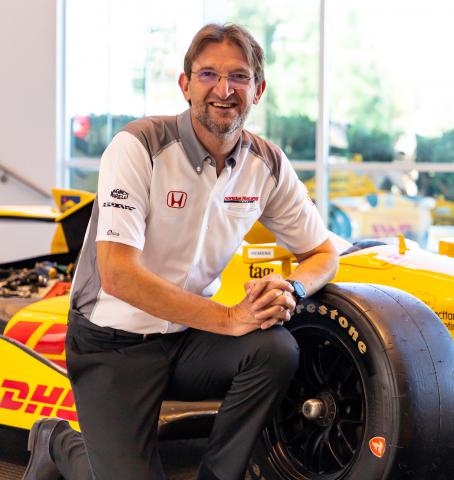
Honda administers its motorsports and performance efforts through Honda Performance Development (HPD) located in Santa Clarita, California. With the retirement of Ted Klaus in December, HPD Technical Director David Salters was subsequently named HPD president.
Salters, a native of England, brings extensive motorsports experience to his new position. Early in his career, Salters served as design and development engineer for the CART program at Cosworth Racing, and later with Mercedes-Benz High Performance Engines (formerly Ilmor Engineering) including stints as team leader of Formula One performance development, and also development engineer with the CART racing program. Salters then moved over to Ferrari, where he oversaw Formula One engine development from 2006 to 2015.
Salters holds a Bachelor of Engineering with Honors degree from Cardiff University and a PhD from the University of Manchester Institute of Science and Technology.
An engaging and gregarious personality, Salters recently sat down with Industry Insights to discuss his career, his new position at HPD, and more.
PRI: Congratulations on your new position at HPD. It was interesting that the development of electric racing vehicles was mentioned prominently in the announcement of your new position. Is it reasonable to assume electric racing vehicles are a special priority for Honda?
Salters: Honda goes racing to develop people and technology, and the company is pretty authentic with that. The factory up here in Santa Clarita has a great team, and we make powertrains and help develop cars. There are several hundred people working here, to run our American motorsports program. Of course, when you think about electrification that is now coming, we are a good way of developing people and technology in that area. With Honda’s lineup of hybrid cars and looking further, that’s important. Very, very important. There are hybrid powertrains in IndyCar in 2023, and there are hybrid powertrains in LMDh (IMSA Le Mans Daytona) in 2023, and we are also looking beyond that. So the answer to your question is yes, because we are focused on the people and technology and trying to promote Honda’s class-leading hybrid cars.
Motorsports are central to the culture of Honda, resulting in strong performances from teams like 2020 IndyCar champions Chip Ganassi Racing. As the new president of Honda Performance Development, David Salters plans to continue this legacy while exploring new technologies such as hybrids and EVs.
PRI: You have an extensive background in racing, through many years. That gives you a deep perspective of where we stand today in terms of competition among manufacturers. Is it as strong today as in your early years?
Salters: That is a good question. You’ve seen a fair amount of racing as well, and this topic fluctuates, depending on lots of criteria. I’m going to speak from Honda’s point of view here, and if you look at IndyCar, we’ve been a consistent supporter of IndyCar for 20, 25 years. A long time. Honda is in it for the long term in racing, which is very refreshing. Other manufacturers come and go; it’s a transient thing. But Honda is in it for the long haul, and it’s part of our culture here. But regarding your question about the level of competition...I don’t know. We enjoy the competition, and we do it so we can compete. That improves the breed. And the more manufacturers (involved), the better. That helps everybody. Undoubtedly, it’s as strong today as in the past in some areas. If you look toward LMDh and others, that looks pretty interesting, doesn’t it? There are some very good discussions with IndyCar for hopefully a third manufacturer, so that’s got potential, too.
It might be a bit weird to say this, but we could be finding ourselves in a golden age right now. There are many things to look forward to. At the moment the level of competition is reasonable. Bear in mind, there are many outside influences on people’s businesses right now. And there are a lot of good indications of things being quite exciting in the future.
David Salters has spent much of his career in international motorsports companies, including Cosworth, Mercedes-Benz, and Ferrari. Although very different organizations, he noted they have one key element in common, “At all forms of motorsports, the pressure is relentless,” said Salters. “But that experience helped me.”
PRI: For an engineer, projects such as the new hybrid power unit in IndyCar are surely an exciting undertaking. Are those the types of things that make the next few years so appealing for motorsports from an engineering standpoint?
Salters: I think it is. From our point of view, it’s about our people, our team. The thing we’re most proud of is (the people at) Team HPD. Our associates here, the ladies and gentlemen...the real pleasure you derive from this is building your team, and watching your team develop and excel. It begets projects like electrification, and hybrids. Very efficient powertrains. Engineers, they get really enthused and excited, and they can show their real skill in projects like this. Building the simulation tools, validating those tools, learning, and taking it all along. The exciting bit is developing the people and the technology, and the two go together. Without the people, nothing happens. With interesting technology, you can further develop people. The two are intrinsically linked, and that’s typically why Honda goes racing.
PRI: On the flip side, there remains a significant question of acceptance of electric power among traditional fans and participants. That’s a big unknown. How can you win people over to the idea of electric technology in racing?
Salters: I think the way you win them over is to provide good racing. We all want to see good racing. So what can you do to make the racing more exciting, that’s my personal view. If you go to watch an IndyCar race, the racing is pretty good. You don’t know who is going to win, which is good. You want to go into a race not knowing exactly who is going to win, don’t you? So the way the technology can best promote itself is to be involved in good racing. If you can put those two things together and have the technology help the racing, that’s going to get the traditionalists over. We watch it because it’s a competition, it’s racing, it’s human, and it’s exciting. It adds value to people’s enjoyment. Technology with good racing is good.
PRI: Honda is involved in a number of racing series. For you personally, and with your background, is there a series you naturally relate to, feel more connected to?
Salters: I’ve been at HPD now for some years, and the reason I love it here is that we do different series. We get to see different stuff, and we’re so privileged here to be involved in IMSA and IndyCar. But we also support F3 and F4. If you look at the differences…as I’ve gotten older and wiser, I’ve realized that if I’m watching sports car racing…you can relax a little more. It’s like five races in one, and the faster cars are overtaking the slower classes. And then you’ve got the Indy 500, which is just pure spectacle. Blimey! Human beings can actually do that! As I’ve grown older and wiser, I’ve come to appreciate each racing series for what it is. I was fortunate enough to be involved in Formula One, which of course has its own nuances. Each racing series has its own pros and cons. We’re fortunate here at HPD to be involved in many different things and you come to appreciate the nuances of each type of racing. I don’t know that I have a particular favorite, but I appreciate the different aspects of each series.
PRI: On the flip side, outside of your current realm, where would you like to see Honda become active? Is there a type of racing you’d enjoy seeing the company pursue?
Salters: I’m not sure how to answer that, but I’ll try. You’ve got to be careful here, because you’re talking to an engineer who happens to also be the company president. (Laughing.) Those two things put me in a difficult position when I consider that question. It’s a separate discussion, from each perspective. In the future, I’d like to understand how—with electrification or more sustainable racing—we can be responsible as we go forward. Honda is a quite responsible company, and as an engineer you want to use that skill to people’s benefit. What we do now is quite exciting, I think—arguably IndyCar is some of the best racing on the planet, and it’s good engineering. That’s great. And in the future that will transition toward hybrid and more things after that, to be more sustainable, so we’ll see what happens there. So if you think about full electric racing and other forms of sustainable racing, the question will be, “How do you make that type of racing exciting?” I’m sure there will be ways. But if I were thinking toward the future, as we become more sustainable and our goals move toward carbon neutrality, how do we use racing to accelerate that, but also make it more exciting. But that’s future-future. Sustainable racing will be interesting, but it has to be exciting.
Honda supports a wide range of racing efforts, including these Honda Civic TCRs fielded by LAP Motorsports in the IMSA Michelin Pilot Challenge. “I don’t know that I have a particular favorite,” David Salters told us, “but I appreciate the different aspects of each series.”
PRI: You spent several years with Ferrari, one of the most recognized performance brands in the world. It’s a safe assumption that the expectations there were enormous. How important was that stint in your career?
Salters: The expectations at every organization are enormous. You’re there to compete, and to win, right? That’s our philosophy, in a respectful way. But yes, Ferrari is probably a special case, because it’s like the national team. So the expectations are huge. But for me, you really challenge yourself. And it’s always nice to put yourself out of your comfort zone. Like all racing organizations, it’s all about the people, and there were great people there. The pressure is relentless, but at all forms of motorsports the pressure is relentless. But that experience helped me...it’s a particular flavor there, at Ferrari. You learn to deal with pressure and solve problems and try and move forward and be positive. It is particular, because as I mentioned, it’s the national team. But there were people I met there, you got some great friends you make as you move through. Italy is a lovely place, very warm and very friendly. I got to speak and work in a different language, which was terrifying and brilliant both. I didn’t speak it very well, but I tried. There were challenges of different culture, different language, etc., but it was a life experience.
One of the most amazing things has also been coming here, to HPD and Southern California. As you get older, you begin to realize that you’re not too bothered about possessions and things, but it’s more about experiences in your life. The Ferrari experience was an extraordinary life experience for my family and me. And then coming to California and working for Honda and HPD, that has been an equal life experience. Those experiences are valuable.
PRI: Looking back across your career, what has always motivated you? Winning races? Championships? Working with your peers?
Salters: The engineering is a primary challenge, and then working with a team of like-minded, driven people is another strong motivation. Doing good engineering, learning and understanding, is a primary motivation. And then, the fact that you get to find out on the weekend whether that was good enough or not, that’s another motivation. (Laughing.) It’s very black-and-white, actually. There is a winner, and those who didn’t win. It’s lovely being in that environment; it’s hard, but it’s lovely. You can find out whether you were good enough, whether your engineering, your team’s engineering, were you good enough to win? That’s really good. It’s a double-edged sword because sometimes you don’t like the result. But you regroup and challenge yourself. That’s what gives you the motivation.
PRI: One of the elements that makes racing so interesting—and unpredictable—is the human factor. You can engineer the perfect engine, or car, but humans still have to drive the car and service the car on pit road. Does that make it more challenging from an engineering perspective?
Salters: That’s what makes it exciting. It boils down to human beings. Being human and showing off the skills of the driver, and the skills and the passion. That’s what makes racing special. The human aspect is delightful. And interacting with humans, that’s lovely also. The teamwork aspect, that is very enjoyable. Now that you mention it, that’s what makes it nice when you get to put together your engineering with a human aspect. There is the team, and the driver, and when you understand what the driver is doing, it’s awe-inspiring. The fact that a human can push the car to the limit and keep it there, that is extraordinary. It’s a testament to what people are capable of. You appreciate that more as time goes along, I think.
David Salters feels that all competition efforts, like the 2021 Rolex 24 At Daytona overall champion No. 10 Konica Minolta Acura ARX-05 of Wayne Taylor Racing, are really just expressions of the people involved. “That’s what makes it exciting. It boils down to human beings.”
PRI: Your father was an engineer. How much did that impact your career path?
Salters: A marine engineer, yes. It impacted me quite a lot, I suppose. I’m very lucky to have the best parents a son could wish for. They always encouraged me, and looked after me. I used to work with my dad during the summers when I was in university, and even before that. I was exposed to (marine) engineering very early, but I pursued a different type of engineering. My dad’s engines rotated at 80 revs per minute, and I was working with engines that rotated at 19,000 rpm. But the physics is all pretty much the same, and the principles are the same. Just different regimes. But it did influence me, because my parents were always there for me. My father had his own business as a marine consultant, so there was a chance for me to go into that. But I wanted to do my own thing. My parents were always brilliant with that, with their encouragement. We had the bond of engineering between us, which was lovely.
PRI: What do you look for in the people who work on your team? What traits are key to success in the motorsports arena?
Salters: As you become more responsible, one of the greatest pleasures I’ve ever experienced personally is the recruitment and development of younger people. You watch them grow and flourish and contribute, and that’s one of the biggest pleasures you will experience. Particularly in the second stage of your career, where you become more responsible. So looking for traits, there are a few that are very important. Honesty, you want people who want to be on the team, and are honest. We all know things, and there are things we don’t know. If we don’t know it, be honest and say so. So honesty goes a long way. And then, energy. People who want to be there and want to contribute. And then, competence and skills. So you want people who are honest, want to be there, full of energy, lots of optimism. And pragmatism, as well. You want them to question things. The nice thing about a team is that you have lots of different people and different views. That’s the point. That will always achieve more than the single person can achieve.
PRI: You mentioned a moment ago that it is important to push yourself out of your comfort zone, to challenge yourself. Why is that so important?
Salters: I think that makes you feel like you’re alive. It’s quite nice to feel a little bit uncomfortable about where you are and what’s ahead in the future. You want to keep moving forward in a sensible way, in a learning way. Humans are quite extraordinary, and if they set goals and challenges they tend to achieve them. Sometimes it’s hard to know if they can be achieved, but trying new things and getting out of your comfort zone, that all adds to life experiences. As you get a bit older you realize that some of the best things are experiences you’ve shared with your family and colleagues, so trying something challenging and different is very enjoyable. You enjoy it in a way that might feel uncomfortable. Watching my children grow and develop, they seemed to relish that. Kids are brilliant, they don’t really notice the challenge, they just get on with it. They don’t notice they’ve learned a new language, they just adapt. Which is quite a lesson for us adults. Humans are quite extraordinary, so pushing yourself far out of your comfort zone is a way to take that forward.
PRI: How are you able to escape the grind of work? Are you able to cultivate any other interests or hobbies?
Salters: Oh yes, otherwise you go crazy. There are a few things I’ve learned along the way, in some high-pressure environments. Much of it is in the mind, remember. Exercise helps a lot because it clears the mind and helps you put a different perspective on things. I love cycling—my son races mountain bikes, so I’ll go out and follow him around. Exercise is good to relax. And I like sailing, because when you’re sailing you have to think about sailing; you can’t think about other things. It’s difficult for your mind to wander. I like to sail, and I like wind surfing. That is awesome, because you just switch off. And the third thing is nature. With my family we have a horse and a dog, and we enjoy going out to have experiences in a natural environment. The simplest things are sometimes the nicest things. A good hike, walking down the beach, or that sort of thing. It’s quite important to keep a balance to all this, and I learned this from not (keeping a balance) sometimes. You get stale and tired. Exercise, taking your mind off things, and my family. I’m very fortunate that my family is awesome, and we enjoy nature together and that helps keep a balance. It’s not always easy, but you have to try.
PRI: We’ll wrap it up with this. What can you tell our readers to prepare them for the changes that are coming to power development in motorsports? What should we be ready for?
Salters: So I’m talking here from the perspective of North American motorsports from Honda’s point of view. Electrification is moving into our motorsports. I personally think it’s great, and also relevant from the perspective of the class-leading products from Honda and Acura. So that’s good. And we’ll do it in a way where the racing is exciting, and that’s good, too. Trying to race more responsibly, and developing people and technology. It showcases our products and that’s great. And then, just going forward, Honda is a responsible company, and we’re all trying to figure out how to use all the benefits of racing to develop the people and technology to move things forward. We want to keep that going. Providing it entertains people, as well. Motorsports is a way of entertainment for people, and it brings them joy. So we will look to keep people entertained, responsibly, as we go forward.
PRI: Thank you, David, and we wish you the best in your new position.
Four things I think while awaiting the start of this month’s (March 11–14) NHRA Camping World Drag Racing Series 2021 season opener at Gainesville Raceway:
1) I THINK THE STORY OF HOW KEVIN Duboiswent from gamer to one of the world’s leading authorities on Mitsubishi Evos is worth highlighting. Dubois, whose Evolution Dynamics is the subject of this month’s Business Profile, got introduced to the niche import like millions of other ’90s teens—through the popular “Gran Turismo” video game. But while most of his fellow players dreamed of someday piloting a real race car, Dubois, an engineer by trade, leveraged his knack for tech into a position at a prominent defense contractor. Soon after, he went car shopping, ultimately landing on…an Evo! For the full story on how that decision led to “Evo D,” as his customers affectionately call the business, flip to page 64.
2) I THINK I’D MAKE A LOUSY SUPREME Court Justice…or any justice for that matter. I say that because in this month’s edition of Make the Case (pages 26–27) both Jack McInnis of World Products and Mark Fretz of Brodix make some pretty compelling arguments on behalf of cast iron and aluminum engine blocks, respectively. On one hand, McInnis notes, “We’ve seen instances where people have really seriously blown some stuff up, and while it leaves a few scars on the [cast iron] block, the block is still perfectly good to use without having to get into welding, re-machining, and that sort of thing.” Conversely, Fretz points out that aluminum “lightens the overall engine package and provides more ways to optimize the car while meeting the minimum weight for the class you’re running in.” But neither side stops there—not by a long shot. Which is why we’re happy to sit back and let you, the reader, decide which is better. See, I told you I’d make a rotten judge.
3) I THINK I WANNA SEE IF CHRIS Blizzard’s racing team has room for one more. I’ll do whatever it takes—change fluids, check tire pressure, make sandwiches—because Blizzard’s 24 Hours of Lemons crew sounds like they’re having a freakin’ blast modifying his ’86 BMW 325E and ripping it through some of the country’s premier road courses…all for under five Benjamins. Lemons competitors, it should be noted, are a fun-loving bunch anyway, as the series’ rulebook all but prohibits participants from taking the events, or themselves, too seriously. And Blizzard’s vehicle fits right in, alternating themes from Ghostbusters to Hello Kitty while sporting a stock-tuned motor that puts out “two-hundred something” horsepower. Which is why we couldn’t resist profiling the Frankenstein-y build in this month’s coverage of the road racing market. Read more about Blizzard’s car, along with a standout entry from the “build by points” Champ Car series, beginning on page 58.
4) I THINK IF YOU WORK IN TECH SUPPORT for a performance piston manufacturer, we feel your pain. Granted, it’s better to be dispensing knowledge than counting tumbleweeds, but word on the street is that more than a few racers and engine builders could benefit from the advice of suppliers like the ones we spoke with for this month’s feature, which begins on page 70. Fortunately, we corralled several of the industry’s best for insights on innovations such as CP-Carrillo’s SCBX piston for the Subaru EJ257, expanded applications for JE Pistons’ Ultra Series Forgings, and RaceTec Pistons’ all-new AutoTec II line forged in 2618 material (more on that, too, in Race Shop, page 106).
 MEMBERSHIP LOGIN