Companies are invited to help support the motorsports industry by joining together under Performance Racing Industry’s landmark program.
Racing and performance companies can now join the movement to build, promote and protect motorsports through the industry’s first-ever business membership program.
Performance Racing Industry (PRI), the producer of world-class trade events and media, has launched its all-new Business Membership designed to unite the industry and provide advocacy, support and resources to help motorsports professionals and enthusiasts alike succeed and prosper. Membership, which was first offered last month to PRI Trade Show exhibitors, is now available to all businesses throughout the racing community. A separate membership for individuals is set to launch in July.
"PRI Show exhibitors have seized the opportunity to join this groundbreaking membership program and create a uniform voice that speaks for the racing industry," said PRI President Dr. Jamie Meyer. "Now we're extending the opportunity to all motorsports companies to be a part of this powerful group and support PRI's efforts to fight current and future challenges at the federal, state and local levels and create programs that benefit the motorsports community."
PRI Business Members will receive a suite of services and benefits that include:
Save Our Racecars: Contribute to the fight to protect the racing community, and ensure racing continues and grows in the United States and internationally
Legal Counsel: Updates, reports, best practices and more information on legal matters impacting the industry
Legal Support Hotline: Access to assistance from PRI staff for insight and information on issues affecting racing businesses
PRI Education: Educational programming and training for racing professionals and enthusiasts
Market Research Reports: Exclusive industry reports and data covering key areas and metrics
PRI Jobs Board: A central hub to post and search for jobs in the motorsports industry
PRI Show Booth Savings: A 10% discount on booth space for PRI Show exhibitors
Also, PRI is currently offering motorsports businesses the opportunity to upgrade their commitment to the industry by becoming a PRI Founding Member. This exclusive membership level comes with enhanced benefits and privileges beyond those provided to standard Business Members.
"If you want to be an industry leader in motorsports, then you have to be fully involved with PRI. Becoming a PRI Founding Member was a no-brainer for us," said Bre Fredritz, marketing director at Callies Performance Products. "As a proud, independently owned American manufacturer, we support racing, the racing community, and the continual efforts to grow the motorsports industry. We want to see our industry thrive for decades to come."
To become a PRI Business Member, or to learn more about how businesses can help PRI's efforts to protect, support and grow the racing industry, visit PerformanceRacing.com/Membership.
When it comes to pistons, it’s no secret that friction and heat can affect performance and overall longevity. In this month’s column, Swain Tech’s Richard Tucker and Gary Huffman of Calico Technologies explain how their respective race-ready piston coatings are designed to stack the odds in your favor.
TBC & PC-9 ADVOCATE:
RICHARD TUCKER,
SWAIN TECH
–
Decades ago, one of the key benefits of using piston coatings was the ability to run higher clearances and pick up horsepower as a result. While that’s still true today, clearances are much better now than they were in, say, the early 1980s, and power is a lot easier to come by through other means. These days it’s more about adding an extra level of protection—an insurance policy in case things go wrong and there’s an unusual surge of heat—to either prevent a catastrophic failure or reduce the potential damage done by that event.
In a motorsports application, we’d address this with two different coatings: Our TBC (Thermal Barrier Coating) for the dome of the piston, and our PC-9 (Performance Coating #9) for the skirt of the piston.
Any time we’re dealing with heat, we’re going to use ceramic-based products to manage it. TBC is a reflective coating that is going to be thin and uniform so that it will be an effective thermal barrier, but not so effective that it traps too much heat in that dome surface—if it did, it would promote detonation rather than discouraging it.
We have industrial ceramics that are very effective at blocking heat, but the problem is that when you use it in a motor, it blocks too much heat and actually traps it right on the surface. There’s a balance between the two, and TBC was developed to be a “plug and play” solution that doesn’t require you to make clearances for your valves and reshape your combustion chamber to accommodate it.
And with the piston skirt, wet lubricants are always going to do the primary work. So the main purpose of that PC-9 coating is to provide a backup form of lubrication to help in “what if” situations: oil starvation, lean conditions—anything that has the potential to make that piston grow larger than it should and want to stick. This will provide some more protection for a little bit of extra time to mitigate bigger problems.
Other folks use a hard-anodizing process to address this, particularly in the drag racing world, and that treatment is applied to the entire piston. That’s certainly an acceptable way to help protect that skirt in those types of applications, where they’re pulling those pistons out of the engine regularly for servicing.
But the downside is that the hard-anodizing process makes the skirt hard, so you’re going to notice problems between the skirt and the wall. So if you’re not taking the motor apart regularly, you probably don’t want to use that hard-anodized process. You want the skirt to be softer than the cylinder wall.
Hard anodizing is providing wear resistance by making the skirt hard, and that’s great for those really demanding applications where you’re just running for a few seconds at high load and checking the piston skirts and cylinder walls regularly. The challenge is that, over a long period of time, you might be doing a great deal of damage to the cylinder wall.
PC-9 is on the opposite end of the spectrum from hard anodizing—it’s a durable coating, but it’s intentionally soft so that when things are too tight, it acts as a sacrificial surface. It’s generally preferable for the skirt and the coating to be the wear surfaces rather than the cylinder wall.
CT-3 & CT-2 ADVOCATE:
GARY HUFFMAN,
CALICO TECHNOLOGIES
–
In a perfect world you wouldn’t have a lot of loading on a piston skirt, but in this world, we do. Pistons are designed with cams on the skirts in order to minimize the contact between the skirt and the cylinder in the load area, but at the end of the day there’s still a significant amount of contact, and that’s the largest metal-on-metal frictional area in the motor. So it stands to reason that when you’re looking to reduce friction and heat in the motor, you’re going to want to reduce friction at the largest frictional point in the motor. That’s probably the biggest advantage that piston coatings can provide.
For that reason, our CT-3 dry film lubricant coating is great for a wide range of motorsports applications. It’s a graphite blend—any time you’re looking for anti-scuffing properties, you’re going to want to use something with graphite in it because of its lubricity. Molybdenum disulfide coating is also very popular in the racing world for the same reason, and it’s very slick as well.
The reduction in friction that the CT-3 coating provides reduces heat in turn—when you rub two pieces of metal together, you create a lot of heat. By using a skirt coating, you’re going to reduce overall engine temperature and ultimately save money because the wear will be on the coating rather than the cam on the piston skirt.
The coating is a sacrificial layer, and it’s going to conform to the cylinder bore to some degree. But typically, when you pull a coated piston out of a motor that hasn’t reached its cycle life, it can be recoated and reused. When most “Saturday night” motors are torn down for rebuilds, the coated pistons can be reused. And a lot of guys do just that.
We also tailor our CT-3 coating to specific applications. In reality it’s an entire family of coatings, and we adjust the chemical blend of it based on the needs of each application. For instance, a four-cylinder, turbocharged, nitrous-injected 600-horsepower drag engine requires a very specific CT-3 coating blend—it comes down to criteria like the expected rpm range, power adders, and the type of fuel you’re using.
Managing heat is also crucial in a high-performance motor, as it allows the tuning to go places it wouldn’t be able to go otherwise. That’s why we also, strongly recommend applying a thermal top coating like CT-2. Like the CT-3 coating, it’s focused on managing the heat in the piston, the only difference is that we’re using a ceramic blend.
Not only does CT-2 reduce heat in the piston overall, it also keeps heat off of the pin bore, and that’s a big problem area in a lot of motors because you generally want to run your pin bores as tight as you can. It also keeps heat off of that top ring, which is very important—you want to do anything you can to reduce heat on the ring package. Anyone who’s racing in a class that allows ceramic top-coated pistons should be running them.
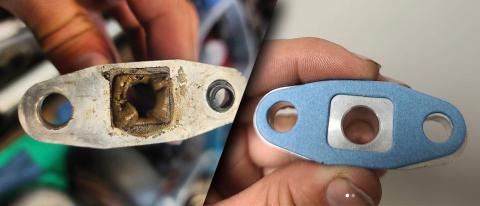
Turbo manufacturers and installers frequently troubleshoot problems for end users. Two common issues, seen here from left to right, involve using a gasket maker for the flange instead of a solid gasket, which blocks oil flow, and using flanges with holes that are too small. Photos courtesy of Boost Lab.
Getting the details right means the difference between making more power and destroying the whole system. Here’s how to ensure you’re on the correct path.
Power adders—and turbochargers in particular—are an integral part of racing’s quest for more performance. But as turbos grow more popular, and the demands put on them more extreme, the risks of making mistakes in their installation and use grow as well. We asked representatives from some leading turbocharger companies about the most common mistakes they see when their customers install a turbocharger system and how to fix them, or avoid them altogether.
Size—and Quality—Matter
“Most people are using turbos that are way too big,” said Geoff Raicer of Full-Race Motorsports, Phoenix, Arizona. “A lot of enthusiasts are focused on peak horsepower for drag racing and don’t know how a large turbo is going to behave during the 98% of the time you’re not at wide-open throttle. An overly large turbo can be terribly laggy and ruin what makes the vehicle fun to drive.”
“Stop using turbos designed for 1970s John Deere diesel tractors on gasoline race engines,” said Kevin Kenney of AGP Turbo, Tempe, Arizona. When asked if that really happens, Kenney said, “Oh, yes. All the customer sees is a 56-mm turbo for cheap. A few hundred dollars more will get you better performance in every way. Every gasoline engine displacement, rpm band, compression, and target boost level will require different precise matching. The compressor wheel size and design, compressor housing, turbine housing, and turbine wheel size and design need to match all the aspects of the engine.”
Proper sizing doesn’t have to be difficult, Raicer said. “We help people with these calculations every single day. There are some YouTube tutorials on the BorgWarner MatchBot page that can help walk you through the process before you contact Full-Race.”
Blowing Smoke
Reggie Wynn of Turbonetics in Moorpark, California, has years of experience responding to end users’ questions, including turbocharger oiling systems. “The customer will call and say, ‘My turbo’s smoking.’ They want to blame the turbo, but most of the time it’s an installation error.” Because the oil coming out of the turbocharger’s center housing rotating assembly (CHRA) is not pressurized, “any restriction is going to cause smoking from the turbo.”
Most of the remedies are straightforward. Use a gasket, not gasket maker, on the oil drain flange, Wynn said. “You cannot control where the gasket maker goes when you squeeze the flange onto the surface of the CHRA. You don’t want it in the passage where the oil comes out.”
Also, beware of oil drain flanges with small passages. “We recommend using a -10 on the oil drain for your average turbo. That comes out to about 3/4 or 5/8 of an inch. The size of the hole in the flange needs to be the size of the hole in the gasket.”
When plumbing oil lines, “turbos and 90s do not get along,” Wynn said, referring to the angle of an oil drain fitting. “Since the oil’s not pressurized, it will make an abrupt stop, back up into the drain, and follow the path of least resistance, which will be that rear piston ring.” Wynn recommends at most 45-degree fittings.
Selecting the correct turbo manifold is “critically important,” according to our source at Full-Race Motorsports. One option is a log manifold, pictured top right, which is inexpensive but can be problematic in its open tube design. Another option is an investment-cast stainless-steel or Inconel manifold, shown top left, that features longer runners and more thoughtful runner geometry. Photo courtesy of Full-Race Motorsports.
And since the return oil isn’t pressurized, be sure the oil returns to the pan “above the oil level in the pan,” Wynn said, not at the bottom of the pan. “It can’t fight the oil that’s already in there.”
“It’s critical to prime a turbo with oil before its initial startup, especially if it’s a journal-bearing turbo,” Raicer said. “If you don’t, it may experience enough wear on initial startup that the turbocharger’s life can be shortened.”
Strong Foundation
Raicer said it’s “critically important” to select the right turbo manifold. “The manifold is the foundation of the whole turbo system. If you get the manifold wrong, the entire turbo system will be wrong.”
Two key elements of manifold selection are the “design component—the runner geometry and turbo position—and the materials and fabrication method,” Raicer said. Log manifolds, while inexpensive, can be problematic in their design, as they’re basically “just an open tube, where all the ports feed into each other and the exhaust pulses smash into each other. The engine basically exhales through a bottleneck. It’s bad for volumetric efficiency and turbine efficiency.”
Poor construction methods, such as “thin-wall, low-grade tubing, stamped collectors instead of fabricated collectors, and MIG instead of back-purged TIG welding can ruin a decent design,” Raicer said. “Before you know it, those things can cause 25%, 30%, even 40% losses coming from a leak or a crack.”
A high-quality fabricated manifold doesn’t have those issues, but fabricated manifolds “are labor intensive, and it costs so much in material and argon to properly fabricate turbo manifolds,” Raicer said. An alternative is investment-cast tubular designs. “With investment-cast stainless-steel or Inconel manifolds, we’re creating longish runners and more thoughtful runner geometry in turbo manifolds that don’t have the downsides of log manifolds or the constraints of fabricated manifolds.”
After 37 years of ownership, Skip Barber has announced a new ownership structure for Lime Rock Park.
Lime Rock Group, LLC, comprised of General Partners Charles Mallory, Dicky Riegel, and Bill Rueckert, and a group of private investors, have assumed control of the historic road racing circuit in Lakeville, Connecticut.
“The Group... [is] bringing outstanding new vision and vitality to Lime Rock’s operations and to our local and regional community. They are the ideal stewards of the Park’s long and successful legacy. This is truly wonderful news for everyone involved with Lime Rock as we commence our 65th year of operations,” Skip Barber said.
Dicky Riegel, former president and CEO of Airstream, Inc., and COO of Thor Industries, Inc., will serve as Lime Rock Park’s new CEO.
Lime Rock Group, LLC was formed specifically for the acquisition of Lime Rock Park. Skip Barber will remain a significant owner in the new entity and be an integral part of its management committee.
The track will open its 2021 with an expanded events calendar, including the Trans Am Memorial Day Classic on May 28-31, the SCCA NER event on June 11-12, the IMSA Northeast Grand Prix on July 16-17, and the Historic Festival 39 on Labor Day, September 3-6.
SuperSprings International has announced the restructuring of its leadership team in response to the growth the company has experienced this year. In 2021, SuperSprings has recorded over 50% growth domestically and more than 200% internationally, the company said.
Adam Weisner, the company’s chief commercial officer, is now leading all sales efforts, including domestic, international, and RV OEM sales. Additionally, Weisner will spearhead all marketing, customer service, e-commerce, and companywide technical support.
Michael Stickney, who joined the company in 2019 as chief sales officer, will take on a new role as chief operations officer. Stickney will now be responsible for all operations, including e-commerce operations, purchasing, warehouse, engineering, order fulfillment, and vendor relationship management.
Gerry Lamberti will continue as CEO and visionary for new products. Justin Tevis will continue to lead data management and reporting, with the additional responsibility of overseeing technology for the company. Ryan Dougan will continue to lead finance for the company, as well as human resources.
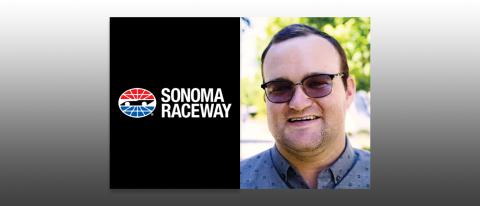
Having earned his rookie stripe as a drag racer at Sonoma Raceway, this lifelong enthusiast returns 10 years later to manage that same quarter-mile track.
For Nick Bublitz, a brush with drag racing at age five sparked a passion that later revved up a career in drag racing management.
Bublitz first took to the quarter-mile at Sonoma Raceway in Sonoma, California, 10 years ago while earning a bachelor’s degree in history from Sonoma State University (SSU). He seemed destined to work in the industry, and this year became drag strip manager for the historic Northern California track.
Sonoma Raceway also is home to the famous 12-turn, 2.5-mile road course that hosts a NASCAR race and other major series.
In his new role, Bublitz will oversee day-to-day operations of the drag strip, including the weekly Wednesday Night Drags program where he got his own start in racing.
The busy 29-year-old also remains the track announcer and race director for Redding Dragstrip, the oldest NHRA-sanctioned strip in the US (and a 200-plus mile drive from his home in Cotati). Of note: He loves to make passes in a 1970 Chevelle that he built up with a 502-cubic-inch big block, 700R4 overdrive, Wilwood brakes, and Global West suspension.
Bublitz recently shared with PRI his plans and goals for drag racers who treasure this iconic track.
PRI: How did you get started with drag racing?
Bublitz: When I was five, my father’s friend let me sit in his Top Alcohol dragster. That started a lifelong passion. Scheduling left me unable to do any regular racing in high school, but when I moved to Cotati for college, I started racing on Wednesdays in my street car. From there it just snowballed.
PRI: As a drag racer, and especially one who has competed at Sonoma Raceway, how will you use that experience in your new role?
Bublitz: I’ve been fortunate to compete at Sonoma since 2011 and spectate there for many years before that. I feel it’s important for the person in this role to have experience as a competitor because it adds valuable perspective. I’ll continue the “racer first” philosophy that the previous track manager, Kyle Seipel, had continued from his mother, Georgia. [Editor's Note: Seipel stepped away from the position at the end of the 2020 season due to his battle with cancer. Unfortunately, he passed away in June 2021.]
PRI: What strengths do you bring to this new role?
Bublitz: When I’m not at the race track, I am a facilities project manager at a game company. Attention to detail, progress tracking, and budgeting are all part of my daily scope. A track manager basically manages a series of smaller projects and events that take place in a compressed timeframe. This skill set has served me well in my role as race director at the Redding Dragstrip, and I feel it will do the same at Sonoma Raceway.
PRI: What changes are on the horizon?
Bublitz: Months before my hiring, the track had discontinued the weekend bracket drag program, but many racers and fans want to see it return. I’m working on new ideas to bring it back on some scale in 2022.
PRI: With fan safety in mind, how will Sonoma Raceway follow COVID-19 guidelines for this season, including the NHRA date in July?
Bublitz: We’ll be following guidelines from the state and the county, according to whatever tier we happen to be in at the time. Each tier change potentially allows us to offer more to the fans. (Sonoma County was transitioning into the red tier from the most restrictive purple tier when PRI spoke with Bublitz in late March.)
PRI: What’s your most gratifying accomplishment?
Bublitz: As a racer, I am most proud of winning a Division 7 NHRA title in my daily driver Ford hybrid hatchback. In my game company job, it was, with my team, delivering a $7 million motion capture facility on time and within budget. And, in race management, it has to be managing the Kool April Nites event at Redding. It’s their biggest race of the year, and it was only the second race I had ever managed.
PRI: Since you started racing at Sonoma in your college days at SSU, do you have some ideas for encouraging more young people to enter drag racing?
Bublitz: This is a very important issue for me. I’m working on a plan to drum up local interest on multiple levels. High schools and colleges are just two of the avenues I plan to take. We are continuing our “Top the Cops” program, which gives high school students the chance to race against police officers in their squad cars. I’m also pleased to announce that the Juggers Racing Team has continued their sponsorship of the high school program by donating a tech card to each Wednesday Night Drags event.
PRI: Who inspires you, and why?
Bublitz: I’ve been blessed with many inspirational figures in my life. In addition to my parents, I owe much of who I am today to my high school physics teacher, Michael Smidebush. He was the kind of person that one aspired to be: level-headed, honest, direct, and always present. That he was well-respected goes without saying. As far as racers go, Glen Terry was about as inspirational as they came. He was a local legend, with countless wins in more than 60 years of drag racing. He was always an innovator and was still competitive in his 80s.
PRI: What can you not live without, and why?
Bublitz: My dog, Frill. She’s a three-year-old golden lab who somehow manages to make life so simple and pure.
PRI: What do you enjoy doing when you are not at the race track?
Bublitz: I’m a bookworm. I typically go through a book a week, give or take. I also enjoy 4WD exploration, camping in Death Valley and the like.
Nick Bublitz
–
Title:
Drag Strip Manager
Organization:
Sonoma Raceway
Hometown:
Cotati, California
Fast Fact:
Nick is the first non-Seipel track manager for Sonoma Raceway’s drag strip in over 30 years, having recently taken the reins from Kyle Seipel, who in turn took over from his mother, Georgia, in 2017 upon her retirement after three decades at the track.
Micro, mini, and Lightning sprints offer big fun and competitive racing at budget prices. And with steadily escalating purses, are they finally getting the respect they deserve?
What would heaven look like for a dirt-track racer? It would surely be filled with tight, anyone-can-win racing. It would be easily attainable, too. And although it might not be a grandstand-filling epic, it should feel at least somewhat professional. At the same time, it would be accessible to guys and gals who want their last hurrah before fading to the sidelines and raising their mugs to the glory days.
When you put it that way, it might just look a lot like the world of micro, mini, and Lightning sprints. These feisty machines offer much of the thrill of bigger, more expensive cars, but in a format that puts them within reach of pretty much anybody who has an itch to go racing and a truck to pull their trailer.
Micro, mini, and Lightning sprints are basically downsized sprint cars powered by motorcycle engines. But the specific terminology isn’t always precise. Mini sprints and Lightning sprints are fairly interchangeable names used to describe sprint cars that are essentially midgets powered by a 1000cc chain-drive motorcycle engine. Micro sprints are roughly half the size of a Lightning or mini, and use a 600cc chain-drive motorcycle engine.
Within these broad categories are a number of different classes, including stock and modified, winged and non-wing. Outlaw classes allow extensive modifications to engines. But at the moment, the most active class appears to be the A-class 600cc micros, which run an engine that’s essentially stock. “A-class non-wing is the most popular, because a lot of people can afford it,” explained Austin Quick of Hyper Racing, Lewisberry, Pennsylvania. “Your backyard guy can literally just go buy a motor off the bike for 1,500 bucks, go find a car, and be racing for anywhere from five to 10 grand.”
Most tracks offer wing and non-wing classes, and there are perceived pros and cons to each. Many of these center on the very young racers these cars are attracting. “Some guys won’t race non-wings for the safety factor,” said Kevin Bayer of the Midwest Mini Sprint Association, Greenfield, Indiana. “I myself like wings on cars because I think the kids are more stable. But, of course, non-wing is going to give them more experience feeling the car in the seat of their pants—how to make the car rotate through corners and stuff.”
Micro-Size Budgets
Arguably the biggest draw of micro, mini, and Lightning sprints is their affordability. Few popular race series offer racing that’s as economical as these machines over the long haul. And that advantage is across the board, encompassing almost every aspect of a mini- or micro-sprint operation. “You’ve got a smaller trailer, with less inventory as far as tires and wheels,” said Quick. “And the tires are half the cost. The other thing is the motor. On the Outlaw stuff you can get 20 races out of an engine. And then those A-class engines, you can go at least 40. I’ve seen some guys go 60 races before they even get a rebuild. Now, as far as you being competitive that whole 60 races, that’s another thing. I’m sure they start to fall off a little bit toward the end of the rebuild. But it’s nothing that puts you out of the ballpark.”
Micro, mini, and Lightning sprints offer action-packed racing at budget prices. POWRi and other organizations sanction regional series for these cars throughout the US.
Of course, like any type of racing, there are big spenders that are willing to devote a seemingly unlimited amount of money to their pursuit of small advantages. But with tight rules and the limited grip of these cars’ relatively small tires, wild budgets typically don’t translate into massive advantages on the track, according to our sources.
“There’s the money guy that will buy all brand-new stuff every year and have the latest, greatest of everything,” said Mike Dicely of Hyper Racing. “And then there’s the budget guy who’s buying the rich guy’s used stuff, or even a third-hand car. But the cool thing is in 600, you can be competitive if you’re knowledgeable and know what you’re doing. You can buy a $10,000 used car and go out and win races with it, no problem. There isn’t a huge division between the haves and the have-nots when you’re actually out on the track.”
The economy of these cars is helped by the fact that their designs, rules, and setup haven’t changed dramatically. This makes it common for racers to have considerable success with far-from-new equipment. “Our last major redesign was in 2007,” said Quick. “There are still quite a few old cars out there. People will just update the axles and wearable components. They’ll use the frame and be good to go. Nothing’s really changed too much as far as pickup points or design of geometry. So a 2000 car isn’t really that much out of competition compared to a 2021.”
Another big cost savings with micros, minis, and Lightnings is the fact that they don’t require a large crew—or any crew at all for that matter. This not only cuts costs but adds tremendous flexibility to the logistics of getting to and from the race track. “The majority of guys will show up by themselves, or maybe with one guy,” explained Alex Grigoreas of California Lightning Sprints, Upland, California. “There isn’t the need for a crew like you would have with a sprint car or midget. These cars are self-starting, and they’ve got clutches, so you don’t have to worry about being pushed off like you do a sprint car or midget. You literally get in the car, fire it up, and drive it to staging. You can show up by yourself and do just fine.”
The handling of non-wing micro sprints is similar to that of larger sprint cars, making them popular with young aspiring pros and veterans alike. Here, one gets wild at the 2021 Tulsa Shootout in Oklahoma.
Adding further appeal to this type of racing is the emergence of big-money events, with payouts rivaling those of far costlier cars. This is prompting more racers to travel farther for a shot at these higher purses. “In the last three to four years big-money shows have really taken off,” observed Quick. “There’s a lot of $5000- and $10,000-to-win races. With those you can travel around and do kind of a tour schedule just with 600s.”
These high-paying races, combined with the inherent low cost of running a micro, mini, or Lightning sprint, make it quite possible to achieve one of the rarest feats in the entire motorsports world—a race team that’s financially self-sustaining. “With these cars, if you’re not blowing up motors, or tearing up equipment, you’re literally racing on what you’re winning,” said Grigoreas. “Your right rear tire will last two, three races. The left rear, I mean, jeez, we can go five, six races on the left. And fuel, I think we use five gallons a night.
“If you are running toward the front of the pack, you can literally run on what you earn,” he added.
In spite of their bargain prices, micros, minis, and Lightnings offer strong performance and excellent racing. In some situations, their lap times are on par with V8-powered sprint cars headlining races. “We ran our cars at the USAC national at Bakersfield just before Thanksgiving,” recalled Grigoreas. “If we were actually competing against midgets, we would have had Lightning sprints second, fourth, fifth, and sixth in qualifying.”
Young Guns and Old Hands
Micro, mini, and Lightning sprints are increasingly popular as a career development step for young drivers. “It’s becoming a great feeder series,” said Kenny Brown of POWRi, Belleville, Illinois. “A lot of midget drivers and a lot of the guys jumping up to sprints come out of micros. It gives you that same feel of running a midget or sprint car. They learn to understand a midget or sprint because of the similar dynamics and technology of those cars.”
Helping fuel the move toward these cars becoming a major development class is the emergence of rent-a-ride setups. This allows competitors to easily and quickly race a strongly competitive car that’s set up well. “Pay-to-ride type driver development platforms have really taken off in the 600s,” said Dicely. “They’re good for parents who don’t have a lot of mechanical experience or racing experience, but their kids love to race. If they have the money to be able to rent a ride, their kids will have good guys behind them who can teach them how to drive and give them good equipment.”
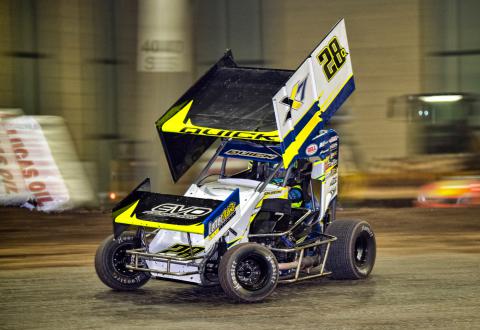
The stock-engine affordability of non-wing A class micros is fueling their emergence as an extremely popular class, according to Hyper Racing’s Austin Quick, shown above in the 28 car.
Another plus for these cars serving as development classes is the strong presence of veteran drivers that populate race fields. These cars have always been popular with experienced drivers looking for a simple, relatively inexpensive way to compete. And those fields benefit up-and-coming young drivers, too.
“We’re seeing a lot of kids coming up from quarter midgets,” explained Grigoreas. “And half of the guys racing 600s here have run midgets and sprint cars competitively over the years. This gives those younger guys an opportunity at 13 years old to run competitively against really experienced guys.
“We welcome those new kids,” he added. “There’s not too many guys here that don’t like racing with them, because a lot them have already got 10 years of experience. And once they get ahold of these cars and figure out how to drive them, they get kind of hard to beat!”
With tight competition, strong performing cars, and the lessons of veteran drivers, the young guns that use micros, minis, and Lightnings as a steppingstone often graduate to other series relatively quickly. While this isn’t particularly surprising, some in the sport feel this progression perhaps moves a little too quickly.
“Top drivers come in and race two, three, four years—they get to the top of our class and they just move on because they want something bigger and better,” noted Bayer. “I’d like the young guys to stick around longer. But I understand why they don’t. And that’s not what the series is built around. So I don’t think we’ll get there.”
Motor Matters
Although micro, mini, and Lightning sprints haven’t seen any radical technical upheavals in recent years, there is nonetheless evolution in their mechanical systems, most of which centers around the engine.
In particular, much attention is being paid to auto tuners, and their potential to be used for traction control. “We can run either gas or methanol in these cars,” said Grigoreas. “And a lot of the guys that run methanol have to have tuners and things to make these production-based engines run a little bit different with alcohol. But some of the systems have the capability of auto tuning the car. It’s kind of a gray area—trying to cheat a little bit, by being able to restrict timing on stuff that has no traction control.”
Micro, mini, and Lightning cars all have starters and clutches, eliminating the need for a support crew. This contributes to keeping car counts high at events like this POWRi race.
Although much of the action in this segment is in the stock class, there are still opportunities to gain additional power through careful prep by engine builders. “Eighty percent of the engines we do are A-class engines, which are essentially stock,” said Don Sakakura of Yoshimura R&D, Chino, California. “But there’s a lot to be gained with the minor modifications within the rules that are legal. A lot of it is in reprofiling the valve seats. And that’s within the rules. You’re not touching any aluminum. There’s a lot there in intake and exhaust flow. And you can adjust compression ratios very slightly. We get an average of about 12% to 15% more power doing these things to an A-class engine.”
Yoshimura’s A-class 600cc engines begin life as brand-new crate engines from Suzuki. But most of the engines powering micro, mini, and Lightning sprint cars start their racing career in a far less favorable manner—they come from wrecked motorcycles. Some in the sport feel this is one of its biggest vulnerabilities.
“I think the biggest challenge for micros is that they use motorcycle motors,” said Brown. “We’re depending a lot on crashed bikes. They go to the junkyard, then people purchase them and dump a bunch of money into them. A lot of guys are running 2007, 2008, maybe 2010 motors. It takes a lot of money to upgrade them so they can be competitive.”
Some say that brand-new crate engines are the solution. That can be a tough sell in these budget-oriented racing classes. But in the long run, it may ultimately prove more cost-effective.
“From what I’m hearing now it’s getting more and more difficult to find a good, low mileage used engine,” said Sakakura. “They’re just not available like they were a few years ago. A lot of these guys will buy a used engine, and down the road for them it turns very expensive, because they don’t really know what they’re getting into. We see engines come through that have only a handful of races on them and connecting rods are hanging out the front of them. It can end up much more costly than it would be to buy a new engine at the beginning.”
R.E.S.P.E.C.T.
With so many positive elements going for them, micro, mini, and Lightning sprint cars are enjoying strong growth and solid popularity among participants. This is evidenced by the healthy car counts reported by all of our sources—typically averaging in the neighborhood of 25 to 35 cars.
But this raises a frustrating question echoed by almost every one of the sources we talked to: Why don’t these cars get more respect and publicity?
“I’d like to see fans giving us the recognition that we deserve for the awesome racing we put on,” said Dicely. “I think if they gave it a chance, if they came out to see a 600 race, they’d see it’s really good stuff. And if we get that, then I think the class could really take off.”
Participants feel that motorcycle-engine sprint cars deserve respect befitting their strong performance. Here, Bruce Douglass qualifies for a California Lightning Sprints race.
Some feel this apparent lack of respect stems in part from the motorcycle DNA of these cars. “If nobody knew these are chain-drive cars, they’d probably get a lot more attention,” said Grigoreas. “I know that sounds kind of funny, but old sprint car guys and hardcore midget guys look at these cars and go, ‘It’s got a chain on it, it’s not a real race car.’ But if they were ever to get in one and actually race it, they’d be absolutely amazed at the performance of these cars. And it’s kind of the stigma that we’ve always dealt with.
“But I can argue that point all day,” continued Grigoreas. “When a chain-drive, motorcycle-engine car is running just two thousandths of a second slower than quick time against national midgets, that’s pretty good.”
SOURCES
–
California Lightning Sprints racecls.com
Thunder Road officials have appointed Scott Tapley as race director for the 2021 season. The longtime motorsports official will oversee all of the Barre, Vermont-based track’s local racing divisions, along with the 19-event schedule.
Tapley is also the race director at Connecticut’s Stafford Motor Speedway and Thompson Speedway Motorsports Park, and New York’s Riverhead Raceway.
“I’ve been very fortunate to be supported by great track operators like the Arute family at Stafford; Eddie, Connie Partridge and Tom Gatz at Riverhead; and Cris Michaud and Tom Mayberry at Thompson,” Tapley said. “I’m humbled and honored to add Thursday nights at Thunder Road to my responsibilities for 2021, and I look forward to being a part of it.”
In 2001, Tapley graduated from the University of Northwestern Ohio with a Motorsports degree. He later spent nearly a decade working full-time for multiple teams in what’s now known as ARCA Menards Series East. In 2008, he helped lead Mohegan Sun Racing and Matt Kobyluck to the series championship as an aerodynamicist, fabricator, and spotter.
After Mohegan Sun racing shut down following the 2010 season, Tapley transitioned to a race director position at Connecticut’s New London-Waterford Speedbowl, followed by Thompson Speedway. He took on the Stafford Motor Speedway and Riverhead Raceway Race Director roles in 2016.
Tapley has also worked for Lee USA Speedway, the Modified Racing Series, and the INEX Legends National Championship. He currently lives in Poland, Maine.
Thunder Road opens its 2021 season on Sunday, May 2, for the 23rd Community Bank N.A. 150 featuring the ACT Late Model Tour, Maplewood/Irving Oil Late Models, and more.
Ford Performance and Toyota Racing Development are both putting the finishing touches on their purpose-built 410-cubic-inch sprint car engines. With a fresh approach that focuses on performance, durability, and low weight, these new mills could soon be setting the pace for open wheel fields.
With some classes boasting power-to-weight-ratios that would make a Formula One driver jealous, top-tier sprint car racing is one of the most demanding forms of motorsports around. The 1,400-pound tube chassis race cars employ a wholly unique blend of suspension tuning and aerodynamic aids, and since it’s a direct-drive powertrain, striking the right balance between horsepower and gearing is absolutely crucial. And when you’ve got nearly a thousand naturally aspirated ponies on tap, engine reliability is an ongoing concern.
The long-standing power plant of choice for sprint car racing is an all-aluminum 410-cubic-inch pushrod V8. The GM-based small block has been a staple of the sport for decades, with engine builders like Kistler, Gaerte, and Donovan supplying their own iterations of the worked-over motor to teams across the country. Viable alternatives for those looking to go a different route with their engine choices have traditionally been slim, but now Ford Performance and Toyota Racing Development are poised to shake up the status quo.
As they seek to expand their presence in the popular racing discipline, both automakers are in the midst of developing 410-cubic-inch sprint car engines of their own. Although these mills currently lack the many hours of refinement that have helped to make the GM engine a cornerstone of the sport, they each benefit from a contemporary engineering approach that has the potential to improve performance while also addressing concerns about the rising costs required to campaign a competitive car.
FORD PERFORMANCE GETS THE FPS 410 UP TO SPEED
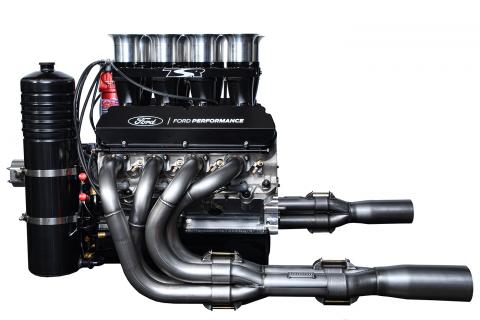
Ford’s new methanol-fed 410 is a Windsor-based block and features a 4.135-inch bore, a 3.800-inch stroke, a 90-degree bank angle, and a compression ratio that’s expected to be greater than 16:1. In terms of output, the team targeted figures over 900 horsepower and 700 pound-feet of torque to achieve a general sense of parity with the rest of the field while maintaining their focus on keeping the package robust, reliable, and affordable.
Engine choices for 410 sprint cars have been extremely limited, but Ford Performance and TRD aim to change that with new designs to rival GM power plants.
“The program originally kicked off back in 2016, when Tony (Stewart) and Stewart-Haas Racing (SHR) signed with Ford,” explained Christian Hertrich, Motorsports Powertrain Supervisor for Ford Performance in Dearborn, Michigan. “Part of the agreement was that we would support Tony’s sprint car program, and an element of the game plan was to change the power plant over to a Ford engine. Development was a little slow-going initially, as we were sort of wrapping our heads around what the sprint car engine was going to be. So in 2017 and into 2018, we started working on some cylinder head stuff and putting together what the structure of the engine was going to look like. By 2019, we were ready to move on to using Ford’s analytical tools for data collection and dyno testing.”
While the partnership between SHR and Ford was the catalyst that set the gears in motion for the FPS 410, Hertrich told us that Ford saw other opportunities associated with the project. “A lot of the racing that Ford supports is grassroots, and interest in sprint cars is huge among our fanbase,” he said. “Right now, the sprint car world is dominated by Chevy; you see a smattering of Ford engines here and there, but ultimately, we were getting outclassed. So it was really about getting our stamp on it, being more directly involved, and giving the Ford name a bigger footprint in the discipline.”
Hertrich said the team used Stewart’s Chevy engine for baseline targets and went from there. “Well, you never want to be worse off than where you started, of course. So we used the Shaver engine to establish baseline targets that we needed to beat in different applications, whether that’s a short track or mile track. And at the same time, we also wanted to make sure we weren’t adding any weight. That’s critical in the sprint car world, so we had to make sure we weren’t putting mass where it wasn’t needed.”
Ford’s 410 program began as a partnership with Stewart-Haas Racing. Once development was finished, driver Tony Stewart soon proved the new engine could win.
Yet, with more than 90 races on the calendar each season, durability was paramount. “It’s not NASCAR or Formula One, where there’s just tons and tons of money to throw at the program, so you absolutely have to prove the engine out,” Hertrich explained. “It has to be cost efficient, so part of the mission was to make sure that these things we’re doing are not super expensive. You’ve also got to be able to run week-in, week-out with the same engine and not send it back to rebuild, because otherwise your costs are going to be a nightmare. So one of the goals was to maximize the number of races this engine could handle before it needs to be torn down. That’s a specific metric for us, so we needed to make sure that we met or exceeded that target number.”
Hertrich admitted that the Windsor-based block was already a stout piece to begin with, so the biggest improvements came from the cylinder head they developed for the FPS 410. “Cylinder heads are very temperature sensitive—we really needed to keep those temps down to increase durability and maintain cylinder pressures. So the cooling system was a big focus as well, making sure that we’re controlling the flows and we’re even from cylinder to cylinder.”
It’s a sentiment that’s echoed by Ricky Warner, crew chief for Tony Stewart Racing in Brownsburg, Indiana. “Durability, along with drivability and performance are a big deal with this new engine. The Chevys were pretty bulletproof, so there’s a lot of work to be done to get it to that level.”
Built around the World of Outlaws’ rule set for 410 winged cars, the engine made its debut at an All Star Circuit of Champions event at I-96 Speedway on August 16, 2019. Development is still ongoing, but Hertrich said the early results are promising. “We won almost immediately after releasing it—Tony took a win with it in the second or third race it competed in. Tony was our proof point for the engine with the All Star series. We would get data from there and get some miles on the engine without worrying about messing up Donny Schatz’s season in World of Outlaws.”
Schatz incorporated the new engine into his program for the 2020 season, but with a limited calendar, vetting of the engine is still underway. “But we’ve come out swinging for 2021,” Hertrich stated in March. “We’ve won three or four races out of the first six or seven events, so we’re very happy with the performance thus far.” Going forward, Shaver Racing Engines in Torrance, California, will be handling the rebuilds of the FPS 410.
Warner noted that as the program ramps up and Ford prepares to finalize the spec with an eye toward offering up an engine package for other teams, the last hurdle is parts availability. Beyond components like the MAHLE pistons, CP-Carrillo rods, Bryant Racing crank, and Jesel valvetrain parts that are used in the package, the engine also utilizes a unique U-joint made by Winters Performance, of which they are the sole supplier.
“It hasn’t taken much to get this engine up to speed,” Warner said. “There are just some components that are unique to this engine package that need to be made more readily available now.”
TOYOTA RACING DEVELOPMENT JOINS THE FRAY
Toyota Racing Development (TRD) isn’t quite at the same stage with its 410 engine program as Ford Performance is—we reached out for comment and they asked us to check back in with them when they’re a bit farther along. But after speaking to Tom Rider of Rider Racing Engines in Mechanicsburg, Pennsylvania, the picture of what this engine will ultimately look like is a bit clearer.
Rider Racing Engines, along with Speedway Engine Development in Indianapolis, Indiana, will serve as the engine builders of the new Toyota mill, which is designed around the rule sets for World of Outlaws, All Star Circuit of Champions, USAC, and other sprint car series’ 410 classes.
“When they contacted us in 2019, they were looking to do a new design from the ground up,” Rider said. “And one of the main goals was to create an engine that would be available for anyone to buy or build—it wasn’t going to be specific to a few in-house cars or something like that. And that changes some of the thought process in terms of design. They also wanted to keep the costs similar to the GM engine while also delivering output and weight that’s similar or better.”
Toyota Racing Development’s success in midget competition (seen here) provides a strong foundation for the division’s sprint car engine program.
Although development is ongoing, initial testing puts the engine’s output at around 915 hp and 685 lb-ft while weighing in at a few pounds lighter than the GM engine. The engine features an all-new aluminum block casting with a purpose-built aluminum head that’s designed specifically for sprint car racing.
As with the Ford project, Rider said the TRD engine program is part of an effort to establish a larger footprint in sprint car racing. “TRD has been heavily involved with grassroots racing for a while now, and this is a segment that they want to be a bigger part of.”
California Assembly Member Tim Grayson (D-Concord) has introduced PRI-supported legislation (AB 904) that would create a new tax credit designed to stimulate long-term capital investments in manufacturing. Industry members are encouraged to register their support for the bill here.
If enacted, AB 904 would provide Golden State manufacturers with over 100 employees with a 5% credit against taxes imposed for the purchase of qualified tangible personal property, such as equipment, machinery, computers or computing software involved in the manufacturing process. Small manufacturers with fewer than 100 employees would be eligible for a 6% tax credit. In both cases, the tax credit covers up to $1,000,000 in qualified investments and may be carried over for up to five years beginning in 2022.
The legislation would help generate new opportunities for California’s manufacturers to invest in the latest production technologies and create high-paying jobs, which is of critical need as the state recovers from the COVID-19 pandemic. AB 904 would also help revitalize California’s diverse workforce and enhance technical skills that lift the entire economy.
Assembly Member Grayson is a member of the SEMA State Automotive Enthusiast Leadership Caucus and was the 2019 winner of SEMA’s Stephen B. McDonald Legislator of the Year award. In addition to being a lawmaker, Assembly Member Grayson, along with his wife Tammy, is also an enthusiast. Included in the Grayson’s collection are two classic Ford Mustangs.
Request support for this AB 904 by contacting the California legislature here. For more information, contact Christian Robinson at christianr@sema.org.
 MEMBERSHIP LOGIN