PRI Founding Members: Connections Are Everything

Submitted by jeffreyc on Fri, 08/13/2021 - 10:34


As an industry we’re strongest when we stand united, both against legislative hurdles as well as in the pursuit of business goals.

The fourth installment of our series reveals why industry leaders have signed on to become PRI Founding Members. Their reasons might surprise you, but in their own words the rationale boils down to connections. You’ve heard the saying, “It’s not what you know, but who you know.” At PRI, we don’t really believe the first part. Brains matter. But in some situations, connections matter more.

Connections are so valuable, in fact, that nearly two dozen companies have committed $25,000 to PRI Membership over a 10-year period. Why would they do that? 

The first reason involves influencing business regulations. Especially when you’re dealing with the federal government, who you know is exponentially more important than what you know. While the PRI family respects that you might be an expert with a cylinder hone, can pull a perfect 0.000 out of the hole, or have turned a profit each year you’ve been in business, nobody in government cares. Sorry, that’s just reality.

With this understanding, nearly every PRI Founding Member has put their faith in PRI’s Government Affairs group to lobby the right legislators with the right messages that benefit our industry. The Founding Members trust PRI to communicate their support of PRI’s Save Our Racecars campaign and the RPM Act of 2021. 

A unified, professional voice in Washington, DC, and in state capitols, matters for businesses that are presently burdened by government legislation or legally threatened by the same. PRI Founding Members know that when our entire industry wins battles against unwarranted regulation, our entire industry benefits—a rising tide lifts all boats. 

The second key reason Founding Members made their commitment is because they wanted to connect with other leaders. Business owners benefit from networking. Face-to-face meetings provide great opportunities for new relationships, which in turn lead to business growth.

While the window to become a Founding Member only opened this spring, PRI has already invited this elite group to take part in exclusive video conferences to discuss PRI business and legislative updates. Additionally, many Founding Members attended the annual SEMA Installation Gala, where they helped celebrate the yearly transition of SEMA leadership. The Las Vegas event, held in July, was the first opportunity for PRI Founding Members to meet in person, and to meet SEMA’s 2022 leadership (and additional potential business connections). 

The second Founder’s face-to-face event took place earlier this month. All Founding Members were invited to the NHRA US Nationals in Indianapolis. Their VIP treatment included four-day all-access passes and PRI Suite access. While the on-track action was exciting, there were business opportunities to be found in the PRI Suite as well. 

The experience at the US Nationals helped prove (again) that we—together—are strongest when we stand united. This matters when facing legislative struggles, and it also matters when we pursue new business goals. By stepping up to Founding Member status, the companies you’ll read about are sending a clear message that they support our entire industry while pursuing individual business goals. And, as Founding Members these companies support the reality that our industry’s collective political voice and economic power carries more impact than any single company’s attempt to navigate today’s complex legislative and economic challenges.

PRI Founding Member status remains available for a limited time for $25,000 (with a payment option of $2,500 per year over 10 years). In other words, for the cost of a business trip for you and a co-worker, your company could position itself at the forefront of the racing industry. 

At the close of the SEMA Installation Gala, one Founding Member was overheard talking about who he hoped to connect with at the upcoming Founding Members events at the PRI Trade Show. There are certainly more exclusive opportunities to come in Indianapolis this December. 

Like the impact of the Founding Members, your involvement with PRI allows our team to continue to build, promote, and protect your livelihood, as well as the prosperity of the entire racing and aftermarket community. Consider joining as an individual or business.

member1

Public relations and marketing used to be simple activities. With hard work, some creative ideas, and the right connections, you’d get print media coverage that would grow your business. TV exposure was a huge bonus.

Things couldn’t be more different today. The media landscape is fractured yet heavily matrixed, and getting exposure requires a sophisticated multi-channel and data-driven approach. Kahn Media, formed in 2008, is a recognized and awarded PR and marketing agency with deep roots in the automotive aftermarket, motorsports, technology, and outdoor lifestyle markets. 

Operating worldwide from their Southern California headquarters, Kahn Media’s talented team of public relations experts, in-house creatives, and digital marketers help clients derive the most ROI from their budgets. Their client roster includes names you know: MotoAmerica (American Superbike), Driven Racing Oil, Roush Performance, Aeromotive, Centerforce Clutches, Lotus Cars, McLaren, Aprilia, Rolex, Motul, Nitto Tire, and many others. The team’s work has been recognized three times by Inc. Magazine in the Inc. 5000 list of fastest-growing private companies in America, as one of AdWeek’s Fastest Growing Agencies, and as the top PR firm by a Southern California business journal for the past four years. 

member1b

Importantly, because enthusiasts know how to connect with other enthusiasts, the Kahn Media team is comprised of performance and racing insiders—people who came from, or are engaged in our industry. This helps the Kahn Media team connect their clients to targeted audiences in meaningful ways. 

Dan Kahn takes a long view on our industry. “The future and growth of motorsports relies heavily on igniting the passion in the next generation of enthusiasts,” he said. “We like to think that with our background in social media, influencer marketing, digital, and content creation, we are uniquely positioned to help other PRI members connect with younger audiences to build brand loyalties that will last a lifetime. Becoming a PRI Founding Member was the best way for us to strengthen our connection to PRI, and to support the organization as it powers forward.”

regiscomm

With a healthy sense of humor, Rex Roy incorporated Regis Communications on April Fool’s Day in 1991. Since then, Roy and his Detroit, Michigan-based company have supported over 30 automotive brands including multiple imports and every division of General Motors, Ford, and the original Chrysler Corporation. Roy’s stints at major marketing agencies provided him with deep insights about strategic and tactical best practices while serving clients including Motorcraft, GM Restoration Parts, GM Service Parts, and Team Chevy. Roy has helped launch more than 120 vehicles, including the 2020 C8 Corvette, and creative directed permanent large-scale public display areas at Daytona International Speedway and in Detroit’s Renaissance Center.

Roy is no stranger to the performance and racing industry, having completed projects for Championship Auto Shows, Kalitta Motorsports, and Borla. As two side-hustles in the late 1990s, Roy opened PowerCurve Chassis Dyno & Tuning Center and was a partner in a national high-performance driving school.

A sharp eye will recognize that the Regis Communications’ logo is a 1934 Chrysler Airflow. The revolutionary car was a sales flop even though its engineering led the industry into the modern era of aerodynamic testing and steel unibody construction. However, Chrysler didn’t take control of the car’s story, and the unenlightened critics won the media battle and killed the Airflow’s chance to succeed. To Roy, the Airflow is a reminder that storytelling matters in marketing. 

“One of the things I’ve realized is that every company has a story to tell, whether it’s using a press release, promotional video, TV ad, website, or sponsorship ask. But many companies, even those with smart marketing teams, could use some outside help to tell their stories better. This leads to more awareness that drives growth. Story development and effective comms are what I can offer PRI, whether a company needs just a press release or a complete marketing overhaul,” Roy said. Adding rather glibly, Roy noted, “But if we don’t band together through PRI membership, we might not have an industry anymore. Given the way government agencies naturally trend toward regulatory overreach, I don’t think this is an overly dramatic point of view.”

Daren Poole-Adams

Daren Poole-Adams of Shelby, North Carolina, is an exceptional drag racer, engineer, and businessman. Regarding these characteristics, he’s not that different from many in the performance and racing industry—he found a way to make a business out of his passion for racing, and has been doing so since the late 1990s. 

Poole-Adams’ current pair of COPO Camaros are a common site around the country as he competes in various NHRA and NMCA events. Partnering with PRI heavyweights like MAHLE, Goodyear, Holley, and Chevrolet Performance, the COPOs are development platforms that advance racing tech. The championship-winning Poole-Adams is a front-runner, for example, in bringing direct fuel injection to the Stock Eliminator field.

member3b

The work Poole-Adams is doing benefits the entire sport, especially at the grassroots level. He told PRI, “We have a passion for production drag racing. It is a study in efficiency that is very relevant to various manufacturers in their quest to bring better, more efficient products to market. As an example, we are currently getting more than 100 drag strip passes out of a pair of Goodyear slicks. Something you never would have dreamed of years ago.”

About becoming a PRI Founding Member, Poole-Adams stated succinctly, “It shows that my business is committed to supporting the racing community.” While there was certainly no doubt about his commitment before, Founding Member status makes this company’s pledge visible and even more influential. “More than anything, we (the people in our industry) need to do some joint educating. They (the EPA) need to understand that converting a street car to a race car actually has a decreased impact on the environment when compared to that same car being run for 100,000 miles on the public roads. Why can’t we partner with the EPA and industry leaders to promote ways that our racing businesses can reduce our carbon footprint in a way that would really have an impact? I spend a whole lot more time in my tow rig or my shop than I do in a COPO!”

member4

What would today’s drag racing scene be without engine blocks from Keith Black? This man’s contribution to professional drag racing is unparalleled. While Keith passed 30 years ago, his legacy of innovation and performance lives on. 

For those who are not familiar with Black’s legacy, as an engine builder he started in the late 1950s building marine engines that set multiple world records. The transition to the 1320 proved natural. Black-engineered engines propelled the legendary Don Prudhomme Top Fuel dragster to more than 250 round wins in 1962 and 1963. Black’s affiliation with Chrysler began in 1965. His company started producing aluminum engine blocks based on the Chrysler Hemi designs in 1971, and his engines would dominate drag racing by the end of the decade, winning every national record in Top Fuel between 1975 and 1984.

Darren Beale, owner of Keith Black Racing Engines (KBRE) in Buena Park, California, told PRI that its status as a Founding Member is another step in making known the company’s role in helping create the very DNA of the American performance aftermarket. Looking ahead, Beale explained, “When KBRE was started in 1959 it involved a collection of passionate people that weren’t afraid of risk-taking and innovation in the pursuit of power. The decision to become a Founding Member was immediate. And for the future, we’re focusing on engine block products that massively increase the strength and power-handling capabilities of the everyday modern V8, that perform equally as well on the street as they do at the strip.”

member4b

Black-block engines—still based on the Chrysler Gen II Hemi and RB Wedge V8s—have powered many brands over the years, not just MOPARs. As a matter of fact, one of the company’s latest partnerships (with Herrod Performance, a leading performance company that focuses on the Ford brand) resulted in the APOLLO package, a reliable 4,000-hp powertrain for Mustangs. 

Beale said, “We are not only committed to ensuring that Keith’s story and legacy lives on, but that Keith Black also earns renewed respect in a more complex, developing, and modernizing market. We feel one of the larger challenges facing everyone will be keeping racing relevant, and that this can only be accomplished by making sure racing remains enticing to younger people and in embracing modern powertrain platforms that can be dramatically improved upon.” As a PRI Founding Member, Beale is in good company that shares his passion.


September 2021
By
PRI Staff

LSI Chemical Announces Indonesian Distributor 

Submitted by laurap on Thu, 08/12/2021 - 17:09
LSI Chemical, Papasari logos


LSI Chemical has announced the addition of PT Papasari to the company’s roster of international distributors of both LSI Chemical and Hot Shot’s Secret products.

Headquartered in Cakung, East Jakarta, PT Papasari also has offices and distribution facilities in Pontianak, West Kalimantan, and Pegangsaan, North Jakarta. The company recently signed to market and distribute the full line of LSI Chemical fuel and oil additives and Hot Shot’s Secret fuel and oil additives and specialty oils for aftermarket retail. PT Papasari is certified by the International Council for Machinery Lubrication (ICML)

Ivan Prasodjo will be the primary contact at PT Papasari for sales of both LSI Chemical and Hot Shot’s Secret products. 

“With over 45 years experience selling lubricant-related products throughout Indonesia, it is exciting to bring on a company with the most compelling nanoproducts on the market,” Prasodjo said.

For more information, visit lsichemical.com or papasari.com. 

August 2021

NASCAR Partners To Launch New Science, STEM Curriculum 

Submitted by laurap on Thu, 08/12/2021 - 16:54
NASCAR logo


NASCAR and the National Science Teaching Association (NSTA) have launched a new science and STEM learning curriculum for K-8 science teachers across the US. The racing-themed science lessons will be available free of charge to educators nationwide on NSTA.org. 

The collaboration between NASCAR and NSTA, the promoter of excellence and innovation in science teaching and learning, features 18 racing-themed lesson plans, including aerodynamics, friction and motion, light, sound, and more. Accompanying videos, games, and more are also featured.

“We are thrilled to partner with NSTA, a passionate community of science educators and professionals devoted to teaching and offering science resources to kids across the country,” NASCAR Chief Marketing Officer Pete Jung said. “This collaboration provides NASCAR an incredible opportunity to make an impact in science education while introducing new generations to the sport.”

Through its relationship with NSTA, NASCAR will also work to bring elementary and middle school students to race events via free and discounted tickets and special family events hosted at NASCAR race tracks.

In related news, NASCAR will support the annual National Conference on Science Education in Chicago in 2022 for the second consecutive year.

For more information, visit nascar.com.

August 2021

Planning for PRI 2021

Submitted by jeffreyc on Thu, 08/12/2021 - 16:33
Indiana Convention Center


We’ve got the checklist to help you make the most of your visit to Indianapolis for the world’s premier motorsports trade event in December.

Yellow. Yellow. Yellow. Green! 

Planning almost always leads to better results—both on the race track and in business—and now’s the time to start planning your trip to the PRI Trade Show. 

At press time, nearly 1,000 exhibitors had signed on to be front and center in Indianapolis, Indiana, from December 9–11. And PRI is more than ready to accommodate. “There’s pent-up demand to conduct business and network face-to-face,” said PRI Trade Show Director Karin Davidson. “This year’s event will be the first opportunity for the entire motorsports community to come together under one roof in more than a year, making PRI 2021 a can’t-miss event.”

Susie Townsend of Visit Indy added, “Indy, as a city, is very excited to welcome PRI back after a year’s absence. When PRI is in town, they kind of own the city, and the way the registration is going, the numbers are looking really strong.”

Planning ahead will help you make the most of your trip to Indy for the PRI Show in December. So, make sure the following items are included on your checklist: 

1) BECOME A PRI MEMBER

First, your PRI membership supports and protects the sport that is such a major part of your life. Second, every level of membership gets you great benefits. Third, becoming a member is easy, just visit performanceracing.com/membership. The sign-up process only takes a couple of minutes, and there are multiple membership options to choose from. Fourth, it’s cheap. The Individual Pro Membership cost is just $40. Finally, you can’t get into the 2021 PRI Trade Show without being a PRI member. In addition to the three paid membership options, for 2021 only, qualified Trade Show attendees can receive a complimentary membership until the end of this year. 

2) REGISTER FOR THE SHOW

Once you’re a member, you can register for the PRI Trade Show online. Go to the PRI website at performanceracing.com, click on “Trade Show,” then hit the “Attend” pulldown menu. There’s no cost for PRI Members to attend the Show. 

The PRI team will process your registration and mail your credentials if you complete the process before the November 18 deadline. After that date, attendees can still register on the PRI website, but they must go to Express Badge Pick Up in the Indiana Convention Center and scan their confirmation letter to print out badges. On-site registration will also be available, but having your credentials in hand means no waiting in line once you arrive to the Show. 

3) BOOK YOUR HOTEL

The PRI Show is among the most popular trade shows in North America. Luckily, the PRI team made finding a hotel room easy by developing a registration site with Visit Indy, the city’s convention bureau. For your PRI Show travel and booking needs, go to: performanceracing.com/trade-show/hotel-travel. Note: PRI provides complimentary shuttles to and from the Convention Center and Airport & Plainfield-area hotel partners.

4) SET GOALS

The PRI Show is THE place to get business done. Start thinking now about which exhibitors and features you’ll want to see at the Show. For instance, are you looking for new product lines to add to your inventory, or do you want to maintain, renew, or grow your existing supplier base? Plan ahead to visit those booths and make a list of people you need to talk to.

Are you looking for shop equipment and tools? Put Machinery Row on your agenda. 

Do you want to expand your technical knowledge, or brush up on best practices in sales, marketing, content creation, SEO, branding, hiring, or cashflow? Choose from over two-dozen complimentary PRI Education seminars. 

Do you want to expand the portfolio of products you sell? The Featured Products Showcase is another can’t-miss area. And make a note to check out the new EV Performance section to see how a new sector is growing up around electric racing and aftermarket performance mods. 

5) COME PREPARED

While the PRI Show is fun, come prepared to get business done. The Show is a face-to-face event, so stock up on business cards to make it easier for contacts to follow up. If you’re reaching out to sponsors, consider printing some flyers with a QR code that will take prospects to your website on their mobile device right on the Show floor. 

You can also make a powerful impression with logo’d apparel, but those do take time to design, order, and ship.

6) ADDRESS THE PRACTICAL CONVENTION REALITIES

Information to help plan a trip to the Circle City can be found at performanceracing.com/tradeshow, including a “Need To Know” section. Two things to think about are dinner reservations and parking. 

While there are dozens of great restaurants in the city center, many of the most iconic destinations—like St. Elmo Steak House—will already be booked by Show time. So, if you’re planning on entertaining clients or buyers, check out the available options and make reservations sooner rather than later. 

trade3
PRI attendees are advised to set goals, which includes noting which exhibitors they want to visit, before arriving on the Trade Show floor.

Visit Indy’s Townsend recommended looking at key areas just a few minutes from the Convention Center and Lucas Oil Stadium. “The new Bottleworks District just opened,” she noted. “In addition to the beautiful new hotel built in a historic Coca-Cola bottling plant, right across the street is a high-end food court called The Garage that’s a great place for dinner. Fountain Square is another one of Indy’s six cultural districts that offers excellent places to eat, and much more, in a restored area that’s actually the oldest commercial area in Indy.”

Due to its downtown location, parking for the PRI Show can be tricky. The city has spaces available for more than 60,000 vehicles, but it’s best to know where you’re going to park beforehand. A parking map and other travel options can be found at performanceracing.com/attend/getting-there. Maps of Indy’s cultural districts, lists of restaurants, and more are all available at the “Hotel & Travel” section of the PRI website. 

Yes, the PRI Show is still months away. But by planning and acting now, you’ll be ready to walk through the doors of the Indiana Convention Center ready to win.

September 2021
By
Rex Roy

From the Editor

Submitted by jeffreyc on Thu, 08/12/2021 - 16:30

Three things I think while, just up the 405 Freeway, organizers are making final preparations for the Acura Grand Prix of Long Beach, set for September 24–26:

1) I think there are several interesting takeaways from this month’s Special Report on the raw materials shortage that has dogged motorsports parts manufacturers and service providers dating back to last year. Beginning on page 64, contributor Steve Statham’s article provides an inside look at how different companies are dealing with a supply chain disruption that, while not unique to racing, has strained resources and forced many suppliers into a never-ending game of catch-up. Lest you think it’s all doom-and-gloom, however, we did unearth some silver linings—for example, California-based Scat Enterprises is having success offloading “C and D movers, like pistons that are .060-over when everybody buys .030-over,” Tom Lieb told us. For more on how businesses are adapting to this (hopefully temporary) new normal, read Statham’s well-researched piece.

2) I think racers are always going to find a way—and a place—to race. Take the off-road community, which faced a fair amount of uncertainty after the Lucas Oil Off Road Racing Series was shuttered back in November. This was no small void, to be sure. Countless young drivers earned their stripes in JR 2 Kart, RZR 170, Modified Kart and other classes throughout the series’ 12-year run. Fortunately, competitors wouldn’t have to wait long, or travel great distances, to find suitable alternatives. Series like Minnesota-based AMSOIL Championship Off-Road and the Valley Off Road Racing Association out of Northern California, for example, have stepped in to provide ample opportunities for teams, tracks and sponsors. From those aforementioned youth and feeder classes up to Pro Buggy, Pro Lite, and Pro 2, a main focus for these groups has been offering enough short-course options to suit almost any racer. For much more on how tracks and sanctioning bodies are keeping these segments trending skyward, see writer Bradley Iger’s piece beginning on page 74.

3) And finally, I think we may have found the world’s grassiest grassroots racing organization! Calling itself the Dirt Squirts Kart Club, this collection of “average guys” competes in recreational-grade machines that have been modified up to about 20 hp, often by way of a new four-cycle engine, along with some upgraded parts and clever tuning tricks. The group has an innocent-enough history: It was established in 2018 after co-founder Peter Austin returned from “one of those Rusty Wallace driving experiences…. When I got back, I thought, ‘Man, I gotta do something like that because it was so much fun.’” A tidy eight-page rulebook keeps costs, and competitors, in check. Tempers do flare—this is racing, after all—but no members have yet crossed the throw-a-punch-and-you’re-out threshold, Austin assured us. Competitors are currently in the midst of an eight-race season, he noted, with events taking place on members’ properties that have been mowed into different configurations, including ovals, a semi-rectangle, and a “road course” that winds around trees. One of the tracks is even run clockwise…because why not? For more on this series that represents just about everything we love about racing, see our coverage beginning on page 142. 

September 2021
By
Dan Schechner

Advocacy Corner

Submitted by jeffreyc on Thu, 08/12/2021 - 11:02


Tracking legal, legislative, and regulatory developments impacting the racing and performance industry.

PRI’s dedicated advocacy team based in Washington, DC, works nonstop to protect motorsports. We are currently tracking several initiatives on the federal and state levels, including an update on the vital RPM Act designed to protect racing, a look at the motorsports industry’s presence at the 2021 SEMA Washington Rally, and a critical notification for parts manufacturers regarding emissions compliance. 

Support For RPM Act Grows In House Of Representatives

Support for the bipartisan Recognizing the Protection of Motorsports Act of 2021 (RPM Act), H.R. 3281, continues to expand as members of Congress receive an outpouring of support for the bill from racers and the motorsports parts industry.

“Support is increasing in the form of RPM Act cosponsors because the motorsports industry has flooded members of Congress with letters requesting their support. The PRI/SEMA SAN’s letter-writing campaign has resulted in over 1.35 million letters sent to Congress in 2021 in support of the RPM Act,” Director of Congressional Affairs Eric Snyder said. 

A top priority for PRI, the RPM Act is designed to protect against overreach from the Environmental Protection Agency (EPA) and clarifies the motorsports-parts industry’s ability to sell products that convert street vehicles into dedicated race cars. As of late July, 30 additional House members, listed below, have agreed to cosponsor the bill; at press time, the bill had 95 total cosponsors.

PRI and SEMA are lobbying Congress on the RPM Act, regardless of whether Congress is in session or lawmakers are back in their districts. Congressional recess presents a great opportunity for members of Congress to meet with their constituents. Rep. Patrick McHenry (R-NC), the lead sponsor of the RPM Act, recently visited SRI Performance, the provider of racing and street performance products in Mooresville, North Carolina. During the visit, Rep. McHenry spoke with industry members—including SRI Performance owner Greg Fornelli, Speed Sport Owner and President Ralph Sheheen, and David Miller, executive director of the North Carolina Motorsports Association (NCMA)—about the importance of passing the RPM Act. 

“It was great to visit SRI Performance,” said Rep. McHenry. “Racing has a long and storied history in North Carolina and is an important part of our economy. I was proud to [recently] reintroduce the RPM Act to protect grassroots motorsports and the industries that support them.” 

PRI encourages race tracks, racing businesses, motorsports parts manufacturers, race teams, and related entities to voice their support of the RPM Act on social media using the assets found at performanceracing.com/rpm-act. PRI applauds the efforts of those that have already spread the word, including Selinsgrove Speedway and Clinton County Speedway in Pennsylvania. To send a letter to lawmakers and see a current RPM Act cosponsors list, visit performanceracing.com/rpm-act. For more information, contact Eric Snyder at erics@sema.org.

PRI, SEMA Connect With Congressional Reps From DC 

PRI and SEMA representatives have escalated their advocacy efforts by participating in nearly 100 meetings with Republican and Democratic lawmakers from Capitol Hill in June and July. As part of the virtual 2021 SEMA Washington Rally, more than 60 industry companies joined PRI and SEMA in a record-high number of meetings with officials from the US House of Representatives and Senate.

Discussions focused on hot-button industry issues, challenges, and concerns, including opposition to electric vehicle mandates, support for protecting motorized off-road recreational access, tax credits for businesses participating in trade shows, and more initiatives for the automotive aftermarket.

Chief among meeting topics, however, was passage of the Recognizing the Protection of Motorsports (RPM) Act.

“It was great to meet with lawmakers who seriously considered the RPM Act, which allows street vehicles to be converted into racing vehicles,” said Braden Liberg, director of compliance and calibration engineering at Edelbrock Group. “Without the RPM Act, there is a threat to the motorsports industry. Unfortunately, many lawmakers are unaware of the challenges facing our industry, and we must work with them to ensure that motorsports businesses can continue to operate.”

Newest RPM Act Cosponsors in US House of Representatives (as of late july)

–

David McKinley (R-WV) 

Robert Latta (R-OH) 

Ann Kuster (D-NH) 

Morgan Griffith (R-VA) 

Jim Hagedorn (R-MN) 

Scott DesJarlais (R-TN) 

David Kustoff (R-TN) 

Glenn Thompson (R-PA) 

Carol Miller (R-WV) 

Matt Rosendale (R-MT) 

Trent Kelly (R-MS) 

Jared Golden (D-ME) 

Elise M. Stefanik (R-NY) 

Andy Barr (R-KY) 

Jay Obernolte (R-CA) 

Michael Cloud (R-TX) 

Austin Scott (R-GA) 

James Comer (R-KY) 

Brett Guthrie (R-KY) 

Bill Huizenga (R-MI) 

Don Bacon (R-NE) 

Warren Davidson (R-OH) 

Mary Miller (R-IL) 

Mark Green (R-TN) 

John Curtis (R-UT) 

Liz Cheney (R-WY) 

Jim Banks (R-IN) 

Dusty Johnson (R-SD) 

Larry Bucshon (R-IN) 

Carlos Gimenez (R-FL)

September 2021
By
Laura Pitts

Budding Budget-Beaters

Submitted by jeffreyc on Thu, 08/12/2021 - 10:47


Eastern Pennsylvania’s Dirt Squirts Kart Club balances laid-back fun with organized competition.

There’s a tiny revolution going on in Eastern Pennsylvania. It isn’t a multi-million-dollar racing series. There aren’t any superstar drivers, clamoring autograph seekers, or worldwide sponsorship deals. It’s just some average guys having the time of their lives, in a racing series they crafted themselves from scratch, using the best cars they can hammer together on a working-man’s budget.

These are the Dirt Squirts. And they can teach all of us something about racing. 

There’s an innocent charm about the Dirt Squirts Kart Club. For the most part, its members aren’t experienced racers. Few of them had ever even driven on a race track before they joined the club. Yet they’ve quickly built a small but truly exceptional racing organization that masterfully balances laid-back fun with healthy, organized competition. 

In fact, their relatively limited prior experience is probably the source of this organization’s magic. Its members aren’t locked into one particular type of car or one style of racing. And they don’t know what can’t be done. They just go out and do it. 

The Birth of a Racing Series

Dirt Squirts began in 2018, the way so many racing endeavors are launched—somebody gets a taste of on-track excitement, starts dreaming, and things take on a life of their own. 

“It started when I did one of those Rusty Wallace driving experiences,” said club co-founder Peter Austin. “When I got back, I thought, ‘Man, I gotta do something like that because it was so much fun.’” 

Austin originally planned to prepare a car for organized dirt-track competition, but some co-worker friends threw a cold wet rug on the idea with talk of how expensive that can be. “So we decided to just buy go-karts, hop them up a little bit, and race them by ourselves,” recounted Austin. “We just kind of raced around my buddy’s yard. And then the next thing you know, we got four or five other guys who were like, ‘Hey, that looks fun. Can we come out with you?’” 

dirt2
The Dirt Squirts Kart Club was created for maximum fun on minimum expense. From that goal, the group has quickly built a race series of surprising sophistication.

It proved to be contagious. They gained 10 more members the second year. Around that time, the club got its scrappy-clever Dirt Squirts name. “It just kind of rolled off our tongue,” said club co-founder Jeff Conklin.

At that point, the initial group of racers became the club’s official leadership, and they took on the name Founding Five. A few of those five leaders dropped out of the club fairly quickly, but elections were held to replace them, and the Founding Five leadership structure continues today. 

The group also began developing rules, with care taken to balance necessary regulation with the casual spirit of the club. “We ended up with about an eight-page rulebook,” said Austin. “I wasn’t intending to do that, but I just kept getting asked question after question: ‘What about this? What about that? How do we handle this?’”

Easy Speed

Equipment isn’t much of a big deal for the Dirt Squirts. It’s all about maximum fun for minimum cost. Their machines are relatively inexpensive recreational-grade karts bought used on Craigslist or Facebook Marketplace. Austin races a Yerf-Dog, while Conklin and many other club members drive Manco karts. 

The feisty performance and reckless fun of racing these single-speed karts comes in large part from the classic hot-rodding formula of engine swapping. Originally equipped with engines putting out around 6 or 7 horsepower, Dirt Squirts karts are fortified with engines putting out roughly three times that. “These are little karts, and they’re not really meant to do what we’re doing with them,” said Austin. 

Dirt Squirt rules specify a maximum of 20 horsepower. A lot of the racers reach that by going to the local Harbor Freight store and plunking down $400 for a 13-horsepower 420cc Predator engine, the kind of general-use four-cycle units you see powering generators, water pumps, and garden tractors. To that foundation, they add a few aftermarket parts and do a few tuning tricks, which brings power up to the 18–19-horsepower range, according to Austin. To enforce the horsepower rule, a competitor has to file a complaint with the Founding Five, who review it and pass judgment based on what modifications the racer has done to the engine.

dirt3
Most of the Dirt Squirts’ tracks are homegrown efforts, built on the property of club members. The most ambitious of them is Conklin Glen, shown here. 

Other rules for Dirt Squirts karts are similarly loose. Suspension isn’t required, but it’s recommended. “We’ve got a couple of guys who race without it, but it’s rough,” said Conklin. “You’ll see their back end get over two feet off the ground sometimes.”

That said, the rear suspension has to be live axle. “You can’t have independent rear suspension, which is what really kind of defines a go-kart from something else,” noted Austin.

Austin said he has about $2,500 in his kart but pointed out that many club members do just about as well for much less money. Repair parts and consumables are said to be available inexpensively online. “A tire on a rim will show up at your front door in a week for 30 bucks,” he said.

Places to Play

The club races on a series of small tracks built on members’ property. The courses typically start out as short-mowed grass, then wear down to mostly dirt as cars lap them. With members having no prior allegiance to any particular form of motorsports, the tracks are designed in whatever shape the racers collectively feel like. There are ovals, a semi-rectangular track, and a road course that winds between trees. One oval track is run clockwise, just because the drivers like it better that way. 

Equally colorful are the names given to the tracks, including BlueStone Oval, Ridge Run, and Endless Mountains Speedway. The club’s Conklin Glen road course is the longest Dirt Squirts track; it’s estimated to be about 1/4 mile. The others are roughly 1/8 mile or less. The tracks are spread out among members’ homes in northeastern Pennsylvania and New York state. Most of the action centers around Susquehanna, Pennsylvania, but the longest distance between tracks is said to be only about an hour’s drive. 

The club even experimented with a night race last year, by fitting lights on the karts and illuminating the track with a 10-pack of shop lights. “It was interesting, to say the least,” recounted Austin. 

Eight races are scheduled for 2021, from late April through mid-October. Together they make up the series championship, which awards trophies to the top-three points finishers. “Most everybody runs for the championship,” said Austin. “To try to entice people into making every race, we have something called the Wash Rule, where you get to wash your worst race. And then, to counter people just picking a race and taking it off, we give a Perfect Attendance Bonus. You get bonus points if you’re at every event, even if you can’t race.”

To ensure necessary manpower for running races smoothly, the club has come up with a simple but effective solution. “When you draw your starting position, you’re also drawing your duty for when you’re not racing,” explained Austin. “So if you draw the pole for the first heat, you’re going to be running flags for the second heat. Second and third do scorekeeping, and then fourth is the backup flagman.”

Although the general vibe is pretty mellow, this is still racing. Tempers flare and personalities boil over. Dirt Squirts’ rules are pretty lenient in that regard, but they nonetheless have a zero-tolerance policy ready for extreme situations. “If you throw a punch, you’re out of this club. No ifs, ands, or buts,” explained Austin. Fortunately, they haven’t had to invoke this rule yet, with most incidents limited to shouting and various hand gestures between drivers. 

Small Club, Big Accomplishments

Despite the club’s homespun flavor, it’s already making some pretty sophisticated moves. As of May 2021, Dirt Squirts Kart Club is legally registered as a Limited Liability Company (LLC). And the club has signed a number of local sponsors, including an electronics store, a beer distributor, and a chainsaw business. “I put together a promo pack, so it looks like we’re legit,” said Austin. Sponsorship packages typically include a trackside banner, T-shirts, stickers on karts, and a website link. 

Most of the sponsorship money right now goes toward the club’s next big goal of getting a transponder system for scoring. “Up until now we’ve done all paper scoring,” said Austin. “And it sucks.” 

Although the club’s races don’t cost a lot to put on, there are inevitably expenses. These are paid mostly through voluntary donations from club members. The donations are put into a drawing in which members can win $100. Some winners immediately donate the cash prize back to the club. There aren’t any dues required from members. 

dirt4
The club has developed a simple system for staffing races: When drivers draw their starting position, they also draw jobs such as flagging or scorekeeping between races.

Although racers are obviously excited to be part of the club, enthusiasm surrounding Dirt Squirts is also starting to extend into the spectator area, too. “We have 30 spectators at some races,” said Austin. “At the night race last year, there was easily 100 people. It may have been closer to 200. One of the guys knows a local fireworks distributor, so we had about $600 worth of fireworks to finish off the night. He’s a professional, and he put on a whole show.”

Next on the club’s agenda is a move to established race tracks for at least part of the season. It’s not that they’ve lost interest in their own tracks. They just want to spend more time racing and less time getting tracks ready. “Setup and teardown are a real bear,” said Austin. “So one of our biggest goals is to split the season up between half homegrown tracks and half tracks like Action Park East and Champion Speedway.” 

The club is already scheduled to run an event at one such track this season, at Action Park East Speedway in Greene, New York. “It’ll be great,” said Austin. “We don’t have to have a flagman, we don’t have to have a scorekeeper, we don’t have to put hay bales out. We don’t have to do anything.”

Room to Grow

With its combination of rowdy trackside merriment, keen competition, and just enough structure to keep things running smoothly, Dirt Squirts has achieved a somewhat rare balance: organized racing that feels serious and satisfying, yet deeply casual.  

And while Dirt Squirts has the potential to grow much larger, they’re cautiously trying not to get too big too quickly. The club currently has 14 members, and they’ve set a maximum of 18 for now. “We don’t want it to grow so fast that we can’t keep things under control,” said Conklin.

In the meantime, the club will continue to evolve with much of the same inspiring sense of wonder it began with. “Last year at the night race, Peter and I were in the pits,” recalled Conklin. “We looked up at the crowd of spectators, and the feeling was like, ‘Wow, how did this happen?’”

SOURCES

–

Dirt Squirts Kart Club
dirtsquirtskartclub.com

September 2021
By
David Bellm

Positive Reinforcements

Submitted by jeffreyc on Thu, 08/12/2021 - 10:02


Armed with specialized building techniques, modern digital tools, and advanced materials, today’s fabricators are building stronger, safer and more effective chassis than ever before.

It starts as just a pile of tubes. Bit by bit, expert fabricators piece it into a spidery jungle-gym-like sculpture. The driver is wrapped in a cocoon of heavy metal hoops. The pieces are tied together into a cohesive whole, and a race car takes shape. 

At this point races are already won or lost. That’s how important a chassis is. 

At a glance, chassis fabrication for most race cars might look like it hasn’t changed much in recent years. But a number of subtle, incremental developments have come along to make race car chassis safer and stronger, while at the same time more economical and less time-consuming to build.

To learn about these changes, we talked to leading experts in the fields of fabrication, materials, and welding. Their insights provide valuable lessons on what it takes to get the ideal race car chassis.

Different Bars for Different Cars

When it comes to chassis design and fabrication, the needs of different forms of motorsports vary widely. Whether its drag, dirt track, or drifting, every type of racing creates different stresses and potential dangers that chassis fabricators have to take into consideration. Crashes in rally competition, for example, are completely different from practically any other type of motorsports. 

“A unique aspect of rally is that we have a very high potential for point loading our cars,” said Ryan Thompson of Thompson Racing Fabrication, Cedar, Michigan. “That means you can hit a tree at 100 miles an hour, and all the energy that your car had carried with it is really focused in that 8- to 24-inch area of the tree. That puts a tremendous amount of energy in that one small spot.”

In contrast, road racing has its own unique mayhem when things go wrong, explained Tony Colicchio at TC Design in Campbell, California. “In road racing, we’re generally hitting big tire walls, which rip stuff. So our problem is that if you hit a tire wall head on, it likes to move wheels into your foot area. The other thing we see are big side-to-side impacts—a whole car hitting you in the door bars.”

Given these complex, dynamic forces acting on a chassis, it might seem prudent to simply err on the side of more bracing, adding extra bars wherever forces could possibly act. But this can build too much weight into a car, and often rules don’t permit it. So fabricators have to carefully consider node placement, the location where tubes meet each other on a chassis.

chassis2
The effectiveness of a chassis often comes down to subtle details. “Sometimes the proper load path isn’t the easiest path to construct,” said our source at Thompson Racing Fabrication.

“A lot of the lower classes in SCCA and NASA have rules that say you can’t add too much bracing or structure within their minimum standard of cage,” said Colicchio. “They’re trying to keep the cost down. So we’ll look at where we are going with the tubing nodes, to improve safety.”

Worth noting is that while many race car chassis are full, purpose-built, tube-frame designs, many forms of motorsports don’t allow such comprehensive structures. This is particularly true in entry-level classes. In such cases, fabricators typically try to reinforce the structure as much as possible to improve handling and crashworthiness. 

“In some classes, if it’s allowed, we do seam welding on the car,” said Colicchio. “A lot of the seams of the unibody would be stitch-welded every inch or so just for extra stiffness on the chassis itself, and then the roll cage would be added to that. Then we try to do as many things as possible with the stock mounting points. If we can go to a mounting point that’s safe, like the rear shock tower, that helps make the whole chassis stiffer.”

Digital Discoveries

To handle the complex needs of building modern race car chassis, shops are increasingly relying on highly specialized digital tools. These allow fabricators to design more effective chassis and assemble them with greater precision, less waste, and fewer mistakes.

CAD software has long been a part of high-volume shops, especially production chassis manufacturers, because of the ease in which digital designs can be integrated into an ongoing fabrication line. Now, thanks to lower cost software, it increasingly makes sense for smaller shops and even for do-it-yourselfers. One of the handiest types of CAD programs for chassis builders is tube-bending software.

chassis3
Digital tools like bending software are increasingly a part of chassis fabrication. “You can lay out your entire frame and then print out a build sheet on how to make each part,” explained our source at Trick Tools.

“With that software, you can lay out your entire frame and then print out a build sheet on how to make each part, and it’ll spit out a materials list,” said Carter Vos of Trick Tools, Pella, Iowa. “You know how much material to order, and it can really simplify the tube-bending process. One of the most popular for us is Bend-Tech Pro, which sells for around $300. You don’t have to know CAD to understand how to use this program. Most of our users are productive the first time they ever use it.”

Some chassis fabrication shops are taking the CAD revolution to the next level by incorporating 3D scanning to precisely image the cabin of cars and design roll cages and other structures. “I really think that’s where the high end of this industry is going,” said Colicchio. “Late last year we purchased a brand-new FaroArm that does blue laser 3D scanning, and then also probe scanning as well. It’s extremely accurate. From there, we have plug-ins that will bring that information and data set into SolidWorks.”

“Most of my cages are for the same 10 cars over and over,” added Colicchio. “So if I spend the time scanning them and getting the design to where I want it, it makes us more efficient and much more consistent. I’ve got a part that’s laser cut and CNC bent, and it will always fit in the same spot. Once we have that file, we can change things like door bars really easily.”

Hot Metal Mastery

For chassis builders, there are basically two types of welding, MIG and TIG. MIG welding is one of the fastest, easiest forms of welding. It utilizes a gun with filler wire automatically fed from its tip. Although it still requires proper training and technique, MIG welding is largely a matter of pushing a button and keeping the gun moving. 

TIG welding, in contrast, is one of the hardest forms of welding. It uses a stationary electrode for the arc, which demands precise, steady hand positioning while welding. The amperage is varied continuously with a foot pedal by the operator, who manually adds filler rod to the molten metal pool. Tremendous coordination is required. 

chassis4
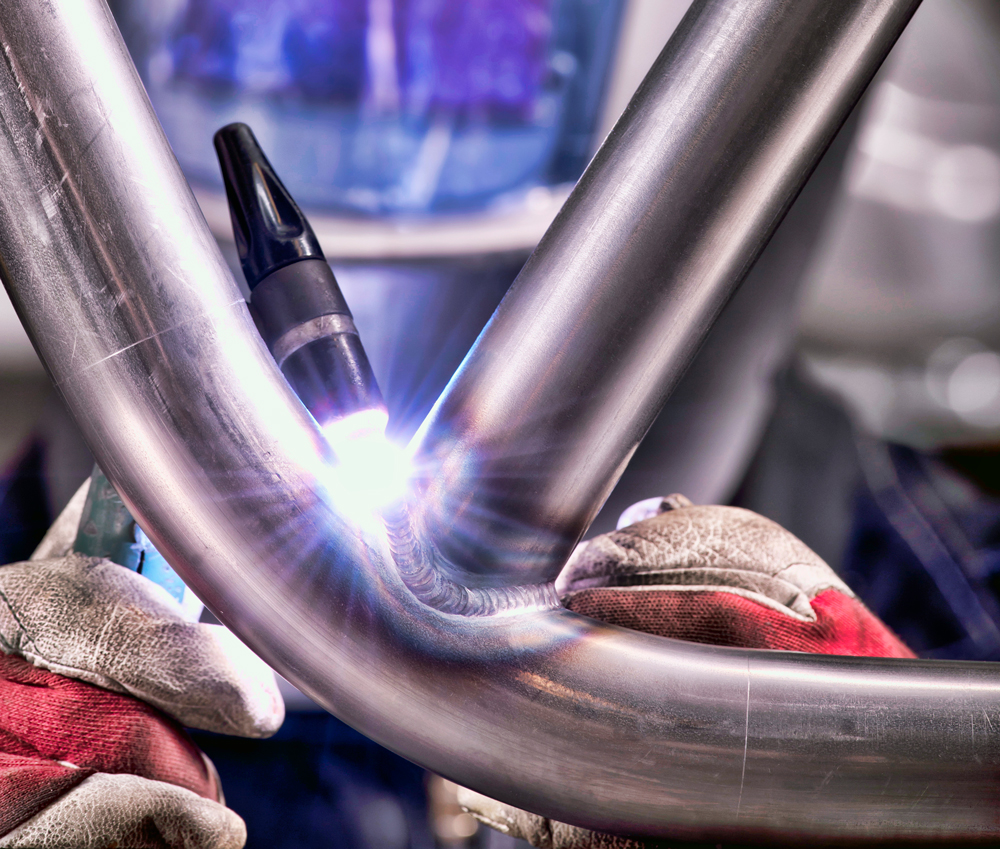
TIG welding (shown) generally makes more visually appealing welds, but MIG welding is faster and can be just as strong. Photo courtesy of A.E.D. Motorsport Products.

Because of this, MIG welding is usually much faster than TIG welding, making MIG a natural choice for companies that mass produce standardized chassis designs. But there’s also an aesthetic factor to be considered. Even in the hands of the very best welder, the look of MIG welds can’t match the flat, tight, rhythmic looping of an expertly done TIG weld.

For some situations, there’s no choice. The material dictates the type of welding. “If it’s 4130 chromoly tubing it has to be TIG welded, per NHRA rules,” noted Lon Damon from Lincoln Electric, Cleveland, Ohio. 

All these things said, both types of welding can produce equally strong welds when done properly. And so, different shops often prefer one over the other for their own unique reasons. Some fabricators switch back and forth to optimize costs for customers. “We do mainly MIG welding, and then on the higher-end projects we do TIG welding,” said Colicchio. “It’s strictly for cost. There’s no strength difference given the materials we’re using. With MIG welding, customers can spend their money on our engineering and fabrication rather than having the prettiest weld.”

The Devil in the Details

With so many subtle nuances and variations in different race car types, specialization is vital to getting an effective chassis. The best chassis fabrication shops usually serve just one form of racing and often work with the same handful of basic car designs. This enables them to obsess over the details that separate the safest, winningest cars from the less desirable ones. 

“We have probably two families of cars we work on, with BMW being our biggest one,” said Colicchio. “Mazda is the next, because of its support of club racing. So we’re very efficient at those builds. That gives us a competitive advantage. Customers don’t have to do the R&D.”

On the flipside, chassis builders who aren’t familiar with a particular type of car or racing series often saddle customers with subpar workmanship, dangerous design compromises, or cars that won’t pass tech. “We see the biggest problems from shops that come from a different form of motorsports,” said Colicchio. “I’ve seen beautifully TIG-welded cages come to me, but the safety for a road race car, and the hits that we’re going to see, just weren’t addressed.”

Great Expectations

For all the importance that individual shops play in building safe, competitive race car chassis, the process of chassis fabrication all stems from racers’ demands and expectations. Unfortunately, those can be surprisingly low, according to our sources. “There are a lot of people who don’t see a rollcage as a safety device,” said Thompson. “Their motivation is, ‘How cheaply can I get through tech? This is just an obstacle I need to overcome.’ They’re probably not going to end up in our shop.”

Much of the difference between subpar chassis designs and effective ones comes down to the details, which in many cases aren’t immediately obvious. “Sometimes the proper load path isn’t the easiest path to construct,” said Thompson. “Compound joints are very difficult to assemble, where you have four, five, six, seven tubes all hitting in one node. If you’re looking for a price point, you start spreading those pieces out. That’s a lot faster, a lot easier to put together. But we’re willing to do the extra work because we want that best quality product possible.”

chassis5
Specialization is an important element in effective chassis fabrication. Most good chassis builders focus exclusively on only one or two types of racing.

Unfortunately, there are some fabricators who simply haven’t mastered the basics of their craft. “I still see bad welds,” said Damon. “I’ve seen some stuff that kind of raises your eyebrows. But I don’t see as much as I did years ago. Now it’s mostly the backyard guy who does a chassis for someone or an update on a professionally built chassis—they added some bars and stuff.”

This has prompted some fabricators to call for standards that would apply to all chassis builders. “In Europe, there are shops that are FIA certified,” said Colicchio. “They’ve gone through steps to prove that their welding is up to spec, that their joint building is up to spec, and so on. In the US, we don’t have that for the most part. It’s really just up to the sanctioning body to tech whatever it is at that point. And as you know, whether that car passes or not can vary wildly depending on who techs it.”  

In general, the sources we spoke to noted that customers are getting more savvy about the importance of a good chassis and what it takes to get one. “I see a trend that people are getting better educated,” noted Colicchio. “We’re seeing people willing to spend the extra money. And they’re starting to realize that it takes time as well. A fabricator you can just hire next week maybe isn’t one you want. If a fabricator isn’t busy, there’s probably a reason why he’s not.”

Ultimately, the quality, safety, and success of a race car chassis comes largely down to the competence and commitment of the shop that builds it. It’s a matter of pride and peace of mind for many fabricators. “I have this mantra: Every roll cage we build should be the very best cage we’ve ever built,” said Thompson. “I’m very aware that people are relying their lives on what we build. I want to sleep well at night.”

Steel with Appeal

–

Except for those in a relatively small handful of top motorsports series, race car chassis are still usually fabricated from welded tubular steel, as they have been for decades. For that, there are two common choices of material: mild steel or chromoly. Both have advantages in terms of weight, working methods, and safety in specific applications. 

Chromoly is an alloy steel that gets its name from chromium and molybdenum, two of its main alloying elements. This type of steel is often referred to as 4130, its American Iron and Steel Institute designation. 

Developed in the early 20th century, chromoly was readily adopted by the aviation industry for its light weight and high strength. Today, 4130 chromoly is widely used in race cars for many of the same reasons. However, the choice often comes down to tradeoffs between weight and crashworthiness. Chromoly is lighter, but it tends to be more rigid. Mild steel, by contrast, is heavier, but it yields more in a crash before breaking, thereby absorbing more energy.

For this reason, the choice of one over the other is often dictated by sanctioning bodies. Rules typically specify welding methods as well. Mild steel can be readily welded using MIG or TIG, but 4130 tubing usually has to be TIG welded. Its thinner walls require more precise heat control.

Along with these tried-and-true materials, new advanced high-strength steels are gaining popularity among fabricators. One that’s getting considerable attention lately is Docol R8, made by Swedish company SSAB and marketed in the US by A.E.D. Motorsport Products in Indianapolis, Indiana. “We use a lot of Docol R8 tubing,” said Ryan Thompson of Thompson Racing Fabrication in Cedar, Michigan. “It was made for motorsports. With it, we can use thinner, lighter material that allows us to put in a few more tubes without adding extra weight.”

chassis6
Docol R8 combines the strength of chromoly and the compressibility of mild steel. “It gives us a better joint for defamation and impact,” said our source at A.E.D. Motorsport Products.

Docol R8 is said to blend the best characteristics of mild steel and chromoly. “Docol is stronger than 4130 by 10% or 15%,” said Al Lowe at A.E.D. “But it’s made with chemical and metallurgical properties that are much more like a mild steel. Because it’s a mild steel, we don’t see the deviation in the heat-affected zone that you do with a heavily alloyed product, so the chemistry and the mechanical properties stay much more consistent. That generally leads to a better fabricated car with less tension, less stress. It gives us a better joint for defamation and impact.”

Some of Docol R8’s advantages come from the method used to form it into tubing. “Chromoly is an extruded type of product, and Docol is rolled from flat product into a tube,” said Bruce Wilkinson of SSAB. “So the consistency and the flatness, the gauge control and the overall dimensions are stronger. The fatigue behavior is much better, much more consistent.”

Along with this advantage, Docol R8 is said to have much of the same compressibility as mild steel. “I’ll use stock cars as an example,” said Lowe. “In the event of a collision, a heavy right front impact transfers a lot of energy to the left rear. Docol steel absorbs that energy. You don’t find the structural failures in other areas of the car that are common with a 4130-built car.”

According to Lowe, Docol can be worked with the same methods as traditional steels, including MIG and TIG welding. It can also be welded to dissimilar metals such as 4130 and stainless steel. He also noted that most sanctioning bodies allow Docol R8 for chassis fabrication, and they typically specify the same wall thicknesses for it as they do for 4130. —David Bellm

SOURCES

–

A.E.D. Motorsport Products
aedmotorsport.com

Lincoln Electric
lincolnelectric.com

SSAB
ssab.us

Strong Hand Tools
stronghandtools.com

TC Design
tcdesignfab.com

Thompson Racing Fabrication
thompsonracingfabrication.com

Trick Tools
trick-tools.com

September 2021
By
David Bellm

100th Running Of Pikes Peak Int’l Hill Climb 2022 Date Set

Submitted by laurap on Wed, 08/11/2021 - 17:09
99th running of the Broadmoor Pikes Peak International Hill Climb (PPIHC) brought to you by Gran Turismo


The milestone 100th running of the Broadmoor Pikes Peak International Hill Climb (PPIHC), brought to you by Gran Turismo, is set for Sunday, June 26, 2022.

“We anticipate unprecedented interest from manufacturers, race teams, and top-tier competitors,” PPIHC Executive Director Megan Leatham said. “Pikes Peak is legendary in the motorsports world; it’s a racing venue like no other. Our 100th running will be a perfect opportunity for drivers to bring their best game to Pikes Peak to cap the first 100 years of competition while ushering in a new century of racing on America’s Mountain.”

In addition to the competition on the mountain, race organizers will also host the Fan Fest pre-race street festival in Colorado Springs and the 2022 Pikes Peak Hill Climb Hall of Fame Induction.

The second annual PRI Road Tour was mountainside for the 99th running of the event this year. To view 2021 highlights, exclusive in-car footage, and on-track action, visit here.

For more information on PPIHC, visit ppihc.org.

August 2021

Power Channels

Submitted by jeffreyc on Wed, 08/11/2021 - 16:38

Photo courtesy of Frankenstein Engine Dynamics

Custom, purpose-built intake manifolds are still a priority for high-end racers, but serious development work for performance production intakes should resume after COVID-19 delays.

Mike Weinle of Weinle Motorsports in Cleves, Ohio, has worked with a Super Stock racer in Sweden to develop the induction system for his drag racing 440-cubic-inch six-pack Mopar. Rules allow a sheetmetal intake manifold, but the owner had a height restriction. 

Weinle said most of today’s high-tech engines have found improvement in shorter runners and larger plenums. “But on this Super Stock car, it was a smaller plenum and longer runner that made it happy,” he noted, adding that he also morphed a round runner into an oval shape. “It was almost a 7-inch runner. It will not run down the track with a big plenum because the car is 3,800 pounds. If the plenum is too big, you’ll lose your acceleration.

“We don’t build much stuff like that—a three-deuce tunnel ram—but I’ve done something like five manifolds for him over the years,” continued Weinle. “You’re always trying to build something better. We’ve ended up 10 or so horsepower better each time, but it’s trial and error. Luckily, the last three have been better each time.”

A little better each time. That’s a game plan much of the intake manifold industry has been following for the past 18 months. Sure, there are one-off custom fabrications for specific racing applications, and sophisticated performance designs are finding a way into catalogs (see sidebars). However, production concerns have sidelined many R&D projects, so much of the development work is focused on incremental improvements.

“From last year to this year, we’ve been so busy and so far behind that we’ve had no time for development work,” said Mark Fretz of Brodix, Mena, Arkansas. “We’re always fine-tuning and refining what we have as we find little things that customers need or discover things that work.”

“I’ve had my hands full trying to keep up with what we have right now,” agreed Bill Mitchell of Bill Mitchell Products (BMP) in Edgewater, Florida. “We’re doing minor tweaks here and there.”

“We’ve got a lot on the drawing board,” added Eddi Pinegar of Trick Flow, Tallmadge, Ohio. But a number of complications, including COVID-related backlogs, has delayed new product implementation. “Plus our orders have gone through the roof, so we really can’t develop anything. We probably won’t have anything new coming out until next year.” Trick Flow also lost its foundry, “so we had to go to a different one, and that’s a whole hassle in itself.”

power2
Despite the emergence of more modern engines, demand remains strong for intake manifolds to fit classic V8s, like this one for big block Chevy from Bill Mitchell Products. Its integral brass water jacket resists corrosion in saltwater.

If there was one massive hangover for the performance industry from the COVID experience, it was all the production setbacks that manufacturers had to overcome. Numerous “mom and pop” foundries that served racing interests had to shut down during the pandemic because of worker shortages and trouble obtaining raw materials.

As the manifold industry found new foundries to work with, new tooling had to be made to complement the intricacies of that foundry’s process. That meant test runs, inspections and tooling adjustments. However, with fewer foundries operating, the workload doubled for some. What normally would be a three-week turnaround to test tooling or start a production run turned into a three-month ordeal or even longer.

“You’re looking at another year to get an intake manifold out to the customers that you introduced a year earlier,” said one company official who wanted to remain anonymous.

The labor problem was so severe that another company had to gather up a posse of its own shop employees and fly them to a foundry to pour the castings in order to meet its orders because the foundry had lost so many workers.

On the upside, racing has resumed, fans are returning, and big boost is still making rousing headlines, especially at the drag strip.

Driving The Market

“They’re going up to 75 pounds of boost now, so that really has changed intake manifolds,” said Keith Wilson of Wilson Manifolds, Fort Lauderdale, Florida. “We need to strengthen them and improve distribution, because they’re trying to jam so much air in there. The velocity coming in is really creating havoc on distribution. Everything packs up in the back. Now you have to put in burst panels in case there’s a backfire. You’ve also got to have two injectors for each cylinder to supply the sheer amount of fuel they need. Just a lot more goes into the design with boost.”

power3
Intake development continues, even while companies work to meet pandemic-fueled demand. “We had several pallets of prototypes,” said our source at Edelbrock Group.

“Edelbrock Victor-style manifolds used in conjunction with one of our EFI elbows has always been a boost-loving combination available for many different engines,” noted Brent McCarthy of the Edelbrock Group, Olive Branch, Mississippi. “If you want more runner length, plenum volume, and a look that can’t be beat, our FAST HR series polymer manifolds for LS engines are the way to go. We have tested them to well over 45 psi, so leakage is not an issue.”

The upward trend in boost has been driven by a few factors, including reasonable cost per horsepower, the Outlaw drag movement and, most importantly, huge strides in electronic fuel injection and fuel management. Intake manifold design followed these trends with dedicated designs, or manufacturers found ways to adapt existing product.

Improvements in bolt-on, throttle-body EFI systems have also allowed manufacturers to continue development of carburetor-style intake manifolds.

“It looks like a carburetor, especially when you have the air filter on, but you have the modern conveniences,” said Tim Torrecarion of Air Flow Research, Valencia, California. “We have dual-plane and single-plane intakes, and with the popularity of these EFI conversions where you still have the old-school look, I think this trend will be around for several years.”

Currently in AFR’s development plans is a line of big block Chevy intakes to fit conventional cylinder heads. The company offers a single-plane intake with a 4500-series footprint designed to complement AFR’s 18-degree Magnum BBC heads.

“But that’s not something your average street guy would put on a 454,” noted Torrecarion. “So, we’re tossing around ideas for a conventional intake: how many and what versions as far as carb heights and applications.

“At the end of the day, it’s all about sales and market potential,” summed up Torrecarion. “That’s why we have three manifolds for the small block Chevy. We have growing SKUs for small block Ford and even our big block Ford. Now, the next one in line is going to be the conventional big block Chevy. I think we have three designs to give us the widest coverage.”

“The Ford Cleveland-head small block is crazy because we do a ton of carburetor and fuel-injected manifolds for them,” said Pinegar. “We also have a dual-carb tunnel intake for the Ford FE that’s coming back out. We introduced that earlier and it went over really well. Then we lost our foundry.

“No one makes that FE intake any longer,” continued Pinegar. “When we’re at the shows, we listen to what people are asking for. It seems they like the FE. We did a single-carb intake and sold more than we expected. Basically, it looks like the factory medium-riser intake, but we redesigned the plenum and runners to get more power.”

Carbureted small and big block Chevy applications remain strong sellers at BMP. “More and more guys are getting small block intakes for different applications, especially circle track,” said Mitchell, noting that he’s been able to keep orders filled and is picking up ground where other suppliers have struggled to meet demand. “We have a couple of marine part numbers for the big block Chevys, and they love those.”

The BBC marine intakes feature cast-in bronze water jackets to reduce corrosion in salt water environments. “Season to season, they had to change manifolds because they all rotted out,” said Mitchell.

Carburetor vs. EFI

In the end, there will be pros and cons to the carb vs. EFI debate.

“With increases to displacement and rpm, the same principles to manifold design apply,” explained McCarthy. “It is easier to execute ideal runner lengths and areas in an EFI manifold than a carb manifold. But carbureted manifolds still have the benefits of a cooler air charge and more time for the fuel and air to mix.”

Even high-tech engines like the Gen V LT, which was designed with direct injection (DI), have users who prefer carburetors, or at least more conventional port injection. Mast Motorsports in Nacogdoches, Texas, has a two-piece carburetor intake for the LT1 and LT4, which requires plugging the DI holes in the cylinder head. The intake could also be used to build a conventional port-injected EFI system. But why would a customer take a theoretical step backwards in engine efficiency?

power4
With a larger plenum, Brodix’s BM2028 series, pictured here, is “the manifold we would run…if there’s any type of power adder or a large cubic inch with high air demand,” our source noted.

“DI is harder to manage for the guy who wants to stick with the old school and is comfortable tuning it,” said Mast Motorsports’ Perry Kiritsy. “He doesn’t necessarily know the new Gen V system. It allows you to utilize the Holley Dominator or Terminator systems.”

Mast has three lines of intakes that appeal to a wide range of users: Mozez (the all-out racing product), Black Label and Factory Mast. The company recently updated its popular Mozez LSX intake, made from a hybrid construction of a cast lower base with a billet lid and throttle-adapter.

“We changed the intake port layout from our first Gen I design, and it has a little bit of a different port shape,” said Kiritsy. “It has an increase in plenum volume, and we offer it with the burst plate now. You can get two sets of injectors, and we do 105-mm and 125-mm snouts. The market really needed that for grudge racing, specifically the guys who run 50 pounds of boost. They tend to split welded manifolds, and we came out with a really robust casting.”

In addition to developing product for the Gen V platform, Mast is also targeting a new Ford product.

“Godzilla is the buzzword of late,” said the company’s Jason Youd of the new Ford 7.3-liter V8. “We have a CNC-ported cylinder head for Godzilla, so we’re working on an intake. The factory one is pretty darn good, though, so it’s hard to make it better.”

Cylinder head development is always a driving force for intake manifold manufacturers. Brodix will release a new cylinder head in the near future but is not disclosing the application or target market.

“I have to be really careful on this one,” noted Fretz. “Yes, there will be an intake manifold that has to be designed specifically for that particular type of head when we get it. I don’t know that it will be ready for the PRI Show this year, but that is the hope. We’ve had the prototypes on the flow bench and in wet flow. They’re doing pattern work on it now, but with all of the issues within the industry, it’s hard to find time to get all the R&D work done.”

To meet the increasing airflow needs of large displacement engines and boost applications using the big block Chevy, Brodix has developed its BM2018 and BM2028 series of intake manifolds. Designed for big displacement, high rpm (4,000 to 8,500) applications, these single-plane intakes have large, contoured plenums to help provide the best signal to the carburetor or handle boost.

“They can be port matched to either oval or rectangular port,” said Fretz. “It’s a larger plenum, so if there’s any type of power adder or a large cubic inch with high air demand, that’s the manifold we would run.”

Design Techniques

Many of the leading intake manifold manufacturers design their products using old-school techniques, such as hand-porting prototypes by experience, measuring flow-bench results and crunching the numbers by hand. Others have adapted computer design and analysis tools.

“It’s a combination of all the above,” said Jesse Meagher of Frankenstein Engine Dynamics, Weatherford, Texas. “No single tool really gives you the whole picture. Based on years of dyno and track testing, we have our own formula for what we like in plenum volume. That may change depending on rpm goals, engine displacement and whether it’s naturally aspirated or turbocharged.

power5
Mast Motorsports’ Mozez intake manifold is designed to work with Mozez cylinder heads, and it supports single or dual fuel injectors per cylinder.

“Then we look at runner length and use some of the more old-school calculations, again dependent on rpm range,” continued Meagher. “The icing on the cake for us then is the CFD (computational fluid dynamics). That lets us look at what’s happening dynamically throughout a complete combustion cycle, taking into account all the valve and cam-timing events. Then we look for distribution issues that we can correct. We’re not only looking to get equal distribution across all of the runners, but we’re also looking to optimize the velocity of the air in each different portion. It’s really a combination of those three factors that leads to our successful manifolds.”

“For us, it’s every bit of experience,” countered Wilson. “We’ve worked with companies on CFD. It’s a good tool, but it was like a flow bench. It’s not everything. It all depends on the information you put in.”

With so much pent-up enthusiasm to develop new production intakes, the future will be interesting for the induction market. And there will still be a few specialty intakes that will be curious in nature, in addition to engineers pursuing fresh concepts.

“We build old-style manifolds,” said Weinle. “Right now, we’re working on a blower manifold for a 302 Ford with D3 heads.”

“Once in a while, designers get to work on a fun and radically different idea,” concluded Edelbrock’s McCarthy. “We had several pallets of prototypes in Torrance that even with the highest of hopes did not run well enough to see production.”

Coyote Boost

–

Divide and conquer. That’s the strategy behind the Bulldog intake from Frankenstein Engine Dynamics of Weatherford, Texas, that’s designed for Ford Coyote applications. 

“The original inspiration was our Iceman manifold that we make for LS and LT platforms,” explained Jesse Meagher. “That uses a single, large inner core. Due to packaging restraints, we really scratched our heads trying to get a large enough core to support the horsepower goals.”

The team penciled out the math and discovered two smaller air-to-water cores—one for each bank of cylinders—would meet the tight packaging restrictions and cool down the intake charge.

“We’re seeing more and more ProCharger style builds, especially on the race car side” added Meagher. “The street car side is still dominated by turbos. Our Coyote line is where we’re really trying to design groundbreaking product.”

intake6
More companies, such as Frankenstein Engine Dynamics, are using CFD analysis. “That lets us look at what’s happening dynamically throughout a complete combustion cycle,” said a company source.

Constructed from 6061 billet aluminum, it’s available with single or dual injector bosses and comes complete with an SFI burst panel and fuel rails. The Bulldog can be ordered in natural finish or black anodized.

“Billet has a number of advantages over castings,” stated Meagher. “The raw material itself is inherently stronger, and it’s more machinable. Also, there’s tens of thousands of dollars needed to invest in tooling for a casting—especially for a product that may not be as popular as we think it should. So, there’s far less risk in billet.” —Mike Magda

Feeding 3,000 Horsepower

–

Wilson Manifolds of Fort Lauderdale, Florida, built a custom billet intake for Jerry Groves’ LS-powered Cadillac CTS-V drag car. YouTube videos show this car making 3,000-plus horsepower on a hub dyno.

“They wanted max horsepower and the best distribution,” said Keith Wilson. “A lot of people in drag racing overlook distribution, thinking that you’re running only a few seconds, but it is critical. If you’ve got your engine on kill and one or two cylinders are way off, you can only tune around the worst cylinder.”

The intake was designed with Wilson’s new 123-mm Hi-Boost throttle body that will seal up to 100 psi of pressure.

intake7
This custom Wilson intake for a large-displacement, twin-turbo big block Chevy uses two 105-mm high-boost throttle bodies and twin injectors per cylinder. It has a billet aluminum base and a sheet metal top.

“Some of the Pro Mod guys will pick up two pounds of pressure by getting away from leaks in the throttle body,” noted Wilson. “We use a 5/8-inch shaft that is much more robust. The blade is constructed out of 70-series aluminum and cut on a taper, so it’s very aero. We lost no flow even though we went to a much bigger shaft.”

With twin turbos providing the boost, three injectors per cylinder were needed to supply enough methanol to the engine. Two injectors are fed by the lower fuel rail, and a single injector is fed by the upper rail.

“Three injectors give him more tuning flexibility and a small droplet size to keep a sharp tune,” said Wilson.

The manifold is machined from 6061 billet aluminum. Wilson said the design elements leverage past experience. “The idea was simply to make as much horsepower as possible.” —Mike Magda

IR Dynamics

–

Built for a wide range of performance applications using GM LS engines with cathedral-port cylinder heads, the FAST LSXHR intake manifold features adjustable-length individual runners (IR) so racers can find the ideal tune.

“The LSXHR is designed to be a tunnel ram-style intake manifold, ideal for generating maximum power in boosted and naturally aspirated engines,” said Chris Potter of the Edelbrock Group, Olive Branch, Mississippi. “It’s rated for up to 45 psi of continuous pressure.”

The lightweight polymer construction is durable and eliminates power-robbing heat soak that can affect aluminum intakes. The removable, reversible top allows for forward- or rear-facing throttle body installations. It also gives access to the individual intake runners that can be swapped out with different lengths.

intake8
The FAST LSXHR intake manifold, with adjustable-length individual runners, is “ideal for generating maximum power in boosted and naturally aspirated engines,” said our source from the Edelbrock Group.

“The LSXHR manifold ships with the standard ‘long’ velocity stacks, and we offer ‘medium’ and ‘short’ stack options that can be purchased separately,” noted Potter. “This allows interchanging of the various runner lengths so racers can experiment with finding which combination makes the most power in their application.”

Other features include dedicated fuel rails, a fuel-injector angle optimized for ideal atomization from the spray pattern, two nitrous bosses per cylinder and a mount pattern for a 103-mm throttle body that can be bored out to 105 mm. The HR is also available for LS3 rectangular port and LS7 raised rectangular port applications in addition to the cathedral port.

“The design was fairly straightforward, as much of the envelope followed that of the LS3 and LS7 versions of the LSXHR,” said Potter. “The lower plenum of the manifold is unique to the cathedral port version to ensure optimal flow and performance with the different port shape. A different fuel rail was also required to ensure optimal position for the fuel spray toward the back of the valve.” —Mike Magda

SOURCES

–

Air Flow Research
airflowresearch.com

Bill Mitchell Products
billmitchellproducts.com

Brodix
brodix.com

Edelbrock Group
edelbrockgroup.com

FAST
fuelairspark.com

Frankenstein Engine Dynamics
frankensteined.net

Mast Motorsports
mastmotorsports.com

Trick Flow
trickflow.com

Weinle Motorsports
weinlemotorsports.com

Wilson Manifolds
wilsonmanifolds.com

September 2021
By
Mike Magda