The International Motor Sports Association (IMSA) has unveiled the new IMSA Diverse Driver Development annual scholarship program, designed to promote and empower drivers from various backgrounds to participate in IMSA-sanctioned series.
The scholarship includes tools to bring drivers into IMSA and position them for success both on and off the race track through substantial assistance from the sanctioning body and several IMSA corporate partners, as well as other industry resources. Each year, a new scholarship will be awarded, with additional benefits extending to a second year for each selected recipient.
“While there are… drivers from diverse backgrounds that have won IMSA races and competed for championships over the years, we must strive for much more diversity and inclusion in our sport,” said IMSA President John Doonan. “The IMSA Diverse Driver Development Scholarship will facilitate the introduction and growth of new drivers who may currently believe that IMSA is out of their reach.
To be eligible for the scholarship, candidates from diverse lifestyles or backgrounds must have a strong desire to compete in IMSA, outstanding previous race results and/or proven on-track potential in junior racing categories, and the ability to build a compelling business plan for securing the remaining funding needed to compete in a full season of the IMSA WeatherTech SportsCar Championship, IMSA Michelin Pilot Challenge, or IMSA Prototype Challenge series.
The IMSA Diverse Driver Development Scholarship will provide one recipient per season with upwards of $290,000 in financial and product support in the first year, depending on the driver’s chosen series. First-year support for the recipient includes the following:
One full-season premium entry into the WeatherTech Championship, Michelin Pilot Challenge, or IMSA Prototype Challenge, worth anywhere from $110,000 to $235,000.
One set of Michelin race tires per event in chosen race series.
Two drums of VP Racing Fuel per event in chosen race series.
One OMP custom racing suit.
One RECARO racing seat.
One set of promotional headshots provided by LAT Photo USA.
In the second year of the IMSA Diverse Driver Development Scholarship, IMSA will offer the recipient 50% off a full-season premium entry fee toward participation in their selected series. In addition, Michelin will provide the recipient with one set of Michelin race tires per event in their chosen race series for the second year.
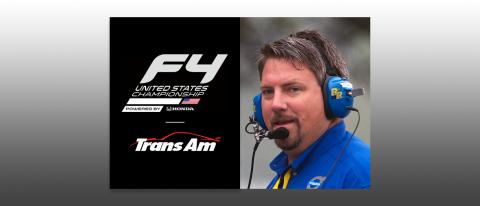
The Trans Am technical director takes on the same role for the Formula 4 United States Championship and Formula Regional Americas Championship, and he’s got his calculator ready, just in case.
In mid-July, Aaron Coalwell took over technical director duties of the Formula 4 United States Championship powered by Honda and Formula Regional Americas Championship powered by Honda. He also continues as technical director of the Trans Am series.
The Formula 4 role seems ideally suited to Coalwell, who got his start in racing on the Southern Polytechnic State University Formula SAE team in the late 1990s. After working as a volunteer tech official at numerous SCCA Club Racing American Road Race of Champions (ARRC) races, he was hired in 2000 as SCCA assistant technical manager, based in Colorado. Among several roles he held during nine years on the team side, Coalwell served as team manager and race engineer for different race teams in the World Challenge Touring Car program, including BimmerWorld, 3ZERO3 Motorsports, K-PAX Racing and 3R Racing.
FIA Formula 4 began in 2014 as an affordable step up from karting into open wheel racing. SCCA Pro Racing and the FIA then created the Formula 4 United States Championship with series partners Honda, Honda Performance Development, Hankook Tire America, and Onroak Automotive. Onroak makes the Ligier JS4 chassis in South Carolina for the series. The four-cylinder Honda engines come from the carmaker’s Ohio plant.
Coalwell recently shared his plans and goals for growing both series.
PRI: What are you most looking forward to as technical director of these series?
Coalwell: As we have done with Trans Am, I look forward to further developing a close-knit technical and operational team to ensure a level playing field for all FR Americas and F4 United States teams. I want to help develop both series as key properties of Parella Motorsports Holdings while providing great customer service that helps make each event as easy and fun as possible for participants.
PRI: How has your tech official background prepared you for this role?
Coalwell: In my 16 years as a tech official and my nine years on the team side, I have learned how teams might interpret and exploit the gray areas of the rules for their advantage. I know what it takes to write clear and enforceable rules. I’ve learned what it takes to run a winning team, so I am also empathetic to teams’ needs and concerns.
PRI: What do you see as the biggest challenges ahead?
Coalwell: Both the F4 and FR series are relatively new to the US, so the biggest challenge is to continue to grow both.
PRI: Can you share your top strategic goals for the next 12 months?
Coalwell: My top 12-month strategic goals, in no particular order, are to help foster growth of entry numbers for both series, improve operational efficiencies and maintain the current high technical standards to ensure a level playing field for all teams.
PRI: Describe the need in road racing for these junior series.
Coalwell: Junior series are important as a steppingstone between entry-level club racing events and the top-level professional series. The junior series are operated by professional staff in such a way that teaches teams and drivers how to operate and be successful in a professional racing environment.
PRI: You remain technical director for the Trans Am series. How will serving in these dual roles help you?
Coalwell: As the technical director of all three series, I can more easily share successful practices between them. It will also allow me to better coordinate sharing of equipment and staff as needed to make all three series more efficient and successful by covering any operational gaps that may arise during our busy events.
PRI: What’s your most gratifying professional accomplishment?
Coalwell: I often say that, as a tech official, you are only doing your job right if everybody is equally upset with you. My gratification comes from having really good, close racing, and then finding all the cars to be compliant afterward.
PRI: Who have been the biggest influences in either your professional or personal life and why?
Coalwell: Probably my first two managers in SCCA Club Racing, Sven Pruett and Patricia “Patc” Henry, and my first two managers in SCCA Pro Racing, Mitch Wright and Shawn Passen. They taught me how to operate professionally and fairly. Sven and Shawn were great teachers on how teams try to circumvent the rules and how to properly inspect cars for compliance.
PRI: If you could have a conversation with anyone past or present, who would it be and why?
Coalwell: Anyone who was very innovative in race car design and building. People like Smokey Yunick, Jim Hall and Colin Chapman, to name a few.
PRI: What is one mistake you’ve learned from?
Coalwell: Not getting details of conversations in writing. I learned this years ago after too many conversations with teams, or customers, were misinterpreted. I prefer to communicate via email so that I have a written record.
PRI: Excluding your cellphone/tablet/computer, what’s one thing you can’t live without?
Coalwell: That would be my calculator. In Trans Am, the teams do not use a single brand of data system, except in TA2, so I am always using my calculator to compare the performance of various cars. All the FR and F4 cars use the same data system, and we have a series DAG (data acquisition engineer), so I will not need to use my calculator as much for those.
AARON COALWELL
–
Title:
Technical Director
Organization:
Formula 4 United States Championship, Formula Regional Americas Championship and Trans Am
Hometown:
Charlotte, North Carolina
Fast Fact:
Coalwell loves riding motorcycles, and the curvier the road, the better. If driving to a race, he sometimes brings his 2003 BMW K1200 R or 2006 Suzuki GSX-R 750 with him to experience different parts of the country.
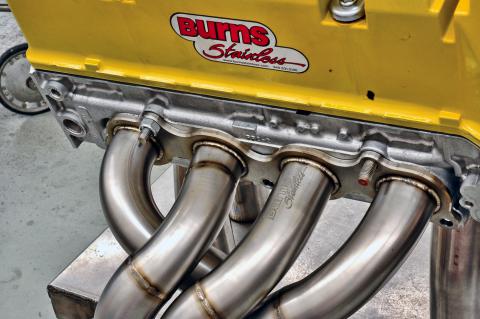
The idea that a pipe needs to be large in order to get a lot of exhaust gas to flow out of the cylinder is “not really the case,” said our source from Burns Stainless. “It needs to be the correct size,” he added.
Bigger isn’t necessarily better, as factors like engine rpm, camshaft choice, transmission, and more should be carefully considered in order to maximize performance.
Racers tend to believe that, especially when it comes to engine components, bigger is better. The quest for ultimate power means stuffing as much air and fuel as possible into an engine, and then venting its waste through sewer-pipe-size headers.
While there is certainly some validity to that bit of tribal knowledge, it doesn’t hold true 100% of the time, especially on the exhaust side of the equation.
“There’s a notion that, in order to get a lot of exhaust gas to flow out of a cylinder, the pipe needs to be large,” explained Vince Roman of Burns Stainless, Costa Mesa, California. “But we find that’s not really the case. It needs to be the correct size.”
“Racers want to make horsepower, and big-tube headers typically make top-end power,” said Chris Hill of Specialty Products Design, Rancho Cordova, California. “But a properly sized header takes into account how the engine will be run. Where do you want the engine to make torque and horsepower?” Because big-tube headers “don’t start working until further up in the rpm band. A Pro Stock car running at 10,500 rpm may like that, but a Super Gas car running on an index likely won’t.”
“There are a couple things going on,” Roman said when explaining why a big pipe may not always be a better pipe. “One is scavenging. With a very large exhaust pipe on an exhaust port, when the exhaust port opens and the exhaust starts flowing out, recirculating eddies form out of the exhaust port. That is an energy waster.”
Another important factor is “keeping the velocity of the gases sufficiently high so that the gases will have a lot of momentum as they flow out of the port,” he continued. “One way to think about that is when you put a nozzle on a water hose. The nozzle increases the velocity of the water and actually throws the water out further.
“The nozzle reduces the amount of flow through that hose,” he noted. “An open hose will flow more than one with a nozzle on it, but the nozzle will push it out further. It’s all about finding that happy medium, balancing the exhaust flow rate with exhaust header flow capacity. If you don’t, the exhaust gases will not have a lot of momentum, so at the end of the exhaust stroke and at the beginning of the intake stroke, there will be a lot of exhaust gas still close to the exhaust port. When intake filling starts to happen and pressures lower in the cylinder, the exhaust gases that haven’t traveled very far from the cylinder will be sucked back into the cylinder, giving you a less explosive charge for the next cycle.”
Among elements at play in an exhaust setup are collector types, which “would have an influence on how the header is finished, noted our contact from Specialty Products Design, who added, “That’s a whole different conversation.”
To calculate proper header size, “engine rpm, camshaft choice, transmission type, and car weight can all play a factor,” Hill said. “You need the header to start helping at 5,000–5,500 rpm.” As an example, he cited a “550-cubic-inch Super Gas drag car running at 7,500 max rpm. There’s no reason to put a 2.50-inch OD header on that car. My choice would likely be a 2.25-inch OD header, or maybe a 2.25-inch OD stepped to 2.375-inch OD.”
Hill also noted there are other elements at play in the exhaust setup, including collector types, “that would have an influence on how the header is finished. That’s a whole different conversation.”
Another factor with an influence on header size is whether the engine is naturally aspirated or has a power adder, Roman said. And if it’s the latter, what type of power adder is being used.
“The scavenging portion of the cycle becomes less important since a power adder, like a positive-displacement blower, provides much more cylinder-filling pressure than a scavenging wave,” he explained. “There aren’t such low pressures in the cylinders during the intake stroke because there is so much pressure filling them.”
Scavenging is still an issue “with nitrous and centrifugal superchargers,” he said. “At part-throttle and low rpm with a centrifugal supercharger, the cylinder-filling pressures aren’t as high as they are at higher rpm. You still want to have good throttle response when it’s not up to full boost. Exhaust scavenging will help here.” The same holds true with a nitrous system, as the racer isn’t always “on the nitrous. A well-designed exhaust system will provide better throttle response in that case.”
With a naturally aspirated engine, a well-designed header “is essentially a power adder,” Roman said. “Well-designed intakes and exhausts do supercharge engines. You will see volumetric efficiency of 125%–130% with a well-designed engine, and that’s a result of intake and exhaust tuning.”
Both Hill and Roman recommended racers take advantage of the exhaust companies’ expertise when it comes to properly sizing headers. “If a racer is honest about his or her usage, most reputable companies can assist in a choice,” Hill said.
Meantime, Burns Stainless has a computer program “that sizes headers and collectors based on engine parameters and combinations,” Roman said. “Using our algorithm, we can calculate proper exhaust tube size and get the length of the header and the collector sizing so that it works with that particular engine combination.”
“But some of this stuff is still trial and error,” Hill pointed out. “For instance, there are all kinds of combos in Competition Eliminator. You better be on your game to even be competitive.”
“The exhaust system doesn’t make or break a race car,” Roman admitted. “There’s a lot that goes into it. But if somebody has a big header, and he’s running first in his class, everybody wants to run everything that guy has. We still see these cycles, but we try to stay tried and true to what we espouse. It works for us and our customers.”
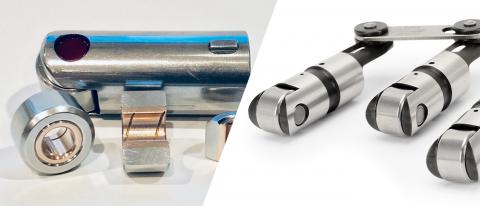
Even though both styles have been around for some time, the debate over these two lifter designs remains a hot-button topic in motorsports today. While many racers already have their minds made up, our advocates note that what makes one option superior to the other often comes down to the demands of the application.
BUSHED LIFTERS ADVOCATE:
NOLAN JAMORA,
ISKY RACING CAMS
–
A little more than a decade ago, we bought one of the first Spintrons off the line. We wanted to create a new line of oval track valve springs. As we were developing these springs and they got to a point where they could handle the rpm and the pressures, we started breaking our lifters. The needles would fail and go all throughout the motor. We’d have to pick them out, rebuild the engine, and keep testing. Eventually we decided that there was probably a better way to do this, and that’s when we started looking at a bushing lifter.
We knew that we would need a material that would be porous enough to pull the oil in, but it also needed to keep the oil in it. Figuring out the right mix of materials took us about two years of testing, but what we ended up with was something that would allow us to keep running the Spintron 24 hours a day, seven days a week without having to do rebuilds.
Whether we’re talking about street use or a hardcore racing application, the average bushed lifter lasts three to four times longer than a needle-bearing lifter would in the same use case. The other huge benefit is if there is a catastrophic valve spring failure, valve tip or stem break, or an oil system failure, a bushed lifter will never break apart and spread needles throughout the engine. It will keep the damage localized to the valvetrain and camshaft rather than spreading to the crank, rod, and piston areas.
Another key difference with bushed lifters is that you don’t see distortion of the bushing as it goes up the main acceleration ramp in the way that you do with needle-bearing lifters under high spring load, high rpm, and higher pressures. This distortion causes variations in the translation between the designed cam motion and the actual valve motion, and that leads to a loss of horsepower. Since the bushing follows that designed cam motion and it is fully translated to valve motion, you don’t lose that horsepower with a bushed lifter.
Another great thing about our bushed lifters is that you really don’t have to make any special considerations for them. These will drop right into an existing combination. If you’re running a solid-lifter roller now, you don’t have to make changes to the oiling system, the oil you use, or the spring pressures. With our bushing material you can run a restrictor, or run it on the street, or run it on high heat—you don’t have to worry about any of that. That’s one of the reasons it’s been so successful at events like Drag Week.
NEEDLE-BEARING LIFTERS ADVOCATE:
BILLY GODBOLD, COMP CAMS
–
There are people who believe, almost at a religious level, that bushings are inherently better. They’re not. On the other hand, there are those who feel the same way about needle-bearings, and that’s not the case either. It really depends on what you’re doing and what the application requires.
Teams in IMSA or FIA GTLM-class racing are all using needle-bearing roller lifters. When everything’s properly controlled, needle-bearing lifters are just better. They’re lower friction, the cam lasts longer, and the needle bearings last longer.
The camshaft and lifter wheel will last three to four times longer with a good needle-bearing than it will with a bushed lifter. A bushing bearing is designed sort of like a drum brake: As the cam comes off the closing ramp onto the base circle and the valve is closed, there’s no spring force going to the rocker arm, the pushrod, and the lifter. The lifter is just floating there, so it will hydroplane on the oil that’s on the camshaft. As the wheel is hydroplaning, it is also slowing down.
If you’ve ever watched big planes land on an air strip, you’ve probably noticed that as soon as the landing gear touches down, there’s a big puff of white smoke. Basically the same thing happens on the opening ramp of a camshaft in an endurance application that runs bushed lifters. Every time it comes around, it will “skid” as it comes back up to speed.
With a needle-bearing lifter, there is much less surface area making contact, and as a result, the amount of friction being created is dramatically lower. That means that the inertia of the wheel doesn’t have time to appreciably change its rotating speed, so you don’t see that smearing of metal as it hits the opening ramp on the other side.
With a bushed lifter setup, you also have to be careful with the type of motor oil you’re using. Because there’s no true pressurized oil between the axle and the bushing as in the cam bearing, you don’t have this hydrodynamic wedge all the time. Without that wedge, the oil chemistry becomes much more important. You need extremely low friction in that sliding area, and you need oil that will get in there and stay there.
Needle-bearings, on the other hand, require very little oil. That’s why there are a lot of needle-bearings in Pro Stock motors and builds like that. They don’t want the oil dripping down the camshaft onto the crankshaft, so a lot of folks will go with needle-bearings just to get away from windage issues.
Even though they run cam tunnels, all the NASCAR teams are still using needle-bearings for the camshaft as well. Since they’re limited to a 60-mm camshaft, these teams run needle-bearings to reduce the amount of oil that needs to be directed to that part of the engine. They know that will allow them to make both the pressure stage and the scavenging stage of the oil system smaller. They’re very conscious of how much power the oiling system takes, and they don’t want to give up a horsepower’s worth of oil to pump it in there and then pump it back to run the babbitt bearing on the camshaft.
At the end of the day, if you know your valvetrain is under control, you want to run a needle-bearing. But if you’re not sure, a bushed lifter can provide some insurance by spreading the load out.
Photo of Robin Miller by Walter Kuhn, courtesy of IndyCar
The Motorsports Hall of Fame of America (MSHFA) has honored racing journalist Robin Miller during a special ceremony at Indianapolis Motor Speedway (IMS).
Miller, one of the inductees in the MSHFA Class of 2021, was recognized ahead of the formal Hall of Fame ceremony in Pontiac, Michigan, set for September 27–29. Ongoing health problems will prevent his attendance at the event.
Hundreds of racing industry members gathered at IMS to celebrate Miller, who started his journalism career at the Indianapolis Star in 1968. Around the same time, he also worked with Jim Hurtubise and other race teams during Indianapolis 500 races.
He later worked for ESPN for RPM 2Night, the former nightly news program devoted to motorsports. This was followed by a stint at SPEED, where he worked on WIND TUNNEL and SPEED REPORT, before joining RACER as a regular columnist, including writing the popular Robin Miller’s Mailbag presented by Honda Racing/HPD. Miller also worked for NBCSN on IndyCar telecasts.
Miller will be formally inducted alongside eight other racing legends, including one of NASCAR’s 50 Greatest Drivers, Davey Allison (Stock Cars), three-time land speed record holder John Cobb (Historic), three-time NHRA Top Fuel champion Larry Dixon Jr. (Drag Racing), Indy and NASCAR trailblazer Janet Guthrie (Open Wheel), 2006 MotoGP World Champion Nicky “Kentucky Kid” Hayden (Motorcycles), seven consecutive APBA Gold Cup winner Fran Muncey (Powerboats), multi-time USAC and NASCAR champion Ray Nichels (Historic), and world-class timer/scorer Judy Stropus (Sports Cars).
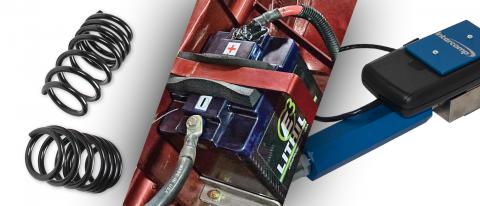
Competition-minded Tesla 3 owners will appreciate the aggressive stance and improved cornering from these lowering springs from Rekudo, part of Holley Performance Products, Bowling Green, Kentucky. The springs will lower the ride height 1 inch in both the front and rear, and are designed to work with the Tesla factory struts.
“These lowering springs are well suited for autocross and track days due to the fact that they lower the car’s center of gravity, and their progressive rate will improve handling as well as maintain a comfortable ride quality under normal driving conditions,” explained Greg Whittle.
The kit will fit 2018–2021 Tesla Model 3 AWD vehicles and come in a black epoxy finish. Overall, they’re designed with a slightly firmer ride when compared to the factory springs while offering a “good compromise” and a sporty feel.
“When installed by a competent mechanic, the install should take two to three hours,” added Whittle. “Other than basic hand tools, the only ‘specialty tools’ required are a coil spring compressor and a thin-wall 13-mm socket to access the top strut nuts. Thick sockets, such as impact sockets, will not clear the counterbore the strut nuts are recessed into.”
The front springs feature a constant 257 lbs./in. rate, while the rear springs have a variable 314–525 lbs./in. rate. —Mike Magda
More power and lighter weight are the two main selling points of the new SuperLite 1200 and 1600 lithium batteries from E3 Spark Plugs in Ponte Vedra, Florida, both of which are designed for motorsports applications.
To demonstrate these benefits, E3 replaced the two 16-volt AGM batteries in an ARCA car with just one SuperLite 1600. The car had considerable amp draw with EFI, coil-on-plug ignition, and 12 electric cooling fans. After 300-plus laps of testing, the data recorder revealed absolute consistent voltage and amperage outputs.
“Next, we wanted to see what it would take to kill the battery,” said Rob Fisher.
The alternator was disconnected, and the car ran 25 laps, or 40 minutes, on battery power alone without a loss of performance.
“In a lead-acid or AGM battery, it will deliver 100% only while fully charged, then drop off to 95%, 90% and so on as it drains,” explained Fisher. “Our lithium battery will deliver 100% of capacity and equal output at all times until the second it runs out.”
The SuperLite 1200 is 13.2 volts, features 24.8 amp-hours capacity, and weighs just 6.9 pounds. The SuperLite 1600 weighs 8.9 pounds, features 1600 pulse cranking amps, and 32 amp hours of capacity.
E3 also offers lithium batteries for marine and powersports applications. —Mike Magda
The new RFX wireless load stick eliminates the cumbersome cabled indicator currently utilized by many load sticks on the market, allowing racers to concentrate on the measurements.
“Load sticks can help a racer ensure consistent performance from their car in a couple of ways. While at the track, load sticks can be used to determine the strength of spring needed to get a car to a particular attitude at one, two, or all four corners of the vehicle,” explained Aaron Van Heel of Intercomp, Medina, Minnesota. “This could be the result of a setting change or damage sustained while out on track.”
Each Intercomp load stick features a 3,000-pound capacity load cell and can span shock mounting points stretching from 15 to 25.25 inches. The bodies are machined from hex-shaped billet aluminum for easy adjustment with hand tools.
“Load sticks can also be effective for racers that travel to several different race tracks throughout a season,” Van Heel noted. “Race tracks with extremely similar traits at the beginning of a race event will oftentimes behave very differently from beginning to end. Small variables, like moisture content in the air, have the potential of making last weekend’s race-winning setup completely un-drivable. A racer that utilizes load sticks has a better chance to keep up with those changing conditions by providing the most complete picture of a race car’s handling performance.” —Mike Magda
Is your legacy performance business due for a rebranding? See how this Honda-centric parts supplier expanded its offerings to other marques and attracted a new audience without alienating its traditional customer base.
THE PROBLEM:A 30-year-old performance parts business lost touch with younger customers.
THE SOLUTION: A comprehensive rebranding to meet the expectations of a new audience.
Motorsports and performance cars can be a tough bird. To some extent, they’re classic. Enduring. Unchanging. But on the other hand, everything evolves. What used to be cutting-edge cool eventually gets pushed to the fringes as “retro” or “old-school”—the warm, comfy blanket for a shrinking crowd of seasoned enthusiasts.
And that’s exactly what happened to sport-compact performance pioneers DC Sports, based in City of Industry, California.
Founded in 1987, DC Sports was a force in the early sport-compact scene. With most of its enthusiasts geared toward Honda cars for the segment’s first decade or so, it made sense for DC’s entire product line to cater to that brand.
The company continued with its all-Honda focus as it was acquired by current owner, Pilot Automotive, in 2007. But over the years, the sport-compact scene had evolved considerably. Honda and Acura products were still a big part of it, but sport-compact enthusiasts were by this time eagerly embracing other car brands. By limiting itself to serving only Honda owners, DC found itself out of step with its audience.
It was time to dig in and regain the edge that had made the company a leader in the sport-compact market’s formative years.
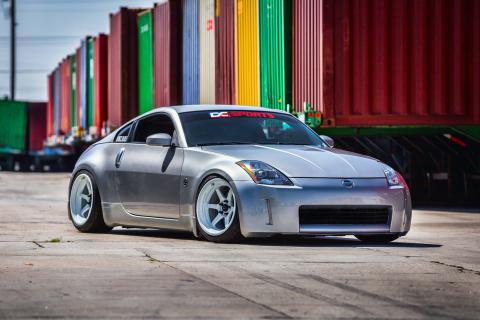
The sport-compact market had evolved considerably since DC Sports was founded in 1987. As a result, an early step in the Honda-centric company’s recent rebranding process involved developing parts for a wider variety of makes, including Subaru, Toyota, and Nissan (pictured).
To begin the rebranding process, DC’s marketing team first established a baseline understanding of how the company was perceived. “When I came into the company at the end of 2018, I sat down with some of the team to figure out how we were going to position ourselves within the market,” said Danny Anguiano, brand manager at DC Sports. “We noticed that the older demographic, 35–40 years old and up, are huge diehards of the DC Sports brand. For them it’s a nostalgia thing. But a lot of those dudes now have families, and they can’t really be playing with their cars anymore.”
From that insight, a picture emerged for how the company should best approach the new audience it sought. “The new generation didn’t really know what DC was before,” explained Anguiano. “They don’t see us as a Honda brand moving into Nissans or a Honda brand moving into WRXs. They see us as something completely new. So it made more sense for us to come in and rebrand as almost a new entity to the market that didn’t know us before.”
As part of DC Sports’ rebranding, the brand’s visual identity had to be overhauled in order to better appeal to its younger target audience. “We spent weeks going over different colors, different fonts, and how those correlate in the minds of different age groups,” our source noted.
The essential foundation of the rebranding was, of course, the parts that would be offered. The company sells only DC-branded components. So the first step had to be developing pieces for other auto brands, including Subaru, Nissan, Toyota, Kia, Lexus, and Genesis.
Once DC had parts to offer a wider range of car owners, its next challenge was getting the right look. The marketing team overhauled the brand’s visual identity to better appeal to its younger target audience. For this phase of the process, the bigger resources and deeper pockets of parent company Pilot Automotive proved to be a vital asset.
“We didn’t want to completely change the logo, but we did add some flavor to it,” recounted Anguiano. “We spent weeks going over different colors, different fonts, and how those correlate in the minds of different age groups. We were able to get quite a bit of data from different branding agencies that Pilot has done market research with. There were things that say what different colors represent to the human mind. For someone between 18 and 22, blue might mean one thing, but to a 25-year-old it could mean something different. I had never seen research like that.”
Next, it was time to get the message out. And for DC’s younger new target audience, social media was the obvious choice—Instagram, in particular. But at the same time, some of the best results have come from a more classic medium. “Email lets us provide people with clear and direct info without it getting diluted like on the Internet, or getting all the other people that are trying to put their opinion into somebody else’s decision.”
While DC Sports’ “older” demographic—those 35–40 years of age and up—were major supporters of the brand, it became clear that younger enthusiasts did not quite share that same sense of nostalgia. “The new generation didn’t really know what DC was before,” reported a company source.
The company is also starting to experiment with paid online advertising, including ads on Instagram and Google. But Anguiano so far is taking a cautious approach. “We have to collect some data before I start pushing the needle too much and it backfires on me.”
In addition, DC has always relied heavily on live event appearances to maintain contact with its audience. The company participated in 70 events in 2019, and hopes to resume that pace once pandemic restrictions are eased.
Although Anguiano describes DC’s rebranding as “a work in progress,” the effort has already yielded impressive results—a 400% annual revenue increase compared to years prior to the project’s start in 2018, he said. At the same time, he also points to intangibles that bode well for the long-term health of the DC Sports brand. “Personally, when it comes to the rebranding side of it, I measure success through the engagement. Because at the end of the day, you’re only around because of your customers.”
How this critical, but often-misunderstood process helps eliminate the harmful forces that can prevent your engine from freely transmitting the power it creates.
The practice of balancing rotating assemblies is one of the most misunderstood dynamics within the engine building community. Just look at social media forums, which are filled with misguided or “voodoo” information on the subject.
So let’s start at the top: The main reason for balancing rotating assemblies is to eliminate damaging and parasitic forces that cause erratic mechanical activity that in turn robs the engine of its ability to freely transmit its generated power. Most people overlook the fact that all engines from the first stage of manufacturing go through some process of balancing. When the crankshaft and all related components are manufactured, they must be shaped and weighed to meet a target weight specification.
As such, the crankshaft is designed with counterweights that offset the reciprocating and rotating forces generated via the combustion cycling, which causes the assembly to rotate. While this is generally known and understood, what we need to make clear is that the engines we used just a few decades ago were running at a relatively low rpm band as compared to the engines we’re currently getting from the OEMs. Notice that I am talking here about “grocery getter” vehicles, not high-performance machines.
Now, let me provide some information that hopefully will get your attention: In the 1990s, OEMs such as GM, Ford, and Chrysler produced engines that would generally accept a balancing tolerance of 2.0 ounce-inch. So what does that mean? Essentially, the 2.0 ounce-inch tolerance means that a typical crankshaft that has a total diameter of 6.0 inches will have 18.95 grams of unbalance weight residually embedded at the outer edge of the counterweights. When the engine is running at 1,000 rpm (just above idle), the embedded weight will cause the rotating crank assembly to generate a “centripetal unbalance force” of 3.56 pounds. As we increase the rpm to 2,000, the unbalance force increases to 14.24 pounds; at 4,000 rpm, it is now 56.96 pounds; and 8,000 rpm will generate 227.84 pounds of force.
Pictured here is an abnormal wear signature indicating harmful out-of-balance forces.
It is important to understand that even though the unbalance force can increase from 3.56 pounds all the way up to 227.84 pounds at 8,000 rpm, the actual embedded weight of 18.95 grams is still the same. Only by increasing the rpm do we increase the generated unbalance force. Simply put, as you increase rpm, the generated centripetal force of the offending unbalance mass is increased exponentially.
At this point you may be saying that because we rarely operate the engine at 4,000 rpm, the 56-plus pounds of force is not a big deal. Well, let me point out that if you had a 56-pound hammer and you dropped it on, say, the hood of your car, you would notice an unwelcome dent. Now let’s imagine that the hood of your car is an engine bearing. This bearing is receiving a pounding load of that 56.96-pound hammer at a rate of over 66 times per second at 4,000 rpm; and at 8,000 rpm, this hammer now weighs 227.84 pounds and is cycling at 133-plus times per second.
It is critical to understand that the damage created at the higher rpm is not recoverable by simply reducing rpm.
For the grocery-getter, you’re probably more interested in fuel efficiency. But for the high-performance engines you should be more concerned with the durability and stability of your engine components. And, you must acknowledge that parasitic drag is stealing horsepower.
Something I’m often asked is whether balancing makes horsepower. The answer is no, at least not in direct form. It does, however, eliminate parasitic forces, which unleashes horsepower. These disrupting (parasitic) forces also can generate erratic mechanical disruptions, resulting in what we call “excitation” to engine components. As we know, vibration is directly linked to premature wear of the engine bearing, along with block and head machined mating surfaces—especially main bearing caps and block registers. It’s also linked to natural frequency excitation “triggering” that results in potentially disruptive harmonics associated with all moving and non-moving components (where you will witness fretting on mating surfaces).
Shown here is excessive bearing wear due to fretting caused by vibration from an unbalanced rotating assembly.
Here’s a quick example of how drivetrain components are linked and work in harmony: While driving down a smooth highway, you accidentally veer off the edge of the smooth asphalt surface. You instantly feel the shuddering of your steering wheel. The tire is bouncing, but again, you feel the disruption in your steering wheel. Now, in order for you to feel the disruption, you must understand that the initial catalyst of that disruption came via numerous interconnected components, all of which were affected before you felt the vibration.
Referring back to the engine, the out-of-balance forces generated by the unbalanced crank assembly emulates the same “disruptive excitation” induced by the rough surface of the unpaved road. But, by simply driving back onto the smooth asphalt you can eliminate the disruptive force. Unfortunately, that’s not the case with an unbalanced crank assembly. Any unbalance force retained within the crank assembly can only be corrected by disassembly and rebalanced to the correct ISO 21940 Balance Tolerance.
Randy Neal is the owner of CWT Industries in Norcross, Georgia. A 50-year veteran of the auto racing industry, Neal is widely considered a leading authority in the design and manufacture of dynamic balancing machines. Over the years he has developed proprietary software, machinery, and application knowledge that’s helped take the “voodoo” out of the balancing process.
Customers often look to counter people for knowledge and service, noted one of our sources, who added, “They don’t ask for pricing, they want you to solve their problem. Upselling is easy because you’re selling knowledge.”
How to ensure your frontline people, those critical points of customer contact, have the skills needed to maximize sales transactions.
There’s no question that the Internet has made fundamental changes in retailing. Yet despite a proliferation of online merchants and a waning of traditional brick-and-mortar stores, in many cases the act of the sale still comes down to a personal interaction between a customer and someone representing the retailer. “People buy from people,” explained Randy Sosnoff of Scott Lewis Associates Inc., Baldwin, New York. “No matter how the conduit works, whether the customer is on the phone or in front of you, there are two people there.”
That being the case, how can a retailer be sure that its frontline person, that critical point of customer contact, has the skills needed to maximize a sales transaction? How can that person not only provide the customer with what he or she asked for, but use the interaction as an opportunity for additional sales?
The answer is simple, yet complex at the same time. What it takes, say the sources interviewed for this article, is education.
“Having a good, fundamental understanding of the components of the car or product is critical,” said Sosnoff. “The first thing counter people really need to think about, before they say one word to the customer, is to envision what the job takes. If you understand what the job entails, then you can talk about replacing all the components to do the job. Don’t let the customer go without at least trying to sell them the other components.”
“When a person comes to you, they want your knowledge and they want your service,” said Bob Balderston of Plumb Bob Automotive, Romulus, Michigan. “They don’t ask for pricing, they want you to solve their problem. Upselling is easy because you’re selling knowledge.”
When a customer comes into his store asking for something specific, Balderston will go to his shelves to retrieve the asked-for “widget,” then he’ll “go to the bolt section, get a couple fasteners, maybe some other piece that might attach to the widget that maybe the customer isn’t aware of.” He’ll then set the part on the counter, plus the additional items, and explain how they work together. “Ninety-nine percent of the time the guy will say, ‘I could use those fasteners because mine are all torn up,’ or, ‘I didn’t even know those things existed.’
“Knowing what you sell gives the opportunity to present the customer solutions,” Balderston said. “You can upsell easily if you educate the customer because you’ve been educated. If you just go by what the computer says to sell, you will never upsell.”
This is where the situation gets more complex.
“At the end of the day, you have two problems,” Sosnoff said. “One, you have a customer who may not know what he needs. And you may have a counter person who doesn’t know what the job needs, either.”
The education gap that can hamper a counter person’s effectiveness has several root sources, starting with the fact that “technology is moving so fast,” said Sosnoff. “We went from carburetors to fuel injection, now we’re in electric vehicles. There aren’t that many vehicles that guys are working on like they used to. So there are a lot of people who don’t really have the expertise to talk about this stuff, because they don’t see a lot of it.”
There is also a limit to the educational resources available.
According to one of our expert sources, education always trumps a quick sale. “[If] you want to upsell,” he said, “teach your employees…. If the customer thinks, ‘This guy knows what he’s selling,’ they will wait in line to see you.”
“As a manufacturer, I talk to my direct customers all the time, but none of us ever talk to the counter person who’s selling the product to the consumer or the installer,” said Dennis Grau of Energy Suspension, San Clemente, California. “And there’s so much pressure today, with cell phones, social media, video games, cable TV—how much time do they have to dedicate toward learning?”
Grau said this situation has been “high on my list of priorities for a long time.” Which is why he is proposing a video training program that he calls Energy Suspension University. It would consist of video modules related to the company’s products, such as “engine mounts, suspension bushings, body mounts. There could be seven to eight categories, and as a counter person passes a module, we could give them some sort of reward for their effort.”
He also foresees this growing into a resource in which, for example, “a chassis component manufacturer works with us to educate the counter people about the whole chassis. I can speak to the advantages of the bushing, but I don’t know what a chassis company’s control arm will do. That’s why collaboration with other manufacturers is critical. Everyone has the information, but no one has brought it together into a video library that I’m aware of.”
Grau said the benefits for such a program could be “massive,” especially when applied to those counter people working in chain stores. He explained that Energy Suspension is “a performance bushing company, but we enjoy business with all three majors. If there’s roughly 16,000 stores at 4.5 counter people per store, that’s 72,000 counter people. If we can educate them and show them how to sell just $20 a month, that’s $17.3 million. That’s a hell of a good head start for our industry.”
It’s not just the chain retailers that would benefit from such a program.
“Education trumps a quick sale any time of the week,” Balderston said. “You want to upsell? Teach your employees. They are the ones who represent your store. If the customer thinks, ‘This guy knows what he’s selling,’ they will wait in line to see you.”
After earning 16 domestic championships and a World Time Attack crown, this Australian is making a name for himself on the world racing stage through Global Time Attack and, most recently, Pikes Peak.
From a young age, I was always around motorsports with my dad. Growing up watching him race go-karts was always a great experience for me, and I knew it was a dream of mine to race. I owe all of my racing to my family for the sacrifices they made to keep my dream alive.
As a kid, I always had a dream of being a State Champion, which I’ve now done 14 times (Victorian Time Attack champion four times, Victorian Sports Sedan champion eight times, Victorian Sprint champion two times). Then I looked to becoming the Australian champion, which I’ve now done twice (Australia Honda Nationals). I was pretty content with those achievements until I won a World Time Attack crown in 2018. That’s when I set my sights on racing in America and receiving an overseas podium, which I recently achieved in April with Global Time Attack.
I’m currently driving for Project Import in America in a Honda S2000 in the Global Time Attack series, as well as in the Victorian Sports Sedan Championship in Australia in my family-owned tube chassis RWD Honda Prelude. I also drive the Elusive Racing Honda Integra World Time Attack car. This year, I’ve been doing select rounds in each series—four races in America, two Victorian Sports Sedan rounds, and the week-long World Time Attack event.
The World Time Attack and Global Time Attack events are along the same lines, but Global Time Attack is based in the US with 99% American or Canadian drivers, whereas World Time Attack is based in Sydney, Australia, and attracts drivers from all over the world—it’s the crown of time attack worldwide. Win World Time Attack and you’re world champ in your division. Win Global Time Attack, and then it’s time to head to World Time Attack to go up against the best.
Scheduling races around the world is currently the hardest thing I do because with the pandemic, I can’t just fly in and out like I did in 2019. Every time I return to Australia, I need to do a mandatory two-week hotel quarantine. That, along with the fact that I pay for all of my flights and travel myself, makes it very hard on me because missing work is a huge issue. I always need to allow that aspect into my schedule each time, and also make sure Australia allows me to return each time. Plus, with the current COVID restrictions my family isn’t able to join me in the US, so leaving them for months is also very difficult for me.
My next goal is to reach the summit of Pikes Peak on race day, and a top-three finish would be even better. I raced Pikes Peak this year as a rookie, but because of the weather we weren’t able to go to the summit on race day. Part of me is over the moon for finishing the race, but the other part knows I haven’t quite finished yet. The finish line is at the summit, and technically I haven’t reached it other than in practice, so Pikes Peak still needs to be tamed.
However, to be a listed driver for Pikes Peak has always been a dream of mine, and this deal came together very late this year. I was still in Australia in January when we got confirmation that we had made the event, and we didn’t even have a car yet. I arrived in America in April, and we had until June to make everything happen.
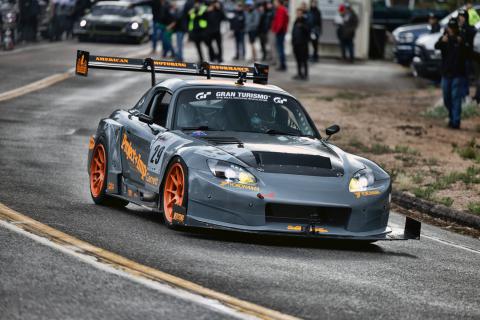
We entered a Honda S2000 time attack car with a custom Honda F20C engine with an Eagle Specialty Products 2.3L stroker kit. It had custom hand-ported cylinder heads by David Flood, and also featured Skunk2 Racing Ultra cams, Garrett G35-900 turbo, TTi six-speed sequential gearbox, Emtron KV8 ECU and electronics, MoTeC dash, custom fabrication by Circle City Hot Rods, and aero by Amir Bentatou at RS Future.
Race day was a whole new experience for me. From the moment we turned up, people knew who we were, and the event was second to none. The number of fans was next-level, and the interest in our car was overwhelming. To have that number of fans so close to the track was insane. To reach the finish line was a massive relief for me and the whole team, but afterward I knew it was time to start planning for a better 2022 Pikes Peak.
The parade back down the mountain to the pits was a dream; to have every fan line the track to high-five each car was an experience in and of itself. People know the car and knew me, and I can’t wait to experience that again from the summit in 2022.
 MEMBERSHIP LOGIN