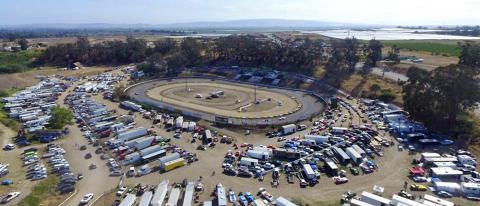
Santa Maria Raceway—the 1/3-mile clay oval in San Luis Obispo County, California—has suspended operations indefinitely. The accompanying Stadium805 concert and event center will also suspend operations.
Current owner Nick Duggan, who purchased the facility in 2018, cited an ongoing legal conflict with county officials stemming from a new residential community near the track.
“The ongoing efforts of the County of San Luis Obispo and the Costa Pacifica Estates Homeowners Association to shut down our facility, and the legal fees defending the actions, has made it financially impossible to continue operating this facility in the way it has operated for decades,” Duggan stated on the track’s social media page.
“County fines between June and August will have reached over $37k and must be paid upfront. Adding to over $150k of lawyers/consultants fees and studies, this has drained us of all remaining operating funds. This is now affecting the quality and safety of our shows.
“Unfortunately, as a local family operation, we no longer have the means to continue the fight to keep this iconic facility open,” Duggan concluded.
All racing events through the 2021 season, including the AMSOIL USAC-CRA Sprint Car Series and the USAC West Coast Sprint Car Series, have been canceled.
An exchange of ideas and information helps manufacturers and dealers match racers with their dream hauler. Here are the important questions for both sides to ask.
Transporting vehicles is just a small part of what racers want from their trailers. This multitool on wheels is also expected to carry a race shop and spare parts; provide food and shelter during down time; tote a mule or golf cart; serve as a motel room and/or lavatory; provide sponsors and other guests with a lounge and refreshments; and maybe even act as a concession stand for a racer’s merchandise. Organizing all that into a narrow space between wheel wells requires foresight, planning, and a keen eye for spatial coordination.
Fortunately for racers, our industry’s trailer manufacturers and dealers bring all those skills to the table and more. Many in the trailer business are racers themselves, so they have firsthand experience with the little details, like where to place D-rings or how many lights are needed at the loading ramp, that will make a racer’s life easier.
All that knowledge, though, must be tapped. When shopping for a new trailer, racers should be prepared for a thorough discussion with a manufacturer’s rep or dealer about what they carry and how they race.
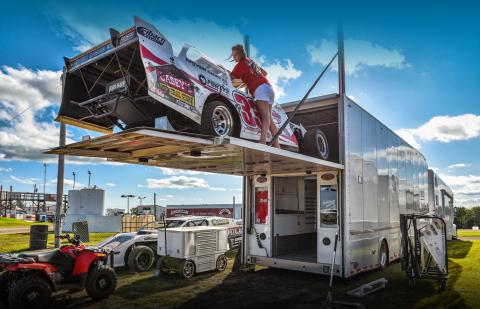
Trailers are a vital multitool for racers, serving as workshop, parts storage, hospitality center, shelter, and of course, transportation for cars. Photo courtesy of Capitol Renegade.
“We’re creating dreams, something very special for these customers,” explained Brad Bell of Formula Trailers, Bristol, Indiana. “So it’s valuable for us to ask as many questions as we can. It’s fun to talk to customers about what their end vision is. A lot of them just don’t know how to get there. They need somebody to ask those questions, and then we can dial it in.”
“You’d be surprised at how many napkin drawings I bring home from the PRI Show,” said Todd Datweiler of T&E Enterprises Auto Haulers, Herscher, Illinois. “I’ll go out to dinner with customers and bring home drawings on napkins to start a project with. All we need is the concept, and we can go from there.”
What follows are some of the most important questions trailer reps and dealers should ask a racer, and vice versa, to make sure the trailer the racer wants is the trailer he or she gets.
Q: What type of racing do you do?
“It sounds crazy, but one thing a lot of dealers miss is asking about what kind of racing they do,” said Chad Stanley of Phil’s Trailer Sales, Waco, Texas. “You have to know what the end user is doing with the trailer before we can decide what to put them in.”
“Each discipline of racing has a little different trailer requirement,” said Wayne Quackenbush of Capitol Renegade, Beltsville, Maryland. “We do a lot of sprint car trailers because we race sprint cars, and we know what it takes to be on the road for a four-day weekend. Drag racers are completely different. They’re not pitting behind the car—they’re generally next to the car—so they may need awnings, electrical and air outside, things like that.”
“Knowing what type of racing they’re doing so you know what to sell your customer is the absolute most important thing,” added Mike Nichols of Haulmark, Elkhart, Indiana. “So many dealers skip that part of the process. They just want to hurry up and sell what they have pre-packaged.”
Q: What are you carrying?
Tim Dibley of United Trailers in Bristol, Indiana, said that question “encompasses not only the vehicle that you’re carrying, but what else are you taking to the track? Are you taking a pit box, a golf cart, a mule? Are you taking hospitality? Do you have the room and weight capacity to carry that in that trailer?”
In Dibley’s experience, “if they’ve been in racing for a while, they know everything they carry with them. What they may not understand is, when everything’s totaled up, what does that weigh?”
The right trailer can make a world of difference in convenience, satisfaction, and success for racers. “We’re creating dreams,” said our source at Formula Trailers.
“If they sit down and add it up, they may be surprised at how much it comes up to,” Quackenbush agreed. “So the first thing I tell people is to buy a trailer that has the capability of handling all that weight.”
Too often, he said, “people are caught up on the price of the trailer, and they’re not asking about the capabilities of the trailer. You see a lot of inexpensive trailers out there that only have a 10,000-pound GVW (gross vehicle weight rating). But the trailer weighs 7,500 pounds, so they really have 2,500 pounds of cargo capacity. And they’re trying to load 3,000 pounds of race car and another 3,000 pounds of equipment in it. If you overload a trailer, it can be very unsafe.”
Paying more attention to price than capability can be especially true of first-time trailer buyers, said Steve Hartman of Look Trailers in Middlebury, Indiana. “First-time users are looking at just the economics of getting the lowest price. But they may not get the trailer they actually need or that is safe to pull, because they buy a trailer with axles that are too lightweight. It’s important to get it spec’d right to begin with, otherwise you’ll be needing a new trailer right away.”
Once the racer has figured out weight capacity needs, “we need to see what their footprint is,” Nichols said. “Before they come to the dealership, they should draw in their floor space, everything they plan to put in this unit, so they can find out if the trailer they want will cover that footprint.”
Getting the ideal trailer configuration starts with an honest, accurate assessment of needs. Amenities for travel can be a big part of that. Photo courtesy of R&M Race Trailers.
United Trailers has downloadable floor plan grids on its website to help with this part of the trailer-buying homework. “You can print a grid of what the floor will look like and draw your car, your cabinets and where things will go, so when you go to the dealer you have everything mapped out,” Dibley explained.
inTech Trailers of Nappanee, Indiana, also offers downloadable floor plan grids “to give them a rough idea if the layout will work for their needs,” said Jim McConnell. “Sometimes it makes it easy for them to understand that they may want a 24-foot trailer, but it’s going to take a 26 to solve their problem.”
Q: What do you tow with?
On a basic level, this question is about having enough truck to pull the trailer.
“If a guy says, ‘I want to haul two cars, plus this, that, and the other,’ and he says he’s towing with a half-ton pickup, then let’s back up here, we’re not getting anywhere,” said Alan Cape of Flying A Motorsports, Cuba, Missouri.
“A lot of people are trying to pull way too much with a smaller truck,” added Bruce Litton of Bruce Litton Trailer Sales, Indianapolis, Indiana. “That’s a recipe for a lot of problems going down the road. So the very first question I ask is, ‘What do you have to pull with?’ That gives me an idea of what size of trailer will fit their needs.”
On another level, custom work may be needed for the trailer to accommodate the tow vehicle.
“When it comes to fifth-wheel and gooseneck-style trailers, those kinds of haulers are very unique, and the manufacturers need to build the trailer to match the tow vehicle,” said Bell. “We need all the tow vehicle information: bed length, bed height, where the ball is placed, if there’s a toolbox inside the bed. Then our engineering staff can make the CAD prints for that trailer to match that tow vehicle.”
Similarly, “if you’re towing with a motorhome or toterhome, you need an extended tongue on the trailer,” said Rich Moline of R&M Race Trailer, Cushing, Oklahoma. “If you have a normal tongue on the trailer and you make a turn too sharp, the trailer will hit the back corner of that motorhome and damage both the motorhome and the trailer.”
Moline orders all his trailers for inventory with extended tongues. “It doesn’t hurt the guy who doesn’t have a motorhome,” he explained. “It just gives him a sharper turning radius with his pickup. It’s not an expensive option, so I’d rather have it on there than not.”
Q: What options do you want?
Because so many race trailers are built to order, “the sky’s the limit as far as options we can do,” said Hartman, echoing the comments of many companies. “They just need to spec it right the first time, so they don’t have the regrets of, ‘I wish I had done that.’”
Cabinets were near the top of the must-have list. “As racers, we never have enough storage,” Moline said. “If you just get the basic L-shaped cabinet up front with a straight overhead, which is what you see in most stock units, you’ll run out of storage fast. In every trailer I order, I put a wheelwell cabinet on one side or the other.”
Lighting, too, was mentioned by many. “You can never have too much lighting,” McConnell said. “Customers will say, after the fact, if they could have done anything different, they would have doubled up their lights. It’s not that expensive on the front end.”
Once racers specify what they plan to carry, the manufacturer can determine exactly what size trailer is required. “We need to see what their footprint is,” explained our source at Haulmark.
It follows, then, that “nine out of 10 racers need a power supply center to help them at the track,” said Bell. “Not only to light up the area to work on their machine, but to power any type of tools they’re using.” Like many manufacturers, Formula Trailers can supply a generator for the trailer, or build an enclosure for a generator that a customer is moving from an existing trailer.
As with so many trailer options, generator capacity varies depending on need. “We’ve put some diesel generators in these big semi-trailers that are crazy in size,” said Datweiler. “Later we’ll find out that not only is that generator running the trailer, but the client will also have a motorhome parked with the trailer and wants to use the trailer generator to also run the motorhome.”
On the other side of the generator spectrum, Haulmark’s popular Edge racing trailer is built with a top-hinged generator door, something Nichols highly recommends “if you’re running a portable generator and have to open your generator door at every race. Make sure your manufacturer is putting in a top-hinged generator door, so you don’t have the sag problems that come with the RV-style generator doors.”
An option that Nick Godfrey of Equalizer Systems in Elkhart, Indiana, considers “the best-kept secret in the trailer industry” is his company’s hydraulic tongue jack. (Hydraulic landing gear for fifth-wheel and gooseneck trailers is available as well.) “Instead of manually cranking a jack, you just push a button, and the jack does the work for you.”
Q: What are your long-term plans?
“I talk to my customers about the long term,” Moline said. “You might be racing in this class this year and next. But if you’re planning to move up in a couple of years, instead of having to buy a new trailer, look at a trailer now that will fit those needs also. In the sprint car world, in a couple of years they may move up to a wing car and will need a taller trailer. It’s cheaper to buy that taller trailer now than to buy a whole new trailer two or three years from now.”
“One thing I know about racers, they change every other year,” Stanley said. “So we’ve learned to ask, ‘What other kind of racing have you done?’ A drag racer may tell us he likes dirt track racing. So we’ll recommend the Edge because of its 96-inch-wide ramp door opening. If you go with another product, it may only have the standard 89 inches. A Late Model car is going to need every bit of that ramp door opening. This way you don’t have to replace the trailer if you decide to change.”
Customer Questions
As for those questions a racer should ask the trailer companies, the first is obvious: How much is it?
“All too often, people are caught up on cost,” said Quackenbush. “There are companies out there building cheap trailers with small axles, tires and wheels, all to get an inexpensive price, and people fall for it.”
“Price shouldn’t be the most important question,” said Moline, “but the customer’s first question usually is, ‘Do you have a 28-foot trailer, and how much is it?’ instead of asking what brand it is and what options are on it.
Referred to as “the best-kept secret in the trailer industry,” Equalizer Systems offers its hydraulic tongue jack and hydraulic landing gear. “Instead of manually cranking a jack, you just push a button, and the jack does the work for you,” said a company source.
“Or they’ll tell me, ‘So and so is advertising a 28-foot trailer for $1,000 less,’” Moline continued. “Is it a major brand that will be there for you warranty-wise? And why is it $1,000 less? Are they using cheaper materials, like thinner-gauge steel in their upright posts and main frames? It’s the old saying: You get what you pay for.”
In a similar vein, after “what kind of racing do you do?” Stanley said the second most important question he asks is whether the racer stays local or puts a lot of miles on the trailer. That information influences the trailer model he recommends, as he will want to put a high-mileage team in a better-quality trailer.
“We do a lot with [the television show] ‘Street Outlaws,’” he said. “When I found out they were traveling all over the place, I put a lot of them in our Haulmark Edge product because that’s our higher-end race trailer. They’re replacing models they picked up at the best price they could and realized real quick that didn’t work for them.”
Nichols said Haulmark has models “that will work great for the weekend warrior, who races 10 to 20 times a year at his local track. But if you put a guy who’s going to drive from LA to Boston to make a race in that same trailer, the long-distance racer is not going to be happy. He would be in the wrong product. Many dealers are trying to sell price, price, price, and it’s definitely not about price once you’re at a certain level, or any level of racing, in my opinion.”
Putting needs before price is vital for getting the right trailer. “First-time users are looking at just the economics…but they may not get the trailer they actually need,” explained our source at Look Trailers.
Another important question a racer should ask a dealer, especially in post-pandemic America, is about lead time.
“COVID put a tremendous backlog into things,” Bell explained. “Everything was going really well at the beginning of 2020, and then COVID pushed everything back.”
“It’s hard to get parts, hard to get people to build the trailers, everything is just harder right now,” said Hartman. “Lead times are out further than I’ve ever seen them in 20 years. If people are thinking about getting a trailer, they want to get it on order as quick as possible. Typically, there’s a longer lead time on race trailers anyway because they are labor intensive. It used to be 12 to 16 weeks, but right now we have some stuff that’s nine months out. They’re talking next season.”
Formula Trailers is also “building through the end of this year and into 2022,” Bell said. “We’re looking at next spring already. In a normal season, things would be winding down at the end of the year, and the PRI Show would start the next season of race trailers. We’re still picking up the pieces of last year, and it’s bleeding right through. I think PRI will just continue that momentum through 2022.”
“You can still get exactly what you want, and it will still be customized to your needs,” said Litton. “The important thing is to allow yourself plenty of time. It will all work out in the wash. We’ll get through this pandemic and be back to racing like we were soon.”
This Arizona-based off-road suspension specialist has become a powerful ally to UTV and shock manufacturers while winning over racers with extraordinary product development and customer service.
Growing up in Southern California in the 1980s with a father who raced a fuel altered, Mickey Thompson as a neighbor, and So-Cal hot rod legend Pete Chapouris’ son as a classmate, it is no surprise Justin Smith was fixated on “big power.”
“That horsepower thing was just driving me—the need or the want to be in anything that was fast,” he said. “I loved horsepower, period.”
From his teen years rebuilding small block Chevys and Fords to drag racing as a young adult, Smith’s pursuit of speed suddenly went “off-track” in the early 2000s.
“I got a ride in an off-road truck,” he said, “and I never looked back.”
Power still mattered in off-road, but not as much as the ride. So Smith threw himself into learning all he could about suspension as he developed a business building sand rails and other full-size off-road vehicles.
The shock he and many others weren’t prepared for, however, was the Great Recession. He lost everything.
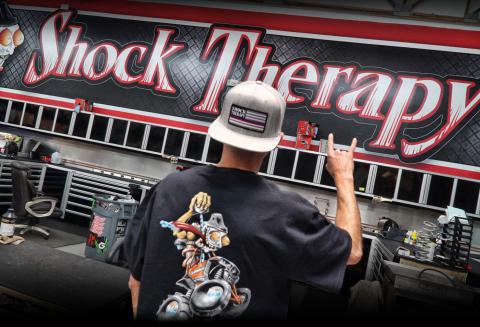
As he battled back, his wife, Jeanette, broke her back in a boating accident, leading to a serendipitous start to Smith’s current business, Shock Therapy LLC, in Phoenix, Arizona, a powerhouse suspension tuning and parts manufacturer that serves the surging UTV market.
“The way this company was started is that she could no longer ride in our UTV because it was too rough and abusive,” he said. “And so I took the shock knowledge from years before in race cars and pre-runners and put a set of Walker Evans shocks on a (Polaris RZR) 900, valved them and sprung them, and made many changes to try to make it super plush.”
It worked. Jeanette could ride again—and still does, 10 hours a day sometimes, even with 2 feet of titanium in her back.
The business name—Shock Therapy—is spot-on for the circumstances, though not planned.
“Actually, the name was just out of the blue, but after I mentioned it, it made perfect sense,” Smith said. “The operation (on his wife), and physically improving shocks.”
The two certainly go hand-in-hand for Shock Therapy. “I think with shocks you adjust rebound until it’s perfect,” Smith said. “In life you can rebound until you succeed.”
Explosive Growth
The modifications for his wife and other early developments took place in the Smiths’ three-car garage, the first official location of Shock Therapy for its formal start as a business in 2014. It has progressed to a complex of three buildings totaling 40,000 square feet, with 14 CNC machines and 60 employees.
The 50-year-old Smith admitted that as he rebounded into the shock and suspension business, there was no Nostradamus forecast.
“The last thing I did was take a look at UTVs and think, ‘That’s going to be the next gold mine,’” he said.
Rising from the ashes of his first company, Justin Smith has built a thriving UTV suspension parts business for Can-Am, Honda, Kawasaki, Polaris, Textron, and Yamaha vehicles.
And yet today’s UTV market is “insane,” allowing Shock Therapy to roughly double its gross sales every year to hit $20 million in 2020.
The company manufactures, sells, and services suspension parts and accessories for Can-Am, Honda, Kawasaki, Polaris, Textron, and Yamaha vehicles. Giving attention to the full suspension is necessary when you consider a well-traveled axiom of motorsports: Speed leads to weak points.
“You go faster because you can, then all of a sudden you break radius rods. Ah, we supply those,” Smith said. “Then, if you break the radius rod, the next thing in line is the tie rods go. Well, we supply those. And then the next thing, you destroy the rack and pinion because they’re not strong enough for the big wheels and tires and driving that hard, and we build rack and pinion.”
Today’s inventory of parts belies Smith’s motto of managing growth, but he did just that in Shock Therapy’s early days. “You have to hold back for the inevitable shakeup; 2008 is always in the back of my mind,” he said.
With that, he carries no debt. All equipment, vehicles, and inventory are paid for, which he acknowledged likely slowed the company’s growth, including the employee count, early on.
“But if everything went to hell in a handbasket tomorrow,” he said, “I’ve got $12 million of inventory that’s all paid for.”
Power of CNC
Shock Therapy’s 14 Mazak CNC machines—from a standard lathe to the seven-axis Integrex—perhaps best represent Smith’s unique dichotomy of bold restraint: He’s not afraid to invest, and yet every machine was purchased used, ranging from $30,000 to $250,000 for the Integrex.
“But we’re very, very careful about their past,” he said of the machines.
And, he has stuck with one brand for the similarity in parts and computer language. “Our employees can be trained on one and know how to run them all,” he said.
Justin Smith isn’t afraid to invest in equipment, as evidenced by Shock Therapy’s 14 Mazak CNC machines. Using one brand also helps simplify operations and reduce training.
He’s also found, as many others do with high-tech machinery, that he’s not using the Integrex to its full potential, and yet its automation allows production of simple parts without human intervention.
Its versatility is valuable, too. “It has parts going through it as simple as a spacer for a rod end to as complicated as a rack-and-pinion main body,” Smith said.
The CNCs have been vital because they eliminate the middleman in designing parts, and Shock Therapy now has more than 400 part numbers and 24 patents.
Smith conveyed the potential of in-house CNC work through the following story: He was on an airplane waiting for takeoff when he had an idea for a clevis, used to attach a rod end to a rack and pinion for adjustability. He sketched it on a drink napkin, took a picture with his phone, and sent it to his machinist.
“By the time I landed,” he said, “he had sent to my phone a CAD drawing of it, and we were making it that afternoon.”
Free Upgrades
Customers come to appreciate Smith’s proprietary information—“his special sauce”—gleaned through R&D, said Shayne Williams, a longtime customer of Smith’s from Peoria, Arizona. He raced for years but now prefers simply to ride his Can-Am Maverick X3 and custom-built sand rails.
Williams has accompanied Smith on the very long test days he puts in for new parts, “and it’s just brutal,” he said, laughing.
“He tears them apart until he can get them perfect, then tears them apart and makes them go bad the opposite way just to make sure,” Williams said, calling Smith a “geometry whiz. He spends an astronomical amount of time to be sure his stuff is the best that money can buy.”
Customers appreciate that Smith keeps that information—spring rates, valving, rate of oil—in-house, and uses it to develop the specific ride a customer seeks.
Shock Therapy’s development process is intense, with testing sessions that are “just brutal,” said one customer. This yields data used to dial in the exact ride desired.
Also valuable—and unusual—is that Shock Therapy, as it improves its products, upgrades customers’ parts for free.
“Who does that? Who calls their customers and says, ‘Let me rebuild it for free,’” Williams asked.
Retired from the fire service and riding a “play car”—a 2021 Polaris RZR Turbo S—in the desert west of Phoenix, John Huppertz has found great value in Shock Therapy’s services.
“I like to be aggressive in my riding, but I like a comfortable ride, too,” he said. “Once I had Shock Therapy revalve and respring my car, it made the ride a lot better, a lot more plush. I’m able to take bumps that if you hit before would be kind of jarring; now you just float over them.”
Huppertz, who chased for a Baja 1000 team in 2019 and will do so again in November, said Shock Therapy refines for the aftermarket the products that OEMs create for the masses.
It leads to the question for Smith: Why not just make your own shocks? “We could build our own shocks, but if we did we’d make enemies (of our partners),” he said.
Instead, Smith said his business is an ally to the shock—and UTV— manufacturers. “We are a business that makes them look better.”
Seeing the Future
UTV manufacturers already use ECU technology, intuitive controls that work on the fly, to affect the suspension. “You turn left it stiffens the right shock,” for example, Smith said.
He raved about Fox’s iQS (intelligent Quick Switch) electronically controlled suspension and what it did for the market. Advanced as it is, however, iQS now represents just the tip of the iceberg. “It doesn’t have to wait for sensors to tell it what to do,” he said. “It knows what’s coming.”
Such terrain-following technology to spot a whoop or potential full-compression “G-out” is not unlike automatic braking or lane departure warning systems in today’s street vehicles, Smith said, and it will further help make UTV rides “amazing.”
Justin Smith’s spring and shock work quickly revealed shortcomings in other components. He responded by developing better radius rods, tie rods, and rack-and-pinion units.
It’s no pipe dream, either, he said in announcing that Shock Therapy late this year will offer a phone app where riders can pay for a suspension tune, not unlike what can already be done for an engine tune.
“We’ve already done the work to make it ride better, but now they can buy the app and do everything on the fly and make it more ‘them,’” Smith said. “You can do it via Bluetooth when you get to where you’re riding. If you’re in the rocks, you put in your rock tune. If you’re in the dunes, you put in your dune tune. If you’re going to go racing or ripping with your buddies, you’ve got aggressive or desert fast.”
Opportunities Abound
Smith said no matter the racing business, new development is the secret to surviving, especially in uncertain economic times. “The opportunity is there for the grasping for those who continue to develop, test, and innovate new products,” he said.
As with other parts for competitive vehicles, suspension sales can be difficult until the customer experiences the advantage firsthand. “It’s hard to get someone to spend money on that magic box; they’re paying for air—until they ride in it,” Smith said. “As soon as their friends have it, or somebody beats them through the rough—then it’s over.”
So it’s still about speed, but perhaps not like it used to be for Smith. “You can put all the power into it you want,” he said about a vehicle, “but if you can’t stop, if you can’t go through the woods, if you can’t hook a corner, it’s pointless.”
What Resume?
–
Justin Smith wasn’t going to do it the same way this time.
“In the past, in all of my other businesses, I hired according to a resume and experience,” he said. “That failed.
“You hire the best guy, but if he’s a bad apple among 10 others—you have 10 other pissed-off guys,” he said. “It was a lot of babysitting.”
This time around, when founding Shock Therapy, he ignored resumes and hired personalities. “We chose the coolest guys we could find, the nicest people we could find, that got along with others, and then we just trained them,” he said.
Today he manages all 60 without an HR person.
Videos shot in the shop show a lot of energy and fun, plenty of ribbing. Passion.
“They all know how to talk smack,” Smith said, laughing. “But one thing they do know to take serious,” he quickly added, “is you pull your own weight, or you get called on it.”
Shock Therapy owner Justin Smith (not pictured) isn’t wowed by flashy resumes. Instead, he looks for prospective employees with good personal chemistry, then trains them as needed.
Shock Therapy’s website and social media exude energy. A slow-motion video of a UTV ripping through whoops is mesmerizing. Smith claimed he could watch it all day.
His unique approach has been successful in driving development through his employees. It’s not something one or two people can accomplish, he said.
“We’re nothing without our crew,” Smith said. “Our guys are badass, and they’re the reason we get things done every day, and get them done right.” —Andy Heintzelman
Affordability, competition, and technology are driving the segment’s popularity, and creating newfound opportunities for those who can provide meaningful race services.
Although it took some time for side-by-sides to earn their rightful place in motorsports, few can deny they’ve helped transform the off-road scene in recent years.
“Five years ago, they were basically considered beefed-up go-karts by the other classes,” said Justin Smith of Shock Therapy, Phoenix, Arizona. “But they got better so much quicker than I think anyone expected them to. Now it’s certainly the segment with the most growth, and typically the largest car counts wherever you go, whether that’s SCORE, Best In The Desert (BITD), or somewhere else. And it’s probably one of the most competitive classes, too.”
Increased manufacturer involvement has been a key factor in that competitiveness, but these factory-level efforts have also upped the ante in turn. “Back in the day, the UTV guys kind of had to band together because we really had no other choice,” explained Nate Martinez of Team Alba Racing, Santee, California. “SCORE and BITD obviously have a giant UTV following now. They have great turnout. But I also know that there are a lot of people out there who are having a hard time getting into the sport now because the factory involvement has significantly raised the costs required to be competitive.”
But as with any racing discipline, a bit of ingenuity can go a long way, even in the production stock classes. For those looking for inroads into side-by-side racing, the specialized needs of these platforms—and the rule sets they must adhere to—guide the demand for components and support.
Powertrain
While endurance-style desert racing formats continue to see strong interest, short-course UTV racing is becoming increasingly popular in various parts of the country. “I’ve noticed that a lot of the woods racers have transitioned into short-course recently,” said Alex Reed of CT Race Worx, Monroe, North Carolina. “I think a big factor there is the ability to be on TV, and the fact that you can run in front of fans who can see 90% of the track from one position. The format allows for a lot more visibility.”
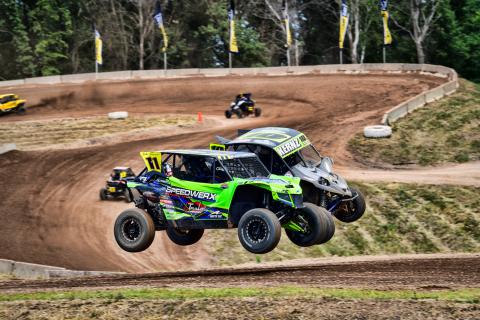
Side-by-sides have caught on big in recent years. They now tend to have the largest car counts at races like this AMSOIL Championship Off-Road event at Crandon International Raceway.
But the two formats tend to favor different tuning strategies when it comes to UTV powertrains and their continuously variable transmission (CVT) designs. “Whether you’re in a stock class or an unlimited class, everyone is running a CVT,” said Dustin Boyko of Trinity Racing, Huntington Beach, California. “The drive belts in these transmissions are designed to be the weakest link in the chain. It’s a lot less expensive to change a belt than it is to replace a transmission. The factory ones are typically made for engines that are making 100, maybe 120 horsepower, but the turbo models are making quite a bit more than that now, so the belts needed to get better. Ours use different rubber compounds and different internal cords that allow enough slip to prevent failures but provide enough traction to efficiently put the power down. Those compounds and cords also prevent the belt from retaining too much heat, which can lead to a belt failure. If you have a belt failure, you’re dead in the water. I carry two spare belts with me all the time, just in case. You never know, and you don’t want to be stranded.”
While CVT belts are designed to be a sacrificial component in the driveline, a belt failure in the middle of an event can ruin a team’s race, so finding a balance between performance and durability is crucial. Smith told us that clutch kits play a key role in that.
“The clutches are an item that everyone spends time on,” he explained. “Making sure that your clutch tuning is dialed in is hugely important, because if it’s not, you’re going to blow a belt. And I think that the durability of those belts really has more to do with clutching than the design of the belt itself. These belts are designed to handle 600 horsepower. What it really comes down to is whether or not the vehicle is tuned properly to keep heat out of the belt at an acceptable level. Heat kills those belts, and the only way you really get heat in the belt is from incorrect clutching.”
Reed said that improved clutching can also yield significant performance increases with no other changes. “For example, with the 2020 Maverick X3, Can-Am made some significant changes—a different engine with more power, and different clutching. If you change just the clutch kit on one of those cars, it will show an increase of 10 horsepower on the dyno. So you can over-work the belt and make more power if that’s the goal, but with that comes more heat.”
Short-course racing is increasingly popular for UTV competitors. Races like this AMSOIL Championship Off-Road event in Minnesota allow greater visibility for fans, and are sometimes televised.
That’s where things get interesting: An aggressive tune makes more power but will shorten the belt’s longevity, while a conservative tune improves durability. Which approach makes the most sense often comes down to race format. “It’s about making sure it lives for that race,” Reed said. “A short-course guy might run for 10 minutes, but the desert guy is running for 10 hours. So the priorities are different.”
And as Smith pointed out, the transmission tends to be the focal point in UTV powertrain tuning because of the limited amount of changes to the engine that are typically allowed outside of unlimited classes. “With a class like Pro Turbo, you’re using a factory crate engine that’s sealed. The only things you’re allowed to do are injectors and an ECU flash. But that’s also the only thing you really need. Our Can-Am makes 330 horsepower to the crank with just a flash and bigger injectors on an otherwise stock engine.”
Chassis and Suspension
As with most off-road racing disciplines, breaking parts is more or less unavoidable in UTV racing, particularly chassis components. “You’re smashing into rocks constantly out on course,” Boyko noted. “So wheels and tires take a lot of damage and need to be replaced often.”
Martinez said that abuse tends to drive racers toward multi-piece wheel designs. “The wheel market is big. Wheels are getting damaged left and right in this kind of racing. I think that having a good three-piece wheel is a huge benefit to a racer because they can replace individual parts of the wheel as needed rather than the entire thing. If you damage a cast wheel you don’t really have any choice but to replace it.”
The beating doesn’t stop at the wheels themselves. Parts like A-arms, ball joints, tie rods and axles are also in demand. “Racers are upgrading to long-travel boxed-arm systems, they’re stepping up to big CVs and axles, and they’re moving to big billet hubs with big bearings,” said Smith. “The most amount of money is being spent on getting components not to break.”
According to our source at Trinity Racing, drivetrains can be a challenge in UTV race prep. “The drive belts in these transmissions are designed to be the weakest link in the chain,” he noted.
Reed said that it’s really a matter of moving well beyond the expected use-case of these machines. “A lot of stock components just aren’t going to take the abuse that these cars go through. Control arms tend to be a weak point, so we jump to a thicker wall material and use chromoly to get the most strength out of the part with the least amount of weight.”
With limited drivetrain modifications allowed, UTV racers largely focus on chassis tuning to maximize performance. “Not many people are leaving their suspensions stock and going out racing these days. It just won’t be competitive,” said Smith. “In the stock classes, most guys go for a spring kit and shock valving, and hopefully they’re working with someone who has some experience on the motorsport side of things, someone who understands car setup. But the guys that are super-fast are spending a lot more time on it. They’re working with shock specialists to tune their setups at every single race. Two weeks before the race they’re verifying what they have, or they’re making changes from the last race to hone in on it. The fast half of the upper-tier racers are constantly tuning their cars with specialists. They’re spending the same amount of time on that suspension tune as the Trophy Truck guys are.”
Yet as the capability of these vehicles continues to evolve, the stakes are being raised in turn. “As these cars get faster, safety is being scrutinized more and more,” said Martinez. “I think there are very few manufacturers of aftermarket roll cages that have any sort of roll-over protection certification right now.”
The Road Ahead
While the horsepower levels are now starting to plateau after years of significant increases, the evolution of UTV racing is far from over. “The progression of power is starting to calm down a bit,” said Reed. “I think the fight now is for durability, and the transmission is a big part of that. Belts continue to be an issue, so I think the next big change is going to be moving away from belts entirely. I wouldn’t be surprised if the next big, bad vehicle from Polaris or Can-Am came with a dual-clutch transmission rather than a CVT.”
He also expects to see more manufacturers lean toward vehicle offerings with a semblance of race tuning, but only to a manageable degree.
“I think it’s about refinement at this point: The differentials are going to get more durable, driveshafts are going to be stronger, axles are going to be beefed up. People are running King of the Hammers on 35-inch tires with these things. The spindles, hubs and bearings were never designed to have that much mass and leverage on those components. But while these manufacturers built their cars with racing in mind because that’s a key marketing element for them, they can’t build race-specific vehicles. They need to be able to sell these vehicles to a wider audience,” Reed added.
Meanwhile, Smith sees big improvements coming on the technological side of the suspension systems, “things like live valve shock systems and terrain-following adaptive systems. Whoever can get behind the tech side of things is going to have a major advantage. It requires a major investment, but it’s where things are going. I think that might be difficult for some of the smaller UTV businesses to do, but I could imagine a larger company like Holley Performance venturing into that space.
Along with short-course, UTVs have also gained popularity in endurance-style desert events, like the Mint 400. And though the cars look similar, their prep is quite different.
“Communications are also hugely important,” Smith continued. “Radios are a constant source of frustration for teams in endurance races due to range limits caused by the terrain. But satellite systems are getting more affordable every day, and an always-on connection can be the difference between a win and a DNF. For example, at the SCORE San Felipe 250, I think our satellite system was a crucial factor in our win. It’s an extremely rough race, and you do have to save the car to a degree. We had two or three close competitors, but rather than trying to over-drive them and break the car because we were unsure of where they were, our team was able to track their progress and could communicate that to me in the car so I could conserve it when their pace slowed down. After the race was over, the front differential went out while we were putting the car on the trailer.”
Regardless of what the future brings, one thing everyone can agree on is that the UTV craze shows no signs of slowing down. “For the most part I think that the ‘race on Sunday, sell on Monday’ philosophy remains true here,” said Martinez. “Granted, having that racer there to do part promotion and show that it works is very important, but the typical UTV buyer is still where the money is for these companies. Annual UTV sales are going great, and they’re only getting higher and higher. Right now, product availability is the biggest problem for most of these manufacturers.”
Despite the loss of a prominent series, the short-course off-road racing community is expanding with new opportunities for pro, sportsman and young racers alike.
Lucas Oil’s announcement last November that it was discontinuing its off-road racing series certainly wasn’t welcome news to its competitors or the off-road racing community at large. Faced with mounting financial strain because of the pandemic and continued uncertainty about what lay ahead, the series called it quits after 12 seasons. During that time it made a significant mark in racing, playing host to some of the biggest names in off-road motorsports and helping to develop the talents of a number of young drivers along the way.
As the Greek philosopher Heraclitus once pointed out, the only constant in life is change. But racers tend to be a resilient bunch, and in the time since Lucas Oil’s withdrawal, several series across the country have stepped up to not only fill the gaps, but also assess what worked in the Lucas Oil series and what needed a bit of tweaking.
“I’ve been involved in the sport for more than 40 years, so I’ve seen sanctioning bodies come and go,” said Frank DeAngelo of AMSOIL Championship Off-Road, Albertville, Minnesota. “Lucas Oil announced that they were done last year, but it was also the first year for Championship Off-Road. It was born from a group of tracks in the Midwest that wanted to see short-course racing continue but needed a sanctioning body. I realized there was a need for some changes in order to stabilize things and ensure the growth of the sport in the years ahead.”
It’s a sentiment that’s shared among these organizations that takes into consideration the needs of pro, sportsman, and youth competitors alike, and it points toward a more unified strategy moving forward.
Building Momentum
Lee Perfect originally helped to develop the Lucas Oil series and now serves as director for the Great American Shortcourse (GAS) series based out of Temecula, California. Perfect said that key areas for future growth of the sport are evident today and based on interest that flourishes outside of top-tier classes.
“The regional series has always been about grassroots racing and providing more track time for everybody, and the youth classes are solid,” Perfect explained. “We’ve got three classes for the trophy karts and another for the RZR 170, and these kids are getting started as early as six years old. The other area that’s seeing a huge amount of interest are the UTVs. That’s been the big industry for the last few years, and we expect that to continue. At GAS, we have five different UTV classes now between Youth, Production 1000, Production Turbo, the Unlimited class, and the SR1 spec class, the latter of which uses a Yamaha R1 street bike engine and is about the fastest you can go for the least amount of money.”
Short-course off-road racing is hugely popular, although it was left scrambling after Lucas Oil’s abrupt departure. In its wake have risen new series, however, such as AMSOIL Championship Off-Road.
Laura Butcher of the Valley Off Road Racing Association in Elk Grove, California, agreed that a strong grassroots foundation is the key to growth not only in the short-course format, but off-road racing in general. “We want to see the kids out there. That’s the future of our sport, so there’s a big focus on keeping this affordable and accessible to families. And UTVs are absolutely booming. Production 1000 is one of our biggest classes. Being able to walk into a dealership, finance one, and prep it for racing with safety equipment for just a few thousand more is a real game-changer. Short-course is great for newer racers because there’s never going to be a situation where you’re stranded out in the middle of the desert, but it’s also a very exciting environment. You can hear the crowd go wild when something happens. And the fans and sponsors love it because they can see the entire track and follow the action throughout the race.”
Lori Wilson of Glen Helen Raceway in San Bernardino, California, said that approachability and affordability are major drivers in the enduring appeal of the short-course off-road format. “We charge these folks a very minimal fee, and the rules aren’t overbearing. Somebody can buy a UTV, a quad, or trophy kart without any racing experience and get involved with minimal expense and lots of track time.”
But Perfect noted that he also didn’t want to leave anyone from the Lucas Oil national and regional series behind with the Great American Shortcourse series. “When they abruptly pulled the plug, it kind of left a void,” he said. “So we have some mini-stock and some other classes there to provide a spot for people who want to show up and run what they’ve got. Then we get into the Pro Buggy, Pro Lite, and Pro 2 classes. Championship Off-Road provides a class where the Pro 4 racers can run out there, too.”
He also explained that the purpose-built nature of many of these vehicles would have left competitors effectively stranded if series like GAS and Championship Off-Road hadn’t picked up where Lucas Oil left off.
Race organizers are taking advantage of the sport’s recent shakeup to reconsider rules and classes. “We wanted to set up our rules so that everyone could play,” said our source at Championship Off-Road.
“From the little trophy karts all the way up to Pro Buggy, Pro Lite, and Pro 2 classes, these teams don’t have another avenue for racing aside from these groomed short-course tracks, and they didn’t have anywhere to run on the West Coast until our series was established,” Perfect said. “My phone started ringing the same day Lucas made the announcement, and fortunately I had almost all of the equipment already on my property—scales, trucks, trailers, and basically all the other equipment we needed to run the series. It took a little while to get our ducks in a row and make a deal with Lucas—there was a lot to sort out along the way—and COVID certainly didn’t help expedite the process. But we had 138 at our first race, which was right around what we expected, and then we had 150 at our second race.”
Along with big car counts in UTV classes like Pro Stock and Pro Modified, DeAngelo cites Pro 2 and Pro Lite as the classes with strong support at the upper end of the totem pole for Championship Off-Road this season. “Pro Spec is also something brand new for this year,” he explained. “It’s similar to the Pro Lite class but uses a spec powertrain that cuts down the costs to field a truck tremendously. Manufacturers have also come on board to post prize money for that class.”
Don Demeny of Dirt City Motorplex in Lena, Wisconsin, said that the loss of the Lucas Oil series has been something of a blessing in disguise for permanent off-road race tracks like Dirt City. “I hate to say it, but it’s been good news for us because it’s sending these racers our way, and we’re happy to have them. The growth of Pro 2 over the past few seasons has been particularly exciting for us, and this year we’re expecting double what we had last year.”
Refining The Formula
While ensuring that racers from the various classes in the Lucas Oil Off-Road Racing Series have new places to race has taken priority for Championship Off-Road and Great American Shortcourse, this restructuring process has also provided an opportunity to consider new approaches to the ways in which the sanctioning bodies operate.
“We picked up the same rules, most of the same equipment, and a lot of the same staff from the Lucas series, but we wanted to kind of change the attitude and receptiveness to some of the racers,” said Perfect. “We’re trying to learn from some of the things that have happened in the past, both good and bad.”
Some insiders told us the departure of the Lucas Oil Off Road Racing Series has been a boon to permanent tracks. “It’s been good news for us because it’s sending these racers our way,” noted our source at Dirt City Motorplex.
DeAngelo said that the rule set that Championship Off-Road has been using wasn’t far off from the Lucas Oil series to begin with. “That was by design, to a degree. But we also wanted to set up our rules so that everyone could play. For example, there was a situation where Lucas Oil had switched over to a specific cubic-inch engine, and that was the max you could have. We wanted to be a little more accommodating, so for the teams that have the older engine packages, we offered a way to continue racing that with restrictors. The general rules that have been in place for many years have been adopted, but we also made allowances to provide a way for everyone to come race.”
Great American Shortcourse has adopted similar balance-of-performance measures to achieve parity between the different engine packages in use in its Pro Lite and Pro 2 classes as well.
Another important recent change for Championship Off-Road was the switch from specially developed race tires used in some of the Pro classes to off-the-shelf DOT rubber. “There were only a couple of companies that were offering race tires,” said DeAngelo. “So last year we came out and said, ‘No race tires—everything has to be a DOT light-truck tire.’ This year we’ve had six tire companies sign on to sponsor the series and racers.” GAS has also adopted similar DOT tire rules.
Although GAS and Championship Off-Road are taking a somewhat coordinated approach in terms of rule sets and event scheduling, Perfect noted that they generally tend to attract different types of racers. “The idea for us is, if you’ve got a race car on the West Coast that raced with Lucas before, we’re going to have a place for you to race out here. Championship Off-Road is a bit more involved, in terms of both time and money. They run every two weeks or so from June until Labor Day. So for the racers out here that wanted to run in that series, they would either be constantly traveling back and forth, or they’d need to get shop space out there. As we were putting things together, the majority of the folks who showed interest in our series didn’t want to do that.”
Sanctioning bodies are working to develop a unified, inclusive strategy for the sport, with plenty of room for young competitors and grassroots efforts. Photo courtesy of Championship Off-Road.
Wilson said that it largely comes down to location and commitment levels for most teams. “The guys who are local will support the Great American Shortcourse series. But since there are fewer dates on the calendar, the bigger teams that want to keep their cars going are generally still back East,” he explained.
Making Inroads
As with any motorsports discipline, sponsorships are a crucial part of the equation for short-course off-road racing. Demeny suggested that would-be sponsors are better served by starting out with a team rather than going directly to the tracks.
“There are companies out there that are interested in getting involved, but maybe they’re not ready to make a full investment,” he explained. “I think sponsoring something like a sportsman truck is a good way to get your feet wet. And products—everybody needs products. It doesn’t need to be cash. Something like motor oil is basically as good as cash, because these racers are going to need to buy it anyway. Consumables will be valuable. We have more tire companies involved now than we’ve had in many, many years.”
And with more classes adopting production or spec-style engine rules across the board, suspension tuning is becoming a bigger competitive element. “Looking at something like Pro Lites, the guy who knows how to tune that suspension is going to have an advantage,” Demeny added. “On short courses it’s not always about horsepower.”
For those looking to get involved on the chassis building and tuning side of things, BJ Butcher of VORRA advised attending some events before diving into development. “Talk to the racers and crew chiefs about what you should and should not be doing, and take notes,” he said. “The community is a great resource for that. These teams are going to be receptive and more than happy to help you out.”
Mint 400 Adds EV Truck Class For 2021
–
One of the biggest off-road races in motorsports just got bigger with the addition of the nation’s first dedicated electric vehicle (EV) class. EV racers can now join the 550-plus teams taking part in this year’s Mint 400, set for December 1–5, in the Nevada desert, just outside of Las Vegas. The new class comes in response to requests from EV truck manufacturers and owners, according to Mint 400 CEO Matt Martelli.
“EV cars have been rapidly evolving, and off-road racing has always been a proving ground for new technology,” Martelli said. “We were contacted by several groups of EV makers and owners, so we made the announcement public [in early March] so the industry understood we welcome them to come and verify their cars. If you have an EV vehicle that can go 400 miles off-road, then you know it can do that mileage on the road.”
Following the lead of Extreme E (seen here), the Mint 400 will add an electric-vehicle class to its December event. “Off-road racing has always been a proving ground for new technology,” said our source at Mint 400.
An ultimate-test environment, the Mint 400 is a four-lap race with pits every 30 miles, allowing EV teams to recharge or change batteries mid-race. “We expect teams to start with one or two laps before pitting, but as battery storage technology gets better, they could eventually make it all four laps,” Martelli said.
Teams that opt to charge their batteries would get their time back on their overall score, like their internal combustion engine (ICE) counterparts. “The advantage of the Mint 400 is racers can refuel as frequently as they need to—they could refuel three times in a lap if necessary—so we’re lumping EV into fueling, whether it’s fast-charging or swapping batteries out,” Martelli said.
Safety is a priority, too, as race officials will implement battery-specific extinguishing systems and safety procedures.
Although participating EV makers and teams were not confirmed at press time, Martelli said there was significant interest from ICE competitors. “On the independent racer side, I’ve probably had 50 calls with racers who are going to buy EV drivetrain systems and build their own vehicle. So, the announcement sparked a lot of curiosity and interest with people.”
Looking ahead, officials are exploring adding separate EV classes based on chassis style and design following the 2021 event. And, who knows, an EV team may take the podium this year, as Martelli pointed out, “From a torque perspective, EV’s immediate torque is superior to what we have now, so EV teams are definitely in contention to score the overall winner of the race.” —Laura Pitts
The raw materials shortages in motorsports are real, but companies are finding ways to adapt.
We live in interesting times, to say the least. There’s no need to re-hash the pandemic of 2020 and whether the responses from governments around the world were correct or not. The memories are all too fresh, and in many places restrictions have not yet been fully lifted. The slow-motion car crash that is the world economy is still tumbling down the highway, leaving a trail of debris in its wake.
For the motorsports industry, the outlook is mixed. The racing calendar is full once more, and fans are back in the stands, but one of the biggest pandemic hangovers is an acute raw materials shortage that has stifled recovery efforts. Demand is high, supply is low, and companies are scrambling to secure enough materials to manufacture parts and keep racers in business.
Of course, this isn’t a problem unique to the racing world. Raw materials shortages are popping up everywhere. “We have found most customers to be very understanding of the situation, as they are facing it in all areas of their lives,” said Chris Douglas of Edelbrock Group, Olive Branch, Mississippi. “Whether it’s lumber, patio furniture, outdoor equipment or other goods, consumers are seeing significant shortages and fulfillment delays. These challenges started during the pandemic but have continued as supply chains try to catch up with an extraordinary surge in demand coupled with workforce challenges around the world.”
In speaking with several manufacturers, fabricators, and metal suppliers for this article, we found out some sectors have been hit harder by shortages than others. “It’s been very rough with mild steel and chromoly in sizes that are most popular for roll bars and roll cages,” said Jill Fazekas with S&W Race Cars and Components, Spring City, Pennsylvania. “It’s been very sporadic with everything else, but in the most popular sizes it’s been a very long wait. We just recently received eight bundles of chromoly, 1 5/8- x .083-inch wall, and we’ve been waiting over two months for that.”
The pandemic has caused shortages in many different materials, especially steel. “It’s been very rough…” said our source at S&W Race Cars and Components.
TW Metals in Exton, Pennsylvania, is a specialty metals supplier for motorsports, aerospace, marine, oil and gas, and other industries, and has a ground-level view of which shortages are hitting the motorsports industry the hardest. “Currently there are three product categories that are the most affected: 4130 tubing, stainless steel tubing, and all forms of aluminum,” said Keith Cookson. “The metals industry was hit head-on with high demand coming off a challenging year and has been trying to correct itself from the disruption of COVID-19.”
He added, “All parts are seeing some type of shortages, but it seems chassis builders and exhaust manufacturers are some of the most affected.”
The Edelbrock Group’s various brands cover a wide cross-section of the industry, from manifolds and cylinder heads to electronics, hoses and lines. “Our most challenged materials are in the metals,” said Dan McKinstry. “There is limited capacity at foundries for casted iron products. Aluminum suppliers are also struggling to keep up with demand, and the cost of aluminum has increased significantly over the last 12 months. We are also beginning to experience pressure on copper-based products used in our electronics portfolio.”
Follow the Parts
To understand how a shortage of a particular raw material can echo through the industry, it helps to look at a commonplace example of the supply chain in motorsports. Tom Lieb at Scat Enterprises in Redondo Beach, California, a manufacturer of crankshafts, connecting rods and rotating assemblies, among other products, gave us a look at all the moving parts it takes to deliver a finished part to the racer.
“Our raw material is billet material for billet cranks, round bar, and then forgings and castings for the other,” Lieb explained. “The round bar we buy here in the United States is from Timken in Canton, Ohio. As far as the forgings and castings, we buy those from China. We do have raw material available, but the big problem is the logistics. In other words, the manufacturer makes it, but it’s 7,000 miles away. So the challenge is to get it from there to here. The whole logistics, the shipping, not only internally in the United States but also overseas, is turned upside down. The lead times are more affected by the shipping than they are anything else.
Many manufacturers depend on complex, vulnerable supply chains with long lead times. Logistics in particular have been “turned upside down,” explained our source at Scat Enterprises.
“In our case, we buy from a steel mill, we ship it to a forging or casting house in China. That’s done, and then at that point we either bring in a raw forging straight from the forging factory or it goes to a machining facility where they do some partial machining, then it comes here,” Lieb continued. “And so the problem is, we actually operate six to eight months ahead of time. In other words, our pipeline now [in June] is being loaded for November or December of this year.
“When the pandemic hit, we had product in all this pipeline. We had product on the shelf that was ready to be shipped, we had work in process that was in the shop being worked on, and then we had raw material that was in the warehouse that would go into the shop as the work orders were written. And then we had material that was onboard a ship that was somewhere on the high seas. And we had product that was in inventory in China that was finished and ready for shipment or getting ready to be shipped. And then we had work in process, and steel mill orders, and things like that. So this whole pipeline, every day, moves.”
Until it didn’t. “The shutdown in China kept anything from getting on board the ships,” Lieb said. “And then when ships did arrive here, the harbor was locked down and they were not unloading. Of course, here, we never shut down. We do some stuff that’s critical,” he concluded.
And so it goes throughout the industry. If any particular link in the chain is disrupted, it can affect multiple products down the line. “Container imbalances have increased lead times out of China, further contributing to our shortages,” said Edelbrock’s McKinstry. “We have increased orders to our Asian suppliers to fill the pipeline and compensate for extended lead times. However, we are now finding that Asian manufacturing sites are operating at high utilizations, limiting our ability to increase the pipeline.”
Shortages can arise in unexpected ways. “Tubing hasn’t been an issue,” noted our source at Ultimate Headers. “Probably the biggest part has been header bolts and gaskets.”
“We’re actually a link in that supply chain to chassis builders, so we’re not only filling the orders to our direct customers, but to those folks as well,” said S&W’s Fazekas. “It’s been tough, because the tubing we do receive, we’re earmarking it for making our products, to keep our products getting out to our customers. So other customers who just want to buy an 8-foot length of tubing, or a full-length of tubing, or 4 feet of tubing for whatever project they’re working on, we had to suspend those sales and discontinue offering that until we get all of our backorders filled. As you have to understand, we’ve had so many backorders on the roll bars, roll cages, and chassis kits, now that we’re finally having the material show up, we’re just using every piece to fill those backorders. The lost tubing sales have really had a significant negative impact on our cash flow.”
Much of the industry has found itself stuck in a perpetual “catch-up” cycle. “Now the problem is, the warehouses are empty,” Scat’s Lieb said. “The manufacturing cycle is trying to make up for all of these gaps that were generated by non-working, and so the reality of that is, we’re going crazy trying to get product to the customer. Our production rates are up 30% to 40% over last year. But it’s not sustainable, because we’re not only taking care of demand, people who are standing there with money in hand waiting to buy a crankshaft, but we’re also, on top of that, replenishing the inventory that the customer has run out of. We’ve got a double whammy. We ship parts to them; they don’t go on the shelves. They turn around and they’re shipped off to their customer. Their shelves are still empty.”
Even for businesses that planned well to maintain their primary products and have been able to stay a step ahead of the shortages, the lack of peripheral items can still trip things up.
“We have survived through it with some careful planning. Tubing hasn’t been an issue,” said Jim Browning with Ultimate Headers, Berea, Ohio. “We buy our 321 stainless in a master coil. When they make that coil that’s all for us, and we get thousands, and thousands, and thousands of feet out of it. We’ve been good on tubing, and careful planning has kept us going without any shortages. Probably the biggest part has been header bolts and gaskets. Some of what you would think are kind of basic things have been tough.”
The Human Element
Nearly every source we spoke to mentioned one particular raw material that was in short supply: human labor. The reasons why “help wanted” signs are getting ignored vary, but most can likely be attributed to a combination of expanded unemployment benefits during the pandemic, worker hesitation to return to potentially infected workplaces, or even, for a not-insignificant number of people, a reassessment of life goals after experiencing extended free time during the shutdowns.
Whatever the reason, the lack of available labor is putting a severe crimp in the supply chain. “What makes this shortage unique compared to other years is most vendors’ inability to respond to increased demands, and labor shortages across all manufacturing categories has limited suppliers’ ability to respond to increased demands,” said McKinstry with Edelbrock Group. “On almost every call with my vendors concerning shortages and delays, the single most contributing factor to these shortages is labor constraints. Going into the pandemic, many of our vendors’ facilities were already operating at high utilizations due to a high demand from a strong economy. Extended plant shutdowns with continued strong demand created large backlogs and additional pressure on already capacity-constrained facilities. As state restrictions eased, plants struggled to get their workforces back. Many of our vendors looking to increase capacity by increasing shifts found it difficult to hire people to fill the open positions.”
A scarcity of workers is at the root of many disruptions. “The single most contributing factor to these shortages is labor constraints,” said our source at Edelbrock.
That labor shortage is one more brake on an industry that is ready to operate at full throttle. “Our customers have been extremely understanding, because it didn’t take long for the word to get out to people,” S&W’s Fazekas said. “They understand there’s a shortage. And not just a shortage, but also in the delivery. Some of our suppliers are saying, ‘Yeah, we have it, but we don’t have the staff to load our trucks to get it to you because of the issues with staffing at different companies.’”
Adapt and Overcome
If the materials and labor shortages are frustrating, they are also forcing companies to be nimble. There are ways to improvise and innovate, and the companies we spoke with are not standing still as passive victims.
“One of the things that’s happened, which is interesting, is that we have inventory that we consider to be C and D movers, like pistons that are .060-over when everybody buys .030-over,” said Scat’s Lieb. “Well, if a guy really needs a part, our sales department has said, ‘I know you want .030-over, but we do have a set of .040s.’ And the guy knows he can’t get anything else, and he’ll buy them. So it’s been a help to us to get rid of some inventory that is not prime.”
S&W Race Cars & Components has taken a similar path in offering alternatives. “What we’re doing whenever possible is offering an upgrade. We’ve been able to do that on a couple different things, like in the roll cage material,” Fazekas said. “If they, for example, wanted mild steel 1.625-inch x .134-inch tubing, we upgraded them to a different tubing, 1.75-inch x .134-inch mild steel roll cage tubing at no extra charge. It was a swap to something we had in stock that still met spec, and it was a little bit of an upgrade.” She noted that the high-demand 1.625-inch x .134-inch-wall mild steel tubing bundles finally did arrive two weeks before our interview after a 20-week wait, and the 1.625-inch x .083-inch chromoly tubing bundles arrived at the end of June after a 23-week wait.
Remembering who your friends are has also been important during this rough patch. “Partnerships are critical in times like these,” said TW Metals’ Cookson. “We’ve resourced well with our suppliers and have made additional investments in personnel to do all we can to stay ahead of demand.”
A defensive mindset and not being too quick to expand into new markets, tempting as they may be, is another way businesses are rolling with the punches. “I’m always looking and keeping my ears open to what’s happening, what makes the best sense for us as a company, and to best serve our customers,” said Ultimate Headers’ Browning. “We could go down a path and do a bunch of stuff and then really put ourselves in a position where we can’t ship, and then that doesn’t help anybody. We’re just being very careful in what we do and why we do it.”
Pandemic-induced shortages are common in all sectors, so most people have come to accept them. “Customers are understandably concerned, but patient,” reported our source from TW Metals.
Marketing plans by necessity have had to be adjusted as companies moved to adapt. “For the last 10 months we have been focused on creating marketing plans around our inventory position more so than strategically promoting new products or growth categories,” said Edelbrock’s Douglas. He also noted that current conditions have offered a good opportunity to double-down on quality control. “We have been extremely focused on making sure that we don’t allow quality to slip during these challenging times. In fact, we have recently recertified our ISO quality rating and are in the process of implementing even more rigorous quality systems.”
Even so, for a company that services as many market segments as Edelbrock Group, the search for raw materials requires constant vigilance. “We’ve had to continuously pursue alternate sourcing, both domestic and abroad, to secure quality materials and components to service our backlog of orders,” Douglas said. “Candidly, it is the most challenging supply environment that I have ever experienced in my career, and we are having to be extremely resourceful and nimble to find materials. Unfortunately, the material shortages are also leading to significant material cost increases, and consumers will continue to deal with inflation for the foreseeable future.”
There will be other challenges to address in the near future that companies should be thinking about now. How will last year’s brief racing season, and this year’s shortened one, affect demand in the coming months?
“The build season for racing was real, but once they got the cars built and they weren’t running, everything just stopped,” Scat’s Lieb said. “It’s going to be interesting to see how the season pans out, now that things are beginning to open up.” But, he added, “the season has been cut short, so how’s the maintenance side of the business going to happen? They haven’t got a full season on their stuff, so they’re not breaking. Are they going to go through a normal rebuild, or are they going to say, ‘Gee, we only raced three times last year. We’ll change the oil and let it sit and we’ll go race again. We don’t need to build a new engine or re-do the race car.’ That’s still yet to happen, but I suspect that not everybody’s going to run a full season, which means they’re not going to spend money on building new stuff or rebuilding existing stuff in the same manner that they would have a few years back.”
Customer Expectations
According to our sources, most customers are taking the shortages in stride. “They hear it from every vendor. What I tell them isn’t anything they haven’t heard from somebody else,” said Ultimate Headers’ Browning.
That said, clear communication is essential to retaining a customer base. “You deal with it in two ways,” said Lieb. “First, you tell them the truth. And second, if you have an alternative, you tell ’em and let them make a decision. Probably 50% or 60% of the time when you give them an alternative, if it fits within their realm, they’ll go with the alternative. So you salvage the sale. The key to the whole thing is communication.”
Fazekas at S&W reports most people have been very understanding during the shortages, although some explanations are easier than others. “It’s hard to explain to some of our customers, ‘Yeah, your whole kit is complete but we’re waiting for these vendor-supplied components.’ And that’s where they get a little antsy,” she said. Besides keeping retail customers satisfied, there are also dealer expectations to manage. “We try very hard to be fair to everybody, between our retail customers and our dealer network,” Fazekas said. “There’s no favoritism there, because we figure that’s just the only way to keep this fair. So they get put into order just like our regular retail customers do, as far as when the order was placed, and when the material comes in, they get filled. Everybody has been very understanding about that, and we’ve had no issues whatsoever.”
A “we’re all in this together” mindset is still prevalent in the racing industry, softening some of the potential sharp edges brought about by shortages. “Customers are understandably concerned, but patient as the supply chain works its way through these issues,” said TW Metals’ Cookson. “TW has also expanded our web portal to help service our customer base around the clock. Communication has been key, keeping our customer base informed of all challenges and working closely with them in non-traditional ways to minimize the effect on both ends.”
“As far as attrition, with people saying, ‘Cancel my order,’ because they just couldn’t wait any longer, there have been a handful of those folks,” acknowledged Fazekas. “They weren’t angry at us or anything. They just needed to find a different source, they were able to find a different source, or they just decided to bag their project or whatever it may be. No hard feelings or anything, we’re victims of circumstance, all of us.”
The namesake of this one-of-a-kind North Carolina operation takes us inside the vault and reveals the untold stories of preserving vintage race cars, supplying race props to the TV and film industry, and even non-profit work that gives American military personnel an opportunity to find out what it’s like on a pit crew.
Bill Rhine is an inspiring success story from the American business and racing community. A native of South Florida, Rhine entered motorsports in the 1990s on the very bottom rung as a rookie crew member with a team competing in NASCAR. Pursuing his dream of working on a professional NASCAR team, Rhine followed the path from Florida to Georgia to South Carolina and finally North Carolina. After honing his mechanical skills and earning greater team responsibility, Rhine later joined Petty Enterprises as fourth-generation driver Adam Petty was moving into NASCAR Busch Grand National competition. Petty lost his life on May 12, 2000, in a crash at New Hampshire Motor Speedway. Amid his grief, Rhine stepped away from team involvement and forged a new path as a self-employed business owner.
Twenty-one years later, Rhine Enterprise is regarded as a premier resource in the restoration and preservation of vintage race cars, having overseen more than 100 such projects. Located in Denver, North Carolina, Rhine and his small crew have accomplished big things, including building and preparing racing machines for various television and film productions. A keen researcher, Rhine proudly displays his amazing collection of vintage racing iron, a collection that offers priceless insights into a rich, earlier era. Rhine Enterprise has also played a key role in the preparation and maintenance of show cars for various entities through the years.
Rhine can best be described with a combination of the phrases “hard knocks” and “old school.” He runs his business today with a flip phone—don’t bother asking about text messaging—and a steady combination of work, sweat and worry. Rhine has survived the hair-raising highs and lows of business ownership amid the ebb and flow of more than two decades of economic cycles. PRI recently visited with Rhine to tap into his honest and straightforward view of life as a small business owner.
PRI: Let’s begin by talking about Rhine Enterprise, Bill. Give us a look at the various work you and your crew are involved in.
Rhine: We do just about everything, really. Our favorite thing to do is restore vintage stock cars. We are considered the world leader in vintage race car restoration, of the NASCAR variety. We also like vintage Can-Am, we like vintage Trans Am, and we’ve restored some of those cars in the past. We also handle Toyota’s entire NASCAR show car program, and the building of some of their custom projects. We do custom builds for the NASCAR Hall of Fame, and different amusement things. Sometimes we get involved in unique projects, so it’s many things.
We’re trying to ramp back up a little bit after COVID. Pre-COVID, we had four people in the shop and one in the office, with two on the evenings and weekends shift. We’re down to two in the shop, two in the evenings, and one in the office. We’re trying to get back to those levels, and we’re trying to find help. We’re like everybody else.
PRI: You experienced a unique series of circumstances that led to you becoming a business owner. What do you remember most about the genesis of Rhine Enterprise?
Rhine: After Adam Petty passed away [in 2000], I decided to get out of racing. When I started working for Adam and at the Richard Petty Driving Experience, that was Adam’s rookie year in the Busch series. We worked out of a building in the back of the Richard Petty Driving Experience, and I watched them build show cars for different clients. I remember looking at various show cars at that time and thinking, “For the money these customers are paying, I could build a much nicer product and make good money.” So that’s how we started; we went after the show car business. The goal was to build a nicer piece than everybody else for roughly the same money. The margins would be a little tighter, but the goal was to get more work. It worked out really well for us and grew and grew and grew.
PRI: Here we are 21 years later. Could you have envisioned the pathway you and your company have traveled?
Rhine: No, not really. And I don’t say that in a negative way. I was under the naive impression that at some point it would get easier. Maybe five, 10, 15 years into it, it would get easier. It’s never gotten easier (laughing). But it has never been not worth doing, if that makes any sense.
We love what we do, we love building cars, we love the people. I joke and say that my business hasn’t made me wealthy to the standards I’d like to be at someday, but it has made me wealthy in the friends and the race car people I’ve come to know. I’ve made some amazing, awesome friendships. That’s the big fun of it, meeting the crew guys and drivers from the past and showing them that somebody still cares about what they did 20, 30, 40 years ago. That’s the cool part.
PRI: Nostalgia is an interesting proposition, and it triggers powerful emotions. There are people who say the past is gone and forgotten, but it looks like your work restoring vintage race cars blows that idea away.
Rhine: Yes, absolutely. It’s a funny thing. We hear from tons and tons of NASCAR fans from the past, and they say they don’t even watch the [current] races anymore. But they still love those old [drivers] and those old cars. They are very passionate, and it’s cool to see. What’s great when restoring an old car is when the people who were involved in the car’s original days come look at it and get emotional when they see the car. Those are the moments that will stay with me forever.
PRI: Your collection of vintage race cars continues to generate lots of attention. How many cars are currently in your collection?
Rhine: I think it’s right at 65 cars right now, restored and unrestored.
Bill Rhine rose from humble beginnings to eventually earn a spot with Petty Enterprises. Now he follows his passion for restoring vintage race cars, like these from his collection.
PRI: Wow, impressive. How do you typically find new cars to acquire? Is there a network that keeps you up to date when cars become available?
Rhine: Yes, there is a network. An amazing network of friends! There are three or four who regularly call me about something they’ve found, and why they think it’s real. I’ll report this to another friend and say, “This is the car we think we have. Who can help us verify what it is?” They’ll help me track down the original people—car builder, driver, crew members—who can verify that this is a legitimate car. And when we restore the car, we go back to those original guys. I love to get them to sign the dash. We haven’t done this in a while, but sometimes we sit them down, buy them a steak dinner and a beer, and film them as they reminisce about the car, telling stories. Nothing polished or professional, just catching it naturally. We don’t use that footage or sell it to anybody, but we archive it. We just want to have it.
PRI: Have there been missed opportunities? Are there cars that got away?
Rhine: Oh, yes. I was at Barrett-Jackson probably 12 to 15 years ago, and I saw a No. 50 Inman Brothers Racing 2+2 Pontiac. It had been raced in vintage and abused. It was all there, but it was worn out. When I looked it over and read the car’s background, I was skeptical because I didn’t believe it was real. It went across the auction block and sold for something like $22,000, and a friend of mine later bought the car and asked me to help document the car’s history. As soon as I started digging, I discovered that this was the car in which Tim Richmond won his first [NASCAR Winston Cup] race at Riverside and won again at Riverside six months later. Richard Petty also drove the car, and also Al Unser Sr. I immediately thought, “Damn it. I missed a great opportunity to own a great car.”
You develop a cynical view when you look at these cars, and rightfully so. There are so many fakes out there. I hear from people all the time who purchase a vintage car and discover that it’s not at all what it was represented to be.
Cars come to Bill Rhine’s shop in a wide range of age, condition, and historical significance. “We never really know what’s coming next,” he said.
PRI: Your work with the television and film industry is interesting. Tell us what you do in that industry, and what is the key to success there?
Rhine: The key? Be patient (laughing). We’ve done a lot of TV commercial stuff. We did all the race props for the Will Ferrell NASCAR movie [“Talladega Nights”]. The TV and film industry is interesting, and I’ve worked with some awesome people there. Mike Brewer, the “Wheeler Dealers” guy, they came and did an episode of their show at our shop. His entire crew of people are some of the greatest I’ve ever worked with. We’ve also done some commercial shoots for different companies—I won’t name them publicly—who were the absolute most miserable people I’ve ever met. The whole, “Don’t you know who we are?” thought process. So the industry is a mixed bag. The Will Ferrell film, 99.5% of those production people were the most wonderful people you could work with. But there are always a few in every group, it’s kind of hit and miss. I guess every business has some of that.
We have turned down three TV shows in the last few years. My team and I have worked hard to build a good reputation, and TV can destroy that reputation as quick as it can make you famous. There are lots of different ways to be famous, and being the most famous person at Walmart is not the type of famous I’m interested in. I’m not going to make my team look like fools just because some producer thinks that if you throw a wrench at Thomas today it will be good television! No, I’m not going to do that.
The TV and film industry, especially the companies producing reality show content, they know that most people would do anything to get on TV because they think it will make them rich and famous. They’ll sign their life away because they want that chance to be famous. We are the most not-famous famous people in the world, and we’re good with that.
Bill Rhine demands absolute authenticity for his cars, a process that includes detective work. “You develop a cynical view,” he said. “There are so many fakes out there.”
PRI: Let’s talk about your early days. Working on a racing crew is far more demanding than most people realize. How did those early years shape how you run your business today?
Rhine: The most fortunate part of that experience was learning to deal with people. When you’re on a race team you’re not going to get along with everybody. You never will. There will always be some guy—and he might be your boss—who makes life difficult. Learning to get along with people, even when you don’t want to, was a big part of that education.
I was also fortunate to come along before racing teams became so compartmentalized. Today they have specialists: The duct work guy just builds duct work; the crush panel person just does crush panels. But when I started, if you did finish fabrication, you welded tailpipes together and mounted pedals and did crush panels and duct work and side panels and valances and bezels and everything. I’m so fortunate and so glad that I had the opportunity to do so many different things. “Oh, you’re done making crush panels? Good, go make some brake lines!” Absolutely, that was a good education.
PRI: As you transitioned from crew member to owning your own business, what was the first business lesson you learned?
Rhine: Mistakes cost money. And you’re only going to survive if you make minimal mistakes, because there is only so much money. I’ll be honest, when I first started the business, I was so young. When I’d go to vintage races the first two years, I’d fly to California on my own dime six times a year and go to a [vintage] race just to help people. When we got there, they wouldn’t give us the time of day because, “What could this kid possibly know?” We had to work very hard to prove to the community that we were real, and we were okay. We did this for two years, just proving to everybody that we weren’t just some dumb kids from North Carolina trying to step into somebody else’s swimming pool.
PRI: Did you have mentors in those early years? As you tried to get your business going, were there people who helped advise and guide you?
Rhine: In racing, there were a lot of mentors. People I really appreciated. If I was willing to listen, they would point me in the direction of the answer. Ray Stonkus, he was absolutely one of my mentors. Bill Pink the carburetor guy, Butch Lamoreux from Hendrick Motorsports. Many guys in racing won’t teach you what they know because they’re afraid you might take that knowledge and do it better than them, but I was fortunate I met people who were willing to help me. And I was always willing to listen; if it meant staying until 10 o’clock that night, I’d do that. I’ve been lucky all through in that way.
PRI: You devote some of your time and energy to a very interesting non-profit, the Military Pit Crew Challenge. Tell us about the organization.
Rhine: We started this project 10 years ago. We travel to military bases with four Cup cars, five sets of pit equipment, all kinds of spares, 80-some sets of tires and wheels, and we train teams of 10 personnel from different commands and squadrons and we do NASCAR pit stops. Real impact [tools], one-pump jacks, the whole deal, the real stuff. We’ll train up to 40 teams in a two-week trial, and we’ll have a huge competition on the last Friday or Saturday for prizes and awards. For seven years in a row that was the only vacation I took each year, because I loved it. I love working with our military, because they are awesome. When people today worry about the youth of America, we’ve still got good kids in America. They’re in our military.
So I love doing that. I also started building large-scale metal naval ships. I’ve got one on display at the naval museum in Pensacola [Florida]. I’m building another one now. I started horsing around with those in the evenings and weekends. I’ve also got a couple of other [hobbies] on my mind. I still love restoring old race cars, and I never want to stop doing that.
PRI: When someone looks at one of your restorations, what’s the most meaningful thing you can hear them say?
Rhine: One of the best was Bobby Allison. Years ago, we found his old Buick Apollo Busch car and restored it to original. We sat it in Don Miller’s museum in Mooresville, at the North Carolina Auto Racing Hall of Fame. Bobby came to look at it one day, and I was so excited for him to see it. We had the hood up, the trunk up, and he was looking all over this thing. He finally said, “Bill, I’ve gotta tell you. I have one problem with it.”
“What’s that, Bobby?”
“It never looked that shiny when I raced it (laughing).”
And that’s the trick, to keep a car looking good and looking correct, without overdoing it. These cars are wonderful show pieces when they are restored, so you take the time to make them shine a little better.
One of Bill Rhine’s proudest achievements is the Military Pit Crew Challenge, in which he trains up to 40 teams of military personnel to compete in NASCAR-style pit stops.
PRI: What advice would you give a young person today who is launching a new business? Any words of wisdom?
Rhine: I would tell them to turn off the Internet and turn off the television for the first five years of their business. Everything on TV tells you how great and how wonderful it’s going to be tomorrow, but the reality is that to build your business correctly takes a long time. I’ve been doing this for 21 years, and there are a lot of people who grew faster than we did because they used social media or did this or that, but a lot of them fell apart down the stretch. Doing it right takes time, and you can’t believe the hype or the Cinderella stories. There are Cinderella stories that are great, don’t get me wrong. But the mindset today is that it’s going to be easy, it’s going to be quick, and it’s going to be no problem. Well, business doesn’t work that way. It’s not easy, it’s not quick, and there are many problems. Deal with your problems when they come up. Don’t hide from them, don’t wait a month to discuss something with somebody. If it’s an issue now, fix it today. That’s probably the biggest thing I would tell someone.
PRI: As an employer, is it difficult to find people who are as driven by passion as you are?
Rhine: Yes. And it’s funny that you use both of those words: driven and passion. You find a lot more passion than you find driven. If you can find both, hire ’em (laughing)! There are a lot of things people are passionate about, but when things become difficult, the passion kind of cuts back a little bit. But the driven people, they are going to march through it and get it done regardless of what comes up. And it is difficult right now in that way. I was fortunate that we had such a really good group for a while, and unfortunately COVID kind of forced us to cut back a little bit. But we have a core of people that have been with us for a long time.
For example, the gentleman who started wiring my cars when I opened my company over 20 years ago is out in my shop right this minute, wiring another car for me. He’s wired everything that’s come through this place in 21 years. He’s not a full-time employee, he just comes in when we need him. And we’ve got a lot of guys like that. They’ve been here for the long haul with us.
PRI: You’re on the front lines on this topic, and I’m curious. Where will the next generation of people come from to work in racing shops and for manufacturers?
Rhine: That’s a great question. What we see in kids today is different. For example, we used to have an intern program with a local school, but we had to end the program because we fired too many kids. The school that was giving us interns decided not to send us interns anymore. They worked here for a week and they’d come sit down in my office and say, “I don’t want to do the crap work anymore.” Well, everybody sweeps up at the end of the day, even the guys who have worked here for 12 years. So it’s not the crap work, it’s cleaning up after yourself at the end of the day. You’ve got to learn to take engines apart before you learn to put ’em together, and you’ll take a lot more engines apart than you’ll put together, you know? You can’t make a quarter-panel on an English wheel until you can make a flat crush panel and make it fit properly. They don’t want to hear that. What we’ve found is that they don’t get that, because of the environment they grew up in. The influences.
We had a kid work here for three days and then tell us they weren’t going to do the work we assigned. “I came down here to build engines, and that’s what I want to do or I’m going to go home.” Well, you aren’t going to build an engine for any team for two or three years; you’re going to take engines apart and you’re going to clean parts. I was really disappointed in that whole intern program. Of 27 kids who came through the program, I think we got three kids who were good, and those kids are still in racing.
Bill Rhine points out that passion is important, but it’s drive that brings success. “You find a lot more passion than you find drive,” he observed. “If you can find both, hire ’em.”
PRI: But that probably goes back to that dedication and drive we were talking about. You either have those things or you don’t.
Rhine: Yes, exactly. When I got the opportunity to go Busch Grand National racing for the first time, stepping into what I felt was the big time, I left a job in Georgia that paid $500 a week. I drove to South Carolina and slept in my truck for the first two weeks. I got paid $150 a week cash for those first two years. I almost starved to death! I know what a $2-a-day food budget looks like. But again, that was the greatest thing for me because I learned. I learned how to save money properly, and I learned how to live on nothing. The team took the chance on this kid from Georgia, that I could work like I needed to. I did, and they kept me. It was great. Now, it wasn’t fun at the time; it was a struggle. But it was exactly what I needed, and there is a limited number of kids right now who are willing to do that.
PRI: In addition to finding help, it seems that one of the greatest challenges of running a small business today is how to promote yourself properly. Would you agree?
Rhine: That’s absolutely true. We don’t advertise and we don’t promote our work like we should, and I regret that sometimes. A lot of times, we’ll have a really cool project come through the shop, and after it’s gone out the door one of us will say, “Did anybody get any pictures of that?” Nope. There wasn’t enough time. We could post more on Facebook, and we should. We have a nice Facebook page—I haven’t been on there for five years, but I hear it’s really cool (laughing). But on the other hand, our business has been everything it needed to be. I don’t have any complaints.
PRI: We’ll wrap it up with this, Bill. What’s coming up for your business? Any new things on the horizon to talk about?
Rhine: We have some Gen-7 projects coming up, the new NASCAR stuff, which is exciting. We have a lot of cool vintage cars we’re working on now. You know, it’s funny, we never really know what’s coming next. The phone has just kept ringing for 20 years, and when it rings, something new is coming. There are eight cars in the shop right now and two more on the way, and a commercial shoot in LA we have at the end of the month. It just keeps coming.
PRI: We appreciate your time, Bill. Until next time, keep that car collection shined up.
Rhine: Thank you, Dave. Tell everyone at PRI to come see us.
Veteran radio and television broadcaster Bob Jenkins, a former “Voice of the 500” inducted into the Indianapolis Motor Speedway Hall of Fame in 2019, has passed away at age 73 after a valiant fight with cancer.
The Liberty, Indiana, native’s voice was heard globally over five decades on the Indianapolis Motor Speedway Radio Network, serving several positions, including chief announcer from 1990 through 1998. Jenkins was one of only four people to serve as television play-by-play announcers in ABC’s 54-year history of broadcasting the Indianapolis 500.
With an easygoing, friendly style that mirrored his personality, the beloved and respected Jenkins anchored NTT INDYCAR SERIES races on television and was a frequent contributor to the public address system at IMS. Jenkins was also a regular master of ceremonies at “500”-related functions, including the Indianapolis 500 Victory Celebration.
In one form or another, Jenkins was connected to IMS for more than 40 years. He was also honored with the Robin Miller Award last May at a ceremony at the IMS.
For more information on Jenkins, read IndyCar’s Bob Jenkins obituary here.
The Wharton Automotive Group has acquired Silver Sport Transmissions (SST). The Wharton Automotive Group, consisting of McLeod Racing and FTI Performance, is owned by NHRA Nitro Funny Car driver and businessman Paul Lee.
SST CEO Jack Silver will retire from his position.
“The employees of Silver Sport Transmissions have become my family, and the decision to retire was not easy, but after speaking with Paul Lee, I knew I was leaving the company in the best of hands,” Silver said.
SST, a TREMEC Elite Distributor, offers TREMEC 5- and 6-Speed kits. Its in-house engineering department develops and refines turnkey kits for various applications—from classic American muscle cars and trucks to four-wheel drives and late model imports.
SST will continue to operate in Rockford, Tennessee. According to a company release, Lee plans to work closely with the entire SST staff to make a smooth transition. SST also intends to be represented at this year’s SEMA Show (Nov. 2–5) and PRI Show (Dec. 9–11).
Design Engineering Inc. (DEI), in partnership with the city of Avon Lake, Ohio, will host its annual DEI Cruise-In on Saturday, August 21. The event will feature food, music, and the hottest cars, trucks, SUVs, race cars, motorcycles, and classic vehicles.
“We’re inviting the entire community to come out and enjoy a Saturday evening of great cars and family fun,” DEI Creative Director Steve Garrett said. “Community cruise-ins are a great way to meet your neighbors and take a walk down memory lane.”
Free and open to the public, the event will be held at the Weiss Baseball Fields, 33401 Webber Road, across from DEI headquarters. It will include activities, music, food vendors, and more.
This year the Cruise-In will also serve as a fundraiser for Valor Home of Lorain County—a transitional housing program for homeless male veterans. Funds will be raised through a $10 donation for anyone wanting to show a vehicle, with all years, makes, models, and styles eligible to participate.
“Whatever you have is welcome,” Garrett said.
Originally hosted on the DEI premises in 2016, the Cruise-In gained the attention of city officials when cars and trucks circled the block waiting to enter the parking lot. As a result, the city of Avon Lake now serves as an official event partner.
The first 300 participants will receive a free commemorative gift. For more information about the annual DEI Cruise-In and how to register a vehicle, visit facebook.com/DEIcruisein.
 MEMBERSHIP LOGIN