SPECIAL REPORT: Shifting Gears

Submitted by johnc on Wed, 02/16/2022 - 14:18
image 1


The motorsports industry answered the challenge of the global pandemic, but are there lasting effects from this pivot to health and safety equipment?

Few people will ever forget those early days of the COVID-19 pandemic in the spring of 2020. The world came to a grinding halt as individuals, governments, and industry attempted to navigate the uncertainty, fear, and health consequences of the rapidly spreading virus and the response to it by governments worldwide.

However, a number of companies from the motorsports industry sprang into action like it was the final pit stop at the Indianapolis 500. These businesses pivoted from producing racing parts to manufacturing health and safety equipment with sometimes astonishing speed.

To get a sense of the lasting impact (if any) of these excursions into the personal protective equipment (PPE) market, we wanted to follow up with these companies as this month marks two years since the COVID breakout led to disruptions within the American economy and the pandemic disruptions that still linger. Were motorsports companies still making these products? Did that pivot to health and safety equipment deliver any lasting business opportunities? What lessons were learned?

With the company representatives we spoke to, the different stories have very similar elements: a recognition of need for safety equipment, a desire to keep employees working, and a rapid swing into action. And, ultimately, a step back from COVID-related products as demand for racing parts came roaring back. All the companies leveraged their own unique capabilities to get the wheels turning.

Think Fast

Impact Racing in Indianapolis, Indiana, is a manufacturer of driver suits, racing gloves and footwear, and other related products. Like so many businesses in the spring of 2020, the crew at Impact suddenly found themselves with plenty of free time on their hands.

“March 2020 the world came to a halt,” said Ben O’Connor Jr. “As manufacturers of motorsports safety equipment, the wheels screeched to a halt. Nothing was going for us. It wasn’t a money thing; people just didn’t need anything because they weren’t racing.”

image 2
When the pandemic hit, the motorsports community responded with creative PPE solutions, such as these face shields manufactured by Fleece Performance.

While following the news, O’Connor said he became aware of the shortage of PPE, which sparked an idea. “I thought, ‘It sure would be cool if we could do that,’ but the FDA requirements to get involved in that—I did some research—are just mind-numbing. The red tape to be able to do that was just nuts. Well, one day they came on and said, ‘Hey, we’re lifting these restrictions so that companies can get more involved. We’re going to remove some of the hurdles for companies to get involved.’ From that point, it was ‘Game on. We can do this.’”

As a maker of garments, Impact was in an ideal position to address the need for outerwear. “The big thing for us was the gowns. There was a big shortage of gowns as well as all types of things,” O’Connor explained. “In our world, in the cut-and-sew world, the two things from a manufacturing perspective that we felt we could do were the masks and gowns.” Impact Racing’s isolation gowns were designed to block large particle droplets, splatter, and particulate matter, to be used when FDA-cleared gowns or formal surgical gowns were not required.

For some businesses, word spread through personal connections within the medical industry. That was what lit the flame at Fleece Performance in Pittsboro, Indiana, a manufacturer of diesel performance parts.

“Brayden and Chase Fleece’s sister is a clinical nurse specialist at Hendricks Regional Health,” said Jeff Merriman of Fleece Performance. “She told Brayden they were in need of PPE, and face shields were one of the main items they were having trouble procuring. As we started reaching out to other state and local officials to see how we could help, we were told that face shields were on their list of needed PPE items as well. So Brayden and one of our engineers immediately started working on a design that could be quickly deployed to the healthcare industry.”

For VP Racing Fuels in San Antonio, Texas, the company’s background in chemicals made a quick transition to producing hand sanitizer a natural choice. “By nature, our VP team will rise to any challenge and made a seamless transition to the new packaging and distribution model,” said Bob Merz. “To meet demand, VP personnel from around the country traveled to our Tennessee plant to kick-off production and shipping for the first two weeks.”

Stratasys, headquartered in Eden Prairie, Minnesota, is a leader in the 3D printing space, with a printer division as well as a printing division. The company was ideally positioned to manufacture face shield visors and face shields at its various facilities.

“My team is the team that got behind it. I run the team that runs the internal labs. We got on it and started making them on day two,” said Pat Carey.

image 3
Companies with chemical facilities readily transitioned to making hand sanitizer. For a brief time, VP’s hand sanitizer far outsold the company’s “normal” products.

“We printed the band, and the shield was Mylar,” Carey said. “People didn’t print the actual shield. As it happens, a big part of our printing process uses Mylar. Our big printers actually print on Mylar, then we throw the Mylar away. We had many, many giant rooms full of Mylar that could be stamped into that shape. So not only did we do the 3D printing, we already had the Mylar. That was when the world was shut down and nothing was available.”

Lubrication Specialties in Mt. Gilead, Ohio, was another company able to shift production to hand sanitizer. “Hand sanitizer was so difficult to find, we originally wanted to manufacture hand sanitizer simply to donate to local businesses, industry partners, etc.,” said Eric Trimble. “We were in a unique position when the opportunity came up to produce hand sanitizer as we already have blending equipment, bottling lines, etc. We were already well positioned to switch over our manufacturing process to accommodate the demand.”

Labeled under the company’s LSI brand, Lubrication Specialties released hand sanitizer in 16-, 32-, and 64-ounce bottles, 1- and 5-gallon bottles, and bulk sizes including 55 gallons and 330 gallons.

Scaling Up

For many of the company sources we spoke with, the step from the motorsports niche into a more general market hungry for health and safety equipment delivered eye-popping sales, even if they were short-lived. “The demand was huge,” said VP’s Merz. “For example, the daily production of our hand sanitizer gallon-size package was over three times that of our ‘normal’ VP products. Our quart production exceeded the normal products by nearly five times.” In a company-wide email from May 2020 that VP shared with us that gave credit to all involved, the company highlighted “Reeling in the Whale,” a 300,000-gallon order from the Auto Zone parts chain.

“We had a record April [2020],” said Impact’s O’Connor. “The best April in the history of the company. When May came, the traditional supply chain started catching up—the 3Ms of the world, and so on. It was only a matter of time; we knew that. We figured it would be short-lived because we knew the traditional supply chain would eventually get caught up. And it did. So by about mid-May, that deal stopped.”

Stratasys assembled a team of some of its biggest customers and coached them on how to ramp up production of 3D-printed visor products. “Customers were calling us: ‘Can you help? Do you have materials? How do we work with you?’” Carey said. “So we built this COVID Coalition. We got together 150 of our customers, including most of the race teams that we deal with, like Penske, Andretti, and Gibbs, and said, ‘We can help you. We can send you the materials for printing.’ In a lot of cases I sent people free materials. I turned on stuff on their printers, features they didn’t pay for. And then we said, ‘Rather than you print and try to figure out where to send those, send them to us.’ We used our logistics team to distribute them.”

For companies that were able to contribute to the health and safety effort, word spread quickly. “We were very surprised by the immediate response on social media regarding the need for our face shields,” Merriman said. “In fact, those social media posts had the most engagement of any social media posts we have ever had. Many people that work in industries that were not able to order face shields through normal channels were reaching out to us to make smaller orders, between five and 500 at a time.”

The speed and efficiency with which the companies shifted gears revealed much about the quality of their workforces, our sources told us. “I was absolutely amazed at what they were able to accomplish in such a short period of time,” O’Connor said. “Everybody there came together as a team and just made it happen in such a fast time. It really just shows what people can do in time of need, when they really need to come together. That was impressive.”

image 4
Stratasys made face shields from vast stockpiles of unused Mylar. This and other applications showcased the broader potential of the company’s 3D printing facilities.

“Our guys were here working 12 to 18 hours. And they would say, ‘I feel good because I’m doing something. Otherwise I’m just a victim sitting at home,’” Carey said. “It was really good for our team spirit.”

Uncharted Territory

The success stories were many, but the health and safety market provided its share of chicanes that slowed things down, even under the emergency order that opened up opportunities to independent producers. “There are still strict guidelines,” O’Connor said. “We can’t call it PPE. Look at any of our literature and any of the stuff we did at the time, we never referred to this as PPE. It was ‘masks and gowns.’ You couldn’t say ‘medical gowns.’ We had to be very careful about how we worded it.”

Lubrication Specialties had similar run-ins with the legal fine print. “One of the largest obstacles were the legalities—the process of acquiring approval to produce hand sanitizer, ensuring we were meeting quality standards, and even the shipping process proved to be difficult at times,” Trimble explained. “There were companies that received an exemption to create hand sanitizer but ultimately lost those privileges because the quality of their product wasn’t meeting standards.”

Besides the immediate need for these products, the clock was ticking for another reason: The traditional supply chain was slowly but surely cranking back into gear.

“We got out of this quickly, because there was a cheaper, faster way to do it—eventually,” Carey said. “In the meantime, this group of 150, we made 100,000 of those shields and distributed them. But its time was over.

“We probably printed for about 180 days,” Carey continued. “The reason we started was, you couldn’t get them. There wasn’t enough PPE, and traditional manufacturing could not scale up fast enough.

“Eventually we had an injection mold made, and we started to mold those parts. It’s faster and cheaper,” Carey added. “But it took us like 12 weeks to do that. That’s the problem with traditional manufacturing. It takes a while. So when that spun up, it got cheaper and faster for everybody, so we stopped printing them. Then we started doing injection molding at a high volume.”

Business Impact

For motorsports businesses, the “all-hands-on-deck” phase of pandemic relief was relatively brief. Even so, some lasting operational insights and relationships were formed.

Stratasys worked with many companies that had 3D printing abilities, but often these businesses viewed it as a niche part of their operations. “The amazing aftereffect is that in a lot of these companies, 3D printing rose in its importance,” Carey said. “The top executives never realized how flexible it was. They hadn’t thought about this ‘bridge’ manufacturing. They hadn’t thought about the flexibility of these printers. In a normal factory, a sheetmetal roller, a cast machine, does one thing. If you want something else done, you buy another machine. A 3D printer can do almost anything. That’s what makes them unique. So it opened a bunch of doors for us. The aftereffect of this is that 3D printing grew because more people realized the power of it. We helped a lot of people.”

At VP Racing Fuels, the production lines have switched back to the traditional additives, lubricants, and other offerings. “We no longer regularly produce sanitizer though the product lines are still readily available,” Merz said. “The initial operation ran from April through November 2020, though we are capable of ramping up for special orders.” The experience gave the company the opportunity to test itself in fresh ways. “New products often highlight opportunities for improvement. Sanitizer quality, production, and distribution followed many of the same strict protocols we use for our race fuels and consumer products. Our most significant changes were to adapt to the massive scale and demand.”

The move into the hand-sanitizer market did yield new business relationships for VP as well. “New suppliers of needed materials surfaced. We even worked with one supplier, Plum Grove, Inc., to make custom stands for our gallon jug dispensers of hand sanitizer,” Merz added.

image 5
Lubrication Specialties quickly responded to an industry need and made hand sanitizer. Many aftermarket companies are seeing long-term benefits from their brief stint in the PPE and personal hygiene market.

It was a similar situation at Lubrication Specialties. “While we still have hand sanitizer available for sale on our website, we are not currently producing any more,” Trimble said. “During the peak of the pandemic, demand was so great we were able to sell thousands of gallons.” Lubrication Specialties also forged some lasting business ties. “For example, one thing we wanted to do was support race tracks. The pandemic hit race tracks hard, and we wanted to help them reopen as smoothly as possible. We were able to donate and offer special pricing to race tracks across the country, so they had hand sanitizer readily available when they did open to the public. We’re grateful to have worked with some amazing people, and those relationships continue to this day.”

Fleece Performance produced face shields and sneeze/cough guards from March 2020 until January 2021. “There were a few other businesses we have relationships with now. Although we don’t do business on a regular basis, we are now connected. We have also made some really good contacts within our local, state, and federal government,” Merriman said. “It is always nice to be recognized for your efforts, and we definitely received more exposure than we expected. We were also mentioned in a web conference by Vice President Pence and featured on a few local media outlets. But that’s not the reason we did it. We were responding to a need to help frontline workers stay safe in a way that we knew we could quickly have an impact. It was also beneficial to help keep our workforce employed and busy during a difficult time for our business.”

O’Connor said that Impact Racing shipped the last of its special gowns in August 2020. “The masks we stopped making relatively shortly. We built several thousand of them, but for a lot of people, it’s a disgruntled purchase to begin with. If they have to wear one, they want it to be somewhat of a style statement. We just didn’t have that element of it.”

The mask-and-gown effort was successful enough that Impact explored the viability of it over the long-haul. “The thought was, ‘Can we do this long-term?’ But then it came back to the FDA thing,” O’Connor said. “We started looking at it. To do this legitimately to build and sell to these companies, we would have to have FDA approval. And again, the process for doing that is mind-numbing for a small company. I’m sure these big companies have full-time staff where that’s all they do, deal with FDA red tape and paper filings and testing.

“The other aspect of it was, because we build the best gown imaginable, we know that works well in motorsports. It’s a good business model, but not so much in the medical field, because in their world, it’s not worth it to them to take a gown and have it washed. They have to sanitize it, repackage it, bring it back.” The disposable, one-use business model for medical garments, almost all of which are sourced off-shore, is not one in which a domestic maker of quality racing apparel has any advantage, O’Connor added.

Even so, doors were opened. “We’ve looked at other areas in terms of safety equipment because of that,” he said. “Maybe not necessarily on the first-responder side of things, but maybe more toward industrial safety and things of that nature.”

While none of the companies we spoke with for this report are still producing the health and safety equipment they launched in 2020, it’s also clear that they have no regrets. Their efforts made a difference, they kept people working, forged new relationships, and learned a few lessons along the way. And if another global emergency rears its ugly head, they’ll be ready to spring into action. 

SOURCES

Fleece Performance Engineering
fleeceperformance.com

Impact Racing
impactraceproducts.com

Lubrication Specialties
lubricationspecialties.com

Stratasys
stratasys.com

VP Racing Fuels
vpracingfuels.com
March 2022
By
Steve Statham

Industry Insights: Rod Reid

Submitted by jeffreyc on Wed, 02/16/2022 - 12:42


This longtime team manager and businessman is investing in the future of motorsports through his NXG Youth Motorsports Academy, which removes barriers to the sport, especially for children of color, and teaches them valuable life skills including STEM education, mechanics, and leadership training.

Ask any racing professional about the future of motorsports and they’ll talk about the challenge of getting young people involved. It’s not just the cost of a vehicle and equipment; there’s a considerable investment in experience required to fully participate in any facet of racing. The barriers to entry into the sport are even higher for young people of limited means. 

Rod Reid of Indianapolis, Indiana, has a program to bring young racers around those barriers, and to give them a solid grounding in the complete picture of motorsports. Reid’s Nexgeneracers (NXG) Youth Motorsports Academy takes primarily kids of color from the Indianapolis area and delivers a rigorous curriculum including mechanics, racing skills, finance, and STEM (science, technology, engineering, and math) proficiency, covering the whole sport of racing. 

Reid didn’t come to NXG without experience of his own. After a successful business career, he was a team manager in Formula Ford and Super Vee starting in the late 1970s. In 2021, Reid’s Force Indy team entered the USF2000 series, where it earned a trip to victory lane; this year, the team jumps to Indy Lights. 

PRI: Your program is all about helping kids get into racing, but how did you get into motorsports? 

Reid: I was not at all aware of motorsports as a youngster, until my family moved to Indianapolis. My family wasn’t really into it, but for some reason I just gravitated toward it, maybe since I liked cars. When I was 17, I wanted to go to the 500, so I became a yellow shirt volunteer. I worked the night before the race, and then that morning I was off. That was my first 500, peering over the fence because I didn’t have a seat. I thought it was the greatest thing in the world!

Then I went on to Purdue University, where I studied engineering and then worked for an engineering firm. I started going to the 500 at that time as a fan. I didn’t get involved beyond that until I started my own business doing advertising and branding. 

PRI: What pulled you into active participation? 

Reid: I was doing some advertising work with a home fuel oil company. There was a young man who approached the owner of the company about sponsorship in racing. His name was Charles Wilson. Because we handled the advertising for the company, the owner sent him to us. I met this young man, and we went through his portfolio and his request for sponsorship. It didn’t fit for that company, but I told Charles, “I’m interested in what you’re doing. I think I can help you raise money.” That’s how I got started, doing sponsorships for Charles Wilson. We raised a few bucks, and eventually got to the point where we became best friends.” 

2
Rod Reid created the NXG Youth Motorsports Academy to expose young people to motorsports while teaching them valuable life skills that can serve them in any pursuit.

PRI: How did this lead to Nexgeneracers? 

Reid: I was there when Willy T. Ribbs came to the Indy 500 in 1991. I was thinking the tide had turned, and we were going to start seeing other African-American folks come into the sport. But here we are 30 years later, and there’s only been one other African-American, George Mack, to run the 500. That’s really, really sad. Charles and I thought, if we’re going to have African-Americans in motorsports, they have to start when they’re young. Whether it’s drivers, mechanics, what have you. That’s how we started. 

PRI: What was the biggest challenge to getting started? 

Reid: We realized, very quickly, something that I preach today: There is a major cultural divide. Even if they don’t play basketball, the average Black kid knows what it is. They understand it. In our communities, we have no clue what racing is. Even those who may go to a concession center and run a go-kart, they don’t understand what this is all about. They just jump in and go, “Wow. This is racing. This is fun.” They don’t understand the business side, or even the sports side, from a competitive perspective.

We decided that the best way to teach kids about motorsports would be to start with go-karts. It took us from 2000 to 2006 to start the program. We used our own money, of course. We held our first class in September of 2006 with kids from local schools and community groups.

PRI: How has the program grown since 2006? 

Reid: We are celebrating 16 years, and more than 2,400 kids have come through the program. We quickly found out that we could use this motorsports platform as a way to teach kids some things that were much more sustainable in the long run, like STEM education and life skills. Our early curriculum would have been very similar to a Skip Barber Racing School: “Let’s get you in there, teach you all about the track and how to drive, and race.” We morphed very quickly to, “Let’s talk more about math and science, and geometry related to racing. Let’s talk about health and nutrition of a race car driver. Let’s talk about taking care of equipment.” Those are life skills that can be used way beyond racing. 

3
Although the NXG program was created primarily for urban African-Americans, it’s open to anyone. “We probably have about 4% or 5% non-Black kids,” said Rod Reid.

PRI: The program is designed around African-American kids, but can anyone attend? 

Reid: Obviously I target the African-American community, but we’re open to anyone. We probably have about 4% or 5% non-Black kids. I get a lot of the white parents who say, “I really want a program like this for my kid because he’s been running go-karts since he was five, but he doesn’t know how to drive. Can you teach him how to road race?” Yes, I can, but that’s not my objective. My objective is to not teach your son or daughter how to road race. It’s really teaching them some life skills that they can take away. I want the kid who has never been in a go-kart before.”

PRI: Driving is great, but even talented drivers rarely reach the big time. I’m interested in the part where we teach kids about all the other opportunities in racing. 

Reid: I say, keep the dream. If your A-plan is to be a race car driver, I’m not discouraging you. I’m just saying, look at the reality. Does your family have the funds for you to do it, even at a go-kart level? There are kids spending $60,000 or $70,000 a year for go-karting. Our families don’t have that kind of money. I tell the kids, you can become someone who maybe learns technology, can be in timing and scoring, or maybe work in the office at a motorsports organization like IMS [Indianapolis Motor Speedway]. Then, if you get some money and you want to spend it in racing, see what happens. 

PRI: How can a kid grow in racing through your program? 

Reid: What motivates me is that possibility of bringing a young person into the sport and seeing them flourish. Right now, we have three programs. We have the Academy, which is introductory. Then, I have our own little race series, the Grand Prix series. Those kids who graduate from the Academy, usually they do 10 events in a season. They race for points, and we crown a champion, but the highest trophy goes to our Driver of the Year. The Driver of the Year is a person who has worked hard, on and off the track. Now we have a new program called Path-to-Pro. That is where we help our graduates find internships. 

4
Beginning as a 17-year-old Indy 500 volunteer, Rod Reid honed his skills in motorsports and business for decades before launching NXG in 2006.

PRI: There’s no set fee to put a kid into your NXG Youth Motorsports Academy. How do you fund all the costs to be able to offer that curriculum to a kid whose family can’t pay for it?

Reid: We have been really blessed with some really strong sponsorship. I’ve got to give a real big shout out to Lucas Oil. We met Forrest Lucas back in 2005. He really liked the idea that we were doing good things for kids. He has been our greatest benefactor. He has provided funds for us since 2006. All 15 years, he’s been our predominant sponsor. That in turn allowed us to get sponsorship with Honda, that we’ve enjoyed now every year. Honda has been our second-longest-running sponsor, providing us motors for the go-karts. We have anonymous people who will send us $1,000 gifts. I also include IMS and IndyCar. They don’t give us cash, but they allow us to be on-site and provide us a lot of support there.

PRI: If you had all the money you needed, what would Nexgeneracers be doing? 

Reid: When we started, I wrote down our vision. Our vision was to be a national program that we would have in Indianapolis, Detroit, St. Louis, Dallas, St. Pete, Portland, LA, or any place that has an urban environment. Last year we introduced our first city outside of Indianapolis, and that was Detroit. We did two events there, and it was extremely well received. We’re going to do four events this year, and we’re going to keep increasing until we can actually have a similar program to Indianapolis, a nine-month program, in Detroit. I’m looking at St. Louis, looking at Dallas, any place that I can get local support. That’s my vision to have NXG Youth Motorsports across the country.

PRI: How can different motorsports stakeholders engage kids in motorsports?

Reid: One word: Education. When I say education, I’m not necessarily talking about formal; I’m just talking about being informed. If a young person doesn’t know that this industry exists as an opportunity, whether it’s an opportunity to be a fan, or an opportunity to work in the pit crew, there’s no way they will engage. I use this scenario: In school, as a part of exercise, they’ll probably pull out a basketball. Those kids could be five years old. Well, I don’t have a go-kart to pull out, and I can’t go to the corner and run it. 

My idea is, you may not be able to run a go-kart on the school parking lot, but you can start with RC cars. If you take a little RC car and say, “Let’s take it apart. Let’s put it back together. Then we’re going to go race it.” Look at what’s happening. You’re teaching motor skills, dexterity, teaching me about a sport. You can teach that, just like you teach basketball. 

PRI: It’s a tall order to keep a bunch of kids focused and understanding what’s going on. What are the keys to good leadership, and what makes a good leader and role model for these kids?

Reid: This sounds really cliche, but you have to love kids. My experience has been, the average person who is a backyard mechanic and works on cars, they aren’t necessarily the same person that wants to go out and play with kids. I say play because that’s, in essence, what you really are doing. You’re teaching, but you’re playing with them. There are two reasons why kids want to work with us. First, they want to drive the go-karts, and then they want to hang out and tinker on them. The same thing that lures a kid to want to come into the program, the go-kart, is the same thing that lures adults. Then the adults realize that a lot of this is sitting around. You’ve got to be comfortable sitting there mentoring a kid, talking to them, providing discipline and information to them. It’s not glamorous at all. 

5
Rod Reid teaches a deep skill set as part of his NXG program. “The acronym for kart, K-A-R-T, stands for knowledge, awareness, respect, and thinking,” he explained.

PRI: What’s the most important learning that your kids take back to their communities? 

Reid: I think it’s discipline and respect. We have a little thing that I wrote when I first started the program. The acronym for kart, K-A-R-T, stands for knowledge, awareness, respect, and thinking. Racing is a thinking person’s sport. I put that up on the board and we say it in the first class. That’s our mantra.

When they leave us, most kids will say, “Gosh, Coach Reid’s really disciplined.” They have to walk in a straight line, they all have a uniform on. Think about it: A kid is 12 years old and hasn’t walked in a line since kindergarten. We start that way, because I said, this is how you’re going to drive. I need you to drive in a line because I’m going to teach you the line.

We use that discipline piece, and then I tell them to respect each other. You can’t race against each other unless you respect each other. Otherwise, you’ll just run over someone. That gives them good leadership skills. Being disciplined, being organized, and being respectful of everybody. That’s going to make a good leader, in my opinion.

PRI: How can the motorsports industry in general be more welcoming to people of color? 

Reid: Some don’t want to hear it, but I can tell you. First of all, they need to know history. There are people who feel we don’t belong there, and that the only reason we’re there is because somebody was sympathetic. But we have been involved with racing since the very beginning. Jack Johnson, who was a famous boxer, bought a Thomas Flyer and challenged Barney Oldfield to a race. Nobody knows that. They don’t realize that there was Rajo Jack, Charlie Wiggins, Red Oliver, or Wendell Scott. They don’t realize that the Colored Speedway Association existed. Back to your question, I think knowing that it’s not an anomaly for Blacks to like racing, and to want to be engaged in it. It starts there. Racism is based on ignorance. People look at me and they say, “You got the attention of Roger Penske. It’s because of George Floyd.” I said, “Absolutely, it’s because of George Floyd.” I hate to say it, but because he was murdered, it became optical for Black folk. All of a sudden, we could be seen. You wouldn’t believe how many calls I got from people in and around motorsports after Floyd got killed. It’s because there was that empathy. Now, that’s going to go away; I’m realistic about it. People look at this and they think that this whole thing, diversity, equality, and inclusion, is just the flavor of the month. Don’t make it the flavor of the month. 

PRI: All racers have heroes and role models. Who are yours?

Reid: I don’t know that I have a major hero. I think, for me, it’s those people who worked hard, but are unrecognized. For example, the Tuskegee Airmen who fought in World War II. I realized what those men sacrificed to do, with very little respect. My heroes are more the folks who work hard, behind the scenes. They didn’t do it for glory, they just did it because it was the right thing to do, even in the face of adversity.

March 2022
By
Jeff Zurschmeide

Newly Appointed: Brian Reese

Submitted by jeffreyc on Wed, 02/16/2022 - 12:39


This industry veteran’s career has been steeped in gasoline and tire smoke, with piston-engine roar for a soundtrack. Now, he has a vision for steering an EV performance tuner brand (spoiler alert: it includes racing).

It’s not unusual for the top executive of a tuner brand to drive a car that tests the company’s wares. In this case, Brian Reese chose the quickest accelerating production car in the world, the 1,020-horsepower Tesla Model S Plaid. (MotorTrend clocked the Plaid’s quarter-mile time in 9.25 seconds at 152.6 mph.)

Many know Reese from his stints as CEO of Race Winning Brands and Driven Lighting Group, and other racing and performance brands including Edelbrock, Craftsman, and Roush Performance. He recently took on the role of CEO of T Sportline, a leading designer, marketer, distributor, and e-commerce retailer of parts and accessories for Tesla and other electric vehicles. 

While T Sportline is expanding its products to other EVs, Tesla by itself presents a huge market. The EV maker reported worldwide deliveries of 936,172 vehicles in 2021, a staggering 87% increase over the 499,647 it reported in 2020. That is a quantum leap from the 22,477 cars Tesla delivered in 2013, the year T Sportline started. 

Reese recently spoke with PRI about his goals and vision for the brand, and the market for EV performance as a whole.

PRI: Since you have a background in traditional motorsports, what are you most looking forward to being involved in the electric vehicle market and T Sportline?

Reese: It is a pioneering time in the EV market, which is a lot of fun, since everything is new. Tesla has already proven that EVs can be intoxicatingly fast. Now everything that goes with fast, like wheels and tires, brakes, suspension, and aero parts, is all open for development. That is where T Sportline will focus.

PRI: Are there plans to expand into motorsports and the EV racing segment?

Reese: Yes, for sure. We’re working on that right now. My Tesla Model S Plaid will be a rolling R&D testbed for T Sportline. And, the company owns one of each Tesla model for product development.

PRI: What do you see as the biggest challenges ahead of you?

Reese: The same challenges facing the entire automotive aftermarket: preserving the freedom to modify and personalize vehicles and convert to racing use if desired.

PRI: What are your top strategic goals for the next 12 months?

Reese: Hiring top talent to support the growth of T Sportline and putting the necessary infrastructure in the company to support the scaling.

PRI: How can the racing industry be more accommodating to the EV category?

Reese: By creating classes for EVs and welcoming EVs to the community of racing. 

PRI: How does your personal interest in EVs shape your approach to how you’ll steer T Sportline? 

Reese: The big pivot point for me was when EVs became fast. That made them cool.

The shift to EVs is completely inevitable. Every OEM is committed to making the transition. They’re racing to get there, actually battling to get there as quickly as possible. It’s pretty obvious that the future of the automobile is electric. It’s a great time to get in at the beginning and build the business in parallel with the adoption of EVs.

PRI: Are there any critical differences between working for an EV-oriented performance brand and one more aligned with “traditional” performance vehicles? 

Reese: I’ve been making cars go faster, turn better, and look better my entire career. This is no different. The only difference is it’s not gasoline or diesel. It runs on batteries. Other than that, it’s the same.

PRI: What do you see as the main barriers for acceptance from the motorsports’ community regarding EV racing?

Reese: The powertrain classification will need to be architected in an electric vehicle sense. Things like cubic inch rules, intake restrictors, or gear rules obviously won’t apply.

PRI: What would you say to people in this industry who are unsure of the opportunities in the EV performance field?

Reese: I think opportunities are there for anyone in the aftermarket. It’s a change in fuel source, but the other elements of customer interest are the same. EV enthusiasts want to modify their cars to go faster, turn better, and race. They want to personalize their cars.

PRI: What’s your most gratifying professional accomplishment?

Reese: Successfully mentoring many talented people in the industry, who have achieved incredible success, both personally and professionally.

PRI: Who has been the biggest influence in either your professional or personal life and why?

Reese: It is hard to single out any one influencer. I am a product of a collection of mentors from the entire course of my career. I have benefited tremendously from working for several different companies and owners, each of which had unique influences on me.  

PRI: Who inspires you, and why?

Reese: Endurance athletes, because their mental toughness to endure the uncomfortable is amazing. 

PRI: Excluding your cellphone/tablet/computer, what’s one thing you can’t live without? Why?

Reese: My family, because they truly are my life.

Brian Reese

Title:
Chief Executive Officer

Organization:
T Sportline

Hometown:
Atlanta, Georgia

Fast Facts:
Brian Reese currently serves on the SEMA Board of Directors and is also the co-founder and partner in a company making accessories for the popular Peloton exercise bike.

March 2022
By
Jim Koscs

Cooling Cards

Submitted by jeffreyc on Wed, 02/16/2022 - 12:06


Marketing products that keep race engines at the right temperature involves a diverse promotional strategy that includes social media, shrewd advertising, and trips to the track.

No report about selling automotive racing products can be written today without referencing the impact that COVID-19 is having on the industry. The market segment that manufactures performance cooling equipment is no exception.

From scarce labor to a limited supply chain, the pandemic has also affected marketing strategies that help suppliers get word of current and new products out to the performance community. 

“I would say we’re in a very interesting, kind of gray area for our marketing at the moment,” said Jalen Frye of PWR North America, Indianapolis, Indiana. “When COVID hit us, our production got really backed up. We had an influx of orders and a skeleton crew, so that pushed our lead times out quite a bit.”

Frye joined the company’s marketing efforts in the summer of 2021 and focused mostly on maintaining the existing sponsorship deals and other motorsports efforts.

“A lot of the sales we’ve been able to generate on the aftermarket side have come from either word-of-mouth or social media,” added Frye. “We’ve been fortunate to have our customers tell our story.”

It’s a similar narrative over at CVR Automotive Racing Products in Arnprior, Ontario, Canada. “CVR has always been a word-of-mouth company, and the racing community has always been our best promotor,” said Ron Thomas. “Not only the racers but the distributors understand the quality and have always conveyed that to the customer.”

CVR offers a unique modular water pump that will fit a variety of engines, depending on the installation kit. There’s a common center unit machined from billet aluminum that supports a 12-volt motor and billet impeller. Depending on the installation kit, the pump will fit a Chevy or Ford small or big block engine. It’s even available in different colors.

“We manufacture our water pumps in Canada, and our goal is to design and make as many component parts as possible. When we can’t make a particular part, we find the best one on the market, not the cheapest one,” explained Thomas, adding that the company’s distributor network is vital to its marketing efforts. “CVR has always marketed through our distributors by providing them with the most up-to-date images and information. We rely on their marketing judgment as they know their customers’ wants and needs.”

Three Dependent Factors

Automotive cooling systems are unique in that there are three separate factors that are dependent upon each other for optimum performance. First, there’s the engine, where the heat is generated and absorbed by coolant that flows through the cylinder block and cylinder heads. Next is the radiator, where the coolant disperses the heat, and then there is airflow—which depends on vehicle grille design, fans, and shrouds—that draws that heat from the radiator fins.

Based on a sampling of cooling product suppliers, marketing and selling to racers can also be broken down into three factors: promoting social media platforms, building a strong website backed by strategic advertising, and spending time at the races. That is, after getting caught up on all the back orders.

2
While some cooling system manufacturers are testing new marketing methods, many are focused on more essential issues. “We’re trying to fulfill all the orders,” explained our source at Canton Racing Products.

“Marketing efforts haven’t changed a lot from [COVID] just because we’re trying to fulfill all the orders,” said Iann Criscuolo of Canton Racing Products, North Branford, Connecticut. “It’s kind of an inverse problem.”

Canton has seen growth in model-specific supercharger coolant tanks as well as universal styles. The model-specific tanks are built to stand out from the factory and competitive units.

“We use .100-inch aluminum, and we offer a black powder coat,” said Criscuolo. “There’s an aesthetic appeal to them along with durability. We do promote those features, but the application is also important, either for their niche or for the certain dimensions that they need to fill. Engine space can be tight, so we build custom tanks.”

Diverse Catalog

For the future, Canton is studying the intercooler market, but coolant expansion tanks and supercharger coolant tanks are keeping the company busy, along with oil coolers and other lubrication-related products. In fact, some companies with a broad range of performance products suggest that having a diverse catalog helps market its cooling line.

“I think we have an advantage in not only just supplying them with the universal cooling and heating products, but also showing them that we have more to offer for engines, whether it be brackets and pulleys, ignition products, fuel-injection systems, oil pans,” said Ralph Martinez of Top Street Performance, Santa Fe Springs, California. “It really opens up the door for us to show that we can help them.”

About 25–30% of Top Street’s sales is from cooling products, and much of those come as the warmer months approach. “Spring and summer are really our high-selling months when we see an increase in the cooling category,” said Martinez. “That’s because the customer’s replacing the water pumps or replacing the radiators. And, of course, new fans are the most popular product.” There are no new cooling products under development, he added. “Right now, we’re just trying to focus on the current products and trying to make them better.”

For some cooling suppliers, COVID didn’t hamper normal marketing efforts with the exception of important trade shows and racing events that were cancelled in 2020. 

3
For nearly 30 years, FLUIDYNE has been associated with numerous racing series, whether through sponsorships, participating at events, or setting aside contingency money. “We have a lot of access to the people and products as a result of that sponsorship,” reported our source from FLUIDYNE.

“We sell a lot of our products through distributors and on our own website,” noted Gary Johnson of FLUIDYNE, Mooresville, North Carolina. “If there’s been a change, it’s the fact that we haven’t had trade shows and we’re unable to go to as many races. So that’s not a change in our strategy, that’s just a change in the result.”

For nearly 30 years, FLUIDYNE has been associated with numerous racing series, whether through sponsorships, participating at events, or setting aside contingency money.

“We have a lot of access to the people and products as a result of that sponsorship,” said Johnson. “We have awards that we present based on how they do in their races or in the points. We participate with the sanctioning body to give it an opportunity to help build its show. I let the sanctioning body choose how it wants to reward its racers, but it makes sure the racers who use my products have my stickers on.”

Following up on conversations from the 2021 PRI Trade Show, future areas of participation could include off-road racing and an expanding dirt-track presence. The company also developed products for the vehicles in the recently launched SRX series. “That certainly opened up our exposure,” added Johnson. “A lot of people went to those races.”

More Clicks, More Likes

While companies will get more facetime with racers this year as COVID restrictions ease, the key marketing buzzwords for our sources still seem to be “social media.” Marketing departments continue weeding out the many choices on the Internet, including learning about “influencers.”

“We do have some influencers,” said Ryan Salata of PROFORM, Warren, Michigan. “There are a few professional racers who will test our products. They’ll take pictures, some lifestyle-type shots, show how to install it, and provide a couple of additional tech specs. Basically, for the cost of a product, a bunch of marketing gets done for us.”

Traditional advertising remains a core component of marketing strategies. Salata said PROFORM is ramping up ads on digital platforms. “In addition to increasing ads, we’re running some A-B tests to see how one ad compares to another, and then choosing the best one. We also tweak it from there as time permits.”

Even though sales go directly to jobbers and NWDs, PROFORM will market to the end user. The strategy is to promote product categories rather than specific part numbers. “For example, it will be a Slim-Fit radiator ad as opposed to a Camaro radiator ad,” noted Salata.

4
Many manufacturers are diving deeper into digital marketing. PROFORM is ramping up ads on digital platforms while collaborating with social-media influencers.

Moroso in Guilford, Connecticut, started offering resale customers more digital information on its products along with those from sister company Competition Engineering, even before COVID-19 prompted many suppliers to rethink their marketing strategies. This move helped the retailers educate their staffs along with customers.

“At present we are working on a revised website that will be more user friendly for our customers to find part numbers and information about them quicker,” said Thor Schroeder, noting that new products are promoted based on features that help separate them from the competition. “We’ll list the attributes of our newly released products based on the testing that we have done with claims that are based on fact and not speculation.”

Citing the company’s 50-plus years of experience and a well-known name, Schroeder noted, “There is always the headache of not resting on our laurels and doing better than what we have done in the past. That is always a contributing factor if we are going to bring a product to market—what attributes the customer is expecting of the product and how we write the instructions. Even during the course of the life of the product, the product might get revised based on customer input and/or rules or technology changes.”

Direct Communication

For Be Cool Radiators, which is based in Essexville, Michigan, the pandemic prompted the company to improve direct communications with customers along with expanding social media opportunities.

“We set up direct telephone support lines to Be Cool technicians, plus customer builds were featured on YouTube channels and other social media platforms,” said Fred Militello, adding that website improvements were also made. “Any novice computer user can navigate. It has turned into a one-stop shop from tech advice to parts ordering.”

A key point in Be Cool’s marketing push is emphasizing that all engineering, testing, and production is based in the USA, and that the company stands behind its warranties. “Also, we have quick turn-around and special one-off builds for racers,” added Militello.

5
Marketing in all sectors increasingly emphasizes education. Moroso now promotes products largely through in-depth information provided to retailers and their employees.

Delivering high-quality components is the emphasis found in marketing material from Maradyne High Performance Fans in Cleveland, Ohio. “Our electric engine cooling fans are designed, manufactured, and assembled in company-owned plants where we ensure that only the highest-grade materials are used and strictest manufacturing standards are adhered to,” said Jim Kahl. “All of our motors are designed for long-life, durability, and use in harsh environments. These motors perform exceptionally well not only for everyday use, but also in extreme conditions. All of our products are performance tested before they leave our factory to guarantee that they stand up to the most demanding high-performance needs and expectations.”

To relay that message, Maradyne communicates with customers through its website and social media channels on Facebook, Instagram, and YouTube. “We work hard to stay current by introducing fresh content and updates regularly, but nothing works better than maintaining close personal contact with our customers,” Kahl added.

One of the more interesting marketing efforts in this segment involves PWR, simply because many racers grew up using C&R cooling products and remember that distinctive C&R logo painted on radiators. In 2015, C&R was acquired by PWR Performance Products in Australia, so the rebranding efforts can be delicate.

“It can be a tough transition,” said Frye. “People still call wishing they could find C&R racing equipment. And they can, and it’s actually better now. But we’ve done our best in the last couple years to shift people over and let them know what happened and why the name change.”

Part of the rebranding involves promoting the R&D facilities and advanced capabilities in Australia, and then reminding customers that every product is made in-house from raw materials.

“They have a wind tunnel in this incredible facility,” noted Frye. “A lot of our developed parts start their cycle over there. When the design gets here, we can make a few tweaks for the American market. They know exactly what they’re getting because everything is made here in-house.”

PWR likes to promote its success with tackling challenges in the drift car market. “They’re going 80 to 100 mph sideways, so it’s hard to get really good airflow,” said Frye. “Those guys who run hot look at the leaders and ask what they’re running. They’re going to need a specific package, and we’re able to offer that. But we also have universal drift packages and universal drag radiators if they don’t want to spend a ton of money.”

New Opportunities

Expanding opportunities in performance cooling is keeping the marketing departments busy reaching out to those racers.

“We’re trying to expand the powersports business,” said Chuck McKaige of Northern Radiator, Willmar, Minnesota. “At SEMA, a major distributor saw a couple of ATV, UTV pieces on display. It seems like it’s a little more difficult of a market to break through just based on how often a radiator in a UTV actually fails.

“It’s not really new, but it’s new to us—in the last several years our diesel product has really caught fire,” continued McKaige. “We offer an OE-style radiator, but it’s better. The tanks are better, the connection points between the tank and the core are much more secure. We also have a fan-shroud assembly that allows removal of the engine-driven fan, which allows more air movement. We’ve also introduced a new controller that enables a standard brushed fan to operate like it’s a brushless fan.”

6
Cooling-system manufacturers are rising to the challenge of designing and building products during the pandemic. At the same time, they’re sharpening how they market to the racers they serve.

To help reach these new customers, Northern Radiator put its website on a new platform. “Our website allows people to go in and look at every product that we have, and many of them are application-specific,” explained McKaige. “There are some products that are universal, but we have all the dimensions. So, the customer has to know which piece that they really want.”

The increasing popularity of turbochargers is motivating Power Cool Systems in Brighton, Michigan, to develop advanced intercooler designs. “We have a couple of drag racing coolers coming,” said Earl Lemley. “Everyone wants higher performing coolers in a smaller air space. We’ve been working on new fin technology and technology internal to the tubes.”

As with any technology breakthrough, the company has to get the word out. Power Cool is expanding its social media outreach and redesigning its website. “We’re going to make it more of a digital marketplace,” said Lemley. “That said, we still value face-to-face interaction, and we really want to listen to the race teams and find out what they want.”

Lemley explained that Power Cool’s goal is to “educate the racers about our technology,” including the company’s core. “On the radiator side, we leverage that our parent company, TWI Systems Group, does OE development. We can pass the same thermal cycle and durability testing. Racers don’t want to worry about their cooling system. They have other things that they need to do, like going fast.”

Sources

Be Cool Radiators
becool.com

Canton Racing Products
cantonracingproducts.com

CVR Products
cvrproducts.com

FLUIDYNE
fluidyne.com

Jones Racing Products
jonesracingproducts.com

Maradyne High Performance Fans
maradynehp.com

Moroso
moroso.com

Northern Radiator
northernradiator.com

Power Cool Systems
powercoolsystems.com

PROFORM
proformparts.com

PWR Advanced Cooling Technology
crracing.com

Ron Davis Racing Products
rondavisradiators.com

Top Street Performance
topstreetperformance.com

March 2022
By
Mike Magda

Member Check-In: Greg Fornelli

Submitted by johnc on Wed, 02/16/2022 - 11:52
image 1


SRI Performance and Stock Car Steel And Aluminum are looking to expand beyond current markets into new race segments and locales.

The pandemic remains a global challenge to businesses of every stripe, but the emergence of a virus didn’t bring innovation to a jerking halt, either in the realm of motorsports or anywhere else. In the ever-briefer offseason, teams are scrambling to get new cars built, and in NASCAR that means creating an entirely new generation of race car. It takes parts, raw materials, ingenuity, and determination. Many of the most basic supplies, particularly in NASCAR country, emerge from the Mooresville, North Carolina, home base of SRI Performance and Stock Car Steel And Aluminum (SCSA).

Founded 25 years ago, SRI Performance and SCSA exist across multiple marketing categories. SCSA’s original core business was providing raw and processed metals to fabricators across a broad variety of racing disciplines. Today, it serves its market from locations in both North Carolina and Indiana. Getting the raw material is one element of readying a racing operation for the coming season. Another is outfitting the race car, which this firm can also help accomplish.

Those remaining components are what SRI Performance, as it now exists, is all about. In 2015, SRI Performance purchased TJ’s Performance Warehouse of Denver, North Carolina, providing it entrée to supply hard parts to the dirt car and drag racing markets. That part of the business operates as SRI Dirt & Drag.

Next, SCSA acquired the chassis, suspension, and trackside-support operations formerly managed by CV Products. And to close out 2015, SCSA bought the component-retailing business of Roush Yates Performance Products, creating a one-stop source for literally anything a race team, in any discipline, can use, from tubing and sheetmetal to engine parts, rollcage padding, and driver gear.

“I founded the company after identifying a niche with the NASCAR teams in terms of supplying steel and aluminum,” SCSA and SRI Performance founder and president Greg Fornelli explained. “Tubing, sheetmetal, bar stock, anything that’s used to build a race car. Our roots are in NASCAR, but we’ve since really diversified into every form of motorsports, and even into industrial accounts. But our bread and butter is motorsports. Dirt racing is probably the single biggest market we touch now, but we also have drag racing, off-road, and marine.”

If the firm has a founding, core product, it would have to be the mild steel tubing that SCSA has furnished to NASCAR and elsewhere for decades. The 1.75-inch, .095 thickness tube for rollcages is ground and polished before shipment. SRI Performance is the lead metal supplier to Technique Chassis of Concord, North Carolina, an approved NASCAR contractor, which is supplying center sections, front and rear clips, plus other assemblies for Next Gen applications.

“We’ve been doing this for 25 years, but before Technique came about 15 years ago, we were selling to individual race teams,” Fornelli said.

Adapting to NASCAR’s parceling of Next Gen technology has been a priority of late. Beyond that, the CV and Roush Yates acquisitions have given SRI a retail footprint that covers racing components from more than 400 manufacturers. A few of those, Fornelli pointed out, account for about half the parts that go into constructing a Next Gen car, including all tubing. His fundamental business strategy is expanding across all of the motorsports genres now being served.

image2
SRI Performance’s Greg Fornelli told us one of his top priorities is “working to stay ahead of the Next Gen car on the NASCAR side, and all the changes that’s bringing.”

“We’re very strong locally, but we’re looking to expand on a national and even, really, an international level,” he said. “We’ll be doing that through marketing and e-commerce. We’re also working to stay ahead of the Next Gen car on the NASCAR side, and all the changes that’s bringing. It’s important to us—a monumental task—to keep track of what’s happening with those parts, while we continue to nurture the dirt racing community, which will represent a huge opportunity to us in the future. From chassis manufacturers in the Midwest to the dirt modifieds in the Northeast, we’re going after them. The bigger multi-car teams, like the World of Outlaws guys, buy quite a bit from us currently. We’ve got a branch in Brownsburg, Indiana, to handle those areas. We’re looking for a bigger presence on the West Coast in the next few years.”

In terms of business discipline and obstacles, Fornelli said manganese supply interruptions from China have made stocking raw aluminum a challenge at times, especially when dirt teams are clamoring to replace body components with painted sheet. “Aluminum’s going to continue to rise, and tubing will come down a little. A lot of manufacturers, steel mills, shut down during the pandemic. Then the world’s governments flooded so much money into people’s hands that there really wasn’t a demand stoppage.

image 3
Citing current supply volatility, Greg Fornelli noted, “If you’ve got material in stock right now, you’re sitting good.”

“In Q1, Q2, we’re going to see the mild steel easing up for sure, a catch-up on the performance parts, but aluminum will be a problem until later in 2022,” Fornelli continued. “And I bet that as the next election comes closer, we’ll see inflation ease up, too. If you’ve got material in stock right now, you’re sitting good. But not too much inventory, because the prices are at historic highs. It’s a very interesting time to be in business. NASCAR was the first major sport to get back in business, and the smaller dirt tracks are exploding now, so I’m very bullish on this industry.” 

March 2022
By
Jim Donnelly

Up To The Test

Submitted by jeffreyc on Wed, 02/16/2022 - 10:49

Photo courtesy of Eibach

A behind-the-scenes look at how manufacturers of suspension parts put these components through their paces before they’re released into the marketplace.

Whether it’s on dirt, an asphalt circuit for 24 hours, or at the highest levels of open wheel competition, a race car’s suspension has to perform for its intended purpose, and each component has a job to do to ensure the whole system works to its maximum potential. Each of those parts also has a story behind how and why it was developed, and each goes through a rigorous testing process to make sure it’s up to the task. 

For a behind-the-scenes look at what goes into the suspension parts that are available for race cars, we talked with six of the top names in the high-performance suspension business to learn about their R&D and testing regimens. 

Eibach

Eibach’s rich motorsports history dates back to the 1980s, when its springs carried DTM competitors such as BMW, Mercedes, and Audi to the top of the podium. Since then, the Corona, California, company has expanded into every corner of the racing world, offering everything from extreme long-travel springs for off-road desert racing to coils for the sophisticated inboard pushrod setups used on top open wheel cars. Today, a customer looking for the right set of springs for their race car can choose from the more than 1,500 options, including the popular ERS series of racing springs, in Eibach’s existing catalog. Sometimes the right spring package for an application doesn’t exist yet, and that’s when Eibach’s engineering and motorsports teams will get together to see what they can come up with.

In many of those cases, Eibach’s motorsports team will be presented with a challenge with certain parameters to work around—if a series changes its rulebook to allow a spring of a different length and diameter than the previous year, for example. After gathering information on what characteristics teams and drivers want from this new spring, the motorsports team then consults the R&D team to see what’s possible. Once the green light is given, engineering works on modeling a spring to make sure it can meet racers’ specific needs.

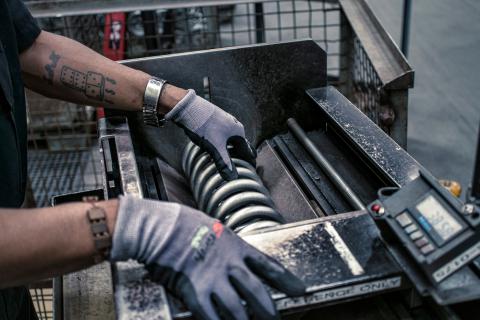
A prototype of the spring is made, then Eibach begins its in-house testing. The spring is loaded on a rate grapher, a piece of equipment that plots the spring rate through its entire range of travel, to confirm that it satisfies the racers’ specs. It’s then put on a cycle tester and run for around 500,000 cycles at various strokes for fatigue testing. If it passes that round of tests without losing any height, rate, or load characteristic, then prototypes are sent out to racers for real-world testing. 

2
Suspension manufacturers all have unique development methodologies. For Eibach, the process begins with collaboration between the motorsports group and the R&D team.

It’s at this stage where feedback from teams might lead to minor tweaks to the spring. One example came from the company’s NASCAR program, said Mark Krumme. “We were able to develop a very special spring with them for use on superspeedways to help control speed and safety of the cars and trucks. That basically came down to back and forth with engineering and saying, ‘Look, the ground effects need to be maintained this far off the ground, and we need the load to be at this point.’” 

For Eibach’s Michael Seidman, that becomes a matter of fine-tuning the rate curve. Using the above methods, Eibach is able to adjust the load characteristics of a spring at any height to give it a more progressive feel, digressive feel, linear feel, or really whatever a racer wants.

And what a racer wants, of course, is very subjective. “Everyone has their own driving style, and that’s why we have spring rate ranges to fit everyone’s preference,” said Krumme.

Energy Suspension

Energy Suspension in San Clemente, California, has specialized in high-performance polyurethane bushings, mounts, and other components for 38 years. In that time, the company has produced a massive catalog of parts that continues to grow every year. Since there’s only so much time in a year to develop new products, Energy Suspension needs to carefully choose what projects it focuses on. 

The decision to develop a specific part hinges on a number of different factors, but one thing Energy Suspension believes it does best is analyzing the competitive landscape and identifying gaps in the market. “Introducing similar products is not our formula for success,” said Jon Burke. “Also, a feature of good product introductions is to lead the market by introducing products that the market is not even aware that it needs yet.” 

Energy Suspension’s marketing and sales teams gather data on a particular problem or market need and get together with R&D to work on a solution. Once a proposed part or kit is given the green light, the company seeks out a vehicle for measuring and test fitting. 

“We can take the vehicle onto our lift to check for the match between our design information and the actual vehicle,” said Burke. “The part models are modified and adjusted as more learning about the application becomes available through our vehicle inspections.”

Once all the measurements are verified and the team has a viable prototype design, tooling for production, including master molds for the polyurethane parts, is developed, and the first prototypes are cast and assembled. These initial prototypes are measured against the original design before being test fitted. After that, the parts go through a series of grueling durability tests.

3
Development projects are typically chosen based on sales potential. “Introducing similar products is not our formula for success,” noted our source at Energy Suspension.

A durometer is used on all polymer parts to verify their resilience, and the parts are evaluated on a compression tester or tensile testing apparatus. A specialized load testing device vibrates parts for extended periods of time to test longevity. Oftentimes, Energy Suspension will build a special-purpose device to simulate high stress in a specific situation and get an idea of expected life under those circumstances. For the ultimate torture test, parts are subjected to a 50-ton press to see how they hold up to extreme loads and ascertain the point at which they might fail. 

The other half of the testing process happens on the vehicle itself. After getting some seat time with the prototype parts installed, drivers will provide feedback on various factors, including ride and handling; noise, vibration, and harshness (NVH); and anything else they experience behind the wheel. “It’s not unusual to encounter user feedback that drives changes in a part or parts of the bushing set,” said Burke.

KW Automotive

Stroll through the pits and paddocks at any sports car race in Germany, and it’s easy to lose count of the KW logos. That reputation has scored KW some prestigious OEM contracts, with the brand supplying shocks for such potent road cars as the Porsche 911 GT3 RS and Mercedes-AMG GT four-door. 

Yet racing is in KW’s DNA, so its team works with competitors both at the professional and grassroots levels to develop new products and continue evolving existing ones. The word “evolution” is key for KW, because its designs change constantly based on feedback from the track, its OEM projects, and its customers. 

“Sometimes there’s a technical evolution based on something that we’re up against on a new project, and that’s where the innovation starts to happen,” said Frank Vasquez, in KW Automotive’s Clovis, California, location. “We start to think of a more creative way to approach that problem. If the solution is feasible, then we can look at applying that across the board on new products. As time goes on, those changes start to trickle down to our most common parts.

“One of the important things to point out is we don’t stock coilover kits on the shelf,” Vasquez continued. “Every kit that is ordered by a customer gets put into the production line and produced specifically for that customer. The benefit of doing it that way is it allows us to be more flexible in those design changes. We get to roll that change out into the new production right away. It guarantees that the customer gets the latest spec, say if the damping profile changed a bit or if the spring rate was updated. All those changes are live in the system, and the product will get built that way.” 

4
Many suspension manufacturers specialize in particular forms of racing. KW Suspensions focuses largely on endurance-racing cars like this Porsche 911 GT3R.

Given KW’s extensive involvement in endurance racing, its dampers go through a great deal of durability testing to prove they can perform over the course of a 6-, 12-, or even 24-hour race. 

“When it comes to endurance racing, it’s a matter of longevity, service life, and consistency throughout that,” said Vasquez. “The teams are looking for parts that are going to work and provide a consistent output from the dampers throughout the extent of that race.” 

KW has many different stress tests to simulate hard usage over extended periods of time. “That helps us down to a component level evaluate how the product wears or behaves, the changes that the shock may see over time, temperature changes, that sort of thing,” said Vasquez. “A lot of it comes with experience as well. If we’ve been using a certain type of shock technology for a while for an endurance championship, we know what to expect. If we do discover any shortcomings, we can start polishing or improving for the next iteration of that product.”

Penske Racing Shocks

As a longtime supplier and partner of teams in Formula 1, IndyCar, and other top-tier series, Penske Racing Shocks of Reading, Pennsylvania, has earned a reputation for its professional racing suspension. But it also offers shocks for drag racing, dirt late model racing, motocross, and much more. The company has developed shocks for many different applications; and while all of its development draws from its experiences at the top levels of competition, the door also swings both ways.

“Formula 1 is probably at the tip of the spear on everything,” said Aaron Lambert. “But from a philosophy standpoint, we try to take all of our technology, whether it’s from Formula 1, or sprint cars, or ATVs, and when we’re designing, we try to cross-pollinate with other markets. That’s where we see a lot of our success. Even though the markets may be drastically different, part of our philosophy is that a lot of our parts all fit together. We might be doing some development for one market, but we’re always trying to see how that might relate to another market and give us an advantage there.”

Penske also develops shocks for endurance racing. Currently, it’s working with teams running cars in the new LMDh prototype class for the 2022 FIA World Endurance Championship and IMSA SportsCar Championship seasons. When developing shocks for those teams, once again Penske relies heavily on its experience in F1.

5
Penske Racing Shocks serves markets from ATVs to Formula 1, sharing insight between them. “We try to cross-pollinate with other markets,” explained our company source.

“From a performance standpoint, we know what types of loads a lot of these new sports cars will be experiencing,” said Lambert. “So we can bring in some of our F1 experience, and when they get to testing these cars, hopefully their initial testing is a lot closer to where they want to be.”

One big difference between F1 and endurance racing is the level of durability needed for all the parts on a race car that’s going to run for a dozen or more hours at a time.

“There’s a lot of testing that goes on, not only just from the standpoint of the damper performing but also the environment it’s going to live in,” said Lambert. “As aero gets more efficient and teams look for savings there, the temperatures get a lot hotter underneath the car, so that means the shocks are getting a lot hotter now. In Formula 1 the car might run for two hours at a certain temperature, whereas in endurance racing the car runs 12 hours, 24 hours in the same conditions.” 

Constantly pushing 100% for 12 hours or more “really puts all the hardware through the toughest conditions possible,” he continued. “We can run simulations and other things here in the shop. We have a lot of different tools to run the shocks for a certain period of time, run them at that temperature, look at the fade, look at what’s going to fail on them before it fails on the car, and then replace those parts or design them differently. We just constantly test and evolve to where, hopefully, our part’s not the weak link.”

QA1

QA1 in Lakeville, Minnesota, makes all kinds of suspension parts for all kinds of vehicles. A remarkable amount of development goes into each part, due to the fact that the company employs what’s called a phase gate product development process for every part it makes.

The phase gate process isn’t too dissimilar from other product development methods, except that at each phase a decision is made to either kill a project or allow it to proceed to the next phase, hence the “gates.” In many cases, customers and racers come to QA1 with a problem, and if the engineering team thinks it can come up with a good solution, then it moves into the six-step phase gate process. Eventually, some concepts are explored, one stands out as a plausible solution, and the process moves forward. 

“After a concept approval we move into a design stage, and that’s where it gets really serious,” said Chuck Olson. “We have a general idea of what we want the product to look like, but in the design stage we’re modeling everything accurately in CAD, and we’re getting a lot of data off the vehicles that our product would attach to, so there’d be a lot of measurements taken. We do a lot of laser scanning of chassis and test fittings of products at this stage.”

Before a physical prototype is built, a virtual part is put through Finite Element Analysis (FEA) testing. QA1 uses a program called Solidworks, which can run a variety of tests on a part to assess strength, flexibility, or whatever else designers and engineers would want to know about. Immediately after running these tests, the team can make changes on the fly. 

Yet the product can’t be tested only virtually, according to Olson. Instead, it must be backed up with physical testing to confirm the FEA is correct. 

“We have many systems at QA1 that we can use for durability testing,” he said. “We have a servo electric test stand that we call the TUV that’s our main durability system. It’s based on a linear electric actuator that, if cooled properly, can run essentially forever. That’s frequently what we’ll use. We purchased it for extremely high loads. One of its primary uses is for shock durability, but we found that by specifying the system correctly, we can use it for sway bars, control arms, components for control arms, cross shafts, you name it. It works great in many applications. We just design some custom fixturing for it. If we want to test a control arm with thousands of pounds of load continuously over two weeks, we have the ability to do it.”

Shortly after these prototypes go through physical testing, they’re sent out to racers to see how they perform in the real world. “Ideally, we’re going to get a lot of miles on them,” said Olson. “And in many cases, they’re racing them. Trying them on the drag strip, trying them on autocross, and road course events, and testing. That’s also a big part of the feedback that we get. It’s all necessary to really have a well-thought-out product prior to release.”

At this stage in the process, it’s rare for QA1 to get feedback that requires a major design change. Some of the most useful feedback they do get deals with installation—whether a part was easy to install or the instructions were clear enough.

RE Suspension

Since RE Suspension’s founding in 2003, the Mooresville, North Carolina-based company has been a champion for grassroots racers. After hearing about the lack of suspension support his friends were getting at their local tracks, co-founder Jason Enders made it his mission to offer top-level suspension knowledge to everyone, whether a particular race car was born in a garage or in the boardroom of one of the top teams in the industry. 

One key advantage RE Suspension was able to offer was shock testing, and that’s in large part thanks to Enders’ partner, Kurt Roehrig of Roehrig Engineering, which builds shock dynamometers. Currently, RE Suspension has five Roehrig dynos, including two 5-horsepower crank dynos, two 10-horsepower dynos, and one EMA (Electro Magnetic Actuation) dyno that can reproduce any waveform, download track data from a data logger, and simulate the exact conditions of a race track. 

6
Suspension manufacturers are always looking for gaps in the market. RE Suspension’s purpose-built bump stops were created to take advantage of new NASCAR Cup rules.

In addition to setting up race cars and fine-tuning suspension systems, RE Suspension manufactures a line of its own parts. Since the company is also a dealer of many of the biggest suspension brands, including Penske Racing Shocks, it tries not to overlap with any existing products when developing parts of its own. “We create products that don’t exist, or people don’t know they need yet,” said Enders. One niche where RE Suspension has thrived is in the performance bump stop market.

When a rule change in the NASCAR Cup series gave teams greater flexibility with their bump stops, Enders saw an opportunity to develop a purpose-built part for the job. He began looking at different materials, like polyurethane foam and solid polyurethane. At the same time, Roehrig had introduced a new top-of-the-line valve spring rater. Together, they beefed up that machine so it could test and measure larger springs, among other compressible parts like bump stops, with impressive accuracy. 

“For a good two years I lived on that advanced spring rater trying to get stops that were more linear, because we figured out that, in the world of bump stops, tires love linearity,” he continued. “All the bump stops we had at the time were made out of foam and they were very progressive, so we started trying different shapes and using different materials that were more linear than what we had.”

This cycle of researching, designing, and building prototypes, testing those pieces and then ultimately going back to the drawing board would continue for some time, but eventually RE Suspension’s hard work paid off. 

“We microscoped this thing until there wasn’t much left to learn,” said Enders. “We figured out where we needed to be and then expanded upon that. It was a lot of R&D, a lot of making stuff and throwing it away and trying different materials and different suppliers for materials until we found something that was good all the way around.”

Sources

Aldan American
aldanamerican.com

Calvert Racing
calvertracing.com

Eibach
eibach.com

Energy Suspension
energysuspension.com

KW Automotive
kwsuspensions.com

Penske Racing Shocks
penskeshocks.com

QA1 Motorsports
qa1.net

RE Suspension
resuspension.com

Summit Racing Equipment
summitracing.com

TTS Top Tier Suspensions
toptiersuspensions.com

March 2022
By
Alex Nishimoto

PRI Education: Brake Kit Selection by Calculation & Experience

Submitted by johnc on Wed, 02/16/2022 - 10:48
image 1

Bailey Campbell is shown here competing in the 2020 King of the Hammers Ultra4 4400 Unlimited class running a 50/50 brake bias with equal line pressure to all four corners. Wilwood recommends as close to a 50/50 front-to-rear brake bias as possible on these vehicles, so the calipers clamp with equal force.

Although components often look similar across different brands, engineering behind the scenes ensures parts are optimized for the unique challenges of each racing genre.

In racing, brake selection is often follow-the-leader: New competitors pay attention to what the top finishers are using. Some brake manufacturers do the same, so calipers and rotors often look similar across different brands. However, the manufacturers make plenty of engineering and metallurgy calculations behind the scenes before calipers get CNC machined or brake rotors cast.

The math involved in the initial planning of a brake system can get long and complicated. Variables involved in figuring front brake torque requirements include the coefficient of friction of the tires (think skinny drag tires versus road-race slicks), radius of the tires, weight of the car, wheelbase, height of the center of gravity, and distance from the front axle to the center of gravity.

Figuring how much brake torque a system can deliver, meanwhile, involves the coefficient of friction between the pads and rotors, rotor radius, and the clamping force of the calipers, which requires even more math involving the master cylinder bore, pedal ratio, caliper piston area, and caliper deflection. Then, engineers must determine the thermal capacity required based on kinetic energy, which is based on weight and speed but varies with the square of speed. A car going 150 mph has four times the energy of one going 75 mph, for example. Kinetic energy increasing by speed squared is one of the major factors pushing brake development.

Another consideration for brake kit selection is wheel size. For example, superspeedway stock cars with 15-inch diameter wheels turn a tremendous amount of kinetic energy into heat, but they don’t need to stop much and use brakes more to settle the chassis. NASCAR’s Next Generation cars have 18-inch wheels and a rotor that has grown more than 2 inches in diameter to handle increased speed on short tracks and road courses.

Tire grip figures prominently into brake engineering math, which is why dirt track cars and dragsters don’t use as serious of a front brake package as a Trans-Am series road racer. With a limited grip surface or narrow tires, brakes that are too strong just lock the wheels too easily. In these cases, the quality is more important than the quantity of the braking, so look for brakes with good feedback and predictable engagement to allow maximum braking without sudden lockup.

image 2
Pictured here is a single, rear inboard brake kit for lightweight sprint and midget cars. The super alloy rotors on a splined axle have a very low rotating weight and still provide excellent stopping power and thermal capacity.

One Example with Ultra4 4400 Cars

These considerations for finding a proper braking package can be vital for preventing or rectifying race vehicle damage. One example of how brake selection fixed a significant problem was found in the Ultra4 series, the popular 4400 unlimited class that started at King of The Hammers. The locked all-wheel-drive, big tires, and high power of the 4400 cars left a trail of broken metal parts in their early days. Recurring driveshaft yoke failure on Miller Motorsports’ rigs was eventually traced to a brake bias setup that, while acceptable for most other forms of racing, proved detrimental in this unique off-road racing class.

Before we dive into that specific instance, though, let’s look at the unique needs of off-road racing. Speeds are typically slower (except when they aren’t), the grip is limited, weights are higher, the center of gravity and weight transfer are greater, and tire diameters are enormous.

Unlimited Trophy Trucks in Baja can easily hit triple-digit speeds, weigh three tons, and run tires up to 42 inches in diameter. Even with their braking needs lessened by limited grip on dirt, the combination of a high center of gravity, large tires, speed, and weight requires they use brakes that would also be at home on full-bodied GT road race cars. At the other end of the off-road spectrum are the “moon buggy” type rock crawlers, which feature one seat, four massive tires, a big V8, and a ton of articulation.

The needs of Ultra4 Racing 4400 unlimited off-road cars are as extreme as the terrain they compete on, as they combine aspects of Baja open desert racing and rock crawling. These rigs need the power to run triple-digit speeds over rough desert terrain, plus the articulation and torque to crawl up trails made of boulders bigger than the car itself.

With a nearly unlimited choice of chassis, motor, suspension, transmission, and tires, these vehicles feature purpose-built tube-frame chassis, front or mid-engine placement, and V8s comparable in power to those on a NASCAR oval. Most have solid front and rear axles, but more cars are moving to independent front suspension or four-wheel independent suspension. Four-wheel drive is required, and four-wheel steering is common, as are hand-operated cutting brakes for braking on individual corners when the car is balanced on three or fewer wheels. Locking differentials and a locking two-speed transfer case send power to all the wheels when needed. Big 40- or 42-inch diameter tires claw over rocks and climb nearly any obstacle.

These cars run conventional torque converter-based automatic transmissions because the drivers can’t spare a foot to operate a clutch. Getting up and over the rock trails with quickness often requires working the brakes and throttle together, with an occasional hand brake applied to one or a pair of wheels. It takes a complicated choreography of brake, throttle, shifter, lockers, and steering to get over these trails quickly.

Balanced Brake Bias

As power and grip increased, 4400 drivers broke front and rear driveshaft yokes, even those made from specially treated chromoly steel. Off-road engineering experts eventually determined an unexpected cause: the front-to-rear brake bias.

Typically, all street and race cars run with some front brake bias, since weight transfers to the front wheels when decelerating. Unfortunately, that doesn’t work for a 4400 car because of the massive engine torque, low gearing (high numerically), huge tires, and locked differentials. With the lockers engaged while crawling, when the brakes try to stop just the front or rear wheels, the engine will quickly find the weakest link in the driveline to break.

There is little weight transfer from braking when climbing over boulders because the car doesn’t have much momentum, but the spinning wheels and tires—each weighing more than 100 pounds—do. So to get the rig over the trail, the lockers might send power to all four tires, with only one of them providing any traction.

Unlike in an AWD car, or a 4x4 with an unlocked central differential, the locked transfer case of a 4400 rig is not designed for the front and rear wheels to spin at different speeds. With the driver modulating the brakes and throttle with both feet, if the brakes are biased, the front wheels can stop while the engine continues to drive the rear. With equal bias, the brakes slow all the wheels down equally, putting the same strain on all parts of the driveline.

Using the same size caliper and rotor front and rear also means carrying fewer spares and allows chassis builders to use similar components all around.

The Hard Parts

As tires got bigger and heavier, power increased, and speeds crept up, Ultra4 brakes have evolved to match the car’s capabilities. Starting with solid 12-inch rotors and Wilwood Dynalite four-piston calipers, Ultra4 racers (running Wilwood components) moved to DynaPro billet six-piston calipers for more pad area. As speeds and tire sizes climbed, however, Wilwood found the old DynaPro design limiting and introduced DynaPro 6A, a stress-flow forged design with a rigid central bridge for better clamping force. Eventually, more thermal capacity was needed, so Aerolite six-piston calipers with ventilated 14-inch rotors behind 17-inch wheels appeared on many top cars.

Wilwood now recommends as close to a 50/50 front-to-rear brake bias as possible on Ultra4 4400 race cars. Typically, a pair of 3/4- or 7/8-inch bore master cylinders is used up at the cockpit, connected via a balance bar or Tru-Bar bias adjuster to a high ratio (10:1) brake pedal. The bore size can vary based on driver preference, but it is important that both front and rear are the same, so the calipers clamp with equal force. The balance bar is set in the middle but can be fine-tuned as needed.

Innovation Feeds Racing

Race car development feeds street car innovations, which feeds back into racing, making both race and street cars handle and stop better. Every racing genre presents unique problems that street cars may only encounter once in a million miles, if ever. Engineers love figuring out solutions to problems, and motorsports allow them to witness the problems and solutions to them at high speeds.

image 3
Tire grip figures prominently into brake engineering math, which is why dragsters don’t use as serious a front brake package as, say, a Trans-Am series road racer. The spindle-mount front drag brake kit shown here weighs less than 6 lbs., which avoids overpowering of the available grip of narrow, small contact patch tires.

Racing innovations have even been used in military and aerospace applications. The unique experience of NASCAR stock cars on small-diameter wheels was directly applied to the brakes on legacy US military vehicles as they gained armor and weight. In addition, engineering done by motorsports builders for off-road racing has been applied to NASA space rovers crawling over Mars and the Moon.

Race car development is often incremental and evolutionary, so copying the winning setup of the front runners is an excellent way to get a car set up. That is, until someone leapfrogs the pack with an innovation that sends everyone back to the shop scratching their heads and playing catch-up. 

Bryan Wood is the Technical Copywriter at Wilwood Engineering in Camarillo, California, where he works in the marketing department writing product briefs, press releases, and blog posts for its website. He has been a freelance contributor to various auto and motorcycle outlets for more than a decade. He occasionally competes in club-level endurance road racing events.

March 2022
By
By Bryan Wood

Advocacy Corner

Submitted by johnc on Wed, 02/16/2022 - 10:24
image 1


Tracking legal, legislative, and regulatory developments impacting the racing and performance industry.

PRI Track Ambassador Tom Deery and the Washington, DC-based advocacy team work continuously to protect race tracks, sanctioning bodies, and motorsports businesses around the nation. This month, we are tracking several initiatives, including details on the new PRI Membership Headquarters, an event to help support motorsports at Wenatchee Valley's Super Oval, a gathering of drag race operators, the Bonneville Salt Flats, how one elected official is supporting motorsports businesses, and more.

New PRI Membership HQ To Support Motorsports

PRI’s recently announced Membership Headquarters in Speedway, Indiana—set to open doors in May ahead of the 106th running of the Indy 500—is already making its impact on motorsports in the region. The 42,500-square-foot building is a critical tool in helping expand PRI Membership and includes spaces dedicated to boosting motorsports businesses and track operators, including a Content Factory for photo and video production, live and virtual educational opportunities, rooms for motorsports gatherings and meetings, and more.

“The new HQ positions the association in the very heart of the racing community within walking distance of the most well-known race track on the planet. Millions of people come to Speedway, USA, every year in search of speed and power. PRI will be right there, helping racers while encouraging the business of racing,” PRI President Dr. Jamie Meyer said. “From an advocacy standpoint, we have to be in front of people, sharing information, getting them involved, and growing the PRI Membership. Community events, racing events, membership events—they will all be supported by our PRI Membership team at this new address. See you there.”

“Whether it’s a meeting of track safety crews or a race team sponsor meeting, we want the HQ to become a toolbox, library, and center where, when you walk in the door, everybody speaks the same language, and you feel welcome,” Deery said.

The new HQ will also serve as a meeting space for the Indiana Motorsports State Coalition, a group of race track operators and promoters.

“Each state has its own challenges, and unfortunately, without a coalition, everybody works through their issues on their own,” Deery continued. “The goal of state coalitions is to collectively identify, solve, or mitigate issues that may come from the state front, but more importantly, gather a group of like-minded people that can lean on each other for support, ideas, and forward-thinking steps to make sure motorsports thrives.”

The building also includes office space for dedicated staff, including PRI Membership Sales Manager Julie Freier.

“We want the new PRI HQ to be a place where drivers, crew, family, enthusiasts, and fans can all unite and support the industry,” Freier said. “We will be hiring additional staff and growing our organization to serve our members. This will include introducing new benefits, increasing our outreach, and expanding our membership organization in order to scale up, make an impact, and help build, promote, and protect the racing industry for many years to come.”

‘Save Our Racecars Night’ Coming To Wenatchee Valley's Super Oval

A night of racing next month will help bring attention to PRI Membership and the “Save Our Racecars” initiative. Set for April 16 at Wenatchee Valley's Super Oval—located in East Wenatchee, Washington, and known as the fastest quarter-mile in the Northwest—the event will feature Bump-2-Pass, B-Mod, and Roadrunner classes, as well as a fireworks show.

The event will highlight PRI’s Save Our Racecars campaign, a crucial initiative to preserve motorsports in North America and gain grassroots support for the Recognizing the Protection of Motorsports (RPM) Act 2021 (H.R.3281/S.2736). This bipartisan bill protects Americans’ right to convert street vehicles into dedicated race cars and clarifies that it is legal to make emissions-related changes to a street vehicle to convert it into a dedicated track vehicle used in motorsports competition. The bill also enshrines in law the racing industry’s ability to produce, market, and install parts and equipment that enable racers to compete.

“The event highlights the importance of Congress passing legislation to protect both the right to race and for companies to be able to produce and sell parts that enable racers to compete on the track. It is critically important that the racing community is engaged on policy issues that impact the sport,” said Eric Snyder, PRI’s Director of Congressional Affairs.

PRI will be in attendance during the event, presented by AVD Motorsports, to promote PRI Membership, which is designed to unite the industry, address challenges and needs, provide support to race tracks and motorsports businesses, and more. For additional information, visit performanceracing.com/membership.

Race tracks across the US are invited to host Save Our Racecars events at their facilities. “We are committed to partnering with all segments of racing and the industry that supports it to protect the future of motorsports,” Snyder added. “It’s important that race tracks remind their patrons and racers that they must get registered to vote, and consider where politicians stand on racing issues when casting their ballot on election day.”

For more information, contact Deery at prisupport@performanceracing.com.

PRI, SEMA Support Effort To Save Bonneville Salt Flats

PRI and SEMA welcome the installation of a new water well and weather and hydrologic equipment used for measuring salt growth conditions at the Bonneville Salt Flats. Federal and state funds were released last year to install the monitoring equipment and help increase the volume of salt pumped onto the historic land speed racing venue this year to a total of up to 500,000 tons.

“The Bonneville Salt Flats are hallowed grounds for land speed racing enthusiasts. In addition, many race parts and aftermarket businesses have used Bonneville as testing grounds for their products. Accordingly, SEMA and PRI are leading the fight to save the Bonneville Salt Flats,” said Daniel Ingber, PRI/SEMA’s Vice President, Government Affairs.

In April 2020, the U.S. Bureau of Land Management (BLM) and Utah Department of Natural Resources (DNR) had signed a Memorandum of Understanding to jointly pursue restoration efforts in a program known as Restore Bonneville. Managed by DNR in conjunction with the BLM and operated by Intrepid Potash, Restore Bonneville is strongly supported by SEMA, PRI, and the Save the Salt Coalition, a collection of companies, organizations, individuals, and land speed racing teams.

Since 1914, hundreds of land speed records have been set and broken in a variety of automotive and motorcycle classes. Speed Week, the marquee event at Bonneville, began in 1949, with scores of racers and thousands of spectators descending on Bonneville in the quest for records.

“Unrivaled in its beauty, the Salt Flats are the crown jewel of natural race courses,” Ingber said. “Of the thousands of people who come out to the Salt Flats each year, it’s an annual pilgrimage for many that’s shared with their fathers and grandfathers. Bonneville is a special place, not only because it’s beautiful and is a wonderful place to compete. Racing at Bonneville is about family and working together to achieve speeds that are almost unthinkable. The fight to save Bonneville is all about preserving this remarkable place for young racers and future generations.”

In the 1960s, the racing venue was over 13 miles in length; but the course is now around eight miles. According to a study by the BLM, the Salt Flats have also shrunk in size from 96,000 acres to about 30,000 acres.

While the bulk of the program funding will come from federal and state appropriations, both industry and the land speed racing community will voluntarily help pay the costs. Financial contributions from the racing community are being accepted at savethesalt.org, a 501(c)(3) organization.

Drag Strip Operators Optimistic Over 2022

Drag racing track operators expressed optimism ahead of the 2022 race season as they gathered in Quapaw, Oklahoma, for the Dragstrip Operators Meeting & Expo (DOME) in late January. Dozens of drag strip owners and operators, primarily from America’s heartland, took part in the meeting that also featured representatives from the NHRA, IHRA, and other sanctions, as well as Tom Deery.

“The big takeaway would be the generally positive outlook going into this season by the track operators. The country’s mood is ‘let’s go racing,’” Deery said. “The basis of the meeting was nuts-and-bolts operations of a facility, which everybody always needs. A big session was on track prep and the advanced ways of managing the surface of your race facility. But mostly, it was a group of like-minded businesses finding solutions to issues.”

Hosted by Gerald Kramer, Carl Blanton, and Al Schoenwetter, the fifth annual event featured special guests including Kurt Johnson of Total Venue Concepts, Scott and Laura Gardner of Gardner Race Track Consulting, Joe Trull of Safehold Motorsports Insurance, and Rex Simmermaker of Winlight Bets.

Three days of educational sessions covered topics including track preparation, digital marketing, track insurance, racing promotion, media, track operations, gate software, hiring and retaining employees, and more. The event was rounded out with an SFI Incident Response Training seminar conducted by Ron Connor.

Deery and drag race operators continued the dialogue in Florida during Racing Promotion Monthly’s 49th RPM@Daytona Workshops on February 13–15, at the Plaza Resort in Daytona Beach. Details from this gathering will be revealed in next month’s Advocacy Corner.

U.S. Rep. Latta Visits PRI Founding Member Callies

Callies Performance Products, a PRI Founding Member based in Fostoria, Ohio, recently hosted U.S. Representative Bob Latta (R-OH) for a tour of the company’s headquarters. The event marked Rep. Latta’s second time visiting Callies, as the tour provided him an opportunity to interact with the company’s employees and watch them manufacture and assemble crankshafts, connecting rods, and camshaft cores.

The Congressman was excited to discuss the most pressing issues facing Callies and the motorsports parts industry, including the RPM Act, tariffs, the ability to hire workers, and federal policy proposals to incentivize electric vehicles. Rep. Latta is a cosponsor of the RPM Act and a strong supporter of the legislation, volunteering to work with House Energy & Commerce Committee leadership to pass the bill.

“With every site visit I have the opportunity to participate in, I always ask if there are any legislative priorities that the companies would like for their Representative to focus on. During my visit at Callies, they emphasized the importance of the Recognizing the Protection of Motorsports Act. I am a proud cosponsor of this bill because it would allow motorsports to legally continue by clarifying that the Clean Air Act permits street vehicles to be converted into dedicated race cars,” said Latta.

“We are fortunate to have PRI and SEMA represent manufacturers, engine builders, and racers to protect our source of livelihood,” said Heath Norton, Vice President of Callies Performance Products. “Thank you, Rep. Latta, for visiting Callies and for all you are doing to fight to protect manufacturing in America.”

Visits like these help lawmakers understand the importance of race parts businesses as an economic driver in many communities. Hosting lawmakers at our Member companies is one of the many advocacy efforts supported by PRI Membership, which is actively working to address challenges and needs, such as providing support for race tracks to prevent them from closing, advocacy for the racing community against current legal threats, and educational programs that help businesses and racers succeed. For more information on PRI Membership, visit performanceracing.com/membership.

For additional information about how to host a legislative representative at your facility, contact Snyder at erics@sema.org.

WV Reintroduces Bill to Aid Construction of Motorsports Complexes

West Virginia has introduced PRI-supported legislation (S.B. 467) to aid and incentivize the construction of motorsports complexes. The bill was introduced in the previous legislative session but failed to pass prior to adjournment. This version of the bill currently awaits consideration in the Senate Economic Development Committee.

“The bill acknowledges that motorsports represent an important part of preserving the technological achievements and cultural heritage of the United States,” said Christian Robinson, Director, State Government Affairs & SEMA PAC.

S.B. 467 recognizes the important economic and civic value that additional motorsports can provide to the state, plus the importance of providing incentives to attract large-scale investment in motorsports entertainment complexes.

The bill would provide tax exemptions for building materials and equipment used in the construction, repair, or improvement of a motorsports entertainment complex.

PRI encourages the racing industry to back this bill by visiting votervoice.net/SEMA/campaigns/91140/respond.

March 2022
By
Laura Pitts

Business Profile: Flis Performance

Submitted by jeffreyc on Wed, 02/16/2022 - 09:50


Taking over production of Mazda’s MX-5 Cup cars, the Daytona Beach, Florida-based team of veteran builders and racers bring their formidable business experience and technical savvy to this wildly popular series.

Flis Performance of Daytona Beach, Florida, became the exclusive car builder for the Idemitsu Mazda MX-5 Cup series in January 2020, and completed 16 of the spec racers before the end of that year. Production stepped up to 24 cars in 2021; and Todd Flis, who owns the business with his brother Troy, anticipates “a pretty big percentage increase in new teams and new drivers for 2022.

“We’ve built 39 cars to date,” Todd Flis reported in late November 2021, “and we’ve seen an average of 25 cars at every race this year,”

What’s driving such significant growth?

“Number one, in 2021 we moved from IndyCar to IMSA, where the series is a much better fit,” Flis said. “IndyCar was a great partner, and we had a great relationship. But IMSA is where we need to be,” where an affordable sports car series can not only cultivate young talent, but also provide a natural step to faster series within the same sanction.

“Number two was the pandemic, which prompted so many sales of these cars for use at private country clubs. About 70% of our build volume goes to Monticello, Autobahn, Thermal, Spring Mountain, etc. All of these clubs have their own MX-5 series, and that’s where the racers went every weekend. Then they brought their kids, and then they wanted to buy cars for their kids.”

A Racing Family

Third-generation racers Todd and Troy have built and campaigned cars together for most of their lives. “My Dad got us started in go-karts at a young age,” Todd Flis recalled, “and we moved up to SCCA sports car racing in the late 1980s. We ran all the way up to Daytona Prototypes and DPi cars, and from there we progressed to prepping cars for other teams and drivers. We ran with racers who had the funding behind them to say, ‘Hey, would you run this for us, and we’ll pay you to do it?’ It was around 2000 when we switched from driving as a hobby to a full-time professional business.”

Each brother had already settled into a specific role: “Troy handles the technical and development side,” Todd Flis explained. “He’s always working on new bits and pieces, and on manufacturing. He deals with our customers’ tech issues. If somebody has a problem with their ECU, he assists them. I handle all the sales, the marketing and contract negotiation. That’s been the case for 35 years. It’s very clear-cut, and it works very well.”

2
Pictured from left, Todd and Troy Flis have created a flourishing business building Mazda MX-5 Cup cars. Some two-dozen fresh MX-5 spec racers rolled out of their shop in 2021, with even more expected this year.

Even 20 years ago, however, the racing industry was rapidly changing, and the brothers found they had to adapt. “Our background was in building cars,” said Flis, “and we would build cars, prep them, the whole nine yards.” But demand for custom building declined with the proliferation and growth of spec series. “So we would still run cars for our customers, or at least maintain them.” And by 2015, the brothers’ own Spirit of Daytona team was campaigning Corvette and, later, Cadillac DPi cars.

It’s not surprising, then, that in late 2019, Todd and Troy were tapped by Mazda to run the automaker’s TCR program, based on the Mazda3. “We were originally going to develop the cars, prepare them, and race them for three years, then turn them into a customer program,” Flis said. The TCR would have been “a step on Mazda’s ladder between the MX-5 and a DPi or GT-style car.” Negotiations with Mazda were well under way in November, when the North Carolina-based builder of Mazda’s MX-5 Cup cars called it quits—and Mazda offered that program to the Flis brothers as well.

Then, due to the pandemic, Mazda put the TCR program on indefinite hold. “It was a blessing in disguise—sort of,” Flis mused, “as it would have been a lot to take on in a very short period of time.” Also, with the TCR car back-burnered, “Mazda put all of its assets into the MX-5 Cup, and that definitely elevated the series. We moved the whole MX-5 operation to Florida and hired two employees from the previous builder. We put a staff together and started building cars in January 2020.”

Engineering & Manufacturing

Flis Performance takes the initial orders, contracts with the buyers and sells the finished race cars. “Mazda does not want to sell race cars,” Flis noted, “nor does any other auto manufacturer. So we absorb the liability.” Mazda does, however, control parts sales. Flis Performance sells the parts it manufactures to Mazda, “and Mazda sells them to the end-user. If a racer bounces a car off a wall and bends a wheel, they go to Mazda Motorsports to replace it.”

For each new car ordered, Flis Performance buys a brand-new MX-5 from Mazda. All are zero-option base models, but they are delivered to the company fully assembled, as they would be to any Mazda dealer. Flis Performance then removes the seats, the soft top, and much of the interior. “We sell some of that stuff,” explained Flis, “and some goes right to scrap.” It turns out that buying and stripping a showroom-stock model is actually more cost-effective than special-ordering a car without all the parts a racer doesn’t need, as the resulting disruption on the production line would cost Mazda more than the parts that are discarded. 

3
Flis Performance team member Kyle Morningstar is pictured working on an MX-5 spec racer. Although the cars are extensively modified, almost all of their parts remain essentially OEM stock.

Once stripped, each car is “rolled about one block up the street” to the Spirit of Daytona shop. “There we take out all the seam sealers and interior parts and weld in the roll cage. It goes through paint, and then it comes back to Flis Performance for finish fitting and final production. So we have a separate facility for fabrication and paint,” and a “clean” shop for final assembly.

Flis Performance, he added, “controls 90% of the engineering of the program. Mazda is very sensitive to the look of the car, so there are no added wings or any other attachments to the bodywork. Mazda is also very, very sensitive to racing what it actually sells. So the only really significant mechanical components that are not in an OEM MX-5 are the racing shocks, the sequential transmission, the brake ducts, the enhanced cooling system, the safety equipment and the ECU. We don’t even pull the engine out of the chassis, although we swap out the motor mounts.”

The current-generation car “has been raced for three years, and there is not much development left in it.” Still, “we are continuously testing new products, pieces and parts to make the car better. Just in the past two years we’ve issued probably 12 TSBs [technical service bulletins], making the car better. We even elevated the compliance program with new ECU telemetry technology, so we can watch and make sure that all the cars are equal.”

Marketing the Experience

Knowing their customers’ wants and needs has also contributed to Flis Performance’s success. “We found pretty early in the game that most club racers want the car to roll off the transporter, and then get in it and drive it all day,” Flis said. So, unlike the previous builder, Flis offers “a seat option, a radio communication option,” and other choices that contribute to an arrive-and-drive experience. Flis Performance customers can skip those components and provide their own, but most want a turnkey race car. “We even offer a setup option. We know where they are going to run, and they send us their weight. So we set the car up and it’s ready to race.”

That said, suspension setup is kept intentionally simple. “It’s not a GT4 car,” Flis noted. “These cars have a very, very small window, and outside of that window can be big trouble.” When that happens, however, Flis can talk the customer through the process of “getting the car back where it needs to be. It needs 3 degrees front negative camber, 3 1/2 degrees rear negative camber. X amount of toe, X amount of caster. And once it is back in that window, it can be fine-tuned from there.”

4
MX-5 spec racers begin as complete new MX-5s, just like the ones dealers sell. Flis Performance then strips the cars before crew members like David Acvedo install a roll cage and other competition equipment.

Flis is also largely responsible for marketing the series. “When we took over production, we negotiated our contract with Mazda so that we could push these cars heavily. Ninety-nine percent of our marketing is through social media. We also have very close ties with IMSA, so we do some co-marketing with them, and we receive a lot of support that way. That’s been a key boost” to Flis’s visibility and competitive position. “If someone is going to buy a homologated race car, they can see that we’re out here, we’re available and we provide great service for the product.”

Like so many successful businesses we’ve profiled, Flis emphasized a commitment to providing high-quality customer service. “We bring our tractor-trailer to every series event,” he said. “It’s called the Mazda CEC, for Customer Experience Center, and it’s stocked with all of the parts, so the customer doesn’t have to inventory anything. They buy the parts off our trailer and charge them to their Mazda Motorsports account.”

Flis also provides tech support, 24/7. “If someone is running one of our cars at a weekend club event, and a warning appears on the dash”—and the racer can’t figure out the cause and/or the remedy—“we can log into the ECU remotely and recommend a fix. Nine times out of 10 we resolve an issue in less than 30 minutes.”

In fact, Flis believes that customer service has been the greatest contributor to his company’s success. “That’s what everybody tells us: ‘I can call you on a Saturday afternoon and someone calls me right back, and we work through an issue.’ He emphasized that Flis Performance is also “open and transparent” concerning “changes, updates and issues people are having with the cars. People come to us with their issues, and we work with them to try to make the car better.” Many of the TSBs mentioned earlier originated with just such conversations. “We’ve even opened up the ECUs a bit, so the customer can go in and look at the things they want to see.” 

From Dockside to Trackside

When we asked Flis what he and his team have learned from the MX-5 program, he cited the challenge of “direct involvement with multiple teams. It’s a lot different from showing up at a race track and preparing one team with one or two cars. Now we have to be concerned about 25 cars. Back in early 2020 we tested 30 cars at Mid-Ohio, and I was sweating like you would not believe until every one of those engines started, and every one of those cars went around the track. Then I felt like the weight of the world was off my shoulders.

“We’ve also had to learn the ins and outs of a tier-1 partnership with a major manufacturer,” he continued. “I communicate with Mazda weekly, if not daily. Of course, we dealt with GM for a long time through the DPi program, and before that we developed the Porsche V8 for its Daytona Prototype. But even that wasn’t the same level of involvement with the manufacturer. That’s been the biggest learning experience.” 

5
As with any racing effort, the work of Flis Performance demands a tightly coordinated team with a wide range of specialties, including administrator Ashli Richardson.

That said, Flis has enjoyed strong support from Mazda and other suppliers, especially when dealing with pandemic-related shortages. “We buy, like, 15 cars at a time from Mazda, and with the pandemic we had 10 of our cars sitting at the port. I got a call from a Mazda distribution manager saying, ‘Listen, I need those cars for my dealers.’ I said, ‘Sorry, I need those cars.’ A Mazda executive stepped in and said, ‘All those cars are reserved for the MX-5 Cup, they don’t go to the dealers.’

“We’ve also been very fortunate to have partners in the industry, whom we have known for a long time, who have stepped up and built things for us that needed to be built or imported parts that needed to be imported.”

In all, Flis anticipates a great future for the MX-5 Cup. “There is so much interest, and so much excitement now that everyone has seen the level of competition and professionalism of it. The expansion and growth of the series is going to be great in 2022,” he predicted.

Approaching a Limit?

Between the two facilities, Flis Performance encompasses about 15,000 square feet, with seven employees. “About halfway through 2021, we went from building two cars at a time to building four at a time. And we added one more employee on the fabrication side. But that’s it. We’ve been in this game too long to over-invest. We’re very happy with the current size and direction of our company. It’s a 90-day wait to get a car, but we’ll deal with that,” Flis concluded.

March 2022
By
John F. Katz

NASCAR Cup Series Drivers Form Advisory Council

Submitted by laurap on Tue, 02/15/2022 - 18:03

Previous and current NASCAR Cup Series drivers have formed the Drivers Advisory Council, which former competitor Jeff Burton will lead, according to published reports. 

The Council has a collective goal to “move the sport forward and conduct positive change.” The Board of Directors includes Kurt Busch, Austin Dillon, Denny Hamlin, Corey LaJoie, Joey Logano, Kyle Petty, and Daniel Suarez.

The initiative marks the third iteration of a drivers council, following one in 2015 and another in 2018. Burton stated the key to making this new council work is to “have someone on the outside that can help. There are conversations that the drivers don’t have to be involved in. They can [meet] with me, then I can go have the lengthy conversations,” Burton said, according to published reports.

More details are expected at a later date.

February 2022