South Boston Speedway—the 4/10-mile asphalt oval in South Boston, Virginia—will celebrate its 65th anniversary with a pair of August events, starting with the Davenport Energy Night event on Saturday, August 6, when the NASCAR Advance Auto Parts Weekly Series Late Model Stock Car Division competitors will battle in twin 65-lap races.
Also on the schedule is a 50-lap race for the Budweiser Limited Sportsman division, a 25-lap race for the Southside Disposal Pure Stock division, and a 20-lap race for the Virginia State Police HEAT Hornets division. Then, fans will get a “glimpse into the past” with the Southern Ground Pounders Vintage Racing Club competing in high-horsepower vintage Modified and Late Model Sportsman vehicles for a 25-lap race.
The Italian Delight Family Restaurant presents South Boston Speedway’s 65th Anniversary Celebration event is set for Saturday, August 20, and will feature twin 65-lap races for the NASCAR Advance Auto Parts Weekly Series Late Model Stock Car Division competitors and a 65-lap race for the Budweiser Limited Sportsman division.
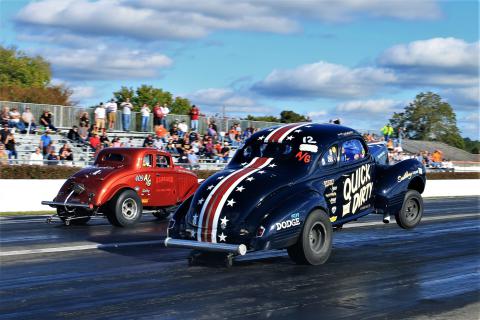
Also scheduled is a 25-lap race for Southside Disposal Pure Stocks division, a 20-lap race for the Virginia State Police HEAT Hornets division, and the East Coast Flathead Ford Racing Association, which will wheel vintage cars in a 25-lap race.
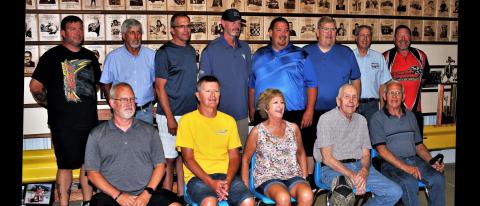
Fremont Speedway, the clay oval located at the Sandusky County Fairgrounds in Fremont, Ohio, has inducted 10 new members into its Hall of Fame.
Dale Blaney (driver), Dan Roepke (driver), Bryan Scott (driver, owner), Al Harrison (owner, driver), Chuck Steinbrick, Bob Hampshire (driver, owner, and mechanic), Mike Witty (driver, mechanic), Vicki and Monte Collins (track officials), and Bob Raubenolt (special contributor) were honored during a ceremony at the track.
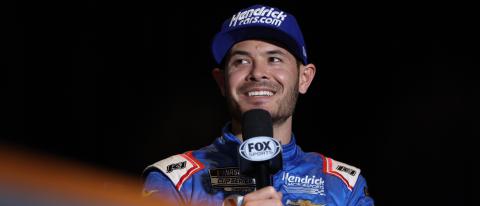
The 2022 Excellence in Sports Performance Yearly (ESPY) Awards presented by Capital One recently celebrated athletes, teams, and moments in the world of sports. Reigning NASCAR Cup Series champion Kyle Larson received the honor of “Best Driver,” beating out Max Verstappen (Formula One), Steve Torrence (NHRA), and Alex Palou (IndyCar).
The driver of the No. 5 Hendrick Motorsports Chevrolet claimed 10-points-paying Cup Series victories in 2021—including the Championship 4 season finale at Phoenix Raceway to claim the title and a win in the annual All-Star Race.
NASCAR Hall of Famers and fellow Hendrick alumni Jeff Gordon and Jimmie Johnson each own four ESPY awards for the same distinction, with Larson’s victory being the 19th time a NASCAR driver took home the nod. Kyle Busch is the most recent NASCAR driver to win the award, claiming it in 2019. Kevin Harvick (2015) and Martin Truex Jr. (2018) are the only other active NASCAR drivers to have won an ESPY.
NASCAR has announced the fall season of its eNASCAR College iRacing Series, which is the largest collegiate esports league in North America and was formed by NASCAR and NACE Starleague to bring competitive sim racing to colleges and universities nationwide.
More than 13,000 students are eligible to qualify for the season-opener through a 10-day time attack window. The top 40 students who post the fastest qualifying times advance to the race.
New this fall, Xfinity joins Coca-Cola, Logitech, Playseat and Southern Computer Warehouse as a presenting sponsor of the series. Competitors will now race NASCAR Xfinity Series cars, replicating the look and feel of the real-life series.
The eNASCAR Scholarship Fund returns this season, awarding the highest finishers a combined $60,000 in scholarships.
Students representing more than 250 universities across the US participated in this spring’s three-race schedule.
Couple of thoughts as we look ahead to the 61st NOS Energy Drink Knoxville Nationals Presented by Casey’s later this month:
1) I think it’s not surprising that Stephan Papadakis’ career has followed an upward trajectory that shows no signs of leveling off. From his emergence as a local legend in Southern California’s sport compact and import scene circa the late 1990s through his transition from driver to owner of the winningest team in Formula Drift history, Papadakis has achieved remarkable levels of success. Spend a few minutes with him, as PRI contributor Jeff Zurschmeide did recently in preparation for this month’s Industry Insights column, which begins on page 28, and it’s easy to see why. Sure, Papadakis can tune and wrench with the best of them, but what we found particularly telling were his approach to management (“I float in and out of micromanaging”) and his philosophy on team-building in motorsports, which he articulated thusly: “[Take] on what you can complete—be realistic about what you’re trying to achieve and whether you can do that with the resources you have. Then, networking and reputation are at least as important as performance on track, because at the end of the day, it’s not just about winning, it’s about people wanting to race with you…. There are so many aspects to motorsports and so much time in motorsports that’s not racing on the track, so make sure that you’re enjoying those parts.” Based on what he’s accomplished so far—and his innate desire to always embrace and conquer the next challenge—we’d say Papadakis has identified a winning formula.
2) I think you’ll appreciate how wecame up with the idea for this year’s annual Machinery Row Preview, which starts on page 48. It originated from an email that got circulated through the PRI offices back in February. In it, the owner of a well-known environmental products and solutions provider shared that his company had just closed a major sale stemming from its presence at last year’s PRI Trade Show. The order came about “all because of the PRI show,” he wrote, “[which] helped them to see the fit and finish of the equipment.” I should note here that for our team, it doesn’t get any better than this. Hearing firsthand that the PRI Show helps buyers make connections, find solutions, and conduct business with hundreds of the industry’s top manufacturers and service providers is our version of turning a 38-second lap at IMS. It’s why we suit up. But after exchanging some in-person (and virtual) high-fives on account of our exhibitor’s win, it occurred to us that this scenario was not unique, that there was no doubt many of these types of stories out there. We also agreed that these stories needed to be told. Now, all we had to do was find them. That proved to be easier than expected, as the PRI Show exhibitors we contacted were more than happy to turn us on to customers whose equipment purchases at recent PRI Shows had paid real dividends for their companies’ operations. Give this piece a read—and in the pages that follow see the dozens of suppliers set to display in this year’s Machinery Row. There may very well be an exhibitor or two in there whose products or services could be a game-changer for your business.
Recently, I attended a No Prep Kings (NPK) race in Hebron, Ohio, and it was one of the most impressive drag races I have been to in quite some time. We have all enjoyed the run that Street Outlaws is on, and this in-person event is the culmination of over a decade of brand building, fan development, and storytelling. All of this comes to light as the gates open and thousands of fans make their way into the track.
It started with a call from my friend, Manny Buginga. Manny is one of many “professional sportsman” drag racers across the country whose program has evolved from a hobby-level interest, but exists on a professional level of effort, funding, and team support. Manny has bounced around sampling the upper level of street car-style drag races, and he’s now interested in No Prep Kings. His team was recently supplemented by longtime friend Carlo Catalanotto, who is himself no stranger to the top level of street car drag racing. Teamed with the best of the Buginga family (Jen, Lil Manny, and Lilly) as well as a number of key drag racing veterans, Manny’s Mustang—code-named “Fred”—really brings the goods to any starting line it hits.
No Prep Kings is so much more than a drag race. It is a study of class structure, talent, and crowd draw. What you soon realize is that Sam Korkis, show producer and the genius behind the Street Outlaws brand, has poured years of expertise into this in-person experience that would be the envy of any race promoter. Backed by multiple TV shows, No Prep Kings is able to “bring your favorite star to life” with all of the characters that you know/love/hate in attendance, competing as they do almost every night on the Discovery Channel. That relationship has translated into ticket sales as soon as the gate opens; there is also great emphasis placed on upfront sales promotions and VIP access—all presented quite well online and through multiple social media channels.
The cast members themselves are a huge part of the program’s success, as they have bought into Korkis’ vision. And why not? It is working. I watched multiple cast members with lines of 50–100 people waiting for merchandise sales and autographs for the entire day. I have seen this kind of fan devotion at the upper echelons of motorsports, but it is most commonly seen in professional stick-and-ball sports. I spent quality time with Daddy Dave, Ryan Martin, Murder Nova, Doc, Jeff Lutz, Bobby Ducote, and more. We talked about their success, the impact of Street Outlaws on the racing world, and their support for the Recognizing the Protection of Motorsports (RPM) Act.
Race parts manufacturers have taken advantage of this industry momentum for years. And during the event I also got to spend time with George Rumore from Long Tube Headers (a PRI Founding Member), Nolan Jamora of Isky Racing Cams, and several other familiar faces. These folks are attending NPK races, supporting the racers, and enjoying extremely high levels of brand awareness. Well done to those of you already there…and it serves as a good reminder that brand-building is still happening in our industry—maybe now more than ever.
Advanced digital marketing happens when your brand/product meets your customer, with a trusted third party making the introduction. Street Outlaws has this figured out, as Sam Korkis continues to elevate the entire sport of drag racing. How far can Sam and his cast of outlaws take us? Only the market knows for sure, but after a decade of dedicated competition there’s a lot to be seen here. I look forward to working with Sam, his cast, and the passionate folks who are driving Street Outlaws. We can all learn a lot from them.
Until next month, remember to get your plans made for the PRI Show, December 8–10 in Indianapolis. And, as always, be safe out there.
Properly installing rods will help ensure optimum race-engine longevity and performance, and our expert sources are here to provide best practices on securing these critical components.
Connecting rod manufacturers are vigilant in providing detailed installation instructions; yet there’s no surprise in the number of phone calls from customers complaining that the rod is ground zero for some type of engine failure.
“There are engine builders. There are engine assemblers. And there are novices or hobbyists,” lamented Roger Friedman of Dyer’s Top Rods, Forrest, Illinois, stressing that the rod often is only as good as the customer. When they get it wrong, “the rod always gets the blame.”
Perhaps a wide-ranging platform of media options is partly responsible. In addition to the manufacturer instructions, there are dozens of how-to stories featured in enthusiast magazines, tech books, cable TV shows, and Internet forums. Maybe all the attention has made this step in the engine assembly look too easy.
And maybe the best practices don’t always get the attention they deserve. Take, for example, the practice of measuring side clearance between two connecting rods paired on the same crankshaft journal. Sometimes this measurement is called the “cheek” clearance.
This small gap is a way to control the amount of oil lost from the bearings and sprayed on the cylinder wall, wrist pins, and piston. The gap will vary between .010- and .020-inch, depending on manufacturer recommendations and type of rod material. Steel rods don’t need as much clearance as aluminum.
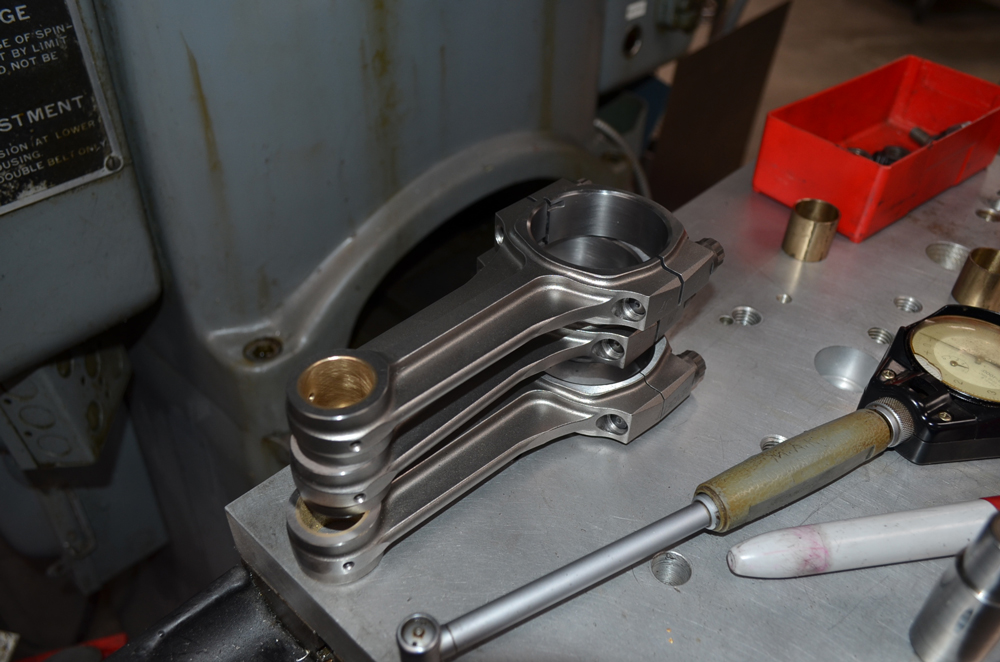
The most popular method of checking the side clearance is with a feeler gauge. Start with a thin blade and work up until the blade just slips between the two rods. Most photos detailing this step show a single feeler gauge being used, and for the most part that approach is adequate for a general-purpose engine build. However, savvy racers will use two feeler gauges to ensure the exact side clearance is measured.
“When using a single feeler gauge, the actual bearing clearance can cause the rod and bearing to cock,” said Tom Lieb of Scat Crankshafts, Redondo Beach, California. “You don’t really get the correct end play.”
Lieb recommended using two feeler gauges of the same thickness to measure the gap 180 degrees from each other. “Say you have .002- to .003-inch bearing clearance. Basically, you will bottom one corner of each bearing against the crankshaft while raising the other side,” explained Lieb. “However, in reality, the bearings move parallel to the crank journal surface. They don’t slide back and forth in a cocked position. If you’re looking for .018-inch clearance, take two .018-inch feeler gauges and measure the gap 180 degrees between the two rods on the crank journal.”
Industry Thoughts
With that in mind, we sampled the industry for the best advice for installing connecting rods. What are the do’s and don’ts of this critical procedure? The connecting rod may appear to be a simple design, but there is considerable technology in choice of materials, methods of construction, and overall structure and configuration. Also, the rod has to work in harmony with the wrist pin, bearings, pistons, and crankshaft, which all have design elements that complement the connecting rod. Improper installation will simply waste that technology. Right away we were faced with a reality check on this quest for wisdom.
“We deal only in very high-end applications,” admitted Stefan Verdi of Auto Verdi, Söderbärke, Sweden. “So we deal with very experienced engine builders and don’t have problems with installation.”
Tightening the connecting rod’s cap screws is a hot topic among manufacturers. Each has a preferred technique, requiring purpose-built measuring devices and proper lubricant.
Okay, let’s start with the basics. Perhaps the most obvious tip is cleanliness.
“Always check the threads and clean the rods before assembly,” said Nick DiBlasi of Race Winning Brands, Mentor, Ohio, which encompasses rod manufacturers BoostLine, K1 Technologies, Manley, and MGP.
“Thoroughly clean components before installation and be sure they are rid of any foreign dirt and oils,” added Matt Polena of K1.
Properly locating the bearings on the rod body and cap is a step often missed in the assembly. “Many high-performance bearings have an ‘upper’ and a ‘lower’ designation, usually found on the back side of the bearing,” said Alan Davis of Eagle Specialty Products, Southaven, Mississippi. “It is important that the upper bearing is installed in the beam portion of the rod and the lower bearing is installed in the cap portion. Installing these incorrectly can cause the appearance of reduced side clearance or possibly causing the bearing to rub on the radius of the crankshaft.”
“People will put them in backwards,” added Friedman, “and then the bearing will hit on the radius of the crank. That’s when they have a bearing failure and blame the rod.”
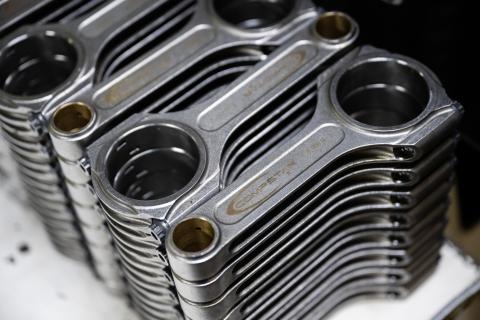
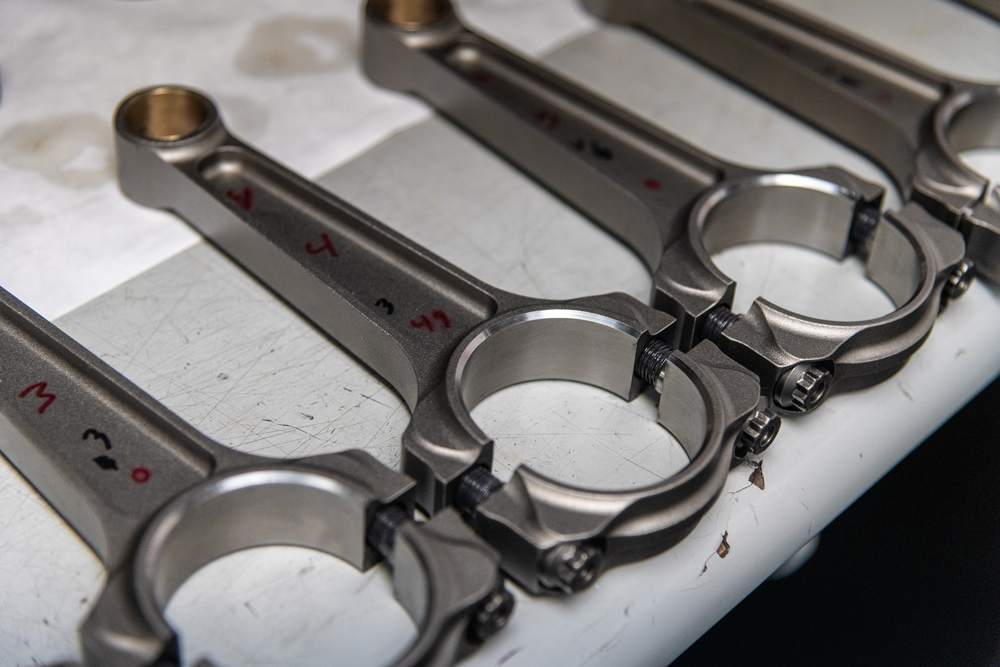
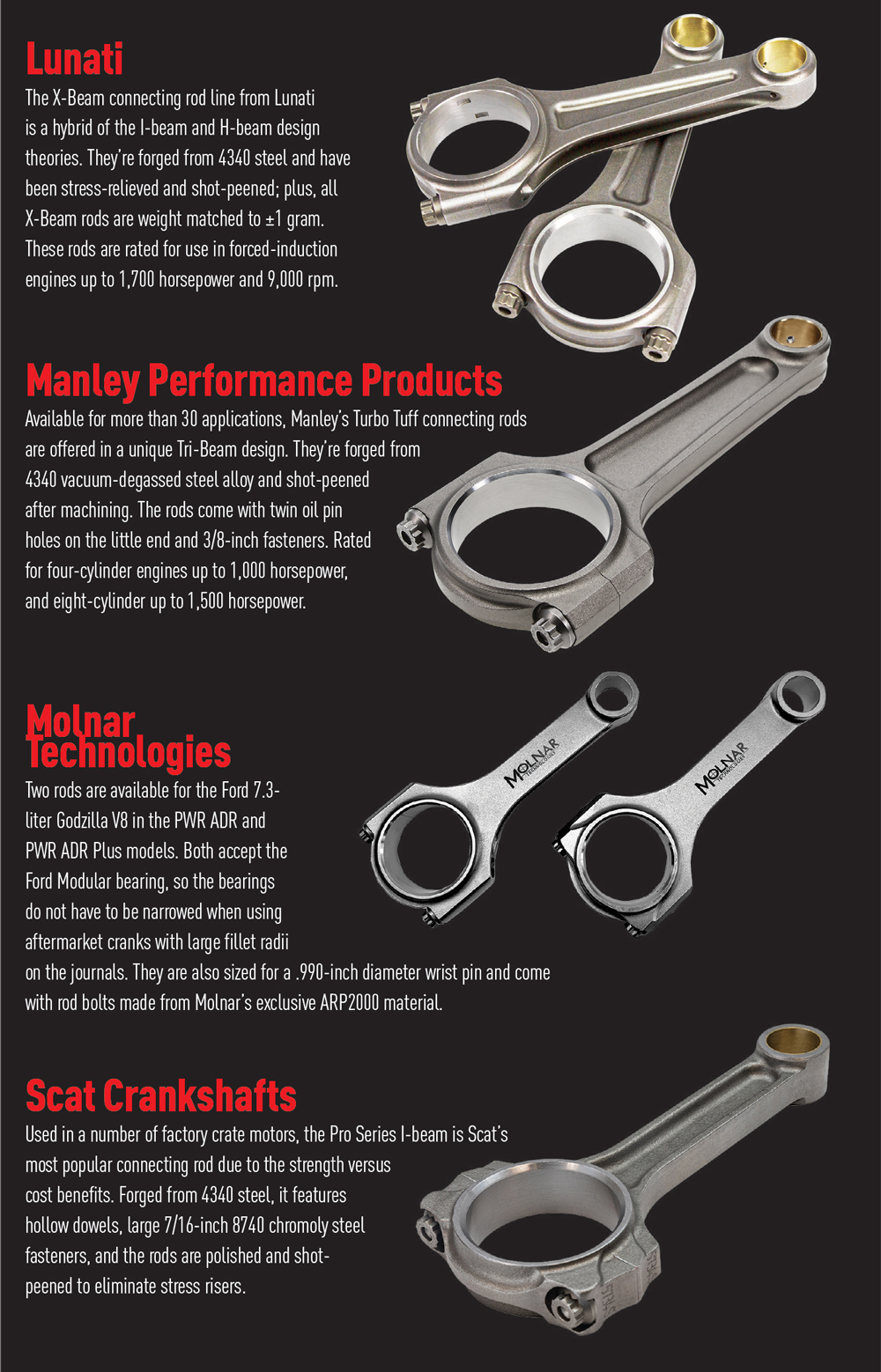
Connecting rods may appear to be of a simple design, but a considerable amount of advanced technology goes into their choice of materials, methods of construction, and overall structure and configuration.
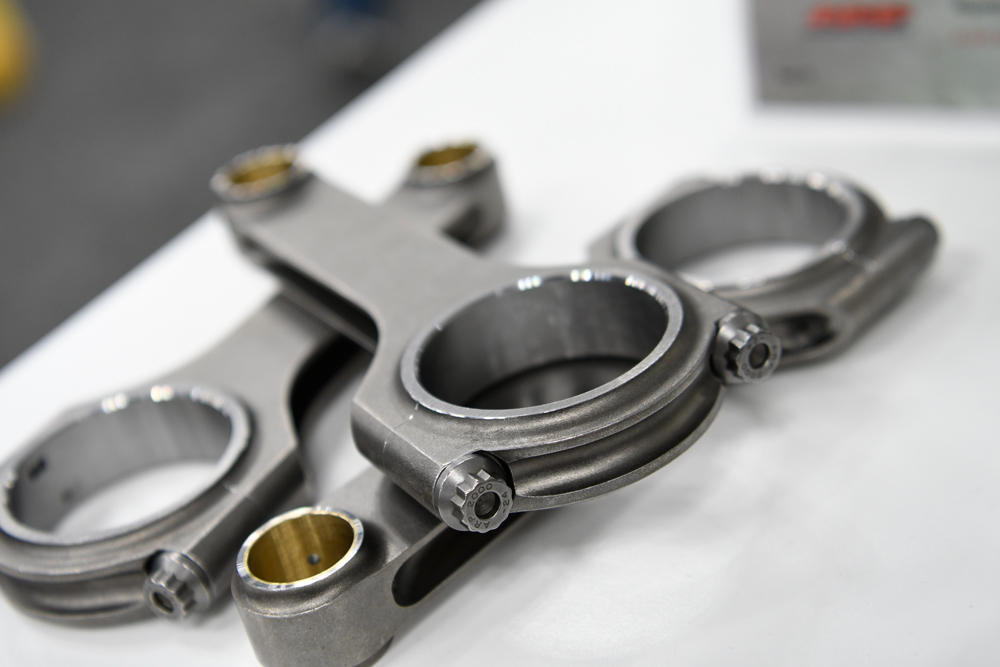
The position is important because bearings have one edge that is chamfered, and it’s designed to ride on the radius side of the crankshaft. The radius is machined into the crankshaft rod journals to help reduce stress concentrations and improve lubrication at those locations. The other side of the rod is flat and designed to face the matching side of the adjacent rod mounted on the same crank journal.
Some connecting rods are designed with an offset. That is, the big end is slightly offset from the rod beam’s centerline. This is to accommodate engine designs where the centerline of the cylinder bore is slightly offset from the rod-bearing radial centerline. Experienced eyes will notice the offset and install the rods in the correct order. However, depending on the offset and the engine, it’s not always a game-changer.
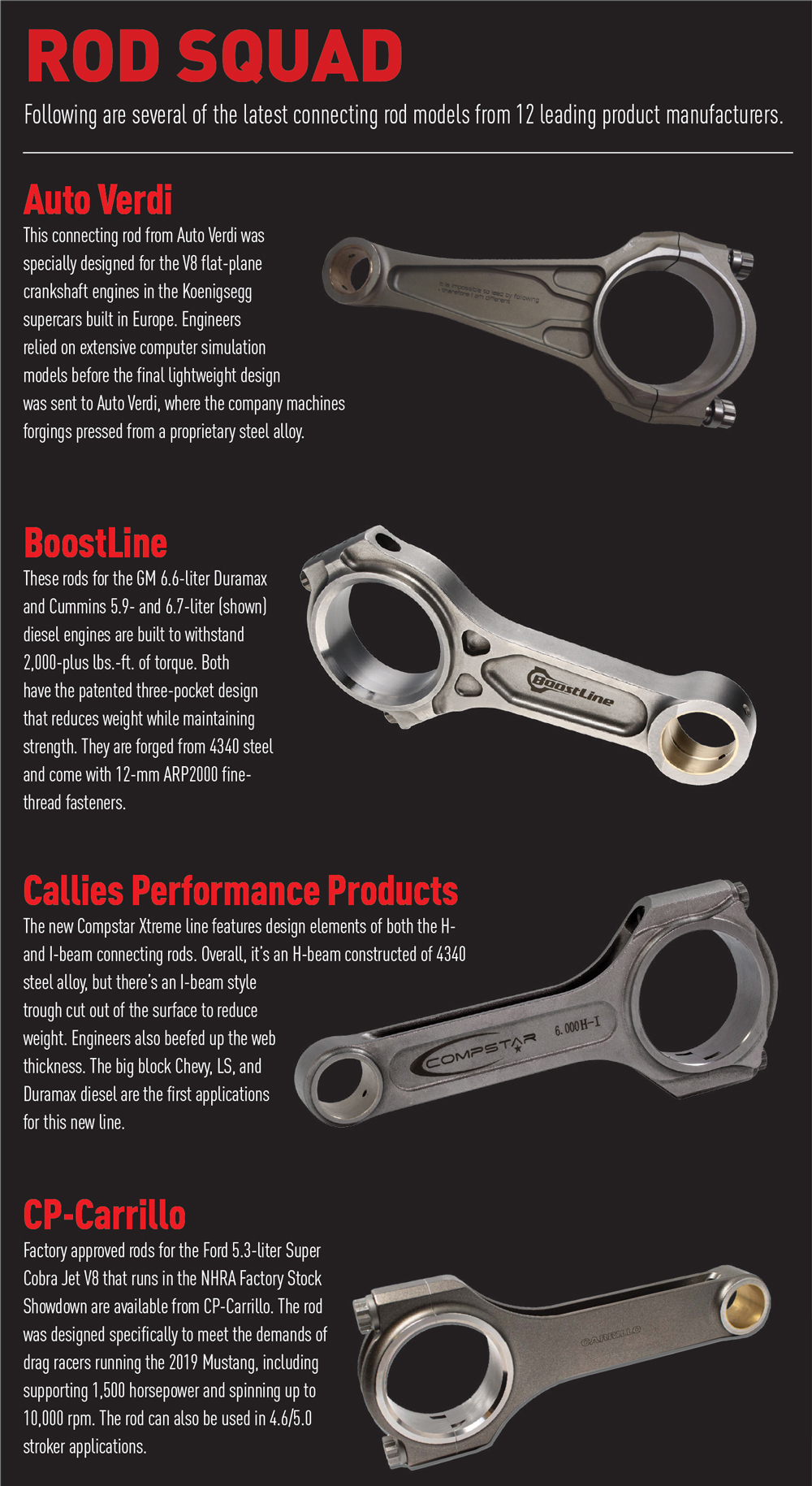
In addition to a wide range of off-the-shelf connecting rods, Callies can produce prototype rods to suit fully custom engine applications.
“The LS engine has on-center rods in the motor. When the LS first came out, nobody was making LS-specific rods, you know, with an on-center beam,” recalled Brook Piper of Callies Performance Products, Fostoria, Ohio. “So, everybody was using small block Chevy rods and never had an issue. Guys to this day still use small block Chevy rods that are offset in a LS application.
“I don’t know that it’s a critical issue,” he continued. “I suppose it would probably mean something if you’re going 300,000 miles. But race-car guys are tearing engines down and putting in new rings and pistons all the time.”
Mixing It Up
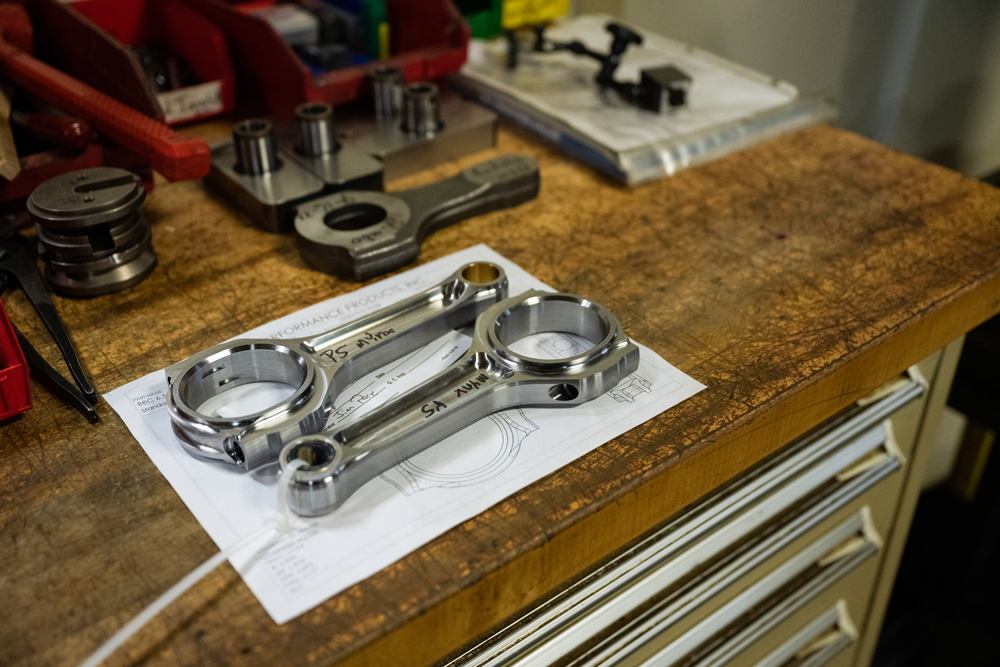
Connecting rods are constructed with the body and caps married to each other. Never mix the caps and beams. Some manufacturers will number match the two pieces in the manufacturing process. If a new set of rods is not already number matched, then mark them immediately upon unpacking.
“But avoid using metal stamps to number rods,” warned Polena. “The rod bore conformity and roundness can be affected by the use of metal stamps. We recommend using layout dye on the cap and rod and scribing or etching the numbers.”
“Also, never flip the caps around when assembling,” added Davis. “This can result in a bunch of problems. They are not symmetrical. Pay close attention to the cap orientation when assembling.”
Consistent rod weight is crucial to the balancing operation. However, some engine builders get a little too finicky and may ruin the rod trying to achieve equal weights.
Connecting rods, like these from CP-Carrillo, are constructed with the bodies and caps married to each other. For the rods to function properly, it’s crucial that the caps and beams aren’t mixed during engine assembly.
“There are a lot of perfectionists who like to think that every rod should weigh perfectly on both ends. We tell people if they’re within one or two or three grams, please don’t grind on them,” said Friedman. “When you grind on them and look at the metal through a microscope, you see fractures in the metal that will propagate a crack and cause a failure.”
If rods need to be lightened or the big ends need to be narrowed to provide the correct cheek clearance, then call on a qualified machine shop to remove the metal properly. And rods should be matched in weight.
“Never order a single rod without providing the big-end and small-end weights of one of the rods in your set,” advised Davis. “Eagle keeps many single rods in stock, and we can usually match the weight you need very closely. ‘I’ll make it work,’ sounds great until you get a rod that’s 15 grams lighter than your other seven, and then you have to remove 15 grams from those to make a balanced set. If you do not have a record of the weights when the engine was balanced, have a machine shop weigh one for you.”
High Tension
The hottest topic, by far, when discussing connecting rod installation is tightening the cap screws. For some, the practice developed into a precision art that requires purpose-built measuring devices. The days of “torque to 50 ft.-lbs. and then give it an extra tug” are over. The first bit of advice that stands out, is “don’t assume anything.”
“Always double check your torque spec on the rod bolts,” said Will Vance of Lunati, Olive Branch, Mississippi. “Don’t assume it is the same as the original factory part. This is one of the bigger issues, believe it or not, of end users. Most all our rods carry the ARP2000 7/16-inch bolt that holds more torque than an OEM rod bolt. We have call after call where the customer said the bolts were torqued to 45 ft.-lbs. and they say, ‘That’s good, right?’ Most of our products carry a torque spec of 73 ft.-lbs. with lubricant.”
Manufacturers cannot stress hard enough that the proper lubricant is critical to achieving honest and consistent torque figures.
“Each fastener is designed to stretch a specific amount using a specific lube,” said DiBlasi. “Changing that lube dramatically changes the tension and changes the amount of torque required to achieve the stretch.”
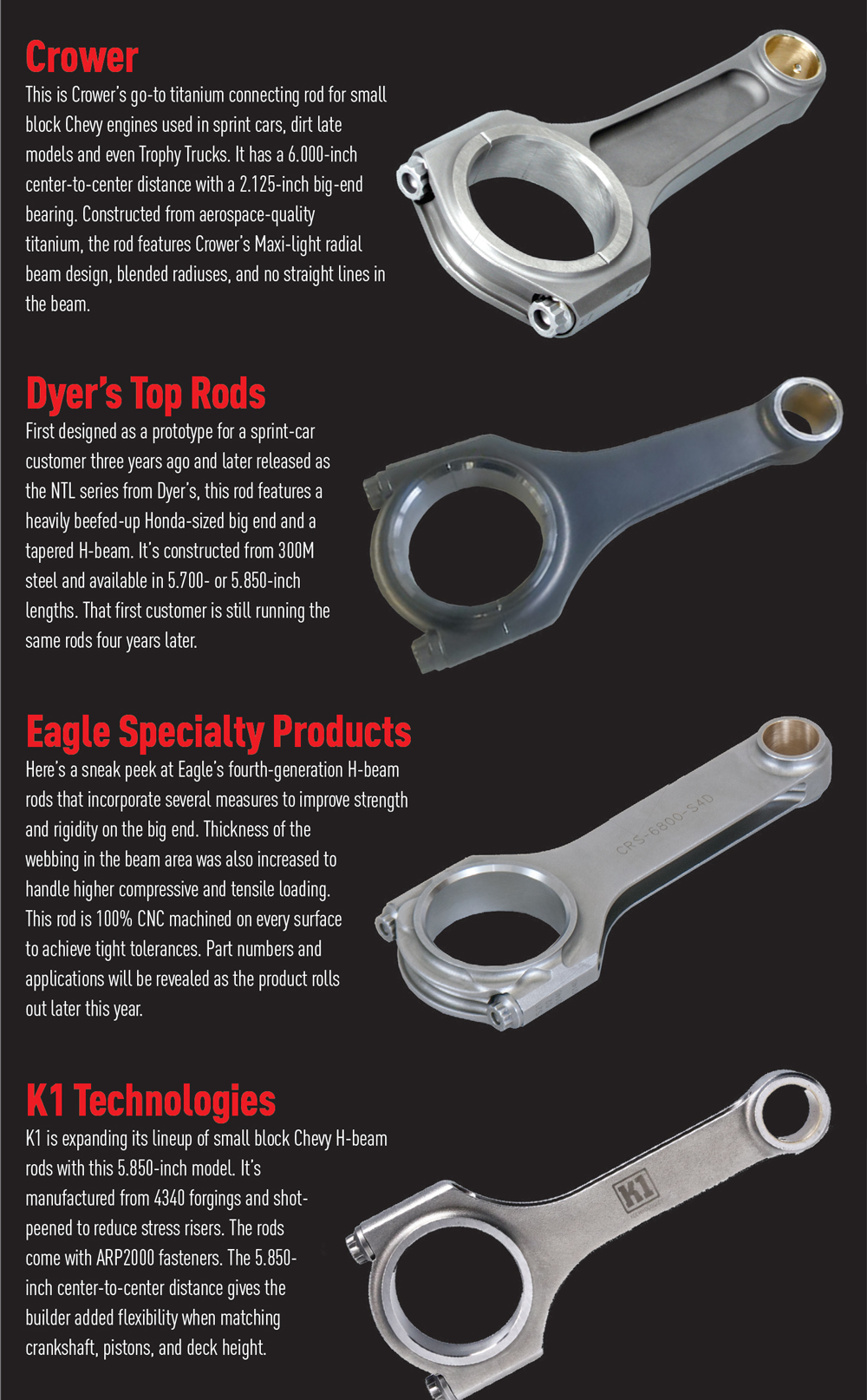
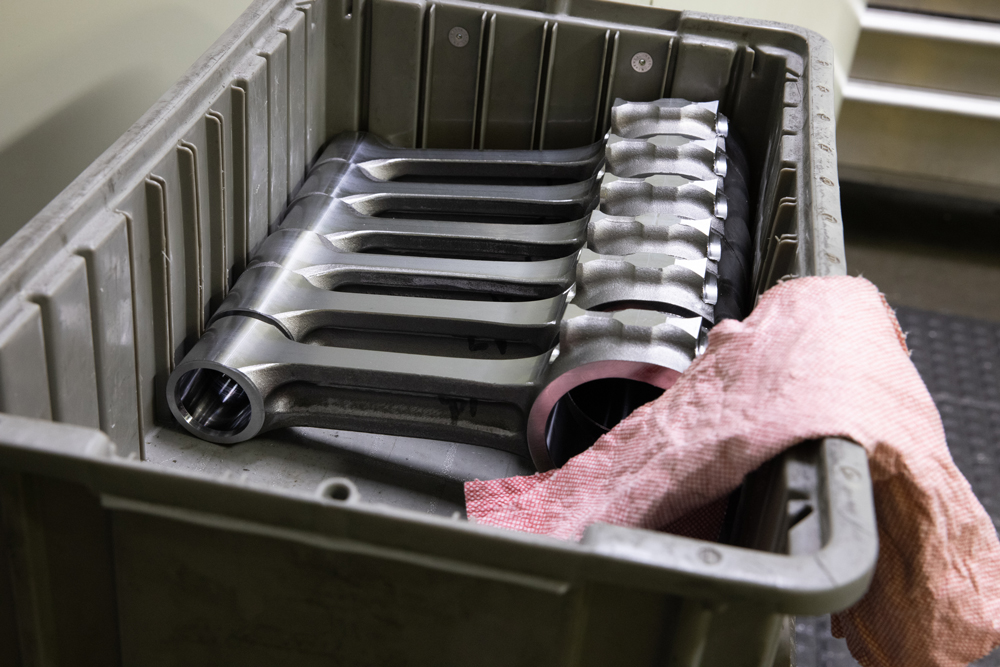
If connecting rods need to be lightened, or material removed to provide the correct cheek clearance, our sources recommend taking them to a qualified machine shop rather than performing DIY grinding. Improper grinding creates microscopic fractures that can lead to a rod failing.
“Make sure everything is clean, including the threads in the rods and the bolts,” advised Tom Molnar of Molnar Technologies, Kentwood, Michigan. “Also, make sure the lube recommended by the rod manufacturer is used, and apply the lube every time the bolts are installed, even when checking bearing clearance.”
Ask a dozen top engine builders how they install piston rings, and you’re likely to find 10–12 methods that differ slightly from one to another. The result is the same, but experienced engine builders have their tricks, techniques, and even superstitions that they follow every time. What follows is a sampling of advice for tightening rod bolts from our group of experts.
“We recommend using bolt stretch as the best method,” said Richard Batchelor of CP-Carrillo, Irvine, California. “We’ve added torque angle as the second-best method, since some applications like angled rods have blind holes, and measuring stretch is just not possible. We always tell customers that they should not use torque alone, as it is only measuring the amount of force required to overcome the friction between surfaces.”
“Bolts are nothing more than very stiff springs, and they must be stretched the proper amount to provide the correct clamping load,” explained Molnar. “Since it’s easier to use a torque wrench to tighten bolts, some people will tighten the bolts and note the amount of torque it takes to get to the right stretch then use this value to tighten the remaining bolts. The problem with torque is that it measures friction, not clamping load.
“Since the mating surfaces (threads in the rod, threads on the bolt, spot face on the rod, and flange of the bolt) can change with each tightening, it makes the correct torque a moving target,” continued Molnar. “Measuring bolt stretch is more difficult than using torque, but it is always a more accurate way to ensure the bolts are tightened correctly and helps keep the big-end bores round and to size.”
“It’s a very good idea to record the untorqued, free length of each bolt before use. On subsequent engine tear-downs, compare the untorqued free length of the bolts with their original value,” suggested Davis. “If you see any change, it is time to replace the bolts. This is the very best way to evaluate the condition of the rod bolts. Just going by ‘number of runs’ or something obscure like that is not accurate at all. Different engines have wildly different stress levels. It is impossible to gauge the life of rod bolts with any accuracy based on how many times they have been run.”
Steel rods have taken up all the discussion so far, but there are racers running aluminum and titanium rods to lower the rotating weight. Following are a couple of tips for these materials.
“It seems to be much more prevalent with aluminum rods to see installers intentionally over-torque the bolts to achieve greater clamping force, say 130 ft.-lbs. versus the recommended 105 ft.-lbs. The concern here is stress on the threads and crank bore distortion,” cautioned Michael Tokarchik of Manley Performance Products, Lakewood, New Jersey, which recently absorbed the manufacturing duties of MGP Connecting Rods under the Race Winning Brands corporate umbrella.
“When installing titanium rods, the setup is almost the same as steel as far as clearances and the like,” said Peter Harris of Crower Cams, San Diego, California. “The biggest problem we see with installation is sneaking up on the bolt torque. They’ll torque them to 10, then 20, then 30 and so on. Titanium tends to grab the bolt doing it this way, and then you’ll run into bolt problems down the road. A titanium rod wants a well-lubricated bolt and one sweeping motion to the recommended torque.”
Not sneaking up on the final torque number is also good advice for users of steel rods.
“I have explained to customers that going in small increments, such as 2 to 5 ft.-lbs. at a time, is not a good idea. It may take that just to overcome the friction, and you may not have actually moved the bolt,” warned Batchelor. “We had a customer who was only going up 2 ft.-lbs. at a time. He reached our max torque and stopped, not realizing that the bolts were under-stretched. Because of that, this resulted in a premature failure of the bolt.”
And the customer probably at some point blamed the connecting rod for the failure.
While the connecting rod is simple in design and function, care must be exercised when installing them. Actual connecting rod failures are rare in motorsports. If a rod bends or breaks, it’s almost always due to improper installation or another contributing factor, such as poor lubrication or severe detonation.
Photo courtesy of Chris Graves / Jim Murphy’s WW2 Front Engine Dragster team
Over the past 42 years, Neil & Parks has evolved from a humble chassis shop to a manufacturer of nearly every component one would need in order to put a Nostalgia Top Fuel or Jr. Fuel dragster on track. Owned and operated by the father-and-son team of Frank and Scott Parks, the shop’s ability to design and produce a wide variety of high-quality one-off parts has made it the go-to option for both domestic and international racers.
Growing up during the golden era of hot rodding, Frank Parks was interested in going fast from an early age. When he couldn’t afford to pay shops to hop up his projects, he learned to do the work himself, and that approach would eventually lead to a career in fabrication.
“I think the shop kind of started as more of a tax dodge for my dad,” quipped Scott Parks. “Norman Neil—the ‘Neil’ part of the shop’s name—was a customer of his back in 1975 when they partnered up on a race car. The business didn’t get started in an official capacity until 1980.”
He explained that his father was frustrated with the arrangement he had with the fabrication shop that he was working for at the time, so he decided to strike out on his own. “My mom was working at that point, and she was making enough to feed us and put a roof over our heads. My dad basically said, ‘Give me six months—if it doesn’t make money, I’ll go get another job.’”
The gamble paid off. Originally located in Salt Lake City, Utah, the shop moved to its current Burlingame, Kansas-based facility in 1993, and the relocation brought with it more than just a change of address. “Norm didn’t want to move,” Scott said. “He had a day job and was doing the tin work on the dragsters at night, but he’d recently gotten married and was kind of losing interest in the race cars. So we parted ways amicably.”
Although the elder Parks’ focus was initially on chassis work, over time he began to see a need to expand the company’s products and services. “During the 1980s and 1990s, basically the only people who made anything for these types of dragsters were the original guys from way back when,” Scott said. “The racing supply companies hadn’t changed hands yet. But they got older and started to retire, and eventually we reached a point where it started to become really hard to get the parts we needed to build the cars. Fortunately, it didn’t all happen at once, and that allowed us to slowly step into the manufacturing side of things.”
From its roots as a car builder, Neil & Parks Racing Enterprises has evolved to a point where manufacturing products is now the top priority. “We are so busy making parts,” said Scott Parks, “there just aren’t enough hours in the day.”
They started with air bottle clamps, but it wasn’t long before Frank Parks began to explore what other racing products could be produced in-house. “I suppose it wasn’t that we couldn’t get them, it was that we couldn’t get what we wanted,” Scott recalled. “The ones that were available were poorly made, or they were the wrong size—they just didn’t meet our standard. And it seemed like every time we turned around, something that we normally sourced from someone else just wasn’t available anymore.”
The company began adding products to the catalog little by little, and a few years ago it reached a point where manufacturing had taken top priority. “We don’t really have time to build cars anymore,” Scott said. “We are so busy making parts; there just aren’t enough hours in the day.”
Specialized Parts For Specialized Racing
Although Scott noted that Neil & Parks Racing Enterprises generally does whatever work comes in the door, the vast majority of his customers are looking for something that they can’t get anywhere else. “I don’t want to build 600 Super Comp cars, where the only difference between one car and the next is the paint scheme. That’s not what we do. If you need a one-off part made, that’s where we come in.”
He also pointed out that the company’s focus on the Nostalgia market came out of necessity more than anything else. “Some of that comes down to the fact that we’ve been around forever, so we tend to know what we’re doing. We raced in this segment for many years and won a number of championships, so that kept us close to that community of racers and ensured that we stayed on top of what was going on in the series. Because we’ve built a lot of the Nostalgia cars, we ended up designing and producing a lot of products that are specific to those cars that you just can’t get from other places.”
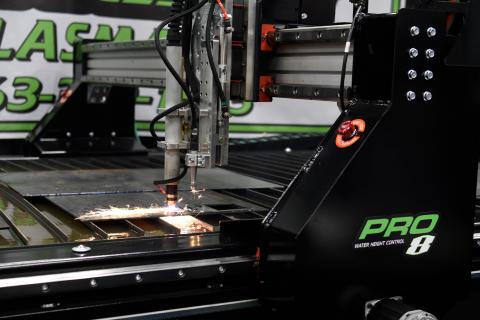
Neil & Parks Racing Enterprises designs and manufactures everything from cylinder heads and billet pistons to wheelie bars and aero parts entirely in-house. Among its equipment are three manual engine lathes, a Bridgeport mill, a CNC lathe, a CNC mill, a tracer mill, a water jet cutter, and a modified keyseater.
He noted that Heartland Motorsports Park in Topeka, Kansas, is the closest race track to the shop, but since Heartland doesn’t host a Nostalgia series, Tulsa Raceway Park—about 250 miles south of Burlingame—would actually be more appropriate to consider their “home” track.
“Since we’re working with customers all over the world, we don’t really need to be ‘local’ to any particular track. With products like these, I don’t think our location relative to the tracks that are supporting this kind of racing is a huge factor. It’s not like you can just go to your local shop and get this kind of work done.”
Tools Of The Trade
The Neil & Parks facility consists of a main, 6,800-square-foot shop and a second, 1,500-square-foot building that originally housed the team’s race cars but was eventually converted to allow for additional manufacturing capability.
“It was a situation where we’d retired from racing, and at the same time, there were just more and more products that were getting hard to find,” Scott said. “We started putting machinery out in that secondary shop because our gun drilling guy wanted to retire, and that’s where we had the space. We make some titanium driveshafts, and you can’t find titanium tubing that big and at the required thickness, so we went out and bought a huge lathe to build a gun drill. The other one that takes up a lot of space in that building is the horizontal boring mill. If you use your imagination, there’s almost no limit to what you can do with one of those. Just last week someone sent me a rearend housing with an older version of Mark Williams’ floaters on it. It had broken a spindle, and Mark won’t make parts for his old floaters, so we decided to put that rearend up on the mill, cut the old spindles out of it, and then put our floater assembly in it, something that he can still buy parts for.”
Although Neil & Parks Racing Enterprises has had an employee or two over the years, the company is largely run by Frank and Scott Parks. “It’s tough to find people to do this kind of custom work,” noted Scott, pictured here.
The only work that Neil & Parks regularly farms out is painting and anodizing, and that makes it a one-stop shop for just about anything a Nostalgia racer might need. The company designs and manufactures everything from cylinder heads and billet pistons to wheelie bars and aero parts entirely in-house, and that’s led to Parks amassing a roster of manufacturing and machining equipment that includes three manual engine lathes, a Bridgeport mill, a CNC lathe, a CNC mill, a tracer mill, a water jet cutter, and a modified keyseater that Scott uses to make internal splines for spools and couplers.
“We also offer a chassis builder training class,” he pointed out. “For $500 a day someone can come here and use all of our equipment and knowledge to build a car. Right now, that’s about as close as we come to chassis building. I’m not going to say I would never build another one, but it’s not work that we’re actively looking for at the moment.”
Keeping It Simple
Although Neil & Parks has had an employee or two over the years, the company has largely been operated solely by Frank and Scott. “It’s tough to find people to do this kind of custom work,” he said. “Even now with all the parts we’re manufacturing, yeah, it’s production, but these are small batches. A couple hundred fuel tank caps and butterfly steering wheels will last us a year or two. There’s just a finite number of dragsters in the world.”
While the operation remains relatively small, it’s not for lack of demand. “We do basically no marketing and we’re buried,” Scott said. “I think the closest we get to that is our posts on Facebook. Usually, I’ll post something when we complete a project that’s kind of unusual—something that people haven’t seen before.”
Pictured here are Neil & Parks Racing Enterprises’ customer Jim Murphy (holding trophy) and crew after winning the 2017 NHRA Hot Rod Heritage Nostalgia Top Fuel title in Murphy’s WW2 front engine dragster.
Neil & Parks customer Mike Botai told us that when he started asking friends for recommendations for shops that could help out with a build for the NHRA Hot Rod Heritage Racing Series, the company’s reputation preceded them. “I think what really caught my attention about the shop is that they really do just about everything in-house, and the quality is just incredible,” Botai said. “Initially, Frank helped me purchase an Alan Johnson motor, and I was just going to have them go through it and get it ready for the 7.0 Pro class. But I realized along the way that A/Fuel was really where I wanted to end up, and Frank happened to have a chassis available that was partially completed. I purchased that chassis from him, and we ended up building an entire car. The build really evolved as we went—it became a really custom, one-off project. They have this desire to do something that’s above and beyond what everyone else is doing, and they have the ability to actually deliver on that.”
Through the shop’s racing efforts and word of mouth, Neil & Parks has built a reputation in the Nostalgia community that keeps customers coming back. “We try to do what the customer needs, and that’s not always what they might want when they come in the door,” Scott said. “We’re not going to do something for them that we know isn’t going to work. We’ll take on experimental projects from time to time, but we make it clear up front that there are no guarantees with stuff like that. Ultimately, we just try to treat our customers right. We don’t mess with them on price, we do the work right, and we try to get the work done in a reasonable amount of time.”
While great care is taken to capture the look and feel of these old-school race cars, a peek underneath the bodywork reveals a range of modern solutions that have contributed to improvements in safety and performance.
Aesthetics play a particularly crucial role in Nostalgia drag racing, and capturing the vibe of renowned machines from decades past goes beyond recognizable liveries and iconic match-ups. Period-correct powertrains, wheel styles, and even suspension setups often play important roles in the quest to capture the essence of these well-known cars and drivers.
Yet at the same time the march of time has introduced opportunities to improve these cars’ durability, performance, and safety while retaining the qualities that make the homage recognizable. Meanwhile, other factors—like the skyrocketing values of original vintage parts—have convinced many Nostalgia series organizers to take an increasingly pragmatic approach to their rule sets in order to ensure that competitors can continue to participate. That, in turn, is bringing more contemporary hardware into the fold.
“There’s a lot of technology being used in terms of data acquisition and things like that,” said Mike Rice of the NHRA Hot Rod Heritage Racing Series, Glendora, California. “Everything evolves, so we’re under a constant barrage of new products, and we’re always considering whether something makes sense for the spirit of the rule or not. We’ve definitely seen new equipment come in that made a lot of sense to allow here. In everything from Top Fuel down to the bracket classes, the racers regularly come to us and say, ‘Hey, would this be legal?’ We basically evaluate those on a case-by-case basis. We try to keep things as original as we can, but it’s a balancing act.”
Given that, we wanted to get a better sense of how organizers in Nostalgia drag racing are achieving that balance by digging into the specifics of the types of products that are, and are not, allowed in these series.
Midwest Nostalgia Pro Stock Association
Mike Ruth told us that the goal of the Midwest Nostalgia Pro Stock Association (MWNPSA) in Chicago, Illinois, is to keep the cars as period-correct as possible, but there are areas of the car where modern improvements are a necessity. “Let’s use my car—the Glidden car—as an example. When Bob raced back in the day, he didn’t have a Funny Car cage and a lot of the other stuff that we put on there for safety. Some of it just didn’t exist back then. We do a lot of NHRA events, and they tech us just like anybody else. So first and foremost they have to meet the SFI spec and the NHRA’s safety criteria to even go down the race track.”
Ruth explained that in the early days of Nostalgia Pro Stock, many were racing with the actual original cars, but eventually those machines became too valuable to continue to race. The problem was compounded by the fact that the cars also needed to be modified in order to maintain modern levels of safety, and no one wanted to do that.
Cars running in the Midwest Nostalgia Pro Stock Association are as quick, if not quicker, than the original cars they’re based on, due in part to some of the changes allowed by race organizers. Larger engines—so they don’t have to work as hard—and modern suspension components improve both performance and durability.
He pointed out that it’s ultimately about paying tribute to the legends more than anything else. “We’re entertainers. It’s not about setting records; it’s about putting on a good show,” Ruth explained. At the same time, he also noted that all of the cars running in the series are as quick or quicker than the original cars that they’re based on, and some of that performance comes down to the changes that competitors have been allowed to make versus the original car’s setup.
“Longevity is your friend,” Ruth said. “We get paid to go down the race track, and if the car breaks, it doesn’t matter how fast you are. So we build engines that are larger displacement than the originals just so we don’t have to beat them up as much and rev them really high. That has helped. A lot of folks have more modern suspension components on their cars. As a spectator, you’re not really going to be able to see that unless you crawl underneath the car.”
It’s pretty much anything goes aside from a few rules of thumb when it comes to engine setups. “We try to stick to conventional-style heads, and the engine needs to be aligned with the car manufacturer—a Ford in a Ford, etc.,” Ruth explained. “But as long as it appears to be a Pro Stock engine, it’s usually fine otherwise.”
Although the series does not allow EFI or power adders, data acquisition systems are fair game. “These systems allow you to resolve problems quickly instead of trying to guess,” he said. “And in terms of consistency, the data helps tremendously. The cars are running in the mid-seven-second range, so they’re a handful—especially with a clutch. So these systems have a lot of benefits for tuning. We just try to hide them so they’re not in plain sight. Between newer engine components, the data logging, the modern suspension setups, and the tires, the cars are getting faster and faster.”
As the series continues to expand its ranks, Ruth expects the landscape of MWNPSA racing to evolve in the coming years. “I’ve seen it grow from half-a-dozen cars to hundreds of cars all over the country. As older guys retire and younger guys come in, eventually we’re going to see things like Erica Enders and Jason Line clone cars. We’re not there yet. But 10 years from now we probably will be.”
Nostalgia Gassers Racing Association
A gasser’s distinct look has always been a significant part of its charm, so it makes sense for a gasser Nostalgia series to really sweat the details on that front. But organizers must also contend with the realities of the marketplace. “I think a lot of associations have backed down on the rules a bit,” said Bryan Huffman of Nostalgia Gassers Racing Association (NGRA), Kewanee, Illinois. “They were getting too fussy. They wanted racers to use parts that just weren’t really available anymore, and that was driving the costs up. Some of the wheels, for instance, became really hard to get. So now we’re seeing more aluminum slotted wheels, Cragars, anything that would still be considered period-correct.”
Modern safety equipment has entered the mix as well. “The old stuff just isn’t as safe as what we have now. There were no engine diapers back in the day, and that’s an important rule for our organization. We don’t want to risk an engine failure getting oil on the tires as the car is going down the track. These cars keep getting faster, so safety is a huge priority for us.”
The guidelines established by the Nostalgia Gassers Racing Association focus on safety, as the cars “keep running faster,” said our source. They also prioritize the gasser’s iconic look, “making sure that the nose height, the wheels, and the tire sizes are correct for the period.”
NGRA’s other guidelines tend to focus on the look of the cars more than anything else, and that plays into the equipment that these racers are using. “That’s the biggest thing, making sure that the nose height, the wheels, and the tire sizes are correct for the period is what we really focus on,” Huffman said. “We allow modern ignition systems and stuff like that, but we don’t allow things like modern EFI, turbochargers, and modern-style superchargers. But we do allow methanol and the types of superchargers that they were running in the 1960s and 1970s. What’s inside these engines is totally up to the racers.”
The series also has some leniency on front suspension setups, provided the nose of the car maintains that gasser appearance. “We like the straight axle cars, but we also allow folks to run independent front suspension setups because there were a number of gassers with independent front ends back in the 1960s. Those more modern setups also make it easier to run a more modern brake system.” The series doesn’t allow racers to run independent rear suspension setups, but anything goes in the realm of solid axles.
NGRA rules prohibit stretched wheelbase and full-tube-chassis cars, but with the series competing at IHRA and NHRA tracks, the cars must meet the chassis standards for their respective ETs as in any other series. “The typical ET in our series is between 9.50 and 10.50,” Huffman noted. “So the chassis has to meet the requirements at those tracks. When it comes to safety, our drivers tend to understand that it isn’t in their best interest to do the bare minimum.”
Nostalgia Super Stock
While appearance is also key for Nostalgia Super Stock in Springfield, Illinois, Mike Singleton said that the organization’s heads-up match racing format tends to encourage some friendly rivalries that are pushing the cars to new levels. “If we didn’t evolve with the technology, we wouldn’t be going as fast as we are. We have more 8-second cars than any other Nostalgia Super Stock club in the country. And that’s a lot faster than these cars were running back in the day.”
The approach for the series is often aimed toward using old school hardware that’s been improved with modern technology. “If you were to look at the engine in my car and compare it to a current Hemi Super Stock, there’s not much of a difference,” he said. “For instance, I’m not running iron heads—I’m running Stage V aluminum heads, and I run an aluminum block as well.”
The series guidelines call for an engine block based on what would have been in the original car, period-correct carburetors, and no power adders, but the rules are pretty flexible when it comes to engine internals. “You can’t come in with a 5-inch bore space that allows for gigantic displacement, or something like that. It basically just needs to follow the original essence of the engine to a degree.”
Nostalgia Super Stock’s heads-up match-racing format encourages friendly rivalries that push these cars to new levels. “We have more eight-second cars than any other Nostalgia Super Stock club in the country,” said our source.
He added that the series has allowed mechanical fuel injection to be used in some instances, too. “It’s often subject to the membership of the club in terms of what gets allowed and what doesn’t.”
The series allows competitors to do more or less what they please with the suspension systems, but full tube chassis aren’t allowed outside of the AFX class, tire width is limited to 10.5 inches, and the safety elements must meet the current NHRA standards for the ETs that a given car is capable of. “We aren’t super strict about the wheels, though” he added. “It would be pretty hard to get wheels from that time period today. But we do run some events where you have to have period-correct wheels, or they won’t let you run. In those instances, we typically just look for re-creations that mimic what they were running back then.”
As with an increasing number of Nostalgia series, Nostalgia Super Stock is onboard with data acquisition. “It’s extremely hard to tune these cars without the data,” said Singleton. “And when you’re starting to run in the eight-second range, you’re also looking for data that’s going to tell you whether or not something’s going on that could hurt the motor on the next run. Some racers are also monitoring shocks and things like that, too. The heads-up format tends to incentivize making these cars as quick as they can be.”
NHRA Hot Rod Heritage Racing Series
With the NHRA Hot Rod Heritage Racing Series spanning across 11 different classes that range from pre-1986 street cars to Top Fuel dragsters, Rice said that the appearance of the cars tends to be one of the biggest areas of common focus when it comes to the Nostalgia rule set. “There’s not many parts that a racer could have run back in the 1960s or the 1970s that would still apply to some of these cars. It’s mostly about keeping the look right, so we have a lot of rules about the bodies that they can run and things like that, and we’re slowly moving the body years forward to stay in step with the audience as it evolves. What a 70-year-old considers to be Nostalgia can be very different from what a 30-year-old thinks is Nostalgia.”
The series allows racers to use modern components in terms of engine and drivetrain combinations, but the fundamentals need to follow what racers were using during a given era. “So they might be using billet parts and things like that, but you’re not going to see any screw-type superchargers, for example, and certain types of fuel pumps in some classes,” he said. “We’re trying to keep the costs under control, and we want the car to look right from a hundred feet away.”
The NHRA Hot Rod Heritage Racing Series allows racers to use modern engine and drivetrain components. “It’s mostly about keeping the look right,” said our source, “but the fundamentals need to follow what racers were using during a given era. We want the car to look right from 100 feet away.”
The specifics tend to vary from class to class, though. “Top Fuel classes are going to have aftermarket blocks, but most of the other classes are going to be more conventional aluminum blocks. They’re going to be a little bit different as compared to an original Chevy 454, but it’s going to follow that same basic size and design.”
The safety rules follow the NHRA’s standard guidelines based on ETs, which range from a helmet and seat belt in anything that’s running 13.99 or above to certified rollcages, five-point harnesses, fire suits, driveline loops, and SFI-rated bellhousings and other protective measures for anything quicker than 9.99.
While the nostalgic look tends to be a focal point for the Hot Rod Heritage Racing Series, Rice pointed out that there’s some flexibility in that area for most classes as well. “In Nostalgia Funny Car, for example, there’s a lot of leeway in terms of what they can do to the bodies. A ’75 Trans Am just more or less needs to retain that ’70s Funny Car look. For the door cars there’s even more flexibility—the only limits are on wheelbase and that kind of thing. Body-wise, they can pretty much make any modifications that they want.”
Rice said that he doesn’t foresee any major changes coming to the series over the next few years, but he does expect ongoing tweaks to help shape the landscape of the Hot Rod Heritage Racing Series as time goes on. “The biggest thing for us is that they look correct. And we’ll adjust body year limitations as we go forward. We’re thinking that 35 years old is what most people would consider to be a Nostalgia vehicle.”
Sources
Midwest Nostalgia Pro Stock Association mwnpsa.com
Ever wonder how the equipment on Machinery Row can enhance your company’s bottom line? Here, a half-dozen entrepreneurs reveal how machines that were featured in this popular PRI Trade Show destination boosted their shops’ quality and productivity.
There’s probably more drooling in and around the annual PRI Trade Show’s Machinery Row than any other area of the Indiana Convention Center and Lucas Oil Stadium. High-end manufacturing equipment worth millions of dollars is on display, along with countless time-saving tools and replacement items like abrasives and cleaning supplies.
Machinery Row is also where solutions are found.
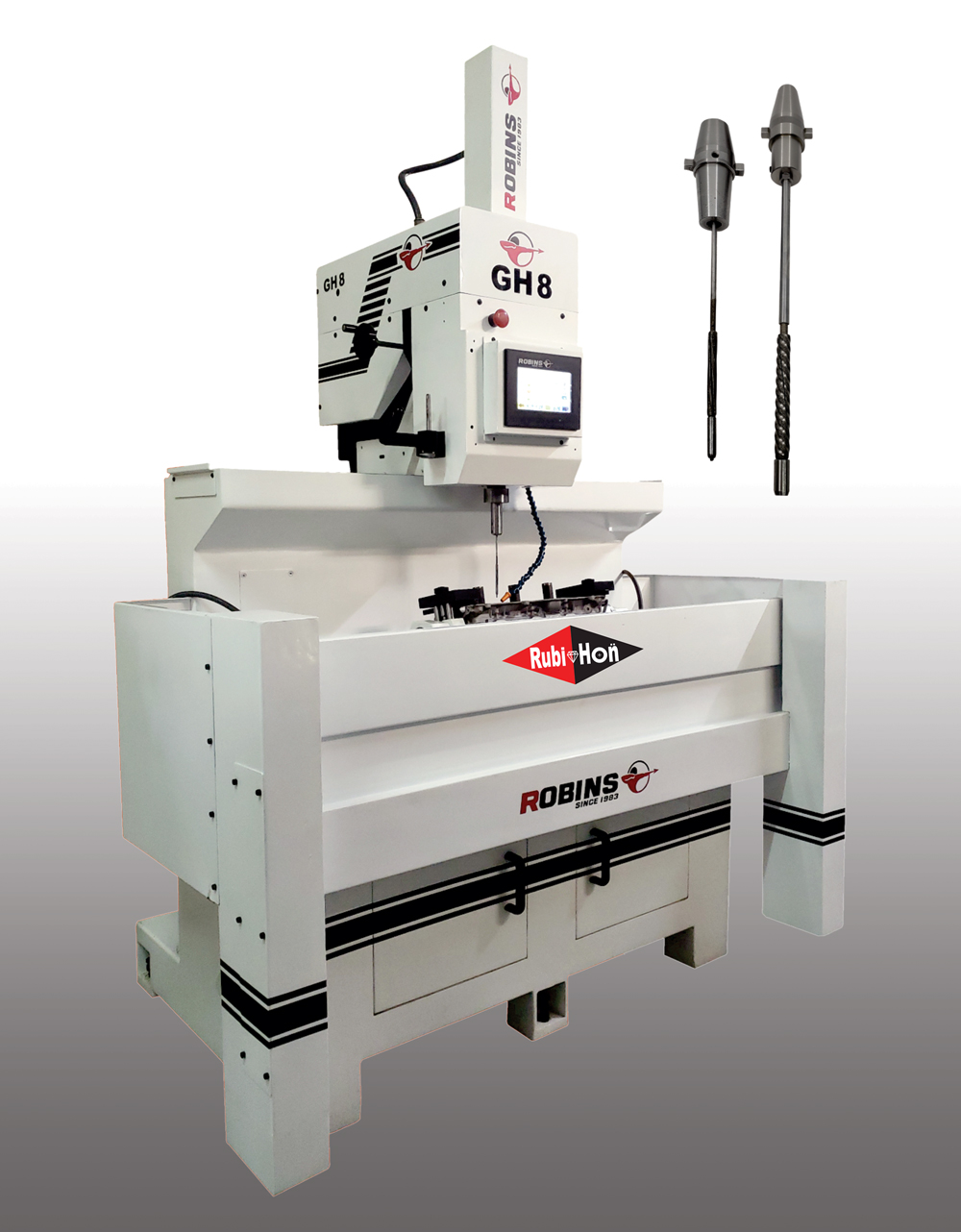
Robins is one of many machinery manufacturers set to display their latest equipment at the 2022 PRI Trade Show. The company’s GH 8 Super Precision valve guide honing machine was designed specifically for shops building small- to mid-size cylinder heads, as well as for high-volume engine rebuilders.
“One of the things that’s really cool about PRI is if you have some problems in your business that you’re trying to sort out, or you’re trying to improve the throughput, you got all these guys there, showing you all the latest technology,” said Dan Fitzmaurice of Zipper’s Performance Products, Elkridge, Maryland. “We really like that part about the Show. I’ve been going to that Show for a long time, and I always bought a lot of tooling and things from it because it’s always improved our business.”
Dozens of companies fill the hallowed Machinery Row section of the Indiana Convention Center to showcase the newest machinery and update racers on new software, training opportunities, and support products for that equipment. The latest trends involving traditional metal fabrication and high-tech billet machining are also demonstrated.
In fact, the manufacturers enjoy the PRI Show for having access to customers with needs outside of racing. That is, the customer is a racer and is at the Show to improve vehicle performance; yet those same racers may need machinery, welding equipment, and supplies for their construction business or other trade. One exhibitor on Machinery Row at last year’s Show hinted that 80% of his sales at that point in the Show were to operations outside of actual racing.
With a promise of that type of problem solving, Machinery Row at the 2022 PRI Trade Show should be more popular than ever. Following are several examples of how Machinery Row exhibitors worked with race shops in the past to solve their problems. Some of these stories came from direct sales at the Show, and others were from follow-up conversations and visits.
These stories reflect many of the current trends in the industry that racers are experiencing, especially on the labor front and sourcing either parts or services. Manufacturers are offering products that are more automated, allowing shop employees to concentrate on other areas of need. Also, these machines are easier to learn, and manufacturers are setting up comprehensive training programs to help bring newcomers to the industry. There are also exhibitors showcasing the latest in 3D printing, new measuring and scanning tools, updated CAD/CAM design software, and other high-tech solutions dedicated to racers.
Bottom line: There’s a wealth of knowledge, experience, and skills available at Machinery Row to help solve just about any production and fabrication problems that a race shop might present.
Smooth Operator
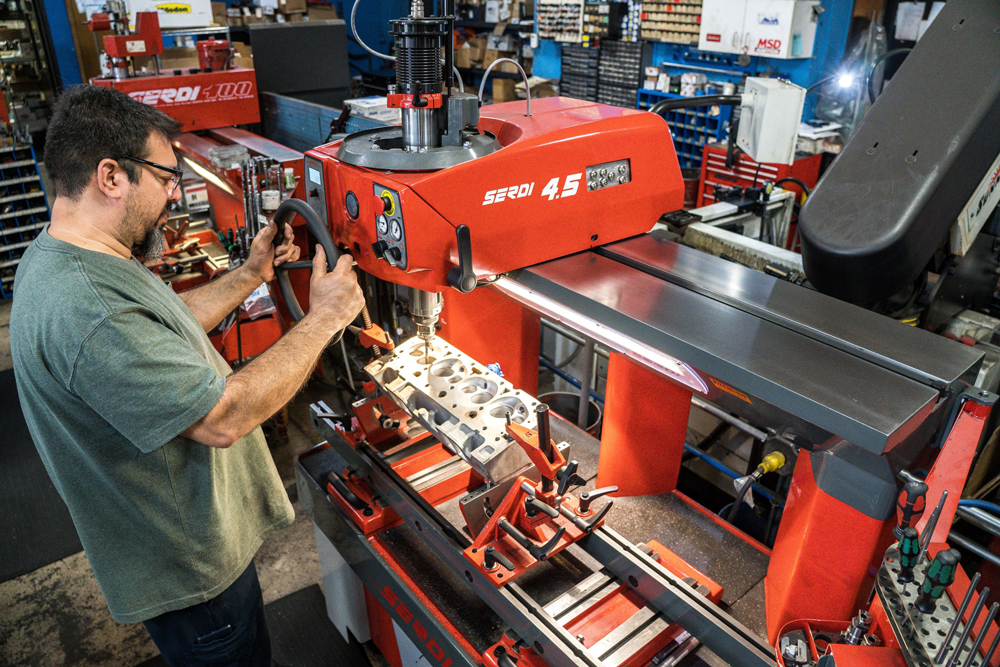
A noteworthy part of the work at Don’s Auto Parts and Machine Shop in Kenosha, Wisconsin, is prepping GM 604 crate engines for competition at area dirt tracks. The recent addition of a Serdi 4.5 seat-and-guide machine that was purchased through RT Sales in Highland, Michigan, has provided two significant benefits for the shop.
“One is that business is very well off right now. We did not get rid of our old Serdi, so the idea was to expand and have two machines so we could have more employees,” said Tony Pontilla. “The second benefit was, obviously, stepping up to a more automated product and a product that turned out much better work. We do about 40 604 crate engines a year that run in the non-winged IRA sprint cars. The ticket was just getting the valve jobs we wanted compared to the old machine. It gives us the ability to put in oversized valves and do custom multi-angle work.”
Don’s Auto Parts and Machine Shop in Kenosha, Wisconsin, recently purchased a Serdi 4.5 seat-and-guide machine from RT Sales in Highland, Michigan. Adding this second Serdi machine to the shop will improve productivity, Tony Pontilla said, and enable him to hire more employees. Here, cylinder head tech specialist Hector Laracuente works on a head from a 410 winged sprint car engine.
Working with Russ Tierney at RT Sales provided an incentive for the sale. “With Russ, whenever there’s a problem, he’s even driven here to work it out,” said Pontilla. “He’s somebody who cares about what he does and goes out of his way to help you out. That’s why we deal with him and RT Sales.”
Working with younger employees is another reason Pontilla likes the Serdi 4.5. He has a large shop with 20 fulltime employees and is eager to introduce machine work to the new workers.
“Training is something we had to do. With the automation on the 4.5, it makes it difficult for a new employee to make a large mistake,” noted Pontilla. “All the dial indicators and electronics make it a lot easier for a new person to understand what they’re doing.”
Finally, it’s all about productivity when investing in new equipment. “Production-wise, a job that took us maybe two hours before, we can turn out with this machine in probably an hour or hour and 15 minutes. It’s probably trimmed close to 50% off our times,” said Pontilla.
No One Else
“Long story short, I bought the machine because I can’t get anybody else to do it for me.”
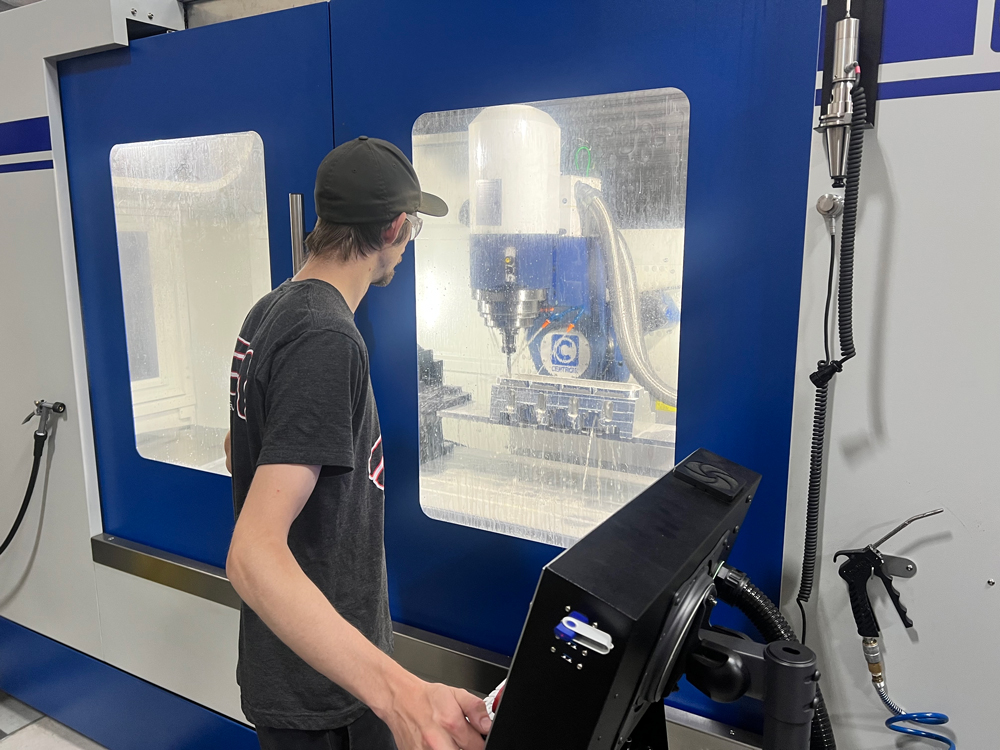
That’s Steve Morris talking about the arrival in January of a Centroid A560XL to his Muskegon, Michigan, shop, Steve Morris Engines.
“I can’t get outside companies to do anything,” continued Morris. “So I bought the machine to do it myself. Right now, we’re making our own billet cylinder heads and, potentially, making our own billet blocks if we have to.”
Steve Morris (not pictured) purchased a Centroid A560XL for his Muskegon, Michigan, engine building shop because he was having trouble finding an outside machine shop to do the work he needed. Today, he’s not only machining his own billet aluminum heads, but is taking on outside fill work. “I can probably keep it busy 24/7,” he said of his new Centroid.
Morris has designed two V8 race engines, the SMX and SML, for high-powered drag and endurance racing. Both are constructed from billet aluminum. For example, a cylinder head will start out as a 105-pound chunk of aluminum, and after the Centroid is finished, there will be a 30-pound cylinder head.
The XL is the larger of the two A560 systems available from Centroid.
“It’s suited for customers with the intention of getting into a five-axis machining system to satisfy the need for CNC porting, engine-block machining, and for making other parts,” said John Cowher of Centroid, Howard, Pennsylvania. “The system has been upgraded with high-torque 40-horsepower spindle, and 1,000 psi coolant through the spindle.”
“Right now, it’s staying busy on a continuous basis. We’ve taken on a little bit of fill work and doing a couple of programs for others,” said Morris. “It’s a mesmerizing machine, just standing there watching it.”
Cowher said the turnkey elements available with the A560 series include necessary hardware, Mastercam software, digitizing software, probe, tooling, fixture plates, and a comprehensive training program.
“Centroid does a great job of training, and I ended up hiring a guy who was already trained in using the machines,” said Morris.
“I can probably keep it running 24/7,” Morris added.
Breaking Through A Roadblock
As business was booming at Zipper’s Performance Products, cylinder honing was a priority service that was falling behind.
“Honing is like an art because it’s a difficult process to do right,” explained Fitzmaurice. “We have a double handicap in the motorcycle industry because we don’t have blocks. We have air-cooled cylinders, and there is less structure to them than a conventional engine block provides.”
Those cylinders can have odd shapes to fit in the crankcase, and they are known to flex during the honing process. Basically, it was taking too long to perform the honing operation on a 20-year-old machine and still meet the shop’s quality standards. Fitzmaurice attended the PRI Show and discussed his problem with Bob Davis at Sunnen Products Company. Zipper’s sent some samples and fixtures to Sunnen, which then put together a demonstration of the SV-30 at its St. Louis, Missouri, plant in March.
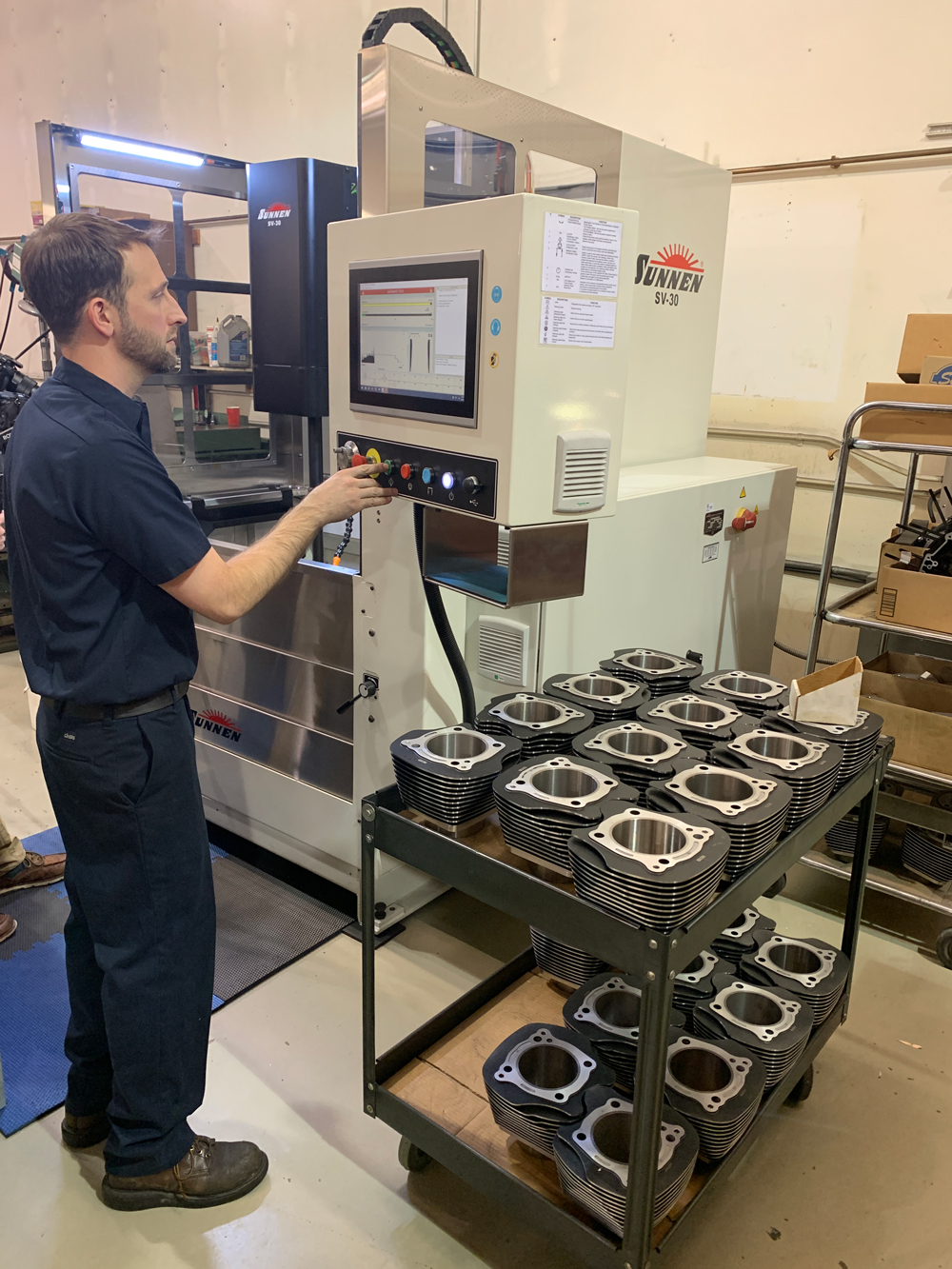
Engine builder and machinist Justin Bender works the Sunnen SV-30 honing machine at Zipper’s Performance Products in Elkridge, Maryland. The shop fabricated a dedicated fixture that holds motorcycle cylinders for the honing procedure.
“The SV-30 is automated, so it moves from cylinder to cylinder by itself,” said Fitzmaurice, noting that the shop-made fixtures hold four cylinders at a time. “The other thing, it has the ability to hold even more parts with a different fixture.”
Cylinder production almost doubled when the SV-30 was brought up to speed, and the shop is looking to the future when experienced technicians will be retiring.
“Remember what I said about honing being an art? I look back at all the years of honing on a conventional machine, even with diamond stones, and say that it’s very art-like. This Sunnen machine takes a lot of that out,” noted Fitzmaurice. “Now it’s a task, and you just line up to do the work. It does what you ask it to do, very quickly and very precisely.
“My partner, we’ve been doing this stuff together since the beginning,” continued Fitzmaurice. “I was wondering what we would do when he retires. I don’t want him to be sitting in front of that machine for 10 years past retirement, just to precision hone liners. The SV-30 just does it!”
Tighten Up the Seal
Baldwin Racing Engines in Friedheim, Missouri, offers a wide variety of performance engines, including those specially built for demolition derbies. Jeff Baldwin’s previous cylinder honing machine provided the basics, yet he was looking for greater precision because cylinder seal was becoming more of a priority in competitive racing.
“The Rottler H85AX is probably the best piece we’ve bought to date, as far as a game-changer in the shop,” said Baldwin. “It is so accurate. It produces such a round, straight hole with little to no influence on our end.”
Baldwin noted that he can set up a block for honing while he trains a new employee on other equipment. “It runs all day long, and I don’t have to worry about what it’s doing,” he said. “As long as you feed it the right information, it’s so dead-on accurate.”
Cylinder honing has become more critical in today’s racing environment because sealing the cylinder is vital to building horsepower. Baldwin relies on diamond honing stones and uses a profilometer to verify the results.
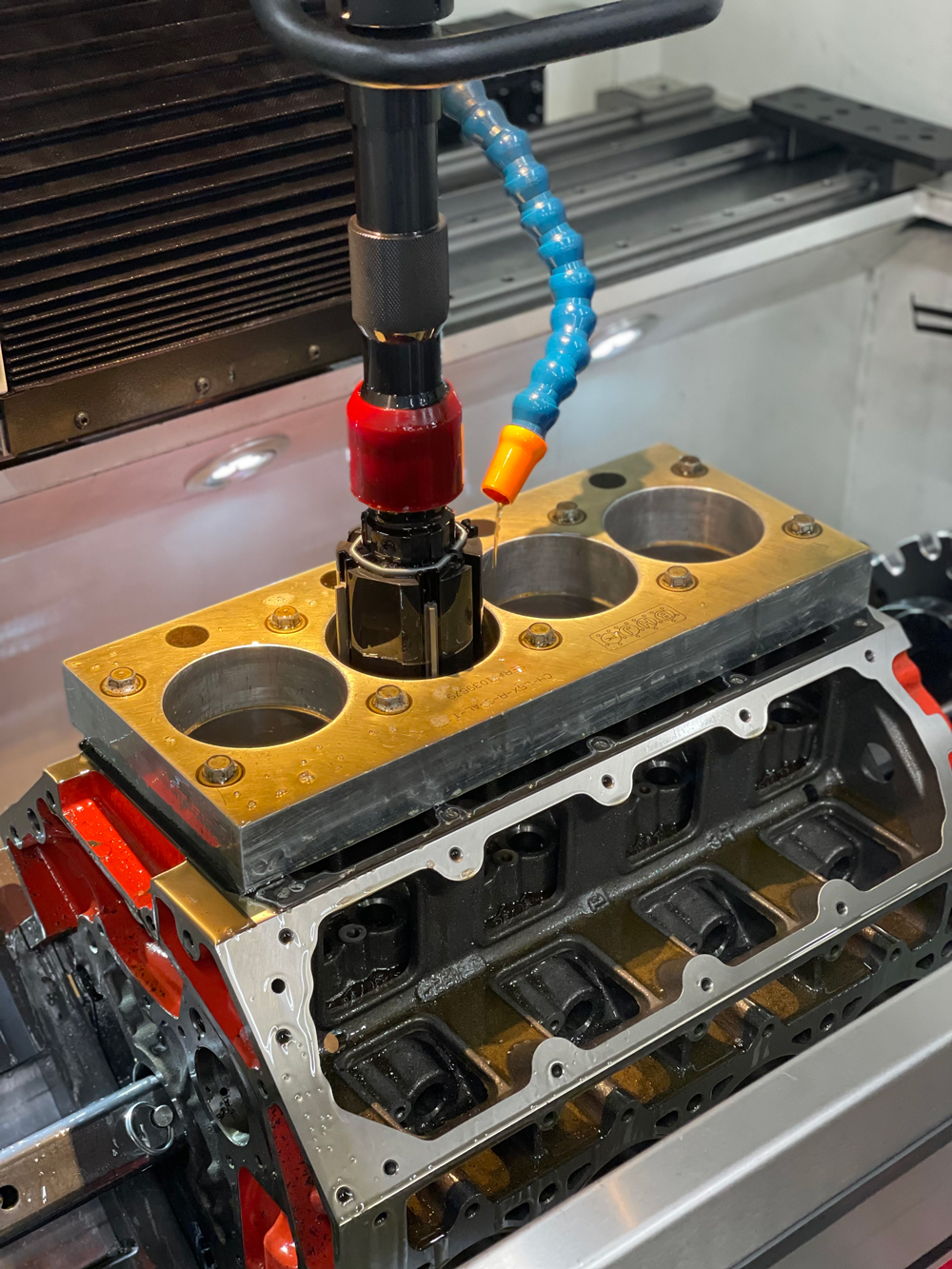
Cylinder honing is critical in today’s racing environment, which is why Baldwin Racing Engines in Friedheim, Missouri, purchased a Rottler H85AX honing machine. Jeff Baldwin called it “a game-changer in the shop. It runs all day long, and it’s dead-on accurate.”
“The surface finishes that we can produce now versus what we were doing before are just so much better,” said Baldwin. “Our valley depths and the Rpk, the Rvk, and all the measurements that the top shops are using now, we can produce and repeat it every time. We want to put more valley depth, and not that you couldn’t do it before on other machines. But with that diamond being so rigid, it produces the same thing every time.”
The consistency from cylinder to cylinder has impressed Baldwin, especially when file-fitting rings. He said the little difference in cylinder size can show up in the ring gap.
“I’m within a half-tenth to no more than a tenth variance from hole to hole, it’s just so much better,” he added. “It took 45 minutes of time savings just in file fitting the rings.”
Finally, the speed and flexibility of the Rottler H85AX allows Baldwin to specialize in a wider range of engine applications. “Well, we’re still heavily into the UMP modifieds, Late Models, and demolition derby—those are still our most popular builds,” he said. “But we do everything for street cars: a lot of Coyotes, LS, and Hemis.”
Balance Sheet
Purchasing a crankshaft balancer from CWT Industries of Norcross, Georgia, allowed Jody Gunter Racing in Valley Mills, Texas, to expand the shop’s services.
“Basically, this is a new venture,” said Jody Gunter. “I was at the point of doing something new in my business. So, that’s how it came about.”
Gunter focuses on domestic engines with a slight preference toward Ford because he offers a performance cylinder head for big block Fords. He used to outsource the crankshaft balancing before purchasing the CWT 5500.
“I drove to Randy Neal’s place in Atlanta to pick it up and take a crash course with him,” explained Gunter. “I was very pleased with the training experience. I was very impressed with his facility. You know, you make a purchase, and then you wonder maybe later if you did the right thing. I feel really good about the fact that they are going to be there to help me, since this is new for me.”
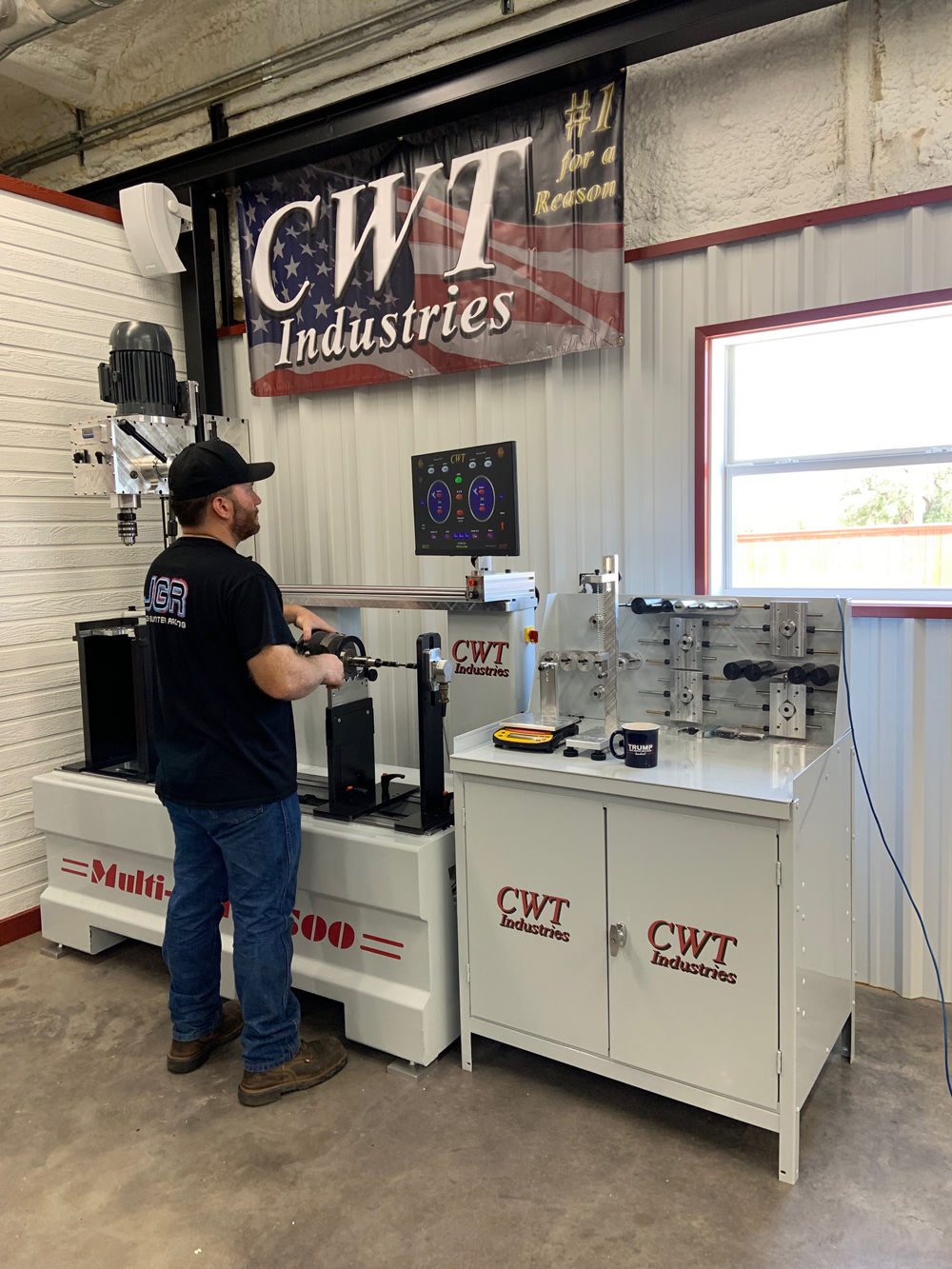
Jody Gunter Racing in Valley Mills, Texas, used to outsource its crankshaft balancing, but Gunter found that many of his local machinists were retiring, with no one replacing them. “It’s forced me to step in and do it,” which is why he bought a Multi-Bal 5500 balancer from CWT Industries. He was pleased with the training he received and happy about the post-sale support he will get “since this is new for me.”
Balancing the engine’s rotating assembly is somewhat of a black art. Engine builders have theories on overbalancing and underbalancing. Gunter had long observed a local engineering legend named Ted who balanced assemblies on an old Stewart Warner machine. When Gunter went for his training, Ted came along.
“I quizzed Ted on the way up there about overbalance, underbalance. We got to Randy’s, and once we got to that discussion, it was pretty interesting,” recalled Gunter. “He has some very interesting theories. One thing that I did notice about Randy is, if he’s got a theory, he’s got a calculation behind it, and I like that.”
Gunter’s work with the CWT balancer won’t just be for engines built in his shop. He plans to take in outside work and grow that part of the business.
“The issue that I’m running into here, is that we’re losing all of our local machine shops,” said Gunter. “The good ones are retiring, and nobody’s stepping up to do it. What we have left, the quality just isn’t great. So, it’s forced me to step in and do it.”
Setting the Table
The Garage Shop in Catawba, North Carolina, used to have a 5x10-foot roll-around wooden table that was the community workbench.
“It looked like a dumpster pretty much all the time,” recalled Aaron Brown. “So I bought everyone in the shop a 3x4-foot welding table from Quantum.”
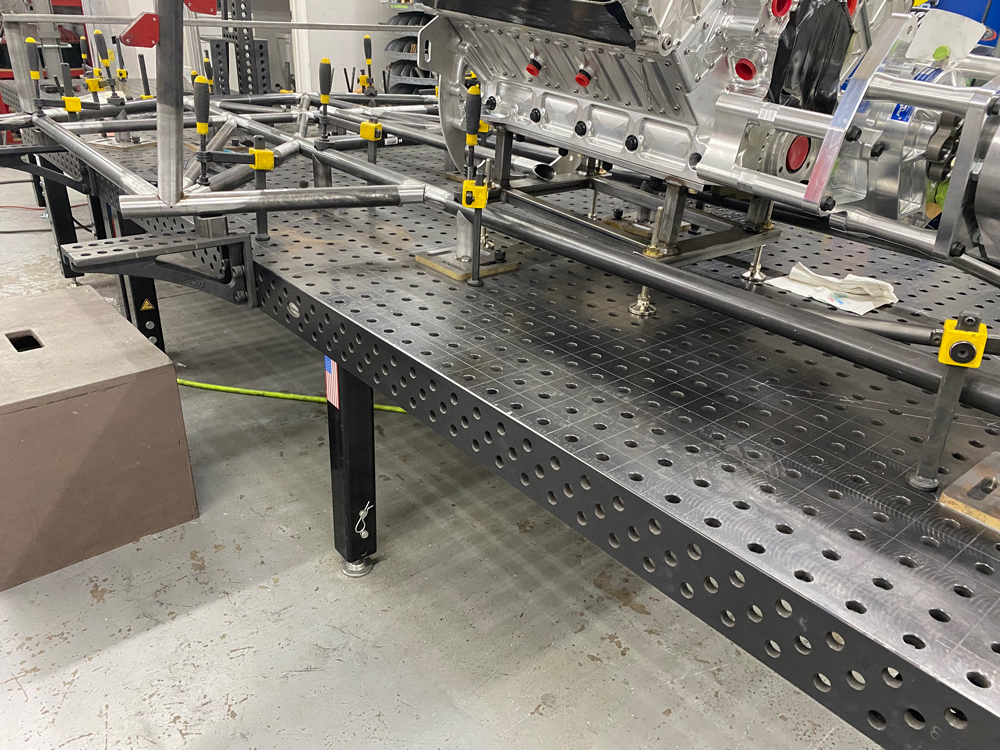
Quantum Machinery of Charlotte, North Carolina, is a distributor for Siegmund welding tables and fixtures, which are manufactured in Germany. They are available in different sizes and styles. The Garage Shop has purchased a total of 10 Series 16 Imperial tables that are constructed from hardened steel and treated to a plasma nitride finish. The tables can easily be connected to provide a large flat surface for special projects.
The Siegmund welding tables distributed by Quantum Machinery of Charlotte, North Carolina, can be attached to form a platform long enough to build a dragster or a Bonneville streamliner. Here are the tables in use at The Garage Shop in Denver, North Carolina.
“Right now, we’re building a Bonneville streamliner with a 280-inch wheelbase,” said Brown. “The whole car is on tables now. They always give you a zero plane to work from. With them being gridded, you can do sideline measurements to make sure your chassis is center of the table. We actually made a body grid over the chassis. So while they’re building the chassis, they know where the body sits.”
The shop designed and built its own fixtures for the tables. “You can get as creative with those tables as you want,” added Brown.
Other chassis projects at the shop include a pair of 1934 Ford roadsters that will run Bonneville and a new Pro Mod car that, ironically, will be used to test the engines designed for the streamliner.
“Our engine program for the streamliner runs supercharged Noonan Hemis. Steve Morris is doing all our engines for the streamliner,” explained Brown. “So, we wanted a vehicle to go test our engines after the dyno and before we put them in the streamliner. We decided to build a Pro Mod car that we’re going to run a mile and a half and basically test our streamliner engines in the Pro Mod car.”
 MEMBERSHIP LOGIN