K&K Insurance, the Fort Wayne, Indiana-based motorsports insurance company, has announced Ron Norton as its new president and CEO. He replaces Todd Bixler, who retired after 12 years with the company.
With 36 years at K&K, Norton began as an associate underwriter in 1986, according to published reports. He would later manage programs including leisure camps, campgrounds, and more before being promoted to vice president of the leisure division in 2007. In 2019, he was promoted to chief underwriting officer.
K&K Insurance is a subsidiary of Aon Risk Solutions and also provides sports, leisure, recreation, event, and entertainment markets.
Knowing which candidates support racing when going to the polls or voting early is essential. Arizona, Kansas, Michigan, Missouri, and Washington will hold their 2022 primary elections on Tuesday, August 2, and Tennessee will hold its primary on Thursday, August 4. Visit PRI’s Vote Racing page for information on voting in the primary, including absentee and early voting, registering to vote, and identifying your lawmakers and the candidates running in 2022.
The Recognizing the Protection of Motorsports Act (RPM Act), H.R. 3281 and S. 2736, enjoys strong support from Arizona, Kansas, Michigan, Missouri, Tennessee, and Washington members of Congress. The bi-partisan RPM Act guarantees the right to modify street cars, trucks, and motorcycles into dedicated race vehicles and safeguards the industry’s right to offer parts that enable racers to compete. For more information on the RPM Act, visit saveourracecars.com/about.
Below are the federal lawmakers who have co-sponsored the RPM Act in the 2021–2022 session of Congress and are running for re-election in 2022.
From drag racing to drifting to content generation, this driver-turned-owner of the winningest team in Formula Drift history describes what motivates him, how motorsports is changing, if he plans to return to the driver’s seat someday, and what’s left for him to achieve.
Stephan Papadakis is the founder and owner of Papadakis Racing, a professional drifting team based in Carson, California, which has been competing in the Formula Drift series since 2004. With four championship titles, Papadakis Racing is the winningest team in the history of the series. Fredric Aasbo, a Papadakis driver, is doing his best to earn a fifth title for the team as he stands second in points halfway through the 2022 season (when this issue went to press).
But there’s much more to the Papadakis story than simply fielding drift cars. Papadakis has broken new ground in past efforts, including the first front-wheel-drive, tube-framed drag racing car in US competition. The Papadakis team earned multiple championships and records in drag racing before turning to drifting. Today, a big part of the team’s public presentation is a YouTube channel with detailed tear-down and build-up videos, and the channel is backed up with a healthy social media effort, including more than 133,000 followers on Instagram.
Papadakis’ success on track and online has led to desirable partner relationships with Rockstar Energy Drinks, Toyota Racing, Nitto Tires, AEM, and Motegi Racing, among many others. Toyota has even featured Papadakis cars in its commercials for the new GR Supra and GR86. We sat down with Papadakis to dig a little bit into his secrets for success.
PRI: How did you get started in this business?
Papadakis: I got into racing at 13, 14 years old. I was really into radio-controlled cars. Once I got my driver’s license and realized I could modify and race real cars, I wanted to be a race car driver. But then I realized that was expensive! You have to go to the race track and do all these things that my family wasn’t into. But I had a bunch of other friends who were all mutually interested in motorsports, and we learned how to work on our cars. We’d go to the local drag racing events, and I just kept learning and kept making friends and networking. After high school I worked at a place that built racing car engines, where I could learn how to work on cars better. Around 1999, I was really continuing to invest in my racing, and at that same time, the sport compact and import scene was really rising, and we were doing events like Battle of the Imports, Pomona, and different local drag racing events.
Papadakis Racing has been competing in the Formula Drift series since 2004 and is the winningest team in the series’ history with four championships. This year, driver Fredric Aasbo is gunning for a fifth title in the team’s GR Supra. Photo courtesy of Formula Drift.
PRI: This is when you started having real success in drag racing?
Papadakis: At that time, I was running a front-wheel-drive Honda drag racing car. That scene was really blowing up all over the US around the time the Fast & Furious movie came out, and they started having all these import events. I had a really quick car that people were interested in watching, and I started going to the different import events across the country. I was getting into magazines and DVDs and things like that. I was able to get sponsorship and just built the team from there.
PRI: Getting those first sponsors is never easy. How did you bootstrap that process?
Papadakis: We’d do more events each year, get a little bit more sponsorship each year, continue to reinvest in making the car quicker, and make sure that we were promoting the sponsors well. It evolved over the past 20-plus years into what we’re doing now. I went from drag racing into drifting, and we’ve always tried to build the most cutting-edge vehicles in our space and also to be on the front end of where people are getting their information. Like I said, it was magazines for a while, and websites, and now it’s our own content.
PRI: Let’s talk about that content. How do you figure out what to cover, and how do you produce the videos?
Papadakis: We work with Jen Horsey, and she’s great with marketing and communications, but she’s also great when we talk about content. For a YouTube video, I’ll brainstorm with her about a concept and the story we’re going to tell. Then we’ll collaborate on editing and make sure that we always come out with something that’s interesting and compelling for somebody to watch.
PRI: What does it take to operate at the top level in the Formula Drift championship?
Papadakis: It ties into the reason I like motorsports, which is that I like progression. I like having something that we’re always trying to evolve and make faster. I mean, it’s definitely a team effort. You have to have a driver who is quite good. You need a reliable race car that has good speed and handling and that the driver’s comfortable with. You need to have a strong team as far as resources. We work with Toyota, Rockstar Energy Drink, and Nitto Tires, and several other companies within the industry that allow us to continue to invest in the race car and go testing. Whether it’s making more horsepower or figuring out how to make the car handle better and have more speed and more angle, we work on a lot of different things that make a competition drift car competitive. Because of our team, we can continue to invest time and resources into that.
PRI: Do you have a management style or a secret to getting top performance and results out of your team?
Papadakis: Motorsports is typically filled with passionate people. They’re there because they love to be there. Number one, we work with people who want to be at the track, and they want to win. Then, we’re very analytical. We have goals of, let’s say, winning an event, and then if we don’t win or we don’t do that well, we analyze what happened and we ask where we can improve. Then we focus on improving in those areas. It could be speed or could be reliability, or it could be spare parts if something goes wrong. We make sure that next time we go and compete, we’ve resolved those shortcomings, and it continues to evolve the program to where it’s more competitive.
Before he entered the drifting world, Stephan Papadakis made a name for himself in the import drag racing scene, piloting the first tube-chassis, front-wheel-drive Honda in US competition. His success and the resulting media attention opened doors to sponsorships and his being able to form a race team. Photo courtesy of Toyota Racing/Larry Chen.
PRI: If I asked your employees about your management style, would they say, “Stephan gives me a goal and turns me loose,” or “He’s over my shoulder the whole way?”
Papadakis: I float in and out of micromanaging. I micromanage a bit to make sure that whoever’s working on a project is on track, and then I let them go with it. If they do well, then I give them more. If they are challenged in some way, then we find out why and try to resolve that. I use a lot of communication, a lot of lists. I’m really into writing things down and having a set of goals. If we’re maintaining the vehicle, what are the items that we’re maintaining, and making sure that we are completing each one of those items. If we have some goals on performance, what specifically are those goals, and how are we going to get there? We write those down and then we work on accomplishing those goals. So, having a clear definition of where we are, where we’re trying to get, and then the path to get there. That’s the thing with motorsports that I like: Each time you go to another competition, you are basically getting graded on how well you achieved those goals.
PRI: How many people are employed at Papadakis Racing? Are your drivers employees or customers?
Papadakis: We have all of that. As far as employees go, we have Fredric Aasbo who drives, and I have two other full-time technicians at the shop. Then when we build a car that takes a certain skill set, we’ll bring in experts in fabrication and vehicle building for the period of time that we need. If we have something like engineering, something that could be electronic or mechanical, I’ll deal with some consultants specifically on those projects. But we don’t build cars all year long, so we’ll use those contractors for a period of time. Then when we go to the racing track, we go from a smaller team of three or four who are normally at the shop up to about 12. We have contractors and technicians and a truck driver on the event weekends, so there’s more of us.
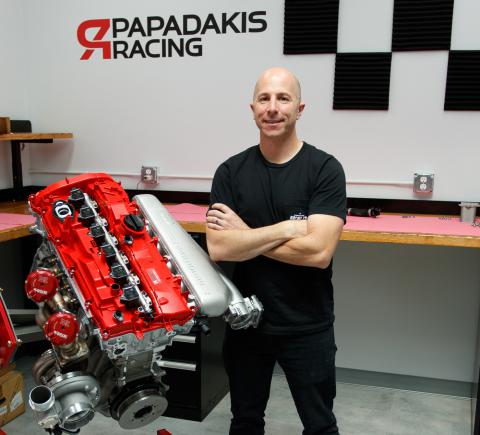
Stephan Papadakis, seen here at his company’s engine dyno, got his start in the performance business working for a race car engine builder so he could “learn how to better work on cars.” Photo courtesy of Toyota Racing/Larry Chen.
On the driver’s end, we’ve got Fredric who drives the Rockstar Supra. He’s in our program where we work with all the sponsors and manage all of that. Then we’ve got Ryan Tuerck and Jhonnattan Castro, who have their own sponsors, but we handle their vehicle builds and logistics. They’re not employees; they’re more of a partnership.
PRI: Is there something special that you look for when you’re hiring somebody?
Papadakis: Experience will be number one, and it’s because with racing and building these cars, they need to be done right the first time. We have to build cars on time and on budget. We can’t be learning as we’re doing it. Secondly, they need to be able to complete projects. There are a lot of great fabricators, but they’re challenged with finishing their projects on time. I work with folks who have a reputation for completing projects on time and properly the first time.
PRI: Are there any leadership traits you’ve picked up over the years?
Papadakis: When I was younger, I was really interested in Robby Gordon, the off-road racer, but he did Indy cars, he did off-road, later he did NASCAR, Trans-Am, and he was quite successful at each of those. I was like, “Oh, my goodness. You can be a driver and also a team owner and cross over so many different ways!” I love that. I want to do that. I’ve always been attracted to sports that have a very thin rulebook where you can design outside the box because the rules allowed it. Import drag racing was like that, drifting is like that, and that’s what keeps me motivated.
PRI: Who else has influenced or inspired you?
Papadakis: We subleased space from AEM Electronics for a dozen years. I was friends with the CEO, Greg Neuwirth, and some of the management and employees. I noticed how a proper manufacturing business was run. If I had a question about running my own business, they were accessible, and I could go upstairs and have a conversation about business and really have some good mentoring in that way.
PRI: You have your own CNC and your own 3D printer. How did you get into that? Because unless I missed something, you were not formally trained to be an engineer.
Papadakis: Each year or so, I try to learn a new skill. With skills like CAD design, I was around people who were already experts in it, like the engineers at AEM or different friends who were actual degreed engineers. I said, “Well, I want to do that,” so I just got the software like SolidWorks, and I’d watch some tutorials on YouTube, and I’d also get books and read up on it, and then just start doing it. If I’d get stuck, I would do research or call a friend. I’d get a little bit of input and go back and figure it out.
PRI: You got your start in drag racing. Do you think you might go back to that sport, and also, will you ever be the driver again?
Papadakis: I’m happy as a team owner, and I spend so much time on managing the team and building the cars, which I think I’m really good at. I think that there are drivers out there who are better than me at driving. In order for what we’re building to get driven at the highest level, it’s not necessarily going to be driven by me. Everybody on the team wants to extract the most out of whatever we’re building, so we want to work with a driver who has the ability to do that. I like winning more than I like driving!
“We’ve always tried to build the most cutting-edge vehicles in our space and also to be on the front end of where people are getting their information,” Stephan Papadakis said. The team generates content on its YouTube channel and has a robust social media presence, with more than 133,000 Instagram followers. Photo courtesy of Toyota Racing/Larry Chen.
PRI: Where do you see motorsports changing in the next five to 10 years, whether that’s in technology or in the business environment?
Papadakis: It’s already happening, and some people are just realizing that it’s happening. I think it’s the interaction between the fans, the drivers, and the events. Where people would show up years ago and just buy a ticket and go in the grandstands and watch cars go around a track, now the fan is much more engaged. They’re following the drivers on social media. There’s much more content outside of just that weekend event that they can be in contact with and make comments and have discussions with other folks who are interested in the sport.
Because we create our own content, we answer our own fan comments. There’s much more of a connection there, and I think that the fan now and into the future appreciates that connection with the sport, the teams, and the drivers. That’s where we really pride ourselves in getting connected. We do it because we love it, and it shows through the content and our social media. We’re just like the people that watch it; we all love what we’re doing. I think that one of the reasons that drifting has increased in popularity is the accessibility of the teams, the drivers, and the whole sport.
When asked if he considered returning to the driver’s seat, Stephan Papadakis said he’s happy as a team owner, “managing the team and building the cars, which I think I’m really good at. I like winning more than I like driving!”
PRI: If someone’s thinking they might want to form a team, whether in Formula Drift or anywhere else, what would be your advice to them? How can they be successful?
Papadakis: That’s the million-dollar question. I think number one would be to take on what you can complete, so be realistic about what you’re trying to achieve and whether you can do that with the resources you have. Then, networking and reputation are at least as important as performance on track, because at the end of the day, it’s not just about winning, it’s about people wanting to race with you. Most of the time is spent not racing. It’s working on cars, it’s communicating with people, it’s traveling with the team. There are so many aspects to motorsports and so much time in motorsports that’s not racing on the track, so make sure that you’re enjoying those parts.
PRI: You’re still young, so what’s left for you to achieve?
Papadakis: I am 45 and we’ve achieved a lot, and I really don’t have an answer! I think the real answer is I’m constantly working to be challenged in what we’re doing, and once it becomes too easy, which rarely happens, I’ll be looking around to see what else we can do that would be more challenging. I’m well past my performance trophy goals. I want to win a championship, but I chase enjoyment, and I enjoy being with friends and the people that I work with. If we can continue to do that, then that’s success and I’m enjoying my life.
Hundreds of new product announcements cross the desks of PRI editors each month. Following are our top picks for August.
Max-Lift BSR Shaft Rockers for LT COMP Cams compcams.com
Testing at COMP Cams in Olive Branch, Mississippi, once revealed that LS engine valvetrain deflection measured on the Spintron was not matching the predictions calculated in sophisticated computer simulation and modeling software.
“Deflection is an enemy for performance over a wide rpm range, because the component loads go up by more than the square of engine speed,” explained Billy Godbold. “And your running duration at the valve shrinks as system loads and resulting deflection increases.”
Engineers determined that the software assumed the rocker-arm trunions were fixed when, in fact, the aluminum stands would flex when loaded. Armed with that knowledge, COMP Cams developed the patent-pending Max-Lift BSR shaft-rocker system for the LS. That technology is now available for the GM Gen V LT engine family.
This bolt-in system increases the valvetrain stability by tying pairs of rocker arms together and using tri-layer bushings instead of needle bearings. The increased stiffness in the valvetrain allows more aggressive camshafts up to .675-inch valve lift.
“With the BSR rocker systems, we increase the stand and system stiffness, resulting in less duration loss with rpm, increased power, and improved valvetrain dynamics, all with a very simple, elegant, and robust improvement,” concluded Godbold. —Mike Magda
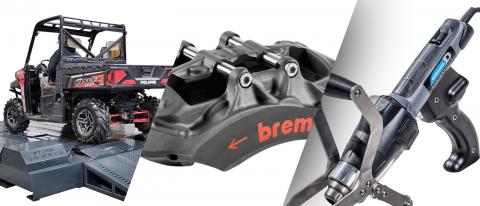
The increasing popularity of racing UTVs and side-by-sides prompted Mustang Dynamometer in North Las Vegas, Nevada, to develop a powersports chassis dyno. This low-profile design with 12.625-inch rollers will support up to 850 horsepower while topping out at 200 mph.
“Mustang routinely expands its product line as the needs of the market change. We felt there was a need for a dedicated side-by-side and UTV offering that could also handle motorcycles,” said Michael Caldwell. “There was clearly a need for this product and, thus, we stepped up and designed one.”
The system features a closed-loop digital controller with web-based HoleShot software. Also included is the patented Virtual Road Simulation technology. The dyno requires 230V single phase while the controls run on 115V single phase. The loading device is an air-cooled eddy current power absorber.
“The unit requires a 20-foot long by 10-foot space to accommodate the test bench and the ramp,” added Caldwell. “The unit can handle wheelbases up to 134 inches, so we have plenty of platform for those four-seaters and longer wheelbase platforms.
“The MD-SXS/UTV is primarily meant for off-road vehicles that can be switched to 2WD mode in lieu of 4WD mode for dyno testing,” added Caldwell. “If there is a substantial shift to a full-time AWD transmission, we will definitely add an AWD option to the dyno.” —Mike Magda
The Holley Sniper product line has long been introducing EFI to a variety of engine applications, but a matching, streamlined ignition system with the same simplicity wasn’t available—until now.
“The purpose of the HyperSpark Master Kit is to make the jump from carburetor to Sniper EFI as simple as possible for the enthusiast or racer,” said Evan Perkins of Holley Performance Products, Bowling Green, Kentucky. “Now, users can have a modern, high-current, computer-tunable ignition that only requires four flying lead connections.”
The system features a true plug-and-play harness with the four flying connectors—switched power, battery positive, battery negative and fuel pump power. There’s also a built-in 40A relay that provides power to all the system components.
“The biggest benefit for a weekend warrior is the ease of installation,” added Perkins. “The ignition is also built around the Sniper EFI platform, which maximizes compatibility and minimizes troubles with antique or tired factory ignitions.”
The system is complete with an ignition box, coil, distributor, and harness. The distributor features a Hall-Effect crank trigger sensor that provides noise-free rpm signal to the Sniper ECU. Making the installation even easier is a patented clear installation cap that eliminates confusion over phasing the distributor to set the #1 plug wire.
Tuning is easy with the Sniper EFI software, and rev limits can be set as a safety measure, according to Perkins. —Mike Magda
Race teams that beat up their tires on asphalt courses will surely appreciate the TS-03 tire scraper available from United Race Parts (URP) in Troutman, North Carolina, which is an authorized distributor for Greaves 3D Engineering.
“It’s been one of our most successful products,” said Bryan Powell. “[Crew members] used to use a putty knife and torch to heat up the rubber.”
The TS-03 features a molded handle for user comfort. The integrated heat gun offers variable fan speed that provides 300 to 600 liters per minute airflow. The heat gun also has a temperature range of 100 to 600 degrees with a total 2,000-watt output. The adjustable handle and blade positions can be set to suit the user.
“This tool makes it a lot easier and faster for the teams,” said Powell. “It is a much more precise way to clean the tire and check for wear.”
Both oval and road-course racers can avoid unwanted tire damage due to using inappropriate tools or excessive heat with other methods. The TS-03 can safely remove debris and leave a smooth, undamaged surface.
“We’ve actually had kart racers use them as well as the sports car teams,” said Powell.
A scraper station is also available from URP to help improve the speed and efficiency of the TS-03. The station secures the tire for ease of scraping, and a foot pedal is used to rotate the tire when needed. —Mike Magda
KRC-1040 Quick-disconnect Throttle Linkage Kluhsman Racing Components krcracing.com
If you’re looking to change carburetors quickly in the pits, the 1040 quick-disconnect throttle linkage from Kluhsman Racing Components in Lockwood, Missouri, will save time. It’s also designed to be adjustable, helping control wheel spin with a long foot pedal for a rough slick track, or a short-throw foot pedal for tacky smooth tracks.
Made in the USA from 6061 aluminum with steel safety locks, the linkage has smooth throttle balls for more precise control. It’s designed for dirt track or asphalt stock cars, off-road vehicles, and drag-racing applications.
“This product was actually drawn out on a cocktail napkin in a motor coach,” recalled Mel Kluhsman, adding that tech inspectors were often removing carbs to check for cheating. Most of the linkages were made of Heim fittings shimmed with washers and secured with small nuts—both of which often fell into the intake manifold or were lost on the ground. “It took about four or five designs to finally end up with the patented KRC-1040. It’s on thousands of cars now.”
The throttle rods will hook up to most carburetors with the included bushings. The rod ends are anodized to withstand severe racing conditions.
“The KRC-1040 is very useful during carburetor swaps,” said Kluhsman. “Simply unlock, pull the carburetor off, make sure you have another KRC-1042 (throttle ball assembly kit) installed on your carburetor. Then you’re ready to go.” —Mike Magda
SRP Pro 2618 LS Piston Line JE Pistons jepistons.com
JE Pistons in Cypress, California, now has a complete line of pistons constructed from 2618 alloy for the LS engine family. There are more than 100 off-the-shelf part numbers with specifications that will cover most applications.
“Street/strip applications are covered in a pretty wide range of power goals,” said Bryce Mulvey. “These are 2618 pistons with sportsman level pricing, so they’re ready to handle everything from NA builds to moderate power adders.”
These pistons are designed with Multi-Fit valve pockets to accommodate popular 12- and 15-degree LS cylinder heads. They are CNC machined with performance style cam-and-barrel skirt shapes to reduce piston rock and improve ring seal.
Other features include offset wrist-pin bores, low-friction skirt coating, and an accumulator groove between the top and second rings. This groove helps reduce pressure from combustion gasses, thereby reducing ring flutter. All part numbers include wrist pins, locks, and Pro Seal rings.
Piston strength is enhanced with a stout .225- to .235-inch top land thickness.
“Doing all our forging in-house in the USA gives us complete control over the manufacturing process and allows us to easily adapt techniques and conditions to achieve the necessary goals for specific parts,” added Mulvey. —Mike Magda
For intense competition, Brembo in Plymouth, Michigan, has developed the new Pista FF family of brake products, including the FF6 six-piston caliper. “This new line of brake calipers is ideal for use on the track, allowing drivers to get the most out of their cars under extreme conditions in a constant search for the best lap time,” said Mike Messina.
This caliper is constructed of forged aluminum, asymmetrically designed, and radial mounted. Pista calipers were engineered with internal brake fluid passages that efficiently channel the brake fluid for maximum pressure and bleedability of the system. The calipers also have a rapid release system for the pads to help speed up pit stops.
“As a whole, Brembo’s new line of Pista products is the perfect next-level upgrade for so many of today’s highly capable road cars seeing more and more track time,” added Messina.
All the new design elements contribute to improved pedal feel and feedback to the driver, along with consistent repeatability and reliability. The system is also available with a four-piston caliper. —Mike Magda
Relying on their expertise in one of the most competitive business segments, the McDaniel family is applying the tenacity learned from the grocery industry to reviving a drag strip on Florida’s Panhandle.
Food and grocery industry veterans Kevin and Cody McDaniel saw an opportunity in reviving a Florida track with a large investment. Their business relationships have already paid off in a big way.
Taking a different direction for this month’s Newly Appointed column, PRI spoke with Kevin McDaniel, who with his wife Tonya and brother Cody purchased the former Powerhouse Dragway in Fountain, Florida, in the state’s Panhandle, in 2021. Renamed North Florida Motorplex, the track reopened in March of this year with a new racing surface, lighting, timing system and tower, bleachers, and a host of other upgrades.
The McDaniels own a chain of Piggly Wiggly Food for Less stores and used their food industry experience and contacts to attract sponsors and develop new payout and prize structures. North Florida Motorplex is now an IHRA member track. The main eighth-mile is called Thunderstruck Dragstrip, and a dirt drag strip is in the works.
McDaniel recently discussed the track’s renovations, new race events, sponsorship and prize programs, and spectator-focused upgrades.
PRI: What changes have been completed at the track?
McDaniel: We tore down and replaced the old tower, concession stations, and bleachers. We hired Charles Jordan’s Bleacher Builders. He buys and refurbishes aluminum bleachers from other tracks. The metal structures in ours came from Daytona International Speedway. Kurt Johnson’s Total Venue Concepts spent two weeks grinding, profiling, and resurfacing the track. Many racers have complimented it, saying how flat it is. We installed a new Accutime timing system and concrete barriers.
PRI: What are the biggest changes made to attract spectators and improve their experience?
McDaniel: We’ve added covered VIP decks that have bars at both ends, big-screen TVs, and food available. People can come out to enjoy the racing, stay out of the sun, and keep up with the weekend’s ball games. We’ve added another 1,500 general admission seats and also tailgating spots, which have been popular.
We’re building a great bracket program, but bracket racing alone doesn’t bring in spectators. So in addition, we’re going to have five to six key events a year, like Night of Fire [nitro cars], Street Outlaws, and Pro Mod cars. We’re hosting a JJ’s Arm Drop event and Carolina No Time nights.
PRI: Tell us about the biggest changes made to improve the experience for racers.
McDaniel: We’ve added utilities in about 75 spots in the pit area for racers to buy water and electricity for their RVs and equipment. We’re now selling VP Racing Fuel and Hoosier tires at the track. We’re building up our Monster Energy Championship Bracket Racing Series, and I think it’s really going to explode next year. We’re paying out $60,000 this year and already have sponsors returning for next year. Our new Firecracker 128 bracket race in July has 100% payback.
PRI: How has your food industry involvement benefited management of the track?
McDaniel: I went to that market for sponsorships to give our vendors return on investment. They responded in a big way. In the new concession stand, everything we’re selling is from a sponsor. Jambalaya Girl has been one of our best-selling items. We have that in our stores. We have a great relationship with Coke. The Coke platform includes Monster Energy, Coca-Cola, Body Armor, and Powerade. We have sponsorships from all four. I know other track owners don’t have this advantage, but we’re using every advantage we can.
We’re in one of the most competitive businesses in the world—groceries. We’re up against Amazon and big box stores. You have to make yourself a little different to stand out. That’s what we’re also trying to do with the track.
PRI: What are some new sponsorship programs?
McDaniel: In addition to the payouts, we came up with the Coca-Cola Redline Club. For $75, racers are eligible for cash prizes and other giveaways over the season. The members’ cars will all have a decal for Coca-Cola Redline Club, so that’s advertising for Coke.
Sponsors have put up nearly $40,000 in prizes. Sunset Luxury Properties put up a week’s vacation at a luxury beach house in Panama City, Florida, valued at $13,000. Any club member that races on a Saturday is entered in a drawing for that at the end of the season.
As other examples, Jambalaya Girl is giving away a year’s supply of its mix and $5,000 cash, which we’ll disburse in smaller amounts. Lincoln Electric is giving away a welder, and Hoosier is giving away sets of slicks to the five racers who have the most visits to the track. We have about 85 cars in so far, even Pro Mod guys. They jumped on a deal from Coke that pays $1,000 to whoever breaks the track record and holds it for the night.
PRI: Which attributes of your grocery business success would you say could be directly applied to improving North Florida Motorplex?
McDaniel: I would say customer service and building relationships. We strive for great customer service in our stores. We have great connections and relationships with our vendor community and manufacturers in the food industry.
PRI: What are some of the most important challenges facing race tracks today? How will you address that with North Florida Motorplex?
McDaniel: Our biggest challenges are supply chain and the price of fuel affecting affordability of drag racing. We may expand weekend races to three days to reduce the number of trips racers have to make to the track, to help reduce their costs.
PRI: What are some areas where tracks can do a better job?
McDaniel: I would say focusing on making the track an outing for families, not just catering to race fans. Big race fans might sit in the Florida sun to watch racing all day, but not everybody wants to do that. You have to offer something else that’s fun, too. We have 12-and-under free every day. We’re considering adding a game room.
PRI: What does success look like for you?
McDaniel: Racers are a bit like grocery customers—creatures of habit. You have to break that habit to get them to come out and try you. When we’re able to bring in a lot of good racing talent once a month, get the bracket program to where we have 150 cars consistently, and get attendance up consistently, that would be success.
Kevin McDaniel
Title:
Co-Owner
Organization:
North Florida Motorplex
Hometown:
Grand Ridge, Florida
Fast Fact:
Kevin McDaniel, 56, fondly recalls his own bracket racing at this same track in the 1990s and early 2000s.
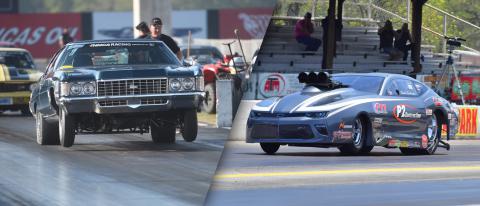
The two styles of competition not only attract different types of racers and audiences, they also require different car setup tactics and come with their own maintenance considerations. As our advocates explain, each format offers a unique allure that keeps participants coming back for more.
Quarter-Mile Drag Racing Advocate:
Andy Warren,
NMCA Nostalgia Muscle Competitor
I actually got my start in racing with eighth-mile bracket racing events. It was kind of the norm around where I lived. When we started following the NMCA in the 1990s, my brother and I would travel to Memphis every year for the finals, and I remember that the nostalgia classes really stuck with me.
By the early 2000s I was ready to do something different, and one day I was looking around on the NMCA website and saw that there was an upcoming race close by in Bowling Green. I had never really raced quarter-mile before, but I found out that they had a class that my car fit in with Nostalgia Muscle.
After competing in that race I was totally hooked. There’s just more of a thrill to it. That extra few seconds might not seem like much, but it makes a big difference when you’re behind the wheel. In eighth-mile racing, you hit third gear and you’re done. But in a quarter-mile race you have a little bit more time to experience everything, and to me that’s just more bang for the buck.
NMCA Nostalgia Muscle is a pre-set index class that goes from 16.0 to 9.50, and because of my driving style, I prefer to chase. With a quarter-mile format, once you cross that eighth-mile mark you kind of clear your mind and figure out what you’re going to do from there. You have a lot more time to think about what you’re doing with this format, and it’s a pretty awesome feeling to pass a slower car right at the last possible second.
The quarter-mile format also has more visibility because there are more nationally publicized platforms for this type of racing through the NHRA, NMCA, and other organizations. That has some clear marketing and sponsorship advantages. I don’t think I would have had the same opportunities if I was running eighth-mile because those events just don’t have that spotlight on them.
This format tends to be harder on valvetrain parts because you’re holding the engine near redline a bit longer, but it has durability advantages in other parts of the car. Unlike eighth-mile racing, you don’t have to be super aggressive with your gearing out of the hole because you need the gear to keep the car pulling at the other end of the track. So it tends to be easier on the transmission, rearend, and other drivetrain hardware.
Rearend gearing tends to be very important in quarter-mile racing, as is tire selection, because tire growth needs to be taken into consideration more than it usually does in eighth-mile racing. If you’re running a bias-ply slick, your tire is going to grow in diameter at speed because of the centrifugal force, and that will affect your final gearing at the end of the track. The tire acts like a big rubber band—the faster you spin it, the more it wants to spread outward.
Eighth-Mile Drag Racing Advocate:
Todd Tutterow,
NHRA Pro Mod Competitor
I like running quarter-mile races, but I think that one of the biggest advantages that the eighth-mile format has is that it’s a bit easier on parts, and that makes it more affordable to compete. Connecting rods, valve springs, and other engine components will take a lot more abuse in quarter-mile racing. It might just be a few more seconds for a run, but those are seconds that I could be putting into more eighth-mile passes. Because of that, we also find that we can run the car harder in the eighth-mile format. But sooner or later you will find the weak link in the setup regardless of the format you’re running in.
Because these runs are shorter, you really can’t afford to give anything up in eighth-mile racing. You’ve got to put all the power down and do it quickly because all of the ET in an eighth-mile race happens early. Big horsepower tends to matter more for the top end in quarter-mile races, so lower horsepower cars aren’t at as much of a disadvantage in the eighth-mile format. Gearing tends to be the biggest difference in car setups between eighth-mile and quarter-mile formats for the type of drag racing I do.
Either way these cars are extremely fast—we’re hitting about 215 mph in the eighth. The quarter-mile adds another 50 mph on top of that, so eighth-mile racing feels a bit safer as well. At those speeds there’s just a lot more danger in a quarter-mile car; two seconds doesn’t seem like a lot, but it makes a big difference. And while the cars keep getting faster and faster, the shutdown areas at these tracks haven’t gotten any longer. Fortunately, most of the eighth-mile stuff that we compete in now runs on the bigger tracks, and having that extra room to get the car slowed down provides an additional measure of safety.
Because eighth-mile racing doesn’t have national events like the NHRA and other organizations have in quarter-mile racing, there tends to be slightly less visibility. Some sponsors prefer quarter-mile formats because they can pull in a different audience due to the TV coverage and things like that, but ultimately it hasn’t really been an issue for the sponsors that we work with. And I think that the eighth-mile racing benefits the fans because it’s easier to see the entire run. It makes for a good show.
The format seems to attract more Outlaw-style series, which really seems to resonate with a certain type of fan. Most of the quarter-mile stuff has pretty rigid rule sets, but the eighth-mile series tend to be less tightly controlled. Those open rule sets generally allow for more innovation, and it makes the competition more interesting as a result. It all works together to make these eighth-mile events feel less sterile, which in turn attracts the fans who value that.
Shopmonkey shop management software “was built to be easy to use for everyone in the shop, including technicians and service writers,” said our source. Typically computer upgrades aren’t required for these cloud-based systems, provided the shop has an Internet connection and an up-to-date browser.
New solutions piggyback on the latest digital advances to provide better efficiency and improve the customer experience.
The digital revolution that completely reimagined phones, computers, and other devices has altered auto shop management as well. Cloud-based systems are available that improve not only shop efficiency but also customer satisfaction. Granted, most of these systems were designed for dealership service departments or general repair shops, but they can be customized to work in a race or high-performance shop environment as well. “From F1 to farm trailer, you can enter it in Tekmetric,” said Prasanth Chilukuri of the Houston, Texas-based management platform.
We recently spoke with Chilukuri and Travis Brown of San Jose, California-based Shopmonkey to learn more about some of the latest developments in shop management systems.
How it Works
Details differ among the companies that offer these systems, but essentially they enable transparent communication about a vehicle and its progress with everyone in the shop, from the person writing the order to the technicians to the bookkeeper who sends the invoice. “It’s an all-in-one solution,” said Brown. “Shops don’t need six or seven different tools to get the job done.”
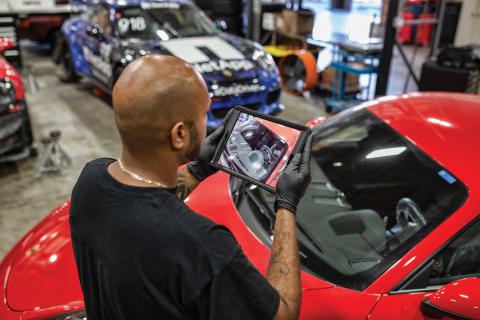
Describing a typical Tekmetric service experience, Chilukuri explained that the system logs in the vehicle; begins the repair order; records a digital vehicle inspection that can be customized for repair, pre-race, pre-sale or other circumstances; adds jobs to the repair ticket as needed, and sources the parts for the repair (either through the shop’s inventory or outside vendors); then sends the estimate to the customer’s smartphone for approval. Following approval, the system alerts technicians that the car is ready to be worked on and offers them the opportunity to order parts that aren’t in stock. If parts availability presents a bottleneck, the system can “reorganize and reallocate time based on what’s ready to be worked on,” Chilukuri said. “You can push that car down if there’s another car you can get out before it.” Once the work is completed, the customer is alerted via text—“we have two-way texting built into the system”—and the customer can pay from their smartphone and pick up the car at their convenience.
Both companies prioritize intuitive user interfaces for their systems and devices. “Shopmonkey was built to be easy to use for everyone in the shop, including the technicians and service writers,” Brown said. With the popularity of smartphone apps and Zoom meetings, shop staff “are more familiar with technology and come to expect it as standard.”
“Our philosophy has always been simplicity,” Chilukuri said, citing the iPhone as an example of the interface experience they wanted. “You can buy a phone now, and it doesn’t come with instructions. Our system should be as intuitive and easy to use, regardless of your role. You can log in…and use the system with minimal training.” Once [it’s] set up, “you can be up and running within 30–45 minutes at the most.”
Tekmetric’s emphasis has been on simplicity, with a user interface for its system that’s intuitive and requires minimal training, said our source. Once the system is set up, a shop can be up and running in as little as 30–45 minutes.
Most shops won’t need to upgrade their computing equipment to use these systems. “With SaaS [software as a service] and cloud-based software…you can use your existing systems as long as you have access to the Internet and a modern browser,” said Brown.
A shop doesn’t even need a super-fast Internet connection to run [these systems], Chilukuri said. “A Wi-Fi connection is great, but the system is so performative that it will work fine with low-speed Internet. I’ve done demonstrations tethering off my cell phone in an airport parking lot and it worked just fine, but the stronger the Internet connection, the faster you can be productive.”
If it Ain’t Broke…
Why consider adopting an auto shop management system if a shop is functioning fine without one? First, they can significantly improve shop efficiency, which, according to Brown, translates directly to increased revenue. “We’ve found, within the first year of shops using [it], on average they’re growing their revenue nearly 40%,” he said. “We chalk that up to internal operational efficiencies, process optimization, and clean communication with their technicians, service writers and partners.”
“We measure a few different things,” said Chilukuri. “Probably the largest one is ARO (average repair order). We typically find customers who use [these systems] increase their ARO by 20%, and the driver for that is transparency. They’re able to present pictures and videos of required work so the approval process is much more fluid. And it allows cycle times to go much faster. They’re getting vehicles out faster, which increases ARO and profitability.”
Another reason is customer satisfaction. “We’re at an age where customers don’t want to sit in your waiting room,” observed Chilukuri. “They don’t even want to wait in line at Starbucks. They just want to walk in and pick up their cup of coffee. That’s the experience people demand now, and we want to arm our customers with that, so they can give their customers the best possible experience.”
“I want to take my car to where I trust the shop owner, and I know that I can send them a text message, they can send me a picture back, and I can pay online,” said Brown. “These are all very modern expectations that have been further solidified around the contactless experiences we’ve had in the last couple of years.”
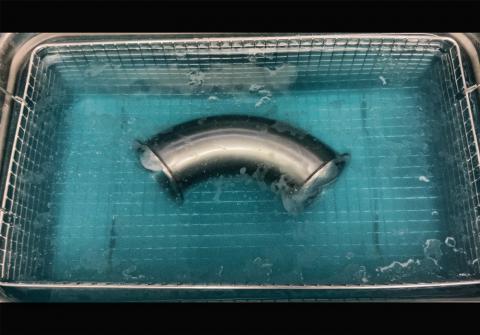
Ultrasonic cleaning is often thought of as a finishing step, said our source from UltraSonic LLC, as it won’t remove things like paint, rust, or corrosion. But its aqueous nature allows it to get into blind holes, cracks, crevices, and other places where other cleaning methods can’t reach.
When scrubbing down components, should blast media or aqueous solutions be used? Or, is a combination of both the preferred method?
Parts cleaners can make components with decades of grime and corrosion look brand new in just a matter of minutes, but they’re not one-size-fits-all solutions. Getting the most out of blast media and aqueous solutions means using the right tool for the job.
Blast Media
Although there are situations where blast media is a better option than the ultrasonic cleaning method, or vice versa, there are also situations where these cleaning methods can complement one another. As Ron Storer of ABS Products in Brea, California, noted, selecting the appropriate methods and media for a given task ultimately comes down to the job at hand and the parts involved.
“For instance, when I’m cleaning parts for race engines—trying to remove carbon buildup, gasket material, grease, and things like that—I’ll use soda. Soda is a one-time-use media, it’s biodegradable, and it’s a soft enough material that it will not change the substrate that you’re blasting.”
Storer pointed out that because soda doesn’t change the surface of the material it’s applied to, it’s mainly used to clean parts rather than change their surfaces. If you’re looking to take a part like an aluminum intake manifold back to a factory-fresh appearance, that’s a different situation with a different process. “In that case I might use dry glass beads because they would make that part look brand new.”
While glass bead media provides a deeper, more intensive clean, he said that it requires more care during the cleaning process, and additional steps may be needed after this process in order to prepare the part for use. “With dry glass beads you need to make sure it doesn’t wedge itself in cracks or crevices of the part. The last thing you want to do is have that material come out later on when the part is installed, and you usually can’t get it out by just blowing it off or rinsing it.”
These beads are ostensibly microscopic glass marbles. When the beads hit the part, they shatter into smaller pieces with sharp edges, and these shards provide a deep clean that can also polish the surface of the component. That means that dry glass beads can effectively take care of two steps in the parts cleaning process at once, but the media also necessitates an additional preparation step in order to get the part ready for use.
“In a situation where I’m using dry glass beads, I’d run the part through that process first and then I’d put it into an ultrasonic cleaner,” Storer said. “Ultrasonic cleaning will loosen up that material through vibrations and get it out of those nooks and crannies.”
He also offers hydroslurry, or wet blasting, as an option that can sometimes take care of both steps. “You might not need to use an ultrasonic process in that case because that’s a wet glass bead media, and the water becomes sort of a cushion, so the beads don’t impregnate themselves into the part. There’s less frictional heat because of the water, and it does yield a smoother finish when the process is completed. But it also takes about five times as long to clean something in comparison to the dry glass bead process.”
Choosing the appropriate blast media for a given task comes down to the part being cleaned and its condition. Among the specialized media available from ABS Products are, clockwise from top left, plastic media, baking soda, steel grit, glass beads, steel shot, and aluminum oxide.
ABS Products also offers other blast materials like aluminum oxide, ceramic beads, and plastic, and each has a specialized use. “Aluminum oxide is great for cleaning out rust and corrosion, but you have to be careful with it because it can also remove material,” Storer explained. “A lot of companies we work with prefer ceramic beads for cleaning components because those beads don’t break down as fast, so the media can be reclaimed and used again. Meanwhile, plastic is great for stripping paint and powder coating, and we use steel shot for peening.”
With the variances in both materials and machines, he recommends that those who are new to these cleaning methods consult the machine manufacturers for their recommendations in order to achieve the results they’re looking for. “We build the machines around our customers’ applications and the media they need to use. And like anything, there’s a certain level of finesse involved in using parts cleaners. You run the risk of ruining a part if you use the wrong abrasive for the wrong amount of time. It pays to get some insight about how to use them properly for a specific set of circumstances.”
Aqueous Solutions
While ultrasonic cleaners can do things that blast media cleaning methods cannot, Jason Shaw of UltraSonic LLC in Amelia, Ohio, told us that it’s generally considered a finishing step in the parts cleaning process.
“Ultrasonic cleaning with our detergents is not going to remove things like paint, rust, and corrosion. In those situations, you’re going to need a solvent or media blaster. If you have very high concentrations of carbon buildup on exhaust ports of a cylinder head, for instance, ultrasonic cleaning can help get that carbon out, but you’d often start with media blast. The advantage of ultrasonic cleaning is that it gets where you can’t touch, see, or feel. It’ll get down into blind holes, cracks, and crevices—places where typical cleaning methods aren’t going to be able to get to. So if you’ve got a block coming out of the junkyard that’s got a bunch of paint, rust, and other nasty stuff on it, you might run it through a jet wash, then media blast, and then put it through the ultrasonic cleaner to remove that media.”
Since ultrasonic cleaning is often considered a finishing step, it’s also commonly used after machining processes. “We have customers who will use the ultrasonic machines on engines as a final clean before assembly,” Shaw said. “It will remove things like the gray dust inside a cylinder wall. It’s a precision clean that will remove those fine particulates that you’re not going to go after with a media blast.”
Ultrasonic cleaning machines put out a wave that creates a microscopic bubble. Wherever that fluid touches, those cavitation bubbles will impact, implode, and pull the dirt off of that surface. One of the key advantages of ultrasonic cleaning is that detergents like those offered by UltraSonic LLC don’t involve harsh chemicals or solvents, but Shaw noted that the appropriate cleaning agent must be used for the material being worked on.
“It’s important to use the right cleaning agents with motorsports components,” he said. “For instance, with certain billet parts, highly polished components, and especially non-ferrous metals, if you use too aggressive of a detergent, it can discolor that metal and etch it. It doesn’t necessarily hurt it, but it doesn’t make it look good. So you need to be aware of that, and that’s why we provide a chart that outlines what detergent you should use with what materials, how much time you should use it for, and at what temperature. It’s a great reference and starting point for those who’re new to the technology.”
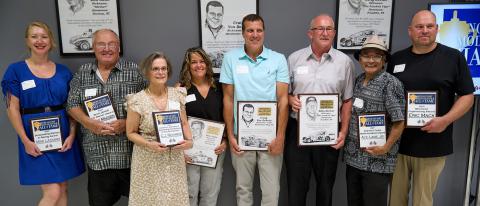
The Northeast Dirt Modified Museum & Hall of Fame in Weedsport, New York, has inducted eight new members into the class of 2022.
DIRTcar Big Block and World of Outlaws Late Model racer Billy Decker, small-block champion Craig Von Dohren, late Don June stock car racer and tech inspector were inducted into the driver category.
Car owner Guy Madsen received the annual Gene DeWitt Car Owner Award, while Eric Mack received the Northeast Dirt Modified Hall of Fame Mechanic/Engineering Award. In addition, the late promoter C.J. Richards was recognized with the prestigious Leonard J. Sammons Jr. Award for outstanding contributions to auto racing for his role as the promoter for Fairmont Speedway in Fair Haven, Vermont; Albany-Saratoga in Malta, New York; Devil's Bowl Speedway in West Haven, Vermont; and Airborne Speedway in Plattsburgh, New York.
Acclaimed photographer Ace Lane Jr. was honored with the Andrew S. Fusco Award for Media Excellence for his photographic legacy in the sport. In addition, Mimi Lazzaro—the victory lane announcer and daughter of the late legendary Lou Lazarro—received the Outstanding Woman in Racing Award.
For more information, visit the Northeast Dirt Modified Museum & Hall of Fame Facebook page here.
Don Schumacher Racing (DSR) and Joe and Cathi Maynard have announced an expanded partnership that sees the Maynards as majority owners of the Top Fuel operation piloted by Tony Schumacher.
The new Maynard Family Racing/Don Schumacher Racing team (JCM/DSR) will launch during the NHRA Northwest Nationals (July 29–31 at Pacific Raceways in Kent, Washington), when the Maynards will oversee the day-to-day operations of the Schumacher-driven/Todd Okuhara-tuned machine.
“While things might be a bit different behind the scenes, to our fans and partners, it will appear to be business as usual,” said Don Schumacher, a motorsports Hall-of-Famer who has led DSR to 366 national event wins and 19 series championships.
DSR will continue to operate its hospitality program, graphic design and vinyl installation, nitromethane, parts, and chassis sales, and a 75,000-square-foot precision machining and fabrication facility in Brownsburg, Indiana. Additionally, DSR’s trio of Factory Stock Showdown Series entries will also continue to compete under the DSR banner.
Don Schumacher, DSR Performance President Chad Osier, and DSR Vice President Megan Schumacher will continue to develop DSR Performance, DSR’s performance aftermarket, aerospace, and defense manufacturing division.
For more information, visit the DSR announcement here or visit shoeracing.com.
 MEMBERSHIP LOGIN