NASCAR has announced the NASCAR Cup Series will race on the streets of downtown Chicago on July 1–2, 2023.
The first-ever NASCAR Chicago Street Race will take place July 2, and be preceded by an IMSA-sanctioned race, which will run July 1. The specific IMSA series will be announced at a later date.
Officials will transform Lake Shore Drive, Michigan Avenue, Columbus Drive, and surrounding thoroughfares into a 12-turn, 2.2-mile street course, with the start-finish line and pit road located along South Columbus Drive in front of Buckingham Fountain. The course will pass through Grant Park, as well as approach the northern edge of Soldier Field—home to the Chicago Bears and the site of the only other Cup Series race to take place in Chicago in 1956.
The course layout was first developed on the iRacing platform, which was used in the 2021 eNASCAR Pro Invitational Series.
The Chicago Street Race will replace Road America on the Independence Day weekend schedule, as confirmed by Ben Kennedy, NASCAR senior vice president of racing development and strategy.
On Tuesday, July 19, “The King” Richard Petty joined Specialty Equipment Market Association (SEMA) CEO Mike Spagnola in the nation’s capital to advocate for Congress to pass the Recognizing the Protection of Motorsports Act (RPM Act). The bipartisan bill (H.R. 3281/S. 2736) protects Americans’ right to convert street vehicles into dedicated race cars and the motorsports-parts industry’s ability to sell products that enable racers to compete.
Like most NASCAR drivers, Petty competed in race cars that started out as street legal vehicles. The EPA maintains the position that such modified race vehicles are not legal under the Clean Air Act, threatening many classes of racing along with an industry that employs tens of thousands of Americans and contributes more than $2 billion to the U.S. economy each year.
Petty and Spagnola sat down with key members of the U.S. Senate and House of Representatives to advocate for the interests of racers, enthusiasts, builders, tracks, sanctioning organizations, and businesses, while also looking to gain stronger congressional support to protect one of America’s oldest pastimes and hobbies: motor vehicle racing. In an effort to curtail the EPA’s overreaching and extreme enforcement of the Clean Air Act, Petty and Spagnola appeared in Washington, DC, to push for passage of the RPM Act, which awaits committee action in the House of Representatives and Senate.
“The EPA is overstepping its jurisdiction and penalizing small motorsports parts businesses,” said Petty. “The RPM Act is essential to the racing industry and protecting the careers of young racers all over the country. During most of my racing career, my fellow NASCAR drivers and I competed in race cars that started out at as street legal vehicles.”
Petty and SEMA met with several key congressional members to discuss the importance of the bipartisan RPM Act. Meetings included Sen. Richard Burr (R-NC), RPM Act lead sponsor; Sen. Thom Tillis (R-NC), RPM Act original cosponsor; Sen. John Barrasso (R-WY), Senate Republican Conference Chairman and RPM Act cosponsor; Indiana Sens. Todd Young (R-IN) and Mike Braun (R-IN), RPM Act cosponsors; Sen. Joe Manchin (D-WV), RPM Act original cosponsor; House Minority Leader Kevin McCarthy (R-CA); House Minority Whip Steve Scalise (R-LA); Rep. Patrick McHenry (R-NC), RPM Act lead sponsor; Rep. Richard Hudson (R-NC), RPM Act lead Republican cosponsor; and RPM Act original cosponsors Rep. Markwayne Mullin (R-OK), Rep. Ted Budd (R-NC), Rep. Doug LaMalfa (R-CA), and Rep. Bill Posey (R-FL).
The RPM Act reverses the EPA’s interpretation that the Clean Air Act does not allow a motor vehicle designed for street use—including a car, truck, or motorcycle—to be converted into a dedicated race car. This American tradition was unquestioned until 2015, when the EPA took the position that converted vehicles must remain emissions-compliant, even though they are no longer driven on public streets or highways.
“The RPM Act will save the livelihood of thousands of Americans, including many young race car drivers,” said Spagnola. “SEMA is dedicated to ensuring our industry remains viable. Racers and the businesses that make motorsports possible deserve clarity in federal law that protects the ability to convert street vehicles into dedicated race cars and sell products for these track vehicles without fear of enforcement.”
Both Petty and Spagnola were optimistic about their meetings with key RPM Act supporters in Congress. “Motorsports has many strong allies in Congress. It was valuable for Mike and me to sit down with these lawmakers to discuss how we can work together to pass the RPM Act this year,” shared Petty. For more information, visit saveourracecars.com.
ProMedia’s National Muscle Car Association (NMCA) has announced a new “All-Star” race is set for the NMCA All-American Nationals at Summit Motorsports Park in Norwalk, Ohio, on August 25–28.
The NMCA vs. Buckeye Stock/Super Stock All Stars presented by A&A Transmission class will feature a 32 cars. The field will include the top five in points for both the NMCA Stock Eliminator and Super Stock Eliminator classes, along with the top 10 in points for the Buckeye team, which runs its events as a single combination class of Stock and Super Stock racers. Then, the top points earner will be able to select a blocker from the non-seeded cars, and the remaining slots will be filled from the top qualifiers in Stock and Super Stock after Q1.
“There are basically two races for one entry fee,” NMCA’s Jim Bailey said in a release. “The NMCA and Buckeye Stock/Super Stock groups are each offering an extra $1,000 bonus if one of their cars wins. If a driver [wins] this deal, [they’ll] get $1,000 plus the other $1,000, and if [they] turn around and win the NMCA race that’s around $3,000—that’s a $5,000 weekend for a $150 entry fee.”
Photo of Dr. Julia Vaizer, left, and Dr. Geoffrey Billows courtesy of IndyCar
Dr. Julia Vaizer will succeed Dr. Geoffrey Billows as the director of medical services for IndyCar and Indianapolis Motor Speedway (IMS). Vaizer becomes the first female medical chief in the sanctioning body’s and track’s history.
Vaizer, who has served as the assistant medical director for IndyCar and IMS since 2021, also served as acting medical director when Billows was on a short medical leave of absence earlier this spring. Billows will continue contributing to medical services part-time starting in 2023.
“Dr. Billows has been a friend, a mentor, a teacher and like family to me,” Vaizer said. “There are a lot of emotions of excitement for him to take a new stage in his life and spend more time with his family. It’s wonderful that he’s going to stay on as an INDYCAR physician.
Vaizer received her undergraduate degree in 2011 from the University of Florida and her medical degree in 2016 from the University of Central Florida. She completed her emergency residency training at Detroit Receiving Hospital in 2019 and completed a dual EMS/motorsports medicine fellowship at IU School of Medicine in 2021.
Those who maintain vintage race cars face some of the same challenges as contemporary speed shops—with the added complication of obsolete parts and decades-old equipment. Here’s how these specialists keep those cars track-ready.
In some ways, maintaining a vintage race car is like maintaining a contemporary race car. Ask Karl Wilen, whose RennsportKC in Grandview, Missouri, specializes in vintage Porsches, but who also serves as crew chief and engineer for PF Racing, a professional IMSA team in the Michelin Pilot Challenge series.
In general, he said, between-race maintenance is “pretty much the same whether we’re working on a modern car or an older car: Do a full nut-and-bolt of the entire car, before and after a weekend. Ultimately, you’re going through the whole car, tip-to-toe, at every event. All fluids are changed every event in addition to your mechanical items. We would rather change oils prematurely than have an engine or transmission failure due to oil breakdown. Cars are scaled to check alignment and corner balancing. Typically, we will have different suspension settings for each track, so depending on the customer’s next event, those settings are changed to accommodate that track. That may include changes to shock settings, ride heights, corner balance, and camber/toe settings.”
While MSA Classics builds engines to last two to three seasons, customers have started asking for annual post-season inspections, said Mitch Bressler. “They figure it doesn’t cost that much, and they’d rather know what’s going on,” to catch small problems before they become bigger ones.
Beyond that general plan, though, the two worlds diverge sharply. “We have to spend more time really inspecting the old aluminum components—wheel hubs, uprights, things like that, even the chassis themselves for stress cracking,” continued Wilen. “These cars are 40 years old, and the metals are starting to let go over time. Metal fatigues, so we really have to pay attention to those components more so than we would with modern day cars that use, say, a sealed wheel bearing in an upright. That’s just a much more solid component than an old 911 with a two-piece front-wheel bearing riding on a spindle that has been out there for 40 years.”
And, while parts shortages affect all forms of racing, they’re greatly exacerbated on the vintage side. “With the vintage stuff, if you break something you might be able to find the part, but you also have to be really careful about what you’re buying,” Wilen said. “That part may be 40 years old, too, so you have to inspect it well before you put it on the car. You can get a worn-out part just as easily as you can get a good one.”
Wilen was among a group of vintage race experts we recently spoke with to find out what it takes to keep historic vehicles in race trim during, and after, the season. Between them, their shops service the full spectrum of vintage racing machinery, from multimillion-dollar Porsche endurance racers to four-cylinder “momentum cars.”
During the Season
“We have a standardized checklist that we go down after every event,” said Don Hoevel of Don Hoevel Racing, Fox Lake, Illinois. Hoevel specializes in Cobras, GT350s and other “Ford stuff,” he said, but also services “lots of Lotus stuff, sports racers, 2-liter sports cars, open wheel cars, Formula B cars, and vintage Indy cars.” Like Wilen, Hoevel will “nut-and-bolt the car, check the brake pads, check the brake discs, charge the battery, do a fluid service if needed, or at least check the levels, check the tires, then do a parts inventory. Do we need pads, do we need tires, how much race fuel do we need for the next event? And then we clean the car. Our saying is, ‘The car has to leave the building a lot nicer than when it rolled in.’”
Keeping the car clean has benefits beyond the cosmetic. “We keep the inside of the fenders clean so we can see any indication of tires rubbing,” said Mitch Bressler of MSA Classics, Carrollton, Georgia. “Or, why is there grease on the back fender now? Do we have an axle seal leaking? Let’s fix that.”
While Bressler is known as “the British guy,” and the cars serviced by MSA Classics are primarily vintage MGs and Austin-Healeys, he works on a wide range of cars, everything from an original Willys Jeep to late model Morgans. His clients are involved in road racing, circuit racing, and rallies. One client recently purchased a Winston Cup car, and Bressler is eager to get it into the workshop to see what magic he can work on it.
“The secret of a good [Porsche] 356 is having all the correct gears and utilizing them,” said Vic Skirmants of 356 Enterprises, seen here working on a 356’s transmission. It’s not about all-out power, he said, but “having the right gears to let you use what you have.”
His maintenance philosophy is to keep his customers’ cars “at the level they were when they started the season. We’re looking at anything that’s a fail point that we know of. But really, we build the car so that as much as possible is done during the offseason. That way, when we get to the track, we’re just fixing problems as they come up. We try not to make a lot of changes throughout the season. But if we can see another second sitting over there, we’re going to grab it, work on it, and make it happen.”
The key to maintaining these cars is “catching the problem before it happens,” Bressler added. “I’m sure you’ve heard this 100 times: We win the races in the shop; we don’t win them on the track. I believe the will to win is not nearly as important as the will to prepare to win. And as prepared as we try to be, it’s important to remember that these are vintage cars. Despite our best efforts, the unexpected can still happen—a bad wheel bearing, the gears seize, broken oil pumps, things that are fine one weekend and not good the next. We don’t have a Magic 8 Ball here to tell when something is going to fail.”
“My theory is, as soon as the race is over, that’s the time to do post-race maintenance on a car. Not wait until it’s time to race it again,” said Bruce Canepa. “After it completes a race weekend, look at everything in the car, evaluate everything in the car, figure out what it’s going to need, and get the process started.”
While there’s always a wide variety of vintage race cars being worked on at the Canepa shop, “the common thing among them is, they’re all race cars,” said Bruce Canepa. “We have to understand what each one needs in terms of regular service and in terms of the things that can fail.”
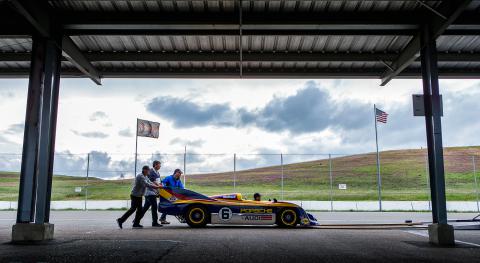
The vintage race cars in Canepa’s shop in Scotts Valley, California, can run the gamut from a Porsche 917 to a Maserati Birdcage, Can Am cars, 1970s Trans-Am cars, and open wheel cars. “The common thing among them is, they’re all race cars,” Canepa explained. “We have to understand what each one needs in terms of regular service and in terms of the things that can fail. Every car is different. They all have shortcomings somewhere. In the old days, a lot of the R&D was racing the cars. If they failed then, and someone hasn’t changed it or re-engineered it, it’s going to fail today at some point.”
Understanding how to maintain a vintage race car “is understanding the life cycle of all the componentry in the car,” Canepa said, “how it was used in the beginning, and how it’s being used today.” A car like the 917, for example, “was designed for endurance racing, 24-hour races, plus practices, qualifying, and everything else. So they’re really designed to be 30-plus hour cars from a reliability standpoint.” The engine in an endurance car can go “at least 50 hours” before rebuilding, Canepa said, “and if the driver’s really good in terms of how he races and takes care of it, he might get 70 hours out of an engine without rebuilding it.”
A Trans-Am car, on the other hand, “is reliable, but it’s not designed to run a lot of hours. So a Trans-Am engine may need a rebuild in 20 hours, or 25 at the most.” Plus, Canepa said, “we’re checking clutches and suspension pieces because they wear out quicker than an endurance car. These cars are heavier. A ’70s era Trans-Am car is a 3,250-pound car, and it’s getting pounded pretty hard on the race track. We check a lot of mechanical things on that car because they just wear out faster. It’ll go through more brake rotors, brake pads, etc. In period, it was designed to run only two hours or less in a race.”
“As a general statement, the fancier and faster the car, the more maintenance it’s going to need, usually requiring a professional level of support,” said Vic Skirmants of 356 Enterprises, North Branch, Michigan. As his business name implies, Skirmants works almost exclusively on Porsche 356s, cars he has raced since 1965.
“I’ve been with them my whole life, and to me it’s about the most reliable car there is, unless the driver screws up. Once it’s set up, a 356 doesn’t require much maintenance. We’re just checking tire pressures and checking the oil during race weekend.” After the race, Skirmants will perform a valve adjustment, a leak-down test, bleed the brakes, freshen the brake pads, and grease the front end. “Pretty minimal,” he said. “If everything is in good shape, then there’s nothing to repair, unless the guy has shoved it in the wrong gear at the wrong road speed. Then you get bent valves, broken lifters, all that kind of stuff.”
The cars at Michael’s Vintage Racing get a “nut-and-bolt” inspection after every race, “but there are also areas where we try to make incremental improvements on the cars,” said Michael Clifford Jr., at left.
There are certain maintenance tasks that apply to all cars, Skirmants said. “The car has to be set up correctly as far as corner weights and alignment, things like that.” He also recommended making sure the brake fluid in the car is fresh and to use standard brake fluid, not fluid with silicone. “Race cars do not like silicone brake fluid, though nobody really understands why.”
“As a baseline, every weekend after a race we do a nut-and-bolt inspection of the whole car,” said Michael Clifford Jr. of Michael’s Vintage Racing, which recently moved from New York to Scottsburg, Virginia. His is a second-generation shop, focused on the British sports cars his father worked on when he started the business in the 1990s.
Beyond the regular maintenance, “there are also areas where we try to make incremental improvements on the cars,” Clifford said. As an example, he cited a customer’s Ginetta. When Clifford was moving the car, “I noticed the throttle travel was very long, so I made an adjustable modification to the linkage so we can adjust the quickness of throttle application. That will help the driver be a little bit more on top of the car.”
Post-Season Maintenance
For Wilen at RennsportKC, post-season maintenance means “a full teardown. We still follow our same protocols; we nut-and-bolt everything, but a couple of months of downtime gives us more time to send stuff out for rebuilding without being in a two-week crunch. We pull the shocks out, tear them down and test them, and if anything’s leaking, we send them out for a rebuild. We typically replace wheel bearings once a year, that way rarely during the season do we have a bearing failure. We rebuild brake calipers, all that fun stuff.”
At Hoevel’s shop, post-season maintenance “depends on how many miles were done in the race season and how hard those miles actually were,” he said. “At Road America, if you turn lap times of 2 minutes 18 seconds with some of these cars it’s a huge strain, but if you’re turning 2 minutes 30 seconds, you’re not using the brakes up that hard, not overstraining the motor.”
Typically, Hoevel will do an engine rebuild “every other year depending on the engine. Same with the gearbox. We’ll pull the suspension off, crack-check the wishbones, crack-check the uprights, we’ll even crack-check the wheels. Fifty-year-old magnesium is not the safest thing to race on.” For Can Am cars, which are built with an aluminum monocoque and have engines that can make north of 1,000 horsepower, “we’ll look over the chassis. It twists and turns, and all of a sudden it starts loosening up rivets that hold the chassis together. We have to look at the rivets and make sure everything is still snug.”
Skirmants, too, said post-season maintenance at 356 Enterprises depends on how hard the car was raced during the season. “If somebody hasn’t used the car that much, the maintenance is pretty minimal. If the car was used quite a lot, you may want to pull the engine down, check everything out, wheel bearings, things of that nature.”
“In the beginning, I was asked to build cars to run two to three seasons,” said Bressler, so at MSA Classics, “we’d go two seasons or so before doing a major engine pull-down. But guys now, they want to do it every year. They figure it doesn’t cost that much, and they’d rather know what’s going on. Engines for one of these little British cars can be upwards of $20,000, so the common-sense thing is, let’s spend a couple hundred dollars to take the engine apart and look at everything. Let’s catch that crank before it’s cracked, let’s get those rings replaced before they hit the cylinder wall.”
Post-season maintenance at Don Hoevel Racing “depends on how many miles were done in the race season and how hard those miles actually were,” Hoevel said.
Beyond the engine compartment, “we won’t do a total tear down,” Bressler said, “but we’ll do wheel bearings, pull differentials out and check them, inspect the gearboxes, and try to be ahead of the curve so we can start next season and they won’t have to miss one or two races.”
“Since COVID-19, everything has slowed; shortages of technicians, parts, materials, freight delays. So as soon as you know when you’re going to run that car, get ready,” said Canepa. “If you’re going to run the car in August, address what needs to be done as early in the year as possible. Make a list so you can get the car totally race prepared. Don’t try to get it ready with one week, or 30 days, or even two or three months to go, because you won’t find the parts. You can’t do it that fast.”
Good Parts—and Help—are Hard to Find
Canepa’s comment about finding parts was a common concern among these shops.
“Parts availability can be a huge problem for me and my British cars,” said Bressler. “We’re getting to be a forgotten car. If I need a crankshaft, it’s going to be six months before I can get one versus in the old days when they were sitting on a shelf. That puts me in a position of, do I pull the trigger and buy five parts sitting on the shelf hoping I can sell them, or risk saying, ‘Sorry customer, you can’t make the race because of this.’”
Clifford sees some relief in the parts supply chain because “some of the smaller volume manufacturers, like Ginetta and Lotus, didn’t want to manufacture all their own parts, so they would use parts from Fords, or Standard Triumphs, or something like that, which makes it easier than you would think to get a lot of the parts.”
Bruce Canepa, owner of the Canepa shop, said his “number-one problem” is hiring qualified technicians with vintage race car experience. “This is old-school mechanical work, and you need mechanics with experience to do that.”
But not all of the parts. He, like others we spoke to, has had a hard time finding brake pads (“I had to order brake pads from England, and the entire country’s stock was gone”), pistons, suspension pieces, “parts that are normally widely available are all backordered. We have to plan farther ahead than normal and carry more inventory than normal, so I have it when I need it.”
“There are two challenges now,” Canepa said. “It’s parts availability and it’s people. You can’t hire enough people with experience to work on these old cars. That’s our number-one problem. We can make parts, or we can figure out who can make the part for us if we can’t. But I can’t make a technician. There are just not enough people with the skill sets that these cars require. Experienced mechanics are our most valuable asset.”
It’s not as simple as bringing in a technician with contemporary race car experience, Canepa said. “New race cars are like new production road cars. The technicians just replace components. They know that certain parts time-out at a certain number of hours or miles, so for them maintenance is a process where they disassemble the car after it’s raced, replace the components that they know are now timed-out, and put the car back together.
“With old race cars you not only don’t have the parts to do that, but there also aren’t any guidelines that say this gets replaced at 4,000 miles or that gets replaced at 50 hours,” Canepa continued. “You have to be able to disassemble the part and know how to evaluate the part, whether it’s a crack-check process or just a visual. This is old-school mechanical work. You need mechanics who have experience to do that, who can look at a part and say, ‘Those gears are worn out,’ or ‘That bearing’s bad,’ or ‘In my experience, these failed at this time for this reason.’”
“Trying to find people for the last five years has just been blindingly difficult,” said Hoevel, who pointed out that the problem is being exacerbated by the changing definition of a “vintage” race car. “What used to be a vintage car was 25 years or older. Now you see two-, three-, five-year-old Porsches, LMP cars, and things like that. A lot of these modern cars have a lot more data systems and computer systems in them, so you need somebody who’s computer literate for one, but also understands car systems and data systems so they can actually read the data and understand what they’re reading.”
Customer Relations
Most of the customers these shops work with entrust their cars, the maintenance, transportation and even trackside support to the professionals.
“I have built my reputation for so long now everyone realizes, let me have the car, let me do my thing,” said Wilen. “It’s going to be reliable; it’s going to be sorted, and we probably won’t have to put much of a wrench on it during the weekend.”
“A few of our customers tell us to go ahead and do what we think,” said Clifford, “but none are completely separate from the process. They like to know what’s happening and why. That’s part of the enjoyment for them—and us—to collaborate about how to improve the car and why we’re improving it the way we are. When the driver is informed about the changes we’re making and why we’re making them, they can use that information on track to tell us if it’s working or not, or if there’s something related that might need attention afterwards.
“I would think that’s probably the case everywhere,” he added, “because in vintage, the owners are here for one reason: they’re enthusiasts. I’m sure there are a few that just like to just get in the car and drive, but a lot of them are really in love with the whole experience.”
“We have a great deal of interaction with our clients,” said Bressler. “We look at our business as being in partnership with our race drivers. Winning races is a package deal. The workshop and the driver work together to make the best decisions for their car. It’s the driver’s skill on the track that shows the quality and ingenuity of what we do in the workshop.
“I want it to be an enjoyable experience,” he said. “I want them to get their money’s worth. These guys are spending upwards of $7,000–$8,000 a weekend, between entry fees, towing, fuel and tires and everything else. I want them to be able to do the whole weekend instead of one lap and done.”
The National Corvette Museum has announced $2.4 million in improvements for the museum’s Motorsports Park, which was damaged in December 2021 following an EF-3 tornado in Bowling Green, Kentucky. Instead of restoring the Motorsports Park to pre-tornado conditions, the National Corvette Museum and its board of directors will also implement significant improvements to the park’s facilities.
“The National Corvette Museum, along with our board of directors, looked at the extent of the damage to the Motorsports Park and decided to find the silver lining in a really difficult circumstance. The improvements we have planned will take our already world-class racing facility to the next level, including much-needed indoor and outdoor event spaces, bar and restaurant offerings in our track observation areas, and upgraded garage facilities,” National Corvette Museum President and CEO Sharon Brawner said.
The NCM Motorsports Park, which is located on 185 acres of property adjacent to I-65 in Bowling Green, opened in 2014. Designed by legendary race track designer Steve Crawford, the road course was created with input from Corvette Racing, resulting in a multiple, reconfigurable track layout with features from Le Mans.
According to Greg Waldron, executive director of the NCM Motorsports Park, the planned improvements will allow track participants, observers, and other guests to experience a level of facilities on par with the excellence of the track itself. “We want all of the guests who visit the Motorsports Park to have an exceptional experience,” said Waldron. “With the addition of these new amenities and reimagined spaces, the Motorsports Park will be the foremost racing and karting destination in the Southeast.”
The NCM Motorsports Park will remain open during construction, and the project is currently slated for completion by early 2024. Visitors can currently enjoy C8 Corvette driving experiences, track rentals for personal vehicle driving and racing, and high-speed go-karts. The Motorsports Park also offers league racing and group karting in addition to corporate and private events. More information on the NCM Motorsports Park can be found at motorsportspark.org.
As some drivers age out of motorsports and more platforms become too valuable to put on track, organizations have turned to the next generation of competitors to shape the look and feel of vintage racing.
Fueled by ongoing supply chain issues and pent-up demand, used car values have soared over the past two years. It has affected the accessibility of everything from Ford F-150s to Nissan 240Zs, and motorsports certainly hasn’t been immune to the trend. Vintage racing has never been the most cost-effective way to get into motorsports, but as the market changes and a new crop of younger competitors looks to get more involved, vintage racing organizations are responding in turn.
“I think this trend has always existed to some extent,” said Bernard Martin of the Pittsburgh Vintage Grand Prix (PVGP), Pittsburgh, Pennsylvania. “At some point, certain cars just get too valuable and too rare to race. And the owners of those cars eventually reach a point where they’re too old to campaign them. Because of that, vintage racing has always been in a constant state of transition to younger drivers and more modern platforms.”
Recent years have seen notable changes in how these organizations go about attracting those new competitors, and everything from the marketing strategies to the definition of vintage has evolved as a result.
The New Grid
“Folks don’t want to race with a Porsche 962 that’s now worth $2 million,” explained David Hinton of Historic Sportscar Racing (HSR) in Clearwater, Florida. “They’d rather buy an LMP3 car for a fraction of the price. Parts and support are much more readily available for them as well. So we’ve definitely seen more modern cars starting to infiltrate vintage racing over the past few years, whether that’s retired IMSA prototypes or production-based GT cars like the BMW E46 3-Series and Porsche Cayman. Drivers who come into vintage racing tend to be primarily interested in the platforms that they grew up with and are familiar with, so the new generation isn’t gravitating toward Triumph TR3s and MG Midgets. They’re looking at cars like the Nissan 350Z and platforms like that. Vintage racing has to move with the times; you have to keep bringing in more modern platforms or you’re going to lose members.”
Pam Shatraw of the Sportscar Vintage Racing Association (SVRA) in Southlake, Texas, said that the SVRA has also seen an influx of newer cars as well as vintage production platforms that have become more desirable in recent years, like BMW 2002s, Datsun 510s, and older Nissan Zs. “B Sedan cars are really showing significant growth, and a lot more Japanese cars are coming onto the scene. Those cars are relevant to these drivers. They’re readily available, the heroes are still around, and the parts are relatively easy to get.”
Popular additions to the vintage racing scene are cars, like the first- and second-generation Mazda Miatas, that used to race with organizations such as the SCCA but aren’t competitive anymore. “They’re coming back out for some very exciting races,” said one industry source.
Shatraw also pointed out that organizations like the SVRA have become a home to cars that formerly raced with groups like the Sports Car Club of America (SCCA), but now aren’t competitive by contemporary standards. “You see that with the Miata. We do an event in conjunction with Mazda called the Miata Heritage Cup with first- and second-generation cars. A lot of these cars went into barns after their time in SCCA racing was over, and they’re coming back out in the spirit of vintage racing for some very exciting races. There’s a lot of activity happening when you put 25 Miatas on a race track.”
Meanwhile, Jeanette Bourke of the Vintage Auto Racing Association (VARA) in Chino Hills, California, told us that VARA was looking for ways to make wheel-to-wheel racing more accessible for young drivers, so the sanctioning body created a DTM class to attract competitors in their 30s and 40s who are interested in campaigning cars like the E46 BMW M3, which now often run alongside old-school Corvettes and vintage single-seaters in mixed-class events. “That’s the age group where we’re seeing a lot of interest within our organization, so we wanted to find ways to support that,” said Bourke.
In that same spirit, VARA also recently introduced hill climb events, which allow would-be participants to compete in street cars. The competitions are held four times a year on Willow Springs International Raceway’s Horse Thief Mile track and follow a format similar to an autocross event, with racers sent up the course one at a time to compete for the fastest lap within their class.
“The drivers don’t have to be members of VARA to come to these events, and they can race with basically whatever they show up with, provided it meets our safety standards,” explained Bourke. “The idea here is to introduce vintage racing to a new group of people. Some of these kids in their 20s have never heard of vintage racing before. But there’s a lightbulb that comes on when they think to themselves, ‘Wait, I can bring my BMW out and race it?’ They might not be able to afford a prepped race car right now, but maybe five years down the road they could be racing in wheel-to-wheel events with us. The hill climb events are bringing in an entirely new pool of drivers that was always there but hadn’t been tapped before. These are the folks who would normally be doing track days with Speed Ventures on the weekends, but now they’re thinking about how they can get a car prepped for racing.”
Getting The Word Out
The evolution of vintage racing isn’t relegated to vehicle platforms and class structures, though. Sanctioning bodies and vintage race event organizers are adjusting their outreach tactics to find these younger drivers through the modern information channels that they’re already using every day.
“These kids aren’t as interested in physical media as the generation before them—they’re finding what they need on their phones,” said Hinton. “So we spend a lot of time and money making videos and sharing those through various social media platforms.”
New drivers entering vintage racing “are interested in the platforms they grew up with and are familiar with,” said a source. That means they gravitate more toward BMW M3s and Porsche Caymans than Triumph TR3s or MG Midgets.
Bourke explained that while word of mouth continues to drive awareness, it’s vital that these organizations aim their marketing efforts where the intended demographic already is while also promoting a sense of community. “A lot of it is Instagram and Facebook, and some of our younger drivers are also racing with SCCA and NASA, and they’re putting the word out, too. We’ve also had the organizers of HPDEs [high-performance driving events] like Speed Ventures come out to our events to check out what we’re doing, and RacingJunk.com has been a great tool for us as well. These are people on a budget who’re already interested in performance driving and are looking for racing parts, so it’s a natural fit.”
For organizations like the Pittsburgh Vintage Grand Prix, getting young drivers involved in vintage racing tends to occur more organically. “For us it’s become a generational thing,” said Martin. “At one point we had five generations of one family racing with us, and that sort of generational connection is becoming more and more commonplace. Some of the onboarding also comes from the car show side. The Glace family is a great example: Vaughn Glace is 20 years old and just won an SCCA national championship, and he also recently hopped in a car at the PVGP that he had never driven before, started in the back, and ended up winning the race. Obviously, his talents put him on those podiums, but where did that interest come from originally? Well, the Glace family has been involved with the Pittsburgh Vintage Grand Prix since the very beginning, and they originally connected with us through the car show side.”
The SVRA is broadening exposure for vintage racing through its SpeedTour events, which combine vintage classes with series that have greater visibility, including Trans-Am. “Running these SpeedTour weekends offers a lot of different opportunities to bring awareness to the vintage events,” said our source.
For the SVRA, the outreach efforts extend to live-streamed events as well as its SpeedTour program, the latter of which connects its vintage races with series that have larger visibility. “There’s a lot of cross-exposure there,” said Shatraw. “Running these SpeedTour weekends offers a lot of different opportunities to bring awareness to the vintage events. Some of it is through CBS Sports’ television coverage of the event, but it’s also the people who are coming to these events to watch Trans-Am’s TA2 class racing and the teenagers competing in F4 who are climbing the ladder toward a career in professional motorsport. The breadth of what’s going on at these events helps to populate the fields at various levels.”
The DIY Approach
As vintage racing continues to see this shift toward more modern vehicle platforms as new drivers enter the mix, it’s also bringing a fresh approach to car preparation and racecraft. “The newer generation seems to be a lot more technically involved,” Hinton said. “They seem to spend a lot more time researching and figuring out how they can make the car faster themselves. I think there’s a tendency with the older generation to say, ‘Oh, that’s just the way that car is—go drive it.’ With these more modern cars, I think it’s a lot easier to buy bolt-on goodies and get positive results on-track. They tend not to require quite the same amount of development that you see with the older cars.”
That same approach also applies to these newer drivers’ technique and the analysis of their races. “They all have their Go-Pros or some other way of filming their laps,” Bourke said. “Some of them have lap timers and other telemetry equipment so they can really analyze their performance. But many of them are also learning that they’ve just got to get the seat time because the older drivers are still getting them in the corners.”
Vintage racing “has always been in a constant state of transition to younger drivers and more modern platforms,” one source said, a trend that has accelerated as certain vintage race cars get too valuable or rare to race.
Shatraw said that many of SVRA’s younger drivers are getting that additional seat time virtually. “When you talk to these younger drivers, you often discover that they’ve driven the track in a simulator or a video game to prepare themselves. They tend to do their homework, and it allows them to jump onto these courses that they may never have actually raced at before with some context for cornering speeds, braking points, and so on. They may never have actually been there before, but they can show up already having hours on that track.”
Looking down the road, Shatraw added that while the vintage racing fields will always be in a state of change, some things will likely remain constant. “There are cars that will always be there—the muscle cars of the 1960s and 1970s in particular. And some classes will also become more niche, like the pre-war cars. Those cars will still be desirable, but over time there will be fewer people who know how to drive them. As we grow more toward the 1980s-era vehicles, I think we’re going to see more and more Japanese cars in B Sedan because people who are in their 40s and 50s now can connect with those cars.”
That connection tends to be the core appeal of vintage racing. “The changes in vintage racing happen because it’s mostly about people racing with the cars that they grew up watching,” said Martin. “So it’s a slow, steady progression. But it’s always moving forward.”
IMSA’s Historic Sportscar Racing Angle
Earlier this year, Clearwater, Florida-based Historic Sportscar Racing (HSR) was purchased by the International Motor Sports Association (IMSA) in Daytona Beach, Florida. With many of HSR’s past races already featuring a number of IMSA properties like Daytona International Speedway, Sebring International Raceway, and Michelin Raceway Road Atlanta, HSR’s David Hinton said the deal presents a great opportunity for both HSR and IMSA.
“IMSA has a huge amount of respect for its history, and this is a way to celebrate and protect that history,” Hinton explained. “As the modern race series continue to move in the direction of alternative-power vehicles, I think there’s going to be more and more interest in the vintage racing side of things in the years to come. At a certain point if you want to go hear a noisy race engine, you’re probably going to have to go to a vintage race.”
Since IMSA sister company International Speedway Corporation owns more than a dozen active race tracks in the United States, the acquisition also puts HSR in a favorable position when it comes time to plot out its race calendar. “That’s a huge help to me,” Hinton said. “There are so many different race groups out there looking for dates, and now we no longer have to fight off people trying to steal them from us. We’re only a couple of months into the new arrangement, and we’re already seeing the benefits of it.”
He also said that there’s a strong possibility that HSR racers will see more events on the calendar for 2023, and the series may also run some support races with IMSA as well. “Outside of that, IMSA doesn’t want to make too many changes over here. I think they’re taking the perspective of, ‘If it’s not broken, don’t try to fix it.’” —Bradley Iger
Kyle Larson and Brad Sweet have announced the creation of a new dirt series for sprint cars in 2023. The High Limit Sprint Car Series will include 12 races, with all scheduled for midweek so as not to compete with other series.
Events will take place on Tuesday, Wednesday, and Thursday nights, and races will be streamed live by FloRacing. Two of the 12 High Limit races will pay $50,000 to win, while the rest will pay out $23,000 to the winner. An end-of-the-year championship fund totaling $120,000 also is included.
Larson and Sweet are expected to compete, and hope to attract other top 410 sprint car drivers.
“Our mission is to help sprint car racing become bigger and better,” said Larson in a statement released by the series. “The High Limit Sprint Car Series will not only create more opportunities for sprint car drivers to race mid-week shows for big money but also give dirt track fans more great racing to attend.”
While dates and venues for the inaugural 2023 season will be announced later, a special kick-off event—the High Limit Open—will take place August 16 at Lincoln Park Speedway in Putnamville, Indiana.
NHRA officials have announced the dates for the first four races for the 2023 NHRA Camping World Drag Racing Series schedule, as the upcoming season will open March 9-12 with the 54th annual Amalie Motor Oil NHRA Gatornationals at Gainesville Raceway. Fans can also look forward to all four professional categories (Top Fuel, Funny Car, Pro Stock, and Pro Stock Motorcycle) in attendance at Gainesville to start the season.
The legendary track served as the opener for the 2021 campaign and is set to open the 2023 season as well. The year will also open with the Pep Boys All-Star Top Fuel Callout specialty race in Gainesville, pitting eight star Top Fuel drivers against each other in a one-day shootout within the Gatornationals race weekend.
Following the March opener in Gainesville, the NHRA will head to Wild Horse Pass Motorsports Park on March 24-26 for the final NHRA Arizona Nationals. Drivers will look to end nearly four decades of racing in Phoenix with a victory, and the last NHRA Arizona Nationals also starts a three-race stretch over four weeks on the West Coast. The 63rd annual Lucas Oil NHRA Winternationals takes place the following weekend, March 30-April 2, at famed Auto Club Raceway at Pomona.
After an off week, the NHRA Camping World Drag Racing Series will go to The Strip at Las Vegas Motor Speedway on April 14-16 for the NHRA Four-Wide Nationals to wrap up the first four races of the 2023 NHRA season. It is the first of two races in Las Vegas, with the spring race featuring the thrilling and popular four-wide racing that’s been a hit with fans on the West Coast. It will mark the fifth time a four-wide race has taken place at The Strip at Las Vegas Motor Speedway and is also one of two four-wide races that take place during the season.
“We are excited to release the dates for our first four events in 2023 and we’re looking forward to starting a great season of racing in Gainesville,” NHRA President Glen Cromwell said. “By starting our year in Gainesville and then moving out West for three races, we’re able to provide more efficient routing and travel plans for our race teams and the entire NHRA series. While this is a different opening to our typical NHRA season, our plan is to get back to the traditional start to our schedule in the future.”
Fans may renew or purchase their tickets now for the first four races of 2023 here. The full 2023 NHRA Camping World Drag Racing Series schedule will be announced soon, as well as details on class schedules.
All races during the 2023 NHRA will be aired exclusively on FOX Sports, with select events on the FOX broadcast network.
First Four: 2023 NHRA Camping World Drag Racing Series Season
March 9-12: 54th annual Amalie Motor Oil NHRA Gatornationals, Gainesville Raceway, Gainesville. The race will also include the Pep Boys All-Star Top Fuel Callout.
March 24-26: 38th annual NHRA Arizona Nationals, Wild Horse Pass Motorsports Park, Phoenix.
March 30-April 2: 63rd annual Lucas Oil NHRA Winternationals presented by ProtectTheHarvest.com, Auto Club Raceway at Pomona, Pomona.
April 14-16: 23rd annual NHRA Four-Wide Nationals, The Strip at Las Vegas Motor Speedway, Las Vegas.
NHRA Top Fuel veteran Terry McMillen and his family have purchased Bunker Hill Dragstrip, known as Indiana's first drag strip.
Effective July 15, Terry, Cori, and Cameron McMillen will be the new owners/operators of the facility at 150 West 900 South in Bunker Hill, Indiana. The IHRA-sanctioned track was previously owned and run by Mark Cregier.
“First of all, I need to thank Mark for everything he has done at Bunker Hill Dragstrip," Terry McMillen said. "He bought the track during the pandemic to save it. He made several much-needed updates to the facility and never stopped working on improvements; in fact, just last week the parts for the new track scraper he purchased were delivered. Our plan is to continue with what Mark started.”
Just last year, Bunker Hill Dragstrip celebrated its 65th anniversary.
 MEMBERSHIP LOGIN