 MEMBERSHIP LOGIN

Hall of Famer, Former Volusia Track Owner Dickie Murphy, 81

Longtime race track and car owner Dick "Dickie" Murphy has passed away. He was 81.
Murphy was the longtime owner and promoter of Volusia Speedway Park in Barberville, Florida, and helped propel Florida Speedweeks to today's legendary event. He purchased the track in 1982, and, seven years later, converted it from dirt to asphalt, garnering wins from NASCAR racers like Kenny Wally and Steve Grissom.
In 1992, Murphy sold the track but repurchased it five years later before converting the surface back to dirt--reestablishing its national reputation in the dirt racing world. After health issues, Murphy sold the track to its current owners, World Racing Group, in 2005.
"Dickie Murphy has been an important part of grassroots racing in Florida for a long time. Whether it be as an owner or operator of Volusia Speedway Park and all of its various configurations, via NASCAR or dirt racing, he was an important part, most recently as a car owner. He will be missed as part of the racing community," said Brian Carter, World Racing Group CEO.
Murphy was inducted into the National Dirt Late Model Hall of Fame in 2020.
For more information, visit the Volusia announcement here.
May 2023
In Case You Missed It: PRI PAC Takeover at IndyCar Grand Prix
The recent IndyCar race at the iconic Indianapolis Motor Speedway (IMS) not only showcased thrilling high-speed action but also brought together industry leaders and supporters of the Performance Racing Political Action Committee (PAC) for a memorable event. PRI PAC donors were granted exclusive access to a suite with breathtaking views of the track and pit passes, providing them with an up-close and personal experience of the adrenaline-fueled world of IndyCar racing.

As PAC supporters cheered on their favorite drivers, they also reaffirmed their commitment to the automotive aftermarket industry's growth and advancement by raising over $30,000 for the PRI PAC. The PRI PAC plays a crucial role in advocating for the motorsports industry's interests in the political landscape. Through voluntary contributions from individuals, PRI PAC provides financial support to candidates who champion policies and legislation that promote the growth, innovation and success of the motorsports industry. By supporting candidates who understand the challenges faced by the motorsports industry, PRI PAC ensures that the voices of its members are heard, and their interests are represented.
For more information on how to support these efforts or attend similar events, please contact PAC Manager Alicia Steger at alicias@sema.org.
May 2023
Wilwood Engineering Hires Brian Cox as Media Relations Manager

Wilwood Engineering--the Camarillo, California-based designer and manufacturer of high-performance disc brakes and components--has appointed Brian Cox as its new Media Relations Manager.
Cox joins the Marketing/Advertising team and will focus on new and long-standing relationships in automotive, truck, off-road and racing media. He will also help optimize and organize media ad buys, ad campaign creation and more.
"Wilwood has been the go-to braking option for so many editorial and project vehicles for decades now, and in this new in-house role, I will do my best to ensure this remains true for many more," said Cox.
With over 25 years in automotive media and the aftermarket industry, Cox most recently served as the Marketing Manager at Vortech Superchargers in Oxnard, California.
Prior experience included positions at the MotorTrend Group as the associate publisher of HOT ROD, publisher of HOT ROD Deluxe, and senior account executive for many magazine titles. He also served at Buckaroo Communications as an account executive on Street Rod Builder, Super Rod, Truck Builder and 4x4 Builder.
For more information, visit wilwood.com.
May 2023
Travis Pastrana, Thrill One Sports & Entertainment Unveil New Nitrocross Brand
Nitro Rallycross--the motorsports property created by Travis Pastrana and Nitro Circus--has officially become Nitrocross. The change reflects the dynamic property's evolution, having grown beyond its rallycross roots into a unique discipline "unlike anything else in motorsports," organizers stated.
"I love rallycross, with its action-packed sprint racing and door-to-door action. That core hasn't changed. But we can't be relegated to the rules historically in place for rallycross. The Nitro Circus full-send mentality is also a big part of our DNA. We wanted to make sure that attitude came through loud and clear," said Pastrana.
Along with announcing the new name and debuting a sleek, refreshed logo, the 2023-'24 season calendar was also revealed. The next season of Nitrocross will encompass 10 rounds, spanning nine months set in six locations. The campaign begins at Visions Off-Road 2023, coming to MidAmerica Outdoors in Jay, Oklahoma, on June 16-17. Additional stops range from the desert Southwest to the frigid Canadian Rockies.
For the 2023-'24 Nitrocross schedule, visit here. For more information, visit the Nitrocross announcement here.

May 2023
PRI Tech: Fastener Strength and Optimized Performance
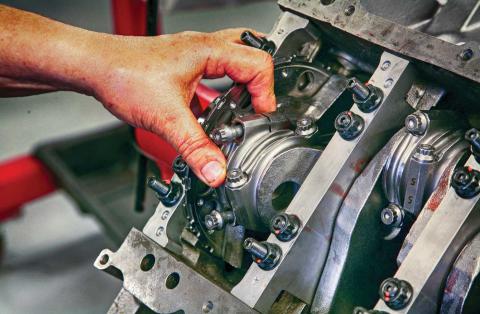
Understanding the properties of these critical components, as well as factors like preload levels and the effect of friction, are essential to the proper assembly of major systems on a high-performance vehicle.
They say you can’t tell a book by its cover, but you can certainly get a good idea of a fastener’s strength by the marking on the head of a bolt.
This is an often understated and important consideration, as many racing associations specify fastener strength minimums for select applications in their rulesets. Plus, most car builders place a premium on reliability “insurance” through the use of stronger fasteners.
It’s also part of a larger matrix: Understanding how fasteners are rated, how different manufacturing processes impact strength, how to avoid failures through proper installation, and factors like preload levels and the effect of friction are all essential to the proper assembly of major systems on a performance vehicle.
Identifying Bolt Head Markings
There are two entities that have established the strength standards we use today: SAE International (formerly known as the Society of Automotive Engineers, founded in 1905 by Henry Ford and others) and the ISO (International Organization for Standardization) located in Geneva, Switzerland.
The most common standards employed in high-performance automotive applications are SAE Grade 5 and Grade 8, plus ISO 8.8 and 10.9—generally employed for metric fasteners. An SAE Grade 5 bolt will have three raised “hash marks” on a hex head. It’s made from a medium carbon steel, and the minimum tensile strength is 120,000 psi. The Grade 8 bolt is made of a medium carbon alloy and rated at 150,000 psi tensile strength; it is identified by six hash marks on a hex head.
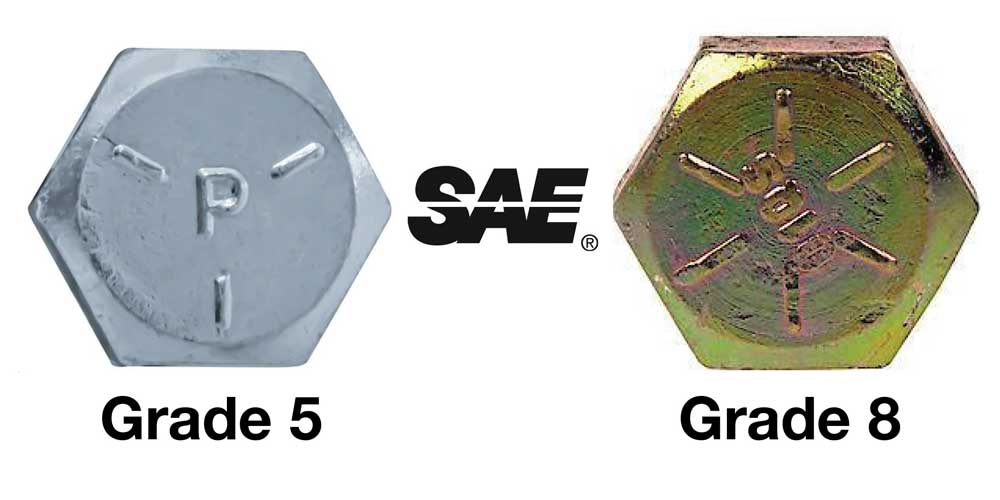
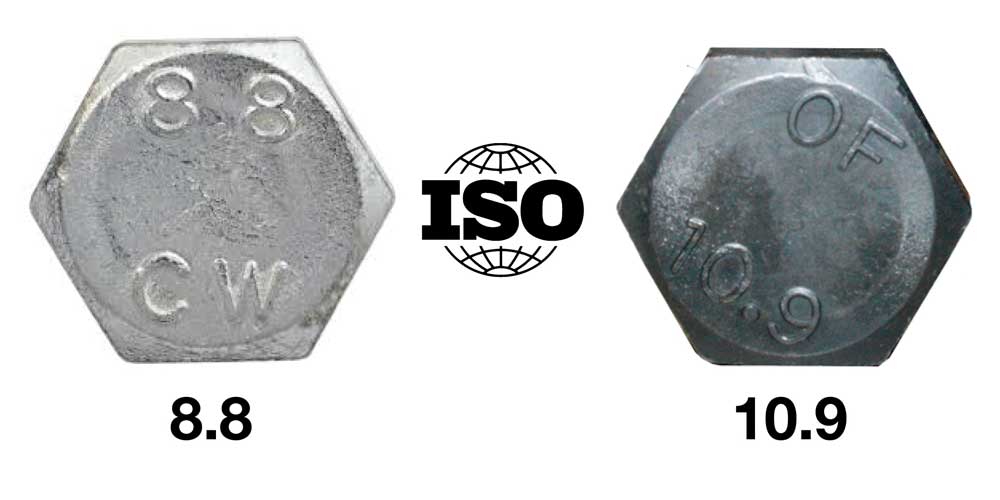
ISO class 8.8 fasteners are equal in strength to SAE Grade 5 at 120,000 psi, and class 10.9 replicate SAE Grade 8 at 150,000 psi. They will have “8.8” or “10.9” in raised digits on the bolt head.
Some suppliers may choose to exceed those standards, however. For example, ARP’s polished stainless steel and black oxide finished 8740 chromoly bolts (and studs) are nominally rated at 180,000 psi—some 20% stronger than Grade 8 or ISO 10.9 fasteners.
Tensile vs. Yield Strength
Tensile strength is the most commonly used yardstick associated with fastener mechanical property. It represents the maximum tension load that can be applied to the fastener prior to its fracture.
In addition to tensile strength there is a yield strength published for all rated fasteners. This is a measure of how much load a fastener can take before it starts to deform (typically around 0.2%). It is also the threshold at which a fastener starts to fail. For example, the yield strength of SAE Grade 5/ISO 8.8 is 90,000 psi; for Grade 8/10.9 it’s 120,000 psi.
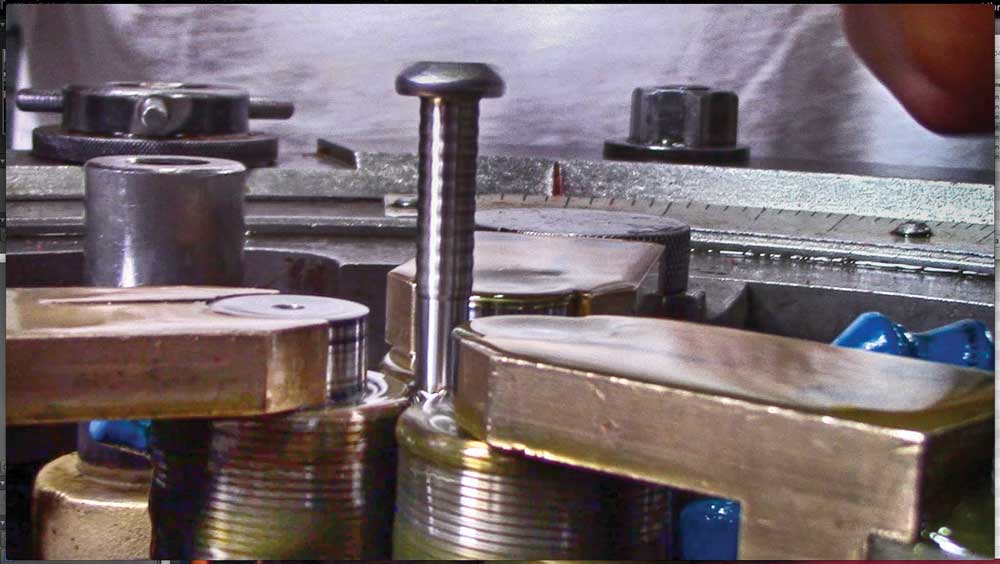
This is an important factor because almost all modern engines are primarily assembled using TTY (torque to yield) fasteners—often installed robotically. While this process is certainly adequate for OEM applications, placing additional stress on these fasteners through engine modifications can lead to serious consequences. Moreover, since the fastener has been yielded by design, it should never be re-used.
Manufacturing’s Impact on Strength
There are also several elements of fastener manufacturing that, while invisible to the naked eye, absolutely do impact a fastener’s durability and service life. This includes the quality of heat-treating process and how the threads are formed as a result.
Generally speaking, there are two primary heat-treatment methods: case hardening and through-hardening. Case hardening is a relatively inexpensive process that affects the surface layer of the component while leaving the core softer than it was before treatment. Through-hardening, by contrast, increases the hardness of the entire component with uniform properties throughout. It is a far more expensive and time-consuming method that requires specialized equipment and multiple steps.
The threads on inexpensive fasteners are cut or rolled on a bolt-making machine prior to heat-treating, when the material is softer and easier to work with. As you might imagine, the threads on better-made fasteners are constructed differently. For example, ARP rolls the threads (versus cutting) after the material has been heat-treated. This results in a fastener fatigue life some 10 times better than you’d get using other procedures.
Critical Bolts and Avoiding Failures
Connecting rod bolts are by far the most critical fastener employed in an engine. A failure here can lead to massive carnage—often damaging the crankshaft, pistons, block, and more. It’s here where more exotic materials are employed to withstand the increased loads brought on by power-adders and racing fuels.
On cap screws manufactured by ARP for aftermarket connecting rods, the actual alloy is stamped on the head (in addition to the company ID). These alloys include:
• 8740 (190,000 psi)
• ARP2000 (220,000 psi)
• L19 (260,000 psi)
• CA 625 (Custom Age 625+ at 280,000 psi)
• ARP 3.5 (280,000 psi)
Upgraded head studs (or bolts) are also a significant factor in engine performance and reliability. When combustion pressures increase, it is necessary to compensate with stronger fasteners and corresponding clamping force.
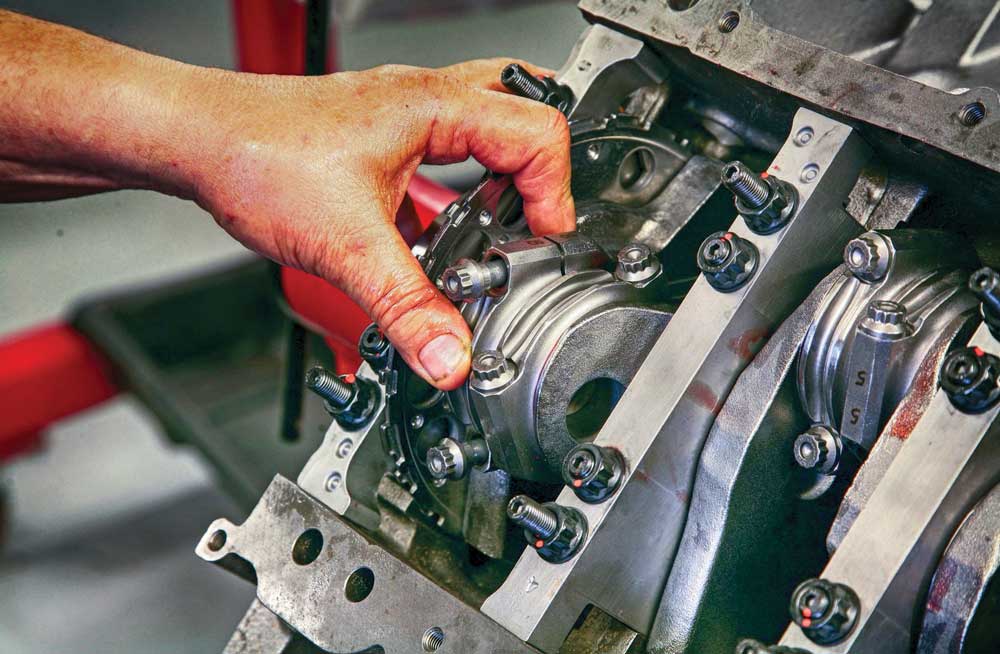
Standard 8740 chromoly studs and bolts are sufficient to handle most normally aspirated engines, while stronger fasteners should be employed for supercharged, turbocharged, and nitrous oxide-boosted engines. ARP, for example, uses an alloy strength range similar to the range for its rod bolts. Likewise, increases in combustion pressure (and engine power output) exert more force on the crankshaft and require upgrading main cap fasteners.
Proper Installation Procedures
No matter how good a fastener is, it can’t do its job unless it is properly installed. A fastener acts much like a spring, as it must be stretched to achieve a rebounding force. For example, a typical 3/8-inch rod bolt will stretch between 0.060–0.065 inches to achieve a 10,000-psi clamping load. When installing rod bolts, it’s highly recommended to employ a rod bolt stretch gauge. This will ensure the fastener is accurately preloaded.
The most common causes of rod bolt failures are either too much or insufficient preload. Too much torque on a bolt will stretch it to the point of yield; conversely, not enough clamping force will ultimately lead to rod cap movement in each cycle and imminent failure.
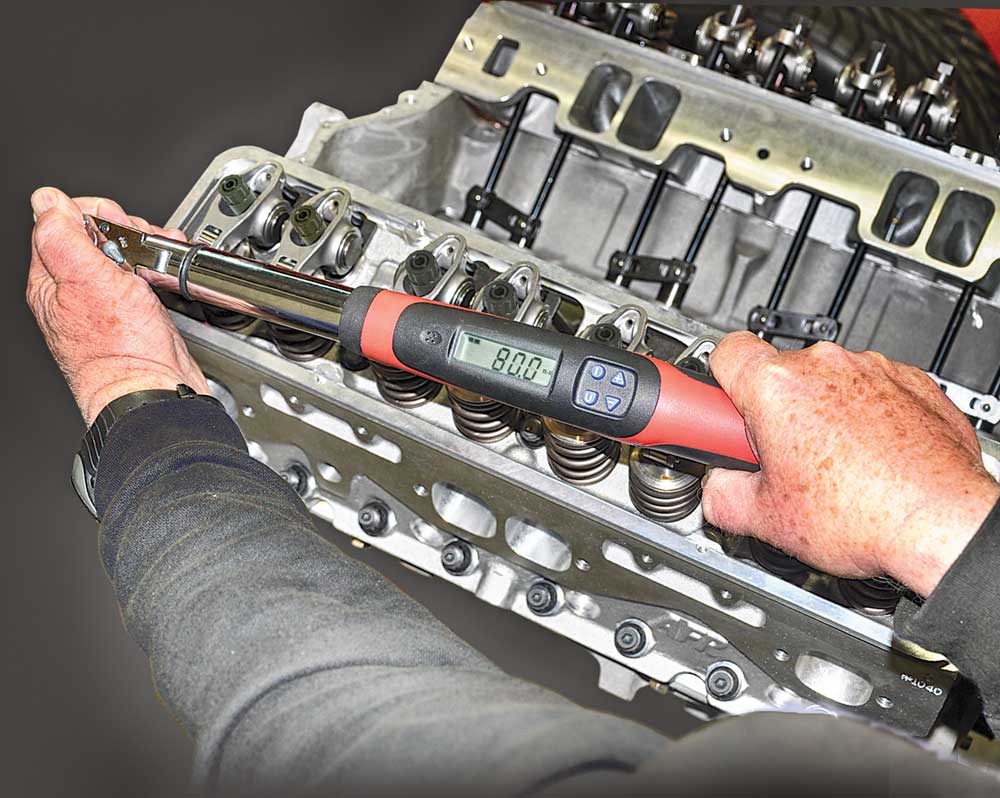
Most fasteners, though, are installed in “blind” holes. So it’s imperative to properly apply the required torque loads. ARP maintains a database of instruction sheets on its website (arp-bolts.com), so finding the proper specs is easily accessible.
Since torque wrenches are delicate instruments, it’s wise to have them tested periodically for accuracy. There are calibration services available nationwide, including by ARP—for free—at NHRA national events.
Preload Levels and the ‘Friction Factor’ Effect
It’s important to note that when a torque wrench goes “click” at its preset value, that does not mean all of the required torque is used to stretch the fastener. A large portion of the energy is usurped by friction, both in the thread and the underside of the bolt (or nut) and the lubricant. This led ARP To develop a lubricant that is superior to oil, moly, EPL, etc., and delivers 95–100% of the desired preload on the first (and all subsequent) pull of the torque wrench.
Note, too, that most OEM automotive engines are built—often with robotic equipment—using the “torque angle” method. This method calculates the specific amount of fastener rotation required, which then is used to determine the ultimate clamp load required. For hand assembly, a minimal torque reading—say 10 ft.-lbs.— is the starting point, and the fastener is then rotated “X” degrees to its final preload.
In conclusion, it’s a good rule of thumb to be wary of any fastener that does not have a marking on it, or that has markings you are unfamiliar with. Using properly rated fasteners, and understanding how to optimize their capabilities, is critical when assembling the engine, driveline, chassis, and suspension of any race car or high-performance vehicle.
Bill Holland has been involved with ARP’s marketing for 25-plus years. His competition background includes drag racing, off-road, and oval track. He currently races vintage sports cars. Holland has authored technical articles for numerous enthusiast magazines and websites. He also has built an AMBR Contender street rod.
June 2023
PRI Members Invited to Special Meetup on May 25

Kick off the Indy 500 weekend in style at your PRI Membership Headquarters!
Located on Main Street in Speedway, Indiana, PRI HQ is within walking distance from Indianapolis Motor Speedway (IMS) and right in the heart of the Racing Capital of the World. PRI Members are invited to join us for food and drinks on Thursday, May 25, from 4–7 p.m. EDT. Food and beverages will be first come, first served, so ensure you arrive early.
Do you want to win free parking at PRI HQ for race day or other cool prizes? Make sure you enter the PRI Open House raffle once you arrive!
Date: Thursday, May 25
Time: 4-7 p.m. EDT
Location: PRI Membership HQ, 1255 N Main St, Speedway, IN 46224
May 2023
On A Mission
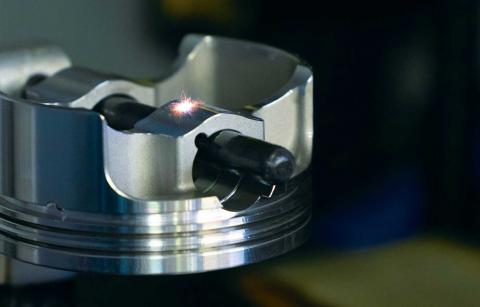
Piston manufacturers are racing to expand lines, keep orders moving, and push the envelope with new materials, all while an unconventional technology draws renewed interest.
Golf-ball-like dimples on the top face of a race piston is a technology that has been around for decades, and every so often these seemingly random craters on the crown draw attention at engine seminars or in motorsports chat rooms. Theories about improved combustion efficiency and manipulating the flame front have been debated and most likely tested by leading engine builders. However, no piston company has promoted the quirky science and marketed off-the-shelf product with dimples.
So it was no surprise that Daniel Schierholt was hesitant to try dimpling the pistons on the 506-cubic-inch B1 Mopar that powers his Super Pro ET dragster. (Schierholt is the engineering manager at piston manufacturer UEM/Icon in Carson City, Nevada.) The company recently partnered with Speed of Air (SoA) Engine Technologies in Reno, Nevada, to use SoA’s patented dimpling technology on a new line of Hyperformance pistons for diesel engines.
Field testing with DFC Diesel in Canada revealed promising results, so dimpled pistons will be available for select diesel applications through UEM/Icon and under the SoA brand. Icon had also worked with California dirt-track racer Bobby Hogge to provide dimpled pistons for his Chevy small block. Again, improved performance was reported.
“If it works with diesel and gas, let’s try drag racing and methanol,” said Schierholt, who switched out the 4.355-inch-bore Icon pistons on his engine with no other changes. “My motor was at 14.5:1 compression ratio. With the dimples it dropped down to 14.32:1.”

Schierholt compared time slips on days with near-equal track and air conditions. On each run the car was launched at 5,000 rpm and shifted at 6,800 rpm. The 60-foot times were down slightly with the dimpled pistons, but the car picked up acceleration through the remainder of the run and finished the quarter-mile .16 second quicker and 3 mph faster on the top end.
“As a driver, you can feel it making more power, more torque,” said Schierholt. “Also, the engine is using about an eighth- to a quarter-gallon less per run.”
While SoA and UEM/Icon are capitalizing on an off-beat cyclical technology that is showing promise, other piston manufacturers are busy keeping up with demand, freshening some popular parts, and creating new lines of product to give the racer and street enthusiast smarter choices. PRI Magazine recently sampled a number of piston companies and found new engines and applications are the prime forces moving development these days.
Active Development
Most experienced engine builders already have a good idea of the piston design, construction, and features that suit their programs. Unless rules change or racers apply more boost than they told their tech reps—which certainly would drive new product—aftermarket piston programs remain healthy, and most engineering divisions are once again active in developing new innovations.
“We’re constantly changing the lineup. It just depends on what’s in demand,” said Alex Gonzalez of RaceTec Pistons, Huntington Beach, California, adding that racers have their own preferences on piston options. “Sometimes it’s just an upgraded wrist pin, or gas porting the pistons, or making them lighter. It just depends.”
“Pretty much everything we have now has been fully maximized to suit today’s modern technology,” said Nick Diaz of CP-Carrillo, Irvine, California. “The only project in development that I can talk about now is a Godzilla line of pistons and rods.”

Over at Race Winning Brands (RWB) in Mentor, Ohio, which oversees Wiseco, JE Pistons, Diamond, and Manley pistons, Diamond is looking at adding product for European exotic and high-performance applications, while Manley continues to offer shelf-focused solutions.
“Wiseco will be launching a new RED series—the acronym stands for Race Engineered Design,” said Scott Highland of RWB.
“JE has the SRP Pro 2618 line, which offers customers a similar solution and has been expanded with quite a few more part numbers for LS, Ford Modular, and Gen 3 Hemi applications,” added RWB’s Kevin Bailey.
There’s even a little taunting going on when the topic of new materials comes up. “We can’t speak on it, but we’ve worked with professional race teams and exotic materials—materials that wouldn’t be considered the norm in modern engine building,” teased Joe Maylish of MAHLE Motorsports, Fletcher, North Carolina.
The dimples, however, are igniting new discussions among racers, and both Schierholt and SoA’s Chris Parkhurst stressed that there is a science behind the technology. The diameter, depth, and placement of the dimples were tested extensively in computer simulations to develop the strategy.
“It’s not that you just start putting dimples across the face of the piston,” explained Schierholt. “We look at flame travel, location of valves, spark versus compression ignition, the type of fuel, and that will dictate where the dimples go.”
“Dimpled pistons have been around for a long time, but it was sort of trial and error,” said Parkhurst. “We got into some pretty advanced computational fluid dynamics to optimize designs. There’s a reason for every dimple we put on a piston, where we put it, and why we put it there.”
The SoA strategy for the diesel pistons also includes a mixture of thermal and anti-friction coatings. “We use coatings for the same reasons that anybody else is using coatings for the most part. However, there’s an interrelationship between the fluid dynamics and the thermodynamics of what’s going on in an engine,” said Parkhurst. “One influences the other. This is where people get kind of sideways with our technology. They just see dimples.”
SoA’s research into the dimple technology started as a way to reduce NOx emissions and improve fuel economy for large fleets. “Racing was never the goal,” said Parkhurst. “We’re a green engine company, and we’ve made a more efficient combustion event with all fuels. The additional horsepower, the additional benefits don’t cost anything. We don’t bolt anything to the engine. At the end of the day, it’s still just the piston.”
For CP-Carrillo, it’s also the connecting rod. The company is looking to expand piston-and-rod packages that are matched for different racing applications.
“Since we are a manufacturer of the rod and the piston, we have great insight and a vast knowledge of how those components can function together in those high-stress environments,” said Diaz. “We’re doing a lot of titanium now with our connecting rod line, and we have a new high-grade steel that’s available now that is 30% stronger than our standard steel. It’s a tremendous upgrade for high-end road racing or drag racing.”

Some of the new CP-Carrillo pistons soon to be mated with a complementary rod will cover options for the Ford 7.3-liter Godzilla engine. The company is working with a professional race shop on the development, and Diaz said two bore sizes will be available: standard and +.025.
“They’re designed for the 1,500- to 1,800-horsepower range,” added Diaz. “They’ll be available on our off-the-shelf Bullet series.”
Addressing higher horsepower, Diaz said the company is working closely with racers to build pistons suited to higher boost applications. “They communicate to us exactly what’s going on with their setup, how their engine’s performing, and we try to analyze that data to build better parts,” said Diaz. “Ultimately that information trickles down to our shelves. If we find something that’s working in a 4,000-hp Pro Mod car, it’s going to trickle down to the sportsman racer, eventually.
“We go over the customers’ needs and ambitious goals,” continued Diaz. “We need to extract as much detailed information from the customer as possible to ensure the block height, stroke, and rod length will yield enough strength for their expected horsepower.”
With any new knowledge comes the opportunity to overhaul an existing product. MAHLE Motorsports recently redesigned its venerable small block Chevy dished piston.
“Here was a technology that’s been around for a long time, and we said, ‘How can we make it better?’ Then we did a complete redesign of the forging. We strengthened key areas, specifically around the pin bore, and just added mass in key areas,” said Maylish, adding that a similar upgrade was given to select Mopar big block pistons.
Trending Sales
A remarkable trend in the piston market these days is the expansion of off-the-shelf product. Custom pistons are still available within a reasonable turnaround time if there are no labor or materials shortages due to a pandemic. However, more performance and racing features are being engineered into affordable, durable products that can be shipped overnight, if needed. While some are direct shelf parts, others are “made to order,” meaning that all the engineering is in place, and pistons can still be produced and shipped in a timely manner.
The RED series at Wiseco illustrates this performance-and-value direction. Standard features include a 2618 alloy forging, skirt coatings, and a 1.5-mm, 1.5-mm, 3-mm ring package. They’ll be available for popular domestic applications in a variety of bore sizes and compression ratios.
“It’s for a drag race guy or a circle track guy who needs the strength and the features of a capable forged part, but it’s in a little bit more of a standardized fashion. So it can hit that middle-of-the-road use application,” said Bailey. “This will be Wiseco’s moderate to heavy-duty power capable performance and value part and can save customers from spending the extra money on pistons designed for severe-duty applications, like the Professional series, if they don’t need it.”
“We see the RED series in the 800–1,000-hp range,” added Highland.
In developing the SRP Pro 2618 series for JE Pistons, engineers adopted a similar strategy to give racers a budget piston capable of 800–1,000 hp. Within the JE SRP line, it fits on top of SRP and SRP Pro. It has standardized features like skirt coatings, pin oiling, and accumulator grooves.
“There is a variety of Gen III Hemi and Ford Modular available now under SRP Pro 2618, as well as an updated complete line of LS,” said Bailey. “LS has the longest list of numbers for varying engine generations and bore/stroke combinations.”

For the Diamond brand, the European and sport-compact market of Lamborghini, Audi, Nissan GT-R, and other performance models is growing at a rapid pace. “People are building billet blocks for these applications,” noted Highland. “It might be a V10 motor where they’re trying to watch the weight, or with power adders they have to have the piston mass in the right areas—you have to balance strength and weight.”
“It’s an expansion into serving the need in markets with really high horsepower,” added Bailey. “There’s 400 hp per cylinder in some sport-compact engines, and failure is not accepted.”
The wide range of pistons available from RWB is helpful to a racer stepping up through the ranks.
“Over the past couple of years, we’ve been helping Samantha Moore, who won the NMRA Limited Street championship a couple of times,” said Bailey. “She’s developing an increasing power level every year on the Coyote that she’s running. The first season she ran our JE Ultra series shelf part, but that ended up needing modifications into a custom part. Now she’s running a ProCharger, and there’s even more boost. So we had to build a custom version of the Ultra series with ring-land changes and other modifications, plus an upgraded set of rings, to be able to withstand extended use and keep sealing throughout the season in the high-horsepower conditions of her setup.”
As mentioned before, piston manufacturers are always looking at new materials, whether exotic alloys proprietary for a particular race team or improved alloys that can also help budget racer upgrades.
“We continue to investigate all types of alloys for pistons,” said Highland. “We’ve looked at metal matrix, obviously. Sure, there are rules concerns, but mainly it’s cost concerns. It’s not always just the material cost, but the machining technique, and the tooling you need is more expensive, There’s also crazy stuff like ceramic materials. We know they exist and do some development on different materials. But we haven’t found anything that really has outperformed 2618 for the money.”
Gathering Information
With more choices available to racers and street enthusiasts, company reps stress the importance of working closely with the phone techs and, most important, being honest with their expectations on the track.
“When some guys call up, they’re very excited because they’ve read something on a forum,” said Maylish. “They want to get, say, a 2618 alloy, anodized top-ring-groove piston for a hot rod that they’re building. Or they’re looking at a 4032 alloy and they want to put 25 pounds of boost to it. Both of which are incorrect in application. I think the main thing is that yes, business is booming, business is unbelievable. But as an industry, we have the responsibility to have conversations with our customers to ensure that they’re making the correct purchasing decisions. If you don’t and they choose the wrong component, it creates a bad experience, and there’s potential that they don’t want to come back and purchase your product.”

“We go over the customers’ needs and ambitious goals, and then we can try to fit them into a package,” explained Diaz. “Not everything is going to work all the time. That’s the tricky part. You’ve got to get all of that information into the computer and figure out the stresses of the certain components and where they can handle certain improvements.”
“All we can do is guide them,” said Gonzalez. “We can’t choose for them.”
Sources
CP-Carrillo
cp-carrillo.com
Diamond Pistons
diamondracing.net
JE Pistons
jepistons.com
MAHLE Motorsports
mahlemotorsport.com
Manley Performance
manleyperformance.com
RaceTec Pistons
racetecpistons.com
Speed of Air
speedofair.com
Total Seal
totalseal.com
UEM/Icon
uempistons.com
Wiseco Pistons
auto.wiseco.com
June 2023
Exerting Control
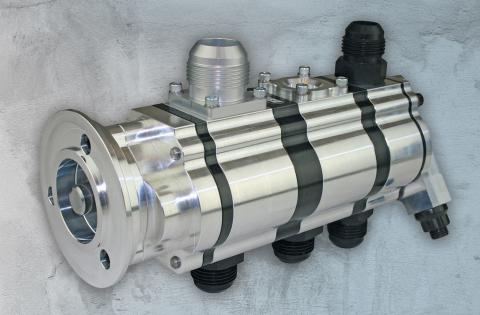
Oil system manufacturers are constantly updating and upgrading this most fundamental aspect of an engine’s operation in order to prevent the (potentially disastrous) consequences of inadequate oiling.
Engines, in one form or another, have been around for a very long time. So, it would seem that by now something as fundamental to the engine’s function as its lubrication system would be dialed in. Yet there are forces at work that keep an optimized oiling system a constantly moving target, from ever-thinner oils to ever-more-powerful engines. Plus, basic fluid dynamics keep system developers on their toes.
“Oil is the only thing in the engine that’s completely footloose and fancy free to go wherever it wants,” said John Schwarz of Aviaid Oil Systems, Chatsworth, California. “Where the oil goes is impacted by what a vehicle is doing. In drag racing, it all goes to the back of the pan, or the back of the valley, or the back of the cylinder head. In road racing, it goes to the front of the pan, the back of the pan, the left side of the pan, the right side of the pan. In circle track racing it typically goes to the right side of the pan. In hydroplane racing, it goes to the wrong side of the pan. Those boats still turn left, but the engine is in the boat backwards, and centrifugal forces in a 2G turn can be so significant that it will overcome the windage and crankcase to drive the oil to the side of the pan where the pickups typically are not placed.”
Oil, Schwarz said, “is the one thing in an engine that’s completely uncontrolled. The better you can control it, the better the system will operate overall.”
Oil Capacity
The foundation of an oiling system, the oil pan, has been reengineered to work with some of today’s most popular engine families.
“One of the biggest things we deal with is how LS engines fit in cars,” said Scott Hall of Moroso, Guilford, Connecticut. “The reason it’s so much trickier than other engines is because, while most blocks have the oil pan rail at the centerline of the crankshaft, an LS has a skirted block, which takes away some of the oil pan capacity. We have to build a variety of oil pan sizes for LS engines to fit into everything from a COPO Camaro to a road racing car or a sand rail.
“The key factors we always look at with any type of oil pan are, how much oil are we looking to get into it, and how does the crank centerline of the engine relate to the lowest point of the car?” Hall added.

With a traditional engine block “you could put an oil pan on there with a kick-out pouch to get some of the oil off the rotating assembly,” added Moroso’s Frank Thibodeau. “That would help free up some windage and get the engine to spin a little faster. But we can’t do that in an LS because the crank is recessed into the block. It’s very similar to the old Hemi motors. In those situations we try to control the oil the best we can with the maximum depth we can put in there, since getting the oil away from the rotating assembly will help. We also build features into the pan, like windage trays and scrapers, to help control the oil and keep it off the rotating assembly as much as possible.”
Another design Moroso uses for these engines is a T-sump pan, “where the sump is wider than the width of the pan,” Hall explained. “We’re trying to find the capacity needed so these pans will fit in the envelope we’re given.”
Oil Control
Yet even the most carefully designed and constructed pan can’t do its job properly if the oil isn’t getting to it.
“One problem we run across quite often in the drag race and truck pull markets is customers not having enough oil to go from A to B,” said Mark Mittel of System 1 Filtration Products, Tulare, California. “The inherent problem is that the right-hand valve cover is full of oil that can’t get back to the sump. It’s draining back through the heads, but then when it’s trying to return to the pan, it falls on top of a rotating mass that flings it right back up again. It’s a tough situation to get enough oil back in the pan to make the complete run or the complete pull.” The situation is more pronounced in the right-side valve cover because “that’s the way the crank and rods are turning,” Mittel explained. “It flings the oil back up on the 2-4-6-8 side of the motor.” Some racers overfill the crankcase as a way to mitigate the problem, but the excess oil can create “a horsepower-robbing situation.”

Mittel’s solution is to install a drain from the back of the valve cover to the oil pan. He recommends using hose “that’s a minimum of a -12 AN, though a -16 is preferred.” The line needs to be plumbed so that “the oil returns underneath the windage tray, because that’s more of a low-pressure area, versus the high-pressure area right next to the spinning crankshaft.” This has worked for “many, many customers,” he added, “especially the Bonneville guys. They have to run a full five miles dealing with oil. This can also help in a Funny Car or an Altered, where you can’t put a very big pan under it. Now they can carry the right amount of oil, and it pretty much ensures the oil goes all the way back to the oil pan.”
Another way to address this situation is to plumb an oil accumulator into the system, Mittel said, “especially with some of these cars where you can’t put a big pan on. If your oil pressure drops below a certain level—whatever pressure you set on the accumulator—it will turn on, and here comes two or three more quarts of oil to feed the motor.”
The Dry Sump Solution
A dry sump oiling system will solve many of these oil control problems because it allows the placement of oil pickups “in places where oil is accumulating, not necessarily in the center of the pan where you’re trying to have a one-size-fits-all kind of pickup,” said Schwarz. “Chrysler Hemis, for example, have a real tendency to pack oil in the valve covers. With a dry sump you have the ability to add scavenge sections specifically for the purpose of scavenging the cylinder heads and getting the oil back to the tank where it belongs.” There is also flexibility in where the sump tank is mounted for a weight placement advantage, he added.
For race vehicles subjected to high G forces, “like a rock climber that goes up steep hills, oil control is a problem,” said Mike Cofini of Clear View Filtration, Spokane, Washington. “A dry sump works better for those type of applications. It’s the same thing on a drag race car. When you throw the parachutes out, oil pressure can drop or could go to zero because all the oil gets thrown to the front of the motor and away from the pickup screen.”
“Anybody who can afford a dry sump should put it in their car, because it’s the best oiling system you can have,” said Thibodeau. “There’s a reason every serious race car in the world has a dry sump.”
To Hall, the “biggest advantage” of a dry sump system is that its shallow oil pan “allows you to have the engine far lower in the car than you would normally have with a wet sump system.” For an LS engine, Moroso makes a dry sump pan that’s 4 inches deep, compared to a standard pan that’s 6–6.5 inches deep, “so you’re gaining 2–2.5 inches of lower center of gravity by going with a dry sump system. That’s a real benefit.”

Oil capacity is another reason to run a dry sump system. “In a Funny Car or alcohol Funny Car, there’s only about 4 inches of pan clearance, and in such a small pan you can’t have 10–12 quarts of oil,” said Cofini. “Because the pan is so close to the ground, or because of other chassis components, there’s not room for very much oil in there.”
“With a dry sump system, you can put five gallons of oil in a car,” Schwarz added, “and with that higher capacity, the engine will be circulating cooler, cleaner oil. You can’t do that with a wet sump, especially because nine times out of 10, even with the older engines everything’s getting lower to the ground. Nobody wants to run a high center of gravity. So the first question we get asked a lot of the time is, ‘How shallow an oil pan can we put in this thing?’
“There’s nothing that a dry sump system can’t help improve with regard to an engine,” Schwarz said.
“Dry sump usage and popularity have never been this strong,” said Thibodeau. “We are selling more dry sump pumps than we ever had as a company. In the 34 years I’ve been at Moroso, dry sumps were typically confined to drag racing and higher levels of circle track, but now you’re seeing them at all kinds of different levels of drag racing. A lot of different racers are using dry sumps. So now we’re making them for so many different applications. We make them with a V-band clamp on the front so it can be put on the front of a centrifugal supercharger drive mount. For LS motors, we took the bolt pattern on the block that was used for an A/C compressor—which is not used on a race car—to develop an adapter to bolt the dry sump to the block.”
This “explosion of dry sump pumps in our industry,” as Thibodeau called it, has brought with it “a bigger need for different types of pressure section widths, depending on the volume needed for these dry sump pumps. Not every one of them will need the same amount of volume to support that motor. So we have five different pressure width options to accommodate the specific types of needs a motor would require.”
On the subject of dry sump oil pressure, Cofini pointed out that “it’s virtually impossible to suck oil through the same size line as you’re putting 80–90 pounds of pressure out the other side. You should be using the next size up line to suck out of a dry sump tank as you’re pushing through the other side.” Testing on a flow bench demonstrated to him that “it’s only a matter of time before it starts not sucking the correct amount of oil through there and creates a vacuum, which will reduce the oil pressure and the volume going through it.” So with an LS engine, for example, “if you’re sucking through a number 12 line and pushing through a number 10 line, everything’s great.”
Dry Sump Alternatives
If a dry sump system doesn’t fit a racer’s budget, there are lower-cost alternatives.
“One option is an external wet sump pump, which is a belt-driven, single-stage pump,” said Hall. “It allows you to build a shallower wet sump pan and have the pump outside.” He called this setup “a big option for all the COPO Camaros when the NHRA allowed them to go to an external wet sump pump,” and he said it’s also popular “with Ford and LS guys. Instead of the oil pickup going the entire distance of the pan and getting in the way of the rotating assembly, now the pickup’s in the rear, the pump’s outside, you can prime the pump, the pump doesn’t get hot, and now you can do more with larger strokes and use the shallower versions of wet sump pans.”
“A wet sump oil pump with a dry sump attitude” is how Verne Schumann of Schumann’s Sales & Service in Blue Grass, Iowa, describes his ER-VAC oiling system. The ER stands for energy recovery. As Schumann explained, “The bypass oil never sees the pan again. It goes back through a re-routing high-pressure hose to the pickup tube, and we re-pressurize the intake tube,” promoting additional oil flow no matter the orientation of the oil in the pan. VAC stands for vacuum; the ER-VAC system is a closed-loop system not vented to the outside air. It’s similar to when a drag racer “introduces a vacuum pump to suck the oil pan into a vacuum reading, which gives you horsepower,” Schumann said.

The ER-VAC system works well in many racing environments, but where it really “dominates,” Schumann said, is in monster truck competition. “They stand the truck on its nose for 6, 8, 10 seconds before it drops down, because the longer they stand on the nose the more points they score. But with a conventional oiling system, when the truck is on its nose, all the oil in the pan runs to the front of the motor, and the pickup, usually in the back of the motor, is now sucking air.” With the ER-VAC system in place, “the trucks can sit there for 10–15 seconds before they drop down on the ground and it doesn’t hurt the motor. We forcefully pipe the oil back to the intake stream and pressurize the intake side of the pump. So if the bypass oil is set at 60 psi, it’s going to go in the intake at 60 psi. And guess what else does that? A dry sump, for big dollars.” Schumann quoted prices for dry sump systems as “$3,000–$7,000 installed; our pumps run from $300–$500. Is it as good as a dry sump? No. But if the rules say wet sump only, we’re a killer item.”
Proper Pressure & Volume
“So many people call me with bearing problems,” said Cofini, who spent 30 years as an engine builder before starting his business making see-through oil filters. “I tell them they need to have more oil pressure, especially in boosted applications, because we’re using that oil pressure as a shock absorber between the connecting rod and the bearings. When these turbo cars make 30–40 pounds of boost, we’ve already squished the oil out of the bearing.” On such an “extreme application,” Cofini recommends “a minimum of 10 pounds per 1,000 rpm. I even like to see 12 or 13 pounds for every 1,000 rpm, especially if you’re running the motor up over 9,500, which a lot of guys do now.”
The popularity of drag-and-drive events like Drag Week and Sick Week has complicated oil pressure recommendations, Hall said. “You have to have enough oil pump in the thing to keep the race car side happy, but at the same time you don’t need to make 150 pounds of oil pressure driving down the road. But when you’re at the track, there’s a balance you need to achieve. A street car making 20 pounds of oil pressure at a stoplight is okay, but in a large-cubic-inch engine, something with huge valve springs and overlap, you have to be careful that there’s a balance of oil viscosities and oil pump sizes.”
Schumann has a new product “just around the corner” called DialAdjust that will enable the driver to adjust oil pressure at the turn of a knob. “Let’s say in a circle track application, during qualifying the driver can turn down the oil pressure for one lap to make a better horsepower rating,” Schumann said. “Later in the race, say at lap 70 or 80 of a 100-lap race, when the oil is getting hotter and more contaminated and the oil pressure is dropping, he can crank it up again.”

The DialAdjust system will be available for “all engine families,” Schumann said, and will require no internal engine modifications. “We’ll pick up the oil for the transition and control the pressure through the oil pump filter area, and then pump it back into the pan. Adjustability will be by two means: Both the volumetric gallons per minute and the pressure will be controlled. The two always work hand-in-hand.”
Oil volume is a critical part of the oiling system that can be misunderstood, Cofini believes. He’s seen it in questions from customers about the size of the oil filter a particular application should run.
“The biggest thing that makes the filter assembly different is the type of engine and how big the oil passage feed hole is going into the motor,” he said. “Horsepower has nothing to do with it. Some people think that the more horsepower you make, the bigger the filter you need, but that’s not true. For example, a Ford has a half-inch feed hole in the block, so at 90 pounds of pressure, it can only run about 12 gallons a minute through that hole. That hole dictates the entire system.
“We have also learned how important the inside of a fitting is to our oil system,” Cofini added. “Take a block adapter for a big block Chevy. The big block has a .600 feed hole on the block. If you put a number 10 line on that, which is a half-inch hole, you’ve restricted oil to the engine. You could have an oil pump the size of a dump truck and a four-inch hose feeding your motor, but if it has to run through a half-inch hole at 80 pounds of pressure, that’s all the volume you get to the entire motor.”
Also important when choosing an oil filter is to match the weight of the oil with the filter material. “One of the problems we have is somebody trying to run too fine of a filter with too heavy of an oil,” said Mittel. “It can cut the flow rate by a third at least, or half.” For a drag racer or tractor puller running straight 60- or 70-weight oil, for example, “for 99% of the applications we would steer them to a 75-micron element. Some companies have a 75-, 80-, even a 100-micron filter, but you can reach a point of no return. If the diameter of the holes in the filter are too big, it’s like not having a filter at all.”
Mittel also pointed out that while blending a straight-weight oil with an oil additive can improve the oil’s lubricating properties—“all the added zinc and phosphorous are your friends”—it will also raise the oil’s thickness. So a straight 50 can become a 60, which may then be too thick for the filter. “And if they’re using a traditional paper-style filter on there, more than likely it will tear the paper inside the filter to let it flow. In most cases the racer never knows that it’s torn a hole in the paper, so they’re not getting any filtration at all. So always be mindful of the other side of the filter.”
Sources
Aviaid Oil Systems
aviaid.com
Clear View Filtration
seethroughfilter.com
Moroso
moroso.com
Schumann’s Sales & Service
schumannssalesandservice.com
System 1 Filtration Products
system1filters.com
June 2023
Dialed In
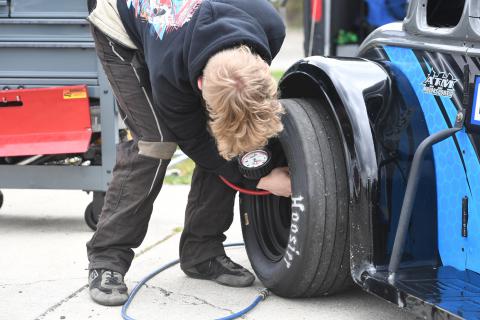
Advances in measurement and testing procedures are helping to deliver consistent, repeatable results on track.
As various series tighten rulesets to address rising costs across a range of motorsports disciplines, chassis setup has become a crucial element of competitive race programs. While the benefits of a well-sorted setup have been understood for some time now, in recent years it has become much more difficult to overcome any potential shortcomings with an additional dose of horsepower or a clever aero tweak. As a result, many teams are taking an increasingly sophisticated approach to the setup process, and they’re utilizing equipment that can provide a level of accuracy that was unheard of not so long ago.
“With the digital caster camber gauges we’re using, the margin of error is down to less than a tenth of a percent,” said Ben Baker of Longacre Racing Products, Boonville, Indiana. “When you compare that to the analog-style needle gauges, the accuracy really comes down to whoever is reading the gauge. The gauge itself might be very accurate, but it’s open to interpretation by the person who is looking at the measurements. There are some chassis height gauges out there measuring within ten thousandths of an inch. In the pavement world, that kind of accuracy is really critical.”
And detailed accuracy required in other industries, such as aviation and the US military, is benefiting motorsports, according to Carter Gerlach of Intercomp Racing in Medina, Minnesota, which is an ISO9001:2015 Certified US manufacturer and offers weighing and measurement products for all three industries and more. “We take that level of precision from our other markets and float it into our racing market products,” he said, noting that Intercomp RFX Wireless Scales are used exclusively by all NASCAR divisions including ARCA for tech inspections, “which is really indicative of the accuracy and the precision of the product.”
Tech-Driven Precision
While the exactness of today’s chassis setup equipment is allowing racers to take a more scientific approach to their tuning strategies, Steve Arpin of Longhorn Chassis in China Grove, North Carolina, pointed out that chassis manufacturing quality can have a profound effect on the end result.
“It really starts on the jigs,” Arpin said. “Teams in every motorsport discipline have always had their ‘special’ cars. I remember that during one of Kevin Harvick’s best years in the Cup series, he had this one specific car that he put aside for the Chase. You’d assume that if anyone would have the budgets to have identical cars produced, it would be teams in the Cup series, yet they still had these certain cars that worked better than the rest of them. That led us to wonder why. What are the differences that make one car stand out among the others? It starts with the materials, the tubing wall thicknesses, and how it’s all put together. You have to think about the chassis itself as a spring because it flexes out on the race track. That means that the consistency and repeatability you’re looking for in a chassis setup starts at that level.”
The importance of quality is reinforced by Steve Watt at Maxwell Industries in Ventura, California, who said that inconsistent parts manufacturing can make it difficult to hone in on the right settings. “With torsion arms, for instance, the manufacturer can make a difference. When some of the titanium ones first came out, we tested them and discovered that they were a softer rate than the aluminum ones. That kind of thing can really impact how you’re setting up the car, and it can kind of take you off of the ‘system’ of settings that you know you like.”

Moving beyond the importance of a solid foundation, Keith Berner of Accu-Force Shock Dynos in Millersburg, Ohio, said that the accessibility of advanced chassis equipment is bringing a level of exactness to grassroots and sportsman racers that simply wasn’t available in the past. “We’re at the point where regional and local competitors are using lasers to get measurements down to the thousandth. We used to use tape measures to do everything, and now we’re using things like micrometers and linear potentiometers that can tell you exactly where you’re at. When I first started building spring smashers, I thought that if we went to a tenth of inch, or maybe even a hundredth, that would be plenty accurate. But once we started using them, we realized that we had to go to the thousandth. Part of it comes down to the level of competition we’re seeing today. If you don’t do it, you’re not going to keep up with the guy who is.”
Gerlach cited Intercomp’s variable speed shock dynamometers, which feature a 40-inch mast height to rate a wide variety of shocks, with either a 3-hp or 8-hp motor, and simulates travel velocities of up to 55 inches per second to gather data for all markets.
To complement a race car suspension program, Intercomp also offers its traditional spring rater for testing springs alone, or its coil rating option, Gerlach explained, which allows testing of the entire coilover assembly without disassembling the shock and spring.
He acknowledged that Intercomp is “not a shock company, but we’re a shock testing company. Really, far and away, I would say shocks have changed in the cars and in the market the most in the past five years. That is a continual moving target and something that is really not slowing down. Racers and the teams are putting a lot more emphasis on their shock programs and accuracy with the testing and validating their shock program with our shock dynos and spring raters.”
As series continue to crack down on the gray areas of their respective rulesets, this level of exactness has become a necessity for those who want to extract all of the performance potential from their car without running into trouble at tech inspection. “As far as measuring suspension travel goes, things have changed quite a bit in the last eight years or so,” said Dave Dunlap of Basic Racing Enterprises in Asheboro, North Carolina. “With how close we’re running the cars to the ground now, it’s not really good enough to get it in the ballpark with a tape measure. We’re now getting to within an eighth of an inch to the ground without hitting it, and that’s thanks to things like the setup plates that companies like Wehrs and DRP Performance are producing. Today we can get a really clear picture of what’s going on with the suspension, and before we were just sort of guessing.”
Building A Baseline
Chassis setups require a holistic approach in order to be truly effective, but generally speaking, there is a hierarchy to the process. For Baker, that starts at the front end of the race car.
“You have to have the front end right or nothing else will work. If you don’t have the camber, caster, toe, and the bump steer set where it should be, it doesn’t matter what you’re doing in terms of weight distribution, or what your load numbers are—it’s just not going to work. So that’s the number-one thing in my mind. The next priority for me is the scaling process, and getting the corner weights where you want them. From there, it’s the load numbers.”
While it’s important to establish a reliable combination of static settings, today’s competitive chassis setups are largely based on how the car will behave on the race track. To get a better understanding of how that differs from those static settings, teams are using setup equipment that can replicate the forces that are applied to the car at race pace.
“We don’t drive around the race track with the car ever at ride height—the only time it’s at that height is when it’s sitting in the pits,” said Arpin. “When we’re scaling the cars, we’re setting the percentages to make sure the car has proper weight distribution, and to make sure it’s heavy enough to pass tech inspection at the end of the race. Everything else is done ‘in posture,’ whether that’s with load sticks or spring smashers. That allows you to replicate the attitude of the car when it’s going around the race track, so all of the setup adjustments really happen there.”
Berner told us that understanding the car’s dynamic position with the data provided by this equipment helps to deliver the consistent, repeatable performance that teams are striving for. “Spring smashers have been a game changer because they let us look at things that we weren’t able to see before, and pull-down rigs have benefited racing in much the same way. Over the years, these products have gotten more and more refined and have taken everything that much further. Our spring smasher goes down to the thousandths because we need that level of precision. What we found was that 10 thousandths on a heavier spring might be 20 or 30 pounds of difference. In today’s world, that matters.”

Although one incremental change here or there might not have a profound effect on a given car’s lap time, this level of accuracy can be used to improve a number of different aspects of a chassis setup. Enough small changes in the mix can add up to something that has a meaningful impact on race day.
“The top-running teams have a deep understanding of every single point on their cars,” Arpin said. “Improving one detail on the car might get you a hundredth of a second, and that might be considered a negligible benefit on its own. But if you stack up 20 different improvements that each get you a hundredth of a second, that can make a very big difference. Two-tenths of a second can be the gap between the national-level teams and the Saturday night racer.”
He added that this level of precision in chassis setup can help identify potential handling problems before they cause problems out on the course. “If you look at the Lucas Oil series, for example, there are virtually no DNFs for the teams that finish in the top five. Being able to look at the car with that much detail gives you a better handling car, so obviously you have more control. Having more control makes it easier to avoid wrecks and not get torn up.”
Gerlach cited a continual evolution in racing chassis setup equipment as “the chassis builders and the experts in the industry that are fabricating and developing setups within the cars are asking for numbers being tested, so we need equipment to test them. Where maybe five years ago they weren’t asking for that to be tested on the cars.”
To deliver those numbers, Gerlach pointed to several of Intercomp’s products including its digital air gauge that reads out to .01 PSI with accuracy of 0.1%, 6061-T6 billet aluminum scales, precision hub scales, caster camber gauges, turn plates, shock dynos, spring testers, and RFX Wireless suspension load sticks.
Intercomp’s Microflex scale systems have four load cells per pad for enhanced capacity and ultra-low deflection, he noted, and offer the company’s highest level of accuracy, repeatability, and stability for consistent chassis setup. They are available with system capacities of up to 16,000 lbs. (7,300 kg), and are an optimal choice for teams using pull down rigs and EV manufacturers that are doing weight and balance on the heavier EV vehicles.
Suspension load sticks are one of Intercomp’s newest products. Gerlach explained that these are installed on all four corners of the race car “in the shop or in the pits, where you’re able to pull a corner of the car into motion and see how much load is applied to that corner as we’re simulating what it’s supposed to be doing on the track.” This provides a picture of the race car’s load distribution in different chassis attitudes and allows racers to select the spring rates required to get the car into the dynamic ride heights needed to carry maximum speed and momentum through a turn. Intercomp’s Load Stick allows the user to read from one to all four corners of the race car on one RFX Wireless Indicator.
Translating Data To Performance
Although the ability of today’s chassis setup equipment to accurately simulate the dynamic forces on the car is a valuable tool for teams, real-world testing is still a critical element of the process due to varying track conditions and other external factors. But rather than relying solely on driver feedback to make adjustments, Watt noted that many teams are incorporating data acquisition systems into their test sessions in order to minimize the amount of guesswork that’s required back in the garage.
“You can put a system in the car that will tell you exactly how fast and how much your shocks moved, and the speed that they moved at, and there are shock dynos available now that will actually play that track data back,” he said. “That allows you to run your shock on a dyno as if it is running five laps around the track, and that can help establish a baseline for a course.”

Berner said that having a precise baseline can be especially helpful for those who find they are suddenly starting from the ground floor again. “Let’s say we’ve got everything dialed in, but you get in a wreck. Instead of sort of getting everything in the ballpark of where it’s supposed to be, and not really being sure whether or not there are still problems in the car, you’ve got everything measured down to a thousandth, or a tenth of a degree, or whatever a particular measurement may be. Once you get the new parts on and set the car up that same way, it should be like the car was never wrecked.”
Combining real-world data with the detailed information that’s available from today’s chassis setup equipment has also ushered in components that enable teams to make changes in equally precise increments. “In some cases, we’ll put to use a packer that’s a sixteenth of an inch to make an adjustment. It’s basically a shim that’s made out of either plastic or aluminum that goes between the bump stop and the shock that changes your engagement height and puts more load on it. Sometimes a sixteenth of an inch is all you need,” said Baker.
He’s also quick to point out that while they’re an important piece of equipment in today’s setup strategies, some of the old school equipment still has its place. “There’s this huge misconception that, if you have a load machine or load stick, you don’t need scales anymore. It’s just not true—there are so many things that those load machines will not tell you that a scale can. Beyond getting percentages, there are situations where a scale will tell you if you have a bent spindle or a bent rearend. There are lots of things that the load machine will not catch.”

With the racing as close as it is today, there’s really no room for error. “People often wonder why their good car is getting beaten by some other guy, and most of the time it really comes down to the details,” said Berner. “There was a point in time where someone might’ve said, ‘Oh, that spindle isn’t bent that bad,’ and they’d race with it. But those attitudes have changed. Now if you even remotely think a spindle might be damaged, you have to change it or you won’t be able to keep up. The whole package has to be right.”
SOURCES
Accu-Force Shock Dynos
accuforcetesters.com
Basic Racing Enterprises
Intercomp
intercompracing.com
Longacre Racing Products
longacreracing.com
Longhorn Chassis
longhornchassis.com
Maxwell Industries
maxwellindustries.com
June 2023