Drag Racing's Time Machine

Submitted by johnc on Mon, 05/15/2023 - 12:08
image 1


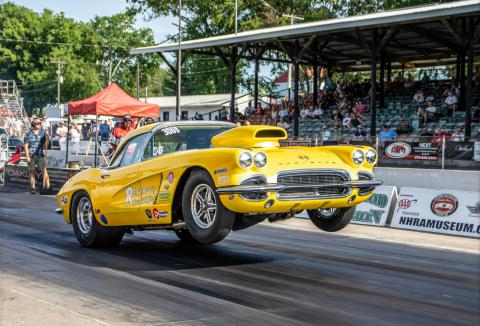
The appeal of front-engine dragsters, gassers, and other vintage quarter-milers is stronger than ever. Surprisingly, nostalgia isn’t the only reason.


“‘Preserving the past. Building the future.’ That’s what the Nostalgia Drag Racing League is all about.”

Butch Hill, president of the Mooresville, Indiana-based NDRL, used that phrase to describe his diverse group of drag racers, but that same kind of looking back/looking ahead philosophy applies to many of the nostalgia drag racing associations currently in action across the US.

There’s no question that the emotions associated with the “good old days” motivate some of these racers to bring out or re-create the cars they ran when they were younger. Or to keep the memory of drag racing heroes alive by building and racing tribute cars. But these men and women aren’t merely reliving the past. They are doing what they can to encourage current and future generations to appreciate an earlier, simpler time in drag racing history. Fostering that appreciation will bring newcomers into the fold, they believe, and keep this drag racing niche alive and thriving. So far, it’s working, and there are no signs that nostalgia drag racing is going to slow down, so to speak, anytime soon. Following is a look at some of today’s premier nostalgia drag race associations and what’s keeping them on track.


Mid-Atlantic Nostalgia Drag Racing Association

MANDRA was formed in the late 1990s “when about 12 guys” started their own nostalgia racing group, explained MANDRA president Merritt Snyder. “They did it for racing fun, as a family activity, and for the camaraderie among members. And it has gone very well.”

Recent end-of-the-season banquets have drawn 75–100 racers, even more for the 20th anniversary party. The cars they race are an eclectic mix, ranging from Snyder’s 1965 Mercury Comet to altereds, gassers, and vintage Funny Cars. The appropriately named English brothers race a Jaguar and an MGA, both 8-second cars.

That mix is “purely by accident,” Snyder said. “Nostalgia is the thing that is common among them, but it’s not like we’re looking for any specific kind of car.” Member cars have to be at least 40 years old. Electronic fuel injection is not allowed, nor are import tuner-type cars. “The only rules we have are, no delay boxes, and no electronics that affect the performance of the car.”

image 2
The diversity of cars racing with MANDRA “was purely by accident,” said Merritt Snyder. “Nostalgia is the thing that’s common among them.” Member cars range from front engine dragsters to an 8-second Jaguar.

The racing is done bracket-style, and “everybody races together,” Snyder said. They participate in 16–17 events a year at eight tracks in the Pennsylvania/Maryland/New Jersey area. “The Reading area, Maple Grove or South Mountain, are the two tracks that are central to where all our people live.”

Snyder said MANDRA adds an average of “a half-dozen new members per year. A lot of people are unhappy with NHRA tracks, because if you get involved in their points system, you’re a slave to their points system. You have to keep going there every week, because you can’t afford to skip races and miss points. Ours is a much more relaxed way of doing it. We only count points for 70% of the races.” That allows someone who can’t make it to all the events to still be competitive for the championship.

While Snyder acknowledged that MANDRA hasn’t tried “as hard as we should to look for younger members,” it did put a new Family Race Car category in place last year in which members of a family can race the same car “and get points for it regardless of who’s driving. The car gets the points, not the driver. We have a guy and his daughter racing a car, a guy and his grandson, and two father-and-son teams racing.

“It’s difficult to get younger people involved because it’s pretty expensive to come up with a 40-year-old car and build it into a race car,” Snyder added. “I remember a time when I said I wanted to build a $2,500 car. You can’t even buy the body for $2,500 anymore.” Plus, because all MANDRA cars run in one class, “we have an elapsed time restriction. The slowest ET we’re going to allow is 14 seconds in the quarter-mile, so it takes a little bit more money to get something together. It’s hard for young people to do that, and we do recognize that.”


Midwest Nostalgia Pro Stock Association

“Our motto is ‘Paying tribute to the legends,’” said Mike Ruth. “We’re trying to keep alive the memories of the guys from the heyday of Pro Stock—Bill Jenkins, Bob Glidden, Don Carlton, Butch Leal, Sox & Martin, that’s our deal. It’s not so much about us; it’s more about keeping those names alive and their accomplishments.”

For the most part, participants drive accurate reproductions of 1990 and earlier Pro Stocks. Ruth drives a Bob Glidden tribute made from a Pro Stock car built in 1979 (but not raced by Glidden). His brother, Jim, campaigns an original 1985 Pontiac that Don Ness built for Butch Leal, though it’s now finished in the “Party Time” livery raced by the Jim Ruth who once owned the IHRA.

image 3
The Bob Glidden tribute car Mike Ruth races in Nostalgia Pro Stock was originally built in 1979 but has been updated “to be safe and meet all the current specs,” Ruth said. “Safety is our utmost concern.”

The Nostalgia Pro Stocks take part in about 15 races a year, plus a half-dozen static displays. At the races, “we pair the cars up evenly, 1970s cars together and 1980s cars together,” Ruth said. “It’s all about the show. We’re entertainers. We’re there to make people feel good and have a good time. We want to put on the best show we can, so people don’t forget guys like Bob Glidden, Lee Shepherd, and Bill Jenkins.” Ruth is proud of the fact that in November, there will be a large gathering of Nostalgia Pro Stocks at the Muscle Car and Corvette Nationals in Chicago, which is the most prestigious muscle car show in the country, he noted.

Ruth has seen racing industry support grow for these cars. “Some of the companies are starting to realize there’s something to this and they need to get on board.” Major supporters of their racing efforts to date include Powermaster, ARP, McLeod, and Hairy Glass, “a supplier back in the day,” Ruth explained. He suggested that the fiberglass manufacturer should reach out to the Nostalgia Pro Stock racers, “and the response was overwhelming. Now if you’re a Nostalgia Pro Stock guy, they’ll give you a discount on parts going on a Nostalgia Pro Stocker.”

Ruth sees his corner of nostalgia drag racing “growing in leaps and bounds. There are more cars, and more groups. A new group started this year in the Chicago area, though they’re going more into the newer cars, into the 1990s, so they’re going faster.

“I don’t think it’s ever going to be a giant thing, but it’ll be around forever,” he added. “Nostalgia has a lot to do with it. It brings you back to an era where you can actually have rivalries. ‘Hey, I got a Mustang, your Camaro sucks.’ ‘Well, my Demon can beat both of them.’ It’s especially hard to get rivalries going in Pro Stock now because they’re all Camaros. Plus, we’re super fan friendly. In the pits, we don’t have any ropes up, so if people want to sit in the car, we take pictures of them, and do the hero cards and all that.”

He said the appeal of a vintage Pro Stock race car isn’t limited to those who grew up with them. “A lot of the younger guys like it. They love the hood scoops since Pro Stocks don’t have them anymore. They love the dual four barrels, the Lencos. We have a fan base of younger guys, but as far as them racing, it’s still fairly expensive for a guy in his 20s to be able to do. But every year we bring newer cars in, so that’s one good thing.”


Nostalgia Drag Racing League

Unlike some of the nostalgia drag racing groups that make what are essentially exhibition passes, in the NDRL championship points series “we really are racing,” said Hill. NDRL classes are intended for vehicles with a nostalgia appearance, 1979 and older body types, and no modern rear engine dragsters. “In keeping with the nostalgic drag race era, there is no traction control, no delay or crossover boxes, no optional throttle stop controllers, no bump boxes, no nitrous.”

All NDRL races are quarter-mile, and cars are grouped in five classes—Pro-7.0, Pro-7.5, Pro-Comp, Pro-Gas, and Modified Production. “Most of the cars in the Pro 7.0 and Pro 7.5 classes are front engine dragsters, altereds, Funny Cars and some door slammers,” Hill explained. “Pro-Comp also has front engine dragsters, altereds and roadsters, with an index range from 8.0 to 11.0 seconds on half-second indexes. Pro-Gas is made up of door slammers with two working doors, a roof or convertible top, and no center steer.” Indexes are the same as Pro-Comp.

image 4
Unlike some of the nostalgia race groups that make what are essentially exhibition passes, “we really are racing,” said Butch Hill of the NDRL. “Half of what we’re about is the camaraderie after the race, but when it comes to elimination time, the place gets serious.”

“For years, people have been asking us for more indexes, and this year we added 10.5 and 11.0 to both Comp and Gas. We did it to drive income. Not for us; we are a 501 (C) non-profit, but we saw an income stream that needed to be put in place for the tracks. It’s the tracks we work with that provide most of the NDRL’s payouts, so we needed to make this financially sound for our championship series to show up.”

The Modified Production class was another recent addition. “We did two races with this class last year, and this will be the first year with a full points schedule,” Hill said. “These are shifter cars only. I call them the Pro Stocks of the past. Back in the ’70s, this was the class to watch. They’re high-winding, gear-shifting, and they come out of the hole with a lot of rpm. No delay boxes, pedal magnets, air shifters, or electric shifters. The index range is from 8.75 to 12.0 seconds on quarter-second indexes. They have to do it the way it used to be.”

At any given event there will be around 125 NDRL cars, Hill said, with Pro-Gas the biggest class. “We haven’t run 10.50 and 11 until this year, and we haven’t had our first race yet, so we’ll see, but I think we’ll get even more cars. We’re just here to have fun and race. Half of what we’re about is the camaraderie after the race, hanging and talking and barbequing and just having a good time. But when it comes to elimination time, the place gets serious. Everybody’s out to win.”

Hill believes one reason for the sport’s growth is the fact that “after so many guys sat around due to COVID-19 restrictions for two years, they were more than ready to dust off those race cars and get out to the tracks. Also, with so much you see on TV about drag racing, the sport is bigger than ever before.”

Racers “are seeing what NDRL is doing and are getting into the game more and more,” Hill continued. “And I don’t see it slowing down. Not any time soon. We have several engine builders who are NDRL sponsors. I know several more engine builders, and every one of them is slammed building engines, getting them ready to compete in NDRL.”


Nostalgia Gassers Racing Association

The name of the association “kinda hits it on the head,” said Bryan Huffman, president of the Nostalgia Gassers Racing Association, Kewanee, Illinois. Car bodies have to be from 1965 or older, and straight axles are not mandated to achieve the iconic nose-high gasser look, “but a nose-high appearance is required.” Engine rules “are pretty open,” he said, though no EFI or turbos are allowed. “We want Roots blowers, that type of engine, as long as it’s not too modern looking. We want vintage wheels, a vintage-correct paint job—none of the swirls and squiggles and fancy stuff they have out now. We want plain-looking cars with decals on them, tinted windows, stuff that gives it a nostalgic look.”

Huffman described the Nostalgia Gassers as “an entertainment group. We’re expected to be available to the fans and put on a show for them. We talk to people, put kids in cars, hand out hero cards, and sign them for the kids. We race heads-up and nobody loses. Ten to 12 cars go up every round. We match each other up, run somebody different each round, and try to keep it fair looking. Since nobody loses, that gives the crowd an opportunity to see the cars in several rounds rather than having the field cut in half after the first round. We can put on a full show for the crowd, and they even give us a little gas money when we leave. That’s the cat’s meow as far as I’m concerned.”

image 5
“Everywhere we go, people come to us and say, ‘You guys are the reason we’re here. We came to see the gassers,’” said Bryan Huffman of the Nostalgia Gassers Racing Association.

Growth within the group has been steady. “We started with 12 cars 12 years ago, and now we’re up to 42,” he explained. “Typically, we’ll lose a couple each year, but pick up two or three. Most of the guys have run in competition before, but now they’re a little bit older. They don’t want to hunt for that hundredth or thousandth. They just want to come out and present their car. Most of our group grew up with gassers, like myself. When I started going to the drag strip, the primary thing I watched were the gassers, and I was in love with them from that day on. Most of our guys are that way.”

But not all of them. “We have younger guys, they just like the gassers. They don’t want to seriously compete. They just want to race once in a while, go to the track, and put on a show.”

Huffman recalled one particular 9-year-old who was fascinated by his car at an event (he races a fiberglass 1941 Willys coupe and a steel 1941 Willys pickup). “I sat him in my car, talked to him, signed autographs. You could tell his eyes were lit up like silver dollars. And he said, ‘I want to do this one day.’ Ten years later, he came up and said, ‘Bryan, I made it. I got my car here.’ We planted that in him many years ago, and he worked his tail off for 10 years to be able to have his own car and be at the track.”


Nostalgia Super Stock Inc.

“We do drag racing the way it was: heads-up match racing, run whatcha brung,” said Rich Berlisk, president of Nostalgia Super Stock Inc. (NSS), Springfield, Illinois. An earlier version of this racing group, formed in the late 1980s, competed in a bracket-race format, “but in 1990 it picked up more steam with heads-up match racing. The reason we continue to do it is because we seem to put on a better show than index bracket racing does.”

The cars competing in NSS are the “factory muscle cars of the late 1950s through the 1960s, up to the time when Pro Stock began,” Berlisk said. “Our oldest car is from 1958; primarily everything is mid-’60s Fords, Mercury Comets, Dodges, Plymouths, full-size Pontiacs like the Catalina, the smaller Pontiacs like the LeMans, and Chevrolets.” Several years ago, NSS added a class of altered-wheelbase cars, “and we have four AWB cars right now, all early 1960s GM and Mopar cars. They run along with our Super Stocks and may run against a Super Stock if the times are comparable.”

The ETs the cars run range from 8 to 12 seconds, Berlisk said. “We pair up the cars. If the track that brings us in wants three runs, you’ll run three times, even if you lose. If the track asks for a winner and a runner-up, I have a formula for that. I pair the two cars with the closest ET. It could be two 12.20 cars or two 8.50 cars, or anything in between, usually within a couple hundredths. That will put on a good show. We’re there to put on a show and educate the general public about the way drag racing was invented back in the ’40s and ’50s.”

image 6
“We are the only ones still doing the heads-up match racing like from back in the day,” said Rich Berlisk of Nostalgia Super Stock Inc. “We’re there to put on a show and educate the general public about the way drag racing was back in the ’40s and ’50s.”

To that end, engines must look like they did in period, with carburetors and era-correct intake manifolds. The AWB cars can run mechanical fuel injection, though one racer was allowed to operate his Kinsler injection system with electronic controls, “and you really can’t tell it’s there. It looks the part,” Berlisk said.

Last year, the group’s roster included 42 cars, up from the handful that started racing back in the 1980s. “In the last five to six years we’ve seen growth,” Berlisk said. “It seems like we lose one through attrition but then pick up two.” Often people will approach him to join; sometimes he’ll recruit a vintage car he spots at a race. A few years ago, at Union Grove he and a prior president saw “a 1963-1/2 Ford running in a bracket race, and we wondered, what’s he doing that for? We went over and asked him, ‘Would you like to run with us?’ Afterward he said he enjoyed it so much he wanted to know how to hook up with us.”

The demographic of the NSS members skews older; the youngest are in their early 40s, except for a 16-year-old son of a member who wants to race.

“I would like to see younger people get into it, but there may be a cost factor for the stuff that we’re building compared to putting a tuner car together,” Berlisk noted. “Some of my members have spent 50 grand on a motor. So their pocketbooks might not be able to take it, but I know a lot of them would like it.”

SOURCES

Mid-Atlantic Nostalgia Drag Racing Association
mandraracing.com

Midwest Nostalgia Pro Stock Association
mwnpsa.com

Nostalgia Drag Racing League
nostalgiadragleague.com

Nostalgia Gassers Racing Association
nostalgiagassers.com

Nostalgia Super Stock Inc.
nostalgiasuperstock.com
June 2023
By
Drew Hardin

Business Profile: Leindecker Racing Engines

Submitted by johnc on Mon, 05/15/2023 - 11:27
image 1


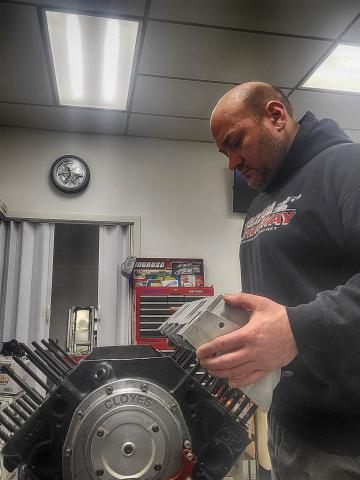
Jason Leindecker found that building engines required creating a brand and a reputation that could stand up against the long-established competition. He succeeded with race-winning performance, rock-solid reliability, and his emphasis on providing high-quality customer service.


Jason Leindecker is a very busy individual. He has been for a long time.

He launched the business that became Leindecker Racing Engines while still in college and while driving a truck for his father’s company. Upon graduation he joined the Coopersburg, Pennsylvania, police. He is still a fulltime officer, while running not only the race engine business but also Coopersburg Auto Parts, which includes a complete auto repair facility.

Although he’s built engines for drag racers, street stocks, and asphalt late models, Leindecker is now laser-focused on dirt-track modifieds. “Most of my business is Northeast-style, dirt modified racing,” he noted. “The majority of our motors are 358s, although some of my drivers have big blocks.” His regular customers range from the Canadian border to the southern tip of Delaware, and to just west of Harrisburg, Pennsylvania; but he has shipped engines as far west as Arkansas, Kansas, and Texas.


One Piece At A Time

Building engines for modifieds has brought Leindecker back to his racing roots. “When I was growing up, my dad had friends who raced dirt modifieds, and every weekend my whole family—myself, my dad, and my brother—would travel to a dirt track somewhere in Pennsylvania or New Jersey. Friday night we’d be one place, Saturday night another, and Sunday night another. That was pretty much every weekend throughout the racing season.

“In 1988, my brother John started racing a street stock at Nazareth Speedway, but I took a different course and went drag racing,” he continued. Leindecker still loves “hot rods and 1955, 1956, 1957 Chevys,” but mostly, “I got sick of hammering out body panels every week. I started bracket racing, and eventually I was running NHRA Stock and Super Stock. That’s where engine building started for me, because to keep up in a class like that you really have to know what’s going on. So I started learning about engines.”

image 2
The 15 to 20 brand-new engines Leindecker Racing Engines sells each year are just one part of the business, according to Jason Leindecker. “A lot of our work is freshening up motors.” Counting refreshes, “we do one or two complete engines a week.”

Leindecker was just 19 in 1997, when he obtained a business license and bought a valve refacer, a seat grinding cabinet, and a flow bench—all secondhand. “I commandeered a corner in my dad’s truck garage, doing cylinder heads for myself and some friends. And it just kind of went from there.”

Indeed, it did. Leindecker bought a house and moved into his own garage. Several more moves and more machines followed. “I would just save my money and buy a piece of equipment, and then save my money and buy a piece of equipment. It’s tough to be at the mercy of other machine shops and other builders, so I started buying my own machines so I could control every aspect of the build and not rely on anyone else.”

Seven years ago, Leindecker moved into his present 5,000-square-foot facility in Coopersburg, about 15 minutes south of Allentown. “That houses my auto repair business, my performance parts store, my machine shop, and my engine-building business. We sell 15–20 brand-new engines each year, but that’s only part of it. A lot of our work is freshening up motors that we sold the year before, or a couple of years before, or even motors from another builder.” Counting refreshes, “we do one or two complete engines a week.” Racers who bring a competitor’s motor to Leindecker tend to stay with him.

He stocks crate motors, also. Particularly popular is GM part number 602, a sealed 350 Chevy. “We probably sell a dozen of those each year.” Altogether, building, freshening, repairing, and selling complete engines accounts for about 75% of Leindecker’s business. Another 15% is machine work for DIY builders, “and the rest is individual part sales.”


Building the Brand

Leindecker runs all three operations with just four employees. Two help out with the race engines, one handles street vehicle repairs, and “my wife runs the parts counter. She’s the glue that keeps it all together.”

Finding reliable help has been “really tough. It’s very hard to find someone with the focus the job requires, because one mistake can turn a whole motor to junk. Or they don’t want to put in the time that’s required. We had a kid washing parts, and after two weeks he thought he should be head engine builder.”

image 3
Jason Leindecker has been doing cylinder head work since he started the business at age 19. “I commandeered a corner in my dad’s truck garage, doing cylinder heads for myself and some friends. And it just kind of went from there,” he explained.

Valuing attitude over experience, Leindecker recently hired a regular customer of his repair shop. “He is into trucks, and the trucks he’s brought in have been absolutely spotless. You can tell they are well-maintained. One day he said that engine building would be really neat to learn, so now I’m teaching him machine work. If someone has good mechanical ability and a willingness to learn, I can teach them how to run any machine.”

While finding employees has been difficult, “absolutely the hardest thing has been establishing my name, my brand, and my reputation. Especially when I started, being that young, you are hard-pressed to find somebody who is going to throw you $20,000 and say, ‘Build me a race engine.’ There were so many other engine builders that I had always looked up to, and tried to fashion myself after, because they were so good and had such a reputation. And now it was hard to compete with them.”

Leindecker believed that his engines were as good as anyone’s, but it seemed like “every racer wanted a particular name, like Pat Morrison, or Kevlar, or Billy the Kid. It took a good 12 to 15 years just to get recognized, to get to where people trusted me and believed that my product was something worth having.”

To get to that place, Leindecker donated “a lot of free labor, finding somebody that I could help, and nine times out of 10 doing it for free, just to get going. It was probably not the best business model to take to the bank,” but to Leindecker, it seemed like the only way to establish himself.

He still sees customer service as key to his success. He doesn’t have a parts truck, but he attends as many races as he can. “I have a lot of racers at a dozen different tracks, and being everywhere at once is, of course, impossible,” he explained. “So I try to rotate weekly—one week I am at this track, the next week at another, and so forth. That way, all of my customers see my face, and they know that I’m not just focusing on a few favorites.

“I bring a box full of tools, with everything I need to check valves and valve springs, and any type of diagnostic that I can do at the track. And I always bring my rulebook in case there’s a question about anything. Knock on wood, I’ve never had to make a major repair while I was there, but you just never know. Mostly I try to make myself seen, so my customers know that I am interested in them, that I am invested in their purchase.”


Customers, Serviced

Leindecker also makes what he calls “house calls. I would rather go to somebody’s garage or race shop to make sure that everything is right, so I don’t have to answer a call on Monday morning where they say, ‘Hey, this broke,’ and then you get the domino effect where everything else is broken, too. My customers might see this as customer service, but I see it as just being friendly.

“One of my standout customers is 14 years old and runs a 358 modified, a DIRT-series big block modified, and some Super DIRTcar Series races, too. He’s just tremendous.” One night last year, just as Leindecker was arriving home from a night out with his wife—a rare night that he wasn’t at a race track—the young racer phoned from a local speedway. He had finished second in the heat race but had broken a pushrod. Could Leindecker fix his engine before the feature?

“Fortunately, that track is only 20 minutes from my house,” said Leindecker, who immediately drove to his shop to get his tools and arrived at the track about 40 minutes after the phone call. “I was able to fix the motor so he could run the feature.”

Brad Brightbill, who campaigns sportsman modifieds at multiple tracks in central Pennsylvania, recalled a similar experience. “The first year I was with Jason, I stripped out a head bolt, and he was at my shop the next morning getting it patched up and ready to race again.”

image 4
Lightning Bodies owner Rick Laubach started buying engines from Leindecker Racing Engines for a customer’s car three years ago, and has since switched to Leindecker engines for his own race car as well. “He’s becoming one of the major players in the business,” Laubach said about Jason Leindecker.

Brad’s father is Kenny Brightbill, a local legend who, since 1967, has scored more than 441 wins at 41 tracks—mostly in dirt modifieds. Brad began campaigning sportsman modifieds around 2002, initially powered by engines he built with his father. About 10 years ago, however, Brad switched teams, and by 2018 found himself looking for a new engine builder. “One of the guys I raced with said, ‘Hey, you should talk to Jason, he’ll give you a good deal.’ So I gave him a call, and he got me back on the track. We won the 2019 track championship at Grandview [Speedway in Bechtelsville]. Then we went back out and won the 2020 championship at Big Diamond [Speedway in Pottsville]. And we won almost every big sportsman race there was in the area,” including the Coalcracker 72 at Big Diamond and the Firecracker 40 at Grandview, for 18 feature wins and two track championships in just two years.

“Last year we had to switch over to a crate motor,” Brightbill continued, “so I got a crate motor from Jason. He’s an all-around great guy, who gives great customer service. He will bend over backward to help anybody. If you have a problem with your motor, he’s at your shop the next day. Any time I was running behind and didn’t have time to run up to his shop to get my motor, he would deliver it to me. Not many builders would go out of their way like that. It doesn’t matter what time of the day or night I call him; if he doesn’t answer he calls me back pretty quick.”

Rick Laubach owns Lightning Bodies in Quakertown, Pennsylvania, and has driven modifieds for 27 years, winning 128 races and 10 significant championships. In addition to his own spec-motor car, he currently drives and maintains modifieds for owners Gary Herman and Ryan Kerr, all under the banner of Shaker Motorsports. He’s run engines from some of the biggest names in the business, but three years ago he started buying Leindecker engines for Herman’s cars and has since switched to Leindecker for his own car as well. He expressed concern that some of the best-known builders are reaching retirement age, while “Jason is up-and-coming. He got his name up there big by winning a lot of races. He’s becoming one of the major players in the business.”

image 5
Jason Leindecker grew his business one piece of equipment at a time so he could have more control over every aspect of an engine’s build. A 2,500-square-foot addition to his existing shop will afford him more room for machining equipment, as well as a new dyno cell.

Leindecker’s customer service, Laubach agreed, “is second to none. I needed a certain kind of oil for Ryan Kerr’s car, which has an engine out of Wisconsin, but my usual supplier didn’t have it. So I called Jason, and he said, ‘l can get your oil, it will be here tomorrow.’ And I said, ‘Let me know when it comes in.’ Well about 2:30 the next afternoon Jason pulls up to my shop with two cases of oil. He had driven to Lancaster to pick it up”—a three-hour round trip from Coopersburg—“for an engine that he didn’t build. He just wants to help people out.”


Range Of Motion

With endorsements like that, it’s hardly surprising that Leindecker ranks his customers as by far his best promotion. “I have advertised in racing magazines and newspapers,” he told us. “I usually have a big booth at the motorsports show in Philadelphia. I have a Facebook page, too, but very little of my business comes from social media. Most of my business comes from word-of-mouth.”

image 6
Jason Leindecker’s customers feel his service is second to none. “I am just trying to keep racing alive,” he said, “to do whatever I have to do to keep my racers racing.”

And his business is still growing. “We are in the process of building a new 2,500-square-foot facility that will eventually house some newer CNC equipment and an up-to-date dyno cell,” all on a property adjacent to Leindecker’s existing shop in Coopersburg. When we spoke in March, he expected construction to be completed by next summer. “That’s our plan for the future.”

That, and continuing to provide not only the customer service but the reliability that Leindecker believes to be just as critical to his success. “I am not looking to take your money. I just want to build a product that keeps racing going, because we all know it’s getting super expensive, and car counts are down yearly. So I am just trying to keep racing alive, to do whatever I have to do to keep my racers racing.”

June 2023
By
John F. Katz

Special Report: Racer Survey Results

Submitted by jeffreyc on Mon, 05/15/2023 - 10:45


PRI’s first-ever poll of teams’ buying habits reveals how and where competitors across all types of motorsports, from the grassroots to the professional ranks, source and purchase their parts.

Taking the pulse of the Performance Racing Industry community through membership surveys is always illuminating. In recent years, the annual Racing Business Survey has provided a wealth of insight into the motorsports retail landscape. For 2023 PRI shifted gears to investigate the other side of the parts counter, so to speak, and surveyed the racers themselves about their parts-buying habits. As expected, there was plenty of intriguing and useful information in the inaugural Racer Survey that retail businesses could use to better understand and connect with their customers. 

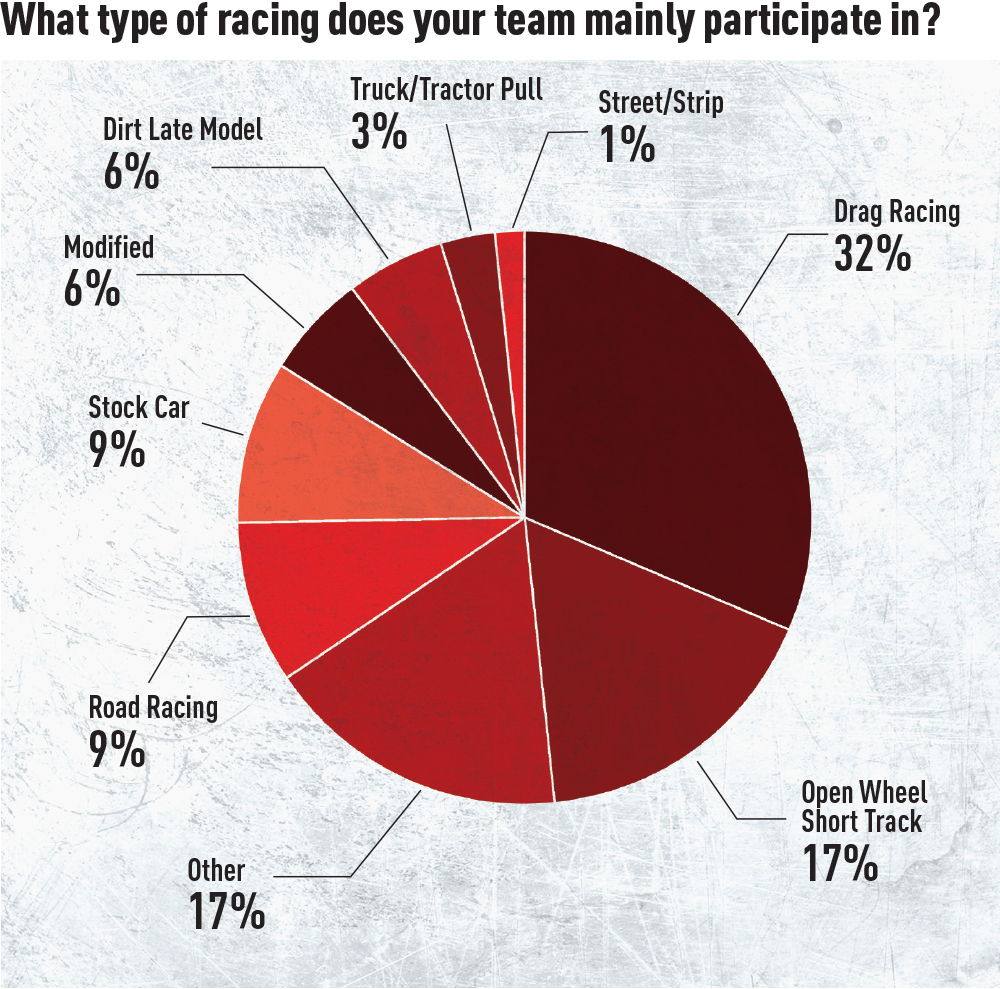
First, a quick snapshot of the racers: Of those who participated in the survey, 69% were grassroots racers or parts of a grassroots racing team, with a similar percentage operating out of the Midwestern US. About half of all respondents reported they made all parts decisions, with the rest sharing responsibility to varying extents. Roughly two-thirds of survey participants install all parts in-house. The largest cohort was drag racers, followed by open wheel short track competitors, but racers from virtually every type of motorsports participated.

2
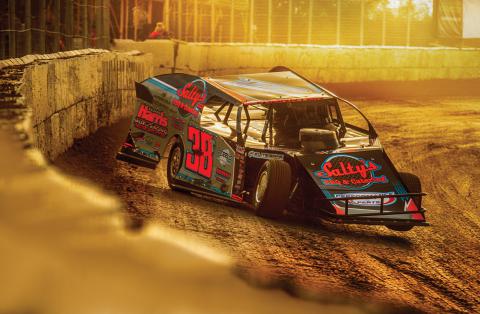
For Patrick Utt of Badger Auto Sport, whose car is seen here, “Supplier commitment to your class or series is important. If they are plugged in to teams like yours, they often get feedback that allows them to evolve their products to better suit your needs.”

Parts buying is naturally influenced by seasonal factors, but most reported they buy parts throughout the year as needed, and almost half the respondents said they purchased parts 10 or more times a year. “It seems like every week,” said Ken Roberts of Roberts Motorsports, East Moline, Illinois. His team runs super dirt late models in the Lucas Oil Late Model Dirt Series, winning Rookie of the Year honors in 2022 with driver Garrett Alberson. “We race the Gateway Dirt Nationals at The Dome at America’s Center in December, we race Vado Speedway Park in January, we run the Winternationals down South, so we pretty much race year ’round. It seems like we’re ordering parts during the busy time, from April through September, at least weekly. The other months, probably every other week.”

Of particular interest, especially to motorsports retailers, is that 62% of respondents reported they planned to run more races in 2023 than last year. That implies even greater parts demand as the calendar unfolds. 

Tried ‘n’ True Versus Brand New

For retailers, the challenge is always how to attract racers who will hopefully become new loyal customers. One of the survey questions asked if racers tended to stick with the same suppliers or if they often tried new ones. More than three-quarters said they tended to stick with the same suppliers, showing the importance of existing relationships.

Patrick Utt with Badger Auto Sport in Riverview, Florida, has owned and operated two racing businesses: Powerhouse Products and RaceQuip. He has raced off and on since 1989, but now road races full time in the Trans-Am TA2 class. “As a racer, I am always looking for innovative new products, but that has to be balanced with changing away from something that you know works,” he said. “Supplier commitment to your class or series is important, too. If they are plugged in to teams like yours, they often get feedback that allows them to evolve their products to better suit your needs.”

3
Michael Garman with Desert Star Motorsports and Challenger Motorsports, who fields cars in a variety of series, prefers to stick with longtime suppliers. “Recently we’ve had to go to other places if we need something quickly,” he admitted. “We don’t like doing that, but with the supply problems today we sometimes have no choice.”

Michael Garman with Desert Star Motorsports and Challenger Motorsports in Pahrump, Nevada, fields cars in a variety of series, including SCCA, NHRA, CIFCA, Western Fuel Altereds, Spec P71, and Optima Ultimate Street Car Invitational. “We always try and stick with long-time suppliers—Don’s Hot Rod Shop in Tucson, Randy at D&Z Customs, Discount Tires, or the Goodyear dealer at Carroll Shelby Enterprises in Las Vegas, have been supplying us for years. Recently we’ve had to go to other places if we need something quickly and they don’t have it. Or we may have to use a different brand to fill a hole. We don’t like doing that, but with the supply problems today we sometimes have no choice. We used a different brand of valve in the Funny Car, and several failed and the motor ate itself.”

When racers do step outside of their parts-buying comfort zone, it can be to get a leg up on the competition or to maintain performance while cutting costs. “Usually, we have really good people around us who have been in the industry a long time,” Roberts said. “They guide us down to what is usually the higher quality products that’ll last through all the different style tracks and track conditions. Every once in a while, we’ll try something different. Ironically, this month we’re trying a different brand of rearend that they designed and made for us to test. Then they are going to take it back and take it apart to see what they can learn to do any better. So this year we took a little risk and got outside our comfort level by trying a different brand of rearend just to see if there might be more longevity. We do look at options, but we usually stay true to what is known to last, that the top-end teams use.”

When it comes to how racers preferred to buy their parts, of those who rely on a local speed shop, 43% reported that they visit one to four times a year, 29% visiting five to nine times a year, and 28% visiting 10 or more times per year. A majority of participants cited the in-person feedback and professional opinion as the main advantage to buying parts at a local shop. But the ease of online shopping is hard to resist.

4
Roberts Motorsports runs super dirt late models in the Lucas Oil Late Model Dirt Series, “so we pretty much race year ’round,” said Ken Roberts. “It seems like we’re ordering parts during the busy time, from April through September, at least weekly. The other months, probably every other week.”

“Personally, I still like to walk into a parts supplier whenever possible. I always seem to learn something from my visit,” Utt said. “If I cannot visit in person, I typically call and ask questions when ordering something for the first time. After that, a well-executed website is a huge time saver for simple re-orders.”

Mansen Way is a hobby racer from Corydon, Indiana, who competes with his Dodge Viper in SCCA and Viper Racing League events. “I prefer online, but I often call to verify with a specialist before pulling the trigger,” he said. “If the supplier is within a 30-minute drive, I would go in person, but that’s rarely the case for Viper-related parts and components.”

For many teams, the combination of online shopping and proven suppliers is the winning combination. “I’d say 90% [of our shopping] is online,” Roberts said. “Motor State Distributing is a big supporter. Allstar Performance, they’re known to help out the racer, plus they have quick access to the parts. When you’re on the road, it’s important sometimes to be able to turn that around in a day or two. That’s of high importance, and they have a track record of doing that. Performance Bodies is another one. They’re real good supporters of dirt track racing and have a history of going out of their way to make sure you get what you need.”

Used components are naturally a part of the racing experience, although the level of used products buying varies dramatically from series to series. “Pretty much the only thing we buy is new,” Roberts said. “When you’re racing on a national level, you really can’t take any chances. I can’t think of anything I’ve bought used.” 

When it comes to buying used parts, Facebook Marketplace was the biggest source cited in the survey, followed by local resellers and dealers.

“Critical items are always new—motor, transmission, tires, safety equipment,” Garman said. “Used stuff would be for add-ons or things that if they fail, no big deal. An example is we have a second tach mounted in front of the motor that we use for fine tuning at the track, that we got used. For the other two cars safety stuff is always new as are brakes, suspension, and so on. Used stuff might be wheels, intakes. The Comet is certified to 8.50, so everything we are doing will be new. Craigslist, Racing Junk, eBay and recently Facebook Marketplace for used parts and also new or custom made.”

g1

g2

g3

g4

g5

g6

g7

g8

g9

g10

g11

New and Noteworthy

When it comes to learning about new products, relying on trusted sources was a major factor. In the survey, 62% listed friends or other racers as their top source for information about racing products. Trade shows came in a close second.

“The worst way to learn about a new product is to see it on a competitor’s car—that means they beat you to it,” Utt said. “I would say that my team has an omnichannel approach to learning about what’s new. Talking to manufacturers either on the phone or at the track, paying attention to social media, cruising websites, reading consumer and industry magazines, and most importantly—attending the PRI Trade Show and other in-person events.”

That in-person, hands-on experience can pay big dividends for retailers. “I’d say what catches our interest is, for example, at The Dome, the parts vendors have a stand, and as we have time we’ll go talk, and they’ll tell us about some of the things they’re doing,” Roberts said. “That’s how we ended up with the new rearend. We told them of the demands that we race with and what we felt needed to be more dependable, and they agreed to build one and have us test it for a month. That caught our interest by them being available and showing us first-hand. The PRI Show is a big way too, there’s no question about it. For instance, we run the Keizer Wheels, and to be able to see them first-hand on how they come apart, it helped our program. Now, if you bend a rim, instead of throwing the whole rim out, you only have to replace one section of it. That’s something we learned by seeing them firsthand.”

5
Mansen Way, a hobby racer who competes with a Dodge Viper in SCCA and Viper Racing League events, finds that the PRI Trade Show “provides a broad selection of performance parts, tools, consumables, and expertise that is awesome to tap into.”

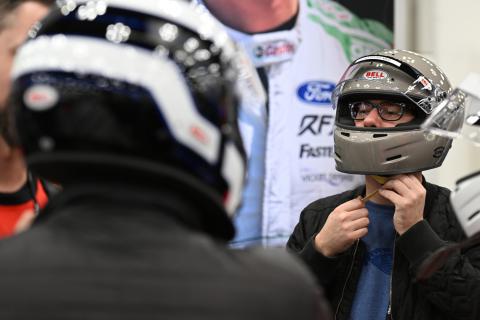
Battle Scarred Motorsports is an organization serving military veterans and first-responders dealing with stress, depression, or PTSD. It has chapters around the country and helps veterans get on track in race cars as a sort of “throttle therapy.” “Battle Scarred does endurance racing, so we do ChampCar, Lucky Dog Racing League, and Lemons,” said Lesley Farner, Indiana chapter lead.

For Battle Scarred Motorsports, the big trade shows aren’t just opportunities to look for new parts but also to interact with their sponsors and suppliers, such as Hawk Performance and Hot Shot’s Secret. “Going to the PRI Show, there were so many fantastic parts out there for us to see,” said Daniel Johnson, program manager and Louisiana chapter lead. “Plus, we got to meet our vendors that help us out, face-to-face. It was two-fold. We could see new products plus tell our guys that had been helping us throughout the years in person, ‘Thank you for your help.’”

Even at the hobby racing level, direct interaction at trade shows pays dividends. “Predominantly, PRI for the latest racing technology along with Viper Parts Rack, DMS and Complete Performance Motorsports, Bad Boyzz Garage,” Way said of his primary sources for learning about new parts. “Also a few former Dodge Viper engineers I’ve met at race events are a wealth of performance information. PRI provides a broad selection of performance parts, tools, consumables, and expertise that is awesome to tap into at the shows. The problem I have is, I never have time to get to all the suppliers in the limited time I have to attend because I spend so much time talking to the vendors with the products I’m interested in.”

“We go to SEMA every year to meet with regular suppliers and look at new products. We’ve been to PRI a couple of times for the same reasons,” Garman said. “Some things we’ll purchase because of relationships, either with the vendor, another team’s recommendation, or maybe even because they help a friend. One of the reasons that we use Wilwood brakes is because they help Courtney Hansen, who we’ve known forever.”

Beyond the paddock and the parts counter, social media rounded out the top three sources of information about new products. “I’m always on social media,” Johnson said. He reports Facebook Marketplace and several Facebook groups he’s in are solid sources for parts. “A lot of times you can do an ISO search [In Search Of parts], and somebody will come through. You know how the racing community is.”

“Social media is where I get most of the useful news I’m interested in, so I go to it several times a day to check for new information and upcoming events,” Way said. “I monitor several Facebook group memberships and a little Twitter to keep up to date.”

In discussing parts buying habits with our sources, some of them spoke about the very specific needs required for their racing ventures, revealing opportunities for ambitious suppliers and manufacturers.

6
For Battle Scarred Motorsports, which helps military veterans and first responders with a kind of “throttle therapy,” the big trade shows aren’t just opportunities to look for new parts but also to interact with their sponsors and suppliers. At the PRI Show “there were so many fantastic parts for us to see,” said Daniel Johnson. “Plus, we got to meet our vendors that help us out, face-to-face.”

“We go through a lot of spoilers and body panels,” Roberts said. “Recently they’ve come out with these plastic quarter-panels, and they’ve been a huge savings in time and money. We would go through a right rear quarter-panel almost every weekend. The other that’s recently helped is the filler panel. They’ve gone to a composite plastic, and it lasts probably six times longer than that metal stuff would. Every once in a while, something like that comes through, and you definitely want to get on board with it, because it saves time and money, which is huge when you race this much.”

Battle Scarred Motorsports also noted how specialized equipment impacts their team. “If we have veterans who have some kind of physical ailment, we have cars that are set up with hand-controls,” Farner said. A local police department donated four Ford Crown Victorias, one of which Battle Scarred converted to hand-control with the help of AMS Vans. “We have a full-out car that we have put six different veterans in that they were able to experience racing as we do.”

One of the questions in the Racer Survey presented several options and asked, “Which do you most wish your preferred speed shop could offer but doesn’t?” Perhaps not surprisingly, “Better prices on parts/labor” drew the biggest response, but “more availability and convenience (ease of scheduling),” “engine dyno service,” and “chassis dyno/engine tuner” also drew considerable support.

Of course, there are many racers who have a foot in both the cockpit and the retail side of the trade, who see both sides of the parts acquisition issue. A noteworthy percentage of racers in our survey reported they worked for a retailer or manufacturer of race parts or worked at an engine builder or race prep shop. 

“Having owned and operated two racing businesses, I am more sympathetic to what manufacturers and distributors deal with on a daily basis,” Utt observed. “I try to be an easy customer by doing my homework first before ordering and also try to have realistic expectations on backlogs in manufacturing and distribution. I probably pay more attention to a company’s background, too—who owns it and how long they have been in business.” 

The racing parts market is constantly evolving, so we’re looking forward to what future PRI Racer Surveys reveal.

Sources

Badger Auto Sport

Battle Scarred Motorsports
battlescarred.org

Challenger Motorsports
challengermotorsports.com

Desert Star Motorsports
desertstarmotorsports.com

Roberts Motorsports
facebook.com/garrettalbersonracing/

Mansen Way

June 2023
By
Steve Statham

Featured Vehicles

Submitted by jeffreyc on Mon, 05/15/2023 - 10:33


Resourcefulness is the theme of this month’s Featured Vehicles with a Camaro built for Drag Week in a one-car garage while a one-of-a-kind build combines Ford power with a BMW chassis.

1

2002 BMW 325i

Chad Anderson  |  Westland, Michigan

Race Series/Class: GRIDLIFE, Lake Erie Pro-Am Series, Riverside Drift Series, Drift Indy

Engine: 5.0L Gen 2 Coyote (factory long block with upgrades including supercharger, billet oil pump gears, and gapped piston rings)

Car: Built and fabricated by Chad Anderson

Features: Silver’s North America two-way coilovers, Wisefab angle kit, Formula Drift spec roll cage, full S550 Mustang interior swap, Konig Countergram wheels, Big Duck Club widebody, Seems Legit Garage axles, Ford 8.8 differential

Facts: Anderson’s background is in engineering, which puts his skills and creativity to the test to create all the necessary one-off components for this one-of-a-kind build. “This car is extremely special, blending a modern Ford powerplant with a BMW chassis,” Anderson explained.


2

2010 Chevrolet Camaro

Scott Miles  |  Crawfordsville, Indiana

Race Series/Class: Drag Week

Engine: 871 blown big block Chevy on E85 built by Scott Miles and Greg Olin, dyno by BES Engines

Car: Built by Scott Miles

Features: Aeromotive, MSD, Summit Racing, Proform, AutoMeter, Holley, Mishimoto, Saldana Racing Products, Texas Speed & Performance, Jegs, TCI, Quick Fuel, Flowmaster, Speedway Motors, CVF Racing, Derale Performance, Driveshaft Shop

Facts: Miles built this in his one-car garage.

June 2023
By
PRI Staff

Feeding the Beast

Submitted by johnc on Mon, 05/15/2023 - 10:30
image 1


How series are ensuring that each level of modified competition offers a fitting venue for nearly any racer regardless of age, experience level, or war chest.


Modifieds are a lot of different things to a lot of different racers. For some, these wildly popular machines are a relatively inexpensive way to compete in a strong-performing, purpose-built race car. For others, they’re the next step up from karts or lower levels of circle track cars. And for others yet, modifieds represent a valuable rung in a ladder that will ultimately lead to a top-level professional driving career.
Regardless of what attracts racers to the world of modifieds, there comes a point for many drivers when it’s time to consider taking the step from local Saturday-night events to bigger series that compete in wider areas, or even across the country. Yet, with that decision comes a number of factors that must be considered. Will it add to one’s enjoyment of the sport? Does it fit in with overall career plans? Is the cost of moving up manageable?

To help better understand these decisions and the factors that influence them, we spoke with representatives from several series, many of them considered “feeders.” Their observations and perspectives provide valuable insight into modified racing and how each stage of competition offers a fitting venue for almost any racer regardless of age, experience level, or budget.


Moving Up

Many in the sport feel there are significant advantages to getting ample seat time in modifieds. They say the unique characteristics of these cars can teach valuable skills that translate to any series or level of racing one might aspire to. “Folks are realizing that if you can drive a high-horsepower, lightweight modified on 8-inch tires, and you can hang on to that, then you could really do well once you get into the Late Model ranks and 10-inch tires,” said Stan Narrison of Modifieds of Mayhem, Montgomery, Alabama. “Some of my modifieds have 650 to 750 horsepower, and they’re much lighter than a Late Model. It truly teaches these kids how to drive cars and how to keep something underneath them. Plus, in a modified, with open wheels, guys learn a little bit of respect. When you put fenders on a car, guys like to lean on each other.”

image 2
In the Modifieds of Mayhem series, some cars put out in excess of 750 horsepower. “And they’re much lighter than a Late Model,” said our source. “It truly teaches these kids how to drive cars and how to keep something underneath them.”

Regardless of whether racers are planning to build a career from their modified efforts or just want to play in a bigger sandbox, so to speak, there are many factors that typically influence the decision of whether or not to make the leap to a more expansive series. Foremost among these factors, of course, is money. It costs a lot to race in any series. That’s compounded by the need to travel extensively across a multistate area. When that starts to become a challenge, many promoters find that payouts can make a significant difference in which series racers choose to advance into.

“The expenses of traveling, fuel, and time away from work become the biggest factors in what series drivers race in,” explained Darlo Mulder of United States Modified Touring Series (USMTS), Webster City, Iowa. “When you get 80 cars for an event, and only 26 of them can make the show, everybody else is getting tow money. Quite frankly, tow money doesn’t pay the bills. If you have guys who are struggling just to make the feature every week, pretty soon they’re just going to run out of money and not be able to travel with us.

“That’s why paying more money now is attracting more drivers to come race with us,” Mulder continued. “For almost every one of the swings we do this year, we’re doing three days at the same track. So instead of traveling from track to track on the weekend, we’re all at the same place. It’s going to save a lot on fuel for these guys.”


All Together Now

Along with trying to keep costs under control, many series find that it pays to cooperate with other sanctions to put on events, which helps keep them viable for racers considering stepping up to the next level. Key among the considerations in these cooperative ventures are rulesets. They need to work for everyone to foster a smooth transition for racers moving between series.

“We write our rules to try to accommodate most sanctions without them making major changes,” said Mulder. “So, for example, UMP is a huge sanctioning body east of the Mississippi, and we get a lot of their guys who want to come run with us. UMP rollcages are an inch and a half, whereas WISSOTA and IMCA are an inch and three quarters, but we allow the inch-and-a-half roll cages so all the UMP cars can come race with us. They also have open motors where they don’t have a whole lot of restrictions. So we made a package for all the open motors to try and get it to where these guys feel like they can come race with us without having to build a brand new car.”

Beyond these factors, one of the biggest keys to attracting the right kind of racers to a series is clearly understanding where a particular sanction fits in the overall modified-racing ladder. Doing so keeps expectations realistic and allows promoters to better serve their racers, whether they’re eager youngsters on their way to pro careers or seasoned veterans looking to satisfy their urge to race in between their nine-to-five weekday routine.

image 3
Increasing payouts has helped attract more drivers to the United States Modified Touring Series (USMTS), according to our source, who also noted that “for almost every one of the swings we do this year, we’re doing three days at the same track.... It’s going to save a lot on fuel for these guys.”

“People hate to say it, but our series is a B-League,” explained Bill Doucette of Modified Racing Series, Meredith, New Hampshire. “There are two steps above us before they get to the top. So we have our place in the ecosystem. Everybody wants to be the big dog, but any sport needs a feeder system. That said, if drivers have raced their local short track on Saturday night events, they can take their modified and come run with us. We don’t have a huge schedule, and we have a fairly small travel area. So they can try out tour racing and see if it’s something they want to do.”

“USMTS is a professional traveling series,” explained Mulder. “There are guys who race just with us as a profession, who have found a home racing here for their career. But building up to that, there are all your stock cars and your B-Mods and all that. Even an IMCA modified is kind of a step down from us.”


Young Guns

Most feeder series for modifieds see up-and-coming young drivers as the future of the sport, bringing new life and energy into the field, even if those racers aren’t likely to stay with the series for the long haul. So regardless of young racers’ overall aims, sanctions typically do all they can to attract them. Often, such efforts are a combination of reaching these racers in their earlier stages while striving to put on a show worthy of their consideration.

image 4
Rules within the United States Modified Touring Series (USMTS) are written with an eye toward accommodating teams that also race with other sanctions. For example, “we made a package for all the open motors to try and get it to where these guys feel like they can come race with us without having to build a brand new car,” said a source with the sanctioning body.

“Attracting young racers is something our organization thinks about a lot,” said Rod Lindquist of WISSOTA Racing Association, St. Cloud, Minnesota. “There are some really good kart operations around here, and a lot of those tracks are actually members of ours. So we already have our foot in the door there. But the best thing one can do to grow the sport, hands down over anything else, is to just have a solid, efficient running organization that puts on good shows.”

Whatever trajectory young racers choose for their ascent up the ranks, they need to weigh their options carefully. Typically, this means making the leap to bigger, more prominent series whenever they’re able, so they can continue to prove themselves worthy of making the next step beyond. For many young modified racers, doing so means switching to an entirely different type of car, typically Late Models.

“There’s a lot of glamour that comes with Late Model programs,” said Narrison. “They’re usually the feature event at most tracks. And modified racers don’t seem to feel the same pressure that there is in Late Models. I think the kids that are moving up realize that they’ve got to jump into that pretty quickly.”

Some sanctions acknowledge career-oriented racers’ progression through various types of cars and accommodate this switch by offering a wide range of classes, to provide a built-in career progression within the series. Sanctions that do so aim to entice their more ambitious racers to progress up the ladder with them, rather than leaving for a different organization.

“We have everything from Hornets to Late Models,” said Lindquist. “So the only reason people would ever leave our series and go to another series is if they moved out of this territorial part of the country.”


The Downside of Moving Up

Some promoters feel that young, career-oriented modified competitors often move up and out of their series too fast. They don’t build a following the way that drivers who stick around year after year tend to. “I’ve had some great drivers come through my race track,” observed Narrison. “Chandler Smith was racing here. It was boom, boom, boom, and he moved through the ranks. It didn’t take long. We’ve had quite a few who have done that here. It makes it tough as a promoter because you want to make stars out of your guys.”

“I think it’s been a problem overall in the sport,” added Modified Racing Series’ Doucette. “I don’t think young racers stay long enough in the lower series to build a fan base. Years ago, drivers raced short tracks all over the country, and they built a fan base. It took years. They didn’t get to the upper levels until they were in their 30s.”

image 5
Acknowledging career-oriented racers’ progression through various types of cars, WISSOTA Racing Association goes beyond modifieds classes and offers “everything from Hornets to Late Models,” said one official.

According to some promoters, another potential challenge among intensely ambitious, career-oriented young racers is the problem of burnout. The intensity and high expectations of hot and heavy youngbloods can backfire, causing these fervent competitors to drop out of the sport altogether at a relatively early stage.

“Today’s world is all about instant gratification,” observed Doucette. “It’s not about the longevity of building a career and making a name for yourself. I see teams come in, and if they’re not up to the Cup level in two years, they don’t think they’re going to make it.”

According to some promoters, one potential solution is to do whatever possible to encourage modified racers to simply enjoy whatever level of the sport they’re at and let everything build on that foundation in due time. The reasoning is that, even if racers find that their career hasn’t panned out the way they’d hoped, there is still the satisfaction of participating and competing.

“Teach kids to enjoy the sport,” said Doucette. “Only a small percentage will ever make the big leagues. But if they learn to enjoy the sport, they’ll play it their entire life.”


For the Fun of It

Like most aspects of running a race series, some sanctions are more in tune with driver satisfaction than others. Those that are have found that the general satisfaction racers get from their events can’t be left to chance. Instead, it’s an attitude that should be fostered consciously and consistently.

“You have to remember that racers are a customer of the series,” said Doucette. “So our mantra is to make everything racer-friendly. Cater to them and do everything you can to get them to come back the next time. A lot of that comes down to just making it an enjoyable experience. It can be as simple as just going over and saying hello. That means a lot to people. At the end of the day, if they get a pat on the back and someone says, ‘Thank you for coming,’ at least they know they were appreciated.”

image 6
Today’s sanctions are taking tangible steps to keep driver satisfaction among their top priorities. “You have to remember that racers are a customer of the series,” said one of our sources. “So our mantra is to make everything racer-friendly. Cater to them and do everything you can to get them to come back the next time.”

Along with concerns about young drivers having the right motivation is the matter of whether or not the youngest of competitors are even ready to jump into a modified to begin with. Some sanctions suggest that young racers should be evaluated carefully before being allowed to enter a series, regardless of whether the driver’s age fits the letter of the rules.

“For years, our minimum age was 16,” noted Doucette. “Now we’ve started to lighten up on that a little bit, but I’m still very leery of a 13-year-old coming in and racing with a bunch of veterans. I have to talk to the kid and see him run first. Then I can make a judgment if he’s ready. The proof is in the pudding—watch him race.”


Keeping It Real

Ultimately, the decision of whether or not to move up to a higher level of modified series is a personal one, dictated by emotional factors as much or more than practical considerations. Some drivers would rather stay where they are and continue to race modifieds in a local series because that’s simply what they enjoy. Others see modifieds as just another car and class to be mastered in a larger quest to build a major-league racing career.

“First off, know what you want to do,” advised Lindquist. “You have to recognize your abilities. You have to be clear about what your goals are. If you just love the sport and you want to compete, then put yourself into the class you want to race in, that you feel you’re best in. That could even mean going down a class. I have a guy in our series who ran several years in a modified, but he found he had more fun going down and running a Hornet.

“This is a great sport for people to find their lane and run with it,” he added. “It all comes down to what’s in your heart as a competitor.”

SOURCES

Modifieds of Mayhem
modifiedsofmayhem.com

Modified Racing Series
themodifiedracingseries.com

United States Modified Touring Series
usmts.com

WISSOTA Racing Association
wissota.org

June 2023
By
David Bellm

Spinning Records

Submitted by johnc on Mon, 05/15/2023 - 09:36
image 1


In contrast to the Cup series, the rule set of NASCAR’s Whelen Modified Tour provides a substantial amount of freedom within the cars’ chassis design, and that allows builders to bring more innovation and customization to the field. But as our experts point out, that flexibility can prove to be a double-edged sword for those who’re just getting up to speed.


NASCAR’s modified racing history is as storied as the organization that created it. It was established in 1948 and is now the sanction’s oldest division, with the first NASCAR points-paying race on the beach course in Daytona Beach, Florida. The division has evolved in a variety of different ways in the time since, but its role as a home for technical innovation has remained a hallmark. While recent years have seen organizers tighten the reins in the interest of improving safety and containing costs, Whelen modifieds continue to offer builders and teams a degree of creative freedom that the Cup series cannot.

“We have some guidelines to adhere to with respect to how we build our cars, but the division also allows us to bring some of our own ideas to the table,” said Phil Stefanelli of PSR Products, Midland, North Carolina. “For example, we’ve recently designed something that’s a little different as compared to most of what’s been out there for the past few years, something with a lot more adjustability. The removal of the chassis height rule last year has allowed us to do more with that; we’re playing with a lot of different suspension stuff now that we couldn’t do before.”

image 2
The ruleset for Whelen modifieds allows chassis manufacturers, such as B&R Fabrication, to bring their own perspective to the design of major components in the car’s front and rear suspension systems and tailor the car to driver and crew chief preferences.

With the majority of the cars’ powertrain components consisting of spec parts, chassis design and setup has become a focal point for teams that are looking for a competitive edge. Darius Grala of Mooresville, North Carolina’s Fury Race Cars explained, “There’s substantially more opportunity for vendors in the Whelen Modified Tour because there are way fewer limitations than you have in a single-supplier model like the Cup series. That allows builders and teams to be more creative, but that flexibility can also add a new level of complexity for teams. That complexity provides more opportunity to get it wrong.”

The most effective chassis designs in modified racing tend to be informed by data as well as extensive real-world experience. When it comes to doing things the “right way?” Well, the answer really depends on who you ask.


Room To Move

The ruleset for Whelen modifieds offers teams and builders the opportunity to try new things with elements of the chassis design, but it’s not a total free-for-all. “You have a ‘box’ that you have to work within,” said Bill Cole of B&R Fabrication, Howell, New Jersey. “There are rules for chassis width, height, track width, wheelbase, and other dimensional elements.”

Other aspects of this ‘box’ focus on the safety side of the car. “There are minimums for tubing diameters, material thicknesses, and the rules for spindle design were updated as well,” Grala said. “After a competitor’s spindle broke, organizers started scrutinizing their designs more, testing them for strength, and an additional tether was added on the right side. The designs needed to be changed in order to accommodate that.”

The situation changes significantly when it comes to the suspension systems, though. “There’s a pretty decent-sized window to make changes to A-frame length and angle,” Cole said. “Suspension pickup points can be changed, trailing arm angles are pretty open, and we have a lot of leeway on sway bar size and arm length. You can also make changes to the way the sway bars link up to the lowers, too. The kingpin inclination on the spindles is pretty open as well, along with wheel offset, provided that you stay within the track width limits. Shocks are a big one, too—you run pretty much any shock that you want to. And you’re trying to build the car as light as possible, and with a center of gravity that’s as low as possible, within the limits of the rulebook.”

Unlike the Cup series, this approach gives each Whelen modified chassis manufacturer the opportunity to bring their own perspective to the design of major components in the car’s front and rear suspension systems. It also gives teams the ability to influence the design of the car based on their own knowledge and experience, and that can help to tailor the car more precisely to the preferences of their respective crew chiefs and drivers.


Distinct Strategies

Stefanelli told us that manufacturers like PSR Products have taken full advantage of this relatively open aspect of the modified chassis by developing ground-up, specialized designs.

“Our front and rear suspensions are different from anyone else’s,” he explained. “We’re racers ourselves, and four or five years ago we saw that there was an opening in the modified series, so we sat down and looked at what was out there, and what we could do better. We wanted our cars to be more racer-friendly, so we designed a whole new chassis. We’ve been very successful with it—Tommy Baldwin won three modified championships with our stuff last year. I don’t want to reveal too much about what we do differently, because that’s our advantage here, but I will say that we did extensive research on front-end suspension geometry and sway bar geometry, and at the rear of the car we have a totally different philosophy to the suspension design.” He cited other companies that use torque arm systems in the rear, “but we decided to focus on a top link design for our cars. We found through our testing that the top link design gives you more forward bite in the car than a torque arm does.”

image 3
Thanks to the relatively open aspect of modified chassis, the team at PSR Products has developed ground-up, specialized designs. “We’ve been very successful with it,” said our source. “Tommy Baldwin won three modified championships with our stuff last year.”

Grala explained that, since the modified division doesn’t put limitations on testing, builders and teams have benefited from knowledge and experience that can be harder to come by through simulation and other means. “Sway bar locations and sizes, along with the sway bar arm designs, are a huge part of the front end of the car. Cup teams used to mess with this stuff continuously before they became spec parts.” Since builders in the modified division can also build in adjustability for the suspension pickup points, there’s a wealth of different tactics available to teams when it comes to car setup.

“The pickup points change everything,” Grala continued, “and the ride height rule is a good example of why you might want to make adjustments there, or even just because of the differences in tire compounds from year to year. Changing this could even provide an advantage just when moving from track to track. The optimum position for one track design might not be the same for another. Cup cars have some leeway here, too; they just have a specific number of holes that they can bolt the components to. But for modifieds it’s essentially open. On our car we use these oval inserts called slugs, which are put into oval cutouts on the chassis. Those inserts have holes in varying locations, but those can be changed. For example, if we have three holes on a slug and someone said to us, ‘I need a hole right in between where these are,’ we can simply make a slug where the hole is located exactly where they want it to be.”

Cole noted that there are a number of adjustments that can improve the car’s grip and yield faster lap times in turn, but the factors involved tend to make these settings a moving target.

image 4
Because the modified division doesn’t put limitations on testing, builders and teams have benefited from knowledge and experience that can be harder to come by through simulation and other means, noted our source from Fury Race Cars.

“Different manufacturers put different kingpin inclinations in the spindles that can affect the amount of negative camber in the wheel, and it changes the cross-weight in the car a little bit,” Cole explained. “You have four tires that you have to connect to the race track, and you’re doing whatever you can to make sure as much of each tire’s surface is doing that as is possible. But, as you go into a corner, the left-front loses camber while the right-front gains it, so that’s always a big struggle. Some guys will run way more A-frame length on the left-front to try to keep that camber in it. Each track wants something different, and some tires want more camber gain than others, so the sweet spot is always changing.”

The situation at the rearend of the car is even more open to interpretation. “Torque arm rear suspension designs have been around for a while now, but other racers swear by top link setups,” he added. “A lot of drivers also like running a short track bar on the left side, others want a really long track bar in the car that goes from one side to the other. Sometimes it just comes down to personal preference, and what they’re used to working with. There’s a million ways to build a mouse trap, and some will go just as fast as others. There are crew chiefs out there who can make anything go around a race track. Something new comes out every year, but some of these trick setups are really just a selling point. Every once in a while, someone will find something that really works, but people usually end up going back to the stuff that they know well.”


Putting It To The Pavement

The ability for chassis builders to take varying approaches to suspension design can benefit racers in a variety of ways, but customization and adjustability won’t translate to tangible improvements in performance without an effective chassis setup. While many racers still rely on knowledge gained from years of notes and seat time, an increasing number of teams are bringing data acquisition systems and other technologies into their test sessions to help pinpoint what works and what doesn’t.

“Data logging allows you to see what the driver is doing and how the suspension is working throughout its travel,” said Grala. “From time to time, we’ll even mount cameras on the car to monitor what the suspension is doing visually. That can allow us to see what’s flexing and what isn’t and ensure that the suspension is actually behaving the way it’s supposed to.”

image 5
Alongside PSR Products’ data logging capabilities, a full pull-down system allows the team to simulate a car going around almost any track they have data from. “Since things are pretty locked down in terms of powertrain and the tires,” said our source, “the setup has become the focus.”

Data can help inform teams and builders about the car’s behavior on a more fundamental level as well. “We’ll put a data system on our car and head to a track that we’re going to race at to do some testing, and then we’ll come back to the shop with that data,” said Stefanelli. “We have a full pull-down system here, and that allows us to simulate a car going around basically any track that we have data from. From that we can get an understanding of where our roll center needs to be, and all of our components are built around where we want that roll center in the car. It can also help us determine things like sway bar timing, and we can see all of the loads on the tires to get a better sense of what’s going on. It helps identify any potential binds in the suspension, too. More often than not, when someone is having a problem with their car and they don’t know what’s going on, they have a bind in the suspension somewhere. This is really where we’re concentrating our efforts in modifieds these days. Since things are pretty locked down in terms of powertrain and the tires, the setup has become the focus.”

But there is, of course, still something to be said for talent and experience as well. “A perfect example is Matt Hirschman,” said Cole. “His car doesn’t have the cutting-edge technology that some of these newer teams use, and yet he just dominates wherever he goes. They’re basically working off of an old notebook—they’ve been to every track more than once and know what to expect from each one of them. If you’re a young traveling team and you show up somewhere without even knowing what the track looks like, it’s going to hurt you.”

SOURCES

B&R Fabrication
facebook.com/BRFabrications/

Fury Race Cars
furyracecars.com

PSR Products
psrproducts.net

June 2023
By
Bradley Iger

Fast Movers

Submitted by johnc on Mon, 05/15/2023 - 09:13
image 1


A look at some of North America’s in-demand motorsports products and services by region and racing segment.


Motorsports retailers and service providers are constantly tracking the newest parts and trends to give their customers a competitive edge. For the latest on which products and services are moving the retail needle, we present the following sales snapshots from shops across North America.


Berry Performance Sales
Defiance, Ohio

Berry Performance Sales is mainly geared toward racers running the LS engine platform, according to owner Brenon Berry, who pointed to a handful of fast-moving products for this category, like camshafts by Brian Tooley Racing and Texas Speed & Performance. “They have a really good reputation. Customers recognize the name and gravitate to that,” Berry said.

Long-tube headers—specifically those from Texas Speed & Performance and Speed Engineering—are also popular for the motorsports retailer since “they have budget friendly stainless steel options; you could have them shipped to your door for around $300–$700,” Berry said.

image 2

Additional fast movers include the Holley EFI Terminator X and chassis/suspension components from UMI Performance, including panhard bars, torque arms, K-members, and sub-frame connectors. “The Holley EFI Terminator X systems make it easy and convenient for all skill sets to get their cars tuned and running. The UMI Performance components strengthen every important aspect of your car and are built right in Pennsylvania.”

Berry also told us he avoids long lead times by working with several distributors and manufacturers to have several different sources for high demand parts. An additional source of income is Berry’s 22-foot open race car trailer rental (pictured). This year, Berry Performance Sales is expanding its marketing reach by sponsoring circle track racers Tommy O’Leary IV, Howard Kelly Jr., and Tim Meine.


NoName Motorsport
Lindenhurst, New York

Suspension upgrades are the most common modification for race customers of NoName Motorsport, said owner Frank Ciati, who services enthusiasts competing in Audis, Volkswagens, and Porsches at courses like Road Atlanta, Watkins Glen, and New Jersey Motorsports Park.

“My customers prefer handling power over engine power. Some performance junkies want top speed, of course, but for the most part they want better handling to really lay into the corners,” Ciati said.

image 3

Popular upgrades include KW Automotive coilovers (pictured) and sway bars, plus spring kits from H&R Special Springs. Michelin tires, specifically Pilot Sports, are a customer favorite.

Brake upgrades are also prevalent, with many customers preferring slotted rotors over drilled, “which can get clogged up easily and be more of an issue than an upgrade at that point,” Ciati said.

EBC Brakes and Hawk Performance are usually the go-to brands for braking components, Ciati said.


T&T Motorsports
Calgary, Alberta, Canada

Bracket racers are buying a range of components from family-run T&T Motorsports, which serves as a dealer, race car builder, and rebuilder.

Fast movers include carburetors from Advanced Product Design; collector tethers and fasteners from Drag Race Solutions; switch panels, dial-in boards, and delay boxes from Digital Delay; headers and exhaust components from Stainless Works; hoses and plumbing components from Fragola Performance Systems; data recorders from Racepak; Pro 1 Racing & Safety components; and additional products from Driven Racing Oil, ProCharger, Quarter-Max, Bear’s Performance, and Hoosier Racing Tire.

image 4

FTI Performance transmissions (pictured) and torque converters are also in high demand, said co-owner and general manager Travis Ringguth. “Especially in the last six months, people [are switching] their converters and transmissions since they deliver a high-quality product. We always try to partner with the most reliable brand, even if the margins aren’t as great for us.”

With help from co-owners (and Travis’s parents) Dwaine and Pam Ringguth, T&T also operates some of the highest paying bracket races in the region, The Classics, which it uses to prove its products on track. The Ringguths campaign a dragster running a Sunset Performance engine, a popular platform in Canada “even though they’re located as far away as possible in Texas,” Ringguth said. He also noted that T&T formed an official partnership with Sunset at the most recent PRI Trade Show.

June 2023
By
Laura Pitts

Motion Announces Two Executive Promotions

Submitted by laurap on Fri, 05/12/2023 - 18:32
Joe Limbaugh, James Howe


Motion Industries (Mi)--the distributor of maintenance, repair and operation replacement parts and industrial technology solutions headquartered in Birmingham, Alabama--has announced the promotions of Joe Limbaugh to executive vice president - chief operations officer (COO) and James Howe to executive vice president - chief commercial officer/chief technology officer, effective June 1. Both will continue to report to Motion President Randy Breaux.

Most recently serving as executive vice president to oversee customer service and productivity, Limbaugh celebrates his 40th year with Motion in 2023. In addition to his current responsibilities leading Marketing, Supply Chain, DC/FC Operations, Real Estate and Enterprise Excellence, he will assume responsibility for operations in all Mi solutions businesses. 

Meanwhile, Howe recently celebrated his 30th year with Motion and was most recently executive vice president overseeing eCommerce, Strategic Pricing, Sales Excellence and Corporate Accounts. He will continue these roles with the added responsibility of Human Resources. 

For more information, visit motion.com.

May 2023

Social Status

Submitted by jeffreyc on Fri, 05/12/2023 - 14:34


A closer look at how racing and performance industry members are using social media to boost their engagement with followers and customers. 

The Specialty Equipment Market Association (SEMA) boasts more than 661,000 followers on its SEMA Show Instagram channel and nearly 600,000 on its SEMA Show Facebook page. Additionally, the SEMA Show has accounts on Twitter and TikTok while also hosting multiple other profiles—SEMA News, SEMA Action Network, SEMA Battle of the Builders, SEMA Education—on various social media platforms. 

“We utilize the platforms where our audiences live and do our best to curate content to meet the audience where they engage with us,” explained Sal Nicosia, SEMA social media manager. “Facebook and Instagram are easy choices for SEMA for all of our profiles, as they are the longest standing platforms where we see the most audience and engagement. Twitter is a great tool to engage with polls, give updates, and tweet across our main pages and membership accounts. LinkedIn is a great choice when it comes to delivering news and giving industry professionals a place to engage with networks and councils, and be part of online events and webinars they offer. TikTok is where everyone is, and we use it to continue to publish content and reach a new generation of automotive enthusiast.”

Let’s take a closer look at SEMA’s approach to social media and what tips it offers to other businesses in the industry. 

2

“SEMA’s social strategy is a blend of show promotion, culture, and lifestyle, as well as stakeholder and initiative collaborations,” Nicosia noted. “The strategy is something we evaluate fairly regularly, as all these things change, and SEMA’s social presence expands. Overall, we strive to produce and publish content that everyone in the automotive aftermarket can resonate with, regardless of their place in the aftermarket industry.”

Patience and consistency are key when it comes to social media—going viral doesn’t happen overnight. Regardless of what content a business may create, keeping it steady over time can lead to success. And don’t grow impatient, as some content takes time to click with audiences, Nicosia noted.

To help your chances of virality, “use the social media platforms’ built-in tools,” he added. The platforms like it when users utilize their features, and oftentimes the algorithm they use will put more weight behind those posts. Additionally, “keep up with trends in your industry, and try to create fun, genuine content that promotes your business/product but also gives your online presence some personality.” 

Current trends include short-form vertical video, livestreaming, social commerce, original content, and more. Hashtags even continue to have some relevance. “Using hashtags on platforms that prioritize them (like Twitter and TikTok) can give the content you publish an advantage in gaining traction,” Nicosia explained. “[Beyond] hashtags, keywording for Search Engine Optimization (SEO) has become an even more important tool in ensuring your content’s relevancy on social media. Utilizing AI tools like ChatGPT or other SEO/keyword best practices can be crucial in contributing to this.”

SEO keywording is the standard practice of using words in the titles and captions of social posts and YouTube videos that you want your content to be most associated with in searches.

“ChatGPT can help with keywording and other aspects of social media and marketing by utilizing the AI’s ability to scour the Internet for information,” Nicosia said. “Simply ask it for what you want, whether it be a social media post caption, blog post, or any other type of media, and ask it to prioritize keywords. There are a lot of social media tools that incorporate AI features like Hootsuite, Monday, Buffer, and others. However, in my opinion, ChatGPT is the most robust and has the simplest user interface to communicate with right now.” 

June 2023
By
PRI Staff

Race Shop

Submitted by jeffreyc on Fri, 05/12/2023 - 12:06


PRI Race Shop for June 2023.

2

Bend-Tech

bend-tech.com

This Coolant Support System is designed to make the handling of longer tube and pipe materials more efficient. Additional support trolleys carry stock as it is loaded into the machine and hold up long parts to maintain a consistent, cleaner cut, no matter the length. The system also allows operators to cut longer parts while maintaining safety standards.

Contact: 651-257-8715


3


CarTech 

cartechbooks.com

In High-Performance Cams and Valvetrains: Theory, Technology, and Selection, Billy Godbold combines his experience with valvetrains at COMP Cams, Lunati, Crane Cams, and Edelbrock with the techniques he uses with professional teams in NASCAR, NHRA, road racing, dirt track racing, offshore racing, and land speed racing. Specific configurations and applications are covered.

Contact: 651-277-1200 


4

Heck Industries

heckind.net

This 90-degree pipe notcher is operated in a standard shop press, arbor press, or iron worker. It’s used for tube/pipe fabrication in various industries, including motorsports, and is ideal for creating weld fit-ups. It’s offered in three sizes with capacities from 3/8-inch up to 2-3/8-inch tube with 1/8-inch wall.

Contact: 810-632-5400


5

Jesel

jesel.com

Jesel Sportsman Series Roller Lifters are designed for mild drag engines, street/strip builds, and circle track racing. They have the same 8620 heat-treated bodies that are used in the Pro Series line and are assembled with Jesel’s bronze bushing cam rollers. Lifter body diameters from .842- to .905-inch are available with either offset or on-center pushrod seats.

Contact: 732-901-1800 


6

Seraphina Safety Apparel

seraphinasafety.com

These flame-resistant performance garments are made from non-igniting fabric and designed to provide superior protection, allowing additional time to escape the hazards of extreme heat and fire. Moisture-wicking, breathable and lightweight, this apparel is easy to wear and keeps women cool and dry in hot, dangerous conditions.

Contact: 800-946-0897


7

ShopSabre

shopsabre.com

The ShopSabre CNC Plasma machines are engineered, designed, and manufactured in the US for entry-level to professional fabricators. The Langmuir Systems brand offers entry-level prosumer CNC Plasma solutions to help the growing shop get started. The MR-1 is an affordable and capable three-axis gantry mill.

Contact: 952-461-4570

June 2023
By
PRI Staff