DRAG RACING: WHAT TO WATCH FOR IN 2021

Submitted by ashtonr on Thu, 12/31/2020 - 12:50

Photo courtesy of Larry Chen and Holley Performance Products

From growing classes to enhanced manufacturing techniques, we tap into several trends guiding the market’s path to a new race season.

Boosted by innovation, opportunity, and a product pipeline that’s churning out parts faster than a greyhound on Red Bull, the straight-line segment is poised for another strong campaign in 2021. Indeed, drag racers today have more choices than ever in terms of cars, engine combinations, and types of racing. High-paying events are taking place at quarter- and eighth-mile dragstrips across the country, and car counts at many are at their highest levels in years.

At the same time, manufacturers in the performance aftermarket are feverishly developing effective, affordable drag racing products, and getting them to market faster thanks to improved distribution and/or delivery.

For a market that never stops evolving, catching up with key stakeholders and taking stock of what’s trending can be a challenge. Fortunately, we’re up to the task. So, with that in mind we present 10 front-burner developments for drag race suppliers, re-sellers, competitors, promoters, and more heading into the new season.

1. FROM NO-PREP TO UN-PREP

Racing on unprepared track surfaces has become all the rage, largely because of big-name cable TV series like Street Outlaws and No-Prep Kings. But beyond the personalities and reality-show drama, there’s an important reason why this type of racing is resonating so much with the general public: Lack of traction is a great equalizer.

“In No-Prep Kings, they’ve got 16-car fields,” said Nolan Jamora of Isky Cams, Gardena, California. “And anybody in the top 10 can win it, easily. You just don’t know.”

However, some in the industry suggest that racing on no-prep track surfaces may evolve into what’s referred to as “un-prep,” in which all the old rubber and slippery, hardened polymer resins that would be left on the track for a no-prep race are removed. Un-prep is said to be safer than no-prep, while still retaining much of no-prep’s low-traction excitement.

“With un-prep, we’re actually scraping all the way to the bare concrete,” said Brandon Mass of Mass Traction, Wellington, Florida. “We’re starting over at the base level. We remove all the glue and rubber off the track, and then clean it. I’d say that you’re going to get a lot more of that within the next year and a half.”

2. HEADS-UP COMPETITION

For years, bracket racing was the de facto standard for all but the top classes in drag racing. But it appears as though things have now come full circle, swinging back to heads-up drag events.

“I really think that’s what people like: Heads up—go all out,” said Jamora. “It’s more interesting, because whoever gets to the end first wins. If a car’s faster, it’s faster. He didn’t beat me because he left 1,000th of a second sooner off the line and didn’t break out.”

3. BIG-LEAGUE BRACKET RACING

Although heads-up racing has more of a buzz about it these days, bracket racing still maintains a huge following. “Index racing is, by far, what makes up most of the market,” said David Reher of Reher-Morrison Racing Engines, Arlington, Texas. “There are bracket races with 300, 400, 500 cars going on all over the country. People supply a lot of parts to them, and it’s a huge group.”

And now, in much the same way as today’s high-profile heads-up events, bracket racing is also getting its share of big-dollar events, too. “The next big thing is probably going to be bracket racing on a level of what you’ve never seen before,” said Mass. “Because there are a lot of big-money bracket races starting to pop up all over. You can literally fill your schedule with just big-money bracket races—I’m talking $50,000 to $100,000.”

drag1
Today’s drag racers rely on advanced technology to reach unprecedented performance levels with a wide array of engine and car combinations. “It’s not the horsepower, it’s how to implement the power,” said our source at Holley Performance Products.

4. STREET-STRIP

Dual-use cars have always been a major player in drag racing, particularly at the hobbyist end of the market. But in recent years, demanding events like Drag Week have catapulted the notion of ultra-sophisticated street-strip cars into the limelight. This has radically redefined what’s possible for a dual-purpose car, with competitors driving hundreds of miles on the street and then making sub-six-second quarter-mile passes.

Such events are proving extremely popular. According to Hot Rod Magazine’s website, online registration for the first Hot Rod Drag Week event in 2020 sold out in less than five minutes.

5. BIG SPENDING

Prize money has been increasing at many events, and racers are using that to justify putting more into their cars and their team setups. “Because there are so many big-dollar races, it makes sense to invest money,” said Jamora. “You can still win a good amount of money if you just go a couple rounds. Unlike Pro Stock or something like that, where you’re spending $2 million a year and you’re winning $50,000. That’s not really going to cut it. But, for example, with No-Prep Kings, if you win that race, it’s $40,000.”

And the big dollars aren’t going into just race cars. It’s the whole package. “People are spending more money on everything, not just their engines,” said Reher. “At the upper levels, they’re towing a $150,000–$250,000 trailer behind them. It amazes me. We started with a bumper hitch and an open trailer, going to Indy.”

It perhaps raises the question of what the upper limit is. “I don’t want to say this in a bad way, but there are a lot of check writers,” said Smitty Smith of Edelbrock, Torrance, California. “Like in the pro-nitrous class, it’s over 100 grand for a motor. And you’ve got guys buying two and three at a time. The average racer can’t afford that.”

6. SOPHISTICATION

Technology tends to trickle down, with prices decreasing and the knowledge base growing larger and more accessible. This has resulted in even local hobbyist racers using equipment and techniques that not long ago were the exclusive domain of top pro teams. “The local grassroots guy is now running pretty much a pro setup,” said Jamora. “Bracket racing used to be 10s and 12s. Now the norm is 7s and 8s. These guys aren’t fooling around anymore.”

Foremost among the increasing sophistication of teams is the ability to compile and analyze data. This is due largely to dropping prices and rising capabilities of data-recording setups that allow detailed analysis of each pass. “Everything running out there has got a data recorder on it,” said Reher. “The simplest of classes go about it all the same way. It’s a data-driven deal.”

drag2
The popularity of shows like “Street Outlaws,” shown here during filming, has given racers a whole new appreciation for street-strip cars, unprepared surfaces, and heads-up competition. “I really think that’s what people like: Heads up…whoever gets to the end first wins,” said our source at Isky Racing Cams.

7. TUNING

Sophisticated computer control over fuel, nitrous, boost, and ignition are allowing for precision tuning like never before. “You don’t see that old guy with the screwdriver adjusting carburetors anymore,” said Jamora. “These days, even beginners are on computers tuning.”

At the same time, horsepower has reached unprecedented levels throughout the sport. Compounding this trend, an increasing number of races are run with limited traction, such as in no-prep events.

As a result, victory now often comes down to how well the team’s tuner did his job. “It’s not the horsepower,” said Joe Pando of Holley/MSD, Bowling Green, Kentucky. “It’s how to implement the power. And that’s where these systems give you the advantage—to be able to utilize and bring the power in a manageable way, gradually, and make changes between rounds. That’s why these cars are becoming so fast on slick tracks.”

drag3
Manufacturers are designing and optimizing new parts faster than ever, thanks to sophisticated CAD systems and 3D printing. “In CAD software, they can simulate airflow before they even make a casting,” observed our source at Edelbrock.

8. POWER ADDERS

Whether it’s nitrous, turbo, or supercharger, power adders have become commonplace throughout drag racing. Within this broad trend, however, preference is said to be shifting to superchargers for the moment, due mainly to current sanctioning-body rules.

drag4
Power adders have become the norm at all levels of the sport, with nitrous, turbochargers, and superchargers raising engine output to never-before-seen levels. As a result, cars with more than 1000 horsepower are now relatively common, such as this 1712-hp 2015 Dodge Challenger Drag Pak. Photo courtesy of Holley Performance Products.

“The big thing was superchargers, and then it went to turbochargers,” said Steve Morris of Steve Morris Engines, Muskegon, Michigan. “Now it’s going back a little bit to superchargers. I think it’s the way promoters designate rules. But they do a pretty good job of parity, so I imagine turbos will be coming back around as a preferred choice—maybe after this year.”

9. IT’S ELECTRIC

Although perhaps not yet mainstream enough to qualify as a full-blown trend, electric vehicle (EV) drag racing is reaching unprecedented levels of visibility; and it may very well be on the cusp of widespread popularity. (See PRI’s coverage of Ford versus Chevy’s current battle in the electric race vehicle segment beginning on page XX.)

One clear sign of that was Ford’s Mustang Cobra Jet 1400 concept car, revealed in late 2020. It was arguably the most ambitious EV drag racing effort yet by a major automaker, and videos of the car have received more than two million YouTube views and counting. Equally noteworthy, Steve Huff of Huff Motorsports in SeaTac, Washington, topped the 200 mph marker in the quarter-mile at Tucson Dragway in May 2020, recording a best time of 201.07 mph in his electric dragster.

Those involved in EV drag racing say the public is interested and eager to learn more. “Five years ago, we didn’t get any attention at the PRI Show,” observed John Metric of the National Electric Drag Racing Association (NEDRA). “People would walk by and kind of raise their noses. Now I can’t get a word in edgewise—people are coming by the booth non-stop.”

10. PRECONFIGURED COMBINATIONS

Racers today are spending less time developing their own combinations of parts, instead relying more on preconfigured setups. “You can buy such good parts off the shelf, without modifications,” said Jamora. “You can put together a good race motor and you no longer have to do head flow, and head grinding, and all this mix and match. You can get a set of heads that have all the flow numbers, and they can basically tell you what the combination should be. There’s no guesswork.”

drag5
Electric drag cars are becoming mainstream, and they seem likely to soon become a full-blown trend. Machines such as Ford’s Mustang Cobra Jet 1400 concept car, shown here, are raising public awareness at drag strips and on the Internet. Photo courtesy of Holley Performance Products.

In some cases, racers are getting preconfigured engine packages from their competitors, which can make for some interesting outcomes. “I was watching NHRA yesterday,” said Smith at the end of the 2020 season. “They showed some contenders who get their motors from other teams, like Matt Hartford’s Pro Stocker. He’s got the KB Racing engine package. So he beat the guy who supplies motors to him. It’s just funny how it goes around, you know?”

Sidebar: Product Development

As drag racing gets more sophisticated and increasingly competitive at all levels, so too are the parts entering this market. Never before have racers had so many choices of highly effective, completely optimized components.

To develop these new products, manufacturers prefer to start by talking face to face with customers and others in the field. “It’s all about boots on the ground,” said Joe Pando of Holley/MSD, Bowling Green, Kentucky. “We have the Holley Motorsports Group. I’m part of that. There are eight of us that travel to all these different events. We’re out there with racers, with engine builders, with people that are making key decisions at race tracks. That’s how we develop new products. And we come up with them pretty quickly.”

To address the needs of the drag market, some manufacturers look to street-strip events like Drag Week. This demanding form of competition is certainly one of the ultimate crucibles in the sport, which readily translates into strong testimonials that resonate with customers.

“Drag Week is a really good testbed,” said Nolan Jamora of Isky Cams, Gardena, California. “They got into the fives, 5.99, [last] year. So you’re running that plus you’re driving 150–200 miles a day, and you’re doing it for six days straight. That’s a good indicator that your parts can last in a drag setup. So then we can tell customers, ‘This is the same material, and you can run a lot more spring pressure, but with littler springs that have less mass, less harmonics.’ People tend to listen.”

sidebar1
Cars like this Pro Mod Camaro, piloted by Stevie “Fast” Jackson, punish components mercilessly. This pushes continual development of stronger parts. “We’re constantly evolving our product line and targeting the vehicles that will benefit the most from it,” said our source at Strange Engineering.

Oftentimes manufacturers develop parts to meet the demands of emerging trends. “We’re constantly evolving our product line and targeting the vehicles that will benefit the most from it,” said JC Cascio of Strange Engineering, Morton Grove, Illinois. “For example, the Radial vs. The World cars and other radial cars. They’re harder on the driveline. The radial tires have a much stiffer sidewall that’s less forgiving. Also, the track prep has evolved and has become very aggressive for radial cars, which compounds the situation. So we developed our billet nine-inch case and the parts to go with it. It’s as close to indestructible as any lightweight component ever produced.”

Because these trends are somewhat of a moving target, it has become vitally important for manufacturers to develop products quickly and more effectively. To do so, engineers increasingly rely on computer-aided design (CAD) and 3D printing. These have proven to be a game changer when it comes to developing manifolds, cylinder heads, and other engine components. “In CAD software, they can simulate airflow before they even make a casting,” said Smitty Smith of Edelbrock, Torrance, California. “Then they can 3D print it and actually put that on the flowbench, see how it works, and critique it.

“With intake manifolds on LS’s and some other late-model motors, there’s no water in the manifold,” continued Smith. “So we can print a 3D plastic part, then make dyno pulls with it before we even invest in tooling. Before it starts heating, cooling, and cycling, and starts distorting a little bit, we’ll get a minimum of 15 dyno pulls out of a 3D-printed plastic manifold before we make a metal casting. That way, we feel confident it’s going to perform like the model. It just allows us to get to market sooner. We’re all competing for the same guys.” — David Bellm

SOURCES

–
Air Flow Research
airflowresearch.com

Edelbrock
edelbrock.com

Holley/MSD
holley.com

Isky Cams
iskycams.com

Mass Traction
masstraction.com

NEDRA
nedra.com

Reher-Morrison Racing Engines
rehermorrison.com

Steve Morris Engines
stevemorrisengines.com

Strange Engineering
strangeengineering.net
January 2021
By
DAVID BELLM

SHOCKING RIVALRY

Submitted by ashtonr on Wed, 12/30/2020 - 13:04

Photo courtesy of Chevrolet Performance and Ford Performance.

Look who’s leading the charge in bringing high-voltage performance to the track and street.

There’s an electrifying twist to the classic Ford vs. Chevy rivalry currently playing out in the racing and performance industry. Detroit’s big dogs are still snapping at each other’s tails on the track and in the showroom, extending a feud that started with Henry Ford and Louis Chevrolet/Billy Durant back in the early days of the 20th century. Whether it’s Silverado vs. F-150 or Mustang vs. Camaro, you can’t sit in the race stands or walk a car show without overhearing blue-oval and bowtie disciples either boasting or hurling insults at each other.

However, it’s not the smell of exhaust fumes that’s stimulating this latest round of competitive friction between the two automakers. It’s the silence of spinning motors—as in electric vehicle (EV) motors.

Ford Performance recently unveiled the Cobra Jet 1400 Mustang, which it believes is the quickest EV doorslammer on the drag strip. And Chevrolet Performance just showed off a complete plug-and-play EV swap kit called Electric Connect and Cruise, or eCrate, for those hot rodders wanting to electrify an older vehicle instead of rebuilding another internal combustion engine.

While their approaches are different and not receptive to an apples-to-apples comparison at this time, there is one significant talking point on which both sides completely agree—their destiny!

“You know, EVs are the future for us, and we’ve invested $11.5 billion in them,” said Brian Novak, an engineer at Ford Performance, Dearborn, Michigan, who supervised the Cobra Jet 1400 program. “And we are going to be building a lot of electric vehicles.”

“All sanctioning bodies are looking at what the future will bring. I think everyone is aware that electrification is growing in the industry, it’s something they need to look at,” confirmed Russ O’Blenes, director of the Performance and Racing Propulsion Team at General Motors, Linden, Michigan. “My guess is, it’s not a matter of if, but when.”

Yes, EVs and different forms of electrified racing are making headlines across the industry and will play a major role in both production vehicles and motorsports. Consider Formula 1 and WEC, where hybrid technology is advancing at lightspeed in both hardware and software. Also look at unique motorsports like Pikes Peak and Bonneville, where EV records are being rewritten at nearly every event. And everyone’s YouTube recommendations are often spiced with videos of a Tesla or homemade EV conversion spanking a Ferrari or other supercar at the drag strip.

fvc1
Traditional V8 fans may be startled by the look of the Cobra Jet 1400’s Cascadia Motion’s motors and inverters, but you can’t deny its strong visual impact. And despite the futuristic appearance, car builders can order the exact same setup today. “All these products are in our catalog,” said a source at Cascadia Motion.

Chevrolet ignited the aftermarket EV competition with Ford little more than two years ago when the eCOPO Camaro was introduced at the 2018 SEMA Show. Powered by two motors that combined for about 750 horsepower, the Camaro broke into the 9-second bracket during an exhibition run at the 2019 Winternationals.

“eCOPO was our first foray into what the future eCrate would look like,” explained O’Blenes. “The COPO program was a success, and a strong platform to make the first showing and lead the way to introducing production-based parts for an e-conversion.”

When Ford brought out the Cobra Jet 1400, many thought it was in response to the eCOPO and expected a heads-up match race—much like the 1990s special vehicles rivalry, when Chevy’s Jon Moss built an all-aluminum 572-cubic-inch big block ZL1 Camaro and Ford’s John Colletti ordered up a 598-cubic-inch Boss Mustang. In a classic Car & Driver magazine shootout, the Mustang won at the drag strip while both cars suffered oil-pressure problems on the road course.

Unfortunately, the Cobra Jet 1400 and the eCOPO Camaro weren’t designed to face each other, said the man who was instrumental in building both cars.

“GM’s goal was to build a Stock Eliminator-style EV. They wanted the same technology and chassis components that comes with the COPO program but with an electric motor,” said Pat McCue of MLe Racecars near Seattle, Washington. “On the other hand, Ford wanted to build the absolute fastest and most powerful electric drag door car ever made.”

1,502 REAR-WHEEL HORSEPOWER

The Ford project was spawned at an NHRA event when Funny Car driver Bob Tasca III and McCue met during a Youth and Education Services (YES) program for high school students. Tasca relayed thoughts from the meeting to Novak, who found an available test Mustang from Ford’s Cobra Jet program.

Watson Engineering in Taylor, Michigan, adapted a roll cage designed for a diesel race truck to the Mustang, then made extensive use of carbon fiber throughout the body. “There’s very little that’s identical to the original Cobra Jet car,” said Jason Antko, noting that the more robust roll cage was necessary for safety. “Packaging the batteries was the biggest hump we had to get over. The car needed to hold that weight. The batteries weigh so much, we had to make sure they were secure.”

There are three battery packs, each assembled by McCue and totaling 800 volts: One is located in the trunk area, another behind the driver’s seat, and a third, smaller one in front of the radiator.

fvc2
Chevrolet is developing an eCrate electric motor package that is designed for easy swapping into a wide variety of street and race vehicles. To test and demonstrate the setup, the division installed it in this 1977 K5 Blazer. “You have the benefit to package it fairly broadly,” said our source at General Motors.

“We call it a distributed battery module system,” said McCue, adding that the battery packs are constructed from XALT battery cells. “If there was ever a thermal event, you don’t have all your batteries in one basket, like a Tesla, where one could go into a thermal runaway and have 700 cells going crazy.”

The downside is that splitting up the battery packs complicates other systems, such as thermal management. “It makes it significantly more complicated, but in our opinion it’s the right thing to do,” added McCue.

The battery packs power a pair of DS250 dual-stack motors from Cascadia Motion in Wilsonville, Oregon. The dual-stacks piggyback each other, and are coupled with a gear drive developed by SCS Gearbox in Bellevue, Ohio, a company well known in the monster truck and tractor pulling markets.

“We specifically went with straight-cut gears rather than helical gears to provide a little more noise,” quipped McCue.

fvc3
The Cobra Jet 1400 uses three battery packs, all in separate locations throughout the vehicle. Despite the complexity this adds to the system, it’s a prudent safety measure. “If there was ever a thermal event, you don’t have all your batteries in one basket,” said a source at MLe Racecars.

Each dual-stack motor is actually two motors on a common shaft, so a total of four inverters are needed from Cascadia, as well. Each dual-stack weighs about 233 pounds and is rated at 960 Nm peak torque, or 708 lb-ft, with a redline of 11,000 rpm. Power is delivered through a Turbo 400 transmission to a live rear axle, just like a regular Cobra Jet.

“That will support up to 1,400 Kw,” said Joe McHenry of Cascadia, noting that’s where the Cobra Jet 1400 moniker came from. “All these products are in our catalog. You can essentially buy the same powertrain as the Cobra Jet 1400.”

“This car makes 1,502 horsepower to the rear wheels, which is double what the eCOPO did,” said McCue. “It has four motors instead of two, and twice as many batteries.”

The real challenge to the team was integrating the power systems to the car and getting all the systems to talk the same language.

“Our VCU300 is used to control torque management, strategies, the launch, the shifts, and various other switched functions using four power distribution units (PDU),” explained Lawson Mollica of AEM EV, Hawthorne, California.

The Cobra Jet 1400 is able to start and idle at 750 rpm, thanks to the AEM controls. The idle speed maintains fluid pressure in the transmission, otherwise a remote pump would have to be installed. There are also AEM displays and keypads that inform the driver and allow launch and shift adjustments just before the race.

“We were working alongside AEM with our calibration and controls engineers,” added Novak of Ford Performance. “I think it’s huge what you can learn from the powertrain controls. There are so many different combinations of what you can do and how to write the control algorithms. I think that is where we’ve learned the most, so far.”

eCRATE AVAILABLE SOON

On the flip side, GM had already developed the hardware and software to operate the Bolt EV, and now the automaker’s strategy is to repurpose those components into a complete Electric Connect and Cruise or eCrate package that should be available for purchase in the second half of 2021.

“The key to our package is utilizing all the production components, so you get all the safety systems and charging capability,” said O’Blenes.

The package was first tested in a vintage 1962 C10 concept truck introduced in 2019. The truck featured a double stack of Bolt motors mated to a 4L75-e automatic transmission. Also in the conversion were two Bolt inverters and a pair of 400-volt battery packs installed in the pickup bed. That package provided an estimated 450 horsepower to the rear wheels.

“The C10 was basically our look at using as many production components as possible,” said O’Blenes. “The K5 would be the first complete production kit.”

fvc4
Chevrolet’s eCrate motor package was introduced in 2019 and first tested in a 1962 Chevy C10 concept truck. It featured a double stack of Bolt motors that put out an estimated 450 horsepower to the rear wheels. Sources at General Motors say the production eCrate package should be available in the second half of 2021.

For 2020, Chevy Performance unveiled a 1977 K5 Blazer that featured the proposed eCrate package. A single-stack Bolt motor replaced the original 175-horsepower 400-cubic-inch V8, and the stock three-speed automatic, fuel system and exhausts were also removed to make way for the four-speed automatic that comes with the package.

“We take the differential and gear reduction out [of the Bolt motor] and put on an adapter plate that has the standard bellhousing bolt pattern, and there’s a LS-style crank flange that splines to the rotor. This allows it all to bolt together with the transmission,” explained O’Blenes. “I will tell you [the motor] is significantly smaller than a small block Chevy. When you add the power electronics, I would say the volume is quite comparable. You have the benefit to package it fairly broadly.”

The most significant packaging hurdle for the kit is the Bolt battery pack. It weighs more than 900 pounds and has a rather large footprint.

“That’s why we’re tailoring it to trucks, SUVs, or potentially an El Camino,” said O’Blenes, adding that the next step would be repackaging production components into smaller building blocks to gain more flexibility in installing it in a wider variety of vehicles. “That battery pack was designed with a specific vehicle in mind, and that vehicle was designed around the battery.”

The eCrate package uses production Bolt controllers and wiring harnesses, and all the parts necessary for shock protection, battery heating and cooling, battery over-charge protection, and even regen braking. Aftermarket components include an electric power-steering kit and a vacuum pump to assist the power brakes. Finally, there’s an aftermarket controller to operate the instrument panel gauges that inform the driver of the battery charge.

A big benefit of using the Bolt package is that Chevy dealers are trained to service these components.

“One of the inherent things we bring to the table is a significant electrification education program for all our service technicians,” said O’Blenes, adding that GM will be setting up certified installers at dealerships and aftermarket companies. Lingenfelter Performance in Brighton, Michigan, is the first company to pilot the training and certification program. Plans also call for training the end user of the Electric Connect and Cruise product.

NEW PRODUCTION WAVE

While Connect and Cruise and Cobra Jet 1400 aren’t exactly the dueling weapons that remind us of Elliott vs. Earnhardt, Grumpy vs. Dyno Don, or Titus vs. Donohue, it’s still noteworthy that Ford and Chevy are developing performance EV projects that could be accessible to performance and racing enthusiasts. Some traditionalists may be hesitant to accept the muted sounds of speed. Others question where the identity that helps mobilize the two brawling factions will come from. Will motors be painted in Chevy Orange and Ford Blue? Can’t argue the benefits of a front- or rear-mounted distributor with electric motors, so how’s the rivalry going to benefit?

“Each car is going to have its own mechanical sound. They’re not silent,” said Novak. “No matter how you develop it or what you have, each car will have its own personality.”

Just when the first soon-to-be-classic Chevy vs. Ford matchup in the EV arena comes is anyone’s guess. But it’s coming.

“Electrification is huge to us, and we have a lot of electric products coming,” said Novak. “We’re proud to set a couple records with the car, and we’ll just keep developing.”

“We’re always working on the next steps,” promised O’Blenes. “A lot comes down to the plans of the sanctioning bodies.”

SOURCES

–
AEM EV
aemev.com

Cascadia Motion
cascadiamotion.com

Ford Performance
performance.ford.com

General Motors
gm.com

MLe Racecars

Watson Engineering
watsoneng.com
January 2021
By
MIKE MAGDA

BUSINESS PROFILE: PROLINE RACING

Submitted by ashtonr on Tue, 12/29/2020 - 10:12


Relying on the skills of a talented team while forging strong relationships with customers, Proline Racing remains a dominant force at drag strips nationwide, and beyond.

Anyone who would advise a business to be the “disruptor” in its segment might not agree with the old maxim that says companies should stick with what they know and do best. It sure works for Proline Racing, though.

As evidence, the Ball Ground, Georgia, engine builder’s website features a list of drag racing event wins, class records, and series championships that goes on for 12 pages. And that’s for just the past four years. Such performance underpins the success that Proline has carefully built over the past 15 years.

“We believe in staying in your lane,” said Proline co-founder Eric Dillard. “We have a lane we’ve worked really hard to build.”

For more than a decade, that lane has been turning 481X and Hemi billet assemblies from Alan Johnson Performance Engineering (AJPE) into 3,000- to 4,000-plus horsepower turbo and ProCharger race packages.

race1
Proline Racing co-founder Eric Dillard, at left, is a strong advocate for the power of specialization. He and fellow co-owner Doug Patton have built their company’s success on carefully serving a limited clientele with high-quality work. “We believe in staying in your lane,” said Dillard.

Dillard heads up sales and business management for Proline. Co-owner Doug Patton is chief engine builder, and co-founder Steve Petty oversees a team of tuners. “Each is head of his own department and really good at his job,” Dillard said. “That’s how we were able to succeed. That was our catalyst for growth.”

Since PRI last profiled the shop in July 2011, Proline has grown its staff from 10 full-timers to 25, with another 10 contractors who work with them at races. Much of Proline’s early growth followed the rise of 10.5 Outlaw racing; it then branched into Pro Mod, which today accounts for about half of its door-car business. Dillard said the other half takes the company deep into the world of small tire, radial, and no prep racing.

Along with “staying in our lane,” Dillard and Petty credit the company’s people for its success. Specifically, they explain how Proline hires top talent and provides a supportive workplace that both fosters their abilities and keeps them motivated with new challenges. Many Proline employees have been with the company 10 years or more, a notable achievement in an industry where high turnover is not uncommon.

“You have to learn how to work with people to capitalize on their strengths and still understand that everybody’s different and get them to work together,” said Patton.

race2
Proline Racing’s door-car customer base is roughly half Pro Mods, with the other half divided between small tire, radial, and no-prep racing. All can benefit from the company’s comprehensive approach. “If you buy a complete engine package from us, we can help you with the entire car,” said Doug Patton.

FORMULA FOR SUCCESS

A closer look at Proline today reveals other aspects of its success that might surprise some.

For one, Dillard said the company doesn’t necessarily envision continuing that rate of growth. Their reasoning boils down to how they effectively satisfy the more than 150 racers they currently serve. Proline has built those relationships by taking the long view of supporting racers’ success and promoting it through a dedicated social media program.

“We sell specialized packages that can be $175,000, and that’s without the car,” said Dillard. “We do 10–15 packages a year. We don’t need to sell more than that.”

Second, Proline does not make its own parts, but rather uses what it judges to be the best components available at the time. That allows the builder to adapt very quickly to new customer needs, race classes, or rules changes.

“We partnered with a client with CNC equipment for a couple of years, only to prove it was not what we should be doing,” Dillard said. “We get 90 percent of that work from Alan Johnson.”

And finally, Proline actually follows a second, very different lane that provides a steady stream of income: building 1,000-plus horsepower, twin-turbo Lamborghini engines.

race3
Proline Racing’s primary specialty is 3,000 to 4,000-plus horsepower turbo and ProCharger race packages, typically built on Alan Johnson 481X and Hemi billet assemblies. “We do 10–15 packages a year. We don’t need to sell more than that,” said Eric Dillard.

BUILDING IT RIGHT

Racers swear by Proline’s engines for both their winning performance and reliability.

“Packages we’ve sold up to seven years ago are still out there running,” said Dillard. “And when customers have bought new packages, we’d sell their used stuff and start a new relationship.”

A Proline package includes tuning and racing support. The shop also sells full engine and fuel/induction packages developed with its immediate next-door neighbor, FuelTech USA.

“One of our selling points is if you buy a complete engine package from us, we can help you with the entire car,” said Patton. “Some people try doing everything themselves and spend the whole year trying to be competitive. Going through us can cost more, but the path to being successful is a good bit shorter.”

Ryan Martin, who campaigns the Fireball Camaro SS in no prep, agreed. “As far as I’m concerned, there’s not a better engine facility,” he said. “What they give you is great customer service and a good motor you can beat on as much as you need to. As long as you do the routine maintenance, it’ll always stay together.”

race4
When racers buy an engine package from Proline, they also get tuning and racing support. This can significantly shorten the time it takes for teams to start seeing success on track. “Going through us can cost more, but the path to being successful is a good bit shorter,” said Doug Patton.

DEVELOPING TRUST

How Proline has built strong bonds of trust with its customers is a testament to how Dillard and lead tuner Petty manage a group of seven tuners.

“Steve allowed me to put these other tuners under him, which allowed us to build this,” Dillard said. “It’s a never-ending process to keep that trust. You don’t just get it started and walk away. Egos run deep in the racing world. You can get into trouble quickly.”

Building trust with customers, Dillard added, requires going above and beyond on service. “We put our egos to the side, because it’s all about the customers,” he said. “Most are still with us a decade later. We take a lot of pride in that.”

Proline moved into its current 24,000-square-foot facility just after PRI’s 2011 profile and has essentially filled the space. Half is used to house three to four tractor trailers for international customers, for which Proline manages their race teams. One of Proline’s international clients is Jose Gonzalez, who started in 2012 with a 1969 Camaro, followed by several other cars with different engine packages. For this season, he’s campaigning two Pro Mod cars: a 1969 Camaro and a new-style Camaro.

“My time is very limited,” Gonzalez explained. “I can do five to seven races a year, sometimes with just eight or nine days’ notice. They always make sure I’m prepared and that everything works flawlessly. I’ve won a PDRA championship with them and a few NHRA races. In terms of engine building, Doug is always working to make things better and to last longer. I don’t think there’s anyone better in the business that I would trust with my racing.”

Ken Quartuccio started his relationship with Proline in a turbo C7 Corvette five years ago. His current car is a Jerry Bickel Race Cars 1967 Mustang Pro Mod with Proline’s new raised-cam turbo Hemi. Before its first race last season, the car lit up the Internet with a 4,800-horsepower pull on FuelTech’s hub dyno. Then, at his second race, the Duck X No Mercy 11 in mid-October, Quartuccio set the drag radial turbo record: 3.56 seconds at 216 mph (in the eighth-mile). 

“I’ve been racing 30 years and never had a company this good,” Quartuccio stated.

DIVERSIFYING, ITALIAN STYLE

Nearly a decade ago, Proline branched into building twin-turbo motors for Lamborghini specialist Underground Racing in Charlotte, North Carolina. About 90 percent have been the V10s, which are also used in some Audi models; and they’ve also done some V12s.

“It’s mostly street, but some race stuff, too—twin turbos on pump gas,” said Patton, who has done all of the 350-plus builds and rebuilds himself, with full support from the Proline machine shop. One of Underground’s Lamborghini Huracáns set a standing half-mile record for street cars at 259.6 mph.

“The Lamborghini work helps us diversify the business, but in a completely different realm,” said Dillard. “It’s steady work. Underground has done a great job refining the package. It helps to work with a good company like that.”

SOCIAL REACH

Proline employs a vigorous social media strategy to generate buzz by touting its customers’ successes. It’s a team effort. Debbie O’Rourke, who was a drag racer for 20 years in Australia and then worked in corporate information technology, does much of the writing, while Bud Hodge handles graphic design and branding.

“Eric and Doug were visionary,” O’Rourke said of the co-owners. “They saw that the online presence would become critical earlier than our competitors. Our main strategy is to support our customers. Nothing speaks larger than their success.”

O’Rourke and Hodge do much of the on-site work, including taking photos and making videos of customers. They publish on Proline’s website, Prolineracing.net, as well as Facebook, Instagram, and the Proline YouTube channel. Encouraged by strong engagement from followers, they plan to increase video content in 2021. At the same time, they’ve established a WhatsApp community for Proline racers to communicate directly with each other.

COMING NEXT

Looking ahead over the next 12 months, Proline is working with AJPE on a completely new engine platform with a Roots-type blower. The project stems from a package they put together for the NHRA, and Dillard expects to have a “very competitive combo” at the first race in Gainesville in March 2021.

“We’re known for stepping into the stuff that’s more difficult,” he said. “When we took on the ProCharger, it was not a viable combo in Pro Mod and small-tire stuff. We saw it as an opportunity, and it was worth the effort. It’s been a big part of our business for the last two years.”

What’s more, the Roots project fits the company’s mission to continually challenge its people to delve into new classes and technology. “It keeps them excited about their work,” said Patton. “We expect it to be very good for the company.”

As for Proline’s overall direction, Dillard avoids the word “growth.” Rather, he prefers to talk about adding more avenues at a controllable pace. “Our job is to give the customers a great experience at the race track, and the only way to do that is to have enough people for the support,” he said. “We will not exceed a client base that we can’t support with our group of people.”

January 2021
By
JIM KOSCS

VP Racing Fuels

Submitted by danielk on Fri, 12/18/2020 - 15:18


Stay Frosty Race Ready

Founded in 1975 by Steve Burns, VP Racing Fuels is now recognized as one of the leaders in race fuel technology. With a catalog of more than 80 fuel blends, and a roster of racing champions across the spectrum of motorsports, the company’s name is seen at races of nearly every type across the country.

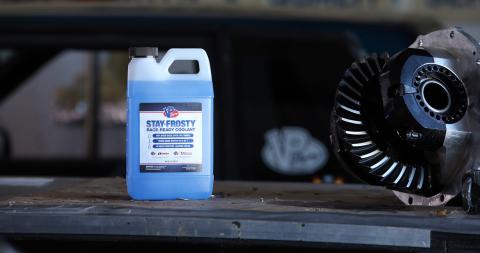
In addition to a wide array of performance fuels, the company also offers one of the premier coolants in the racing industry. The Official Performance Coolant of IMSA, Stay Frosty performs for Saturday night grassroots racers and top level pros across the racing industry.


According to driver Robby Gordon, "With race day weather over 100°F, our engine temps climbed to about 225°F with our standard water and coolant formula. After replacing with Stay Frosty Race-Ready Performance Coolant our engine temps only came up to about 202°F on race day, even with a radiator fan failing mid-race." 

Product details:

Stay Frosty Race Ready is a proprietary VP Racing Fuels coolant formulated for high-compression, high-heat racing engines. It contains a specialized blend of heat transfer agents that drastically improve coolant’s ability to transfer heat away from high temperature cylinder heads. Temperatures of engines are reduced by up to 30°F compared to conventional glycol-based coolant. This increases the density of the air/fuel mix, and allows ignition timing to be safely advanced without the threat of detonation – resulting in more power and torque.

  • Ready-to-Use – Just Pour In
  • Contains No Slippery/Hazardous Glycol
  • Reduces Engine Temps By Up To 30°F
  • 100% Water-Based Formula
  • Maximizes Horsepower and Torque
  • No Freeze Protection – Maximum Cooling
  • Non Toxic and Biodegradable
  • Blended with Chemically Stable Reverse Osmosis Water

Learn more about the Stay Frosty Race Ready coolant, and all of VP Racing Fuels products, by visiting vpracingfuels.com


Race Team confidential: Antron Brown, Brownsburg, IN

Submitted by danielk on Thu, 12/17/2020 - 16:59


There’s little downtime for a championship-winning driver who splits the offseason between Top Fuel and his sons’ Jr. Dragster teams. 

A normal offseason is less than 90 days from Pomona to Pomona on the NHRA side. We keep plenty busy because it goes fast with staying in shape at the gym to the guys refreshing the parts, the branding on the car, trailers, uniforms, photo shoots, and testing before the first race, which this year is at Gainesville in March.

In addition, my sons Anson and Adler both race in the Midwest Jr. Super Series. Anson races the 7.90 Index, Sportsman, Pro Sportsman, and also in the 13-and-up age group. Adler races in the 10- to 12-year-old age group, Pro Sportsman, and 8.90 Index. Anson was 8 when he started and is now 16, while Adler started at age 6 and is now 12.

The difference between me driving rather than being a crew chief is that when I race Top Fuel, all I have to do is drive and mix fuel. I don’t have to worry about the car or what it does, or about the tune-up to make the car better.

But, as crew chief on the Juniors, I’m now worried about everything that I’m not used to having to focus on during the NHRA national events, like what tire pressure we need for the conditions, or how to jet it or tune it, or how to tune the clutch. At the same time, I’m trying to coach them to be better race car drivers so they can improve and learn from their mistakes.

I’ve always been interested in the mechanical side of the race car and how things work and operate. [As their crew chief], if I understand the mechanics, I feel that it makes me a better driver. It makes me look at more things on the car that I can then talk to my crew chiefs about—things I feel going down the race track in the dragster.

With the Juniors, we’re spending time now going out in the shop and tearing the race cars down and putting the eagle-eye on the chassis and parts to make sure their cars are perfect. We replace the bearings in the rear axles, make sure the engines are prepped, and we’ll send them off to get freshened up. We also get new windshields, make sure they fit in the car properly and safely, and renew their NHRA competition license.

Pre-COVID, the kids would attend the PRI Show in Indy and walk the floor with me and visit the booths and spend time with our partners. We will do social media and showcase the offseason and what we’re working on. We like to focus on what Impact Racing does and can provide for safety for the youngsters, also.

My approach to sponsorship is that we deliver for our partners who support us. COVID and pre-COVID are two different worlds. Pre-COVID, I would do a lot of in-person events like speaking at vocational schools, meetings with our sponsors and distributors, appearances at Matco Tools events, and things like that.

But with COVID, we don’t foresee doing any in-person events or meetings until mid-2021. So, for now, we use Skype or Microsoft Teams for meetings with our sponsors to discuss what value we can bring to them during these times.

We’re also really hitting social media hard with requested messaging points from our partners. Instagram is our biggest focus because it brings the most value, but we do Twitter as well, and Facebook gets some good engagement.

For the Juniors, it’s really no different than what we do for Top Fuel and the NHRA Camping World series, just on a smaller scale. The kids have to learn to put in the work and time, and learn the value of having loyal partners. It’s great life lessons. 

January 2021

Ask The Experts: Heat Suppression

Submitted by danielk on Thu, 12/17/2020 - 16:53

Beyond minimizing damage from high temperatures, heat protection products can also improve performance. For example, this turbocharger blanket from DEI retains the heat in the source—the turbo—which then allows it to spool faster with less turbo lag.

Discover the best ways to prevent high-temperature transfer from sensitive—and expensive—race components.

What’s the best way to maintain air intake and fuel temperatures to prevent issues with hot fuel, such as vapor lock and power loss?

“The best way to stop heat is at the source,” said Heatshield Products’ Steve Heye. “This applies to all questions when it comes to controlling/reducing heat, either radiated or direct-contact. A thermal insulation on a heat source like exhaust pipes, headers, or turbocharger downpipes is the most effective solution at containing heat. If insulating the heat source isn’t an option or not preferred, a radiant heat shield (something that deflects heat away) is the way to go.”

When it comes to air intake components, “shielding the air box, air intake tube, and intake manifold itself helps lower air intake temperatures and the temperature of the air/fuel charge, which helps increase power through the cooler, denser air,” Heye added.

“You want to apply product directly to the intake tube itself or block the heat source that’s closest to the intake,” said Eric Baun of DEI. “Especially in turbo applications, keeping a blanket on the turbocharger keeps heat in and doesn’t allow it to soak over to the intake side. Keeping heat in the turbo also allows it to spool faster so you have less turbo lag. That isn’t helping the intake temperatures as much as helping the exhaust flow at that end.”

heat1
When it comes to air intake components, “shielding the air box, air intake tube, and intake manifold itself helps lower air intake temperatures and the temperature of the air/fuel charge, which helps increase power through the cooler, denser air,” said a source from Heatshield Products.

How do you keep the driver comfortable and protected from the effects of heat during a long race?

“This is a real issue for endurance racers in the car for a long time, anything longer than an hour or more,” said Baun. Much of the heat is coming in from the engine compartment, but the transmission tunnel can be a heat source, too, he pointed out, especially if exhaust pipes are routed through there. 

Applying heat barriers in the engine bay, such as exhaust wrap on the headers, “brings down the radiant temperatures under the hood so they won’t seep into the cabin,” Baun said. 

But Heye pointed out that “many classes across different racing genres won’t let you insulate or wrap the exhaust system. If rules don’t allow insulating the exhaust system, the next option is shielding the race car interior from the outside using a thermal barrier to deflect radiant heat away from the floors, firewall and transmission tunnel.” 

All three companies offer heat barrier products that can be used on the floor and transmission tunnel. They’re made from lightweight materials, so they don’t add weight to the car, and most are installed using adhesive backing. 

“Some applications are too demanding for an adhesive-backed material, which is where our other heat shields come into play,” said Jeremy White of Thermo-Tec. “They can be mechanically fastened to your vehicle using bolts and washers.”

DEI and Heatshield Products also offer barrier products with mechanical instead of adhesive installation.

heat2
Thermal barrier sleeves, such as these Express Sleeves from Thermo-Tec are a quick and easy product to protect wires, hoses, and cables on race cars.

Transmission cables under the car are vulnerable to heat. What’s the best way to protect them?  

“Our sleeving category has everything you need to protect every line on your vehicle,” said White. 

Heye added, “A heat shield sleeve is the way to go. We offer different versions: heat reflective, heat reducing, open seam, tube sleeves, and so on. Some of these are offered with built-in high-temperature hook-and-loop fastening so they can be easily installed and just as easily removed if necessary.

“When it comes to thermal barrier sleeves, the question we are asked most often is, ‘Can the heat sleeve be loose around what it’s protecting, or does it need to be tight?’” Heye explained. “Loose is fine, snug is better, but the ends of the sleeve must be tight or sealed onto what the sleeve is protecting. This keeps heat from getting inside the sleeve and still causing issues. This is the small but important aspect customers miss the most when installing heat shield sleeving.”

“Wrapping the exhaust would help as well,” added Baun. “Anywhere you will wrap will cut down on radiant heat in the area. But line sleeving is the quick, easy way to keep from losing time in the pits waiting for these cables to cool down.” 

SOURCES

–

Design Engineering, Inc.
designengineering.com

Heatshield Products
heatshieldproducts.com

Thermo-Tec
thermotec.com

January 2021
By
Drew Hardin

Tech Update: YOUR Oil’s Best Friend—The Piston Ring

Submitted by danielk on Thu, 12/17/2020 - 16:25


Why this seal between the motor oil and combustion gases is so vital to your engine’s performance.

Have you ever wondered why automatic transmission fluid is “fill-for-life” and motor oil still has to be changed every 5,000 miles? The simple answer is contamination.

Combustion is a powerful but dirty business. Besides what comes out of the tail pipe, those same combustion gases—carbon monoxide, nitrogen oxides, vaporized moisture, and partially burnt fuel—also make their way into the crankcase. When these same exhaust gases that we don’t want to breathe (because they can kill you) leak past the piston rings, we call them blow-by. These harmful gases chemically attack the motor oil, which is why used motor oil turns dark. 

As a certified lubrication specialist, oil monitoring analyst, and member of the Society of Tribologists & Lubrication Engineers, I can tell you that blow-by gases are what contaminate your motor oil. Jet turbine engines experience incredibly high temperatures, but those lubricants will live significantly longer than internal combustion engine oils. Why? There is no blow-by in turbine engines. 

In fact, the same base oil used to make motor oils is also used to make stationary turbine engine oils. While a motor oil might live 10,000 miles in a four-cycle engine, these turbine oils will live more than 10 years! What is the difference? Turbine engines never expose the lubricant to combustion gases. Both internal combustion engines and turbines generate lots of heat, but only internal combustion engines expose the lubricant to combustion blow-by gases.

oil
Why does motor oil turn dark? Blow-by gases (combustion that leaks past the piston rings) contaminate the oil, which causes the change in color.

Now don’t get me wrong, motor oils are designed to withstand the assault of these intruders. But the fact remains that combustion blow-by gases contaminate and chemically degrade motor oil. This is why a high-performance motor oil can contain up to 14 different chemicals, and a jet turbine oil might contain only four different chemicals.

So what does all of this mean? Simply put, your piston rings are your motor oil’s best friend because they are a seal between the motor oil and the combustion gases. 

Motor oil is the lifeblood and sole source of lubrication for your motor. The job of the motor oil is as follows:

1. Cool the lubricated parts in the engine.

2. Clean the lubricated parts in the engine.

3. Protect the lubricated parts in the engine.

4. Transfer power in the hydraulic parts in the engine.

Fuel dilution, moisture, soot, and heat all affect the motor oil’s ability to do its job, so it pays to keep your motor oil cool, clean, and dry. With that said, your piston rings are the only line of defense between combustion gases and your motor oil.

Invented by John Ramsbottom in 1854 (before the internal combustion engine was even invented), the piston ring is a seal. The job of the piston ring is to:

1. Seal the combustion chamber and minimize the loss of gases to the crank case.

2. Improve heat transfer from the piston to the cylinder wall.

3. Help maintain the proper quantity of oil between the piston and the cylinder wall.

4. Regulate engine oil consumption by scraping excess oil from the cylinder walls.

oil2
The piston ring is your oil’s best friend, according to Lake Speed, Jr. of Total Seal Piston Rings, who noted that a Gapless ring reduces blow-by, thereby protecting motor oil from contamination.

When you look at the job of the motor oil (to cool, clean, and lubricate the engine) and the job of the piston rings (to seal, transfer heat, and meter the oil), it is easy to see how they play complementary roles. The better the piston rings do their job, the easier it is for the motor oil to do its job, and vice versa.

In over 15 years of reviewing used oil analysis reports, I’ve never seen low engine wear when the oil contamination levels are high. In fact, the bad wear results generally coincide with high levels of fuel dilution and other combustion-related contamination.

However, when was the last time you thought of motor oil and immediately thought about piston rings? 

When you think about motor oil today, the first thing that probably comes to mind is zinc (ZDDP), and that is understandable. The issues related to changes in ZDDP levels in motor oil have been the headline story in our industry for over 15 years, so it is understandable to think zinc at the mention of motor oil. However, there is more to motor oil than just ZDDP—just as there are other parts in an engine besides the camshaft.

Today, we have several specialty oils designed to protect your engine. But these oils can’t do their job without the piston ring doing its job. 

In simple terms, the better the piston rings seal the gap between the piston and cylinder wall, the less combustion blow-by gas (which is hot and full of moisture, fuel, and other nasty chemicals) gets into the oil. The bottom line is that better ring seal means better oil life and performance, which means longer engine life. That is why the piston ring is your motor oil’s best friend! 

Lake Speed, Jr. is the VP of Sales & Marketing at Total Seal Piston Rings. He is also a member of the Society of Tribologists and Lubrication Engineers and holds Certified Lubrication Specialist and Oil Monitoring Analyst certifications.

January 2021
By
Lake Speed, Jr.

Problem Solvers

Submitted by danielk on Thu, 12/17/2020 - 16:10


Rick Hall came up with a creative, affordable, yet still effective option to house his trackside sales operation.

The Problem: Setting up a secure, walk-in trackside store on a tight budget
The Solution: Build the store from a used shipping container

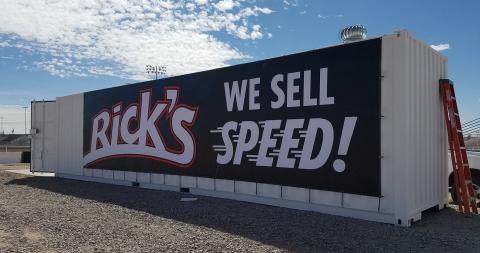
Speed shop owner Rick Hall of Las Cruces, New Mexico, came up with this innovative solution for setting up a trackside shop at nearby Vado Speedway Park. Instead of the trailer, truck, or tent setup typically used by trackside vendors, Hall built his store from a used shipping container. 

He started by shopping carefully for a container in good condition, to give his store the polish and longevity he wanted. “Some containers are rusted up and they look decrepit,” said Hall. “And the prices are all over the place.” He decided to pay the extra money for a 40-foot, one-use container that was in good shape. 

To provide a solid, level foundation for the container, Hall laid down a layer of base-course rock, then he had a concrete pad poured for the entryway. Once the container was delivered, an electrician ran lights inside and wired it for 110-volts, which Hall powers with a generator. For the walls, he wanted the versatility and clean finish of slatwall. But drilling mounting holes in the sides of the container could cause leaks or rusting. So Rick welded in 4-inch-wide by 1/8-inch-thick steel to attach it to. He also mounted a turbine vent to the roof to help combat the New Mexico heat. Even so, the interior still gets hot at times. For now, he runs fans inside, but he’s planning to add an evaporative cooler. 

problem
When faced with the challenge of locating his company’s trackside sales operation at Vado Speedway Park, Rick Hall purchased a used shipping container that provides ample space for inventory along with security between events.

With most of his inventory remaining in the store between races, security was important. Hall supplemented the container’s robust doors and latches by welding a bolt-cutter shield around the lock. To add luster to his store, he had the container’s exterior painted white with an airless sprayer. The finishing touch is the “Rick’s” banner on the side. Besides attracting racers to the store, it’s also an effective billboard. “Interstate 10 runs right by the race track,” said Hall. “We get comments all the time: ‘Boy, that’s the only sign we can see down there!’” 

Hall’s whole store setup cost less than $10,000—a bargain when you consider that a 40-foot trailer could easily be twice that. Nonetheless, he said some vendors would still be better off using a trailer. “This is the only track within 200 miles,” Hall noted. Vendors in denser areas, “could hit a lot of race tracks, so they’d need to be mobile.” 

But Hall noted that a shipping container serves his store needs well, providing the security, solidity, and weather protection he demands, at a relatively low cost. And that’s problem solving with style. 

Do you have a creative solution to a problem in your business, race car, or shop? We’d love to hear about it. If we like the idea, we may just publish it in an upcoming edition of Problem Solvers. Send your ideas, tips, or suggestions to editorial@performanceracing.com.


Shipping Container Basics
–

  • Containers are available new, used, and “one-trip”—used only once, making them almost brand-new. 
  • The most common lengths are 20 and 40 feet. There are two basic heights: 8' 6" standard and 9' 6" high cube.
  • Used prices start at about $1,500 for a 20-foot standard; better-condition one-use containers cost roughly twice that. 
  • Most companies will deliver within 250 miles, with fees based on distance. Expect to pay $300 or more. 
  • Containers can also be rented, with prices typically in the range of $130 per month for a 10-foot standard to $200 per month for a 40-foot-high cube.
  • Some companies also offer custom modifications. Installed roll-up doors start around $900, and glass windows go for about $500 each and up. 
  • Be sure to check your area’s zoning restrictions before buying or renting a container. Many municipalities have ordinances that apply. —David Bellm


January 2021
By
David Bellm

Editors’ Choice

Submitted by danielk on Thu, 12/17/2020 - 15:48


Hundreds of new product announcements cross the desks of PRI editors each month. Following are our top picks for January.


EZ CHECKER TOOL

MS Racing Components
msracingcomponents.com

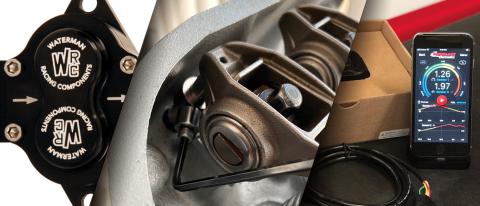
If you scorn the LS engine for its non-adjustable valvetrain and swear loudly when trying to use a conventional pushrod-length tool to determine the correct geometry, then the EZ Checker from MS Racing might be your salvation.

We all know that excessive lash created by a short pushrod can lead to severe punishment on the valvetrain components. A pushrod that is too long may end up causing the valve to stay open after a hydraulic lifter pumps up. That’s not good either.

LS engine builders have long developed their own techniques to ensure proper valvetrain geometry. For those who have used the EZ Checker tool, they say shop efficiency is often improved.

MS

“Engine builders have told me they can now set the pushrod length in under two minutes,” said Mike Scano, who developed the patent-pending product. “They’re speeding up productivity and shipping engines out faster.”

Constructed of 303 stainless steel, this tool features a spring-loaded self-adjuster that takes up the zero lash after the rocker arm is installed. A small Allen wrench locks down the captive screw before the EZ Checker is measured the traditional way with a long caliper.

The EZ Checker is available for both the LS and Gen III Hemi. —Mike Magda


COMBO FUEL PUMP

Waterman Racing Components
aeromotiveinc.com/product-category/waterman/

Reducing overall vehicle weight is always on the minds of race car builders, and the new Combo fuel pump from Waterman Racing Components certainly helps in that effort.

Designed to mate with the belt-driven power-steering pump from Sweet Manufacturing that utilizes a two-stud mounting footprint, the Combo fuel pump is a favorite among dirt modified, dirt late model, and national midget race teams.

“It’s small, light, and perfect for those cars,” said Johnson Barrick. “It’s a market-specific product.”

waterman

Six different gear sizes from .150 up to .400 inch are available, giving the Combo pump the capability of delivering fuel between 1.45 gpm to 3.9 gpm. The pump is compatible with gasoline, methanol, and ethanol fuels. It’s machined from aluminum and houses steel shafts and precision-lapped gears.

The pump was first designed at Waterman as a private-label license to Sweet as a mate to its power-steering pump. Sweet then developed its own fuel pump, prompting Waterman to upgrade its original design.

“We wanted to reintroduce it because before we were selling it only through [Sweet],” noted Barrick, adding that the Combo pump now plays an important role as part of the company’s growing distributor/jobber program. —Mike Magda


DUAL CHANNEL PE-WIDEBAND CONTROLLER KIT

Performance Electronics
pe-ltd.com/product/dual-wideband

Performance Electronics—the manufacturer of standalone ECUs, sensors, and digital displays for the automotive aftermarket—has introduced a product to help racers and enthusiasts tune their carbureted or fuel-injected engines while retaining their vehicles’ factory look. The PE-Wideband O2 with Bluetooth was designed for users to monitor an engine’s live air fuel ratio straight from a smartphone without having to install gauges in the dash—just pair via Bluetooth to receive data in seconds. 

PE

Pictured here is the dual sensor kit, which, like the single sensor kit, features a corresponding app that can connect with up to two sensors to show data for a range of different engines. Available for iOS and Android devices, the app is highlighted by an adjustable history graph and fast reconnection times.

Aside from the easy-to-use Bluetooth capability, users will also benefit from an easy installation with a two-wire design. The kit comes with the PE Wideband Controller with a Bosch LSU 4.9 O2 sensor and weld-in bung. The controller—which features a robust yet compact design—offers 0–5 volt analog and CAN output. —Laura Pitts


ONLINE BONUS

6.6L L8T Gen-V Engine Block
Chevrolet Performance

Chevrolet Performance has introduced an all-new cast-iron Gen-V engine block to help LT engine builders produce big power. Found in the 2020 Silverado HD, this block can be the base for crate engine builders seeking durability and strength. Click here for our exclusive video.


January 2021

Make The Case: Nitrous vs. Turbocharging

Submitted by danielk on Thu, 12/17/2020 - 15:33


As the horsepower wars refuse to concede, nitrous oxide and turbocharging lead the way as two quick power enhancers. In this month’s column, nitrous guru Pat Musi makes the case as to why he prefers this readily available staple to bolster his engines, while the legendary Kenny Duttweiler stands his ground as a turbocharger advocate.


NITROUS ADVOCATE:
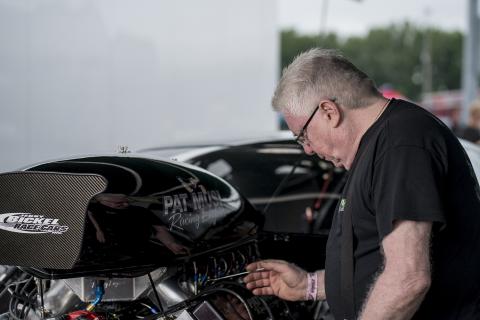
PAT MUSI, PAT MUSI RACING ENGINES

There’s no question that the turbo guys make big power, but luckily for us, they’re not able to apply it as well as we can.

I’ve never been a forced-induction guy—it’s not that I can’t do it, it’s just that nitrous setups intrigued me, and I wanted to build a better mousetrap. And over 20 years, I think we’ve done a pretty good job of that—our stuff lives, it doesn’t blow up. I think we’ve helped bring back confidence in nitrous. We’re constantly working on ways to make the motor run more nitrous through it, and ultimately displacement is a big factor in terms of how much you can put in it and keep it alive.

I always hear people saying that turbocharged engines don’t break, but I’m up there on the starting line and I’m watching them break. Spinning those engines to 10,000 rpm is hard on parts, and every combination has its plusses and minuses. When these turbo guys break rods or tear up valvetrain components, that’s big damage. And in terms of maintenance, although I don’t [work] with those turbo teams directly, I would assume that, due to the rpm’s those guys are running, they’re going to have to change valves probably twice as often as we do. And I know they get about half as many runs as we get with a set of connecting rods.

pat

Nitrous is also quite a bit easier to tune. We have nitrous racers that can do their own stuff—we give them a baseline and they can go out and run it all day long. Turbo guys all have to have tuners with them. One time at a race, Jose Gonzales told me, “I’m thinking about switching back to nitrous because I can’t afford to keep paying these guys this much money every year to come tune my car. I watch your guys, and they run on their own!” So because turbo cars can be so difficult to tune, they’re not very consumer-friendly. 

There’s also the initial costs involved. If you have a target of, say, 2,000 horsepower, it is definitely going to be less expensive to get there with a nitrous setup than it would be with turbos. For the guy who wants to, for instance, go do a Street Outlaws kind of deal running a 632 ci engine, it will be way cheaper to build a 632 with two stages of nitrous on it than it would be to build a 632 and a turbo system for it. The initial investment with turbos is substantial.


TURBO ADVOCATE:
KENNY DUTTWEILER, DUTTWEILER PERFORMANCE

The easiest way to look at it is this: Once the turbochargers are on the engine, you’ve got an endless supply of power. You don’t need to refill bottles to get the power back, and in a nitro car, you can deplete those pretty quickly. I remember I was once watching a guy at Bonneville with a streamliner that was normally aspirated and running nitrous, and I lost count of how many bottles they had to put in that thing to sustain a five-mile run. And after one run, they had to re-load it all over again. With turbos you can buy a set and run them all year, or over several seasons. 

It’s just a very different way of making power. One of the biggest advantages of turbos is that you can make big power with small displacement engines. We’ve got stuff that will easily make 10 horsepower per cubic inch, and it’s not uncommon for turbo guys to be making 4,000 horsepower with a 520 ci motor these days. And while turbos require a bit of power to make them work, you’re using exhaust energy to do it, so it essentially takes some load off of the crankshaft.

Ken

You also have a lot of different ways you can approach a turbo setup, so what we usually do is set a horsepower target and then identify the turbocharger that most easily addresses that for a given application. For example, if you want to make a couple thousand horsepower, there’s a variety of sizes of turbos that will do that. The smaller ones offer more flexibility in terms of fitment, and the spool-up time is typically shorter. And as these turbo units get more and more efficient, the power levels of these smaller turbos are starting to exceed those of the big turbos from just a few years ago. With such a wide range of options available, you can address a customer’s power number with something that easily integrates into their combination and that fits within their budget. And once they’ve made that up-front investment, there’s no additional cost to run turbos.

It’s also important to remember that the displacement of an engine is a big factor in terms of how much nitrous you can put in it, whereas with a turbocharger you are essentially increasing the engine displacement with the manifold pressure. As that boost pressure goes up, you can pack in an extreme amount of air and fuel, and that means you can mimic an engine that’s much larger. If you run out of horsepower with a turbo, the problem is that you just don’t have a big enough turbo. 

I also tend to think that turbocharged engines will live longer than their nitrous-fed counterparts. While the nitrous guys are getting better with that—they don’t see as many engine failures as they used to in drag racing—at the end of the day, the easiest high-horsepower device that you’re going to strap on an engine is going to be turbos. It’s not uncommon to watch turbocharged cars run all weekend without ever having to take more than the valve covers off, whereas those other guys might be changing pistons or tearing the engine apart to address another issue. The guys that don’t want to do that a lot are probably better suited to the turbocharged stuff. 

January 2021
By
Bradley Iger