Newly Appointed: Bryan Wilson

Submitted by jeffreyc on Tue, 01/16/2024 - 15:23


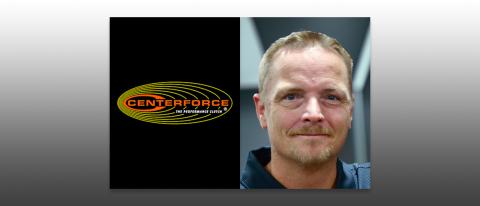
The new president and CEO of Midway Industries, Inc., parent company of Centerforce Clutches, got his start while still in school…elementary school, that is.

This past October, Bryan Wilson took the reins of this third-generation-owned and operated company, one where he has spent his whole career, as its new president and CEO. He takes over the position from his father, Pat Wilson, making him the third generation in Centerforce’s 41 years in business. 

Bryan got his start in the family company by working a broom at Centerforce Clutches when he was in kindergarten. Like many boys that age, he also got into a bit of mischief. “A favorite memory as a kid at the company was running around the production facility and stealing sugar cubes from the coffee stations,” he recalled for PRI. “I also enjoyed spending time with my grandfather, Bill Hays. When I was a little kid, he joked around, and we would run around town in one of his cars to ‘pick up chicks,’ as he’d kid me.”

Wilson will oversee company strategy and provide what the company described as a renewed drive toward innovation and growth in the performance clutch market, which Wilson acknowledged is shrinking in this day of automatic transmission domination. Under his leadership as general manager, Centerforce saw significant growth, including increased sales and the addition of several new products and applications. He recently shared his outlook for the company.

PRI: Was your life growing up surrounded by high-performance cars and racing? 

Wilson: Because I grew up around those cool cars, I never appreciated them until I was old enough to enjoy them. 

PRI: What are some of your memories from working at Centerforce from an early age?

Wilson: This company has always been a part of my life. Sweeping the parking lot for my grandfather when I was maybe five or six years old was the start. When I was old enough, my first real job at Midway was crimping wire harnesses and drilling backing plates for Stinger Ignitions. As I graduated to a full-time position, I started in our bonding department making our Dual Friction facings, and it all took off from there.

PRI: What are you most looking forward to in your new role as president and CEO?

Wilson: Mostly to make my family proud by improving on what we do and how we do it, growing the brand and even starting something new. I want to pass along that a family business can be a great place to work, because we can have a great time making parts that people just want to have fun with. As my friend Doug Dwyer would say, “Making parts that people don’t need, to impress people they don’t know.” 

PRI: We noticed on the company website that Centerforce offers clutches for engine swaps in the Triumph TR7 and TR8. Now that is what we’d call a niche product! How does Centerforce respond to such seemingly small markets?

Wilson: Being a clutch-centric company, we are niche by definition. The clutch market is withering a bit in volume, but we still have a great many places we can improve. More engine and transmission swaps in all kinds of vehicles really makes us focus on a wide variety of clutch products and applications. As many other industries are finding, we also must become a bit more flexible. While our products are a bit difficult to make as one-offs, we can run low-quantity production.

PRI: Where do you see the best opportunities for Centerforce in the near term?

Wilson: Finding those niche opportunities and helping our customers get the best product to meet their performance and ease-of-use needs. I don’t want to give away too much else at this point, but I will say there are ideas forming. 

PRI: How does the company explore new opportunities?

Wilson: We have built a team of professionals that have either been at Centerforce for more than 30 years, or in the industry for even longer. That experience and some new blood always makes for great conversations. I want to build on that knowledge and bring them all together to plan our strategy. 

PRI: What is one mistake you’ve learned from in your professional career?

Wilson: In the past, I believed that you should pick a management style and evolve. I have learned there is not one style, but many. People are very different, from their reactions to their motivations. Each person needs a mix of styles to be effective. Unlike numbers, people are not as simple as two plus two equals four.

PRI: Who has been most influential to you in your professional career?

Wilson: I have been lucky to work with and know many people that have influenced and coached me over the years, though I must give this one to my father. While we do not always see eye-to-eye, he has had the largest impact on me being who I am. Influence is not specific, but how we look at life and if we choose to grow and improve. He has always promoted learning and curiosity, and I guess my grandfather instilled that in us, as well.

PRI: What is one piece of advice you have received, whether personally or professionally, that has greatly impacted your life?

Wilson: If you enjoy what you do, you will never have to work a day in your life. 

PRI: Excluding your cell phone/tablet/computer, what is one thing you can’t live without?

Wilson: Besides family, friends, and coffee—challenges! If it wasn’t for those, how boring would life be?

Bryan Wilson

TITLE:
President and CEO

ORGANIZATION:
Midway Industries, Inc. (Centerforce Clutches)

HOMETOWN:
Prescott Valley, Arizona

FAST FACT:
“I find that many of us in the car industry have some hobby outside of cars, and mine happens to be pool/billiards,” said Bryan Wilson. “I love the game and the balance between physical coordination and the complexity of working through the rack.”
February 2024
By
Jim Koscs

Editors’ Choice

Submitted by jeffreyc on Tue, 01/16/2024 - 13:21


Hundreds of new product announcements cross the desks ofPRI editors each month. Following are our top picks for February.

Zero EV Fire Suppression

Lifeline
lifeline-fire.com

1

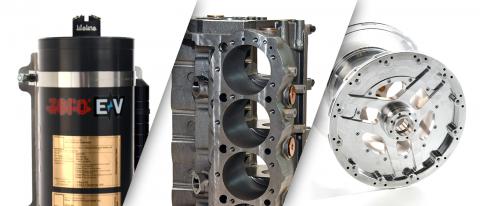
Fires in electric vehicles require a different suppressant strategy, and motorsports can often be a test ground for emerging technologies. Such is the case for the development of the Lifeline Zero EV fire suppression system designed for electric vehicles and hybrids.

“It went through a lot of testing, and it had to pass FIA tests and specifications,” said Matthew Bridges of Lifeline USA, Dublin, Virginia. “That’s because the suppressant needs to be non-conductive.”

A variety of sizes from 1.5 kg up to 3.0 kg are available in both stored pressure and remote charge that uses a CO2 cartridge. All use 3M Novec 1230 suppressant that helps produce increased levels of concentration for a quicker knock-down of the flames.

The stored-pressure models feature advanced nozzle design, and the remote charge versions have the cartridge integrated into the side of the cylinder for improved packaging. The 1.5-kg models are ideal for single-seat cars, while the 2.0-kg model is designed for saloon/sports cars. The largest 3.0-kg model can be used in international rally events.

The systems are homologated to FIA Technical List 16. The systems are supplied with a complete installation kit that includes anti-torpedo brackets and all components for a professional appearance.


Iron 4.500-inch Bore Center SBC Cylinder Block

M&M Competition Engines
mmcompetitionengines.com

2

Small block Chevy engines built with cylinder blocks that feature 4.500-inch bore centers are all the rage in select Late Model and modified classes. Now there may be another market opening up soon.

“We’re certainly hitting the circle track guys hard, but also drag racers are getting interested,” said Scott Patton of M&M Competition Engines, Franklin, Indiana, which recently introduced a new iron cylinder block that’s available in either the standard 4.400- or 4.500-inch bore centers. “We sensed there was a lack of blocks available to racers, so we developed this one.”

Available with a deck height of 9.025 or 9.325, the block can be ordered with 350 or 400 main journals and a one- or two-piece rear main seal. The cam location is raised .391-inch and can be a 55-mm roller or 60-mm Babbitt. Other features include four-bolt main caps, standard or reverse cooling, and priority main oiling with crossovers to ensure equal lifter lubrication.

“We also have extended head-stud bosses for additional thread engagement,” noted Patton. 

The lifter valley was engineered so that engine builders have plenty of flexibility in lifter size and location. Core plugs are machined to accept -16 AN O-ring plugs, and oil galley plugs are machined to accept -6 O-ring plugs. The block is also designed with a wide pan rail.


TorqueStar Top Fuel Harley Rear Wheel

DayStar Machine & Cycle Concepts
daystarmcc.com

3

Structural integrity is the key selling point to this TorqueStar aluminum wheel that was designed by DayStar specifically for Top Fuel Harley racing.

“The rear wheel gets a lot of shock at launch, especially in the hub area where it often shears off the bolts that secure the hub,” said Steve Vickers of DayStar Machine & Cycle Concepts, Dobson, North Carolina. “We added a bunch of features to make it stronger.”

The main components of the modular wheel design are machined from 6061 billet aluminum, while the hub area is machined from 7075 billet aluminum. The bearing hubs are interlocked into the spoke plates to maximize torque distribution. There’s a generous hub-engagement depth of .625-inch; plus, the hubs are secured with 12 1/4-20 bolts and six dowel pins. Competitive wheels may have fewer securing bolts and no dowel pins.

There are 24 bead-lock bolts per side to keep the tire in place. The wheel is 14 inches wide and designed for 31/15 Top Fuel motorcycle tires.


Gen III Hemi Billet Valve Covers

DSR Performance
dsrperformance.com

4

The snowballing popularity of the Gen III Hemi engine in street and track performance is generating a wide variety of trick performance and aesthetic upgrades. These billet aluminum valve covers for the 6.2-liter Mopar engines from DSR Performance in Brownsburg, Indiana, address both those objectives.

“We wanted to blend a vintage style with a modern touch,” explained Chad Osier. “These are perfect for those who want to upgrade a Hellcat but have a vintage look.”

The show-car finish comes from precision CNC machining out of 6061 billet aluminum. The covers are baffled in the front and rear, and they feature dual ports. The covers come with ARP installation fasteners, oil caps, and O-rings for a direct swap on a Gen III Hemi.

“We offer them in a bare billet, so it’s a blank canvas for the customer to paint or engrave them as they wish,” added Osier. “Then we also have one with DSR badging.”


Wireless Steering Wheel Panel

ECU Master
ecumasterusa.com

5

Give your vehicle the look and functionality of a Formula 1 race car or WEC Hypercar with a wireless steering wheel control panel from ECU Master in Garland, Texas.

“It’s completely wireless RF transmission. There are no curly cords to get tangled up,” said Zach Denney. 

The ergonomically designed carbon case easily mounts on a wide variety of racing steering wheels, and the position is adjustable. The panel features eight pushbutton and four rotary switches that are customizable to driver preferences. 

“You can adjust traction control, ABS, power levels, or change engine maps,” said Denney. “It’s great for off-road in bouncy environments as the driver doesn’t have to take hands off the wheel to make adjustments.”

The control panel is also useful to road racers, Time Attack, track day, and other race vehicles. “Anything with a steering wheel,” added Denney.

The RF transmission is immune to all interference in the car. It features low power consumption and easily replaceable batteries. It also has direct integration with other CAN-bus devices, including ECUs.


Oil Catch Can with Air-Oil Separator

Improved Racing
improvedracing.com

6

Available with a large 7.0- or smaller 3.5-ounce reservoir, this new oil catch can from Improved Racing in Orlando, Florida, features a patent-pending air-oil separator that was developed using CFD computer modeling, lab evaluation, and real-world testing.

Both models have similar features, including quick-release provisions to easily check the oil level and versatile mounting brackets. The big selling point, however, is the air-oil separator design.

“There’s no steel wool,” said Michael Ihns. “We use a 100-micron, five-layer stainless-steel filter with increasing porosity. This helps the oil coalesce into larger droplets.”

Additional efficiency is achieved through unique air passages that induce cyclonic separation to clean the blow-by gases. According to the company, the unit achieves 85–95% separation.

Other features include a quick-release mechanism that requires only a 1/8 turn to open, and there’s a tool-free mounting bracket that can be clocked in 16 positions. Finally, there’s a safety lock to prevent accidental release.

Vehicle-specific kits with hoses and attachments are available for many popular applications, including Corvette, Camaro, Ford F-150, and select Mopars.


Davies Craig EWP80 Remote Electric Water Pump

3pConnect
3pconnect.com

7

There are now three ways to purchase the Australian-made Davies Craig EWP80 water pump: pump only, pump with harness, and pump with harness and controller.

By removing the parasitic loss of a belt-driven mechanical water pump, racers can gain upwards of 13 horsepower in some applications. An electric water pump gives the user a wider cooling strategy that includes running the pump after the engine has shut down to reduce heat soak throughout the system.

“With the controller, you can program the preferred engine temperature settings, and it will control the pump and the radiator fan,” noted Johnny Ramirez of 3pConnect, Ontario, California, which is the US distributor for Davies Craig. 

The pump is constructed from anti-corrosive, heat-resistant, glass-filled nylon and incorporates a ceramic-faced seal for durability. Maximum current draw is 7.5 amps at 13 volts, and it will work within an operating temperature of -40 to 248 degrees F. Weighing just two pounds, the pump will accept hoses from 1.375- to 2.000-inch diameter. It’s rated at 23.8 gallons per minute at 13 volts.

“This fan is not platform or vehicle specific,” added Ramirez. “It can be an upgrade on a stock vehicle or work on a Pro Mod.”

The pump and controller kit come with fittings, temp sensor, wiring harness, clamps, and hardware.

February 2024
By
Mike Magda

POWRi Announces 2024 Schedules for War Sprint League, 305 Sprint Series

Submitted by laurap on Tue, 01/16/2024 - 12:26
POWRi Racing logo


Series officials have announced the 2024 schedules for the POWRi WAR Sprint League and the POWRi 305 Sprint Series.

With 20 events at nine tracks throughout the Midwest, the POWRi WAR Sprint League opens at I-70 Motorsports Park in Odessa, Missouri, on April 20, followed by two days of racing on May 3 at Callaway Raceway (Fulton, Missouri) and May 4 at Lucas Oil Speedway (Wheatland, Missouri). The series will wrap with two days of racing at Lake Ozark Speedway in Eldon, Missouri, on November 1-2. 

The POWRi 305 Sprint Series, meanwhile, features an eight-event showcase schedule in 2024, also opening at I-70 Motorsports Park on April 20 and closing with two days of racing at Lake Ozark Speedway on November 1-2. 

For more information, visit powri.com.

POWRi Wingless Auto Racing Sprint League 2024 Schedule
4/20/2024 | I-70 Motorsports Park | Odessa, MO
5/3/2024 | Callaway Raceway | Fulton, MO
5/4/2024 | Lucas Oil Speedway | Wheatland, MO
5/26/2024 | Double X Speedway | California, MO
*6/14/2024 | Crawford County Speedway | Denison, IA
*6/15/2024 | Shelby County Speedway | Harlan, IA
7/5/2024 | Lake Ozark Speedway | Eldon, MO
7/6/2024 | Lake Ozark Speedway | Eldon, MO
7/12/2024 | Paducah International Raceway | Paducah, KY
7/13/2024 | Paducah International Raceway | Paducah, KY
*7/19/2024 | Mason City Speedway | Mason City, IA
*7/20/2024 | Mason City Speedway | Mason City, IA
8/31/2024 | Lake Ozark Speedway | Eldon, MO
9/1/2024 | Lake Ozark Speedway | Eldon, MO
9/12/2024 | Lucas Oil Speedway | Wheatland, MO
9/13/2024 | Lucas Oil Speedway | Wheatland, MO
9/14/2024 | Lucas Oil Speedway | Wheatland, MO
10/5/2024 | Valley Speedway | Grain Valley, MO
11/1/2024 | Lake Ozark Speedway | Eldon, MO
11/2/2024 | Lake Ozark Speedway | Eldon, MO
*WAR Wildcard Events to be run in conjunction with the Western Iowa Non-Wing Sprints, Show-Up 50-point seasonal events only.

POWRi 305 Sprint Series 2024 Schedule
4/20/2024 | I-70 Speedway | Odessa, MO
5/25/2024 | Lake Ozark Speedway | Eldon, MO
5/26/2024 | Lake Ozark Speedway | Eldon, MO
8/31/2024 | Lake Ozark Speedway | Eldon, MO
9/1/2024 | Lake Ozark Speedway | Eldon, MO
9/28/2024 | I-70 Speedway | Odessa, MO
11/1/2024 | Lake Ozark Speedway | Eldon, MO
11/2/2024 | Lake Ozark Speedway | Eldon, MO

**Schedules are subject to change. 

January 2024

Ask the Experts: Engine Dyno Maintenance

Submitted by jeffreyc on Tue, 01/16/2024 - 09:52

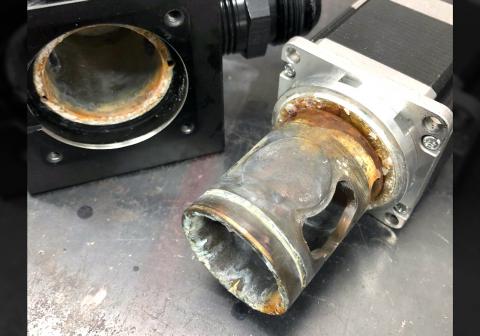
YourDyno provided this example of dynamometer absorption cavitation. A company representative said this is caused by high absorber temperatures and an undersized water system.

Dynamometers play a vital role in engine tuning, but if these sophisticated devices aren’t maintained properly, the accuracy of the data they provide can be compromised.

Engine dynos are designed to deal with some extreme forces, but they are ultimately sensitive measuring instruments, and the quality of the results they provide is highly dependent on owners’ maintenance habits. And as Kevin Hamilton of Nesbru, Norway-based YourDyno pointed out, sometimes owners can create maintenance problems without even knowing it. 

“Using untreated water in an engine dyno can cause significant problems,” he explained. “Hard water can cause electrolysis if you’ve got dissimilar metals in a component of the dynamometer, and that will eat away at that metal. Untreated water can also cause calcium buildup, which can create other problems. There are a multitude of bad things that can happen with water that hasn’t been treated properly.” 

Meanwhile, Ben Fox of SuperFlow in Sussex, Wisconsin, noted that water can also be inadvertently contaminated as well. “One of the biggest problems that I see is that engine shops will get blocks or cylinder heads in, and they’ll do machine work to them, but they won’t clean out the solvents and detergents within the castings thoroughly enough. After the engine is assembled, they put it on the dyno, and that solvent or detergent gets into the water system. That can cause foaming issues, and if it gets into the absorber side of the control system, it can cause all sorts of control problems.”

Hamilton also said that regular recalibration should be a part of any engine dynamometer maintenance routine. “Folks regularly let sensors, torque arms, and load cells go out of calibration. That’s a very common issue that we run into. If the scales are not appropriately dialed in for each sensor, you’re ultimately getting incorrect information from the dyno.”

2
Disciplined maintenance of a dyno’s water filtration system can ensure that the system continues to flow properly, said SuperFlow’s Ben Fox. “If it gets clogged, it’s going to create a water flow issue, and that will cause control problems.”

He suggested these systems be recalibrated on a regular basis based on both the manufacturer’s recommendations as well as the frequency of the dynamometer’s use. “Weather correction is really important, too. You want to make sure that the weather station is measuring temperature, barometric pressure, and humidity within a reasonable margin of error. And you need to use some sort of standard measure against that, whether that’s an external system on a race car, or even just calling your local airport to get their readings.”

Jostein Fonneland of YourDyno told us that flexible couplings, drive hubs, and dampened driveshafts are commonly overlooked as well. These components can fail over time, and engine dyno operators often make the mistake of ignoring the resulting problems by cranking up noise reduction features. 

“Some dynos will have a flex coupling, others will have a drive hub, and some have a dampened driveshaft,” Fonneland said. “Over time, the rubber inserts in the driveshaft will start to fail, and that can create harmonics and resonant vibrations. That resonance usually shows up in the torque line. Normally it will give an erroneous torque signal or torque spikes. Sometimes people will get a graph that doesn’t look good, and they will increase the noise filter to address the problem. But if there’s an internal part that’s failing, you’re not really taking care of the problem—you’re just hiding it. And the data behind it is not going to be as repeatable.” 

Instead, Fonneland advised doing a run without any noise reduction filtering at all. “If the graphs look fine without any filtering, it’s a good sign that those parts are OK. But if there is an underlying problem, increasing the noise reduction filter isn’t going to resolve it.” 

He also said that valve maintenance can play a vital role in the long-term performance of an engine dyno. “There are different styles of valves, and some will last a long time without any maintenance, but others will need to be taken apart to remove scale buildup, or they may start to stick. If a valve sticks, or it sometimes sticks and sometimes moves, it will be very difficult to get smooth sweeps.” Fonneland added that these problems tend to happen more often with barrel-style valves than with butterfly valves, but they should be checked for this buildup at regular intervals regardless. 

Fox noted that disciplined maintenance of the water filtration system can help to prevent some of this buildup and ensure that the system continues to flow properly. “That should be the top priority when it comes to maintenance,” he said. “The water filtration system keeps the crud from ever getting to the absorber and servos, but it has to be maintained in order to keep it free-flowing. If it gets clogged, it’s going to create a water flow issue, and that will cause control problems.” 

He said that the quality of water that’s being used largely dictates how often the filtration system should be serviced. But as a general rule of thumb, it’s a good idea to check the filters at least once a month, and they should be replaced yearly. 

Sources

SuperFlow
superflow.com

YourDyno
yourdyno.com

February 2024
By
Bradley Iger

Atlanta Motor Speedway Building New Gatehouses Ahead of Ambetter Health 400

Submitted by ajh on Mon, 01/15/2024 - 10:57
New gatehouses at Atlanta Motor Speedway


Atlanta Motor Speedway, Hampton, Georgia, is constructing three new gatehouses to service its Johnson, Champions and Earnhardt grandstands.

The new entrances will feature updated architecture and are designed to expedite guest entry into the grandstands, track officials said.

The new gatehouses will be completed before Atlanta’s spring NASCAR weekend, headlined by the Ambetter Health 400 on Sunday, February 25.

For more information, visit atlantamotorspeedway.com.

January 2024

Voice Your Support: Bills Seek to Repeal Virginia's ZEV Mandate

Submitted by laurap on Fri, 01/12/2024 - 16:06
internal combustion engine production plant


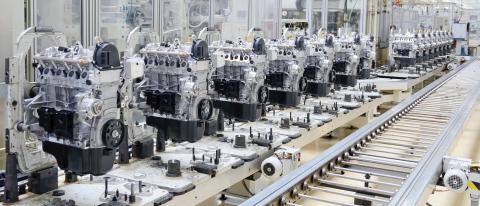
In Virginia, lawmakers introduced PRI-supported legislation to repeal the law tying the state to California's motor-vehicle emissions standards. Under current law, new gas- and diesel-powered vehicle sales will be banned starting in 2035. The multiple bills now await consideration in the Virginia General Assembly. 

PRI does not believe that the government--Virginia's or California's--should be choosing winners and losers in the automotive market. Virginians should decide what vehicles are best for them and their families. 

Your voice can make a difference! Click here to tell Virginia lawmakers to repeal the internal combustion engine ban. 

For more information, contact Kiley Chapley at kileyc@sema.org. 

January 2024
By
The PRI Washington, D.C., office

From The Executive Editor

Submitted by jeffreyc on Fri, 01/12/2024 - 15:44


Who will you help?

Motorsports industry veterans have received help at some point in our lifetimes that has ultimately benefitted our careers. But this assistance can go further back. Whether a school teacher, a guiding relative, an honest yet direct coach, or a car owner willing to give an up-and-coming driver a chance, these real-life influencers (as opposed to virtual) make lasting impacts that we carry with us to this day.

While spending time last month in Indianapolis for the PRI Show, I observed a common theme throughout the event. As I looked at the tens of thousands of people, and interacted with hundreds of them, it occurred to me, “Each one of us had to get our start. Who helped us?”

We commonly hear the question, “How do we keep motorsports prospering for generations to come?” Well, it begins with us, and if you haven’t done so already, it needs to begin now.

During the PRI Show, I had a timely encounter with a respectful and highly knowledgeable young man who was excited to attend his first PRI Show. As our conversation progressed, he shared his plans with me for his future and where he would like to eventually work after graduating from college. As he spoke, I started thinking of the people with whom I could connect him and how they could encourage and guide him. By the end of the first day of the Show, he left with an arsenal full of resources and connections to begin his motorsports career. Sure, I had the ability to recommend him to the decision makers, but it was his passion, his skillset, and his determination that will soon transform what is currently a dream into a viable reality.

Influencing today’s youth to guide them into motorsports careers can be as simple as making some introductions, as I did, to people who can offer advice, words of encouragement, or actual employment. We have the knowledge and experience that allow us to take someone under our wing and train them so they can learn a new skillset that translates to marketability, and ultimately, a prosperous career. 

I challenge each one of you in our industry: Help someone this year. If you have provided guidance in the past, that is commendable, but we aren’t done yet. We can’t be. We need to search out those opportunities to keep motorsports thriving. This can be as simple as assisting at entry-level racing events or mentoring a student from a local high school, tech school, or university. How can you encourage or train a young man or woman to transform their interest in racing into a lifelong career?

As we look ahead to the 2024 race season, go out there and make a difference in someone’s life to ensure motorsports continues to thrive for future generations.

January 2024
By
Meredith Kaplan Burns

From The Executive Editor

Submitted by jeffreyc on Fri, 01/12/2024 - 15:41


“It’s the most wonderful time of the year” may bring visions of the upcoming holidays or parents gleefully skipping through an office supply store pushing a basket full of school items while children are sulking behind as they prepare for the upcoming school season.

To me, December is definitely “the most wonderful time of the year,” as the racing industry gathers in Indianapolis for the PRI Show, December 7–9. While the race season winds down, the racing business opportunities ramp up in Indianapolis. Orders for new product lines or equipment are placed, cutting-edge technology is unveiled, networking opportunities abound, all while relationships with friends who we may only see once a year are renewed.

With more than 1,000 exhibitors packing the Indiana Convention Center and Lucas Oil Stadium, thousands of products to preview, 40-plus education and exhibitor seminars, ancillary events such as RTBC and others, how will you fit everything into those three days?

This November edition of PRI Magazine was carefully crafted to act as your official Guide to the PRI Show! Included you will find a schedule of events, a list of both the PRI Education and exhibitor-sponsored seminars, plus details about new events that we are pleased to bring you. 

We don’t hold back on fresh events and activations at this year’s event. Before the PRI Show even starts, engine builders will be interested in attending the AERA – Engine Professional Industry Conference, presented by Motor State on Wednesday, December 6. Once the Show opens on Thursday, head over to Lucas Oil Stadium for the Ekarting Classic, presented by Top Kart USA, and the Esports Arena, presented by SRO Motorsports Group. Plus, don’t miss the PRI Paddock & Podcast Studio in the Yellow Hall Lobby in the Capitol Cube.

Let’s not overlook all the features that make the PRI Show so special. Kicking off this year’s Grand Opening Breakfast is Indy 500 winner Tony Kanaan, who will be joined onstage with Speed Sport’s Ralph Sheheen. Doors open to the Sagamore Ballroom in the Indiana Convention Center at 7 a.m. on Thursday, December 7. Tony will be hanging out at PRI for the day as he will join fellow racer Daniel Morad and Advanced SimRacing’s Marc-André Ladouceur to discuss “Racing Simulation as a Training Tool for Motorsports” on Thursday at 11 a.m. on the SRO Stage in the Esports Arena of the Lucas Oil Stadium.

When you are walking the Show floor, stay updated with all the latest information about the PRI Show by logging in to your Show Planner either at pri2023.mapyourshow.com or by using the PRI App. You can quickly search for products or exhibitors, see all the Show events and the floor plan. If you want to know if Tom Shay, Alex Striler, or Jennifer Cario will be back this year to share their expertise (good news: they will!), you can view the names of all the seminar speakers. You can locate different Show activations, such as Hot Rodders of Tomorrow, Featured Products Showcase (in its new location at the ICC Capitol Connector), or even where the Street Outlaws will be corralled (or attempt to be) this year, all by using the App.

So, let’s make the most of our time at the PRI Show. I’m looking forward to seeing you there!


November 2023
By
Meredith Kaplan Burns

NASCAR Cup Series Establishes 2024 Short Track, Road Course Rules Package

Submitted by ajh on Fri, 01/12/2024 - 09:23
NASCAR Logo


NASCAR Cup Series officials have announced updates to the short track and road course rules package for 2024.

The changes, including a simplified rear diffuser with fewer vertical strakes, will go into effect at the first short-track race of the season at Phoenix Raceway in March.

The aerodynamic changes aim to promote more competitive racing on those track types, the organization said.

For more information, visit the NASCAR announcement or visit nascar.com.

January 2024

Melling Engine Parts Acquires QualCast

Submitted by ajh on Thu, 01/11/2024 - 14:52
Melling QualCast


Melling Engine Parts, a Jackson, Michigan-based manufacturer of oil pumps and other powertrain components, has acquired QualCast, a supplier of valvetrain automotive parts based in Nashville, Tennessee.

QualCast offers valvetrain solutions for heavy-duty, industrial, light and medium-duty, marine and performance applications.

“QualCast will strengthen Melling’s valvetrain business and allow us to expand into market segments we do not have a strong foothold on,” said Mark Melling, CEO. “We are thrilled and excited about the opportunities to expand with QualCast and increase our valvetrain range.”

Melling and QualCast will continue operating independently, the company said.

For more information, visit melling.com.

January 2024