Two record-setters are profiled this month, including a three-time micro sprint champion and the first screw-blown EFI car to run in the 3.60s.
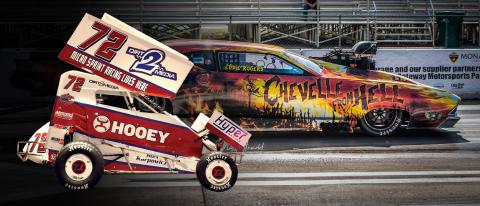
Hyper Racing X7 Micro Sprint
Alex Karpowicz | Spring Branch, Texas
Race Series/Class: National Open Wheel (NOW) 600 Series
Engine: Yamaha R6 600cc with Hyper EVO Fuel Injection
Car: Built by Hyper Racing
Features: TJ Forged wheels and hubs, Performance Electronics ECU, Advanced Racing Suspensions shocks, Ultra Shield full containment seat, Outlaw Wings
Facts: This is a three-time NOW600 championship car.
Based on 1969 Chevrolet Chevelle
Eddie Rogers | Berryville, Arkansas
Race Series/Class: PDRA Pro-Boost, Midwest Drag Racing Series, ADRL, Xtreme Raceway Park’s Xtreme Pro Mod Series
Engine: Screw-blown 521 Brad Anderson Hemi built by Eddie Rogers
Car: Built by Chris Duncan Race Cars in Chandlerville, Illinois
Features: Brad Anderson Enterprises block and cylinder heads; Bullet Cams camshaft and lifters; GRP connecting rods; Bryant Racing crankshaft; Manley Performance valves; PSI springs; PSI supercharger; T&D rockers; Dayco 8-mm supercharger belts; MSD ignition system; Davis Technologies Profiler handles wheel speed management, ignition controls, fuel management, and rev limiters; Strange Engineering components
Facts: The car is named “Chevelle from Hell” and is tuned by Rogers’ stepdaughter Amanda Hoover (one of a few female tuners in the Pro Mod world). Hoover and Chris Duncan met while racing against each other, and now build cars together, including this one, at Chris Duncan Race Cars. When originally built, the Chevelle from Hell was the first screw-blown EFI car to run 3.60s, however, it currently isn’t running EFI.
Whelen Engineering, an emergency warning equipment manufacturer based in Chester, Connecticut, is partnering with Mazda Motorsports to become the new title sponsor of the Mazda MX-5 Cup series beginning in 2024.
The 14-race, IMSA-sanctioned season begins on January 25 as part of the Rolex 24 at Daytona.
"Whelen has been a mainstay of the racing industry for decades and everyone at Mazda MX-5 Cup is thrilled to become a part of that family," said Jonathan Applegate, Mazda Motorsports senior program manager. "Having a strong partner like Whelen enables us to take the series to the next level and get more eyeballs on the series."
For more information, see the full announcement at imsa.com.
Every PRI Show unearths some hidden gems, whether it be in the horsepower-generating form, or suspension, machinery, tooling, software, oil, pit equipment, safety gear, I can go on and on.
One of the advantages to attending the PRI Show in person, and intentionally walking aisle by aisle looking carefully at each booth and the products on display, is that attendees often discover a new component, technical innovation, or piece of equipment that they weren’t aware of before entering the Indiana Convention Center and Lucas Oil Stadium. I have experienced numerous conversations on the third day of the PRI Show over the years when buyers have enthusiastically revealed to me that they placed an order for a new product to add to inventory or a new machine that saves time or ups their game against their competitors. They were anticipating their return to their businesses so they could share the good news with their customers. So many products, so many aisles, so many hidden gems.
I refer to “hidden gems” because quite often a product will be marketed toward one type of race car but it can easily cross over into others. For example, there could be a product that was designed by a dirt late model racer for that segment, but then after having a conversation with a drag racer, or a business owner who focuses on the autocross segment, the designer realizes that innovative new idea can benefit a wider slice of the motorsports market than first intended.
People often ask me why the PRI Show isn’t segmented into drag racing, open wheel, off-road, road racing, and more. Well, it’s for the exact reason that we want you to find those components or services that may otherwise have been overlooked by not visiting that section of the Show floor.
Now that we’ve settled back into our rhythm and begin the new race season, it’s how we utilize what we discovered at PRI that will impact 2024. Follow up on sending an email or making a call to that new contact you met. If you want more information about a product or piece of equipment and haven’t heard back from the manufacturer, reach out. Did any words of advice ring true in one of the PRI Education seminars? What about some technical advice that you want to try out? Follow through and implement that this month. Heck, being leap year, we get an extra day this month, so aim for the 29th as a deadline.
While the PRI Show can inspire us, we need to be intentional and proactive to incorporate those hidden gems—whether they be products or knowledge—into our racing or business programs. Make the best use of your PRI experience.
PRI’s Washington, DC-based legal and advocacy teams work continuously to protect and support motorsports venues, sanctioning bodies, and businesses around the nation. We are tracking several initiatives this month, including a significant legislative victory in Ohio to secure consumer freedom, a successful event for the Performance Racing PAC at the 2023 PRI Show, and more.
Performance Racing PAC Raises Nearly $20,000 to Support the Future of Racing
The Performance Racing PAC is thrilled to share the incredible success of the political action committee’s event held inside Lucas Oil Stadium during the Ekarting Classic at the 2023 PRI Show. Your enthusiasm and support truly made it a night to remember.
With more than 100 passionate attendees, the event was a gathering of racing enthusiasts, industry professionals and racers, all committed to securing our beloved industry’s future. Thanks to your generosity, we raised nearly $20,000 for the Performance Racing PAC.
“It’s always energizing to see new and returning PAC members come together to support the industry,” said Alicia Steger, SEMA and PRI Political Action Committee Manager.
Where does this money go? PRI is prohibited from using association funds to directly support political candidates aligned with the industry’s goals. Voluntary contributions from PRI members, however, can be used to go straight to supporting lawmakers, candidates, and legislation essential to the racing community.
“We have set high goals for this election cycle, and with turnouts like this, we will surely exceed them,” said Steger. “Election years are the most impactful time to become visible and build relationships. Candidates need us just as much as we need them.”
Your commitment and support have set the stage for a promising year ahead. Stay tuned for more updates on PRI PAC initiatives and future events. Together, we are making a difference.
For more information on how you can support PRI’s government affairs efforts, please contact Alicia Steger at alicias@sema.org.
Ohio Secures Consumer Freedom in Vehicle Market with Enactment of H.B. 201
In a significant victory for consumer freedom, Ohio Governor Mike DeWine has signed PRI- and SEMA-supported legislation ensuring Ohioans, not the government, decide which vehicles best suit their needs. The bill, H.B. 201, prohibits any state or local government entity from restricting the use or sale of motor vehicles based on their power source, including internal combustion engines (ICE).
Following its passage through the state legislature, H.B. 201 was officially signed into law by Governor DeWine just before the new year. This bill represents a significant step forward for proponents of consumer choice, who believe individuals should have the right to select the vehicle that best fits their lifestyle and budget, regardless of its fuel type.
“This is a monumental win for Ohioans and the freedom to choose,” said Christian Robinson, SEMA and PRI senior director of state government affairs and grassroots. “Governor DeWine’s decision to sign H.B. 201 into law sends a powerful message that Ohio values individual liberty and empowers its citizens to make informed choices about their transportation needs.”
The bill’s enactment comes at a pivotal time in the automotive industry, with rapid advancements in alternative fuel technologies alongside ongoing concerns about affordability and infrastructure readiness. H.B. 201 safeguards the diversity of options available to Ohioans, allowing them to choose vehicles that align with their budget, driving habits, and personal preferences.
For more information, contact Kiley Chapley at kileyc@sema.org.
Maine Delays Vote on Proposed Clean Car Rule
Due to storm recovery efforts, Maine’s Department of Environmental Protection (DEP) has delayed a vote on a PRI-opposed proposal requiring that 82% of new vehicles sold in the state be zero-emissions vehicles (ZEV) by 2032. As a result of the delay, the proposal cannot be implemented until 2028 at the earliest.
“This aggressive ZEV mandate is an overreach,” said Christian Robinson, SEMA and PRI senior director of state government affairs and grassroots. “Mainers deserve the freedom to choose the vehicles that best suit their needs and budgets, not be dictated to by government regulations.”
Drafted in response to a citizen petition from an environmental group, the rule aims to tighten emissions standards for new passenger cars, light-duty trucks, and medium-duty vehicles sold in Maine, aligning the state with California’s latest clean car rules, which the state has historically followed.
PRI believes that Mainers, not the government, should decide what vehicles are best for them and their families. We will continue to update PRI readers as the situation progresses.
For more information, contact Kiley Chapley at kileyc@sema.org.
Take Advantage of Discounts for PRI Members
PRI Membership allows the racing community to showcase its passion and pride for the industry. By uniting motorsports professionals, PRI is actively addressing challenges and needs, such as providing support for race tracks to prevent them from closing, advocating for the racing community against current legal threats, and providing educational programs that help businesses and racers succeed. In addition, PRI Membership provides deals just for industry members.
An active PRI Membership is required to attend the PRI Show, so if you were at the recent event, you can access your deals and discounts on the PRI Member portal.
The PRI Member portal on performanceracing.com shows the latest benefits, discounts, and deals courtesy of PRI partners including Edelbrock, Goodyear, K&N, and many more.
Here’s how to access the PRI Member Portal in three easy steps:
1. Visit performanceracing.com and click “Login” in the top right corner.
Log in to your account with your email and password. FIRST TIME LOGGING IN? Click “Forgot Your Password” to create your account.
2. Select “My Profile” in the upper right corner and choose “My Benefits” under Account Links.
Cross that finish line confidently as a result of following this useful yet often overlooked wiring advice.
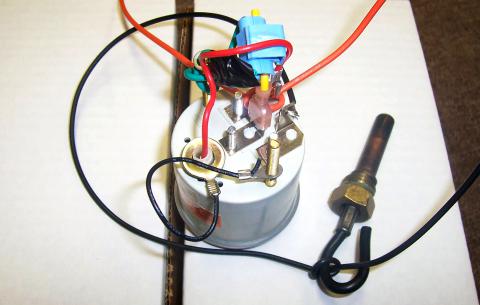
“Don’t tell me to check my ground, my wiring is fine!”
While the above photo is somewhat of a joke, it represents many situations that we at Auto Meter see daily. How many times have you heard of a lost race due to an electrical malfunction? Whether you are wiring an Auto Meter gauge, an ignition system, a trans brake, a nitrous controller, or rewiring your entire car, here are some basic wiring tips to make your job go as easily and successful as possible.
Ground
This is first on the list. Even though manufacturers and even magazine tech articles have been screaming it for years, ground relocation is still the number-one fix for electrical-related issues. Just because something is metal does not mean it is a good ground. Because it is a good ground for something else, such as a radio, a light, or a power outlet, does not always mean it is a good ground for what you are adding.
Due to the gauges’ constant reference ground, we recommend grounding your gauges directly to the engine. Why?
Any self-grounding (engine) senders will be grounded to the engine.
If the engine is not very well-grounded, the starter will not crank, and the spark plugs will not fire. Therefore, you will be more worried about solving that issue before you ever see a gauge reading.
The engine generally ends up being a “cleaner ground” than the body, chassis, or even the battery.
Grounding to an aluminum intake manifold or cylinder head is okay. I typically look for an unused accessory mounting hole in the block, head, or intake.
Remember, the battery is the return path for everything electrical in the engine, and therefore certain sensitive devices, such as air-fuel-ratio gauges or pyrometers, can be affected by this return current flow if connected to the battery.
Some manufacturers recommend direct battery ground, and most times for their own good reasons, so we recommend following the manufacturer’s recommendation for where to ground your electrical device. For Auto Meter, this would be a direct engine ground.
It Has a Good Connection (Or Does It?)
Just because two wires look like they are connected, they can still present a problem. There are many ways to connect two wires (or to install a connector). Here are some examples of various connection types:
Twist wires together and tape
Twist wires and install a wire nut
Twist wires and solder
Insulated crimp connector
Non-insulated crimp connector
Non-insulated crimp connector with solder
Scotch Locks
Weather Pack connector
Deutsch connector
There is a different purpose for each connection type listed, just as there are more connection types than listed above. In the automotive and racing world, remember that the wiring needs to survive bouncing, vibration, extreme cold, extreme heat, moisture, and dryness, not to mention various amounts of current flow.
Twist and tape: I never recommend twist and tape, as over time the twisting can loosen and cause a high-resistance connection or intermittent/failed connection.
Wire nuts: Wire nuts were designed for buildings and structures. Therefore, I do not recommend these in the automotive world. They are also not to be used in the weather.
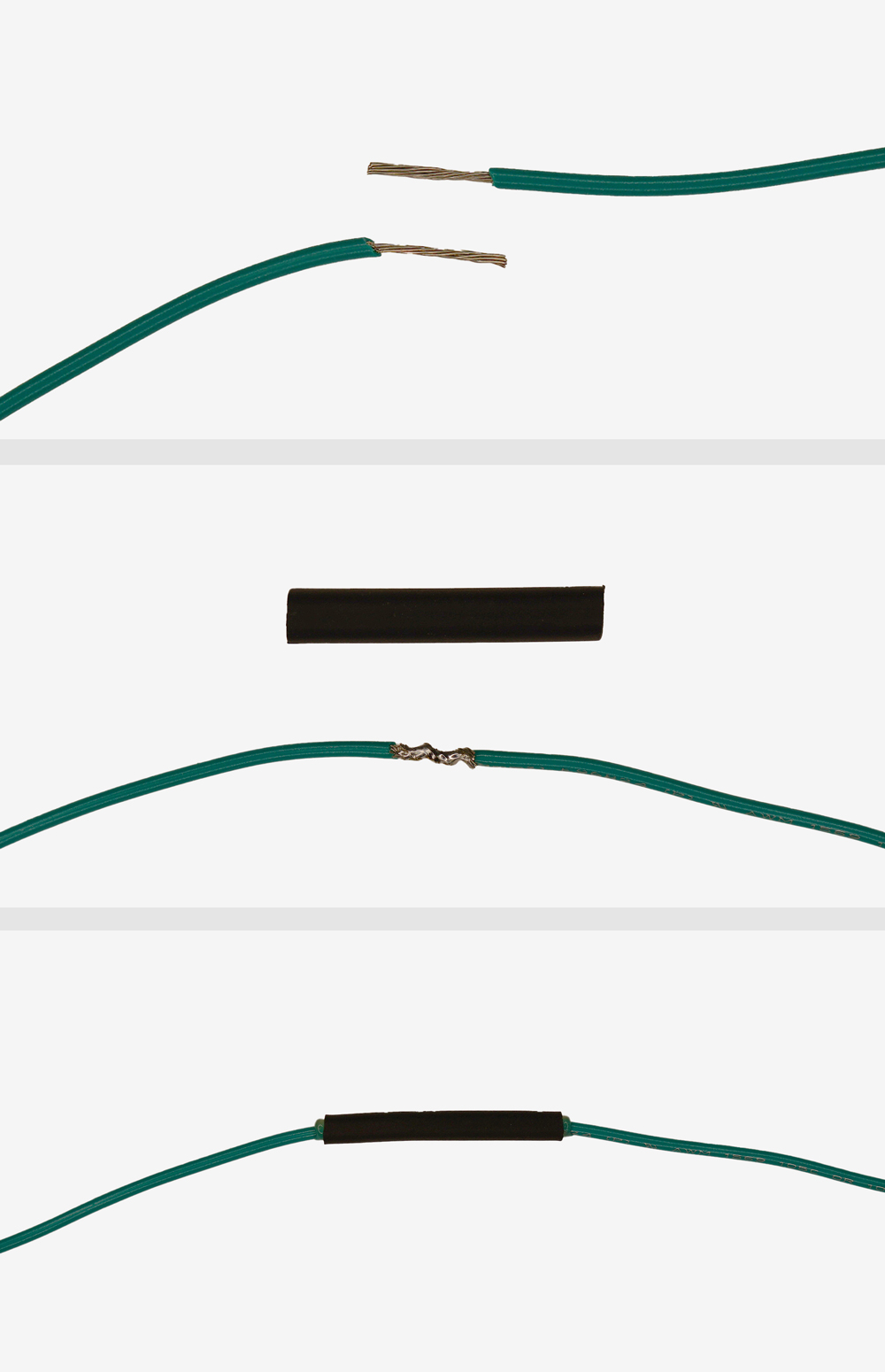
When twisting and soldering, it’s best to twist the wires in-line to make a smooth, non-protruding connection. After soldering, cover the connection with a properly sized heat shrink.
Twist and solder: When done correctly, twisting and soldering is a great way to make a splice, though it is recommended that it be twisted inline to make a smooth, non-protruding connection, then the connection should be covered with properly sized heat shrink.
Insulated crimp connector: An insulated crimp connector is okay in the interior of the vehicle when properly crimped, using the correct tool and if the connector is also properly sized. For high-current loads, you should consider a non-insulated version and solder the connections after crimping.
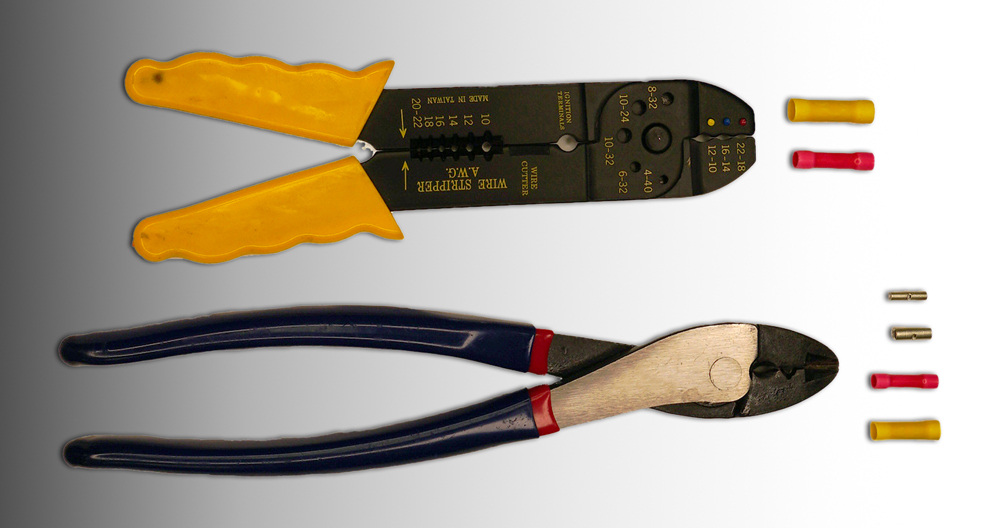
The yellow crimpers shown in the photo far right are typical of inexpensive, parts store crimpers. These will typically crimp an insulated terminal; however, I suggest these go into your emergency tool kit for road-side repairs rather than when trying to do a professional, long-lasting wire repair.
The blue crimpers can do either insulated or non-insulated connectors and create a much more positive and tighter crimp than the yellow versions shown.
Non-insulated crimp connectors: Non-insulated crimp connectors are used when you want to solder the connection after crimping. These are also used when you simply do not want that bulky red, yellow, or blue plastic insulation protruding or bulking up a common connection point. Sliding a properly sized piece of heat shrink over a non-insulated crimp connection looks so much better than those colorful insulated versions. You can also use a more aggressive crimper with these that do a much better job of making a permanent crimp. This is even more important in high-vibration situations.
Scotch locks: Scotch locks (also referred to as vampire splices, quick splices, 3M Scotchlok connectors, trailer splice connectors, etc.) should never be used. They are quick and easy, but that is where the good ends. The bad is that they are not weather resistant, they loosen up over time, they can easily damage the individual wire strands, they can overheat from poor connections, and they are quite bulky. Wrapping them in tape does nothing but seal in the moisture. Next to bad grounds, I have fixed more problems created by these pesky connectors. Don’t use them!
Weather Pack or Deutsch connector: If you are doing professional wiring and wiring in something that might be unplugged for maintenance, such as an instrument cluster or engine that comes in and out often, you might consider using a Weather Pack or Deutsch connector. This involves a bit more time, special tools, and knowledge of the connectors. Plus, they are a bit pricey. When properly done, they provide a great weathertight connection and allow the component to be easily serviced without cutting wires or having to keep track of connection arrangements when dealing with more than one wire on a component.
When Not to Solder
First and foremost, do not solder any Type K thermocouple wire connection (commonly found with pyrometer gauge thermocouples). This changes the properties of the thermocouple wire, which can change the overall reading of the gauge.
High-vibration locations or locations where the wiring will be prone to a lot of movement can cause a soldered connection to crack or break. In the engine bay, I tend to use a non-insulated crimp connector, then slide the heat shrink over the crimp. The heat shrink will add a strain relief as well as weather protection (if using a good quality/sealing heat shrink).
Support Your Wiring
Use your choice of wiring conduit to keep wires neat and organized. Choose routing paths away from moving parts or extreme heat. Do not route wires through your door jambs!
Use zip ties or electrical tape to keep the split-loom or wire conduit closed.
Do not route so tight that your wiring is being stretched.
The blue-handled crimpers, above right, can work with either insulated or non-insulated connectors and create a more positive, tighter crimp than the yellow-handled crimpers, which are typical of the inexpensive crimpers found at auto parts stores.
Pre-map or measure how you are going to route your wiring to make sure you have enough wire and to help avoid surprises later. Take a lesson from your OEM vehicle manufacturer. Though the wiring is not done for looks, it is typically well organized, wrapped, sealed, and out of the way of high heat and moving components. It is typically pretty well strain relieved to avoid supporting its weight, the weight of other components, and from being pulled on from body flex, engine movement, and suspension movement.
With these simple tips, your wiring project can go a long way with fewer problems, whether the project is small or large, and you can focus more on going faster and winning races.
Engineering Lab Technician Cory Villani has been with Auto Meter Products since 2002, where he is currently involved with testing new and existing products, as well as the R&D installation of products. Auto Meter has specialized in providing performance enthusiasts, racers, and vehicle builders with instrumentation and vehicle electronics for more than 60 years.
Exploring sales opportunities for ancillary products in addition to the power adder itself.
No power adder works in a vacuum (if you’ll excuse the lame pun). Adding a supercharger, turbocharger, or nitrous oxide injection to an engine is an increasingly easy way to make power, but those adders require a number of other components to not only attach them to the engine, but also to get the most from their power-making potential. We spoke to experts across the power adder segment to find out what ancillary products are needed to make these systems work, as well as some nice-to-have options to make tuning easier. These products represent sales opportunities for manufacturers and installers that will not only improve their bottom line but also their clients’ satisfaction with these systems.
Turbochargers
Reggie Wynn of Precision Turbo & Engine of Crown Point, Indiana, started his list of accessory products with the basics. “Some of the things that are an afterthought, that racers forget about, are flanges and clamps. The flange/clamp that mounts your turbo on the exhaust manifold and then the downpipe flange/clamp for the exhaust.”
Next on his list were wastegates, “or if the turbo you’re buying has an internal wastegate, those are called actuators. There are some aftermarket actuators that guys go with that can outperform the stock ones, which allow you to run more boost than the actuator the factory turbo comes with.”
Wynn also suggested the use of a boost controller, either manual or electric, that “hooks to the wastegate and allows you to fool the wastegate to open later to help you run more boost.”
Precision Turbo’s Reggie Wynn said some racers forget about ordering a few of the basic components needed to set up the turbocharger system, like “the flange/clamp that mounts your turbo on the exhaust manifold and then the downpipe flange/clamp for the exhaust.”
Hart’s Turbo of Fayette, Missouri, doesn’t sell ancillary products other than flanges and clamps, but the company is a master distributor for Turbosmart of Ontario, California, and has done much R&D work with racers using Turbosmart’s wastegates, particularly its new electronically controlled versions. “Their products are a game changer in the turbo market for what we’re doing and where we’re going,” said Roger Conley of Hart’s. “Turbocharging is in the midst of changing over the last two years, migrating to controlling boost on what we call the ‘cold side,’ where we take boost and vent it to atmosphere on the compressed side of the engine package. It gives us the ability to keep the shaft speed of the turbocharger up, and it responds quicker.”
Conley has seen, “in the last 14 months, cars are running their 60-foot with the kinds of short numbers the centrifugal supercharger cars are running. They’re keeping their shaft speeds up, and there’s no lag.” He cited one example, working with no-prep racer Larry Larson, where replacing a pair of conventional Turbosmart wastegates with a pair of the electronic wastegates “made two more pounds of boost on the starting line just because the E-gates were holding the gate shut from the pulses and backfires trying to force those valves open.”
Hart’s also sells turbochargers to truck and tractor pullers, but “pulling is a whole different animal,” Conley pointed out. “They don’t run wastegates in pulling. We size the turbo based off the engine platform. A diesel doesn’t even have a throttle body. It’s all controlled by fuel. So we have to be even better at sizing the turbine wheel and compressor wheel the right way to not get into an overspeed situation.”
Ryan and Deena Salenbien of Salenbien Performance of Maybee, Michigan, developed their hub-free Apex turbochargers for drag racers and truck and tractor pullers. They see some of these ancillary products as power adders themselves.
Turbo Guard supplies “a screen mesh that you put on the face of the turbocharger compressor inlet to keep any foreign materials from hitting or sucking into the compressor wheel,” said Ryan Salenbien of Apex Turbo.
“An intercooler is definitely a power adder,” Ryan said. “Intercoolers take the hot compressed air and shrink it down as it gets colder to go into the intake manifold. It definitely makes more power, whether it’s an air-to-air or water-to-air cooler. There’s performance advantages to running them.” He did point out, though, that “not all divisions or classes allow for an intercooler.” So even though Apex Turbo offers an intercooler “that works really well with our turbocharger,” it’s up to the racer to determine if it’s legal in their class.
The Salenbiens have also designed velocity stacks for their turbochargers. It’s a concept any old-school hot rodder will recognize: “It’s a cone-shaped device that helps gather and re-align the airflow and direct it to the compressor inlet of the turbocharger,” Ryan said. “It will provide more flow through the turbo and will increase the performance of the turbocharger.”
While most accessory products will help improve the power adder’s performance, the Salenbiens also mentioned products to improve a turbocharger’s safety. “We’re working with Suncoast Products on a turbine containment ring for turbochargers,” Deena said. “It’s designed to support the turbo in a way where if there was a turbine wheel failure, it would get stopped so that none of those turbo components could enter into the engine or atmosphere and wreak havoc.”
Guards in front of a turbo are also products that can safeguard a turbo, like those from Turbo Guard. Turbo Guard supplies “a screen mesh that you put on the face of the turbocharger compressor inlet to keep any foreign materials from hitting or sucking into the compressor wheel,” Ryan added.
Turbocharger service, “inspection after use and also keeping up with the latest advancements,” is also something offered to Apex customers, Deena said. “We have a whole department that does service and refurb work. We advise all our customers to not take the turbo apart and send it back to the manufacturer to have it professionally looked at, cleaned, inspected, and rebalanced” and repaired if necessary.
Superchargers
Nearly every supercharger manufacturer we spoke to put fuel system upgrades at or near the top of their list of ancillary product requirements, whether it was for a Roots-style or centrifugal blower. “For the average guy who’s building 1,500–2,000 horsepower, you buy your blower and then you’re looking at your fuel system,” said Jimmy Martz of Vortech Superchargers, Oxnard, California. Whether that means upgrading just the fuel pump or the pump and fuel delivery device(s) depends on the application, he added. “But the PRI crowd is probably going to need both. You’re looking at a minimum to replace your fuel injectors and, depending on your horsepower goal, you will need a fuel system to match that.”
For Blower Drive Service (BDS) in Anaheim, California, fuel system recommendations are based on “whatever the setup of the customer is doing, as far as the engine size and rpm,” said Kurt Gordon. “We typically tell them what CFM they need, whether it be a carburetor or throttle bodies.”
“A lot of our kits come with fuel injectors,” said Dan Bronsten of Magnuson Superchargers, Ventura, California, “but they’re only good to a certain power level. Beyond that folks would upgrade fuel injectors, and then the next thing is the fuel pumps.”
Kurt Gordon of BDS recommended racers lean on the expertise of the supercharger manufacturers when building a system. “It would be very, very hard for them to try to put together something because they don’t know, for instance, how far the crank snub or the standoff or anything lines up to the drive accessories and things like that.”
“Once you build your fuel system, now you’re looking at, who are you going to use for your ECM?” Martz added. “Are you going to use FuelTech, Holley? You should use whoever you’re familiar with. Then you’re going to need to add bypass valves, depending on the horsepower you’re trying to make. We have three or four different sizes to choose from.”
As with turbocharging, the use of an intercooler with a supercharger is dependent on class rules. Racers will likely need “some sort of really large, custom, air-to-water or air-to-air cooler,” Martz said. “And then there are guys who will cool with fuel instead. They’ll run methanol, M1, or E85, and that has a cooling effect of its own.” But, he cautioned, “now you’re looking at very large injectors, corrosive fuel, and all the things that go with running an ethanol-based fuel.”
All of Magnuson’s kits come intercooled, said Bronsten, “and most of our systems are specific to an application where we’ve designed the biggest intercooler we can fit in there.” Magnuson’s position in the market is different from the rest of the sources we spoke with in that it has chosen to focus on manufacturing supercharger kits that are EO certified, explained Kim Pendergast. So the company doesn’t recommend end users who are driving their cars on the street to upfit a kit with anything that isn’t EO certified.
But Magnuson does work with racers, and with tuners and upfitters with racing clients. One such company is VF Engineering in Anaheim, California, which offers as its “flagship system” a Magnuson TVS 2300-based supercharger system for Lamborghini Huracán and Audi R8 models.
“We create a supercharger kit that incorporates the power adder,” said Nik Saran. The kit’s primary components include the intake manifold, “either a one- or two-piece aluminum manifold, which is bolted to the engine’s intake system and also incorporates the heat exchanger for the after-cooling system we include”; the FEAD, or front-end accessory drive, which revises the belt-drive system to drive the supercharger by the engine’s crank pulley and keep the internal speed of the supercharger rotors within an optimal range for power delivery and volumetric efficiency; an air-to-water cooling system, “a separate water system isolated from the engine’s water system with its own reservoir and a pair of radiators in the stream of incoming air from the vehicle’s side vents”; a larger fuel pump, “as we do need more pressure to deliver the volume of fuel that we’re requesting through the software for the fuel mixture required to keep EGTs within the range we want”; and the ECU calibration, “which we gave extra attention to detail, knowing how essential it is for reliability,” Saran said. VF Engineering’s calibrations “do not disturb” the engine safety system tolerances—ignition retard, temperature systems, and NOx systems—to prevent the engine from going into limp-home mode.
With the proper fuel octane and ignition timing, these kits can produce “a gain of 180 hp at all four wheels,” Saran said. Currently the kit is in the EO testing process, so it is for off-road use only in emissions-regulated states like California.
Nitrous Oxide
As nitrous oxide injection is fundamentally different from the forced-air power adders mentioned above, so too are its accessory components. Chris Isbel of Nitrous Express in Wichita Falls, Texas, ran through a list of what he termed “necessity items” as opposed to components racers could consider as options.
First was a nitrous controller of some kind, “whether it’s a window switch or our progressive controller. Those would give you the ability to activate and deactivate the nitrous.” The window switch is essentially “straight on-off activation,” he explained, while the company’s Maximizer 6 progressive controller can activate up to four different nitrous stages based on rpm, mph, throttle percentage, or boost pressure. It also allows the racer to save multiple tunes. (On Isbel’s not-mandatory but “nice to have” list is the company’s touch-screen display for the Maximizer 6 “for making changes on the fly.”)
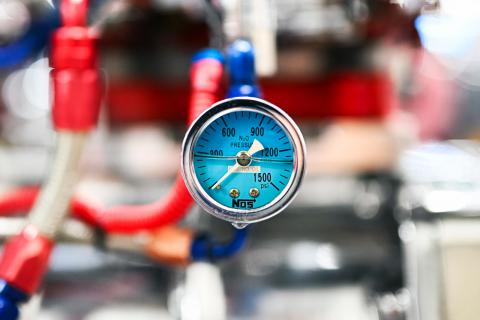
“Nitrous is run off bottle pressure,” said Chris Isbel of Nitrous Express, so he recommended a nitrous pressure gauge to monitor the pressure, and a nitrous bottle heater to maintain the pressure.
Next on the list were a nitrous pressure gauge and a bottle heater. “Nitrous is run off bottle pressure,” he pointed out, so the gauge “allows you to monitor that pressure, and the heater is there to maintain that pressure.” A purge kit would “round out a good, core setup,” and then options might include billet bottle brackets instead of the standard stainless brackets, and dual vents for the purge kit.
There are several places a racer can go to refill nitrous bottles. One is Airgas, an industrial supplier “that has a store in every major town in the country,” Isbel said. Likewise, some welding supply stores offer nitrous oxide in addition to oxygen and acetylene. There are also local race shops that do refills, and this could provide an additional revenue stream for a business not currently offering the service.
Nitrous oxide systems don’t require a lot of maintenance, and if they do, a nitrous solenoid is something a racer can check themselves. Should maintenance be needed, nitrous system suppliers offer rebuild kits.
Nitrous oxide systems don’t require much maintenance, Isbel said, depending on how much and how hard the racer is running. “I have customers who have been using the same solenoids for five, six years now with no issues whatsoever. But then a racer who’s racing every Friday night making five, six passes, going again on Saturday making another six or seven passes, they can get about two seasons easily, maybe more.” The solenoids are something the racer can check for themselves. “Just open it and see how dimpled the piston is and go from there.” Should repairs be needed, Nitrous Express offers solenoid rebuild kits.
Kits or Components?
Many power adder manufacturers sell their products as complete kits, with many or most of these accessories packaged with the adder itself. Or they try to take some of the guesswork out of the process by researching the ancillary products for the customers. On the day we called him, Gordon of BDS was “placing a big order with MSD to get distributors, coils, and boxes in for us to sell as an add-on to our blower. I will try to find what goes with it so we can put it on our website. That way, when they order the blower, they can just purchase these other components at the same time instead of having to take another step and go on Summit or JEGS to try to find something.”
While some racers might prefer to scour websites, forums, and fellow racers’ opinions to craft a system of their own, Gordon didn’t recommend it.
“It would be very, very hard for them to try to put together something because they don’t know, for instance, how far the crank snub or the standoff or anything lines up to the drive accessories and things like that. In the kit, we give you the spacers, we give you the V-groove pulley, the manifold, the snout, the belt, the idler, we give you everything in the kit so you can pretty much just bolt it on and then pick out whatever fuel you’re going to put into it.”
Current cutting-edge trends in metal fabrication and welding are focusing on more compact designs, automation, and improved efficiency.
If there appears to be a rekindled interest in metal fabrication around automotive custom shops and race garages, especially from younger want-to-be craftsmen, then consider the prominent role of social media.
“You’ve got these old-school guys like Gene Winfield who didn’t mind sharing their skills,” explained Phil Heck of Woodward Fab, a division of Heck Industries in Hartland, Michigan. “But he’s rare. Most of his generation were pretty secretive about how things got done in the shop. They didn’t leave the doors open so people could wander in and see what they were doing. Now everything’s being shared on YouTube. What might have been a secret years ago is now common knowledge. There’s just so much stuff on the Internet that demonstrates how easy it is for anybody to do this work.”
In following this promising renaissance within the industry, Woodward has released two new English wheels, including a benchtop model that reflects one of many noticeable trends that’s promoting smaller equipment in fab shops.
The TruTool N 200 nibbler from TRUMPF helps speed up cutting duties in fab shops. Grant Fergusson said it was “probably our most popular tool” at the recent PRI Show.
“It’s actually designed in Australia. Originally, we thought it was a silly thing, but my customers explained that getting into tighter spots sometimes required the need of two English wheels,” said Heck. “I know we’ve had some customers that travel conducting classes and seminars, and I think they put this in the trunk of their car.”
Woodward specializes in metal fabricating and forming tools, offering products from $15 up to $15,000. While many factions of the industry are moving toward automation, Heck said his customer base is different.
“They’re working on a prototype or one-off basis most of the time,” he said. “For some of our tools, they can be manual or power. Manual is often preferable because it’s more controllable. Also, it’s impossible to make an English wheel or planishing hammer automated.”
Increased Automation & Robotics
Increased automation and the growth of robotics in the fab-tool industry is being driven by numerous factors, including the need for increased production at some shops in addition to continuing struggles in the labor market.
“As technology becomes more available and affordable, and labor becomes harder to come by, you can drive those two points closer together. So, automation is something that a lot of people are looking for, especially from bigger shops where they do a lot of volume,” said Bruce Van Sant of Trick Tools and Van Sant Enterprises, Pella, Iowa. “We’ve been selling more in the line of CNC tube benders, and this year we have a full three-axis CNC bender because there’s so much interest in that type of equipment.”
Manufactured in Germany by Transfluid, the CNC bender can churn out headers, roll cages, and other tubular parts up to 3.000-inch OD in 10-foot lengths. One of the keys to implementing such an expensive machine in any shop is proper training of the employees who’ll operate it.
“We’ve seen improvements in software and programming. There’s even collision-avoidance simulation. It will show a simulation of the bending on a screen to make sure you don’t have any problems or conflicts,” said Van Sant, adding that the ROI can depend on many factors. “We’re not trying to replace humans, but there’s more need for automation because of labor shortages and less availability for hiring people.”
Huth tube benders can be used for a variety of chores in a fab shop.
Bend-Tech in Osceola, Wisconsin, helps shops improve build times with its CNC tube and pipe plasma cutting machines. They can fabricate designs with holes and end cuts, plus mark all bending locations, rotations, and degrees on the pipe.
“Our product assists in automating the shop’s processes,” said Kyle Merry. “Our CNC tubing pipe processors are able to cut out all of your profiles, mark your part identification and your fit-up locations, and also give you all of your bending information as well.”
Models include the Dragon A250 that can handle four-inch-diameter round tubes up to 21 feet long, or there’s a smaller model designed for tubes up to 12 feet. The Dragon A400 handles 24-foot materials—including square, rectangle, angle, and channel—up to 6 inches in diameter and has a maximum capacity of 400 pounds.
“One of our shops recently said they took their projects from a three-week build to a one-week build,” added Merry. “We’re actually able to calibrate a bender and die in our software and give you your real bending instructions. For example, a 12-inch leg with a 90-degree bend in another 12-inch leg—that’s not a 24-inch part, right? Material stretches and it springs back. We actually take all that into the calculation and put the real bending information on the tube for you.”
Tubing benders are a specialty at Hartford, Wisconsin-based Huth Benders, which offers Huth and Ben Pearson models in a variety of sizes and capabilities to meet the demands of different metals, intricate bends, and new end-forming proficiency.
“Stainless steel is always an area of interest, because it can be tricky and kind of a bear,” said Ken Murray. “But we’re also doing the tube forming to help them put tubes together. A shop may source mandrel bends from somewhere else, but they still have to put them together, and they need a tool that works really fast.”
One popular tool is the 1674 broad-range tube expander that can produce 25,000 pounds of expanding power through the 3.5-inch cylinder and 49,000 pounds through the 5.0-inch cylinder.
The NG120XL saw from HE&M Saw can easily cut tubing and make notches. The model will also cut through a 2.5-inch solid steel bar.
“It has two heads. Guys might be working with bigger stuff or a couple of different sizes, and they don’t want to do tool changeovers,” said Murray.
While saving time and money is on the minds of Murray’s customers, his product development strategy may seem cautious in an industry where technology is driving forward at a fast pace.
“How can I do it quicker and better depends on who, right? It depends on whether it’s a small manufacturer who’s looking to produce more efficiently, or an operator who’s actually doing his own stuff. Those are different worlds,” explained Murray. “We might be a little slow on the automation because we’re dealing with smaller guys, not the huge shops that need a CNC approach. We do have some models that incorporate PLCs [programmable logic controllers], and we’ll be doing more of that as we go forward.”
Robotics is another advancing technology edging its way into the industry to help counter labor shortages and improve production. Training and programming are also key considerations in those purchase decisions by a fab shop.
“We’ve come out with a new robot called the Copilot that is very user-friendly,” said Andy Weyenberg of Miller Electric, Appleton, Wisconsin. “People may shy away from automation because it’s expensive, but the big problem is trying to find somebody who can program it.”
The Copilot’s advantage is that programming time can be as little as 15 minutes. In the past, programming for a run of five or 10 parts could take longer than the actual production.
“You can teach it simply by moving its torch to the piece. When you’re in the learning mode, you can press a button to set a start point, you can move the torch down and set another point, and that would be your ending point. I mean, basically an 18-year-old kid and a 68-year-old man could have the thing programmed in the same amount of time. It’s just super user-friendly,” explained Weyenberg.
Another company promoting advanced welding stations is TRUMPF based in Farmington, Connecticut. Its TruArc Weld 1000 is a fully equipped tool that includes an exhaust system and other critical safety equipment.
Benchtop English wheel models from Woodward Fab are growing in popularity for small metal-shaping shops.
“Two of the biggest benefits for a performance race shop are speeding up high-quality production and freeing a shop’s skilled welders to focus on more complicated tasks,” said Tommy Zoladz. “The TruArc Weld is so easy to use that anyone on the shop floor can program the machine and run it, even without much welding experience.”
Zoladz also said automation helps create consistency in welds, which is a selling point in the aftermarket. The station is also designed to allow the operator to load or unload one side while the other side runs production. On the smaller side, TRUMPF offers a cordless 18-volt TruTool N 200 nibbler.
“It’s probably our most popular tool at PRI,” said Grant Fergusson. “Race shops can make templates and easily do repeats on regular parts. They can also make cuts outside the shop since the tool is cordless and fast. Also, it does not create sparks or dust, which makes it safe for working around fuels or oils.”
Time Savers
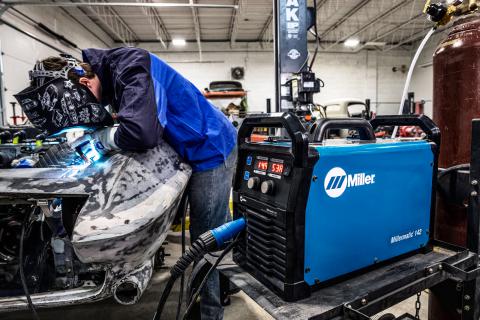
There are other trends in the industry that suppliers are noticing. Miller Electric has a new Millermatic 142 welder that features an inverter engine, which has been a staple in the larger units, yet it is small and lightweight, runs on 120 volts, and still offers a 60% duty cycle.
“So it’s not just a hobby machine with that kind of rating. Inverter engines open you up to a lot more versatility in your welding processes,” added Weyenberg.
Welders at race and fab shops are getting a lot of love these days, and not just from advanced technology. Miller has the ArcStation series of tables, including a small folding unit with a thick metal top and larger models with wheels that can easily be moved around the shop.
“It’s very relevant to our industry because it’s hard to have a nice, sturdy platform with 500 pounds capacity at the race track that doesn’t take two men and a small boy to move,” noted Weyenberg.
Over at Trick Tools, modular fixture tables have grown in popularity. “We saw a lot of welding tables where everybody used to have dedicated jigs for each part they needed to build,” recalled Van Sant. “Now the systems are much more modular and can be reformatted and repurposed for different things. So you can have one table that gets quickly changed over from one part to another. This allows for more customization and personalization for chassis builders.”
As a result of COVID-19, some shops had to downsize, whether due to loss of sponsorship or lack of racing opportunities during the pandemic. That prompted some fabrication equipment manufacturers to offer versions of their products with a smaller footprint.
Shaviv USA offers numerous tools to debur and finish metalwork. “We offer the quick and cost-efficient solution that many shops rely on,” said Nick Prohl.
“They’ve had to utilize their space more efficiently, because maybe they’ve brought multiple race cars in one program and had to combine shops. So space is always a consideration,” explained Paul Beha of HE&M Saws, Pryor, Oklahoma. “That’s where our bench-top saw series comes into play. They don’t take up much room, but they have a lot of benefits.”
Just in the portable bench-top series, HE&M has eight models available. “It’s basically what fits the customers’ needs. The 782, which is the smallest model, will stand upright and can be utilized as a vertical saw. Some people have that need,” said Beha. “The other thing would be capacity. Some saws there have a 6-inch capacity, some have a 4- or 3-inch.”
The small saws also have dry-cutting ability, so there’s no mess, and they can be utilized at the track where there will not be any environmental problems with the fluid. At first, the small saws were not a hit with the company brass, which was happy selling larger industrial saws. However, at automotive venues, the big saws were not an easy sell. Beha then tried out a line of smaller saws made in Italy.
“I couldn’t believe how fast you can cut a solid piece of steel in under 20 seconds,” he recalled. “The blade doesn’t even get hot. The two things that fatigue a blade are vibration and heat. And the design of these saws, for example, the NG120 and several of the other models, have 10 roller guides surrounding the blade on two sides and the top. So they’re securely held, they’re dry cutting. And the precision is amazing. We can cut slices .005-inch thick, and they’ll remain true top to bottom.”
Not all advancements in fab tools have come in big-ticket items. Bad Dog Tools in Bristol, Rhode Island, recently released 5.0-inch flat and 7.0-inch flange versions of its HDII line of Endless flush grinding and cutting wheels.
“DeWalt just came out with a new 7-inch FlexVolt angle grinder, and it’s a super-cool combination with our Endless cutting wheel,” said Ann Strong. “It has cordless ability, and you have 6 1/4 inches of cutting depth. You can do frames, body panels. It’s great for metal, carbon fiber, fiberglass, Plexiglas. Even if it’s concrete and you have to grind down the apron in front of your garage.”
The flange version allows for flush sanding and grinding. For really tight spots, Bad Dog has cutting wheels down to 1.25-inch diameter.
“I have a mid-engine Porsche 914. Once I had to cut a bolt off the engine. I don’t know if you’ve ever seen the engine compartment on a Porsche 914, but it’s not for the faint of heart,” recalled Strong. “We used the inch-and-a-quarter to reach down and cut that bolt. You could not do that with a larger blade because it just would not fit. So, each of the versions of the HD2 has its own sort of niche, tools that it works on or operations that it can do. We always advocate using the right tool for the job.”
Finesse
While hardcore cutting and grinding may seem like very aggressive and heavy-handed actions in the shop, there are elements of finesse required for some racing operations. Richard Orlikowski of Goodson Tools and Supply in Winona, Minnesota, pointed to clutch grinders who are looking for more accurate products to help them maintain consistent launches.
“They want to keep all of those things the exact same, so they need a grinding wheel that’s going to give them the same finish for each and every pack that they have,” said Orlikowski, noting that Goodson sources a very specific CBN abrasive stone in two sizes just for that market.
Recently, Goodson has expanded that focused strategy for the wide-open market of sanding belts. The company now purchases jumbo rolls in bulk and then cuts them down to specific sizes for each customer base.
“If they have some weird, old size that they’re looking for, we make them custom in-house, so the belts are usually out within two to three days,” said Orlikowski. “Everybody wants the brand-new stuff. But some of the older tools and machines still work great. The problem is everybody’s discontinuing the product lines for those machines. So, we are still able to make the grinding and sanding belts for those machines, because we don’t have stock sizes. We make whatever size you’re looking for. It’s benefited those guys because they don’t have to spend the money to buy new machines and new supplies.”
As noted earlier, many factions of the industry are seeing the need for more compact or miniaturized products, and Goodson is trying to keep up with many of those demands from race and fab shops.
“The newest stuff in machining seems to be getting smaller. You’re not seeing a lot of the three-eighths and eleven-thirty-seconds stuff anymore. Everything’s going to five mil or four-and-a-half mil. Some of the equipment needing to be repaired is all smaller dimensional,” said Orlikowski. “It’s making it harder for us to try to find those specific tools that the customers are looking for.”
Even with automation and more precision in the fab shop, there remains the need for simple hand finishing with basic traditional tools. Shaviv USA in Bolingbrook, Illinois, offers a wide variety of deburring tools that have been used for decades.
“Over the years, there have been plenty of advancements in the cutting of metals and other materials directly from machining. Unfortunately, no matter how precise the fabrications seem to get, no one has yet to perfect machining to a degree where our tools have become obsolete,” said Nick Prohl. “On brand-new production parts, even the slightest burr can cause fittings to misalign. Rather than redo these parts from scratch, we offer the quick and cost-efficient solution that many shops rely on.
“You also have to take into account that a lot of fabrication and work takes place not just on newer builds, but older rigs in the automotive sector,” added Prohl. “There has always been a great restoration aspect that goes hand-in-hand with what we do. We help ‘finish’ that workpiece.”
The “Home of the Snowball Derby” is alive with activity beyond the popular end-of-season event.
“We like to experiment,” said Tim Bryant, who, with his brother Randy, operates Five Flags Speedway in Pensacola, Florida. “We like new things. We don’t like to just do the same things over and over—with the exception of the Snowball Derby, which we want to do over and over for many years to come.”
We spoke with Bryant while he was in the thick of preparing for the 2023 Snowball—the 56th running of the track’s marquee event—but he generously took the time to share his vision of the Speedway and its place in the racing world, both for his local community of racers and for those who travel much farther to visit the track every December to close out their traveling season.
Five Flags Speedway opened in 1953 and is named for Pensacola’s “City of Five Flags” nickname, which represents the various governments that have ruled the city during its history. The track’s paved half-mile, with 15-degree banking in the turns, provides what Bryant described as “a short-track fan’s idea of what short-track racing should be. It’s a fast track. It yields good side-by-side racing. And I believe it showcases a driver’s talent equal to the car’s technology. The best car with a mediocre driver isn’t necessarily going to always win out over a mediocre car with the best driver.”
Five Flags is known as a Super Late Model track, Bryant acknowledged, largely due to the influence of the Snowball Derby. “But we try to have a diversified schedule. We have a strong local contingent of different levels of racing.” In a busy schedule that runs from March through December, the track hosted the ASA Southern Super Series several times, Alan Turner Pro Late Models, plus events for sportsman, pure stock, Crown Stock, Outlaw, pro truck, and other divisions.
And then there’s the “other different activities,” as Bryant described them, that take place at the facility, like drifting, monster trucks, and car shows. “During COVID-19 we had a drive-in theater in the parking lot,” he said. “We try to keep the place busy.”
For most of its regular-season races, Five Flags Speedway draws competitors primarily from the Southeast, East Coast, and Midwest, Bryant said. For Snowball, on the other hand, “we’re coast-to-coast. We’ve got several Canadians entered, one racer from Mexico, and we’ve got California to Maine to the tip of Florida to Colorado.”
Enhance the Experience
The Snowball Derby, which started as a 100-lap event in 1968 and now runs for 300 laps, was the brainchild of the track’s then-owner, Tom Dawson. “I’m always quick to say that, when my family took over the race track in 2004, we inherited a marquee event,” Bryant said. “We take very little credit for what the Snowball Derby is, but we’ve worked really hard to enhance it. We know that each and every year we need to do something a little different, to try to enhance the experience. Especially for the fans, so their experience is more than just coming to a race.”
To that end, the Snowball Derby is now nearly a week-long festival. It starts with a kick-off party on Tuesday evening attended by the racers and livestreamed on Racing America. “People can get out and actually mingle with the drivers,” Bryant said, “and we do the same thing at the track on Wednesday night. We make a bit of a production about our qualifying drawdown, which signifies the qualifying order for the Snowball Derby. We put a stage in the pits and bring the drivers up, do short interviews with them, and let them do a draw. We have a local charity come in and serve chili, and we have live music. We have a lot of fun with that.”
Tim Bryant describes Five Flags Speedway as “a short-track fan’s idea of what short-track racing should be. It’s a fast track. It yields good side-by-side racing. And I believe it showcases a driver’s talent equal to the car’s technology.”
Four nights of racing lead up to Sunday’s main event. “We’re fortunate to get some participation from NASCAR drivers each year, which is big for the fans,” Bryant said. He also believes those big-name drivers motivate “some of the short-track guys to go out and compete and beat those guys. We bill this race as the best-of-the-best of short-track racing. Certainly, we like the NASCAR drivers, but the tried-and-true short trackers are what this race is about.”
Much of the lead-up to the Snowball Derby is designed “to make our local drivers who race with us all year long feel a part of it,” Bryant added. That includes The Alan Turner Snowflake 100, the Pro Late Model race run the night before the Snowball. “This is its 20th year, and it has turned into a huge event in its own right,” he said. “It’s certainly one of the five biggest Pro Late Model races in the country. We’re pretty proud of that.
“I’ve always been a believer that activity spurs activity,” he continued. “The more we can draw in these guys, so each event for each division is their pinnacle for the season, that builds excitement. When guys come back to racing next March and start the new season, they’re already talking about Snowball. So we’re fortunate that we’ve been able to maintain that enthusiasm.”
Affordable for Racers
Encouraging local racers to participate in the star-studded Snowball Derby is one of several strategies Bryant employs to help his regulars, and those who don’t have the budgets of a national touring team.
“We work really hard to come up with ways to make racing more affordable for the racers, and that’s probably the biggest challenge we have, because costs are escalating at a rapid pace.” For example, Bryant elected to maintain the limits he set on tire purchases during the pandemic-related shortages. “We’re cognizant of the costs to these teams to be on the road for multiple-day shows, and we found out that we can conduct races and still limit the amount of tires people can buy—except for the Snowball Derby.”
Bryant also “works hard on rules packages to keep costs more affordable,” he added. “We work well with other sanctioning bodies, and we’re tightly affiliated with the new ASA group and involved in several committees within the ASA organization. We try to communicate with them and other sanctioning bodies outside of ASA and make sure that our rules are consistent. If there’s a new widget that comes on the market that costs a gazillion dollars, we try to make sure that we can keep that off of these cars. It’s hard to deny the fact that the better funded teams are always going to have a little bit of an advantage. But we pay close attention to the underfunded teams. We need them to continue coming to the race track, so we want to make sure that we do anything within our powers to help that happen.”
Tim Bryant (seen here) and his brother Randy took over Five Flags Speedway in 2004. “Our mission statement, if we had one, would be simply to make everyone’s experience, regardless of which gate they go through, a good one,” Bryant said.
Those strategies appear to be working. Bryant said that car counts have remained “pretty steady this year. And our Southern Super Series that we also manage has averaged 30 cars a race. We’re pretty proud of that.”
When asked if he and the Five Flags team did anything differently than other tracks in the area, Bryant said, “I don’t know that I can put my finger on anything that we do differently, especially with neighboring tracks. Mobile Speedway to our immediate west; Stan Narrison, who runs Montgomery Motor Speedway just to the north; Scott Menlen, who runs the Fairgrounds Speedway at Nashville; Ben Sumner, who runs Crisp Motorsports Park in South Georgia, we all talk enough and work well enough together that we’re all kind of doing the same things. Even though our tracks are different, and our programs may be different, our philosophies are the same. I think that’s what racers like. They want some consistency wherever they go.”
While best known as a Super Late Model track thanks to the popularity of the Snowball Derby, Five Flags Speedway has a diversified racing schedule “with a strong local contingent of different levels of racing,” Tim Bryant said. The track has also hosted drifting and monster truck events, among other activities.
That level of communication is very helpful in avoiding conflicts when it’s time to schedule races, Bryant said. “We work extremely close with the tracks in our region during the offseason. We make sure that if we do run on the same weekends, we’re running different divisions. And for the most part, we work with other series, even on a national level. We respect big events. We make sure that we don’t schedule an event of any size on top of an established marquee event for another track, and it doesn’t matter where it is.”
His relationship with neighboring tracks even extends to his crew pitching in when needed. “It’s not unlikely to see us helping at a neighboring track, and it works both ways. They come in and help us, too. We feel very good about the relationships that we have with other tracks.”
Community-Minded Business
The Speedway’s relationship with its neighbors is somewhat unique because the track has been there for 70 years. “Our community has kind of built up around Five Flags Speedway,” Bryant pointed out. “We’re a very community-minded business, and we participate in a lot of things locally. We contribute, and we make our facility available for a lot of organizations of a charitable nature. So we have a good relationship with our local community. Based on what I know some tracks have to deal with, we feel very blessed that we’ve got that kind of relationship with our community.”
And vice versa. Businesses in the area realize “how important, especially an event like the Snowball is to the local economy,” Bryant added. “Our county tourism bureau helps us with some marketing efforts for the Snowball, because they know it fills up a lot of hotel beds at what would normally be a down season for a tourist town. So they’re willing to help us, and we’re grateful for that.”
“We inherited a marquee event,” Tim Bryant said about the Snowball Derby, and the Five Flags team has since then “worked really hard to enhance it.” Snowball’s Super Late Model main event now caps off almost a full week of activities and races.
At other times of the year, though, being in a tourist town means the Speedway has to compete for the entertainment dollar. “During the summertime, we scratch and claw, like most tracks, to draw an adequate number of spectators to help us pay for our events,” Bryant said. And then there’s the competition from the digital world. “Like most tracks, we’re streaming most of our events, so it’s our job to make the experience at the track even better than before, so that people don’t just decide to stay home and watch it on TV.”
Facility improvements are among the ways he’s working to keep fans in the stands, but he admitted that’s “a work in progress. We couldn’t make all the improvements that we wanted overnight once we took ownership, but every year we put something back into the track. Over our 20-year run we’ve made a ton of improvements. After we purchased the track we put in some new grandstands, and we’ve built some hospitality suites. We’re continuing to upgrade as we go. And we think that has worked in our favor. If we had made all the improvements on Day One, once the new wears off, you’ve got to find something else to get people’s interest. So out of necessity, I think slow, steady growth has been our friend.
“You know,” he added, “our mission statement, if we had one, would be simply to make everyone’s experience, regardless of which gate they go through, a good one. We do everything and to the best of our ability to make sure that happens.”
With a cautious eye toward the 2024 season as the economy recovers and the election looms, the racing aftermarket released cutting-edge innovations, timely product upgrades, and expanded applications at the PRI Show.
While the 2023 PRI Show offered valuable networking opportunities along with informative educational forums, new performance products have always been the backbone of the event—and a big lizard appeared to be stimulating much of the parts development as the racing industry readies for a new season of competition.
It seemed as if one couldn’t walk down any aisle inside the Indiana Convention Center and Lucas Oil Stadium without bumping into some type of product designed for the Ford 7.3-liter V8 known as the Godzilla engine.
Here’s just a small sampling of new parts discovered for that powerplant while strolling among the 1,000-plus exhibitors: eight-stack EFI from InnoV8, front cover from Late Model Engines (LME), bellhousing to support Tremec transmission from Lakewood, high-mount front drive system from Holley, bolt kits from ARP, lifters from Isky, Magnum crankshaft from Callies, cam phaser lockout and conical valve springs from COMP Cams, CNC-ported cylinder heads from Livernois Motorsports, intake manifold from Edelbrock, performance bearings from King Engine Bearings, supercharger from Harrop Engineering, and steel rocker arms from Jesel.
Although the Godzilla platform garnered more than its share of headlines, the engine doesn’t seem to be in a lot of race vehicles at this point. Most of the excitement is currently focused on muscle car and street rod swaps; however, that perspective will change soon.
“There will be more racing applications coming for Godzilla,” said Bryan Neelan at LME, Houston, Texas. “It just needs to be supported by more guys like us.”
“It’ll be more like the LS sooner or later,” added Nolan Jamora of Isky Racing Cams, Gardena, California.
The drive for more precision in engine building—from the valvetrain to cylinder honing and more—was a theme of the 2023 PRI Show. As engine builders strive for ever more horsepower, the margin of error keeps getting smaller and smaller, requiring new levels of precise measurements.
Other potential racing innovations on the horizon were showcased at PRI, including new EV components, alternative fuels, and simulator racing. There was even a proposed concept for a new type of turbine engine called the Tomahawk TX from Xcentrick Innovations in Brookings, South Dakota. Projected horsepower was 7,500 at 12,500 rpm while weighing less than 200 pounds. A working prototype has yet to be built; nonetheless, the design theory of a combined-cycle centrifusion turbine with an afterburner drew a good deal of curious attendees to the presentation video.
Across the hall there was a new engine that is ready to race. Katech Engineering of Clinton Township, Michigan, unveiled its new 2.7-liter billet inline-four engine designed for midget racing. The cylinder block dimensions are based off a GM LT engine, and it features a Katech CNC-machined LT cylinder head.
“We designed and developed this engine completely in-house,” said Kennan Moffitt. “We’ve made 375 hp on methanol. And since every ounce counts, we made it as light as possible at 168 pounds.”
For this engine, Katech blocked off the direct-injection ports on the LT head and adapted a traditional Kinsler fuel-injection system. Yet the engine is designed so that a pair of high-pressure fuel pumps can be mounted on the block and run off the camshaft to provide enough fuel for DI.
“Our purpose was to get it in the Xtreme Midget Outlaw series, but you can do whatever you want with it,” added Moffitt. “It’s capable of on-road applications. We’ve heard guys joke around that they’d like to put it in their Miata.”
The Katech engine is an encouraging example of renewed R&D in the performance aftermarket following the pandemic when many development projects were put on hold. Product demand soared during that time, while manufacturers battled supply chain challenges, higher materials costs, and labor shortages. When those problems were finally sorted out, companies channeled more time and money not only into development but also getting the manufacturing operations up to speed. Sometimes the delay allowed for additional improvements. Two years ago, Dart Machinery in Warren, Michigan, showed off a prototype Mopar Gen III Hemi Iron Eagle block that came standard with 7/16-inch head studs.
The Late Model Engines’ booth at the PRI Show featured new products for several engine families, from LS and LT to Ford’s Godzilla V8.
“Now we can offer an upgrade to half-inch studs,” said Nick DiBlasi, showing off the orange powder-coated production version. Other features of the block include steel four-bolt main caps, priority main oiling with two lifter crossovers, scalloped water jackets that allow more coolant, and 5/8-inch-thick decks.
“This block is for the guys really pushing limits on the OEM blocks, guys with power adders,” added DiBlasi. “This is a clean-slate approach. We’re fixing a lot of the shortcomings of the factory block.”
Another new Dart Iron Eagle offering is based off the Toyota 2JZ architecture. It also features Siamese cylinder bores, extra-thick decks, 11-mm or 1/2-inch head-bolt holes, revised oil-passage locations, and scalloped water jackets.
“We’re also working on a cast-aluminum version,” said Brandon Abidin. “This block will be used in everything—obviously a lot of drag racing but also drifting, Time Attack, and a variety of applications.”
The Dart iron 2JZ block is a fresh option in a segment where high-priced billet blocks or considerable machine work on a factory block were the only alternatives.
“This casting solves every issue,” said Abidin. “To me, this could be the next LS swap for people who aren’t LS savvy. I think you’re going to see a lot more guys adopting this engine.”
Addressing a void in the market is certainly one approach that’s driving new product development for racers, as are new engine and vehicle applications from the OEMs. Changes in sanctioning body rules will also spur development. Then there are new forms of competition that get manufacturers excited.
“Racers are asking for a lot of drag-and-drive stuff these days,” said Jamora at the Isky booth. “A lot of people are getting into that because there are so many classes. You can run cars from a 14-second daily driver up to 8 and even 6 seconds. They can go on any budget to run these cars.”
Since reliability is a key factor in building a drag-and-drive engine, Jamora recommends Isky’s bushed lifter, “because you have cars that run 7s and 6s, yet they need to idle and drive 150 miles in traffic. So it’s a true test of what the lifter can do. We’re the only one that does a bushing hydraulic roller. We have the fastest LS running in the 6s with a hydraulic roller.”
Boost Drive
One industry trend that continues to flourish is boost. Driven by the demand for 1,000-plus-hp street engines along with the continued growth in outlaw and small-tire classes, plenty of new superchargers and turbochargers were shown at PRI.
“These are our Next Gen turbochargers, and they’re at least 10% better in terms of airflow than the previous design,” noted Reggie Wynn of Precision Turbo & Engine, Crown Point, Indiana. “Basically, you have the same size but more efficient.”
Slowly, more rules and class designations are coming into the once wide-open world of outlaw racing.
New products from Turbosmart USA are providing engine builders with more control over boost pressure. “With our newer generation of products, we’re directly controlling the power management in a way that has never been done before,” said Marty Staggs.
“We designate a lot of our turbochargers that are constrained by rules with an ‘R.’ That means it’s a class-specific turbocharger. For example, this 6470 is legal for the Mean Street class at the World Finals,” said Wynn, noting all R units will have an integrated speed sensor for data acquisition. “For us, this Next Gen Technology has been a game changer. We’re able to achieve more horsepower with less boost. That means the shaft speeds are lower, and you’re not working the turbo as hard as you had to in the past, which can introduce back-pressure issues.”
Controlling boost has also become a critical issue. Turbosmart USA, based in Ontario, California, showed off its line of new electronic StraightGate external wastegates that are available in different sizes. The idea is to offer the engine builder and tuner more control over boost pressure.
“Precision and total control,” emphasized Marty Staggs. “With our newer generation of products, we’re directly controlling the power management in a way that has never been done before.”
The traditional pneumatic wastegate will not go extinct, according to Staggs. But the electronic models will provide the accuracy that leading tuners need for competitive runs.
“You’re controlling manifold pressure directly: this much boost at this point in the run,” explained Staggs. “Ideally, the turbo is spinning at its optimum shaft speed, so you get peak efficiency, peak performance, and full control over the power of the engine.”
Turbosmart offers a wide array of boost-control products, sometimes begging the question if there’s a need for such diversity.
“We’re in all forms of motorsports, from jet skis to Reno air-race planes, and we don’t know what our customer is going to end up doing with our product,” said Staggs. “If you have forced induction, we have something for you, whether it’s turbocharged or supercharged.”
Over at ProCharger, the Lenexa, Kansas-based company displayed its wide range of centrifugal superchargers, but the main attraction was a new line of modular accessory drive kits.
“For LS, LT, small and big block Chevy, we have an accessory drive that you can start out with just the water pump and alternator. Then you can add AC, you can add power steering, and you can add a ProCharger in steps,” explained Grant Jones. “Or you can do it all at once. We’ve had guys successfully support 1,600 hp with it.”
For hardcore racers, Jones said the biggest ProChargers are helping make 4,500 hp, and he’s seeing a wider range of motorsports drawn to boost applications.
“We’ve got blowers that will support more power than what most of the racers are wanting at this point. You’re starting to see a lot more road race, drifters, and even mud trucks with blowers. The same principles that work for drag racing can apply to slick mud surfaces,” said Jones. “Road racing is also growing. A ProCharger runs cooler than other types of forced induction.”
Investing In Machinery
Boost is certainly the key factor in the massive performance increases made in the diesel community. Helping those engine builders are more tuning controls and more data to make better decisions about modifications.
“Every year we’re getting more and more diesel guys with inquiries about engine dynos,” said Shawn Kell of SuperFlow, Sussex, Wisconsin. “In my opinion, that’s a very underserved industry. There just aren’t enough dynos in diesel shops.”
Handling the massive torque of a diesel engine is the main challenge for any dyno. The Black Widow is a diverse model for high-horsepower engines, but the sales team would enjoy seeing a dual-brake version.
Among the new engine blocks in Dart Machinery’s booth was an Iron Eagle block based off Toyota 2JZ architecture. “This block will be used in everything—obviously a lot of drag racing but also drifting, Time Attack, and a variety of applications,” said Brandon Abidin.
“Brandon Hart [Hart’s Diesel] has combined two of our Black Widow brakes,” said Kell. “We helped him with the valve-control strategy. He’s done the majority of the work, and we’re excited to see what it’s going to do. Hopefully, we can convince our engineering team about it, but we’ll see what the future holds on that.”
At the Show, SuperFlow released its WinDyn5 software that provides direct real-time access to all subsystems with sophisticated screen displays on up to four monitors. There are more than 500 user-configurable channels. “This software is network friendly, which is very popular with our customers,” added Kell.
Machinery Row is always a big draw at PRI as attendees drool over the latest in high-tech CNC machines as well as traditional metal-shaping hand tools. Mazak unveiled the VC EZ 20X, a four- or five-axis-capable machine with a 15,000-rpm spindle speed. Even with cutting-edge technology built into today’s CNC machines, Paul Robinson said Mazak’s top priorities are often training and support.
Edelbrock displayed its CNC machined Victor cylinder heads for several engine applications, including Gen III Hemi and LS7. It hopes to get approval to use the LS7 heads—with provisions for mechanical injection—on 410 sprint cars, said Jamie Wagner.
“We do training on different levels. We can do the full turnkey support for them, or we can give them the basics and they can do it on their own,” said Robinson. “What Mazak does better than anything is we have the best service and parts inventory. We’re there to support the customer long term.”
Exploring New Markets
As companies gear up their R&D efforts, they’re often looking at new markets for their products. Borowski Race Engines in Rockdale, Illinois, was specializing in the LS engine until the pandemic hit and supply chain problems changed the shop’s dynamics.
“We were motivated to expand into other platforms, like the big block Chevy,” said Joe McCaul. “We’re also seeing new opportunities in off-road, like sand buggies and air boats. We’ve found a big market in Iceland, especially with Formula Off Road.”
“We’re seeing big growth in off-road,” concurred Zeke Urrutia at Ferrea Racing Components, Fort Lauderdale, Florida. “Side-by-sides are really big for us now. Some of these guys are spending $40,000 to $50,000 just on aftermarket parts for their vehicles.”
“We’re seeing more and more shows putting autocross into their events,” added Robert Florine of ARP, Ventura, California, which unveiled a number of bolt kits for the Godzilla engine in anticipation of more racers gravitating to that platform. “If they’ve got a drag strip, they almost always have an autocross.”
Over at Brian Tooley Racing, the Bardstown, Kentucky-based company has invested heavily in a Spintron and advanced engine modeling software to design its latest camshafts for the Gen III Hemi. “We were able to run hundreds of iterations of lobe designs,” said Brian Tooley, who added that it was necessary to purchase his own cam-grinding machine after he developed a breakthrough formula a couple of years ago.
Keeping up with racing’s nonstop evolution was a theme of the seminar put on by Randy Neal of CWT Industries, who was joined onstage by MAHLE’s Dan Begle and Kimm Karrip. “It’s amazing where we’ve evolved,” Neal said. “All the low-hanging fruit of making horsepower, that’s gone.”
The Gen III Hemi continues to be a popular foundation for new parts development. Edelbrock of Olive Branch, Mississippi, showed off its new Victor heads that are full CNC ported and come with copper seats for those racers using titanium valves. “We raised the intake ports an eighth of an inch,” said Jamie Wagner. “This head will be six-bolt capable when those blocks become available.”
Edelbrock also displayed the Victor CNC 12-degree six-bolt cylinder head for LS7 engines. They come with .220-inch raised intake ports and .100-inch raised exhaust ports. There’s even a version with provisions for mechanical fuel injection into the intake ports. “We’ve been trying to get approval from various sanctioning bodies to use this in 410 sprint cars,” added Wagner.
Finally, one of the more compelling trends or themes drawn from the 2023 PRI Show is the drive for more precision in engine building. Brad Lagman of QMP Racing in Chatsworth, California, developed the MC-1 measuring center because traditional methods of taking piston, lifter bushing, or bearing measurements were inconsistent.
“If I gave a piston and micrometer to 19 different guys, I’d get 19 different sizes,” said Lagman. “Now I have youngsters in the shop, and they can measure parts like a seasoned pro with the MC-1. We can isolate bad parts before they get into the assembly room.”
Precise measurements are the key to unlocking hidden horsepower these days, according to many engine experts.
“We keep trying to make more horsepower per cubic inch. If we refine the engines, our margin of error gets smaller and smaller and smaller,” said Lake Speed Jr. of Total Seal, Phoenix, Arizona. Speed was part of an educational seminar on metallurgy and surface finish along with racing consultant Billy Godbold and Ben Strader of EFI University. “If you want to climb higher, you’re going to have to measure things more precisely, because as Ben says, you can’t manage it if you can’t measure it.”
Another seminar emphasizing precision was led by Randy Neal of CWT Industries of Norcross, Georgia, joined on-stage with Dan Begle and Kimm Karrip of MAHLE, Farmington Hills, Michigan. Neal reminded the attendees that motorsports is an evolving industry, and the only way to move forward is to improve accuracy.
“If you can’t measure it, you don’t know—you’re just guessing,” said Neal. “If you’re really going to the next level, technology is the only asset available to you. It used to be in Cup racing we had to go 501 miles to win. Now they’re building engines that can go 20,000 miles. It’s amazing where we’ve evolved.
“But the path is clear. If you think you can beat technology, that’s a losing bet,” summed up Neal. “All the low-hanging fruit of making horsepower, that’s gone.”
A Word From The Sanctioning Bodies
By most accounts, 2023 was a rewarding year for the majority of motorsports organizations. With the promise of additional races and new sponsorships coming to many venues—along with stable rules packages and expected higher car counts—there is an air of confidence that this year will be just as successful.
Safety, as always, is the primary concern of sanctioning bodies. Last year, World of Outlaws in Concord, North Carolina, required on-board fire suppression for the first time.
“We have documented instances where it helped,” said competition director Tom Devitt. “Of course, with anything new, we had some issues that we had to work through.”
The biggest problem centered around the support clamps, but changes were made to ensure proper mounting. New SFI specs were written that take into consideration a sprint car’s weight, fuel, and packaging. As for new product under consideration, Devitt said the series is looking at new fuel injection and cylinder heads presented by the aftermarket. Also, two companies are working on cylinder blocks, as current product is in short supply.
Over at the NHRA in San Dimas, California, drivers in cars running faster than 150 mph at any distance will be required to wear a SFI 38.1 head-and-neck restraint.
“For a lot of years, a neck collar was used, and many thought it was for protection. But mostly the neck collar was used for flame intrusion at the bottom of the helmet,” explained Lonnie Grim, national tech director, noting the rule will impact categories like Super Gas and Super Comp. “We looked within our licensed categories of how many participants this covered, and it’s a significant number. This is one of the biggest moves NHRA has made in a long time due to safety.”
Following the introduction of Factory X last year, Grim said NHRA will be reviewing Factory Showdown and Factory X in early 2024 to see if any performance adjustments will be needed for the season. “Obviously, our Factory X category would love to go faster, and at some point, they will,” he said.
Last year was the 10th anniversary of the PDRA, and record car counts were set with a race average of 320 vehicles across eight events. For this year, Redline Oil became the first title rights sponsor. “Partnering with Redline takes us to a higher professional level and gives us a stronger hold in the market,” said series director Tyler Crossnoe. “Classes are staying the same, but payouts are going to be increased.”
PDRA events are focused mostly in the East; however, westward expansion is on the table. “I would like to get a little bit closer to home [Tennessee], but I know that’s a couple years down the road,” added Crossnoe. “It’s finding the tracks and seeing what works for the racers. It might be two divisions and running a true World Finals. We’ve been looking at multiple options.” —Mike Magda
Pippa Mann’s Shift Up Now focuses on one key component that enables success in motorsports: funding.
By any standard, Pippa Mann’s racing career, both inside and out of a race car, is successful. The London-born driver started her professional career in the British Formula Renault series in 2003 at age 20, and in 2009 moved over to American racing with the Indy Lights series. She scored her first Lights win in 2010, as well as three pole positions. The following year, she moved up to IndyCar, driving for Conquest Racing, Rahal Letterman Lanigan, and then Dale Coyne Racing until 2017. After a stint as a test driver in FIA Formula E, Mann has been active in European endurance racing with Giti Tire Motorsport, taking the SP8 class win at the 2021 24 Hours of Nürburgring.
In addition to her career as a driver, Mann has built a business coaching drivers in the SRO America and IMSA GT4 series. Beyond that, she has taken the lead at Shift Up Now, an organization dedicated to securing funding for aspiring female racers. Funds raised from donations and sponsorships are used to award opportunities to racers who have the talent and drive to succeed in motorsports. This allows those racers access to more competitive equipment, seat time for testing and practice, and resources to help grow their careers.
We found time in Mann’s hectic schedule to sit down and discuss Shift Up Now and how it differs from other programs designed to advance women’s careers in racing.
PRI: Tell us about Shift Up Now. What’s the elevator pitch?
Mann: The primary goal of Shift Up Now is to fund female athletes in motorsports.
PRI: Do you just arrange sponsorships, or are you also working to identify jobs for women other than as drivers?
Mann: That’s what Women in Motorsports North America (WIMNA) does, which is a different type of organization than Shift Up Now. WIMNA is a big organization that’s able to do everything. Shift Up Now is a very small organization that’s focusing on a very small part of the problem, which is funding female athletes in motorsport. We are really focused on the problems that are hitting our athletes, which literally is the funding to compete.
Pippa Mann, who leads Shift Up Now, has a successful career both in and out of race cars. Here she is in the No. 39 Clauson-Marshall Racing Driven2SaveLives Chevrolet at the 2019 Indianapolis 500.
PRI: Funding is the main challenge facing racing drivers regardless of who they are, but is it still harder for women?
Mann: Funding is an issue for all racing drivers regardless of where they’re from, who they are, absolutely. But when you look at the research into marketing spend and sponsorship spend and dollar spend, you’ll see there’s still a significant disparity. That’s where Shift Up Now is trying to persuade sponsors to step up to the plate to back women in motorsport equally. Our goal is not more, our goal is equal.
PRI: You have had a substantial career as a driver and coach. What made you decide to come to this little organization and try to work on this now? You’re still driving actively, so why Shift Up Now and why now?
Mann: The simple answer is: because it’s important. Shift Up Now was just starting to find a foothold, and there was this group of athletes who were bringing a level of brand recognition, even though it was very small, back in 2020. It was around that time that the founder, an amateur racer named Lynn Kehoe, asked me to step up and take the reins or it was probably going to go away. Lynn had hit a lot of dead ends, a lot of roadblocks, as we all do. Those of us who were involved felt that we were on the cusp of something. So when Lynn asked me to take on running Shift Up Now, I said, “Okay, but if I’m going to do this, you have to let me relaunch this in a manner that I and the other racers feel makes sense.”
We understand this is the lunatics running the asylum, but if this is going to be us, we need to be allowed the freedom to try and go and do this in a way we think will work. In December of 2020, we relaunched Shift Up Now. That was when we added outside membership to the organization as a way of getting race fans involved in what we were doing. By adding a membership option for supporters, we’re trying to bring those people closer to us for the long term. Also, frankly, using that $100 a year membership fee. It’s not a ton of money, but $100 a year per person helps us run the business. Because I’m driving a lot of race cars and I’m incredibly lucky that I get to do that, but this isn’t making me massive amounts of personal wealth, nor do I have a huge amount of time available.
For someone like me to be able to run Shift Up Now, it was imperative that it was able to wash its own face, pay for its own website, and pay for the PR help. Three years later, as we enter December of 2023 [Editor’s note: this interview took place at the beginning of December 2023], we’ve added Aaron Vogel as our president. So I am no longer a one-man-van running around with my hair on fire. There’s now two of us running around with our hair on fire instead of just me.
Also, we have added Sarah Montgomery as a director of membership, and we’ve recently reinvested in new membership software, and we’ve relaunched that literally just last month. So now there’s three people running around with their hair on fire.
Shift Up Now partnered with Yokohama Tire to put Ashley Freiberg in a full-time seat in the Porsche Sprint Challenge series. “We were able to watch Ashley go out there and win races and win the series championship in that car,” Pippa Mann said. “That was so incredibly cool to see!”
PRI: You’re investing in the organization’s public face and membership organization. Is that delivering results?
Mann: Yes. We have a new platform that’s much more interactive. It really gives our members what they’ve been asking for. It’s aesthetically pleasing. As a result, we have more brands that are starting to join us as corporate members. They’re not really spending the kind of money that allows us to sponsor people in race cars yet, but they’re spending some money to show their support for us, and they’re providing benefits of various types to our members. I think our members will find that fantastic, and we hope it will attract more members because frankly, the bigger Shift Up Now has gotten, of course the more money it takes to run the thing.
PRI: What happens when someone joins your organization? What do they get for their money?
Mann: Members get access to online events. For example, tonight we have what’s called a fan forum. Callies Performance is a sponsor of that, so it’s the fan forum presented by Callies, and we have around 20 of our members who are coming via Zoom to talk to me, Sarah Montgomery, Ashley Freiberg, and Sabré Cook directly. We’ve started doing these monthly giveaways for our members. The first two are going to be signed items, and then next year we have some fairly cool giveaways that I can’t talk about quite yet because it hasn’t been announced, but that’s going to be a lot of fun.
For the members who are aspiring racers, we have educational webinars. Next year we’re going to do one of those per quarter. So one fan forum and one educational webinar per quarter, and it’s going to be on topics that we think will interest our audience. Right now, Sabré Cook is going to be doing a webinar about the benefits of iRacing, why she believes it’s helpful, why she believes young drivers should do it, and how it helps her. We have a partnership with PitFit, renowned for training race car drivers in Indianapolis. They are going to continue our “train the race car driver” series. We have three of our four educational webinars scheduled. Basically, there’s one online event per month. Also, every month our director, Sarah Montgomery, is going to be reaching out to our members and sending information just to them.
We also have discounts from several brands inside our membership portal. Bell Helmets, for example, gives all of our members a discount. Our members get benefits from Sabelt, and we’re adding more brands that want to be involved with that. Our members are starting to get more and more back from being part of our journey and working with us and supporting us. We hope we’re creating a two-way street because that’s what we’re trying to do. We’re trying to make these core supporters feel involved and engaged and like they really are part of this. Without them there’s no way I could have taken on running Shift Up Now.
Among the grants Shift Up Now provides is money “for extra coaching on the weekends” for women racers who “found enough money to get to the race track but can’t actually afford a coach,” Pippa Mann said. “Things like that are really important.” Mann knows from firsthand experience, as she coaches drivers in the SRO America and IMSA GT4 series.
PRI: Have you had any particular success where you sponsored someone, and they won a championship, or you were able to achieve something important for someone in their career?
Mann: The person we have to talk about is Ashley Freiberg. One of our biggest successes was partnering with Yokohama Tire this year to help Ashley return to a full-time seat in a race car in the Porsche Sprint Challenge series. Yokohama’s motorsport manager reached out to me, and we were able to put a deal together where Yokohama was the biggest part of the deal, but they wanted Shift Up Now to appear as the title sponsor in Ashley’s campaign. We were able to watch Ashley go out there and win races and win the series championship in that car. That was so incredibly cool to see!
Every time we’re able to connect our racers with brands that want to support them and bring real dollar amounts to the table is a massive victory. While we have been smaller so far, hopefully you’re going to see several more brands added next year. This year we added the support of Yokohama through Ashley, and next year our partnership with Yokohama is expanding a little bit more. We have started to get some of our racers featured on TV this year, so you’re going to start to see more content about our racers reaching more audiences. As we both know, that’s not immediate financial help, but when you are providing the sponsors with another avenue for exposure and you are putting them in front of a bigger audience, that helps drive the wheel forward.
PRI: Our readership at PRI is people who are in the business of motorsports. Is there anything that they can do to help women drivers in your context?
Mann: We’ve seen teams investing in female talent such as Hannah Grisham. That gave her the opportunity to race and win at the Heart of Racing Shootout in 2022. Then she’s gone on to score two pole positions in SRO Sprint X in 2023 and win twice with her teammate Rianna O’Meara-Hunt at Indianapolis Motor Speedway. Team owners are realizing that if they invest in female talent, they could be investing in race-winning drivers.
We also have the Shift Up Now Foundation, which is our 501(c)(3) non-profit, and it lives alongside the for-profit organization. So our for-profit organization deals in all sorts of traditional partnerships, sponsorships, it has our membership, we do social media campaigns for people. However, our foundation can operate in a slightly different space because of that tax deductible status. The mission is a little more complicated, but it pretty much comes down to the same thing. The mission is to help fund female athletes in a sport where they are still currently underrepresented and underfunded. The missions line up, but it creates a different way to appeal to different companies, and to wealthy individuals. It allows us to work with race tracks or events that want to support a 501(c)(3) in motorsport because it makes sense to them.
With the funds in the Foundation, we write sponsorship grants for athletes. In the same way a brand comes in and writes a sponsorship, now it’s a sponsorship grant, and it comes with deliverables that drivers have to provide in return for the funding, the same as any sponsorship would. It gives us another avenue to provide that support that so many of our athletes are missing.
To Pippa Mann, Shift Up Now focuses on “finding ways to make a difference, on helping people,” and making sure “that the funding is going where people need it to go.”
PRI: What sort of things are you granting money to do?
Mann: Sometimes it’s the money to pay for extra coaching on weekends because she found enough money to get to the race track, but she can’t actually afford a coach. Things like that are really important. We had one driver this year who was using her teammate’s takeoff tires. She had new tires for qualifying and the races, but she was using the takeoffs for testing. So we are trying to make sure she has the money to have appropriate tires to use before qualifying. That’s where the Shift Up Now foundation focuses. We are not big enough yet to be a title sponsor. We would love to be, but we’re not there yet. We focus on finding ways to make a difference, on helping people, and that the funding is going where people need it to go.
PRI: We’ve been talking about putting money in at the front end. Is there anything that a track or a series could do as far as reducing barriers to entry for women racers?
Mann: The whole point is we want to be treated as equals. No one at Shift Up Now is out there asking for something special. That said, I think IMSA’s Diversity Scholarship is fantastic. I love the fact that it’s open to all minorities in motorsport. I think it’s a fantastic idea, but I also think you have to be very careful because we are not asking for special treatment. We’re out here asking to be treated as equals because we believe that when you treat us as equals and we have equal opportunity and equal seat time and equal testing, we can compete as equals. All we’re asking for is the equal opportunity to either succeed or to fail, but to do so on our own merits.
PRI: We are always on the lookout for young people coming out of karting. How young is Shift Up Now prepared to go with its sponsorships and grants? Would you consider a 10-year-old girl working her way up in karting?
Mann: We can’t do it right now because we’re still too small. If we spread ourselves any more thinly than we’re currently spread, nothing is going to happen. At the moment, our biggest priority is trying to push up, and then we want to reach down. We need to continue to push up first. However, being able to reach down is 100% on our radar. It’s on our athletes’ radars. There’s a way we can start in 2024, where those who want to be mentored can be paired with an athlete to learn.
PRI: Where would you like Shift Up Now to be in 10 years’ time?
Mann: I’d love to see a Shift Up Now athlete competing in IndyCar and in NASCAR, IMSA, and SRO sports car racing. I would love us to have the financial ability to be active in all of those major series. And I would love us to have a robust junior athlete program that is reaching down to that transition from the kart to car space. I want to have a robust junior program that reaches down across all of these various disciplines and helps bring up the next generation of racers. That’s the big dream.
 MEMBERSHIP LOGIN