The Xtreme Outlaw Midget Series and POWRi National Midget League have renewed their partnership for the 2024 season with 10 co-sanctioned races in the second iteration of the Xtreme Outlaw-POWRi Challenge Series.
The series will award a $2,500 check to the champion and cash prizes for the top five finishers in the season-long standings.
"We're excited to renew the partnership between POWRi and the Xtreme Outlaw Series for 2024, and we hope our drivers are just as eager to get the season started," said POWRi National Midget League Director, Kenny Brown. "This lineup of racetracks is a tour of some of the best race places in Illinois and Missouri, which we know will put on a great show when the stars of both national tours collide."
The Challenge Series begins in April at Farmer City Raceway in Farmer City, Illinois, and will conclude in September at Highland Speedway in Highland, Illinois.
PRI and SEMA Editorial Director Jason Mulroney has bolstered the editorial departments by adding A.J. Hecht, associate editor, and Jack Haworth, coordinating editor.
Hecht joins PRI and SEMA from "THE SHOP," where he managed its daily e-newsletter. In his new role, Hecht oversees the digital PRI News and SEMA News and reports to Digital Content Editor Laura Pitts.
Haworth, whose past experience includes Men's Journal, TEN: The Enthusiast Network and more, is responsible for assisting with the production of PRI Magazine. He reports to Executive Editor Meredith Kaplan Burns.
"These additions come during a time of growth for PRI and SEMA, including the recently relaunched SEMA Magazine," said Mulroney. "In their short time here, both A.J. and Jack have already proven themselves as phenomenal team members. We're thrilled to have them on board."
Due to storm recovery efforts, Maine’s Department of Environmental Protection (DEP) delayed until 2024 a vote on a PRI-opposed proposal requiring that 82% of new vehicles sold in the state be zero-emissions vehicles (ZEV) by 2032. As a result of the delay, the proposal cannot be implemented until 2028 at the earliest.
Click here to submit a comment to Maine’s DEP opposing the proposal.
Drafted in response to a citizen petition from an environmental group, the rule aims to tighten emissions standards for new passenger cars, light-duty trucks and medium-duty vehicles sold in Maine, aligning the state with California’s latest clean car rules, which the state has historically followed.
PRI believes that Mainers, not the government, should decide what vehicles are best for them and their families. The automotive industry is embracing new technology to make cars cleaner and more efficient, which includes hydrogen, new synthetic fuels, alternative fuels and improvements to the internal combustion engine. The government should allow the market to continue to innovate all forms of technology that significantly reduce vehicle emissions.
For more information, contact Kiley Chapley at kileyc@sema.org.
The Dale Jr. Foundation, the charitable organization founded by former NASCAR Cup Series driver Dale Earnhardt Jr., raised $1.3 million in 2023, the organization announced.
Nearly 70 groups, organizations and charities benefited directly from those funds, the Mooresville, North Carolina-based foundation said, while an additional 59 organizations received in-kind support.
The Foundation’s year-end giving program included many charities that fit its mission statement, which is giving underprivileged individuals, with a focus on youth, the resources to improve their confidence and education and the opportunity to achieve extraordinary goals, foundation representatives said.
Parella Motorsports Holdings (PMH) has opened applications for the 2024 PMH Powering Diversity Scholarship.
The scholarship aims to create a more diverse field while empowering drivers from a variety of backgrounds to participate in a PMH-owned series. Scholarship recipients will receive free entry into any PMH-owned series, including Sportscar Vintage Racing Association (SVRA), The Trans Am Series presented by Pirelli, Formula Regional Americas Championship (FR Americas), Formula 4 United States Championship (F4 U.S.), Ligier JS F4 Series, TA2 Club and Prototype Sprint Series Association presented by Hankook (PSSA).
The PMH Powering Diversity Scholarship is open to individuals who demonstrate diversity, equity and inclusion, and have a ride confirmed in a PMH-owned series for 2024. Applicants will be responsible for securing any additional funding needed to compete.
All applications must be submitted by January 15, 2024.
For more information or to apply, visit speedtour.net.
Extreme E has revealed the schedule for its 2024 season, which includes its first-ever event in the United States.
The all-electric off-road series will make its U.S. debut when it hosts the season finale for its 10-round championship in Phoenix, Arizona, November 23-24.
Beginning in February in Saudi Arabia, the series will also make stops at a yet-to-be-announced location in Europe and Sardinia, Italy.
"To head to the USA for the first time for our season finale is an important milestone for our series and a fitting conclusion to the year," said Alejandro Agag, founder and CEO of Extreme E. "It is a key market for us and there is plenty of passion for off-road racing across the country, so we are looking forward to Extreme E's debut in North America which will likely crown the victors of the championship."
The SEMA Businesswomen's Network (SBN) is accepting registrations for its Women’s Leadership Forum (WLF), taking place March 5-7, 2024, in Austin, Texas. Themed "Evolve: Advancing the Future of Women in Leadership," the forum will empower women employed in the automotive aftermarket to reach new levels of career success by honing their personal development and leadership skills.
"The SBN forum provides a place for women in the industry to come together to learn how to navigate the challenges of leadership and communicate their value in the traditionally male-dominated automotive aftermarket industry," said SEMA Council Director Nicole Bradle, MA, CMP, CAE. "The lessons learned, along with the relationships built, will leave attendees ready and inspired to overcome their unique leadership challenges and build the confidence needed to elevate their impact in their organizations."
Now in its third consecutive year, the SBN Women's Leadership Forum will feature programs, workshops and resources designed to help women thrive in the workplace. Participants will receive career advice from experienced leaders, build a strong professional network of women who understand their market and take part in discussions where they can address their challenges and wins.
Program highlights include:
A keynote session highlighting mindset shifts for an intentional life.
Breakout sessions focused on defining your roadmap, qualities of women who lead, unleashing your potential and financial planning.
A human resources and diversity, equity and inclusion (DEI) panel discussion on increasing representation of women in an organization.
Action planning session to help attendees define specific actions needed to achieve their goals.
Networking happy hour to connect with like-minded professionals.
Morning sunrise activities.
Complimentary headshots.
"The Women's Leadership Forum impacted me both personally and professionally in so many ways," said previous participant Aliceje Keyburn of Yamaha Motor Corp. "Not only am I a leader in my organization, but I also lead a family and a friend group. The skills that I learned were applicable to many aspects of my life."
For more information on the SBN Women's Leadership Forum and registration details, visit www.sema.org/sbn-wlf or contact Nicole Bradle at Nicoleb@sema.org.
Don Schumacher, NHRA team owner and Funny Car pioneer, passed away on December 20 at the age of 79.
Schumacher had spent the past several months privately battling lung cancer before succumbing to illness-related complications, according to the NHRA.
In November 2022, Schumacher was presented with the NHRA’s Lifetime Achievement Award. In 2019, he was inducted into the Motorsports Hall of Fame of America in Daytona Beach, Florida, and in May 2013, was enshrined into the International Motorsports Hall of Fame in Talladega, Alabama. He was also invited into the International Drag Racing Hall of Fame in 2007.
A Funny Car match racer in the 1960s and ‘70s, Schumacher took a departure from motorsports to grow the family business, Schumacher Electric. In 1998, he returned to NHRA Drag Racing to build a team with son Tony Schumacher. Don Schumacher Racing (DSR) made its competition debut at the 1998 U.S. Nationals in Indianapolis, clinched its first championship title in 1999. His teams have won 19 NHRA world championship titles and 367 Wally trophies, including the five he won while behind the wheel of a Funny Car.
Between ever-increasing power levels and the variety of fuels racers are using, choosing the right fuel system components is more important than ever.
“Without fuel, you don’t go.”
Jeff Stacy of the Aeromotive Group, based in Lenexa, Kansas, distilled the importance of an effective fuel system down to that brief, five-word sentence. Even with all the best block prep, head work, and valvetrain science, an engine is a very expensive doorstop without fuel to make it run. We picked the brains of five fuel-delivery experts for their advice on how to choose the proper components and build the most effective fuel system for a variety of racing disciplines.
Best Results
We started our discussions with this question: How can racers get the best results from their fuel system? The question was purposely wide-open, as we hoped each would approach the notion of “best results” from a different perspective.
“Buy American-made, high-quality products,” said Stacy. “Fuel systems are not a place to try to save money. Waterman [what Stacy described as “predominantly a circle track and very high-end drag race company”] and Aeromotive build a premier product that is priced accordingly. We see people who figure they can do it cheaper by hobnobbing this to work with that, and it doesn’t work. It may work for a month, two months, or until it gets hot out. But the founder of Aeromotive, Steve Matusek, named the company Aeromotive Fuel Systems for a reason. We’re not just a fuel pump manufacturer. We don’t sell you a pump and say, ‘Good luck.’ We manufacture the complete system. We sell you a pump and provide you the inlet filter, outlet filter, fuel pressure regulator, whatever you need to make this work in the application that you’re trying to fuel.”
“In order to optimize fuel system performance, it is essential to ensure proper sizing and maintenance,” said Brandon McDaniel of DeatschWerks, Oklahoma City, Oklahoma. “Having a fuel system with 20 to 25% overhead is recommended for improved drivability and to avoid excessive heat buildup. However, oversizing injectors by more than 25% can negatively impact idle quality and throttle response, and oversizing fuel pumps beyond 25% more than you require to meet horsepower goals may result in heat buildup and vapor lock issues.” DeatschWerks, he said, “has painstakingly developed injector and pump sizing calculators to simplify the selection of the proper flow rates to meet a racer’s needs.”
Correctly sizing, locating, and maintaining fuel filters is “crucial,” McDaniel said, to prevent fuel pump and injector malfunction. “Debris can cause severe damage to fuel pumps, resulting in potential engine damage. Debris in injectors can disrupt cylinder-to-cylinder balance, causing issues such as lean or rich cylinders. DeatschWerks’ dual-stage magneto-mechanical filters are recommended to filter out any such debris that might be in your fuel system. Proper maintenance of fuel system components can avoid costly and damaging issues down the line. We recommend cleaning your fuel filter and injectors every racing season.”
“Regulating fuel pressure is one of the biggest things in a fuel injection system,” said Bryce Cegielski of FiTech EFI, and properly mounting the fuel pressure regulator is key to making it work properly. In an application with high underhood heat—like this twin-turbocharged engine—it’s important to keep the regulator away from those heat sources.
“The key to having a good running EFI system is consistent fuel pressure,” said Bryce Cegielski of FiTech EFI, Riverside, California. “The most foolproof way to achieve consistent fuel pressure, no matter what the vehicle is doing and experiencing, is an in-tank fuel pump. An EFI-rated gas tank has baffles inside of it that keep fuel next to the fuel pump. So when the pump always has access to fuel, you can anticipate that you’re going to have consistent fuel pressure.” Because a fuel pump pushes fuel rather than pulling it, in an application where the fuel pump has to be mounted outside the tank, “the most important thing is to get that pump gravity fed with fuel—putting it below the bottom level of the gas tank,” he added. He also advised “keeping the line sizes leading to the pump as large as possible and as short as possible. Anything that adds up as a restriction prevents fuel flow from getting to the pump.”
“One of the most important things, especially when assembling your fuel system, is to keep things as clean as possible,” said Nic Santarpia of Fuel Injector Clinic, Hobe Sound, Florida. He often sees people assembling a fuel system using “lines off the shelf that might have been sitting for some time. Dust and debris can accumulate in lines and other fuel system components. That tends to clog either their filters after they just started getting fuel flowing through their system, or even down into the injectors.” If a racer buys a complete system from a manufacturer, “that company should pack up everything and seal components into individual bags” so the components will be clean and remain that way, “even if you don’t put it in the vehicle right away.”
Matthew Sosa of Holley, headquartered in Bowling Green, Kentucky, said a fuel system’s best results rely on three pillars: “First you need to make sure you have enough volume or enough flow rate coming out of the pumps to support the horsepower of your engine. Second is the control aspect of the fuel system, which is mainly in the tank. Wherever those pumps are, or wherever the pickup is, it should always be submerged in fuel.”
This is one part of the fuel system equation that can be race-discipline-specific. “A drag racer only needs to think about acceleration in one axis,” Sosa pointed out. “When you take off, the fuel is going to go to the back of the tank. But it gets a little more complicated if you’re a circle track or road racer because you need to control the fuel in multiple axes. You could be braking and turning, or accelerating and turning, and the fuel could be sloshing around.”
Sosa’s third pillar is plumbing. “With plumbing, it’s really an efficiency question. What the pump flows at the pump at a certain pressure doesn’t matter. What really matters is how much flow you can get through your entire system.”
Building the System
Putting together an effective fuel system begins with determining your goals, Santarpia explained. “Typically, you want to have an idea of what your power output is going to be, because you are going to need enough pump. You are going to want the correct filtration and the correct injector size for the power you are trying to make. Fuel line size can create a restriction in flow if it is too small, so it is also important to choose the appropriate size fuel line for your power goals.”
This “tore up” Waterman fuel pump shows what can happen when methanol is left in a fuel system over the winter, said Jeff Stacy of Aeromotive Group. “Methanol is very corrosive” because it attracts moisture. “You don’t want to store any non-gasoline-based fuels over a winter.”
He also mentioned fittings as “an overlooked component of fuel systems in many cases. Cheap fittings can leak and cause fuel flow restrictions. My personal recommendation for fittings and fuel systems in general is Fore Innovations.”
McDaniel cited racing type and horsepower output as critical factors in building a fuel system, but he also said it’s important to identify “all the necessary components prior to purchasing. These include elements such as drivetrain loss, fuel pressure, fuel type, boost pressure, and whether the fuel system is return or returnless, as well as whether it is a rising or static pressure system. By having knowledge of these components, it will be easier to determine the appropriate flow rate, pressure, and plumbing required for selecting a suitable fuel system.”
Aeromotive takes a lot of the guesswork out of building a fuel system with its Power Planner, Stacy said, a tool on the company’s website. “It will have everything from our smallest, A750 pump all the way up to a mechanical pump, and it will show you inlet size fitting part number, outlet size fitting part number, post-filter, pre-filter, what regulator to use if we recommend one, and how to plumb it whether it’s a fuel-injected application or a carbureted application.”
“To optimize fuel system performance, it is essential to ensure proper sizing and maintenance,” said Brandon McDaniel of DeatschWerks. Some may be tempted to run the largest injectors possible, but “oversizing injectors by more than 25% can negatively impact idle quality and throttle response.”
Should other questions arise, he advised calling Aeromotive’s tech department. “We’ve been building fuel systems for 30 years, and some of our tech people have been here for 25 of those 30 years. So we’ve seen everything and done most everything. Don’t email us, don’t message us on social media. Pick up the phone and call us. It’s so much easier. If the guy’s just looking for a part number, we’ll give him just the part number. But if he wants to learn, we will teach him the fluid dynamics of a fuel system so he will understand why we’re recommending what we’re recommending.”
Component Selection
It’s easy to get deep into the weeds when discussing which fuel system components to use and why, especially given all the different permutations of race engines and their output. We’ve collected some of the general concepts to point racers in the right direction when it comes to choosing pumps, lines, regulators, and other parts.
Regarding fuel pumps, several of our sources talked about having enough fuel volume to support the engine. “Support” refers to the amount of fuel, whether it’s measured in gallons, liters, or pounds, for the power level the engine is expected to make.
“It’s an equation based on the brake-specific fuel consumption and the weight of your fuel,” Sosa explained. His rule of thumb: “One gallon of gasoline per hour can support approximately 10 horsepower” for a naturally aspirated engine. It takes about 30% more E85 to support the same amount of power, and twice the flow rate if using methanol.
Fuel pressure will vary, too, depending on whether the engine is carbureted or fuel injected, and naturally aspirated or boosted.
Building an effective fuel system starts with providing the engine with enough fuel to support its horsepower production, our sources said, and that process begins at the fuel pump. Every fuel pump manufacturer offers tools, from online sizing charts to knowledgeable tech support, to help a racer make this important decision.
“The output of a pump for a carbureted application could be 15 psi, and we may regulate it down to 8,” Stacy said. “But fuel injection is rated at a much higher psi at the injector, typically 43 psi. People can get in trouble if they don’t look at the flow rate at pressure. We always ask, what’s your base pressure, and is it turbocharged, supercharged, or naturally aspirated? If it’s naturally aspirated, we can end our conversation there. If it’s turbocharged, we have to find out how much boost they’re going to make to make their peak horsepower. As you pressurize the intake manifold with your turbocharger or supercharger, you make it harder for that injector to fire enough fuel in at 43 psi. So we raise the fuel pressure. For every pound of boost we create, we raise the fuel pressure one pound, so that 43 always stays technically at 43.”
“Regulating fuel pressure is one of the biggest things in a fuel injection system,” Cegielski said. Where to mount a fuel pressure regulator varies depending on the application. In a street car, “a lot of people will use something like a C5 Corvette filter/regulator—it’s both in one—and they’ll put it back by the gas tank. That’s totally fine for a 400-hp small block or something like that, as you’re not creating too much heat. But when you start getting to higher performance engines, vehicles that have a lot of underhood heat, you want to be mindful of where the regulator is. When you start adding turbos under the hood, it’s better to run fuel through the fuel rails then to the regulator. This keeps fuel circulating so even if an air bubble gets in, it’ll pass the injectors, go to the regulator, and return back to the gas tank.”
Selecting the proper size fuel injector is similar to selecting the right fuel pump, Santarpia said. “Once you discern how much fuel you’re going to need for the amount of airflow you’re going to move or power you’re going to want to make, you can select the appropriate injector size for your application.” But “too much injector can definitely be a bad thing,” he noted.
“Let’s say a vehicle needs a 1,000cc injector to support its power goals. But some people think they should buy the biggest injector out there to have room to grow in the future. Well, the bigger the injector, the smaller the pulse widths are at idle and cruising. It’s a lot more difficult to control fueling and get consistent shot-to-shot consistency of fuel mass at those really small pulse widths.” His advice: “Pick the injector that’s appropriate for your power goals and gives you 15 to 20% headroom, so that way you don’t have an injector that’s super inconsistent at idle and is difficult to get dialed in down low.”
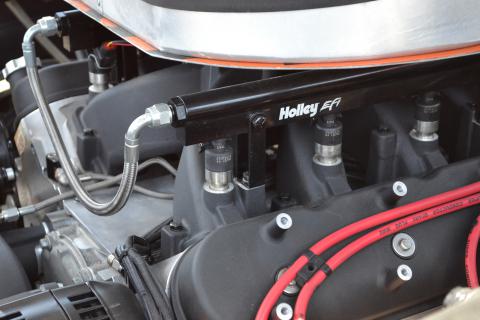
“The volume of the fuel rail is also very important,” Sosa said. “As fuel injector size increases, if the rail volume stays the same, then every time those injectors open, they’re going to have a higher local pressure swing. The pressure locally is going to drop, and those pressure swings may lead to stumbling or can make an engine more difficult to tune. It’s definitely worth the effort to make an upgrade to larger diameter fuel rails or high-volume fuel rails because you’ll be able to better control those pulses.”
All of our experts recommended installing filters at both the inlet and outlet sides of the fuel pump. Their mesh size recommendations were consistent, too. DeatschWerks’ McDaniel summed it up succinctly: “We recommend using a 100- to 200-micron filter before the fuel pump to protect it, and a 5- to 40-micron filter before injectors or carburetor—a 5-micron filter for direct injection, 10-micron for port injection, and 40-micron for carb applications.”
As fuel flow increases, “we have to increase the surface area of the filter element,” Stacy pointed out. “We don’t change the micron rating, but we go to a larger filter. If I were to take our filter that’s rated for 1,000 hp and put it on one of our mechanical pumps, one that could support 3,000 hp, we would crush that filter in the filter housing because it can’t pass the amount of fuel through that small surface area that the pump needs.”
Sosa also noted that the filter element “needs to be compatible with the type of fuel you’re running. When you get into methanol, a lot of guys will run stainless filters with stainless elements, so you don’t have to worry about compatibility.”
What Not to Do
After asking our experts about what racers should do for their fuel systems, we ended the conversations asking about mistakes they’ve seen and problem areas to avoid.
“With fuel pump sizing, you want to make sure that the fuel pump you select is large enough to support your horsepower, but there are downsides to flowing too much fuel through the system,” Sosa said. “One is because you’d need a larger regulator, but you’re also adding a lot of heat to the fuel every time you compress it.”
Sosa also cautioned against using the wrong kind of rubber hose for fuel lines. “To most guys, rubber is rubber. But it’s not. There are certain rubber lines that are meant to carry oil, and if you put fuel in them, they will work, but they’ll deteriorate very quickly.” Look for fuel lines with an SAE rating of J30, “which means it’s constructed with an inner tube made of a fuel-resistant rubber.” Fuel line specific to fuel injection carries an additional R9 rating, he added.
On the subject of lines, “keep fuel lines away from any type of heat source or moving source, like driveshafts or exhaust pipes,” said Cegielski. “Generally speaking, if you try to mindfully follow where the factory fuel lines were on a vehicle, a lot of them were put there because they are away from those types of situations.
“Another big one we run into is builders who want to run hard lines but don’t have the tools to bend stainless steel line, so they try to find a softer material like aluminum,” Cegielski added. Aluminum, though, is not rated for the same pressure as stainless. Plus, “certain metals do not perform well against fuel pulsation. When a pump is running, it creates small fluctuations of pressure, which can crack aluminum. We tell people to go with a high quality, stainless-steel-braided PTFE line or fuel injection hose. If you are going to use hard line, get the best quality parts you can, like stainless steel hard line.”
Santarpia at Fuel Injector Clinic and Stacy at Aeromotive talked about the damage that can be caused by leaving alcohol-based fuels in a system.
“We find when vehicles using E85 sit a long time without running, the alcohol tends to leave a residue on the tip of the injector that, when mixed with moisture in the air, creates this black tar-like substance,” Santarpia explained. “If the vehicle doesn’t run for a long time after that, it can congeal and stick the injectors shut. It’s acting like an adhesive between the valve and the valve seat, and the injector can’t create enough force to open up that valve after sitting for so long.”
“If you leave methanol or ethanol in your gas tank, in your fuel pump, and in your carburetor over the winter, or even over three or four weeks without being started, you will be a very unhappy camper,” Stacy said. “Methanol is very corrosive. People will leave methanol in their pump all winter long, and it will eat the bottom chamber of that pump. And E85 tends to jellify, I guess you would say. It gets thick and gooey. So don’t store any non-gasoline-based fuels over a winter.”
“When it comes to modifying your fuel system, it’s important to do your own research and not rely solely on what has worked for others,” McDaniel said. “While some may prefer to push the limits of injector and pump flow, others may opt for a more conservative approach. By understanding the specific needs of your fuel system, you can make informed decisions that will leave you satisfied with the results.
“Never cut corners,” McDaniel added, “as saving a few dollars on a fuel pump could ultimately lead to engine failure or missed opportunities on the track. If you lack experience in modifying fuel systems, seek the assistance of a professional to ensure that your modifications are properly designed and built.”
Honda Performance Development (HPD), Honda's United States-based motorsports arm, has officially changed its name to Honda Racing Corporation U.S.A. (HRC US) to reflect its new role in Honda's global racing efforts.
With the change, HRC US will take on an increased role in Honda's global motorsports activities, including the company's Formula 1 power unit development program.
Collaborating as one global entity, these two independent racing arms of Honda -- HRC Japan and HRC US -- will combine expertise and resources to strengthen Honda’s overall motorsports capabilities, the company said.
Starting in 2026, HRC will partner with the Aston Martin Aramco Cognizant F1 team as the team’s official engine supplier. HRC US will also be involved in Formula One power unit development and race support starting in 2026.
 MEMBERSHIP LOGIN