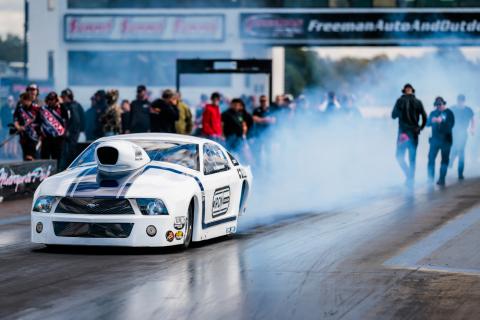
The Drag Illustrated World Series of Pro Mod has created the new Pro 10.5 Challenge to run in conjunction with the 2024 Drag Illustrated World Series of Pro Mod, March 1-3, at Bradenton Motorsports Park.
The Pro 10.5 Challenge will be an invitation-only, $25,000-to-win, 16-car shootout utilizing PDRA Pro Street rules. More than 20 drivers will attempt to qualify.
PDRA Pro Street was created as an updated version of the original Outlaw 10.5 class, according to race officials, with drivers limited to 33x10.5 bias-ply slick tires and body styles that retain factory appearance, profiles and dimensions.
HOW RECENT ADVaNCES IN COOLING SYSTEM COMPONENTS ARE IMPROVING THE PERFORMANCE OF TODAY’S Race cars.
Targeting the cooling system as part of a weight-reduction effort may seem like a risky strategy, especially for a drag-and-drive car that boasts a massive, nitrous-craving V8 pumping out more than 2,700 horsepower.
But that’s where John Pairaktaridis of Delta Performance Automotive Group (PAG) in Astoria, New York, said he could help Dave Schroeder and his cousin John Ens with their street-legal, Pro-Mod style 2019 Corvette. The pair are two-time winners of the HOT ROD Drag Week, including in 2021, when the car averaged 6.793 seconds at 198.08 mph at five different tracks that required 1,000-plus miles of commuting on public roads between races.
“Drag Week is a wonderful R&D testbed because they find ways of destroying your product,” said Pairaktaridis.
Schroeder had won an earlier Drag Week with a 1966 Corvette, and the plan was to transplant many of that car’s vitals over to the new race car, including the 872-cubic-inch Reher-Morrison all-alloy engine with four stages of nitrous and a very robust Delta cooling system.
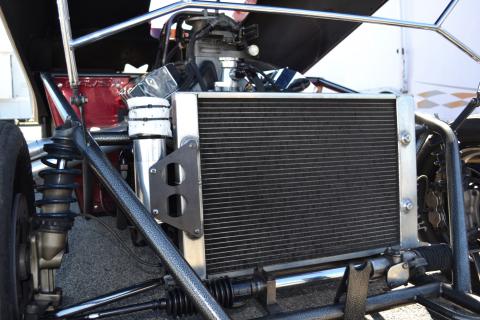
“I said, let me build you a mono-core radiator with the same dimensions, same fans, same shroud, same everything, just thinner. Then let me know the results,” added Pairaktaridis.
“John told us that the industry really hasn’t embraced the single-core radiator,” recalled Ens. “So, that was the one we put into the new car, and it has worked out extremely well.”
Conventional wisdom suggests that a larger or thicker radiator will provide greater cooling power; that a double-pass design will work better than a single-pass. Three- and four-core radiators have been built based on the reasoning that more cooling area is better. However, it’s harder for air to get through that mass of metal, which completely negates any cooling efficiency that the additional surface area could provide.
Today, new tube-and-fin designs developed from extensive computational fluid dynamics (CFD) analysis and even wind-tunnel testing are giving manufacturers more options and flexibility in designing systems that are lighter and more thermally efficient.
What follows is a sample of other companies in the industry whose sources share additional trends that benefit racers such as the continued growth of brushless fan motors, unique fan blade designs that are more efficient, development of auxiliary components such as expansion tanks, and the increasing number of complete radiator-fan-shroud packages to facilitate engine swaps and improve factory applications.
Results Oriented
The new Delta mono-core radiator helped the Schroeder-Ens team shed more than 20 pounds off the nose of the car because much less coolant was needed to fill the system.
“And it actually cooled the car better,” praised Ens, noting a chilly engine is critical to a drag-and-drive gameplan. “We run such a large camshaft that we have to keep our lash extremely tight for the road trips—tighter than a person would ever race at. Our motor grows .002-inch for every 10 degrees F of engine temperature. If you can imagine, we set up the valves at 70 degrees F, and the engine goes to 170 degrees. The hottest we’ve ever seen John’s setup was about 170 degrees. On a cool night, we’re running in the 140s and 150s on the road.”
“It did cool better,” agreed Pairaktaridis. “This is one of those examples where CFD work and mathematical modeling translated to empirical data. It doesn’t always happen, but this was one of those situations where it actually made sense.”
The Delta system also includes a pair of 16-inch brushless fans and a remote electric water pump with dual outlets that flows 65 gpm. “It also has a four-inch stainless-steel impeller,” said Pairaktaridis.
While running less coolant provided weight savings and eventually increased thermal efficiency for the drag-and-drive Corvette, there are other race teams looking to increase the coolant capacity of their systems.
Delta’s new mono-core radiator helped the Schroeder-Ens
drag-and-drive team shed more than 20 pounds off the nose of the car because much less coolant was needed to fill the system. “And it actually cooled the car better,”
said John Ens.
Delta’s new mono-core radiator helped the Schroeder-Ens drag-and-drive team shed more than 20 pounds off the nose of the car because much less coolant was needed to fill the system. “And it actually cooled the car better,” said John Ens.
“We definitely see guys wanting to run bigger reservoirs to build up their ‘thermal battery,’” said Jack Anderson of PWR Advanced Cooling Technology, Indianapolis, Indiana. “We build plenty of customized pressure cans to suit whatever specific setup the teams can run. Obviously, more water means the bigger thermal battery, but more water means more weight,” he cautioned.
PWR specializes in custom cooling systems for a wide range of racing series but also sports a line of off-the-shelf products that often fit the needs of a team. With horsepower levels continuing to increase dramatically, the team at PWR has seen pressurized cooling systems become more vital to the operation of the car.
“Rather than running a radiator cap that might open at 30 or 35 psi, we basically have a closed system with a pressure-relief-valve that might be set to 60 or even 75 psi. That way you can run much hotter temps without actually losing any water,” said Anderson. “That helps if you’ve got a high-horsepower car, and you might be stuck with some traffic in a low-speed section of the track. It gives you more of a thermal battery to play with in that system.”
According to Anderson, the key to an effective cooling system is the radiator. “We see massive differences in our internal comparisons with our latest fin-and-tube technology,” he said. “An off-the-shelf system might get you by, but being able to customize it and extract every last bit out of it really makes the difference as you try to compete up front.”
Airflow is also paramount to proper cooling, and companies are seeing some car builders not prioritizing radiator placement. “Obstructing good airflow is a big thing,” said Fred Militello of Be Cool Radiators, Essexville, Michigan. “You know, putting turbos right out in front and things of that nature. They need to spread out the real estate and give the radiator a chance to breathe. Guys start building motors and stacking stuff everywhere. Before you know it, there’s no place to put a radiator.”
Veteran chassis builders will mock up all the components and call the radiator company with relevant dimensions. “Then we can do up a custom blueprint for them and send it over to them,” noted Militello. “They can do some alterations to the car or the blueprint, and we can finalize a build for them.”
After airflow obstruction, the biggest mistake racers often make when setting up the cooling system is water speed. “It’s a big issue. People think that they have to slow the water speed down to give the radiator a chance to do its job. But if the water speed’s too lazy, it’s not cycling through the engine quick enough,” said Militello.
Sluggish water speed can reduce the pressure and volume inside the radiator tubes, which then reduces the efficiency of the heat dissipation. Racers can work with thermostats and restrictor plates to control the water speed in addition to changing water-pump and crank pulleys.
On the street-performance side, Militello said complete retrofit packages for popular muscle cars is one of the hottest trends in the industry. “The LS market is where it’s at right now,” he confirmed. “Whatever, an old Chevelle or Camaro, they’re looking for a plug-and-play package for a crate motor or something out of salvage. Right now, we’re even doing one for a 1936 Chevrolet.”
A complete package will include a radiator with the proper sized inlet and outlets, steam ports for LS applications, custom aluminum shroud, and high-torque electric fans. Other accessories include a billet recovery tank, billet radiator cap, and wiring harness with relays and sending units.
Moroso has broadened its expansion and recovery tanks for performance vehicles and select UTVs. They’re direct, bolt-in replacements, said Frank Thibodeau, and their billet aluminum components “are much more durable” than a plastic tank.
“We can get them in a natural or polished finish,” Militello continued. “A lot of companies don’t offer polished. In natural finish, a lot of times the guys want to paint them, but we shy away from that. Painting the core will obstruct heat dissipation.”
Northern Radiator in Willmar, Minnesota, is adding more versatility by offering radiators with threaded hose connections. This allows various types of hose connections, depending on the application.
“It’s really nice for distributors who can have fewer part numbers because the hoses can be changed,” said Tracy U’Ren, adding that LS swaps are also driving much of the development at the company. On the competition side, some racers are moving to larger radiators.
“We just built a 35- by 19-inch dual-pass with an LS steam port for a Baja racer. Before, our biggest radiator was a 31-inch. Now we have a radiator for the big trucks,” U’Ren said, adding that more racers are also considering cooling systems that can serve a variety of events. “They’re looking to have the cooling so they can bounce around to the style of races that are going on at the moment. So, making sure that the cooling products that we put into the vehicle can handle the road races just as much as the drag. It may be a little bit overkill for the strip, but it will definitely stay up to speed on the road courses.”
Expanding the market for high-performance vehicles is also a priority for many companies producing cooling products. PROFORM Parts, which is based in Warren, Michigan, is growing its 1-2-3 system that comprises a matching radiator, fan, and shroud to include higher horsepower applications.
“The 1-2-3 is a complete system,” said Ryan Salata. “It comes assembled in the box with a thermostat, so you’re not hunting for 100 pieces in a kit. This is not a kit. It looks like it came from the factory and drops in as a unit. We’re up to 800 hp with some of the units. Some are universal and some are for LS conversions with the steam port.”
While brushless fans are drawing most of the headlines these days, they are expensive and more difficult to set up. Maradyne in Cleveland, Ohio, has developed a new Smart Start brushed motor that provides some of the benefits of a brushless motor without the higher cost.
“Our brushed fans do the trick and work forever,” said Jim Kahl. “But they do have brushes that can wear out, and they’re one speed. When they go on, they’re full power.”
One of the advantages of a brushless fan is its variable speed, and the fact that it draws less amperage than a brushed fan. The strategy behind the Smart Start motor is a smooth, controlled startup that draws less current than a standard motor that goes from zero to full speed almost instantly.
“This Smart Start fan winds up,” said Kahl. “It takes three seconds to go from start-up to full speed. That eliminates the amp spike at the ignition of the fan, which is similar to a brushed fan. But you don’t need a PWM controller with this fan. It’s a brushed fan, but it has operational features like a brushless at a fraction of the price.”
The Smart Start is available in 12- and 16-inch sizes. Maradyne has also combined the Smart Start fan with the Jetstreme Supreme blade that the company introduced earlier. The original Jetstreme blade was an S-shaped design, while the Jetstreme Supreme adds curvatures in the blade surface similar to a sickle.
“That blade does two things,” said Kahl. “It moves more air. Our original Jetstreme with the S-blade was 3,100 cfm, and the new Jetstreme Supreme with the sickle blade is 3,400 cfm. And the way it cuts through the air, it sounds quieter. That’s a big advantage for the street guys.”
Maradyne is developing a brushless fan system, which will eventually give customers three price levels between the brushed, Smart Start, and brushless.
“We’re always keeping our eyes and ears open for improvements or new product technology,” added Kahl. “The really big question is EV. As more turn to electric vehicles, where are fans going to be needed? So we’re keeping an eye on that because everybody knows electric vehicles, like them or not, are coming.”
Accessorizing
In the category of new accessories for cooling systems, Top Street Performance in Santa Fe Springs, California, has new serpentine front-drive kits that offer a cleaner appearance and allow for the addition of air conditioning. Also driving sales is the increased use of electric water pumps. Current models include small and big block Chevy along with small and big block Fords.
“The next one will be for an LS engine,” said Ralph Martinez. “Our water pumps have been popular. We advertise that they flow about 40% more than your stock water pumps. That really intrigues customers, especially when you have a large engine that gets hot. The most important starting point would be a good water pump.”
Obstructing airflow is a common problem, which negatively affects race engines, according to Be Cool Radiators’ Fred Militello. “Guys start building motors and stacking stuff everywhere. Before you know it, there’s no place to put a radiator.” He prefers chassis builders mock up components and send him the relevant dimensions so he can build a custom cooling system for that application.
Another accessory popular with performance enthusiasts is upgraded overflow, expansion, and recovery tanks. Moroso in Guilford, Connecticut, has expanded its dedicated replacement applications for performance vehicles and select UTVs.
“We’ve also come out with different coatings on some tanks,” said Frank Thibodeau, noting that replacing the plastic OEM tanks is driving sales. “The plastic tanks get beat up from heat cycles, and they’re going to crack and fade over time. An aluminum tank is going to give you better appearance and it’s much more durable.”
Late-model performance applications are the most popular, such as BMW, Mazda Miata, Ford Mustang, Chevy Camaro, Dodge Challenger, Lotus, Nissan GT-R, and Subaru. Interest is also growing for side-by-sides, including Polaris.
“They’re direct bolt-in replacements, so no additional modifications need to be done. The plastic tanks will fail after repeated high-heat applications. That’s not good in a race-car situation,” said Thibodeau. “You don’t want coolant dripping all over the track. All the caps are all-billet aluminum, so you can put the cap on multiple times without worrying about damaging the receptacle. Everything is welded, and we use billet aluminum fittings for the tops and the bottoms. So everything is really high quality.”
Final Advice
When evaluating efficient cooling systems and determining common mistakes that racers make, sharp-eyed observers may have noticed a key piece of advice missing from this discussion.
“Not having a big enough oil cooler is probably the biggest mistake,” observed PWR’s Anderson. “We spend a lot of time working with oil cooling because typically that’s the more important fluid to cool. Obviously, you have to cool the water, but engine oil is very important.”
Fear not, because oil pans, coolers, and pumps and their contributions to cooling efficiency will be discussed in the June 2024 edition of PRI Magazine.
The final bit of advice from industry experts may appear obvious, but it is essential to setting up a race-effective cooling system.
PROFORM Parts’ 1-2-3 cooling system is made up of a matching radiator, fan, and shroud. “This is not a kit,” said Ryan Salata. “It looks like it came from the factory and drops in as a unit.” PROFORM has 1-2-3 system applications that will support up to 800 horsepower.
“You need to know where the hottest coolant is, not the hottest point on the engine,” observed Pairaktaridis, noting that some engines may have the temperature sensor in the head near an exhaust header. “It may be misleading, because the last thing you want to base your cooling system off of is your exhaust temperature. Knowing where you’re taking the temperature is very important, and we need to know what the hottest coolant is doing.”
“Basically, the warmest part of the cooling system is usually your upper hose area, where the water’s releasing out of the engine and going back into the radiator,” said Militello. “That’s your true temperature of the engine, so it depends on where the temperature sensor is mounted. The gauge may not be reading properly because the sending unit is in a cylinder head next to an exhaust port. If it’s a mechanical gauge, the sending unit needs to be close to the upper hose area.”
The correct coolant temperature was quite pivotal in setting up the cooling system in the Schroeder-Ens Corvette. “In a lot of ways, our system is set up like a road race car or like a NASCAR car,” said Ens. “We’re trying to cool from all four corners of the block. Temperature-wise, you know, the hotspot always wins.”
With the software continually reaching new levels of accuracy and the hardware more accessible than ever before, simulators are becoming an indispensable tool for driver training.
Once dismissed as mere child’s play, simulators have been an integral part of driver development in top-tier series like Formula 1, NASCAR, and IMSA for a number of years now. While the systems used at this level of motorsports are often highly customized, multi-million-dollar setups, the simulation technology that’s now readily available at the prosumer level is reaching a degree of sophistication that’s not far behind.
“People often still write off this technology as just a video game,” explained Steve Paladino of Podium 1 Racing, Franklin, Tennessee. “But what they’re missing is that, at this point, the level of accuracy is part of what makes these simulators fun and immersive. At the end of the day, you have to keep in mind that pro drivers wouldn’t use this stuff if it was garbage. Meanwhile, the cost of entry continues to go down, while the quality continues to go up.”
As Nikolas Dubois of Advanced SimRacing in Anjou, Quebec, Canada pointed out, the technology is providing real-world results on a regular basis. “F1 proved to everyone that this is a very valuable tool. Initially simulators were implemented for technical reasons—to test theories about aero and other aspects of car setup. But now it’s allowing drivers to train on something that reacts very much like the car they’ll be driving in the real world, which is giving them a much better understanding of where the limits are before they even get to the track.”
Yet like so many aspects of motorsports, the hardware and resulting levels of precision are largely tied to a race team’s budget, and how far they want to go down this rabbit hole.
Tiered Technology
Although simulation rigs are more advanced than ever before, there’s still a sizable gap—in terms of both fidelity and cost—between the systems that are commonly used for driver training and the bespoke setups that are created by auto manufacturers and teams in top-tier racing series like Formula 1.
“One of the programs that’s considered a standard in the industry is rFactor,” said Dubois. “There’s a version of this that you can use at home, but top-tier teams and automakers typically use rFactor Pro for engineering development. The Pro version is a very different approach—it’s not what you’d call user-friendly, and you have to have engineers to work on the models. Just creating one custom car model in rFactor Pro can cost upwards of a quarter-million dollars. The benefit of that is it takes a huge amount of data into account, so you get a greater level of accuracy from it.”
“People often still write off this technology as just a video game,” said Steve Paladino of Podium 1 Racing. But, he added, “pro drivers wouldn’t use this stuff if it was garbage.”
At this level, the expense of model development is just a fraction of the overall cost involved.
“These are seven-figure setups,” said Robbie Montinola of SRO Motorsports, Austin, Texas. “For the most part, these rigs are built into ‘simulation rooms.’ Think of a room that’s about a thousand square-feet or so, where they’ve built a very realistic, life-sized version of the race car with the same ergonomics as the car they’re campaigning. So, if it’s a Formula 1 car, it could essentially be an F1 tub with large, curved screens that emulate a 360-degree field of view, and they may be using proprietary simulation software. They also usually have rooms that are connected to those simulator rooms, where engineers and other support staff monitor information and communicate with the driver. It is very much a NASA-style experience.”
At the opposite end of the spectrum, a racer can also put together a simulator rig for home use for a few grand to keep their skills sharpened and stay familiar with course configurations.
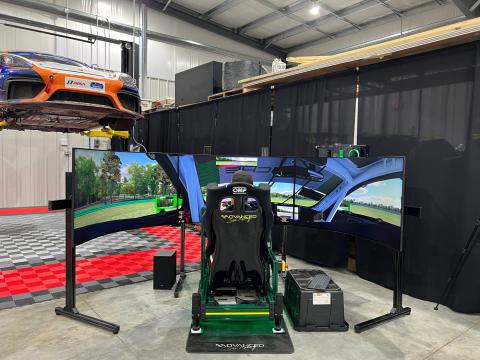
The systems used by teams for driver training typically fall somewhere in the middle, though, often costing between $15,000 and $50,000. These systems typically use direct-drive steering wheels, which create realistic feedback from the tires and suspension using internal magnets rather than a traditional gear set. The wheels’ quick-release system also functions much like the ones used in actual race cars, allowing drivers to swap out steering wheels to more closely replicate the type used in their race car. Multi-display setups are common, which allow for a greater degree of peripheral vision, while high-end pedal sets can now also emulate the brake system feedback that someone would experience in a real race car. Expired racing seats are often used to establish the proper driver position in the simulator, too, and some systems have integrated actuators that can shift the entire rig several inches in any direction to replicate the sensations of brake dive, squat, and roll, as well as weight transfer and road surface variations.
While the level of realism that this hardware can create is impressive, Cam Murphy of SimGear Motion Simulators in Schaumburg, Illinois, pointed out that the software still does a lot of the heavy lifting.
“iRacing is arguably the standard for consumer-level simulators today, and it continues to get better and better. One really important advancement that has become commonplace now is that they started laser-scanning race tracks, and those scans find every nuance in elevation change, and every nook and cranny in the road surface, and that’s translated into the simulation. There’s also been a major development effort to accurately replicate real-world physics. That takes into account everything from the weight, weight distribution, and the aerodynamics of the car to the chassis stiffness, suspension setup, tire compounds and pressures, and track conditions.”
Achieving a level of accuracy that allows these simulations to serve as useful training tools for professional drivers requires taking myriad details into account, but tire modeling, specifically, has become an area of intense focus for many software developers as of late.
“As an example, with our official racing simulator—Assetto Corsa Competizione—the developers work closely with both the auto manufacturers as well as Pirelli,” Montinola said. “When we change a tire compound in real life, the simulation is updated with new data from Pirelli to reflect that change in the latest tire model. So the tire model is constantly evolving alongside what is happening in real life.”
“Leading into each of our race weekends, you’ll see that a large number of our drivers are on social media talking about how they’re training on the simulators,” said SRO Motorsports’ Robbie Montinola. “They want to get as much training in on the simulator as they can.”
As simulator physics continues to move toward parity with reality, telemetry data is becoming an increasingly complementary training tool.
“Virtual Racing School software allows you to record your iRacing telemetry, and within seconds of completing a race, you can go to their site and compare your telemetry data to their pro drivers,” Paladino explained. “So you can immediately see where you’ve done well and where you can find improvement, corner by corner, tenth by tenth.”
Translating Virtual Seat Time Into Real-World Results
The headline benefits of using simulators for driver training are fairly straightforward: virtually unlimited track time, minimal costs after the initial investment, and the opportunity to drive tracks you haven’t physically been to. But there are also other advantages of simulators that may not be as immediately obvious.
Simulation technology that’s now readily available at the prosumer level is reaching a degree of sophistication not far behind those simulators used in professional motorsports. “At this point, the level of accuracy is part of what makes these simulators fun and immersive,” said Steve Paladino of Podium 1 Racing.
“The reset button,” Murphy said with a laugh. “But in all seriousness, that gives you the ability to get on a track and go flat-out without risking the expense of wrecking a race car. You can do hours and hours of track time at that pace and not burn an ounce of fuel, go through a single consumable part, or bend a single fender. It not only allows you to get a general idea of where the limits are, it also provides the visual reference points to keep a track configuration fresh in your mind, so when you’re out on track in real life, you can get back into that rhythm quicker.”
Simulators also allow drivers to hone another skillset that’s very difficult to replicate in real-world practice sessions. “In most of those sessions, you’re effectively doing time trials,” said Paladino. “And that means you’re not learning race craft. When you’re in a field of cars in the simulator, you’re learning which alternative lines work and which don’t, where your passing opportunities may be, and how to adapt to different situations in real time.”
That can result in a more well-rounded driver on race day. “Pro-level drivers generally use simulators to keep themselves sharp and consistent,” said Dubois. “But at the sportsman and grassroots levels, the improvements can be pretty stunning. We had a gentleman in a Porsche Cayman GT4 one-make series who was regularly finishing mid-pack in his class. He’s been training with us for about a year now, and he just won his first race this past weekend,” he said in fall 2023.
From The Basement To The Grid
Racing simulators have come a long way in recent years, but technological limitations still remain today. Although haptic systems like those made by D-BOX can replicate variations in road surfaces and shifts in weight balance, simulators cannot recreate the sustained G-forces generated by long, sweeping corners or high-speed braking zones. While it may be easy to shrug this off as simply a compromise in the level of immersion that’s available today, the implications go deeper than entertainment value.
“The overall feel is still a bit different. No matter how good you are in a real car, people always tend to be a bit slower in a simulator,” said Montinola. “And most real race car drivers tend to be slower than the folks who’re purely focused on simulator racing. For racers, I think there’s a degree of disconnection that we still face with simulation technology without those real-world forces communicating information about things like the coefficient of friction. You may know where those limits are in the car, but it’s harder to pinpoint them in the simulator, outside of just looking at the data.”
Simulator training is “allowing drivers to train on something that reacts very much like the car they’ll be driving in the real world,” said Advanced SimRacing’s Nikolas Dubois, “which is giving them a much better understanding of where the limits are before they even get to the track.”
Still, as this technology becomes increasingly accessible, simulator training is quickly moving beyond the realm of novelty and becoming an obligatory element of teams’ racing programs.
“Leading into each of our race weekends, you’ll see that a large number of our drivers are on social media talking about how they’re training on the simulators,” Montinola added. “It’s a part of their process now. Practice session track time is limited on race weekends, so they want to get as much training in on the simulator as they can. That way, when they actually get to the track, they’re just dialing in the race car and then they’re ready to go qualify.”
The proliferation of simulator training is just getting started, Paladino said. “Simulator racing and training has been huge in Europe for a long time, but America is just now waking up to it. ‘Drive to Survive’ has brought more visibility to it, and the pandemic created a new level of demand for ways for drivers to train at home. As a result, I think one of the big changes we’re going to see is that it’s going to change some of the entry points into motorsport. I think we’re going to see more and more kids getting their start in simulators who end up being very competitive in the real world. And I think it’s going to help lower the barrier for talented drivers that might not have the opportunity otherwise.”
Dubois explained that as the technology becomes more accessible while also becoming more advanced in terms of accuracy and depth, its use as a training tool by racers may eventually become ubiquitous.
“Simulation has come a long way in recent years, but it’s still in its infancy right now, and I think it’s going to be much more mainstream in the near future. Eventually it’s going to be almost mandatory to have a simulator at home. That’s because, if you don’t, you’re never going to be as competitive as a racer who can train for eight to 10 hours a day if they want to. It’s all about practice.”
Murphy noted that at a certain point it becomes less about creating a competitive advantage and more about keeping pace with the field. “It’s an incredibly beneficial tool to have off-track. Much like data, it’s a tool that allows you to come into the next race with better preparation. Almost every pro driver out there is already using this technology to some degree.”
Despite its longstanding popularity in Europe, rally racing has struggled to gain traction in America. But thanks to new strategies and formats that are helping to bridge the gap between professional and grassroots efforts, that may soon change.
Rally racing’s origins date back to the advent of motorsports itself. Events like the 1894 Paris–Rouen Horseless Carriage Competition, and Automobile Club de France’s 1,000-mile Bordeaux-to-Agen trek that took place the following year, are considered to be some of the first organized forms of auto racing. The latter also set the tone for what would later become known as stage rally.
Like Formula 1, rally racing gained a foothold with European audiences early on thanks to the immense talent on display and sheer spectacle of the competitions. The discipline has had a much harder time establishing a lasting beachhead on this side of the pond. While different factors have conspired against its success in the US over the decades, new tactics are emerging that signal a potential sea change on the horizon.
“Part of the problem has been that most people don’t know that rally racing is happening over here,” said Perry Seaman, Eastern regional director for NASA Rally Sport, Industry, Pennsylvania. “The Internet, video games, and media coverage of series like WRC has brought much more visibility to the sport over the past decade or so, but the American public generally isn’t aware that this is something that’s going on in the US. Changing that is the big challenge that we’re currently working to address.”
The American public generally isn’t aware that rally racing is going on in the US, said NASA’s Perry Seaman. “Changing that is the big challenge that we’re currently working to address.”
Preston Osborn of the American Rally Association (ARA) in Speedway, Indiana, told us that involvement in rally racing grew substantially in the wake of the pandemic, and sustaining that upswing in growth is the key to the sport’s long-term health here in the United States. “The competitor base has definitely gotten larger over the past three to four years. COVID-19 likely played a role in that because people had more free time to build cars, and some new events came to fruition as a result. Now it’s about keeping those numbers high.”
Expanding promotional efforts are expected to increase the sport’s visibility and help to cultivate a larger audience. Leading the charge is Nitrocross in Costa Mesa, California, a series inspired by rallycross racing but forging its own identity.
“We see Nitrocross as related to rallycross and rally, but significantly different enough in track design, format, and vehicles to be its own sport,” said Chip Pankow of Nitrocross.
Launched in 2018 by Travis Pastrana and the Nitro Circus crew, Nitrocross features three classes that each compete on purpose-built courses featuring jumps, banked turns, multiple surfaces, and various racing lines.
Nitrocross is related to rally racing, “but significantly different enough in track design, format, and vehicles to be its own sport,” said Chip Pankow. “We know our sport has some of the best motorsports content out there. It’s just been a matter of getting it both to our audience and to new audiences.”
“The segment is very healthy,” Pankow added. “We are nearly sold out of our top class [Group E] vehicles, there’s a waiting list for the SxS (side by side class), and we’ve just announced the vehicle upgrade package for our NEXT EVO class and there is tremendous interest.”
Nitrocross’ growing momentum is a good sign, but more traditional forms of rally racing still face challenges. In terms of car counts, the bar of entry can appear particularly high for rally racing, and the logistics involved in stage rally events typically equate to remote locations that can limit the appeal for spectators and racers alike. However, the recent emergence of both rallycross and rally sprint formats may prove to be the piece of the puzzle that’s been missing between the grassroots and pro-level competition.
Creating Entry Points
While the cost of a WRC (World Rally Championship) build can venture into six-figure territory, a substantial initial investment isn’t necessarily required to get involved in rally racing. Closed-course rallycross events, like those held in various regions of the US by the SCCA, are similar to autocross in that a competitor can get involved with a road-legal car with minimal prep and then work their way up the ranks at their own pace.
“Our focus is more at the grassroots level,” said Rick Myers, director of Rally/Solo for the Sports Car Club of America (SCCA), Topeka, Kansas. “It’s basically like Solo on dirt, where you’re running against the clock, and there’s one car on the course at a time, more or less. The risks are pretty limited, and it doesn’t take a significant financial layout to get involved. Those factors have allowed us to grow this sport across the country.”
Involvement in rally racing grew substantially in the wake of the pandemic, and sustaining that upswing in growth is the key to the sport’s long-term health here in the United States, said Preston Osborn of the ARA. “Now it’s about keeping those numbers high.”
SCCA’s RallyCross program is broken down into nine classes across three categories—stock, prepared, and modified. At the ground level of the stock category, virtually any mechanically sound vehicle with all-season or winter tires is eligible to compete. “The cars run the gamut,” Myers said. “There are plenty of Subarus and vehicles like that, but a lot of them are economy cars—old Chevy Cavaliers, Hondas, and Mazda Miatas are popular here, too. The safety requirements are pretty straightforward: You need a helmet, and if you’re in one of the upper classes that doesn’t have side glass in the car, then you need to have arm restraints. It’s incredibly easy to get engaged with this.”
Although the rallycross format can’t replicate all of the elements that make stage rally appealing to fans and competitors, it also addresses several of the major obstacles facing rally organizers.
“For a stage rally event, you typically need several hundred volunteers,” said Tim O'Neil of the Team O’Neil Rally School, Dalton, New Hampshire. “You also have to have a group of top-level people communicating with the landowners, asking permission to use these roads, block off public access, and so on. The landowners are often people who do not like to take risks. They might have concerns about damage to the roads, or bad actors misbehaving. Some may also be concerned about competitors driving too fast on the roads between the stages. That could upset a land manager, and then when it comes time to borrow the road for next year’s event, they’re not as receptive. It becomes easier for them to just say no.”
Meanwhile, rally sprint events essentially split the difference between rallycross and stage rally, allowing competitors to run on a closed course that’s similar or identical to a rally stage without a lot of the issues that can hamper stage rally events.
“We recently started a soft rollout of our rally sprint program,” Osborn said. “These events are meant to be simple not only for competitors, but also for organizers. It’s a way to get people involved in rally on a smaller scale, and it’s easier to secure permitting for events that are held in these types of closed venue areas. Rally Ready in Dale, Texas, has been the champion of that program so far; we’re doing four rally sprints with them this year.”
“It’s basically like Solo on dirt,” said SCCA’s Rick Myers in describing RallyCross. “You’re running against the clock, and there’s one car on the course at a time, more or less.” Competing cars “run the gamut,” he said, and include Subarus, Hondas, and Mazda Miatas.
Seaman pointed out that rally sprint events tend to make things easier on organizers in other ways as well, so the concept is also being applied to some stage rally events. “Since these events are all either on closed roads or within one facility, it’s less expensive to run it. For example, this past summer’s Iron Mule rally had 110 stage miles, and to get that they closed a network of connecting roads that allowed for a few different course configurations. Because of that, the rally cars were never really on public roads. That changes the cost structure of the event for the organizers, which trickles down to the competitors.”
Dialing In
Rallycross offers grassroots racers an opportunity to get involved in the sport with minimal investment, but like any motorsports discipline, there’s a demand for consumables, and more comprehensive builds are commonplace in the upper levels of this format.
“Even at the grassroots level, you need things like tires, brakes, and shocks,” said Myers. “Generally speaking, those that compete in rallycross tend to be influencers within their automotive circles. When their friends ask for shop recommendations, or a particular type of product, the ones that have provided them with support are going to be the first ones that they suggest.”
Many aspects of the mechanical hardware and tuning approach are fairly unique to the sport, but there’s also a fair amount of common ground with road racing and other disciplines. “The handling characteristics are obviously different from autocross or a road racing car, but the engineering goals are often the same,” Myers continued. “When it comes to the suspension, you still want to maximize grip. These suspensions are set up a bit softer, but a lot of the same engineering and technology are still in place. You’ve got to be able to keep the tire on the ground in order to move the car forward. A lot of folks in the Modified category are running pretty aggressive tires and extensively engineered suspension setups, and they’re using data acquisition systems to help gain an edge.”
O’Neil also said that while there may be a smaller number of American rally competitors in comparison to other racing disciplines, they tend to demand high-quality products that can both perform and stand up to serious abuse.
“Rally stuff differs from road racing and street stuff. The wheels have got to be stronger, and the tires have to be bulletproof,” O’Neil explained. “When it comes to suspension, most everything you find out there is to lower the car, and that won’t work on a rally car. It’s just not rugged enough. Seats, racing harnesses, and other safety equipment are kind of universal, so extending out to the rally guys from that side of it is pretty easy to do. And everyone needs things like instrumentation, brakes, clutches, and cooling system stuff, too. It just needs to be up to the task. For example, if a stage rally car has 450 horsepower, you need a clutch with a load rating of, like, a thousand. I need to more than double the rating because of the shock loads that these parts are subjected to. Some of the suppliers will say things like, ‘Oh, I sell this to the road racers all the time and they love it.’ I’m like, ‘OK, thanks—gotta go.’”
Seaman said that teams’ investments in stage rally programs vary widely, but deeper pockets don’t necessarily guarantee faster times. “Someone who builds a $15,000 car can be quite competitive if they build it right, can drive it well, and have a great co-driver. There are also folks in the Pro class who’re driving $200,000 cars with turbos, all-wheel drive, and sequential transmissions. But our team’s Merkur XR4Ti, with a junkyard engine swap, placed third overall at the Sandblast Rally this past year. We actually outran one of those six-figure Pro-class cars in one of the stages.”
The Road Ahead
As organizers seek to bring more awareness to rally events here in the US, they’re also working on solutions to some of the logistical concerns that are faced by fans and racers alike.
“Right now, expanding the number of events is a big priority for us,” said Osborn. “One of the big challenges that you have with rally is that a lot goes into organizing an event, and we’re reliant on local organizers to do a lot of that groundwork. Because of that, we typically only organize one event in a given area per year. So as a competitor, if you’re looking into investing in a rally car, you might only have a few events that are within a one- or two-day tow from where you live, and that really limits the number of times you can use that car per season. We want to change that.”
Rally competitors tend to demand high-quality products that can both perform and stand up to serious abuse, said Tim O’Neil. “The wheels have got to be stronger, and the tires have to be bulletproof. When it comes to suspension, most everything you find out there is to lower the car, and that won’t work on a rally car. It’s just not rugged enough.”
The ARA’s fledgling rally sprint program is part of that effort. “We want to expand that in order to create these pockets of competition across the country,” Osborn continued. “One of the areas that’s seen a lot of success over the past few years is Missouri, and that’s in part because we do a big national event in March every year, and we also have two other regional events each year. Because we’ve added those events, we have much more engaged volunteers and personnel, along with an influx of local competitors. We’re seeing a similar thing in the Pacific Northwest as well, between Portland and Seattle. Teams in those areas might have five events per year within 250 miles of where they live, and that region has become a hub of competition as a result.”
Most also cite a bigger social media and digital presence as part of the strategy to further promote the sport. “The biggest obstacle has been breaking through,” said Pankow. “We know our sport has some of the best motorsports content out there. It’s just been a matter of getting it both to our audience and to new audiences.”
Pankow’s team has made strides by offering free live streaming of the Nitrocross races on Rumble, an online video-sharing platform which is available around the world. While this partnership has created a “barrier-free experience for anyone interested in the sport,” they’re utilizing additional creative strategies to tap into different audiences.
“Not only do we have to make the content easily accessible across multiple platforms, but we are also constantly seeking new audiences,” added Pankow. “These [efforts] include inviting drivers from other disciplines, visiting new venues, social media, and a strong influencer program that has introduced our sport to a massive number of new fans.”
Homegrown efforts to draw interest in American rally racing will continue, but Seaman noted that the sport may get a significant push from a globally recognized name in the not-too-distant future.
“There’s been some talk about holding a WRC event in the United States. If we could manage to pull that off, it would bring a lot more visibility to what we’re doing here. This is a sport that’s primed for sudden growth. Right now, you don’t see a lot of YouTube content, for instance. But if you get a lot of folks involved who are good at generating awareness, that could change very quickly.”
The slogan on the website says it all:“It’s about engineering and win lights.”
“If you’ve got reliability, and you’re out there winning races, that just breeds confidence. And confidence is the absolute best tool in the toolbox. If you have the confidence that you don’t have to worry about anything, and all you have to do is drive, that’s an invaluable tool. Brett adds that to my program.”
Troy Williams, a Top Dragster and bracket racer out of Virginia, has been a customer of Brett Nesbitt and the rest of the crew at Nesbitt Performance Engines in Graham, North Carolina, since 2012. During that time, Nesbitt has built “three or four” engines for him, “but they’ve maintained probably 10 or 12. Sometimes I’ll buy a car that’s a turnkey operation, and I’ll take the motor to Brett and have him go through it and get his seal of approval. I drive other people’s cars as well, and that’s part of the agreement I have with them. If we’re going to do this competitively, we have to make sure we have competitive powerplants. So we take those engines to them as well.”
How does Williams define “reliability?” “I’m putting 300 to 400 runs on an engine before I take it back for freshen-up. And I’m running it on the ragged edge.”
To Williams, what sets the Nesbitt operation apart from other engine builders is the engineering background that Brett and his father Jeff bring to the business, which they co-founded in the late 1990s. “I just think they’re on the leading edge,” Williams explained. “Brett’s a younger engine builder, so he’s always looking to do things different and maybe not be afraid to step outside the box.”
“I was a mechanical engineer with General Dynamics before I started doing this,” Brett Nesbitt explained. A long-time bracket racer, he started “tinkering around” with engines in his father’s shop “to figure out what I could come up with and then go to the track to see how it would run.”
His success earned him a reputation among his fellow racers, to the point where he was building engines for “10 to 12 customers” on the side while working at General Dynamics. When the company announced it was relocating to Minneapolis, “I didn’t want to go up to the cold,” Nesbitt said, so he opened the engine shop. “When I started, it was just me in a 50-by-40-foot building. I ran like that for about a year. Then I realized I had enough room for my machines, but I didn’t have enough room for the freshen-ups that were coming in. So I added another 50-by-60 feet and tied it into the original building.”
Nesbitt Performance Engines was founded in the late 1990s by Brett Nesbitt and his father Jeff. The facility now encompasses 5,400 square feet, where “we do all the machine work in-house all the way to the dyno, and the engine is ready to go in the race car when they pick it up,” Brett Nesbitt said.
Today, Nesbitt Performance Engines operates out of a 5,400-square-foot facility. “Between all-new engines and freshen-ups, we probably do 150 to 175 engines a year,” Nesbitt said. “We do all the machine work in-house all the way to the dyno, and the engine is ready to go in the race car when they pick it up.” Nesbitt does “90%” of the block prep and operates the SuperFlow dyno; Jered Gall does the cylinder heads; John Lasseter specializes in assembly; Dalton Walker does tear-downs and cleaning up, “and he can balance crankshafts and do other operations, too;” Nesbitt’s 17-year-old stepson, Braxton Scott, “can run the seat-and-guide machine and can do a lot of the machining here; he’s a quick study”; and Nesbitt’s wife, Jennifer, “runs the front, does the books, manages the inventory, and deals with the customers when they come to pay and pick up. That’s a full-time job in itself.”
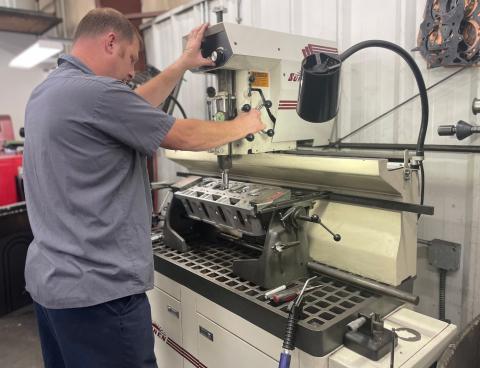
The machinery in the shop comes from Rottler, Sunnen, and Bridgeport. “We just bought that brand-new Rottler [H85-series] hone that they premiered at the PRI Show last year,” Nesbitt said. “I think there’s two of them on the East Coast. That thing is a time-saver, and it does a really good job.”
He’s considering buying another Rottler machine within the next two years to help with block prep. “With most of the heads that come in, most everybody’s running CNC programs now, so that is automated. So then you’re seat-and-guide working and assembling the heads. But you spend probably three or four times the amount of time prepping blocks and getting them where you want them, so that machine would help. The amount of time it takes to prep these brand-new blocks is a real constraint.”
Nesbitt said he’ll make the decision on the new machine “from the way the growth of the business looks, how the business is going to trend into this next year, volume-wise. Last year was the best year we’ve ever had. And this year we’re real close, within 5 to 10% of that. I don’t see it going backwards any. The industry still seems to be going strong.”
Every Shape, Form, or Fashion
Nesbitt’s specialty is “99% big block Chevrolets,” he said, “whether they’re bracket racing engines or nitrous platforms. Every shape, form, or fashion a big block Chevrolet goes, we do here, all the different cubic inches and bore spacings.” His most popular engine packages include a 632-cubic-inch, 12-degree engine that runs on race gas; a 582-inch conventional headed motor that will run on either gas or alcohol (Nesbitt calls it “a workhorse. It can run a lot of laps and it’s very low maintenance.”); a couple of different engine combinations with 20-degree heads; “and we got a 4.840 [bore space] nitrous combination that probably encompasses 90% of the new engines we build.”
Most of Nesbitt’s customers are on the East Coast, from the Northeast down to Florida, though he’s seeing growth in sales from the Midwest and as far west as Washington state. He’s even shipped engines overseas, including to Qatar. “We ship everywhere.”
Brett Nesbitt’s specialty is “99% big block Chevrolets,” he said, “whether they’re bracket racing engines or nitrous platforms.” This is one of his fuel-injected and nitrous-fed big blocks. What sets the engines from his shop apart, he believes, is “the quality of the machine work and the performance numbers we get out of them.”
When asked what he thinks sets his shop apart from other engine builders, Nesbitt said, “It’s the quality of the machine work and the performance numbers we get out of them.” He chooses parts, from vendors that include Brodix, Dart, and Advanced Product Design, among others, “strictly on quality. I’m not as much about cost.
“There are certain components at a certain power level that are capable of handling the workload, but when you get up to the higher horsepower motors, you need to go to a different tier of quality. For the top-end motors we get, all they get are the top-end parts I know of. I don’t want to put a sub-par part in it because that one part can compromise the whole combination. If I have a product or a combination that’s out there working, I don’t like to deviate from it—as far as the part. We might mess with machining operations to try to get more power, but component-wise, if I have something out there that’s making a lot of laps and not giving any trouble, I’m not going to change it. Even if I have to wait to get that part, I’ll wait.”
And sometimes Nesbitt has to. His lead time to build an engine is “100% parts-availability-driven right now. I try to keep in stock stuff that I know we run in larger volumes, like the parts for the really popular bracket motors that we sell. But if I run out of parts and I can’t keep the pipeline full…I mean, just the lead times on blocks right now is 12 to 14 weeks.
Nesbitt Performance Engines uses only premium parts for its customers’ high-end, high-horsepower engines. “I don’t want to put a sub-par part in it because that one part can compromise the whole combination,” Brett Nesbitt said.
“If I’ve run out of a particular part for the combination somebody’s looking for, and you tell them it’s 15 or 16 weeks, it seems like in this industry, if they have the money in their hand, they have to spend it,” Nesbitt continued. “So you’ve got to stay ahead of the parts. That’s one thing we’ve done in the last two years. Since Jen’s been here, we have kept a whole lot more inventory. We’ve done that since the pandemic, because you have to be able to provide the service in a timely manner.”
He Shows Up
Troy Williams and Michael Paschal, another Nesbitt customer, cited the shop’s high level of service as a big reason they keep coming back.
For Paschal, a Top ET bracket racer from Greensboro, North Carolina, Piedmont Dragway in Julian “is about 15 minutes away in my backyard. Nesbitt’s shop is, I guess, a good 40 minutes probably for me, but it would take Brett probably 30 minutes to get to the track. There have been several times that I would be at the track on a Friday evening testing, and I would call them and say, ‘Hey, I need help changing this, changing that,’ and the next thing I know, here he is showing up in nice clothes, work clothes, it doesn’t matter, he shows up. He’ll give you a hand. That’s just how all of those guys are over there at their shop.”
“Two years ago, we just freshened up the engine, and I put it in the car and took it out for the first weekend,” Williams recalled. “It had a noise that I just couldn’t find. I called Brett at 1:00 on a Saturday and told him I had this noise. He said, ‘Check this, check this, check this.’ I checked everything. I called him back, and he told me to put the car in the trailer and meet him at his shop. I was racing in Virginia Motorsports Park, which is about two-and-a half hours from Brett’s shop. I said, ‘Brett, it’s 1:00 on Saturday.’ He said, ‘I didn’t ask you what time or what day it was. I told you to put the car in the trailer and meet me at the shop.’ So on a Saturday at 3:30–4:00 I roll into his shop. It’s him and one of his head guys, Jered. They instantly diagnose the engine, found that it had a bad lifter in it, a brand-new bad lifter. Fixed it by 6:00. I’m back on the road headed back to VMP. That’s the kind of service he gives you.”
Service and performance. “I have a true conventional 24-degree headed 632 in my car right now,” Williams explained. “We just qualified it at a PDRA event with a 4.38. It has no power adders. It’s 100% horsepower with conventional heads.”
Paschal’s engine is a “632 Headhunter motor on alcohol. My best ET with it so far is a 4.43. Being on alcohol and a conventional head motor, that’s really stout. You typically don’t see alcohol motors going 4.40 anything. So a lot of people were very, very impressed with it, seeing how fast it is and just how consistent it is. This is my first year with it, and it has taken me to 11 finals this year,” he said.
Brett Nesbitt said his lead time for an engine build is “100% parts-availability-driven right now.” Since the pandemic, he has kept more of the in-demand parts in inventory, “because you have to be able to provide the service in a timely manner.”
Paschal recently raced at the Fall Fling event in Bristol, Tennessee, and said after the first day of racing “the race promoter came up to me and said, ‘Man, we pulled your sheets from all your passes today, and we have never in our lives seen a car, or a setup, that consistent.’ People couldn’t believe it. I posted my slips on the Internet, and people were just blown away with how consistent this thing was. It was like a copy machine, like the same run over and over and over. Those guys, they do really, really good work. You couldn’t ask for any better,” he concluded.
Does eighth-mile racing hold the secret to drag racing’s long-term success?
“Drag racing is such a sensory experience—the sights, the sounds, the smells. Watching it on TV is cool, but being there in person is so much better.”
Drag racer and PDRA marketing director Will Smith hit on something important as he contemplated how to protect drag racing’s future. He wasn’t naïve to the headwinds facing the industry; Smith has heard the naysayers’ various arguments—the core demographics are aging, younger generations don’t care about cars, land is too valuable, the future will be all-electric—but he also understands drag racing has unique appeal.
Drag racing is meant to be felt.
Just as a spectator can feel an NHRA Top Fuel car scream to the 1,000-foot mark at more than 330 miles per hour, a grassroots competitor can feel the camaraderie of the competition at the local drag strip. Professional drag racing gets the national attention, but you might discover the key to drag racing’s future at a simple grassroots eighth-mile event.
“The heartbeat and backbone of drag racing is at these local drag strips run by families that are sustaining themselves in very small markets,” said Chris Graves, owner and operator of Funny Car Chaos. “I can’t tell you how many eighth-mile tracks there are in Texas, Oklahoma, and Arkansas that have been open forever and are staying open.”
Embrace the Chaos
Based in Princeton, Texas, and hosting races from coast-to-coast, Graves’ Chaos series is arguably one of the most entertaining and successful drag racing shows in the country. You won’t find John Force or Ron Capps there, but there’s no shortage of authenticity or colorful characters.
Racing strictly on the eighth mile, the series launched in 2017 as a one-race showcase of grassroots Funny Cars from all eras. It wouldn’t take long for demand to grow the Chaos brand into two different series—Funny Car Chaos and Nitro Chaos—with a healthy slate of 14 races on the books for 2024.
The rules are simple. “The magic potion is that we are basically a rules-free race program,” said Graves. “We don’t have a limit or regulation on engines, body styles, or anything like that. The safety stuff is obviously checked and required, but outside of that you can run any front-engine Funny Car or nitro car.”
The potion works like a charm. The series welcomed its 200th different Funny Car into competition this year and regularly packs the grandstands with drag racing fans of all stripes. They line up nostalgia Funny Cars, modern day Funny Cars, nitro and alcohol Funny Cars—there’s something for everyone. With unlimited horsepower on the line, the series sticks to eighth-mile racing for two simple reasons: safety and affordability.
“The parts attrition is a huge part of why we’re running eighth mile,” said Graves. “These are grassroots racers; they aren’t professional race car drivers with million-dollar budgets and sponsors on the side of their car. Our drivers have names on the side of their car like Ballew Thunder, Mr. Explosive, Grim Reaper.”
It’s a great example of the power of authenticity and accessibility. Graves ensures his races feature a family-friendly atmosphere and that fans have unlimited access to the race cars and drivers in the pits, allowing them to interact with the stars of the show.
This is a key page from a playbook finding success right now. The strength of eighth-mile grassroots drag racing is not driven by windfall profits, but by people with a dedicated passion for the sport.
“All of the independent eighth-mile drag racing series are sitting pretty good right now,” said Graves. “It’s just a different atmosphere [at the track]. It dates back to where the big show was 25 or 30 years ago.”
Give, Don’t Take
The World Drag Racing Alliance (WDRA) just left the starting line a year ago but has found success with a straightforward mission: Give back to the sport at the grassroots level and make it sustainable for everyone involved.
“WDRA is strictly in service to the track owners and bracket racers at the core of our sport,” said Skooter Peaco at the WDRA, Springfield, Illinois. “WDRA will give more to the sport than it takes and will work to form an ‘alliance’ between the sanction, the tracks, the racers, and the sponsors so everyone benefits and not just one group.”
“Parts attrition is a huge part of why we’re running eighth mile,” said Chris Graves of Funny Car Chaos. “These are grassroots racers; they aren’t professional race car drivers with million-dollar budgets and sponsors on the side of their car.”
Grassroots drag racers are passionate about their sport, but the love of racing only goes so far. The economic model still needs to be sustainable.
“We see that the racers are less likely to travel to events that don’t have the proper overall value,” said Peaco. “The facility location, parking, timing, the race itself, the people behind the event, and the opportunity the race provides all get factored in.”
One important element to providing value is getting sponsor dollars and discounts into the right hands. “We created a way for sponsors to support racers and tracks without the commissions or fees they would normally pay to the sanction,” said Peaco. “We created nearly a dozen tangible discounts for our member tracks and several discounts for our racers. This puts real money back in their pockets.”
According to Peaco, some tracks have saved up to $15,000 during the season due to these discounts, not an insignificant amount for a local track. The WDRA is not just helping existing tracks save money, but it’s also helping new tracks come to life.
In 2023, WDRA partnered with Street Legal Dragway in Southern California. Owned and operated by Andy Marocco, this brand new, 330-foot drag strip “aims to provide a safe and legal platform for regional street car enthusiasts to unleash their horsepower and compete.” (Learn more about Marocco’s vision for Street Legal Dragway on page 50.)
Drag racing for 330 feet is a new concept, but it aligns with the WDRA’s mission to do whatever is necessary to keep drag racing going strong into the future.
Small-Tire Success
Like any form of motorsports, drag racing is in a constant battle to stay relevant. Fortunately, with the success of the No Prep Kings TV show, which just completed its sixth season, and the growing reach of drag-and-drive influencers like Cleetus McFarland and Tom Bailey, small-tire drag racing is helping grow the sport amongst a younger fan base.
Stefan Rossi, owner of ACE Racing Engines in Torrance, California, knows all about the success of small-tire racing. After relocating his engine shop from the UK to California in 2019, business boomed. A dedicated quarter-mile racer back in the UK—where the eighth-mile trend is still slow to catch on—his move to the US converted him to running eighth mile.
“All my life I was like, ‘No, eighth mile is boring,’” said Rossi. “Then probably a year after being in the [United States], I totally flipped. Now I look forward to running the eighth mile, whereas I don’t really look forward to running the quarter.”
Today, most of his business is dedicated to building turbocharged eighth-mile engines for drag radial outlaw racing. He’s busier than ever, often working 15-hour days to keep up with demand. When not working on an engine build for a customer, he’s building his 1966 Nova to compete in the Pro 275 class in the Fueltech Radial Outlaws Series, a highly competitive and popular series.
“Car counts at these [Outlaw] races are huge, with 32-car fields for most classes,” said Rossi. “Two customers at a recent race were parked out in the grass because there was no room in the actual pits.”
Rossi believes the growing appeal of drag radial outlaw racing is due to the variety of classes and its accessibility for amateur racers. “It’s appealing to working class people because it’s actually reachable,” said Rossi. “There are so many different classes and different speeds ranging from the mid-3s to the 5.50s, so you can fit in pretty much anything according to your budget.”
For an engine builder obsessed with performance and engineering, the appeal of eighth-mile outlaw racing is straightforward. “I think eighth mile shows the true performance,” said Rossi. “Everything must be perfect—the engine, the chassis, the trans, the converter—to go sub-one in the 60-foot and then sub-four in the eighth. Whereas in the quarter mile, you can get away with a bit more.”
Shrinking Margins, Skyrocketing Performance
The Professional Drag Racers Association (PDRA)—the eighth-mile drag racing series based in Fredericksburg, Virginia, with events on the East Coast and in the Midwest —continues to see growing car counts and razor-thin margins.
“Ten years ago, Pro Nitrous running 3.70s was crazy fast. Now that time is borderline of qualifying,” said Smith. “Today there are cars running 3.60 flats, and they’re knocking on the door of the 50s. Two-tenths of a second improvement in this short amount of time is huge, and that’s happening in every class.”
All our sources, including the PDRA, cited reduced cost as an important reason behind the success of eighth-mile racing. It’s easier on parts, which is easier on the budget.
In addition to ultra-competitive Pro Mod racing, PDRA features several other classes ranging from super street to Junior Dragsters. To hear Smith describe it, car counts are up, ETs are down, and interest is peaking.
“Every year that goes by we get bigger and better,” said Smith. “Spectator turnout grows, our car counts go up or hold steady in all classes. The PDRA brand just continues to grow, and we’re going to keep building on it.”
Safety Comes First
All our sources cited reduced cost as an important reason behind the success of eighth-mile racing. It’s easier on parts, which is easier on the budget. More importantly, with the increased speeds of cars today, 660 feet is significantly safer for drivers.
“When you try to run these cars quarter mile, they get hairy and you’re on edge,” said Smith. “You take a Pro Mod running over 200 to the eighth, it’s going to gain 50-plus miles an hour out the back to the quarter. Those 50 miles an hour make a big difference from a safety standpoint.”
“WDRA is strictly in service to the track owners and bracket racers at the core of our sport,” said Skooter Peaco. “We created nearly a dozen tangible discounts for our member tracks and several discounts for our racers. This puts real money back in their pockets.”
Drag racing is inherently dangerous, but as we continue to coax more speed and power out of vehicles, that risk needs to be mitigated. Just consider it was 1992 when Kenny Bernstein first broke the 300-mile-per-hour barrier in the quarter mile. Fast forward to 2023, Mike Salinas just topped 300 miles per hour in the eighth.
With speeds and acceleration rates skyrocketing, sufficient shutdown space is key. The PDRA only runs the eighth mile, but often uses quarter-mile tracks that offer longer shutdown areas.
Graves invested in Dave Leahy’s Electrimotion Shut-off Transmitter and Safety Shut-off Box for the Chaos series—a system that automatically deploys the parachutes and shuts off the fuel and ignition of a car once it crosses the finish line.
“We purchased the Leahy system this year as a safety upgrade to help us control some of these cars on the eighth mile,” said Graves. “These tracks that are 50 or 60 years old were built when cars were way slower. Now they’re crossing that same length of real estate much faster and at a higher rate of speed.”
The PDRA, which runs only eighth-mile races, keeps getting “bigger and better” every year, said Will Smith. “Spectator turnout grows, our car counts go up or hold steady in all classes. The PDRA brand just continues to grow, and we’re going to keep building on it.”
Tighter competition, increased safety, and decreased costs will always be a winning combination. Despite the amplified grumblings of a few quarter-mile traditionalists, people who love drag racing aren’t there for a distance, they are there to race. Light up the Christmas tree, mash the gas, race to the strip—there’s beauty in the simplicity.
“I’m a drag racing fan and I’m a drag racer,” said Smith. “I don’t care the distance; I just love drag racing.”
Back to Basics
Racing is all about winning, but working together as an industry to embrace change and innovation scores the biggest victory—a thriving industry. That’s what keeps the lights on at the hometown track and the wrenches turning at the local race shop.
“I think eighth-mile drag racing’s success is backed up by the industry it’s created,” said Graves. “There are so many businesses in hot rodding now and so many manufacturers that are able to sustain and grow their business with people buying their parts.”
Most importantly, drag racing’s appeal is no longer concentrated to one sanctioning body or style of racing. The interest is everywhere.
“If you step back and look at drag racing in a box, right now I’d say it’s more successful than it was 30 years ago,” said Graves. “Today you’ve got 100 different ways to drag race, whether it’s small tire, no prep, Funny Cars, electric cars, it doesn’t matter.”
The trends are pointing in a clear direction: a grassroots revival.
Rossi is seeing an increase in no-time racing, no-prep racing has found mainstream success via television, and no-rules racing has found popularity in the Chaos series. In 2024, the hunger for drag racing is strong, and those who wish to dismiss the sport clearly haven’t been paying attention.
“Kids don’t hot rod anymore, and motors are run by computers now, but there’s still this quest for speed and trying to go faster in whatever way you want to do it,” said Graves. “The pulse is good; the drag racing pulse is good.”
Southern California’s 330-Foot Opportunity
Southern California is the birthplace of drag racing, but today only three public drag strips remain—Barona, Irwindale, and Bakersfield—serving roughly 24 million people. The reasons are unfortunate but familiar: soaring land values, increasing insurance premiums, and online retailers’ propensity for replacing race tracks with distribution centers.
There are no easy answers to this problem, but Andy Marocco has come up with a unique solution. In fall 2023, he officially opened Street Legal Dragway in Perris, California, a 1/16th-mile drag strip catering to the street-legal racing crowd.
“We have a unique opportunity to reinvent a segment of drag racing and bring it back to where it used to be,” said Marocco.
With limited space to work with, Marocco drew inspiration from the Hot August Nights Drag Races in Sparks, Nevada. Since 2011, the massive car show transforms a casino parking lot into a functioning 1/16-mile drag strip for four nights of street-legal hot rod competition. The concept has worked well and proven to be popular, so Marocco decided to bring the idea south and try it on a permanent basis. He pitched the idea to the World Drag Racing Alliance (WDRA), which partnered with him to turn his dream into a reality.
“It isn’t every day that you get to help create a new drag race venue, while at the same time aiding in getting street racing to the track where it belongs, and doing it in California,” said Skooter Peaco at the WDRA, Springfield, Illinois. “Andy’s model is very viable and could really help slow down the problem of our tracks disappearing.”
As with any radical new concept, just getting the drag strip open involved several challenges that most track operators wouldn’t encounter. First off, there were no set rules for a 330-foot drag strip, a concern for insurance companies.
“With the WDRA’s help and sanctioning, we were able to create a new set of rules for 330,” said Marocco. “It wasn’t just about building a drag strip, we also had to rewrite the standards for the insurance underwriters as well.”
Street Legal Dragway is a new concept in drag racing, a 1/16-mile drag strip catering to the street-legal racing crowd. “The ‘traditional’ drag racer may not think 330 feet is a viable option, but they are forgetting that this isn’t for the traditional drag racer,” said the WDRA’s Skooter Peaco. “It is for the kids on the street who aren’t coming to drag strips right now.”
With the paperwork complete, the asphalt laid, and the gates officially open, would people be interested in 1/16-mile drag racing? The initial reception has been positive, with Marocco saying his soft opening saw around 75 cars come out and positive sentiments from those in the pits.
“The appeal is the fact that you can test and tune, you can have eliminations, brackets, you can run for prize money or trophies—there’s something in it for everybody,” said Marocco. “It’s also affordable. What other motorsport can you name where you can go race your vehicle for 40 bucks?”
The affordability is important, but it takes more than cheap runs to keep racers coming back. Marocco is banking on the fact that “330 racing” takes drag racing back to its roots and delivers ultra-competitive racing. Margins will be even tighter, producing a challenge for drivers and an entertaining show for spectators.
“The drivers have to gear it different; they have to learn how to control the clutch a little different,” said Marocco. “I think most racers fear that they may look foolish on a 330 track because there’s less time and less distance to make up for an error.”
Marocco said that a 330-foot drag race is distilled down to two core components of drag racing. “The equalizer right now on our track is traction and reaction. That’s it, that’s the purity of the sport.”
Ultimately, the mission of Street Legal Dragway is to reduce illegal street racing by providing an outlet for drag racing in a region that has limited opportunities to do so. It’s not traditional drag racing, but Marocco’s unique vision is exactly what attracted the WDRA to throw its support behind the idea.
“The ‘traditional’ drag racer may not think 330 feet is a viable option for our sport, but they are forgetting that this project isn’t for the traditional drag racer,” said Peaco. “It is for the kids on the street who aren’t coming to drag strips right now. Andy is introducing a generation of street racers to a safer alternative and a place they can hang out on a Friday night.”
Honoring drag racing’s heritage is important, but as Marocco and Peaco explained, maintaining a rigid traditionalist mindset is counterproductive to the health of the sport. Times change, circumstances change, and being open-minded will ultimately keep drag racing alive for decades to come.
“‘Traditional’ racers initially hated eighth-mile racing when it first debuted, and now eighth-mile racing is pretty much the standard,” said Peaco. “WDRA is behind this project because if we want to ensure that our sport is around for another 70 years, then we need to start thinking about it differently.”
One-sixteenth-mile drag racing won’t be for everyone, but it fills an important niche with the street car crowd. Additionally, in drag strip-starved locations like Southern California, a 330-foot track can easily be built for a temporary event—like Hot August Nights does every year.
“Three-hundred, thirty racing is definitely something I think we’ll see more of in the future, because you can accommodate it in a lot of different places, like abandoned parking lots or shopping centers,” said Marocco.
Located on state fairgrounds, Marocco’s Street Legal Dragway has a five-year contract, with another five-year option at his discretion. It is an innovative idea, and it will be interesting to see how 330 racing fares in the months and years ahead.
“Somebody’s got to take the risk. I did it,” he added.
Opening a new drag strip in Southern California is always a risk, but taking on that challenge in an effort to preserve the future of our sport? That’s a risk worth celebrating. —Jack Haworth
Today’s driver training regimens incorporate much more than just extra laps on the track.
Like every aspect of racing, the quest for improving driver performance is only accelerating. For long-time followers of motorsports, the training regimens modern drivers have adopted is astonishing to witness.
Driver fitness was not always a given, to say the least. Just a couple of decades ago, driver fitness was often measured at the post-race beer bash. Mark Martin raised eyebrows in NASCAR garages in the early 1990s when he swore off drinking and channeled his energies into daily weight-lifting routines and a strict nutritional focus. His case was considered so unusual that it was a widely reported story in the sports media.
Martin was a bit of an outlier at that time, but today any driver not following a comprehensive fitness routine would be an outlier in the sport. Now the stakes are higher, the money greater, and the competition to make it to the top even more fierce.
Physical fitness and strength training are a necessity, and there are many schools of thought on the best paths for drivers. But fitness between the ears is also a major factor. Advances in neurocognitive research, and breakthroughs in technology that have revolutionized training techniques, have transformed how drivers approach their training.
While drivers have become more focused on their overall fitness in the car, they can often overlook the importance of hydration, said Todd Hayes of FluidLogic. New in-car hydration systems make it easier than ever for drivers to keep their fluid and electrolyte levels up, and those who do are staying at the top of their game, Hayes said.
“It’s becoming more commonplace for research to be done on this racing business because it’s more popular, it’s more extensive,” said Jim Leo of PitFit Training, Indianapolis, Indiana. “It has changed, and it has changed for the better. I think that’s a good thing. The bar has been raised over the years.” PitFit has specialized in the human performance side of the motorsports industry for nearly 30 years and has collected extensive data along the way.
We spoke with several sources about the latest techniques for improving driver performance. For some of our sources, their techniques are proprietary, and specific methods are held close to the vest. For others, such as The Mental Agility Coaching Center in Park Ridge, Illinois, since they are licensed mental health professionals, they must maintain the confidentiality of the people they work with. But all had important insights into the latest training techniques to elevate drivers to the next level.
Overcoming Weakness
The reasons drivers seek out sports performance training facilities span the gamut. Jordan Stewart is a cognitive trainer at The Mental Agility Coaching Center and a licensed mental health therapist with a master’s degree in Sport and Human Performance. “We do have people who come in who’re not very confident, they’re feeling a little anxious, maybe they are tentative or hesitant going into turns, but sometimes—a lot of the times—people are just trying to get an edge, too,” she said.
Quite often, drivers will approach trainers with what they feel are weak spots in their performance, but they are not always the best judges of their own capabilities. “Everything starts with our assessment,” PitFit’s Leo said. “Drivers will come to us with what they perceive as a negative component, and fixing this component will in fact make them more productive in the race car. And then we’ll do an assessment and determine that maybe where they consider themselves to be inferior, they’re not. They may just be average. And there may be some other areas that could dramatically improve their opportunities to succeed in the race car.
“Our assessment is very comprehensive,” Leo continued. “It takes the entire day. It’s mental and it’s physical. We do interviews with them, and so the driver will oftentimes discover that where they felt they were not lacking, they in fact are. We have a data pool for comparison for the last 25 or 30 years to show, ‘This is where the top level, the mid-level drivers are, and this is where you are.’”
Unpacking mental baggage is often a part of a sports training specialist’s job. “When racers fail to perform well in qualifying or race sessions compared to practice, that’s a sign their mental game might be the issue,” said Patrick Cohn with Peak Performance Sports, Orlando, Florida. “We help with perfectionism, dealing with mistakes, pressure, distractions, and over-driving, to mention a few.”
According to Cohn, perfectionism is a particular issue he encounters. “This happens when racers think the ‘stars have to align’ to feel confident,” he said. “How they feel, the track conditions, the car set-up, etc. has to be right to feel confident. Perfectionism also leads to high expectations, getting easily frustrated with mistakes, being self-critical, worrying about what others think, and wanting the car and driving to feel perfect.”
There are times, too, when drivers may not even be aware of their shortcomings, or of newer technology that can boost their endurance. FluidLogic in El Segundo, California, manufactures advanced in-car driver hydration systems and finds itself having to overcome the outdated perception that a driver receiving a plastic water bottle during a pit stop will keep the driver sufficiently hydrated.
“To be honest with you, hydration is one of the last things the drivers think about nowadays, which is really puzzling, with the level of competition, how it has increased and how the driver has become a little more focused on overall fitness in the car,” said Todd Hayes of FluidLogic. “I feel they still don’t look at hydration as being super vital to their performance in the race car.”
Training Techniques
The days when training equipment for athletes was limited to jogging shoes and a weight bench are over. Advanced cognitive training equipment and techniques available today work on reaction time and visual field awareness by developing the neural pathways in the brain, and how the brain makes decisions and responds to stimulus in the environment.
Among the tools The Mental Agility Coaching Center uses are Fitlights. “The Fitlights are discs, and we can set any type of parameter on them,” Stewart said. “We can change the colors, we can change the way they light up, so if we want them to light up just a little bit, we can put up a dot, or we can light up the whole light. We can change the timing, we can have it delay. So we can do whatever we want with the lights to put these athletes in cognitive overload. Which means putting them in a place where their brains are thinking hard. Challenging them with different lights, challenging them to react to the different colors, the different setups that we have, the reaction time.
“I used those to put a driver in cognitive overload recently. Not even a week later he was saying, ‘I felt so much more comfortable in the turn.’ Because thinking about when you are in that turn, you have a bunch of stimuli around you—lots of cars, you’re kind of claustrophobic, and the natural thing a human would do is back off. So let’s try to get him to be so cognitively stimulated and overloaded in this situation that he can go into those turns and feel okay.
The Mental Agility Coaching Center uses Fitlights to put athletes in what Jordan Stewart called cognitive overload. That means “putting them in a place where their brains are thinking hard,” so they learn to react to increasing amounts of stimuli without backing off.
“The more stimulus we have and the more we can practice this, the slower the race track is going to feel,” Stewart continued. “If you’re racing and then you go and drive on a normal road, everything around you feels a lot slower. That is actually the goal of this training, for the brain to be thinking so quickly that in these really fast, highly intense situations, your brain is processing so fast that your decision making is second nature. There’s no hesitation.”
Visual tracking is another technology that The Mental Agility Coaching Center has enthusiastically adopted for driver training. “The visual tracking in particular really lit me up when I started learning about it,” said founder Dave Marks. “The visual tracking for me just really captures my imagination, because in effect we are able to see the visual field, the point of view, of a driver, or any performer, and also see specifically what they are looking at. I can tell if a driver going into a turn is looking at a distance marker, versus a car in front of them, versus checking their mirrors.
“There is a study that was done that I think is pretty cool, by Pupil Labs, which created this particular technology. They showed that for a NASCAR pit crew, by doing visual tracking, they were able to knock two-tenths of a second off per lug nut. Which, if you do the math, that comes down to a second, and that, in turn, at say, an average of 100 mph, that’s 146 feet,” Marks said.
Driver training today can even pinpoint imbalances in body chemistry that can affect performance. Among the information PitFit acts upon following its driver assessments is the lactate threshold. “Your lactate threshold is the point when your body starts producing larger amounts of lactic acid, larger amounts than your body can tolerate, which will fatigue you,” Leo said. “When fatigue sets in, then a number of other factors become apparent—your focus, your ability to concentrate, all these other areas. So we’re going to improve your lactate threshold. You’ll be able to work at a higher level without producing this acid. We’re going to train you to do that.
When Pupil Labs trained NASCAR pit crews in the skill of visual tracking, they were able to knock two-tenths of a second off of each lug nut, which can be a significant time savings over the course of a race.
“In the car, your heart rate is higher. And when you produce this lactic acid, suddenly all these areas you could stay focused on to be at your highest level are going to deteriorate. So now, instead of you driving the car at 165 beats per minute, at which point your body starts to break down, you can go all day long at 165 because we’ve raised that lactate threshold to 170 through the proper protocols,” Leo added.
Certainly, top racers are clued into the benefits of advanced driver performance training and leading-edge equipment. “I worked with AJ Allmendinger,” Cohn related. “He said, ‘Mental coach has taught me what to focus on in and out of the race car. How to stay calm and focused have been key skills that I have learned, which have helped me be a better and more confident race car driver.”
PitFit counts top Penske drivers among its clients, building on a relationship with Penske Racing that dates back to 1993. “Scott McLaughlin is a great example,” Leo said. “He didn’t start working with us until this year. In his first year in IndyCar, he was 14th as a rookie, and then he was fourth, but the lowest Penske driver even though he was fourth. Then this year he ended up being third in the championship, and the top Penske driver. His teammates are Indy 500 champions and two-time series champions. For him, it was consistency. We worked with him and changed his body and his diet and his mindset.”
Hayes has witnessed how the FluidLogic in-car hydration systems have allowed drivers to stay at the top of their game. “This year we won the Indianapolis 500 and the IndyCar championship with FluidLogic,” he said. “Those drivers are very tuned in to staying hydrated in the cockpit, because they are in a closed cockpit now, too. Heat never was an issue in the open wheel world until they put a windscreen on an IndyCar.
“Getting drivers to learn how to control their mind and be calm, inside and outside the car, is an element you’re seeing more and more of,” said Jim Leo of PitFit Training. “You’ve got to take care of yourself outside of your respective sport to be productive in it.”
“And I would add Tyler Reddick in the NASCAR world. Hydration is his most important preparation tool for the race. He’ll drink about 120 ounces of water in a 500-mile race. He’s somebody who will change drink bottles within his car two to three times during a race, and he really pays attention to it,” Hayes added.
Future Trends
Looking ahead, it seems likely that developing a driver’s mental game will continue to be a key element in improving driver performance. “Getting drivers to learn how to control their mind, inside and outside the car, to be able to control their mindset and be calm, is an element you’re seeing more and more of,” Leo said.
“Mental coaching helps racers focus on a functional performance instead of a perfect race,” Cohn explained. “We help racers manage expectations, focus on the process, be less self-critical, let go of mistakes quickly, and not worry about what others think on the team.”
Small gains in mental acuity can lead to big gains on the track. “If you start working the mental game and you start working the neurocognitive side, you’re going to have the advantage over everybody else who isn’t,” Marks said. “That advantage can be critical. If it gives you an extra two or three seconds through efficiency gains during a drive, I’ll take that. That’s a couple of places at least.”
The limits of driver performance are still being explored, but with the explosion of sports training specialists entering the field, especially in this social media age, drivers may need to reign in their natural need for speed and vet sources carefully. “I think due diligence for the drivers is important, to really research who they are working with and get feedback from some of the clients,” Leo advised.
But after identifying legitimate training sources, drivers should not be reluctant to explore leading-edge methods for improving their performance. “The days of people just doing their activity and moving on have long passed,” Leo said. “There’s enough research being done that shows that you’ve got to take care of yourself outside of your respective sport to be productive in it. With athletes it’s critical.”
Primary sponsors often receive the accolades for their contribution to motorsports, but it’s the numerous, smaller entities that, when combined, complete the funding process. Here, we provide a view from the sponsor’s seat with Andrew Norman of Colibri Capital.
The business side of racing is never easy. It takes a tremendous amount of money to run at any kind of professional level, and the number of zeroes keeps getting longer the higher you go. To make ends meet, drivers and teams typically need sponsorship. But getting and keeping sponsors is an entirely separate skill from piloting any kind of race car, and not every aspiring driver or team is good at it. No one knows how many world-class drivers have been denied the chance to shine at the highest levels of racing because of finances, but it’s a big number.
That’s why we sat down with Andrew Norman of Colibri Capital in Bellevue, Washington. We met Norman somewhat by chance at the IndyCar Grand Prix of Portland and learned that he’s a sponsor of Benjamin Pedersen, driver of the No. 55 IndyCar for AJ Foyt Racing. Pedersen raced his rookie year in IndyCar in 2023 after finishing as a top-five driver in IndyNXT in 2021 and 2022, with previous F3 and F4 experience dating back to 2016.
Pedersen finished the 2023 IndyCar season in 27th place, with no wins, podiums, Top 10s, or pole positions. Yet the cost to field his car is not materially different from the cost to field the series champion’s car. We wanted to dive in with Norman to ask about what draws a sponsor to spend precious marketing budget to back a driver, and what it takes to keep them coming back. What we learned was how a new generation of motorsports enthusiasts can band together to become involved in racing at a much higher level than they could ever expect to achieve individually.
PRI: Before we get into racing, give me your elevator pitch. What does Colibri Capital do in the world?
Norman: We are a financial planning, investment management, and protection business. We build custom financial plans for individuals, families, businesses; write custom financial plans; and then we align investments in insurance products to meet the stated objectives of a client.
PRI: Okay, that doesn’t scream motorsports like, say, STP or Champion Spark Plugs. What brought you to the idea of sponsoring a racing driver?
Norman: We have a passion for motorsports, and during COVID-19 lockdowns, when traditional methods of engaging with clients went away, we created a “stay on track” campaign and began working with Global Racing Group and Benjamin Pedersen when he was in IndyNXT. Over the years that relationship has expanded and our relationship with Benjamin has grown. Initially we started all this as a passion project, and it’s escalated over time.
PRI: Your relationship with Benjamin Pedersen is organic, but what would you look for in a driver or team to consider sponsorship?
Norman: Given the nature of our work, we’re looking for consistency and predictability, and someone who we feel can represent our brand well as an advocate. As it relates to Benjamin in particular, he’s levelheaded, he’s very consistent, and has been over the years. He really focuses on doing the very best he can with what he’s got. He’s also a hometown, homegrown driver from Seattle, like us. So when it comes to market activation, we have a lot of clients who are motorsports fans because you tend to end up doing business in the areas that you’re passionate about.
PRI: It’s a big jump from being passionate about motorsports to backing an IndyCar driver. This isn’t really typical, is it?
Norman: Sometimes financial advisors are passionate about wine, and they do a lot of events at vineyards, and there are advisors who are passionate about beer, and they go to Oktoberfest. For us it’s been motorsports, and we are actively involved because we learned about Benjamin and his IndyNXT pursuits. We saw press and articles about him, and that’s how it all came about.
PRI: Does Benjamin do appearances or other activities away from the track?
Norman: Earlier this year we did a celebration with Avants car club, and we had Benjamin as a guest. The celebration was for all of the volunteers and all of the partners of Avants. We did it at a private car collection. Benjamin came out and was a guest speaker and said hello to everybody and introduced himself. It made it a lot easier that he’s from the Pacific Northwest, so he knew where he was going, and all of the logistics were fairly straightforward. But he lives in Indianapolis now, so he had to hop on a flight. We took care of that.
PRI: Let’s talk about the unique way your small company gets together a bigger check for sponsorship. How do you come up with the money?
Norman: Well, Ameriprise is a big Fortune 500 company. We’re part of Ameriprise, but as Colibri Capital we have our own brand and our own practice. Our view was that we wanted to do something innovative where other advisors might be interested to piggyback on it. Because Ameriprise is a national firm, there are advisors in other regional markets who have expressed interest in doing something similar to what we’re doing or participating in what we’re doing. We’ve created this pathway where we got approval for community relations, and we got approval for brand standards from Ameriprise. So now we’re in this effort to create a list of advisors who would like to join us for the 2024 season.
“It’s not enough to simply have the brand or logos on the car,” said Andrew Norman of Colibri Capital’s innovative approach to sponsoring Benjamin Pedersen’s IndyCar efforts. “Strengthening existing relationships and building new ones can happen anywhere, but we really enjoy having that happen at the race track.”
All of this stuff takes a lot longer when the budgets get bigger. But if you imagine that there are 10,000 advisors at Ameriprise, if 100 of them want to participate in a program like this, then all of a sudden you have created an economy of scale. If each interested advisor kicks in $25,000 to the sponsorship, then we’ve got a $2.5 million racing budget. We’re not there yet, of course. It’s going to take some time. But we’ve got the pieces of the puzzle in place. I’m doing the heavy lifting of talking to advisors all across the country who have questions about how it works and what they can do with it.
What’s different about our approach is that it truly is a grassroots effort. We’re not asking our corporate marketing department to write a big check, because this is something that’s very new and historically not something where they have an allocated budget. That doesn’t mean it will never happen, but what’s new about it is that I’m having conversations with advisors one-on-one, and each advisor who wants to join tells his or her colleagues about it. Then when we have 25 or 50 people, it starts to spread like wildfire. More people hear about it, and more people want to participate.
PRI: This column is read by people who wake up in the morning wondering how they can fund their racing operation. They’ve been told a million times that there has to be return on investment. How can a driver or team provide that return, and how much return do sponsors expect to get?
Norman: For the advisors in the short term, the way that we’ve utilized it is we’ve had weekends where we’ve hosted trackside hospitality. We have hosted hospitality at the Indy 500, the Indy GP, the Portland GP, and we have participated in team activities at Thermal and at the Long Beach Grand Prix.
If we have a suite at the race, that’s not overwhelmingly cost-prohibitive. I think for the weekend it’s a couple hundred dollars per person. In our industry, we’re heavily regulated on how much we can spend. So you have to keep a log of who you’ve invited, and who participates, and how many people came, because there are protocols we have to follow within our industry. It’s very strict. We manage all of that.
Then we have our partnership with Avants where they piggyback on our weekend. A lot of times clients will just come on Sunday for the race. Then you’ve got tickets for Friday and Saturday, and we share those with other regional people and businesses who might become clients. Then we’ve had all these other ideas about how we could activate around sponsorships, because not everybody has access to a race. We’ve created grassroots marketing efforts for people who are remote.
We are now working on a national campaign allowing advisors all across the country to participate in the 2024 season. The aim is to create unique content such as advertising that we can all share, and since there are races all across the country, there are unique opportunities for others outside our PNW (Pacific Northwest) market to activate in a way previously thought to be impossible. We want to share this experience with everyone. If 50 to 100 of us pool resources, we can do something magical.
PRI: But getting back to return on investment, how do you pencil out whether this sponsorship was a net benefit for your company?
Norman: The economy of it really is to build meaningful relationships with our clients. Meaningful relationships with clients normally lead to repeat business, it leads to client retention, and it leads to introductions to new people. So our goal is to share our passion for motorsports with other people. That usually translates into new business. There’s no promise or guarantee that it will, but historically it has. We have brought people to our events over the years, and we’ve built wonderful relationships with them, and that’s meant great things for repeat business and has allowed us to maintain business over time. Of course, we never go into these things thinking that we’re going to have some massive ROI. We’re doing it with the intent to do innovative, meaningful things to build meaningful relationships with our clients, and then see what grows from there.
The message to our clients is that we’re a team practice, just like motorsports is a team sport. Racing really simulates so much of what we do because teamwork is important. The work that every person does is important, and the team really matters. That’s why I love it so much, and that’s why we stuck with it.
PRI: Do you think other potential sponsors could “crowdsource” a significant sponsorship by aggregating smaller amounts from many individuals?
Norman: Normally these deals happen between a corporate marketing department and the team representative. We’ve been actively working with team representatives and trying to say, “Look, this is something that we’re working very hard from the other way, from the grassroots basis.” It’s been really encouraging because when I talk to other advisors, they want to participate. Advisors in Tennessee, California, Oregon, Texas, and in other regional markets. It’s approaching race sponsorship from the bottom up. I’ve been the champion of this, but I’d say not everybody’s crazy enough to do it.
“A lot of marketing is just doing the things that you’re passionate about and then having faith that the business will come,” said Andrew Norman of Colibri Capital. “Thankfully, over the years, that’s the way it’s worked out for us.”
PRI: Do you think this would work for other professional groups or business organizations? If it works for financial advisors, could it work for realtors, attorneys, plumbers, oil change shops, or any other business?
Norman: I think it is scalable, so long as there’s someone who is willing to champion the process. There’s no compensation for that part. I don’t get paid to do this. I’m doing it because I want to sponsor a race car, and I want to do innovative marketing. Then I want to take this innovative, groundbreaking marketing to other advisors who want to participate.
Now, there are protocols that we have to follow. There are brand standards we have to follow. There are rules we have to follow. So my goal is to eliminate all the red tape and do all of the heavy lifting and create a pathway for advisors who want to do innovative marketing to piggyback with us. We are doing fun, cool, interesting things with our clients, and they might want to do the same things with their clients. That usually leads to deeper, more meaningful relationships, and that’s usually good for business. There is no actual metric that says, “If I do this, then that will be the outcome.” A lot of marketing is just doing the things that you’re passionate about and then having faith that the business will come. And thankfully, over the years, that’s the way it’s worked out for us.
During the COVID-19 lockdowns, “when traditional methods of engaging with clients went away,” Colibri Capital “created a ‘stay on track’ campaign and began working with Global Racing Group and Benjamin Pedersen when he was in IndyNXT,” Andrew Norman said.
PRI: It definitely sounds like there’s a faith-based element to your plan, but here you are with your name on the side of an IndyCar. Not the biggest name on the car, but you’re there. Is that enough?
Norman: We’re a small boutique practice in the Pacific Northwest, so we don’t have an unlimited racing budget. We might have an IndyNXT budget, but we don’t have an IndyCar budget. So the goal was to take this to other folks and create this kind of groundswell because everyone who sees what we’re doing immediately falls in love with it and wants to do it. It’s a visceral reaction.
I think in the long term, if a lot of us do this and it works for other advisors the way that it’s worked for us, then I think it will catch the attention of other people who will want to replicate this idea. That’s really what we’re shooting for. We’re really trying to rally a group of professionals, and we’re working with some marketing folks to spread the word and to share what we’re doing, and that other people can join us and piggyback with us, too. We’ve created a tiered approach at three different price points for advisors who want to participate in the sponsorship marketing program.
Where we hope to continue to find success is on the activation and engagement side of sponsorship. For us, it’s not enough to simply have the brand or logos on the car. Strengthening existing relationships and building new ones can happen anywhere, but we really enjoy having that happen at the race track.
Backed by experience launching major sports streaming platforms in recent years, World Racing Group’s new chief media and marketing officer promises a “bigger, bolder, better” 2024.
“Bigger, bolder, and better.” That is how Charlie Mellilo, the new chief media and marketing officer for World Racing Group (WRG) in Charlotte, North Carolina, describes what dirt racing fans can expect to see in the streaming content from the organization in 2024.
In his new role, Mellilo will oversee all areas of content creation, production, distribution, and marketing for all World Racing Group properties: World of Outlaws NOS Energy Drink Sprint Car Series, World of Outlaws CASE Construction Equipment Late Model Series, and Super DIRTcar Series. WRG also has its own direct-to-consumer platform, DIRTVision.
Prior to joining WRG, Mellilo led global client services for Endeavor Streaming, the direct-to-consumer technology division of Endeavor, after it had acquired NeuLion in 2018. While at NeuLion and Endeavor, Mellilo managed the launch of numerous streaming services, including UFC Fight Pass, Rogers Sportsnet NOW, and Univision NOW. He also worked with the NBA, NFL, WWE, ESPN, Sky New Zealand, and other premier sports properties on numerous direct-to-consumer services.
While speaking to PRI Magazine about his 2024 plans for WRG, Mellilo mentioned that he was looking forward to playing a bit more golf now that’s he’s relocated from the New York City area to Charlotte.
PRI: This is a new role for you, but not a new kind of work.
Mellilo: That’s correct. I’ve been around the media, marketing, and fan engagement space for quite some time. Before that, I was in finance. I’ve had some interesting twists and turns in my career, and each one has enabled me to grow. I like the adventure of changing things up from time to time.
PRI: Did you have a connection to dirt racing before you joined WRG?
Mellilo: Growing up on Long Island, my exposure to racing, from a local perspective, was limited. We did not have dirt track racing. There was Westhampton Raceway drag strip, which closed in 2003. Riverhead Raceway is still around, a quarter-mile paved track. But I’ve always been a fan of racing in general, from F1 to World Rallycross.
PRI: What has you most excited about the new role?
Mellilo: Over the last 12 years or so, I’ve worked with the likes of UFC, the NBA, the NFL, ESPN. All were at the top of their game. So, I think being uniquely positioned as the number-one organization in a sport that has opportunity for growth is what excited me the most about coming to WRG.
PRI: Is streaming content your main focus, or do you have the whole marketing basket?
Mellilo: Everything within the area of media and marketing, business development, and sponsor partnerships is going to be a broad responsibility for me. I’m prioritizing the areas that we can improve in the near term that are going to have the biggest impact on the business.
PRI: How do you see WRG’s content creation or distribution evolving in 2024?
Mellilo: Bigger, bolder, and better. I want to make sure that we continue to deliver the best racing on track, but also do other things. How do we create more content that makes fans feel like they’re at the track and not just watching a race on TV? One of the things I love about streaming is that it offers the ability to do a lot of those things and create those fun experiences.
PRI: Do you see unrealized opportunities to enhance streaming content or develop new types that can inspire that kind of excitement?
Mellilo: I think there are tremendous opportunities to do exactly that. I like to push the needle a bit. That doesn’t mean we’re going to change everything that fans have grown accustomed to. But I do think that in the broader industry, we are seeing a shift in the way content gets consumed and the way fans engage. The motorsports industry has a tremendous opportunity to reach many new fans.
PRI: Are there any specifics you might be able to cite at this time about things we can expect from World of Outlaws or DIRTVision in 2024?
Mellilo: They’re in the strategy stage, so there is nothing specific that I can share now. We are going to create and enhance experiences that serve the sport and our core fan base. World of Outlaws and Super Dirt Car series fans are incredible. Our fans eat, sleep, and breathe it. That kind of enthusiasm gets me excited.
PRI: Is there any mistake that you feel you’ve made and learned from in your professional career?
Mellilo: My biggest mistake was allowing people to persuade me from taking a calculated risk when I truly believed in the outcome. I allowed myself to be swayed from my belief by people who either didn’t see it the way I saw it or were trying to play it safe, and they were afraid of taking a calculated risk.
PRI: Is there a piece of advice you’ve received professionally or personally that greatly impacted your life or work?
Mellilo: Yes, to take calculated risks! I make sure that I’ve got a healthy perspective on the potential ramifications of those decisions. I know that when taking such a risk, I’m not the only one doing so. The business is taking the risk, too. That was a piece of advice I was given early in my career when I was probably prone to more unnecessary risk taking, due to lack of experience.
PRI: Aside from your phone, tablet, or computer, what’s one thing you can’t live without?
Mellilo: That’s easy—my wife and family. I’ve got two children, 11 and 8, whom I love dearly and enjoy spending time with.
TITLE:
Chief Media and Marketing Officer
ORGANIZATION:
World Racing Group
HOMETOWN:
Charlotte, North Carolina
FAST FACT:
“I’m an avid golfer, and I will rarely, if ever, turn down a golf invite,” Charlie Mellilo said. “Aside from work, one of the things about being in the Charlotte Metro area that has me excited is that I can play golf 10 or 11 months out of the year, as opposed to the five- to six-month window that I had in New York.”
Hundreds of new product announcements cross the desks of PRI editors each month. Following are our top picks for January.
Porsche 964/993 Pistons
MAHLE Motorsport
us.mahle.com/en/motorsports/
Performance off-the-shelf stroker pistons for the Porsche 964/993 engines are now available through the PowerPak line at MAHLE Motorsport in Fletcher, North Carolina.
“This allows the Porsche enthusiasts in competition to take the next step,” said Joe Maylish. “We worked with several professional Porsche race teams to get their feedback. Combined with the experience of our engineers, we came up with this package that we feel will really benefit the racer.”
The PowerPak program was developed for sportsman class racers. This kit helps Porsche owners build maximum displacement with a 102-mm bore and 80.4-mm stroke using a connecting rod with a 127-mm center-to-center distance. This modification increases the original 3.6-liter displacement on the six-cylinder engine to 3.9 liters.
The pistons are constructed from 4032 aluminum alloy and will provide a compression ratio of 11.4:1 with a 1.0-mm deck clearance. The compression ratio will slip to 10.9:1 with a 1.4-mm deck clearance. Compression height is 29.5 mm, and the crown volume comes in at 35cc.
Designed from a lightweight slipper-skirt forging, the piston features a dual phosphate coating and MAHLE’s Grafal skirt coating. Piston weight is 480 grams, and the pistons can be matched with MAHLE’s Nikasil-coated liners. The ring set includes nitride steel 1.2-mm top, 1.2-mm napier and 3.0-mm oil.
Exhaust Fasteners
ARP
arp-bolts.com
ARP in Ventura, California, has expanded its line of exhaust header fasteners to include application-specific kits for the most popular engines and a number of universal kits to cover much of the remaining market.
The best scenario for a race engine is a strong fastener with a straight flange and a proper gasket. “If the gasket shrinks or the flange warps, the bolt is always going to come loose,” warned Chris Raschke.
ARP header fasteners are available in polished stainless steel or black-oxide finished 8740 chromoly steel. Both materials are nominally rated at 180,000 psi and both are fully 20% stronger than Grade 8 fasteners.
Users can choose between 12-point heads or nuts. These compact designs allow the use of socket wrenches in tight proximity to the tubes. All kits include washers. For factory cast-iron manifolds, ARP offers stainless and black bolts by size in five-packs that come in .250-inch increments to assure the correct length.
“The studs make it easier If you’re pulling the header on and off a lot,” said Raschke. “The ARP studs have a starter nose that makes it much easier to get the nuts on the stud in tight locations. Also, you’re not wearing out the hole in the heads by putting the bolt in and out.”
Racer 2.4 Driver Firesuit
Impact Racing
impactraceproducts.com
Always a popular mainstay in the Impact Racing firesuit lineup, the Racer line has been upgraded for 2024.
“We went back to the drawing board and created an all-new design,” said Ben O’Connor from the Indianapolis, Indiana-based company. “The result is a suit that is 32% lighter than our previous offering, with better breathing capability.”
With redesigned styling and quilting, the suit is SFI-rated to 3.2-A/5 and the more stringent NASCAR 3.4-A/5. Popular features of the Racer 2.4 include proprietary fire-rated aramid-based fabrics, banded collar, and 180-degree belt.
“The addition of a lumbar stretch panel in the lower back, 360-degree full-floating arm gussets, boot-cut cuffs, and extra-deep pockets promise to make the Racer 2.4 the most comfortable Racer suit we have ever offered,” added O’Connor.
Featuring a two-tone, European inspired design that complements a variety of race car liveries, the Racer 2.4 is an ideal option for competitors wanting a budget-friendly, two-layer driving suit without sacrificing styling, comfort, or safety.
The Racer is also available in a two-piece version. The suit is offered in sizes small, medium, large, extra-large, 2XL, and 3XL. Available color combinations include black/black, red/black, blue/black, and black/grey.
Godzilla Flexplate and SuperCase Bellhousing
ATI Performance Products
atiracing.com
With all the power parts being developed for the Ford 7.3-liter Godzilla platform, racers will need extra strength behind the crankshaft. To that end, ATI Performance Products in Gwynn Oak, Maryland, has developed a new flexplate and SuperCase bellhousing to mount a race-prepped GM transmission and torque converter.
“The bell package allows a customer to adapt a Powerglide, TH350, or TH400 to their Godzilla-powered vehicle with ease,” said JC Beattie Jr. “Someone running a stock motor at base horsepower all the way up to a 3,000-horsepower Pro Mod could take advantage of this bell and case package.”
The steel flexplate is manufactured in the USA and is double MIG/TIG welded for additional strength. Each plate is CNC machined from SFI-spec steel and inspected to ensure flatness and run-out tolerances. The ATI flexplate is SFI 29.1 certified and precision balanced to .10 ounce-inch. Included in the kit are a billet-steel crank adapter, bolt kit, and bellhousing to mount popular GM-based transmissions.
“The Chevrolet Powerglide and TH400 are by far the two most popular drag racing transmissions out there. There are literally hundreds of thousands of Chevrolet transmissions behind Ford powerplants,” added Beattie. “Also, we designed all of our bell packages to take up the least amount of room possible, but there may be some cutting or grinding needed on vehicles with smaller tunnels.”
Adrenaline Engine Assembly Lube
Hot Shot’s Secret
hotshotsecret.com
Once a few engine builders noticed the performance of the Adrenaline R-series racing oil in their engines, they reached out to Hot Shot’s Secret in Mt. Gilead, Ohio, to develop additional products to address their other needs.
One of those requests was a break-in oil, which Hot Shot’s Secret engineers are still formulating and looking to release in 2024. The other was an assembly lube to provide dry-start protection.
“We focused on that first start-up,” said Kyle Fischer. “The builders and racers were looking for three specific qualities in an assembly lube.”
The first was the correct viscosity and level of tackiness in the fluid. “We really went overboard on the tackiness,” noted Fischer. “This assembly lube stays on the part, even if the engine sits in a crate for a couple of months. Every surface will stay lubricated until startup.”
The second quality was sufficient zinc content, and Hot Shot’s Secret developed the lube with more than 2,000 ppm of zinc. Finally, engine builders wanted an assembly lube that is soluble and will mix well with the break-in oil.
According to Hot Shot’s Secret, the Adrenaline assembly lube was tested against a leading competitive product and shown to provide 27% better wear protection. Also, long-lasting corrosion resistance was achieved with a 1A rating in a D130 test.
Custom Pushrods for LS Engines
Elgin Industries
elginind.com
Elgin Industries in Elgin, Illinois, is expanding its Pro-Stock 500 series of pushrods with a new, custom-length 5/16-inch diameter model that is specifically engineered for the GM LS engine family.
“The LS platform’s continued popularity has inspired the development of a broad range of performance camshafts,” said Rick Simko. “When building a performance LS engine, a hardened pushrod should be installed.”
For many years, Elgin has offered hardened pushrods in the factory 7.400-inch length. The new Pro-Stock PR-515 pushrod is 7.450 inches long to provide additional lifter pre-load lash needed for performance camshafts that have steep ramp profiles combined with non-adjustable LS rocker arms.
“As the specifications of lift and duration increase, so does the steepness of the cam’s ramp profile,” explained Simko. “These increases place heavier workload on the hydraulic lifters, resulting in higher lash settings. The LS engine’s stock rocker arm configuration is non-adjustable, so all lifter lash settings must be done by changing the pushrod length.”
The new pushrod has a wall thickness of .075-inch, which provides 20% greater column strength than the factory pushrods. The 500-series rods are manufactured from 1010 carbonitrided steel and are rated for spring pressures up to 400 pounds.
Victor CNC Gen III Hemi Cylinder Heads
Edelbrock
edelbrock.com
To go along with an all-new Performer RPM cylinder head for the Gen III Hemi platform, Edelbrock in Olive Branch, Mississippi, has also developed a new Victor CNC version that will appeal to racers.
“The target audience for the Victor CNC will focus on drag racing and the off-road market,” said Mike Sanders. “The Performer RPM will target the high-performance street and resto-mod markets.”
The Victor CNC head was developed by the company’s in-house engineering staff along with the Edelbrock Race Center that is located within Pat Musi’s race shop in Mooresville, North Carolina. The new head will feature 2.250/1.650 valve sizes with an intake port volume of 225cc and an exhaust port volume of 70cc.
“Other benefits for racers include copper B1 intake seats, copper BX exhaust seats, six-bolt-per-cylinder capability, and bridged rocker towers for valvetrain stability at lift,” added Sanders. “All-new intake and exhaust port designs are capable of flowing 431 cfm at .700-inch lift and 250 cfm at .700-inch lift, respectively.”
The combustion chamber volume will be 72cc, and the head is designed for a max valve lift of .700-inch.
 MEMBERSHIP LOGIN