Customer appreciation is an important yet underestimated and often overlooked element of any successful racing or automotive company. What’s more, there’s never a bad time to show your customers they’re valued, regardless of whether sales are currently up or down.
Business is a two-way street, so it’s worth taking extra time (and in some cases, spending extra money) to improve and maintain your best customer relationships.
The question is, what’s the best way to show your customers the appreciation they deserve?
THE ROI OF CUSTOMER APPRECIATION
First, let’s clarify why customer appreciation is so important for motorsports companies and similar businesses. Like every other investment in your company, you can think of it in terms of ROI (return on investment). For every dollar you spend on customer appreciation, you can expect to make more than a dollar in additional revenue—assuming you spend those dollars wisely.
Much of this value will be generated by prioritizing customer retention. It’s well-established that customer retention is less expensive than customer acquisition—in other words, it’s cheaper to keep a customer than to acquire a new one—and customer appreciation is one of the easiest ways to keep your current customers around. When customers feel valued, and/or earn something by patronizing your establishment, they become more loyal to your brand.
But customer appreciation also has a customer acquisition angle; when customers feel valued, they’re more likely to talk about your brand to their friends, family members, and colleagues.
So how, exactly, are you supposed to show your customers that you appreciate them?
TRANSACTIONAL & SHORT-TERM STRATEGIES
We’ll start with a selection of short-term strategies that can be executed on a per-transaction basis. You can apply these as often as you’d like, but they tend to pay off more if you execute them consistently.
Extra services or complimentary products. You can start by giving away certain products or extra services that show customers you’re willing to go the extra mile. For example, if you’re selling race parts, you could offer free installation (assuming the labor isn’t especially intensive), or you could throw in something small related to the core purchase—like oil filters with a purchase of motor oil. You don’t have to spend much or sacrifice much time; the point is to stand out by offering something your competitors don’t.
Occasional giveaways and premium freebies. You can also occasionally sponsor giveaways or premium upgrades for your customers. Giving a customer their order for free, by surprise, is a great way to become the topic of conversation the next time they gather with colleagues. The trick is to time it right—so you’re not spending too much money on the effort.
Brand swag. Brand swag, the trendier name for promotional merchandise, serves multiple purposes. On the surface, it’s a nice way to show customer appreciation; a T-shirt, mug, calendar, or similarly practical item serves a purpose for your customers, and if given to them for free, can be a highlight of their day. If it has your company logo on it, it’s also going to double as a form of advertising.
Gift baskets. Gift baskets are best reserved for your long-term and major clients—the ones placing orders with your business on a frequent and consistent basis. Consider sending gift baskets to prominent buyers, like racing teams in your area, around the holidays.
Dinners and celebrations. Similarly, you could show appreciation to your best clients by taking them to dinner or celebrating major victories with them—if you work with a specific racing team and their driver wins an important race, invite them out to celebrate (on your dime). It could tremendously increase their loyalty.
Thank-you letters. Don’t overthink your customer appreciation strategy. Sometimes, a simple thank-you letter is all it takes to make a customer feel good (and keep them loyal to your business). Hand-written cards are especially impactful, but an e-card to celebrate their birthday or anniversary with your company can go a long way, too.
These are just some examples. Feel free to experiment with your own customer appreciation ideas.
BIG-PICTURE & LONG-TERM STRATEGIES
On a higher level, you can implement policies, programs, and event coordination to make your best customers feel even more appreciated.
Customer loyalty programs. You’re likely already familiar with customer loyalty programs offered by consumer brands like Starbucks, Amazon, REI, and Apple. What’s stopping you from offering one of your own? Membership programs are easy to set up with the help of a third-party platform, and you’ll have a ton of flexibility with how you reward your customers. For example, you can give certain discounts or freebies based on the number of dollars they spend with you, or have a progression track that unlocks different rewards over time.
Anniversaries. Take the time to recognize anniversaries with your best clients. Depending on the timing, it may also be the perfect opportunity to remind them about maintenance or talk about the latest parts in stock.
Social media spotlights. Some brands have grown in popularity thanks to a “customer spotlight” program they execute on social media. Periodically, they take a photo of a customer, tell their story, and share it on social media to all their fans. This is especially powerful if your customers happen to be known throughout the racing industry; just make sure you get their permission before posting.
Thank-you videos. Thank-you letters are great for expressing appreciation to a single customer, but what if you want to express appreciation to an entire industry? The best way is with a thank-you video that recounts some of your most memorable or favorite experiences with your customers. Get it professionally produced and share it on social media for maximum effect.
Customer appreciation events. You can also host regular customer appreciation events, which vary in scale with your customer base. For all your customers, you could hold a discount day or similar celebration. If you’re focusing on your “best” customers, you could host a private celebration with food and drinks.
The success of your customer appreciation strategy will depend not just on the tactics you use, but also on the nature of your brand and the strength of your overall customer service department. Work to better understand your customers, and experiment with different offers to maximize your results.
Jayson DeMers is the founder and CEO of EmailAnalytics, an app that visualizes email activity to help optimize team productivity. He is also the founder of AudienceBloom, a Seattle-based content marketing agency. Jayson graduated from the University of Washington in 2008 with a degree in Business Administration, and immediately entered the field of online marketing. Since then, he has authored hundreds of articles as a frequent contributor on publications including Forbes, Inc., The Huffington Post, Entrepreneur Magazine, and Search Engine Land.
The Southern California Timing Association (SCTA) and Bonneville Nationals Inc. (BNI) are preparing the historic salt flats of Bonneville, Utah, for Speed Week, the innovative land speed race set for August 8-14, 2020. Since 1949, the groups have organized and promoted the event, one of the largest meets on the salt that attracts several hundred drivers.
Over 250 teams, ranging from streamliners topping over 500 mph to vintage 50cc motorcycles, are entered for the event.
In light of the coronavirus pandemic, SCTA President Bill Lattin and BNI Chairman Pat McDowell have been working with local, state, and federal government agencies to ensure the health and safety of participants of the event, which is set for one of the most socially-distanced racing venues in the world.
“We are committed to protect the health and safety of our participants, spectators, and volunteers,” said Lattin. “The SCTA has received all the necessary approvals and permits from local health and governments association to greenlight the 2020 Bonneville Speed Week as planned. The Utah office of the Bureau of Land Management does require several alterations to the standard procedures in order to hold the event.”
All staff workers will be practicing recommended guidelines and wear face coverings. Additionally, easily accessible sanitation and hand washing stations will be placed throughout the venue.
Besides the health precautions, organizers must monitor the natural race course surface. Officials on site have reported that the salt conditions are excellent so far, and two long courses are currently groomed and ready for racing.
The Bonneville Salt Flats is located two hours from Salt Lake City and 15 minutes from Wendover, Utah, via Interstate 80. The facility is easily accessible from the Bonneville Speedway exit.
Spectator entry is available on site with $20 daily passes. Weekly passes are $50. Spectators, racers, and crews will be supported by a variety of local and out-of-state vendors offering food, drinks, racing safety equipment, sunglasses, and more.
Specific details for the event, including up-to-date event status, maps, schedules, entry and general information can be found at SCTA-BNI.org or by contacting office@scta-bni.org.
Amid efforts to restart a stalled economy in the face of a still-active pandemic, racing suppliers share their lessons learned and the strategies they’ve implemented to survive this two-pronged crisis.
The novel coronavirus that causes COVID-19 is only about 1/1000 the size of a human hair, yet its impact has been immense.
When racing stopped in early spring, seemingly everyone paid the price, with revenue lost across the motorsports spectrum.
And as the months dragged on, a handful of tracks—prominent ones included—had little choice but to scrap their seasons entirely; some motorsports businesses followed suit, while others continue to struggle as states, cities, and counties implement phased reopening protocols.
However, for another group the pandemic has not been an all-encompassing, apocalyptic event. This “pause button,” in fact, has presented these racing operations with new opportunities, fresh revenue streams, or maybe just the time to perform much-needed updates of business essentials, from shop equipment to websites and social media.
Shops Diversify
“Racers improvise,” said legendary engine builder Keith Dorton of Automotive Specialists, Concord, North Carolina. “We had to improvise the same way back when the gas crisis hit in the 1970s and racing stopped. I’ve been through similar things before, being in business for 55 years.”
Dorton had already made some adjustments to his business a few years ago, when NASCAR rule changes and the effects of the last economic downturn “took away” a lot of his professional race customers.
“Our racing business hasn’t stopped, but we had to look at being more diversified,” he explained. “We got into doing more muscle car and vintage engines, hot rods, and a lot of land speed engines.
“When this thing hit back in March, we thought we were going to have to shut down,” he added. “But being so diversified now gave us a loophole to stay operable legally. We haven’t missed a day.”
In the shop are engines, including a flathead Ford and a 1955 Pontiac, from project cars getting fresh attention from owners with more time on their hands. “We’ve been doing a lot more outside machine work for general shops, even some diesel work,” Dorton said, referring to 6.0 Fords and a Duramax being prepped for high-performance builds.
With more time on their hands during the pandemic, the team at Automotive Specialists has focused on project car builds getting fresh attention from owners. Pictured here is a flathead Ford engine going on a ’32 Ford Roadster that is scheduled to run at The Race of Gentlemen in New Jersey later this year.
Dorton has kept all his employees, with machinists—four full-time and one part-time—still at the shop and the front-office staff working from home. “We are very fortunate, very blessed that we were in a position that we could utilize more resources and keep going,” he said.
Barry Wright of Barry Wright Race Cars in Cowpens, South Carolina, said his crew of eight is working on dirt track cars that were already in his shop when the pandemic hit. “If we didn’t have this backlog, we’d have had nothing to do,” he explained. “I feel fortunate to be in the position we are in because it has hurt, no doubt about it. It’s devastating. This is my 44th year in the business, and I’ve never seen anything like this.”
Most of his business is building cars and doing repair work. “But with them not racing,” Wright said, “our repair work’s been put aside. All we’ve been doing is the complete cars, or partials, and we probably have another month of work left.”
Wright said at the start of the year he felt like “this was going to be a super year for all of us. It felt like dirt racing was really coming back, getting a lot of exposure, and then this happened. It’s hurt us all.”
Wright, too, has diversified with powder-coating, water-jet, and laser-cutting operations that he can offer to businesses outside of racing. “But everybody I talk to in the fabrication business other than race cars, they’re suffering, too. We haven’t had to lay anyone off yet, but if they don’t hurry up and get racing and knocking some wheels off, I might have to.”
Like Wright, “We’re chewing down a backlog of work,” said Ken McCaul of Borowski Race Engines, Joliet, Illinois. “Our most popular couple of engines are $30,000 to $40,000, pump-gas, 1,000-plus-horsepower engines that are going into cars that take a long time to build. We’re not as tied to a racing schedule as other companies might be.”
McCaul has noticed “some people are a little more hesitant to pull the trigger on a new build, but they seem to believe this is a short-term issue, and they tell me they’ll call back. We’re diversified well enough to maintain full employment, doing everything we can to keep our people safe.” That includes splitting its workforce into two shifts “so they’re not on top of each other at the machines,” and fitting all employees with cartridge-style respirators.
Having “several months’ lead time on engine orders” has also helped Butler Performance in Lawrenceburg, Tennessee, avoid a slowdown. “We have that cushion kind of built into our business, up to a year lead time sometimes,” said David Butler.
The shop specializes in Pontiac and LS engine builds, “higher-end street engines,” as Butler described them. Butler also offers engine parts and parts kits, business that has turned out to be “actually larger than the engine shop, and that’s kind of by design. Many years ago, we were racers, and our primary customers were racers.” But the company made the “conscious decision” to diversify into “higher horsepower pump-gas packages and custom builds on street engines, so that even during the recession through 2009 our business didn’t fall off. If the race side trailed off, it was just a part of our business. Not all the racers quit. There are always guys, like we’re seeing now, who are financially secure enough that they don’t stop doing what they’re doing.”
Furloughs
Even though companies with a mix of racing and street car customers seemed to fare better during the slowdown, not all were spared pain. Despite having “about 60% race, 40% street” customers, Casey Wegner said Wegner Automotive in Markesan, Wisconsin, initially laid off the entire shop staff “until we could see where this thing went.”
Business has been affected “across the board—asphalt, dirt, drag race, doesn’t matter what it is,” Wegner said. “Everybody’s in a holding period. In the Northeast, closer to New York, Canada, the Quebec area, they’ve canceled the whole season. Any engine sales we would have had there definitely came to a halt.”
Maintaining full employment during the pandemic, Borowski Race Engines has outfitted its entire staff with cartridge-style respirators and split its workforce into two shifts to better allow for social distancing.
The street car side of the business “is different,” he said. “Guys want to tinker on stuff in their garages.” But even there, the “big-ticket items, like a full engine build, have been pushed onto the back burner. It’s the lower-cost items that we’re still busy with.”
There’s enough work in the shop to bring back 10 of the 20 furloughed employees. “We’re just trying to watch our numbers so that we don’t go under trying to make it through this,” Wegner said.
S&W Race Cars in Spring City, Pennsylvania, was forced to go through an additional level of heartache on top of pandemic-related layoffs when its founder, Walt Weney Jr., passed away in May. The company had celebrated its 60th anniversary in 2019; and Terri Gdowik, Weney’s daughter, had just taken over the company’s presidency before the pandemic “brought everything to a screeching halt,” said Jill Fazekas.
“To do the right thing and for everybody’s safety, we laid off all our shop personnel, which was very scary,” Fazekas said. During the closure, Gdowik and her brother, Gary Weney, have been implementing the second phase of a multi-year makeover of the S&W facility, “going through the whole shop, cleaning it up, making sure every piece of equipment is tuned up while the guys are gone,” said Fazekas. “When our fabricators do return, they’ll be better organized and have the tools to get the job done.”
Internet to the Rescue
“Thank God for our customers. They keep ordering parts,” Fazekas said. “Our sales team is working from home to keep things going. Our customers never missed a beat, and we’re thankful that they’re okay with the long wait for parts, because our fabricators are not in the building.”
Once they can return, Fazekas foresees them working overtime and even double shifts to get through the backlog of orders. “Everybody is on board for digging in and doing what they need to do to get the parts to our customers.”
Fortunately, S&W launched a new website last summer “that’s much easier to use and more user friendly,” Fazekas said. “And we now receive so many questions through social media. Between Instagram and Facebook, we receive dozens of questions a day. That’s been a huge help through this pandemic.”
Tom Sandal of Carolina Racing Supply in Mooresville, North Carolina, also credits a new eCommerce-enabled website with “making this not as painful as it could have been.” As a retailer and distributor of race car parts, Sandal’s business “has dropped off. But there’s still work being done on cars. Even though they couldn’t race, it was a time for them to further analyze their program, see if there were areas of their race car that they needed to refresh or update.”
Sandal likened the function of his website to that of a home improvement store. “There are all kinds of eCommerce websites that consist of what someone can order for you. But people aren’t interested in that. They want to know what they can get today. If I’m going to drive to a home improvement store, nine times out of 10 I’ve already been on their website and determined that what I want was in stock. It was imperative that our customers knew what we had in stock. That’s made this for us.”
S&W Race Cars, which had to lay off its fabricators in response to the coronavirus pandemic, implemented the second phase of a multi-year facility makeover during the closure. “[We are] going through the whole shop, cleaning it up, making sure every piece of equipment is tuned up while the guys are gone,” a company source told us.
Sandal was also surprised by how much the site helped his local business. Prior to the pandemic, when his store was open to foot traffic, “I couldn’t believe how many people would come in and say, ‘I was looking at this on your website.’ Of course, we’re also doing more mail order, but it’s amazing how much it’s helped our local business.”
Even with the store closed, customers can use the curbside pickup service Sandal started. “You miss the opportunity for add-on sales, but it works great for the guy who knows exactly what he wants,” he noted. “We should always offer that.”
Manufacturers Repurpose
Much as Detroit automakers have retooled certain manufacturing facilities to aid in the pandemic response, the automotive aftermarket has done its part as well.
“I was watching the news about shortages of PPE and it made me think, ‘What can we do?’” said Ben O’Connor of Impact Racing, Indianapolis, Indiana. The company’s core business of making helmets, driving suits, and other safety equipment “was still there, but greatly reduced. That was a scary prospect for all of us.”
Unwilling to “sit on the sidelines waiting for the market to come back to us,” O’Connor took the idea of making PPE to the rest of his team. “And everybody said, ‘Let’s do it.’ Within about four days we were shipping masks.” It helped that Impact had relationships with suppliers who could advise the company on fabric selection for the masks and protective gowns it is also producing.
“It’s been successful,” he said. “Our doors are open, everyone’s employed, and we’re providing a service to the community, providing goods that are in great demand and short supply.”
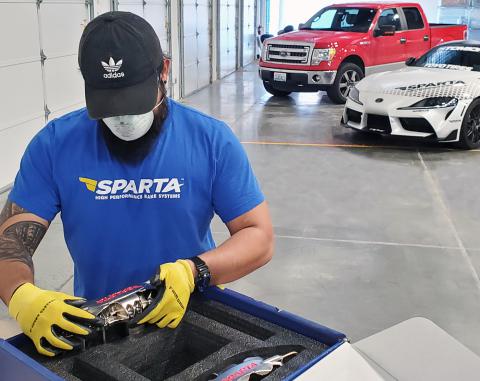
Performance brake manufacturer Sparta Evolution in Kent, Washington, has also repurposed some of its in-house CNC machines “for medical device manufacturing and other related components,” said John Lee. “We have a lot of talented machinists and engineers, and one of them had experience, before joining our company, as a medical device manufacturer. We discussed [retooling] with him, and he said it was a great idea, we could do this.”
For the company it’s a win-win-win, Lee added. “It gives back to the community, it really helps with the current situation of the pandemic, and though it is a shift in our manufacturing processes, it does help our business,” he explained.
Meantime, hand sanitizer is now being produced by Hot Shot’s Secret in Mt. Gilead, Ohio, along with the company’s fuel and oil additives and other engine problem-solvers. “Internally we had discussions about ways we could help not only our local community, but truckers and healthcare professionals,” said Eric Trimble. “We made the decision to bring in the raw materials, switch over some lines, and produce a couple thousand bottles of sanitizer. At first, we gave them out within our community—to fire stations, sheriff’s stations, nursing homes—and we also put a four-ounce bottle in every order that came through our website.”
Once word of the sanitizer got out, “We got quite the response, with people looking to purchase it,” Trimble said. “We realized we could really help a lot more people than we were, so we ramped up and started producing this on a large scale.” The sanitizer is now available in quantities from 16-ounce bottles to 55-gallon drums.
The sanitizer is also part of a Trucker Appreciation Care Package the company developed to benefit those over-the-road freight haulers that make up a large segment of its customer base. The Care Package includes a bottle of sanitizer, a bottle of Hot Shot’s Secret Everyday Diesel Treatment, a product guide, and promotional discounts on future purchases.
Safety-Kleen is widely known for its oil collection products and race parts washers, but the business is also part of Clean Harbors, which offers industrial cleaning services. “Anybody can call the Clean Harbors 800 number to find out what they should do, and what they don’t have to do,” said a company source.
“Not only can we try to help them be safe with the hand sanitizer, let’s try to keep some money in their pocket as well by helping with their fuel economy,” Trimble said.
Many in the racing community know Safety-Kleen in Port Orange, Florida, for its oil collection, parts washers, and other cleaning services. But Safety-Kleen is also part of a 40-year-old, $3.5 billion company called Clean Harbors that takes on clean-ups on a massive scale, mopping up after oil spills, hurricanes, and other disasters, explained Drew Patey. “When we have a problem like COVID-19 shutting down businesses, and those businesses want to reopen in a safe manner, customers are turning to us for direction and clean-up,” he said.
Those customers include race shops, tracks, and sanctioning bodies. Prior to The Real Heroes 400 at Darlington in mid-May, Safety-Kleen dispatched a six-man crew to “decontaminate the whole track,” Patey said. Over the race weekend, two crew members remained on-site to clean after each day’s events, and then the crew returned to do it all over again for the Toyota 500 a few days later.
“This is what we do, day in and day out,” Patey said. “We are always available to give direction. Anybody can call the Clean Harbors 800 number to find out what they should do, and what they don’t have to do. You need to do something. You can’t think it’s just going to go away. You need to be ready for employees to come back to work, and your fans and competitors to come back to a safe environment. This stuff was pretty wicked.”
Patey wasn’t the only one looking forward to racing reopening, which was just beginning at this writing. Early spring was grim, but most were looking into the tunnel and seeing light by mid- to late summer.
“We believe when things get back to full speed ahead, it’s going to be the best year ever,” said Fazekas. “We’re staying positive and just thrilled to be part of this industry, and we can’t wait to see everybody back at the race track.”
Customer education is high on the list of priorities for Angelo Vigil and Geddes Racing Engines, where a tight-knit crew works closely with clients to set expectations and goals, and keep them posted on builds through social media updates.
On a recent Saturday morning when he’d come into the shop to handle some paperwork, Angelo Vigil found himself dealing with non-functioning Internet. A service provider’s tech was working on it, and it seemed as if the problem would be resolved fairly quickly. That was a relief to Vigil, owner of Geddes Racing Engines in Colorado Springs, Colorado, because he wanted to post engine photos to Facebook and Instagram.
This was no frivolous pursuit, but rather a key business strategy. Social media has not only become essential for the shop’s marketing—it’s also a critical tool for managing workflow.
“We love our customers, but as a small business, we don’t have time for them to be constantly stopping by to check on their projects,” Vigil explained. “We ask them to follow us on Facebook or Instagram, or both. We’ll post photos and tag customers so they can follow the progress as their engines go through the shop. That reduces distraction by cutting down on phone calls and drop-ins.”
Leveraging social media for marketing and shop management is one way Vigil melds creativity and business savvy to serve customers from coast to coast and beyond, all from a 3,000-square-foot shop with a crew of three.
After graduating from SAM Tech, Geddes Racing Engines owner Angelo Vigil accepted a position with Dart Machinery, notably when the company was supplying heads to top NHRA Pro Stock teams. “My time [there] was formative. I still draw upon those lessons daily,” Vigil said. Pictured here is Dart founder Richard Maskin, at left, and Vigil, at right.
A NEW START
Vigil purchased Geddes Racing Engines in 2002, keeping its established name but steering the business to a 50/50 mix of race and street. Customers are indeed spread out, with engines and parts being shipped as far as Hawaii and Dubai.
On the racing side, Vigil took Geddes into United States Modified Touring Series (USMTS) dirt tracks for a few years, establishing a reputation for building durable, race-winning engines.
“At first, it was about getting our name out there and looking at rules packages outside the box,” Vigil said. “We looked at what was available to racers, and what we could do better. Our goal was to build a high-quality engine in a competitive price range that has serviceable parts in it. It was about learning how far to push something, and then making it last several thousand laps before it has to come back for freshening.”
Often, that meant convincing customers to spend more for higher quality parts. “For example, a better set of lifters might cost $200 more but could be rebuilt after a season,” Vigil said. “A $1,600 crankshaft might be serviceable for the lifetime of the engine, versus a $600 crank that might last one season.”
Vigil’s approach paid off. Geddes Racing Engines won USMTS championships in 2013 and 2014. Then, in 2015, when Geddes-built engines won 19 races, the organization named the shop “Engine Builder of the Year.” The reputation for durable racing engines became foundational for Geddes, generating word-of-mouth and customer loyalty for both race and street business.
HOT ROD HEART
As it does for many, Vigil’s love of working on engines began at an early age. “Growing up, I was always a tinkerer, taking things apart and putting them back together,” he said.
Vigil found more than inspiration in the pages of Hot Rod magazine. “I spotted an ad for SAM Tech in the back of Hot Rod,” he said. “I went down to Houston to check out the school and liked what I saw.”
After graduating from the School of Automotive Machinists & Technology (SAM Tech) in 1995, Vigil moved from his Colorado home to Michigan to take a job at Dart Machinery. Notably, Dart was supplying heads to top NHRA Pro Stock teams.
“My time at Dart was formative,” he said. “I not only learned a lot about engines, but also how these businesses work. I still draw upon those lessons on a daily basis.”
Returning home to Colorado after the 9/11 terrorist attacks, Vigil found Geddes Racing Engines listed for sale. He set out to combine his experience from Dart with the spirit of Hot Rod in order to truly build something new.
In addition to race engines, current street engine work focuses on LS and Gen III Hemis, including 1,000-plus horsepower twin-turbo and supercharged builds. Significantly, nearly a third of the shop’s street work is now import engines, which Vigil said has been growing of late. Geddes also does machine work for other shops handling such projects.
Vigil has two employees, both of whom are technicians. “Justin Smith is my cylinder head guy who’s been here for four years,” he said, adding that Sheldon Baron represents his most recent hire.
Finding the right employees is a challenge regardless of the economic climate. “It’s easy to find people who want to do this work, but it’s not easy to find the skilled people who can do this,” he added. “I’ve had probably half a dozen SAM Tech grads here over the years. If in need of an employee, that’s the first place I call. Some reach out to me, and I keep resumes on file if we don’t have an open spot.”
Geddes Racing Engines owner Angelo Vigil notes that hiring the right employees can be a challenge regardless of the economic climate. “It’s not easy to find skilled people who can do this,” he said. Pictured here is technician Justin Smith, who Vigil described as the shop’s “cylinder head guy.”
KEY TO GROWTH: CNC
Vigil said the shop has always invested in modern tools and equipment. One pivotal and expensive asset Vigil acquired seven years ago put Geddes Racing Engines on the map for stellar block machining: a Rottler F68A programmable automatic CNC machining center.
The investment was huge for a small shop, coming to about $100,000 once tooled and set up for work.
“Being a smaller shop, there were some things that we could do but that were very labor intensive,” Vigil explained. “Having to farm some things out, we were not getting the quality we really wanted. Getting the CNC machine solved those problems.”
He calls the CNC machine the shop’s bread and butter. “It drove people to the shop and opened other markets for us,” he said. “The biggest was sleeving. We do a ton of Darton sleeve kits for LS, Ford Coyote, and imports and more. There was a time when we didn’t want to do that for import engines. Now we do. It sets us apart.”
Darton, Vigil said, took notice of his work. “If you’re in the western half of the US and call Darton for sleeves, and ask where they can be installed, they refer a lot of business to us,” he said, adding that Geddes uses the CNC machine for more than sleeving.
“It’s such a good multi-purpose machine,” he continued. “We can do things that we had been sending out and giving up control on the quality. We can do the work more accurately and more quickly.”
Geddes Racing Engines uses its Rottler programmable automatic CNC machining center to bring more work in-house and build trust with its clients. “We can take block measurements and send that to the customer to show why we might have to do a particular job. It educates them,” Angelo Vigil said.
He also explained that the CNC helps to streamline work by allowing him to more easily group similar projects. “If I’ve got the CNC set up for smaller import blocks, we’ll do three or four of those,” he said. “And then next time, we’ll do a handful of Gen III Hemi blocks. It helps the work get through the shop much faster.”
Vigil said the CNC machine can help build trust with a customer, too. “We can take block measurements from the machine and send that to the customer to show why we might have to do a particular job,” he said. “It educates them—for example, showing why we might have to oversize the block or sleeve it.”
Geddes is known for more than its CNC work. The shop also does valve work, employing a Serdi machine. “It uses a live pilot and, for us, it’s very accurate, which is especially beneficial on the small import engines,” Vigil said.
FROM GOATS TO “GODZILLA”
Geddes is also a go-to shop for classic muscle car engine rebuilds, but with a modern twist that Vigil encourages customers to embrace: electronic fuel injection.
“We do a lot of EFI conversions on older muscle cars, a lot of Holley Sniper systems,” Vigil said. “For another $500–$600 over a carburetor, the customer gets a much better driving experience and reliability. Holley’s done a great job. Once the air cleaner is on, it looks like a carburetor. Some guys are a tough sell, but once they see that, it changes their minds.”
Geddes keeps busy with numerous projects of various sizes. “At any given time, we’re working on 20–30 engines,” said Vigil. “For some it’s the whole engine, others it’s just the machine work. We do a wide variety of projects.”
On a Saturday two weeks after PRI spoke with Vigil, the Geddes Facebook page displayed work in progress for multiple LS engines, a few Nissan RB26 blocks for Skylines, a Ford Coyote, and even a Pontiac 400 and Chrysler 383. In other words, it was a typical work roster for a shop that deftly caters to multiple generations of performance cars and customers.
Among those customers are other performance shops that send some of their most challenging machine work to Geddes. One of those, 50 miles away in Littleton, Colorado, is Rains Performance Motorsports.
“I’ve probably used 25 different machine shops over the years but am now exclusively loyal to Angelo,” said Glen Rains. “To give you some perspective, there are probably 15 machine shops within five minutes of me.”
Rains began sending work to Geddes about two years ago, mainly for CNC block machining. Most of what Rains sends is for LS engines and Gen III Hemis, though it also includes a mix of other modern and classic muscle cars similar to what Geddes handles for its own customers.
“I’ll get involved in just about anything, and Angelo has the flexibility with his equipment to work with me on any of that,” Rains said.
Before working with Geddes, Rains had been using machine shops out of state, but found the shipping costs and added downtime to be a drag on business. “Finding someone local to do the CNC work was a game changer,” Rains said. “Getting the quality I want has helped my business tremendously. The quality of Angelo’s work and attention to detail has been second to none in the state of Colorado that I’ve ever dealt with.”
THE CUSTOMER EXPERIENCE
Vigil remains focused on earning and keeping customers’ trust. And, if the customer is not always right, he helps get them there.
“We take the same approach to street cars as race engines,” said Vigil. “We talk with customers about their goals, lay out a budget, and use the best parts we can for what the customer can afford. Our ultimate goal is to give the customer the best experience.”
At any given time, Geddes Racing Engines will have 20–30 builds at its shop. “We take the same approach to street cars as race engines,” Angelo Vigil said. “We talk with customers about their goals, lay out a budget, and use the best parts we can.”
Often, that means providing some extra counseling and education. Among the challenges Vigil has faced, particularly with his street-engine customers, is dealing with those who want to supply their own parts. “Some don’t understand what they’re buying,” he said. “They might bring in good parts that don’t necessarily work well together for the project.”
Vigil has boosted the shop’s parts sales not only as a profit center, but as a way to ensure that he satisfies or exceeds customers’ expectations. “We offer competitive prices, and often we can supply a part better suited to their application,” he said. “But we don’t dictate to customers. We like to educate them. The more they learn, the more they feel part of the process and get more attachment to it.”
Vigil is not only Geddes’ shop owner—he’s also a customer: His daily driver is a 2010 Chevy Camaro SS with a naturally aspirated 440 cubic-inch LS7 that puts 600 hp to the rear wheels. And, he’s planning to add a ProCharger supercharger. The car is a calling card for the shop.
SOCIAL MEDIA MAVEN
Geddes Racing Engines does not currently sponsor any cars or drivers as a marketing tool, although Vigil said he would not rule it out for the right opportunity. In the meantime, he has become something of a social media maven, getting the most from the reach and influence of Facebook and Instagram. He allots time each day to post on the popular platforms.
“I’m 47, and many of my customers are of a younger generation,” Vigil said. “You have to understand how they use these platforms to make buying decisions.”
In addition to helping cut down on customer drop-ins and phone calls that could interrupt work, the posts yield several other benefits. Vigil described his use of social media as an educational tool, helping to show customers the results of his recommendations for parts or machining work, thereby helping to build trust.
“Customers can see inside of the engine as we’re working on it,” said Vigil. “That’s of course not possible once the job is complete.”
The posts also serve as a running log of the project that customers can show to others, either in-person or through their own social media channels. “They will inevitably share that with friends, who might then also become customers down the road,” said Vigil.
Best of all, Vigil said, social media and its benefits don’t cost him anything but his time.
Social media helps Vigil keep an eye on customer trends, but he also takes a more proactive approach to that aspect of the business. “I’ve got good contacts at all my vendors, and they do a good job of keeping us aware of things coming down the pipe,” he said. “I also get to the big PRI Show to look for ways to improve workflow through the shop and to find new things for customers.”
Vigil ultimately pins the success of Geddes Racing Engines on confidence and vision. “Don’t impose limitations on yourself,” he advised. “Don’t assume that because someone else can’t do it, that you can’t, either. You have to have that fire. Big risks can bring big rewards.”
From hidden gems to behind-the-scenes services, today's suppliers stress value in their dedicated performance products.
Talking about shop tools can sometimes feel like walking through a field that’s been seeded with land mines.
People get passionate about their favorite tools and develop brand loyalties as strong as any developed by Ford, Chevy, or Mopar in the engine arena. Go into any race shop or talk to an engine builder, and they’ll likely have strong opinions about which tools earn their keep and which don’t.
At the same time, numerous useful tools get overlooked. There are plenty of reasons for that. Sometimes, it’s simply inertia at work—it’s easy for a shop to keep doing things the way they’ve always been done. Other times, a tool may just be new and having trouble getting traction in a crowded market.
It’s also easy for buyers to get overwhelmed by choices. Throw in the extra dimension of cost versus perceived value, along with the merits or downsides of country of origin, and tool buying decisions can get complicated in a hurry.
To try to uncover a few overlooked tools, including some that can make a big impact for a race shop, we spoke to several tool manufacturers and suppliers. Even during a time when it would seem like tool availability would hold few surprises, we stumbled upon a few.
One aspect of tool selection that several of our sources mentioned was the importance of simply being able to get it into a technician’s hands and demonstrate what the tool can do.
G & G Technics in Richlands, Queensland, Australia, has a deep tool catalog in its home market. It also sells a handful of its specialty tools in the United States, such as its GGT-850 hydraulic ball joint separator. “People need to see them,” said Phil Jankura. “If you show a tech any of those tools, it takes him about five seconds to understand the value of it. Especially on the ball joint separator.”
Motorsports professionals and enthusiasts often develop deep brand loyalties for their favorite tools, and likely have strong opinions over which products earn their keep in the shop or trackside. Photo courtesy of Great Plains Fastening Systems.
Hidden Treasures
One factor that can keep a product under the radar is that motorsports-oriented tools are sometimes quite specialized, beyond what’s found in the average repair shop. But sometimes a tool will make that leap in refinement in the other direction, from mainstream to race team.
“Goodson offers a lot of tools that can be labeled as hidden gems,” said Janet Tapp of Goodson Tools and Supplies for Engine Builders, Winona, Minnesota. “The first one that comes to mind is the Lifter Bore Burnishing Tools. Sometimes during a high-performance engine build you’ll find that the lifter bores are a little tight toward the bottom of the bore. This low-tech tool can fix that problem quickly without causing other problems in the process. You simply drive the correct size burnishing ball through the bore with a slide hammer and the bore is accurately resized. You can even do this without removing the cam. Plus, no debris is created that needs to be removed before assembly can continue. We’ve had this tool for years for the daily driver, but in the past couple of years we’ve worked with some NHRA teams to develop burnishing balls for Top Fuel and Nitro Funny Car engines as well.
“Another hidden gem that Goodson offers is our Air Powered Valve Lapping Tool,” Tapp said. “This tool is popular with several drag racing teams since it operates without electricity. It is 100% air actuated and operates on just 90 psi. It’s perfect for use at the shop or at the track.”
The adaptability of a tool is always a factor in a motorsports environment. “Our HDII, it’s an abrasive wheel, so you can cut, sand, grind, and sharpen,” said Ann Strong of Bad Dog Tools, Bristol, Rhode Island. “You can cut muffler pipe, you can cut quarter panels. We have them in sizes ranging from 1 1/4-inch all the way up to 7. The most popular within the motorsports industry are the smaller ones, up to 4 1/2 inches. And we have just come out with a flanged version of the 4 1/2 and the 6 inch, which is great for grinding down body filler,” she said.
“Our Biter, which is drill mounted, is an awesome tool for cutting any sort of sheet material. It’s patented; we have two patents on it. It mounts right on your drill. It’s not air driven,” Strong continued. “We call it ‘the sports car of nibblers.’ It’s small, lightweight, really maneuverable. It’s steerable as well—that’s one of the patented features. So you can make circular holes, if you wanted to, down to 1/2-inch radius, which is pretty darn cool. You can’t do that with an air-driven nibbling tool.
“When we’re at PRI, when we’re at SEMA, when we’re at the different race car or collector car shows, those are the two tools that people really sort of gravitate to,” Strong said. “They say, ‘Wow, I’ve never seen that before. That would be great for this project.’”
Of course, sometimes tools don’t get noticed because they are new and word hasn’t spread yet—especially during a global pandemic, which was the situation Strong Hand Tools in Santa Fe Springs, California, found itself in this past March when it released its new GCC200 gas cylinder cart.
“Our newest line we’re focusing on is gas cylinders, and we’re trying to make it easier for people to move them around safely, comfortably, especially if they’re one person,” said Strong Hand Tools’ Danny Ulloa. The GCC200 allows the user to easily move a bulky gas cylinder around the shop without having to rely on chains or straps to secure it.
Strong Hand Tools is already working on additional variations of its new gas cylinder cart, which was released earlier this year and allows technicians to safely and efficiently transport gas cylinders.
Although the gas cylinder cart is new, Strong Hand Tools is already working on additional variations to offer. “We’re currently working on ways to have one individual be able to roll it out to a truck and load it on by themselves, without messing up their back or straining a muscle, making it so their cart does most of the work and reduces a lot of the amount of weight you’d be picking up,” Ulloa said. “We’re trying to design it with a lot more safety features for individuals.”
Even common types of tools that have been around for generations can be improved and adapted to specialized applications. And the continuing introduction of new engines ensures a steady need for tool development. G & G Technics has developed a harmonic balancer remover (GGT-180) for GM LS engines, late-model Chrysler Hemis, and pre-2018 Mustang engines. “The balancer remover, one of the main things about it is you don’t have to remove the radiator, because it’s a compact tool,” said Jankura. “It’s one of those things where you sell it to a tech, they immediately see the value in it. While it is expensive, you probably recover the cost in a couple of jobs. We do have a new one out that will accommodate the 2018–2020 (Ford) Coyote 5.0s, that we make specifically for that,” Jankura said.
Sometimes, to keep a tool in front of people means spreading the word on the variety of jobs that can be done with it. At Shaviv USA, a maker of hand-deburring tools in Bolingbrook, Illinois, a point of focus is industrial shop spaces and many customer-facing retailers installing more plexiglass barriers between workers and customers. “Plexiglass is a hot commodity right now,” said Ron Prohl. “So technically, plexiglass, especially the areas where they make plexiglass, they have to cut it, either laser cut it, cut it out, drill it, all sorts of things. And Shaviv deburring tools that are handheld tools do a nice job of finishing the product.”
Behind the Tool
There are times when a tool itself might not be overlooked, but the service behind it may be. “We offer a Trusted Advisor Program,” said Andy Mandell at Dynabrade, a manufacturer of power tools, abrasives, grinding and finishing tools, and more, in Clarence, New York. “We have Dynabrade salesmen throughout the United States and the world. We will stop by a business, take a look at their work stations. We can make recommendations regarding doing tasks safer and more efficient. We can review all tools, air lines, abrasives, and accessories, and make sure everything is working in tip-top shape. No-obligation demonstrations are available on every product in our line.”
The longevity of shop tools makes it easier to win the trust of technicians who recognize an established brand name, such as Burr King Manufacturing Co. Here, the company’s belt grinding equipment is being used by students at The Fab School.
Value is always a part of the tool-buying calculation, but it’s not always one that’s easy to quantify up front. A company’s track record can help. “When you have a company as old as Burr King—we’ve been in business since 1951—if they’ve worked in a shop at all they’ve probably already seen a Burr King sitting around,” said James Krier with Burr King Manufacturing Company, a maker of belt grinders, polishing equipment, and vibratory deburring tools located in Warsaw, Missouri.
That very longevity, however, can be a blessing and a curse—a curse in the sense that a product doesn’t enjoy the same spotlight that newer, flashier rivals may get. But a blessing, too, in that it’s easier to win the trust of technicians who recognize an established brand name.
“There’s no planned obsolescence in anything that we build,” Krier said. “We’ve had a machine called the Model 760—it’s been through a couple changes, but everything always retro-fitted to the older style machine. There was never any designed obsolescence where we said, ‘Oh, in five years we’re not going to make this part anymore.’ If you had a machine that was 30 years old, we still support that machine. That’s a very unique thing that it’s a one-time purchase at a shop. You buy a shop tool for $3,000, and it’s something that could be in there for decades. That’s like something your grandpa used to have, those kinds of quality tools, and that’s still the way we do it here.
“That’s really the hidden treasure in this whole thing, that it’s a one-time buy,” Krier said.
In the Race Shop
Race shops often have several special requirements for their tool arsenal. They need to be able to use a tool in the shop or in the pits; the tool may have to be used while a crew member is wearing protective gear; and crew members and technicians may have to improvise on the fly when making race repairs.
For those reasons, Strong said Bad Dog Tools’ Biter is the type of tool that can make an impact for race teams. “If they have to make some sort of modification or repair in the pit, it’s just a real easy tool to have on hand,” she explained. “It’s right there, it’s going to work, you have it on a battery-operated drill, you’re not messing with hoses or electrical cords. It can be a make-or-break tool depending on what’s going on at any given time.”
There are many tools that, while simple, can make a big difference for motorsports professionals. “In terms of efficiency, every race shop should have a valve spring tester,” a source from Goodson Tools and Supplies for Engine Builders told us.
Although it’s easy to forget when watching race cars going into drift mode at a dirt track, a clean environment is a must for engine building and race car construction. Mandell at Dynabrade sees evidence that teams are paying more attention to this aspect of the business. He said current trends show increasing interest in “vacuum air tools and vacuum downdraft tables, to eliminate dust in the workplace. Very important for safety.”
Tools and toolmakers that can respond to the motorsports industry’s need for customization are also poised to succeed. “Goodson now has a division called Abrasive Industrial Supplies (AIS) that manufactures all of the abrasive belts in our catalog. But AIS isn’t limited to those products,” said Tapp. “If a race shop needs a specific abrasive belt that’s not in the Goodson catalog, odds are Abrasive Industrial Supplies can make it.”
There are many tools that, while simple, can make a big difference for a race shop. “In terms of efficiency, every race shop should have a valve spring tester, whether it’s a digital or an analog model. Valve spring testers are essential for proper engine setup. A single spring that’s off will drain performance and could cause engine failure,” Tapp said. “Quality measuring tools are always in demand in the racing business. We like to say that if you’re not measuring you’re only guessing, and that’s no way to win a race.”
Buying Mistakes
Experts also point to some common mistakes to avoid when shopping for shop tools that will pay off in the long run. “People look at a tool, and they imagine what it can do,” said Strong with Bad Dog Tools. “Every tool has a parameter, every tool has a way it’s supposed to be used, and what it can do. And a lot of people, they imagine what it can do, and they’re disappointed when it can’t do that. I think people have to keep sight of that, to make sure that they’re doing with that particular tool what is within the parameters of what that tool can do.”
Shops in the market for new tools should consider several factors before purchasing, including the tool’s potential value, whether there is another, more expensive tool that can complete the entire job, and how long the device is designed to last.
Every shop in the market for tools has a budget, but it’s important to make sure all costs are being considered. “The biggest mistake we see when it comes to purchasing shop tools is putting cost before value—and no, they’re not the same thing,” said Goodson’s Tapp. “When buying shop tools, you have to ask yourself if the tool is the right one to do the job. Yes, it might be adequate, but are you going to have to do another process to get the finish you need? Will another tool that may cost slightly more do the whole job? How long will the tool last? Is it a one-use tool or will it last for years?
“Here’s a real-world example,” she continued. “The Goodson Hyper-Finish Diamond Valve Guide Sizing System Master Kit includes everything needed to hone valve guides between .271-inch and .389-inch diameters. In order to size valve guides with reamers, you’d need 37 different reamers, which would cost more than the Master Kit just for the tooling. This doesn’t even take into account your labor and storage for all of the tools. This is what we mean when we say you have to weigh cost and value.”
“A lot of these new shops are just trying to get by with the minimum,” said Burr King’s Krier. “If they look for the long term, yeah, you’re going to spend a little bit more money on a Burr King. But if it’s a tool that you’re going to have there for the next 20 years or 30 years, what’s your cost on a tool like that? It gets down to the cheapest tool in the shop really quick when you have something for that long. I see that as a huge mistake, when people look to purchase anything when they under-buy for what they may need for tomorrow.”
It can be all too tempting for shops to save a few bucks by purchasing knock-off tools found in low-end hardware stores and many big-box retailers. But resisting that temptation will deliver a bigger payoff. “You’re going to find the least expensive material, the handle and blade. The handle looks the same, but the blade, the material in the blade, it’s not heat-treated right, it’s not hardened. It’s not made professionally,” said Shaviv’s Prohl. “And, of course, the biggest problem people will have, in all industries, including the automotive industry, if you buy an inexpensive tool that has an inexpensive blade on it, you’re subject to breaking the blade and maybe cut yourself.”
To that end, once the effects of 2020’s pandemic have subsided and industry trade shows throw open their doors again, the tool manufacturers we spoke with were eager to show off their wares to the motorsports community.
“It’s one thing to see something on a YouTube video or a commercial on TV,” said Strong. “It’s another thing to see it in person. That’s where that whole ‘shock and awe’ factor comes into play.”
The August 21-23 NASCAR weekend at the iconic Dover International Speedway in Delaware will take place without fans due to concerns surrounding the coronavirus (COVID-19) pandemic.
While the six races at The Monster Mile will move forward, state officials did not approve the track’s request to host a limited number of fans in the interest of public safety and health concerns.
"We submitted a comprehensive plan to state officials outlining our planned procedures and protocols for keeping our fans safe throughout our August race weekend," said Mike Tatoian, Dover International Speedway’s president and CEO. "Unfortunately, due to the increase in COVID-19 cases in recent weeks, the decision was made to not allow fans. We understand it, and while we are disappointed, we also realize that we need to err on the side of caution and yield to the opinions of public health experts to help reduce the further spread of COVID-19."
The schedule will feature the "Drydene Doubleheader Weekend" on Aug. 22-23, featuring a NASCAR Xfinity Series and NASCAR Cup Series doubleheader each day, with all four races on NBCSN.
On Saturday, Aug. 22, the "Drydene 200" NASCAR Xfinity Series race takes the green flag at 12:30 p.m., followed by the "Drydene 311" NASCAR Cup Series race at 4 p.m. On Sunday, Aug. 23, the "Drydene 200" NASCAR Xfinity Series race begins at 1 p.m., followed by the "Drydene 311" NASCAR Cup Series race at 4 p.m.
On Sunday, Aug. 23, the "Drydene 200" NASCAR Xfinity Series race begins at 1 p.m., followed by the "Drydene 311" NASCAR Cup Series race at 4 p.m.
Friday, Aug. 21, will feature the "General Tire 125" ARCA Menards Series East race begins 2 p.m., followed by the "KDI Office Technology 200" NASCAR Gander RV & Outdoors Truck Series race at 5 p.m. (FS1).
Pat Musi, the legendary engine builder and owner of Pat Musi Racing Engines, celebrates his 50th year in business in 2020. Musi began his career running a small speed shop in Carteret, New Jersey, and quickly became of the most successful engine builders in motorsports.
“It’s exciting to see everything you’ve worked for come together,” Musi said. “We’ve proven ourselves over the years, and we’ve won a lot of championships and had a lot of success. It’s been pretty cool.”
Pat Musi Racing Engines will host an open house from its Mooresville, North Carolina, facility on Saturday, November 14, to commemorate the anniversary. The event will also officially launch the new Edelbrock Race Center. Additional details, including special guests, will be announced at a later date.
“Where it is today, I would have never imagined it,” Musi said. “I started driving when I was 20-21 years old, and the guys I read about – Bill Jenkins, Ronnie Sox, Bob Glidden, Lee Shepherd – I immediately got involved match racing them. It was a cool deal to be able to race those guys and outrun them sometimes. I had the work ethic to do well and I was willing to put in the time.”
Featuring a relatively simple format with low barriers to entry, this precision-focused discipline is flush with opportunity for suppliers and performance-improvement shops alike.
Typically held in parking lots or rented air strips with a course lined out by way of safety cones, autocross is often considered a steppingstone on the path to road course disciplines like time trials and wheel-to-wheel club racing. But while autocrossing undoubtedly has grassroots appeal in that sense, it’s also a legitimate racing segment all its own, with both a clear path up the ranks of competition as well as distinctive strategies in both racing technique and car setup that stand apart from its road course-based counterparts. And those characteristics have contributed to the lasting, undeniable appeal of autocross for competitors across the country and beyond.
“We’ve got about 65,000 members in the Sports Car Club of America, and more than half of them cite autocross as their primary interest,” explained Bob Tunnell, multi-time SCCA Solo national champion and Topeka, Kansas-based SCCA Time Trials national series competition director. “That’s a lot of people, and a lot of opportunity for the aftermarket.”
Although often considered a steppingstone to road racing, autocross requires intense driver focus. “It’s very competitive,” a source told us. “There are so many more decision points crammed into a 60-second run than there are on a two-and-half-mile road course.”
As OEMs raise the bar for production vehicle capability and enthusiasts look for challenges that go beyond the stoplight drags, autocross has seen a noticeable rise in popularity in recent years. “There is a growing scene in autocross,” said Nicholas Madara of Automotive Performance & Chassis, Cary, North Carolina. “The events are huge, and in general we’re noticing that people are paying attention to how their cars are handling, and what kind of tires they are putting on their cars, now more so than ever before.”
While part of the appeal is the relative simplicity of the format, the specialized character of autocross lends itself to car setups, modifications, and maintenance routines that are tailored specifically to it, rather than being simply carried over from traditional road course tactics. Here, we’ll take a closer look at the details to see how autocross competitors are honing their programs in the never-ending quest for quicker lap times.
Multifaceted Appeal
Part of autocross’s popularity can also be attributed to logistical considerations. Since these events normally aren’t held at race tracks, organizers have much more freedom in terms of where and when they are held, and the costs of allocating parking lot or runway space usually pale in comparison to those of road courses earmarked for officially sanctioned competition. That equates to entry fees that can be a fraction of the cost of road-course events, whether that’s a wheel-to-wheel club race or simply a track day test-and-tune.
The accessibility of autocross is further aided by the fact that these racers can compete in a garden-variety street car, if they choose to do so, which in turn translates into a much lower cost of entry to get started in the discipline. “It’s inexpensive, it’s relatively low risk, and it’s a low amount of time commitment as well,” said Dave Whitworth of the National Auto Sport Association, Las Vegas, Nevada. “Even if a car isn’t competitive—if it’s safe, you can run it. And since most entry-level events are one-day programs rather than a race weekend, and they’re normally held all over the country every weekend, you can avoid travel expenses as well.”
Don’t mistake autocross competition for a glorified car control clinic, though. “It demands a lot of focus, and it’s very competitive—I would say even more so than time trials,” Tunnell said. “There are so many more decision points crammed into a 60-second run than there are on a two-and-half-mile road course. I remember hearing from a racer who started in autocross and eventually moved up to the highest levels of professional road racing. After a few seasons, he dropped me a note saying that he missed the intensity of autocross. With autocross there’s never a moment where you can relax, where you aren’t fully focused on the run.”
It’s also important to note that autocross is not exclusively an entry-level enterprise—sanctioning bodies have well-established frameworks for racers to move into more advanced competition as their programs and experience mature, with classes that range from ostensibly factory-stock street cars to near-unlimited classes that are populated with tube-chassis, purpose-built race cars. “[My wife] Patty and I have been competing in autocross since 1983, and it’s every bit as meaningful and challenging to us today as it was when we were just getting started,” Tunnell added.
Safety
Another important factor in autocross that provides significantly more accessibility in comparison to competitive road-course disciplines is the circumstances that facilitate its low safety equipment requirements, which can otherwise be costly and prohibitive for folks who might consider using their daily-driven vehicles in competition.
“You basically need a properly functioning vehicle with seat belts, along with a helmet and closed-toed shoes,” said Whitworth. “Because your speeds are relatively low and there are no stationary objects or other cars to hit on course, the safety equipment that works on the highway generally works pretty well on an autocross course.”
Autocross has relatively few safety equipment requirements when compared to most competitive road course disciplines. “You basically need a properly functioning vehicle with seat belts, along with a helmet and closed-toed shoes,” one source said.
But that doesn’t mean competitors are prohibited from adding equipment that might not only make them safer, but also faster. “They aren’t required, but there are several advantages to safety equipment like six-point harnesses,” said John Haydon of Pegasus Auto Racing Supplies, New Berlin, Wisconsin. “That will definitely help to hold the driver in the seat, which means more of your focus is on your inputs rather than fighting to keep yourself in place as you’re driving.”
Roll bars and cages generally aren’t required either, but they do provide another significant measure of safety while also stiffening the chassis, thus improving the car’s overall handling by preventing the suspension geometry from changing when subjected to high cornering loads.
Car Setup
Although handling and grip are top priorities in both autocross and road course racing, there are some important factors that distinguish the former from the latter. “You’re setting the car up for quick bursts of speed, and handling response that’s a bit dartier than you’d typically find on a car tuned for the road course,” said Madara.
Autocross has enjoyed a noticeable rise in popularity in recent years, and with that comes increased aftermarket opportunities. One source noted that autocrossers are focusing on how their cars handle and proper tire selection “now more so than ever before.”
Some of that comes down to tire choice, but sanctioning bodies generally limit competitors’ options to a specific treadwear rating to keep relative parity within a given class. In many of the lower “street” classes, where allowed modifications are highly restricted, alignment tuning plays a significant role as competitors look for ways to shave off tenths without running afoul of the rulebook. “There are no slaloms on a road course, and that kind of transitional handling is really important on an autocross course,” Tunnell noted. “So racers spend an inordinate amount of time playing with alignments. You’ll frequently see folks at events with a set of jack stands and a string around the car doing adjustments.”
That generally equates to additional negative camber and more toe-out, said Whitworth. “You’ll see a lot of autocross cars that run toe out in the front to help the car turn in faster, but that kind of setup would be terrible on a road race car when you’re on a long straight.”
Moving up the ranks to the mid-level classes, where competitors have more freedom to make modifications, suspension changes are normally the focal point. “Spring rates tend to be stiffer than stock, but they’re still softer than you’d normally use on a road race setup,” Tunnell said. “The surfaces in a parking lot or airstrip tend to be much bumpier than your typical road course, so the suspension also has to be a bit forgiving or you sacrifice stability. Shock settings are really crucial.”
And suspension tuning goes hand in hand with modification. “Spec alignments, ride height adjustments, and corner balancing with digital scales are all common services we provide for our autocross customers,” said Madara. “Aftermarket springs and sway bars are popular upgrades with these cars, along with polyurethane bushings.”
Factory bushings are typically made from a rubber compound, which is designed to provide compliant ride quality characteristics in street-driven cars. But that compliance also allows for more deflection over bumps, causing the alignment to change as the car moves around. Switching to a polyurethane bushing reduces that deflection tendency, further improving the predictability of the car’s handling and overall response.
Braking performance is also an important consideration. But unlike road-course setups, where effective heat management over prolonged use is perhaps the most essential characteristic, the format of autocross de-emphasizes thermal management. “It’s not uncommon to see folks in the upper classes, where you’re allowed to make significant changes to your brake system, to actually move to a smaller brake system to save weight,” said Tunnell. “The demands on the brake system in autocross in terms of heat dissipation are far lower, so there’s not much point to lugging around big rotors and big calipers if you don’t need them.”
Responsiveness from the brake system is needed, however, so pad choice is perhaps the most critical component in the system. “You don’t have a pace lap to warm the brakes up to operating temperature, like you would in a road race,” Haydon said. “So you need a brake pad that will be effective right away, when it’s still cold. Compounds like the Hawk HP+, which was developed specifically for autocross use, provide much higher friction levels than a street pad while also operating at much lower temperatures than road racing pads do.”
At the higher levels of autocross competition, where the modification rules are generally the least restrictive and purpose-built powertrains are common, aerodynamics also play a significant role. But in contrast to road racing aero packages, which normally seek to balance drag and stability at triple-digit speeds, autocross aero is an entirely different animal. “In the higher prep levels, aero is required to be competitive—if it’s allowed in your class, you’re going to want to do it,” said Whitworth. “Drag isn’t really a factor at these speeds—the main goal is downforce, so your aero has to be optimized to do as much as it can in that regard.”
Tunnell noted that while the aero used at this level of competition is not the kind of stuff found in an OEM parts catalog, there are resources that can help racers figure out what they need. “You don’t have to be an aerodynamicist to have good aero these days—there are so many companies making really efficient bits and pieces that you can put together,” he said. “You have to be careful to make sure you’re not buying something that’s simply cosmetic—there’s a lot of that stuff out there, too—but if you talk to the competitors who are doing well, you can usually find out who is making the good stuff and who isn’t. There are also a lot of airfoil simulation programs out there now, which you can run on your car to figure out what kind of wing angles and chord lengths you need.”
Making autocross an attractive entry point into competitive motorsports is the comparatively low wear and tear involved. Even though the car is pushed hard throughout each run, 60 seconds of at-limit driving is typically easier on a vehicle’s mechanical systems than road-course competition.
Maintenance
Another aspect of autocross that makes it an attractive entry point into competitive motorsports is the comparatively low wear and tear involved versus road-racing disciplines. Most courses are designed to keep speeds under triple digits at any given point in a run, and although the car is being pushed hard throughout, 60 seconds of at-limit driving is much easier for a vehicle’s mechanical systems to tolerate than road-course competition (usually), which often lasts a half-hour or more without the opportunity for cool-down. That doesn’t mean autocross competitors can ignore a vehicle’s servicing requirements throughout a season, though.
Most autocross competitors have a maintenance checklist they go through after each event. “That includes a nut-and-bolt check, just making sure everything is tight and working properly, and all the systems are in good shape,” one source said.
“Most competitors have a checklist they go through after each event,” said Haydon. “That includes a nut-and-bolt check, just making sure everything is tight and working properly, nothing is leaking, and all the systems are in good shape.”
It’s also vital to identify any areas known for failure in a particular vehicle’s design and plan accordingly, said Whitworth. “As you get into the mid-level classes, it starts to become more important to pay attention to weak points that apply to specific cars because they are being run harder than they normally would be,” he explained. “But for the most part, it’s tires, brake pads, and fluids. Mazda Miatas are really prevalent here because they’re classed very competitively at almost every level and there’s a ton of them out there, but many of them are getting kind of old. So sometimes those cars might need a new set of bushings or a clutch replacement, but that’s still a one-and-done kind of situation where the car is good to go for a long time after that’s been addressed.”
Tunnell emphasized, too, that longevity and regimented maintenance intervals go hand in hand. “Brake pads and tires are the most consumable items a Stock/Street category driver needs to worry about, but they also need to accelerate all fluid change intervals versus typical street use. I recommend cutting change intervals in half, so if you regularly change your oil and filter every 4,000–7,000 miles, I’d cut that to 2,000–3,500 miles. I also recommend flushing the coolant and brake fluid every year as well, and I also don’t go along with a manufacturer’s ‘lifetime’ change interval for the transmission and differential—I think of ‘lifetime’ as 80,000 miles and cut that in half for a frequent autocrosser. And once you begin modifying your drivetrain, you’re putting greater demands on all the fluids, so consider upping the frequency even further. It’s cheap insurance against excess wear and breakage,” he concluded.
Industry experts weigh in on how to best care for an engine’s circulatory system.
Racers, engine builders, and other members of the performance industry tend to talk about engines as if they were living things. An engine “breathes” through its cylinder heads and exhaust system. Its “brains” are the ECU and other electronic systems. And its “blood” is the oil, pumping vigorously thanks to the beating “heart” of its oil pump.
The analogy is apt, said Thor Schroeder of Guilford, Connecticut-based Moroso, which is why we shouldn’t view “the oil pump as just an oil pump, and the oil pan as just the oil pan. Every year in racing we want to go faster and do it in less time than before. With these increased expectations come greater demands on our equipment. Most racers today realize that they will have to run a quality oil pump to get the performance and reliability they are looking for. The wrong pump selection can result in the engine having poor performance or a diminished life expectancy.”
In this installment of our ongoing Tech Support series, we asked several companies to share the types of questions most frequently asked of them by racers and engine builders, along with their answers. Judging by the responses from our industry experts, racers who continue to hunt for constant and reliable oil pressure may be a bit confused by the difference between high-volume and high-pressure oil pumps, and wonder if the engine’s beating heart could be a source of power.
OILING BASICS
Why does my oil pressure drop at high rpm? “It’s most likely an oil pump cavitation issue, and this is a common problem when you spin an oil pump past its design parameters,” said Bill Baroody of Dailey Engineering, Temecula, California. “Cavitation is the formation of voids (vapor bubbles) within a liquid, caused by a rapid decrease in localized pressure on the liquid at the pump inlet as the pumping cavity opens. As the fluid passes through the pump the pressure increases, causing these voids to implode [and] resulting in a shockwave. These shockwaves are powerful enough to cause pitting and erosion to the surface of the pumping gears, decreasing its performance and longevity. As cavitation worsens, the pump outlet pressure can no longer be maintained.
“The local pressure drop that causes cavitation is a factor of both fluid restriction and pump speed,” Barody continued. “Restriction can occur at the pump inlet due to an undersized feed line, restrictive fittings, or high oil viscosity. As pump speed increases, it is harder for the oil to fill the pumping cavities quickly enough to prevent a local pressure drop.”
“Cavitation is related to the high-speed operation of any oil pump,” added Mike Osterhaus of Melling Performance, Jackson, Michigan. “Cavitation will occur in any pump as the speed increases to the point where the oil can no longer fill the internal pumping chambers. If the inlet pressure drops below the vapor point of the oil then cavitation will occur, as oil vapor bubbles will form in the oil. The pressure regulation valve is designed to redirect some of the output flow back into the inlet port of the oil pump. The bypassed high-pressure oil increases the local inlet pressure to push back the onset of cavitation. This is referred to as supercharging the inlet, and it allows the pump to effectively operate at higher engine speeds. It is important to know that modifications made to redirect the bypassed oil to the sump (oil pan) instead of the pump inlet will negatively affect the oil pump’s operation and allow cavitation to occur at lower engine speeds.”
Osterhaus said that Melling’s Shark Tooth oil pumps for small block Chevrolet engines “utilize a helical asymmetrical gear set that improves the operation of the pump by significantly reducing the pressure ripple produced by spur-gear oil pumps. The helical-gear design provides more time for the oil to fill the gear set, resulting in improved performance and delaying the onset of cavitation.”
High-speed applications can lead to cavitation, or the formation of vapor bubbles within the oil, reducing performance. Specialty oil pumps, like Melling Performance’s Shark Tooth, which is designed to provide more time for the oil to fill the gear set, can delay the onset of cavitation, a company source told us.
What’s the difference between a standard-volume, a high-volume, and a high-pressure oil pump? “Standard volume relates to the volumetric flow rate matching the original oil pump for the engine,” said Osterhaus. “A high-volume oil pump produces more flow rate than a standard pump. This is accomplished by changing the rotor or gear set, typically by increasing the thickness of the set. A high-pressure oil pump indicates that the oil pressure required to open the pressure relief valve is increased relative to the original design. To do this, the design of the pressure relief spring is changed to apply more force to the pressure relief valve. This means an oil pump can be both high-volume and high-pressure.”
A high-volume oil pump, Osterhaus said, “will provide more oil flow to the engine across the engine’s operating range. Any modifications that will increase the engine’s demand for oil—larger bearing clearances, higher flow-rate lifters, adding piston and/or valve spring oilers—will require a high-volume pump. A high-pressure oil pump will supply additional oil flow at higher engine speeds due to less oil passing through the oil pump’s internal pressure relief circuit. Many factory stock performance engines came with standard-volume high-pressure oil pumps.”
Osterhaus also pointed out that “the oil demands of performance engine blocks with priority main lubrication are less than factory blocks, so a stock-volume oil pump is recommended. A high-volume oil pump will supply too much oil and result in high oil pressure across the engine’s operating range. In the case of GM’s LSX and Dart’s LSNext blocks, a stock-volume pump can provide too much oil. As a result, Melling has developed a low-volume oil pump for aftermarket LS engine blocks with priority main oiling systems.”
When making pump recommendations to customers, Schroeder uses these guidelines: “If the customer has a rear sump, where the deepest part of the oil pan is toward the back of the vehicle, like 1979–1995 Mustangs, and the oil pump is in the front of the engine with that big long oil pump pickup tube, I would recommend strongly that a high-volume oil pump be used. If the vehicle has an oil cooler, remote filter, and an extra-capacity oil pan, [and] is a street/strip car that also might see an autocross or go on a road course, I recommend a high-volume oil pump. If the vehicle is being used for drag racing, or is a street/strip car that will only be raced in a straight line and has to run a stock capacity oil pan, then I would recommend a standard-volume oil pump. For the vehicles that have the luxury of being able to run an extra-capacity oil pan, and are being used in a drag race application in which the operator of the vehicle is less inclined to watch their gauges, I would recommend a high-volume oil pump. If the last horsepower is trying to be freed up in a drag race car, even those with extra-capacity oil pans, then I recommend a standard volume oil pump, but stress that the operator has to be aware of what the gauges are telling them and to act if there is a severe pressure drop.”
Discussing your needs with an oil pump manufacturer is the best way to find the right fit for each application. Pictured here is Dailey Engineering’s LS dry-sump system, which features an optional air/oil separator and adjustable pressure regulator.
I put a vacuum-pump system on my car and now I don’t have the oil pressure I used to. What happened? “Vacuum pump usage relative to oil pump functioning is the least understood thing with the racing public and even many engine builders,” said Verne Schumann of Schumann’s Sales & Service, Blue Grass, Iowa. “If you put a vacuum system on it, you’ve taken away the whole life-support system of priming the pump. Ninety-nine percent of oil pumps in the automotive world are vented to the atmosphere. The atmospheric pressure pushes on the oil reservoir pool in the oil pan and helps push the oil into the screen. Once the oil gets up to the gears, then it’s self-sustaining.
“Our Energy Recovery Engineering System takes the extra oil, commonly called the bypass oil, and pressurizes it to whatever the oil pump is set at, to send it back to the intake tube of the oil pump system. You’ll have the normal oil pressure and volume with the vacuum pump system operational,” Schumann added.
Do clearances and oil selection affect oil pump recommendation? “They have a huge effect on the oil pump’s performance, so much so that we recommend the customer work with us directly,” explained Schroeder. “Other variables are the intended rpm range of the engine, if the engine is normally aspirated or has a power adder, and what fuel type the engine uses. From this information we can recommend which of our pumps be used, be driven at what speed, and even come up with a custom dry-sump pump specifically tailored to that application.”
What is the functional difference between a rotary (aka gear rotor or gerotor) and geared oil pump for a performance engine? “A gerotor-style pump is a good slow-speed pump, but once it gets past about 4,500 engine rpm, it can’t pick up any more oil, or increase the volume or pressure of oil going through the motor,” said Mark Mittel of System 1 Filters, Tulare, California. “At System 1, every pump we make is spur-gear style. Our pumps will go up to 8,800 rpm before they start to nose over and cavitate. The spur-gear stuff is what you want if you’re going to set your engine on kill every time.”
“Gear rotor has been the OEM choice since the 1960s because it is more efficient,” said Schumann. “The exit speed of the oil—how fast it comes out of the pump, in feet per second—can be double that of a gear-to-gear pump.”
But in the performance industry, “two engines that constitute a big chunk of sales, the small block Chevy and big block Chevy, have gear-to-gear pumps,” Schumann added. “And they’ve gotten outdated by OE thinking and engineering of the gear rotor pumps.”
To help level the playing field, Schumann developed the Paddle Wheel oil pump, a gear-to-gear pump with scallops machined into each gear tooth.
“In a gear-to-gear oil pump, when you turn it over it squeezes the oil, and that oil oozes out of the gearset,” he explained. “With a Paddle Wheel pump, the oil oozes up to the paddles, and the paddles catch it and accelerate it. The net result is that the Paddle Wheel gear-to-gear oil pump is no longer obsolete.”
Remind racing customers about the value of using oil filters specifically for motorsports applications. In addition to addressing filtration, engineers have designed these oil filters to combat pressure drop, increase flow, and reduce oil bypass.
Can an oil pump make horsepower? “Cars driven on the street today have oil pump systems that are roughly 30 percent larger than what the engine needs,” observed Schumann. “If you run a stock or super stock car with a typical old-school high-volume racing pump, it’s 30% bigger than a stock pump, and the stock pump is 30% bigger than what the engine needs. Add those up and now you have an oiling system that’s 60% larger than what the engine needs to survive. Racers and engine builders have figured out they can run a standard-volume oil pump because it’s still 30% bigger than what the engine needs.
“General Motors has told some of the best engine builders in the country that you can’t go less than their half-inch gear rotor pump for the LS engine (or the optional, non-warrantied 0.420-inch pump used for the COPO Camaro only),” he continued. “But we have people running 0.325-inch gear thickness in our drag strip pump, and they’re picking up 10, 12, up to 16 horsepower, depending upon how much overkill the system had before. And the bearing life has held up for the entire race season, no issues.”
DRY SUMP
What are the advantages of a dry-sump oiling system? “With a dry-sump system, the oil pan is not used for oil storage as it is with a wet-sump system,” Baroody explained. “Instead, the pan is specifically designed to be as thin as possible while still effectively scavenging the oil that is suspended in the windage generated by the crankshaft. Oil is stored in an external reservoir, eliminating the risk of oil pump starvation caused by the extreme G-load effects during racing. With the use of a thin dry-sump oil pan and remotely mounted oil tank, the engine can be lowered in the chassis to improve the vehicle’s handling characteristics.”
“The primary advantage of a dry-sump system is its ability to make more power,” added Schroeder. “With very little oil in the pan, the rotating assembly is not burdened with the weight of excess oil (commonly referred to as ‘windage’). And because there is no internal pump, the windage tray or screen, which isolates sump oil from the rotating assembly, can run the full length of the pan. Keeping the rotating assembly free of windage allows it to spin freely and make more power. In addition, the extra crankcase vacuum created by the dry-sump pump helps to improve ring seal for additional power gain.”
Cleanable, reusable oil filters can be used as an engine diagnostic tool, according to our source from System 1 Filters. “You can actually look inside the motor without taking it apart,” he said. “You can tell what’s going on in the motor by the color of the debris in the filter.”
What issues come up when converting from a wet-sump to a dry-sump oiling system? “Customers forget that engines equipped with a dry-sump oiling system must be sealed so they don’t pull in outside air,” said Schroeder. “That means no open valve cover, lifter valley, or crankcase vents.”
Can I adapt a pre-owned racing dry-sump pump to my engine? “Buying pumps from used NASCAR engines and trying to adapt them on different racing cars is a big problem,” advised Stefan Verdi of Auto Verdi, Söderbärke, Sweden. “The pump will not work for them because the specifications of the pump will be wrong for their engine. The NASCAR engines often have a very small oil need compared to the engine’s size. A privately built engine will need a lot more oil, so the NASCAR pump’s pressure section is not big enough. Also, the fittings are custom made specifically for each NASCAR team, so they are not easy to find on the open market. If you do, they’re very expensive. The brackets that fit those pumps to NASCAR engines often won’t adapt to another engine. They will put the pump too far forward or too far backward. The whole thing will be wrong.
“In the future, some of the NASCAR teams will stop selling these pumps to the buyers who put them on eBay,” he continued. “They will destroy them. The latest generation of pump can never be used on another engine. It was too complicated to make and too complicated to adapt. The teams understand that people buy these pumps and then get angry because they won’t work on just any engine. So, they have started to destroy the parts rather than selling them and getting in trouble.”
What size dry-sump pump should I use? “Initially we base the flow rate on what the factory pump’s GPM was and use that as a starting point,” explained Gary Armstrong of ARE Dry Sump Systems, Loomis, California. “There are other factors, too, so we always base our decision on the size, use, modifications and objective of the racing engine. We use a minimum of two, up to four scavenge stages, also depending on use.”
OIL FILTERS
Can an oil filter make power? “With a free-flowing oil filter, the oil pump doesn’t have to work as hard to push oil through the filter, and the motor is not laboring to drive the pump to push oil through something that’s a little restrictive,” said Mittel of System 1 Filters. “I’ve heard our filter can make anywhere from seven to eight horsepower all the way up to 10 or 15 horsepower on the dyno. Now, there will be guys who say those numbers could be in the margin of error, or there were air changes in the dyno room—like if they went to lunch, came back, and there was better air quality in the room. So, we kind of stay out of that war, but we are freeing up the system, and it could possibly make more horsepower. We know it can give you better pressure because it’s less restrictive.”
Is there a rule of thumb about filter micron size and oil weight? “System 1 makes 35-, 45-, and 75-micron filters,” responded Mittel. “The 35-micron filters are for the new kinds of lighter-weight oils, 0-weight or 10W20. When you get into a little bit heavier style oil, like a 20W50, or a straight 40-weight or 50-weight, we like to bump up to the 45-micron filter, which is a basic performance-style element. Anything over 50-weight you should go to the 75-micron filter, especially if you’re using a Lucas Oil additive, because that bumps up oil by 10—your 50 becomes 60, or your 60 becomes 70. The 75-micron filter has larger diameter wire where the cloth is woven, so it’s more robust.”
The primary advantage of a dry-sump system is its ability to make more power, one source told us. “With very little oil in the pan,” he said, “the rotating assembly is not burdened with the weight of excess oil, commonly referred to as ‘windage.’”
Where do the filters need to be in a dry-sump system and what micron size should they be? “To properly filter the system you need three stages of filtering,” Baroody explained. “The first stage is a 730-micron filter in the oil pan that captures any large debris before it gets sucked into and damages the scavenge sections of the oil pump. The second stage is a 75-micron scavenge filter placed after the scavenge pump and before the oil tank. This keeps the tank clean and ensures the pressure section of the oil pump will be in good condition. If debris passes through the pressure section causing scoring, then the performance of the pump will be compromised. The third and final filter is the standard engine oil filter. This will be anywhere from 15–35 microns and should be the last component before the oil enters the engine block.”
How can you use an oil filter as an engine diagnostic tool? “A cleanable, reusable filter is an excellent tool,” Mittel stated. “You can actually look inside the motor without taking it apart. You can tell what’s going on in the motor by the color of the debris in the filter. For example, the difference between a rod bearing and main bearing: A main will be more copper looking, where the rod bearing will have an aluminum look to it. You can pick out the bronze distributor gear, too. If the distributor gear is too far down, or not far down enough, the gear isn’t fully engaged where it runs on the camshaft. The gear starts to get eaten up, with material shedding off the gear. In situations like that, with the different kinds of materials in motors today, you can just about pick out what’s what in the filter. And in most cases, problems can be fixed before they become major.”
While budget-priced performance connecting rods are common throughout the industry, many motorsports manufacturers are now focusing on high-horsepower or endurance applications that require additional strength and versatility.
In what universe would connecting rod manufacturers concede that their products could be used as some de facto rev-limiting device?
Well, that’s the justification a leading manufacturer was told when one of his engine builders questioned a Midwest sanctioning body as to why I-beam connecting rods were required in the engines for a certain class. The engine builder suggested H-beam rods were more readily available and easier on the pocketbook.
“Everyone knows that you cannot turn an I-beam as high an rpm as you can an H-beam, so this will limit what people do with their engines,” reportedly was the sanctioning body’s response. The engine builder quickly reminded the official that a 7,200-rpm chip was already required in the ignition box.
Introduced at the PRI Trade Show, AWA Composites’ composite connecting rod is half the weight of aluminum designs, and is projected to last an entire race season.
“I just shake my head sometimes when these guys come out with rules that they intend to save everybody money, when all it does is end up costing people more money,” said Tom Molnar of Molnar Technologies, Kentwood, Michigan.
Making this rule even more absurd is the realization that leading connecting-rod manufacturers are at the top of their game right now—and I-beam vs. H-beam is no longer a contentious and divisive feud between racers or manufacturers. There is a wide variety of models available to cover power levels for all racing venues. Behind significant computer and lab investments from their R&D efforts, companies have accurate data and simulation intelligence to supplement years of their own experience and customer feedback in building the proper connecting rod for specific racing applications—regardless of the preferred design. Balancing the priorities between strength, weight, and cost remains the critical challenge for the aftermarket.
“Engine builders are not looking for an anvil with two holes,” observed Gabriel Casella of Saenz Performance in Miami, Florida.
MARKET MOVERS
In addition to the current vitality among manufacturers, the connecting rod market may soon witness the working arrival of a disruptive technology that was first previewed at the PRI Trade Show two years ago. That’s when AWA Composites of Rolling Hills Estates, California, introduced its Sheet Matrix Composite, a fiber-woven composite with a proprietary weaving technique. Designed for Top Fuel engines, this connecting rod is half the weight of a conventional aluminum rod, yet is projected by company engineers to last an entire season instead of just 12 to 15 races. It has gone through a few changes since its debut.
“Now, by reason of our new design, we are in the final stages of getting some conclusive figures on those,” said Bryan Gill. “We have gone through alcohol testing. We have gone through Spintron testing. We have done forms of post-testing and material FEA. Now we are in engine testing.”
AWA is adapting this new composite to an OEM application as well as other race-engine components. The company expects to display pushrods, pistons, and wrist pins at this year’s PRI Show in December. But don’t hope for entry-level models or budget pricing.
“We wanted to show proof of concept of being able to master the tremendous cylinder pressures that are created by a nitromethane engine. Once we’re able to master that cylinder pressure requirement, everything else falls by the wayside to that,” Gill added. “We understand that composites are usually, in the grand scheme of things in the automotive industry, always on the premium end of anything. So, we are at the end of the ultra-premium market, and we do not really intend to offer what we call a budget composite rod.”
If AWA’s rod can last an entire season, then there will be an argument for saving money. “Cost versus benefit, I think that we are one of the better choices out there,” claimed Gill.
Auto Verdi in Soderbarke, Sweden, is another manufacturer that specializes in high-end connecting rods by focusing on NHRA Pro Stock, and officials don’t foresee expanding the line to other racing disciplines, unless a business case can be made.
“Everything is custom made. We work straight to the customer’s requirements,” explained Stefan Verdi, noting that most of the rods are an H-beam design. “We work with a couple of different materials. The up-level material is for Pro Stock. They’re looking for durability and rods that can withstand 80 to 100 runs.”
Auto Verdi does stock a small inventory for popular Saab and Audi applications, but other than Pro Stock the customer base is limited to a few diesel and land speed engines. Even though Auto Verdi has close ties with NASCAR and circle track engine builders via its oil-pump products, those markets are not candidates for connecting rods.
“That would entail a considerable machining investment,” said Verdi. “If we start producing and then they quit on us, we will have a problem.”
Most manufacturers offer a range of connecting rods to suit different applications and horsepower levels. But even some of those companies are rethinking their budget series.
“We’re going to be discontinuing our Sportsman line,” said Shane Pulido of Crower Cams, San Diego, California. “Either today’s customer wants a really good rod, or they’ll go offshore—and we can’t compete with those in a budget line. Everything we offer is made in the US with US steel.”
Providing a package deal motivates Scat Enterprises to offer a variety of connecting rod options, as the company often matches rods to the crankshaft, pistons, rings, and bearings for assembly. Pictured here is Scat’s Pro Sport H-beam model.
Crower has long focused on I-beam designs from billet steel, and one of its most popular lines is a tapered RBT (radial beam technology) Maxi-Light that removes excess material from non-critical stress areas. For popular applications, this rod is offered in a variety of weight and bolt configurations to suit the rpm, horsepower level, type of racing, and whether boost is involved. For example, in a small block Chevy the lightest Series 1 rod weighs 495 grams and comes with a 3/8 bolt for horsepower levels up to 550 on the drag strip. The Series 5 rod weighs 645 grams, comes with a 7/16-inch bolt, and is built for 1,000-plus engines at the strip.
“For Series 6, we design those just for horsepower, rpm, and how much boost are running,” said Pulido, adding that the engineers evaluate the stroke, piston weight and piston speed at various crankshaft angles. “We can see the force at those points and rpm, and then we overbuild the rod by a long shot—because everybody wants to put it on the ragged edge and go for broke.”
Crower also has tips for inspecting rods between teardowns. “Looking at the bushing end to see if it’s squished out on the bottom from detonation. Also, your bearing’s going to tell everything, as far as how it’s wearing. If it’s wearing on the top end, then you have a detonation issue. If it’s wearing on the other end, you’re over-revving it,” said Pulido.
Catering directly to the customers’ specific needs is a common theme among manufacturers. K1 Technologies in Mentor, Ohio, focuses on H-beam designs. Instead of offering good-better-best choices, K1 tries to match the rod to the engine requirements.
“For certain applications, like small block Chevrolet, you have a lot of circle track people looking for a lightweight option,” explained Mike Skeen. “Whereas more of the drag race community is looking for a standard weight or a heavy-duty H-beam. The hardware stays consistently the same—it’s all ARP2000.”
Providing a package deal motivates Scat Enterprises in Redondo Beach, California, to offer a variety of connecting rod models. “The reason we have so many different rods is because we have the crankshafts to match them,” said Tom Lieb. “For instance, you’ve got a cast crank, and there’s no reason to buy an expensive H-beam rod. It’s just overkill on the pocketbook, but also the application.”
Scat’s strategy is to match up the crank, rods, pistons, rings, and bearings, then balance the unit so it’s ready for assembly. “We’ve gone step by step by step to match the application to the pocketbook. That’s about as simple as it gets,” added Lieb.
Again, Scat works with customers to determine the appropriate package. Street-rod and Super Stock dirt track engines might both dyno out at 500 peak horsepower, but the stress and durability requirements are quite different—and therefore the engine is set up differently.
Weight restrictions sometimes limit engine builders, but lighter connecting rods are not always better. “It depends on the application. There are some lightweight rods that should not be in certain [segments],” one source told us.
“You look at piston speed, which is based on the stroke,” said Lieb. “That will break a rod, and it has nothing to do with horsepower. Yes, we do have to do things with horsepower in mind, but it’s more piston speed, weight of the components, and the rpm you’re running.”
One of Scat’s premium rods is the Ultra HP Stroker, where the design game plan moved mass where it was needed to improve strength, then pockets were cut where strength wasn’t needed to lighten the overall weight.
“If you look at an I-beam, there’s no material there. But on an H-beam, because of the way we machine the rib, the cutter has a radius and leaves a triangular cavity in that section,” explained Lieb. “It has absolutely no effect on the rod’s strength.”
As racers educate themselves more in the deep technology of the sport, offering the customer a choice of steel materials provides another selling point. The most popular alloys are 4340, 4330 and 300M—although few companies will work with all three, and some partner with suppliers to develop a proprietary alloy.
“A lot depends on the application, and depending if it’s off the shelf,” said Julio Conception of Saenz Performance. “The 4340 tends to be a little bit heavier than 300M. Let’s say you want 1,200 horsepower—a 4340 rod would be a heavier rod than a 300M rod capable of holding 1,200 horsepower, but the 300M would be more expensive.”
Saenz offers both I- and H-beam, but focuses on I-beam in its Performance Series, while the budget-minded S-series is all H-beam. Most of the applications cover import engines, yet the company is expanding into the domestic market.
“Every customer is different, so we like to get in the conversation to know their application. Not only do we ask what you’re doing now, but how much horsepower are you looking to make in the future,” said Conception, who added that drag racers make up the better part of the company’s customer base, although midget racers using four-cylinder engines are a growing market. “Our first domestic rod is a 6.125-inch LS, and now we came out with the Ford 4.6-inch in the Performance series.”
Earning a strong reputation with dirt track engine builders has helped Dyer’s Top Rods in Forrest, Illinois, categorize its line of connecting rods to suit very specific engine-builder needs. “We also make rods for the off-road and LS markets,” said Roger Friedman. “And then we have Australian accounts for their sprint cars. We only make connecting rods.”
The product lineup is basically broken down by weight into different levels or series. For example, the H-series is the heaviest, while the XL-series is extra light—but there’s also ultra light and super light series. The rods are mostly standard H-beam or a tapered beam.
“After 20 years, we pretty much know what our customers are asking for. The range of lengths and weights is determined by the horsepower, rpm levels, and piston weight,” said Friedman.
Off-the-shelf rods are not fitted with hardware until all the customer requirements are noted. Then the big end can be finish-honed, as needed.
“We don’t have a lot of cookie-cutter stuff on the shelf,” added Friedman, noting that all Dyer’s rods are constructed from 300M steel. “It’s expensive material, but I believe it’s one of the strongest materials out there when the heat-treat is correct.”
Dyer’s originally machined its rods out of billet but finds the new forgings stronger. “A forging will give you grain structure around the big and little ends,” said Friedman.
Molnar Technologies offers a variety of rod weights and lengths for popular applications, mostly in H-beam and constructed from 4340 steel alloy. For the small block Chevy, there’s a standard rod, mid-weight, and light-weight.
“Then we have our PWR ADR and PWR ADR Plus rods,” said Molnar. “The Plus rods are for the extreme guys—the spray and boosted engines when they start getting into the 35- and 40-pound boost ranges. We use proprietary ARP2000 bolts for everything.”
Molnar also manufactures a lightweight I-beam rod for circle track SBC engines and NHRA-approved Stock replacements.
“We take everything on an individual basis. We do not rate by horsepower because, quite honestly, nobody ever broke a connecting rod or a crankshaft due to horsepower,” said Molnar. “Horsepower does not break rods.”
Rod manufacturers are sometimes limited by rules—and not the farcical type that think a rod design is by nature a rev limiter. There are often weight restrictions, and certainly some organizations have outlawed exotic materials. The minimum weights required by some sanctioning bodies are intended to keep costs down. Still, lighter isn’t always better.
“It depends on the application. There are some lightweight rods that should not be in certain applications. Our lightweight late-model rods are made for a small four-barrel or a two-barrel application. You would not want to run that rod in a 410 sprint car. Everybody wants everything light, light, light, but there are limits,” said Molnar. “Five-hundred-gram rods are just not going to live in some of those applications, which is why we do not put horsepower ratings on them. We try and take each into each engine build on an individual basis, and try and help people get the right parts for their application.”
On the other side of the fence, Engine Pro in Wheat Ridge, Colorado, manufactures its line of rods from one-piece forgings that are initially produced offshore. “Then we finish machine them in Kansas City,” said Jesse Jones. “I like the idea of a single-piece forging, because it’s the same material, same circumstances for both pieces.”
All of the Engine Pro connecting rods are H-beam style forged from 4340 alloy. The customer has a choice between three ARP fasteners: 8740 chromoly, ARP 2000, or L19. Engine Pro suggests maximum horsepower levels based on the fastener selection, ranging from 700 up to 1,500 depending on the application.
Engine Pro also offers a lightened version of the H-beam for LS engines with ARP 2000 as standard bolts. Final weight comes in at 615 grams.
“Our goal was to make it the same weight as the OEM to replace the powdered metal rods,” added Jones. “Essentially, it’s the same construction as all the other H-beam rods, but thinned out in some areas where we can get away with it.”
Eagle Specialty Products in Southaven, Mississippi, offers products for a wide variety of applications for a diverse range of end users.
“Our rod lineup covers any form of grassroots and semi-professional racing,” said Alan Davis. “The only limitations would be custom or unique applications. Our strength is in our large-scale production. This drives the price down—not shortcuts in quality or material.
The entry-level SIR rod is forged from 5140 steel and designed for rebuilds, although some racers will use them in claimer applications. Next step up is the FSI I-beam made from 4340 steel followed by the top-of-the-line CRS 4340 H-beam rod. Both rods have bolt options.
“The H-beam rods are forged in two pieces,” noted Davis. “The cap is forged separately from the beam. This allows the grain flow of the rod cap to follow the stress lines. This feature would be impossible if the rods are forged as one piece and separated later.”
Eagle also offers an option called “Extreme Duty” in response to high-boost applications in the sport-compact market. “Most of these engines were making more than 260 horsepower per cylinder (1040 hp total). We start with the same H-beam rod and polish the entire rod to smooth out any microscopic pits or inclusions, which are starting points for fatigue failure,” explained Davis. “We then install the ARP Custom Age 625+ bolt, which have roughly a 27% higher tensile strength. The much higher clamping load helps keep the big end bore stable under extreme conditions, hence the name ‘Extreme Duty.’ We haven’t established a power rating on these yet.”
Eagle will introduce its fourth generation connecting rod in the near future. “I can’t tell you much more than that, but just like Eagle changed the performance landscape over two decades ago with our 3D rod, the 4D rod will do it again,” said Davis.
One of the companies touting I-beam construction is Callies, although it does offer limited applications in H-beam—starting with the value-added Compstar series. It’s forged and machined offshore, then sent to the US for finishing.
“We bring them here and do all the critical dimensions in our machines,” said Brook Piper of the Fostoria, Ohio-based company. “Then we go to our Ultra lineup, where we have an H-beam, but it’s for the high-volume applications only. The H-beam is a little easier to make than the I-beam. So, we can keep some costs out of it. So, the guy on the fence that really should use a better rod, then he could get into our H-beam instead of buying something from overseas.”
Callies uses 300M steel on all the Ultra rods. It also offers an Ultra XD that is designed for additional rod-to-cam clearance with stroker crankshafts. The company’s top-of-line offering is the Enforcer series.
“The Enforcer is for monster power-adder guys, whether it’s nitrous or boosted,” said Piper. “These are our I-beams on steroids—thickened up a little bit and heavy.”
Eagle Specialty Products’ connecting rod lineup “covers any form of grassroots and semi-professional racing,” noted a company source. Pictured here is Eagle’s FSI I-beam rod forged from 4340 steel.
For circle track racers, Callies offers a lightweight version of the Ultra I-beam, but also caters to traditional H-beam racers. “We have been trying for years to educate them that the I-beam is stronger. But it is one of those handed-down things that they all believe in—H-beam is where you need to be in the circle track,” explained Piper. “So, we actually came up with the Ultra Dirt Series now.”
The Ultra Dirt is a lightweight H-beam design for small block Chevy that is available in three lengths with Honda-sized journals or the standard 2.000-inch journal.
BEYOND H-BEAM AND I-BEAM
One way a manufacturer can help distinguish itself from the H-beam vs. I-beam debate is to come up with a new beam design. In addition to a traditional H-beam, CP-Carrillo of Irvine, California, offers an A-beam in its marketing plan. And Lunati has a new X-beam rod for the market.
“The A-beam is a lightweight I-beam style rod,” explained Richard Batchelor of CP-Carrillo. “It’s designed for lower horsepower, naturally aspirated engines. The Super A is a little beefier I-beam style designed for mild boost.”
Introduced into the motorsports world by Fred Carrillo, H-beam connecting rods are still considered CP-Carrillo’s “bread and butter,” according to a company contact, who added, “It’s what we’re known for and have done for decades.”
CP-Carrillo’s H-beam rods are constructed from a proprietary 4330 steel alloy, and may also be ordered in a tapered design. The company also offers a line of rods designed to meet NHRA requirements for Stock Eliminator replacement, and there’s an aluminum rod line for select applications, including drag racing.
Finally, CP-Carrillo makes a Bullet line of rods from 4330 near-net forgings to appeal to select budget markets. “It’s an I-beam style rod,” said Batchelor. “We made an investment in a few forgings for limited applications, and that is to keep the cost down. We buy the forgings in bulk, keep our costs down, and minimize machining operations where we can to make them more of a low-cost sportsman rod.”
The Bullet series should attract circle track engine builders and select sportsman drag racers, but the Pro H-beam is still CP-Carrillo’s signature offering.
“The H-beams are typically for bigger power, our bread-and-butter rod. It’s what we’re known for and have done for decades,” said Batchelor. “Fred Carrillo actually brought the H-beam into the motorsports world. The rod stayed pretty much the same structure for many decades. In the last 10 years we’ve made some changes, improving the designs through FEA and our own knowledge.”
Some 50 percent of the company’s business is with custom orders, and working closely with the engine builders is key to producing the correct product.
“What are your goals today and for the future?” asked Batchelor. “Sure, you want to make 600 horsepower now, but in two years are you going to be happy with that? Do you want to make a thousand horsepower? Design the rod for what you want to do with it, not just what you are doing with it.”
Over at Olive Branch, Mississippi-based Lunati, the company has introduced the new X-beam for LS and LT engine families. The design strategy is to combine the benefits of both I- and H-beam rods into a unique 4340 forging that is secured with ARP 2000 bolts. The company rates these 6.125-inch long rods up to 1,700 horsepower and 9,000 rpm. A lightweight version is also available with respective ratings of 850 horsepower and 9,000 rpm.
“Even though pricing on it is cheaper than our Signature series, it is the ultimate rod to have for any extreme horsepower application, whether that’s boosted or nitrous,” said Will Vance. “These rods were extensively tested in a dyno mule making closer to 1,800 horsepower and spun up to 9,000 rpm. When pulled down for inspection they looked new. We believe we have one of the baddest rods on the market with a price that any racer in this power range can afford.”
Lunati’s rod lineup starts with the Voodoo H-beam series that is rated up to 750 horsepower, followed by the Signature I-beam series with a rating of 1,200 horsepower.
“The Signature has been our premier rod for years and still extremely strong,” said Vance.
FINAL ANALYSIS
By all accounts, connecting-rod manufacturers show a willingness to work with individual teams to meet their specific needs, and have compiled proven track records to back up their designs. There are high-end racing classes that allow titanium, but all those rods are custom ordered and expensive. Other specialty classes like Top Fuel and some land speed engines are loyal to aluminum rods; however, if composites prove worthy of the hype, then that is a narrow segment that will be disrupted in the near future.
In a final analysis, however, current connecting rod strategies appear to be benefiting motorsports with few drawbacks. Computing power, testing, and mature wisdom combine to build a solid product that is versatile and cost effective. The future can only get better, if only because experience continues to enlighten the skeptics and teach the novices.
“I have seen people try things, had things not work out, then five years later you find people trying to do the same thing again,” explained Molnar. “It keeps going around and around. As new people come on board, they try all the things that they think are going to work…. Regardless of the brand, why don’t you call the manufacturer? Why go to someone that does not have any connection to what you are doing?”
 MEMBERSHIP LOGIN