The National Hot Rod Association (NHRA) has put its long-standing corporate offices in Southern California up for sale. A listing for the Glendora, California headquarters at 2035 E Financial Way can be found on the Colliers commercial real estate company website.
The sale has been confirmed by NHRA Vice President of Communications Jeffrey Young, who noted that the sanctioning body will not relocate its headquarters, but instead split operations between Glendora and its offices located near Indianapolis, Indiana, on the property of Lucas Oil Raceway.
“We are re-evaluating our office space needs based on what we have learned through the pandemic. We will still maintain a headquarters in Glendora as well as our current office space in Indianapolis,” Young said.
Some NHRA personnel have already transitioned to Indianapolis, while other executives will remain in California.
The two-story “flex” building features over 28,000-square-feet, including 5,000-sq.ft. of warehouse space and an office area. The building sits on 1.65 acres of land overlooking the San Gabriel Mountains and the Glendora Country Club.
The listing states the seller is willing to lease back half of the building for short- or long-term, giving the NHRA the option to remain at the location for an undisclosed period of time.
To view the listing, visit here. Interested parties may contact Colliers at 818-334-1900.
Iredell County Economic Development Corporation (EDC) will launch a technical assistance program, called ReVamp, to help local motorsports teams and component manufacturers diversify to serve new markets. The program was made possible through partnership and funding from the Town of Mooresville and Industry Expansion Solutions (IES) at North Carolina State University.
The ReVamp program will support companies with matching funds, up to $10,000 per company, for technical support assistance. The Town of Mooresville has provided $100,000 to Iredell EDC to support the ReVamp program, which was launched in response to the changes resulting from the impact of both NASCAR’s Next Gen car and the impact of COVID-19 on the racing industry.
“Investing in ReVamp is a win for small businesses and the local economy,” said Mayor Miles Atkins, Town of Mooresville. “With the concentration of our motorsports cluster, there is tremendous opportunity, and supporting them will result in growth and job creation in our community.”
The initiative is modeled on a program previously deployed by IES to help Department of Defense contractors diversify. Two local companies—Roush Yates Engines and MSI Defense— participated.
ReVamp is one of three programs developed by Iredell EDC to respond to the changes happening in the motorsports industry, including ReGen, a series of “lunch and learns” webinars to provide local manufacturers basic tools for diversification and to invite them to the “deeper dive” of ReVamp. Stream 2021, hosted earlier this year, brought together Charlotte region manufacturers to facilitate supplier and procurement opportunities for companies.
Nearly half of North Carolina’s seventy motorsports manufacturers are located within Mooresville, alongside over half of the state’s NASCAR teams. The concentration of manufacturers and teams has yielded a network of highly skilled manufacturers and engineers in Iredell County. This advanced manufacturing ecosystem that supports the racing industry also supports other manufacturing sectors, including defense and aerospace.
Photo by Jacy Norgaard, release courtesy of DIRTcar
DIRTcar Racing has announced a new 4 Cylinder division will debut in the Northeast, joining DIRTcar Big Blocks, 358 Modifieds, Sportsman Modifieds, and Pro Stocks.
“When we first introduced the possibility of 4 Cylinder sanctioning it went over very well with the promoters,” said DIRTcar Northeast Director Dean Reynolds. “Just about every sanctioned track has a 4 cylinder division so let’s give the teams something to shoot for as well with a little added PR.”
Tracks will continue with their own 4 Cylinder rules, but, as Reynolds notes, DIRTcar aims to have a common, uniformed rules package “down the road to... increase numbers and improve safety.”
Already 10 area tracks have agreed to the sanctioning, which will offer a $2,550 point fund through the Hoosier Racing Tires Weekly Championship Points.
Competitors, who must obtain DIRTcar membership, will be able to earn points from May 14 through September 6. Similar to other DIRTcar Northeast divisions, a driver’s top 16 finishes will be tallied and the top 10 overall will share from the point fund. The first overall champion will collect $500.
Participating tracks include Airborne Speedway, Albany-Saratoga Speedway, Bear Ridge Speedway, Brewerton Speedway, Can-Am Speedway, Freedom Motorsports Park, Genesee Speedway, Glen Ridge Motorsports Park, Mohawk International Raceway, and Ransomville Speedway. The program will open to Canadian tracks when COVID-19 restrictions allow.
Off-road retailer 4 Wheel Parts has announced the promotion of Kathryn Reinhardt to director of retail marketing.
Reinhardt holds over 15 years of experience in the automotive aftermarket industry, including expertise in new product launches, vendor relationship building, and category marketing.
In her new role, Reinhardt will lead the company’s go-to-marketing strategy, as well as the planning and execution of the 4 Wheel Parts retail and house brands marketing.
“Kathryn’s made a significant, positive impact in her short time at 4WP, strengthening our partner brands’ marketing efforts as well as 4WP’s overall marketing presence,” said Jason DiFuccia, VP of category management and marketing. “Her extensive marketing expertise and industry connections make her an ideal leader to expand 4WP’s marketplace leadership.”
Reinhardt represents 4 Wheel Parts and its manufacturing brands on the SEMA Board of Directors. She is also the immediate past chairwoman of TORA and the current chairwoman of SEMA Cares.
Speedway Motors, the manufacturer, retailer, and distributor of high-quality automotive parts and racing products based in Lincoln, Nebraska, has announced four recent promotions within the company.
“Over the past year, we’ve experienced unprecedented growth,” Speedway Motors Director of Marketing and People Operations Betsy Grindlay said. “As we continue to add new products and new retail and distribution centers, these promotions will help position us to meet customer demand by getting products on shelves quickly, providing a good customer experience online or through our customer experience center, and delivering orders quickly, efficiently, and without any hassles.”
Richard Thomas has been promoted to director of operations at the company. Thomas, who has held various leadership roles in the US Navy, first joined Speedway Motors in 2018 in the compliance department, where he helped oversee regulatory compliance, including the California Air Resources Board (CARB).
In his new position, Thomas will oversee Speedway Motors’ warehouse capabilities, including the Nebraska, Arizona, and West Virginia-based engineering teams and IT teams, a group comprised of about 200 employees, according to Grindlay.
“With the growth we’ve seen in the past year-and-a-half, I think he’s going to set us on a path to continue that into the future, helping make sure we give our customers the best experience possible,” Grindlay said.
Thomas holds a Bachelor of Arts from Ohio State University and two master’s degrees from the University of Texas at Austin and the University of Nebraska–Lincoln.
Andrew Boellstorff has been promoted to director of digital product and technology. With over 15 years of experience, he held positions at GT Exhaust, EMIT Technologies, Nebraska Book Company, and Spreetail before joining Speedway Motors in 2018 as a senior product manager.
“Andrew has been integral in the structural improvement of our website, improving the experience and making online purchasing even easier for our customers,” Grindlay said.
In his new role, Boellstorff will oversee all aspects of development and analytics, according to Grindlay. He holds a bachelor’s degree from the University of Nebraska–Lincoln and a master’s from Wichita State University.
Brandon Bisch, meantime, has been promoted to director of e-commerce. First joining the company as a customer care specialist and purchasing assistant in 2005, Bisch has held various roles, including quality control, marketplaces manager, and, most recently, business unit manager for the e-commerce team.
“Bisch has a thorough understanding of our customers’ journey due to his extensive experience at Speedway Motors,” Grindlay said. “This year, he and his teams have been a major factor for the unprecedented growth of the web business unit.”
Bisch holds degrees from the University of Southern Indiana and Nebraska Wesleyan University.
Lastly, Kaitlin Mathison has been promoted to director of marketplaces. First joining Speedway Motors in 2015 as a sales associate, she later held positions including SEO analyst, marketplaces specialist, and, most recently, business unit manager, where she helped lead the marketplaces team toward growth.
In her new role, Mathison is responsible for the entirety of Speedway Motors’ presence on eBay, Walmart, and Amazon online selling platforms.
“Mathison brings an energetic diligence to this role. Every project she tackles, she hits the ground running.” Grindlay said. “Watching her take over our marketplaces business has been extraordinary. She’s a hard worker, and at the helm of this incredible team, they will continue to do amazing things to make it easier to get product in the hands of people building their dreams.”
Mathison earned her bachelor’s degree at the University of Nebraska–Lincoln.
Speedway Motors currently has over a dozen positions open at its company, including executive assistant, machinist/CNC programmer, shock technician, warehouse team members, and more. For more information, visit speedwaymotors.com/featured/careers. For more information, visit speedwaymotors.com.
Considering the different types of pumps, fuel choices, induction systems, car styles, and intended applications, parts selection can be complex. Fortunately, our experts are here to help clarify and simplify the process.
Fuel pumps aren’t supposed to be sexy. They’re like a pair of work boots, or a trusty hammer, or a good helmet. They’re there to do a job. If you notice them, there’s probably something wrong.
But without fuel pumps nothing happens in a race car—instead of the sweet music of internal combustion, you’re left to absorb the deafening sound of silence.
What’s more, the work of fuel pumps is actually more complicated than it might first appear, with a demanding array of criteria driving the choice of which one to use. And if you get it wrong, you could not only lose races but destroy expensive components in the process.
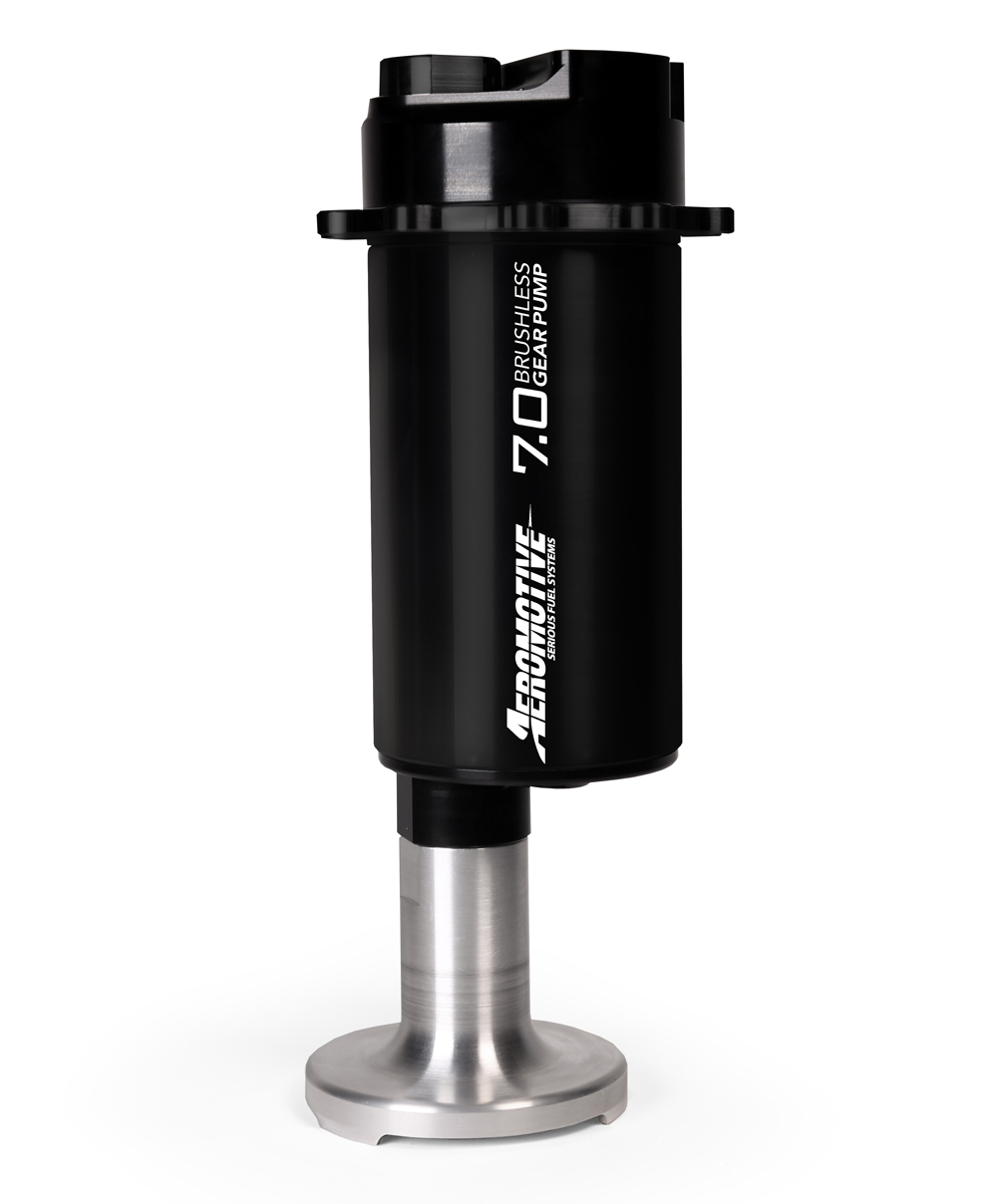
The trend toward brushless electric fuel pumps arose out of the need for greater fuel flow from a smaller unit for high-horsepower engines. The speed of these pumps can be controlled to vary fuel flow to meet engine demands. Photo courtesy of Aeromotive.
To learn more about these essential unsung heroes of the motorsports world, we talked to leading fuel system experts for their insights and recommendations on the subject. They took us through the different types of pumps, best applications, and the pros and cons associated with each one.
Electric Pumps
Of all the fuel pump types being used in motorsports today, electric pumps are the most common. They’re found in everything from simple carbureted bracket cars to 3,000-horsepower, twin-turbo, fuel-injected beasts. Much of the popularity of electric fuel pumps stems from their sheer versatility. Name almost any imaginable combination of car, engine, or induction system and there’s probably an electric pump for it.
Electric fuel pumps fall into two broad categories: inline and in-tank, based on where the pump is mounted. Each configuration has its own advantages and disadvantages.
Inline pumps are mounted outside of the fuel tank. One of the primary advantages of this configuration is its adaptability. Locating the pump outside the tank removes many of the space considerations imposed by mounting a pump inside the tank or cell. Because there are fewer size restrictions, a wider array of flow ratings and pump configurations are available. In addition, racers can even run multiple pumps in series if necessary.
That said, inline pumps can take more work to install. They need to be mounted below the bottom of the tank, and no further than two feet away from it so they can draw sufficient fuel into the pump. This can pose challenges in some cars, which can lead to compromised installations that reduce the fuel system’s effectiveness.
In-tank pumps are mounted inside the fuel tank or fuel cell. This configuration offers several significant benefits. “The advantages of an in-tank mounting system are one, you exclude the pump from environmental heat,” said Brett Clow of Aeromotive, Lenexa, Kansas. “That way it isn’t a target from external sources like exhaust or the pavement. And two, in-tank installations are cleaner and easier, because when you install the tank, you’ve installed the pump and pre-filter and everything. You don’t have to worry about how you’re going to get the pump low and close to the outlet of the tank and clear the wheelie bar or the suspension or whatever else may be going on in the back of the car.”
Another advantage of in-tank units is that the pump is submerged in fuel, which keeps the pump motor cooler. This can allow the pump to run more efficiently and extend its life. In-tank installations also tend to run quieter, which can be particularly important for dual-purpose race cars that do significant amounts of street driving.
One of the few downsides to in-tank fuel pumps is that they can be more challenging to install on OEM fuel tanks or on fuel cells that weren’t designed for the particular pump being fitted. In these cases, some fabrication and adaptation may be necessary.
Although the terms “in-tank” and “inline” seem straightforward enough, Clow noted a recently introduced wrinkle that could prove confusing. “The term ‘inline’ is kind of a misnomer,” he said. “It’s generally considered to mean the pump is outside the tank. But from our perspective at Aeromotive, we use the term ‘inline’ very specifically to define a pump in which the electric motor is in the fuel flow path. It runs wet.
“It’s a distinction with a difference in it,” added Clow. “When the motor is in the fuel flow, it can run continuously and not have the motor overheat. It’s cooled and lubricated by the fuel flowing through it.”
This brings up the subject of efficiency, a crucial concern for any fuel pump. The quest for greater flow in a smaller unit has led to the emerging trend of brushless electric motors for fuel pumps. “With a DC brushless motor, you typically get greater power for the given size of the package,” explained Rob Scharfenberg of Fuelab, Collinsville, Illinois. “It also gives you the ability to control the speed of the pump, so you don’t have to have it going full-out all the time. You can actually control it by your ECU. So, for example, we could have an electronic regulator that’s capable of controlling the fuel pump’s speed based on the sensed demand within the system. So if you have a really high-horsepower application, you don’t have to pull so much fuel pressure. You could make it more streetable.”
That said, not all manufacturers are on board the brushless bandwagon. “We don’t follow the buzzwords,” said Jim Craig of Weldon Pump, Oakwood Village, Ohio. “A growing faction out there are using brushless fuel pumps. But we don’t offer a brushless pump. Our pumps are the most efficient fuel pumps on the market. We draw the lowest amount of amperage but provide the most amount of fuel flow. Some of these brushless pumps are putting 18–20 volts to them to get them to spin enough just to keep up with one of our midrange fuel pumps.
“And you can only reduce the fuel flow out of a pump so much until you get to where you can’t maintain fuel pressure,” added Craig. “A lot of brushless guys are saying, ‘Well, my ECU can ramp it in and start from nothing.’ But you still get to a point where you can’t maintain pressure. So it’s only reducing volume so much.”
Mechanical Pumps
At the basic level, fuel pumps that are powered directly off the engine are considered mechanical pumps. At the lower end of the mechanical pump range are legacy OEM-style pumps. These are generally diaphragm-style pumps mounted to the engine block in the factory location, fueling carbureted engines. Although most forms of motorsports have abandoned OEM-style mechanical pumps, they’re still required by many stock-car sanctioning bodies and in some stock classes of drag racing. For most street-stock dirt-track racers, these pumps are the only approved choice.
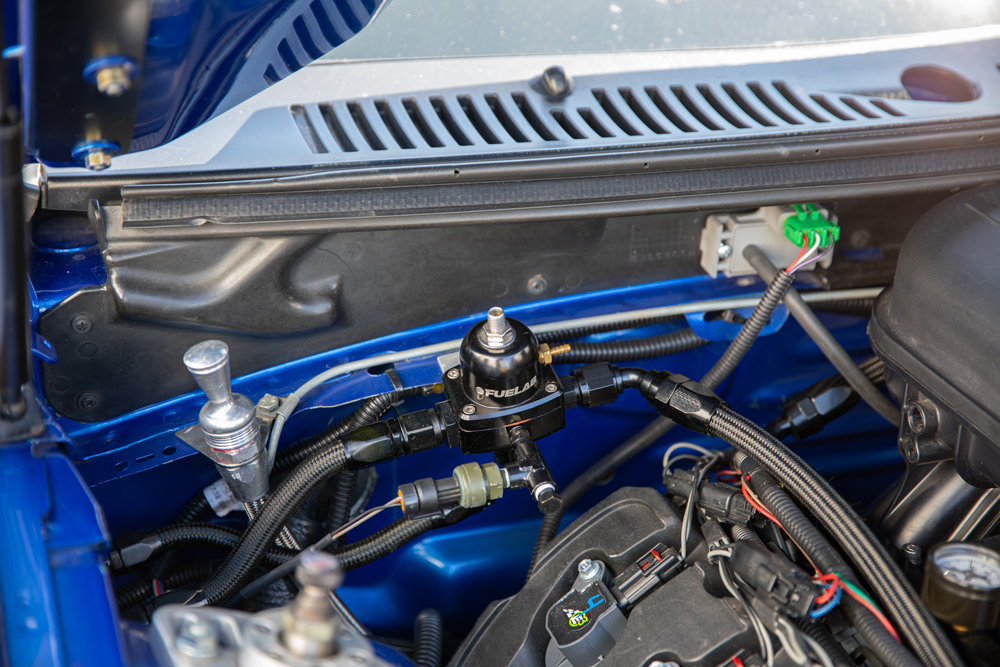
An electronic fuel pressure regulator is used to control the speed of a brushless electric fuel pump based on the demand that the system senses.
The fundamental advantage of OEM-style mechanical pumps is their simple, proven design. No external fuel regulator is required, there’s no additional work to mount them, and the technology itself is durable and reliable. As the mandatory choice in several extremely popular types of racing, these pumps still see widespread use. And so, despite their limited flow capability and complete unsuitability for EFI applications, many suppliers still offer a full product line to serve racers that are required to run them on their engines.
Also commonly used in motorsports are direct-drive external mechanical pumps. These can be driven by a dedicated belt-and-pulley system, mounted to the back of an external oil pump, or run directly by the camshaft through a timing cover adapter. Direct-drive pumps are typically found on dirt-track sprint cars, late models, and modifieds, as well as engines using mechanical fuel injection.
But perhaps the most dramatic application of this technology is in moving torrential amounts of fuel through high-horsepower, boosted drag cars. “The escalation of power was just outpacing the development cycle on electric fuel pumps,” explained Clow. “How do we make more power with a given engine? We just throw more boost at it. We get bigger turbos, bigger blowers, the boost goes to 25, 35, 45 psi, and your total fuel pressure numbers are exceeding 100 psi. And it’s really in that area where a mechanical pump’s advantage is going to start to reveal itself.
“All fuel pumps have an efficiency factor,” Clow added. “They all have internal leakage as pressures go up. As the pressure increases, that leakage increases incrementally with it. It’s not a tremendous amount of fuel. But when you look at the flow curve on an electric pump, you see a more dramatic decline from low pressure to high pressure. What’s going on there is you’re seeing the electric motor with a fixed amount of torque slow down as the pressure increases. So you’d have both the flow losses across the pumping mechanism and the reduction in pump rpm. That’s going to result in reducing the flow available as pressures go up. But if you put a mechanical pump on the engine, that pump isn’t going to slow down.”
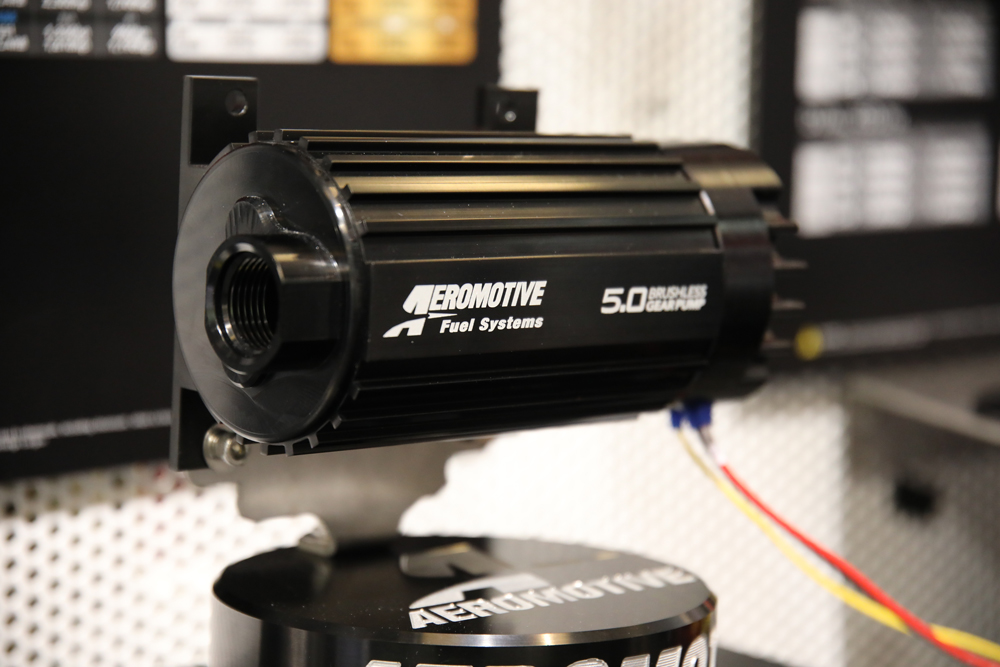
Fuel pumps can be mounted either inside or outside the fuel tank. Each configuration has its advantages and disadvantages. An externally mounted pump, like the 5-GPM Aeromotive Signature brushless electric pump shown here, doesn’t have the space restrictions that an in-tank pump would have. But it has to be mounted close to and below the fuel tank.
Despite their efficiency and high flow, direct-drive pumps have a disadvantage in that they can’t be used with a fuel cell mounted in the back of the car, unless a cumbersome cable drive is used to run a mechanical pump in the back. If a front-mounted mechanical pump is used with a rear-mounted fuel cell, vacuum will go so high at the inlet of the pump that cavitation can occur. This high vacuum flashes the liquid fuel to vapor at the inlet of the pump. The resulting interruption in fuel flow could put an end to a pass and possibly damage the pump at the same time.
Even with this limitation, direct-drive mechanical pumps have found a solid niche in motorsports. But, like so much else in racing, that position is in a state of flux, as continuing development of electric pumps moves the point at which a mechanical pump’s advantages outweigh the disadvantages. “We’ve been progressively increasing the capabilities of electric fuel pumps with our brushless gear pumps,” said Clow. “These pumps have come along to facilitate supporting these higher horsepower combinations on exotic fuels, without having to relocate the fuel cell to the front or put a big cable drive system in for a mechanical pump.
“But regardless of how much electric pumps evolve, there will always be a place for mechanical pumps,” admitted Clow. “They’ve earned a spot. With mechanical injection, that’s where you traditionally run a pump like that. And there’s also a small part of the marketplace, alcohol carbureted, where a mechanical pump and its variable flow characteristics allow us to cheat our fuel pressure a little bit, running low pressure at idle and higher pressure down track. And those markets will continue to be there.”
Choosing the Right Pump
When looking at the choices of fuel pumps, one thing quickly becomes very clear: It’s complicated. If you take into consideration the types of pumps, fuel choices, induction systems, car types, and the intended usage of the vehicle, there are many ways to get it wrong. And the results can be catastrophic. Besides losing races, improper fuel delivery can instantly ruin components or even grenade entire engines.
And unfortunately, the choices aren’t getting any simpler. With forced induction and EFI adding greater complexity, the stakes have gotten mighty high with regard to fuel delivery. “There’s a lot greater complexity that’s occurring today,” observed Scharfenberg. “So the challenge is navigating through a lot of that. The one thing that I think a lot of people need not be shy about is understanding that they need to learn something new. Unfortunately, I think there are a lot of guys out there that are going, ‘Ahh, I already know it. So I’m just going to forge ahead.’ And I think that that’s sometimes where they get into trouble.”
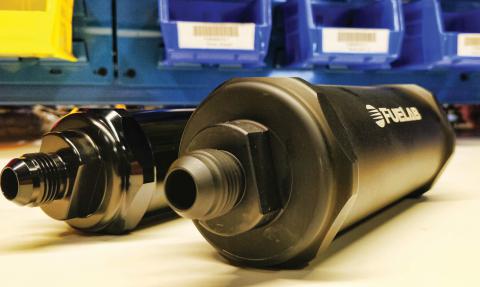
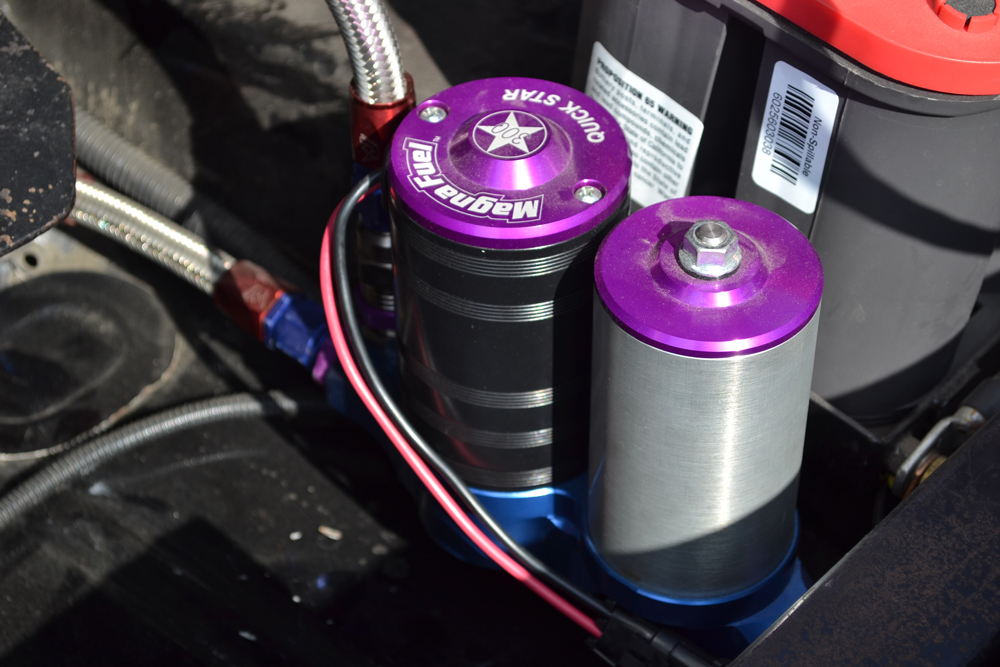
MagnaFuel external fuel pumps can be purchased with a companion fuel filter, as shown here, or without one. The QuickStar model can support more than 950 hp.
According to Matt Henson of DeatschWerks in Oklahoma City, Oklahoma, that kind of attitude often leads to common mistakes. “First off, many people don’t realize how fuel system pressure affects fuel pump flow—flow decreases as fuel pressure increases. People don’t understand that even though a pump is rated for 1000 hp, it may not support 1000 hp for them, because their particular system might be running different fuel pressures. Second, they don’t see how OEM fuel system designs affect fuel pump output. Modern OEM fuel systems use fuel flow from the pump for slosh control and fuel tank delivery issues. This robs fuel flow from the pump, lowering the amount of power it can support. Some guys will also undersize lines on the inlet side and they’ll kill the fuel pump. Or they’ll use excessive filtration or too tight of filtration on the inlet side, and they’ll kill a fuel pump, because you’re going straight to cavitation. So you have to size the lines, the filters, and the pump so that everything works in conjunction with the motor horsepower.”
Many racers try to give themselves some margin for error by intentionally choosing a pump that’s larger than they need. But this too has significant complications. “Let’s say, for instance, you put a fuel pump in your car that’s moving 200 gallons an hour, but your motor is only making 1,000 horsepower,” said Craig. “That means you’re constantly returning to the tank half of what that pump is putting out. That will start to heat the fuel. You’ll end up elevating the fuel temperature and turning fuel to vapor, which results in cavitation, erratic fuel pressure, and erratic performance.”
Manufacturers have plenty of information available online to help racers choose the correct pump for their specific application. But this can quickly become overwhelming, as racers grapple with factors like fuel weight, brake specific fuel consumption, and the relationship between flow and pressure. Fortunately, some manufacturers also provide far easier methods of choosing a fuel pump. A number of suppliers, including Aeromotive and DeatschWerks, have online search systems on their websites that guide customers to the correct pump choices, just by answering a few simple questions.
And all suppliers we spoke with agreed on one point: It’s always best to call the manufacturer’s tech line if you’re not sure of something. “Most guys will look online, because there’s a lot of information out there,” said Craig. “But 90% of them will end up just calling me. And then I walk them through it. I’m an educator of fuel systems.”
Fuel Cell Considerations
Fuel pumps are a central element of a cohesive, effective fuel system. But without the right components to complement them, they can’t perform the way they were intended.
Foremost among those components that must be carefully considered in a fuel system is the fuel cell. Designed to optimize fuel flow and reduce hazards in crashes, fuel cells are a vital part of a racing fuel system and are therefore required by sanctioning bodies for most types of competition.
There are three primary elements to a fuel cell: enclosure, bladder, and foam baffling. Enclosures are typically made of plastic, steel, or aluminum. This material serves as an outer shell to resist punctures in the event of a crash. For greater protection, many fuel cells have rubber bladders inside the enclosure. These soft inner containers are designed to absorb impacts without puncturing, by stretching and conforming to sharp edges during a crash.
Not all fuel cells have rubber bladders—they aren’t required for some types of racing.
But whether or not they have a bladder, fuel cells today are all generally filled with safety foam, designed to prevent fuel from exploding if it ignites. At the same time, the foam also limits fuel sloshing to ensure more consistent fuel delivery.
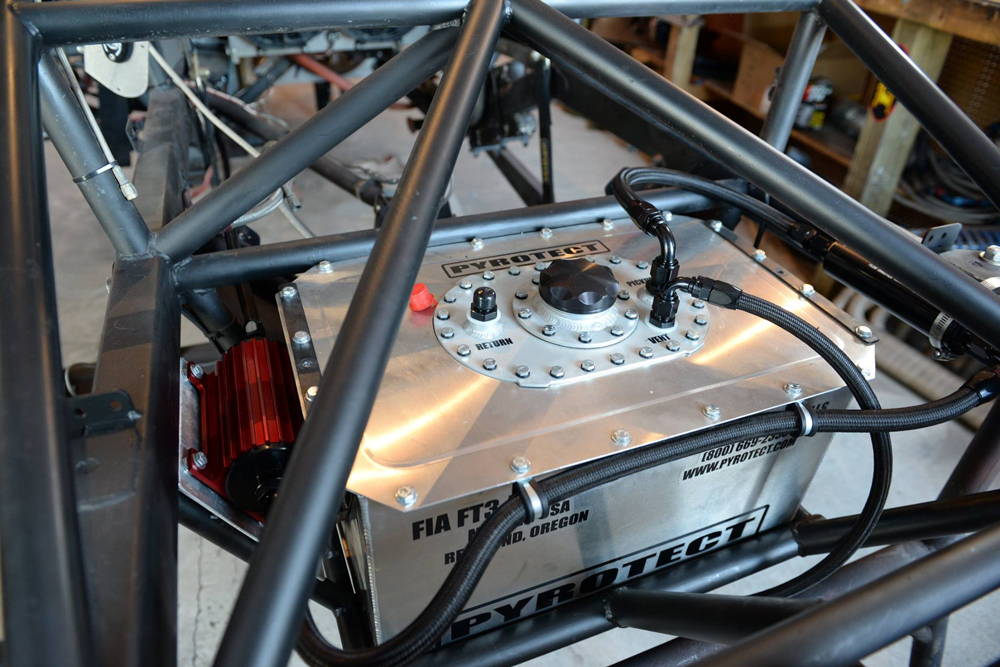
Not all sanctioning bodies have stringent fuel cell requirements, one of our sources said, making it important to choose a fuel cell approved by a reputable organization, such as the FIA. Note the FIA certification on this Pyrotect fuel cell. Photo courtesy of Pyrotect Safety Products.
Ultimately, fuel cell choices are largely dictated by the sanctioning bodies. Therefore, the rulebook is the first place to start when considering a fuel cell. That said, many manufacturers feel there is still considerable room for improvement over what’s specified.
“Some rulebooks are extremely lax on fuel cell requirements,” said Dave Dack of Aero Tec Laboratories (ATL), Ramsey, New Jersey. “We always encourage racers to make sure the cell is equipped with check valves for both the fill and the vent, and most importantly that they choose a cell with an approval from a reputable, world-renowned organization like the FIA.”
Other manufacturers point to the importance of the mounting position and the risks a vehicle is exposed to when choosing a fuel cell, regardless of what’s required by the sanctioning body. “A good rule of thumb is that if the fuel cell is in a high-risk area, such as behind the rear axle, or in the side pod of the vehicle, you really need to have a certified rubberized bladder type cell,” noted Steve Russell of Pyrotect, Redmond, Oregon. “There are also circumstances, like in high-powered off-road race trucks, that carry anywhere from 80 to 120 gallons of fuel. For those we typically build in the next higher standard, even though it’s not required, just because of the sheer speed and impacts they can take.”
Beyond safety concerns, practical considerations like line size and mounting points are crucial in choosing a fuel cell. Given the complexity and nuances of fuel systems in general, this unfortunately leaves plenty of room for mistakes. “I see this all the time where guys will have a 3/8-inch or 1/2-inch standpipe for a pump that needs a 5/8-inch or a 3/4-inch pickup tube,” observed Brett Clow of Aeromotive, Lenexa, Kansas. “And the pump is going to suffer for that because it’s going to be starving for fuel, producing a lot of vacuum, and cavitating. And it can boil fuel, because of the restriction created by the suction side of the pump.”
To simplify the choices, there’s a growing trend in offering preconfigured pump and cell assemblies, which come already set up with the correct enclosure, pump, fittings, lines, and filter. Although the cost may appear to be higher than it would be when sourcing individual components, it can be nearly the same when everything is factored in.
“If you look at one of our fuel cells with a pump in the cell, on the face of it, it may seem kind of pricey,” said Clow. “But take and buy a fuel cell, some lines, hose ends, and a 100-micron filter, then compare it to the price of one of our cells with the pump already in it. There’s really not much difference.” —David Bellm
Dan Millen, president of Livernois Motorsports & Engineering, dives deep into its engine building, tuning, and motorsports vehicle services all done in-house out of its massive Dearborn Height, Michigan facility.
Hear about its record-breaking runs, why racers know "how to get it done," and why having the right team can make any operation successful. Plus, catch some jaw-dropping burnouts and dyno runs.
Jason Enders from RE Suspension and Greg Fornelli from SRI/Stock Car Steel & Aluminum tell why the PRI Trade Show is a must-attend event, a thought echoed by 82% of exhibitors. The PRI Show, set for December 9-11, in Indianapolis, Indiana, provides racing manufacturers and service providers with direct access to the worldwide racing marketplace. PRI showcases all forms of auto racing, all under one roof—stock car, drag, sports car, prototype, sprint car, midget, modified, formula, dirt late model, sport compact, karting, vintage, and more.
Buyers and attendees come from all 50 states and nearly 70 countries. These include volume buyers of racing products, technology, shop equipment, and services. More than half are retailers of racing products or race engine businesses, while others include professional race teams, motorsports warehouse distributors, high-performance install shops, and race car builders. Almost 85% of attendees make buying decisions or recommendations.
PRI exhibitors get face-to-face with buyers for hands-on sales presentations of new race products. Show highlights include Machinery Row, indoor trailer exhibits, and the Featured Products Showcase, all of which provide unparalleled selling tools exclusive to PRI.
SEMA President & CEO Chris Kersting has commended US Representatives Patrick McHenry (R-NC) and Raul Ruiz (D-CA) for introducing H.R. 3281, the Recognizing the Protection of Motorsports Act of 2021 (RPM Act). The bipartisan bill includes 48 original sponsors. The RPM Act protects Americans’ right to convert street vehicles into dedicated race cars and the motorsports-parts industry’s ability to sell products that enable racers to compete.
The RPM Act reverses the EPA’s interpretation that the Clean Air Act prohibits a motor vehicle designed for street use—including a car, truck, or motorcycle—to be converted into a dedicated racecar. This American tradition was unquestioned from 1970 until 2015 when the EPA took the position that converted vehicles must remain emissions-compliant, even though they are no longer driven on public streets or highways.
“SEMA looks forward to working with Congress to enact the RPM Act and make permanent the Clean Air Act’s original intention that race vehicle conversions are legal,” said Kersting. “We thank Representatives McHenry and Ruiz for standing up for racing and the motorsports parts industry by introducing a bipartisan bill to protect racing and the businesses that produce, install, and sell the parts that enable racers to compete."
There has already been an unprecedented outpouring of support for the RPM Act this year, with Americans sending over 1.1 million letters asking Congress to pass the legislation. It is imperative that enthusiasts and motorsports businesses keep up this momentum by reminding their lawmakers in Washington, DC that they must act now to protect the right to convert a motor vehicle into a race car.
“I am proud to support automobile racing and will work to ensure motorsports enthusiasts here in North Carolina and across the country can continue the time-honored tradition of modifying stock vehicles for competitive racing,” said Rep. Patrick McHenry. “I look forward to working with my colleagues to help ensure the RPM Act becomes law."
“Growing up, I spent countless hours at the race track with my father," said Rep. Raul Ruiz. "Racing has always been close to my heart. I am delighted to introduce the Recognizing the Protection of Motorsports (RPM) Act which will keep our American tradition of vehicle racing alive and give enthusiasts and their children the same opportunity that I had to create memories at the racetrack."
Motorsports competition involves tens of thousands of participants and vehicle owners each year, both amateur and professional. Retail sales of racing products make up a nearly $2 billion market annually. Most of the vehicles raced on the approximately 1,300 race tracks operating across the US are converted vehicles that the EPA considers to be illegal.
It is important that members of Congress hear from the racing and automotive enthusiast communities about the importance of passing the RPM Act into law in 2021. To write a letter to your members of Congress, visit sema.org/rpm.
Our expert sources are here to troubleshoot temperature increases, size up (or down) expansion tanks, break down the differences in radiator type, and more.
One of the fundamental properties that all internal combustion engines share is the need to maintain a proper operating temperature. Run an engine too hot, and the resulting parts failure could prove catastrophic. Run an engine too cold, though, and it won’t operate as efficiently as it should. Now, take that bit of Auto Shop 101 knowledge and put it in the pressure cooker that is racing, and the risks—and rewards—of proper cooling rise dramatically.
It may be fundamental, but proper engine cooling practices require a knowledge and experience base that’s distinct from other engine functions. For that reason, we reached out to experts in engine cooling and asked for their most frequently asked questions from the racing community, as well as their answers.
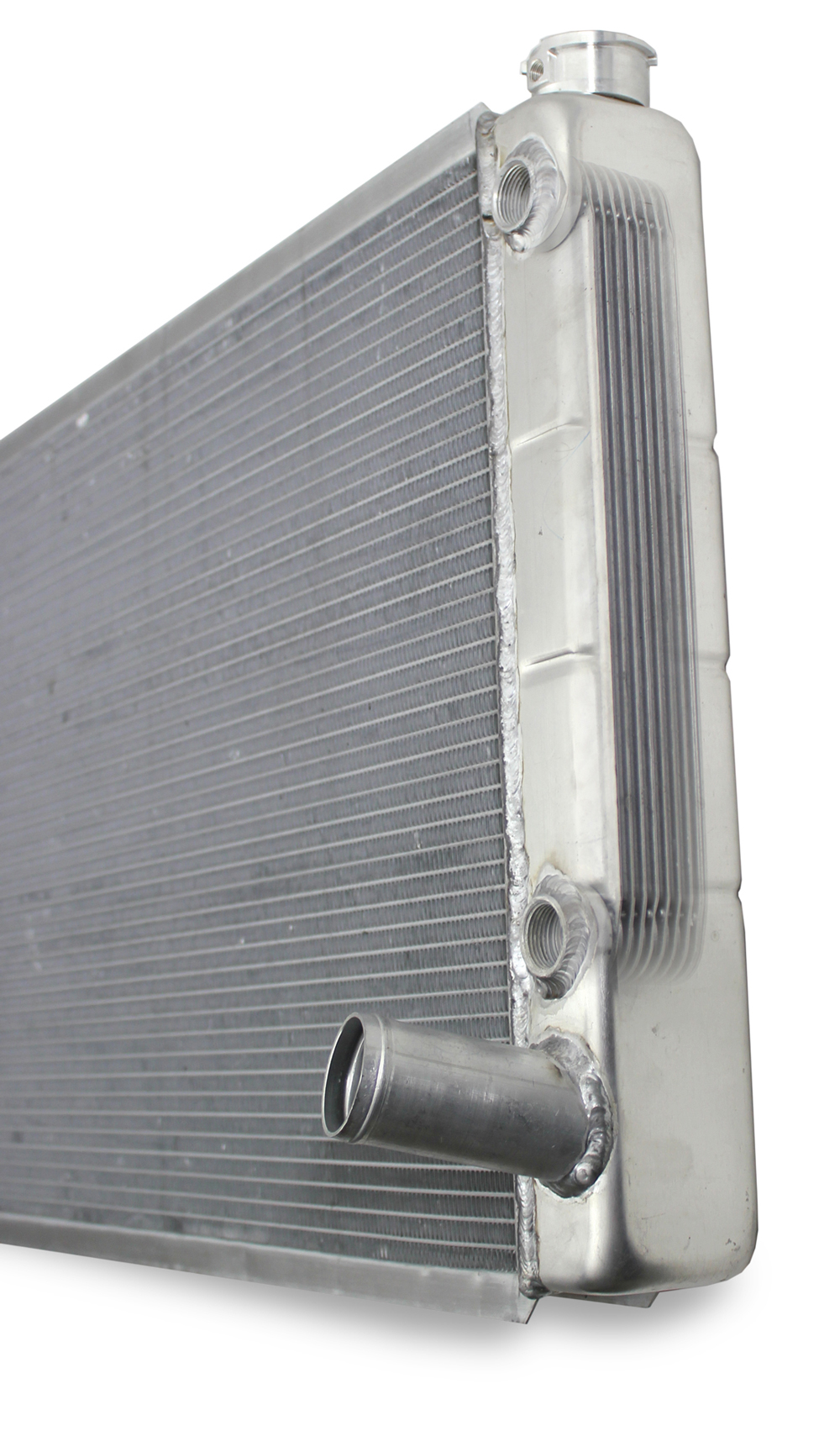
Northern Radiator manufactures competition radiators with an eight-plate Super Flow Oil Cooler built into the tank. It is “highly efficient” in heat transfer, said a company representative, and can be used with either wet- or dry-sump oiling systems.
What are the differences among the variety of radiators available in the market?
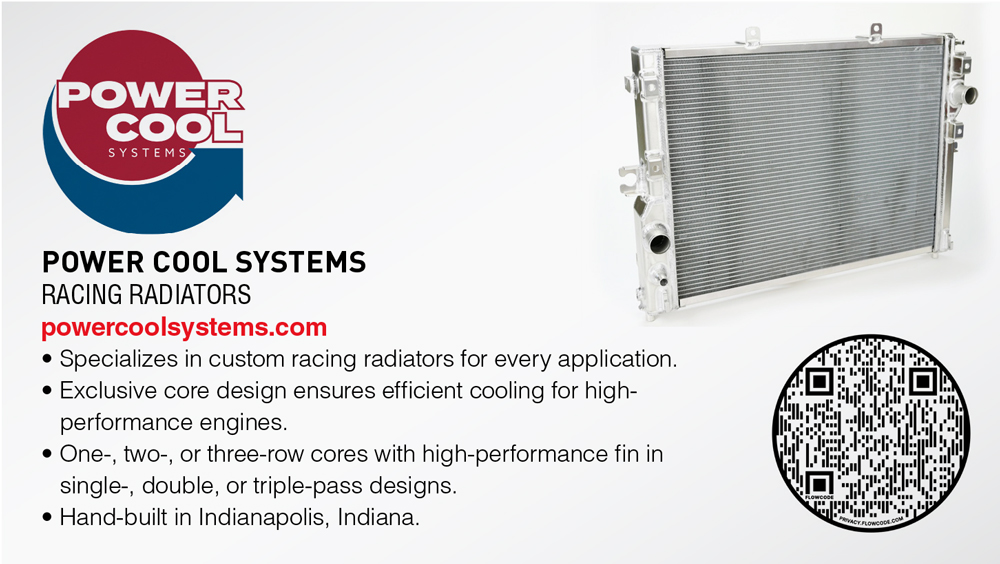
The two main considerations when comparing radiators for racing applications are airflow and coolant/water flow and turbulence. Airflow technology is dependent on the core tube size and configuration, and on the fin size and configuration. Our sister company, Tube Wright Inc., developed several different cores that Power Cool uses to build radiators for racing applications: a 52-mm Ultra-High-Performance Core and 36-mm and 26-mm High-Performance Cores. These cores provide maximum heat transfer with or without the addition of a high-performance fan to deliver more cooling performance under extreme racing conditions.
The other factors that determine how effective your cooling system will be are the water flow rate and turbulence of that water as it passes through the tubes. Higher flow rate and high turbulence both work together to achieve faster and more efficient cooling at the extreme engine temperatures that racers need to be competitive. We advise teams to look for dimpled-core tubes, which maximize surface area of the water flowing through the radiator, thereby increasing the radiator’s cooling capacity. Power Cool’s Ultra-High-Performance and High-Performance radiators use this dimple technology. —Earl Lemley, Power Cool Systems, Indianapolis, Indiana
Is there a difference between a radiator used for racing and one used for another application, like a restoration?
Not necessarily. Most of our radiators have two rows of 1-inch aluminum tubes. They’ll cool your 1968 Camaro and your small block or big block modified circle track car that you take out on Friday or Saturday night.
But we do have a difference in our race product that other manufacturers don’t: an eight-plate oil cooler we call the Northern Super Flow Oil Cooler. Some manufacturers will put in what’s called a barrel cooler, a tube that sits in the tank. While barrel coolers are high flow, they have poor cooling efficiencies. The eight-plate design is the largest cooler that will fit in our race radiator tanks, and the plate design is highly efficient in heat transfer. It can also handle either a wet-sump oiling system or the higher pressure and volume of a dry-sump oiling system.
We also have single-pass, double-pass, and triple-pass radiators, all designed to help the racer dissipate heat based on whatever his issues might be. Sometimes a single pass through the radiator is not enough. A double-pass radiator gives the coolant two passes through the core, and a triple-pass radiator gives it three passes through the core. With a double-pass you’ll typically get an extra five degrees worth of cooling, while a triple-pass will give you 7% to 10% more cooling. Most double- and triple-pass radiators work well when you have limited airflow at the front of the car and you need that extra time in the radiator to help dissipate heat. —Chuck McKaige, Northern Radiator, Willmar, Minnesota
Is a thicker radiator core better than a thin one?
Let’s start by defining “better.” In a radiator, better would be defined as exchanging more heat under similar conditions. Heat is transferred from the engine coolant to the radiator fins, and then to the air that has been pulled through the core by the fan or a positive pressure area in front of the radiator. This air then travels to a low-pressure area out of the hood or into the engine bay. The job of the radiator is to remove as much heat as possible from the coolant.
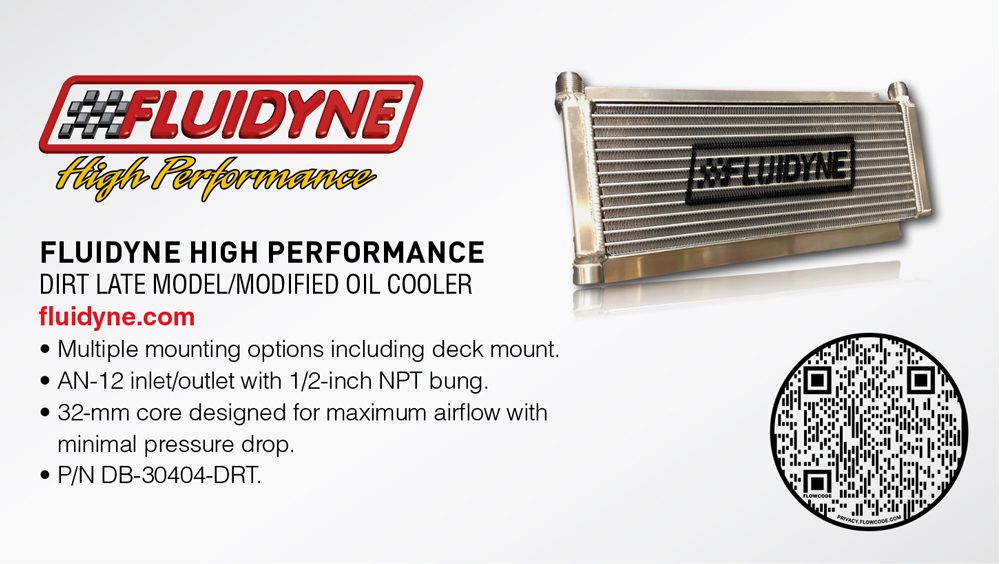
Many assume that thicker radiators are automatically superior in cooling, but that is not the case. The most efficient core would be thin, but tall and wide, which allows the most amount of heat exchange. When you start adding extra rows, they get less efficient as you stack them. There is a point where too thick becomes a problem, as the incoming air becomes turbulent and the path of least resistance is no longer through the core. As technology progresses, we will evolve into cores that remain thin but contour to the chassis, providing maximum heat exchange in a previously unusable area. —Ryan Williams, FLUIDYNE, Mooresville, North Carolina
A thicker radiator is not always better at cooling, said our source at FLUIDYNE. In fact, a radiator that’s too thick can be less efficient at heat transfer, as the air flowing through it can become turbulent.
With the advancements in core technology, such as cooling tube and fin design, improvements have been made in heat rejection. This has allowed us to utilize thinner cores for a given application, and the thinner core gives us a more efficient core where airflow is concerned. With all things being equal, the thinner core will have less pressure drop from the front side to the back side of the core. This allows the velocity of the air to be higher, which in turn creates another positive situation in heat rejection. Within reason for the application, a thinner core is just more efficient with the given amount of airflow it’s seeing.
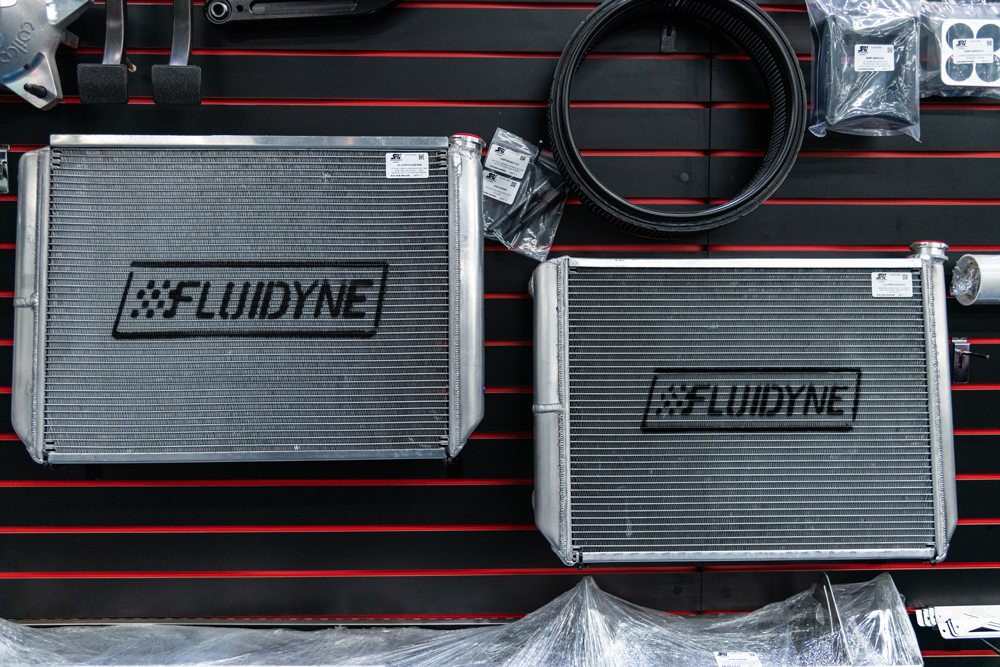
For example, where we previously used a lot of 55- to 68-mm cores, we can now use a 42-mm core and see better cooling. We also end up with a lighter part and less fluid weight. Obviously, there is a point of diminishing returns when it comes to using thinner cores. There will always be a minimum thickness that is desirable.
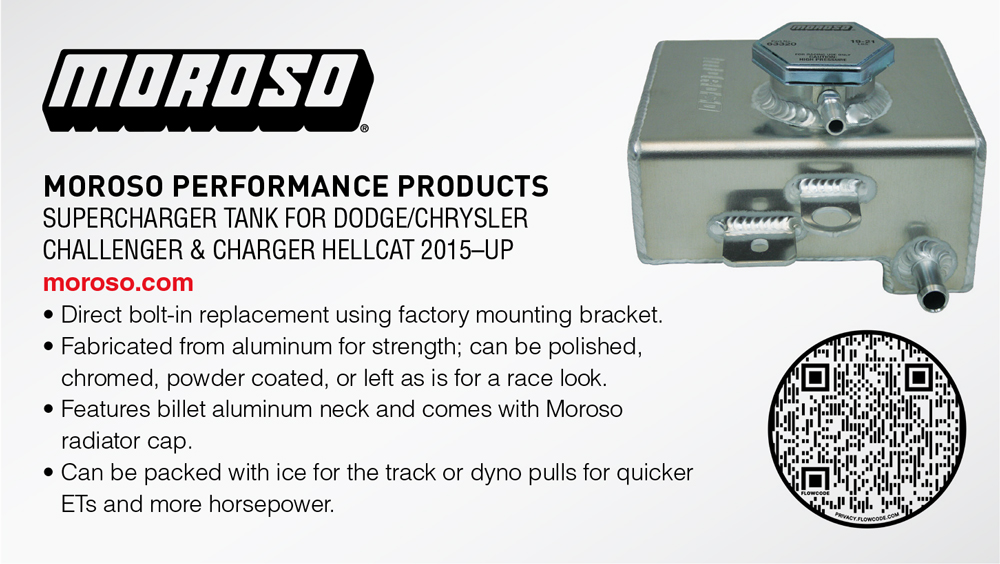
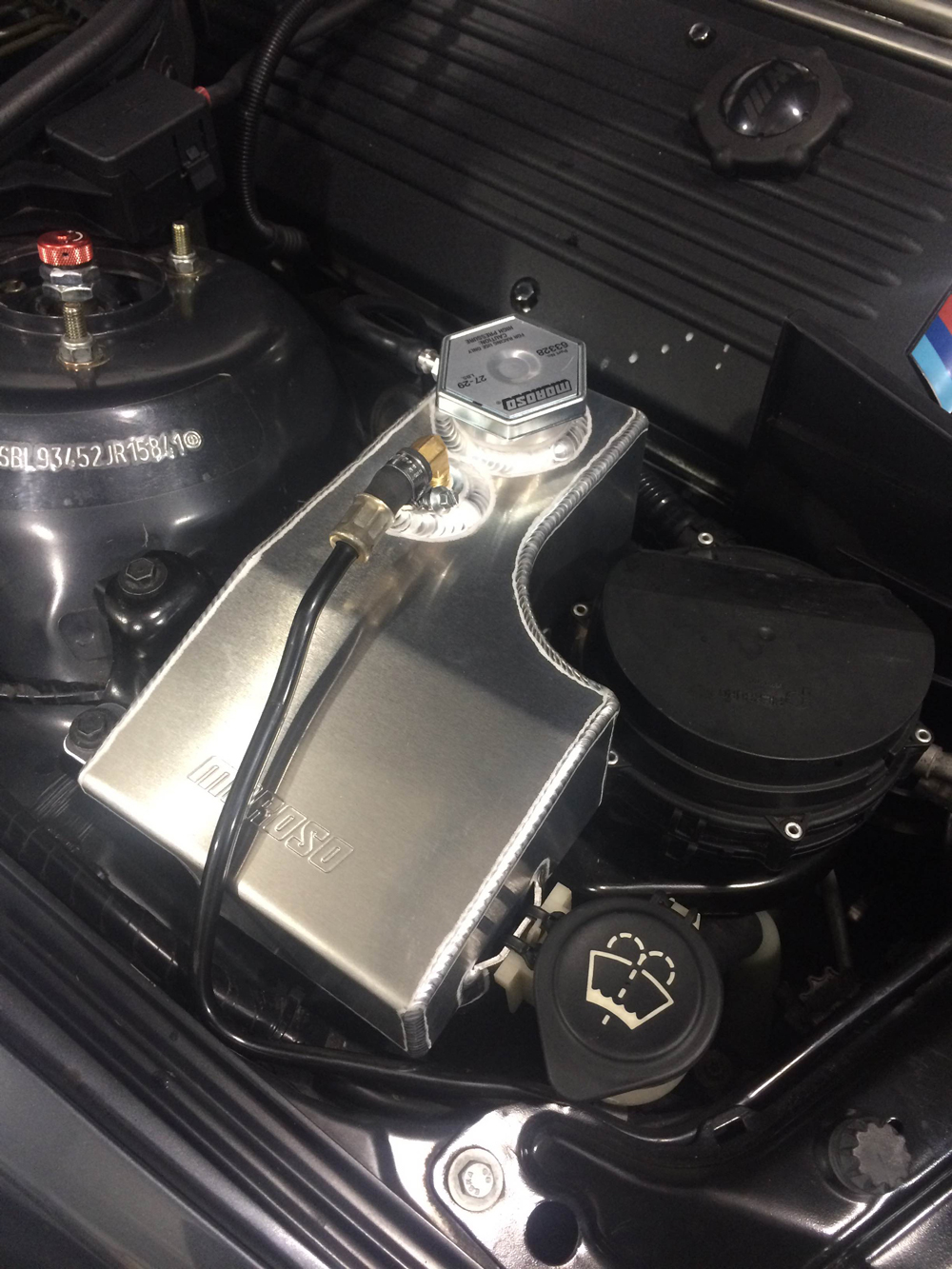
Performance retailers can sell direct-fit aluminum expansion tanks to replace plastic factory tanks, which are prone to cracking, according to our source at Moroso Performance Products.
Another interesting point about core thickness: The thicker the core, the more the air heats up as it passes through it. Thus, the thicker core will have higher temps on the back side of the core, which can have a negative effect on water temp.
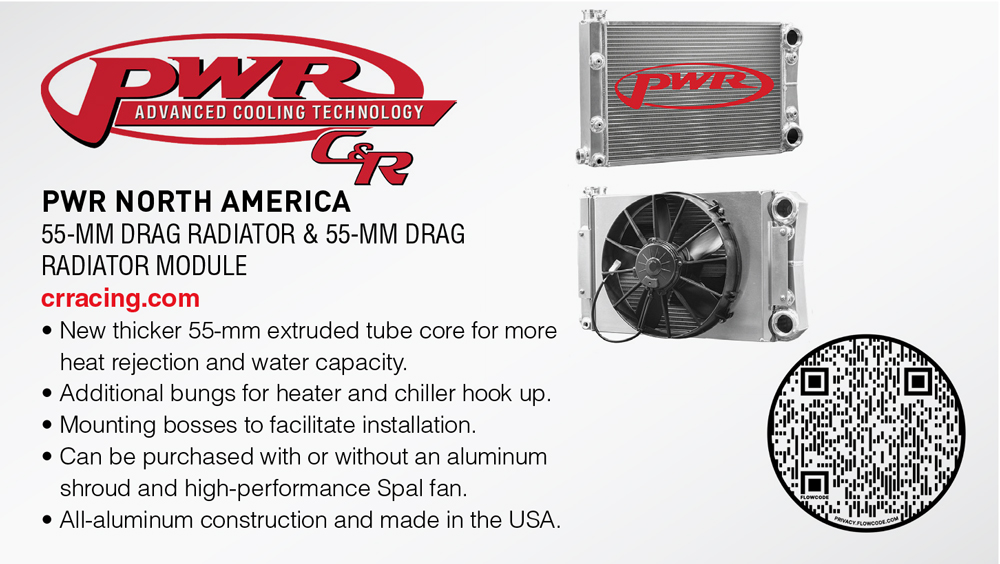
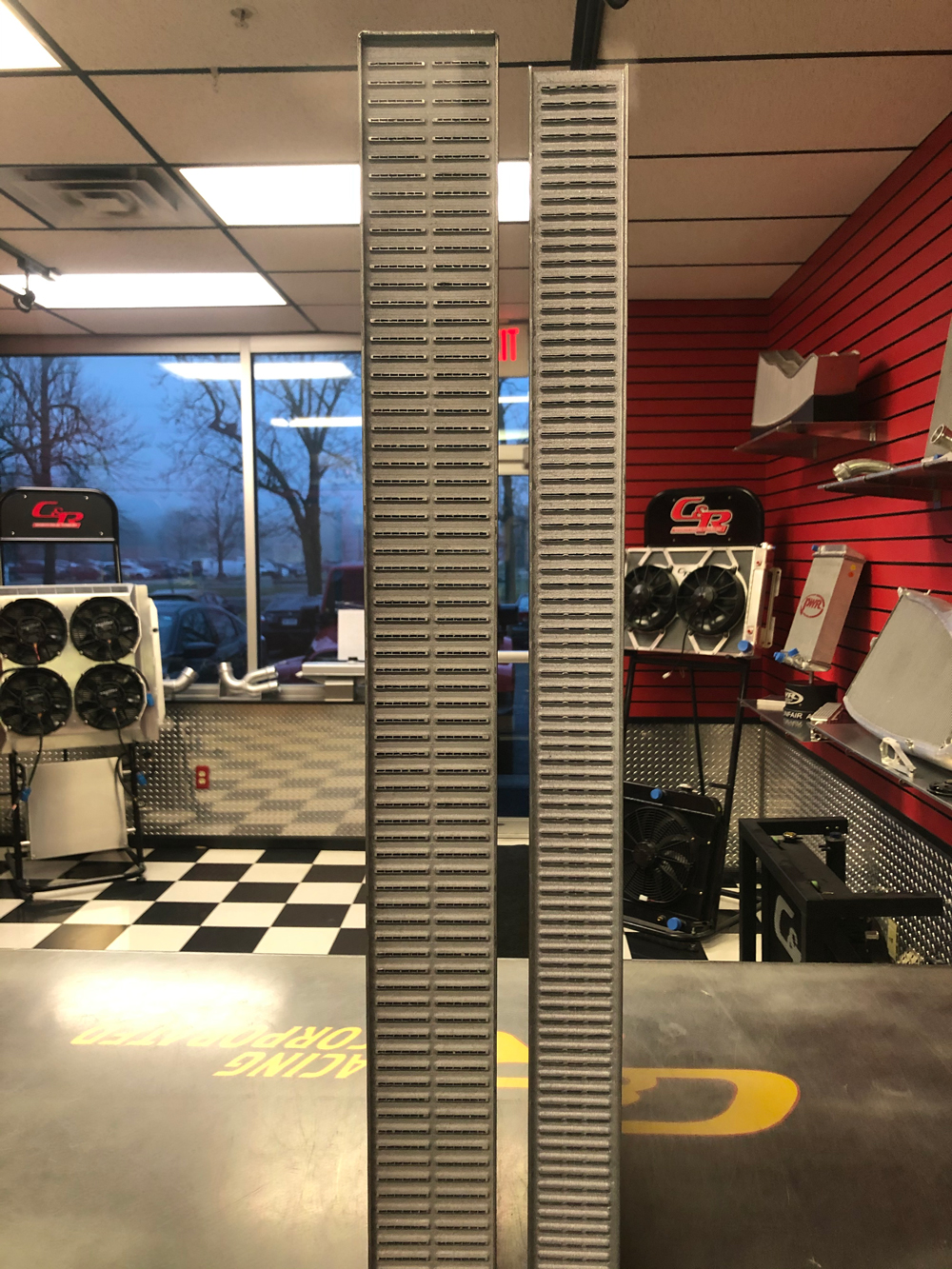
With [our partner] PWR building its own cores in-house, it gives us great latitude when it comes to core thickness, cooling tube and fin type, as well as fin density, where we can tailor a core spec to a specific set of parameters for a given application. —Herb Engelhart, C&R Racing Inc. (part of PWR Advanced Cooling Technology), Indianapolis, Indiana
This photo illustrates the difference in thickness between two C&R Racing radiators, a 68-mm core (left) and a 42-mm core. Improvements in cooling tube and fin design have enabled the company to use thinner cores for a given application, which makes for a lighter part and less fluid weight.
Should I install smaller lower radiator hoses or restrictor plates to slow down the coolant and keep it in the radiator longer?
No. A cooling system is closed-loop. The more time the coolant is in the radiator, the more time the coolant is in the engine. Reducing coolant flow will only expand the temperature difference between the inlet and outlet temperatures. That’s bad for a whole bunch of reasons.
The inlet and outlets on the engine usually are attached to separate components—the block and heads. If the temperature of one is significantly different than the other, you’ll have a problem with thermal expansion. Though it might not be immediately apparent, that poor head gasket is being sheared to death. The heads are growing larger than the block. Your head gasket problem could be a cooling system problem.
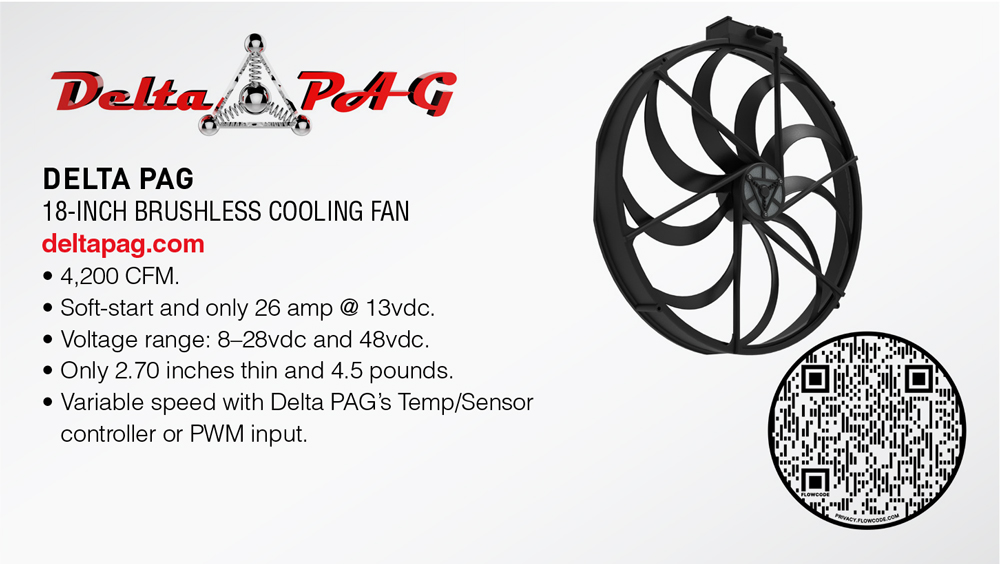
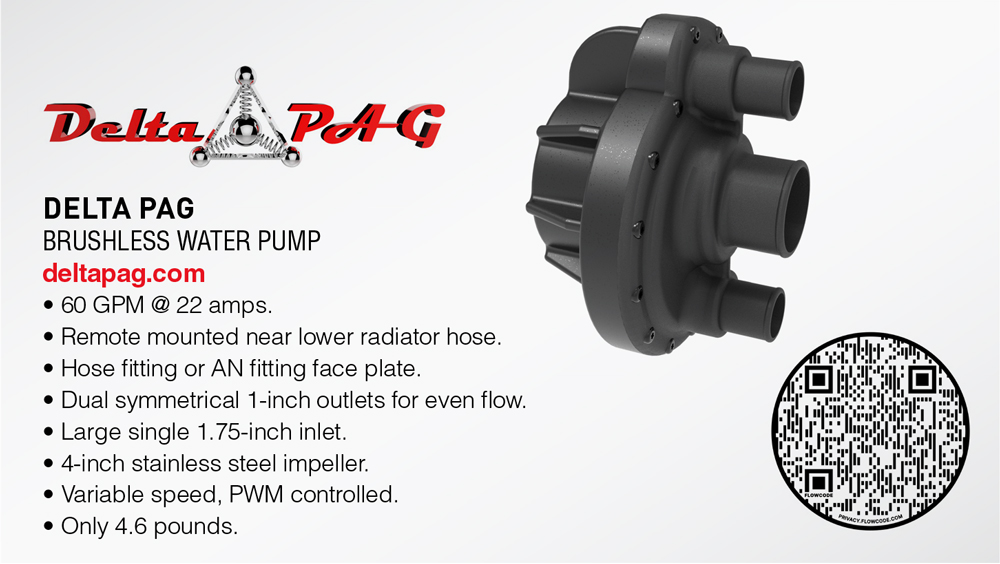
There are situations where lower flow has benefits, and others where max flow is required. Too fast or too slow are both problematic for proper cooling. Having the engine’s rpm determine coolant/airflow makes it nearly impossible to maintain ideal operating temperatures. That’s why Delta PAG manufactures variable-speed brushless water pumps and fans. They’re powerful [and] efficient; and because of their ability to operate at variable speeds, they can increase or decrease flow rate from 5 to 60 gallons per minute as needed via a one-wire signal PWM. It has a huge 1.75-inch inlet and dual 1-inch outlets and only weighs 4.60 pounds. —John Pairaktaridis, Delta PAG, Astoria, New York
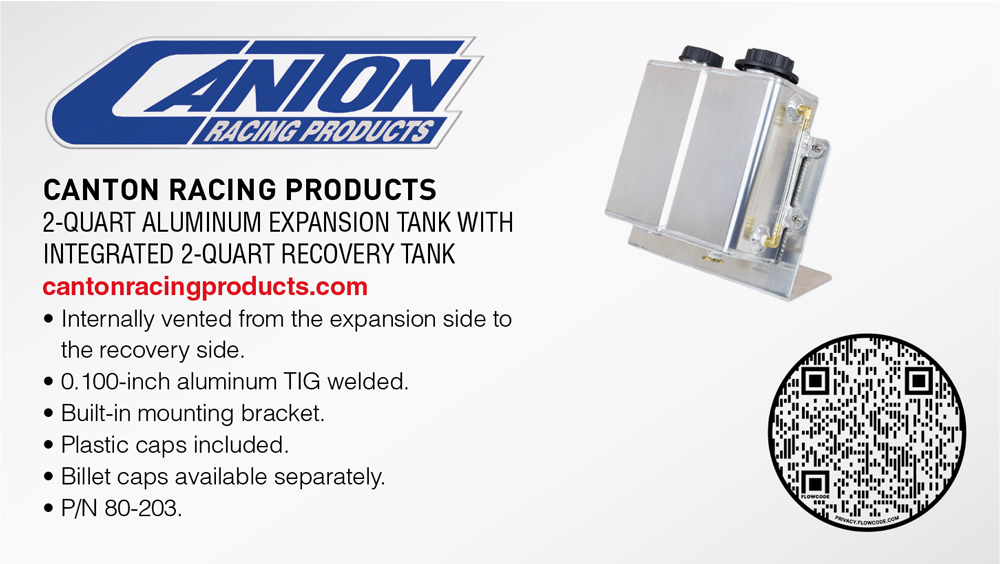
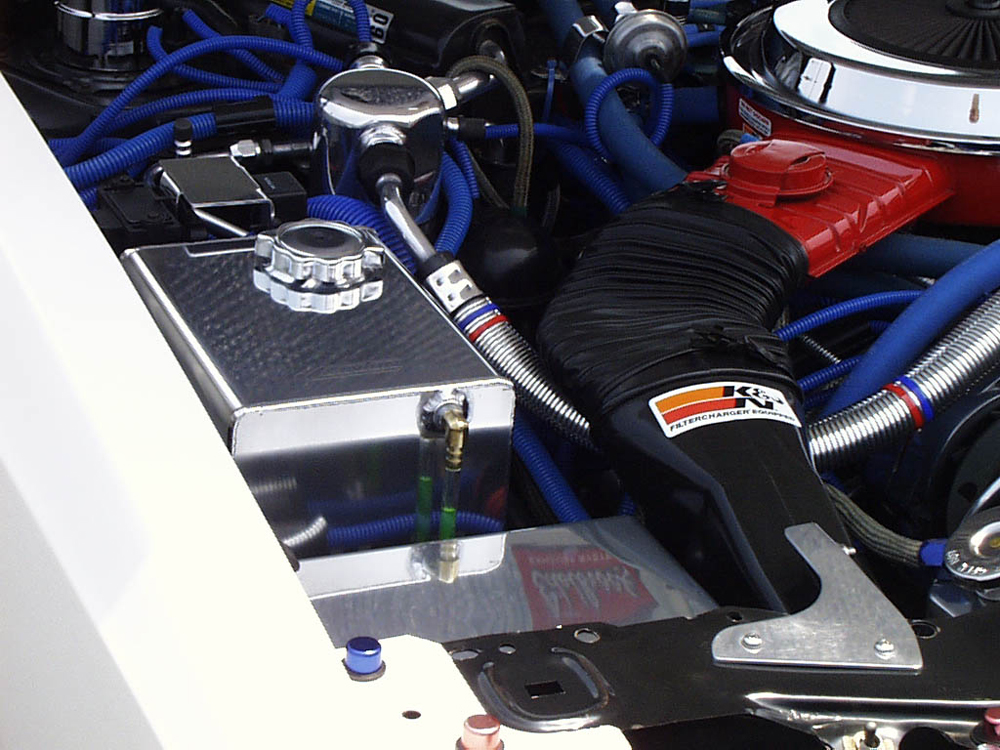
Space in a race vehicle’s engine bay is at a premium, so Canton Racing Products developed a mathematical formula to calculate the correct size for an expansion tank.
I put in a new motor and radiator, but the engine is running hot. What should I do?
95% of the time, a correction of one or more of these issues will solve the problem: Set the proper timing of the distributor; properly jet the carburetor; and/or replace an improper thermostat. If the engine’s timing is too far advanced or retarded, that causes the motor to run hot because it’s working harder. The same is true if the engine is running too rich or too lean. And if you replace a 180-degree thermostat with a high-performance, 160-degree thermostat, that usually immediately cures the problem. —Rick Hobbs, PROFORM, Warren, Michigan
How does using a high-pressure cap improve performance?
Two important facts here: One, cooling systems like the one in a production vehicle generally work with pressures less than 19 psi. Two, water boils at 210 degrees F.
These two facts are important because they define the need for pressurized caps. One thing we do not want is to boil the water. This will create pockets of air, which greatly hinder cooling performance. As we increase the pressure, we are able to increase the boiling point of the water in our cooling systems. Every pound of pressure is equal to 2–3 degrees F increase in the boiling point. In the top tiers of racing the engine cooling system operates at pressures over 50 psi. They can then tape off the front end, increasing the downforce on the car. Taping off will increase the water temperature, so they are able to run the car at 250 degrees F without having cooling issues. These types of temperatures would overheat a standard production car, possibly leaving you stranded. —Ryan Williams, FLUIDYNE
What is the difference between an expansion tank and a recovery tank?
To properly function, a pressurized cooling system needs a fill, expansion and air-bleed area when filling or topping off coolant. That area needs to be the highest point in the system. In older vehicles, the top of the radiator was the highest point of the cooling system, and it was accessed through a pressurized radiator cap. New vehicles are designed with aerodynamics, styling, pedestrian-protection, and a host of other factors that place the vehicle’s radiator lower than the engine in many cases. The expansion tank, then, is located at the high point in the cooling system and serves the same function as the radiator cap in older vehicles. Expansion tanks are valuable in helping the cooling system operate properly in race cars as well, as race car designers and builders mount radiators lower—or even at different ends of the vehicle—than the engine. Performance retailers can sell direct-fit aluminum expansion tanks that replace the prone-to-cracking plastic expansion tanks under the hoods of most modern vehicles.
The function of a recovery tank is to contain the system’s expanded hot coolant. This happens when the internal thermal spring of the radiator cap is tripped and sends the expanded fluid out the side bleed hole port of the radiator neck. Sanctioning bodies require race cars have a place for this expanded coolant to go, so a recovery tank should have a vented cap and be plumbed close to the side bleed hole port of the radiator cap neck. As the coolant cools down, the spring in the radiator cap will go back to its normal position, and the cooling process will create a vacuum that sucks the coolant back into the system. —Thor Schroeder, Moroso Performance Products, Guilford, Connecticut
What size expansion tank do I need for my coolant system?
The general rule of thumb for proper capacity of expansion is 12% of total coolant volume for drawdown and 6% of the total volume for thermal expansion.
Drawdown capacity is the amount of coolant that can be lost before air reaches the water pump and is introduced into the system. Air bubbles in the coolant system can cause inconsistent cooling and can also prevent the thermostat from opening if an air bubble gets trapped underneath it.
Thermal expansion occurs as coolant accumulates heat from the engine. The 6% of the expansion volume is calculated from the amount that the coolant level will rise at 212 degrees F. This takes into account the density change of the coolant itself and all the components that are in the coolant system. If the volume is calculated incorrectly and an inadequate expansion space is provided, coolant will be discharged from the system at operating temperature. To prevent the possibility of spilling coolant, a catch tank or a recovery tank can be used.
To get the proper expansion tank volume, add together the drawdown capacity requirement and the thermal expansion requirement for an additional 18% total volume required for the expansion tank. As most coolant systems are designed to operate with about 13 quarts in the system, these calculations serve as an example:
Drawdown = 12% of 13 quarts = 1.56 quarts
Thermal Expansion = 6% of 13 quarts = .78 quart
Expansion Tank Size Required = 2.34 quarts
In a situation where a large enough tank isn’t available, a recovery tank can be used to make up some of the expansion volume needed. A recovery tank will collect any coolant that is expelled from the pressure relief. In a setup with a recovery tank, it is important to make sure that the coolant system is still full enough to allow for drawdown. —Iann Criscuolo, Canton Racing Products, North Branford, Connecticut
How much horsepower can be gained by converting to an electric pump?
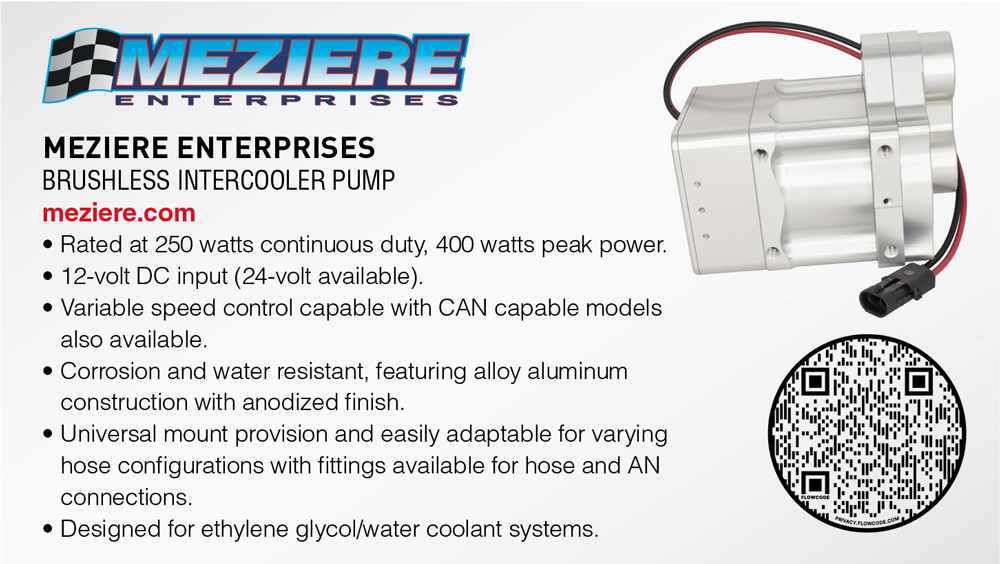
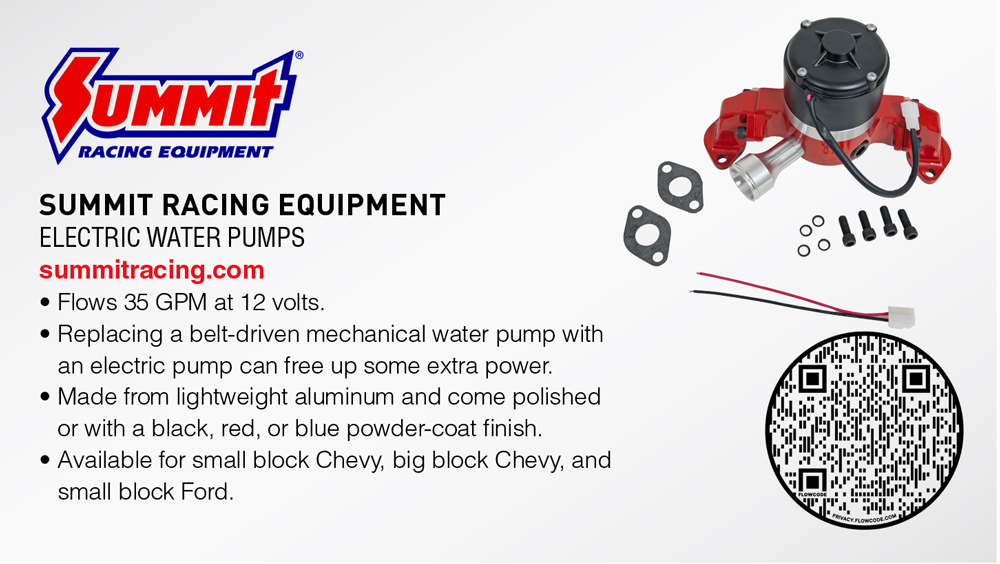
Since an electric coolant pump works at a steady rate and a belt-driven pump is rpm dependent, it is hard to give an exact number as far as horsepower gain is concerned. As a general reply, we tell our customers what we have seen on various dyno tests, which is somewhere between 7 and 14 horsepower maximum. The details matter greatly when trying to discover what the true number will be for your build. Important factors include the design of the factory pump, most especially the stock impeller diameter, shape and internal clearances. Also important is the target rpm where the power will be used. If that rpm is beyond where the factory pump begins to cavitate and become horribly inefficient, greater horsepower gains may be realized. —Don Meziere, Meziere Enterprises, Escondido, California
Are CVR Proflo Extreme water pumps interchangeable?
Yes. The pumps are designed for use with all of CVR’s other (non-LS) mounting kits, so they are interchangeable. Simply change out the mounts/legs and you can move between a Ford 351, a small or big block Chevy, or a big block Ford. That’s one of the advantages of a universal pump. It makes it easy for the racer to change from one application to another, and it also reduces overall inventory costs for the dealer.
Our Proflo Extreme water pumps flow 55 gallons per minute (GPM). That motor, coupled with the CVR elliptical billet impeller, provides the maximum benefit to the racing industry. —Ron Thomas, CVR Products, Arnprior, Ontario, Canada
 MEMBERSHIP LOGIN