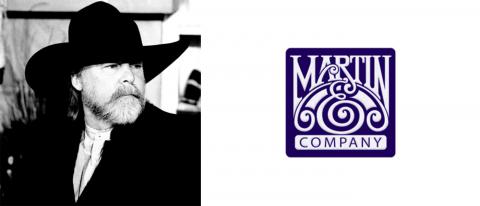
Martin & Company, a full-service marketing solutions firm specializing in national automotive aftermarket brand building, has announced the passing of the firm’s co-founder and CFO, Randal “Randy” L. Martin.
Martin is the spouse of Zan Martin, Martin & Company president and co-founder, and a former serving member of the SEMA Board of Directors and a former SBN Chair. The agency, located near Nashville, is one of a few in the nation that focuses almost exclusively on the automotive aftermarket.
“I am totally heartbroken. Randy was the creative and financial genius at the agency. He has been my rock, my companion, my best friend and my trusted advisor. Through his direction the company has managed many difficult times of recessions, growth spurts and unforeseen changes; and always we came out stronger and better,” Zan Martin said. “I feel comforted by my family and friends, teammates and the many associates that have reached out with your condolences. Thank you.”
Throughout its 27 year history, Martin & Company has assisted in the growth of many iconic brands, including E3 Spark Plugs, MAHLE Motorsport, American Powertrain, Cherry Bomb, LSI Chemical, and more. The company was formed after the pair attended the 1993 SEMA Show and had an idea to start their own agency. The decision was solidified after Randy sketched the company’s logo on a cocktail napkin on the flight home.
For more information about Randy Martin’s life, visit his obituary here. In lieu of flowers, the family requests donations to be made to either the National Audubon Society or Martin Methodist College, c/o Starnes Scholarship Fund, 433 W. Madison St., Pulaski, TN 38478.
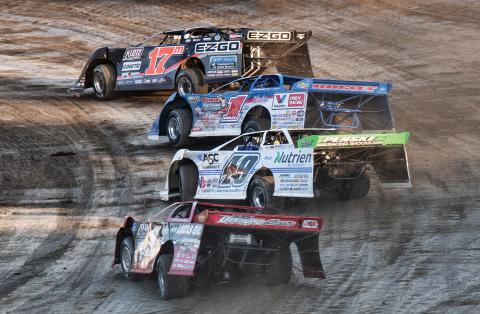
With largely unencumbered rule sets in top tier series, suspension tuning has become a focal point for many dirt late model teams’ programs, encouraging experimentation and innovation in the pursuit of quicker lap times.
In World of Outlaws and the Lucas Oil Late Model Dirt Series racing, suspension setups have taken on increasing importance in recent years. As organizers seek to maintain parity in race fields while keeping running costs at bay through targeted mandates, it’s an aspect of tuning that’s still allowed a substantial amount of creative freedom today. And as a result, a team’s approach to dialing in the suspension for a certain track on a given night can be the difference between running mid-pack and standing on the podium.
While many popular race series have rules that provide a general path to follow, dirt late model teams still enjoy considerable leeway when it comes to suspension component combinations.
“For 99% of the teams, it’s now the most important thing,” said Marshall Fegers of QA1 Precision Products, Lakeville, Minnesota. “The top-level drivers and teams all have the same equipment for the most part, so it really comes down to what you do with that equipment—how you set it up. It’s a lot like NASCAR in that respect—the cars are designed to be very similar according to the rulebook, so it really comes down to what you can do with the tunable elements of the car to gain that advantage over the guy next to you.”
And as such, these tuning strategies have become incredibly sophisticated, leveraging technology that was exclusive to the realm of OE suppliers not so long ago. Armed with volumes of data and driver feedback, teams are aligning themselves closely with suspension component manufacturers in order to develop the solutions that can provide that competitive edge. It’s a dynamic that fosters inventive design, and it’s pushing dirt late model racing forward in a very tangible way.
“You can’t muscle your way to a win with a power advantage these days,” said Justin Cockerham of Hyperco, Rosemont, Illinois. “Suspension is the game right now.”
Painting Inside the Lines
Although many popular series have adopted rule sets that provide a general path for teams to follow when it comes to general suspension design, dirt late model teams still enjoy considerable leeway when it comes to component combinations.
“In the top-tier series, most of the rules that the teams have to work with are related to maximum ride height and droop rules based on the chassis,” Cockerham explained. “You’re also not allowed to run electronically controlled parts, and some series and classes have a limit on the number of springs you can run per corner. But there’s a lot of freedom when it comes to spring design—many racers are running stacked springs right now, or dual-rate springs, or soft, long-travel springs. And because of all the variables involved, there are virtually no two setup strategies that are alike. These racers are running at 40 or 50 race tracks around the country every season, and they’re optimizing their programs based on the data that they’re gathering. And that’s why they go faster and faster every year.”
Aaron Lambert of Penske Racing Shocks in Reading, Pennsylvania, also noted that because of the ways the rules are designed, the car’s aero kit and suspension system are intrinsically tied to one another. “Along with the droop limiter rule, every major series has a rear decklid height rule, and you’re always trying to manipulate the car so that you can pass tech inspection with the rear spoiler up as high as it can be. Aero has become a very big thing in the late model world—we have a lot of former and current NASCAR drivers and crew chiefs that are involved now, and they’re bringing over what they learned in that discipline.”
Penske Racing Shocks’ Aaron Lambert told us that air shocks are growing in popularity because of the “naturally progressive nature” of the shock’s air chamber. “You don’t see load spikes like you would with a stacked [spring] setup.”
And as these teams seek out those aero advantages, sanctioning bodies often turn to suspension restrictions to keep everything in check. “A lot of times they’ll create shock rules to negate those potential aero advantages,” said Aaron Morey of ThyssenKrupp Bilstein of America, Poway, California. “For example, there are rules that say that your shock can’t extend past a certain amount in the right front corner because teams were getting the front end on the right-hand side really high in order to bring the spoiler down low in order to pass tech, and they were out on the race track, they’d be inches above everyone else. But the great thing about dirt late model racing is that, when it comes to what’s inside the shock, just about anything goes.”
So although the rule sets confine tuning to a general set of parameters, there’s a lot of room for creativity within that sandbox. “Years ago, we would have only run a single spring per corner,” said Jason Young of Öhlins USA, Hendersonville, North Carolina. “Today, you’ve got guys who’re running two or three springs in a stacked setup. Bump rubbers are a bigger player in the market these days as well, along with bump springs and bellow washers. There’s a ton of different options out there now.”
Shocks are often considered “black magic” by many, so few dirt late model teams work on them, said one source. Instead, many teams have developed relationships with shock manufacturers and work with them to get the results they want on the track.
Lambert told us that air shocks are seeing an upswing in popularity, too. “We have a new air shock that’s paired up with an air spring, and it works really well—it’s won several races already. With that design, we’re able to manipulate the spring curve in ways that we wouldn’t really be able to otherwise—it’s a really big advantage. A lot of these guys are running two stacked springs in parallel on the right front with a bump stop to create a spring curve that yields different spring rates based on where the suspension travel is at a given moment to create a progressive rate system. But the problem with that is when the suspension crosses over from one spring to the next as it’s compressed, you will inherently see a load spike in the suspension, and that load spike transfers to the tires. Any time a tire sees a load spike, there’s going to be a loss of grip. But an air chamber is naturally progressive as it is compressed, so you don’t see those load spikes like you would with a stacked setup.”
Ditching the Guessing Game
With so many different combinations available and a rule set that encourages experimentation, you might expect each team’s suspension tuning strategy is largely based on seat-of-the-pants driver feedback and the associated lap times delivered. But gone are the days of lengthy trial and error with a hunch and an arsenal of parts. Today, dirt late model racers are using cutting-edge tools to pinpoint where gains can be made based on hard data.
“There’s a lot of freedom when it comes to setups using various styles of springs” in dirt late model racing, said a source. “Many racers are running stacked springs (pictured), or dual-rate springs, or soft, long-travel springs, bump springs or combinations of all the forementioned. With the variations of chassis designs, damper tunes and driver preferences, rarely do you see the exact same spring packages between two competing cars within the same series.” Photo courtesy of Hyperco.
“There’s been kind of a revolution in late model setups over the past few years,” said Fegers. “Before 2015, to set the cars up we would put them on four-corner digital scales and get our corner weights and ride heights where we want them. But after that, ‘smash machines’ became much more prevalent. With these machines you can compress a shock with a spring on it to a given center-to-center measurement on the shock mounts, and it will tell you a spring force with a digital readout. The smash machines have led to a major transition in how we talk about setups and what we pay attention to in those setups. Now, not only do we know what the spring force is at static height, we can also look at the dynamic height it will be at when the car is racing on track. That has really changed the game—we don’t really worry about our ride heights as much, and we care a lot more about the spring force at the height that the car is seeing at speed. We can tune it to make sure the bumper isn’t going to dig into the track, or the right-rear doesn’t compress so far that it starts to pull the left front corner off the ground. It’s allowed teams to develop a baseline and make quick, drastic changes as needed for a given track.”
Cockerham pointed out that, for teams that want to run up front, understanding how to effectively use this technology has become obligatory for dirt late model racers.
“Every single top-level contender has a spring smasher in their trailer, and they’re constantly testing and looking at travel and load numbers to understand how the changes are affecting the car. Springs are the cheapest form of data acquisition on the car—if you’re able to measure your spring’s travel at a very precise and accurate level, you can get a world of useful information about the dynamic forces of your race car.”
Conducting the Symphony
While teams are taking a more advanced approach to their tuning practices now, they’re also working closer with manufacturers on specific elements of the suspension system to ensure that overall development stays headed in the right direction.
“Four or five years ago, if you walked around the paddock at a late model race you would have only seen Integra and Penske shocks,” said Lambert. “Now we’re seeing big pushes from companies like Bilstein and Fox, so that’s been really good for the racers, and all of the guys who’re running the fast cars in these top series are tied in with a shock manufacturer. Shocks are still considered black magic in dirt late models—not a lot of teams work on them on their own. Instead, they’ll explain to their shock manufacturer what the car is doing and what they want it to do, and the manufacturer builds shocks around that feedback to produce those results.”
Race organizers seek to maintain parity in race fields, creating a situation where top-level drivers and teams have similar equipment. Under those conditions, “it really comes down to what you can do with the tunable elements of the car to gain that advantage over the guy next to you,” said one source.
It speaks to the nature of the suspension systems in general—a complex collection of components working in concert, where changes in one area often affect behavior in another. “The teams deliver the feedback to our engineers and we provide the solutions,” Morey said. “Sometimes that’s exclusively through shocks, but sometimes it’s a combination of shocks and other suspension parts.”
Even with these advanced systems, analyzing suspension performance based on data acquisition can still be a tricky proposition for teams, Öhlins’ Christer Lööw pointed out. “You have to have a lot of experience and know what you’re looking for. There’s no meter that tells you that the suspension is getting better or worse. But the clues are in there,” he said.
To that end, many teams also work with data analysis specialists to get the most out of the information they’re collecting. “On a night-to-night basis it’s often handled by the teams,” Fegers said. “A crew chief will look at the track and look at the car and know what changes they need to make so the car will run faster. But many teams will also bring in engineering support for test days to help dial in the car based on the data.”
And it all points the way toward more informed teams with increasingly faster cars in the future. “As we learn more, I think you’ll probably start to see more instances where the suspension is reacting to inputs that are coming from places other than the wheel,” Lambert said. “If the wheel is moving, other parts of the car are moving as well, and that has an impact on the suspension’s behavior. At the end of the day, if you can do things that can provide more mechanical grip, it’s going to give you an advantage.”
Formula 1 has provided an update on the 2021 race calendar, with new COVID-19 travel restrictions meaning it’s no longer possible to race in Turkey on June 11–13.
That weekend will now remain free, with the French Grand Prix moving a week earlier than originally planned to June 18–20 and a second race in Austria—the Styrian Grand Prix—added to the calendar on June 25–27.
That creates a new France-Styria-Austria triple header, with the Austrian Grand Prix staying in its original July 2–4 slot. All tickets to the French Grand Prix are valid for the earlier date.
The changes mean there continues to be 23 races planned for the 2021 season.
NHRA and Auto Club Raceway have announced July 30–August 1 as the rescheduled date of the 61st annual Lucas Oil NHRA Winternationals presented by ProtectTheHarvest.com.
The Lucas Oil NHRA Winternationals, which traditionally kicks off the NHRA season, was postponed due to state health guidelines in California. NHRA and the track have worked very closely with state and local officials to find a new date for the event and are confident that the new date will allow more fans to attend the famed race.
“We are very excited to have the Winternationals back on our schedule,” said Kasey Coler, NHRA vice president of Track Management and Operations. “The Winternationals is a historic event, and we’re thrilled to be returning to Pomona.”
Related, NHRA and Pacific Raceways in Kent, Washington, have come to the decision to cancel the 2021 Flav-R-Pac NHRA Northwest Nationals.
“NHRA needed to make a decision to move forward to allow teams and touring staff time for travel preparations,” said Glen Cromwell, NHRA president.
Though Washington State recently announced a lessening of its COVID-19 restrictions, there is still uncertainty about what rules could impact the event.
“Although what we heard yesterday was encouraging for our state, the path for large events in 2021 is still not clear,” said John Ramsey, general manager of Pacific Raceways. “An event like this requires a lot of advance planning. We needed assurance from the state and county that we could run an event of this size without any restrictions, but we were unable to get a guarantee. Fans of the Flav-R-Pack NHRA Northwest Nationals deserve confidence in the event dates and experience. We will be 100% ready for the series to come back July 29–31, 2022.”
The Winternationals will take the original slotted date of the Northwest Nationals and now conclude the annual NHRA Western Swing, a three-race series from the mountains of Denver to the wine country of Sonoma and finally to sunny Southern California of Auto Club Raceway at Pomona.
Motorsports parts sales have surged since the pandemic shutdowns. How long can it go on?
By now, it’s a familiar story for just about every company that services the motorsports industry—the expectations of a severe economic slowdown following last spring’s pandemic lockdowns quickly gave way to the reality of massive demand for parts, resulting in eye-popping sales spikes.
And that demand is still in high gear, with companies from coast-to-coast scrambling to keep up.
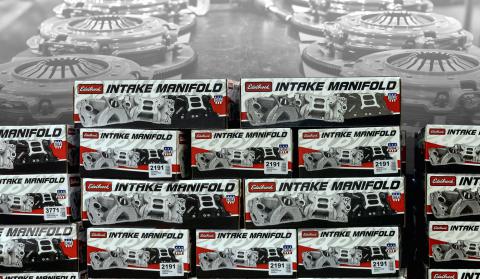
“Talking to the customers, the warehouses, the retailers that are out there, everything that Dart can supply them, it doesn’t matter if it’s a block, a set of heads, an intake manifold, or even small parts for our components, it doesn’t even land on their shelf,” said Steve Arent of Dart Machinery, Warren, Michigan. “It comes in their receiving door, and out their shipping door within a day or two. I don’t know if that’s a good thing because the orders that we have, it’s the biggest in the company history, as far as the open orders. And they’re not stopping. We’re constantly playing catch-up to fulfill these orders and the due dates that we’re given.”
In retrospect, the reasons behind the surge aren’t difficult to figure out. During the initial lockdowns people were stuck at home, often isolated, and looking for things they could do. “One thing we have to realize is we’re in the entertainment industry. I don’t think people quite get that,” said Alan Davis of Eagle Specialty Products, Southaven, Mississippi. “People spend disposable income on what we all have to offer. And when they all of a sudden couldn’t go out to eat as much, and they couldn’t go to ballgames, and they couldn’t go to movies and they couldn’t travel, they all looked at that project car and said, ‘Hey, I’m going to work on that. I’ve got time, I’ve got disposable income, money.’ I think that’s what drove a lot of the spike this summer. A lot of people say, ‘Eh, it’s just the extra stimulus money.’ But you know, it’s not that much in the scheme of building a car.”
“We saw a lot of, obviously, web traffic that definitely spiked up by June,” said Dave Davis of Anderson Composites, a manufacturer of carbon fiber and fiberglass body parts for late-model performance cars, headquartered in City of Industry, California. “What I tended to notice was that, even if somebody was working or not working, they seemed to have more idle time. They basically were on their phone looking at our products on our website. My goal was to let everybody know that, one, we were still in business, and two, somebody was going to answer the phone.”
William Goldman, a veteran Hollywood screenwriter, once said of the movie business, “Nobody knows anything.” That could be said of the past year, too, as enterprises of all types struggled to navigate the pandemic. “The crazy thing is, everybody, from what we thought, to what experts thought, to what the industry leaders were telling us, to what our governments were telling us, state, local, and federal—everybody got it wrong,” said Eagle’s Alan Davis. “Everybody didn’t just miss the bullseye, they missed the whole target. Everybody thought everything was going to die, we’re going to be in for a recession, blah blah blah. The result of the lockdowns and the pandemic, how we dealt with it, how we’re getting out of it—it’s all just been wrong. We wake up every day and wonder, ‘How in the world did that happen?’ Nobody saw any of this coming.”
From Every Direction
As the pandemic spawned shutdowns and economic chokepoints around the country, followed by blistering demand for products, each company had to deal with different problem areas. For some, the big issue was raw material shortages; for others it was shipping delays, or labor shortages, or teams spread far and wide working remotely, or social distancing and sanitation standards. For some companies, it was all of the above.
In the early stages of last year’s lockdowns, much of the country was stuck at home, often isolated, with little to do. “What I tended to notice was that, even if somebody was working or not working, they seemed to have more idle time,” said our source at Anderson Composites. “They basically were on their phone looking at our products on our website.”
“We never actually laid anybody off back in the spring. My boss is the type where he’s really loyal to his employees,” said Alan Davis. But some employees quit, and the company struggled to secure replacements. “It was a relentless turnover. It really put us behind. That coupled with the annual Christmas rush, we always have trouble getting parts—forgings, semi-machined parts—from overseas during the Christmas rush, because Walmart and everybody else gets bombarded with their stock. So things slow down a little bit. And then come February the Chinese New Year hits and the entire country of China shuts down for a month. And all those things—increased orders, sales being what they are, having trouble getting employees to stay, and then increased shipping problems—really put us in the hole by January or February.”
The frustrations of hiring and retaining employees led Eagle Specialty Products to some unconventional measures, with surprising results. For online job applications, they included a new question—an almost tongue-in-cheek one, but not entirely. “Are you really interested in getting a job, or are you just wanting an interview to satisfy your unemployment benefits requirements?”
“But the response was not something we expected at all,” Alan Davis noted. “The number of people that actually admitted they only wanted an interview so they could keep their unemployment benefits was 80%. People actually said that.”
Business restrictions also varied wildly from state to state. Many California-based businesses, such as Anderson Composites, are just now approaching normalcy. “Our team finally came back to the office as a group just this week (mid-April). It all comes down to the availability of a vaccine,” said Dave Davis. “We’re still pseudo-remote, and we’re still working as best we can as far as getting our supplies online, and our parts basically in-house. But they’re already pre-sold for all the popular items.
Companies like Eagle Specialty Products used the surge in demand as an opportunity to familiarize and educate customers on some lesser-known parts and lines. “It’s been a weird way to introduce new products,” said our source, “but it’s worked.”
“The rough winter season back East didn’t help us out much either. We had notifications and a lot of calls from dealers as far as time delays,” Davis continued. “Again, it was logistics for everybody as far as getting things from our warehouse to our dealers and drop-shipped to our consumers. We’re catching up with that, and now we’re catching up since the port of LA is back open supposedly at full steam again. You could see all the ships lined up outside last month. They’re finally all getting back in line again.”
For Dart Machinery, labor difficulties combined with multiple state shutdowns, plus attaining the necessary small parts from the company’s suppliers, were the biggest hurdles. “Here in Detroit, with the Big 3, you would think that our employee pool would be bigger than most, but everybody, all manufacturing here in Detroit since January 1 of this year, has turned back on, and they’re gobbling up employees left and right,” Dart’s Arent said. “Any time that we’re shut down for a day, it’s four days for us to make up. This time we were shut down for a week and a half, and it just puts us further and further behind.”
Adapting on the Fly
Companies have been forced to improvise to meet the surge in demand. “About three or four years ago we introduced a line of connecting rods and crankshafts that was sort of in between our entry level and our high end. As far as strength and everything it was in between, the price was in between, and we really thought there would be a market for that,” said Eagle’s Alan Davis. “And they’ve never really sold well. I think a lot of that is just because people are used to ordering what they’re used to ordering. So when everything started getting scarce on the shelves, we started swapping those parts.”
The past year has proven to be an excellent opportunity to educate customers on this newer line of parts. “People are going for it simply because they want whatever they can get right now. But it’s been a way to put some of this new product in people’s hands,” Davis continued. “Now, we’re starting to see warehouses putting this stuff on the shelf, because the customers got it, because they had to get something, and they’re saying, ‘Hey, this is not too bad, and I can call and order that again.’ So it’s been a weird way to introduce new products, but it’s worked.”
For Dart Machinery, partial assembly ahead of time was better than waiting until every part was in hand. “In March we had 120 big blocks that we made up to a certain point. We were waiting for main caps to come in. As soon as the main caps came in we hammered the rest of them out, machined the caps, the cam tunnel, honed them all up and shipped them out the door. So we’re still making parts, but unfortunately we’re waiting for weirdo components—main caps, main bolts, cam bearings—to complete the machining process.”
Due to restrictions imposed by state and local authorities, some businesses are just now being allowed to bring employees back to their facilities. “We’re still pseudo-remote,” reported our source from Southern California-based Anderson Composites, “and we’re still working as best we can as far as getting our supplies online, and our parts basically in-house.”
All of these factors make planning for the next six to 12 months difficult, to say the least. “It’s tough,” said Eagle’s Alan Davis. “There’s a side of you that says, ‘This is a bubble. This is going to slow down.’ And so you’re real hesitant to just throw everything in to ramping up production and going crazy. There’s a side of you that says, ‘We don’t want to get in over our head because when this slows down the brakes are going to hit pretty hard.’ But then again, we kind of thought that in December, and it hasn’t slowed down. So you are just riding this wave wondering how long it really is going to last. Because it does not show any signs of slowing down at all.
“We have far less inventory on the shelf than we ever have,” he continued. “So we’d like to get that back up to a normal level anyway. So even if it hits the brakes we’ll probably stay in production for several months just to get our inventory back to where we’d like it to be.”
“We keep thinking that it’s going to slow down,” said Dart’s Arent. “We figured after last summer it would slow down a little bit, but it hasn’t. The first quarter of this year, not only Dart, but all of Race Winning Brands’ other companies are banner years so far. Our crystal ball is a little foggy when it comes to the future.”
Add reliable crystal balls to the ever-growing list of parts in short supply.
Due to ongoing COVID-19 health and safety restrictions in Ontario, Canada, organizers for the Honda Indy Toronto and the NTT IndyCar Series have jointly announced that this year’s event set for July 9-11, will no longer be a part of the 2021 schedule.
“The NTT IndyCar Series race around Exhibition Place and Princes’ Gates is a hallmark of our summer schedule,” Penske Entertainment Corp. President and CEO Mark Miles said. “To have that void for a second straight year is heartbreaking. We deeply miss our fans there and urge them to remain safe during these unprecedented times. INDYCAR looks forward to a high-powered return in 2022 and for years to come.”
The race on the streets of Toronto has been a staple of the IndyCar Series since 1986. The list of champions includes legendary names such as Bobby Rahal, Emerson Fittipaldi, Al Unser Jr., Michael Andretti, Alex Zanardi, Dario Franchitti, and Scott Dixon.
IndyCar is considering various scenarios for the remainder of the 2021 calendar as it relates to the recent cancellation.
The current mid-summer portion of the schedule will resume Sunday, August 8, for the inaugural Big Machine Music City Grand Prix on the streets of Nashville, with live coverage on NBCSN.
A group of professionals, including Sean Jones, Townsend Bell, Jeff Swoboda, Jason Campbell, David Scheinberg, Steve Madincea, Chris Lencheski, and Paul Pfanner, has founded the new Rod Campbell Award.
Rod Campbell, who passed away in March of 2020, was a motorsports marketing pioneer.
“Rod was extremely special in that he had such enthusiasm for providing opportunity and mentorship for others,” Swoboda said. “When you look around the motorsports industry those results speak for themselves in how many executives and key figures got their start with him. This award program will help to continue that legacy and develop talent that we will see contributing to the industry for many years to come.”
The Rod Campbell Award has been established to help create a launchpad of opportunity for young professionals (18–23 years old) looking to begin careers in the automotive and motorsports arenas. The first award winner will receive four to six weeks of paid, apprenticeship-style experience in companies affiliated with Campbell.
A panel of automotive and motorsports executives will choose one candidate to gain paid experience with 7R Events, Bryan Herta Autosport, Fantastec, Phoenicia Sports & Entertainment, Racer Media & Marketing, and Short Shoot TV during the summer of 2021.
The deadline is Friday, May 21. For more information and to apply, visit here.
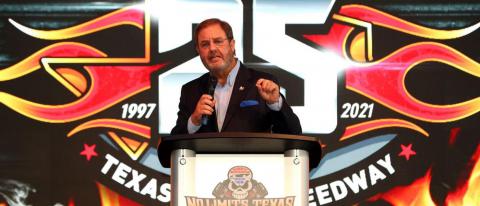
After more than three decades with Speedway Motorsports, including the last 25 years at Texas Motor Speedway, Eddie Gossage will step down as president of The Great American Speedway following the June 13 NASCAR All-Star Race.
“The timing just feels right after 32 years with the company,” Gossage stated. “The Smith family and Speedway Motorsports changed my life and I will forever be appreciative and grateful.
“Before my wife Melinda and I chart our next adventure, I’m thankful that I get to come full circle as a promoter with the NASCAR All-Star Race.”
After working for Nashville International Raceway, Bristol International Raceway, and Miller Brewing Company in motorsports management and public relations capacities, Gossage joined Speedway Motorsports in 1989 as the vice president of Public Relations at Charlotte Motor Speedway, where he worked under the guidance of Speedway Motorsports Executive Chairman Bruton Smith and then Charlotte Motor Speedway President Humpy Wheeler.
Smith named Gossage General Manager of Texas Motor Speedway in 1995 and added the title of TMS President in 2004. Now 62, Gossage is one of the longest-tenured employees at Speedway Motorsports.
Under Gossage’s leadership, Texas Motor Speedway has hosted millions of fans at NASCAR, IndyCar, and World of Outlaw races, produced car shows and concerts with The Rolling Stones, ZZ Top, and Willie Nelson, and in 2015, built the world’s largest LED high-definition television, the 22,704 square-foot “Big Hoss.“
“I am grateful for all that Eddie has done for our company. He’s been a promoter, friend, and an asset to the entire motorsports industry,” said Gossage.
Paolo Ferrari, Scott Damon, Nizar Trigui, Gabriel Asbun, and Craig Schneider
Bridgestone Americas has announced changes to key leadership roles under CEO & President Paolo Ferrari.
Scott Damon, currently group president of Operations, has been named chief operating officer. As COO, Damon will have responsibility for the company’s core tire business, which includes the original equipment, replacement, and retread tire businesses for the consumer, commercial truck and bus, off-the-road (OTR), Ag, and Latin America segments. In addition, Damon will retain responsibility for the company’s manufacturing, LSCM, quality, and procurement functions.
Nizar Trigui, formerly chief technology officer, will now serve as chief technology officer and group president of Solutions Businesses. In this expanded role, Trigui will have accountability for the company’s mobility solutions, IT, and circular economy strategies, in addition to R&D, technology, and all Akron, Ohio-based operations.
“As Bridgestone continues to grow its efforts in the areas of mobility solutions and sustainability, it is imperative we create the necessary alignment within Bridgestone Americas to effectively realize our goals locally and globally,” said Ferrari. “We have built a strong leadership team within Bridgestone Americas, and this new organizational structure strikes the right balance between execution on our core tire business and the further development of our medium and long-term sustainable and mobility solutions platforms.”
In addition, Gabriel Asbun, currently group president of Americas Tire & Solutions Business, has been named group president of Integrated Businesses. In this new role, Asbun will have responsibility for Bridgestone Retail Operations (BSRO), Firestone Industrial Products, and the company’s Credit First National Association (CFNA) consumer credit division.
Craig Schneider has also been named chief strategy officer. Schneider, who was instrumental in the recent sale of Firestone Building Products, will continue to support the company’s evolution through the global strategies outlined in the Bridgestone Mid-Long Term Business Plan, including shaping the portfolio, partnership development, and all M&A activities.
With more than 550 automotive parts brands and over 4 million unique parts, the SEMA Data Co-op (SDC) is evolving and dropping “Co-op” from its name to better reflect the growth in services and industry needs. Since launching nearly 10 years ago, SEMA Data has evolved and has expanded beyond being a central repository for data.
“We realized there were two things that happened: One was the manufacturers needed help to get standardized data to the co-op. Second, we needed to help the industry know what to do with it,” said Gigi Ho, vice president of SEMA Data. “We are now actively helping the industry progress and grow through data, and by dropping the ‘Co-op’ from the title, we wanted people to concentrate on the ‘Data’ aspects of what we do.”
SEMA Data began in 2012 as the first industry-owned and -operated data repository. Manufacturers would submit information about products in standard ACES and PIES formats, making it easy for resellers to find products quickly and efficiently. This would increase manufacturer sales, speed up the distribution process, and improve customer satisfaction.
With data standards just emerging, most businesses were still relying on paper catalogs, and manufacturers struggled to adapt to the new formats. Once the data was structured properly and included in SEMA’s repository, resellers struggled to see the value.
“The industry has been evolving slowly with product information, going from print to spreadsheets to XMLs, and now push or pull APIs,” said Ho.
SEMA Data began offering plug-ins, based on its APIs, early last year for popular e-commerce platforms for companies to power their websites or to power the data feeds into their business systems. The APIs (application programming interface, a set of specifications used by a software program to query another software program) make it possible for businesses to get updated information more frequently and, in turn, move products through the distribution channel much faster.
As an industry made up primarily of small businesses, many companies are looking for ways to better utilize standardized data. To remain competitive, businesses must adapt to online sales and processes quickly, which can be boosted with properly formatted data. By dropping the Co-op from its name and rebranding the industry program as SEMA Data, Ho hopes to put the emphasis on data and wants companies to view it as a power source for their businesses.
SEMA Data provides the information driving thousands of businesses in the specialty-equipment aftermarket, enabling product searches that help consumers find the parts they want. Through data management and support, education, training, advocacy, and other membership programs, manufacturers and resellers have access to a variety of resources designed to streamline operations and power sales.
For more information about SEMA Data, visit semadata.org.
 MEMBERSHIP LOGIN