Holley Appoints Investment Banking Exec As VP

Submitted by laurap on Tue, 06/15/2021 - 18:19
Holley logo


Holley, the platform for performance automotive enthusiasts, has announced that Vinod (Vinny) Nimmagadda has been appointed as executive vice president of Corporate Development and New Ventures. Nimmagadda, an experienced investment banker, will serve as a member of the executive leadership team and report directly to President and CEO Tom Tomlinson.

“I am pleased to welcome Vinny Nimmagadda as our new EVP,” said Tomlinson. “Vinny brings eight years of M&A experience in the performance automotive aftermarket with a specific focus on the enthusiast consumer. His experience and interests mesh nicely with our M&A strategy, consumer focus, and commitment to innovation, and he will play a key role driving our inorganic growth.”

Prior to joining the Holley team, Nimmagadda served as vice president at Jefferies Group LLC, in the Global Automotive Aftermarket team, where he played a role in many M&A transactions, financings, and equity offerings.

In addition, Nimmagadda is an avid automotive enthusiast. He graduated from Columbia University, where he earned a bachelor’s degree in Financial Economics. While at Columbia, he also served as president of the University’s chapter of the Society of Automotive Engineers and led a team of engineering students which competed nationally in the Formula SAE series.

For more information, visit holley.com.

June 2021

Racing Businesses Fight Against EPA Overreach With RPM Act

Submitted by laurap on Tue, 06/15/2021 - 16:44
Street cars converted to race cars


Businesses throughout the country are taking a stand against the Environmental Protection Agency’s (EPA) claim that it is illegal to modify street vehicles and convert them into dedicated race cars. The $2 billion racing industry is pushing back by seeking passage of the Recognizing the Protection of Motorsports (RPM) Act of 2021 (H.R. 3281), a bipartisan bill which clarifies the motorsports-parts industry’s ability to sell products that enable racers to compete, and protects Americans’ right to convert street vehicles into dedicated race cars.

“The inconsistency of the EPA's stance around converting street cars to purpose-built track vehicles has not only constrained long-term investment in the industry but it is creating added complexity/concern for our customers,” said Chris Douglas of Edelbrock Group, a company that has been manufacturing performance parts since 1938. “The RPM Act is the first step in protecting and preserving our industry for future generations - now is the time for action."

In 2015, the EPA endangered the motorsports industry when it introduced a proposal that would have put an end to racers’ ability to modify street vehicles into dedicated race cars, a practice that has taken place for 45 years since the Clean Air Act was introduced. Although the EPA formally withdrew the proposal, the agency has since maintained that street vehicles cannot be converted into race cars—an assertion that has left the motorsports industry in a state of flux. Passage of the RPM Act will make clear that the Clean Air Act does not apply to street vehicles that have been converted into race cars used exclusively in competition, giving the industry the confidence and clarity that it needs.

As advocates for the motorsports industry, Performance Racing Industry (PRI) is also pushing for the RPM Act. “Businesses are at risk,” said Dr. Jamie Meyer, PRI president. “Racers and businesses deserve a law that clarifies that it is legal to convert a street vehicle into a dedicated race car. PRI will continue to fight to preserve what is an American tradition until the RPM Act is passed.”

Introduced by U.S. Representatives Patrick McHenry (R-NC) and Raul Ruiz (D-CA), the RPM Act currently has the support of 65 cosponsors, including 19 Democrats and 46 Republicans. Dedicated race cars, which represent 0.07% of vehicles in operation, are trailered to and from the race track and have little effect on the environment. Yet for thousands of amateur racers, starting with a street-legal vehicle and using race products to convert it into a dedicated race car is the only affordable way to get into the sport. In order to protect racers and ensure that racers can continue to legally modify their vehicles into race cars, the RPM Act—which was introduced to Congress last month—must be passed into law.

“Many of our customers and employees are avid racers who build dedicated vehicles for competition,” said Al Noe, Summit Racing Equipment’s Chief Marketing Officer. “Our customers trust us to deliver the parts they need so they are ready to race; they can also trust us to fight for their right to build and race these vehicles. The RPM Act is vital to ensuring a vibrant future for motorsports and our industry as a whole.”

The RPM Act was first introduced as a bill in 2016. Over the years, it received strong legislative support and although versions of the bill have passed the House Energy & Commerce Committee, it was never fully voted on before the end of any Congressional year. Because the bill has already been subject to committee hearings before the House and the Senate, the 2021 RPM Act is well-positioned to become law this legislative year.

The racing community is urged to continue to voice support for the bill by visiting saveourracecars.com.

June 2021

Live Chat: How the Future of Emissions Impacts Parts Manufacturers

Submitted by laurap on Tue, 06/15/2021 - 16:20
Facebook Live Chat on Wednesday, June 16


Get the latest updates about emissions compliance, testing, and requirements by joining a Facebook Live Chat on Wednesday, June 16, at 3:30 p.m. EDT (12:30 p.m. PDT), where participants will learn about potential new changes and how they impact parts manufacturers. Since emissions compliance applies to nearly all performance and engine products, it’s imperative for manufactures of engine-related products to understand emissions laws and testing evolution.   

Facebook Live Chats are open Q&As where participants have a chance to communicate directly with the featured guest. This live chat features PRI/SEMA General Counsel David Goch, who represents the industry on various issues, including emissions compliance.  

Location: SEMA Emerging Trends and Technology (ETTN) Facebook page (https://www.facebook.com/SEMAETTN). 


June 2021

Newly Appointed: Jeff Striegle

Submitted by jeffreyc on Tue, 06/15/2021 - 12:25


Building on successful stints in race team management and motorsports broadcasting, this industry veteran now oversees the track that sparked his passion for racing.

Berlin Raceway and Entertainment Complex in Marne, Michigan, opened its 71st season this year with a new general manager, Jeff Striegle. A NASCAR race announcer for Motor Racing Network (MRN) for the past 24 years, Striegle continues in that role as well.

Striegle witnessed his first auto race as a boy at this very track in the 1970s. That experience set him on a path to later running a race team that competed here for 12 years. It also led him to establish Racing Awareness, a non-profit organization that supports the Helen DeVos Children’s Hospital in nearby Grand Rapids. From racing he moved to broadcasting, always keeping Berlin in his heart, though.

“My passion and love for the sport comes from all of that,” Striegle told PRI.

And, as if a new leader wasn’t reason enough to celebrate, the track recently pocketed $50,000 after taking top honors in the Advance Auto Parts-backed “Advance My Track Challenge,” a community-based program where fan voting decides the winner among 22 NASCAR-sanctioned short tracks across the US and Canada.

Amid the activity, Striegle recently shared plans, some already unfolding, to transform Berlin Raceway into a full entertainment experience similar to that of NASCAR’s premier venues.

PRI: What are you most looking forward to in this new role at Berlin? 

Striegle: Taking the track back to how it began. It should all be about the fan experience. Look at NASCAR tracks. Fifteen years ago, all they did was run a Cup race and an Xfinity race, and that was good enough. Today, the tracks boast 50 different things you can do on a given weekend besides watch a race. That gave me ideas to implement here. 

PRI: What do you see as the biggest challenges ahead of you?

Striegle: The sport is not at the same popularity peak as in 2006. Our challenge is to introduce racing to a younger generation and to people who have not experienced it. We have to do new and different things to attract new people to grow the fan base and the sport.

PRI: What are your top strategic goals for the next 12 months?

Striegle: By offering more experiences, we can raise revenue and profitability. We’ve already implemented some things with camping, and we’ve developed a new 2/10th-mile short track within our main track. This will let us add programs for younger racers, including mini cup cars, quarter midgets, mini wedges, Bandoleros, and Legends. We’ll run those races on a different night. It’s the same track, but a different experience.

PRI: How are you expanding on the “entertainment” component of the facility? 

Striegle: When a family leaves the raceway, they should feel like they got their money’s worth and more. We moved up start times, so we finish racing at seven. In addition to usual concession stands, we’ve added an outdoor grilling station on the main concourse. We’ve got a gourmet cheese and chips and margarita cantina. Our new Brickyard Lounge holds up to 250 customers. It’s modeled after the best outdoor lounge in Key West (Florida) with a huge bar, stand-up tables, lights, sound, outdoor heaters, and a fire pit. 

PRI: How are you marketing or promoting these changes at Berlin Raceway?

Striegle: We’re using social media to announce the specials, the schedule, and updates. We’re not doing conventional advertising—no TV, radio, or billboards. Instead, we are strengthening relationships with the local ABC, NBC, and Fox affiliates and their sports programming. Their sports anchors are coming out during the week, taking part in practice sessions, interviewing drivers, and talking about upcoming events. Seeing race results, track highlights, and features on the news every week is helping introduce racing to new people. 

PRI: What would you say makes Berlin Raceway such an important part of the community?

Striegle: People have grown up with this track. Many first dates and family reunions have been here. There’s absolutely a community feeling about this place. We’ve done many things with the Helen DeVos Children’s Hospital here for 15 years. We raise donations. We provide tickets and racing experiences for staff, families, and most importantly, the children. We’ve also done much to recognize our veterans and first responders.

PRI: What do you think is key to continuing the facility’s momentum?

Striegle: Culture. The company I was with before, Gordon Foods Service in Grand Rapids, had a great culture. It taught me the importance of a team, working together, and always thinking about new ideas and clearing hurdles. 

PRI: How do you think your MRN broadcasting background will serve you in this role? 

Striegle: Working with MRN has given me the opportunity to visit NASCAR and short tracks, to see firsthand what they are doing. That helps us adopt new ideas that we are already working on. The audience is changing, the cost of the sport is escalating, and we must recognize that what we do from competitor and fan standpoints is ever changing.

PRI: What’s your most gratifying professional accomplishment?

Striegle: I’ve had amazing opportunities, but running the charity for the children’s hospital has been the most rewarding thing I have ever done. 

PRI: Who inspires you, and why?

Striegle: My father was my biggest inspiration. He passed five years ago. I still carry him with me. When I have a question, I think I know how he would answer it. I’m also inspired by families of children with cancer. I see the strength of the parents and the children. 

PRI: Excluding your cellphone/tablet/computer, what’s one thing you can’t live without? Why? 

Striegle: The support of my wife, Julie, because I am on the road a lot, traveling with NASCAR for MRN, and when not doing that, working at Berlin Raceway. That schedule can be hard. She knows what we are trying to accomplish. She is part of Berlin Raceway, too.

Jeff Striegle

–

Title:
General Manager

Organization:
Berlin Raceway and Entertainment Complex

Hometown:
Grand Rapids, Michigan

Fast Fact:
Berlin Raceway takes its name from the town’s original name. After World War I, town leaders elected to change the name to Marne to honor soldiers who died in the Second Battle of Marne, France.

July 2021
By
Jim Koscs

Stop Doing That…Do This Instead: Gauge Installation

Submitted by jeffreyc on Tue, 06/15/2021 - 11:46
Gauge Installation

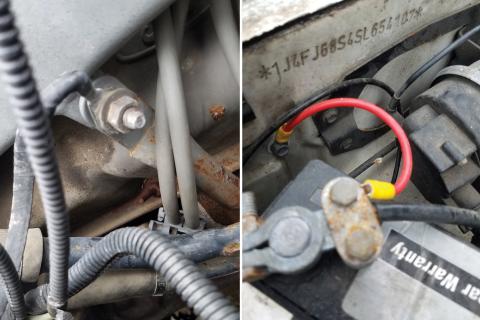
The most common problem associated with gauge installation, according to our source, is improper grounding. To illustrate, the setup at far left shows the correct way to ground, while the photo at right has incorrect color wiring and no shrink wrap to supply strain relief. 

Instruments often malfunction due to improper grounding, excessive vibration, or flimsy wire connections. Here’s how to avoid these common complications.

“The number-one common issue” when installing gauges, according to Marc Erickson of Auto Meter Products, Sycamore, Illinois, “is grounding. Getting a good ground on the chassis, or the engine block or cylinder head, will rectify 90% of [installation] problems.”

This is an issue when putting gauges in any type of car, but it can be particularly problematic in a competition vehicle, Erickson explained. “There are so many electronics in today’s race cars. Anything with any type of electronic current running to it normally creates RF [radio frequency] noise. We’ve built our products to handle the RF noise, but if you don’t have significant ground, it doesn’t matter how good of a product you build. It’s just not going to operate correctly.”

Compounding the problem is the fact that “a lot of race car interiors are tin or aluminum,” he pointed out. “People think they can take the ground from the tach or another gauge and just run it to a piece of tin in the vehicle. But a builder will often put silicone or something around the outside of a metal floor to keep debris, water, or smoke out. When you put silicone on, it insulates the floor, and there’s no ground path back to the battery.”

RF noise can be particularly disruptive to the function of tachometers, Erickson said. “Tachs are based on pulse input, 12-volt square-wave inputs from the ignition system,” he explained. “If you do not have it grounded correctly, the input wire, or even the power wire, will pick up RF noise. The tachometer will read the RF noise as pulses coming into the tachometer, and it will either start jumping all over the place or will read high.”

stop2
Today’s race cars include “so many electronics” that  naturally create RF noise, noted our source at Auto Meter Products, who explained that without significant ground “it doesn’t matter how good of a product you build. It’s just not going to operate correctly.”

Oil pressure and water temp gauges, on the other hand, “are based on resistance to ground. They’re going to take the path of least resistance,” he said. “The sending unit and oil pressure gauge are grounded in the block, or the head, and the other one doesn’t have a significant ground if it’s grounded to a piece of tin in the car. It then grounds through the actual sending unit, making the gauges read high. Relocating the ground to a good chassis ground or the block or the head will take care of these problems.”

Bad Vibes

Vibration can create problems with instruments, Erickson said, “especially on gauges, like oil pressure gauges, that have a large pressure sending unit. We’ve seen a racer mount a sending unit to the block and then can’t understand why they’re continually going through sending units. They don’t consider the solid mounts on these cars. With the sending unit on the block, and everything mounted solid, the harmonics have to go someplace. They will vibrate a sending unit to pieces.” 

The solution is to “mount the sending unit on a steel-braided line, and then mount that on the firewall or an inner fenderwell if the car has them and isolate it a bit on a rubber pad.” 

Auto Meter also makes liquid-filled gauges “to help handle vibration if you’re going to mount a gauge in a high-vibration area, like on the chassis, in the engine compartment or on the back of a supercharger,” Erickson said. “It will also dampen the actual needle movement of the gauge itself, so it’s not bouncing all over the place when you’re trying to read the gauge.”

Connections

Pay attention to wire connections, Erickson advised. “We’ve seen people use an inexpensive ring terminal with nothing on it—the bare wire coming out of the ring terminal—and as the car ran, you could see the wire move up and down. Especially if it’s inexpensive wire, as it moves up and down it’s going to break.” 

He recommended making those connections using “ring terminals that are crimped on with a good crimper, then after that use some sort of heat shrink with glue inside of it.” Some suppliers call it marine heat shrink “because the glue makes it waterproof. When you heat the wrap, the glue comes out and holds everything together. That eliminates the movement of the wire in the ring terminal and gives it some strain relief.” There are “ring terminals, butt connectors, and spade connectors that have the glue-type of shrink wrap built right into it,” he added. “You crimp it on, hit it with a lighter or a heat gun, and it’s already all there.” 

Before the Install

“Do your research before purchasing the product, and purchase the product that does what you need it to do,” Erickson said. For example, Auto Meter sells “the most basic tach that will show just engine rpm’s to ones that will record a run and let you download it so you can look at it on your PC. Or let’s say you want an oil pressure gauge, but you also want a low-pressure sending unit and a warning light. You don’t have to buy all that separately. We have those features built into one product. If you’re looking for a gauge that you want to do something specific, contact us and make sure you’re getting what you want.”

SOURCES

–

Auto Meter Products
autometer.com

July 2021
By
Drew Hardin

Make The Case: Livestreaming Races

Submitted by jeffreyc on Tue, 06/15/2021 - 11:19


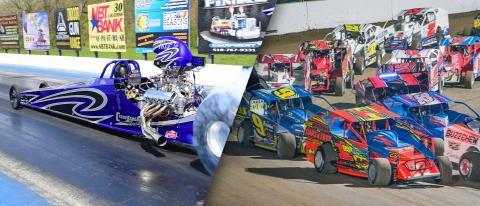
Recent global events have prompted track organizers and promoters around the country to take a closer look at online video streaming as not only a stop-gap measure, but a new source of revenue in the long term. But while livestreaming offers benefits to fans and racers alike, the logistical and monetary considerations may have some folks thinking twice before jumping into the fray.

LIVESTREAMING OPPONENT:
WAYNE DELMONTE,
LEBANON VALLEY DRAGWAY
–

I think that one of the main issues with livestreaming is that it provides the opportunity for people to not come to your track and be an in-person spectator who might buy from your merchandise booth or your snack shack, and it can negatively affect revenue in that way. 

While it’s convenient to watch from home, those fans aren’t getting the same experience the ones in the stands are. You’re watching the race through someone else’s lens, and if you’re lucky it’s a shot of the starting line, mid-track, and the finish line. You might not see the whole race from start to finish in the way that you would want to, but ultimately you really have no choice in the matter. 

There’s also the intangible elements to consider—the smell of race fuel, the sound, the rumble of the ground during a pass. You can’t replicate those things on a computer, and you also can’t walk through the staging lanes and see what cool cars are there or talk to different racers at the event. You’re watching curated clips of the events that are happening. That might be enough for someone who’s really familiar with the sport and just wants to keep up to date on what’s going on, but if you’re someone who’s just getting into it, you’re missing out on a huge part of the experience. 

makethecase2

There are also some significant financial obstacles that have to be considered. If you don’t spend the money to have a quality livestream with high-end cameras, professional production, and the required Internet bandwidth, you’re asking for problems. You also have to consider the fact that you need crew members who’re dedicated to specific roles in order to make it work—an unmanned live feed camera system probably isn’t going to cut it. 

It also needs to work well right off the bat or you risk tarnishing your track’s reputation. If you’ve got people paying for access to the service and your livestream is terrible, that’s just another way for the track to get a bad review or something like that. Nothing is worse than bad publicity on the Internet—it stays there forever. For us, the costs involved to get it off the ground and make it into a high-quality service would probably turn out to be a losing proposition. 

LIVESTREAMING ADVOCATE:
JIMMY PHELPS,
WEEDSPORT SPEEDWAY
–

First and foremost, livestreaming gave tracks the ability to operate in some capacity during the COVID-19 shutdown. We’re all fans of racing, and it provided opportunities that we wouldn’t have otherwise had if there wasn’t a little bit of revenue and fan involvement coming in. And for the race teams, it also allowed them to satisfy their sponsorship agreements on some level. 

For us it was bigger than just trying to get that streaming fee out of a household. It helped to keep things afloat during the pandemic, but on a larger scale it has broadened our fanbase—in the Northeast modified world, we’ve definitely noticed a geographic expansion there. 

A perfect example of that is Max McLaughlin, a North Carolina-based racer who has made a name for himself over the last three or four years up here in Central New York. When he comes out to our track, both our local fans and the ones in North Carolina want to watch him race, and livestreaming gives us the ability to provide that to folks near and far. 

The decision to stream our 2021 events stemmed from the idea that if we had the ability to enhance our reach, it would offer a little more to our partners and sponsors. There is a fanbase of people out there who want to see what’s going on at your track, and that fanbase doesn’t necessarily have the ability to be there otherwise—they might be too far away to make the drive there on a given night, or maybe they want to watch a family member that lives across the country. The world is becoming smaller because of this technology. 

Our fear going into it was that these people were not going to outweigh what we could potentially lose in the grandstand ticket sales, but we’re slowly starting to see that broadening that fanbase has actually improved the bottom line. There are situations where some people just can’t be there, and we’ve created a way for them to still be a part of it. That has proven to outweigh the situations where people could go out to the track but decide to stream it at home instead. 

makethecase3

Fortunately for us, Weedsport Speedway’s owner Al Heinke established an in-house production team alongside the extensive renovations that began here back in 2013. As the property evolved, he was always looking for ways to enhance the entertainment value of the facility, and he decided that we needed a crew of people here that could create some professional, real-time productions to make the “show within the show.” All of the MAVTV features from Weedsport Speedway are done in-house here—we send it to them more or less ready to air. So, since we were already filming and producing our own races anyway, livestreaming wasn’t a big logistical leap for us. 

That said, if tracks want to offer livestreaming, I think it’s important that they put their best foot forward right out of the gate. There are definitely capability needs that need to be addressed in terms of bandwidth and the quality of the production itself. We’ve learned a lot over the course of the past few years with the American Flat Track races and other events that we’ve done—the need for fast, consistent upload speeds was a necessity that we were aware of and had already addressed previously. 

The infrastructure needs to be right; it’s something that any venue considering offering livestreaming services should thoroughly evaluate. Do you want one camera, or do you want six? Do you want in-car footage? That’s where everybody is going to be doing things a little differently, and where stronger efforts are going to really stand out.

July 2021
By
Bradley Iger

Editors’ Choice

Submitted by jeffreyc on Tue, 06/15/2021 - 10:32
Editor's Choice


Hundreds of new product announcements cross the desks of PRI editors each month. Following are our top picks for July.

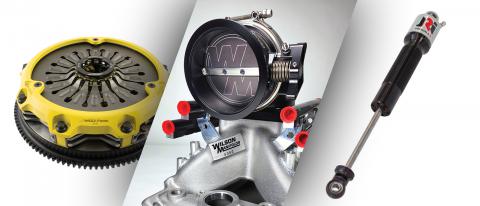
MOD-TWIN 225 CLUTCH KIT FOR SUBARU WRX STI

Advanced Clutch Technology (ACT)
advancedclutch.com

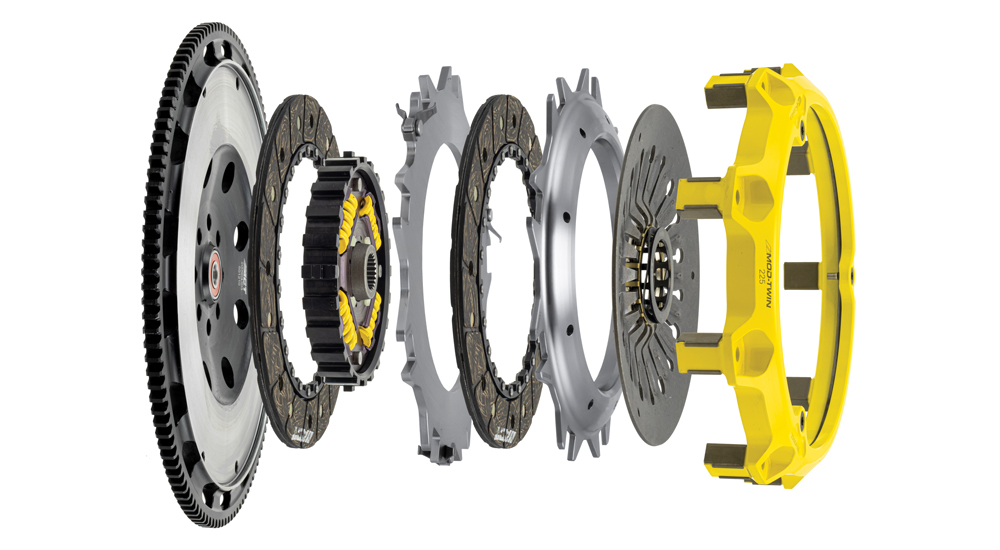
Thanks to its modular construction, the new Mod-Twin 225 clutch is available in one of 10 configurations for the Subaru WRX STi—including three different clamp loads—so it’s well-suited for high-horsepower applications on the street, strip, or road course. The key component is a single mono-drive hub designed to reduce stress on the drivetrain.

“Turbo four-cylinder engines have a lot of torsional vibration and are notorious for being hard on clutches. They will strip out the splines and hubs,” explained Rich Barsamian. “What’s really needed is a sprung hub to dampen the torsional vibration.”

editors2

editors3

There isn’t much room to add springs to the hub, so ACT developed a mono-drive hub that’s sprung and supports two discs. The clutch is also available in a rigid construction for street and race applications. Depending on the configuration, the Mod-Twin 225 will support between 700 and 1,340 lb-ft of engine torque.

“It’s really designed for the gearhead making a ton of power,” said Barsamaian. “When people try it, they’re impressed. They were expecting a heavy pedal feel. This clutch holds the power but is a treat to drive.”

The clutch uses the factory pull-type design and simple installation. The kit includes chromoly flywheel, ARP clutch bolts, and an alignment tool. The kit also works with the Mitsubishi Evo engine. —Mike Magda


SB/09 SHORT-TRACK SHOCK ABSORBER

JRi Shocks
jrishocks.com

The new SB/09 short-track shock absorber from JRi Shocks is available in an aluminum body for short-track asphalt racing. It also comes in a steel body that is legal in dirt-track modified and other classes that don’t allow alloy construction.

It’s a small-bore shock with a .500-inch OD shaft. Multiple piston options are available, including linear, high-flow and linear digressive.

 editors4

“With approximately 60 clicks of rebound, compression or bleed adjustment—depending on jetting—and a base valve design, the SB/09 is ideal for a wide range of short-track applications,” said Candace Martin.

The shocks can be set up for coil-over operation with spring sizes ranging from 2.5- to 5-inch in diameter, and teams can order it with a stroke distance of 5 to 9 inches. JRi also offers a shim kit and SB/09-specific wrench to adjust the shocks for different track conditions. —Mike Magda


123-MM HIGH BOOST THROTTLE BODY

Wilson Manifolds
wilsonmanifolds.com

When Wilson Manifolds originally developed a 123-mm billet throttle body, boost pressures were in the 10- to 20-psi range. “Now they’re running over 60 pounds,” said Keith Wilson. 

That prompted the company to design a much beefier model with the same dimensions that’s an easy swap with the old model.

“We’ve gone to a double-sealed shaft that holds up to 100 pounds of pressure without leaking,” noted Wilson. “Even though we went to a larger shaft and gained a lot of strength, we lost no flow.”

editors5

The massive .625-inch stainless-steel shaft is aerodynamically shaped, and the blade is tapered to enhance airflow without giving up strength. The blade is fastened to the throttle shaft with aircraft quality hardware that is Loctited and peened to assure positive retention. The TPS engagement is precision fit and compatible with either Ford or MoTeC sensors. Finally, there’s a two-way adjustable linkage system.

The 5-inch V-band inlet and outlet make the new throttle body a direct replacement to the original 123-mm throttle body.

“A lot of racers have gone to a crank-driven blower, and we wanted to make a throttle body that’s as safe as possible,” added Wilson, noting that this same design is also available in a 105-mm size. —Mike Magda

July 2021

Problem Solvers

Submitted by jeffreyc on Tue, 06/15/2021 - 10:21


A minimum pricing policy can work for or against you, so we asked a leading racing manufacturer to point out the potential pitfalls and map out the road to success.

The Problem: I’m concerned that a MAP (Minimum Advertised Price) policy will hurt my business in the long run.

The Solution: Devise a policy specific to your business needs, and everyone—including your resellers—will win.

Rich Barsamian of Advanced Clutch Technology in Lancaster, California, understands your quandary: “You’ve spent an incredible amount of time and money to bring your product to market.” And now some retailers are letting it go for discount prices that “devalue your product, and your company, in the eyes of consumers.” You’ve considered implementing a Minimum Advertised Price (MAP) policy, but you know that’s a weapon that must be wielded with care. Potentially, it’s a double-barrel shotgun with one barrel pointing back at you.

To disarm that second barrel, you need a MAP policy—perhaps a MAP strategy would be a better term—specifically designed for your company, your products, and your resellers. Get the details right, and everyone wins: You can protect your reputation, and at the same time assure your resellers the profits they need to sustain their own success.

First, said Barsamian, let’s clear up any confusion over terms Minimum Advertised Price (MAP) and Minimum Resale Price (MRP): “The price is the price is the price.”

With that out of the way, the next step is to calculate the minimum retail price that will allow your customers to make the margins they need to give your product the support it deserves. In other words, they need to make a profit on your product so they can hire employees who can provide knowledgeable sales and technical support, in addition to excellent customer service after the sale.

problem2

problem3
An effective MAP (Minimum Advertised Price) strategy can help manufacturers protect their reputation while at the same time guaranteeing resellers the margins they need to sustain their own businesses.

Then, to enforce that price, you need what Barsamian calls a “sting”—but the sting has to hurt the reseller more than it hurts you. “You don’t want to hurt your own business, but the reseller has to know you mean business. The worst mistake you can make is a policy with penalties so strict that they impact not only the reseller’s business, but your own business as well. 

“Let’s say your penalty for a first-time offense is 90 days that the reseller cannot buy your product.” Can you survive a full quarter without those sales? “Your policy needs to be written as if you know your biggest customer is going to break it right out of the gate.” You need a penalty that will allow you to weather the storm if that worst-case scenario comes to be.

Barsamian suggested a “three strikes” policy: “Strike One is a warning. Strike Two is a specific time on the Do Not Sell (DNS) list. Strike Three, you’re out!” But again, carefully consider the duration of that DNS period, and don’t do this at all if it doesn’t suit your business model.

Further, once you’ve decided on a policy, know that you must enforce it, with all of your resellers, equally. “First of all, you have to,” Barsamian reminded us, “otherwise you could be subject to some antitrust issues.” Second, “you will lose all respect from your resellers if you don’t.” The upside is that once your resellers realize that you are “dead serious, they will want to be compliant. They will want to sell your product, because your product will yield the margins necessary to sustain their business.”

As difficult as enforcing a MAP policy may be, not enforcing one can lead to a “race to the bottom,” where resellers compete on price alone, ultimately eliminating the margins that allow them to provide even acceptable levels of sales support and customer service (as they lay off the staff they can no longer pay). “Eventually,” said Barsamian, “they won’t even be able to pay you.” And then no one wins, except perhaps the schlub running an Internet business out of some moldy basement.

On the other hand, Barsamian noted, “If you create a policy that fits your company, with a penalty phase that doesn’t cripple your business—and you enforce the policy equally and evenly—the negative effect on your business will be minimized. Eventually, when your policy is established in the marketplace, your brand will no longer be devalued at the consumer level, and wholesalers will want to promote and sell your product.”

SOURCES

–

Advanced Clutch Technology
advancedclutch.com

July 2021
By
John F. Katz

Oxford Replaces Monadnock On ACT, PASS Schedules

Submitted by laurap on Mon, 06/14/2021 - 18:07
Oxford Plains Speedway logo


The American-Canadian Tour (ACT) and Pro All Stars Series (PASS) have announced that the doubleheader initially planned for New Hampshire’s Monadnock Speedway on July 4 has been moved to Maine’s Oxford Plains Speedway on Sunday, July 11. 

The program will remain the same with twin 150-lap features for the ACT Late Model Tour and PASS Super Late Models, plus a 50-lap PASS Modified shootout. The change allows weekly Late Model and Super Late Model racers around the region more time to get their cars ready. Qualifying begins at 4:00 p.m. with features to follow.

PASS will also visit Oxford Speedway for the 48th annual Oxford 250 on August 27–29.

Monadnock Speedway and ACT are still in discussions about the possibility of an event at the track later in the year if scheduling allows.

For more information, visit acttour.com and proallstarsseries.com.
 

June 2021

Tech Update: Troubleshooting Diesel

Submitted by jeffreyc on Mon, 06/14/2021 - 16:44
Tech Update


How to identify and address the top three problems associated with diesel fuel regardless of the application.

Whether we are talking about a 400-horsepower street truck or a 3,000-horsepower race truck, they each deal with similar problems associated with diesel fuel. And that holds true no matter what kind of diesel fuel they run, whether it is standard Ultra-Low Sulfur Diesel (ULSD), biodiesel, premium diesel, off-road diesel, or diesel race fuel. Sure, these diesel fuels do differ in some regard—cetane rating, sulfur content, color, etc.—but the challenges they all present are relatively uniform. 

In racing, the top three problems associated with diesel, regardless of the kind of diesel used, are lubricity, deposit control, and combustion efficiency. Let’s take a closer look at all three. 

Lubricity

To better understand diesel fuel lubricity and its impact, we should first consider how it is measured. There are many standardized test methods to determine diesel fuel lubricity, but the most common is the ASTM D6079 HFRR (High Frequency Reciprocating Rig) test method. The test consists of submerging a contact point between a steel ball and a flat steel disc into a sample amount of fuel. Under a controlled environment, the temperature is set to approximately 140 degrees F and the ball is placed under a light load, then it moves back and forth at a set frequency for 75 minutes. After 75 minutes, the wear scar is measured both parallel and perpendicular to the sliding direction, and the average wear scar is recorded. The results are measured in μm (microns). The larger the number, the more wear that has occurred. For reference, the ASTM D975 (Standard for US Ultra-Low Sulfur Diesel, or ULSD) specification calls for a wear scar no greater than 520μm, while the Truck and Engine Manufacturers Association (EMA) recommends a stricter 460μm wear scar maximum. 

If you use a diesel tow rig, you should take note that today’s ULSD does not contain the lubricity needed to fully protect our vehicles. Consider: The Bosch CP4 fuel pump has an unusually high failure rate in the US, upwards of 7%, when compared to a 1% failure rate in Europe. The European EN-590 Diesel has a 490μm wear scar specification, while in the US the base is 520-micron in ASTM US D-975. Therefore, the failure is caused by the lack of lubricity in ultra-low sulfur fuel in the US.

tech2
Insufficient fuel lubricity has caused this CP4 fuel injection pump to fail. Note the debris present as well. Cam erosion causes metal particles to enter fuel injectors, which are then recirculated throughout the fuel system.

Lubricity is so critical because of its role in controlling fuel-pump and injector wear. This is even more the case when talking about high-horsepower, high-torque diesel applications with aftermarket performance upgrades.

At Hot Shot’s Secret, we recently tested an industry-leading diesel race fuel in the HFRR test method, and it came back well below the recommended level of lubricity, recording a wear scar of 590.5μm. Drivers beware, because this lack of lubricity can lead to very expensive mechanical failures. Fortunately, we were able to treat this diesel race fuel with an additive and lower the wear scar to 461.5μm—a much safer level of lubricity. We recommend doing a fuel analysis that measures lubricity if you consistently use the same diesel race fuel and ensure you are getting enough protection for your hard parts. 

Deposit Control

Another common problem with diesel fuels is their ability to control injector deposits. Coking deposits forming on injector tips have been an issue for years. These deposits form both in, on, and around the injector nozzle holes, which can cause spray pattern issues. A relatively new problem with high-pressure common rail fuel injectors is the formation of internal diesel injector deposits (IDIDs). Unlike traditional coking deposits, these deposits form on the internal components of the injectors. 

Diesel fuel contains something called carboxylic salts (waxy, sticky deposits). These deposits used to be soluble in older, high-sulfur diesel fuel, but are not in today’s ultra-low sulfur diesel. The salts make their way past the fuel filter and into the fuel injectors, depositing on the internal surfaces. Today’s high-pressure common rail injectors have a very tight tolerance of 1–3 microns, so even the slightest deposit formation can cause serious problems, including sticking injectors, power loss, and fuel flow issues.

tech3
Shown here is a worn CP4 fuel injection pump cam caused by a lack of fuel lubricity. Fuel acts as a lubricant in most fuel pumps, but over time lubricity lessens, which leads to excessive wear and ultimately causes the pump to seize and fail.

Unfortunately, not all additives and detergents are able to remove IDIDs; they are much tougher to eliminate than traditional coking deposits. To remove IDIDs and prevent them from inhibiting performance, you must use an injector cleaner that is specifically formulated to combat IDIDs. 

Combustion Efficiency

Combustion efficiency issues may not be as prevalent with diesel race fuel, but they can still be problematic at times. Cetane is a liquid hydrocarbon that, when available in higher volume in diesel fuel, improves the ignition of the fuel, resulting in improved performance and fuel economy, and decreased emissions. 

Diesel fuel cetane rating can vary greatly from station to station, and from state to state. A 40 cetane is the minimum rating for diesel fuel sold in the US, but some states have stricter requirements. California, for example, has its own cetane minimum of 53. This is because, generally, a higher cetane rating means the fuel will burn cleaner and produce less emissions. This is good news for the environment, but it also produces greater horsepower and torque numbers. Diesel motorsports applications generally seek greater cetane numbers for that reason—more power. 

While most over-the-road diesel engines run best on fuel with a cetane rating of 47+, it is not always available. Running fuel with a poor cetane rating often results in rough operation, knocking, less power, and lower fuel economy. The challenging part is that you often do not know the cetane rating of the fuel you’re running. This is where additives come in. Whether you want better fuel combustion for on-road or off-road diesel applications, a cetane improver may be the answer. The industry standard to improve diesel fuel cetane is 2-ethyl hexyl nitrate. Keep this in mind as you do your research—be smart about what you add to your diesel engines and rely on a supplier’s track record and reputation to give you the facts.

Kyle Fischer is the director of branding and promotions for Lubrication Specialties Inc., manufacturer of Hot Shot’s Secret. Fischer is a self-professed “gear head” with a passion for anything car-related. When he is not managing Hot Shot’s Secret’s busy event schedule, race sponsorships, and trade show marketing, you can find him testing new products on the dyno or track, or attending drag racing and car club events for fun.

July 2021
By
Kyle Fischer