Officials from the NTT IndyCar Series have announced that, due to restrictions in Ontario focusing on COVID-19, the Honda Indy Toronto event will not be rescheduled or replaced this year. As a result, the series will remain with a 16-race schedule for 2021.
“We are thrilled the season will continue next month with a memorable July 4th race at Mid-Ohio Sports Car Course, which has hosted the NTT IndyCar Series since 1980. It will be followed by an action-packed August with a fantastic inaugural event on the Streets of Nashville (August 8), another historic NASCAR-IndyCar weekend at Indianapolis Motor Speedway (August 14), and the final oval of the season at World Wide Technology Raceway (August 21),” the sanctioning body stated.
“The 2021 season will wrap with an epic West Coast swing at legendary circuits of Portland International Raceway (September 12), WeatherTech Raceway Laguna Seca (September 19), and the Streets of Long Beach (September 26).”
The complete 2021 NTT IndyCar Series schedule can be found at indycar.com/schedule.
Jeff Gordon, the four-time NASCAR champion, television broadcaster, and NASCAR Hall of Fame member, has been named vice chairman of Hendrick Motorsports, which will make him the second-ranking team official to chairman and majority owner Rick Hendrick.
As vice chairman and co-owner, Gordon will maintain a daily presence at Hendrick Motorsports, focusing on the organization’s competition and marketing groups. The Vallejo, California native will report to Hendrick and work alongside Team President Marshall Carlson and General Manager Jeff Andrews. In addition, he will join Hendrick on NASCAR’s team owner council and assume Hendrick Motorsports’ seat on the sanctioning body’s diversity, equity and inclusion committee.
Gordon officially begins his new role on January 1, 2022.
“I cannot put into words what Hendrick Motorsports means to me,” Gordon said. “In many ways, it’s my home and the people here are my family. I’ve never lost my passion for the organization, for our sport, and for the sheer challenge of racing and winning at the highest level. Being part of the competition is where I’m happiest and feel I can make the biggest contribution to the continued, long-term success of the team.”
In October 1999, Gordon became an equity owner of Hendrick Motorsports. He remains Hendrick’s only partner in the 13-time NASCAR Cup Series championship-winning organization, for which Gordon won 93 races and four titles as a driver from 1992 until his retirement from full-time racing in 2015.
Gordon joined FOX Sports as an analyst in 2016 and has been a mainstay of its NASCAR Cup Series race telecasts and other programming. He will continue to work as a FOX broadcaster through the end of the 2021 calendar year.
Legendary Companies, led by Wade Kawasaki and partners at Irving Place Capital, has announced the acquisition of Paragon Corvette Reproductions.
The Michigan-based Corvette restoration parts manufacturer and supplier enters as Legendary Companies’ third strategic acquisition since partnering with Irving Place Capital in late 2018. The acquisition expands the range of products available from Legendary Companies and widens its customer base by offering high-quality restoration components for 1953 through 1996 Corvettes.
“Paragon Corvette Reproductions has an amazing track record for supplying the best restoration components for classic Corvettes,” said Legendary Companies President and CEO Wade Kawasaki. “It has been a great honor to work with the company’s owners, Steve and Stacey Childs, on this acquisition. Steve’s knowledge on classic Corvettes is second to none, and together they assembled an outstanding team of employees to handle more than 36,000 parts for a 43-year range of Corvettes.”
Paragon will continue to operate with the same leadership team and staff.
McLaren Racing has announced it will enter into Extreme E, the all-electric off-road series that aims to use racing to promote sustainability and diversity, in 2022.
The team will compete in the five-race global championship next season, designed to highlight the impact of climate change in some of the world’s most remote environments, promote the adoption of electric vehicles for a lower carbon future, and provide a gender-equal motorsports platform.
McLaren Racing has previously served as a supplier for the FIA Formula E Championship, providing the battery powertrain for the Gen 1 and Gen 2 seasons. The entity also actively competes in Formula 1, IndyCar, and esports.
McLaren Racing will operate the team using both existing personnel from outside the Formula 1 program and additional specialist resources. All Extreme E teams are limited to four mechanics and one engineer at each event for the one-make car, plus two drivers.
“While Formula 1 will always remain at the center of our world, like IndyCar and esports, our entry into Extreme E is additive to the McLaren Racing franchise and will complement and help support all our programs,” McLaren Racing CEO Zak Brown said.
Mopar has named Don Schumacher Racing (DSR) Performance as the supplier of officially licensed engine components for the 2015 and 2021 Dodge Challenger Mopar Drag Pak.
The Dodge Challenger Mopar Drag Pak is the limited-production, purpose-built muscle car for grassroots and professional drag racers competing in events sanctioned by the National Hot Rod Association (NHRA) and National Muscle Car Association (NMCA). The quickest, fastest, and most powerful Drag Pak made its on-track debut this past March with a seven-second quarter-mile run at the NHRA Gatornationals in the Sportsman’s Factory Stock Showdown (FSS) class with DSR pilot Leah Pruett at the helm, Mopar stated.
The new DSR Performance online catalog offers engine components for the supercharged 354-cubic-inch Gen-III HEMI V-8 engine that powers both the 2021 model year and previous-generation (2015) Drag Pak.
The licensing agreement is the latest step forward in the evolution of an existing partnership that began in 1971 and was formalized in 2003 between Mopar, Dodge//SRT, and Don Schumacher Racing.
“DSR has enjoyed an extremely successful partnership with Mopar and Dodge//SRT for more than 20 years now, and for me personally, our relationship extends back five decades,” said Don Schumacher, owner of DSR. “Our partnership is always evolving and to now expand into this new venture where we are the official distributors of licensed Dodge Challenger Mopar Drag Pak components is something we’re quite proud of. We can’t wait to offer this additional level of support to the Drag Pak community of racers and enthusiasts.”
Products include:
● Aluminum race blocks and rebuild kits
● Cylinder head assembly and hardware
● Camshaft
● Rotating assembly parts including cranks, bolts, rods, and pistons
● Valvetrain and intake valves
● Various (tensioner, supercharger, and idler) pulleys
As one of the industry leaders in design, development, and manufacturing, PRP has always taken its products to the next level. This American-made line of parts is composed mainly of billet aluminum components and machined to perfection. From the beginning, PRP’s goal was to solve a problem. Creating products that would be aesthetically appealing and function as they should. As a steadily growing company, PRP has always tried to stay ahead of its competition through innovation.
2020 was a tough year for companies as many had no idea where we would be in the near future. PRP was no exception and tried to brace for a hit to the racing industry. With this in mind, additions to its line were kept to a minimum. As PRP moved into the summer of 2020, business stayed strong, and even grew to an off-the-chart level. PRP has made great strides in growth with additional staff and faster manufacturing equipment. With its new business plan in place through 2021, its design team is hard at work. PRP not only will be adding a load of new products to its current line, they will also be introducing a new line of products.
PRP is particularly excited about its new product line and its unveiling. This new line will encompass all of the great attributes of the PRP line but be tailored to Jr. Drag Racing. These products will include fuel cells, butterfly wheels, breather tanks, and also some accessory items like warm up stands and throttle cables, just to name a few. PRP will be able to give the Jr. Dragster league some great products, coming the end of 2021.
PRI 2021 is fast approaching, and it is PRP’s goal to have all these great new additions on display at the Trade Show in Indianapolis (Dec. 9-11). Don’t delay; check out PRP’s website and all of its other great products! PRP’s line covers a wide variety of components like carburetor accessories, engine accessories, cooling, transmission, chassis, electrical, and a whole lot more. Watch out for all new LS additions in 2022.
American-made products—what you need when you want it! Track tested, racer approved!
Tracking legal, legislative, and regulatory developments impacting the racing and performance industry.
PRI’s dedicated advocacy team based in Washington, DC, works nonstop to protect motorsports. We are currently tracking several initiatives on the federal and state levels, including an update on tax credits for businesses participating in trade shows, rules related to hiring independent contractors, and employee retention tax credits.
Urge Congress To Support Tax Credits For Trade Shows
As previously reported (see PRI Magazine, May 2021), a PRI-supported bill was introduced in Congress that would provide tax credits to cover 50% of the expenses associated with exhibiting or attending a trade show, such as the PRI Trade Show in Indianapolis. The bipartisan Hospitality and Commerce Job Recovery Act of 2021 (H.R.1346/S.477) would help businesses participate in trade shows and the millions of men and women employed in the tourism industry.
There is growing bipartisan support for the legislation. H.R.1346, has 80 cosponsors (42 Republicans and 38 Democrats). If enacted into law, it would provide PRI Trade Show buyers and exhibitors with a tax credit for 50% of the cost of attending or exhibiting at the 2022, 2023, and 2024 events.
“This bill would help increase the number of attendees and exhibitors at the PRI Show. The stimulative impact of the legislation would lead to more hotel nights filled, busier restaurants, and additional spending in Indianapolis and cities across the country. It is crucial to hotels and service/hospitality businesses,” said PRI Vice President of Government and Legal Affairs Daniel Ingber.
PRI exhibitors and attendees should ask their employees to send a letter to their federal lawmakers in Washington, DC, by visiting votervoice.net/SEMA/campaigns/81675/respond.
The Biden Administration has finalized a new rule to withdraw the independent contractor regulation issued in the closing days of the Trump Administration.
“Gig workers are at the heart of the debate—from Uber drivers to other types of flexible, temporary, or freelance jobholders. At issue is making sure there is clarity in defining whether a worker is an employee or independent contractor so that the relationship is unquestioned by the IRS or state tax collectors,” Ingber said.
While the issue may be revisited in the future, the US Department of Labor (DOL) is currently reverting to previous guidance on distinguishing whether an individual should be classified as an independent contractor or employee. Specifically, the DOL deferred to the seven-factor “economic realities” guidance test issued in 2008 and based on court cases. Factors to be considered include:
• The extent to which the services rendered are an integral part of the principal’s business
• The permanency of the relationship
• The amount of the alleged contractor’s investment in facilities and equipment
• The nature and degree of control by the principal
• The alleged contractor’s opportunities for profit and loss
• The amount of initiative, judgment, or foresight in open market competition with others required for the success of the claimed independent contractor
• The degree of independent business organization and operation
In recent years, the increase in independent contractors who perform on-demand services, such as drivers, freelance writers, and other gig workers, has placed a focus on the definition. Company employees have protections under the Fair Labor Standards Act (FLSA) such as minimum wage and overtime compensation that do not apply to independent contractors.
“There are benefits to hiring an independent contractor such as defining a specific work product to be accomplished within a budgeted amount and time period—with no further obligation,” Ingber said. “There is usually no question whether you are hiring an independent contractor since it is frequently for a specific outsourced duty (website design, construction, payroll) for which the contractor has other clients, has control over their schedules, has a limited and defined duty, and is otherwise independent. However, watch to see if circumstances change over time whereby the relationship could be considered employer/worker when applying the Seven Factors Test. In that case, a company should review the situation since there is an obligation to collect and pay taxes and benefits. If not sure, consult your attorney or accountant.”
For more information, contact Stuart Gosswein at stuartg@sema.org.
Take Advantage of the Employee Retention Tax Credit
Racing businesses are urged to take advantage of a COVID-19 economic relief program enacted in 2020 and expanded this year—the Employee Retention Tax Credit (ERTC)—designed to help employers that suffered significant financial losses or that were closed due to a government order but continued to pay workers who were unable to perform their duties.
2020: The tax credit is equal to 50% of up to $10,000 in qualified wages paid between March 12–December 31, 2020. The total credit is capped at $5,000 per employee and applies against employment taxes on wages paid to all employees. There is a 100-employee limitation. Credit is available if the employer had a fully or partially suspended operation during any calendar quarter in 2020 due to orders from an appropriate governmental authority due to COVID-19; or the employer experienced a significant decline (more than 50%) in gross receipts during the calendar quarter.
2021: The tax credit applies to all four quarters of 2021. The credit is now equal to 70% of up to $10,000 in qualified wages per quarter (including health plan expenses). This means the tax credit is potentially $28,000 per employee ($7,000 for each quarter). Employers who have experienced a 20% or more decline of gross receipts in a quarter, compared to the same quarter in 2019, can apply. For 2021, the size limitation was increased to employers with 500 or fewer employees (up from 100 workers).
“Many companies are not aware of this program enacted to help businesses retain workers,” Ingber said. “Racing businesses, in fact, all small businesses suffering an economic downturn in the last two years should take advantage of this program. The program was enacted so that companies can use the cash that is not sent to the IRS to address other financial needs.”
Under the expanded ERTC program, a business that obtained a PPP loan can claim the ERTC if wages paid with PPP funds are excluded for the purpose of calculating the ERTC. The IRS issued new guidance for employers on the rules that will apply to the ERTC for the first two quarters of 2021 at irs.gov/pub/irs-drop/n-21-23.pdf. Additional IRS coronavirus relief information is available at irs.gov. Employers should work with their accountant and payroll preparer to confirm ERTC eligibility and file the adjusted Form 941 tax deposit.
A thorough understanding of how setup strategies—and equipment—can help cut lap times is helping boost sales of scales, shock dynos, and more.
As many racing disciplines have become more limited by grip than horsepower, a stronger focus on chassis setup has developed in turn. But effectively communicating the benefits of this equipment to customers requires more than just a recital of the bullet points.
Although crate classes and those that have more or less untethered engine rules might appear to exist on opposite ends of the regulation spectrum, these days there’s a common refrain that runs through both of them.
“It’s not just a horsepower game anymore,” said Chris Berg of Intercomp, Medina, Minnesota. “On one hand, you might not have the opportunity to put an exotic camshaft into a car, or run some sort of exotic fuel, because that stuff is tightly controlled in spec classes. But since most classes use a spec tire—even if you’re given free rein with your engine combination—you still have a finite amount of grip to work with.”
Either way, simply muscling one’s way to the front of the pack has largely become an antiquated notion. Instead, teams must focus their tuning efforts on other aspects of the car in order to shave time in a manner that’s consistent and repeatable, and that’s led to growing interest in chassis setup strategies as well as a rising demand for the related setup equipment.
But the inherent value of that equipment is more difficult to express than, say, the torque gains of a cylinder head design, or the weight savings of a better material. Instead, effective marketing of chassis setup equipment often requires a hands-on approach and a thorough understanding of how it can improve a team’s race program.
Quantifying Competitiveness
While this equipment might not be considered a mandatory investment for the weekend grassroots racer who’s looking to mix it up for fun, proper chassis setups become more of a necessity as one moves up the ranks of competition.
“This equipment is getting more and more critical to a team’s success,” said Keith Berner of Accu-Force Dynos & Testers, Millersburg, Ohio. “As the racing gets closer and the sport gets more technical, the guys that think they can do setups by the seat of their pants are going to fall farther and farther behind. We’re all now relying on various pieces of chassis setup equipment to figure stuff out to a much more precise degree.”
The latest chassis setup equipment enables racers to get all the performance that’s available out of the vehicle, said a source. Often, it’s some of the least expensive speed that can be found in the car.
And as Steve Watt of Maxwell Industries in Ventura, California, explained, it’s effectively mandatory in the top tiers of many circle track racing disciplines. “Most of our customers for this type of equipment are USAC National dirt guys and World of Outlaws teams,” he said. “I’d say 90% of the World of Outlaws teams have a shock dyno in the trailer, and most of these teams wouldn’t even go to the race track if they didn’t have either dyno data or a dyno for testing the shocks. It’s incredibly important because they’re so finely tuned today—there’s so many different things going on with the valving, the bleed, and so on. There’s also always new stuff coming out, and these teams want to make sure they don’t get caught out using inferior stuff. Dialing that new hardware in requires this kind of tuning. Most of the teams are now putting their shocks on the dyno between heat races, and they’ll check it again before the feature race.”
Watt added that it often comes down to cost per lap. “If you run a 410 sprint car, your motor program is all based on laps, and every lap you do with a car that’s not as good can be a wasted lap. So the goal is to make everything as dialed in as it can possibly be every time you hit the race track.”
Racers who rely on seat-of-the-pants feedback will fall behind those who benefit from the precision of the latest chassis setup equipment, said Keith Berner of Accu-Force Dynos & Testers.
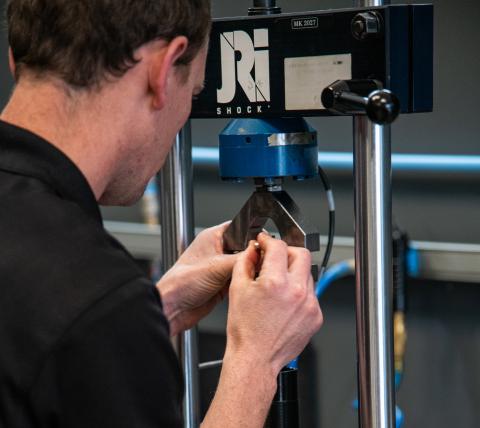
While sophisticated pieces of equipment like shock dynos, spring smashers, and pull-down rigs are all key players in the modern chassis setup arsenal, Ryan Salata of PROFORM in Warren, Michigan, said that vehicle scales still play a key role in chassis setup across a range of racing disciplines, too. “For the teams in oval track, Formula Drift, and even drag racing, it’s a cornerstone of race car setup for a lot of these teams. You can solve a range of issues with these scales by determining things like proper cross weight and percentage distribution, and adjusting the suspension accordingly while taking an individual driver’s preference into account as well. Scales deliver measurements that allow you to see how an adjustment affects a particular spec in real-time. This is one area where buying the right tool for the job pays off in spades.”
Lynnie Doughton of DRP Performance Products in Rocky Mount, Virginia, summed up the general philosophy behind chassis setup in a way that any serious competitor can appreciate. “We’re limited to the rules package that we have and the total amount of grip that’s available,” he explained. “So there are two things that we need to do: First, we need to make sure that we’re utilizing all of the grip that’s available, and the majority of the race cars out there aren’t set up to do that. Second, we need to make sure that we balance that grip properly. If you have too much of the grip up front or at the rear, it’s going to be more difficult to get all of the performance that’s available out of the car. That’s what this equipment allows you to do, and it’s often some of the least-expensive speed that you can find from the race car.”
Getting The Word Out
Because of the inherently technical and nuanced nature of the beast, selling chassis setup equipment is a different proposition than typical racing components, where effective marketing can be as straightforward as a display touting performance statistics.
“For us, it’s been shows like PRI—having people look at and try the equipment in person,” said Salata. “We’ve also gone out to the races with our scales, but what’s tricky is that it’s very easy to get into the weeds in a situation where someone is trying to fix an issue with their particular car. It’s a piece of equipment that captures units of measurement—if they’re standing on it, they understand what it does and the accuracy of it. But I think it’s important not to get too technical with it before someone really understands what to do with those measurements.”
Vehicle scales play a key role in chassis setup across a range of racing disciplines. “For the teams in oval track, Formula Drift, and even drag racing, it’s a cornerstone of race car setup,” said Ryan Salata from PROFORM.
Berg told us that Intercomp has been successfully working with a dealer network. “We have a great relationship with those folks—they’re the ones who’re really out there pounding the pavement. Sometimes they’re out at race events and they’re essentially bringing us along for the ride. I think that a lot of our dealers see our strong brand recognition and want to align themselves with one of the most respected names in motorsport weights and measurements. For our products in particular, I also feel like the racers are often seeking advice from a distributor or company that might be sponsoring a car locally that’s winning at the track—that success attracts those customers to that particular business.”
Watt agreed that, as with many aspects of racing, word-of-mouth tends to be a significant factor. “When my customers win races and championships, it’s the best marketing that we can ask for,” he said.
The Importance Of A Good Education
Doughton noted that the biggest current hurdle in selling chassis setup equipment is knowledge—both on the dealer’s side as well as the customer’s. “The number one reason that more dealers don’t sell chassis setup equipment is because they don’t understand it. It’s hard to sell something when you aren’t fully aware of how it works and what it does. I think in those situations, you’re going to have a tendency not to bring it up—you’re going to avoid engaging in those conversations. If the dealers simply become more knowledgeable about what’s available and the reasons why you’d use some of this equipment, they would naturally sell more of it.”
A shock dyno is almost mandatory in circle track racing’s top tiers, reported Steve Watt from Maxwell Industries. Most teams put their shocks on the dyno between heat races and “check it again before the feature race.”
Berner pointed to tutorials and after-sales support as aspects that can have a sizable impact on the marketability of this equipment, too. “When people buy from us, they have the opportunity to do a tutorial with us where we spend an hour or two with them. We also do longer one-on-one courses for folks who want to go more in-depth. Educating yourself on this equipment is hugely important—like anything else, you don’t know what you don’t know.”
And, as Watt noted, being able to collect data from chassis setup equipment is one thing…knowing what to do with it is another. “Our strongest asset is our service. When a new customer gets a shock dyno, I tell them to give me a call once they’ve got it plugged in and ready to go. I know the software well enough that I can have you running a shock in a minute and a half, and I can tell you what graph to look at to find the data you want. With our machines we can send data back and forth between our equipment and our customers’, so if they’re struggling with something, I can actually send them data off of a shock absorber and they can look at it on their screen as if they just tested it. That way they have all of the information I have, and we can compare that data.”
Because of the “finite amount of grip” available from spec tires, precise chassis setup is more important than ever, said Chris Berg of Intercomp. Seen here is Intercomp’s new HubScale 360, an alignment system with a self-contained wireless scale that now provides greater clearance for brake components.
Like many aspects of race car tuning, chassis setup requires time, effort, and experience to yield its full value, but it can pay big dividends for those who have the patience. “It’s a process,” Berg said. “You shouldn’t go into this assuming that you’ll be able to reinvent the car overnight. Consistent performance is what wins races, and that comes with a greater understanding of how to use equipment like this to your advantage.”
Connecting rods are gaining weight and getting stronger to accommodate race engine builders bent on cranking up the boost.
If there’s a common mistake that engine builders make when selecting connecting rods, it’s probably that they don’t listen to their connecting rod supplier.
“But you have to know your supplier,” advised Tom Lieb of Scat Crankshafts, Redondo Beach, California. “There are people who sell parts, and there are people who make parts.”
That’s a given: Leading engine builders will work directly with a well-respected manufacturer to ensure that the correct rod is helping anchor the rotating assembly. Most rod manufacturers offer a range of different designs and lengths, while others focus on specific markets or applications. The bottom line is that manufacturers can offer a wealth of practical knowledge.
“When a supplier tells you to torque a bolt to a specific number or use a specific clearance, they’re coming from a position of experience,” noted Lieb.
Meeting Power Demands
In the past, the search for a winning combination often led engine builders to use lighter connecting rods as new materials and manufacturing methods improved the rod’s overall strength. A lighter rotating assembly will accelerate quicker, which may be the slight advantage that a drag racer or dirt track racer needs. That conventional wisdom is being challenged today by rod companies that are concerned about the tremendous power levels generated when engines are boosted and tuned to the ragged edge.
“Rod weight is important, as it affects the reciprocating forces in the engine,” explained Matt Polena of K1 Technologies, Mentor, Ohio. “Many people think a lighter rod is better because it means faster throttle response and acceleration. But the rod needs to be strong enough to withstand the horsepower and tension forces the engine can generate. Weight is just one characteristic to consider when making your connecting rod choice.”
Pushing the engine’s envelope is also pushing up the weight of connecting rods. Just ask Kenny Duttweiler, who has built all the record-setting engines for the Poteet & Main Bonneville streamliner Speed Demon. These engines run wide-open throttle for five miles with boost pressures up to 50 psi.
“Any form of detonation would bend the rods,” recalled Duttweiler. “It doesn’t take a lot to spike the cylinder pressures. We probably started with a 680-gram rod and ended up with around 880 grams. Now our big block rods weigh 930, and I’m having Chrysler rods made that are over 1,000 grams.”
Teams can chase gremlins all over the engine trying to find the cause of detonation. One year, using the 388-cubic-inch engine, the Speed Demon team made a pass with an ultra-safe 11 degrees total timing. On the return run they bent a rod.
“At what point did we fix the problem and at what point did something else occur?” asked Duttweiler, who thinks some form of spark scatter or intrusion into the cam/crank signals interfered with the precise timing maps needed for a perfect run. “You might get a couple hits on the spark that’s off a few degrees, and that would bend the rod.”
Regardless, Duttweiler worked with two rod companies over the years, and the advice kept recommending heavier and stouter rods.
“I told him off-the-shelf rods simply won’t work,” said Stefan Verdi of Auto Verdi, Söderbärke, Sweden—the company currently working with Duttweiler. “You need something more like a diesel rod, so I came up with a rod that was very heavy. We do a lot of rods for diesel engines. Those rods need to be very fat, and then they work perfect.”
“Know your connecting rod supplier,” advised Tom Lieb of Scat Crankshafts, who reminded us that manufacturers can offer a wealth of knowledge to an engine builder.
Sophisticated tuning has certainly upped the power game, especially at the drag strip where power adders are the norm.
“We’re always making stronger rods. We try to steer people in that direction,” said Peter Harris of Crower Cams, San Diego, California. The company’s Maxi-Light 93 series is available in six different versions, stepping up in weight each time. “For road racing guys, you always want to keep them in a stronger rod even though they want a lighter one. And you still have to get them into a 7/16-inch rod bolt because that racing is so hard on the rod bolts.”
Even Crower’s top-of-the-line series 6 model has a few different versions to handle power adders. “We’re always making the beam stronger and making the big end stay round,” added Harris. “Our Maxi-Light series is a radial beam design, which means it’s all continuous radiuses. There are no straight areas for stress concentration.”
While strength is a priority, the best rod design that can achieve that toughness continues to be debated. It’s one of the hottest arguments within the industry, and it’s one of those where there really isn’t a clear-cut winner.
“We’ll preach all day long for a big power adder that an I-beam is stronger than an H-beam. But at the end of the day, everyone argues both ways,” said Brook Piper of Callies, Fostoria, Ohio, which recently introduced its Enforcer series. “It’s a heavier, stouter rod that can take power adders. If you are not making 1,000 horsepower, you’re nobody these days. And everybody’s using some kind of power adder.”
Weight vs. Durability
Over at Dyer’s Top Rods in Forrest, Illinois, only H-beam rods constructed from 300m steel are produced—so the priority is on selecting the best weight and size for the application.
“We’ll ask how much horsepower, peak rpm, piston and pin weight—get all the usual information,” said Roger Friedman. “Then I can determine how heavy or light a rod and whether it needs a 3/8-inch or a 7/16-inch bolt.
Callies’ new Enforcer connecting rods are heavier, stouter rods designed for engines with power adders. Pictured here is an Ultra Enforcer rod for LS engines.
“What has changed is the LS engine,” continued Friedman. “It seems that if you’re talking 600 to 800 horsepower you can get away with any rod. If you had 600 to 800 horsepower in a regular small block Chevy, you don’t normally get by with any rod. I really don’t have an answer; it just seems that the LS is more of what I call a ‘happy’ engine.”
Friedman and others also have intense discussions with customers over rod weight.
“The best engine builders will question themselves, but their clientele sometimes dictates what they will build,” said Friedman. “Racers complain they want lighter and lighter rods, which do accelerate faster. There’s probably 1% of all the dirt drivers that can tell the difference between a light or heavy rod in an engine.”
Even when titanium rods are allowed, Friedman suggests that it would be difficult to tell the difference from the driver’s seat. “They’ve got these cars glued to the track and they’re on the throttle all the way,” he added. “A titanium rod may weigh 500 grams and our rod in the same application could be 620. Maybe in a small bullring a driver could feel the acceleration difference. But on an average track where they’re on the floor all the way, how’s that guy going to tell what the rotating assembly is doing to him?”
“Let’s say you go from 650 grams down to 600 grams,” added Tom Molnar of Molnar Technologies, Kentwood, Michigan. “How much difference does that 50 grams make when you’re trying to move a 3,000-pound car? You go too light and you’ll have a catastrophic failure. We’re moving people into stronger parts.”
Molnar has developed the Power Adder Plus series to keep up with power demands. “Everyone wants to spray or turbo their motors,” he said. “We’re adding more material in critical areas. We’d been running our regular rods with pretty good luck. But when I see what some of these guys are doing, I better have a stronger piece.”
When designing these new rods, Molnar relied on science and engineering but also “40-plus years of just doing it.” He said FEA is a great tool, but he has seen improper data used, followed by unsound results.
“There’s more to it than just what a computer tells you,” he said.
“The strength of the rod is in the metal,” confirmed Lieb. “It goes without saying about the quality of the metal and heat-treatment. But the amount of metal is the strength. Look at NASCAR. They run a relatively heavy rod because of the rpm they run.”
Dyer’s Top Rods manufactures H-beam-style connecting rods, with an eye on selecting the best weight and size for the application.
Plus, there are design tricks manufacturers can use. Scat will drill a hole near the big end of the rod in its Ultra Lite stroker H-beam series. “Now we’re able to put more material in the beam,” said Lieb. “The weight of the piston during overlap is tremendous. When it is coming up with both valves open, it’s ready to go through the cylinder head. That’s the material that holds the piston when it changes direction.”
There are limits to dealing with a steel rod, however.
“We try to steer guys to their application, and if they have a power adder, we try to put in the heaviest rod we can,” said Piper. “But once you get to a certain point you have to look to an aluminum rod.”
Aluminum connecting rods take up a lot of real estate, but they are easier to manufacture and, of course, they are lighter than steel. A big block Chevy rod may be 200 grams lighter than a comparable steel rod. Most are machined out of billet alloy, so there’s flexibility in the design. Perhaps the most useful property of the alloy rod is that it acts like a shock absorber in high-boost and high-cylinder-pressure applications like Top Fuel, Pro Mod, and even truck and tractor pulling. Not all of the tremendous pounding the piston takes under detonation or misfiring is transferred to the crankshaft, mains, and bearings. The downside, however, is that an aluminum rod won’t offer the same cycle life as a steel rod, so it’s used mostly in applications where there is consistent maintenance and replacement. Yet, there are always exceptions.
Lunati’s new X-beam connecting rods combine the benefits of traditional I-beam and H-beam designs, said a company representative. “That helps to minimize weight without sacrificing strength.”
“We’re seeing more people use them for street use,” said Anthony Giannone of MGP Connecting Rods, Colorado Springs, Colorado. “These are high-horsepower, Drag Week-style or street-strip engines making 2,000 horsepower.”
Drag Week engines must run for about 1,000 miles on the road plus a number of all-out runs on five race days at various drag strips during the class competition.
“I want to say our rods are good for a Drag Week-and-a-half on an engine that’s making 3,000 horsepower,” said Giannone. “We’re also seeing more people use them in LS engines. That’s about the only application we’re broadening the horizon with these days.”
MGP can choose between 42 different designs after considering the customer’s application and power level.
“We’re starting to get into import engines, and that can be a tough fit for an aluminum rod and still have enough cross section to make them durable enough to handle boost,” added Giannone.
In addition to weight and construction design, rod length is another fun topic that comes up often in bench-racing sessions. Some engine builders have a range of rod-length-to-stroke ratios that fall within their acceptable margins. Others set priorities like deck height, piston compression height and stroke, and then let the rod length fall where it may. While rod length is a highly debatable subject, there are success stories when making certain changes.
Alan Davis of Eagle Specialty Products in Southaven, Mississippi, recalled an engine builder specializing in offshore marine motors. One of his top products was a supercharged 540-cubic-inch big block Chevy utilizing 6.385-inch rods.
Alan Davis of Eagle Specialty Products told us the company often educates engine builders about proper connecting rod selection. “Understanding which rod is right for your application is essential in extracting the best performance from your engine,” he said.
“While everything worked well, we were able to reduce piston skirt wear by putting a comparable assembly together that used a longer rod,” said Davis. “The reduction in maximum rod angle and resulting reduction in side loading helped extend the service life of the engines. It also made for a smoother running engine and it was less sensitive to timing. Engine acceleration is not important in an offshore application but reducing wear due to constant high-rpm use is.”
Eagle offers a wide variety of rod designs and often has to educate the builder on proper selection.
“Most manufacturers offer several variations of each connecting rod that each shine in different applications. Some exist to save money, some exist to provide ultimate strength, some exist to reduce weight to improve acceleration, some exist for longevity in real-world applications. There are connecting rods that are a mixture of several of these attributes, but you can’t have everything. Understanding which rod is right for your application is essential in extracting the best performance from your engine. Understand your requirements and take a realistic approach to considering the viability of each option.”
Further Improvements
The future of connecting rods isn’t exactly filled with surprises. There are suggestions that composite materials and 3D printing will be major factors, but for now those breakthroughs are still deep in development.
“There is the most benefit to gain from creative and innovative design,” predicted Will Vance of Lunati, Olive Branch, Mississippi. “Although new materials are constantly being developed, many new materials have limitations, like cost or shelf life, that are prohibitive to all but the highest end consumer.”
Vance said manufacturing improvements will lead to lower costs, but engineering design will lead to more performance advancements.
“Lunati recently developed a new X-Beam connecting rod that combines the benefits of traditional I-beam and H-beam designs,” he said. “That helps to minimize weight without sacrificing strength. We feel it offers the best strength-to-weight ratio of any rod geometry.”
As far as materials, there is no “unobtainium” that offers both significant strength and a reduction in weight. Auto Verdi plans to come out with a stronger steel in the next year or two, but there is very specific and expensive heat-treatment associated with this alloy.
“Cost is always a concern with racers, but there are teams that will pay,” said Verdi.
“This is a never-ending process, and we are always improving,” said Davis. “The market has dictated the necessity for design improvements. More power is being made now than ever before and stronger rods are being developed with this in mind. The biggest thing you will see in the future of connecting rods is diversity. Application-specific connecting rods will emerge as each market segment becomes more educated in where the advantages are to be found in their specific application.”
Center Stage
—
While most of the companies we spoke with for this report offered advice on connecting rod strength, design, length, and materials choice, one wanted to focus on a very specific oversight on the part of some engine builders.
“Some engine builders do not understand the rod offset needed to keep the pin end of the rod centered in the piston,” said Richard Batchelor of CP-Carrillo, Irvine, California.
There is a simple formula to determine the offset: rod width – cylinder back offset = the rod offset toward the crank throw. For example, on a small block Chevy, a .940-inch-wide rod minus the .880-inch-bank offset equals a +.060-inch offset.
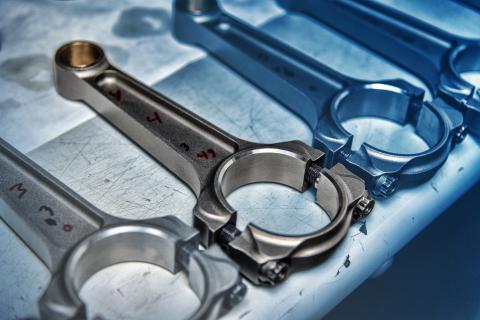
Pictured is a comparison of CP-Carrillo connecting rods with different offsets. From top, an LS rod that is on center, a small block Chevy rod with a .060-inch offset, and a small block Ford rod with a .110-inch offset.
“Often we see the big-end rod width listed as on center when it should not be. Our rod order form requests that the ends be written down from center of the beam,” explained Batchelor.
The company recently had a nostalgia fuel customer with six vintage blocks that all had slightly different bank offsets. The team had constant issues with the pin end rubbing the piston and the big end of the rod rubbing on the crank cheek.
“I sent them a sample rod with a narrowed pin end and had them mock it up in each block and measure the distance to the piston pin boss on both sides. Once I had these numbers, I was able to get them a rod that was intentionally offset on the pin end in the opposite direction of the big end. This combined with an increase in big-end offset and narrowed pin end was just enough to keep it off the piston, regardless of which block they were using,” said Batchelor. “It took me some time to figure it out, but in the end, they were extremely happy to not have this problem anymore.” —Mike Magda
Manufacturers of gaskets and sealants caution users against “old habits” as products and technologies have evolved to meet the demands of both modern and vintage power plants.
The science behind gaskets and sealants has evolved greatly over the past three decades, their evolution driven by vastly increased performance from OEMs, staggeringly powerful street cars and, of course, racing.
But while product development has largely kept pace with changing demands, some builders have not, according to the manufacturers we spoke with for this report. In fact, too many still rely on older methods that can actually work against the latest gasket, seal, and sealant technology, our sources noted. Among the key problem areas cited: choosing the wrong products for the job; incomplete or incorrect surface preparation; not following the manufacturer’s installation instructions; applying coatings and sealants where none are required; misunderstanding manufacturers’ torquing specifications; and using uncalibrated torque wrenches.
“Trying to get past old habits is the biggest issue,” observed Micky Hale of Cometic Gasket, Concord, Ohio. “Many builders have their go-to thing that they used to do 20 years ago and think it still applies today.”
“The power that engines make today is so much higher than the same application 10 years ago, so you can’t do things the same as back then,” added Nick DiBlasi of JE Pistons, Cypress, California, which manufactures the Pro Seal line of gaskets. “Look at 360 and 410 sprint car engines making hundreds more horsepower than 10 years ago with essentially similar combinations. Cylinder head and piston design and tuning are pulling out so much more power. The difference between a 600 and 850 horsepower V8 is a great difference in cylinder pressure.”
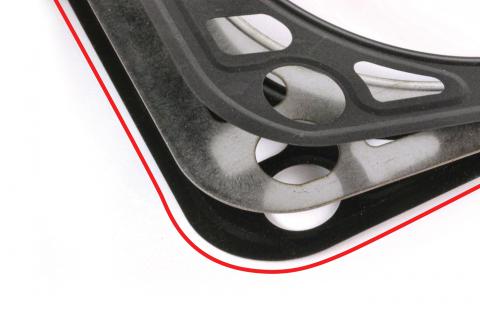
Fortunately, all of the aforementioned problems are preventable. For starters, gasket manufacturers cover the performance gamut with multiple tiers of products, including composite, various types of MLS, and cut-ring gaskets that use composite and steel bodies. Meantime, better materials and products for older applications are coming to market on a pretty regular basis.
The Limits of MLS? It Depends
According to DiBlasi, one common mistake builders make is sticking with the OEM-style multi-layer steel (MLS) gasket with too much power; or, conversely, jumping from MLS to copper or O-ring in builds where those products aren’t needed.
“OEM gaskets are great for stock performance and long life,” he said. “It is optimized for factory power plus maybe up to 20% more.”
Higher-performing aftermarket MLS gaskets represent the next step. NHRA Pro Stock and NASCAR teams use MLS gaskets, for example. For some import engines, DiBlasi said MLS is preferred, too, regardless of power due to cylinder head bolt design and configuration.
“The Honda B-series is a great example,” he told us, citing the four-cylinder naturally aspirated engine used in the automaker’s 1980s and early 1990s models. “The engine was designed for 175 to 200 horsepower, but builders can make 1,600 hp using MLS gaskets.”
Beyond MLS
And that leads us to our next point: There are other products to consider before going to copper or O-ring. Cometic’s MLX gasket has an extra “stopper” fold-over layer that provides a torque-limiting surface, which prevents yielding of the combustion seals, according to the company. A high-temperature polymer coating along with embossments provide a micro seal for fluids against the head and block surface.
But even that solution has its limits. For high-performance street and race applications, Cometic offers spring-energized gaskets (SEG) for LS and third-gen Hemi builds.
Getting engine builders to give up old habits when it comes to gasket use is a “big issue,” reported one source. Gasket development has kept up with engine technology, but some builders still use older methods that can work against current gasket technology.
“It’s got a drop-in stainless spring-energized ring that pops into our MLS carrier, like a built-in O-ring in the gasket,” Hale noted. “Unlike a solid ring, you don’t get the deep groove in the block and head. With this ring, it ends up being just one or two thousandths. It’s been out a year and a half, and we have some heavy hitters running with success.” The company plans to expand availability to additional engines, too.
Pro Seal also offers a cut ring gasket that uses a stainless-steel ring surrounded by a composite gasket. DiBlasi stressed that this is intended for very high cylinder pressures for racing, i.e., not for long life.
Athena-SCE of Mount Pleasant, Tennessee, owner of the SCE Gaskets brand, offers its Vulcan Cut-Ring gasket that does not require machining of the block or head. The gasket uses a composite body with steel core reinforcement and bead seals on top and bottom that seal in fluids. A solid stainless ring is flat on the bottom to go against the block or sleeve, and features three micro-ridges that bite onto the cylinder head.
“On a rebuild, you’ll have to deck the head three- to four-thousandths to clear those out, but most builders are taking a 10-thousandths pass on heads to true them up anyway,” explained Aaron Hunter of SCE Gaskets. “You could use our Cut-Ring head gaskets to levels high enough where you’re worried about the crank dropping out the bottom. In terms of boost, we’re seeing guys get well into what used to be copper gasket and O-ring territory.”
Beyond those levels, Hunter directs builders to the company’s line of copper gaskets, including Titan, Pro, and ICS Titan. The latter features Integral Combustion Seals that Hunter said perform the function of O-ringed blocks and heads without the added machining.
Athena-SCE is working with its partner Athena SpA to launch the new Accu Seal Pro composite head gaskets for OE replacement and performance, which is currently in development and expected to be released by early 2022.
Pay Attention to the Basics
Tim Golema at MAHLE Aftermarket in Farmington Hills, Michigan, told us he sees a number of blunders in the field that could be prevented by better understanding the basics of bolt load.
“There’s confusion over torque-to-yield, fasteners, tension, the angle part of torque, and what exactly torque is,” Golema said. “Some will over-torque head bolts. That actually extrudes the gasket material and causes problems. I’m not sure everybody understands this.”
High-performing MLS gaskets are better suited for some applications than copper or O-ring gaskets. According to a source at JE Pistons, MLS is preferred for some import engines, regardless of power, due to cylinder head bolt design and configuration.
Golema also said buying the wrong gasket for the job is common, especially with DIY-ers. “They buy thicker gaskets thinking that improves sealing,” he explained. “They don’t understand compressibility and why different materials are used for different applications. It’s not all their fault. It’s the myth that has been handed down over generations.”
Hale touted the importance of using a high-quality torque wrench, but said he still talks to customers who don’t know or remember to get it calibrated every couple of years.
With the proliferation of LS and Chrysler third-gen Hemi architectures, DiBlasi said builders could benefit from a better understanding of the differences between engines in the same family, especially between forced-induction and naturally aspirated versions.
Copper gaskets can be a tuning tool, said JR Clark of Clark Copper Head Gaskets. The company offers custom gaskets in six thicknesses, allowing drag racers to raise or lower compression between passes by changing gaskets.
“Builders that do a wide variety but don’t go case-by-case are more likely to run into problems,” he said. “For example, on the six-bolt LSX you can go higher on power still using an MLS gasket versus a stock LS block with four head bolts,” he said. “It all comes down to clamping force. The less there is, the more reason to step away from MLS and move to a sealing-ring type gasket, like our Cut Ring, or an O-ring, for full pressure sealing around the cylinder.”
Put Down the Spray Can
Atop their list of user missteps, gasket makers overwhelmingly cited customers following the outdated practice of using additional coatings or sealants when none are required. Spraying copper coat was a primary example.
“Almost no MLS-type gasket needs any further coating,” explained DiBlasi of Pro Seal. “Our gaskets have a base coating for adhesion, another layer that’s a heat blocker, and a top layer designed to fill in the voids between mating surfaces. When you put copper coating on top of that, you’re inhibiting the gasket’s ability to seal.”
He emphasized that MLS has evolved over decades, though builders may not be aware of its development. “An MLS gasket designed in 1985 is very different than a new MLS gasket,” DiBlasi added. “So all they’re doing is spraying an inferior coating over the one that’s already there and doing the job. We’ll get a damaged gasket back and see copper sprayed all over it.”
Hale of Cometic Gasket had similar observations. “Our gaskets, especially head gaskets, need no additional sealers as long as both surfaces are done with the correct Ra finish,” he confirmed. “Additional sealers like copper coat work against MLS. All it’s really doing is putting a layer of liquid under the gasket and not letting the embossment do what it’s meant to do. It basically hydraulics the gasket.”
Hunter, too, spoke out against using additional coatings on SCE’s MLS head gaskets. “We have a proprietary polymer coating on our MLS Spartan that doesn’t require anything else. You need a 50 Ra surface or better. The builder should have a profilometer to measure deck surface.”
Golema, while also citing copper coat as an ongoing concern, did report some positive news elsewhere. “On the performance side, we don’t see as much of the over-use of RTV to the point where it was plugging up oil pumps,” he said. “Use those products sparingly. Once you smear oil or RTV, you risk extrusion. Don’t use it unless we put it in the kit.”
When to Use Copper
When a power adder makes enough cylinder pressure that is beyond what MLS can handle, that’s usually where copper comes into play, according to JR Clark of Clark Copper Head Gaskets in Blaine, Minnesota. Because many customers are less familiar with copper, however, Clark takes orders solely by phone to assess each individual’s application.
“We get a lot of guys who call who think they need copper for a street car, but I spend a lot of time trying to talk people out of it,” he said.
“All of our gaskets go through a heat-treating process, so it anneals them dead soft; it’s pliable, so it goes around the O-ring,” he explained. Clark agreed, too, that MLS is suitable for most performance applications and naturally aspirated race builds. For the amount of boost used by turbo or ProCharger racers, though, MLS won’t hold.
Gasket manufacturers serve the performance industry with multiple tiers of products for the latest generation of race engines. Even older engine applications are benefitting from new products and better gasket materials.
Clark also advises each customer on the prep work required for copper. “You need a fresh head and block surface, because copper won’t fill up imperfections,” he said. “And copper is temperamental with water with more than eight pounds of pressure. It won’t get into the combustion chamber, because you’re also running an O-ring or fire ring. So, if you have water in a cylinder with copper and an O-ring, you have a different problem. The head is coming up. Look to head and block prep. Or there may be a bad intake gasket, or water getting into the intake port.”
Clark cited copper head gaskets as a tuning tool of sorts, too—the company offers custom gaskets in six thicknesses, which allows drag racers to change gaskets at the strip to raise or lower compression in between passes.
Over the last year or two, Clark has noticed an influx of business from Porsche and Lamborghini owners competing in standing-mile events. “They’re throwing so much boost at them,” he said about the custom turbo builds. Among other hot segments is desert racing, where builders are using turbocharging to push the two-cylinder, 70-horsepower engines in side-by-sides to 300 horsepower.
Graphite for Exhaust Gaskets
Especially with older engine architectures, getting perfect surfaces can be difficult. A specialty product like Remflex Exhaust Gaskets might be needed. Inventor and founder Remington Moore created his graphite gaskets 15 years ago, having worked with the materials for industrial applications, including aeronautics.
The Remflex gasket sandwiches wire mesh between two layers of graphite. The end product is 1/8-inch thick and, following the manufacturer’s torque specs, compresses to half that to seal imperfections. The product has, however, also found favor among customers without surface problems, according to Rebecca Clifford of Mineral, Washington-based Remflex.
The company catalog includes about 500 parts, from 1920s Ford Model Ts to late model 2010s. Most are for American cars, the most popular application being the small block Chevy. Numerous imports are also covered.
Remflex’s product is proven in racing—the company has partnered with John Card Racing on its Top Alcohol dragster and Veney Vega Funny Car tribute. Stacy McGlory drives the Remflex Funny Car in the East Coast Pro Comp Series.
Clifford told us that customers most often struggle with understanding torque specs. Some, she said, question whether the company’s stated specs are enough.
Permatex has grouped its latest products by color, each with different sealing properties. Red gasket maker (pictured) is meant for use in high-heat areas, such as exhaust manifolds and headers.
“They typically have not worked with our product before and are accustomed to using conventional exhaust gaskets,” she said. “We want them to follow our guidelines exactly. The product is soft and takes [the] form of the surface. They should not try to compress to less than that 1/16-inch thickness.”
Clifford also cautioned against using any sealants with Remflex gaskets. “There’s absolutely no reason to,” she said.
New Life for Old Engines
Even to the level of street and track performance available via modern LS, Hemi, and Ford Coyote applications, the hot-rodding world remains a vast melting pot. There are loyal followings for everything from Ford flatheads and small block Chevys to oddball combinations like Buick 350s and AMCs.
Composite gaskets can work for most of these applications, and more products are hitting the market all the time. Golema said MAHLE Aftermarket is building up a new line of composite gaskets for a wide range of older engines. “There is an opportunity to use better materials with the older applications,” said Golema. “Each application is engineered based on configuration, material, compressibility, and coating. We can change the material density based on bolt load.”
Here, too, Golema cautioned builders to avoid old habits, even when working on classic engines. “Materials have changed. The aluminum head used on the small block Chevy 30 years ago is much different than today’s aluminum heads,” he said. “We make a handful of composite products with and without wire ring for cast iron or aluminum hardware. Also, for the small block, if you’re using a traditional stamped valve cover, you need to use a more compressible material than with a cast cover and machined surface. For non-stamped applications, we have a line of aluminum-cored gaskets.”
Silicone Issues (and Solutions)
Just as gasket manufacturers caution builders to avoid using RTV sealers with their products, so too did our source at Permatex in Solon, Ohio, but from the other side.
“People used to want to use the silicone on a traditional cut gasket,” said Eric Seibold. “Our chemical gaskets are designed to be used as standalone products. If you’re using our gasket maker on a traditional gasket, you are probably creating leak pathways.”
Gasket-maker products have also changed over the years to accommodate the evolution in fluid chemistry, so choosing the right product for the job is critical. Common applications for Permatex products include valve covers, oil pans, transmission pans, water pumps, thermostats, exhaust manifolds, and intake manifolds. A specific gear oil silicone is recommended for differentials and axles seals, and a water pump and thermostat housing-specific formula is designed for resistance to today’s coolants.
“Additive packages in oils are significantly different than 30 years ago,” said Seibold. “The friction modifiers in gear oils in particular are extremely aggressive. If you use the wrong silicone, you could end up with a leak.”
Seibold said Permatex has simplified its product line and is highlighting its latest oxime silicones. These are quite different from its older (but still available) acetoxy-based silicones, which contained acetic acid and could damage sensors with off-gassing. The oxime silicones, by contrast, are sensor-safe.
Essentially, the company groups its latest products into black, gray, and red. The black silicones are flexible and highly fluid-resistant, specifically for different types of oils, Seibold explained. “These can be used anywhere you might have different metals coming into contact with each other and having different expansion characteristics.”
Gray cures into a more solid, harder rubber and is generally best suited for high-vibration applications and high torque loads. Red is in between flexible and hard, and is meant for use in high-heat areas, up to 750 degrees F. From there, Seibold recommended racers use the top-line Optimum product if they’re working on their car during the week, when the longer cure time is not an issue. At the track, however, the company’s Right Stuff products cure immediately for repairs between passes.
 MEMBERSHIP LOGIN