Business Profile: Freedom Racing Engines
Submitted by jeffreyc on Mon, 06/21/2021 - 11:14


This Indiana-based diesel shop’s focus on perfecting its recipe has given rise to a brand that’s become “synonymous with racing and winning.”

Among an impressive list of accomplishments, Freedom Racing Engines provided the 6.7-liter, twin-turbo Cummins that powered Scott Birdsall’s 1949 Ford pickup to a new diesel record of 11:24.065 in the 2020 Pikes Peak International Hill Climb. Freedom also built the 5.9-liter Cummins for X275 racer Ryan Milliken’s 1969 Nova, which debuted at Lights Out 12 in South Georgia just this past February. 

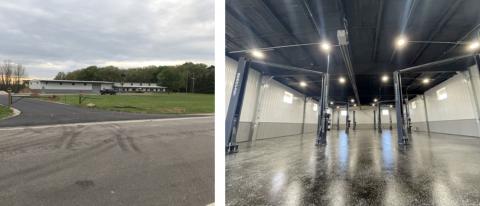
Freedom is owned by brothers Chase and Brayden Fleece, who established Fleece Performance Engineering in North Salem, Indiana, in 2008 to manufacture high-performance diesel components. (The PowerFlo lift pump is just one of their signature products.) The brothers moved their operation to Brownsburg in 2012, where they began outsourcing machine work to Freedom—located literally across the street—and then purchased Freedom outright in 2014. In 2019, both companies relocated to a brand-new, purpose-built, 75,000-square-foot facility in Pittsboro, about 16 miles northwest of Indianapolis. Today Fleece and Freedom together employ just under 70 people, all full-time.

Freedom’s operations manager, John Benshoof, had been a dealer mechanic in Minnesota before signing on as the “tire guy” for Antron Brown’s Top Fuel Dragster team in 2008. He soon moved up to cylinder head specialist, the position he held when Brown won the 2012 NHRA Top Fuel drivers’ championship. By then, however, Benshoof had met his wife-to-be, and wanted to spend less time on the road. “So I transitioned to working in the machine shop (in Brownsburg) for Don Schumacher Racing, where I gained all kinds of experience in machining, CNC, and shop operations.” He started his present position at Freedom in spring 2015.

Perfecting the Recipe

Freedom specializes in Cummins and Duramax diesels. “Cummins has always been our bread-and-butter,” Benshoof explained, “and Brayden and Chase have been involved with Duramax since the get-go. But the Cummins engine is the one to have, especially in a pulling application.”

And while Benshoof is naturally reluctant to share specifics, he did note how Freedom has “spent a lot of time perfecting our recipe—and a lot of that is data acquisition. Over the years we’ve done a really good job of stacking up run files on our dyno, and then constantly picking our recipe apart, and making small adjustments.” This has allowed Freedom to “adjust quickly, and to continually improve what already works. In any kind of racing, you always have to look for The Next Thing.”

business2
Freedom Racing Engines and Fleece Performance Engineering joined forces in 2014, and moved into their current, 75,000-square-foot facility in Pittsboro, Indiana, in 2019.

Even more than that, however, Benshoof attributes Freedom’s success to its people. “The number-one thing in business—it doesn’t matter what you are making—is to have the right people. In business you have the who, the what, and the how—but as long as you have the who, the rest gets taken care of.”

Furthermore, “We’re small enough that communication isn’t hard,” he continued. “We still use email to communicate, but for the most part we’re all right there, so it’s easy to pass information along.” Still, Benshoof likes to start every Monday morning with a meeting. “That’s my time to talk to the crew, get a game plan together for the week, and to find out who has questions or concerns.”

People and Promotion

Product promotion is equally people-powered; when Benshoof insists that “our customers are our best advertisement,” he really means it. “We’ve never spent a lot of time trying to market through magazines, or even social media.” Promotion “is completely organic. It comes from winning at the track. When our pullers are successful, people call our shop. They want quotes. They want us to build engines.”

And while winning brings new customers in the door, customer service brings them back. “We are in the business of building relationships more than building engines. When you work with somebody—when you are working with thousands of their hard-earned dollars—it’s the service after the sale that’s key. And that’s how we’ve always done things. You treat people good, you take care of them, and you make customers for life.”

business3
Having the right machinery has helped Freedom Racing Engines succeed. It boosted efficiency and “repeatable quality,” noted one of the company’s managers. “It opened up the opportunity to sell a project, get it done in a timely fashion, and get it done the same way every time.”

One of those customers is Ryan Milliken, who, when he’s not racing his oil-burning Novas, partners with wife Leslie in Hardway Performance Solutions, a diesel specialty shop in Mary Esther, Florida. Ryan met Chase Fleece 14 years ago at a dyno event sponsored by transmission-builder SunCoast. “I was the guy at the Fleece booth firing questions, probably until they wished I’d walk away,” Milliken chuckled. “I’ve been buying Freedom engines from Fleece before the brothers took possession of it.”

Milliken built his first Cummins-powered Nova, a bright green 1966 hardtop, with a waterless block and a Wagler head assembled and machined by Freedom. He sold that car in 2019; the Cummins in his new (and strikingly blue) 1969 Nova is a pure Freedom product. “Their combinations are tried and true,” Milliken confirmed, “with data to back them up. Every move is calculated. If we make a change, we know what to expect—and then we go back to see if it did exactly what we were expecting.”

Milliken’s own shop also builds performance diesels, “but just basic stuff—600 to 700 horsepower, nothing too wild. When someone comes in with bigger dreams and aspirations, I sell them a Freedom engine,” he said. Or, if a customer sees something on Milliken’s car that they want for themselves—for example, “the custom front cover with the integrated dry-sump oil system that Freedom sells, I just call up Freedom and get an estimate, and if the customer says, ‘Yeah, I’ll have that,’ then I order it, and it’s on its way. It’s great to sell something that you absolutely know for a fact is going to work perfectly when it shows up at the customer’s door.”

Similarly, Derek Rose has been a Freedom customer “since they started moving heavily into the diesel world in 2014.” Rose is the owner of DNR Customs, a diesel shop in Casco, Michigan, where “we do everything from basic repair to servicing full-blown competition vehicles.” He recently opened a second shop just to handle his growing race business. Rose also campaigns his own 2,000-hp 2006 Dodge Ram 2500 in the Outlaw Diesel Super Series.

business4
Data acquisition has been key in “perfecting our recipe,” said John Benshoof. “We’ve done a really good job of stacking up run files on our dyno, and then constantly picking our recipe apart to continually improve what already works.”

Much like Milliken, Rose appreciates the Fleece/Freedom scientific approach to performance. “Back in 2014–2015, the diesel industry was evolving faster than the speed of light; but if you were in the industry, you knew the Fleece name,” he explained. “John and Chase were willing to take the time to work through the setups, to try endless different combinations, to learn what worked and what didn’t, and to put together an awesome recipe for their Stage 2 6.7-liter motor. And I was involved in everything they were doing. So we built a relationship, and a rapport, on racing.”

Fleece Performance sponsors and participates in a wide range of diesel events across the country each year. “A spectator at an event may not buy an $80,000 race engine,” Benshoof allowed, “but they might buy a Fleece Cheetah turbocharger for their pickup truck.”

Advantages of Automation

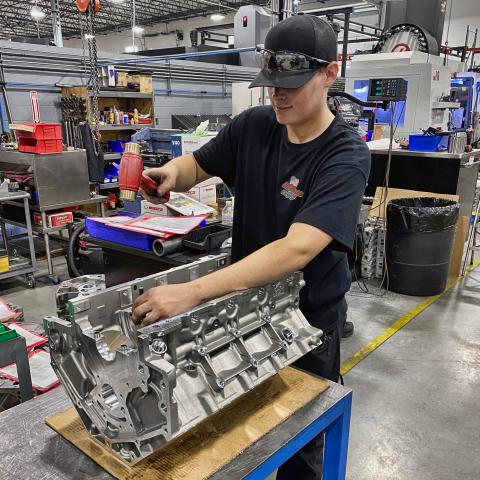
Having the right equipment has also helped Freedom succeed. “When we purchased Freedom it was a nice shop, Benshoof recalled, “with all good machines”—but not the kind of machines the company needed if it was going to grow. That situation changed “the day we bought our Haas VF-6, and we automated our machine work for our Cummins and Duramax engine blocks. On some projects, we went from machining and handling an engine block for two weeks before it was assembled, to half a day.” Other parts that might require operations on five different machines over a period of 12 hours could now be finished on one machine, in about an hour. Benshoof pointed not only to the huge gain in efficiency, but in “repeatable quality” as well. “It opened up the opportunity to sell a project, get it done in a timely fashion, and to get it done the same way every time. It changed our business drastically. And it opened our eyes to what we could do.”

business5
Derek Rose has been a Freedom Racing Engines customer “since they started moving heavily into the diesel world in 2014,” he said. Rose is seen here in his 2,000-hp 2006 Dodge Ram 2500 in the Outlaw Diesel Super Series.

When Freedom buys the components it doesn’t manufacture, Benshoof chooses them “mostly by the reputation of the supplier. I see our vendors as partners. I am fortunate to have made a lot of good contacts during my career in drag racing, and that’s how I was able to bring in Trend, Diamond, Manley,” and other top names in the industry.

So loyalty plays a part, but so does a preference for the tried and proven. “At this point we’ve very much established a recipe for each application,” Benshoof said. So even when a supplier is hawking something new, “we don’t change stuff just to change stuff.” That said, “stuff” changes fast when performance or reliability demand it. In fact, “most of our development has come out of necessity, when a part has failed because we’ve surpassed or exceeded its capabilities. At that point we go to the vendor and say, ‘Hey, look, this needs to change, because it isn’t working.’ And if the vendor is not willing to improve their product, then we move on. We find another source, one who understands what we are dealing with, and who can help us get over that hump.”

Expanding the Brand

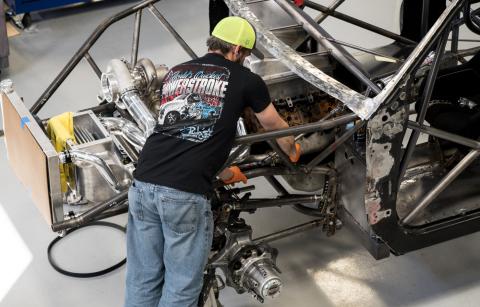
For the most part, the respective roles of Fleece Performance and Freedom Racing Engines are clearly defined: The former manufactures high-performance diesel components, the latter builds complete competition engines. Freedom, said Benshoof, still has “a few customers who just want machine work, and then they assemble the engine themselves. But most people, once they start getting into it,” soon see the advantage of “having us assemble it and dyno it. That’s where you get the support.”

And so “the two companies complement each other really well,” Benshoof commented. “Freedom does a good job of marketing for the entire organization. We’ve been able to get engines into cars like Ryan Milliken’s Nova, and some of our pulling truck customers have enjoyed really good success, so the Freedom brand has become synonymous with racing and winning.”

Nonetheless, “back in 2019, we decided that Freedom needed its own product, so we kicked off our Freedom Series cylinder heads for Cummins and Duramax diesels, which we offer in various versions from remanufactured to high-performance. We set up a production environment within Freedom to build the heads, although we still use the Fleece distribution network to bring them to market—because the Fleece brand is so large, with truck shops and dealers around the world.”

Milliken noted how Hardway has “sold a bunch” of Freedom cylinder heads, and often has them drop-shipped to customers. “And you don’t have to wonder about the quality.” Milliken even runs the Stage 2 version on his 1969 Nova, “with a custom billet shorty intake that they made specifically for my car.” 

business6
While some customers just want machine work done on their engine components, others, “once they start getting into it,” soon see the advantage of “having us assemble it and dyno it,” said a company source. “That’s where you get the support.”

A more esoteric project, which is documented on Freedom’s website, is a solid-billet-aluminum Cummins engine block. “That’s been in development for a long time,” Benshoof said. “We’re not trying to sell it yet. We’ve manufactured a couple of them, but the timing isn’t right, for us as a business, to get it out there and support it. In business, there are times for development, and times for making money. But for a small business they rarely come at the same time.”

Benshoof reminded us that, for all of Freedom’s success, running an engine shop is still a tough business. “There used to be machine shops on every street corner. It’s competitive, and you have a lot of overhead. To do things on the scale that we are doing them now—a lot goes into that. So we have to be mindful of what the next market looks like, where we are going relative to the industry, what’s going to make money—and what’s not going to make money but will still do well for us.”

The billet block seems to fit into this last category. “We’re trying to get one into one of our customer’s Pro Mods,” he added. “It’s going to have a ‘Wow!’ factor: ‘I can’t buy that, but I can buy this.’” 

Meanwhile, Benshoof honestly sees more profit potential in “more street and more re-mans,” bolstered, of course, by Freedom’s race and pulling reputation. “And we’re going to expand our cylinder-head lineup into Power Strokes, to continue to grow that portion of the business—as well as the engine-building side.”

Of course, Freedom has plans for its racing engines as well. “I can’t tell you a whole lot about what we are doing there,” Benshoof said, “other than that we are always looking to develop more and different ways to make power.”
July 2021
By
John F. Katz

CT Performance Opens New Facility

Submitted by laurap on Fri, 06/18/2021 - 16:21
CT Performance's new facility in Stockbridge, Michigan


CT Performance has announced its relocation to a brand-new facility in Stockbridge, Michigan. 

“We have invested considerable time and resources into this move and are confident that this expanded facility will enable us to serve our clients better and maximize our performance output,” a company release said. “Our long-term goal is to be the one-stop shop for all your performance needs.”

The 12,500-square-foot facility is situated on five acres of land and is expected to allow CT Performance to offer additional services, including tire mounting, balancing, alignment, and in-house machining and parts manufacturing. The new facility also features a 5-axis CNC machining center, giving CT Performance the ability to manufacture performance components in-house.

For more information, visit ctperformance.com.

June 2021

Wound Up

Submitted by jeffreyc on Fri, 06/18/2021 - 13:00

Photo courtesy of Rudy’s Performance Parts

The diesel racing market remains cautiously optimistic for growth as “getting back on track” and embracing new technologies stand out among stakeholders’ top priorities.

If there’s one segment in the performance and racing industry that may literally have a bullseye on its back, it’s the diesel market. 

A wave of scrubbed events last year due to the COVID-19 pandemic reduced the need for parts and engine builds, especially on the tractor-pulling circuits that rely heavily on county fairs and other regional gatherings to support the competition. Helping keep the industry moving was the core audience for these events—millions of 3/4- and 1-ton diesel truck owners who use their vehicles in agriculture and construction while also modifying them for towing and recreation.

“I would say 75% of the events or more were canceled. So, it really slowed our work down,” said Ryan Salenbien of Salenbien Performance, Maybee, Michigan. “Nobody needed horsepower or had anything to fix.”

That stood in contrast to the experience of Wade McGinnis of Thoroughbred Diesel in Winchester, Kentucky, however, who told us, “Some sectors have been hit adversely with COVID, but for us business has been very good. We’ve been blessed. We’re more of an e-comm, so I feel like our niche customers are 650 horsepower or less. As far as the competition customer, obviously we can service them, but it’s really not our core customer.”
diesel2
Scheid Diesel manufactures its own 5.9L and 6.7L Cummins aluminum blocks for performance applications. The company is looking forward to a busy second half of the 2021 racing season, “getting back on the track and being able to have some events,” said Dan Scheid. “We feel like people are ready to get out and enjoy themselves.” Photo courtesy of Scheid Diesel.

“We’ve been setting sales records every month,” agreed Lavon Miller of Firepunk Diesel, Plain City, Ohio. “The majority of our customer base is all essential workers. They got their travel and leisure taken away, so they put all their time into building their trucks.”

However, peeking around the garage doors of all these diesel shops is the US Environmental Protection Agency (EPA), which has mounted an unprecedented crackdown on the illegal removal or alteration of factory emissions components on production vehicles.

“We pretty much have dropped all tuning platforms with a diesel aftertreatment system. It’s just not something that Firepunk offers,” said Miller. “[EPA] pretty much made it clear that if the truck is plated for street use, there’s zero tolerance on tampering with the aftertreatment systems.”

Ten to 20 years ago, diesel vehicles were seemingly making headlines at nearly every global racing venue. Audi and Peugeot dominated Le Mans and WEC racing; then Audi quit to focus on electric car racing. Mazda toyed with a diesel in IMSA racing but returned to gasoline after three years. Now endurance racing officials have banned diesel for the hypercar prototype class.

Also, not too long ago there were high-profile diesel breakthroughs at Bonneville and in World Touring classes. A significant number of vehicles at Dakar were diesel-powered, too, and some still are. But across the globe, diesel racing opportunities have tapered off as automakers are pressed by government officials to eliminate the engines in passenger vehicles.

In the US, only drag racing and tractor pulling offer significant opportunities for racing a diesel engine. And the aftermarket has taken the sport seriously. Diesel technology includes clean-sheet billet engine designs and massive tri-turbo compound configurations that provide more than 150 pounds of boost. There has been an earnest uptick in engineering and parts development for the competitive puller or drag racer.

“Right now, the biggest excitement is getting back on the track and being able to have some events. It’s the number-one priority,” said Dan Scheid of Scheid Diesel, Lafayette, Indiana. “The farm economy right now—the grain prices and stuff—are extremely good. So, typically, when you got farmers that are making money, they like to pass it around.”

Scheid recently added a new mill and lathe to the shop, and fabricating high-pressure fuel lines is keeping the machines busy along with development of hardcore parts.

“We’ve been kind of stuck on the 12-valve heads for the Cummins 5.9 engines, and now we’re getting ready to introduce 24-valve heads,” added Scheid. “Either a mechanical or electronic fuel injection system can be used on them. So, we should be getting that out to the marketplace here just within the next month or so. And we still are marketing our 5.9 and 6.7 Cummins aluminum blocks that we have available for performance applications.”

Rudy’s Performance Parts in Burlington, North Carolina, is already drawing crowds and competitors, having sponsored its first 2021 event in late April at Piedmont Dragway in Julian, North Carolina. Approximately 300 participants raced, and despite weather delays the company leveraged the event successfully through its marketing channels.

“We pretty much start out just marketing on Facebook, posting videos and photos,” said Tim Eied. “We get a lot of attention from the spectators, from the vendors, from the racers, and we get a lot of hype from the ODSS (Outlaw Diesel Super Series). We had to cancel our last two events because of COVID, so we were limited to about 3,000 people this time.”

Rudy’s is shifting its attention away from performance upgrades to other needs of the truck enthusiast, including suspension, interior upgrades, and lighting.

“Also, we’ve veered off into the UTV side. We still have tuners from Edge, Superchips, and Banks that are emissions friendly,” noted Eied. “But AMP power steps, bed covers, parts like that is where our focus has shifted. It seems that everyone else in the industry is also making that shift.” 

Diesel shops will gladly offer performance parts again if the manufacturer gets them certified through the California Air Resources Board (CARB).

“We’re working with some of the manufacturers and suppliers on CARB approvals for a lot of the parts,” added Eied. “PPE (Pacific Performance Engineering) has CARB-approved downpipes and up pipes. Edge is working on getting all their tuners CARB-approved. S&B is working on getting all of their intake systems approved. It’s awesome, and obviously they don’t want the market to be limited. So they’re working on them, they’re doing a great job of it.”

diesel3
Rudy’s Performance Parts promotes its brand by fielding its own race truck and sponsoring several drag race events, in association with the Outlaw Diesel Super Series. Photo courtesy of Rudy’s Performance Parts.

“[CARB approval] is in the forefront of every major manufacturer in the diesel niche right now,” confirmed McGinnis. “It’s what everybody is working toward. What does it need to help the movement? We need more testing facilities to get them tested and on the road.”

Miller is in regular contact with his state’s EPA office, and has set down strict sales policies that will keep it in line with federal guidelines as well.

“After communicating with my Ohio EPA rep, he said not all tuning is illegal. But if you have to turn off an oxygen sensor and you disabled the DEF pump or the EGR or anything like that, that’s considered tampering and you’ll be held accountable for it,” said Miller. “So, if I can’t sell a tune that doesn’t meet those requirements, I just don’t do it.”

As a result, many diesel shops are looking to offer an alternative to tuning.

“I think tuning is still popular, but I tell you one product that has really shined in the last couple of years has been throttle sensitivity boosters,” said McGinnis. “They’ve taken a place alongside tuning. It’s a nice performance modification that can be done to a truck. You can take it off if you have to take it in for warranty. Doesn’t really affect the warranty and really increases drivability.”

Since Salenbien caters to professional diesel racers with dyno testing and custom engine building—including tractor engines—he can focus more on parts development. At the 2019 PRI Trade Show, Salenbien introduced his Apex turbo, a unique design in which there is no fastener for the compressor and turbine wheel. The blades extend all the way to the core, which effectively increases the size of the turbo even though the housing dimensions don’t increase.

“That opens up the door in the limited classes. If you’re in a 3.0 class and allowed only a 3-inch compressor wheel, you got to maximize all you can out of that 3-inch hole,” said Salenbien, adding that other forms of racing are now interested in the patented design. “I didn’t know anything about car racing, but we’ve actually started pairing up with some racers and understanding that side of the world.”

Looking to the future, diesel shops are optimistic that sales will grow as the diesel racing schedule returns to normal, even if diesel fuel prices escalate or there’s still a hangover from the pandemic. 

“The only real concerns that I have are supply issues,” noted Eied. “COVID made a huge impact on supply; but in all honesty, it doesn’t really appear to be getting much better, which is a little bit nerve-racking. The last thing we want to do is not be able to take care of our customers. So we’re doing everything we can to stay stocked up on inventory.”

“The main thing is more events,” added Scheid. “We feel like people are ready to get out and enjoy themselves.”

“I think as people stay performance-minded, it’s going to keep us evolving,” predicted McGinnis. 

Keeping the market clean will also be a priority—even for racers.

“I try to preach over and over to my customers: You want to make it lean at wide open throttle. That way, you have a better chance of getting it dialed in to where you have as low smoke output as possible. Then people outside looking in to our industry don’t see us as just a polluting smoke machine,” said Miller. “Our S-10 race truck makes over 3,000 horsepower with no smoke going down the track. People are starting to jump on that trend of trying to put new setups together that are clean with less smoke output.”

SOURCES

–

Firepunk Diesel
firepunk.com

Rudy’s Performance Parts
rudysdiesel.com

Salenbien Performance
salenbienperformance.com

Scheid Diesel
scheiddiesel.com

Thoroughbred Diesel
thoroughbreddiesel.com

July 2021
By
Mike Magda

Sonoma Raceway Names Peter Rogers VP Of Sales

Submitted by laurap on Thu, 06/17/2021 - 17:28


Peter Rogers, a long-time executive in the music and entertainment industry, has been named vice president of sales for Sonoma Raceway.

In his new role, Rogers will oversee all aspects of sponsorships and sales for the 1,600-acre Northern California facility, including title sponsorships, premium sales, corporate events, and official speedway partnerships.

“This is a very exciting time to join the motorsports industry, and to take on this role at an iconic facility such as Sonoma Raceway is a great challenge,” Rogers said. “We will continue to build on the overwhelming motorsports success at Sonoma Raceway, while finding new ways to better position the raceway on a local, regional and national stage. I can’t wait to get started.”

Rogers holds former experience with Sony Music and Jay-Z’s Roc Nation. His most recent position was serving as vice president of partnerships and business development for the Life Is Beautiful Festival in Las Vegas. Rogers will report to Speedway Motorsports Chief Sales Officer Kevin Camper.

Rogers is a graduate of the New England Conservatory in Boston with a master’s in music from Yale University in New Haven, Connecticut. A lifelong car enthusiast who also participated as a substitute double bassist with the Park Avenue Chamber Symphony in New York City and the Las Vegas Philharmonic, Rogers will relocate from Las Vegas to Sonoma. 

For more information, visit sonomaraceway.com.

June 2021

Port City Racecars Announces The Acquisition Of Crazy Horse Racing

Submitted by laurap on Thu, 06/17/2021 - 13:10
Port City Racecars (PCR) logo


Port City Racecars (PCR), based in Mooresville, North Carolina, has announced the acquisition of Crazy Horse Racecars (CHR), the asphalt short track chassis builder and current PCR dealer based in South Paris, Maine. Once the acquisition is complete over the next month and a half, Crazy Horse Racecars will become Port City Racecars.

Current CHR customers should expect increased resources and a “seamless” transition, PCR said. The additional resources include skilled fabricators, sales and marketing efforts, as well as back-end office operations that will position the company for growth.

“...With this move into the Northeast market, PCR will be able to closely support the vibrant community of asphalt short track racing by offering all our same services but in a much more convenient way by eliminating long drives for our customers in the Northeast when they need to get their cars serviced,” PCR Owner Gary Crooks said.

For more information, visit portcityracecars.com.

June 2021

Alive & Growing

Submitted by jeffreyc on Thu, 06/17/2021 - 11:12

Photo courtesy of Ultimate Callout Challenge

With participation—and power numbers—rising and ETs falling, diesel is one of the hottest forms of motorsports today.

“Is diesel racing dead?” That was the subject of a recent Diesel Performance podcast, which pitched that very loaded question at Gregg Jolley of the Outlaw Diesel Super Series (ODSS) in Terre Haute, Indiana. ODSS is one of the most popular diesel drag racing organizations in the country, with six events planned for 2021 spanning a swath of territory from the Midwest to the Southeast.

“In my opinion, it’s very much alive and growing at a very rapid pace,” Jolley told PRI, pointing to participant growth that has “almost tripled in size in the past three years.” Even during a pandemic-hampered 2020, “the events we were allowed to have had record attendance numbers. Everyone was ready to get out of the house. I think we’re going to experience the same sort of thing this year.”

Growth isn’t occurring just in diesel drag racing, either. Greg Lussetto of the Heartland Pulling Series in Bridgeport, Nebraska, said truck and tractor pulling has traditionally “been centered in this little corridor region of Ohio, Illinois, and Iowa. But all of a sudden, things are going on in the East Coast. And pulling has popped up in Montana and Wyoming. There’s an organization that’s trying to get rolling in the Arizona/New Mexico area, and Texas has had a ton of growth.” 

Another way to measure diesel racing’s vitality: According to Chris Searle of the Ultimate Callout Challenge (UCC) in Idaho Falls, Idaho, “Five years ago, the biggest thing was to run the quarter-mile in the 9s. In 2016 we had only one or two trucks running that fast. A year later, over two-thirds of them were doing 9s.” And a year after that, the UCC switched the drag racing portion of its event from quarter-mile to eighth-mile “because the trucks were going so fast.” 

Earlier this year, Firepunk Diesel’s Larson Miller became the first diesel racer to make an eighth-mile pass in the 3s at the Lights Out 12 event in Georgia. Searle called this progress “a great thing for the sport,” and has made diesel drag racing “extremely popular.”

diesel2
Participation in Ultimate Callout Challenge is by invitation only and is limited to 30 trucks. That’s done so all competitors have the time they need to tune for the various events, “but it’s also a feather in your cap to say you competed in the UCC,” said Chris Searle. Photo courtesy of UCC.

So popular, in fact, that the UCC team has partnered with Hot Shot’s Secret to start the brand-new Hole Shot Diesel Series, which will hold events in Western states. “We used to have racing out West until the NHRDA (National Hot Rod Diesel Association) went under two or three years ago,” Searle said. The classes and rules for the Hole Shot series will be like those at ODSS events, which was done by design. “We told Gregg we wanted to adapt your rules so they become nationwide rules,” in the hope that the two series, in the not-too-distant future, could jointly hold an East versus West finals. 

As part of its inaugural season, the Hole Shot series will run one of its events at the Texas Truck Jam, which takes place at the Texas Motorplex in August. The Texas Truck Jam has been growing steadily since it started four years ago, but co-founders Joshua Cole and Cory Sorrells are hoping their involvement with the Hole Shot series will take the event to another level. They’ve expanded the Jam from one to two days to accommodate the expected activity, and are planning for thousands to come through the gate. 

“Our whole goal with this is to have a playground for anyone who wants to be competitive,” said Sorrells. “You can throw your truck in the show-and-shine, put it on the dyno, race it on the track, do whatever you want.”

Playground Atmosphere

That multi-event “playground” atmosphere is popular in diesel racing. It’s common to combine drag racing, truck and tractor pulling, dyno competition, and a truck show at one event. At the East Coast Diesel Nationals, held at the Numidia Dragway in Numidia, Pennsylvania, the drag strip and pulling track are “right next to each other and are run at the same time,” said Ron Knoch of the National Association of Diesel Motorsports, Kansas City, Missouri. “People can watch both. If there’s a lull during the drag racing, they can watch sled pulling.” 

Likewise, the Scheid Diesel Extravaganza, which this year celebrates its 25th anniversary, is held at Wagler Motorsports Park in Lyons, Indiana, where “the drag strip and pull track are within 500 feet of each other,” said Scheid’s Jared Jones. “As you’re watching drag racing you can look behind you and see a truck pull down the track at the same time.” 

The Ultimate Callout Challenge is based on that multi-discipline format, but with a twist. “Our idea was to create an event, with a drag race, sled pull, and dyno, all at the same location, to see who is truly the best,” said Searle. “Ours is different from most drag series. It requires one truck that is built to go fast, put down big dyno numbers, but then also pull a sled. Building a fast truck that can also sled pull creates a unique challenge. You have to keep weight on it for the sled pull and lose it for drag racing.” 

Participation in the UCC is limited to 30 trucks by invitation only. That’s done to make sure all the competitors have the time they need to tune for the various events, “but it’s also a feather in your cap to say you competed in the UCC,” Searle said.

pf1

pf2

pf3

pf4

pf5

pf6

pf7

pf8

pf9

pf10

pf11

pf12

pf13

pf14

pf15

pf16

pf17

pf18

pf19

pf20

pf21

pf22

pf23

pf24

Entry-Level Growth

While high-profile events like the UCC and ultra-quick ETs grab attention and social media eyeballs, most of the event promoters we spoke to said the sport’s expansion is coming at the other end of the diesel spectrum. 

“The most growth we’re seeing is in the stock trucks, just because of expense,” said Knoch. “The top classes are going to be the Hot Street classes. These guys drive their trucks to the track. They may change tires, or not, make a few tuning adjustments, compete, then turn it back down, put the regular tires back on and drive home.”

diesel3
At the top tier of diesel drag racing, speeds are increasing and ETs are falling. UCC’s Chris Searle considers that progress “a great thing for the sport,” which has made diesel drag racing “extremely popular.” Photo courtesy of UCC.

“Our biggest classes by far are the ET and 7.70 index classes,” said Jolley. “Those are your street-driven pickup guys, the weekend warriors who want to show off what their truck can do. At Rudy’s Fall Truck Jam in North Carolina, we’ll have 120 trucks in those two classes alone. That’s a huge chunk of our market.”

“Those ain’t slouches,” said Jones of the 7.70 and 6.70 index classes. “You need 600 to 700 horses to run a 7.70, and around 1,000 to 1,100 horses to run a 6.70. And those are some beefy trucks, packing 6,000, 7,000 pounds and getting those numbers.”

To Jones, the 5.90 class is “gaining the most popularity. These are 1,400- to 1,500-horsepower pickup trucks running consistent 5.90s. It’s a really tight bracket class and still a budget-friendly class. With the Ford, Chevy, and Dodge engines you can get 1,400 or 1,500 horsepower relatively easily. It’s still an iron block, iron head, not a lot of billet stuff. It’s mostly fuel and air to get to that point.” 

As popular as the index and bracket classes are, heads-up and no-prep-style racing are growing in the diesel racing world. “I don’t foresee the index classes going away, but we are going to do away with our Pro Street class this year and add what is essentially an Outlaw, run-what-you-brung style class, like a big-tire class at a no-prep race,” said Sorrells.

“I took Nathan Wheeler’s Crazy Horse truck out to an airport race hosted by Flying Diesel,” said Cole, “and there were 17 people in the run-what-you-brung class. That’s a huge turnout for a class like that. I’m going to one this weekend in San Antonio. Every couple weeks there’s a race like that down here. It’s become a huge thing.” 

Cole and Sorrells are adding a no-prep race to the Texas Truck Jam “on Friday night before the main event on Saturday. It would be a top-end, street-style race on the back half of the track,” racing from the end of the quarter-mile “to the sand trap. The Texas Motorplex track is 6 feet shy of 1 mile, so you have all the room in the world up there.” By doing the no-prep racing at the far end of the track, the other end “will still have the good, solid prep that Texas Motorplex is known for.”

Diesel trucks are doing so well at these kinds of races that “all kinds of rules are starting to be made to ban four-wheel drive,” said Jones. “But if you want your no-prep series to grow, you need to let these diesel pickups in. Make a class for them or adjust the rules accordingly. We need to involve everyone to keep the sport alive.” 

Some promoters won’t allow the trucks to race heads-up or no-prep due to concerns about controlling a vehicle at high speeds that’s as tall and heavy as a 4WD diesel. But “all those trucks running no-prep are still certified to run 8.50s in the quarter, following the rules made by NHRA,” Jones said. “These are NHRA-legal drag trucks with SFI-approved cages. They’re just as legal as the car beside them for their weight.” 

600-pound Gorilla

But safety isn’t diesel racing’s only pressure point. Concerns over the US Environmental Protection Agency (EPA) prosecuting competitors and their tuning shops is “the 600-pound gorilla in the room nobody wants to talk about,” said Lussetto.

Generally speaking, most industry members and enthusiasts are aware that not every vehicle, once modified, can be driven on the road. But our reporting indicates EPA enforcement is having a negative effect, with the availability of fewer legitimate options for performance and the specter of that 600-pound gorilla [the government] hanging over stakeholders and impacting this segment of American motorsports. 

“People are worried about EPA crackdowns, what’s going to be allowed and what’s not,” Jolley confirmed.

One example is Smoke & Speed’s King of the Street Challenge, which in prior years had welcomed competitors converting daily, work, and road trucks. These days, however, it is now open only to emissions-compliant vehicles, said Sara Phillips-Chapman. “We’ve done that to help boost the industry and drive competition forward instead of it disappearing, as has happened in these past few years,” she explained.

Although concerns about the EPA “haven’t affected our event yet,” Jones told us, Scheid Diesel is one of many performance diesel companies that has been “pushing the RPM Act pretty hard.” (The SEMA-sponsored Recognizing the Protection of Motorsports Act, which was reintroduced in the House of Representatives in mid-May, would protect the right to convert street vehicles into dedicated race vehicles and protect those in the motorsports industry that sell competition products for those vehicles.) Scheid is encouraging others to do the same. “The more people we get on board,” he said, “the stronger we’re going to be.”

‘Weird Animal’

Though the two motorsports have a lot in common, truck and tractor pulling “will never be a mainstream sport like drag racing,” said Lussetto. “It’s a weird animal, kind of a niche. We get marginalized, like we’re a bunch of hillbillies, even though there is amazing technology in pulling.” 

As an example, Lussetto cited the father-and-son team of Jody and Colin Ross, whose pulling tractor “runs four turbos in three stages. They’re running anywhere from 200 to 300 pounds of manifold pressure, and I heard a behind-the-scenes rumor from a legitimate source they dynoed that motor at 4,600 horsepower. That’s out-producing a blown alcohol Hemi, on diesel.”

To Lussetto, events like the UCC that feature both drag racing and pulling are “a very good thing. It’s exposure to people who wouldn’t necessarily see pulling.”

Also working hard to broaden pulling’s visibility is Jason Schultz of Richland Center, Wisconsin, who said his Beer Money Pulling Team “has about a million followers” on social media. And that doesn’t include the audience for the podcasts he produces twice a week. Because there “aren’t as many kids growing up on farms now, I felt like we need to get this out to social media.”

diesel4
At National Association of Diesel Motorsports events, the classes experiencing the most growth are stock classes, said Ron Knoch. Gregg Jolley of the Outlaw Diesel Super Series agreed. The “street-driven weekend warriors” make up “a huge chunk of our market.” Photo courtesy of National Association of Diesel Motorsports.

Schultz races a tractor called The Remedy, with Case IH sheet metal and a stroked and turbocharged International diesel that produces around 2,500 horsepower. But tractors aren’t where the sport is growing, he said. 

“Diesel trucks are the biggest area of growth for sled pulling. Not every kid has a (International Harvester) 1066 or a (John Deere) 4020 on the farm anymore, but every kid has a Dodge Ram truck with a stack coming out the hood, driving around town and smoking everybody out at the stoplights.”

Gregg Randall of the National Tractor Pullers Association in Columbus, Ohio, has seen “demand widen” at NTPA events “for the single-turbo class we call Pro Stock Diesel Truck. It seems like it connects to the younger male demographic that goes out and buys a diesel truck, puts a chip in and plays on the street.” Even though the Pro Stock Diesel trucks aren’t trucks “you can compete in and drive on the street, there’s a connection there to that class. You’re watching something like your own truck on the pulling track. It’s relatable.”

It’s the diesel truck classes that are drawing “first generation” participants to pulling, Randall said. “They are guys probably in their 30s, or they’re sons of dads who are getting them started. It’s been a breath of fresh air, getting some new folks in.”

One of the “biggest changes” Randall has seen is the expansion of truck and tractor pulling into circle-track venues. “They’re bringing in something special outside of the normal local drivers competing twice a month. Whether it’s a truck and tractor pull, monster truck show, demolition derby, or something else, it’s drawing fans that have never been to that track.” That brings front-gate revenue to the track to supplement the back-gate revenue typically generated by the participants.

Come Together

Several of our sources told us cooperation among diesel series promoters, racing participants, and members of the diesel performance industry is key to diesel racing’s growth. Lussetto, for example, noted that truck and tractor pulling “is fractured in all different parts of the country” because each regional association sets its own rules. “We need a national presence, like an NHRA, to set up safety standards and class rules we all can follow. Commonality of rules is king.” 

On the drag racing side, cooperation between the ODSS and the new Hole Shot Diesel Series has that kind of commonality in its sights. Yet this level of cooperation among diesel drag racing promoters is relatively new, said Searle. “We’re really seeing the diesel industry come together to take it to the next level, really advance it so it’s on the same tier as gas drag racing.” 

dieself5
The Beer Money Pulling Team’s Jason Schultz campaigns The Remedy, a Limited Pro Stock tractor with Case IH 210 sheet metal and a stroked International engine. With a 4.1-inch Hart’s Diesel turbocharger it produces “about 2,500 horsepower,” Schultz said. Photo courtesy of Clayton Ullom.

In the past, “the diesel industry was really divided in a lot of ways,” he continued. “If one manufacturer was sponsoring an event, there were contracts where nobody even remotely close to [a competing manufacturer] could come to that event. It really created discord and made it hard for the industry to grow. Now we’re trying to bring the industry together a little more.” 

The ODSS, for example, is made up of three performance diesel companies, Scheid Diesel, TS Performance, and Rudy’s Performance Parts, “that are direct competitors in the business world, but they have come together to improve the sport. For a long time, it was very tough to get the diesel industry to understand that. The more you have, the more people that’ll come.”

SOURCES

–

ARP
arp-bolts.com

Beer Money Pulling Team
facebook.com/beermoneypullingteam/

BoostLine
boostlineproducts.com

Callies Performance Products
callies.com

Calvert Racing
calvertracing.com

CP-Carrillo
cp-carrillo.com

Crower
crower.com

Erson Cams
pbm-erson.com

FASS Diesel Fuel Systems
fassride.com

Fluidampr
fluidampr.com

Heartland Pulling Series
heartlandpulling.com

Hole Shot Diesel Series
holeshotdieselseries.com

Hot Shot’s Secret
hotshotsecret.com

Hypermax
gohypermax.com

Kill Devil Diesel Speed & Machine
killdevildiesel.com

MAHLE Aftermarket
mahle-aftermarket.com

MAHLE Motorsport
us.mahle.com/en/motorsports/

Mean Green
mean-green.com

National Association of Diesel Motorsports
dieselmotorsports.us

National Tractor Pullers Association
ntpapull.com

Outlaw Diesel Super Series
outlawdieselss.com

PPE
ppepower.com

Red Line Synthetic Oil
redlineoil.com

Remflex
remflex.com

Ross Racing Pistons
rosspistons.com

Schaeffer’s Specialized Lubricants
schaefferoil.com

SCS Gearbox
scsgearbox.com

Scheid Diesel Extravaganza
scheiddiesel.com/scheid-diesel-extravaganza

Smoke & Speed LLC
smokeandspeed.com

Texas Truck Jam
facebook.com/texastruckjam

Turbonetics
turboneticsinc.com

Ultimate Callout Challenge
ultimatecalloutchallenge.com

Wehrli Custom Fabrication
wcfab.com

July 2021
By
Drew Hardin

Special Report: Women In Motorsports

Submitted by jeffreyc on Thu, 06/17/2021 - 10:39
Cara Adams

Cara Adams, Bridgestone Americas

Our all-female panel of distinguished industry leaders offer candid perspectives on equity and expectations within the sport, what attracted them to racing, and where there’s still room for improvement in a traditionally male-dominated field.

Racing, and automotive performance in general, has traditionally been considered a masculine interest, but through the accomplishments of racers like Leah Pruett, Simona de Silvestro, and Natalie Decker, that perception is slowly starting to change. And as women continue to represent an increasingly stronger presence on the grid, they have the potential to inspire and influence the next generation of would-be competitors, in turn promoting a more diverse and inclusive environment overall. 

But while the headway made on track is often self-explanatory, advances behind the scenes of racing in fields like engineering, logistics, and management tend to be more difficult to quantify. With that in mind, we sought perspective from women whose career paths have followed that side of the equation. Through that perspective, the goal is to get a better understanding of where the inroads to this traditionally male-dominated industry are, what kind of progress is being made, and where there’s still room for improvement. It’s the kind of insight that can point the way toward better engagement with younger generations, and keep motorsports headed in the right direction.

Participating in our discussion are Cara Adams, Director, Race Tire Engineering and Manufacturing, Chief Engineer, Motorsports at Bridgestone Americas in Akron, Ohio; Kim Pendergast, CEO of Magnuson Products in Ventura, California; Jill Gregory, Executive Vice President and General Manager at Sonoma Raceway in Sonoma, California; Amy Faulk, CEO of Hypertech in Bartlett, Tennessee; Krista Elliott Riley, Partnership and Event Manager for Wayne Taylor Racing in Brownsburg, Indiana; and Rena Shanaman-Tenorio, Chevrolet Detroit Grand Prix Event Director; Partner in Ball, Shanaman & Tenorio in Farmington Hills, Michigan.

PRI: What was it that led you to pursue a career in motorsports?

Cara Adams: My interest in motorsports developed through my interest in engineering. Growing up I had a passion for science, no doubt influenced by my mom, who was a science teacher, and my grandfather, who was an engineer at NASA. 

While I was in engineering school, I was invited to go check out the machine shop where they design and build Formula SAE race cars at the University of Akron. Aside from the time I’d spent helping my dad rebuild the carburetor in his Beetle, I didn’t know much about tools or cars at that point. But I walked into this machine shop, started asking questions and learning about what they did, and realized that this stuff looked pretty fun. And after I got to ride in a Formula SAE car, I thought that if I could establish a career where I got to work with race cars, I’d have it made. 

Kim Pendergast: My interest in motorsports came by way of a colleague of mine in another industry who was a big enthusiast. I invested with him and started going to the SEMA shows, and I realized that there were smaller companies within this industry that I could afford to acquire with my own money. 

There are a lot of industries that you’re just not going to be able to enter into that way; the scale is too big. I’ve been an entrepreneur for almost my entire life, and I wanted to own and run my own company, but I also felt like I could bring something to the party even if I hadn’t been in the industry from the very beginning. My hard knocks were in other industries, but those lessons still apply in this one. 

Jill Gregory: I didn’t necessarily set out to have a career in motorsports, but I’ve always been interested and involved in sports marketing. I’ve also always been a sports fan, and I’ve had a chance to work at a few agencies along the way that had brands with sports portfolios, and NASCAR ended up being one of those. 

Growing up I wasn’t a huge racing fan, but my cousin brought me to a few races and just the experience of it all really had an impact on me—nothing compares when you have the sights, sounds, and the scale of what we do right in front of you. Going to races is a very unique experience, and that part of it has always intrigued me. So when I had the opportunity to work with this industry on a deeper level, I actively pursued that. 

Amy Faulk: It was almost by accident, really. When I was growing up we didn’t have a lot of money—my mom worked and my dad had a radiator repair shop, and they couldn’t afford a babysitter, so my brother and I stayed at my dad’s garage. To keep us busy he would give us tasks to do, and I just learned a lot and got familiar with car parts. My mom was a beautician, and when I got older I would go and stay with her and help around the salon, but I liked the garage—it was more fun than being in that beauty shop atmosphere. 

When I started in college, I wasn’t really sure what I wanted to do. But then I met my husband, who raced and was a mechanic at a Volkswagen dealership, and he was instrumental in me getting my first job at Racing Head Service (RHS) in Memphis, Tennessee. I was racing back then as well, and between that and my job at RHS I was able to form good relationships with people across the industry. It didn’t hurt that the pay was better than my previous job as a medical assistant, either. 

women2
Hypertech CEO Amy Faulk, who won the NHRA Super Stock championship in 1979, said that while she “loves winning, wins are a momentary thing. My accomplishments in business were more satisfying because they had a lasting impact.”

But I had a real turning point after the NHRA World Championship. [Editor’s note: Amy won the 1979 NHRA Super Stock championship.] Everybody just expected me to take on a career in racing—go to Top Fuel or Funny Car, or something like that. But while I love winning, wins are a momentary thing, and my accomplishments in business were more satisfying because they had a lasting impact. I wanted to challenge myself beyond the race track. 

Krista Elliott Riley: My initial connection with motorsports came about when I was working for three radio stations in Orlando, Florida. I was running a new business development team that was focused on finding new dollars from manufacturers, and to do that, we would design these promotions. While doing that, I formed a good relationship with the promotional director at Daytona International Speedway putting together giveaways and things like that, and I started working directly with teams to get prizing so that we develop these end-aisle displays that would help the manufacturers push product through. 

That’s how the initial connection to racing was made, but the promotional director at one of those radio stations was also Wayne Taylor’s next-door neighbor, and one day he explained to me that Wayne was looking for some help and that we should talk. That’s how I ended up working with Wayne, and I learned everything from the ground up from there—activating PR, events, promotions, business tie-ins, and how to work with a race team. 

Rena Shanaman-Tenorio: It was more by fate than design, really. I wanted to volunteer to work on a jazz festival that takes place in downtown Detroit every year, and I decided to go to the promoter’s office to express my interest. 

This was a few months before the first Detroit Grand Prix and they were right in the middle of getting ready for this brand-new event, so they took my information and said that they would contact me later. The next day they called me and said that if I would be willing to help out at the race, they’d make sure I got a really good position at the jazz festival. 

I agreed—my brother is an avid F1 fan, and he was really excited about the race coming to town, so I figured it wouldn’t be half bad. A lot of the same locations within the venue for the race paralleled with locations for the jazz festival, so I thought I could gain some experience from it and kind of get the lay of the land. 

They assigned me to coordinate all of the entertainment that was coming in and out of Hart Plaza—I never saw a race car that weekend as I was basically in an underground control center, but I really enjoyed working on the event. A few months after that I was asked to be part of a small committee to create a volunteer organization that would support the Grand Prix, and that’s how I really got further involved in motorsports. At the start of my career I obviously delivered results, but I also feel very fortunate that one opportunity progressively led to another as time went on.

women3
Jill Gregory, Sonoma Raceway executive vice president and general manager, “wasn’t a huge racing fan” while growing up, but going to a few races “really had an impact on me. Nothing compares when you have the sights, sounds, and the scale of what we do right in front of you.”

PRI: Do you feel that there’s more pressure on you as a woman in a traditionally male-dominated industry? Do you feel the standards are the same?

Adams: I’ve always put a lot of pressure on myself because I’m female; I always thought that I needed to go in and work twice as hard in order to prove myself. In certain cases with certain people you may have to work a little bit harder in order to do that, but in general, I don’t think expectations of me were really different from anyone else. That’s the beautiful thing about motorsports: It’s all about results. If I develop a tire that everyone loves, nobody cares if a man or woman designed it. 

Shanaman-Tenorio: I’ve always worked with the true professionals in this sport, and I think that the expectations to deliver have been the same. But there’s also no question that early on in my career, as a woman in motorsports, I wasn’t given as much inherent credibility as perhaps some people would have given a man in the same role. I think there would have been more assumptions that I had the skills to do the job, whereas in my situation I had to demonstrate those abilities to some people—mostly at the lower management level—along the way to win that trust. 

Pendergast: I think the pressure in this industry is less about your gender and more about being competent in your craft and authentically part of the club. This industry values people who know and love their product. 

women4
“The pressure in this industry is less about your gender and more about being competent in your craft and authentically part of the club,” said Magnuson Products CEO Kim Pendergast. “This industry values people who know and love their product.”

PRI: Do you feel that this industry is welcoming to women? Is it an attractive career path for young women?

Gregory: I don’t think there’s been a particular issue where I’ve had to overcome the sorts of obstacles that you might find in a number of other industries. The fact is, when we’re in an auto manufacturer meeting, or we’re in a meeting with some top marketing executives, there are many times when the women in the room are the obvious minority. 

I think that the motorsports industry has been welcoming to me, and I would recommend it to any woman who likes sports. This is somewhere that I think you can be really successful. 

Faulk: I definitely believe that there’s great opportunity here, and more opportunity for women in this industry than there has been in the past. It comes down to preparation, and you have to have the passion for it. To me, there’s nothing better than the sound of a well-tuned engine with the right exhaust—that’s just music to my ears. 

There’s going to be all kinds of challenges, but if you like it, you’ll grow and learn from those challenges.

Riley: I can only speak from my experience in sportscar series, but I think it is a welcoming environment. It’s an industry with a very entrepreneurial spirit—you have to learn a lot, and you’re constantly shifting between challenges great and small. One minute you might be handling a small issue for a driver, and the next minute you’re in a boardroom as part of a multimillion-dollar negotiation. If you’re someone who wants to avoid being bored or pigeon-holed, it doesn’t get any better than that. 

women5
In motorsports, “you’re constantly shifting between challenges great and small,” said Wayne Taylor Racing’s Krista Elliott Riley. “If you’re someone who wants to avoid being bored or pigeon-holed, it doesn’t get any better than that.”

PRI: Are there areas where the industry could do better in that regard?

Faulk: The biggest issue I see is that you go take on a job with a company, and sometimes you just get overlooked—some employers may not see that potential in you and may not give you the opportunity to participate. It’s a situation where, for instance, a company picks a team to go to the SEMA Show, and all of the sales guys end up going while the women are kind of left behind; they’re not even asked if they want to participate. 

It’s important for these women to have those face-to-face meetings. If they’re not there, they’re not networking and they’re not getting the experience, and that prevents them from having the tools they need to succeed and move up the ladder. You might be the most qualified person for a given job, but if you’re not in the heart of things, someone else might get picked over you just because that potential employer knows that person from meeting them at a show, a race, or some other event. 

Adams: I think we’re making great strides right now, but, of course, there are areas where we can still improve. Situations like when I made the transition from being an engineer into being an engineer and a leader of others: The first year that I had a female engineer working for me on a small team, it opened my eyes to the things that I thought were OK as a female engineer versus the things that I am willing to tolerate with one of my engineers. Certain environments and certain attitudes toward women are a little more apparent when you’re shepherding other people through the sport. 

IndyCar is great, though—I’d say 99% of the people in IndyCar are very welcoming and supportive. But I think continuing to have talks with race teams about diversity and giving people a chance is always good.  

Shanaman-Tenorio: Various series have been focusing more on developing the talent of women who race. But as an industry, it’s almost expected to be “grassroots” progress in terms of bringing more women into other roles outside of the cockpit. There isn’t the same concerted effort to attract women into the engineering and pit crew jobs, along with the administrative side of the business. And I think that’s happening in part because there hasn’t been a defined need for it, but certainly there could be more women in all of those aspects of motorsport.

women6
“You control your own destiny,” said Cara Adams, director of race tire engineering and manufacturing and chief engineer, motorsports, at Bridgestone Americas. “Don’t let anyone tell you what you can or cannot do.”

PRI: Do you have a professional role model or mentor, or someone who inspires you?

Adams: I’m going to start with Judith Resnik, an astronaut from Akron, Ohio, who was on the space shuttle Challenger. She’s been a role model of mine not only because she was on the shuttle doing all this advanced scientific research, but also because of my connection to NASA through my grandfather’s engineering work there. 

Once I started following racing, Janet Guthrie became another role model for me—I was always impressed by what she was able to do and the barriers she was able to break down in motorsport. And I would be remiss if I didn’t point out that my mom has also been a great role model for me as well.

Shanaman-Tenorio: One person that immediately comes to mind is Vicki O’Connor—she and I became good friends, and we were colleagues. She was one of the first women I worked with in a senior position in motorsports. 

Another is Shannon Shafer. Shannon and her husband owned a company that contracted with racing organizations on both the operational side and the sponsor sales and servicing side, and she definitely set a standard of professionalism for me. 

Riley: I tend to gravitate toward folks who have a strong sense of integrity, and those who expect more of themselves. I think of Wayne and Shelley Taylor for their deep conviction and can-do attitude, and how that approach can be seen in our crew and our engineers. 

I also think of Angela Hall, who has revamped the credentialing system at IMSA, and Emily Nash, who has revitalized our paddocks and victory lanes. And Sarah Robinson, who brought such incredible creativity and energy to our paddock when Michelin first came aboard.

women7
“Don’t be afraid to speak up, be who you are, and have a point of view,” said Sonoma Raceway’s Jill Gregory, seated here next to NASCAR driver Kevin Harvick. “Be confident in your abilities.”

PRI: What’s the most important lesson or piece of advice you’ve carried—and that’s served you well—through the years?

Adams: You control your own destiny; don’t let anyone tell you what you can or cannot do. And one of the best lessons I learned early on was that if you want something, just be persistent. 

Faulk: Avoid lip service; if you say you’re going to do something, do it. And don’t be afraid to get dirty when you need to. 

Riley: If something’s not working, be willing to move on to the next idea. It’s okay to fail, but “fail quickly.” Other than that, just be kind, be persistent, and be creative. 

Shanaman-Tenorio: Be credible; know what you’re talking about before you open your mouth. If you get caught in that sort of situation, I think it tends to hang over you longer as a woman. 

Pendergast: Probably one of the smartest guys I ever worked for once told me, “Kim, you have a balance sheet. Here’s what you contribute to a company, and here’s what you get paid by that company. Always make sure that the first figure is bigger than the second one.” Life is really that simple. At the end of the day, employees have to bring more value than they cost. So if you have some quirks, you better be pretty exceptional. 

But the best advice I ever received was from the president of the company at my first job. He said, “Kim, you should give your ideas away—you have so many of them, you don’t need them all. If you give a few of them away to other people, they will remember it.” It took me 20 years to be able to do that. 

Gregory: Don’t be afraid to speak up, be who you are, and have a point of view. Be confident in your abilities. In a situation where you might be one of the only women in the room and you want to perform well and make the right decision, you have to have almost an extra boost of confidence early on. But if you know this is where you want to be and you have a passion for the work, express that. If there’s a doubter out there—even if it’s yourself—going back to that fact that you’ve got something to contribute to the sport is something that will keep you where you need to be.

SOURCES

–

Cara Adams, Bridgestone Americas
bridgestoneamericas.com

Krista Elliott Riley, Wayne Taylor Racing
waynetaylorracing.com

Amy Faulk, Hypertech
hypertech.com

Jill Gregory, Sonoma Raceway
sonomaraceway.com

Kim Pendergast, Magnuson Products
magnusonsuperchargers.com

Rena Shanaman-Tenorio, Chevrolet Detroit Grand Prix; Ball, Shanaman & Tenorio
detroitgp.com; ballshan.com

July 2021
By
Bradley Iger

Industry Insights: Mark Stielow

Submitted by jeffreyc on Thu, 06/17/2021 - 10:16
Mark Stielow


This self-described “hot rodder” who guides GM’s motorsports efforts and moonlights building “Pro Touring” Camaros explains why collaboration—even among competitors—is beneficial, why a new SUV would likely dust an old muscle car, and why internal combustion engines won’t leave racing anytime soon.

Automotive performance is not just a thing; it’s a state of mind, a culture, a way of life. That truth is self-evident with Mark Stielow, who this past October was named director of motorsports competition engineering at General Motors.

A native of Missouri, Stielow was inspired by a passion for engineering and performance at a young age. A graduate of Missouri University of Science and Technology, Stielow joined GM as a test engineer in 1991. It began a long and winding career that saw Stielow leave the automotive giant in 1994 before returning in 1999 and resuming his ascendency within the company.

Stielow has shown a unique level of versatility, as he has managed what could be viewed as parallel careers over the past 30 years. While maintaining his influence and leadership at the corporate level, Stielow has also cultivated his interests in vintage performance cars. A pioneer in the field, Stielow coined the phrase “Pro Touring,” which describes the thriving field of equipping vintage muscle cars with modern suspension and engineering. Stielow’s many muscle car “builds” have fascinated enthusiasts and landed him—and his creations—on the cover of countless performance magazines.

Stielow’s leadership at GM comes at a pivotal time in automotive performance and manufacturing, as the industry navigates the tricky terrain of emerging technologies such as electric propulsion, and the impact of such technology on motorsports. Stielow recently sat down with PRI to discuss his role and the state of automotive performance.

PRI: I read a comment from you recently that said, “There is going to be some exciting stuff going on in motorsports in the next few years.” That’s an interesting statement. Give us a quick summary of the things that are coming that are especially exciting.

Stielow: What is definitely coming is that several programs will see hybridization, for example IndyCar. The whole industry is pivoting, and we’re definitely going to see more electrification in motorsports. So as our portfolio at GM maintains their classic IC (internal combustion) engine, we’re also doing a heavy pivot toward full electric on our motorsports side. In IndyCar we are definitely getting into the hybrid drive there, and with other series that utilize hybrid drives we are looking at that as well. We’ve been studying pretty hard. 

Every sanctioning body that I deal with, they have approached us to ask us our ideas of full electric racing. We’ve had conversations with almost every form of racing, having discussions on what a full electric venue looks like. So there will be some interesting stuff going on, and we’re all going to have to sort out how we manage that and what it looks like. We’re currently kind of dipping our toe in the water with the Extreme E full-electric off-road race program working with Chip Ganassi Racing. We’re getting a little taste of that, trying to understand what it all means.

PRI: You took on your new role at GM last year, and I’m sure you hit the ground running. Looking back at the past few months, what’s been the most important thing you’ve tackled thus far?

Stielow: As we moved motorsports out from under Sales, Service, and Marketing to Engineering, we’re really trying to tie together the production side of our learnings and motorsports. I’ve spent a lot of time trying to transition learnings from what we do on the OE side to racing, and back and forth. That’s been the most challenging thing. The other thing is that we’re kinda laying out a strategy. I’ve always been a one-year, two-year, five-year plan kind of guy, so we’re trying to work with our marketing and our production people to tie those two things together. We’re into racing to build the brand, win races, and to help the identity of our brands: Chevrolet, Cadillac, GMC. But also we want to do technology transfer between motorsports on the production side. And the third thing is to grow people. Racing is…they don’t move the Indianapolis 500; that’s a hard date out there and you have to hit it. Racing breeds a certain quick, problem-solving mentality in people and engineers. I started my career in motorsports in the 1990s, and that really drove the sense of urgency to get things done on a timeframe. So one of the things I want to do, more for our motorsports operation, is be able to do those three things.

industry2
Mark Stielow has managed parallel careers over three decades, as an engineer on the leading edge of performance technology for GM while also building vintage Camaros with the latest engine and chassis upgrades. In fact, he coined the term “Pro Touring.”

PRI: What’s it like to work for GM President Mark Reuss?

Stielow: He’s awesome. I’ve known Reuss for a long time, and he is a true car guy. He gets it. I can go in and have any kind of conversation with Mark…technical, marketing, vision stuff. He’s got a great knack to have peripheral vision, a real gut sense of the right thing to do. So I’ve really liked working with Mark. My direct boss, Jim Hentschel, vice president on our Engineering side, he’s also a great leader and a great person to work with.

PRI: When you initially joined GM in 1991, the industry was on the cusp of a performance resurgence. Being very honest, those cars of the 1980s were not a lot to brag about in terms of performance. But by the mid-1990s we had some pretty good performance cars coming out of Detroit. Was that an exciting time?

Stielow: Yes, it was. When I was working for Herb Fishel in motorsports before I was doing Corvettes and Camaro Showroom Stock racing, those 305 TPI cars were…well, they were pitiful. But that’s what we were racing. NASCAR was going full-tilt, and engineering was just coming into that realm and making a difference. So yes, those were exciting days. We still had stock-block cars running at Indy; it was during that period when we still had the Buick program running at Indy. That was a fascinating time. Later on in my career when I was doing stuff at HPVO (GM High-Performance Vehicle Operations), I remember working on these little four-cylinder coupes and realizing that this four-cylinder Cobalt would kick the crap out of that 1988 Camaro we were racing back then. Even our lower cars today are much faster than what we thought were performance cars in the late 1980s and early 1990s. 

PRI: As an original muscle car guy, back in the day if you had 400 horsepower, you owned the street. Owned it! Today, 400 horsepower is very common.

Stielow: That’s exactly right. Be careful lining up against that new SUV at the stoplight in your old muscle car, because the SUV will probably walk you!

industry3
COVID-19 restrictions “so drastically limited practice that you almost have to come off the transporter ready to race,” said Mark Stielow (right) looking over the Mustang Sampling Cadillac DPi-V.R endurance racer of JDC-Miller MotorSports. “A lot of work is being done with tire modeling, vehicle modeling, and driving simulators to really make the car good when it comes off the trailer.” 

PRI: Mark, you are obviously very passionate about performance and racing. How has that passion influenced the cars and trucks you’ve been involved with at GM? How has it inspired you?

Stielow: You know, I’ve been fortunate. Growing up in Missouri my dream was to work in the automotive industry. This is all I ever wanted to do. I feel extremely lucky that I’ve been able to play a small part and write a little bit of history in motorsports and performance in these different roles. There was always a drive to learn, and I love the technical aspects of these cars. I like digging into the details and doing reviews, getting into the nuts-and-bolts of things. At my core I’m a hot rodder, I build hot rods at home. I understand the full vehicle better than a lot of people because I grew up in vehicle integration at General Motors. I’ve worked on a lot of different areas. I’m very interested in the vehicle systems and making them perform better. We’re trying to win races and be in the hunt with our competitors, and that is rewarding. In motorsports you get your report card much more quickly than on the production side, but I really cut my teeth doing the production development work.

PRI: Touching on electric power a little bit more, it seems that we’re seeing two distinct “flavors” of electric power in terms of performance: hybrid and full-electric technology. Do you have an opinion on which technology will become more prevalent in motorsports? 

Stielow: It’s hard to tell. There are a lot of straight-up physics involved. The amount of energy that a gallon of racing fuel holds versus how many kilowatt hours that converts to and how much battery you have to carry around to do that, for example. I’ve got a feeling there might be a huge technological jump (coming) that will help the storage of power on the electric side. But for the foreseeable future, in my opinion, for anything resembling endurance racing we are still going to have IC engines. The power density of fuel is so much greater than electricity at this point. But for things like sprint races, and Formula E where the races are shorter, electric power will be right in there. So as technology grows…I think we’re going to learn a ton about batteries and battery controllers and motors as we push those components harder in motorsports. That technology will then trickle back to the production side. 

PRI: The automotive industry has always been about competition. Very intense competition among GM, Ford, and all the other players. When you have an emerging technology—such as electric—where everything is shifting rapidly, how do you stay in front? How do you maintain and hold a lead when technology is changing? It looks like that would be exceptionally difficult.

Stielow: I think back to the 1950s and 1960s, when the GM Research Labs developed a lot of new technologies that spread not only through GM but throughout the auto industry. We’ve been in the battery and electric vehicle space for a long time, and when GM focuses in on a program, we do a good job. We’ve got a lot of guys in the R&D space, developing new battery chemistries, and we’re coming up with some different things. We’re pulling at it full-tilt. I think we’re going to be successful.

I think some of the other competitors out there got into the EV space because there are really no emissions requirements there; it’s easy for a small manufacturer to get involved because you don’t have the overhead of making sure things are emissions compliant. So a lot of those companies are using off-the-shelf technology in terms of batteries. All the OE’s are going to be pushing hard to come up with a way to make our battery chemistry more effective, less reliant on precious metals, and make our battery packs more cost-effective, more efficient, and hopefully lighter as well.

industry4
“There is a nostalgia there, for the aesthetic of the old car,” said Mark Stielow of his Pro Touring 1969 Camaros. “And then you really want it to perform more like a modern car.”

PRI: You also mentioned in a previous interview that in a perfect world companies could share information that could accelerate the development of electric technology. But obviously in the hyper-competitive environment of automotive manufacturing, sharing information would become pretty complicated. Is that good or bad? Would it be better if companies collaborated, or is it better to foster a competitive environment?

Stielow: We’ve actually partnered with others on various projects, so it is definitely possible to collaborate. We’ve partnered with Honda to share some of the battery technologies, for example. It is capitalism at work, we’re all trying to come up with the best system we can. When you partner you learn things from them, and they learn things from you. We’ve collaborated on other things as well. For example, Ford and GM worked together to develop the 10-speed transmission and it is shared between our two companies. Some things we share on, and some things we don’t. It’s an interesting time, for sure. GM is one of the largest auto manufacturers and we have developed a lot of technologies.

PRI: I’m curious about the future of the IC engine. Will we see a rapid transition and see the IC basically abandoned, or will there be a long-term place in motorsports for IC technology?

Stielow: We’re going to have IC technology in motorsports for a long time. The example I use all the time is a horse. There is no reason to have a horse in today’s society, yet my wife owns one and she goes riding three times a week. There are events surrounding horses, and they still have the Kentucky Derby, steeplechase events…people still love horses. So no matter what happens with electric power, we’re still going to have internal combustion engines because we love them. They don’t make horses any smaller these days, so if you’re going to haul a horse trailer across the country, the power density of diesel fuel and the ability to refill a heavy-duty truck with diesel versus recharging with electricity, in my lifetime I don’t think we will see electric replace the diesel in that situation. There will still be internal combustion engines to do workhorse things. 

And I think there will be internal combustion engines in racing, especially endurance racing and forms of motorsports where it just makes more sense. The fans like the sound, and the thrill of seeing a NASCAR machine go by at 200 mph, and seeing a Top Fuel car go down the strip at 300 mph. That is going to stay around because people love it. I love it, you love it, and we’ve spent our entire life going to motorsports events. It’s not just the speed, it’s also the sound and the experience. That feeling in your chest when a Fuel car fires up, you’re not going to replace that with an electric vehicle. That’s my argument for the IC engines. But heck, you can still find guys who like to use steam tractors to pull things around. So the days of the IC engine are going to last for a long time yet to come. We’ve developed them to a fine level, and they are extremely efficient. They are great! I’m an old-school guy, too—I still like firing up a good small block Chevy and hearing that rumble. 

PRI: The automotive business is driven by sales and profits, and not just by performance. As you develop various technologies at GM, how do the business realities influence your work? Do you always have an eye on how all of this can transfer to the cars we drive on the street?

Stielow: We try to. There are things we can experiment with. But unfortunately, the days of having a lot of discoveries in motorsports have been narrowed down by the sanctioning bodies. We’ve been kind of pushed into very tight corners on what we can and can’t do. Definitely from the performance side, the things we learn in motorsports we apply to a car such as the Corvette, for example. We get farther into simulations that really help the production side. The best example is that (in motorsports) they’ve tried to cut down the amount of testing we can do, and with COVID-19 that has so drastically limited practice that you almost have to come off the transporter ready to race. Which means your SIM tools have to be really good. So a lot of work is being done with tire modeling, vehicle modeling, and driving simulators to really make the car good when it comes off the trailer. 

On the production side, we want to get away from the expensive early-development vehicles and shorten our development cycle. We want to be able to go from an idea to a production car in a shorter period of time. That takes a similar kind of simulation tool. Vehicle modeling, tire models, engine models, those kinds of things. We can virtually integrate these cars along the same lines as motorsports, which really shortens our development cycle and shortens the amount of time we need to tune the pre-production vehicles before they go into production. The tightest linkage between motorsports and production is the gain in technology in the simulation space.

industry5
Mark Stielow was recently named director of motorsports competition engineering at General Motors, assuming the post at a pivotal time in automotive performance and manufacturing. Here he confers with Laura Wontrop Klauser, at right, GM’s sports car program manager, outside the Corvette C8.R garages at Daytona International Speedway.

PRI: Let’s shift gears a little bit. You’re very unique, Mark, in that while you’ve maintained your career at GM, your interest in Pro Touring vintage Camaros has turned into a significant part of your life. How do you balance? How do you make the two interests co-exist?

Stielow: I don’t watch football, I don’t watch basketball, I don’t play golf…my hobby is building hot rods. I relax by going out in the shop and working on my projects. I’ve done this since I was 16 years old, it’s something I’m passionate about, something I like to do. I’ve always got one of those projects in the hopper, kind of messing around with it. Luckily, I’ve been fortunate and enjoyed a little bit of exposure out of it. When I was younger, the first time I was in Hot Rod Magazine or on the cover of Car Craft, I thought that was super cool. It’s still fun to play with it and push the envelope. I learn things at work and I try to apply it to my hot rods. Over the years, each version has become a little bit nicer.

PRI: I’m the proud owner of a 1969 Camaro myself, Mark, and I have to say, this is very interesting to me. Today’s cars have tremendous performance characteristics, yet people are still fascinated with making a 50-year-old machine drive and race like a modern car. What drives that fascination?

Stielow: I think there is a nostalgia there, for the aesthetic of the old car. And then you really want it to perform more like a modern car. When I started working with these (vintage Camaros) back in the 1990s, I wanted to put some of the more modern technology into something that looked like a 1969 Camaro but I could drive cross-country, and could take to open track days. I started hardening the car and making it faster, and as I got a little older, I also wanted air conditioning and a modern radio and more comfortable seats, which meant that my wife would go with me, right? And I’ll enjoy cruising more. But I just enjoy the aesthetic and the look and feeling of driving around in an old ’69 Camaro. Earlier generations hopped up ’32 Fords, but our generation likes ’69 Camaros. Because that was the car you either had in high school or aspired to have in high school. When you got older and could afford one, you bought one and discovered that it drove like crap! And then you proceed to try and fix it. At least that’s what I did.

PRI: So bottom line—and I’m just having some fun here—can you make your ’69 Camaro handle better than a C8 Corvette?

Stielow: (Laughing.) No. I have this conversation with people all the time. It’s just the simple laws of physics. A Corvette has better CG, better aerodynamics, better track width, and is better integrated. A C8 Corvette is a wonderful car and they drive great. They have a tremendous bang for the buck. You can buy almost any old muscle car, and the performance would not stand up to a new Corvette. They do everything better. It’s just that they don’t look like an old muscle car.

PRI: Your passion for performance has served you well in your career. When you look back, can you pinpoint the origins of that passion? Can you identify what turned you into a car guy?

Stielow: My dad was of the old school where we had to kind of keep our junk running. My dad also had a trash hauling company, and he would allow me to take things apart and put them back together. That’s really what drove my mechanical fascination, he kept me occupied disassembling engines and different parts. I became enamored with mechanical things, and later came radio-controlled cars. As soon as I could get my driver’s license, I got my first car. I remember the first time somebody let me go to the drag strip, I was fascinated by the fact that I could hold my foot all the way down on the throttle, wide open, for the whole quarter-mile! That was amazing to me, because on the public roads you couldn’t do that. Then I started wanting to make it go faster down the quarter-mile, and it all kind of snowballed from there.

PRI: We’ll close with this, Mark. If you are approached by a young engineer who is interested in getting started with a factory performance car, what advice would you give that young engineer?

Stielow: I think the best bang for the buck is to get a C5 Corvette. That is a fantastic car. If you think about it, when you were younger you wished you could buy an all-aluminum small block Chevy, a six-speed transmission, ABS brakes, independent front and rear suspension with aluminum upper and lower control arms, and 385- or 400-hp, stock. I mean, that’s the stuff of legends. The C5 Corvette has all of those things. Think about that, if your Camaro back in 1969 had all that equipment it would have been a dream. I love those C5 Corvettes and I’ve got a super-soft spot in my heart for those things.

PRI: I appreciate you giving us some time, Mark. Thank you.

Stielow: Thank you, Dave. And we’ll see you at PRI this year.

July 2021
By
Dave Argabright

Industry Mourns Passing Of Bobby Unser Jr.

Submitted by laurap on Wed, 06/16/2021 - 17:41
Image of Bobby Unser Jr. courtesy of Albuquerque Journal 
Image courtesy of Albuquerque Journal


Bobby Unser Jr., the son of three-time Indianapolis 500 winner Bobby Unser, has passed away at the age of 65 following complications with hip surgery.

He was preceded in death by his father, Bobby Unser, who passed away at the age of 87 in early May. 

Unser Jr., part of the famous Unser racing family, made a name for himself by competing in the Pikes Peak International Hill Climb. He made his debut in 1976 with a ninth overall finish in the open wheel division. In both 1977 and 1978, he finished second overall. He eventually moved on to the rally car division with a 1985 Pontiac Fiero, finishing fourth in the category in 1985.

He later became a stunt driver, with his work featured in the 1990s TV series Walker, Texas Ranger, along with commercials. 

June 2021

NASCAR Announces Revised Pinty’s Series Schedule

Submitted by laurap on Wed, 06/16/2021 - 16:36
NASCAR Pinty's Series logo


NASCAR has announced a revised 2021 Pinty’s Series schedule slated to start Sunday, August 1, at Sunset Speedway. The season was initially set to open at Sunset on May 23.

The updated schedule features eleven races at seven tracks, all taking place in August and September. The season finale has moved to Delaware Speedway but will remain known as the Pinty’s Fall Brawl.

The two-month delay is due to ongoing restrictions around COVID-19. All events will be run in accordance with local, provincial, and federal guidelines.

“We are thrilled to have a full championship season scheduled and look forward to crowning a Pinty’s Series champion following the Pinty’s Fall Brawl,” said Chad Seigler, NASCAR vice president, international business development. “We appreciate the hard work of government officials and industry partners and the patience of our fans as we planned the 2021 schedule. Our main goal is to put on as safe an event as possible. We also look forward to returning to a more traditional schedule next year, including the long-awaited dirt race at Ohsweken Speedway.”

Races will air on TSN and RDS in Canada and MavTV in the United States. Start times and complete broadcast schedules will be released at a later date.

2021 NASCAR Pinty’s Series Revised Schedule (subject to change)

DATE    TRACK    CITY
Sunday, Aug. 1    Sunset Speedway*    Innisfil, Ont.
Sunday, Aug. 15    Circuit Trois-Rivières    Trois Rivières, Que.
Saturday, Aug. 28    Circuit ICAR    Mirabel, Que.
Sunday, Aug. 29    Autodrome Chaudière*    Vallée-Jonction, Que.
Saturday, Sept. 4    Canadian Tire Motorsport Park    Bowmanville, Ont.
Sunday, Sept. 5    Canadian Tire Motorsport Park    Bowmanville, Ont.
Sunday, Sept. 12    Flamboro Speedway*    Flamborough, Ont.
Sunday, Sept. 26    Delaware Speedway    Delaware, Ont.
*Twin features

For more information, visit nascar.ca.

June 2021