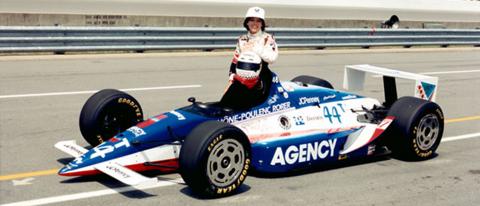
Lyn St. James will be honored with the Cameron R. Argetsinger Award for Outstanding Contributions to Motorsports during a ceremony on September 11.
A pioneer for women in motorsports, St. James is equally recognized for her numerous firsts and records for speed as she is for her many contributions off the track. As a result, a committee of auto racing professionals selected her as the seventh honoree and recipient of the Cameron R. Argetsinger Award presented by the International Motor Racing Research Center (IMRRC).
The Award honors a person in motorsports recognized for having advanced and improved the sport in roles that may include driver, team owner, sponsor, race promoter, journalist, or sponsor sanctioning official. It memorializes Cameron R. Argetsinger, often referred to as the father of American road racing. Established in 2014, previous award recipients include Chip Ganassi, Richard Petty, Roger Penske, Mario Andretti, Jim France, Lesa France Kennedy, Ben Kennedy, and Bobby Rahal.
After a hiatus in 2020, the Argetsinger Award returns to a new location at the Jack Daniel’s Club at Watkins Glen International during the Hillard US Vintage Grand Prix weekend. Fans may secure tickets to the award ceremony here.
For more information, visit the IMRRC website here.
In early 2020, the Automobile Club de l’Ouest (ACO), the Fédération Internationale de l’Automobile (FIA), and the International Motor Sports Association (IMSA) had announced their intention to create a joint top class for endurance racing. The three parties, along with the help of manufacturers, have announced an agreement on the technical specifications for the new category, which means LMH prototypes will be able to compete in the IMSA WeatherTech SportsCar Championship beginning in 2023.
The specifications aim to allow cars with different technical definitions to compete alongside one another in the FIA World Endurance Championship and the WeatherTech Championship. These cars are the LMH (Le Mans Hypercar), officially introduced in 2021, and the LMDh (Le Mans Daytona h), officially introduced in 2023.
“What we achieved as a group... has the potential to revolutionize prototype sports car racing all over the world. The stage is set for a highly competitive top category that will include many of the world’s greatest automotive manufacturers, showcasing relevant technology in the world’s most prestigious endurance races,” IMSA President John Doonan said. “Collectively, we have an opportunity to engage with the next generation of endurance sports car racing fans and elevate our sport to the highest levels.”
All specifications for tire fitment, acceleration profile, braking capability, and aerodynamics were approved by the World Motor Sport Council (WMSC). To view the key technical elements, visit here.
Tires (Front/Rear Width in cm):
AWD: 31/31
RWD: 29/34
Acceleration Profile:
AWD: Activation speed deployment will be BOP tool (removed from TR) and it will be monitored with PDST (from Speed 1 to Speed 2)
AWD: Due to the track variations in global competition, there will be two BOP activation speeds (dry/wet linked to tire fitted to the car). With our current knowledge, a 120-160 kph range would be implemented
LMDh: Control software to limit the contribution of eMotor to traction control capability
Braking Capability:
AWD & RWD: Total differential potential on coast identical on all cars (AWD = Fr + Rr, RWD = Rr)
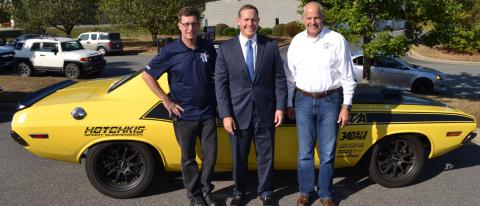
Ron Thiel, left, and John Hotchkis, right, of Hotchkis Performance, met with Rep. Ted Budd, center, in Washington, DC
PRI and SEMA representatives have escalated their advocacy efforts by participating in nearly 100 meetings with Republican and Democratic lawmakers from Capitol Hill during June and July. As part of the virtual 2021 SEMA Washington Rally, more than 60 industry companies joined PRI and SEMA in a record-high number of meetings with officials from the US House of Representatives and Senate.
Discussions focused on top industry issues, challenges, and concerns, including opposition to electric vehicle mandates, support for protecting motorized off-road recreational access, tax credits for businesses participating in trade shows, and more initiatives for the automotive aftermarket.
However, chief among the discussions was the passage of the Recognizing the Protection of Motorsports (RPM) Act. The bipartisan RPM Act is a top priority for PRI and SEMA and will protect the motorsports industry against overreach from the Environmental Protection Agency (EPA). The bill clarifies the motorsports-parts industry’s ability to sell products that enable racers to compete and protects Americans’ right to convert street vehicles into dedicated race cars.
“We must continue to communicate with and educate elected officials about the issues that are important to the industry,” said Daniel Ingber, PRI and SEMA vice president of government and legal affairs. “We value the opportunity to meet with lawmakers and will continue to push for the rights of the aftermarket industry.”
The RPM Act was first introduced in 2016 after the EPA began interpreting the 50-year-old Federal Clean Air Act (CAA) to include race car conversions. PRI and SEMA have led the fight to advocate for passage of the bill, which was introduced earlier this year in the House of Representatives after enthusiasts sent more than 1.3 million letters to lawmakers urging them to pass the RPM Act. The bill currently has Congressional support from 82 co-sponsors, including lawmakers who signed on after meeting with industry business representatives and staff. PRI and SEMA urge racers and race fans to continue to reach out to lawmakers and demand that the RPM Act be passed into law.
“We cannot let up on our efforts to push for the RPM Act,” said Ingber. “As the EPA attacks the motorsports industry, we must protect our rights to modify vehicles. The RPM Act will clarify that it is legal to modify street vehicles into dedicated race cars and give the industry the assurance it needs to continue to legally compete.”
With strong bipartisan support and engagement from the industry, the RPM Act is well-positioned for passage in the current Congressional year. Committees have reviewed the bill in previous years and are prepared to expedite the bill.
“It was great to meet with lawmakers who seriously considered the RPM act, which allows street vehicles to be converted into racing vehicles,” said Braden Liberg, director of compliance and calibration engineering of the Edelbrock Group. “Without the RPM Act, there is a threat to the motorsports industry. Many lawmakers are unaware of the challenges facing our industry, and it’s imperative that we work with them to ensure that motorsports businesses can continue to operate.”
Click here to see the current list of RPM Act co-sponsors, and don’t forget to send a letter to your US Representative asking them to support the bill and fight for it to become law.
Spurred by competition, imagination, and the desire to keep sponsors happy, custom tool boxes and pit carts are growing in size, complexity, and functionality.
Competition breeds innovation. That’s certainly true on the race track, but it’s proving to be the case in the pits and team garages as well. Standard-issue tool boxes and pit carts will get the job done, but when a team owner or crew chief can bat ideas around with a tool box or cart manufacturer, the team ends up with a precision piece of equipment that can do so much more than just store tools. Following are some of the coolest custom tool boxes and pit carts from the racing industry’s top manufacturers, as described by the manufacturers themselves (plus one satisfied customer).
CTech Manufacturing
Pit lane in NASCAR is a lot like a really nosey neighborhood. Each team is being compared to the team next to them, and the one after that. This incredible level of competition extends far beyond track limits, starting with pit carts. They have been getting bigger and more complex throughout the years, and they do a lot more than hold tools.
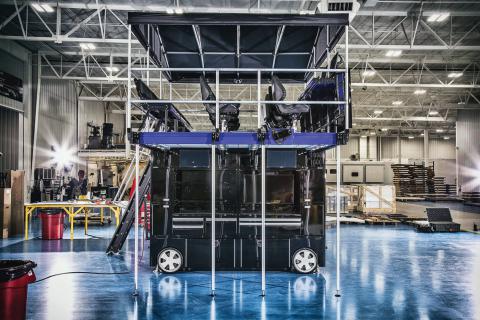
Our ULTRA Cart Dual-Deck is the biggest solution CTech produces for the motorsport market. Looking less like a storage solution and more like a mobile headquarters, this new ULTRA Cart offers the largest observation deck of any pit cart on the market and introduces innovative features to pit cart design.
CTech Manufacturing
The ULTRA Cart serves many critical functions: to host effective tool and equipment storage, engineering workstations, sponsor branding, VIP/guest hospitality, and more. It must accomplish all those functions without being a burden on the team in terms of setup and teardown.
The dual-deck design allows teams to host more team members, sponsors, and guests on the actual pit box than previous designs. The expanded sponsor branding boards hanging off the front of the cart offer better visibility for sponsor branding. The pit cart chassis itself also sits perpendicular to the pit wall, which increases pit crew safety and workflow by allowing crew members to communicate and move more efficiently from the front to the back of the pit box.
—Nate Birkenmeier, CTech Manufacturing
A couple of years ago, when the ULTRA Cart Dual-Deck was put on display at the PRI Show, I thought, “This has a quality presence.” You know, it’s hard being right next door to Penske, Hendrick, Gibbs, and all these guys. You’re battling that envy where your sponsors are looking up at the neighbors. We always wanted the biggest and best that we could get.
A lot of the time sponsors bring family members, friends, or wives to the track, and those can be long days, so comfort is an issue. Once you get up top of the ULTRA Cart Dual-Deck, you really feel like you’ve arrived. We have five seats across the front tied to the race team, one row of four swivel seats in the middle row, and three bench seats in the back. All in all, you can fit about 15 people between the individual chairs and bench seats.
From the crew’s perspective, we have a vast amount of room on both sides of the cart to set up tires and move back and forth. The safety aspect of being able to see and communicate freely was an added benefit. That design element took it to the next level. The fact that it’s two stories up and it’s all open, once you have it, you never want to go back.
—Rick Ware, Rick Ware Racing
Badass Workbench
John Benoit of Benoit Racing in Charlotte, North Carolina, visited us at Barrett-Jackson in West Palm Beach, Florida, in April 2019. He had just moved into a new shop and was looking for some quality workbenches and tool storage that would look great and be heavy enough to withstand the day-to-day abuse that frequently occurs in a race team’s garage.
We worked with John to design a custom-built U-shaped workspace that would allow him to do just that. We also built him a teardown table for rebuilding parts, and another mobile workbench to wheel around the shop.
Badass Workbench
Prior to finding us, John was working off folding tables.
The process was pretty smooth. After getting measurements and the overall idea of how John wanted to bring the shop together, we worked side-by-side with him to provide the most Badass custom workbench for his application. As you can see from the pictures, it really turned out great. We flew in to help with the installation, and John couldn’t have been more pleased with the way it turned out.
—Cody Freeze
Delson Products
I’ve known the owner of R2 Motorsports in Anaheim [California] for years. We go way back. He called one day and wanted to talk to me about tool boxes for his shop. We got together, I measured the space, and we tossed around a few ideas. His shop is laid out in such a way that everything is just a step away and thoroughly thought out. I really enjoy working with people who know what they want and allow me to get their shop to that next level. You have to make things convenient and accessible to make a shop functional.
Along the back wall we built a 38-foot combination of two 10-foot benches, two 6-foot benches, and a 6-foot bench in the center. All our tool boxes are powder-coated, and we use the same 3/16ths workbench tops that we used 30 years ago. Our drawer slides are big and heavy-duty, something like 300 pounds. We use slam-style stainless-steel paddle handles, and all our hinges are stainless. Our tool boxes are built like a street rod.
Delson Products
When we set it up, I gave him air lines where he wanted and lots of electrical outlets. Because everyone is cordless, I set him up with lots of plug-ins up and out of the way, so you can use your work surface as a work surface.
We also built a center island that’s 20-feet long with drawers at the very end. A race shop needs an area where you can sit down on your stool, lay stuff out, and think about what you’re building. Or hold a meeting standing next to what you’re building.
Now I’m building him a chase truck that goes along with same program as the tool boxes to maintain his Class 6100 desert race truck.
—Danny Delamater
Pitboxes.com
Gold Eagle, the parent company of STA-BIL and 303 products, requested four display pit boxes for its trade show booths and mobile displays.
The company wanted the front to be tiered display shelves with a lid for cover during transport. Mounted inside the lids are television screens for product information slide shows. In the rear is storage for extra inventory.
Pitboxes.com
The pit boxes are easily movable, too, with our pneumatic tires and steering.
Also included were optional side display shelves that can be adjusted for height and used as needed for extra display area.
—Ricky Sanders
TechnoCraft
We love to work with our customers, and sometimes that means working with our customers’ customers. When Mike Morel decided he was going to run an NHRA Funny Car, he had a new trailer custom-built for him. Our customer had him work directly with us to make sure we fulfilled his needs with the cabinets and tool boxes.
Mike was very specific about his cabinets and tool boxes and what he needed where. He wanted a tool box in the door opening at the end of the bench. This used to be a challenge for us because our framework didn’t allow for us to put a tool box in the end of a bench. We designed a new frame piece that allows a door or tool box in the end. We also built for him what was at the time a one-off tool box with a left-hand handle, so the drawers could be opened without entering the trailer. Mike could then access some of the most important tools needed for between-rounds service from outside. This base has a double tool box with eight drawers opening into the trailer and eight drawers opening into the entry door opening.
TechnoCraft
All our tool box drawers are made of .080 aluminum for light weight and strength. Our 3- and 4-inch drawers have 250-pound roller-bearing slides, while our 6-inch drawers have double 250-pound roller-bearing slides.
—Brian Hope
Top Drawer of the Tool Box
The products contained in a race shop’s tool box or pit crew’s rollaway are as uniqe as the operation itself—no two are likely the same. However, as your source for newly released and highly useful tools and gear, PRI presents eight items that all motorsports professionals should consider for efficiency and performance in the workspace or trackside.
How to fix low pressure, excess consumption, windage, and other oiling system problems that often arise in race vehicles.
Considering how important proper oiling is to a race engine, it’s surprising to learn from oil system experts how many corners tend to get cut when these systems are put together.
“We get these calls every day,” said Steve Morrison of Milodon, Simi Valley, California. “A guy buys a $44 mail-order oil pan with zero baffles or oil control for his aluminum-headed, 500-horsepower engine and has oil pressure issues every time he gets on it. The problem is, buying a rudimentary empty steel bucket can cost you an $800 crank—or more.”
“Anybody who is spending the time, money, and thought process on a ‘built’ engine for racing should make their oiling system a high priority,” said Thor Schroeder of Moroso Performance Products, Guilford, Connecticut. “Why risk the investment or cut down on the potential of a built engine by not using the proper oiling system?”
Why indeed? In order to complete the circle, we recently asked Morrison, Schroeder, and other oil system experts to identify some of the most common problems they’ve seen in race engine builds and how to solve them. Along the way, we also learned about a few new products in the pipeline, some of which may debut at the PRI Trade Show in December.
Low Pressure
There can be several reasons for an engine’s oil pressure to read low, or lower than expected, especially after the engine has been rebuilt.
“We’ve had customers rebuild an engine with the exact same parts and have lower than previous oil pressure due to different tolerances on the new parts versus the old parts,” said Pat Haberkorn of Peterson Fluid Systems, Longmont, Colorado.
“The engine builder enlarged clearances in the bottom end to make them support more power and rpm,” explained Travis Rosenbarger of Boundary Racing Pumps, Royse City, Texas. “The customer doesn’t understand why those increased clearances could cause less pressure. Before it was at 80 psi at 2,000 rpm, now it’s 55 to 60. But there’s nothing detrimental going on. It’s just how the engine was rebuilt.”
Engine rebuilding can cause oiling problems if the builder isn’t paying attention, Rosenbarger said. “There are restrictors in the head that limit the amount of fluid that goes into the head. Sometimes engine rebuilders will remove them and forget to replace them. Same thing with piston squirters. If you forget to put them back in, they just dump oil out, and you might get like 5 psi. Make sure all accessories are replaced and working properly.”
Oil Coolers
Several of our experts cited external oil coolers as a contributor to lower oil pressure, “especially if the oil cooler is designed inappropriately for the system,” said Herb Engelhart of C&R Racing, Indianapolis, Indiana. “In fact, if an engine is having a pressure issue, an oil cooler could be detrimental due to increased pressure drop.”
If a racer is experiencing “poor oil cooling in a ‘good’ oil system, that could be cooler-related and/or related to lack of airflow to the oil cooler,” Engelhart said. “Some oil coolers lack internal turbulators in the cooling tubes, which reduces their heat rejection by a fair amount. We don’t sell any oil coolers without internal turbulators.”
But it’s airflow, he pointed out, that’s the most important factor. “An oil cooler needs a reasonable amount of air, or it simply won’t work well, even if it’s the best oil cooler money can buy.”
Schroeder noted that problems can arise “when a racer has an engine blow up but doesn’t clean out or replace the oil cooler lines, replace the oil cooler, and clean out the accumulator if equipped with one. Before the engine blows up there will be bearing material and other pieces of the engine depositing themselves throughout the oiling system. Someone might think they are saving money by reusing an oil cooler, but the deposited pieces in the oil cooler are just lurking to destroy the new engine.”
Oil Temperatures
However, when oil temperatures become too high, that is when many racers decide to invest in an oil cooler, but some customers need the guidance from a dealer or manufacturer to determine which product is best for their application. “We get many calls about a customer needing an oil cooler because their oil temps are too high,” explained Ryan Williams of FLUIDYNE High Performance, Mooresville, North Carolina. “The first step is to get a baseline of your current oil temps. If you do not have an accurate gauge and sensor, that should be your first purchase. With that information, an aftermarket supplier can provide better solutions for your specific needs. Optimal oil temperatures are generally 230–265 degrees Fahrenheit for a non-synthetic blend. It is important to get the oil temperature up to 230 to burn off condensation and other acidic deposits that can contribute to excessive bearing wear. Conventional oil will start to break down above 270 degrees, but you can increase the upper limit by switching to a high-performance synthetic oil. We find that once fully informed, the customer can make smarter decisions about their setup instead of hanging parts and hoping for the best.”
Optimum oil temperature is vital for an engine’s health. C&R Racing’s oil coolers have internal turbulators in the cooling tubes designed to improve heat rejection.
The Proper Pump
“Most racers today realize they will have to run a quality oil pump to get the performance and reliability they are looking for,” said Schroeder. “The wrong pump selection can result in the engine having poor performance or a diminished life expectancy.”
Moroso’s oil pump solutions run the gamut from CNC-machined blueprinted oil pumps to billet aluminum oil pumps and custom dry-sump systems.
An effective oil system is crucial for any racing engine, but it can be complex. Our source from Moroso recommends discussing options with specialists to avoid mistakes.
“If a customer has any questions about which oil pump to use, the customer should work with us directly,” Schroeder said. Finding the correct pump will entail discussing variables such as “the intended rpm range of the engine, whether or not the engine is normally aspirated or has a power adder, and what fuel type the engine is going to use. From this information we can recommend which of our pumps should be used, be driven at what speed, or even come up with a custom dry sump pump specifically tailored to that application.”
OEM vs. Performance Pumps
Problems can arise when a racer uses an OEM oil pump in a high-performance engine, said Rosenbarger. “OEM pumps are made for OEM duty cycles and OEM rpm. If you get a car with a 6,000-rpm limit, the factory doesn’t expect that pump to run at 6,000 rpm for an hour straight or even close to it. They expect it to run at 2,000 rpm for 100,000 miles and have certain stints up to 6,000.”
The weak links in the OEM pumps are its gears, “which are generally made out of a press sintered material,” he explained. “At the microscopic level, a press sintered gear has a bunch of holes and porosity inside of it. If you hammer on it, particularly against the rev limiter, there will be a weak spot in that gear with enough holes that it will break in half. That causes an instantaneous loss of pressure with no warning and generally a cooked motor every time.”
Rosenbarger noted that “in the Coyote market especially, I see guys buy a brand new 2021 model and have it in the shop doing oil pump gears before the dealer tag is off it. They know those gears are going to wear or fail.”
It’s not that Ford is making substandard gears, he added. “But these cars come out of the factory at 500 horsepower and then go straight into the shop for a Whipple or another power adder. All of a sudden, they’re at 850, 900 horsepower. Some of them go straight to twin turbo, which is 1,200 to 1,500 horsepower. That’s just way too much for the oil pump gear.”
Ford is not the only OE with these issues, Rosenbarger noted. “Gear failure in general is widespread.” That’s why while Boundary sells full oil pump assemblies, “a lot of what we do is replace the gears inside of them.”
Gear-to-Gear PUMPS
While OE-style gerotor pumps are used in many of today’s performance engines, the gear-to-gear pumps found in traditional small block and big block Chevrolet engines, as well as Pontiac and Oldsmobile engines, “are still strong contenders for a percentage of the marketplace,” said Verne Schumann of Schumann’s Sales and Service, Blue Grass, Iowa. Improving those gear-to-gear pumps has been his focus for years, and his innovations are keeping these older-style pumps—and their host engines—not just alive, but competitive.
His latest design is the Paddle Wheel gear. “Gear-to-gear pumps operate by the curvature of the teeth in the gears rotating against one another,” Schumann explained. “They squeeze the oil to move it.” The Paddle Wheel gear incorporates cup cavities in the idler gear that “shoot oil at high velocity to the outlet of the pump.” While the meshing of the gears remains the primary means of moving the oil, the Paddle Wheel cups provide a secondary oil transfer within the same pump housing. The cups move the oil “about two to three times faster in feet per second” at the same gear rpm. “When you exit a bunch of oil fast like that, it creates a void in the vertical column of oil, which means the gear-to-gear portion is easier and quicker to work.” Easier translates to using less horsepower to move the oil, and quicker means the pump’s output can better keep up with engine rpm.
Debris Flow
During his years as an engine builder prior to founding Billet Connection in Spokane, Washington, Mike Cofini would inspect about a dozen of his customers’ bracket-race engines at the end of each season. He found some of the engines showed vertical scratches on the cylinder walls. “I would have to do a hard hone on the cylinder walls, a hard polish on the crankshaft, and replace all the bearings.” On other cars, “I couldn’t tell if they had 25 or 150 runs on them,” and the bearings were nice enough to re-use.
He realized the racers with the undamaged engines either towed their cars to the staging lanes and then back to the pits after the pass, used a disposable oil filter instead of a screen filter, or both.
“When we drive our cars back to the pits, a lot of times those roads are dirty, or you have to pull off into the gravel to allow somebody to pass you,” Cofini explained. “Your headers are blowing dust and dirt off the ground, and it’s getting sucked down into the carburetor or injectors.”
The screen filters, “which I have been a fan of all my life,” could not catch those dust particles, he added. “For the first time in my 30 years of building motors I realized that the dirt and dust we suck down the carburetor and injector were contributing to the scratches I see inside the engine.”
Cofini turned his research project into Billet Connection’s Clear View oil filtration assembly, which allows a racer to see the oil through the filter to determine its condition. “There’s a little air fitting on the side of the assembly. When you shut your engine off, a shot of compressed air to that fitting pushes the dirty oil out of the filter so you can see every large, visible particle caught on the top of my screen. In a matter of five seconds after you turn your engine off, you can see if anything is eating itself up inside the motor.”
He has also adapted some of his assemblies to put a disposable filter underneath the screen filter “to catch the microscopic particles we can’t see but that can leave marks. I’ve converted hundreds to that disposable filter with our unit on top. It has helped their motors, giving them more runs on the bearings, cylinder walls, and rings.” He also pointed out that the “disposable filter flows more than twice what any pump could pump at 10,000 rpm, so it is not a restriction in the oil system.”
Excessive Oil Consumption
The scratches in the cylinder walls “are directly related to oil consumption and wearing out the rings,” Cofini said, an issue that is compounded with the use of low-tension oil rings on the pistons.
“A low-tension oil ring is not applying a lot of pressure against the cylinder wall,” he explained. “Those vertical scratches cause little grooves, and oil sits in those grooves. If you have 100 grooves, and those grooves are full of oil, when the piston drops below the grooves, all that oil is mixed with the fuel charge and is directly related to oil consumption past the ring. A standard-tension oil ring scrapes oil off the cylinder walls a lot better. Even with the vertical scratches, it will absolutely help control that oil.”
Billet Connection’s Clear View oil filtration assembly allows racers to easily and quickly inspect oil. “You can see if anything is eating itself up inside the motor,” said our source.
Mike Osterhaus of Melling Performance in Jackson, Michigan, agreed that “when unexpected oil consumption is noticed, the first thing that is thought of is worn or damaged piston rings.” But, he added, “high oil pressure, incorrect oil, or too much oil can also be the cause of oil consumption. All of these can affect the amount of oil that can pass by the piston rings and get burned in the combustion chamber. In addition, worn gaskets and seals will also contribute to the leakage or consumption of engine oil during operation.”
Avoid the Empty Bucket
“Imagine you’re doing a burnout and holding a fishbowl full of water,” said Milodon’s Morrison. “You’re going to wear it as soon as you launch.” Now envision a similar scenario in the empty bucket of an oil pan Morrison referred to at the beginning of this story. A hard launch could not only starve the oil pickup, but the oil will splash against the crankshaft, “where it gets beaten to a pulp. Now half the oil won’t return to the pan because it’s all foamed up.” Plus, the oil hitting the spinning crankshaft “will slow down the crankshaft, like putting brakes on your pistons.”
Milodon and other performance oil pan manufacturers recommend oil control devices to keep the oil from sloshing around in the pan. Baffles and trap doors, generally positioned low in the pan, hinder the oil’s fore-and-aft and/or side-to-side movement during launches and cornering. A windage tray sits in the pan just below the crankshaft to capture oil being thrown off the crank and, through louvers cut in the tray, direct the oil back into the sump.
Many oil system problems stem from improper baffling. Melling offers baffle kits designed to keep the pickup submerged in oil, reducing the chance for oil starvation.
Morrison has received push-back from some customers who don’t want to run a windage tray because they’re “too hard to fit,” he said. But they are height adjustable, he pointed out, and in some cases they may be a power adder. Or at least a power saver.
Morrison dyno tested an LS engine with and without a windage tray, and he found the engine with the tray “picked up 13 horsepower at 3,000 rpm and held that 13-horsepower increase all the way to about 7,200 rpm. Our LS windage tray is about $55, so 13 horsepower for $55 is the deal of the year. It’s not really making horsepower, but it’s keeping you from losing it.”
Pickup Problems
Upgrading the oil pan means upgrading the oil pickup as well, Morrison said. “Our pans are very specific, so the pickup has to be exactly in the right spot.” Trying to re-use the stock pickup “is working around all the engineering the manufacturer put into the pan. You have to buy the pickup and the pan together.”
Rosenbarger advised against modifying the oil pickup. “If you look at the bottom of a Ford pickup, for example, there’s an oval opening in it and the rest of it is covered. People think that if they cut the face off the pickup, the oil will flow better. But that’s a bad idea. The hole is purposely small to make sure that whenever you’re cornering, accelerating, or braking, the pickup hole is submerged in the deepest part of the oil in the sump.” Making the hole larger risks exposing the pickup to the air when oil is moving in the sump. “Customers will tell me they’re losing 30 or 40 pounds of pressure when cornering, and they think there’s something wrong with the pump. I’ll ask about the pickup and find out they cut it open.”
Aeration & Cavitation
Exposing the oil pickup to the air is one way to introduce aeration, or foaming, into the oiling system. A restriction in the pickup tube could also aerate the oil in the inlet circuit, said Osterhaus. “This will reduce the pump’s volumetric efficiency, as the aerated oil has reduced film strength, lubricity, and heat transfer capability, and the oil becomes compressible. This can cause accelerated wear and erratic operation of the hydraulic components, including the lifters, timing tensioner, and camshaft phaser.”
Oil pans like this Milodon unit are designed to provide a more consistent oil supply. They can also increase engine output by reducing power losses from windage.
If the pickup tube is severely restricted, “cavitation occurs,” Osterhaus added. “The oil will be subjected to inlet pressure low enough to cause vapor bubbles to form in the oil on the inlet side of the pump. The vapor bubbles do not allow the pump to fill properly, and the bubbles are then transported over to the oil pump’s discharge port, where the high pressure in the port causes the bubbles to implode. When this occurs, there is an enormous amount of energy released. The energy will generate noise and has the potential to cause pitting and surface erosion inside the oil pump.”
On the Drawing Board
Cofini said Billet Connection’s next new product is a dry sump tank, which should be available by the time you read this, or soon after. “It’s a completely machined tank, made from one piece of aluminum. Not a weld in it. It will have a see-through filter on the tank; then I’m making a head that matches our filter and will hold a disposable filter on the pressure side of the system going back in the engine.”
Schumann has a couple of new products in the works, including new gauges that will more accurately and immediately monitor the efficiency of an engine’s oil. The standard oil pressure gauge, he explained, “takes 3 to 4 seconds to react to any changing conditions. That means that part of the story is 3 to 4 seconds behind an event that takes place in the engine.” With 8- to 10-second cars “as common as can be these days,” a time lapse like that could be catastrophic.
The Paddle Wheel gearset from Schumann’s Sales and Service makes traditional gear-to-gear oil pumps more effective, with cups designed to provide secondary oil transfer, according to a company source.
Adding gauges that monitor the oil’s flow in gallons per minute or feet per second would give a truer and more immediate picture of what’s happening with the oil, Schumann said. Those are the monitors under development in his shop. Of the three, clocking feet per second “may be the most important. It measures the ability of the oil to instantaneously keep up with the crankshaft’s rpm gains when moving parts in an engine go from idle speed to high rpm. It’s a whole new parameter that even the best engine builders haven’t monitored.” Pioneering that technology has made developing the gauge a challenge, but Schumann is working with a manufacturer to produce a gauge that “we can have at least with an engine builder on a dyno, and perhaps be able to measure feet-per-second in a race car.”
On the other hand, gallon-per-minute gauges already exist in engine tech labs, “and some NASCAR teams are rumored to have that bolted to the dashboard,” Schumann said. “It’s basically a linear flow, closed loop going through a monitoring gauge. It operates the same as the gauging here in our R&D shop.” That GPM gauge is expensive, though, “a $300 to $500 adventure. I’m hoping to cut that in half at least.” If he’s successful, Schumann said he’d bring it to the upcoming PRI Trade Show.
He also plans to bring what he calls “patented wet sump oil pan technology. I’m not going to build oil pans, but I will sell this technology to oil pan manufacturers.” He wouldn’t go into detail, pending his patent application, but he did say the new technology “will totally change the complexion of wet sump oil pumps and the pan environment they go into. This technology will move forward our tag line of ‘wet sump oil pumps with a dry sump attitude.’”
Engine builders want more automation in their shop machines to help counter labor shortages, and they’re keeping a close eye on surface finishes.
For the most part, suppliers of engine-building machinery weathered the pandemic surprisingly well. Sales were consistent, even with staffs working from home, and there were minimal disruptions in production due to COVID-19 absences. All segments of the market kept pace with previous years, including racing and industrial, which gave manufacturers enough breathing room to continue R&D projects and upgrade or develop new equipment.
Evidence of those efforts will be showcased on Machinery Row at the 2021 PRI Show in Indianapolis on December 9–11. There remain a few veils of secrecy this far out from the Show; however, hints of exciting introductions have been shared.
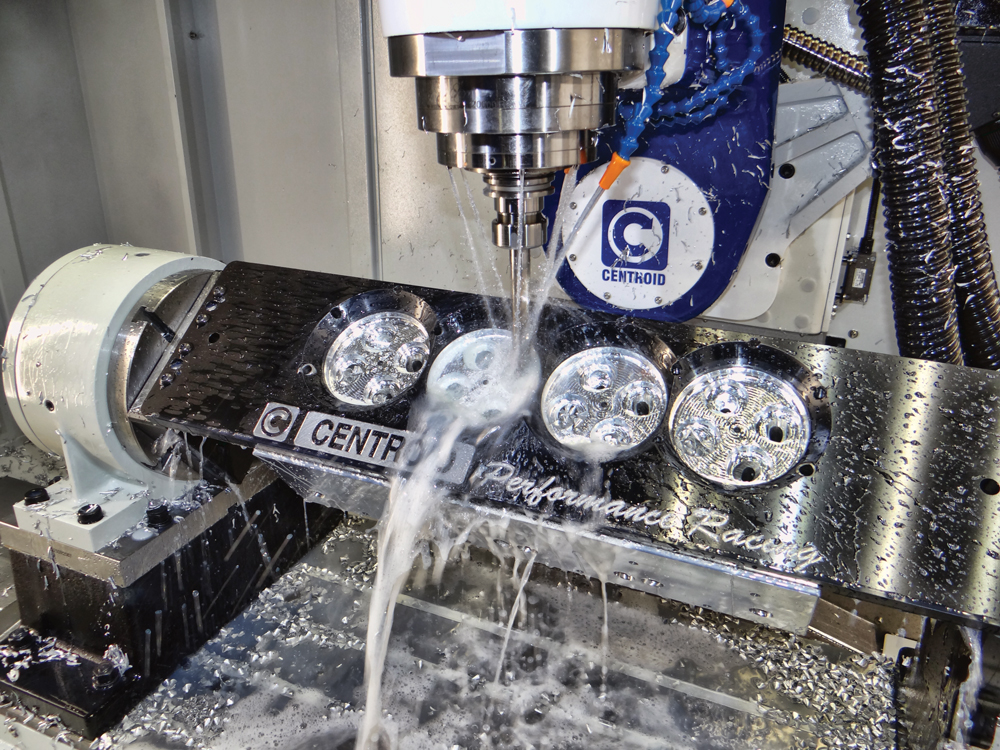
“There will be an all-new B4250 engine block machine, which has an all new frame with a bigger spindle,” said John Cowher of Centroid, Howard, Pennsylvania. “Also, our big machine, the A560XL, will be an all-new machinery frame to debut this year.”
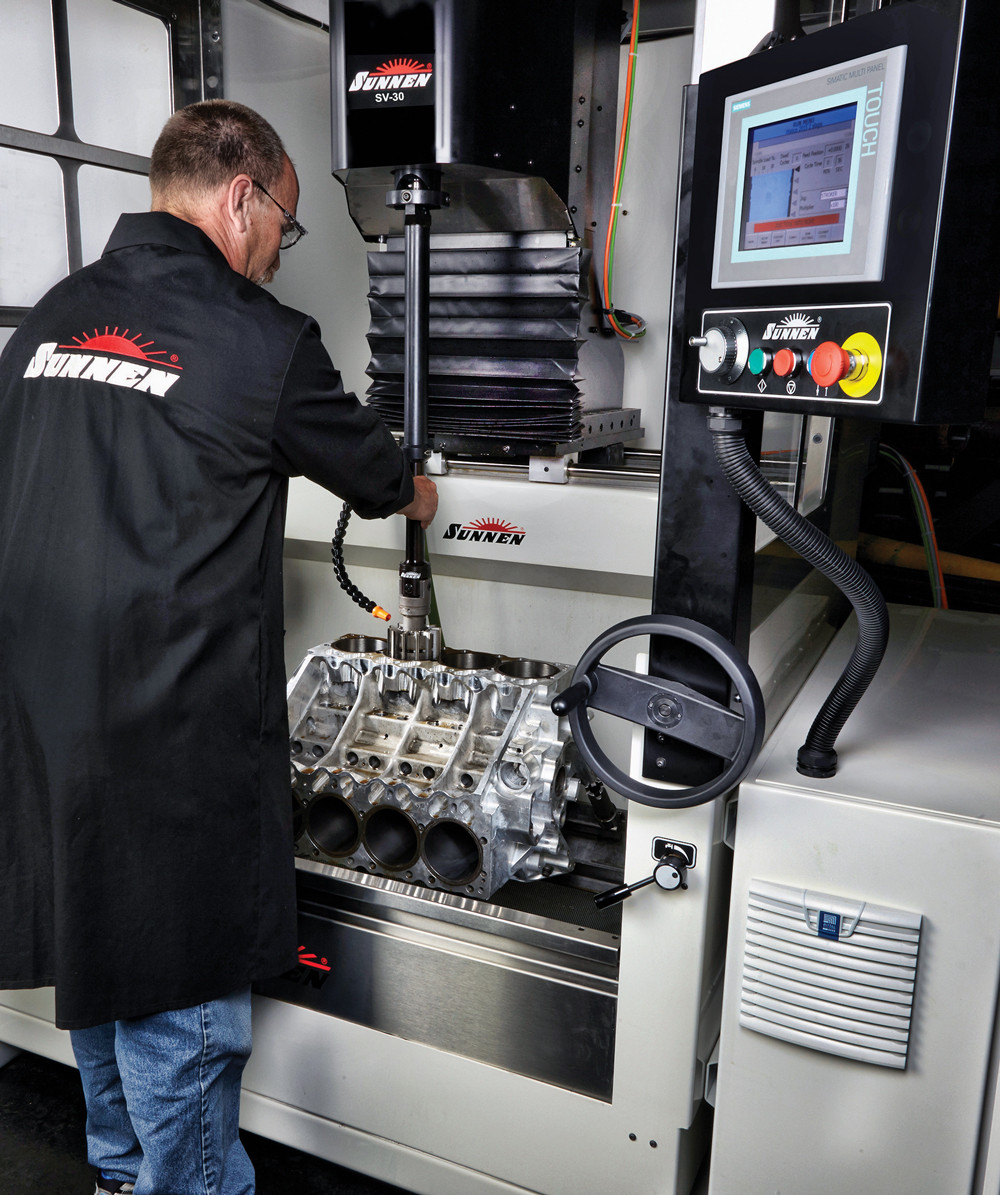
“We’ve got some new product introductions coming up later this fall,” confirmed Bob Davis of Sunnen, St. Louis, Missouri, who added that new graphics and a revised logo will adorn the company’s products. “We are a couple years away from our 100th anniversary, so we decided it was time to freshen things up a little bit. And by the Show, we’ll have e-commerce available to our customers on the website.”
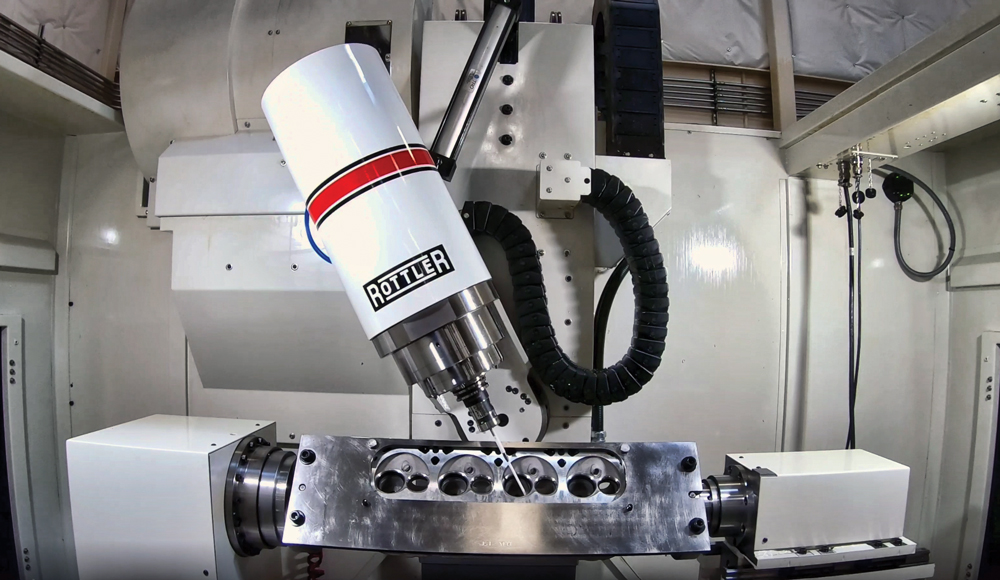
“We’ll have a nice lineup of machines,” added David Bianchi of Rottler, Kent, Washington. “We’ll also have a surprise and a few tricks up our sleeve.”
Growing Sales
One begs to fully explain the relatively steady bottom line and even an occasional sales record for the machine industry during the past 18 months. There is certainly noticeable consolidation and shrinking of the engine rebuilding market for both commercial and racing operations. Those surviving shops are picking up the slack and staying very busy, and that includes buying equipment to fulfill needs that previously had been sourced out.
“I had the busiest year-and-a-half ever. Everybody is busy. People are wanting to do their own stuff,” noted Russ Tierney of RT Sales, Highland, Michigan. “Lately, it may take a month or better to get parts back because every shop is overwhelmed. So guys are buying their own machines so they can control the quality.”
“I’ve worked for the company since 1979, so speaking with some history behind me, I can say we had the best year we’ve ever had,” agreed Jeff Murchison of Hopper Equipment & Supply, Upland, California. “I really think that in all categories where there’s general engine building and performance, there’s more money being spent, whether that’s fixing up old cars or racing hot rods.”
Another segment that’s keeping engine shops very busy is the diesel market. Most racers have diesel trucks to tow their vehicle to the track, and performance diesel work is also on the upswing.
“We’ve done very well,” said Tammy Baker of Joe Baker Equipment Sales, Cincinnati, Ohio. “A lot of diesel work has picked up. The race shops just keep doing what they do.”
Like other machinery experts, our source at Rottler anticipates a further shift toward automation, allowing for increased production amid a shortage of qualified operators.
Reviewing some of the jobs performed by leading engine shops, Centroid has noticed an uptick in modifying OEM superchargers and how that equipment meets the challenges of working within tight confines. “I’ve been doing a lot of programming, specifically with porting superchargers,” said the company’s Andrew Jenkins. “You can gain a lot of horsepower by porting out a stock supercharger, also intake manifolds and blower snouts. It’s very difficult to do some of those engines because of the geometry. It’s not your normal port shape. Long tooling is needed because you can’t always cut all of it from the open face of the supercharger. Sometimes you have to come at it from the back, which can mean tooling in excess of 18 inches.”
The company has also observed a growing need to machine billet parts and modify turbochargers with all the attention that boost is getting at the track.
“The biggest thing with COVID is that people can’t get parts, so they’re looking for ways to bring matters in-house,” added Jenkins. “That’s what has brought on some of these billet projects. They want to be able to make the parts themselves so they’re not relying on other manufacturers. Also, some of our customers are porting turbocharger housings.”
With more emphasis on sealing the engine and keeping combustion pressures inside the cylinder, there’s also a need to deliver surface finishes to exact specifications. Advanced CBN (Cubic Boron Nitride) and PCD (Polycrystalline Diamond) cutting tools have allowed manufacturers to develop more sophisticated machines that can deliver exact finishes.
“Whether it’s the top of the block or inside a port, we have some neat stuff going on there,” reported Rottler’s Bianchi. “We have some new advancements, proprietary things that we’re not ready to launch. They’re about six to eight months out.”
“It’s up to the gasket manufacturer to set the standard,” noted RT Sales’ Tierney. “Just like cylinder honing. It’s not Sunnen that tells you what the finish should be. It’s the ring manufacturer. You need to have a profilometer. The old guys can run their fingernail across the finish and tell you what it is, but a profilometer gives you an exact number.”
Automated machinery saves manpower but still requires skilled designers and CAD technicians to make it function, noted our source at Centroid.
More engine shops are transitioning to diamond honing stones to achieve the desired cylinder surface finish.
“Diamond is pretty much the way to go now,” said Davis. “It’s typically faster cutting, and it lasts longer with fewer change-overs. They’re more expensive to buy, but it all evens out because they last longer, and you’re not shutting down the machine to change stones as often. There’s more total uptime.”
Sunnen is also working with Applied Nano Surfaces, a company out of Sweden that has developed a surface solution that can be applied with a honing machine. “Instead of using stones, it uses ‘ledges’ and applies a solution to the cylinder walls,” explained Davis. “It’s not really a surface treatment, it actually changes the composition of the cylinder walls. It makes them extremely durable and reduces friction.”
Personnel Shortage
If there’s a single critical issue facing both manufacturers and users of engine machinery, it’s the shortage of qualified operators. There isn’t enough new talent entering the industry to replace the experienced machinists as they retire. Graduates of trade schools often have multiple offers from aerospace, manufacturing, and medical industries in addition to automotive. Most engine shops will train new workers, and machinery suppliers have extensive training programs to offer. The challenge is finding enthusiasts who want to learn and stay with a shop.
“Guys are buying machines to do stuff themselves so they’re in control of the quality, but it all comes back to having a guy run the machine,” said Tierney. “A lot of places would like an automated piece of equipment, but you can only automate the precision to a certain level,” which may not be up to what a performance shop would want to get.
“I would say most of my customers are struggling to find qualified help,” confirmed Darren Davis of Millennium Machinery, South Bend, Indiana, a dealer for Citizen Swiss and Miyano machines. “They’re all stealing people out of the same pool of guys. We’ve been running training programs for new operators and bringing people up the best we can. We also built a couple machines that people put robots on to try and fully automate them.
“Almost all of our machines come with a bar loader,” he added, “so they’re made to run unattended. We’re planning on bringing a Citizen Swiss CNC lathe with a bar feeder to the PRI Show. A lot of people from the last Show didn’t understand how the bar feeder was integrated into the system.”
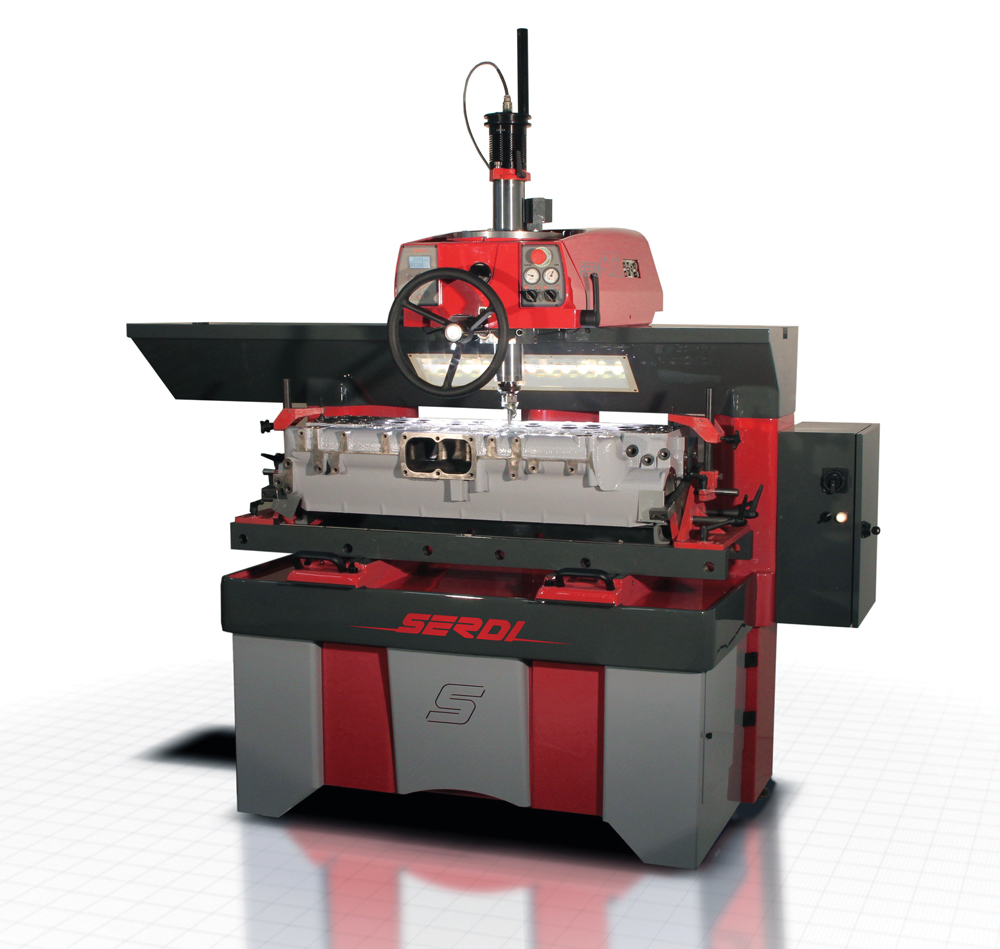
Versatility is vital for most engine builders, driving demand for machines like Serdi’s S4.5 valve guide and seat cutting machine, which can handle small and large heads.
Some suppliers acknowledged that a market still exists for manual machines. “They’re a little afraid of CNC,” noted Baker. “They still like the hands-on.”
Others say more engine shops—even longtime operations—are asking for advanced computer-controlled equipment.
“I’ve got two big CNC machines going to a man who’s almost 70 years old,” Murchison said. “If I didn’t have the Rottler software, I probably would have tried to steer him away from it, unless he was going to hire someone to run it. But I’m going to train him, and I know he’ll adapt to it and make it work.”
The shift toward more automation will continue, according to industry observers, simply because of the labor shortage and the potential to increase production in large shops that grow when smaller ones close as the owners retire. Bianchi cited the difference between Rottler’s H85A and H85AX honing machines. The latter is automated, and the user can leave it unattended while all the cylinders on one bank of a V-style block are honed.
“The mix of A to AX, especially in the performance market, has significantly shifted to the AX,” said Bianchi. “It’s almost turned to where the performance guys are buying AXs, or even beyond with the AXY that can do the whole block. We’re definitely seeing more automation, also with boring machines, surfacers, and cylinder-head equipment. Our CNC porting machine sales are double from a year ago.”
Machinery manufacturers are devoting more attention to eliminating guesswork. “There used to be a lot more touch and feel involved,” explained our source at Sunnen.
One of Centroid’s clients recently lost six employees due to a number of factors, including childcare costs and COVID issues. While automation is a concern, if not a priority, for customers, an employee remains necessary to an engine shop’s operation.
“You still need that human being to get that part into the fixture and ready to go,” advised Cowher. “If the customer can get it in the fixture and call the right program, then you’re good to go [with automation]. But you need several different classes of these operators. There’s an operator, and then there are guys who can design and manipulate ports with the software.
“What I see is the older guys retiring, and the younger guys are stepping up to the plate and buying modern CNC machines,” he added. “They want to be able to do it all, and they want to do it automatically and with precision. So, we have to up our game a little bit and start teaching them how to do CAD work to make those parts.”
Over at Sunnen, one of the strategies is to help the less experienced workers with an easier user interface. “A lot of the older workers are retiring,” said Davis. “The new people coming up may not have that hands-on experience. Our machines are made with computer controls that remove a lot of the guesswork. There used to be a lot more touch and feel involved with such things as surface finish, crosshatch angle, and things like that. There was a lot of manual intervention, like measuring the finish bore with a dial-bore gauge. Now, we can program that all into the honing machine ahead of time, and it will hit ‘stop’ right on the money every time with the exact crosshatch pattern, the exact bore size, exact surface finish you want.”
Many of the experienced workers who are retiring were also adept at fixing machines. Now some of the manufacturers are offering online diagnostics and repair instructions.
“The shop can get somebody at the factory to figure out the problem, whether it’s mechanical, electrical, or operational,” said Murchison. “It can be worked out pretty quick, and it takes a load off my back.”
One possible conflict that challenges some engine builders is the choice between a machine that is versatile and can perform multiple jobs or a dedicated machine that focuses on one task.
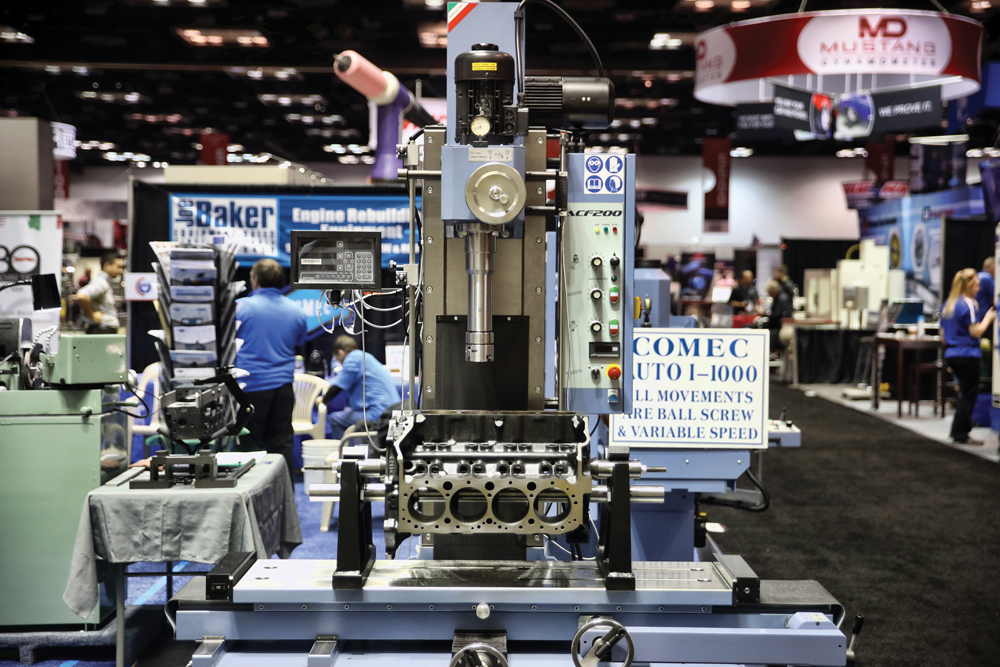
“In the case of Comec machines, particularly the boring mill, the competitive CNC machining centers are essentially industrial machine tools that have been optimized for the automotive market,” said Kevin Hartley of Comec, Mooresville, North Carolina. “Whereas the Comec CNC boring mill is actually designed as an automotive machine from the beginning and dedicated only to automotive operations. It’s a very simplified CNC control, so it can be sold for less than a comparable large industrial-based automotive CNC machine.”
Serdi, also in Mooresville, North Carolina, offers the S3.5 valve seat and guide machine that is popular with many automotive operations while the larger S4.5 can handle both small heads and the large diesel cylinder heads as well. Race shops, however, are drawn to the STroniK line of CNC machines.
Although machinery manufacturers like Comec generally weathered the pandemic well, they’re eager to get back in front of customers at December’s PRI Trade Show.
“The STroniK allows the operator to design his own valve seat profile,” noted Hartley. “That’s important for a race shop that does a lot of development work and must be able to make modifications to the valve seat profile. Because it uses a single-point cutting tool, it engages only a small amount of material at any time, eliminating chatter on hard seat materials and improving accuracy.”
Bottom line: The automotive machine industry is eager to show off new equipment and help customers solve their labor issues, whether that’s with training or more automated equipment. Racers will benefit with new technologies that provide increased precision and productivity, regardless of a shop’s size. Just a sampling of the catalogs shows that there is a machine for every task and budget.
“And you can build with some of these machines, too,” said Murchison. “You don’t have to buy it all at once. You can add to it when the time is right.”
“Yeah, we’re coming to PRI with new equipment because I think it’s time,” concluded Bianchi. “The industry, as a whole, we’re all getting back together.”
As interest in vintage motorsports continues to grow, sourcing parts for these older vehicles is becoming an increasing concern. In order to help keep competitors on track, these shops are leveraging modern technology to restore and even re-create components when NOS is no longer an option.
A second golden era is currently developing in vintage motorsports. The popularity of many historic race vehicles, from stock cars to Indy veterans, is growing as racers shift their focus from contemporary classes and formats to throwback series that cater to old-school cool.
“There’s definitely been an uptick in interest lately,” said Malcolm Mangum of Apex Vintage, New Hill, North Carolina. “It’s evolving, too. What’s considered ‘vintage’ is changing. These racers tend to gravitate toward the cars they saw at the race track when they were growing up.” That means the “younger folks coming into it are more interested in the cars from the 1970s, ’80s, and ’90s,” while the older customers are drawn to cars from even earlier decades.
As the car counts go up, so does the demand for parts. “These guys aren’t going out there to do parade laps,” Mangum pointed out. “There are a number of ex-professional and otherwise very accomplished drivers in these series, and they can be just as hard on equipment as anyone else in racing. These racers are willing to spend the money to have the best equipment out there, and they want to exercise these cars accordingly.”
Parts availability is a key issue as vintage racing grows more popular and competitive. “These guys aren’t going out there to do parade laps,” said our source at Apex Vintage.
Hours spent on the track come with the inherent need for maintenance and repair. While teams in modern racing series can simply hop online or open a catalog to find what they need, there’s a finite number of available parts for many vintage platforms, and stockpiles are dwindling. “When parts become hard to find, the first thing most of these teams do is reach out to their racing community,” said Tony Pardo of RM Motorsports, Wixom, Michigan. “People who are running similar cars who might have a shop that they work with, or a contact that can point them toward a specialist who might have what they need. If they don’t, those specialists can usually provide them with some options that will get them running again.”
Restoration
Since authenticity is a core tenet of vintage racing, teams will often opt to have a component refurbished rather than replaced if it is damaged or worn out. Not only does this maintain more of the car’s originality, it’s also less expensive than having a one-off part reproduced.
“On some of this vintage race stuff, sometimes the parts don’t exist, or the customer might not want to deal with the costs involved to reproduce it,” said Rodney Heaton of Millennium Technologies, Plymouth, Wisconsin.
“We have the option to restore these parts in some cases. It often comes down to the condition a part is in,” he continued. “For example, we recently did the cylinders for a V12 Packard. When the parts came in, they were stripped down bare. That allows us to a get a full picture of what repairs are needed. That also tells us if there are things we’re going to need to make, either from a parts or fixturing standpoint. Is it something where we’re going to need to manufacture a sleeve and install it, or is it something that we can overbore and plate? At that point, we have a better idea of how to move the process forward.”
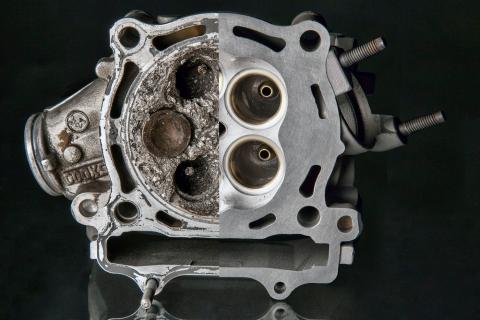
Building new parts is too pricey for some racers, so repair is a viable option, explained our source at Millennium Technologies, who noted the extensive welding on this head.
Heaton said that the amount of corrosion damage on the Packard cylinders pointed the team toward overboring. “We decided to shoot for a specific bore size, but we didn’t really know if we’d be able to hit that size until after we had machined them and saw how well they would clean up,” he explained. “We had a total of 24 cylinders we were working on, and I think when we opened up three or four of them, we realized that those couldn’t be repaired to match the sizes of the others. So we scrapped those and focused on matching the rest of them.”
Mangum cited a situation where repairing a mangled component was the best option to get a vintage racer back on the grid. “We have a car here that was involved in an on-track incident a few months ago. One of the rear aluminum uprights that the suspension arms bolt to was badly damaged—three of the mounting points on that piece were broken. We know there are some used ones out there, but we weren’t able to locate one, so the decision was made to repair the existing part instead. In that situation, the component was welded, heat-treated, and re-machined to correct specifications, and we have 100% confidence in that part again. But there are also times when parts come in that are too far gone for repair to be an option.”
Re-creation
Even if the budget allows for a comprehensive restoration of a component, reviving some parts can prove difficult—or impossible—simply by virtue of the components’ design and construction.
“We run into a lot of issues with older aluminum parts that had water going through them,” said Mike Miller of Cunningham Precision Group, Columbus, Indiana. “Vintage aluminum material tends to have a lot of zinc in it, and that causes a ton of corrosion. So with things like cylinder heads and water pumps, they don’t wear out, necessarily—they deteriorate.”
3D printing has proven to be a game-changer for re-creating vintage components, but an original part to reverse engineer is still required, noted our source at Hoosier Pattern.
When the budget allows, reproducing those parts can ultimately be the best way forward. “One recent project we did was for a Cummins diesel-powered car than ran in the Indy 500 back in the 1930s. It was the only car that ever ran the 500 without making a pit stop,” Miller explained. “Cummins was having its 100-year anniversary, so it was restoring a lot of historic engines and vehicles. During that process, Cummins discovered that this engine had major cylinder head issues.”
Rather than trying to restore the heads to a usable state, Cummins engineers chose to re-draw the cylinder head using 3D scanning technology. “That allowed them to supply us with a CAD model of the head,” Miller said. “From there, we did the design work for our foundry. We used a 3D printer to create all of the cores and the mold, and we poured new castings and machined those castings.”
Mangum pointed out that CAD renderings also allow for certain components to be reproduced in billet aluminum, which is often a less labor-intensive alternative to casting. “Depending on the situation, we can either 3D scan the part and have it CNC machined, or we would need to work with a specialty casting business that can create a sand mold of it,” he said. “From there we’d need to take that casting to a machine shop that’s capable of taking the measurements off of a good piece and re-machining this new casting to match to create an operational part.”
Although, as Dave Rittmeyer of Hoosier Pattern in Decatur, Indiana, noted, not all clients have the ability to supply a CAD rendering of the component that needs to be reproduced. “Unless you have a series of prints, you’re going to have to have a part. Even if it’s a scrap part, you need something to start with. Even a portion of a broken block or head is helpful. You need to have something that can be reverse engineered.”
Rebuilt vintage parts can benefit from modern upgrades. These calipers from Apex Vintage have stainless-steel pistons, along with improved seals and hardware.
Fortunately, once a vintage part has been scanned and rendered in CAD, the reproduction of that part is a much easier process for any would-be customers further down the line. While creating CAD renderings requires specialized knowledge and expertise in the related software platforms, Rittmeyer said that the rise of affordable computing power and software is helping to eliminate a significant barrier for enterprising DIY folks who need one-off parts but can’t afford to hand over a blank check to get them.
“There are some fairly sophisticated free CAD systems out there now, and we’re starting to see more and more customers modeling up their own parts,” Rittmeyer explained. “Five years ago, the knowledge wasn’t really there, but that’s changing. When customers come to us with their own CAD files, they’re effectively skipping what tends to be the biggest hurdle in the process of getting that part cast or machined.”
The Path Forward
On the restoration side of the equation, Heaton expects to see a reemergence of long-forgotten methods in the coming years, “some of the ‘lost art’ kind of stuff that isn’t readily available now, like welding or brazing cast iron, or sand forming tubing. Twenty years ago, you couldn’t get that sort of work done anywhere. Now I can think of three or four people off the top of my head that are sand forming tubing for exhaust systems. It’s one of those situations where the only way to do the job correctly is to use this method. There are ways to achieve very similar results, but they aren’t the same thing, and that matters in the restoration world.”
Mangum agreed that the details matter to this subset of the racing market. “The look of the component is very important to some customers and using the same welding process is a part of that, even if it’s not as good as what’s available now from a technological standpoint. It’s important to them because you can look at the part and tell how it was welded. There are folks who will want the old brazing process because that’s how the cars were originally manufactured.”
Meanwhile, Pardo sees modernized parts reproduction as an aspect of the industry that will continue to grow as vintage series bring increasingly more capable cars into the fold. “It’s important to keep these cars safe with modern materials and parts. We can’t keep using old stuff, it’s just not going to cut it in motorsport.”
As parts are inevitably consumed, racers need to find good shops and suppliers. People who run similar cars are great for recommendations, said our source at RM Motorsports.
Miller looks to 3D metal printing as the next game-changing leap in technology. “I think that eventually almost all of these parts will be printed, especially the one-off stuff,” he predicted. “In the past, 3D metal printing was pretty barbaric, but new printable alloys are being developed that are producing better surface finishes, so the finished products look better. You can still tell that a component was printed, but the resolution is getting finer and finer.”
Rittmeyer agreed that all signs point toward metal printing. “We can already do it. It really comes down to the size of the part, the material, and the use case. By and large it’s too expensive for most projects right now, but costs are coming down every day. It’s no different from how we currently use 3D printing and sand molds. Twenty years ago, only aerospace companies could afford to do it. Now it’s all over the place.”
He added that the establishment of industry guidelines for metal printing will likely serve as a turning point for the technology. “Standards and specifications for the strength of 3D metal printed parts are being developed right now. This is getting a big push from the military. They need vintage parts for aircraft and other equipment, and those parts absolutely need to be as strong and reliable as the original components. Even right now, the technology is already producing some very impressive results,” Rittmeyer concluded.
Truck and tractor pulling remains wildly popular among fans and racers alike thanks to cutting-edge engine technology, reliable safety standards, and its all-American, grassroots atmosphere, according to one of the sport’s most knowledgeable and longest-serving officials.
People come and go in the business world, particularly in leadership positions. But it’s quite the opposite with Gregg Randall, the executive director of the National Tractor Pullers Association (NTPA). Randall joined NTPA 31 years ago as a scoreboard operator immediately following his college graduation, and aside from a brief stint away to assist with a family business, Randall today leads NTPA from its headquarters in Worthington, Ohio.
Pulling is a historic sport that predates the piston engine. In modern times the sport has become a fan favorite, with deep roots in rural and small-town America. The concept of harnessing modern horsepower to move a giant weighted sled down a track continues to attract hordes of fans both in person and on television.
Like all modern sports, NTPA today must navigate through numerous contemporary challenges. It has capitalized on the hometown appeal of the sport and continues to reach fans in a variety of ways. NTPA’s longtime relationship with RFD-TV is one of the most enduring in motorsports, and its “NTPA Championship Pulling” television program is a perennial viewer favorite.
An Ohio native and a graduate of Urbana University, Randall recently visited with Industry Insights to reflect upon the current state of pulling and his lifetime of involvement in the sport.
PRI: Tractor and truck pulling is a very unique form of motorsports, and fans and competitors tend to be passionate and loyal. What is it about the sport that creates such passion?
Randall: I think there are a couple of secrets to our success. One of them is the engineering marvel of multi-engine tractors and combinations. Two, three, four, five engines together, that has proven to hold a very popular appeal. Second, I think our accessibility to fans is a key. Our fans can roam the pit area freely and see the equipment and drivers up close. Our drivers are very engaging, and that’s a refreshing thing for fans. I’ve visited different types of sanctioned events in motorsports, not only motorsports but professional sports, and their accessibility is very limited and very structured. That’s a factor in keeping our sport popular with fans.
For instance, this weekend we are going to Atwood, Tennessee, and it’s our first time down there. Many times when we go somewhere new, the promoter will ask about accessibility. We’re going to a race track, so they are used to the concept of a hot pit area being from the gate of the pit area throughout the race course. We’re different; we’re like drag racing, where everybody can roam around. Our hot pit actually starts near the competition area and ends at the end of the competition area. So our cold pits are quite large compared to other forms of motorsports.
PRI: Technology continues to shape every form of motorsports today. Electronics, digital tools, and so forth. How about pulling? Has technology in the vehicles impacted the sport?
Randall: It has. As you said, every form of motorsports has been impacted. The biggest thing we see is the use of the dyno. It used to be that a dyno was a luxury; now it is a necessity. With turbocharging in particular, that’s where we’ve seen a lot of gains and a lot of things being figured out. You go back to the sport 40 years ago; they were literally hooking to the sled to test stuff. There was no other method to see how something would perform aside from in competition. Now the dyno is a big piece to tune all that horsepower.
It’s very interesting; you take an off-season like we’ve had due to the pandemic, and what do guys do with their time? I think a lot of them spent time at the dyno. So now we come out on the track and here’s a guy who was a sixth- to eighth-place tractor consistently, now because of their work in the off-season they are a top-three tractor. Why? Because the money they saved from not running their tractor last year they spent this winter on the dyno, or with other technology.
PRI: Let’s talk about the competitors. Pulling has always been very grassroots, filled with independent people and teams. Is that still the culture within pulling?
Randall: That really is the culture. A lot of our competitors are business owners; we’ve got competitors who own huge manufacturing businesses. These people are independent, but they’re not necessarily sponsored and hired to go out. They are individual owners of businesses and their pulling operation. We’ve got some sponsorship in teams and that’s a great thing, a great bargain. It’s still a family-based sport where the kids will come along. Normally on our Grand National circuit the teams are taking a crew of one or more people who work on the vehicle and make sure it’s ready to go. That’s expanded a little bit over the years, I think. But we still have that appeal for independent-minded people, from grassroots America.
PRI: Does the grassroots nature of your competitors influence how you schedule events? Is there a geographic range you have to keep in mind?
Randall: I always joke about being in the Midwest, our circuit seems to primarily land in the [NCAA] Big Ten conference. We’re in Minnesota, Wisconsin, Illinois, Michigan, Ohio, Indiana. We have some events now in the southeast—Virginia and North Carolina, for example. And this year we’re going to Dodge City, Kansas, and we’re very excited about that [new] event. Craig and Julie Dollansky are the new managers at the facility there, and their event is the July 4th weekend. Behind my desk I have a map with stick pins for all of our Grand National events, and the Dodge City event definitely lands far west outside of our circle. But they really want to build this into a major event, and I think we will. They have the right attitude and promotion smarts to make it happen. We’ve got a lot of events where pulling kind of lands at ground zero of our base: Ohio and Indiana, for example. As we go farther out, we don’t have as many events, but we continue to expand outside the circle a little bit.
Tractor pulling draws big crowds, particularly in the rural Midwest. As executive director of the NTPA, Gregg Randall leads one of the sport’s top sanctioning bodies.
PRI: In agriculture, brand identity remains very strong. John Deere and Case IH, for example, each have their own loyal following. Is this something NTPA is able to capitalize on?
Randall: The brand loyalty is there, and it connects so well with the fans. And, of course, you’ve got the Chevy-Ford-Dodge [truck] rivalry as well. That hasn’t changed in my five decades of being around the sport. There are still some real die-hards within our sport who definitely cheer for the red [Case IH] or the green [John Deere]. It’s interesting, the presenting sponsor of our Grand National circuit is Case IH, and we’ve worked with them for several years now. It’s a great company to work with. They are definitely aware of that brand loyalty, and if you run the Grand National circuit you’ve got to have a Case IH sticker on your vehicle. It’s kind of funny to see the John Deere guys put the Case IH sticker on. Sometimes they’ll hear a little bit of razzing about it, but those competitors say, “Hey, they’re putting money into the sport, we support them and they support us, and that’s all good!”
But the rivalry is still there. We have our weekly television series, and I’m one of the hosts and do the winner’s circle interviews. It’s funny because we put a Case IH hat on the winner’s head, and the John Deere guys often say, “Hey, gimme that Case IH hat. That’s the only time you’ll see me wearing one, but I’m glad to put it on because I just won the event!” We have a lot of fun with that.
PRI: NTPA has had a long presence on television through your relationship with RFD-TV. Frankly, this is probably one of the most natural, ideal partnerships in all motorsports. How important has this traditional television outlet been in your growth over the past couple of decades?
Randall: Television has definitely been the stick that stirs the drink when it comes to attracting sponsorships. We have Case IH that I mentioned, O’Reilly Auto Parts, Hot Shot’s Secret, Angry Farmer products, and some others, and they connect with the rural market. That’s where our relationship with RFD has been really solid. It is unique, because it fits our demographics so perfectly.
The other thing that’s been so nice is that through all these years [our show has] been on Tuesday nights at 6:30 p.m. EST. Plus, our Monday morning at 12:30 a.m. EST [slot] is actually great for Pacific time. I’ve had many people from California mention they’ve watched us during that time slot. So it has been very good for us and has attracted sponsors. We’ve been with the [RFD] network for 17 years, and I think that’s probably an ongoing record in motorsports, staying on the same network for that many consecutive years.
The accessibility of participants is a big factor in tractor pulling’s success, according to Gregg Randall, seen at far right. Adding to that visibility is NTPA’s TV show on cable channel RFD-TV.
PRI: NTPA is also actively marketing live streaming of events. What’s been your experience thus far with live streaming?
Randall: We’ve had some very good guys working with us in that area. The Steinmetz brothers [Matt and Josh] over the years have had a big impact on our streaming. It is a pay-per-view broadcast, and it has grown every year. I think this is our eighth year, maybe ninth. Almost 10 years. It’s the promoter’s event, and we don’t just take all the streaming revenue and put it in our pocket; the majority of that revenue goes back to our promoters. And it’s a product the fans enjoy. The crew people who are not able to attend the event, they enjoy tuning in. It’s funny, our first event of this year was at Sauk Rapids, Minnesota, and we did not have streaming available for the event. We immediately heard from several people, “Why aren’t you live streaming this event?” So we know the audience is there, and it’s been a positive product for us to serve more fans and promoters. It’s a win-win all the way around.
NTPA’s Gregg Randall feels that the looser COVID-19 restrictions of tractor pulling’s small-town venues are beneficial as the sport looks to regain pre-pandemic attendance levels in 2021.
PRI: The concept of electric vehicles has clearly arrived in many forms of motorsports. What are your thoughts with regards to EVs? Have you seen any movement to try an electric entry in pulling?
Randall: I just had an inquiry from California about that very topic, asking if we had considered putting together a class of electric-powered vehicles. I explained that our promoters need a few vehicles in each class in order to be feasible, and I’m not sure how that would begin. We have categories and rules, and most of those are [based on] combustion-type engines. So it’s going to be interesting to see what the next few years bring. We’re a little bit behind on that, I know it’s in drag racing and other forms of motorsports. But it will be interesting.
PRI: You’re also involved as executive producer of your television property, “NTPA Championship Pulling.” How much of your time and energy goes into producing the show?
Randall: My role in the show mainly comes down to the contract with each of the venues we go to. We give the promoter an inventory of commercials for each show, and then we figure out what classes will be on the show. We try to balance all of our divisions and what we want to film.
There are things I’d like to see happen with our show. I’d like to see us expand to an hour-long show, to be honest with you. I think we could attract much more sponsorship with an hour-long show. And we could do more with the show itself. That’s a direction I’d like to see us go, but we haven’t quite got there yet.
PRI: Let’s talk about safety. What elements has NTPA implemented in recent years with an eye on keeping competitors and fans safe?
Randall: First and foremost, our involvement in the SFI program has been paramount to our success in the area of safety. Many years ago, we were the second or third sanctioning body to be involved with SFI. They pre-date my time with the company, in fact. That in itself keeps things fresh with all the moving parts of the combustion engine. We’ve also got a very good tech safety department, headed up in Brownsburg, Indiana, with Larry Richwine. Larry has a hundred-some officials who are trained through Larry and certified through SFI. That’s the number-one piece to our safety program. We need those people in place to make sure the SFI standards are being followed.
We’ve also talked about track length. For a long time, our track length was 300 feet, as wide as a two-lane highway and as long as a football field, end zone to end zone. Now we’re as long as a football field from the end line at the back of the end zone. We’re at a maximum of 350 feet at most venues because we need safe run-off zones with entrapments, sand zones, that sort of thing. A lot of it has to do with the fact that the vehicles are running so hard because of increased horsepower. It’s hard to keep the vehicles together, night after night, week after week, if you’re running a longer course. It makes it very difficult on the vehicles to have multiple runs on the same night, and it’s something we are looking into. The goal is to pull the sled farther than all of your competition, that’s a simple thing to understand. But what does that mean? What distance? That’s something that has changed a lot in the last 10 years.
PRI: PRI is more active than ever in leading the industry in terms of actively protecting ourselves from government and agency restrictions. Are there issues unique to pulling that could threaten the sport?
Randall: As we get back to normal after the pandemic, we have often said that we’re glad we are pulling in communities of 10,000 people or less. That’s normally where we are: fairs, those types of facilities. If we were pulling in the major cities, we would probably find a lot more of this type of scrutiny (social distancing). So is it on our radar? Yes, we’re aware of what goes on. But a lot of times that scrutiny is more active in larger cities. In smaller communities that scrutiny has not arrived yet. That’s kind of how we view the situation.
Tractor pulling’s mix of grassroots competitors, burly equipment, and straightforward format has created a potent combination. “It’s still kind of a timeless thing,” said Gregg Randall.
PRI: Your first tenure with NTPA came right out of college back in 1990. I’m probably stating the obvious when I say that pulling has been a lifetime passion for you.
Randall: Yes. I can remember going with my dad to the Ohio State Fair. they had one of the bigger pulls around, just an hour from our house. The engineering of the tractors, the big tires, as a kid it was fascinating. From there, I came to enjoy the competition.
I love all the divisions we have in our portfolio, because they all have unique challenges. But the goal is the same: to be the strongest of the night in that division. So yes, I’ve enjoyed pulling and I still enjoy the sport.
PRI: How has the sport changed since that time? What’s different than, say, 1990?
Randall: The speed of the vehicles going down the track. A lot of times our sled operators can tell what the top speed was going down the track based on experience, and usually if they aren’t going 33 to 34 mph at some point, it’s a surprise. It’s a combination of the track, maybe the sled isn’t set quite right, but you’ll hear people say, “Man, that was 37 miles an hour!” We haven’t publicized that issue very much, but that might come in the future. When you’re going that fast, with that amount of weight on your tail, that is really flying with that much weight. It would be interesting to take video from previous decades and sync up the video for 300 feet and see how much the pull speeds have increased. I guarantee that we’re going faster now than we did in previous years. If you look back 20 or 30 years, the difference has been dramatic.
PRI: We’ll close with this, Greg. What’s ahead for NTPA? What’s on the horizon that has you and your staff fired up?
Randall: I’ll be honest with you, that’s a tough question at the moment. We’re trying to feel our way through the newness of the post-pandemic world. We are definitely looking forward to getting back to a normal situation where crowds can gather and enjoy this all-American form of the sport. Quite honestly, we feel very blessed to be able to conduct these pulls. It’s still kind of a timeless thing. Going to a fairgrounds, you don’t often go to a fairgrounds to watch motorsports. There is still a history there, where my grandfather and my father, myself, and now my children and grandchildren, we’re going back to the same places. I can look back 50 years and look ahead 20 years. Will the same faces still be part of this form of motorsports? I think they will, and that’s one of the really unique things about our sport.
PRI: Gregg, we appreciate you sharing your time with us. Thank you, and all the best as you and your series work through the 2021 season.
Randall: Thank you, Dave. We appreciate your interest in NTPA.
Formula E and the FIA have published the provisional calendar for the 2021–2022 ABB FIA Formula E World Championship, featuring three new locations as part of a record 16-race season spanning 12 cities across four continents.
Getting underway in late January, the season opener will be a night race in Diriyah following the success of last season’s inaugural night race. The grid will then head to Mexico City before visiting the first of three new cities with South Africa’s Cape Town—returning single-seater FIA World Championship racing to the country for the first time since the 1993 South African Grand Prix.
China then returns to the calendar in March 2022 before events in Rome and Monaco, with the race in the Principality moving from a biannual to an annual event.
Berlin, the only city to have featured in every season, takes its familiar place on the calendar in May, followed shortly after by the second new venue with Vancouver.
Racing then heads to The Big Apple for a series of doubleheaders beginning with the New York City E-Prix, before two races at London’s ExCeL and a climatic doubleheader season-finale in Seoul utilizing a circuit incorporating the Olympic Stadium.
After two consecutive years of absence due to the global pandemic, Formula E plans a return to Paris in 2023 for the arrival of Formula E’s Gen3 cars. In addition, the Paris E-Prix will move to a biannual event format, adapted to provide a new balance for the championship’s calendar.
Mexico’s Baja California peninsula will host the four-race schedule for the 2022 SCORE World Desert Championship released by SCORE International.
Featuring all four races in Baja California, Mexico, for the seventh time in the history of the series, the race coverage will air domestically and be syndicated internationally. In addition, SCORE will celebrate its 49th desert-racing season in 2022 with the expected return to pre-pandemic race operations.
As in years past, the season opener will be held in San Felipe. The three additional events will start and finish in Ensenada, considered the off-road capital of the world.
The BFGoodrich Tires 54th SCORE Baja 500 presented by 4 Wheel Parts will be held June 1–5, in Ensenada, and the season-ending BFGoodrich Tires 55th SCORE Baja 1000 presented by 4Wheel Parts will be held November 15–20, in Ensenada.
After being postponed due to the pandemic, the SCORE Baja 400 will be held September 13–18, in Baja California. The 2022 schedule marks the third time the newest SCORE Baja race will take place.
SCORE racing features some of the best competitors from all over the US and as many as 30 countries. Races include classes for pro and sportsman cars, trucks, UTVs, motorcycles, and quads.
“Mexican races are the cornerstone of SCORE, and to have all four races south of the border for the seventh consecutive season and seventh time in SCORE’s long history is a distinct honor and a wonderful privilege. We welcome the challenge to continue to add to the illustrious SCORE Baja racing legacy. And to finish the season with the iconic SCORE Baja 1000 always attracts racing extremists from around the world,” SCORE International President/Race Director Jose A. Grijalva said.
2022 SCORE World Desert Championship Schedule
35th SCORE San Felipe 250—
March 29-April 3, San Felipe, Mexico
BFGoodrich Tires 54th SCORE Baja 500, presented by 4 Wheel Parts—
June 1-5, Ensenada, Baja California, Mexico
3rd SCORE Baja 400—
September 13-18, Ensenada, Baja California, Mexico
BFGoodrich Tires 55th SCORE Baja 1000, presented by 4 Wheel Parts—
November 15-20, Ensenada, Baja California, Mexico
 MEMBERSHIP LOGIN