SPECIAL REPORT: Technical Excellence

Submitted by jeffreyc on Thu, 07/15/2021 - 09:54


Science, technology, engineering, and math (STEM) programs aimed at youth are crucial for the future of motorsports.

Attempting to predict the future is a fool’s game, but even so, it doesn’t hurt to prepare for whatever may come in the years ahead. For the motorsports industry, a big part of preparing for the future is making sure younger generations are a part of it. Assuming the next generation of mechanics, fabricators, designers, and technicians—and fans—is just going to show up the same way previous generations did is a risky business.

This is not just a problem for the racing industry. Many a graybeard in the skilled trades has looked around the shop floor at his aging coworkers and wondered where the young replacements were going to come from. But in motorsports in particular, ensuring those future jobs are filled will require young people with education and training in science, technology, engineering, and math, a combination given the shorthand of STEM. (Some programs include the arts in the mix, creating a STEAM acronym.)

If steering youth toward STEM careers sounds like a big job, it is. After decades of telling young people that keyboard professions in office settings were the only path to success, sparking a rebirth of STEM skills with practical applications is a challenge on a societal scale.  

Fortunately, there are many programs run by motorsports organizations both large and small that are focusing on STEM education for young people. These organizations approach the problem from a variety of angles, but the first step is simply spreading awareness, because most young people have no idea how many career paths are available in racing. 

“There are so many professional careers that exist within the industry. I believe at any given NHRA event they always say there are about 3,000 working professionals,” said John Baadilla of Launch—Motorsports Careers for the National Hot Rod Association, Glendora, California. “You think of the sport of drag racing, you don’t realize how many different careers come out of this. It’s not just about driving the race car.”

The NHRA has taken a two-pronged approach to the issue of attracting the interest of the next generation. The sanctioning body’s YES (Youth and Education Services) program, established in 1989, aims to introduce STEM concepts to school-age children at NHRA national events, while the NHRA Launch—Motorsports Careers seeks to pair motorsports employers with young people with a passion for racing who are looking to break into the industry.

Simply introducing children to motorsports is step one, even in racing hotspots like Indianapolis, Indiana, where NXG Youth Motorsports, a 501c3 non-profit organization, is based. NXG uses racing for STEM education, life skill development, and exposure to racing industry careers, primarily aimed at African-American youth and other minorities.

“I did a survey when we started doing this to see how many kids had ever come into the Indianapolis Motor Speedway, because we were doing our classes both at the Speedway on a parking lot and at the state fairgrounds on a parking lot,” said Rodney Reid of NXG Youth Motorsports. 

special2
A key step in getting young people interested in motorsports and technical careers is to first introduce them to racing, like these teens attending an NHRA youth program.

“Many, many more kids, I think it was like 80% of our students, had been to the state fairgrounds, and less than 50% had ever been inside the Speedway,” Reid said. “Even at that, they had been there maybe for like a Carb Day or qualifying. They hadn’t gone to the race. So we found there’s this big gap between them understanding racing and being exposed to it from just the pure enjoyment of it—the racing enthusiast’s perspective—all the way to, ‘Well, what do I do with this? I’m not going to be a racer. Is there anything I can do with this?’ We thought, ‘Let’s talk about careers—engineering, mechanics, PR people, communications. You can do that and be involved in motorsports, and you don’t have to be a race car driver. And you also get paid as opposed to paying.’”

Larsen Motorsports runs a jet drag car program out of its Palm Bay shop on Florida’s Space Coast, as well as offering design, engineering, fabrication, and restoration services. The organization established the Blazing Trails STEAM education non-profit, while also running an internship program at Larsen Motorsports for Florida Tech students. “These students are green. Some of them have never touched a tool before in their lives,” said Elaine Larsen. “It just depends. We work with aviation maintenance students. We work with kids who just want to turn wrenches. And we work with some troubled teens as well. I think motorsports is opening up their doors, giving kids a shot.”

Building Programs

Of course, deciding to have a STEM program is one thing. Establishing curriculum and overcoming the obstacles is something else entirely. 

“Our curriculum is very much focused and driven by the industry,” Larsen said. “What is the industry looking for? What is Don Schumacher looking for? What is John Force looking for? What is Jack Roush looking for, or Tesla, or SpaceX?

“What we do with Blazing Trails is we actually go to the students. We travel to their schools, or we go to a career fair or we go to an educational outreach event. We engage them,” Larsen continued. “What I like to do is give them different positions in the motorsports family because, obviously, we’re all about motorsports. We’re all about drag racing. We do the engineering, fabrication side of things. We do the business side of things, the marketing and forming a team and what that takes. And then putting the team together—crew chief, truck driver, and so on. So during the program we put them in all these different positions and then we switch after about 10 or 15 minutes, and they learn about what that team member would do on a motorsports team. We actually build one and then we rotate. Everyone gets a chance to see what a fabrication job would look like. Sometimes we let them strike an arc and they weld with our Miller welders. Sometimes we are digitally manipulating a race car or building it and designing it, running CFD [computational fluid dynamics] analysis on it. They really get immersed from the full concept-design-fabrication to implementation and taking it to a track. I love that part. That’s Blazing Trails.”

special3
NXG Youth Motorsports uses racing to teach African-American and other minority children a variety of life skills while also exposing them to motorsports-related careers. 

Loxley Browne established Athena Racing, a girls-only, 6th–12th grade STEM education program in April 2019 in San Diego, California. Athena Racing’s course material is presently 100% online, organized around summer “camps,” with plans to incorporate a kart racing element in the future. 

“This is all very in-real-life driven. This is what is needed in the business world,” Browne said. “I’m very connected into business. When you look at the curriculum that’s out there in the schools, it has to get through all these major approval processes. By the time it’s approved, it’s so outdated it doesn’t actually mean anything anymore. So I’m bringing in industry experts, and we’re focusing on one little nugget of information that’s going to spark the curiosity in these girls. If this is something they want to do and explore more, then they’ll either come to me and say, ‘Let’s build this out and start doing more,’ or they’ll find a way to get the knowledge themselves. Everything I’m doing is basically showing them the opportunities that are available.”

At NXG, the curriculum is divided into five levels: Road Ready, which is an introduction to motorsports; Pressure Points; Funding Fun; Track Tools; and Race Ready.

“We came up with three foundational aspects of the program,” NXG’s Reid said. “We use go-kart driving and motorsports as a tool to teach life skills and life skill development, to teach and apply STEM education, and to have exposure to automotive- and motorsports-related careers. We knew that a racing school was a real necessary piece of the skill set, that you needed to have an education both in the classroom as well as on track.”

Reaching the kids at the right age was also important for NXG. “The idea was that we would work with fifth-graders. I think you develop your motor skills at around 10 years old,” Reid said. “People could argue all day, ‘Start karting when you’re five years old, or six years old.’ I truly believe that we could do as much with a 10-year-old starting in karts, who has never been in anything motorized, and within a few weeks we could have them doing just about as well as someone who started when they were five.”

The NHRA’s YES Program is one of the largest STEM outreach initiatives out there, and also one where plenty is packed into a short time period. The program consists of field trips that schools can take in conjunction with NHRA national events. Typically, students will arrive on a Friday morning, where they will assemble at a special midway area set up with displays. Then, with presentations every 30 minutes, they will hear from spokespeople and have panel discussions with drivers, crew chiefs, and partner representatives.

“Each one tells their narrative of how they got to where they’re at,” Baadilla said. “They talk about how science, technology, engineering, and math play a role in their career. They talk about all the careers and opportunities that exist in this industry. There’s a little bit of motivational, positive speaking about making good life decisions, setting goals for yourself, things like that.”

After the presentations, student receive tickets to the race, where they can walk the pits, see cars up close, interact with drivers, or go into the grandstands to watch the races. “There’s no charge whatsoever for any of these things. All they have to do is provide their transportation,” he added.

Big or Little?

Determining the optimum size for a STEM program depends on the institution running it. For some, small and focused is better. For others, funding is a limiting factor to the size of the program. Others are intended to reach as many students as possible. 

Brian Tocci of Larsen Motorsports works with the Florida Tech interns at the racing shop. “Working on the race team, the actual hands-on, day-to-day stuff, smaller works for us,” Tocci said. “We’re a small business like a lot of race teams. We’re five full-time employees, and we manage all these students. They work part-time around their schedules. They go to Florida Tech full-time while they work our internship part-time. But the Blazing Trails side, we’ve done anything from 20 students all the way up to a couple hundred at a time. It’s not as in-depth where they’re designing something and doing a big fabrication build. It’s more quick stuff to get them interested in the actual program, get them interested in motorsports and engineering and different STEAM aspects.”

special4
Larsen Motorsports has an internship program for technical-school students. “I think motorsports is opening up their doors, giving kids a shot,” said our source at Larsen. 

For NXG, smaller classes work better, but those numbers add up over time. “Scaling up for us would be just having a few more cohorts,” Reid said. “We max out at 20 kids per class, which is a pretty healthy class. We average about 16 kids per class, and I won’t put more than 10 karts on the course at any one time. It took us about six years to raise the money so we could buy all the equipment—trailers, karts, suits, helmets—in no small part thanks to Lucas Oil, which has been our title sponsor since the very beginning. Once we got all the assets in 2006, we had our first class. We started working with girls and boys. We’ve had about 2,300 students in 15 years, and about 26% of our participants have been girls.”

The NHRA currently has several partners in the YES program, including Ford, Mopar, and Western Technical School. Reaching as many students as possible is one of the goals. “As time goes on, more and more companies are realizing that the next generation, that’s the future right there. Those are the people who are the future workforce, our future consumers,” Baadilla said. “In any sport you’re trying to get that younger demographic, and we have a program where we routinely get (pre-COVID), year in and year out, 30,000 to 35,000 students to come to these events. What greater way can you convey your message and your objectives to that target market? And do good for the community and something positive for that age group?”

Athena Racing started small but has grown quickly, with ambitious goals for expansion. “We have grown 1,500% in the past six months,” Browne said. “We are reaching girls across the United States, and this year for our summer camps we’re actually setting up education hubs in South Africa, Costa Rica, Nepal, and Vietnam. So we’re going to be reaching girls around the world. 

“Here in the United States it’s primarily the middle-class girls, 6th through 12th grade,” she continued. “Their parents are very professional, career-minded parents, and they understand the value of learning as much as they can right now, perfecting their resume in high school so that they’re prepared for the next steps, whether it’s college or an apprenticeship. And I’m setting up feeder programs with colleges and companies to start sending our girls into them.”

Measuring Wins, Overcoming Obstacles

STEM-oriented organizations have many different ways of measuring the effectiveness of their programs.

“First, we do an entrance exam and an exit exam, and we see if they were able to garner some of the principles,” NXG’s Reid said. “Unfortunately, we don’t have them long enough in a year like you would for a school classroom. At best, if a kid takes all five classes that we offer, we’re going to have them for 40 hours in a summer.

“We also look at other things we were able to influence those children to do, maybe extracurricular things,” Reid continued. “Probably the single greatest feedback we get from the parents is that they feel their children are more confident. I get that a lot.”

special5
Among the core elements of its program, NXG Youth Motorsports uses karting and motorsports as “a tool to teach life skills and life skill development, [and] to teach and apply STEM education,” noted our source at NXG.

The NHRA works with education professionals to help evaluate and evolve the YES Program. “We’re always tracking growth. We’re seeing new schools participate, we’re seeing more students come out,” Baadilla said. “We have an advisory committee of teachers that we work with and bounce ideas with, and they give feedback on the things we’re doing. They come out to the races from an educator perspective to let us know things that are good, or things we should maybe think about that would appeal to the education sector and be of greater value to students.”

For Browne at Athena Motorsports, simply asking the girls what they think is one of the best evaluation tools. “We do surveys with the girls all the time. After each camp, they get a survey that they answer,” she said. “And then we are always just measuring the effectiveness of our courses. I talk with them as we’re going through and doing different workshops and such so that we improve it so that it is something that keeps them interested. And we always have our goals that we have to meet as a board for what we want to get accomplished. We’re always measuring everything.”

Although the responses to these youth-oriented STEM programs has been almost universally positive, the people we spoke with say there are still obstacles to overcome. “One of the concerns a lot of schools have, even more so now, is having the budget for them to take a field trip to come out and do things,” said NHRA’s Baadilla “We try to work with them and show them that this is worth their while. If a school, a class, can take only one field trip a school year or semester, and they have only a certain amount of budget, in their eyes, why should they choose us as the one event they’re going to bring their students out to?”

Reid at NXG Youth Motorsports reported that a lack of exposure to racing among his students takes time to overcome. “The biggest one is the cultural divide. When we think about stick-and-ball sports, that happens in school. By the time a person gets to middle school, they’ve been exposed to basketball, football, baseball, track and field, and soccer. Some have even been exposed to lacrosse and field hockey and other things. But they’re not exposed to motorsports.”

Of those that have some motorsports experience, “there are families that are heavily rural and predominantly white, and they have been doing maybe sprint cars and midgets or other forms of racing,” Reid noted. “In the Black community, the highest form of racing that kids are exposed to would be drag racing. It’s not like you can go down to the corner like you can with a basketball and get into a pickup game. There’s so much more involved.

“The cultural divide is why the education piece is so important,” Reid continued. “Not just to tie into motorsports. That makes sense from a STEM perspective. But also, ‘What is racing?’ I have to teach that.” 

The View Ahead

The global pandemic forced numerous changes on the various STEM programs, but the innovations that were launched have the potential to benefit even more students. “One of the initiatives that we started in the fall of last year—and it’s still being used right now—is the virtual program we created,” NHRA’s Baadilla said. “A lot of the content and a lot of discussion points that a student would see at a live YES Program presentation we now are sending to schools. They can sign up and use it in the classroom, teachers can assign it as homework, they can watch it together as a class, if they’re distance-learning they can watch it from home. Basically, we’ve created video content with the same type of material that we cover at our events.”

These moves helped YES soldier on during the pandemic shutdowns, but also opened the door for more students to participate. “When you sign up for the virtual program, you still get the ability to receive a free race ticket to come out on the Friday of the event,” Baadilla said. “This has also allowed us to promote this all throughout the country. In a traditional YES Program, your school has to be at least a driving distance proximity to attend an event. But now, we’re using this throughout all 50 states. Schools and areas that don’t have an NHRA National event are starting to use this video content in their classrooms and see value in it.”

special6
Along with campaigning a jet drag car, Larsen Motorsports also runs its Blazing Trails program, which exposes kids to a wide variety of motorsports careers and disciplines.

For NXG, a slow but steady expansion beyond Indianapolis is on the horizon. “I thought if we were in every market, every urban market that IndyCar would run, then we could in turn have maybe this reciprocal relationship where we bring the community to IndyCar and motorsports, and then motorsports and IndyCar to the community,” Reid said. “Expanding into other markets was always part of our desire. This year we’re having an opportunity to do that in Detroit.” NXG introduced its first pilot program at the Chevrolet Detroit Grand Prix on June 12 and 13. More than 100 kids had applied in just the two weeks after the program was announced. Reid added, “We’re talking to other markets as well.” 

According to our sources, enthusiasm for racing exists among young people. They just need a guiding hand to find how they can fit into the picture. STEM exposure and education are crucial to helping the next generation find its way. 

“I know people say, ‘Is there a passion for motorsports?’ Oh my gosh, heck yes,” said Larsen. “Every single time we go to a race, every time we go and engage schools and colleges, the passion for racing exists. It’s just helping students find a path, a clear path to how they get to what they want to do. And that just equals time and money. There’s only one Larsen Motorsports, but there are so many other companies that could be doing the same things that we do in their local school districts and their local colleges.”


Personal Best

There are any number of practical reasons to get the next generation interested in STEM skills, but for many of the people we spoke with for this article, the motivation for establishing these programs was deeply personal. 

“It was born out of frustration,” said Rodney Reid of NXG Youth Motorsports, Indianapolis, Indiana. “I was involved in motorsports in my 20s and got involved with a Super Vee team. We were doing some Formula Atlantic and some Formula Fords, but in Super Vee in particular we were able to raise funds to work with Budweiser.” At the time, he was working with Charles Wilson, who was hoping to move up from Super Vee to IndyCar and become the first African-American to run the Indy 500. “He and I became fast friends, and I did onsite promotion as well as sponsorship-seeking for our team, Scorpion Racing.”

That attempt to move to IndyCar ended in bitter disappointment for Wilson and Reid, and the bad blood from that experience caused them to leave the motorsports field for a decade. But eventually, they had a re-think. “Why are we letting this get the best of us? We do not want to have another little Black boy or girl with aspirations of racing to have the same frustrations that we went through,” Reid said. “So we said, ‘We want to do something for the next generation of racers,’ so we started an organization called NEXGENERACERS. And that’s what NXG stands for.”

For Loxley Browne, the motivation to create something like Athena Racing was burning inside her all along. “This is a program that, basically, the spark just fired up inside me. I had been volunteering at the La Jolla Concours and listening to all my friends talk about racing. Then there’s everything I know about the business world, the start-up world, and entrepreneurship. There’s the fact that I used to race SCCA before I became super serious about business. And I was also working with the STEM ecosystem here in San Diego. It was like this perfect storm happened. I put all of the puzzle pieces together and decided, ‘I’ve just got to make this happen.’

“This is for those middle-class girls who have two parents who work,” she continued. “Those who come from money, the higher class, they don’t need this. They go out and get their own race car and do whatever they want to. And those who are in the lower class, they already have so many programs out there trying to get in front of them. I grew up in that middle-class family where things were tight. Each one of us had our things we had to do after school, but there was no extra money for anything else.

“The middle class takes care of so much in the United States,” Browne continued. “This was my way, kind of personally, of trying to give back to those parents who are just stressed beyond belief and to give them a community for their little girl to engage with.” —Steve Statham


YES, Please

The NHRA’s YES (Youth and Education Services) Program is one of the pioneers in the STEM education field, having been established in 1989. It was put into motion by Gary Densham, a Funny Car driver who was also a high school teacher. “He saw a great correlation between how he could implement all the principles that they utilized at the race track, and how that could be utilized in the classroom, whether it’s an auto shop class, a science class, or a math class,” said the NHRA’s John Baadilla. “There are so many applications of what goes on in the classroom that get used in the real world of NHRA drag racing. Densham, combined with NHRA and a committee of teachers in the Southern California area, worked together to create this program. It debuted in Pomona, California, the first-ever Youth and Education Services program, along with the Career Opportunities Fair, which actually still occurs at every Fall Pomona race.” —Steve Statham

special7
The NHRA’s pioneering YES Program reaches kids through a number of STEM initiatives, including field trips to NHRA events and an annual career fair.

SOURCES

–

Athena Racing
athenaracing.org

Blazing Trails
blazingtrails.info

Larsen Motorsports
elainelarsen.com

NHRA
nhra.com/launch
nhra.com/yes

NXG Youth Motorsports
nxgyouth.org
August 2021
By
Steve Statham

Newly Appointed: Cary Redman

Submitted by jeffreyc on Wed, 07/14/2021 - 16:55


Immersed in the heart of the performance aftermarket for 20-plus years, this Michigan native joins the MagnaFlow team to rev up retail sales.

With a resume that reads like a Who’s Who of Hot Rodding, Cary Redman feels right at home as the recently appointed director of retail sales for exhaust system maker MagnaFlow in Oceanside, California. Redman’s mission is to expand and strengthen relationships with major retailers for the MagnaFlow and BRExhaust brands in North America. 

As a high schooler, Redman worked in a CarQuest store, and in 1999 he earned a BS degree in marketing and business management from Northwood University in Michigan, specializing in the automotive aftermarket. Following an internship with Holley Performance Products, Redman worked there for five years, becoming Northeast regional sales manager. 

A nine-year stint with Prestolite Performance (now known as ACCEL Performance Group) followed, with responsibility for Auto Zone, Advance, Canadian Tire Corp, O’Reilly Automotive, Pep Boys, Balkamp (NAPA) and others. During that time, he earned an MBA in business administration from Ashford University. Then came what Redman called his dream job: working at Edelbrock for 10 years, ultimately becoming its vice president of sales.

Speaking with PRI and sharing his vision and goals for expanding MagnaFlow’s retail presence, Redman summed up why he loves his work: “I’ve been into performance cars my whole life. So it’s like getting paid for my hobby.”

PRI: What are you most looking forward to at MagnaFlow?

Redman: I’m looking forward to really concentrating on a market channel, expanding the product mix and filling the gaps. When you add O’Reilly, NAPA, AutoZone, and Advance together, it’s about 20,000 locations that are impressions for our brand. Consumers should be able to walk in and get MagnaFlow products at all of those locations.

PRI: What do you bring to this position that makes you a good fit?

Redman: I’ve worked with all forms of distribution, including WDs, retailers, e-commerce, and engine builders, and I was heavily involved with the chain stores from previous jobs. That’s why MagnaFlow brought me in—to grow their category exposure in that segment.

PRI: You’ve seen many changes in retail over the years. How would you describe the biggest?

Redman: The biggest change has been the focus shifting from DIY customers to commercial business—service shops. Chain stores have really honed in on commercial business, and some have stronger business there than with DIY. The key for service shops is inventory. With 20,000-plus locations, you have a lot of reach to get into the smaller shops. The other big change is definitely e-commerce. 

PRI: What are some of the top challenges that performance manufacturers face in retail?

Redman: Emissions compliance is of course a big challenge. MagnaFlow is in a good position, because we sell EPA- and CARB-approved parts and catalytic converters. People are having to replace converters, especially customers who have to “get legal.”

PRI: What are your top strategic goals for the next 12 months?

Redman: Strategically, I want to align with each retailer from sales and operations standpoints. That means making sure they have the right product mix. It also means making sure we have effective communications through the entire chain—operations, forecasting, marketing, sales, and POS. Being a performance enthusiast, I know what it’s like to make multiple trips to the store for parts. My goal is to make sure each retailer has all the parts for the customer to complete a job without making multiple trips. 

PRI: What has been your most gratifying professional accomplishment?

Redman: Working at Edelbrock and becoming VP of sales there. It was going from a dream to reality over a 20-year period. In the present, I’d say it’s coaching the people on my team, helping them grow their accounts. 

PRI: Who has influenced you either professionally or personally, and why?

Redman: Mark Adin was the VP of sales at Holley who allowed me to do the internship. Bob Bruegging, who is president of Race Winning Brands now, got me into the retail market. He took a risk on me doing some presentations, and it really worked out. Steve Whipple was VP of sales at Edelbrock before I got that job. He taught me life lessons, including how to manage customers, risk and reward, and also to balance work and home life.

PRI: Who inspires you today, and why?

Redman: I don’t think in terms of one person. I always watch what other successful people and manufacturers do. I constantly look out for what is done wrong, so I can do it right. And I adopt the things that people are doing right. 

PRI: Excluding your cellphone/tablet/computer, what’s one thing you can’t live without? 

Redman: I love putting my phone away on the weekends and taking time with my wife to work on and drive our cars. I have a 1970 Chevy pickup with a supercharged LS, and she has a 1956 hot rod Chevy.

Cary Redman

–

Title:
Director, Retail Sales

Organization:
MagnaFlow 

Hometown:
Ravenna, Ohio

Fast Fact:
Cary Redman attributes his work ethic to growing up on a farm in Michigan. “I was milking cows, shoveling stalls, and rock-picking fields. I don’t sit for long. I always love to be doing something.”

August 2021
By
Jim Koscs

Stop Doing That…Do This Instead: Fire Suppression Systems

Submitted by jeffreyc on Wed, 07/14/2021 - 16:10

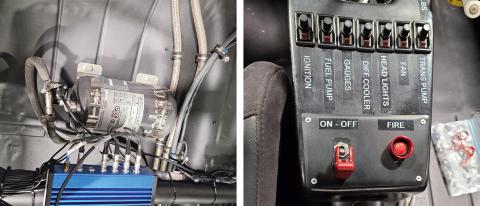
Pictured here is a Lifeline 3.0 kg system with electronic activation installed in a 1973 BMW CSL. Note the positioning of both push buttons to activate the system in the image at top left, as well as the placement of the fire bottle in the image at bottom left. Photos courtesy of HMS Motorsport.

Following these basic yet critical components of using and installing a fire suppression system can lead to a protected race car, but most importantly, a saved life.

A fire suppression system is something a racer hopes to never use. But if the situation does arise, the system must be sized and installed correctly to give the driver as many precious seconds as possible to get out of the burning car. Recently, we spoke with experts at HMS Motorsport in Mooresville, North Carolina; Safecraft Safety Equipment in Pittsburg, California; and Stroud Safety in Oklahoma City, Oklahoma, for tips on the proper selection and installation of a fire bottle system. When these folks tell you to “stop doing that,” take it to heart. Their advice just may save a life. 

Know the Rules

When choosing a fire suppression system, all of our experts agreed that the first resource to turn to is the sanctioning body or series rulebook. 

“Start with what you’re required to have,” said Safecraft’s Johanna Higginbotham. “If anyone wants to have more than that, we can lead them in the best direction to do so.”

The rulebook will dictate whether the system needs to be manually or automatically activated—or both—the number of nozzles and where to locate them, and the size of the system, usually expressed by weight or volume of the suppressant. 

There is a fundamental difference in approach to fire suppression systems between those series adhering to SFI specifications—NHRA, NASCAR and other circle track racing—and those, like IMSA and the SRO Motorsports Group, that follow the FIA’s rules, noted HMS Motorsport’s Zach Schucker.

“FIA systems tend to be smaller than an SFI system because they are trying to do different things with the fire system,” he explained. “The SFI has a rule about having a nozzle by the fuel cell, but the FIA ignores the fuel cell, because 90% of fires start in the engine bay area, not near a fuel cell. An oil line or even a power steering line, on the cars that still have it, is more likely to come off and catch fire compared to a fuel cell having a puncture or a leak and creating a fire.” 

Series not affiliated with either FIA or SFI, such as the SCCA, NASA, and club race events, “will allow either sort of system,” Schucker said, “as long as you follow the manufacturer’s guide to installation and that you’re up to certification on that system.”

Installation Orientation

Stroud Safety has an easy-to-understand diagram in its suppression system installation instructions showing the recommended locations for the fire bottles and how they should be oriented. “There are definitely mounting positions that are incorrect,” said Stroud Safety’s Tommy Cunningham, primarily because of how the bottle works. The extinguishing agent exits the bottle via a siphon tube, which must remain submerged in the agent. That won’t happen, for long, anyway, if the bottle is mounted upside down. Likewise, mounting the bottle parallel to the ground with its head pointing to the front of the vehicle means the tube will quickly starve if the system is fired under heavy braking. Mounting the bottle low in the chassis, parallel to the ground but perpendicular to the chassis axis, is Stroud Safety’s preferred location; the next best is mounting the bottle parallel to the ground and in line with the chassis axis, with the bottle head pointing to the rear of the vehicle. 

The bottle should be positioned so the tech inspector can read the bottle’s gauge and label, said Higginbotham. Otherwise, “I’ve seen guys have to take the bottles out of the car to pass tech.” 

stop2
One important item on every driver’s pre-race checklist should be bottle recertification and refilling, noted one of our sources. “A lot of people wait until the last second and then realize their bottle is out of date,” he added.  

Nozzle orientation is important as well. Stroud Safety recommends mounting them in an inverted position to keep the ports from getting blocked by dirt or other debris. If using a nozzle with a 180-degree spray pattern, it should be mounted so the spray pattern is horizontal, Schucker said. A vertical spray pattern “decreases the radius that the suppressant will spread out and cover the fire.”

Also, check with the system’s manufacturer to find out how many nozzles can be plumbed to each bottle, Higginbotham said. “Our 5-pound kit comes with three nozzles, but we’ve seen customers try to plumb more than that on them. That’s not what we recommend.”

Don’t Do That

It’s common, Higginbotham said, for racers to install the firing cable in a manually operated system without considering the driver’s position under race conditions. “Make sure you can still reach it quickly and efficiently when you’re harnessed in, in the helmet and neck brace.” 

Also check that the pull handle “is firmly mounted,” said Cunningham, or you won’t be able to “fully open the system.” It takes a firm pull to activate the system. 

Problems can occur when bending a system’s hard lines during installation, Schucker said. “If somebody goes to bend it, and instead of using a brake-line bender or something like that they just bend it, they’ll end up kinking it and creating a crease. When that happens, either the suppressant isn’t going to flow through there or it will flow at a very restricted rate.”

Cunningham added that “overtightening the lines at connection points often causes problems,” as do dirty threads. And, he added, all tubing radius bends “must be over 6 inches for proper functioning.”

Racers often leave the system’s safety pins in place when the car is in transit, but they’ll forget to pull the pins prior to racing, Higginbotham said. “That has to be one of the things on your pre-race checklist.”

Another item for the pre-race checklist is bottle recertification and refilling, Schucker said. “A lot of people wait until the last second and then realize their bottle is out of date. Because it’s a pressurized container, you can’t ship it expedited without a special license. Very few retailers or service centers have that certification because it’s so expensive. So you’re either stuck with ground shipping the bottle to and from, or if you’re in a rush, you may have to find someone to physically drive the bottle somewhere.” Bottles must be sent to a company “certified for that style of system,” he added. “Do your research when you purchase the system, so you know where the recertification facilities are in your area.”

SOURCES

–

HMS Motorsport
hmsmotorsport.com

Safecraft Safety Equipment
safecraft.com

Stroud Safety
stroudsafety.com

August 2021
By
Drew Hardin

Houston Raceway Park To Close After 2022

Submitted by laurap on Wed, 07/14/2021 - 16:05
Houston Raceway Park Photo courtesy of NHRA
Photo courtesy of NHRA

Houston Raceway Park, the 1/4-mile dragstrip in Bayton, Texas, will close following the 2022 race season.

The 35th annual Mopar Express Lane NHRA SpringNationals presented by Pennzoil, set for April 22–24, will serve as the final event for the Houston-area track. 

Immediately following the event, the new property owners will repurpose the drag racing complex into an industrial business park.

“Our family is extremely proud to have showcased the top level of professional drag racing for 35 wonderful years,” Track Operator Seth Angel said. “It’s been a dream come true to meet and work with all the incredible drivers, team owners, and NHRA executives who come together each year to entertain the millions of racing fans in our area.”

“We at the NHRA want to thank Houston Raceway Park and the Angel family for their commitment to the sport of drag racing,” NHRA President Glen Cromwell said. “Our race teams, partners, and NHRA officials look forward to celebrating the track as we close out this chapter of NHRA history.” 

Houston Raceway Park first hosted a national event in 1988. At the time, the 500-acre facility was co-owned by the Gay family of Dickenson, Texas, longtime friends of brothers Greg, Gary, and the late Glen Angel. The Angel brothers then bought out the Gay family’s interest in 2004.

The track has been the site of many memorable moments, including NHRA’s first four-second run set at the 1988 race. Texan Eddie Hill quickly topped that record by running a 4.93 in the final round of Top Fuel to win the race. 

For more information, visit nhra.com or houstonraceway.com.

July 2021

New Sprint Car Series At Perris Postponed Until 2022

Submitted by laurap on Wed, 07/14/2021 - 15:29
New Sprint Car Series At Perris Postponed Until 2022


The Pace RUSH Sprint Car Series—scheduled to launch in the West Coast region at Perris Auto Speedway—has been postponed until 2022.

According to longtime Perris Auto Speedway promoter Don Kazarian, the postponement is due to the impact of the pandemic and vendor supply issues.

The RUSH Sprint Cars Series was launched in 2018 as a “cost containment” non-wing division featuring the Chevrolet Performance RUSH 602 sealed crate engine by Pace Performance. RUSH directors Vicki Emig and Mike Leone plan to visit Southern California in November to meet with prospective promoters and participants interested in the new series. 

For more information, visit facebook.com/rushsprintcars. 
 

July 2021

Editors’ Choice

Submitted by jeffreyc on Wed, 07/14/2021 - 15:06


Hundreds of new product announcements cross the desks of PRI editors each month. Following are our top picks for August.

MODULAR FIT PAD SYSTEM

G-FORCE Racing Gear
gforce.com

There’s a husband-and-wife racing team whose heads both measured for a medium helmet from G-FORCE Racing Gear. However, the wife’s medium didn’t fit as snugly as the husband’s due to different facial features.

“Because of the Fit Pad sizing pads available for their helmets, she was able to customize the cheek pads so she could feel as comfortable as her husband,” said G-FORCE’s Jeremy Speich.

The Fit Pad is a modular system available on the Nova and SuperNova full-face helmets—plus the Nova open-face for that nostalgia appearance—that feature the Comfort Bland Plus liner. For added comfort, these liners feature a soft, moisture-wicking material and a fabric pattern that breaks up the hard edges that may interfere with a driver’s peripheral vision.

There are six different locations for the Fit Pad adjustment: four around the crown and each cheek pad. Sizing pads (2-mm or 4-mm thick) can be removed or added and stacked to provide a wide range of comfort options.

editors1a

editors1b

“There are variances in sizing and matching a head to that size,” explained Speich. “The Fit Pad allows you to fill those variances and make it your specific helmet. You can customize front-back, left-right, and the cheek pads.”

The Fit Pad system recently became available to the company’s Rift and REVO helmets, and is now offered on G-FORCE Racing Gear’s full line of SA2020 full-face helmets. —Mike Magda


LIMITED-SLIP FRICTION MODIFIER ADDITIVE

Champion Brands
championbrands.com

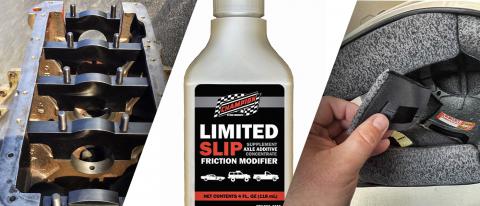
Getting horsepower to the track is always a priority for racers, and a limited-slip differential (LSD) is often a critical element in that operation. The new Limited Slip Friction Modifier additive from Champion Brands is engineered to eliminate noise, vibration, and harshness associated with select LSDs and locking differentials.

“Our LSD additive is designed to work in both limited-slip and locked configurations by limiting or controlling the amount of slip allowed in the differential,” said Karl Dedolph III. “It has been very successful in both types of rearends, as well as in both on- and off-road racing applications.”

Clutch-type limited-slips will benefit most from the additive. Suggested dilution is 1:25 in appropriate gear oils, or use at a 1:10 ratio to provide factory fill limited-slip performance. The additive has been field proven in high-speed police fleet trials, and racers will also see benefits.

editors3

“Drag racing is probably the most common use. For maximum straight-line acceleration, the intent of our additive is to provide as close to zero slip as possible between the left- and right-drive wheels. The result produces better acceleration times,” added Dedolph.

The additive is also useful in diesel trucks used to tow race cars to the track. Having an LSD in a RWD truck is especially helpful for getting out of rain-soaked pit areas or parking lots. —Mike Magda


BILLET STEEL MAIN CAPS FOR MOPAR B/RB BIG BLOCKS

Milodon
milodon.com

Milodon recently redesigned its billet steel main caps for the big block Mopar B/RB cylinder blocks to include 3/8-inch cross bolts for added rigidity.

“If you’re going to put a stroker crank in a stock block,” said Steve Morrison, “you have to strengthen the bottom end.”

Milodon has provided main caps for cylinder blocks since the 1970s, and the previous Mopar big block caps were designed with the two standard vertical bolts or studs. 

editors2

“We never saw a cap break because it was too weak,” noted Morrison. “While it was still a better version of the stock cap, it could move around and then you lose clearance. You really need the cross bolts, like the 426 Hemis have.”

The caps are American-made from a proprietary billet steel and will fit the 383/400 B blocks and the 440 RB block. The engine builder has to machine holes for the 3/8-inch cross bolts, but they’re positioned in the exact same locations as the Hemi block, which means they won’t interfere with any of the oil-pan fasteners. Main stud diameter remains at 1/2 inch.

“The cross bolts are the way to go because they bring so many degrees of strength,” Morrison added.

The caps are available to replace all five caps on the blocks, or just the middle three. —Mike Magda

August 2021

Problem Solvers

Submitted by jeffreyc on Wed, 07/14/2021 - 13:39

Safety and safety awareness are regular topics during team meetings at MAHLE Motorsport, where management welcomes and often acts on employees’ suggestions for improvement.

By following several simple and easy-to-implement best practices, this race parts manufacturer has avoided workplace accidents for more than four years.

The Problem: Workplace accidents cost US businesses billions of dollars each year.

The Solution: Prevent injuries and downtime by implementing smart and effective safety practices.

Running a race team, a machine shop or repair facility comes with known risks. Anyone who has worked in a shop—or on cars in general—has stories to tell, and maybe a scar from a power tool that got away, a welding project that got a little too hot, or some other accident that caught them off guard. As we’ve all experienced, “@$#! happens.” 

But the reality of shop safety is that @$#! doesn’t have to happen. As a matter of fact, @$#! can be successfully avoided if you take the right approach to safety. 

problem2
MAHLE Motorsport has been able to avoid workplace injuries at two of its facilities for more than four years. “Managers and supervisors actually walk the shop floor,” noted a company source. “That lets us talk one-on-one about safety.”

The MAHLE Motorsport North America team (makers of world-class racing pistons and other components) has an excellent safety record. And Plant Manager Brad Green recently spoke with us about how they’ve managed to effectively ward off workplace mishaps at MAHLE facilities in Morristown, Tennessee, and Fletcher, North Carolina.

“We’re a big manufacturing facility—hundreds of people are here on-site and our other plant—and the Motorsports Group hasn’t had a single lost-time incident in over four years,” said Green without a hint of sanctimonious pride. “Our approach is really simple, and our success comes from everybody being aware of what’s going on around them all the time.” 

Think about it: That many workers going more than 1,000 days without so much as a repetitive stress strain. So what’s the MAHLE team working to avoid? Basically, the types of accidents that the Occupational Safety & Health Administration (OSHA) ominously categorizes as The Fatal Four:

  • Falls (either a person falling or something falling onto a person)
  • Electrocution
  • Struck By (something)
  • Caught In Between (one thing and another thing)


Green’s team, and MAHLE management, embrace situational awareness as the key to plant safety. “We talk about being aware of safety and safety hazards at regular team meetings,” he explained, “but it goes beyond that. Managers and supervisors actually walk the shop floor. That lets us talk one-on-one about safety.” 

Management at MAHLE puts a premium on safety, so much so that Green said employees are even on the lookout for potential problems outside the building and in the parking lot. 

Green reinforced the point: “We really encourage people to look all around them. On the floor, around their workspace, above them, everywhere. In fact, during a shop floor conversation not long ago a machine operator mentioned that he had noticed a ceiling-mounted loud speaker didn’t look right. We brought in a scissor lift and discovered that it had come loose from its mount, and it could have fallen and potentially hurt somebody. This guy was aware of his surroundings, and that made a difference.”

Employees also are encouraged to speak up about machine repairs or additional safety equipment they need at regular team meetings or whenever a situation surfaces. 

“Our team has even added safety equipment to machines that we buy because we have our own engineering staff that’s more than capable,” Green said. “For machines that we have to frequently load material into, instead of having a locked, fixed door for safety, we utilize light curtains. Let’s say somebody puts their hand through that light, it works like a safety stop for that machine.” 

Green further noted that their group is looking at proximity sensors to monitor the areas around other machines. “There are a lot of different ideas out there that can impact safety,” he added.

While MAHLE’s shop floor safety dialogue and in-house safety engineering may seem informal, the company does have mandatory protocols in place for safety gear and daily machine safety checks, among others. For example, the E-Stop (emergency stop button) on every machine is tested at the beginning of every shift.

Green capped our conversation with one important point: “From the safety perspective, people think that if they stop the machine cycle, then the danger is gone. But you have to be cognizant that some machines have stored energy from stored air pressure or hydraulic pressure, and to truly make the machine safe—and to avoid OSHA’s Fatal Four—you have to consider the stored energy for a machine to be truly safe to work on.” 

Altogether, these simple and easy-to-implement best practices represent concrete steps toward making any shop a workplace where @$#! doesn’t have to happen…anymore.

SOURCES

–

MAHLE Motorsport
us.mahle.com/en/motorsports/

August 2021
By
Rex Roy

Tech Update: Indivisible: Pumps And Dyno Performance

Submitted by jeffreyc on Wed, 07/14/2021 - 10:46


Proper sizing, configuration, and curvature are critical to maximizing the potential and longevity of your water brake engine or chassis dynamometer. 


Dynamometer testing provides critical data that allows you to fine-tune your driveline for optimum performance. However, the ability to achieve the highest level of performance from your race vehicle is only as good as the dyno system and its components. 

Some of the most important components of a water brake dyno system are its pumps. Properly specifying the right intake and return pumps will allow you to reliably test over a wide horsepower range, with long service life and minimal maintenance downtime.

In a water brake system, water flow, proportional to the load under test, creates the resistance to the engine. The dyno’s intake pump creates a controlled water flow through the inlet manifold, which is then directed to the center of the rotor in each absorption section. This water is then propelled by centrifugal force to the outer dynamometer body, accelerating into pockets on the stationary stator plates, where the water then decelerates.

The power generated by this pattern of acceleration and deceleration is absorbed by the dynamometer to determine engine torque. The water, now heated by this transfer of energy, is then discharged and pumped back into the top of the storage tank, away from the system intake.

Pump Sizing/Selection

Properly sizing the dyno system’s pumps is the first step in ensuring efficient, reliable performance and long service life. Poor pump selection can result in wasted energy on the system, and increased wear and tear on the pump.

A general rule of thumb for sizing the intake pump is that 10 gallons per minute (gpm) of capacity is needed for every 100 horsepower that will be under test. So, if you will routinely be testing 800-hp engines, you will want to specify a pump with a capacity of at least 80 gpm. Operating pressure (expressed as psi) is determined by the dyno system manufacturer and is generally in the 65–70 psi range.

tech2
Correctly specifying the right intake and return pumps allows users to reliably test over a wide hp range, with long service life and minimal maintenance downtime.

A smaller return pump is needed on the discharge side for pumping water back to the reservoir, as the flow is lower and not holding any back pressure. A below-ground well reservoir will take a smaller pump, letting gravity do the work. A larger pump may be needed on an above-ground tank, working against gravity to return the water to the top of the reservoir.

Additional parameters that factor into pump selection include voltage (single-phase or three-phase), inlet and outlet diameter, pipe size, and reservoir size.

Choose Your Configuration

Once you’ve determined the basic pump performance parameters, the next factor to consider is whether a horizontal or vertical pump will best suit your dyno setup. Horizontal pumps are the most prevalent and are best suited to installations where overall equipment footprint is not an issue. Systems with an above-ground reservoir typically use a horizontal pump.

In higher horsepower dynos, or shops where floor space is at a premium, vertical pumps can bring higher capacity with a more compact size. Vertical pumps are well suited to below-ground reservoirs, where the pump can be dropped into the tank at ground level. Vertical pumps also have the added advantage of seal-less pump design—an option that eliminates the risk of leaks and reduces overall maintenance.

Consider The Curvature

Now that you know the size and type of pump you want, you will want to consider the performance curves of your pump options. The performance curve indicates how a pump will perform with regard to pressure head and flow. In general, you should look for a more rounded pump curve, which is indicative of a pump’s ability to maintain the required pressure through variations in the flow rate.

A pump with a rounded curve is more capable of adjusting the pressure to compensate for the load on the system and is more forgiving of variations in performance. A pump with a flatter curve is less forgiving. If flow becomes restricted, the risk of wear and tear to the pump and its components is significantly increased.

Beyond pump performance, features that affect lifetime maintenance should also be considered. For dyno systems using vertical pumps, a seal-less design eliminates the mechanical seal and associated maintenance. Another feature to look for on both horizontal and vertical models is renewable sleeves and bushings. This means that routine replacement of these parts can be done in the shop, rather than sent out, minimizing dyno downtime.

Pumps are at the heart of any water brake engine or chassis dyno. With careful selection, your dyno will run smoothly, allowing you to focus on maximizing your vehicle’s performance.

Gary Smith is Regional Sales Manager for Ruthman Companies. He joined the company’s flagship Gusher Pumps brand 48 years ago, where he took on various roles before spending the next 30-plus years in sales for Gusher. In 2016, he transitioned to a wider role with Ruthman Companies, representing its full range of pumps and valves. Smith has worked with countless manufacturers and race shops to spec and install pumps for both engine and chassis dyno applications.

August 2021
By
Gary Smith

Ask the Experts: Tech Videos

Submitted by jeffreyc on Wed, 07/14/2021 - 10:29

At Speedway Motors, video content ideas come from “common customer requests or issues, projects our employees are working on, and many other sources,” noted a company contact.

Improve your online resources with technical content that can provide essential training and answer FAQs.

Why is technical-based video content becoming more important to the performance racing industry? It has to do with a fundamental shift in how we process information. 

“As a society, we have transitioned from wanting to read about stuff to wanting to watch stuff,” said Ted Hughes of MAHLE Aftermarket, Farmington Hills, Michigan. “It’s not about training articles anymore, it’s, ‘I want to watch a video on how to do it.’” 

Hughes said the target audience for MAHLE’s videos are its technicians, whose median age is in the mid to late 40s. “That means half the people are in their early 40s and in their 20s and 30s. They haven’t picked up a printed magazine or newspaper in years. If we want our message to get to them, we have to reach them digitally.” 

To that end, MAHLE has created a video studio at its Farmington Hills headquarters and recently launched the MAHLE Video Warehouse (videos.mahle-aftermarket.com) as a portal for all its video content. 

Melling Performance in Jackson, Michigan, aims to reach a wide swath of its customers with its videos, according to Eric Smith. “Direct customers, shade-tree mechanics, racers, and do-it-yourselfers all appreciate the help and advice in the tech videos,” he said.

Retailers, too, recognize the benefits. “A customer browsing our website can find videos that outline product details more in-depth, answer questions about a product, or explain common issues,” said Katie Bennett of Speedway Motors, Lincoln, Nebraska. “All of this leads to reduced customer issues and improved experiences with our company.”

For tips on how these experts produce technical videos that engage and inform their customers, read on. 

Q: Where do the ideas for videos come from?

“Understanding the need for increased remote education and distance training options, we identified 25 to 50 topical videos that came from our sales team that interfaces with customers—the things they needed to help them do their jobs, or things their customers were asking for,” said Hughes. “We also get feedback through our website and social media. If we get a couple questions about a particular topic, that means there’s more people out there running into the same thing. That’s a trigger for us to get onto a video about that subject.”

Melling, too, looks for “a common theme of tech or install questions” from its technical department, said Smith. “That helps determine that it would be helpful to put out a how-to video on a specific part-number installation, or a more general tech tip on how to do a procedure when building engines.”

For Speedway Motors, determining video content “is a collaboration across the entire company,” said Bennett. “Our marketing team works closely with our merchandising, customer experience, e-commerce teams and many others to identify the need for technical videos. Content ideas come from common customer requests or issues, projects our employees are working on, and many other sources.”

expert2
Recurring tech or install questions to Melling’s technical department help determine whether the team puts out a how-to video on a specific part-number installation or a more general, procedural tech tip, a source told us.

Q: How do you decide who’s responsible for and participates in the videos?

“Speedway Motors is fortunate to have many in-house experts with technical knowledge in a variety of areas,” Bennett said. “Our employees are in their own garages working on projects or racing on the weekends. We lean on all our experts to provide insight and expertise. We also have a team dedicated to content creation that works alongside these experts to produce videos.”

For MAHLE, the video’s content determines the parties involved. “On the tool and equipment side of our business—to train someone who buys an air-conditioning service machine, for example—that video would be done by one of the engineers or product specialists, so they can speak with confidence and have an air of credibility,” Hughes said.  

“Other types of videos, like our tech-tip training videos, are done with Tim Golema, our senior manager of training,” Hughes added. “In pre-pandemic times, he would spend 45 to 48 weeks a year on the road teaching technicians in the field. That changed dramatically last year, so we equipped his office in Chicago with a green screen and a ring light” so he could continue his training sessions via video.

Q: What were some problems, and solutions, you worked through making these videos?

“Not every expert with technical knowledge is comfortable delivering that information through video,” Bennett said. “We had to develop coaching and other techniques to help our experts deliver the best information possible.”

MAHLE has learned that the style of the video “has to suit what the audience is looking for, or you’re not going to have the credibility you need,” Hughes said. “Know your audience. If we’re reaching out to distributors or people who work in an office, they like a video with more professional polish. But in most cases, we’re trying to get technical content delivered to people who get their hands dirty for a living. They don’t want some suit in front of a camera telling them how to do their job. They want a guy in a shop shirt saying, ‘This is what I encountered, and this is how you can avoid it.’”

SOURCES

–

MAHLE Aftermarket
mahle-aftermarket.com

Melling Performance
melling.com

Speedway Motors
speedwaymotors.com

August 2021
By
Drew Hardin

LSI Chemical Announces China-Based Distributor

Submitted by laurap on Tue, 07/13/2021 - 18:04
LSI Chemical logo


LSI Chemical, the manufacturer of fuel and oil additives developed with patented carbon nanotechnology, has announced Anna ChemTech Co. Ltd. (Shanghai) as its international distributor to sell and market LSI Chemical and Hot Shot’s Secret oil and fuel additives in China. 

As part of the agreement, LSI Chemical’s state-of-the-art R&D facility in Ohio will be used to develop custom formulations for the Chinese market.

Anna ChemTech is an international trading company with a product portfolio that includes lubricants, coatings, metalworking fluids, and more.

In addition to the full line of LSI Chemical fuel and oil additives, Anna ChemTech will market and sell Hot Shot’s Secret complete line of fuel and oil additives and specialty oils for gas and diesel-powered vehicles. 

“Anna ChemTech is deeply rooted in our core industry. We look forward to formulating oils and fuels in partnership with Anna ChemTech’s customer base according to their specific performance specifications and introducing the Hot Shot’s Secret brand of aftermarket products to the Chinese market,” LSI Chemical President Todd Cawley said.

For more information, visit lubricationspecialties.com or hotshotsecret.com.
 

July 2021