Innovative designs and new applications are keeping manufacturers busy as engine builders and outrageous boost levels demand more of the product.
Crankshaft design is becoming more inclusive.
“Everybody wants something a little different,” observed Nick Boes of Shaftech, Fostoria, Ohio. “Got a customer with a drag boat. It has a big block Ford crank with Hemi rod journals and a Chevrolet snout. We’re getting more and more cranks like that where it’s a conglomeration of a little bit of everything. Everybody wants their own little spin to make it a unique piece. But we can’t stock stuff like that because we’d never get rid of the next one.”
Boes doesn’t manufacture crankshafts, but rather he repairs, modifies and applies finishes, so he sees the wide variety of crankshafts now peppering the market, especially because those selective racers may not be able to get a duplicate crankshaft for some time.
“They’re all moving to one-off parts. When a guy hurts something like that and wants to order a crank now, they may say 16 weeks, but he’d be lucky if that’s when he actually got it,” said Boes.
Like most other sectors in the racing industry, crankshaft manufacturers stayed busy during the pandemic and often struggled with the same problematic issues of labor and parts shortages.
“Just getting trucks,” added Matt Polena of K1 Technologies, Mentor, Ohio. “There’s a lack of shipping trucks to get stuff from Point A to B.”
“I was talking to a customer who had 32 motors on the floor and couldn’t get enough parts to finish even one of them,” agreed John Partridge of Bullet Cams, Olive Branch, Mississippi.
Hottest Trends
Despite some setbacks, new products are rolling out of the shops as more applications become popular or the crank manufacturers expand their catalogs.
“Howards did release both LS and big block Chevy billet cranks in our Reaper Series just before the pandemic shut everything down,” noted Kirk Peters of Howards Cams, Oshkosh, Wisconsin. “We feel those two consumer markets had and currently have the biggest potential for market growth. Also, LS is the wave of the future and Howards plans on meeting those challenges with a better engineered product, such as machine center counterweight clearances so our cranks can be used in both stock and aftermarket blocks. The addition of center counterweights on both the LS and BBC cranks has increased the longevity of larger stroke crankshafts.”
Center-counterweight or eight-counterweight crankshafts are certainly one of the hottest topics in the industry right now.
One of the hottest trends this year is the eight-counterweight or center-counterweight design.
“We’re coming out with a new eight-counterweight billet LS crankshaft,” said Tom Molnar of Molnar Technologies, Kentwood, Michigan.
“We are offering more center-counterweighted crankshafts than ever before. The first to roll out are Chevy big block with LS following,” echoed Alan Davis of Eagle Specialty Products, Southaven, Mississippi. Conventional design cranks will also be on the forefront of company efforts, he said. “We are putting a lot of effort into developing a specific crankshaft for use in the RaceSaver sprint car series. We want to offer more than just a modified version of an off-the-shelf crankshaft. We want to not only reduce costs, but also improve performance and durability while staying within the RaceSaver rules.”
Debate over choosing between a six- or eight-counterweight V8 crankshaft seems to focus on weight versus unwanted vibration.
“Center counterweights are implemented to reduce crankshaft flexing at extreme power and rpm levels,” explained Davis. “This will also increase durability and fatigue strength. Racers are making more power than ever.”
Crankshaft design is getting more specialized as custom engine configurations proliferate and power reaches unprecedented levels. Photo courtesy of Eagle Specialty Products.
“A lot of people do not like the extra weight,” countered Molnar, noting there are specific markets that truly need full counterweight designs. “The longer the stroke, the more there is a need for eight counterweights. Shorter strokes do not need them as badly.”
Molnar pointed out that “counterweights will not necessarily improve performance but will improve longevity. You have forces pulling on all the rod pins. You need a counterweight opposite of those forces to reduce the bending. This is not about balancing, it is about reducing bending.”
Engineers at Lunati in Olive Branch, Mississippi, agree with the benefits of the eight-counterweight design but have plans for an added twist. “The demand for an eight-counterweight is coming from hardcore racers,” said Will Vance. “It’s the same scenario we went through with the big block Chevy. Everyone figured out six counterweights were fine in a street application, but if you’re making any real power you can get too much crank whip. Now we’re seeing 450-cubic-inch LS engines turning over 7,500 rpm. Crank whip can be an issue with them.”
To help separate its crankshaft from the competition, Lunati plans to leverage its proprietary Black Magic finishing technology currently used on the company’s premium line of LS camshafts. The in-house coating adds hardness and smooths out the surface while leaving a unique black chrome appearance on the metal.
“The coating really improves the RA factor,” added Vance. “It fills in any imperfections left after machining. We’re looking at doing the same finish with crankshafts. It won’t make any more power, but it can improve longevity on the bearing ride area. If we can get this eight-counterweight crank going, it will probably be introduced with a play on the Black Magic brand.”
Another hot market for manufacturers is big diesel engines used for tractor pulling. Callies, which is based in Fostoria, Ohio, has released a billet crank designed for the International DT466 engine after a couple local racers brought in an aftermarket crank for a checkup. Engineers made a few design changes to strengthen Callies’ billet offering and are now talking with the racers to see if additional stroke is desired. This project opens up additional possibilities in a market in which the crankshafts can weigh up to 250 pounds.
“John Deere is probably one that we’ll do very soon,” revealed Brook Piper. “We’re going to go after the big cranks in the tractor market.”
On a more conventional note, Callies is developing a billet crank specifically for a billet block machined by Bullet Race Engineering in Australia that’s patterned after the Nissan RB30 platform.
“They’re targeting the Toyota 2JZ market down there,” added Piper.
Dirt late models running 4.500-inch-bore-center cylinder blocks make up another hot segment within the crank industry.
“We’re making a lot of crankshafts for those,” explained Peter Harris of Crower Cams, San Diego, California. “Those late models are very hard on parts. The harmonics going on in those engines can be really bad. We’ve had to make the cranks stronger.”
On the OEM side, new fuel economy and emissions standards are driving the development at Tier 1 supplier Pankl, which is based in Austria but also has operations in the US.
“Our customers have started to work on higher efficiency combustion engines, such as VCR [variable compression ratio] and opposed-piston concepts, which require a special crankshaft design,” said Christoph Wachmann.
New Directions
Much of the crankshaft industry has settled into a comfortable pace. Each manufacturer has its favorite steel, and while there may be different schools of thought on heat-treating, cranks are more durable than ever. Engine builders often have standard orders and don’t deviate from their favorite weights or journal sizes. They’ve experimented in the past but now know what works. and they’re happy with the results.
That doesn’t mean that risks can’t be taken. One of the livelier directions in the market is the flat-plane crankshaft. Other than Formula 1, flat-plane crankshafts have been tested but not well accepted into other racing venues. Among the reasons given was that engine builders were tired of chasing dampers around the dyno room because flat-plane cranks can be notorious for vibration issues.
Despite the challenges, there is still interest. Ford developed a flat-plane crankshaft for its 5.2-liter Voodoo engine found in the Mustang GT350 and GT350R programs.
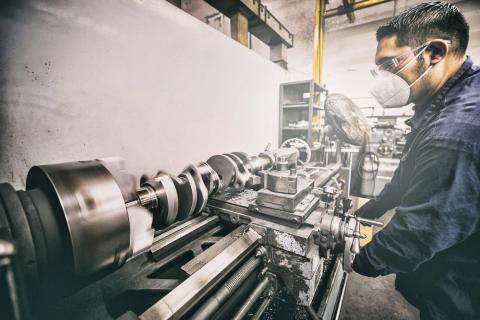
Manufacturers are investing in equipment to pursue new applications and emerging markets, such as this crankshaft for pulling tractors. “We’re working diligently on adding capacity and flexibility through machining technology,” said our source at Callies Performance Products.
“We are making more billet flat-plane crankshafts,” said Tom Lieb of Scat Crankshafts in Redondo Beach, California. “We’re making them for engines other than the Ford. Engine builders are finally getting onto the fact of what the flat-plane crank is all about. And the flat-plane crank is about using the exhaust system for tuning.”
Lieb said there are misconceptions about equal-length headers when using a conventional 90-degree crankshaft in a V8 engine. But with a 180-degree crank, equal-length headers will take advantage of the exhaust dynamics created as the cylinders fire 180 degree apart.
“You can adjust the length of the header, but to all four at the same time, and now you can use the exhaust to tune the intake,” suggested Lieb, adding that Ford worked out many of the vibration issues by using an up-down-up-down configuration for the rod-pin locations instead of an up-down-down-up configuration often used in other flat-plane applications.
“That changed the balance of the firing order from side to side,” added Lieb. “This way it goes front-to-back, front-to-back to even the load across the crank and cuts the vibration.”
The debate continues, however.
“There are things that happen in a flat-plane crank that cannot be fixed,” warned Molnar. “You cannot fix some of the forces even though the crank is balanced correctly. Those engines shake. They might get some better performance, like in a Formula 1 car. But they basically tell the drivers, ‘If you don’t like the way the steering wheel vibrates, we’ll find somebody else.’”
No doubt that engine builders are demanding more of their crankshafts. Boes said the data acquisition on one of his customer’s tractor-pulling engines revealed the turbo boost peaked at 425 pounds during one pull.
“That’s a staggering number, when you think about it,” he said. “We’ve gotten a lot more requests to repair cranks. I think it’s twofold. Costs keep going up, so repairing becomes more feasible. Also, availability is getting to be a problem.”
“Big turbo, real high-horsepower drag racing applications seem to be the wave of the future,” noted Harris. “Outlaw and no-prep racing. Some of those guys are making two-, three- and four-thousand horsepower. Trying to keep a crankshaft in there while it’s trying to get pushed out the bottom of the block is pretty tough.”
Although many in the industry have comfortable preferences regarding cranks, there’s still some debate on issues such as materials and number of counterweights. Photo courtesy of Crower Cams & Equipment Co.
Increasing crankshaft strength often revives the billet versus forging debate.
“There’s a place for both,” said Peters. “If there’s not a forging available, building a crankshaft from a solid round piece of material is the best way. It all comes to building a billet crankshaft when nothing else is available.”
“There really is no debate, only a misinterpretation of design intent and manufacturing viability,” affirmed Davis. “A forged part will be stronger than a billet part if there are no other differences dimensionally, material, or otherwise. I do think it is interesting that the automotive industry is the only industry that seems confused about this. Go anywhere else in any machinery-related industry and it’s not even a topic anyone talks about. Why don’t we have billet hand tools, for instance?
“I think this all started because way back in the day, all anyone ever had were OE parts, and aftermarket forgings were not yet cost-effective,” continued Davis. “Yet, a high-end racing crank would always be a billet one. OE forgings were only slightly better because the materials used were still not very strong compared to chromoly steels. I think the lofty reputation has just persisted through the years.”
What’s Next
Looking ahead, some crank suppliers are updating their manufacturing facilities and others are following advanced technologies, such as 3D printing. Callies and its sister company Energy Manufacturing will be bringing three new WFL multi-operation machines online in the near future.
“We’re working diligently on adding capacity and flexibility through machining technology,” said Piper. “One of the WFLs is a monster. It could also do a 40-inch diameter by 20-foot-long crankshaft. That gives us the capacity for longer applications.”
Manufacturers are increasingly asked to build cranks for engines that are “a conglomeration of a little bit of everything,” noted our source at Shaftech.
“Additive manufacturing is already possible, but costs are high,” said Wachmann. “The advantages will be lower weight with best stiffness and lubrication systems.”
Market consolidation will be a factor in future development plans. K1 recently released a crankshaft for the Gen III Hemi, and sister company Dart Machinery is developing a Hemi block.
“In conjunction with our other brands we have been working on Gen III Hemi parts to complement the Dart block,” said Polena, noting that matched rotating assemblies with K1 crank and rods and Wiseco pistons are productive for engine builders. “We have a couple of K1 rotating assemblies just for the LS platform, but we’ve been working on other applications, making sure all the fitments are right. It does take a lot of the guesswork out compared to trying to put together the parts individually from different brands.”
Ford’s Godzilla platform is also drawing attention at K1; otherwise, the ongoing directive is quality control.
“We’re looking at keeping tighter tolerances on the crankshaft than what we’re currently using,” added Polena. “We don’t have a crank yet for Godzilla, but we do have rods and have made some custom pistons.”
On the custom side, Bullet continues to modify forgings to make them legal for Super Stock racing. One of the key adjustments is adding .015-inch stroke, which is legal under NHRA rules.
Flat-plane cranks are gaining popularity, largely because of the tuning possibilities they open up, according to our source at Scat Crankshafts.
“Normally we put in only .013-inch to give the customer some cushion,” said Partridge. “Then we make them as light as we can within the rules, which means the counterweights cannot be undercut. You can’t knife edge them, either, but we roll the leading edges over. And we can run any bearing diameter. It’s usually a 283 Chevy for the mains and a Honda for the rods, but we can do any size they want. When we get through with them, they usually weigh around 40 to 42 pounds.”
Obtaining raw forgings is the priority at Bullet. The company first tries to find US forgings, then goes to overseas markets.
“We do all the work in-house to make them the way we want, as opposed to buying something already made and trying to reconfigure it,” added Partridge. “It’s a specialty crank, and not that many other people do it. It’s so low volume that most others don’t want to fool with it. For two of my workers, that’s basically all they do.”
Keeping up with demand will be the main priority for crankshaft suppliers, even as the racing season winds down. The winter months are always busy for engine builders, and they are understandably anxious about parts delivery.
“Some customers basically tell me, ‘Just don’t let me run out of crankshafts,’ and I’m trying to get at least 20 in the shop at all times,” noted Harris. “So, it’s good business out there.”
The Damper Question
—
To run a damper or not. Sometimes that is the quiz of the week in racing garages.
Also referred to as a harmonic balancer, dampers are designed to reduce unwanted harmonics created when the crankshaft bends and twists under heavy loads. The automotive performance aftermarket offers four types to racers: viscous, pendulum, friction and elastomer. The manufacturers of each type have their loyal customers, as there are pros and cons to each design that engine builders weigh before selecting one for a particular application.
But there are racing classes where dampers are not used, and that’s not always a good idea.
“We had an import racer who was really having a hard time with crank flex,” recalled JC Beattie Jr. of ATI Performance Products, Baltimore, Maryland, the manufacturer of elastomer-style dampers. “He was not running a damper at the time. When he went on the two-step, the car would not sit still.”
ATI suggested a damper package that worked. “Turns out the crank would flex so much that the back of the crank would bend and engage the clutch a little bit as it flexed, making the car creep forward,” explained Beattie.
The damper industry seems to always be educating the customer on their product’s benefits, including those racers who refuse to run them. They point to reduced wear on bearings and less risk of crankshaft failure, thereby reducing costs.
Although some engine builders question the necessity of harmonic dampers, manufacturers say that just the increased longevity and reliability they provide is reason enough to run one.
“Sprint cars and Formula 1—both rumored holdouts to damper integration—are currently using dampers or have used them,” said Brian LeBarron of Fluidampr, Springville, New York, manufacturer of a viscous-style damper. “Fluidampr recently had great success with a small-diameter viscous damper on a Formula 1-inspired, 1,000-hp, 10,500-rpm, 396-cubic-inch V12 OEM production engine. The engine developer enclosed the damper within the timing case and used active oil cooling to achieve zero damper maintenance. In addition to the enclosed crankshaft damper, four camshaft viscous dampers were used to diminish torsional vibration effects in the valvetrain itself.”
Sprint car engine builders have always worried about weight and packaging when trying to fit a damper in line with the water pump. Still, there are benefits.
“They are giving up horsepower, more peak rpm and the longevity of their engine and/or the components on it,” added Beattie. “If you can’t convince a racer that a few pounds will free up a lot of power, then I am not sure what will.” —Mike Magda
Always on the cutting edge of market trends, this multi-faceted Southern California racing operation began by focusing on the import scene, even earning a Pikes Peak class win. It has since expanded into electrification, among other new frontiers.
When friends Tony Kwan and Mike Chang founded Evasive Motorsports in 2002 as an early e-commerce website, “we were one of the few in the industry selling parts online,” Kwan recalled. “I believe that’s what gave us an advantage. Many people were already selling on eBay, but we believed it was important to grow our own site and drive traffic to our own platform. That was very important to growing our user base and creating customer loyalty. As online shopping grew in popularity, businesses that didn’t adopt this sales channel began losing sales to those who did.
“We started really small, selling parts from home, mainly for Japanese cars,” he continued. “At first we found our niche in small accessories—lug nuts and things like that. As we grew, we moved into a one-lift garage in Walnut, near Los Angeles. Now we had a place where we could stock parts that we thought were cool and that would sell. We tried to focus on the rarer items, parts that were harder to get, because we didn’t want to be like everyone else. As we grew, we invested everything we made back into the business. We’ve moved five or six times since then.” In March of this year, Evasive moved again, into an 18,000-square-foot facility in Cerritos, California.
While Evasive Motorsports has grown its physical plant, it has also built a knowledgeable, dedicated and enthusiastic staff, numbering between 20 and 22 as this was written. “We’ve been lucky to find great people,” said Kwan, “and we’ve put together an amazing staff with good work ethics. We try to inspire our team members and help them grow individually. Everyone here is almost like family. I think that’s why our turnover rate is so low.”
Everyone on the team helps select parts for the catalog. “They are all very much in tune with the industry. They’re hip, and they have good taste. So if any of them spots something that they think we should sell—something they think is going to be really hot—we will go ahead and get it. Mike and I can’t take all the credit; we have a really good staff.
“We attract new customers mainly with our social media presence,” Kwan continued. “And we keep them coming back by building cool projects and offering good advice, as well as the latest and greatest products.”
Thinking Young
Not surprisingly, Evasive’s customers are young. “Most are probably between 18 and 35,” said Kwan, “and the ones who are over 35 have been with us since the beginning.” More significantly, “at least 50% of our customers take their cars to the track.” So in addition to parts—still mainly for Japanese and European imports—Evasive Motorsports offers race preparation services, including wheel alignment, corner balancing, suspension installation and tuning, and general maintenance. “We’ve track-tested an extensive range of parts,” Kwan added, “and we encourage our customers to call us for recommendations.”
You don’t attract serious racing customers unless you race yourself. Here again, Evasive has been tuned from the start to its younger, import-focused audience. “We were one of the first companies in the US that participated in Time Attack,” Kwan recalled. That was in the mid-2000s, when Time Attack was already popular in Japan, with significant support from Japanese tuning companies. “It was just starting to take off in the US,” initially with exhibition races promoted by Japanese tuners. “Over time,” said Kwan, Evasive’s participation “helped us earn our ‘street cred,’ both within the US and globally. We even competed in a Time Attack event at Tsukuba Circuit in Japan, with a supercharged Scion FR-S that we built with backing from the manufacturer, and HKS as the title sponsor.” The Evasive car lapped Tsukuba in 59 seconds, “where anything under one minute is a pretty big deal.”
Peak Performance
When Kwan talks of building “cool projects,” he means race cars. Among the coolest have been the cars Evasive Motorsports has built for the Pikes Peak International Hill Climb. Interestingly, Kwan sees the 156-turn, 12.2-mile ascent as “an evolution of our involvement in Time Attack. It’s similar in that it’s a time trial, but it’s a much more grueling course and a more challenging environment.” It’s also a world-renowned event, where Evasive can not only “challenge ourselves” but also “compete with some of the greatest racers out there. Our marketing strategy is to show what we can do.” Furthermore, when Evasive first faced the Peak in 2013, “there weren’t many other tuning shops from our industry that were competing there.”
Tony Kwan and Mike Chang founded Evasive Motorsports in 2002, selling small accessories online. They now command respect as a race-prep shop for international events like Pikes Peak.
Since then, the various Scion FR-S setups that Evasive has run up the mountain have become “cooler” every year. They started with an HKS supercharger, then turbo-boosted power on an original FA20 platform, which was eventually swapped out for a Toyota 2JZ straight six. After placing 11th in the Time Attack 1 Division in 2019, driver Dai Yoshihara returned in 2020 with the same purpose-built, 2JZ-powered Toyota 86, now fed by a larger turbocharger. But the Evasive effort would prove a nail-biter all the way. Practice was plagued by minor failures, and then a major drivetrain issue that required a new transmission. The car was not back together until 3 a.m. on the Saturday morning before the race on Sunday.
Having failed to qualify, Yoshihara started last—just as the sky darkened and drizzle dampened the road. Despite a brush with a safety rail near the top of the course, Yoshihara finished 1st in the Unlimited division, and 9th overall, with a time of 10:11.446. “If he didn’t clip that railing,” Kwan observed, “he probably would have driven a sub-10. But we were very happy with the way things came out.”
From Retail to Manufacturing
In addition to its comprehensive catalog, Evasive now manufactures its own product line under the name EVS Tuning. “We started EVS four or five years ago,” Kwan reported. “This has been a fulfilling venture for our team, as we get to design and create our own parts. We try to create products where we see a need for our customers. A lot of times when we’re at the track, we see things that we think people could use.”
For now, a lot of those parts are destined for Honda S2000s, whose owners comprise “a big chunk of our customer base. Aside from suspension parts, we have roll center adjusters, camber kits, and a roll bar.” EVS also developed a carbon-fiber aero kit for the Civic Type R, because “at that time, nobody else had one. It was really successful. So we made a roll bar for the Type R as well.
Evasive Motorsports still focuses on the traditional Japanese and European cars it built its business on, but now the company is venturing into EV motorsports with efforts like this Tesla.
“Another of our most popular parts right now is the GTLM aero mirror,” he continued. “We designed and developed it from scratch, in-house. Once it was ready to go, we recruited high-quality manufacturers to mass produce the components. We assemble it in-house, and because the parts come from all over the world, there is less chance of anybody copying it.”
Most EVS manufacturing is contracted out—to whomever provides “the best-quality samples,” said Kwan—although Evasive does make prototypes on its own CNC machine.
Customer Reviews
Like Kwan, Rodger Rivera grew up in the So-Cal universe of modified motoring. “We were running Subarus in the 1990s,” Rivera told us. “Then I moved up to Seattle in 2001 and changed from lowered cars to rock crawling to lifted trucks, and then back to lowered cars. That was about 2003. I realized I didn’t have any connections. So I reached out to a friend, who happened to be a friend of Tony, and now he provides all the parts on our cars.”
The cars include a pair of WRX STi’s: a 2017 for Rodger and a 2015 for his wife, Tara. Both run mostly HPD events. “Ninety percent of the aftermarket parts on both cars are from Evasive,” said Rivera. “And I say 90%, because for tuning, I obviously have to use a local shop. If I still lived in California, I’d have Evasive do 100% of the work on the car.”
Rivera is impressed by Evasive’s “dedication to motorsports. It’s not just the quality of the parts that they sell, it’s that they test them in the cars they run on the track.” There’s credibility—“weight” Rivera called it—to that. “You might spend a little more, but if you build it right the first time, you save money in the long run.” He cited the example of a custom front bumper he purchased for his S2000. “Everybody knows that if you are working with aftermarket parts, chances are you’re going to have to make some modifications.” The part Kwan recommended cost $2,000 more than “some knock-offs, but he guaranteed it would fit. And, no kidding, when I got it from paint, I put it on the car, and everything matched up, 100% perfect.”
Evasive Motorsports recently began designing and manufacturing its own products, under the EVS Tuning name. “When we’re at the track, we see things that we think people could use,” said Tony Kwan. Seen here is engineer Kelvin Yong.
When Rivera has had a problem, he’s been impressed with Evasive’s customer service. When an AutoPower roll bar that Tara needed—pronto—for an HPD event got bent during shipping, “Tony connected me directly to AutoPower and arranged for them to work with the shipping company so they could ship a replacement bar as soon as the claim cleared.
“Another time I ordered a pair of seats, and when they arrived the rails were a little too low, and my wife was a little too short, and she couldn’t see. Tony asked me to ship the rails back, and he worked with me on a replacement—and on top of that gave me a great deal on a pair of Recaro seats.
“They are just great people to work with. And they’re honest. They are not going to say, ‘We’ll get back to you tomorrow,’ when they know they can’t. They’ll be up front and say, ‘This is how long it’s going to take, and if you want to wait, we’ll be more than happy to do it for you.’ We’ve been in the car scene since 1989, and we’ve never had such great customer service,” Rivera concluded.
“They definitely go out of their way to make sure their customers are taken care of,” agreed Michael Yeung of Honolulu, Hawaii. Yeung ordered a set of wheels from Evasive Motorsports 10 years ago, “and just went from there.”
Yeung enjoys “tinkering with” his S2000. “It’s supercharged, has all the aerodynamics, and a custom interior,” he explained. Yeung has introduced friends to Evasive Motorsports and, while vacationing in Southern California some years ago, decided to drop in on the shop.
“I met Tony, and he showed me around. Ever since we’ve been friends. He’s very knowledgeable, and if he doesn’t know the answer, he’ll go out of his way to find it. If anything is back-ordered, they keep me in the loop,” Yeung concluded.
Plugged In to the Future
For its 2021 Pikes Peak effort, Evasive Motorsports built a super-lightweight Tesla Model 3. “Times are changing,” observed Kwan, “and the EV market is constantly growing. We decided we needed to be a part of that movement.
“The car ran extremely well during practice with Dai driving, and we qualified second.” On race day, however, electrical issues limited the Tesla’s power, “so we didn’t get the results we wanted.” Yoshihara finished 8th in the Exhibition Division, with a time of 11:41.162.
“It was heartbreaking,” said Kwan, “after all the work from our team and our sponsors. Thankfully, our sponsors still fully support us,” and were happy with how well the campaign engaged potential customers. “We look forward to improving the build and returning even stronger next spring.”
Owners Tony Kwan and Mike Chang credit Evasive Motorsports’ success largely to its staff, who even help select the company’s products, including chief technician Jason Reinholdt, seen here. “They’re hip, and they have good taste,” said Kwan about their team.
Meanwhile, one of the latest products from EVS is a custom wheel for the Model 3, “as a way into the Tesla aftermarket. It’s a flow-formed cast wheel, so it’s stronger than a standard casting but costs less than a forging. We think we can sell it at a good price point for a 19-inch wheel.”
Still, while Kwan foresees growing sales in the EV aftermarket, he emphasized that Evasive’s involvement in electrification is “a long-term strategy. We definitely love and appreciate our petrol-powered cars. They are still our main business.”
In the shorter term, Evasive Motorsports hoped to enter the Time Attack event scheduled with this year’s Acura Grand Prix of Long Beach, which was in September. “In the future,” Kwan added, “we would like to run an open-wheel series. To compete at that level would be an awesome experience for our staff.
“I think our customers will be rooting for us, having seen us come from grassroots racing, and evolving up to that.”
As regulations push production car design toward electrification, automakers across the globe are now looking at EV technology as a top priority for development. But what does it mean for the future of their racing programs?
Over the past few years there’s been a pronounced shift in focus across the automotive industry. While internal-combustion-powered vehicles have served as most brands’ bread and butter for decades, looming fuel economy and emissions regulations are simply too strict to address by conventional means. That has led many companies to develop platforms that are purpose-built to support hybrid, plug-in hybrid, and pure EV powertrains.
Although motorsports has traditionally been a venue to develop cutting-edge technologies that may eventually find their way into production street cars, the nature of EVs has dictated somewhat the opposite approach at this early stage in its maturation. Current battery tech still limits the disciplines and formats where electric vehicles can be truly effective in racing, but those limitations are generally less of a concern with respect to the use-case of road-going vehicles.
Importantly, however, this shift also means that a massive amount of engineering muscle is now aimed squarely at these new platforms. As the OEMs continue down a path to increased electrification, here’s a closer look at how EV racing fits into their larger strategy, and what that means for the collective future of motorsports.
Nissan Motorsports
Franklin, Tennessee
Nissan made its all-electric racing debut in the ABB FIA Formula E championship in 2018 for the series’ fifth season, and the automaker wasted little time making its presence known on the grid. With driver Sebastien Buemi at the helm, the team took second place in the championship and secured six podiums, six pole positions, and 16 Super Pole qualifying appearances along the way.
Beyond brand awareness, the format of the series has also provided Nissan with an environment where the development of the race car correlates to the engineering behind the company’s EV production cars. “For us, it’s much more than motorsport,” said Tommaso Volpe, Nissan’s global motorsports director. “One of the main reasons we joined the series is because of this strong connection that we can make between Formula E and the core business. We came into the sport with a lot of experience in the electrification of road cars, and we transferred a lot of that experience into the development of the Formula E car.”
Formula E no longer uses a ‘spec’ powertrain, unlike many electrified series currently operating today. “The chassis and bodywork are spec components, but it’s a fully bespoke powertrain,” Volpe explained. “That’s why Formula E is the series that attracts the largest number of automakers as compared to any other motorsport. The money that we’re spending in the development of the car is relevant to the core business, while spec elements—like the aerodynamics of a single-seater, which do not apply to the core business—are not things that we need to spend on.”
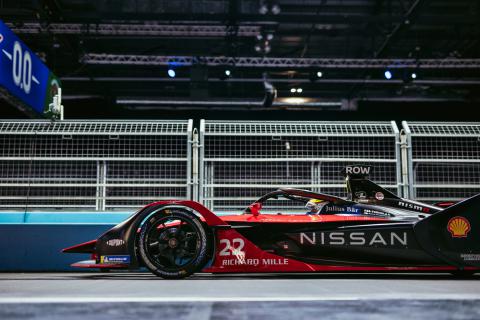
Nissan’s electric racing efforts currently focus on the ABB FIA Formula E championship, “a playground” for testing future EV technologies, said our source at Nissan.
This is incredibly important for Nissan, as the automaker plans to have a fully electrified road car portfolio in its key markets by 2030. “Formula E provides us with a playground to test this technology in a high-performance context,” he said. “Along with the development of the powertrain components themselves, we’re also developing the powertrain management software, which is equally important. The two most essential areas of R&D for us in Formula E are making the hardware as efficient as possible and making the energy management as sophisticated as it can be through the software. These two areas are key to developing successful platforms for vehicles like the Ariya, our first electric SUV. Developing the energy management software is crucial because it provides more flexibility in terms of applications for an EV powertrain.”
Volpe told us that while Nissan is open to the idea of expanding into other series and motorsports disciplines with its EV technology, right now that strategy is largely being guided by series rule sets. “This is more of a function of motorsport in general,” he explained. “The strategy for Nissan—and many other automakers—is to use prototype categories like Formula E to promote the brand and develop technologies. Looking at GT categories, this is where you tend to enter with your products. Here electrification isn’t the driver, it’s the product, so you’re looking at the products in your portfolio that you can homologate and race in specific categories.”
While Volpe wouldn’t comment on the specifics of Nissan’s plans for EVs in motorsports, he said that the experience that the automaker has gained in Formula E will allow the company to hit the ground running as it starts to venture into other series with the technology. “Some of it will depend on the homologation specs given by the sanctioning bodies, but the experience we’re gaining in this series is valuable for any kind of electrification.”
Audi Sport
Neckarsulm, Germany
Electrification in Audi’s motorsports efforts dates back to 2012, when the automaker debuted a hybrid powertrain for its Le Mans program. Over the years, that system progressively evolved to play a larger role in the powertrain’s overall performance, in turn pointing the way toward the EV system that would come a few years down the road.
“Throughout the latter period of our Le Mans program, the hybrid content in terms of the total amount of power increased,” said Allan McNish, director of motorsports activities for Audi Group. “From there we moved into a complete battery electric vehicle when we stopped our Le Mans program and transitioned into Formula E. In much the same way most of our racing programs operate, it was a precursor to what we were developing on the road car side.”
McNish noted that Audi’s involvement in Formula E has not only provided a test bed for technologies that the automaker plans to put into production, it has also given the company a platform to change perceptions. “We were developing the system as well as the messaging. It allowed us to show customers what’s coming. There’s a dramatic shift happening for the customer right now, and for them to understand the benefits, they need to be able to see it in action. It’s not just about getting from Point A to Point B. It can be exhilarating as well.”
Audi’s EV motorsports efforts began with its 2012 hybrid Le Mans car, then progressed to Formula E. Now, the Dakar Rally is the company’s next EV-racing target.
Audi has already targeted the next motorsports venue where it will take its EVs. “We’re transitioning out of Formula E and into the Dakar Rally, which is another step forward for our electric technology,” said McNish. “Dakar is one of the toughest challenges that you can take on while looking at it as an all-electric drive. There will be a lot of learning and development in the beginning. It’s definitely going to be different from what Audi has done before.”
He explained that racing environments not only provide real data at the extremes, they also allow the automaker to compare that data with more traditional testing procedures to discover where further refinements can be made. “There are effectively two core parts to an EV strategy: the hardware, and the software development to maximize the hardware. The latter is where I think you’ll see the big gains coming. Using Formula E as an example, at some race circuits we are now recuperating up to 40% of the energy used. Ten years ago, that was lost energy. A lot of this is about figuring out what these electric motors like and don’t like in terms of where we’re recuperating the energy, and how we can use that recuperation technology to also improve vehicle dynamics. We can also replicate these scenarios on dyno rigs and fully dynamic simulation systems, and we’ll run the latter on race weekends. When we’re racing in New York, our simulator is running back in Neuburg.”
McNish sees a future for EV tech in rallycross as well as GT-class road racing. But as far as Audi’s road map for EVs in motorsports is concerned, that path will ultimately be determined by the automaker’s larger goals in the years ahead. “It depends on what opportunities there are. What’s clear in our strategy is that it has to align with our priorities. Over the next few years, I think we’re going to see a much broader range of championships for battery electric vehicles.”
Toyota Racing Development
Costa Mesa, California
Although Toyota is not competing in a pure EV racing series right now, TRD President and General Manager David Wilson noted that the automaker has been focused on hybrid and EV technology for quite some time. “The development is much more advanced on the production side than it can be on the motorsport side right now. Toyota has more electrified vehicles on the road today than all other manufacturers combined. While we’re not presently competing in an EV-based venue, you’d have a tough time identifying a top-tier motorsport discipline that isn’t either presently using some form of electrification or considering a transition to some form of that. That’s where we are right now. As one of three OEMs competing in NASCAR, for instance, we have been in regular conversations with the sanctioning body about where the sport goes, directionally. I’m quite confident that there’s some form of electrification on the horizon there.”
In the meantime, Toyota’s continued involvement in LMH class racing in the FIA World Endurance Championship nurtures technological development as well. “This is a technology-driven class of racing, and there is a tangible component that feeds into the development of production car electrification with that effort.”
Wilson also pointed out that Toyota is not exclusively focusing on one type of technology as a solution for emissions concerns. “We don’t subscribe to ‘one size fits all’ thinking, and the hydrogen engine we’re using in the Corolla Sport we’re campaigning in the Super Taikyu endurance series in Japan is a good example of that. One of the big challenges is finding a path that will still captivate the fans. One of the benefits of this type of hydrogen technology is that, aside from the combustion of minute amounts of engine oil while driving, hydrogen engines emit zero CO2. Yet they still sound like traditional internal-combustion engines. So we feel that carbon-neutral motorsport solutions don’t necessarily have to be mutually exclusive from the elements that fans get excited about.”
He told us that motorsports continues to provide the company with an incredible platform to showcase these technologies, and TRD plans to take advantage of that. “Racing is a big part of sporting culture of America, and that provides us with a way to connect with a massive, passionate fanbase. With electrification, it allows us to engage with consumers and show them that it can be a technology that’s deployed not just because it’s socially responsible, but because it can deliver real performance.”
Yet he said that these motorsports initiatives must align with the realities of the current market. “Series like NASCAR and IndyCar talk about staying relevant, but it’s really about right-sizing the operational model. Teams cannot sustain the levels of money that they have been. There just isn’t enough sponsorship to support it. So IndyCar is looking at a ‘spec’ bolt-on hybrid system, and whatever we come up with in NASCAR is likely to be of a similar ilk. The teams can’t afford to get into that kind of arms race.”
With that in mind, Wilson sees EVs’ widespread integration into motorsports coming by way of hybridization first. “My pragmatic view of it is that the hybrid solutions make sense as a first step because they’re far more attainable than a pure battery EV solution. In five years’ time, I’d be shocked if every form of top-tier motorsports didn’t employ some form of hybridization. It’s almost like gravity at this point.”
General Motors
Detroit, Michigan
GM has the notable distinction of being the first automaker to introduce a purpose-built and mass-produced electric vehicle. Although the concept may have been a bit ahead of its time when the EV1 hit the streets back in 1996, it gave the automaker a head start on its competitors as the technology began to take shape.
Development of its EV racing hardware is humming along nicely today, as evidenced by projects like the eCOPO Camaro, which uses a conventional drivetrain hooked to a pure-electric powerplant that generates 800 horsepower and 800 pound-feet of torque.
General Motors’ eCOPO Camaro is a one-off testbed and demonstrator for the company’s eCrate motor concept, an 800-hp electric motor assembly designed to be a bolt-in replacement for popular GM engines.
“General Motors has been known as crate specialists for internal combustion engines, so we wanted to kind of look forward and see how we could apply that same concept to powertrains of the future,” said Russell O’Blenes, director of the performance and racing propulsion team at GM. “So we designed and built that motor and battery package to be a direct replacement for the engine in the car.”
This year also marks GM’s venture into off-road motorsports with an EV. “We’re currently competing in the Extreme E series with our Hummer brand and Chip Ganassi Racing,” O’Blenes explained. “It’s a global off-road racing motorsports program, and it’s been a great initiative for learning in the space. We really focus on using motorsports as a way to try new, innovative things so that we can then bring that technology back to our production components.”
Outside of competition in series like Extreme E, GM also has dedicated locations where EV technology testing is ongoing and expanding. “We have our Performance and Racing Center in Pontiac, Michigan, which my team heads. As we’re developing the new Charlotte Technical Center in North Carolina, we’re looking at how we can tie in those testing facilities as well.”
GM has paired with Chip Ganassi Racing to field this Hummer-branded EV racer in the inaugural 2021 Extreme E off-road series. “It’s been a great initiative for learning,” said our source at GM.
O’Blenes said that General Motors is also working closely with sanctioning bodies to determine where they see EVs fitting into their respective series. “It’s about figuring out what the future opportunities are for electrification. We started with NHRA, but Chevrolet also has a major presence in IndyCar, and for the ’24 season we’ll be using a new engine with a hybrid system. We’re working closely with them to see what kind of learnings can be had from the package. We have long partnerships with all of the sanctioning bodies, so we’re trying to work with them and our partner manufacturers to get a better understanding of what the right places are for this technology, and how we execute it to make sure it’s successful.”
Although technological hurdles still exist—and recent supply chain shortages certainly haven’t helped in that regard—it’s clear that significant progress is being made to bring EV technology to a wider motorsports audience. “In motorsports and really everywhere in the EV realm, the battery technology and the hardware are rapidly evolving,” O’Blenes added. “We’re all working toward a common goal, and you can see results in series like Extreme E and Formula E. Because so many people are all working hard to go fast, we’re making really good progress in this space.”
Motorsports safety has primarily focused on internal-combustion vehicles. But with the growth of EV participation at every level of racing, these longstanding practices must evolve.
The inherent dangers of auto racing have been romanticized since the first two motorized carriages in town lined up against one another. It’s human nature to test our bravery and skill, to find joy in our successes in the face of peril. But thanks to a wide array of mechanical, technological and organizational changes implemented over the years, auto racing has become a far safer pursuit than it was even just a few decades ago.
Unfortunately, many of these advancements came as a result of incidents that revealed gaps in our knowledge about where potential deficiencies existed. As electric vehicles continue to find footing in motorsports, they’re rewriting the rules not only in terms of performance, but also safety. With a fundamentally different design and fuel source, EVs pose new challenges for teams, sanctioning bodies and racing facilities, many of whom have just begun to venture into this territory with minimal outside guidance.
“You don’t know what you don’t know,” noted Pete Fiset, a member of the International Council of Motorsport Sciences. “Right now, the industry is still figuring out a lot of this. Many of these different racing groups are taking their own approach to it and are creating their own solutions, but they’re not always sharing that information with everyone else. It would be a shame for everyone to have to experience the same problems on their own before they too can figure out how to make things safer.”
It’s also clear that a better understanding of some fundamental concepts, best practices and what the future may hold will help lay the groundwork for a safer racing environment. As EVs expand their footprint beyond one-make series and production stock classes in racing, it’s the sort of insight that will only become more valuable over time.
Taming A Different Beast
Mike Hurst of the SFI Foundation in Poway, California, said that it’s difficult to pinpoint specific best practices for EV safety in motorsports because trends (and standards they would necessitate) have not been established yet. But there are several key elements that are intrinsic to on-track electric vehicle safety as we know it today—as well as some inevitable challenges.
“For the majority of the programs we have, a lot of it would transfer over and be acceptable for use in an EV race car,” Hurst explained. “And I think there’s a parallel there if you look at, say, how local fire departments are equipping their staff and training for incident response with EVs. Many of the tools are the same. But much of EV motorsports in the US is still in the conceptual stage, and there are also things that we’re going to need to do differently. Things like specific fire suppression agents and standardized powertrain controls that would oversee thermal limits and the amount of current. To me, that’s going to be the toughest thing to manage. This is a safe propulsion system as long as OE-style controls are in place to provide safeguards against over-stressing the battery and things like that. But when put into a motorsport context, people are going to want to take everything to the limit. That’s what racers do.”
As EVs gain popularity on race tracks, organizations like the International Council of Motorsport Sciences are working to develop new safety protocols for them.
That presents issues that might not be detectable at a glance. “The dangers are usually obvious. You can see a fuel leak,” said John Fabijanic, SAE Faculty Advisor at Cal Poly San Luis Obispo in California. “I’m fairly comfortable having my students handling gasoline. I’m usually more concerned about high-temperature fluids like coolant and oil. Those worry me more because people are generally less cognizant of how to handle them, and I would put electricity in that same boat. But SAE has done a good job establishing those basic rules in terms of how we isolate it down into low and high voltage and breaking it down into non-dangerous modules.”
John Metric of the National Electric Drag Racing Association (NEDRA) in Houston, Texas, and owner of Lonestar EV Performance, said that while batteries are just another type of energy storage, their characteristics point to a change in procedure when it comes to incident response. “When ignited, liquid fuels are consumed very quickly. But a battery segregates electrons from one side of the accumulator to other side of it. As long as there’s not some uncontrolled way for those electrons to get from one side to the other, they’re fairly stable and safe. You could throw a match onto the battery and it’s not going to spontaneously explode. Where we generally run into issues is with physical punctures of the battery, overheat conditions, and individual component failures inside the system. The reaction is more like a fuse burning—the fuel doesn’t all go up at once. That typically provides time to evacuate the driver, and usually there’s time to move the vehicle off the track as well. But if minutes go by without doing anything to contain it, that small fuse can set the whole vehicle on fire.”
As Fiset explained, those fires can be much more difficult to extinguish than a blaze fueled by an internal-combustion vehicle. “Once thermal runaway sets in and the batteries catch fire, they can be very, very hard to put out,” he said. “We are used to dealing with alcohol or petroleum-based fires, but these fires can become self-supporting. Just removing oxygen and hitting it with a CO2 extinguisher won’t cut it sometimes. In some circumstances, these battery fires can require thousands of gallons of water to contain.”
EVs present unique safety challenges. For that reason, course workers at events like this Formula E race proceed with extra caution when handling them.
The technology is improving, though, and Fabijanic told us that improvements in controlling thermal runaway are already being seen throughout the industry. Yet when things do escalate to that level, those situations don’t always line up with traditional best practices. “Those kinds of fires tend to run hot and release a lot of nasty chemicals, but the main issue is that they’re internally sustained. So you need ventilation and, ideally, you’d smother it. With a lithium-ion fire, there’s a kind of sand that contains specialized chemicals that are more effective at putting out those types of fires.”
Strategies For Success
Fabijanic also said that Formula 1, which incorporated a hybrid system into the race cars’ power units in 2014, is one of the series that’s leading the way in terms of protective equipment and operating procedures for EV technology in motorsports. “At this year’s British Grand Prix, for instance, there was a big crash and there was a significant delay before they moved the car because they were confirming that the high voltage system was disabled. The safety crew had the thick, high-voltage gloves on as well. The issue was that there was still a green light lit up on the roll hoop of the car, which indicates that the hybrid system is active. So they went through a series of checks, and none of the normal corner workers touched the car until it was deemed safe. This is how Formula 1 is handling it, and other series are going to have to consider implementing similar measures as they bring in this technology.”
Similar scrutiny should be applied to the designs of the race cars themselves. “DC current is always trying to find ground. Get between it and that ground and there’s the potential for electrocution,” Metric said. “The battery compartment and the driver’s compartment should always be separate to prevent any high voltage around the driver.
Electric vehicles tend to be heavier than traditional race cars. As a result, components designed for the latter may not directly translate to EVs. Photo courtesy of Lonestar EV Performance.
“Since the early days, NEDRA rules have specified a master cut-off switch that’s accessible by the driver as well as the track crew, so either one can disable the main power pack,” he continued. “The battery pack should also be held down to the car in such a way that it’s prevented from splitting apart and going in its own direction. Ultimately, you can plan for the worst, but wrapping yourself around a tree isn’t part of anyone’s plan. Fortunately, in drag racing you’re not really faced with a significant potential for meeting a fixed object perpendicularly like that.”
Hurst said that the prospect of using motorsports components that were designed for traditional race cars on electric vehicles also comes with some additional considerations. “EVs tend to be heavier, and that might change what’s going to work in a given application. A 4,500-pound vehicle is going to have a lot more crash energy than one that’s 3,000 pounds. That also applies to things like wheels: Putting a traditional skinny drag wheel on the front of an EV that was intended for a car that weighs half as much could present a problem. It’s a situation where the original manufacturer of the component just may not have envisioned that use case.”
The Shape Of Things To Come
It’s clear that at this early stage in EV motorsports’ development, many of the rules and standards are still being written. Unlike the last century of automotive development, this is not a situation where gradual refinement has plotted a clear course for everyone involved. Instead, this is really more of a reinvention in the context of motorsports, and that means that finding the right solutions will inevitably require some experimentation.
“You know, part of this is about figuring out how to manage these on-track incidents safely without telling everyone they have to go home because there’s a car burning up,” Hurst said. “I saw a story about a mobile water tank solution they’re trying in Germany, something you’d move around with a big truck. When they have a runaway thermal event with an electric car, they take that tank to the site, hook it to a fire hydrant to fill it up, and then drop the car in it. That might be a way to manage that. But then you have to consider that once that tank is filled, it’s not going anywhere—it’s just too heavy.”
Fabijanic said that before long, that approach might not be necessary. “It used to be a situation where if you did something wrong, it was fairly easy to get these batteries to run away,” he said. “But today’s batteries are far more robust. You have to really mess them up to set them into a runaway condition. Advances in battery chemistry have played a big part in that, as well as the packaging strategies that are now being used to address thermal issues. We also understand a lot more about how to keep them cool today, which is good for both safety and performance.”
With their lack of combustible fuels, EVs such as this Formula E car (in front of the Safety Car) are less prone to burning. But runaway EV batteries can trigger self-supporting fires that are difficult to extinguish.
Moreover, the wild card here isn’t necessarily the technology itself. “If racers have the freedom to make changes, they’re not going to take a conservative approach,” Hurst said. “So the big question is whether this technology makes sense for grassroots racing. This is pretty sophisticated stuff, and you worry about the guy who’s got just enough knowledge to be dangerous.”
Yet there also needs to be a balance that allows for innovation and meaningful competition. “It’s almost a marketing decision. Do we want people building their own cars at home and racing them, or are we trying to get unmodified cars out there?” Metric wondered. “If there’s no tuning involved, I think the appeal is going to be limited. I also think that with most innovations, it’s some sort of accident that leads to a rules change, and until there’s a problem that necessitates a new approach, the electric program is kind of wide open. But from a sanctioning body perspective, if something can be shown to significantly improve the situation, I’m all for it.”
Perhaps most importantly, with the financial backing and engineering resources of nearly the entire auto industry focused on EVs right now, they will continue to evolve at an incredibly rapid pace. “Eventually everything gets engineered to be safe, and innovations that are considered too expensive today might not be just a few years from now.” said Fiset. “Five years is like a lifetime with this technology.”
With the auto industry on the road to EV transition, the racing community prepares for change.
At the 2021 Summit Racing Equipment NHRA Nationals on June 26, the Ford Mustang Cobra Jet 1400 did a crowd-pleasing burnout, staged, and then carried its front wheels well past the tree on the way to an 8.12-second run at 171.97 mph. The only roar, though, came from the crowd. Driven by Top Fuel Funny Car pilot Bob Tasca III, the Mustang had broken its own quarter-mile record for full-bodied electric cars set earlier in the day.
The electric Mustang’s record exhibition pass came just two months after the NHRA announced a new electric vehicle (EV) racing category for the 2022 NHRA Summit Racing Series. The sanctioning body’s embrace of EVs and the Mustang’s record were just two of a steady stream of EV developments to come from the performance and racing arena this year.
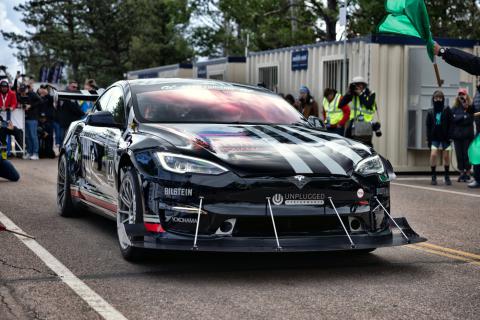
The day after the Cobra Jet 1400’s record run, professional road racer and Motor Trend journalist Randy Pobst piloted the newly built Unplugged Performance Tesla Model S Plaid to 10th overall in the 99th Pikes Peak International Hill Climb, also winning the Exhibition class. The car, which used a totally stock triple-motor drivetrain making 1,020 horsepower, had track-modified suspension and aero pieces available for Teslas from Unplugged Performance. With the same Tesla, Pobst also ran a 1:28.21 lap at WeatherTech Raceway Laguna Seca, just 0.6-second behind the lap record for a production car that he had previously set in a $1 million internal-combustion-engine-powered McLaren Senna.
In off-road racing, the grueling Mint 400 in Nevada opened an EV class for this year’s event in December, and Audi announced it would campaign an EV in the Dakar Rally in Saudi Arabia the following month. Since much of motorsports stems largely from connections to production vehicles—even if just visually—none of this should come as a surprise. Global carmakers, from mainstream to high-end luxury, had already announced goals and multi-billion-dollar investments to transition to EV-only production within about 15 years. Some have set even more ambitious goals than the White House announced in August.
While excitement for EVs is building in pockets of the racing community, at this point, nobody is calling for replacement of internal combustion engines (ICE) in motorsports. Instead, EV builders and racers, along with aftermarket suppliers and sanctioning bodies, are asking: How do EVs fit into our industry and sport? Where are the business opportunities? Who are the pioneers and innovators, and what challenges are they working to solve?
Here’s a start on some answers.
NHRA PREPPING for EV DragS
The NHRA sees EVs as a growth opportunity. By working with OEMs, the organization plans to “remain on the forefront of all things performance,” said Brad Gerber of the Glendora, California-based drag racing sanctioning organization.
Gerber confirmed that the NHRA has held individual and group calls with automakers, including Chevrolet, Ford, Kia, Toyota, and Dodge. An in-person meeting held at the Gainesville race in March gathered information from racers and other stakeholders, and more such meetings were scheduled.
“We want to get everybody going in the same direction,” Gerber told PRI.
While EVs are currently legal to race in the NHRA, the new EV category announced for the 2022 Summit Series solidifies their place in the sport. Electric cars will compete in all seven NHRA Divisions, with a national champion crowned at the Dodge//SRT NHRA Nationals Presented by Pennzoil in Las Vegas, Nevada, before the 2022 SEMA Show.
Final rules for the new EV category are expected by late 2021, giving teams a chance to build cars. To help make that a little easier, modifications will be limited to suspension, wheels, and tires for their first year in the series. Gerber said the NHRA also wants to develop a specific EV class but had no details yet.
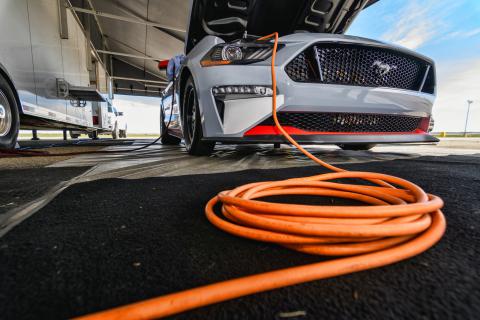
Electric race cars are going mainstream, thanks largely to projects like Ford’s Mustang Cobra Jet 1400, an exhibition drag car that routinely clicks off low-8-second 1/4-mile ETs.
“EV is not replacing anything,” he said. “It’s an addition. The new EV category in the Summit Series is the easiest way to get this going at the grassroots level.”
Each carmaker is at a different stage in its EV program, which is one of the challenges going forward, Gerber acknowledged. “For example, Ford wants to go in as fast as possible, while Toyota won’t have an EV until 2024 or 2025.”
Gerber said the NHRA wants the EV entries “to look like manufacturers’ cars, but we also have to be concerned about their weight, speed and safety. For example, we need to know what the battery compartment looks like. How safe is it in a high-speed accident? We have to have plans in place for extricating the driver and dealing with fire if necessary.”
Gerber suggested as one possibility a spec tube-frame chassis with a compartmentalized battery and using an OEM’s EV system and body. “It could look like a Camaro, Mustang, Challenger, Supra, whatever it may be,” he said. “This opens opportunities for manufacturers to do R&D in a safe environment.”
Performance companies have expressed interest in contingency and sponsorship opportunities for the new class, Gerber confirmed.
“It’s a relatively new industry with a lot of innovation going on, and people want to be on the forefront of that,” he said. “We can put them on the forefront on a national level. We own our own production; we control the content.”
Mint 400 Opens to EVs
Some of the most important new EVs coming down the pike are pickup trucks and SUVs, the heart of the US auto market. They’ll now have a new venue to prove their mettle in off-road racing: The Mint 400 in Nevada launched a new EV class starting with this year’s race in December.
Matt Martelli of Terranaut Media Group in Vista, California, which owns and manages the Mint 400, said the new class was created in response to requests from EV makers. It is open to all manufacturers and models, though there was no estimate of potential entries as of early August.
The annual race, which runs in some of the harshest conditions in the Mojave Desert, welcomes more than 400 race teams competing in everything from Class 11 stock VW Beetles to Trophy Trucks. Martelli believes EV trucks could fit right in, and that a brutal off-road race could be both an ideal proving ground and promotional opportunity for manufacturers.
EVs such as Teslas are eligible for SCCA solo competition, and the organization has formed a dedicated committee to integrate EVs into other SCCA events.
“Off-road racing has a long history of embracing new technology,” Martelli said. “It’s a culture and sport, but it’s also a business. We want OEMs, the aftermarket and suppliers and builders to come and be part of this. We want to make it a successful promotional platform for them and help new technology develop.”
Martelli said more than a dozen companies expressed interest in the new EV class, but the new class was announced in the spring, leaving only about eight months to prepare an entry for this year’s race. Importantly, he explained that the Mint 400 would require no changes to accommodate EVs.
“Our race is ideal for this,” he said. “It has four 100-mile loops with a pit every 30 miles. So, whether EV teams need to recharge or swap batteries, we can allow for that. We’ve discussed with different companies having different time stops.”
Martelli expressed confidence that the race could handle EV-related safety issues. “We’re already using high-speed, high-density fuel towers, which probably require more for safety than lithium-ion,” he said. “It’s just a different protocol.”
Consumer exposure will be critical for any EV racer’s success as a promotional tool. Martelli said the Mint 400 fits the bill with more than 65,000 spectators over four days of racing. This includes a start/finish in Stateline, Nevada, plus remote spectating areas and the Mint 400 Off-Road Festival in Las Vegas.
Given the popularity of off-road racing, this will be a space for EV builders and aftermarket suppliers to follow closely.
SCCA Makes Way for Electric Sports Cars
The Sports Car Club of America in Topeka, Kansas, which in the past sanctioned such legendary series as the Trans Am and Can-Am, is preparing to integrate EVs into the club’s various programs. The club’s recently formed Electrified Vehicle Advisory Committee (EVAC), which includes board liaison Dayle Frame and representatives from the different SCCA programs, is tasked with gathering information from tracks, racers and other stakeholders.
Only the club’s Time Trials/Track Events section had been working with EVs to this point, according to Jon Krolewicz, who manages that program. Notably, it had already classed individual EVs, including Tesla, for Solo, in which drivers race individually against the clock. His section wrote a displacement-equivalency formula based on horsepower for an EV to compete with ICE cars and integrate them into ICE classes.
The thrust of the EVAC’s work, Krolewicz explained, is unifying EV safety information and procedures across the club. “Once we have that, it becomes the platform from which a racing class can be started,” he said.
Among the safety concerns tracks must address are driver extraction and fire suppression in a crash, according to Krolewicz. Lithium-ion is the most common battery chemistry for production cars, which is why the SCCA is focused on it.
“The basic safety of a production car like a Tesla is vastly different than, for example, someone converting a Formula Ford to EV,” Krolewicz said. “We need to create rules that allow both production and specially built EVs to run.”
Because many SCCA drivers build their racers from well-used cars, the club is taking a long view when forming EV classes and rules. “There will be many more production EVs in the next few years, and we know that in five years, and most certainly 10 years, these will be very accessible to turn into club race cars,” Krolewicz said.
Charging infrastructure is another challenge the SCCA is studying, and it could be an opportunity for the charging industry. Right now, a race team might need its own diesel generator to charge an EV, but Krolewicz anticipates that as EVs proliferate, tracks will be inquiring about greater charging needs. Battery swaps may become an option for specially built race cars, he said.
“That’s more of a track issue, but it is a consideration for SCCA, because we can’t put together a 30-car EV field and then find there isn’t enough charging infrastructure for them,” he said.
Finally, Krolewicz said the SCCA is encouraged by the interest expressed in EV racing from outside the club. “What has our attention is that aftermarket companies want to get onboard,” he said.
Turn 14 Distribution Gears Up for EV Parts
The total number of EVs on the road right now is relatively small, and most are Teslas. That situation is evolving rapidly, however, opening business opportunities. Turn 14 Distribution in Horsham, Pennsylvania, has indicated its commitment to this growing market, including sponsorship of a Tesla Model 3 in last June’s Pikes Peak International Hill Climb.
Dai Yoshihara, who won the Unlimited Division in the 2020 race in a Toyota 86, piloted the car to 51st place out of 54 finishers. (The course had been shortened from the normal 12.42 miles to 9 miles due to ice on the road near the top.) Other partners on the project included CSF Radiators, KW Suspension, Sparco, and Titan 7 Wheels.
The Pikes Peak International Hill Climb has emerged as a potent showcase for EVs; the current overall record is held by an EV, and Turn 14 Distribution sponsors a Tesla for the event. Photo courtesy of Turn 14 Distribution.
“As a performance parts distributor, the connection to EVs is an important one for the future of the aftermarket industry and our business,” Daryl Sampson of Turn 14 Distribution told PRI. “The long-term strategy is to bring attention to the EV market, announce our support for the market and our partners who are willing to be pioneers, and embrace it by producing parts for a segment that will only grow in coming years.”
An EV already holds the overall record on the mountain: Romain Dumas covered the full course in the Volkswagen I.D. R Pikes Peak in a remarkable 7:57.148 in the 2018 event, more than 16 seconds faster than Sébastien Loeb achieved driving a Peugeot in 2013.
What kind of parts will sell for a car like the Tesla Model S, which offers up to 1,020 horsepower from the factory? There are already numerous aftermarket opportunities for EVs with chassis and body upgrades. Turn 14 Distribution last year provided a Tesla Model 3 to a carbon fiber manufacturer to develop parts for it, and the distributor is now exclusively offering the products, Sampson revealed.
“As a leader in the performance wholesale aftermarket distribution arena, we are certain that this is the future of the automotive landscape and have made the decision to embrace it,” he said. “We’ve been in contact with our existing business partners to let them know that we are willing and ready to support, buy, and inventory products as they are developed for the market.”
The Turn 14 Distribution-sponsored Tesla will be on display at the SEMA and PRI shows and various track events throughout Southern California.
Entropy Racing EVSR Racing Program Gets A Running Start in SCCA
One SCCA competitor, Entropy Racing in Sacramento, Pennsylvania, has already been winning road-course bracket races against ICE cars in the club’s Washington, DC and South Jersey Regions with its electric sports-racer, the EVSR.
“We are the only EV racing on real race tracks against gas cars,” said Charlie Greenhaus.
Entropy’s efforts with the EVSR demonstrate the viability and challenges of independently built EV race cars. The company has built four cars and currently has three more awaiting completion. Customers are renting and campaigning two cars, and EVSR plans to run the NASA 25 Hours of Thunderhill race in December using battery swaps.
To help spread its message, Entropy/EVSR became the title sponsor for the EVSR Bracket Racing Championship Series running at Summit Point Motorsports Park in West Virginia. The series is open to cars from virtually any series, but as of early August, EVSR was the only electric entrant.
Entropy Racing’s EVSR road racer is unusual in that it competes on-track against gas cars. Since its debut in 2014, EVSRs have amassed approximately 20 victories.
The first EVSR raced in 2014 and began winning against ICE cars immediately, according to Greenhaus, including beating a field of 18 Spec Racer Fords at New Jersey Motorsports Park. The EVSR team has since earned about 20 victories and numerous top-10 finishes.
Greenhaus described the EVSR setup as “simple,” as “there’s forklift equipment in our cars. These motors have been around for 15–20 years.” The EVSR typically makes 170–180 hp. It can be pushed as high as 220 hp, or, if more range is needed, dialed back to 150 hp. “Tuning” is done by plugging the car into a laptop and adjusting EV system parameters, just as one might adjust mapping for an ICE. Typical top speed is 125 mph, though the car has reached 140 mph.
The EVSR’s lithium-ferrous phosphate (LFP/LiFePO4) battery has been specified for any EV entrants coming into the series. It is less energy-dense than lithium-ion, but its 50 miles of range is more than enough for the 22–30 mile races in the series. Greenhaus describes its chemistry as “very stable” and able to handle impacts well and with easy and quick fire suppression.
He pointed out advantages over ICE race cars, including 40% less prep time. “We get the cars cleaned up, prepped, charged and ready for the next race and put them on the trucks. In the morning, it’s just turn on and go racing,” he said.
With no shifting for the direct-drive transmission and no driveline lash, the EVSR is said to perform very well in rain and go easier on its suspension than ICE cars. Also, there is very little powertrain maintenance.
Buying an EVSR outright would cost about $100,000, including charging equipment, according to Greenhaus. That’s much higher than the $60,000 or so for a new race-prepped Spec Miata but can be a bit less than a BMW E46 M3. Getting a sponsor, Greenhaus said, could push the EVSR program to the next level.
Electric GT Converting ICE Into EV
Like every period in hot rodding and racing, the EV era has pioneers and innovators who push technology forward. Electric GT in Huntington Beach, California, is one example. The company started about five years ago with the conversion of a damaged 1978 Ferrari 308 GTS. The car raised eyebrows for both its audacity and its blazing performance compared to the original V8 model. Today, Electric GT offers conversion packages for a growing number of applications.
When PRI caught up with Electric GT partner Brock Winberg, the shop was converting a client’s Porsche 911/934 RSR clone that had been vintage-raced and already had racing suspension. The owner, who also has two Teslas and cars built by Electric GT, plans to autocross the electrified Porsche.
EV racing’s future popularity will depend largely on aftermarket support, such as Electric GT’s eGT-913 Porsche system that converts 1969–1989 Porsche 911s to electric power.
A big driver in the conversion business is the availability of Tesla Large Drive Units from salvage cars. The “LDU” has essentially become the Chevy LS of the EV conversion world. This compact, sub-300-pound package integrates the motor, single-speed transmission, differential and inverter.
Winberg expects this trend to continue until other brands’ EV motor units are available in significant numbers. “It always boils down to what is the most widely available and most supported by the aftermarket,” he said. “Right now, that’s Tesla. It’s quite a lot of power for the money.”
As with the Chevy LS, an ecosystem is growing around the Tesla technology. Electric GT uses controller units (VCUs) from AEM, which replace the Tesla logic board. The AEM system, co-developed with Cascadia Motion, can “recharacterize” the motor to boost output and other parameters. (The Mustang Cobra Jet 1400 uses the AEM technology.)
“AEM is really the first one to be doing this on an aftermarket level,” Winberg said. “Its AEMcal software gets in there like HP Tuners do for a gas engine, and racers can play with the torque tables. It really opens up the tech-savvy tuning aspect. We’re going to see a lot more of that in the industry.”
Winberg explained that the Tesla LDU works most easily in cars that have independent rear suspension. “It’s not undoable with a solid-axle rear, but it takes a whole lot more fabrication,” he said. (Aftermarket IRS setups are available for some classic muscle cars.)
The Tesla Model 3 and Model Y use different technology than the Model S, and there are some challenges to using it, according to Winberg. “We’re starting to experiment,” he said. His bottom-line message to builders and aftermarket suppliers, though, is simple: “Don’t miss out on this trend.”
In these times of need-it-now instant gratification, seemingly endless virtual meetings, and COVID-related shortages, it’s an old-fashioned personal touch that can often be the key to successful partnerships.
Parts manufacturers and dealers in the motorsports industry are joined at the hip, with the health of one affecting the health of the other. Sometimes that can be a turbulent ride, particularly during the past year, when material shortages, supply chain disruptions, and a cracked labor market have placed enormous strains on racing enterprises from coast to coast.
Pandemic conditions aside, the relationship between manufacturers and dealers has been evolving in a number of ways in the past few years. For one, the speed of business and the expectations for rapid delivery have only accelerated.
“The level of satisfaction that we have to provide now has to be right now,” said Scott Neely of Cometic Gasket, Concord, Ohio. “People don’t want to wait for anything. Everybody has become so accustomed to getting everything right now. If it’s not in stock, they’re just on to the next Google search result to find the parts. I would say there’s a lot less patience in the marketplace than there used to be.”
Of course, the speed with which the market now operates is not just a matter of demand, it is also a reflection of what is technologically possible today. Jeff Evers, also from Cometic Gasket, described how new systems have led to much quicker product development.
“Everything being data driven—ACES [Aftermarket Catalog Enhanced Standard] and PIES [Product Information Exchange Standard]—we’ve been working hard to get everything in those formats,” Evers said. “We can produce a gasket, and within that same afternoon, once that first article is done and approved, we can get it on our websites, on our data feed, we can get our marketing department to take a picture of it, and it’s all out there within an afternoon, compared to waiting a year cycle for a new catalog. That’s just the way data has changed and information is distributed.”
That type of manufacturer ability leads to opportunities for ambitious distributors. “Customers who request the ACES and PIES files then have access to all of your product,” Neely added. “Somebody could have our file and build a website in an afternoon and be in business the next morning. Everything is just so much quicker and so much faster.”
Another shift in the manufacturer/dealer relationship has seen makers of parts and sellers of parts tied more closely together, for a variety of reasons. “The relationships I have with many manufacturers has become more of a partnership in recent years,” said Rich Willerton at Pegasus Auto Racing Supplies, New Berlin, Wisconsin. “In years past, dealings were more straightforward: This is what they have, this is what we want. Most interaction was a little back-and-forth trying to negotiate a better deal. Now there are more factors involved—shared marketing, product promotions, and customer referrals—which may have previously been nonexistent.”
Part of that shift is due to the rise of distributors that specialize in very particular markets. “The evolution of the dealer relationship has changed to a much more targeted level of communication,” said Neely. “The quantity of niche customers has increased, and the number of broadly stocking distributors has decreased. The way you work with a customer today is much more focused on the specifics of the items and/or categories. Increased tech and application information is now more important than ever, and the ability to directly communicate that information is key. Increased product detail when releasing new products and applications is first, with all mechanisms of communication required. Electronic direct feed, social media, and in-person follow-up are the only ways to ensure that information gets consumed. ‘Sending an email’ doesn’t get it done, ‘putting it on the website’ doesn’t get it done. A full coverage effort is what is needed, and people dedicated to the task is key.”
Manufacturer-dealer relationships are evolving, even while the pandemic strains supply chains like never before. Intensifying these challenges is a customer base that expects to receive parts almost immediately.
Living, as we are, in the “information age,” the flow of that data is crucial to smooth relations between manufacturers and dealers. “From the manufacturer perspective, we are striving to have the tools available for the dealer to learn about our new products, or if we have updated any established part numbers, as quickly as possible,” said Thor Schroeder of Moroso Performance Products, Guilford, Connecticut. “We do this by having our company on a continual basis update the electronic data of our products and have it available for our customers’ use.”
Much of the detailed product information in past years was a kind of “inside baseball” that didn’t always filter to the racing grassroots. That’s not the case anymore. “I think there’s definitely been some evolution, particularly on the short track side of things, from manufacturer to dealer,” said Chris Dilbeck of PFC Brakes, Clover, South Carolina. “I know there has been for us, specifically. It just seems like years and years ago, some people would consider a distributor as just an order taker, to where they would just try to get their hands on onesies-twosies, whatever it was a customer may want. But now, a lot of the distributors are more tech savvy, and racers themselves are a lot more educated on the product.”
Manufacturers’ Outlook
There are varying perspectives from the manufacturers’ side on what makes for a good working relationship (and vice-versa, see below). Neely at Cometic Gasket likes to see commitment first and foremost. “There are plenty of effective ‘order takers’ in the automotive and performance aftermarket. Those willing to represent your brand by stocking inventory is the difference between ‘top of mind’ and ‘they asked for it,’” he said.
A dealer/distributor looking to provide “above and beyond” service will display “the willingness to spend the time needed to detail issues to solution,” Neely said. “If a problem or opportunity exists, telling your partner manufacturer about it is helpful. Willingness to support that effort with inventory commitment is even more so. Communication through sales and then tech departments is the best way to strengthen the manufacturer and dealer relationship.”
A regular part of PFC Brakes’ promotional efforts includes a PRI Trade Show special. The disruptions of 2020 were not as bad for PFC as they might have been, thanks to a number of dealers stepping up to the plate. “We still had a PRI special even though we didn’t have the Show last year,” Dilbeck said. “But our larger dealers still understood the importance of our end users. Car build season was coming with or without COVID. Our end users still needed parts, and so we had some distributors that still did their annual purchase volumes. We actually had a good year from our short-track grassroots market distributors. Our PRI discount was a part of that, but they rely on us heavily to give them forecasts and give them a pulse of the end-user market so that they know what kind of volumes to purchase from us.
“So we have a very good working relationship with our best distributors when it comes to giving them a heads-up on what we feel like they need to order. And there is a lot of trust there because they order it,” Dilbeck continued. “That is a dream distributor, one that you can, especially from a sales standpoint, say, ‘Hey, we’ve got these certain part numbers we’re seeing an uptick in, seeing some demand grow out in the marketplace, would you be willing to order X amount of these for us to be able to make a larger run?’ All of our best distributors always participate in those things.”
Moroso’s Schroeder listed a number of things the company likes to see from distributors: “A dealer partner that holds their pricing on the product lines that they currently sell. Their reputation scores and how they are promoting their business either through content and/or on what social media platforms. Since we are an established company, we have to analyze how they would fit in with our other customers.”
Dealers’ Outlook
On the other side, dealers have certain criteria they use to judge the value of their relationships with manufacturers. For Willerton at Pegasus, the most important factor can be summed up in one word: “Responsiveness. On the dealer side, we deal with the end user, and they demand answers immediately. Many of those answers have to come from the manufacturer, and delays of days and even weeks can hurt the customer/dealer relationship, which in turn may harm the dealer/manufacturer relationship. As a buyer, I also have to be flexible with the manufacturer. Being willing to work around small mistakes and understanding delay issues, especially this past year, has strengthened relationships with many of my suppliers.”
Willerton also noted the importance of face-to-face meetings when it comes to strengthening ties between Pegasus and the manufacturers it works with. “Providing marketing and training materials for our salespeople has become increasingly important the larger our company grows. In-house training visits from representatives gives us a first-hand interaction with new products that has become invaluable. Other services, such as shipping on our account or using our preferred method, show that a manufacturer is willing to do more to make a lasting partnership.”
Suppliers such as PFC Brakes depend on the annual PRI Trade Show to strengthen relationships. To help make up for the canceled 2020 event, the company offered its Show Specials to customers anyway.
Jake Knowles is a racer who also runs Knowles Race Parts and Bodies in Rome, Georgia. For him, speed of shipping is critical when evaluating manufacturer performance. “Same-day shipping is always a plus. You know racers, they need it right now.” But sometimes just the basics of having parts in stock is the key thing. “If they’ve got it there on the shelf and they can ship it out that day, that’s a big plus.”
Manufacturers that sell directly to the public is a sensitive subject, as it can make life tougher for dealers. “My biggest pet peeve is to have to compete against a manufacturer,” said Bernie Stuebgen of Indy Race Parts, Indianapolis, Indiana. “Some of them won’t sell direct, and some of them do sell direct. Sometimes it’s difficult to compete against the ones that sell direct. You often question yourself, ‘Why do I stock their product?’ Whenever I have to compete against them for the sale, sometimes they will ultimately undercut you and sell it at retail cheaper than what you’re able to sell it for. That’s, unfortunately, always been a struggle. There are a few manufacturers that stick out way more than others. That’s just what you have to endure if you want to do this and be in it.”
One way that manufacturers that sell direct try to minimize that impact is by only selling parts for full retail price to the general public, while allowing their dealers to sell at a discount off list through a Minimum Advertised Price (MAP) policy. That’s how Cometic Gasket balances the competing interests.
“We have a MAP policy. If you have one, then you’d better enforce it,” Neely said. “We’ve kind of run the gamut of using some outside agencies to enforce our MAP. But we find that our customers are some of our best enforcers. They will point out to us other customers that are undercutting or whatever. They’ll send us links and screen grabs and everything else, and then we address it and confirm with the customer that it was handled. If you’re going to have one, then you’d better enforce it, otherwise you’re going to erode your product’s profitability.”
Common Ground: The Race Track
Increasingly, shared experiences at the track lead to closer ties between manufacturers and dealers.
“I think it goes back to the manufacturer and how well they educate their distributor and their sales staff,” explained Dilbeck. “But in a lot of cases, like our bigger distributors, they have sales guys who are racers, just like we are at PFC. They go out and try the products on their race cars. They know which ones are favored in certain arenas and know how to troubleshoot them. I feel like that has really helped us with our big distributors, just having knowledgeable sales staff as an extension of the PFC sales staff when it comes to distribution. That helps build that rapport between a manufacturer and a distributor, that common ground that we’re going racing on a Saturday night, and they are, too. That just makes work a little more fun.”
Racing experience and on-track performance are vital to building trust and respect. “I really only carry stuff that I would use myself,” said our source at Indy Race Parts.
“If the manufacturer actually is in racing and not just works there, I think that helps a lot too, because they know more about what we’re talking about,” said Knowles. “If they need something, they would want it that quick, so they know that we need it.”
For some distributors, parts won’t get through the door until they’ve proven their worth on the race track. “I really only carry stuff that I would use myself,” said Indy Race Parts’ Stuebgen. “You can buy some stuff from here or there, but sometimes I just question the quality of their material or where it’s manufactured.”
When Problems Arise
It’s inevitable there will be conflicts between those who make parts and those who sell them. Cometic Gasket’s Neely said that one way to diffuse them is with personal visits. “Having outside manufacturer reps who are in the field, able to bring these conversations up in a professional and structured way, allows us to prioritize the customer’s needs by identifying what can be done with existing procedures and policies, and moving to any unique circumstance that cause us to be on different pages.”
“Most of my manufacturers are willing to work with me but are not always able to comply with our company’s needs,” said Pegasus Auto Racing Supplies’ Willerton. “By being understanding and flexible with my suppliers, I have built up a bit of prestige among some of them, which sometimes allows a few favors to be called in. Other situations may call for a little give-and-take. There are times however, that an agreement cannot be met, and you may have to find another source.
While much of the aftermarket has moved online, there’s still a need for physical stores and reps to service them. “In our industry, people want to see people,” noted our source at Cometic Gasket.
“In one instance,” he continued, “a manufacturer had created some new products that they wanted us to push, which were not in line with our customers’ needs. I had to respectfully decline and risk that this manufacturer would put an end to or greatly reduce the relationship we had built over the years. We still have that relationship, but the continued growth between us has slowed. I must add that the decision that was made has worked out better for us.”
The pandemic continues to throw a wrench in the works when it comes to manufacturer/dealer relations. Stuebgen has seen relationships become more impersonal. “I spend so much time of my day on the phone, I just get tired of being on the phone,” he said. “So a lot of contact now, if I know certain people at certain places, I just text message people or email. Sometimes I go through Facebook Messenger or Twitter to reach out to somebody to order something. It’s not the same as it used to be, where you’d just call up on the phone, or old-school, send a fax.
“Maybe some of it’s COVID-related,” Stuebgen added. “It is funny, since everybody wants to draw the ‘COVID card,’ that’s just how some places are now. I chuckle because you call certain places, and nobody ever answers the phone. But you send an email and you get a response back in three minutes.”
The Road Ahead
As 2022 approaches, the pandemic is still reshaping relations between manufacturers and dealers. But through it all, the basics of business haven’t changed much.
“The old standards still apply when selecting a new source: quality, pricing, and delivery,” said Willerton. “Currently, delivery of product has a greater emphasis compared to other factors. Supply chain issues have plagued many manufacturers, and the ability to provide the goods on a timely basis has been a major struggle.
“If most factors are equal, the ability and willingness of a manufacturer to work within your needs is a big plus in that final decision,” Willerton added. “Even minor elements such as return policy, bonus discounts, and shipping flexibility show that a supplier is interested in more of a partnership than a transaction-based relationship.”
Online transactions can be fleeting, but relationships with WDs and the shops they serve often span decades. Regardless, the end goal is the same—getting parts in the hands of racers.
The international aspect of so much of the motorsports industry is another factor that will continue to shape business relationships. “With most top manufacturers, our relationships have gotten closer and stronger,” Willerton said. “There is a lot of competition between manufacturers, especially with overseas manufacturers having easier and greater access to dealers, and that has led many to contribute more to the relationship. Providing more service than just a transaction builds the relationship and helps those manufacturers and suppliers feel more like a partner with the dealers. The few that have become more impersonal have raised red flags about the financial state of their business. If they just don’t care anymore, they are possibly on their way out of business.”
What the post-pandemic landscape will look like is anybody’s guess. Are the changes permanent or transitory? “I think it’s probably going to take a year’s cycle to see,” said Cometic Gasket’s Neely. “We went from doing a lot of open house shows and warehouse shows to virtual events.”
Yet racing has always been more personal than that. “In our industry, people want to see people,” Neely said. “They want to talk over a beer, they want to walk around the warehouse, check out everybody’s products, they want to go to car shows and look at hot rods. It’s a much more hands-on crowd. Sure, you save a lot of money with no travel, but the personal things suffer when you can’t be in front of your customers, can’t work directly with your customers at their facilities, can’t do training seminars and those kinds of things. There’s no way you can sit there looking at a Zoom meeting or a PowerPoint and get the same interaction with customers as you can being in their facility, having a lunch brought in and going over all your different products. There’s no way you’re going to get that online.”
New product introductions are the key attraction at the PRI Trade Show, so add these first-time exhibitors to your list of companies’ booths to visit in December.
Motorsports constantly evolve and always innovate. Racers don’t win by doing what they did last year. Yet it can be challenging to keep up with the latest products, services, and technologies.
That’s why it’s important for racers—and anyone involved in the racing industry—to make a point of attending the PRI Show, scheduled for December 9–11, at the Indiana Convention Center and Lucas Oil Stadium. Each year, the Show welcomes new exhibitors and their exciting products, and 2021 will be no exception. Many companies new to PRI are among the Show’s confirmed lineup of approximately 1,000 exhibitors. These newcomers will showcase their offerings of race products, trailers, machinery, and simulation and testing technologies among the Show’s 750,000 square feet of total exhibition space.
“Attendees can expect to see new products and innovative changes to existing products from our first-time exhibitors,” said PRI Sales Director Celina Ingargiola.
Andrea Brake, another sales director on the PRI team, noted, “Long-time attendees can look forward to seeing new products and possibly finding a new supplier or customer. New exhibitors keep the PRI Show fresh and exciting, plus they’re a great sign that our industry is heathy and growing.”
Here are a few of the latest companies to join the line-up.
Morimoto Lighting
When it comes to performance automotive, lighting is probably not the first thing to come to mind. But Atlanta, Georgia-based Morimoto Lighting is out to change that.
Morimoto headlights improve nighttime safety by allowing racers and production-vehicle drivers to see farther down the road—and a wider view side-to-side—illuminating obstacles much sooner than with original-equipment headlights.
New exhibitors to the PRI Trade Show in December provide a fresh and different perspective with products not only for race vehicles, but for the shop, trailers, and tow vehicles, such as these accessories from Morimoto Lighting.
“We know that almost every single person who races owns a truck, either to race with or to haul their racing vehicle(s),” said Chris Nelson. “At Morimoto, we believe the truck that tows a racer’s toys also needs some attention when it comes to safety, style and performance.”
Truck lights aren’t the only “bright idea” Morimoto is bringing to the Show. In addition to showcasing its entire product line of LED headlights, fog lights and taillights, it will unveil some new racing-specific products that are top secret until showtime. For a pre-show look at its products, visit morimotolighting.com.
FFP CustomS
Pedal faster! That’s the idea behind some of the products offered by FFP Custom Bolt and Go Parts.
Made in Dover, Florida, the Bolt and Go product line includes its Wireless LED Roll Bar Light Mount and Bolt On Oil Fill. But its innovative patented Bolt On Pedal Assembly enables quicker shifts for manual-transmission powertrains.
Although the pedal assembly was initially designed to be added at the factory, FFP Custom will demonstrate how DIYers can install it themselves.
In 2015, company owner Ryan Frazier began by working on other people’s cars. When he couldn’t find what he needed, he soon designed his own line of custom parts. In 2017, business was so good that Frazier devoted himself to creating and manufacturing innovative parts that customers didn’t know they needed—until they found they couldn’t race without them.
To see how simple the pedal kit installation is, FFP Custom will have a cut-away driver’s compartment so attendees can try it for themselves, and then take a comfortable seat behind the wheel. Learn more at ffpcustoms.com.
SpringRithm
Owners of chassis shops and service facilities know that a spring smasher can cost some two grand or more. It’s no small investment, but a necessary piece of equipment—until now.
SpringRithm is an app designed to smash springs virtually using a cell phone or other mobile device. SpringRithm works by outputting measurements so the user can set springs to reach desired loads. It’s designed for users who don’t have access to a coilover testing machine or spring smasher, but still need dial-in coilovers correctly tuned.
SpringRithm outputs the dynamic loads that the springs will see in travel and tells how to preload the coilover nut to achieve the set load/loads. SpringRithm can handle single and stacked spring setups, with a bump stop analysis in the works.
According to company founder and creator Benny Boudreaux IV, SpringRithm has been in development for more than two years, and the final release is ready for use in the auto racing world. “Although we developed it with oval dirt racing in mind, SpringRithm can be used for a variety of performance vehicles,” he said.
Curious? At the Show, SpringRithm will have a few iPads running the app and a spring smasher to compare results. (An Android version should be available by showtime.) Demos will include single spring setups, progressive stack setups, and digressive stacks. Visit the company’s Facebook page, SpringRithm by B4 Unlimited, for demo videos and FAQs.
Ohio Brush Works
Since its founding in 2000, Delaware Paint Company of Plain City, Ohio, has focused on industrial, marine, protective and military coatings and applicators. Recently, it launched a new division, Ohio Brush Works, dedicated to designing and manufacturing quality auto paint brushes. As happened with many businesses that pushed to diversify their products in 2020, Ohio Brush Works found itself with the opportunity to develop a premier line of brushes for the auto industry.
“We think our auto brushes are the best-made brushes around,” said Pete Newton. “We’ve designed them to be rugged and long-lasting and provide a smooth finish when applying paints and coatings. We are excited to share them with a new audience at the best racing show in the country.” Ohio Brush Works will offer product giveaways and exclusive show discounts. Check out what the company has to offer at ohiobrushworks.com.
Hart’s Turbo
Fans of tractor or truck pulling know the Hart name. For more than 25 years, the company has been held in high regard for its performance tractor- and truck-pulling turbochargers, fuel injection pumps and injectors.
This year brought a new opportunity for this small-town business run by a father and two sons. They’ve founded a new division, Hart’s Turbo, that brings their diesel performance expertise to aftermarket turbochargers for gasoline and street/strip applications.
For diesel competitors in particular, Hart’s Turbo will display its truck- and tractor-pulling turbochargers at PRI 2021, along with a newly expanded line of turbos for gasoline and street/strip applications.
“We look forward to introducing the Hart name and the highest quality USA-made turbos in the world to a whole new audience of performance mavens,” noted Roger Conley.
Booth visitors will get an up-close, hands-on view of Hart’s newest car. To learn more about Hart pre-Show, visit hartsturbo.com.
M1 Concourse
Michigan is the home of the M1 Concourse, a new and unique facility located at the north end of the famed Woodward Avenue in Pontiac. The M1 Concourse is perfect for vehicle and product reveals, as cars can be staged inside, then driven out onto the track for a demonstration.
“Events at the M1 Concourse are not static,” said Tim McGrane. “Our 28,500-square-foot event center can host an elegant sit-down dinner for 350 or an outdoor event on the terrace for 2,500. Each event overlooks the Champion Motor Speedway, where guests can enjoy pit access and thrill rides around our 1.5-mile track. Event organizers can even hire one of our professional drivers to teach guests how to drive controlled laps behind the wheel of a performance vehicle.”
While at the PRI Trade Show, learn more about the unique and multi-purpose M1 Concourse, located at the north end of the famed Woodward Avenue in Pontiac, Michigan.
Other amenities include a multi-purpose outdoor event arena with a 2.5-acre skid-pad and covered event spaces that can accommodate groups of 500. M1 Concourse also offers private garages, repair and restoration shops, and restaurants.
Take a look around the M1 Concourse at m1concourse.com.
Vengeance Racing
Ron Mowen, owner of Vengeance Racing (VR) of Cumming, Georgia, is no stranger to PRI. “We have provided display vehicles for various PRI exhibitors over the years and felt it was time we create our own display,” he said. “We felt it would be an honor to be included in the PRI Show as an actual exhibitor. Quite honestly, we felt we were already doing 90% of the work required by providing and transporting Show vehicles for other exhibitors, but not reaping the benefit of being able to actually market our company and promote our brand.”
Team Vengeance is coming to Indy specifically to showcase its latest in-house build and shop race car, a sixth-generation Corvette Z06 called Fatman 3.0. “This 3,500-hp C6 has a very special place in the hearts of us at VR,” Mowen said, “and we have taken it to an entirely new level using the best manufacturers in our industry. We want to show off our capabilities as well as the quality products from our vendors.”
This longtime provider of display cars at the PRI Trade Show will have its own presence at December’s event, as Vengeance Racing plans to showcase its latest in-house build and shop race car, a sixth generation Corvette Z06 known as Fatman 3.0.
Mowen clarified what he meant by “entirely new level:” Fatman 3.0 is a “3,500-hp twin turbo, billet block, full chassis, absolute perfect example of a C6 Z06 Corvette that should be making 3-second 1/8-mile passes by the time the PRI Show rolls around.” Check out some of VR’s other builds at vengeanceracing.net.
Ready For You
Indianapolis is ready to host the PRI Trade Show. Visit Indy, which serves as the Indianapolis convention bureau, has never let its guard down regarding COVID-19 with its sucessful protocols that have allowed the city to host major events—the entire 2021 NCAA Men’s Division 1 college basketball tournament, including the Final Four, and the Indianapolis 500 to name just two.
The easy way to make hotel reservations for the Show is to book through Visit Indy, which also serves as the Show’s only official housing partner. Seven new hotels and nearly 900 brand new hotel rooms will be available by showtime, allowing more motorsports professionals to stay downtown near the Indiana Convention Center and Lucas Oil Stadium.
One more thing: For the first time ever, all PRI Show attendees and exhibitors are invited to become PRI Members. Every level of membership, from the Pro Membership for individuals to the Founding Membership for corporations, unites us all to build, protect and promote our industry.
PRI’s Ingargiola summed things up when she said, “The response for the 2021 PRI Show has been incredible! Between attendance and exhibitor registration, it’s clear that the racing industry is ready to get back to business!”
Stay informed of the changing business landscape by attending one of the many PRI Education seminars that will take place during the PRI Show in Indianapolis.
If it’s your business to know the latest about airflow, valvetrains, suspensions or anything that has to do with making money in racing, you need to be at the PRI Trade Show this December 9–11, in Indianapolis, Indiana. In addition to all the new race-oriented products that will be on display, attendees can choose from more than two dozen Education Seminars taking place at the Indiana Convention Center.
Dan Schechner, PRI’s Director of Education, stated, “Like we have for years, we’re bringing experts to Indy to give PRI Members the best information on business, tech and our industry. This year, over three days, we’re offering more sessions and covering more topics than ever before.”
The following is a quick overview of the sessions. Seminars are organized into Business Track and Tech Track sessions. A complete course listing and registration information are available at performanceracing.com/trade-show/education.
Business Sessions
For those desiring to grow their businesses, there are several commonly shared concerns: growth strategies, marketing tactics and human resources. For 2021, PRI has a dozen individual sessions covering these topics and more.
Experts include content gurus, social media savants, and business and management consultants. Among them is business expert Tom Shay, who is coming back for his sixth PRI Show. Shay’s two sessions are glibly titled, “Small Businesses Don’t Die, They Just Make Too Many Mistakes!” and “You’re Making Money, But Where’s The Cash?”
Shay said he enjoys visiting Indianapolis because the city really rolls out the red carpet for the PRI Show. “My goal for 2021 is the same as any year: I want to have fun and help businesses put more money in their pockets.”
Small business owners relate to and learn from Shay’s keen understanding of business realties and human nature. For example, Shay said, “Business owners have told me, ‘My employees can’t be stealing. They’ve been with me forever.’ And I tell them, ‘Those employees could be stealing so much they can’t afford to quit!’”
Business owners need to be aware of all types of enterprise pitfalls, even the ones they don’t want to see. Anyone who runs a shop or a retail business will want to schedule time for Shay’s seminars.
Presenter Chris Salem will cover brand and business building. Salem will address the importance of identifying and communicating the core value of a business in the session titled, “Building Your Brand and Your Business Simultaneously.”
Also known as “Plumb Bob,” the incomparable Bob Balderston will present a special session at PRI 2021 for retail operators rooted in decades of experience behind the counter…and several years of stand-up comedy.
Brian Lewis and Jason Dodge each have sessions covering digital marketing. Lewis will focus on why every performance business needs to be on the web, while Dodge will discuss how to convert Internet search traffic into actual sales traffic. Just getting people to a business’s website isn’t enough to get them to buy. Dodge will explain the typical “customer journey” to maximize a business’s online sales.
In his session “Competing for Quality: Hiring and Employee Retention,” Ed Krow will help leaders learn to hire and keep the best employees.
Social media and content creation have emerged as the biggest marketing trends of the 21st century. While the “old ways” of advertising still exist (traditional TV, radio and print), a business won’t likely reach today’s mass audiences (and especially younger prospects) without a solid understanding of Facebook, Instagram and Google, as well as content marketing. Join Jennifer Cario in her two deep-dive sessions, “Facebook 2021: Build Your Reach Without Breaking The Bank,” and “Instagram Reality Check.”
Justin Cesler—a key member of the PRI Road Tour—titled his seminar, “WTF Is Content?!” The session will provide a practical, hands-on understanding of content and how to utilize various marketing channels to effectively reach customers.
John Viscardo will host PRI’s inaugural Social Influencer/Content Creation Panel of all-stars, who will share pro tips that can easily be applied to a business’s marketing efforts. Panelists include Emily Williams from Flying Sparks Garage, sports reporter Jacklyn Drake, Alex Taylor of Alex Taylor Racing, HorsepowerMonster.com’s Jeff Huneycutt and the aforementioned Justin Cesler from Driveline Studios.
Business authority Alex Striler is also leading two can’t-miss sessions: “Sponsorship 101: How to Write Proposals that Sell!” and the “PRI Presidents’ Panel.” The former focuses on sponsorship fundamentals. “This year’s seminar will help you understand why sponsors are sponsors, and what it takes to get their attention and their commitment,” Striler said. “I’ve done this session multiple times, and it’s typically standing-room only.”
Car Chix founder Jeanette DesJardins, far left, will host this year’s annual Women in Motorsports panel featuring Hendrick Motorsports’ Alba Colon, racer/stunt driver Collete Davis, Chip Ganassi Racing’s Ashley Chalk and Angela Ashmore, and drag racer Haley James.
Striler’s second session hosts an impressive panel of industry leaders including Kevin Miller, president/CEO of USAC; Julian Gill, CEO of Eibach Springs; Jesse Spungin, president/CEO of Mechanix Wear; Chris Dickerson, president/CEO of Horizon Hobby; and PRI’s own president, Dr. Jamie Meyer. “The PRI Presidents’ Panel will address current events and issues relevant to the business of racing and offer ideas on how members of the industry can collaborate to help motorsports grow,” Striler explained.
PRI covers the RPM Act, legislative lobbying and Federal Executive Agency actions that impact the entirety of the performance and racing industry. The RPM Act and PRI’s legislative efforts are helping ensure that our industry remains vibrant and protected by the government from the government. While the Presidents’ Panel may touch on the RPM Act, there is a PRI session led by Daniel Ingber and David Goch that exclusively focuses on this important legislation and how racers and businesses can get involved.
Another important seminar is the “5th Annual Women in Motorsports Panel” hosted by Jeanette DesJardins from Car Chix and Crank It Media. Her esteemed guests include Hendrick Motorsports lead engineer and program manager Alba Colon, the duo of Ashley Chalk and Angela Ashmore from Chip Ganassi Racing, racer and stunt driver Collete Davis and drag racer Haley James.
Technology Sessions
Innovation, especially in racing, never stops. Incremental changes that net small gains in performance can make the difference between leading the pack or being a back-marker. This year, tech sessions are heavy into engine building with expert-led sessions covering airflow, EFI, bearings, fluids, valve springs and more.
Legendary engine builder Darin Morgan and Preston Mosher, BES Racing Engines’ cylinder head department manager, are hosting “Air Speed in ICE and Bending the Rules for More Power.” This experienced pair will discuss the physical and regulatory rules governing induction systems and provide details about how to find the winning balance for a particular application.
In “3D Computer Flow Analysis Simulation of Performance Intake & Exhaust Port,” Dan Agnew will provide information about how to understand intake and exhaust ports using Computational Fluid Dynamics. Chris Osborn will take things from the computer to the physical world with his session, “Racing Valve Spring Design and Development.”
In his can’t-miss tech seminar, Bob Morreale of The Tuning School will review how the industry progressed from early electronic fuel injection (EFI) to modern tuning for today’s high-performance engines, and where the future of EFI tuning is headed.
Because airflow doesn’t mean a thing without some atomized fuel, Bob Morreale’s session, “The Past, Present and Future of EFI Tuning” is critical for many racers and engine builders.
Meantime, MAHLE Aftermarket’s Dan Begle will cover the design and fundamentals of performance engine bearings during his 90-minute session on opening day. Attendees will learn how race-specific components like rpm limiters, superchargers, and more affect bearing choices, and have the opportunity to ask questions of their own.
A special panel session will cover the lifeblood of any race car: fluids. The moderator is Driven Racing Oil’s Kyle Fickler, and his panelists include Jason Rueckert of VP Racing Fuels, Total Seal’s Lake Speed Jr., and Bill Alexander, also from Driven Racing Oil.
Register Now
The PRI website has a section dedicated to Education and the sessions that will be offered December 9–11. View the full list at performanceracing.com/trade-show/education, where registration is also available. Every session and leader are listed, along with a synopsis of what will be covered.
Business leader Shay told PRI, “I can’t wait to return to Indy. I look forward to PRI all year long. Of all the races, conferences, and trade shows I attend every year, PRI is by far the most productive, informative and fun.”
Jim Liaw has joined Performance Racing Industry (PRI) as the General Manager leading the staff and operations out of the Aliso Viejo, Calif., office. Having co-founded Formula Drift in 2003, Liaw introduced the sport of drifting to America and built what is now the top drifting series in the world. Reporting to PRI President Dr. Jamie Meyer and working with the PRI management team, Liaw will direct and oversee activities related to the PRI Trade Show, PRI Membership, PRI Magazine, online content, and promotion for all segments in the motorsports industry.
“We are thrilled to welcome Jim to the PRI team,” said Meyer. “He has a proven track record of success, and he knows and understands the motorsports industry. He has vision, leadership, and passion – and he shares PRI’s goal to protect and grow the racing industry.”
Like many in the automotive industry, Liaw was an auto enthusiast before he was able to drive. After graduating from UCLA, he joined McMullen Argus Publishing (now Motor Trend) as a sales associate for Sport Compact Car magazine, and later served as sales manager for one of the first-ever sport compact drag racing series, Import Drag Racing Circuit (IDRC). As a pioneer and entrepreneur, Liaw finds trends, builds brands, and cultivates new enthusiasts.
“I’m not afraid to innovate and push boundaries,” said Liaw. “I know there are challenges facing today’s motorsports industry—such as attracting younger fans, combating government restrictions, supporting race tracks and in-person events, and protecting racers’ rights—and I am excited that I can be a part of the PRI team advocating for the racing industry.”
One of Liaw’s priority initiatives as PRI General Manager will be successfully executing the 2021 PRI Trade Show in Indianapolis, Ind., on Dec. 9-11. With about 1,000 companies already committed to exhibit at the event, the PRI Trade Show is the racing industry’s No. 1 source for new technology, ideas, and business opportunities. The in-person event includes over 45 conferences, seminars, and social gatherings, making the PRI Show the best place to learn and build valuable business connections.
Liaw will also assist Meyer in building PRI’s new membership program. PRI Membership is a ground-breaking program that, for the first time ever, advocates for the motorsports market by uniting the worldwide racing community. Businesses and individuals are able to become PRI Members, thereby building, promoting, and protecting motorsports. As an organization dedicated solely to racing, PRI represents all segments of motorsports, including drifting, stock car, drag, sprint car, midget, modified, formula, dirt late model, sport compact, karting, vintage, and more.
 MEMBERSHIP LOGIN