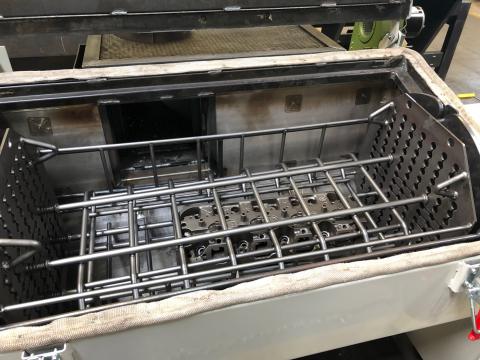
Effectively cleaning race components requires the proper equipment. Winona Van Norman recommends using its Thermal Cleaning Systems, which incorporates a three-part process that bakes off the grease and grime with its Eliminator Oven (seen here), followed by a shot blaster that blasts the ash and contaminants off the surface, and concluding with a shaker that removes the blast media.
Selecting the right equipment—and using it correctly—will help users avoid common mistakes and achieve optimal results.
Clean parts are important to ensure any sort of automotive assembly works properly. The high-stress environment of racing steps up that need considerably, to a point where the parts need to be “precision clean,” a term coined by the team at UltraSonic LLC of Amelia, Ohio. Yet there can be a disconnect between the desire for clean parts and the steps to get them there, despite the wide variety of cleaning machines and processes available to race shops and teams.
“One machine doesn’t do it all,” observed UltraSonic’s Phil Esz, who races a Top Alcohol Funny Car. “You need an arsenal of cleaning equipment.”
Dave Ward of ABS Products, Brea, California, agreed, adding, “The number-one issue we run into is using a machine not for the purpose it was intended for, or not using the proper machine for the proper results.”
Here, Esz, Ward, and other parts cleaning experts share their views about the different methods of cleaning and mistakes to avoid during the process.
The Right Tool
“Knowing the desired outcome is the key to getting the right machine,” said Ward. As an example, he compared cabinets: “If someone is looking for more of a factory look to cover up machining marks, that requires a blast cabinet with a heavier type of abrasive, such as steel grit or shot. That finish isn’t possible with a cleaning type of cabinet and media like soda or glass bead, which are more on the mild side.”
In some cases, he pointed out, “two machines may be needed. The job could start with an ultrasonic cleaning machine and finish with our HydroSlurry machine to create a clean, new-looking part. Or, for a crankshaft, a blast machine can be used to clean the crank, which then gets polished on a polishing lathe.”
Ultrasonic machines “really shine in the racing community because the parts are pretty clean to start with,” Esz explained. “It cleans the oil, grit, and dirt off in a matter of seconds.”
Cleaning materials are just as important as the equipment that houses them. In fact, problems often occur in shops where the media has been overlooked and wasn’t replaced in a timely manner. “It’s not doing the job it was originally meant to do,” said a source from Giant Finishing.
“With really dirty stuff, guys get good results using their spray cabinets and soda blasters in conjunction with an ultrasonic cleaner,” added UltraSonic’s Jason Shaw. “They can cut down on cleaning times with other equipment, and then use the ultrasonic cleaner for final clean before assembly.”
“The main question we ask the customer is, ‘Tell me about your project,’” said Mark Oryszczak of Giant Finishing, Addison, Illinois, which specializes in vibratory deburring and finishing machines. “After vibratory finishing, what is the next step in your manufacturing process? Is this final finish? Does it go to plating? Does it get painted? Are you looking to polish? Does it go to assembly? Does it get welded? What is the size of the largest part you envision putting into the machine? Those questions help us determine what type of process to give them.”
“The most difficult problem to clean is grease, especially grease that has been baked onto hot surfaces and collected other grime from the atmosphere,” said Lisa Hargrove of Winona Van Norman, Wichita, Kansas. “The most effective way to address this problem is with one of our Thermal Cleaning Systems. The three-part process bakes off the grease and grime, then blasts the ash and contaminants off the surface. Then a shaker removes the blast media and cools down the part for handling.”
The Wrong Way
The most common mistakes Hargrove sees with Thermal Cleaning Systems occur when an operator “assumes this can be done in just one process. Problems arise from skipping steps. You can’t go straight to blast or only bake if you expect to have a truly clean part.”
“One of the things people do wrong with an ultrasonic machine is put too many parts in,” Esz said. “They think they can fill the thing up like a hot tank. But when there’s a lot of weight in the tank, it sucks up all the ultrasonic power, and it’s not very effective.”
Operators also have the tendency to start the cleaning process before the water-based solution in the ultrasonic tank is up to proper temperature, Esz added. “It cleans better at the correct temperature—150 degrees—than it does at 100 or 110.”
Cleaning materials are often overlooked—and overworked—say our experts. “You have to keep that media clean,” said Oryszczak. “A lot of problems the guys have with the media come from the fact that they’ve had the same media for decades and it’s all glazed over. It’s not doing the job it was originally meant to do. Finding the right chemistry is also extremely important.”
Also, operators often “don’t have enough media in the machine, and they’re not getting the proper tumbling action,” he added. “When there’s more media in the machine, and the parts go down to the bottom of the machine, that’s when the work is getting done, when you have all that weight pushing down and grinding. If the parts are just sitting there vibrating on top, nothing’s getting done.”
Media selection has a big impact on the cleaning results as well and is “the biggest thing most people need to learn,” said Oryszczak. “There’s literally thousands of different combinations of sizes, shapes, and compositions of media. We’re creating new media all the time, coming up with new shapes for certain issues.” For example, media has been developed especially for gears, “to get into the valleys in between the teeth to make sure it gets cleaned. If you just put a general-purpose medium in it, it might be too big and won’t reach certain areas.”
The Best Thing
All of our experts encouraged engine builders or race teams to reach out with any questions they may have about parts cleaning.
“Pick up the phone and call us,” said Oryszczak. “I can get more out of a phone conversation than an email or text. You might divulge something you didn’t think is relevant that could have a huge effect on what I tell you to do.” He also invites customers to send sample parts. “Let us process them for you and get the results. We can potentially show you much better results more efficiently than what you’re doing now. Then you can come in and run sample parts with us in our lab.”
“When looking at any type of machine, especially one you’re spending big dollars for, you really should talk to people who know what they’re talking about within the industry, whether it’s the company you’re buying from or experts in that field,” said Ward. “Ask them what they’re using and how they’re using it. They won’t tell you their secrets about how they’re making their engines last longer or produce more horsepower, but they more than likely will talk to you about their cleaning equipment and how they use it.”
After setting speed records on water, this racer faced a whole new learning curve when she turned her attention to Super Comp and Top Dragster racing on dry land.
I started my racing career on the water with performance boats in 1-mile shootout events at Lake Havasu and Lake of the Ozarks. I have multiple records for fastest solo female powerboat driver on water, setting a world record in 2016 with a top speed of 185 mph in a 388 Skater powerboat.
After racing in shootouts for five years, the sport was becoming too dangerous, and we were seeing more boating accidents. I wanted to continue my racing career, so I turned to drag racing with my husband, Travis Richardson, and father, Don London, joining me.
It just so happened that Top Fuel driver Shawn Langdon’s dad, Chad Langdon, was selling his entire Super Comp operation. We went down to their shop, and it turned out to be a perfect fit.
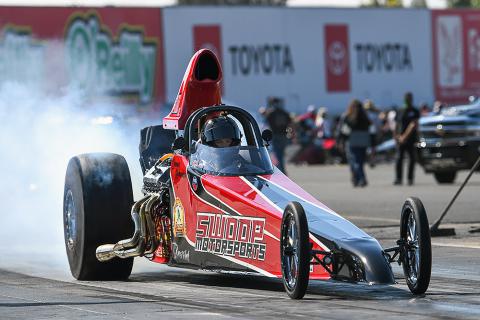
Swoop Motorsports is our race team, and we have five cars in the fleet, racing in Super Comp and Top Dragster classes. My dad has been an engine builder for years, so he built all the engines for our team.
With the first dragster I raced, we modified the car just for me at London Racing Engines (my dad’s shop). We decided to go through the car from front to back to learn everything we needed to know about the driveline and give it a complete refresh. We updated the dash to Racepak, re-wired the entire car, adjusted pedal location and cables, gave it a new paint job, got a custom seat made to fit me, added a new windshield, got a new engine build from London Racing Engines, re-certified the chassis and so much more. We truly made it custom to fit me.
For the 2021 season, we recently raced at Pomona for the first time. We didn’t have any data on the cars, and track temps were hot, so let’s just say that was a learning experience for us. However, I was able to go two rounds in Top Dragster and Super Comp.
Other events we plan to attend this year are the Divisionals in Boise, Idaho, in September (at press time), then the Vegas Divisionals, followed by the Vegas Nationals and the World Finals in Pomona. This has been a very tough year, as a lot of the races got cancelled in the beginning of 2021 due to COVID-19. They were re-scheduled at the end of the year, so we had to pick and choose what we could attend.
Prepping the race cars before events usually consists of oil changes, new spark plugs, and inspections of frames, brakes, chutes, tires and electronics. Additionally, when we arrive at the track, the weather stations go up and we start monitoring the weather, especially the DA [density altitude].
In sportsman Super Comp racing, we have learned that once you get your car running great, don’t touch it. To hit your index, you have to do the same routine every time: same air psi, same dead stall, same launch rpm. We do minor changes depending on altitude, but for the most part we try not to touch them.
As for Top Dragster, we change out spark plugs every one to two runs depending if we are testing the car for heat index within the cylinders (timing mark on the plug). Then we add more fuel per gear, we check tire shake if there is any, and possibly then change launch rpm if need be.
After each run, we record all of our times and mph and input it into the Crew Chief software. We have it so dialed now that if we know what our 60-foot is, we can usually get very close to the number. The Super Comp dragsters also have Racepak to monitor all the engine data like dead stall rpm, launch rpm, engine temperature, driveshaft rpm, etc. This really helps us make sure the cars are running consistently each time. The last few years we have been collecting data at the tracks, and now it’s starting to pay off as we know what to dial coming into our first round of qualifying. It really helps us get on the number faster, then we must rely on ourselves to cut a light.
Top Dragsters are equipped with ComSync electronic fuel injection/ignition systems. This is where we collect the performance data to make any changes for the next run. We also collect data from the AFR readings, EGTs and inlet air temperature to make adjustments where they are needed.
Regarding how often we replace parts, the Super Comp dragsters are 614-cubic-inch engines that receive new valve springs, lifters, rod bolts, pistons and pushrods every two years. We adjust/check the valvetrain every two races and do frame inspection and change the spark plugs and oil every three races.
The Top Dragster engines require a little more attention as they are making upwards of 2,200 horsepower on methanol. General maintenance includes checking transmission fluid for quality, inspecting the entire frame on rail for any cracking, checking the CV joints in the driveline, performing a leakdown and compression tests. We also check the valvetrain and keep track of the number of runs for connecting rod change-out and lifters.
To wrap it up, in 2017 I went to Frank Hawley’s Drag Racing School and got licensed in Super Gas and Super Comp. In 2019, I received my Top Dragster license from Tom Bayer’s School of Drag Racing. Next on my to-do list: Top Fuel!
Unity in the racing industry has never been more critical than now to ward off government overreach. Here, one motorsports entrepreneur shares his personal fight.
This fifth installment of the PRI Members series takes an honest, practical look at why PRI Membership is so important. The short answer is simple: Advocacy. For those not familiar with recent legal actions by the Environmental Protection Agency (EPA) against tuners, retailers and other racing businesses, prepare to have your eyes opened.
“The industry is reeling from the EPA’s recent actions,” said PRI President Dr. Jamie Meyer. “We’re seeing the industry attempt to understand the EPA’s enforcement actions. Tuners and component suppliers feel that their businesses are threatened. We’ve already heard of distributors planning to drop powertrain products because they fear becoming targets of EPA prosecution.”
Meyer has previously noted that the diesel tuning market has already been hard hit, and products for traditional race engine builders, such as long-tube headers, have vanished from the market due to EPA enforcement actions.
It’s not as if the EPA’s actions are clandestine. The agency publishes lists of consent agreements here: epa.gov/enforcement/2021-clean-air-act-vehicle-and-engine-enforcement-case-resolutions.
The page for 2021 includes dozens of companies, many of which are diesel tuning specialists. The EPA-imposed penalties are significant. It’s one thing to lose a business for free market reasons, it’s another matter to have a business financially crippled or forcibly shut down by bureaucrats.
What Is the RPM Act?
While there is a long fight ahead for the performance and racing industry in Washington, DC, the good news is that PRI and SEMA are fighting this battle professionally and respectfully on the legislative front. The effort is personal to many at PRI, and may in fact impact your business, your suppliers or your customers.
If passed, the RPM Act will have a significant, lasting effect. Let’s look at the big picture.
Becoming a PRI Member is the first step in supporting the Recognizing the Protection of Motorsports Act of 2021 (RPM Act), a bipartisan bill that protects Americans’ right to convert street vehicles into dedicated race cars.
The Recognizing the Protection of Motorsports Act of 2021 (RPM Act) is bipartisan legislation that protects Americans’ right to convert street vehicles into dedicated race cars. The RPM Act also protects the motorsports-parts industry’s ability to sell products that enable racers to compete. The bill clarifies that it is legal to make emissions-related changes to a street vehicle for the purpose of converting it into a race car used exclusively in competition. It also confirms that it is legal to produce, market and install racing equipment.
The RPM Act is something every single participant in the business of racing can and should get behind.
The First Step
Becoming a PRI Member is the first step to support the RPM Act, which was written to save your business and protect your right to race in the future.
New for 2021, PRI has launched a membership program for individuals and businesses. Joining PRI will make Members part of a like-minded community that will help build, promote and protect motorsports, and quite possibly defend individual people. Membership options begin at just $40, not even the cost of a full tank of gas in today’s economy.
The link to PRI’s Membership page is performanceracing.com/membership. Signing up is easy, and the community is responding. Thousands of individuals as well as hundreds of businesses have joined. In addition to the four Founding Members featured in this story, 21 additional companies signed on for the Founding Members’ $25,000 10-year commitment.
Here’s why these companies have made such a major investment: Every PRI Founding Member has put their faith in the PRI Government Affairs group to lobby the appropriate legislators with the most effective messages to counter the EPA’s enforcement policies with a new law.
The Founding Members trust PRI to communicate their support of PRI’s Save Our Racecars campaign and the RPM Act of 2021. PRI Founding Members know that when our entire industry wins battles against regulation, our entire industry benefits. In other words, they’re doing it for their own businesses, and for your right to race.
Membership Benefits
Joining PRI means more than representation in Washington, DC. There are members-only discounts, PRI Trade Show exclusives, business resources and networking opportunities provided to each of the membership levels. Two are designed for individuals or small businesses, and the third intended for the businesses with the highest commitment to our industry.
The most popular membership level is less expensive than just about any tool in a box, but becoming a PRI Pro Member does more than any wrench or screwdriver. A PRI Pro Member supports the industry that supports you, your business and your family, at just $40 per year.
The next step up is the PRI Champion Member at $250 annually. Designed for individuals, this level includes significantly more benefits, especially for those attending the 2021 PRI Trade Show.
The ultimate commitment to the PRI community goes to those who become Founding Members. Unlike the other memberships that are paid annually, Founding Members make a 10-year commitment. The total outlay is $25,000, a sum that’s absolutely reasonable when paid yearly.
Additional and updated membership information is available on the PRI website at performanceracing.com/membership, and the PRI team is available to answer any membership questions.
From the Front Lines
Many believe the EPA’s enforcement actions are limited to gross environmental polluters or huge automotive companies like Ford, Volkswagen or heavy equipment manufacturer Caterpillar. Yet the EPA now has years of enforcement actions against small businesses that service niche racing markets. Here is one shop’s story.
The team at PFI Speed, led by Brent Leivestad, started in the performance and racing hobby by scrounging for Honda and Acura parts at junkyards back in the mid-1990s. Through decades of hard work and ingenuity, Leivestad built a viable business that serves the drag racing market from a 7,600-square-foot, 11-bay shop in Fort Lupton, Colorado (northeast of Denver). The company’s YouTube channel is popular (334,000 subscribers), and its team (that includes Leivestad family members) occupies an important niche in amateur and professional drag racing, selling race parts and offering dyno tuning.
In November 2020, the EPA contacted Leivestad demanding information on the company’s products, its suppliers and customers. The letter was the first step in an official audit of PFI Speed.
PFI Speed complied and provided the information. Leivestad said, “We gave them all our stuff, and it was like, this is us. They gave us an extension because it was a lot to go through.” Months later, the EPA found PFI Speed in violation of the Clean Air Act and levied an $18,041 fine.
Leivestad was understandably angry, yet in every interview and YouTube post, he has remained admirably calm, respectful and professional. While Leivestad’s attorney recommended he sign the agreement and pay the discounted fine (down from $180,000), Leivestad hesitated. “If I sign this document, I, Brent Leivestad, can never modify a car again, or they can come back at me.”
PFI Speed’s situation is not enviable. He has decided not to settle.
PRI President Dr. Jamie Meyer, at left, meets with Brent Leivestad, whose Colorado-based performance shop was recently targeted and fined by the US Environmental Protection Agency over alleged violation of the Clean Air Act.
“The EPA is taking the position that any car that has a VIN can’t be modified, and it doesn’t matter whether you tow it to a track or not,” Leivestad said. This interpretation essentially makes preparing vehicles for many of the most popular forms of amateur and professional racing illegal. Engine transplants are also illegal if the engine came from a production vehicle.
The racing industry needs the RPM Act to become law in order to legally prevent EPA enforcement action from fining and potentially shutting down more companies like PFI Speed.
Accurately charactering the situation, Leivestad said, “This is not just about us, this is about the industry. I feel like if I say that I was in the wrong, then what’s to protect you [others in the industry]? I don’t believe I did anything wrong. It’s going to take everyone coming together.”
This Case Is Far From Closed
If the RPM Act doesn’t become law, PFI Speed’s story could become your story, or the story of the shop that builds your cars or the retailer that sells you parts. Leivestad’s story exemplifies the importance of becoming a PRI Member. Now. Every level of PRI Membership remains open, but PRI Founding Member Status is only available for limited time.
Regardless of which membership option you choose, PRI can’t protect our industry without your help. Your membership might mean the difference between our industry winning or losing the fight in Washington, DC.
PRI Membership Levels
—
Pro Member: $40
Membership Card & Welcome Packet
PRI Stickers
Support for PRI’s “Save Our Racecars” Advocacy
Inclusion in the Performance Racing Industry Political Action Committee
10% discount on PRI Merchandise
12 issues of the digital PRI Magazine
Subscription to the PRI eNewsletter
Posting access on the PRI Jobs Board
PRI Show Exclusive Benefits
Pro Member Show Badge/Identification
Early Access to the PRI Trade Show Floor
Champion Member: $250
All Pro Member Benefits
PRI Swag Pack
25% discount on PRI Merchandise
12 issues of the print edition of PRI Magazine
PRI Show Exclusive Benefits
Exclusive Champion Member Show Badge/Identification
VIP Access to the Champions Lounge at the PRI Trade Show
Founding Member: $25,000 at $2,500/year for 10 years
All Pro & Champion Member Benefits
Official PRI recognition of your company’s leadership and commitment to the racing community
Exclusive access to the PRI Founding Members Network
Company name displayed on the Wall of Champions at PRI Corporate Headquarters
Company logo displayed prominently on a dedicated area of the PRI website
An invitation to the Annual PRI President’s Briefing
PRI Show Exclusive Benefits
Exclusive Founding Member Show Badge/Identification
Invitation to the PRI President’s Event
Exclusive Founding Member Signage at PRI Trade Show
The performance and racing industry is full of niches where expert specialists offer their skills to customers looking for that last nth of performance. This is how Performance Automatic in Frederick, Maryland, got into the business more than 35 years ago. Owner Rich Carlton said, “During the heyday of the 5.0 Mustangs, we focused on developing racing products for Ford automatic transmissions.” The company expanded to offer products for traditional three-speed GM Hydramatic and Chrysler TorqueFlite products, and now offers an impressive catalog of products.
The company’s Street Smart line of transmission packages carries a lifetime warranty, and higher capacity four- and six-speed transmissions are now available. “We’re continuing to support and develop new products for drag racing, muscle cars, street cars and even kit cars,” Carlton told PRI.
“Performance Automatic is honored to be a PRI Founding Member,” he said. “We have all faced numerous challenges in the last 18 months, but we are looking to the horizon where we can reach new goals working together. Being a Founding Member will help us do our part. We will grow with our industry while supporting all levels of motorsports, attracting younger customers, generating fresh ideas, and hopefully enjoy another 35 years of success.”
Now a worldwide supplier of hub components and chassis setup equipment, DRP Performance comes from humble roots. Back in the 1980s, DRP began as a small supplier of racing parts to local circle track racers. The Rocky Mount, Virginia-based team now designs and manufactures original products for professional and semi-professional race teams and chassis builders around the world. “Our team innovates, and that’s made us an industry leader in our field,” said Lynnie Doughton, DRP Performance president.
The company’s bearing kits, seals and grease are used by championship teams across racing’s spectrum, from karts to NASCAR. DRP’s advanced chassis setup equipment, including pull-down fixtures, alignment systems and data acquisition systems, enables race teams to learn faster, with fewer mistakes and less wasted money.
“Our team’s goal is to simplify the most complicated parts of being competitive so that more people can be involved in racing,” Doughton said. “Our products help shorten learning curves and reduce the investment in trial and error.
“DRP Performance recognizes that our industry needs an organization out there promoting the benefits of what we do to the rest of the country and world,” he continued. “PRI fills this role well. When PRI offered the Founding Member program, it was an easy decision for us. We love the racing industry and want to support it in any way we can.”
F&S Collision Repair Center Inc. is a husband-and-wife owned shop formed in 2002. The business now occupies 11,000 square feet in Troy, Missouri (northwest of St. Louis) and specializes in high-quality collision work. The company’s motto is, “If you can tell we fixed your car when you get it back, we haven’t done our job.”
Chris Fetter’s pride in his work, his company, his family and his community is evident. F&S supports multiple community organizations including the local Rotary International and the Chamber of Commerce. Fetter and wife Shan’s two youngest sons, Brandon and Derek, work in the family business. The boys learned the trade when they were young and built cars that won at local car shows and the NOPI Nationals. One of the boys’ creations even landed a cameo in a Honda commercial.
F&S works diligently to put just about any vehicle back on the road. The company’s services range from paintless dent repair to fixing vehicles involved in major collisions. The company also has the capabilities and room to complete repairs on motor homes, over-the-road trucks, and its home county’s emergency vehicles, ambulances and fire trucks.
The Fetter family has always been involved in racing. Chris currently races against Derek in the dirt late model division. Chris said he became a Founding Member “because I’ve been a spectator, sponsor, mechanic, engine builder, fabricator, car owner and driver. I have been on every side of the fence, so I have experienced just about everything someone could in motorsports. I want a say in the way the motorsports industry moves forward so that racing can be affordable, and that we have a level playing field that’s exciting for spectators to enjoy.”
Founded in 1993, QA1 is now an industry leader in performance shocks, suspension components, composite driveshafts, rod ends, spherical bearings and related accessories. The company has remained a dedicated member of the motorsports community since its inception. Some of QA1’s first products were circle track shocks and related components.
QA1 has since expanded its expertise to include shocks and fabricated components for street performance, pro touring and drag racing enthusiasts. This includes everything from individual components, such as tubular control arms, K members and trailing arms, to full-vehicle suspension systems.
The company operates out of its office and 100,000-square-foot manufacturing space in Lakeville, Minnesota. The state-of-the-art facility includes a complete line of CNC machines, hydraulic presses, filament winding and laser cutting equipment that permit all-inclusive shock absorber, suspension component and composite driveshaft manufacturing and assembly operations. QA1’s quality system is certified to the ISO 9001 standard.
Melissa Scoles, president/CEO, at QA1 told PRI, “Many different forms of racing have made up the core of our business for decades. Many QA1 team members spend their time in the garage getting ready for race day or bringing their family to events to pass along the tradition to new generations of enthusiasts. Committing QA1 to become a Founding Member made sense to me both on a business and personal level.”
Here’s what I think while tracking the PRI Road Tour’s progress this month from Super Dirt Week (Oct. 7–10) to the Indy Autonomous Challenge (Oct. 22–23) to the Dodge/SRT NHRA Nationals (Oct. 29–31).
1) I think—no, I know—that I
couldn’t be more excited to share the news that Jim Liaw has just been named General Manager of Performance Racing Industry (PRI). Jim arrived at PRI last month from Formula Drift, the preeminent international drifting series he co-founded with Ryan Sage back in 2003. Truth be told, we’ve been big admirers of Jim’s for years—he and Sage were profiled in our Industry Insights column in 2007, followed by Jim alone just a few years ago. I recently went back and re-read that interview (PRI Magazine, April 2018) in the context of Jim becoming our new GM and, I have to say, we couldn’t have scored a bigger win. The track record at FD speaks for itself, but it was Jim’s response to a question on leadership and keeping perspective, in particular, that I thought really spoke to his passion and approach to building successful operations: “I think I go back to something I realized when we started the series in the beginning: I am first and foremost a fan, and that keeps my feet on the ground…. I’m a racing and a car enthusiast; I go to all kinds of events, all kinds of races, as a fan. I always keep that in mind. The way we operate [at Formula Drift] and what we focus on is that our series is not solely about helping your company or your team drive revenue; there has to be a fan element and culture within the series. We want to take the time to create something people can enjoy, and that’s been our primary focus.” You can read more about Jim’s role at PRI in the lead-off to our Industry News section on page 170. Keep an eye out for next month’s issue, too, where we’ll sit down for a one-on-one with Jim to discuss his thoughts on the present and plans for the future of PRI.
2) I think the list of “PRI firsts” just grew once again with the successful execution of SaveOurRaceCars.com Championship Night at Madison International Speedway (MIS). Yes, the August 20 program in Oregon, Wisconsin, where three track champions were crowned at the NASCAR-sanctioned half-mile paved oval, was the first time PRI has ever sponsored a race. And it couldn’t have been for a better cause, as the event provided a perfect opportunity to connect on a grassroots level and raise awareness of the threats facing our industry. Those threats begin with the US Environmental Protection Agency (EPA) and its efforts in recent years to prevent vehicles designed for street use from being converted into dedicated race cars. PRI and SEMA have been working tirelessly to fend off EPA overreach, most notably through introduction of the Recognizing the Protection of Motorsports Act of 2021 (RPM Act), a bipartisan bill that, if passed, would confirm that it is legal to make emissions-related changes to a street vehicle for the purpose of converting it into a race car used exclusively in competition; it also affirms that it is legal to produce, market, and install racing equipment on converted race vehicles. There were several takeaways from the experience at MIS, which you can read about in our full report beginning on page 56. And, if you haven’t already done so, please send a letter to your lawmaker in Congress, urging them to support the RPM Act, by visiting SaveOurRaceCars.com.
The PRI Road Tour’s recent stop at the largest tractor pull in the world—the incomparable Pull Town USA event in Bowling Green, Ohio, brought to you by the National Tractor Pullers Association—left an indelible impact on the PRI Team and me. Part state fair, part Mardi Gras, part family reunion, and all about motorsports—the more than 500 tractor pullers that populate this event put on a show at a level that is rarely seen in a sportsman event.
None of this will take you by surprise if you are even remotely tuned in to our social media channels. PRI hit this event with almost every creative staffer that we have in our bullpen, and you were rewarded with some of the wildest action our community has ever seen. To see these lumbering giant tractors resting at the PRI Show is one thing, but to see all 35,000 horsepower straining in anger in front of a crowd of over 80,000 fans, well, that’s something quite different.
Of course, we are covering this event in great detail here in PRI Magazine, but I wanted to give you my personal takeaways after spending an evening with Mike Erford and Dave Schultz and their team. As soon as we hit the Wood County Fairgrounds, the energy was palpable. As Dave drove us into the venue, we paused for the playing of the National Anthem. It was later that Dave explained that Pull Town usually has the US Air Force do a flyover, but because of military operations, they were unavailable. No problem—a tractor pull team lent their private jet for the ceremonial act of freedom.
PRI President Dr. Jamie Meyer, at center, with National Tractor Pulling Championships Media Director Dave Schultz, left, and President Mike Erford, right.
The customer service was off the charts. All evening, Dave was pointing out enhancements that had been made over the decades, always with the customer in mind, that added to their enjoyment.
Throughout the event, I couldn’t help but be impressed with the flow of the show, the constant entertainment—always something to look at, always something to see. There was major sponsorship involved at Pull Town USA, and the PRI Road Tour team had visited with the good folks at Callies Performance Products earlier in the day. Still, it’s clear that a lot of engine parts manufacturers are missing one of the cornerstones of the industry here.
When I got a chance to address the crowd, I thanked them for their passion and love of motorsports, and I invited them to the PRI Trade Show in December. They appreciated the fact that PRI had come to their favorite tractor pull to help share the action and excitement with the world. And I was rewarded with 80,000 new friends.
With a 54-year legacy, Mike and Dave told me, “People are always asking us what the secret is to Pull Town USA.”
For me, after just a short visit, the secret was quite clear. Mike, Dave, and all the other “Blue Shirts” (code for volunteer staff) are the secret to Pull Town USA. They love this motorsport, love their pullers, and will do anything to give their audience a show that will keep them coming back for another 50 years.
Long live Pull Town USA, and God bless America!
PFI Speed Video
To put this very simply: The racing industry is under attack by the Environmental Protection Agency (EPA), and we all need to pay very close attention to what is going on here.
By now, I hope you have taken the time to watch the interview I did with Brent Leivestad, owner of PFI Speed out of Fort Lupton, Colorado. If you haven’t, please go to https://youtu.be/lpPgY7S3E2g and check it out. Brent tells the story of how the EPA has fined him $18,000—a sum that if unpaid within 30 days rises to $180,000—for selling Hondata devices (37 units). What should sit you straight up in your seat is that Brent was able to show us documents demonstrating that at least 24 of these sales were to dedicated race cars. Why this is so important is that the EPA has said it wouldn’t apply the Clean Air Act to race cars; but this is the first documented case of them going after the sale of race car parts to race cars strictly for the purpose of racing. So, please, watch the video, and share it with your customers and racing network.
To protect our industry and motorsports events like the Pull Town USA tractor pull, PRI has been transformed into an advocacy group (alongside our award-winning media and events). PRI Membership and the supporting 501(C)4 PAC that backs this membership have been developed to protect you, the racing industry professional. As the PRI Membership grows, and we raise money and numbers of voters, our influence in Washington, DC, will grow as well. Together, we will have a better chance to take on the challenges facing the racing industry. Today it is the EPA, tomorrow it will be something else. But, with your PRI Membership we will face it together, as a united team, able to take on anything that comes our way.
Senators Richard Burr (R-NC) and Jon Tester (D-MT) have reintroduced the Recognizing the Protection of Motorsports (RPM) Act (S. 2736) in the U.S. Senate. The pro-motorsports, pro-business bill, which was reintroduced in the U.S. House of Representatives in May 2021, is critical to ensuring that racers can continue to modify street vehicles into race cars used exclusively in competition, and that businesses can continue to produce, market, and install racing equipment. The bipartisan Senate bill includes six original sponsors, including Mark Kelly (D-AZ), Joni Ernst (R-IA), Joe Manchin (D-WV), and Thom Tillis (R-NC).
The racing community has been vocal in supporting the RPM Act since 2016, after the Environmental Protection Agency (EPA) first declared that the 50-year-old Clean Air Act does not allow street vehicles to be converted into racing vehicles, even if the vehicles are trailered to the track and are used exclusively for motorsports competition. The RPM Act enjoys unprecedented energy in 2021, as racers and motorsports parts businesses have sent more than 1.5 million letters to federal lawmakers urging passage of the bill this year.
“The racing industry has made clear that the RPM Act is critical to protecting an American pastime and the small businesses involved,” said Dr. Jamie Meyer, President of Performance Racing Industry (PRI). “We thank Senators Burr and Tester for introducing the RPM Act in the U.S. Senate and for bringing the bill one step closer to becoming law.”
The RPM Act is now being considered by both the U.S. House of Representatives and the U.S. Senate. The bill is well positioned for passage in the current Congress as a result of the strong grassroots support for the legislation. Members of Congress are familiar with the RPM Act, which has already been the subject of hearings in previous years by the House Energy and Commerce Committee and the Senate Environment and Public Works Committee, which have jurisdiction over the bill.
“Amateur motorsports is a unique American pastime,” said Senator Burr. “This bipartisan legislation provides certainty for folks who enjoy America’s long-held racing tradition, in the spirit Congress intended when it passed the Clean Air Act more than 50 years ago. I’m proud to work with my colleagues on this common-sense legislation to protect the legacy of American motorsports for years to come.”
Motorsports competition involves tens of thousands of participants and vehicle owners each year, both amateur and professional. Retail sales of racing products make up a nearly $2 billion market annually. A majority of the estimated 1,300 racetracks operating across the U.S., including oval, road, dirt and off-road, feature converted race vehicles that the EPA now considers illegal.
“Folks in the motorsport community have always relied on the freedom to modify their vehicles to race and compete,” said Senator Tester. “This legislation will codify that freedom into law by preventing unnecessary regulations on motorsport hobbyists, allowing amateurs and professionals alike to uphold tradition while still following the intent of the Clean Air Act.”
As advocates for the worldwide motorsports industry, PRI is urging the racing community to unite and contact lawmakers to pass the RPM Act.
“It is critical that members of Congress continue to hear from the racing and automotive enthusiast communities about the importance of passing the RPM Act into law during this session of Congress,” said Meyer. “We’ve witnessed the impact that our actions have had in getting the RPM Act to where it is today, but we must continue the momentum and continue to tell Congress to pass the RPM Act immediately.”
Supporters can contact their legislators about the RPM Act by visiting saveourracecars.com.
As parts-coating types proliferate, what kind of real-world benefits can racers expect from these treatments?
“Coatings have grown up.”
That’s how Richard Tucker of Swain Tech Coatings, Scottsville, New York, summed up the current state of the coatings industry compared to, say, 20 years ago. “Folks who oversold what they could do, or who didn’t apply the right coating to the right application have fallen by the wayside on a large scale. There still could be coatings that will be misapplied or over-promoted, but it’s not part of mainstream coating anymore.”
In other words, the old myths surrounding coatings are mostly gone. “Don’t dismiss it as snake oil until you try it,” said Jason Arbogast of Tech Line Coatings, Rutledge, Tennessee. “There is science behind it. There is data behind it. There are a lot of guys using coatings that you may not think are using them, but that is why their stuff is holding together and working. And they may not tell you that.”
Any concerns that engine builders and race teams may have about coatings these days will have more to do with their proliferation than their performance. “People don’t understand what this myriad of coatings is capable of doing,” said Carl Benton of PolyDyn Performance Coatings, Houston, Texas.
“The gap that we see, from an end user’s point of view, is that it can be hard to tell the difference among coatings and suppliers, why one may work better than another,” said Carrie DiMarzio of Industrial Hard Carbon (IHC), Denver, North Carolina.
There also can be a tendency of end users to view coatings as some sort of magic bullet, that “if a coating was applied to any surface, it would improve that surface or system,” said IHC’s Gokhan Yildiz.
That’s why IHC, and other companies that contributed to this story, spend time educating their customers as to the realistic benefits they can expect from coating performance parts. “We’re not just a coating supplier, we are a solution provider,” said DiMarzio. “It’s not, ‘Do we use coatings?’ It’s, ‘How do we use coatings?’ Where in the system is the coating used? How do we design a system using coatings? Because everything is a system.”
What follows is a deeper dive into how engine builders and racers can best use coatings, and what they can realistically expect from coated parts.
Basic Properties
The variety of coatings available to racers goes far beyond the oft-used lubricants and thermal barriers. There are coatings that attract oil and others that shed oil. Some coatings disperse heat, while others trap heat. There are dry film coatings, diamond-like coatings, hard-anodized coatings, polymer-based coatings, ceramic coatings, thin- and thick-film coatings, coatings with a jewel-like finish, and coatings that one manufacturer promotes as “ugly.”
There are single-purpose coatings, but there are also coatings that serve multiple purposes. “For instance, our thermal dispersant coating dispels heat, is oil shedding, and is corrosion resistant,” Arbogast said. “Guys will use that on connecting rods to keep heat out of the rods and help them last longer. That gives you more life expectancy in drag race applications, especially with aluminum rods.” That same coating can also be used “on water pumps, oil pans, valve covers, carbs, alternator housings and so on,” he added. “We have coatings that literally go from the carburetor to the oil pan. How far do you want to take your coatings?”
Modern coatings can offer a wide range of benefits for race engines. Some components, such as valves, often have multiple coatings to accomplish different objectives, said our source at Industrial Hard Carbon.
In some cases, a single component may receive several different coatings. “For example, different coatings can be applied to the head, stem, and tip of a valve depending on the specific engine design,” Yildiz said. “We have to consider environmental factors such as temperature and lubrication and look closely at the type of interactions present with the countersurfaces, the valve guide and seat, prior to providing a coating solution. For instance, the head of a valve can be coated with DLC [diamond-like carbon film], while the stem and tip are coated with CrN [chromium nitride].”
Go from the simplicity of a valve to a complex component like a turbocharger and the coating options grow even further, said Benton.
“On the hot side, which drives everything, putting on a ceramic coating that can tolerate the heat will hold more heat in the turbocharger, which will drive the compressor wheel better and protect the compressor wheel, so it doesn’t melt. We can protect the exhaust housing so it doesn’t turn into a rusty mess. We can do the same thing with the center section, coat it so it doesn’t turn into a ball of rust. We can do some really trick things with the compressor. If you put our PD-14 Silver on the inside of the compressor housing, it will flow 7%–9% more air because the coating alters the boundary layer of air.” (PolyDyn has also used PD-14 Silver on carburetors to achieve the same effect.)
When it comes to the turbocharger’s bearings, “because of the way my coating holds oil on the bushing bearings, they last and last,” Benton said. “When you keep the hydrostatic layer of oil in place, you have no friction at all, so the turbo spools like crazy.”
Line2Line Coatings of Clarkston, Michigan, offers abradable graphite coatings that are used to minimize running clearances between components. These are “thick, fuzzy, abradable coatings based on graphite and resins” that can be used to restore parts from pistons to oil pumps, explained Andy Suman. “We can build up components so they fit better than when they were new.” The graphite-based coating is applied thicker than traditional solid film lubricants, often creating a line-to-line fit at assembly. During initial operation, the coating safely hones itself to the ideal operational fit. The final geometry accounts for machining tolerances, assembly torque distortions, thermal expansion, and kinetic strains, because they are all present during the break-in. During the wear-in, tiny coating particles (mostly under 5 microns) are released into the oil. Suman said there is no need to change the oil after break-in, “but it could have a gray hue from the graphite. After the initial run-in, the wear stops, so future oil changes look normal.”
Fundamental Coatings
With so many options available, where does the selection process begin?
“People will ask, ‘If you were going to coat something in the motor, what would you start with?’” Benton said. “Pistons and bearings. Those would be the first two things, because if you’re going to hurt something in the motor, it’s usually one of those.”
Tucker called those “the fundamental coatings, like coating the rod main bearings with a lubricating coating as a backup form of lubrication for cold-start situations and oil starvation, or situations where your oil film can’t perform the role it’s intended to. With a more aggressive tune, when it’s more likely that a tuning error, or bad fuel, or something else could damage the piston from a heat standpoint, then you might consider adding a thermal barrier to the top of the piston.”
The visual appeal of coatings is important for many customers, and suppliers try to accommodate whenever possible, such as on these headers coated by Tech Line Coatings.
“We study each application very closely from a tribological standpoint,” Yildiz said, defining tribology as “the science of interacting surfaces in relative motion. If you have two surfaces or components that are in contact in a certain environment, you have a tribosystem.”
When IHC designs a coating, “these are the things we have to hone in on to provide a suitable coating for that specific tribosystem,” he said. “What is the substrate material of the two components that are in contact with each other, and how well are the surfaces prepared? What is the working temperature? Is it a dry or lubricated environment? Is it a high load or sliding application? Or both? There are lots of tweaks we can do, or that people can choose, keeping the goal in mind to serve the tribosystem as best as possible.”
Proper Prep
Other than coating choice, probably the most important—and sometimes overlooked—factor in a successful coating application is the preparation of the parts prior to coating. “It’s like painting a car,” Benton said. “When I talk about preparation, 85% of the time a part is in PolyDyn’s shop, it’s in preparation.”
Tech Line Coatings puts so much emphasis on proper pre-coating preparation that it has shifted its marketing focus almost exclusively to professional engine shops and away from retail and DIY enthusiasts, Arbogast said.
“A lot of engine builders put their stuff together in a clean room, take the time and make sure it’s right because with those guys, their name stands behind it,” he explained. “Like our name stands behind our coatings. We want it to go to a guy who’s going to put it on the right way.”
Surface preparation is critical, Yildiz added, because the thin film coatings that IHC applies are “typically 3 to 5 microns thick. Five microns is about 0.2 thousandths of an inch, a very minimal dimensional change to the component. If you have a component with certain surface roughness, or peaks and valleys on the surface, the coating is not going to cover those up or smooth the surface. Because it’s only 3 microns thick, it will conform to the surface.”
Those peaks and valleys can lead to what Yildiz called abrasive and/or third-body wear. “A rough surface can limit the frictional gains and wear-reducing properties the coatings are designed to provide and will act as an abrasive in most cases,” Yildiz explained. “That’s why we have to look at the mating surfaces at a microscopic level and, if necessary, take appropriate steps to improve the surface finish prior to applying coatings to ensure favorable results.”
Coating Appearance
“Guys have asked me for a particular coating because it looks the prettiest,” Arbogast said, “but it may not be right for their application.”
For the most part, our experts said, a coating’s appearance is not necessarily indicative of its performance.
“Sometimes, the materials used inside the coating don’t lend themselves to a high-gloss, high-luster finish,” Arbogast said. “We’re trying to make them prettier, but ours have been more function over form.” Tech Line Coatings’ CBC-1 and CBX piston-top coatings have, respectively, a chalky white and gray metallic finish. “CBX was made for combustion ratios of 12.5:1 and up and supercharged and nitrous applications,” he explained, “while CBC-1 was designed for 12.5:1 and lower.” Tech Line Coatings also offers a gold piston top coating “that a lot of customers want because it looks prettier, and it works well for 9.5, 10.5, sometimes 11:1 combustion applications.” The gold coating will work in engines with higher combustion ratios, “but it may not work as well, and you could lose the gold color.”
Exhaust components are especially harsh on coatings. Multiple layers of coatings are typically applied for extra protection, according to our source at Swain Tech.
“We strive for perfection, because it’s better for the end user to see something that looks like jewelry or a piece of art,” said DiMarzio. “But the looks don’t tell you it’s great or bad. You want to understand the overall systems, the materials the film is deposited on, the compositional performance of the film being deposited, and how it’s going to benefit the application depending on temperature, wear, pressure, what it interacts with.”
“We actually promote our exhaust parts coating as an ugly coating,” said Swain Tech’s Tucker. “When it’s put in use it’s difficult to keep clean, because when it heats up it can get growths on the surface of the coating. There have also been times when the base metal of the exhaust can expand more than the layers of the coating can expand, and that can lead to a fracture of what tends to be the outermost layer of the coating.”
Not to worry, he said. “One of the reasons we put it on in multiple layers is it’s virtually impossible to get all of the layers off,” added Tucker. “And even if you fracture the outermost layers, the remaining layers are more insulated than the coatings that are primarily put on the exhaust parts to improve their look.”
“The beautiful looking, polished ceramic exhaust coating holds the heat inside like it’s supposed to,” Arbogast noted, “but it’s limited in its applications. The outside gloss can handle a surface temperature of up to 1,300 degrees. That’s fine on most applications, but when you start talking about something like a twin-turbo diesel, which is going to put a huge amount of exhaust heat in there, you’re going to lose the finish. The coating is still on the part, but it just doesn’t look as good as it did.” To help slow and even prevent that from happening, he recommended putting a base layer of coating on the exhaust that can withstand higher temperatures and following it with an attractive top coat.
Meeting Expectations
There are so many variables in how race engines (or transmissions, differentials, or other components that can be coated) are built and used that quantifying the benefits of coatings in an exact way is difficult. No one can say, for example, that an engine with coated bearings will make X number of drag strip passes before teardown compared to one with uncoated bearings. Or that the friction losses from coating piston skirts will result in an increase of X horsepower.
In fact, said Tucker, “as we have gone from primarily carbureted motors to fuel-injected motors with electronic management, it’s much harder to get power gains by just doing the coatings. Management systems are so effective at maximizing and getting real information in real time. With a carburetor it was much more blind, so it was pretty common to see a noticeable power increase by coating combustion chambers or piston tops.”
Effective coatings can improve engine longevity considerably; this piston from a 3000-hp Pro-Mod engine has withstood 40 passes, according to coating supplier Line2Line.
Instead, at Swain Tech, “we’re primarily talking to people about adding a measure of protection in case there’s a tuning error,” Tucker continued. “In the racing world you’re often tuning noticeably closer to the edge of what the parts can take than you would on a street application. When they are adding more power, running the motor under heavy loads for long periods of time, or there are inherent challenges to the motor in general, it makes more sense to add those coatings.”
“What some people don’t realize about coatings,” Arbogast explained, “is that to truly see performance advantages from the coatings, the engine needs to be re-tuned after coating. We’ve had a couple customers call and say, ‘I just spent a lot of money coating all my stuff in the motor, and I can’t see a difference.’ We will then ask, ‘Did you retune it? Readjust your fuel? Readjust your ignition system? Readjust your timing? If not, you’re not going to see those differences.’ By coating the parts, they will last longer, but to get the full benefit, it will take some adjustments to the engine.”
Coating companies may not make sweeping generalizations about horsepower and durability gains, but there are plenty of anecdotal examples of the benefits of these products.
PolyDyn’s Benton said he found using an oil-shedding polymer to coat the crankshaft counterweights in a wet-sump Chevrolet 350 engine—“there’s like gazillions of them in roundy-round cars, right?”—was worth 14 to 16 horsepower above 4,000 rpm. “A coated-up motor comes off the corner like gangbusters, and it also rpm’s smoother.”
When he and his son were racing a NASCAR Late Model with a Windsor engine, Benton coated the car’s transmission and quick-change rearend. As a result, “it only lost 15 horsepower from the flywheel to the tire. When you go out there with that kind of advantage, and you tell your driver that you have a secret weapon, for some reason they drive harder and they’re unstoppable.”
The benefit of Line2Line’s clearance-control coatings is that “everything lasts longer if it’s not rattling,” said Suman. “If it’s not rattling, it’s not piercing oil films, and your parts aren’t rubbing on each other. Pistons are our workhorse. We’ve seen people who would get 15 nights on a set of pistons now run 45 nights because the rattle is gone.”
Added Line2Line’s Mark Gelstein, “One of our customers had a brand-new gerotor oil pump that at idle or low rpm was making 20 to 22 pounds of pressure. We coated all the internals, and now it never drops below 55 pounds with that same hot, thin oil.”
Suman and Gelstein are proud of the fact that “we’re the guys at the PRI Trade Show with the table full of used parts,” Gelstein said. “We love showing off what a 3,000-horse blown alcohol Pro Mod piston that has 40 passes on it looks like. It looks like brand new.”
The most dramatic anecdote we heard came from Arbogast: “We got a chance to help out a local guy doing his drift car engine, a supercharged LS motor. We told him putting coatings on would give him a few more horsepower, manage heat better, and provide longevity for the parts, which was important for him, since while drifting, the car will see constant 6,000–7,000 rpm throughout the run.”
On his first event, while in the middle of a run, “the blower belt shredded, pulled off the boost reference gauge, and the motor went to a full lean condition at 6,000 rpm,” Arbogast continued. “But instead of detonating and blowing holes in the side of the block, the motor stayed together. Some of the parts were scorched inside, some of those bearings were squished, but he did not see the catastrophic failure that would have happened without the coatings. And because the pistons did not seize inside the block, and the bearings were not welded to the crank, he was able to pull the motor apart and put in new bearings, a couple of new rods, and some new pistons. The heads were salvageable, the valves were salvageable, and there was no hole in the side of the block. He was tickled to death.”
New developments are putting custom exhaust fabrication within reach of more in the racing community, with better results and faster build times.
Building headers can be like getting a root canal. It’s one of those things you know you need to do, and you’ll feel better when it’s done. But getting through it can be a journey of patience, bravery and an impressive array of swear words.
Yet custom exhaust work is increasingly becoming a necessity, as potential car-and-engine combinations reach staggering numbers. “Engine swaps are becoming much more popular,” noted Steve Zimmerman at Stainless Headers Mfg., Lake City, Minnesota. “There’s more stuff in junkyards and more leftover frames sitting around. So engines are ending up in places they’re not supposed to be. That makes finding an off-the-shelf header that much more difficult.”
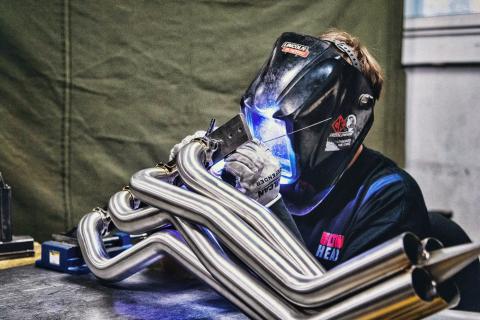
For the uninitiated, custom headers aren’t what they perhaps appear to be. Although the tubes in a well-built custom header flow smoothly and evenly like bent pieces of tubing, they’re actually in most cases formed from short, individual sections of tubing, welded together and then ground smooth.
It’s not easy to do. But this age-old method of building custom headers is still the best way to come up with the complex bends typically required to fit headers in an engine compartment and keep the length of the tubes close to equal—an important element for optimizing the power and tuneability of an engine.
In other words, custom exhaust fabrication is more of an art than a science. But now there are new components, kits and tools to make the job easier. To learn more about these developments, we reached out to some of the leading suppliers of header components. They gave us valuable insight that can take much of the exhaustion out of exhaust fabrication.
Skilled Labor
Many of the suppliers we spoke to have moved away from building custom exhaust systems and instead focus mainly on selling components. “Custom fabrication work is very time consuming,” noted Vince Roman of Burns Stainless, Costa Mesa, California. “It can be pretty expensive. The other part is, since we need to have the car, it has to be somebody who is close by or willing to ship us their car.”
In most cases, then, racers seeking custom headers are left with two choices: Find a capable local fabricator or build it themselves.
None of our sources said outright that the process is beyond the abilities of DIY builders in a home garage. Nonetheless, some underscored the high level of skill the job requires. “Most of the customers that buy our individual components have made headers before,” explained Jim Browning of Ultimate Headers, Berea, Ohio. “I equate it to watching home improvement shows on TV. They make it look easy, but those are professionals doing it day in and day out.”
“It’s not for the mild-mannered weekend warrior in his garage,” added Roman.
Burns Stainless “pretty well [doesn’t] stock any mild steel components,” a source told us. “There’s no reason to sell somebody something that will corrode away, when for a few dollars more we can get them something that’s going to last for a long time.”
That said, not all suppliers paint a dim picture for aspiring DIY header builders. Some even encourage customers to try it for themselves. “We get brand-new builders every single day and it’s great,” said Zimmerman. “We actually have a whole build series on our YouTube channel. When you break it down in the steps, it’s not a big deal at all for anybody who has a little bit of welding experience and has possibly done some light fab work.”
Material Issues
There are essentially two choices for header material: mild steel and stainless steel. Mild steel was a popular choice for many years, and it’s still appealing to the DIY builders who may not have the necessary skills to work with stainless steel. Nonetheless, fabricators these days increasingly favor stainless steel for header construction. “It switched over about nine, ten years ago,” recalled Jim Renella of Performance Tube Bending, Irwindale, California. “Stainless got very affordable. Everything was mild steel before that.”
“We pretty well don’t stock any mild steel components,” added Roman. “There’s no reason to sell somebody something that will corrode away, when for a few dollars more we can get them something that’s going to last for a long time.”
Further enhancing stainless steel’s appeal for headers is the additional cost of coatings that mild steel requires to prevent corrosion and decay. “As coating costs are increasing, it becomes much more of a break-even point for stainless steel,” explained Zimmerman. “For instance, with a big block Chevy header kit we sell, the cost difference from mild steel to stainless is $275 to $325. When a guy goes to get his headers coated, whether it’s ceramic coating or just high-temp paint, he’s usually looking at about $250 to $300.”
Some builders take sort of a hybrid approach to building custom headers, by forming a rough mockup out of mild steel and then turning it over to a fabricator to build the finished piece out of higher-grade materials. “We have a customer who’s building a Lamborghini Miura from scratch, powered by a Ford Coyote motor,” said Roman. “He built a mockup of his headers in mild steel.”
Building headers is a complex geometry problem, where the need for gently curved, equal-length tubes collides with the real-world limitations of a car’s body and chassis.
Along with stainless steel, aluminum is being introduced for exhaust components. While it’s unsuitable for the brutal heat of headers, it’s starting to gain popularity for other exhaust system parts.
“In February or March of this year, we very quietly launched a bunch of undercar systems in aluminum,” said Zimmerman. “We’ve had enough of our customer base looking for something more lightweight that’s going to be better for race purposes, and aluminum was our solution. The weight difference is phenomenal. With mufflers it’s more than 40–45% lighter than stainless for the same design. And with tubing, you’re going to be 50–55% lighter with the same thickness on everything.”
The cost of Stainless Headers’ new aluminum components is said to be only about 10–15% more than equivalent stainless components. While the durability isn’t as good as stainless, for the most part it’s proving sturdy enough for weight-conscious competitors looking for an edge without resorting to pricier, more exotic materials. “Our initial concerns were that these mufflers and bends weren’t going to hold up,” said Zimmerman. “But we’ve had really good success stories from some of our earliest customers who’ve been running the same muffler in road racing and track cars for six months now without fail, which is better than expected.
“We’ve even done a couple of merge collectors in aluminum, and bullhorn systems for some of these all-out drag guys,” he added. “There’s some Pro Mod stuff where they really don’t mind replacing it every other weekend. So for us, aluminum is a great middle ground on getting something lightweight without breaking the bank, like swapping over to titanium.”
However, any discussion of materials these days would be incomplete without mentioning the effects of the pandemic. With international supply chains battered by COVID-19-related factors, header component manufacturers are sometimes forced to delay orders, put shipments on hold or offer customers alternatives for the time being.
Nonetheless, some suppliers have been able to cope better than others. “I had an inkling about this a few months ago so I ordered a lot of inventory,” said Renella. “I’m getting a mill run ready for stainless steel tubing, and I’m willing to place a big order with money upfront.”
Completing the Puzzle
Another important consideration for fabricators building custom headers is the question of what specific components to order. A custom header is essentially a jigsaw puzzle without a picture on the box, forcing fabricators to order the correct type and quantity of tubing bends, collectors, flanges and other hardware before they even know exactly what they are going to need.
To help customers get all the right pieces for their project, Burns Stainless offers a Race Engine Spec Form on its website. Users fill out the online form with information about their engine, car, exhaust system and type of racing. From those details, Burns then works up a custom list of components the builder needs to order.
Other suppliers favor a more organic approach to understanding customers’ needs. “I think it’s important to have a conversation with customers,” said Browning. “When someone’s spending their hard-earned money on a performance product that’s their passion, I think that’s worth a 10-minute phone call to find out what they really want and need.”
Prefabricated header components like these double-slip collectors from Burns Stainless can shorten fabrication time and dramatically improve the quality of custom headers.
Browning said he asks customers about the kind of engine they’re using, the make and model of vehicle, whether it’s a factory chassis or custom unit, engine placement in the chassis and more. Along with this, he’ll frequently have customers text or email photos of their setup to get an even clearer idea of their needs.
To further aid fabricators in their header-building efforts, some component suppliers offer kits. They typically include flanges, collectors and an assortment of tubing bends. Some kits also add other extras to accommodate a wider range of potential applications. Kits from Stainless Headers, for example, have collector tabs, oxygen-sensor bungs and even a supply of TIG-welding filler rod. “It’s basically missing only the welder,” said Zimmerman.
Some suppliers have developed their own unique hardware, designed to further simplify the build process and allow more options for fabricators. Ultimate Headers offers cast elbows that have very tight bends, which allows headers to sit closer to the engine by making the first bend in the system a smaller radius than is possible with bending.
“Because of that cast elbow, we’re able to engineer and manufacture headers that have big tubes and make them fit in tighter places that aren’t easy to do,” explained Browning. “It flows extremely well. You’re not cutting a tube in the middle of a bend, where you’ve now made it more egg shaped.”
The Back End
Although many race cars don’t need an exhaust system beyond their headers, mufflers and full exhaust systems are increasingly becoming a reality for some, particularly on tracks with aggressive noise regulations. For dual-purpose cars, a full exhaust system is pretty much a given.
As with header building, there are a number of kits available for exhaust system fabrication. These typically include pipes, mufflers, flanges, connectors and clamps, built from aluminized mild steel or stainless steel.
One of the more unique exhaust-system developments is oval exhaust tubing. “Cars are getting more powerful, and they’re getting lower to the ground for aerodynamics,” explained Zimmerman. “They need to have large exhaust tubes, but they don’t have the ground clearance. Our oval exhaust tubing is great for being able to hit the large cross-sectional area and still keep things tucked up tight into a floorboard, or even inside a rocker panel.”
Building custom headers takes patience and skill, even for pros. But it’s not beyond what a motivated DIY builder can handle, said our source at Stainless Headers Mfg.
To further enhance ground clearance, the company has also developed a unique, proprietary slip joint for its oval exhaust systems. “With our slip joints, you don’t have to run flanges and eat up some of that ground clearance,” said Zimmerman.
For dual-purpose cars, catalytic converters are still a consideration. That can be a vexing problem for serious competitors who want maximum performance in a street-legal combination.
“To try to meet an emissions standard, the cats on production exhaust systems have gotten closer and closer to the engine,” said Roman. “To get the full benefit of a racing header, you want to have a long-tube header, so that’s usually not compatible. For example, there are aftermarket headers built for C8 Corvettes that incorporate the stock cats in their original places. But other than getting a tube header, you’re not really getting much benefit.”
Whatever combination of car and engine you’re working with, today’s component suppliers offer more options than ever before to make the task of building an exhaust system easier, faster and more effective. Building custom headers is still challenging work that requires considerable skill and patience. But now more than ever, it’s possible to finish the exhaust portion of a race car in a way that looks good and works efficiently, which leads to better power and increased performance.
Building Headers the Ice Way
—
Before Victor Franco of icengineworks in Austin, Texas, came along, designing custom headers was a tedious trial-and-error process. “All the experts would tell me, it’s essentially a Hail Mary,” he said. “You had to waste a lot of material, and it would take months to design a quality system. So, I guess my assertion was, ‘There’s got to be an easier way.’”
Franco developed a system designed to take the pain and guesswork out of header design and allow quicker fabrication once the design is set. His product, the Header Modeling System, breaks the process into three separate stages: Stage I is design and modeling; Stage II is tube cutting; and Stage III is assembly and welding.
Stage I is the core of the system. It’s a set of plastic blocks designed to enable builders to quickly and precisely mock up custom headers. Once users have snapped together their header mockup, markings on the blocks allow them to easily calculate bends and cuts.
“The plastic blocks are like Legos,” explained Franco. “They snap into each other, and they’re a faithful representation of actual bent tubing that’s available. You don’t have to go to a computer, turn it into a virtual design, and then have to come back to the real world. It’s a faithful, one-to-one scale model. For example, if you’re running a tube into a steering column, you’re going to see it.”
The blocks are available in three types: EH for exhaust headers; NP for turbocharger manifolds; and FE for full exhaust/cat back systems, intercooler and turbo downpipe tubing assemblies, and cold air intakes.
The Header Modeling System from icengineworks speeds the process of creating header mockups, and helps fabricate accurate finished components from that model.
Stage II of the system is a method for cutting tubing precisely. It includes a fixture designed to transfer the measurements and angles quickly and easily from the mockup for faster fabrication.
Stage III is a unique clamp designed to hold tubing in place for tack welding. It aims to eliminate small positioning errors that can add up to big inaccuracies and wasted pieces when compounded over the length of a whole header.
At around $1,000 or more, the Header Modeling System probably wouldn’t be a casual investment for some shops. Franco explained that the cost of building a product like this in relatively small production runs does not allow a lower price point.
Yet the system’s cost justification is compelling, nonetheless. “I had one customer tell me that it brings a 40-hour job down to as little as 10 hours,” said Vince Roman of Burns Stainless, Costa Mesa, California, a retailer of the product.
With welding and fabrication shop rates now typically at least $75 per hour, a 30-hour savings like that would pay back more than double the cost of the Header Modeling System.
Franco has seen the pain of building custom headers the old-fashioned way. Now he’s a man on a mission to speed the process and make it more accessible for people of all skill levels. “There was a guy I met who was very proud of the header designs he did for a Fiero. It took him three months. Well, three months at two hours a day? You’re nuts. Unfortunately, that’s the best he could do.
“I tell people, if that isn’t worth $1,000 forever, then you are in the wrong career, man.”—David Bellm
Formula Drift has announced that Vice President Ryan Sage will assume the role of president of Formula Drift Holdings, LLC, as Jim Liaw moves to his new position at Performance Racing Industry (PRI).
Liaw will remain a Formula Drift board member, focusing on the company’s international and Federation relationships, including the FIA Drifting Commission.
“Change can be difficult but is sometimes necessary,” Liaw said. “This is simply a new chapter in my life and the career I’ve established in the industry I love. Stepping down from my day-to-day role doesn’t mean I’m done with [Formula Drift]. On the contrary, I have full faith in the upward trajectory of the Series and the team that will take it forward.”
Sage, who co-founded Formula Drift with Liaw, has served as Vice President since 2004.
“Jim has been my business partner, and most importantly, my friend for the past 20 years, so I’m excited to see him to take this new path in his life. He leaves Formula DRIFT with a legacy of helping to build the largest, most respected drifting organization in the world, as well as being at the helm when [Formula Drift] weathered it’s biggest challenges,” Sage stated.
The 2021 Formula Drift season continues on the Streets of Long Beach on September 17–18, for Round 7 of the FD PRO Championship. Both the PRO and Link ECU PROSPEC Championship teams will then converge on the House of Drift—Irwindale Speedway—on October 22–23 for the season finale.
OMP Racing has announced a new company name following the acquisition of Bell Racing Helmets Group in 2019. Both brands, along with Zeronoise communication systems and Racing Spirit apparel, will now operate under Racing Force USA, Inc.
OMP Racing SpA Chairman and CEO Paolo Delprato stated, “With the acquisition of the Bell Racing Helmets Group in 2019, we consolidated the sales of all the brands within the OMP Racing S.p.A. organization for [Europe and the rest of the world], excluding the Americas. With two well-known brands, OMP and Bell Helmets, it was important to rename the company in a way that equally represents the rich history of both established brands along with emerging brands Zeronoise and Racing Spirit.”
The product lines will continue to be offered under their respective brand names, OMP Racing, Bell Helmets, Zeronoise, and Racing Spirit.
Bell Racing Helmets based in Sakhir, Kingdom of Bahrain, will operate under Racing Force International, WII.
 MEMBERSHIP LOGIN