Tracking legal, legislative, and regulatory developments impacting the racing and performance industry.
PRI’s Washington, D.C.-based advocacy team works around the clock to protect race tracks and motorsports businesses. We are currently engaged in a number of federal and state initiatives, including a new campaign to raise awareness and pass the RPM Act, along with an update on international tariffs for U.S. businesses and a note about how PRI is supporting race tracks.
Call Congress, Tell Your Lawmakers To Pass The RPM Act
Support for the bipartisan Recognizing the Protection of Motorsports Act (RPM Act), H.R. 3281 and S. 2736, is more critical in 2022 than ever before. The bipartisan bill, designed to protect Americans’ right to convert street vehicles into dedicated race cars, has garnered healthy backing by lawmakers. As of press time, the RPM Act had 113 members of the House and 22 Senators co-sponsoring the initiative, thanks in large part to the Save Our Race Cars letter-writing campaign, which saw over 1.5 million letters sent to Congress. The industry’s efforts have garnered the attention of lawmakers, but we can’t let up until the bill becomes law.
PRI thanks the racers, businesses, enthusiasts, and fans that have already sent a letter to elected officials, and we encourage you to follow up by making a quick call to voice support for the bill. Talking points and the phone numbers of your local elected officials can be found at votervoice.net/SEMA/campaigns/88605/respond.
“Lawmakers are more likely to address the issues they hear the most about. If an office hasn’t heard from their constituents in significant numbers over a period of time, they assume the issue isn’t very important or has been addressed. We can’t let them think that the hard work has been completed on the RPM Act,” said Daniel Ingber, PRI’s Vice President of Government and Legal Affairs. “Now is the time to step on the gas and apply pressure. We need our co-sponsors to make passing the RPM Act a top priority, so go online to find out how to call your lawmakers and ask that they save racing from government threat.”
Beyond phone calls, below is a list of actions industry members can take to help to pass the RPM Act:
• For those that have not sent a letter, visit saveourracecars.com. A letter has already been drafted, and it takes less than a minute.
• Sign and send a letter to your lawmakers on company letterhead. Email erics@sema.org for a template and more information.
• Post about the RPM Act on your company’s social media accounts using the toolkit of digital assets found at performanceracing.com/rpm-assets.
• Become a member of PRI and learn more about PRI’s Political Action Committee (PAC). The Performance Racing PAC allows PRI members to support the lawmakers that stand up for racing in Washington. Visit performanceracing.com/membership for more information.
For details about the RPM Act and more information about working with your lawmakers, contact Eric Snyder at erics@sema.org.
New RPM Act Supporters (as of late November 2021)
U.S. Senators:
Tammy Baldwin (D-WI)
Marsha Blackburn (R-TN)
Deb Fischer (R-NE)
Mike Braun (R-IN)
John Kennedy (R-LA)
John Hoeven (R-ND)
Bob Casey (D-PA)
U.S. Representatives:
Clay Higgins (R-LA)
Gus M. Bilirakis (R-FL)
David P. Joyce (R-OH)
Cynthia Axne (D-IA)
Angie Craig (D-MN)
Darren Soto (D-FL)
John R. Carter (R-TX)
PRI Social Media Campaign Brings Awareness To RPM Act
In conjunction with ongoing efforts, PRI’s advocacy team has begun a social media campaign encouraging the racing community to call and write their members of Congress and ask them to support the RPM Act.
“The men and women who work in the motorsports industry, racers, and their fans are on the front lines in the fight to pass the RPM Act,” said Eric Snyder, PRI’s Director of Congressional Affairs. “We have commenced a social media campaign that is focused on getting everyone who is a part of the racing community to write their members of Congress in support of the bill. For those who have already written their lawmakers and want to do more, this campaign is for you. We’re asking that you take the next step and call your lawmakers and ask them to pass the RPM Act.”
The phone campaign is off to a fast start, with over 500 calls to Congress in just its first few weeks. PRI appreciates the efforts of everyone who has helped so far and is enthusiastic about the campaign’s impact as it continues to evolve.
U.S., E.U. Agree To End Steel And Aluminum Tariffs, U.S. Now in Talks With Japan
The United States and the European Union have agreed to end a three-year dispute over steel and aluminum tariffs. As a result, effective January 1, 2022, the U.S. will no longer impose 25% tariffs on steel (sheets, bars, tubes, etc.) and 10% on aluminum, and will instead use a quota system. The agreement will also apply to derivative products made in the E.U. and subject to tariffs such as steel bumper stampings (HTSUS 8708.10.30).
“For motorsports manufacturers who have been subject to tariffs—those who import raw steel or aluminum, or certain finished products like steel bumper stampings from the E.U.—it means they are no longer subject to the 25% tariffs on steel or 10% tariffs on aluminum unless the value of the U.S. imports exceeds the E.U.’s allotted quota. This should save these companies money and will take effect this year,” said Stuart Gosswein, PRI’s Senior Director, Federal Government Affairs.
Related, the U.S. and Japan are now pursuing a new commercial and industrial partnership to bolster economic ties, including strengthening supply chains, export controls, and innovations such as digital technologies. As part of the discussions, the two countries have agreed to pursue a quota approach to remove the metal tariffs.
“If the discussions between the U.S. and Japan are successful, it would mean that motorsports manufacturers who import steel or aluminum from Japan would no longer have to pay the 25% and 10% tariffs and instead would be able to take advantage of a quota system for metal imports,” Gosswein said.
The Trump administration first imposed the metal tariffs in 2018 under Section 232 of U.S. trade law, citing that dependence on foreign sources posed a national security threat. Based on quotas, Argentina, Australia, Brazil, and South Korea were excluded, and Canada and Mexico were eventually excluded based on the USMCA trade agreement. Although the tariffs have been imposed worldwide, a primary issue to be addressed is the global overproduction of metals, especially by China.
For more information, contact Stuart Gosswein at stuartg@sema.org.
PRI Supports Race Tracks With Motorsports Fairness And Permanency Act Of 2021
The Motorsports Fairness and Permanency Act of 2021 (H.R. 4674 and S.2940) has been introduced in the U.S. Senate by Senators Debbie Stabenow (D-MI) and Richard Burr (R-NC). The PRI-supported bill would amend the Federal Tax Code to make the seven-year recovery period for race venue investments permanent, ensuring race track owners and investors can claim an important tax incentive for their facilities for years to come (more on that below).
“The bill will help to speed up the depreciation schedule for investments made in race facilities. If passed, this law would provide an incentive to invest in racing facilities,” said Eric Snyder, PRI’s Director of Congressional Affairs.
The Act also has bipartisan support in the U.S. Congress, having been introduced by U.S. Representative Mike Thompson (D-CA), and with eight co-sponsors as of press time, including PRI allies Rep. Richard Hudson (R-NC) and Bill Posey (R-FL), along with Terri Sewell (D-AL), Stephanie Murphy (D-FL), Tom Reed (R-NY), Jackie Walorski (R-IN), Drew Ferguson IV (R-GA), and Michael Waltz (R-FL).
Currently, accelerated depreciation of race tracks is authorized through December 31, 2025. Accelerated depreciation of race track investments applies to capital expenditures in a facility’s ticket booths, track surfaces, suites and hospitality facilities, grandstands and viewing structures, props, walls, special-purpose structures, facades, shop interiors, and buildings. In addition, support buildings such as food and beverage retailing, souvenir vending, and other non-lodging accommodations, parking lots, sidewalks, bridges, fences, and landscaping are also eligible.
The tax incentive does not apply to transportation equipment, administrative services assets, warehouses, administrative buildings, hotels, or motels.
For more information and to see if your race complex is eligible, contact Eric Snyder at erics@sema.org.
With such a wide range of price points and feature sets currently available, determining which data acquisition system best suits a particular racer’s requirements can be difficult. Industry experts cut through the noise to figure out what a given driver needs—and what they don’t.
From the top tiers of motorsports to the grassroots, data acquisition has become nearly ubiquitous in recent years. There’s a very good reason for that.
“When it comes to racing, knowledge is power,” said Evan Perkins of Holley Performance Products, Bowling Green, Kentucky. “So it’s no surprise that data logging has been commonplace in drag racing and road racing disciplines for a long time. What’s interesting is that we’re starting to see a lot of growth in the side-by-side and UTV market. As more series pop up for these racers to run in and it gets more competitive, they’re looking to find an edge over the rest of the pack. Data logging is a really effective way to do that.”
But it’s certainly not a “one size fits all” proposition, and with so many variables in the mix, it can be tough to nail down what type of data logging system makes the most sense for a specific application. As our experts attest, simply choosing the most elaborate solution that a budget will allow may not be the most ideal approach.
Emerging Trends
Since its inception, data logging has been closely tied to technological progress at large. As with mobile phones and other consumer devices, as cutting-edge technology from prior years becomes more mainstream, it allows for the integration of more advanced features at price points that make these devices accessible to a greater portion of the market.
“Camera systems have really taken off for us,” said Cameron Bennett of AiM Sports, with offices in Lake Elsinore, California, and Roanoke, Virginia. “Once we got into high-definition, CAN-based cameras, it really created this powerful tool for data logging. Things like rpm, throttle and brake position—any channel that you might want to bring over—can be overlaid onto the video in real time. There’s no post-processing needed to combine the video with the data. It’s something where a driver can say, ‘I wonder why I was off-pace going through turn two on lap three’ and go back to that point in the video to see what their hands were doing, what their feet were doing, and what the car was doing in order to figure out where the issue was. It’s something we initially saw in top-tier road racing series, but it’s all over the board now, from karting to IndyCar.”
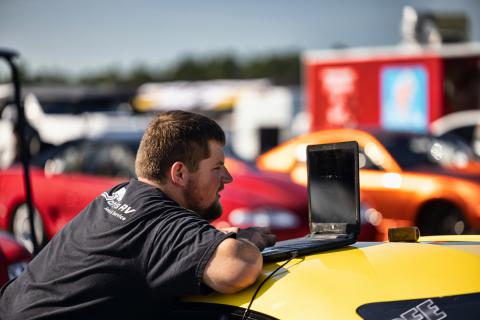
Data acquisition systems are no longer considered high-end luxury items. In fact, they are now commonplace at all levels and nearly all forms of racing, including karts and UTVs. Photo courtesy of Holley Performance Products.
Perkins said that as UTV racing has grown in popularity, data loggers have been adapted to capture information that’s specific to the unique characteristics of those vehicles. “It opens up a whole new world of data points. For instance, a lot of side-by-side racers use data loggers to monitor CVT belt temperatures to make sure the belt doesn’t overheat. It’s critical for them because if that belt fails, they are stranded until it is replaced.”
Marc Erickson of AutoMeter Products in Sycamore, Illinois, said that as younger, more technically savvy generations of drivers get on the grid, he has noticed a more educated approach to data logging. “They have a better understanding of what they need from a system based on the car they’re running. So we’re seeing somewhat of a shift away from all-purpose data logging systems that can do, say, a hundred channels to ones that offer fewer channels and are more affordable, but have the specific functionality that those racers need. In that respect, another big change we’ve seen recently is in memory. For a long time, memory chips were really expensive, but they’ve become so inexpensive that the same components can be built with much less money now, which in turn costs the customer less money.”
Keeping It Simple
Entry-level systems typically range from about $400 to $1,000 and can provide information that’s critical to a driver’s success.
“It’s one of those things that when the car is running great, it might feel unnecessary,” Erickson pointed out. “But when the car does that one weird thing that’s hard to explain, that’s where data logging pays for itself.”
Today’s CAN-based cameras allow data to be overlaid onto video in real time, allowing racers and teams to pinpoint issues with greater precision. Photo courtesy of AiM Sports.
Dennis Lawler of Exhaust Gas Technologies in Chino, California, said that systems in this price range typically collect data that is useful mainly from a diagnostic standpoint. “Things like rpm’s, exhaust temperatures and pressures,” he cited, “information downloaded after the run mainly for tuning and troubleshooting purposes. Exhaust temperatures, for example, can tell whether the engine is running too lean or too rich. That can be dialed in between rounds.”
Bennett said that even these budget-minded systems can offer a wide range of information. “A system like the Solo 2 DL taps into the vehicle’s ECU to get quite a bit of data—rpm, throttle, some kind of MAF or MAP sensor information, and sometimes brake data as well. That usually covers the basic necessities. But what’s available ultimately varies from manufacturer to manufacturer. With a platform like the BMW F-series, we can gather 41 different channels from the ECU, everything from wheel speeds at each corner of the car and steering angle to water and oil temperatures.”
Pricier data systems can typically monitor more functions, but the car needs to be set up with the necessary sensors to provide that data. Photo courtesy of Holley Performance Products.
Perkins said when moving up the hierarchy of systems toward the top of this price range, the core differences are often the number of channels of data that can be captured simultaneously. But more sophisticated data logging systems also require more sophisticated vehicle setups in order to utilize the additional capability.
“The Racepak Sportsman, for example, is a totally standalone system that can capture data from an EFI car or a carbureted car, and it has 25 dedicated channels for monitoring,” he explained. “For a drag racer, that could be things like driveshaft rpm, so a racer can compare that with engine rpm to detect slip in the drivetrain and how well the car is hooking up. Shock travel can also be monitored to see how the suspension is behaving during launch. But it’s important to remember that sensors are needed to support these functions. The vehicle itself needs to be set up to provide that data to the system.”
Going Hardcore
High-end data loggers generally range from $1,500 to $3,000, but for teams competing at the highest levels of racing, the investment can venture well into five-digit territory. “A Top Fuel team might spend $30,000 or more,” Lawler said. “These systems are going to have many, many more inputs, because the more you know, the faster you go. It’s a situation where a crew chief needs to see all of this data at the same time in order to program the car properly for a specific run.”
Erickson noted that systems like these benefit racers in ways that go beyond sheer performance. “This kind of information will not only allow teams to tune the car to go faster, but they can also be a great early warning system if the car is losing oil pressure somewhere, or something along those lines.”
From the driver’s perspective, the heart of a data acquisition system is the dashlogger, which can display data from an ECU, GPS, accelerometer, and a variety of other inputs. Photo courtesy of AiM Sports.
Beyond the number of different channels of data that can be recorded at a given moment, advanced data logging systems are also outfitted with greater processing power to capture information at a higher refresh rate. Refresh rate can be incredibly important when troubleshooting an issue that happens for a fraction of a second and only under certain circumstances, as it could end up being the difference between seeing all of the data needed to correct the problem or missing it entirely.
“At the professional level, the refresh or sampling rate becomes a much bigger priority,” Bennett said. “Something like the MXG 1.2 can sample an analog sensor at up to 1,000 Hz, or 1,000 times per second. Sometimes that level of precision is necessary in order to get the information needed.”
Communication Is Key
Because of the specificity of certain applications and the potential complexity of the vehicle setup required to capture some types of data, Erickson said that figuring out which system is the best fit for a particular racer usually comes down to a conversation with them about their specific goals with the system.
“I ask them what type of vehicle they have, what they’re doing with it—is it naturally aspirated, or a blower car, or turbocharged, or are they running nitrous—and what type of class they’re running,” Erickson explained. “From there I usually ask them what they want to monitor. Some folks know and some don’t. If they’re not sure, we’ll look at the car and the class they’re running in, and I’ll explain what the norm usually is. These days a lot of folks are really well versed on the subject, so they already know exactly what they want out of the system. Having the specifics about what they want to do and what type of budget they’re working with makes it a lot easier to zero in on what’s going to work best for them.”
Perkins said that for the entry-level buyer, it’s about data logging the parameters that will keep the car out of trouble. “Oil pressure and temperature, engine temperature, things like that are a good place to start in order to create a safety net for a race program,” he advised. “From there, start looking at sensors to monitor vehicle performance in terms of traction, acceleration, lateral G’s and so on. If you make a change to the shocks and want to see if it actually increased grip, data logging is a great way to substantiate whether or not the change is in the right direction.”
The enormous breadth of data-acquisition components available today allows these systems to be fitted to almost any vehicle imaginable—including older machines built long before the digital age.
Bennett agreed that the best way to really determine which data logger best fits an application is to start by gathering some data from the driver. “There are folks at the grassroots level who will spend more on the data system than they did on the car. They’re just really into the data and love using it to get a better understanding of the vehicle’s performance as well as their own. Then there are some really seasoned drivers who have cars that are really well taken care of, and they don’t necessarily need all the data. It comes down to a 20-minute conversation to figure out what their goals are with the system and what they want to see. If they want specific features, we can narrow the field down through a process of elimination to get to the right system.”
Lawler suggested a similar tactic as well. “Ask them what they’re seeing now and what they wish they could see. That helps develop a picture of what their program looks like, and which piece of equipment is going to get them what they want.”
He’s also quick to point out that the data logger is one piece of a larger data acquisition puzzle. “Some car owners will be kind of brave and say, ‘Just give me everything,’ but the team might not have the capability or experience to use that information properly. That’s going to end up being a waste unless the crew chief is taught about the data they’re going to see and how they’re going to interpret it. So training can become part of the process
as well.”
Manufacturers keep up with race engine changes through constant R&D and on-track testing. Here’s a look at what’s new, plus tips on whether to rebuild or replace a worn component.
For some racers, electronic fuel injection represents the cutting edge of engine induction technology. That case certainly can be made, given the large number of tuning parameters that are precisely manipulated by the latest computer software. Yet for others, that complexity doesn’t appeal. Instead, they compete—and win—using some version of a device that has been called a “controlled fuel leak.”
“Most of our customers have tried fuel injection, but they don’t want to tune all the time, they just want to race,” said Trevor Wiggins of GET’M Performance, Alvaton, Kentucky. “A carburetor just works, and it’s really easy.”
“A carburetor can make more torque, more horsepower, and use less fuel than EFI,” said Dave Braswell of Braswell Carburetion, Tucson, Arizona. That remains true, he said, even as drag racing V8s continue to grow in size and output, and can spin at 10,000 to 11,000 rpm.
Meeting the needs of these evolving powerplants requires never-ending R&D on the part of carburetor manufacturers. “We’re constantly changing and trying different things,” Braswell said. “It’s the only way to stay ahead of the game.”
What follows is the latest information on carburetor development from Braswell, Wiggins and other leading manufacturers.
‘The Sky’s the Limit’
While AED Performance in Richmond, Virginia, “can build a carburetor for just about anything,” said Jeff Harris, “we focused a lot of our R&D this year on high-end drag race applications. We were a class sponsor of PDRA’s Extreme Pro Stock class, working with a couple of those teams and a couple of the guys in the Pro Outlaw 632 class.” One of the company’s owners, Jay Brockwell, traveled with the Pro Stock teams “and did most of the R&D in person at the track.”
The result is a new billet bowl that can better “control the fuel in the bowl before the carb can meter it,” Harris explained. “It makes the fuel that the metering block sees and the fuel that you’re trying to meter more consistent. It keeps it from aerating, keeps it from sloshing from one side to another.”
Working at the track was a crucial part of the development process. “G-forces change things. Running something on the dyno versus getting something to run on the race track are two completely different things in the carburetor world. On the dyno it sits still. But with these Pro Outlaw 632s and Extreme Pro Stock guys, you’re talking some really quick 60-foot times. You need to control the fuel as the car leaves, to make the launch more consistent. So we’re working not only on control in the bowl, but also the quality of the fuel charge to the combustion chamber itself. We are constantly winnowing in on it to make the best piece we can.”
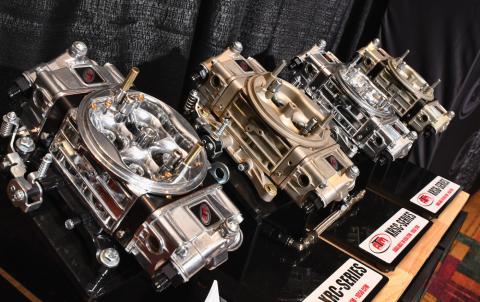
The Big Flow Carburetor (or BFC) from Braswell Carburetion is a five-circuit carb designed to keep pace with today’s larger, faster-spinning motors, according to a company source.
Another factor that proved invaluable to development at the drag strip was data acquisition, Harris added. “We’re able to take that data at the track and make changes accordingly. It makes a big difference in making sure the engine is optimally tuned for each customer. In some cases, without that capability, we could be leaving anywhere from 10% to maybe 20%, on the high end, of power on the table. Even if it’s 10%, 80 horses out of 800 is a big deal. And again, something that may not show up on the dyno would definitely show up under load and at speed on the race track.”
Real-world R&D goes hand-in-hand with the company’s CNC capabilities to continually develop its carburetor components. Harris said, “We are constantly evolving our metering blocks and producing different sizes of billet bodies. Those are the kinds of things that the CNC world allows us to do. The sky’s the limit. We can machine things better and better to fit each application. Each carburetor is as custom as we can make it.”
‘Refined Everything’
“We’ve refined everything we’ve been making,” Braswell said about his company’s R&D efforts. On the circle track side, “We recalibrated for the 602 and 604 crate motor classes. We make five carburetors for each of those engines, depending on the fuel they’re using: pump gas, 110, CHP, E85, ethanol and methanol. We change the venturi diameter and throttle-bore diameter for the different fuels. Also, the metering plates have a different calibration to optimize their performance with those fuels.”
Refinements have also come to the carburetors for Late Model open engines. “Late Model motor development in the last 10 years has happened so rapidly, it’s a moving target. What worked last year doesn’t work as well this year, so we have to come up with a better product to improve driveability, torque, and horsepower as cylinder heads and displacement change.”
For drag racers, Braswell has updated its carburetors “mostly with metering changes.” Changing metering plates on the carburetors for some Competition Eliminator engines “was worth two- to three-hundredths in the 60-foot, which is significant. We’re incorporating those changes across the line into different classes.”
“We have to keep making them bigger to get in the arena of our customers who are making 1,350 to 1,400 horsepower,” noted our source at GET’M Performance, which just last year released three new four-barrel carburetors.
Braswell is also redoing the tooling for the B-7520 two-barrel carburetors “to go to a 2.700-inch butterfly,” he said. These are used in Mountain Motor Pro Stock, Top Sportsman, and other big-inch classes. “Big motors used to be 600 or 800 inches. Now a big motor is more than 900 inches, so we’re trying to keep up with the ever-moving target of the application.”
Engines are not only getting bigger, but they’re also spinning faster, he said. “Back in the 1990s, a high-rpm motor was turning 7,500 rpm. Now, a drag race motor routinely turns over 11,000 rpm.” At those speeds, “airflow through the carburetor actually drops off because the motor’s volumetric efficiency decreases. But pulsations from the intake cycle also tend to make the carburetor go rich at higher rpm—the rebound wave also meters fuel in the carburetor. We had to keep changing our metering systems to keep up. Where most modular carburetors produced today have just a single air bleed on the high-speed circuit, we’re using up to three high-speed bleeds. This enables us to better tailor the fuel curve at the higher rpm these engines are running.”
‘We Have to Keep Making Them Bigger’
While “everyone knows us for our Twin Blade,” Wiggins said, GET’M Performance released three four-barrel carburetors last year. One was a 1,050-cfm throttle-stop-style carburetor, the other two came in at 1,250 to 1,300 cfm and 1,750 cfm.
“The four-barrel is an easy transition for people to move to our stuff, especially racers who already have a four-barrel,” he explained. “The four-barrel is widely accepted in the throttle-stop world and very well accepted in larger engine markets. A 632 that made 1,100 horsepower used to be a big motor. Now there are 632s that make upwards of 1,400 horsepower. We have to keep making them bigger to get in the arena of our customers who are making 1,350 to 1,400 horsepower.”
The 1,750-cfm four-barrel “is more our future world,” Wiggins said. “To stay ahead of the curve, we’ve even been testing a 1,900-plus-cfm carburetor.” On the Twin Blade side of his business, Wiggins has a carburetor in development with a capacity of “around 2,100 cfm,” and a Dominator-style Twin Blade that is “probably a year away” from release.
Engineers at Holley have updated some of the company’s best-known carburetor lines, including the XP, by “[giving] them a new look and [changing] some of the things the modifiers were changing on the older carbs,” a source told us. “That way they could have everything at their fingertips.”
Carburetor development isn’t just about big cfm numbers, Wiggins said. “We’re trying to get a venturi-to-throttle-bore ratio. That’s how we’re able to achieve more and more cfm. The bigger bore doesn’t necessarily mean the largest venturi. You’re trying to get the ratio that you know is very consistent and works very well through the low, mid, and high range of engine air demand. I can build any size venturi. I can build a straight venturi. But if you can’t get it to idle, or transition to wide open, it doesn’t matter how big it is.”
Another trend Wiggins is paying attention to is the use of “baby blowers”—250-cubic-inch Roots-style superchargers—on bracket race engines.
“A lot of people are looking for more horsepower without spending a lot of money,” he explained. “They’re putting these baby blowers on their bracket motors with a single carburetor on top. That makes us build a more efficient carburetor and a more efficient metering block to feed enough fuel through a baby blower.” The setup, he said, “has been a large seller for us.”
Beyond carburetors, GET’M Performance is branching out into ancillary components: fuel pressure gauges, fuel logs, and bypass regulators, among others. “If you call me and say the engine’s not running right, I always ask what the fuel pressure is,” Wiggins said. “A lot of people don’t know, or they’ll have to pull the Racepak up. So I decided I’m going to start supplying gauges.”
‘Carbs on a Diet’
Laura Shehan of Holley Performance in Bowling Green, Kentucky, said the company last updated its racing carburetors several years ago with the introduction of the XP and Gen 3 Dominators and the associated calibrations for E85, methanol, and dual-quad setups.
“When we embarked on the 4150 XP, we realized we needed to refresh the entire lineup from both an aesthetic and performance perspective, not to mention put the carbs on a diet by making the change from zinc to aluminum. We considered the typical upgrades that the modifiers were doing and implemented them in a well-tuned, out-of-the-box carburetor.”
“Those older carburetors were kind of behind the times,” agreed Holley’s Tyson Rinehart. “We decided to give them a new look and change some of the things the modifiers were changing on the older carbs. That way they could have everything at their fingertips.”
The switch from zinc to aluminum had benefits beyond shedding weight, Rinehart explained. “There’s also heat soak. Zinc held in a lot of heat, while the aluminum will dissipate it. There’s not as much expansion, boiling the fuel and stuff like that with the aluminum series.”
Among recent “major design enhancements” to PROFORM’s Race Series carburetors are new lower fuel ramps in the bowls, noted a company source, along with redesigned aluminum main bodies.
“On the XP and Gen 3 lineup, we implemented billet metering blocks and throttle bodies,” Shehan said. “Each of the metering blocks went through exhaustive testing and was designed specifically taking into account carburetor size, fuel, and application. Regarding the fuel bowls, we added 20% fuel capacity, anti-slosh baffling, and a drain plug feature. The main bodies of the 4150 XP and Gen 3 Dominator have the idle bypass system that works to allow the idle air to be set without losing the functionality of the transfer slot for off-idle fuel.”
Holley’s 2300 XP two-barrel also went through an update. “We eliminated the choke tower to transition the carburetor into a full-out race carburetor,” Shehan said. “Like the 4150 XP and Gen 3 Dominator, the 2300 XP also has a billet metering block and throttle body, as well as a high capacity fuel bowl. We integrated an anti-siphon system into the accelerator pump channel in the main body to reduce the draw of fuel from the accelerator pump.”
As a volume carburetor manufacturer, Holley faces a unique challenge, Shehan said. It needs to “provide a calibration that will perform upon installation, provided the carb is appropriately sized, and yet have the flexibility and range to be tuned specifically for that application by the end user,” she added.
‘18 New Carburetor Part Numbers’
PROFORM Parts of Warren, Michigan, has made what it calls “major design enhancements” to its Race Series carburetors. “Our tooling needed to be readjusted, so we had the opportunity to do a redesign and add features to our existing line,” said Ryan Salata. The company also added three new lines to the Race Series inventory, “18 new carburetor part numbers,” Salata said, for supercharger, circle track and alcohol, and E85 applications.
Improvements have been made throughout the carburetors. Among the most significant, according to PROFORM’s Dennis Grzebyk, are new lower fuel ramps in the bowls. “The fuel chute is a big deal. It stops the aeration of fuel into the fuel bowls from the needles. It creates a downslope, so the fuel goes down and under rather than splashing directly down.” Another facet of the new bowl design is increased internal baffling to control fuel slosh
during high-G-force situations like rapid acceleration and cornering.
The aluminum main bodies have been redesigned, with a contoured leading edge to the venturis to smooth the air coming into the main body. “The way the main body is knifed, you see nice cuts on the casting,” Grzebyk said. “The air bleeds are recessed a little further back into the body for airflow into the venturi.” The main bodies also have new, double-step annular boosters that improve fuel atomization and throttle response.
The billet throttle base plates are now built with slabbed throttle shafts with low-profile screws, which improves combustion efficiency by decreasing the air resistance into the venturis. PROFORM has also engineered more surface area in the base plates, which provides more contact between the main body and blocks to make that assembly stronger and more rigid. And within the metering blocks are eight pre-drilled emulsion channels that are tunable to allow precise control of the air/fuel mix.
In sum, the changes result in “improved performance, better fuel retention, and reduced slog,” Salata said. “We expanded our carburetor’s capabilities to fine tune and drill down.”
Rebuild or Replace? Expert Tips on Carburetor Care
When is it time to rebuild a carburetor? “Usually power or driveability will start to drop off, or you’ll develop a flat spot when you get on the throttle,” said Dave Braswell of Braswell Carburetion, Tucson, Arizona.
“If it doesn’t idle right, or you hear it miss from time to time, that’s an opportunity for a rebuild,” offered Trevor Wiggins of GET’M Performance, Alvaton, Kentucky. “For drag racing, if you go and deck the motor on a two-step and it doesn’t deck clean, something’s not right.”
“If the engine is consuming a lot of fuel, or it’s leaking a lot of fuel, or it just doesn’t have the performance peak that it used to, most likely that’s time to rebuild,” said Tyson Rinehart of Holley Performance, Bowling Green, Kentucky.
“You’ll see your performance drop or fall off,” added Dennis Grzebyk of PROFORM Parts, Warren, Michigan. “Times or miles per hour will change for the negative. That usually means something’s clogged, there’s sediment in an orifice, or possibly a bad power valve.”
Jeff Harris of AED Performance in Richmond, Virginia, brought up another kind of clog: “Fuel cell foam is one of those things that people never think of. It deteriorates over time and ends up in the carburetor.”
Several different indicators can help racers identify when it’s time to rebuild a carburetor. “Usually power or driveability will start to drop off, or you’ll develop a flat spot when you get on the throttle,” said our source at Braswell Carburetion, who documented this 4760-series alcohol carburetor rebuild. “The customer didn’t maintenance the carburetor,” he noted, “and needed to have it sent in to be rebuilt.”
Simple neglect also can be the root cause of carburetor problems. “I’ve had customers who rebuilt their engines several times and didn’t touch the carburetors,” Braswell said. “Then things aren’t working as well, and they wonder what’s going on.”
One easy thing racers can do to improve a carburetor’s longevity is to drain the float bowls when the car is on the trailer, Braswell said. Otherwise, “the fuel in the float bowls bangs on the needles and seats. It wears parts out just going down the road.”
“It’s never a bad idea to do maintenance through the year,” Harris said. “At the end of the year, pop the carburetor off, clean it out really well, freshen it up with a new set of gaskets, and have it ready to go for next season. Two hours on a Saturday with a can of carb cleaner and some gaskets may save you some headaches.”
Certain race fuel types can also cause trouble. “Q16 will actually eat the metal as it goes through,” said Rinehart. “It will take anodizing off and make passages bigger over time. That will take a toll. Q16 is...an effective fuel, but it’s not a friendly fuel.”
“Alcohol is very corrosive compared to gasoline,” Wiggins said. “If alcohol sits in the carburetor, it will start working on the floats, making them heavier. Alcohol will work on where the anodizing isn’t as thick, and it will start to corrode. Then the carburetor won’t respond accurately. It won’t idle accurately. The motor won’t do a burnout accurately, or it won’t run down the track accurately.”
To keep that from happening, “every two to three years, we tell our customers to ship our carburetor back and we’ll rebuild it for free,” Wiggins said. “It’s more important to me that my carburetors run good than the time it’s going to take me to tech it when it starts to act stupid. We want our carburetors to run good, and we want our people to win.”
Under most circumstances, rebuilding, rather than replacing, can cure a carburetor’s ills. “Usually you can rebuild a carburetor to the end of the earth,” Grzebyk said. “With billet stuff, you’ll probably have that carburetor forever unless you outgrow it. But if you’re working with an outdated carburetor, with old technology compared to what’s available today, that’s a good time to replace your old one.”
Damage can also get to a point where a carburetor has to be replaced rather than rebuilt. “This newer gas with a lot of ethanol in it will eat on some of the metal almost like electrolysis,” said Rinehart. “It will pit the metal. If you get excessive pitting, that will turn into holes. That’s when it has to be replaced. It’s not going to get any better at that point.”
Damage isn’t the only reason to replace a carburetor. Years of use can also just wear one out, said Wiggins. Beyond excessive wear, the most common reason to replace a carburetor “is if you change the situation,” he said. “If you change the motor size, change cars, change fuel, it might be easier to replace it. If you’re going from gas to alcohol, for example, and your cast carburetor has a cast bowl that is not coated, alcohol will eat up the castings. Alcohol or E85 will not eat up billet or anodized products in the same way it eats away at cast aluminum.”
Because all GET’M Performance carburetors come with anodized billet fuel bowls, making the change from one fuel type to another may not require a complete carburetor replacement. “Often we can still utilize the same main body and fuel bowls in changing our customer’s carburetors to a different fuel setup or application,” Wiggins added.
“People switch back and forth,” Braswell said. “They’ll race at a different track, or the rules change. They’ll want to take their alcohol carburetor and switch it to gas or vice versa. Usually we’ll swap main bodies and metering system, or we’ll just build them another carburetor, so no matter where they race, they’ll have a carburetor.”
“If you start with a 300-horse motor or a 500-horse motor, and you want something that makes 800 horses, you’re better off to start over in most cases,” Harris said. “In the race car world, carburetors are not terribly expensive, relatively speaking. Something that’s custom or one-off for each engine, even at the high end, is in the $2,000 range. Two thousand bucks in a race car is still a relatively low number, especially for something that’s one-off per customer, per engine, per fuel and per application.” —Drew Hardin
SuperSprings International (SSI) has announced changes to its leadership team.
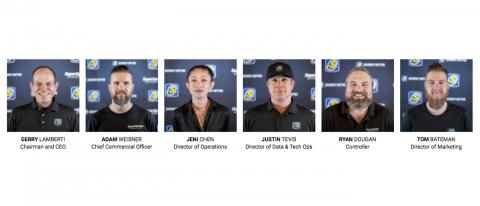
SSI has restructured to establish five defined business units led by a member of its new Leadership Team. The units include Marketing led by Tom Bateman, Director of Marketing; Operations led by Jeni Chen, Director of Operations; Data and Tech Ops led by Justin Tevis, Director of Data and Tech Ops; Finance & HR led by Ryan Dougan, Controller; and Sales, which is currently open to a new leader.
All members of the Leadership Team report to Chief Commercial Officer Adam Weisner, who reports to SSI Chairman and CEO Gerry Lamberti.
“This new leadership structure is exactly what SSI needs as we turn the page on 2021 into 2022 and beyond,” Lamberti said.
With cam designers constantly pushing the limits, valvetrain engineers have stepped up their game to keep engines content.
Keeping the valve springs “happy” is an excellent summation of the direction that camshaft and valvetrain development has taken over the past decade. Valvetrain failures used to dominate conversations in garages and engine shops, but those grumbles have slowly been silenced by a number of factors, including better materials, extensive testing and improved manufacturing processes.
“We’ve never stopped working on parts,” said John Partridge of Bullet Racing Cams, Olive Branch, Mississippi. “Of course, we’re always looking for power, and valvetrain control is the biggest issue.”
The valvetrain has been drawing more attention in recent years, even though the camshaft is the drum major that directs the marching band of valvetrain components.
“It’s the entire combination,” added Nolan Jamora of Isky Racing Cams, Gardena, California. “More people have dynos, and we get really good feedback and know the range where they want to dial in a little bit more.”
“But the cam guys are always pushing the limits,” noted Trip Manley of Manley Performance Products, Lakewood, New Jersey.
No Camshaft Too Big
Camshaft manufacturers are able to push those limits to unexpected extremes because of improvements in lifter design, pushrod stiffness, valve-spring durability and lighter but stronger valves. They’re also beefing up camshaft construction with tougher steel materials to reduce camshaft twisting and bending that interferes with the optimum timing of valve events or creates unwanted harmonics in the system.
“A lot of guys are upgrading their camshaft materials, even in classes like Top Sportsman and Top Dragster,” said Guy Aguayo of Crower Cams & Equipment Company, San Diego, California. “They’re going from 8620 steel billet to 9310 cores. It seems like there’s no such thing as a camshaft that’s too big. Guys are going over 1-inch valve lift on a regular basis. They’re getting to just under what a Pro Stock engine would use.”
Cooperation with engine builders often leads to innovation. Isky Racing Cams can develop specs and grind cams “in about 30 minutes,” according to our source at the company.
Callies Performance Products in Fostoria, Ohio, has seen this trend in upgrading cam cores as it offers two popular types to the industry, including tool steel and induction-hardened, or carburized, 8620 steel.
“Tool steel is in a class of its own,” said Brook Piper. “But a lot of guys like the induction-hardening because that’s what the OEMs do. It’s less expensive and good for a variety of applications. So, it all depends on what they like.”
The Callies cores are rough machined to the proper bearing size and lobe pattern before race shops and cam companies finish grind to the exact specs. Piper said the company is slowly starting to finish-grind more cams for a wider customer base. Most of the current finish-grinds are for users who need a high number of similar cams at once, such as a Top Fuel team.
So much attention is paid to camshafts these days because it is a significant part of the engine’s overall power potential, and it’s a hardware component that can easily be changed and tested. Very few engine builders will change piston design, intake-manifold dimensions or cylinder-head porting without having first tested a variety of cams.
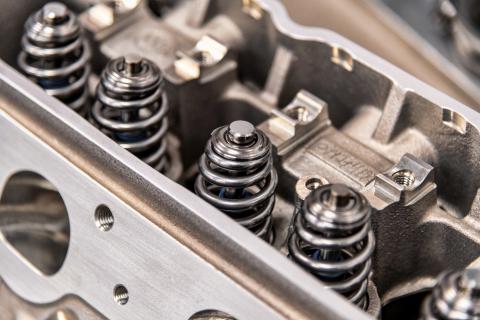
The dramatic improvements in valvetrain technology seen in the last few decades come mostly from extensive failure analysis, improved materials, and exhaustive testing. Photo courtesy of Manley Performance Products.
“Everyone is looking for an edge. Three or four horsepower used to be a butt whooping in Cup racing. Now it can be a butt whooping at the Chili Bowl or something like that,” added Chris Straub of Straub Technologies, Piney Flats, Tennessee. “I tell them that cylinder pressure creates torque at the end of the day. Torque and rpm create horsepower.”
Ironically, one of the keys to gaining a small valvetrain edge lies in the cylinder block. Straub recalled an engine builder telling him that a Straub camshaft was off by six degrees when installed, even though the cam had checked out perfect on a Cam Doctor. Straub asked about the block and discovered it was one that had a reputation for inaccurate lifter-bore positions.
“Long story short, one intake valve out of eight was correct on the camshaft lobe because the lifter angle was correct in the block. The other seven were wrong, and they varied from as much as four degrees advanced to three degrees retarded,” said Straub. “Correcting the lifter-bore angles can mean 30 horsepower. That’s a big difference.”
Engine builders are taking advantage of the latest CNC technology to ensure accurate lifter-bore angles and positions. They’re also increasing the lifter-bore diameter to support roller lifters with larger wheels, which in turn allow more aggressive lobe profiles. But those new lobe profiles can also be hostile to the valve spring on the opening cycle.
“If we can keep the spring from going into flux, we can do a lot more on the closing side,” explained Partridge. “Basically, it’s a design thing where we’re tweaking how aggressive we get at low lift and how much we move it in the middle to keep the spring from getting excited. If we can keep the spring happy, we’ll make more power. As soon as that spring gets unhappy, it’s going to lose power.”
“It’s tough to figure out the ramp speed with bigger cams. Sometimes the ramp speed can be a bit slower with cams that have a large base circle,” said Aguayo, noting that these discussions generally cover big-displacement drag racing engines. For circle-track racers, the strategy often focuses on not allowing the engines to overpower the track. “If they can keep from spinning the tire out of the corners, that’s ideal. For some drivers, the camshaft and engines are so aggressive that they keep spinning the tire. We need to tone them down a little bit. But the big sprint-car engines, they still use a big camshaft.”
Custom Camshafts
Tailoring camshafts to specific events, tracks and drivers basically means that most racing cams are custom made for engine builders. That process requires an enormous amount of information.
“Sometimes, people are a little surprised by the questions when they call our tech line,” said Billy Godbold of COMP Cams, Memphis, Tennessee. “Clearly, we will want to know about the engine, but they wonder why so many questions about the vehicle, track and driver specifics?”
Godbold described a detailed process, noting that the information required goes well beyond physical dimensions (including rod-to-stroke ratio), understanding all the airflow characteristics (both intake and exhaust), compression ratio and fuel type. In fact, even piston design has a strong influence on cam choice and will be considered by the tech reps.
“Perhaps the most important thing we will then ask about has to do with piston-to-valve clearance,” said Godbold. “Many engine builders can accommodate large valve reliefs, but these will often greatly reduce combustion efficiency. With an unrestricted engine that has great headers and a well-tuned intake, the engine may well want as much overlap as you can throw its way for maximum airflow and filling [the cylinder]. But the big reliefs required can hurt combustion efficiency, more than offsetting our potential gain in flow. Understanding these factors is hugely important.”
The application basics are then covered in full detail. “We always ask about rpm, but in general it is difficult for more engine builders to focus on where the vehicle performance matters the most,” said Godbold. “These types of considerations are often even more important in circle-track racing. Races can be won or lost on restarts, so we often ask multiple questions about the competition. Knowing where we are going to focus will greatly change how we set the exhaust opening and intake closing, and perhaps even the overlap we select. Every form of racing has very similar needs, which all require attention to ‘torque curve shaping.’”
Once these factors have been established, driver styles will be considered (see sidebar on page 98) to help determine the camshaft’s general specs. Finally, there are valvetrain limits and durability targets to consider. Key details include valve weight and pushrod/rocker-arm stiffness.
“We sometimes have the customer check his lift with full open load versus just checking a valve spring to calculate system stiffness, especially in combinations that are very well developed,” said Godbold, adding that the number of engine cycles are then considered. “It would blow your mind to compare the cycles on a NHRA Top Fuel run versus something like a five-mile Bonneville pass. Circle track and events like Drag Week move that decimal place over several more places.”
Critical Element
After all those calculations, the valve spring is the last critical element to be considered (see sidebar on page 104).
“Knowing the rocker ratio, general installed height and coil bind height, our technicians will be sure not to leave way too much or too little room at max lift,” added Godbold. “Finding the right combination requires a full systems approach.”
Working directly with engine builders who have dyno facilities and strong testing programs prompted Isky to purchase a new cam grinder to help reduce turnaround times for custom camshafts.
“We can come up with the grind specs, send them over and grind the cam in about 30 minutes,” said Jamora. “An engine builder could call up and tell us to add a couple degrees duration and put in three degrees of advance—we can do it that quick.”
Key to the program’s success is having enough cores in stock and having enough notice to finish the grind before the last shipping service pickup. Isky has also refined its popular bushed-lifter program by narrowing the choice of materials for the bushings to just two. Also, oiling strategy has been modified to increase durability, and the line has expanded to hydraulic rollers in many popular engines.
Victory 1 Performance has moved all of its titanium valve manufacturing under one roof, shortening turnaround time and improving responsiveness to customer needs.
“We do lifters for Harley-Davidsons now,” added Jamora. “That’s how well the bushed lifters have spread to different applications.”
For open or unrestricted engines, cam suppliers have considerable flexibility. Some classes of racing, however, have limits on cam design, such as restricting the amount of total valve lift or requiring a minimum vacuum to control aggressive lobe overlaps.
“With some guys, we have to wrap their heads around the fact that we’re not making the best cam for the motor. We’re making the best cam for the rules,” noted Eric Bolander of Howards Cams, Oshkosh, Wisconsin. “Sometimes it’s just a matter of getting good feedback from the customer about what the car is really doing and where the driver actually wants his power. Engines make about 3,500 rpm of good power, and that has to come from somewhere.”
Bolander recalled a customer who complained that his car was “lazy” at the drag strip, and he wanted a new camshaft that provided more torque.
“He calls back to tell me that he launched the car, put it on its back bumper and tweaked the quarter panels,” said Bolander. “He thought I was responsible because I gave him a cam with so much more torque. I said I am just the cam guy, not the driving instructor.”
Advanced Computer Simulation
Camshaft designers have generally relied on experience and a few math formulas when determining the specs for a customer. However, advanced computer simulation software now assists that operation at some shops. For example, Bullet Racing Cams is using a very sophisticated modeling program developed in Europe that has proven to be quite accurate.
“We took that information and ran it on a Spintron to see if it was accurate, and it was,” said Partridge. “We can take into account a lot of things, such as valve and rocker weights, spring rates, contact points. It’s really a lot simpler than running on a Spintron. We found it tells us more than the Spintron does.”
What Bullet is looking for goes back to keeping the valve springs happy. Partridge can make incremental changes in lobe design to see how they affect the entire valvetrain. The more information that the engine builder can provide to feed the computer program, the more accurate the engine model will be. Since Bullet works mostly with drag racing and circle-track teams, the research is more focused.
“We’re too small to be everything to everybody,” said Partridge. “It all trickles down. A guy with a high-end bracket car wants his stuff to be just as happy as the guy with a Pro Stock motor. We try to pass on the technology.”
Most recently, Bullet has been studying boosted applications and learning how to leverage lobe-design strategies developed for naturally aspirated engines.
“It all goes back to keeping the valve spring happy,” said Partridge. “We were able to take engines running at 10,500 and get them to 11,200 rpm just by doing some tweaking. We’ve focused a lot on supercharged engines because that’s a big part of the market for us.”
While software keeps Bullet moving forward, extensive dyno testing is helping Cam Motion in Baton Rouge, Louisiana, develop new cam strategies. One connection sometimes overlooked by engine builders is the relationship between the cam and the intake manifold runner lengths. The company recently conducted exhaustive dyno tests with a 6.0-liter LS engine equipped with stock 706 cathedral-port cylinder heads. Tests compared the factory intake manifold with 11-inch runners against an Edelbrock Super Victor with a carburetor and sporting runners about 6 inches long. Standard 1 7/8-inch diameter tubular headers were used for all tests.
Junkyard Dog and Titan King cams were tested, and both had similar lift numbers and exhaust duration. The only difference was that Titan King closed the intake valve four degrees later than the Junkyard Dog version.
“The long runner plastic intake appreciated the later intake valve close event much sooner than the shorter runner Super Vic intake,” explained Steven Balusik. “The 47-degree IVC (intake valve close) camshaft did not surpass the 43-degree IVC cam until 6,500 rpm when used with the short-runner Super Vic. Whereas the later 47-degree IVC camshaft caught up to the earlier 43-degree IVC cam at 5,100 rpm when using the long-runner OEM plastic truck intake. The shorter runner intake had more power under the curve with an earlier intake valve close event.”
Cam Motion conducted a similar test with LS3 rectangular-port heads, and the results were similar. “However, the larger cross-sectional port and larger valve of the LS3 head needed less duration than the smaller cathedral-port head to achieve the same rpm levels and power peaks,” noted Balusik. “As you can see, camshaft design has an intricate relationship with intake manifold and cylinder head design. This is why we offer different camshaft designs for single-plane manifolds, and we commonly recommend different cams for different cylinder head designs.”
Valvetrain Considerations
Valve selection strategy is quite a bit simpler than picking springs or firming up cam numbers. Everyone wants the lightest valve possible that is also strong enough to withstand the competitive elements. Rules often restrict titanium, so stainless steel is the next choice. High-heat, high-boost and high-cylinder-pressure applications may need Inconel for the exhaust valves.
Regardless, valve manufacturers have their favorite, and sometimes proprietary, alloys. Some offer different alloys to serve different applications and price points. They also have tricks to reduce weight, such as undercutting the stem, dishing the valve face or hollowing out the stems. Finally, there are coatings to improve durability.
“Coatings are becoming more prevalent. We’ll use a CrN coating on the seats of titanium valves, which allows you to run steeper seat angles and increase the flow,” said Manley, noting that materials haven’t changed much over the years, but the manufacturing process has improved. “Manufacturing is really dialed in. Everyone has tightened up their acts with machining, finishes and really tight tolerances.”
Valvetrain materials continue to evolve. Tool steel is gaining popularity for camshafts, alongside induction-hardened 8620 steel, observed our source at Callies Performance Products.
“We’re doing more with the nitride coating on our Black Lightning line of stainless valves,” said Ian Levitt of QualCast, Nashville, Tennessee, noting heavy-duty applications are driving much of the development. “The demand is for diesel and natural gas engines, both stationary and off-highway applications.”
Victory 1 Performance, based in Mooresville, North Carolina, recently moved its CrN coating process in-house to put the complete titanium valve manufacturing under one roof. This move shortens turnaround time, since all valves are custom made there. However, when a valve does fail, manufacturers are quick to work with the engine builders to identify and solve any problem.
“Most of the time, customers don’t have access to failure analysis, whether metallurgical or physical,” said Derek Dahl of Victory 1 Performance. “We’ve seen just about everything when it comes to engine failures. We have had the great opportunity over the years to work with some of the most innovative and curious engine builders.”
One area where weight isn’t much of a concern is the pushrod. They keep getting as large as the block and heads will allow. Right now, the fattest is 3/4-inch in Pro Mod, but everyone is striving for the strongest, stiffest pushrod available to reduce valvetrain stress and harmonics. Trend Performance, based in Warren, Michigan, is known for producing some of the strongest pushrods on the market, yet other components that work with the pushrods were leading to failures.
“We were noticing fail points around the radius of the pushrod tip,” said Steve Rhodey, adding that the rocker adjusters on some pushrods were extremely hard. “We also noticed tooling marks on the adjusters, which were assisting the problem and causing severe galling.”
Manufacturing a tool-steel tip solved some problems, but Trend continued to see problems when open seat pressures exceeded 800 pounds. So the company developed its own line of adjusters with a material that was more compatible with Trend’s pushrods, as well as other pushrod manufacturers’ products.
One expanding market for pushrods is diesel. “The Powerstroke market has been huge for us,” said Rhodey. “There are a lot of bulletproofing kits going around, like stud kits and head gaskets. We have an upgrade to one-piece, 4130 chromoly pushrods that measure 11/32-inch diameter.” Some engine builders are asking for tool-steel valve retainers and locks, he added, due to the increased stresses on the valvetrain in boosted applications.
“We’re also seeing a new interest in tool-steel retainers,” agreed Ed Doyle of CHE Precision, Newbury Park, California. “The concern is not so much about how much they weigh, but how much more life can they give the customer. We can get these retainers close to titanium, but they will never be as light.” Recent development at his shop has focused on new products for the Gen III Hemi and new Ford 7.3-liter Godzilla V8.
At the end of the day, valvetrain technology has improved vastly in the past couple of decades because of extensive failure analysis, improved materials and exhaustive testing.
“Today you can build a 1,000-horsepower street engine,” said Manley. “It’s pretty reliable because of all the years that people broke engines and learned from it!”
Cams for Drivers
Developing and tuning an engine to suit a specific driver’s tendencies instead of building for maximum horsepower is a rather common strategy in today’s team garages. Camshaft designers are all too familiar with such requests, yet there are many nonbelievers.
“I had one guy, the only time he didn’t finish dead last was if somebody broke or crashed,” recalled Eric Bolander of Howards Cams, Oshkosh, Wisconsin. “We listened to him on how he thought he drove. Then I listened to his boss to find out how he really drove.”
Bolander’s team put together an engine package on paper that everyone thought was “totally screwed up,” but the young driver finished second the first time out with that engine setup.
“We gave him a really predictable cam that worked with his right foot,” explained Bolander. “It didn’t make him jerky, no matter what he did. It really got him to be smooth and fast.”
Over at Isky Racing Cams in Gardena, California, Nolan Jamora said he always asks about drivers’ styles. “You could say it might differ from track to track,” he noted, “but rarely will they switch styles that they grew up with. That is something we consider when grinding a cam today. One guy isn’t going to need as much coming out of a corner and he’ll want more midrange. Whereas another driver will want to run full throttle right up to the turn, jam the brakes and pull out with all the torque we can give.”
Drag racing also has its distinctive challenges.
“We have different grinds for No Prep racing,” said Jamora. “We have Pro Mod and Outlaw engine combinations that are the same but with totally different cams because of what they’re experiencing, track-wise.”
Road racing presents a more taxing task to the cam developer because there are so many more variables. Yet the key is keeping the engine strong coming out of the turns. Billy Godbold of COMP Cams in Memphis, Tennessee, said designing an engine around the driver starts first with the engine and application basics.
“Once the engine configuration and operating requirements are understood, we start to focus on the driver.” Godbold, who runs an LS-powered BMW in road-racing events, speculated on a theoretical race between himself, a “talented” driver and a “phenomenal” driver, such as Tony Stewart or Kyle Larson, and how the engine builder should think about driver abilities in the turns. The key is understanding the gears and operating rpm that each racer would utilize for the same turn—and understanding how the resulting cam specs will be “rather surprising.”
“The cam for me and a Kyle Larson would be very close to the same,” theorized Godbold. “I would be exiting the corner at a lower speed in third gear, and he might come out 15 mph faster and in second gear. If I shifted down to second, even at the lower speed, I would probably get into the throttle too fast and spin the car.
“A very good, yet not exceptionally gifted driver would come out of the same corner 10 mph faster than me but 5 mph slower than Kyle,” he continued. “They would have the throttle control to be able to control all the available torque in third gear, but not the car control to be shifting faster all the way back to second and running through the gears.”
Through a collection of charts that compare engine rpm, speed in each gear and exit speeds, Godbold put together a strong case that shows how different types of drivers can take advantage of specific cam designs that are sometimes very close together in cam strategy. Consider the following: “For the talented driver faster than me, the only reason he does not want an extra 33% wheel torque in second gear is all the shifting required takes away his concentration on the racing line. He’s faster not shifting as much as Kyle Larson but also needs the added 5% to 15% torque we can give him in the 4,000–5,500 zone with a later exhaust opening and earlier intake closing. Sure, that will take away a few percent from 7,000–8,000 rpm, but he is only there at the end of the long straights and will have better lap times and set up passes more easily with more grunt coming off the corners at lower rpm.
“For Larson or Stewart, they’re not even thinking about shifts,” continued Godbold. “They just blip the throttle as the engine approaches the redline and their right hand executes the shift almost like an involuntary response. These drivers only see that 4,000–5,500-rpm zone in the pits or during the victory lap. Giving them more in the 6,500–8,000 zone is paramount for best lap times.” —Mike Magda
Spring into Action
Increased efforts in valve-spring development have also led to more precise strategies in selecting the correct spring for a particular application. There certainly is no shortage of choices, with single, dual, triple, beehive and conical designs on the market, sometimes all from the same company with considerable testing to help validate the recommendation.
“People ask about loads, but we find that the spring mass and frequency are at least as important as the seat and open loads,” suggested Billy Godbold of COMP Cams, Memphis, Tennessee. “Valve springs and the camshaft profile are very much dancing partners. The profile leads, requiring the valve spring to follow along at low lift and then control the system at high lift. Finding the right combination requires a full systems approach.”
Jack McInnis of Erson Cams in Louisville, Kentucky, confirmed that rationale. “The primary factors when selecting valve springs in a racing engine are valve lift and rpm range along with the aggressiveness of the camshaft profile,” he said. “As engine rpm increases, so does inertia—resistance to changes in speed and direction of the valvetrain components. The valve springs play a critical role in maintaining control of those changes.”
Striving for the smallest diameter spring that will work is also proven advice, as long as the spring is strong enough to keep the lifter in contact with the camshaft.
“The larger the coil, the more amplification of harmonics,” said Chris Straub of Straub Technologies, Piney Flats, Tennessee. “Wire diameters go up in some cases or are smaller in some cases. But the actual size of the valve-spring OD has come down because of improved materials, and we’ve learned a lot as far as harmonics. Because a larger coil amplifies harmonics, we want to keep that down to a minimum.”
The topic of harmonics is a perfect segue into what many believe is the key element of selecting valve springs: the desired clearance between the spring coils at full lift. In other words, what is the measurement at full valve lift before the coils actually touch or bind together? The following sample of quotes from industry leaders shows there are both aggressive and conservative approaches to this topic.
“At maximum valve lift, most engine builders want the valve spring to be within .050- to .060-inch short of coil bind,” said McInnis of Erson Cams. “This almost coil-bound condition returns the coil spring to a uniform, stable shape on every closing cycle. If there is excessive space between the coils, the spring will be unstable.”
“Endurance valve springs have to run lower stress rates than a drag race spring, but almost all valve springs need to be run within .080-inch from bind at max lift to dampen coil surge at high speed,” explained Godbold of COMP Cams. “This can be difficult to understand, but because of the distance to bind and installed height parameters, running 0.550-inch lift camshaft with a 0.675-inch spring or 0.750-inch camshaft with a 0.900-inch spring can be almost as hard on your valvetrain as trying to run the other way around.”
“When I grew up in the shop, we were taught .070- to .100-inch clearance before coil bind,” said Straub of Straub Technologies. “Well, that’s the length of a football field these days. I mean, we’ve got people bringing the intake to almost zero—actually stacking the spring because that takes all the harmonic effect out. There’s no reverberation on the valve spring whatsoever. On the exhaust, they’re still keeping it in the .050- to .060-inch range. So, minimal coil bind is actually advantageous in some cases.” —Mike Magda
Following a long family history of racing success going back to the 1960s, Holbrook Racing Engines has earned its place among the great engine builders by coaxing remarkable power from Ford Coyotes and other popular engines.
Chris Holbrook is clearly in his element. Despite the whirlwind of activity that whips through his shop every day, he speaks on the phone with a relaxed, easygoing manner that sounds more like someone at a picnic.
Perhaps that’s not surprising. He’s been around racing and engine building literally his whole life. When asked if there’s an engine combination he’s built that seems “unusual,” he struggles to come up with an answer. He’s pretty much seen it all, built it for racing and dyno’d it to glorious power figures.
Holbrook is a racer to the core. He learned by watching his dad, Carl, ply his trade in a long string of successful Super Stock drag cars. Eventually, Carl Holbrook opened an engine shop, serving a wide array of race and street customers.
Chris followed in his father’s footsteps, rising through the ranks of drag competition, eventually winning the 1999 IHRA Pro Stock championship. Shortly after that accomplishment, “around 2005,” he launched Holbrook Racing Engines, building engines that continue to power his customers into the winner’s circle year after year.
The Blue Oval Connection
Located in Livonia, Michigan, Holbrook Racing Engines is about a 45-minute drive from Milan Dragway and some two hours from Summit Motorsports Park and US 131 Motorsports Park.
Just as significant, the shop is also a short ride from Ford Motor Company’s Dearborn headquarters. The Blue Oval brand has always held a prominent place in the Holbrook family’s efforts. “I think from my Dad and me running Ford products all our lives, that’s where the relationship started.”
In 1968, his father bought a Mustang Cobra Jet and began racking up a potent string of records, wins, and championships in NHRA Super Stock, earning him the nickname, “Captain Cobra Jet.”
Chris Holbrook, at center left, lives a life devoted to racing, running a busy engine-building business, campaigning a string of successful drag cars, and grooming his son, Del, to continue the legacy.
Today, Chris proudly carries on that legacy. In 2013 he teamed with Watson Racing to campaign a 2013 Mustang Cobra Jet, culminating in a win at the NHRA Nationals in Indianapolis. The following year, he backed up that success with a 2014 CJ that won that year’s NHRA Best Engineering award.
Through these efforts, Holbrook gained valuable information on the Coyote V8 Mustang, what it’s capable of, and what it takes to win races with it—wisdom he gladly passes on to customers.
Recently, Holbrook began campaigning a 2000 Mustang. “This is our first year out with the car, so we’re still getting used to it,” he said. “It’s in an eighth-mile class, and 4.52 has been our fastest ET. We actually set the speed record for NMCA at 161 and change.”
Besides its record-setting performance, his latest car has another thing in common with his previous Mustangs: Coyote V8 power. With the on-track experience he’s gained with this engine, his shop has become the go-to for racers looking for an edge with it.
Accordingly, Holbrook said the Whipple-supercharged Coyote V8 has become the shop’s bread-and-butter engine combination, making up a large percentage of the jobs they’re working on at any given time.
“I think the Ford Coyote is a growing market in general,” said Holbrook. “But it’s also been coming our way because we ran a lot of the NHRA Factory Stock Showdown. Our team and some customers did quite well with it. Now we’re kind of switching over into NMCA and NMRA and running some of their classes with the Ford Coyote engine, and we’re again doing well. So our business is just following that.”
Chris Holbrook has built a reputation for modern Ford race engines, such as this billet-block, tall-deck Coyote V8, but the shop will tackle practically anything customers bring in.
Holbrook also handles warranty work on Ford’s crate engines. “If the customer has an issue, the engine comes here,” he said. “We take it apart, and then Ford engineers come over and evaluate everything to determine if it’s the customer’s fault, something wrong with a part or an assembly error.”
Even with these strong connections to Ford products, Holbrook doesn’t have an exclusive relationship with the Blue Oval brand. At any given time in his shop, there are plenty of other street and race engines being carted around, waiting for the Holbrook magic. “We’ll do an LS engine for the street, a Coyote for the street, a small block Ford, small block Chevy, big block. We do a wide variety,” he explained.
Engine Central
For the amount of work that goes through Holbrook’s shop, one might expect the facility to be something more monumental. Granted, at roughly 7,000 square feet, the brick-faced industrial building Holbrook and his team work out of isn’t a tiny corner garage. But then Holbrook casually mentioned how much he and his crew work on day after day, year after year: “There are about 50 to 70 engines in our shop at any given time. We’re definitely out of space.”
To do the work, Holbrook and his crew rely on proven equipment they’ve used for years. “For honing, we use a Sunnen hone with diamond stones, and we have a Sunnen line hone,” he said. “Then we have a Serdi head-seat machine and an RMC machine that does the block work.”
While many shops are making the leap into CNC equipment, Holbrook has taken a more conservative approach, sticking with what he knows best. That said, he doesn’t rule out switching to CNC. “We definitely want to get into more of the CNC stuff,” he said. “Matter of fact, my son is taking CNC machining in college right now, so hopefully our plan is to get more CNC equipment.”
The most important piece of equipment in the shop just might be the SuperFlow engine dynamometer, which is in almost constant use. “If we build a complete engine, I always push to put it on the dyno,” said Holbrook. “And we have some outsource customers who bring their engines in, and we dyno and tune them.”
Power People
Like any other proven business, the success of Holbrook Racing Engines largely comes down to the people doing the work every day. For that, Holbrook relies on a lean staff of dedicated pros.
Holbrook runs the day-to-day business, with administrative help from his wife, Holly. Out in the shop, he relies on a mix of specialists and generalists. “There are a couple of guys who do whatever needs to be done, one guy who does a lot of the block machining and cylinder-head work, and then we have two guys who do a lot of the assembly.”
Despite the relatively small headcount and the high volume of work going through the shop, Holbrook’s crew enjoys a pretty standard 8-to-5 workday, with three or four extra hours on some Saturdays.
Holbrook learned a long list of things from his dad, but his methods of supervising people aren’t among them. Instead, he developed his own, lighter touch for motivating and managing his team. “I grew up working for my dad, and I loved him to death,” he recalled. “But if you were one minute late punching in, he reamed you. And lunch was from this time to this time—or else. I don’t want to be that strict. I try not to burn my crew out.
Holbrook Racing Engines maintains a brisk workflow despite having a relatively small staff. The crew is a mix of specialists and generalists, allowing them to handle varying demands effectively.
“We have a good time here,” he added. “A happy, fun shop is a good running shop. If everybody’s pissed off at the boss, it just doesn’t help productivity.”
Holbrook’s emphasis on keeping things light has paid dividends in terms of retention, a necessity in an industry that depends heavily on a limited pool of specialized craftsmen. “It’s a tough business,” he admitted. Because fewer and fewer people are taking up the trade, “you’ve got to keep the people you have who are good and give them something to work for. One guy has been with me pretty much since I opened. The other ones have been here eight to 10 years.”
The Business of Racing Engines
With nearly two decades in business, and a highly visible racing program of its own, Holbrook Racing Engines is well established in motorsports, particularly in drag racing. This gives the business the luxury of a steady demand year in and year out. “We get our customers mostly by word of mouth,” explained Holbrook. “A lot of that is because of our racing program. It goes back to that old saying, ‘Win on Sunday, sell on Monday.’”
To augment the publicity from racing, Holbrook Racing Engines is the presenting sponsor of the NMCA Muscle Car Mayhem in Bradenton, Florida. Other than that, Holbrook professes to do little or no actual marketing for his business. The same goes for his online promotional activities, which for the most part get lost in the ongoing hustle of getting work through the shop and into customers’ hands.
“We need to do more online marketing,” said Holbrook. “But to be honest with you, we’re always so busy. We just don’t have time for that. You just do the day-to-day things, and that other stuff gets forgotten.”
Chris Holbrook knows that success in both racing and business is always a team effort. To keep his crew motivated, he relies on a light, easygoing management style.
There’s an even more urgent problem facing his business: parts shortages brought on by the pandemic. “I spend my days chasing down parts, wondering how to get them and asking how fast we can get them,” he said. “We’ve got jobs waiting.”
Amid these challenges, he’s grooming the next generation of his family to play a role in the Holbrook legacy. In particular, his son Del is taking an active role in the shop and its racing endeavors. The 18-year-old just graduated high school and is jumping full-force into the action.
Besides studying CNC programming and trying his hand at race-track photography, Del pilots a recently built Ford Mustang with a naturally aspirated Coyote engine, competing in NMRA and NMCA Open Comp. “We’re getting his feet wet in it before we get into heads-up racing,” said Holbrook.
With a past full of accomplishments, a shop full of work and a family that keeps involved in all of it, Chris Holbrook is in an enviable position. While he continues to enjoy the fruits of his labor, racers throughout the country put his engines to work setting records, pummeling competition and pushing the boundaries of drag performance.
With seven-figure purses at stake and social media fame awaiting the victors, high-dollar bracket races have become can’t-miss events for drivers and fans alike. Here we examine how this trend came to be and what organizers are doing to ensure its ongoing success.
High-dollar bracket racing isn’t exactly a new concept. The idea first emerged decades ago. Yet recent trends have put these events on the radar of an increasing number of would-be participants and spectators.
“This used to be something that was almost exclusively put on by individual race tracks,” said Luke Bogacki of Luke Bogacki Race Services, Carterville, Illinois. “When I was racing with my father back before I was even old enough to drive, I don’t remember a single event being put on by an outside promoter.”
That dynamic began to change in the late 1990s, Bogacki said, with the success of George Howard’s original B&M series. “At some point it really shifted to racers promoting events. There’s been a bit of a comeback over the past few years where tracks present events like these, but by and large, the most successful races these days are events like Peter Biondo’s Fling races, Randy Folk’s annual million-dollar race and the SFG races that Kyle Riley puts on. Those are all racers putting on those events, and I feel like we, as racers, have migrated to those because they’re built on the premise of giving racers what they want.”
Andy Anderson of FRBR Promotions in York, Pennsylvania, said that it took more than just the chance to bring home big prize money to fill the staging lanes. “These guys set out to put together the kinds of races that they themselves would want to attend, a weekend where there’s not only a lot of money involved, but also a lot of racing. The prospect of traveling once and racing three or four times brought these opportunities to the everyman.”
Going Big
While it takes a holistic approach to design an event with the potential for lasting success, there’s no question that increased visibility has helped drive the popularity of big-money bracket racing in recent years.
“A lot of people have that fear of missing out, and I think that quite a bit of it has to do with Motor Mania TV streaming all of these big-money races,” said Jake Hodge of Final Call Promotions, Franklin, Kentucky. “Four or five years ago, there might have been just a couple of huge races that had streaming coverage over the course of a race season. These days there are weeks and weeks of back-to-back coverage of these events.”
Bracket racing has benefited from promoters—oftentimes racers themselves—putting on competitor-friendly programs. “These guys set out to put together the kinds of races that they themselves would want to attend, a weekend where there’s not only a lot of money involved, but also a lot of racing,” said our source with FRBR Promotions.
The sky-high purses undoubtedly play a role in the continued growth as well. “The ratio between the top prize money and the entry fees has changed, and that’s also a big part of why we’re seeing it blowing up right now,” Hodge added.
Josh Morgan, who promotes the Star Spangled Banger event at Kil-Kare Raceway in Xenia, Ohio, said that the formats of the events also contribute to their ongoing appeal. “People are more willing to go to an event where they can spend two or three days—or more—racing for more money rather than traveling around to a bunch of smaller, one-day races. For me personally, getting the family, the RV, the trailer and everything else together to drive to the track and only race one time for $65 to win $1,200 is not as attractive as the scale that these bigger events are using. A lot of other people feel that way, too. To be able to race for a whole weekend for $400 or so and be in the running for $10,000 or more, it’s pretty obvious why these races are getting so much attention.”
Making The Math Work
Bogacki said that, even as recently as five years ago, the purses at these events weren’t commensurate with the amount of money it took to cover the costs of building a competitive race car, traveling and paying entry fees. “That began to shift pretty monumentally around 2015 or so, and it has reached heights that I never imagined we’d see,” he said. “I think 2020 was a bit of an aberration in that we had four ‘million dollar’ races, including two that paid a guaranteed million. I never thought I would see that in my lifetime, and all of them were successful. Many of us just didn’t have a bunch of different options for things we could do last year, so a lot of people were able to kind of stockpile money, and they were chomping at the bit to do something.”
Although last season may turn out to have been a bit of an anomaly in that regard, Hodge said promoters are getting savvier about making these events look affordable, which increases car counts and facilitates higher prize money in turn. “I promote an event in Ohio that had two $10,000-to-win races, and we had 511 racers show up for it,” he said. “A few years ago, The Million was $2,000 to enter and it guaranteed one hundred or two hundred thousand dollars. Now they’ve adopted the SFG [Promotions] concept, where it’s $1,500 to enter and guarantees a million dollars. So it’s cheaper to enter, and the potential winnings are much higher. That’s why they had more than 700 entries this year.”
It’s the scale of these events that allows for such astronomical payouts, Morgan added. “That big prize money is coming almost exclusively from the entry fees. People are showing up. And the event organizers’ end usually comes from those entry fees as well, along with buy-backs. Sponsors typically contribute with product.”
Anderson noted that buy-backs are becoming a greater contributor to event revenue. “They help a lot. When there are strong payouts, buy-backs tend to bring in a lot of money, and they can also help make up the difference if an event ends up with a lower car count than expected.”
According to one promoter, requiring racers to register and pay their fees months in advance tends to limit car counts. “Want a lot of race cars to show up? Open the gates to everyone,” he said. Photo courtesy of Chris Simmons.
Hodge reported that most racers at the premiere big-money bracket races use buy-backs to stay in the running if they’re eliminated in the first round. “I usually figure that 70% of entries are going to buy-back just as a safe number,” he explained. “It’s normally around 85%, though. Using a race like The Million as an example, it costs $350 to buy back on Wednesday, Thursday and Saturday, so that’s $1,150 there. It’s $500 to buy back for the million race on Friday. So that’s $1,650 on top of the original entry fee. And on Friday, the buy-backs are used quite a bit. If a racer pays $2,000 to enter a race, they’re probably going to go ahead and pay another $500 to buy back in if need be.”
Yet Bogacki is quick to note that payouts tend to favor structures that will grab headlines more than anything else. “The most successful events generally have guaranteed payouts. Everybody knows exactly what they’re getting into when they sign up. When Howard first introduced The Million, it was an attention getter, but it was always rooted in the notion that it would pay a million if the event pulled in four or five hundred cars, something that wasn’t really feasible for a number of years. Instead, they would very plainly lay out on the event flyers what the purse paid if there were 200 cars, 300 cars and so on. The payout structure in this type of racing has always been extremely top-heavy, though. Back in the day, it wasn’t uncommon to see a race that would pay $10,000 to win and $1,500 to the runner-up. Today it’s more like $100,000 to win and $10,000 to the runner-up. So the scale has increased, but the ratios are pretty similar. As racers, we’re often guilty of fixating on what an event costs to enter, and what it pays to the winner.”
The Recipes For Success
With so many events now vying for racers’ attention and participation, Anderson said that the most successful races offer something that goes beyond the prospect of a big pay day.
“It’s an opportunity to create a sense of community,” he said. “People want to go to an event where they’re going to get in a ton of racing and have a good time on track, but it needs to extend out from there. Things like pit parties and side events like reaction time challenges help to create an overall vibe for the event. We find that people feel more inclined to be a part of these events whether they turn on win lights or not because they know it’s not going to be just another weekend at the track. It’s going to be an experience. To get people to spend their vacation days and hundreds of dollars, they have to feel valued. The grassroots guys are the heart of drag racing, and for the guy who scraped together $400 to do this because it was on his bucket list, this stuff is huge.”
Because these events are multi-day commitments, many racers bring their families along as well. “We always have extracurricular stuff going on around the event,” said Hodge. “A family-friendly environment is going to be more successful. We have bounce houses for the kids, and some events during the summer will have water slides so they can cool off during the day.”
Whereas large payouts do tend to draw well-heeled bracket racers, “they also tend to keep the locals away,” said an event promoter for Kil-Kare Raceway in Ohio. “We hold our events on our home track, and these folks are our friends,” he explained. “So the goal for us is to make sure everyone has a good time, and to put together something where the racers feel appreciated.”
Morgan said that racer attendance ultimately comes down to the types of competitors promoters want to attract. “It depends on the niche that they’re after. Really big payouts attract the heavy hitters, but they also tend to keep the locals away. It’s important to keep the local racing community happy, though. We hold our events on our home track, and these folks are our friends. We want them to keep coming back. So the goal for us is to make sure everyone has a good time, and to put together something where the racers feel appreciated.”
That, in turn, creates an environment that’s enjoyable even for the folks who don’t end up on the podium. “Don’t get me wrong, I love the thrill of chasing after the insane money and everything like that,” said Bogacki. “But there’s an element of that where things just get really intense, and it’s easy to get swept up in that. So recently I feel like there’s been more of an emphasis on outright fun. Organizers are now asking themselves what they can do to make these events enjoyable, win or lose. That’s a wise move.”
Hodge offered a few pieces of advice for would-be event organizers: “Pre-entry requirements—where racers register and pay their entry fees months in advance—tend to scare people off. Want a lot of race cars to show up? Open the gates to everyone. And whatever is on the flyer needs to be followed to a T. A lot of people base their decisions on where they’re going to race on what is on the flyer. Deviations from that can lose the trust of the racers.”
Bogacki agreed that laying out the ground rules in no uncertain terms and sticking to them are absolutely critical. “To do these types of events on a long-term basis, it’s really as simple as doing what you say you’re going to do. Having been on both sides of the equation, the biggest mistake that promoters make, in my opinion, is not putting all the rules and procedures on paper. The more that is set down in black-and-white, the less room there is for interpretation—or misinterpretation. It just makes things operate so much smoother.”
When it comes to sales forecasting for the 2022 racing season, a solid outlook is decidedly difficult to pin down.
Talk about a moving target.
As this is being written in early November, record numbers of container ships are loitering off the coast of California, suppliers can’t keep racing parts on the shelves, Help Wanted signs are everywhere, and things may very well get worse before they get better. Demand is surging, yet supply is locked down in a chokehold that would make a professional wrestler proud.
How does a business forecast sales for the 2022 racing season? Consult astrological charts? Read entrails, like an old-school shaman? Flip a coin?
Things may not be that dire yet, but there’s no easy way for motorsports businesses to forecast the inventory they’ll need for the upcoming racing season. With shortages happening in almost all areas of the sport, even relying on long-established business relationships with suppliers is no guarantee of getting a clear picture of parts availability.
“There is no working with suppliers to ensure anything. Because they can’t ensure anything. Nothing. It’s the most frustrating time I’ve ever had in 48 years of doing this, as far as parts go,” said Mike Johnson of JMS Racing Engines, El Monte, California. “It’s dragged on for so long now that we can’t even get estimated dates on when parts will be available. I have two high-end race engines that have completely missed the racing season because I can’t buy a block or a pair of cylinder heads. When I call, they used to say, ‘Oh, we’re looking at 90 days, we’re looking at 120 days.’ Now they say, ‘We don’t know.’”
“The forecasting is impossible. We do the best we can,” said Paul Banghart of GAT Racing, Tucson, Arizona. “It’s a little scary to get way ahead of the curve because if we get way ahead on something and have a ton of them in stock, and then all of a sudden somebody gets a bright idea and changes a rule, now we’re stuck with 150 tires that can’t be used.
Pandemic-related supply shortages are gripping all aspects of motorsports, delaying shipments and driving up costs, even for parts that are relatively commonplace. Seen here is Watson Ruppel Performance.
“So far, so good,” Banghart continued. “We’ve been keeping up, but it’s definitely been hard. We’ve had to say no to people this year more than ever before. ‘Nope, I don’t have it. And nope, I can’t get it.’”
Given the interconnected nature of the motorsports supply chain, a shortage in one area can send ripples through entire racing series. Boss Chassis, in Belleville, Illinois, specializes in midget and micro chassis. “There are only a few manufacturers for the rearends that we run. Same with the steering gears,” said Austin Brown. “If any of them have issues, everyone would have issues.”
Despite delays and shortages, our sources indicate that racers are still keeping the throttle wide open when it comes to ordering parts. “We haven’t seen the parts shortages discouraging a lot of folks from building engines or racing yet,” said Heath Watson at Watson Ruppel Performance, Sarahsville, Ohio. “Racers are very passionate, and most of them are going to find a way to get on the track, even if there are more challenges to do so.”
Part of that ongoing demand is undoubtedly related to people wanting to get back to “normal” life following the lockdowns of 2020. But a contributing factor could very well be that many racers are opening their wallets now because they realize inflation is running rampant, and things will only cost more in the future. If that’s the case, it’s going to be hard for manufacturers and suppliers to get back ahead of demand in the short term.
Out of Order
In this environment, businesses have no choice but to adapt as best they can. “Our parts-ordering process has definitely changed. We try to look ahead and order parts early,” said Watson. “We are also investing a lot more time in locating parts and often pay more for them when we finally find what we’re looking for. Prior to 2020, common parts were stocked at nearly every distributor we deal with. Now we often must check with all our distributors, and with several websites and do Internet searches before we might find the right part.”
Having plenty of sales data on hand always helps, but data from normal years has limited use in this economic environment. “I’m a pretty big proponent of looking at the macro sense of the economics,” said Jesse Olson of Medieval Chassis, Mayer, Minnesota. “Obviously, we have a lot of background information in our online sales, as we have our own online store. We use all the Google Analytics to see month-by-month, quarter-by-quarter, where we’ve been sitting year-over-year and try to forecast that in for our build schedules when it comes to our chassis, parts sales, things like that. With us being a manufacturer, we produce a lot of the parts that we sell in-house, a lot of the bolt-on accessories and so forth.
The industry’s dependence on overseas manufacturing is intensifying the supply-chain crisis. Companies such as Medieval Chassis are finding relief in using domestic manufacturers.
“From the macro sense, we’re just watching what’s going to happen after the beginning of the year,” Olson reported at the close of 2021. “I don’t think anything is going to change. We’re on the up right now. People basically want to get out and work on their cars and get going for next year already. Usually we see a lull of about a month between the last week in October to about the first week in December. Guys have harvesting and will be in the field, or deer hunting, and so forth. This year we have not seen that at all. Every week it’s just more and more and more.”
Although parts of all sorts are in short supply, certain items kept being mentioned by our sources. “Our biggest challenge right now is with a certain few products like tires, which is a huge one,” said Banghart. “Sheets of aluminum are huge problems for us right now. Assuming that things are going to be held up, assuming what normally comes in a week or week-and-a-half will be four to five weeks, we’re just trying to forecast that. It’s obviously really hard. We’re calling the suppliers every so often to ask if they have any information. Sometimes you get a good answer, sometimes they don’t have a clue.”
“What I’m hearing from the manufacturers is that a lot of the time they can’t get the material,” said Johnson. “It’s widespread, through pistons, connecting rods, cranks, heads, blocks. There’s a shortage of valve springs. It’s crazy.”
It’s not just the parts that are delayed. “Even the powder coaters are so backed up that they can’t give you a date, and they don’t have employees so they can only do one certain thing,” said Brown. “It’s just about everything we deal with. It’s hard to even give a customer a date if it can’t all be done in-house.”
“A lot of stuff that we do is not necessarily cookie-cutter stuff. So we’re trying to find a balance of what we think we’re going to need,” said Trevor Hutter of Hutter Performance, Chardon, Ohio. “In some instances, when we use a part off the shelf, I can reorder it immediately, knowing that it can take sometimes 12, 14 or more weeks for stuff. If we’re using something that I’m pretty confident we’re going to use again, I’ll just reorder it right away. But, man, the stuff that we need to custom order, we have to warn people ahead of time. We used to be able to pay for expedited stuff. Some people aren’t even doing expedited at all because everybody wants everything expedited.”
These shortages are reminiscent of the first few months of the pandemic, when grocery shoppers encountered empty shelves. “What’s happened in the industry, I want to call it the Toilet Paper Syndrome,” said Johnson. “It just creates more of a shortage because of the hoarding. And I’m guilty of it too! It’s like, ‘Oh, no main bearings for big block Chevy. Oh, there’s four sets.’ I buy them all. It’s just so amazing to me that the manufacturers are so far behind and can’t get caught up.”
Domestic vs. Import
There’s another conversation that industries both large and small will have after the supply chain cyclone stops wreaking havoc and some semblance of predictable sales forecasting returns. That conversation revolves around the accepted economic wisdom of just-in-time delivery models reliant on the unhindered flow of global trade. That model has enriched many, but it’s a model that relies on nothing ever going wrong.
It’s inevitable that people will talk about sourcing more American-made parts and forming domestic supply chains that are less vulnerable. Some of the businesses we spoke with pointed out that partnering with more domestic suppliers has relieved some of the parts availability pressure and helped with sales forecasting.
Some customers still don’t understand the magnitude of current supply-chain issues. “We have to warn people ahead of time,” explained our source at Hutter Performance.
“I’ve always been a very big proponent of buying domestic, and it seems like the domestic items are available,” said Medieval Chassis’ Olson. “They’re not the cheapest, and racers don’t always like that. But the domestic sources are typically available. Aside from a couple of larger items—hub assemblies, things like that that we can’t control—everything else we source domestically.”
According to Olson, the difference between locking in domestic sources versus foreign suppliers isn’t just an improvement at the margins. “It’s dramatic,” he said. “Something as simple as, say, rearend snouts. In the past, what everybody did was source them overseas to get the cheapest price possible to make the biggest margin. Well, as things have stopped as far as the imports go, the domestic sources have opened up, and they’re on the shelf. We have changed some suppliers on that front, knowing what was coming. With some items, we are taking it upon ourselves to create a domestic source so that option is out there for the racing industry.”
GAT Racing’s Banghart also reported that buying domestic has helped ease some of the supply pressure. “There are probably three or four companies we deal with that manufacture onsite and ship straight out. Honestly, I would have to say, they’re pretty good,” he said. “Those three or four companies that build stuff and ship it, where it doesn’t go to a warehouse first, their fill rate is probably better than something that I buy from overseas.”
The search for domestic sources can often drive businesses to take another look at their local industrial scene. “On my end, I haven’t had an issue with getting metals, aluminum and tubing,” said Boss Chassis’ Brown. “We have a big supplier in St. Louis that’s maybe 20 or 30 minutes from us, so I don’t have to have it shipped in, I can just drive there and get it myself. Obviously, the prices have increased, and they try and let us know, but it’s just so unknown.”
2022 Season
As for what racers should expect for the 2022 season, the outlook is still murky. But there are a few things safe to predict. For one, it’s going to be more expensive.
“I’m telling them to expect price increases on everything, which we are absolutely seeing, and increased lead times on everything,” said Banghart.
“Any time there’s a shortage, prices are doubling and tripling,” said Johnson. “There’s another problem that all of us are dealing with. We all have a parameter of a quote in our heads. We’ve been doing this long enough so if a guy says, ‘What do you think it’ll run?’ we have an idea.
Raw materials such as tubing are also seeing the effects of global shortages. This has continued to drive up costs, with frequent price increases occurring throughout the year.
“Right now, a crankshaft has gone up 30%. But they’ve done it three times this year,” Johnson continued. “Typically, in this industry, we would get a price raise on parts around February every year, 3%, maybe 4%. We got price raises in February of 4%. I got another price raise in June of another 6%, and I just got letters that parts are going up again. And every one of them is saying ‘due to the cost of materials.’ It makes it really hard to be able to even quote anything right now.”
“On steel, we’ve seen about a 10% cost increase in total, which for us is a lot,” said Olson. “Most other manufacturers, I’m guessing, are probably seeing a 30% to 40% cost increase. Again, just because of the volume that we run through here, our costs are pretty limited as far as increases.
“Aluminum is going to be the big one,” he continued. “We’re seeing 10% month-over-month here since March. That is not going to stop until probably March of 2022. A sheet of aluminum is going to be close to $200 here by the time all is said and done. That’s going to get pretty hard for modified guys, and dash kits, things like that, on other cars. The other side of it are the labor costs and all the indirect costs—powder coating has gone up, consumables have gone up, welding gasses have gone up.”
On a more positive note, it’s likely racers can look forward to rules stability from the sanctioning bodies, as any abrupt changes to the rulebook could run into the reality of parts that comply simply aren’t available. “I’ve seen a little bit of easing up on allowing a different tire for an event or two,” said Banghart. “IMCA now allows grooving of tires because of the tire shortage. They figure people get more life out of them.”
So what can racers do to prepare for the 2022 season? For one, start planning sooner. Don’t wait until three weeks before the season starts to begin work on the race car.
Despite setbacks, business is brisk at most shops. “We haven’t seen the parts shortages discouraging a lot of folks from building engines or racing yet,” noted our source at Watson Ruppel Performance.
“We have seen several acting sooner to get their engines pulled and begin the rebuild process earlier in the offseason than in previous years,” said Watson. “That will be helpful in getting things back to them in plenty of time for next season. We often don’t know what parts will be needed until we tear down and inspect the engine. The sooner we do that, the quicker we will be able to order the parts that may be backordered or hard to find.
“We are talking with our customers about parts availability issues, but most of them already know about it to some extent from their own research or talking with other racers and gearheads,” Watson added. “Shortages are happening in every industry, so I don’t think it is a surprise to many people anymore. Most people are understanding of that.”
“The more pre-planning you can do, the better off everyone is going to be with how long it takes to get stuff,” said Hutter. “People call up and say, ‘Oh, we don’t need it for a month.’ Well, okay, that’s about a quarter of the time it’s going to take to get the parts you need.”
With shortages likely continuing for the foreseeable future, racers may need to dust off or relearn some old skills. “The racer will need to be prepared as much as they can, as far as getting their spares and whatnot together,” said Brown of Boss Chassis. “They may have to go back to not being able to just purchase products right off the shelf. It would be neat to see racers build their own parts again.” There was a time when racers, out of necessity or simple ingenuity, took a more hands-on approach to making parts themselves, he said. “We may see more teams start doing that.”
In the meantime, racers and suppliers both will have to grin and bear it. Johnson of JMS Racing gave us the forecast for the winter: “The frustration level is everywhere. I have frustrated customers, which frustrates me. I call the manufacturers. I’m frustrated so I get on one of them. They’re frustrated from getting bitched at all the time. It’s just a frustration chain now.”
From slinging dirt to the echoes of slinging slots, the PRI Road Tour concluded its second trip across America highlighted by several iconic go-fast locales.
In this fourth and final installment of our coverage, we begin with a bucket-list dirt track event in Upstate New York, followed by a trip Down South for the second largest drag radial event of the year—No Mercy 12—where PRI called attention to the Recognizing the Protection of Motorsports Act of 2021 (RPM Act) through its title sponsorship of the event’s leadoff competition—the Magic 8 Shootout—followed by the legendary Indianapolis Motor Speedway for an event that at one time could be considered heresy: driverless vehicles at the Brickyard?! Finally, the cross-country road trip wound down as the horsepower ramped up in fabulous Las Vegas for one of the NHRA’s signature races. For complete coverage of all stops on this latest edition of the PRI Road Tour, visit performanceracing.com/roadtour.
NAPA Auto Parts Super DIRT Week
From New York to Iowa, from California to the Carolinas, dirt track racing is one of the most popular genres of motorized competition in North America. Why? Easy: accessibility and affordability. There are thousands of events at some 1,500 tracks across the continent. The events support local competitors while offering national recognition. Classes range from karts up to 900-horsepower open wheel monsters. And importantly, racers can be competitive at a reasonable cost—drivers have a legit shot at earning a share of the purse, which at the most recent NAPA Auto Parts Super DIRT Week was up to $50,000. Super DIRT Week happens at Oswego Speedway, a stone’s throw from Lake Ontario by the tiny town of Oswego, New York. Over last year’s Columbus Day weekend, “The Steel Palace” converted annually to “The Clay Palace” hosted some great competition, from the Billy Whittaker Cars 200 feature, to the DIRTcar 358 Modified Salute to the Troops 150, to the DIRTcar Sportsman Chevy Performance 75, and several others.
Magic 8 Shootout/No Mercy 12
Amateur racers and the businesses that support them know how to put on a great show, lay down some quick runs, and have a good time in the process. While it might not be IndyCar, IMSA, and NASCAR, the competition is no less real, and the drivers and teams are no less competitive. The difference is scale, but don’t be mistaken: These smaller events are still “majors” to the racers and fans who participate in them. Proof positive was Duck X Productions’ four-day event in October at South Georgia Motorsports Park known as No Mercy 12. While the PRI Road Tour has visited several races across the US, PRI was a pivotal asset in this event as title sponsor of the Magic 8 Shootout—an opening night of action where the top eight drag racers in four classes battle it out non-stop under the lights. PRI and Duck X Productions teamed up to support the event and raise awareness for the Recognizing the Protection of Motorsports Act of 2021, a bipartisan effort to protect Americans’ rights to modify and convert street cars, trucks, and motorcycles into race-only vehicles.
Indy Autonomous Challenge Powered By Cisco
On a recent fall weekend at the Indianapolis Motor Speedway (IMS), the familiar sound of two-liter turbos could be heard echoing around a fairly empty Brickyard. But this was no ordinary session, as driverless Dallara-produced AV-21 vehicles lapped IMS with top speeds exceeding 150 mph in the landmark Indy Autonomous Challenge (IAC) powered by Cisco. In all, the competition consisted of nine separate teams. Specs for the autonomous cars were established by students from Clemson University’s department of automotive engineering, who worked with pros from Dallara and engine provider Energy Systems Network to develop the car and the basis of the technology all nine teams would use. Mechanics and engineers from Juncos Hollinger Racing worked with the IAC teams to put their cars together. To qualify for the purse, cars were required to leave pit lane, run a warmup lap, then take two flying timed laps, and finally a cool-down lap—the latter involved navigating around several inflatable barriers to test cars’ maneuverability. Alas, only four teams managed to complete first-round runs, and ultimately advance toward the winner-take-all $1 million prize.
Dodge/SRT NHRA Nationals Presented By Pennzoil
If you follow the NHRA traveling circus, you probably know there’s not another event on the schedule that has the same feeling as Las Vegas. In between runs you can see sponsorships being evaluated, old relationships ending, and new affiliations taking shape ahead of the 2022 season. The drama puts extra pressure on drivers and teams gunning for championships, or fighting to retain their rides for next year. In fact, if you had a scorecard you could track the corporate big shots in attendance. Many fly out a few days before the SEMA Show to soak up the sun and catch some great racing before they spend four straight days doing business on the Show floor. Their presence is a force keenly felt by drivers and teams. And, rising to the many challenges present, the racers in Vegas did not disappoint. Multiple records and milestones were achieved over the three-day weekend in late October, which also served as NHRA’s 1,000th event to date.
Mohammed Ben Sulayem has been elected President of the Fédération Internationale de l’Automobile (FIA). He succeeds Jean Todt, who has served the maximum three terms since his election in 2009.
Sulayem, from the United Arab Emirates, has served as the president of the Emirates Motorsports Organisation (EMSO) since 2005 and was FIA World Motor Sport Council Vice President for the Middle East. Also a former Rally driver, he was a 14-time FIA Middle East Rally Champion, winning 61 international events from 1983 to 2002.
Elected for a four-year term, he appointed Carmelo Sanz de Barros as President of the Senate, Robert Reid as Deputy President for Sport, and Tim Shearman as Deputy President for Mobility.
“I wish to express my infinite gratitude in the name of the FIA and that of its Members to Jean Todt for all that has been achieved over the past 12 years. I am committed to pursuing the important work and [making] motorsports and mobility take further steps forward,” Sulayem stated.
 MEMBERSHIP LOGIN