The United States Auto Club (USAC) has announced its Chief Mechanic of the Year Award will be named “The Golden Greek Award” in honor of the late championship-winning mechanic and USAC president Johnny Capels. The “Golden Greek” was Capels’ nickname, coined by Bill Hill of National Speed Sport News.
The Golden Greek Award will recognize one nationally-licensed USAC member based on mechanical performance, team success, and more. A one-of-a-kind trophy and a $10,000 prize will be presented each December during USAC’s Night of Champions celebration following USAC’s Silver Crown, AMSOIL National Sprint Car, and NOS Energy Drink National Midget season.
Capels, who passed away on June 9 at 86, served in numerous roles within racing, including builder, driver, chief mechanic, team manager, car owner, and series president.
“The Golden Greek Award is a way to preserve his legacy while honoring the present and future chief mechanics who have and will follow in his path,” said USAC President and COO Kevin Miller.
Richmond Raceway—the 0.75 miles, D-shaped asphalt race track in Richmond, Virginia—has announced Lori Collier Waran as track president. She will assume her new role on July 11.
Waran is a longtime Virginia media executive and serves as the fourth track president and the first female president in the 76-year history of “America’s Premier Short Track.”
Prior, Waran served as the chief revenue officer and associate publisher at Virginia Business Magazine + Media. Before this, Waran spent more than a decade as the general manager and publisher for Tribune Publishing and Landmark Media Enterprises’ Richmond-based Style Weekly.
NASCAR returns to Richmond Raceway for its first-ever summer race weekend on August 13–14, featuring the NASCAR Camping World Truck Series Playoffs on Saturday, August 13, and the Federated Auto Parts 400 NASCAR Cup Series race on Sunday, August 14.
Universal Technical Institute (UTI)—the technical training college with locations throughout the US—has announced 15 new programs across its campus footprint. The new programs, including aviation, HVACR, robotics, industrial maintenance, and wind energy technician training, will be added to UTI and NASCAR Technical Institute (NTI) branded campuses.
The announcement follows UTI’s acquisition of MIAT College of Technology in May 2021. UTI also announced efforts to add auto and diesel essential programs to the MIAT Canton, Michigan campus.
Pending approvals, the following programs are projected to launch by the end of 2024:
UTI-Austin: HVACR
UTI-Avondale: Aviation
UTI-Exton: Robotics and Automation
UTI-Lisle: Wind Power, Industrial Maintenance
UTI-Long Beach: Aviation
UTI-Miramar: Aviation
UTI-Rancho Cucamonga: Wind Power, Industrial Maintenance, and Robotics and Automation
UTI-Sacramento: Wind Power, Industrial Maintenance, and Robotics and Automation
SCORE International Off-Road Racing—the off-road racing sanctioning body based in Ensenada, Baja California, Mexico—has appointed Kurt Miller to the newly created role of marketing sales manager.
Miller is a longtime industry veteran, recently serving as the director of Marketing and Sales for Westin Automotive/Superwinch. Previously, he was a key accounts manager for Mickey Thompson Tires and Mickey Thompson Entertainment Group (MTEG).
“Since my early years working for Mickey Thompson and MTEG, I have been involved indirectly with SCORE International. I am truly excited to have this opportunity to now become officially part of the current SCORE family,” said Miller, who reunites with longtime mentor and associate, SCORE Vice President of Marketing and Sales Jim Ryan. The pair helped launch Dirt Sports Magazine in 2004.
In his new position, Miller will be involved in every aspect of SCORE marketing programs, including sponsorships, the SCORE Journal publication, live streams, race-day tracking, hospitality, special programs, and more.
The West Coast Stock Car/Motorsports Hall of Fame has announced its Class of 2022, which includes industry pioneers representing the west’s short tracks, Indianapolis 500, NASCAR’s national competitions, and international tracks of Europe.
Elected for induction in the Class of 2022 are Greg Biffle, NASCAR Xfinity and Craftsman Truck Series champion; Garrett Evans, inaugural and four-time NASCAR Northwest Series champion; Brendan Gaughan, two-time ARCA Menards Series champion; David Gilliland, two-time ARCA Menards Series West championship crew chief; John Moore, 2021 NASCAR State of California champion and Spears Racing League championship owner; and Jimmy Sills, three-time United States Auto Club Silver Crown champion.
2022 Heritage inductees are Art and Michael Atkinson, father and son officials and track operators; Phil Casey, nine-time United States Auto Club national championship chief mechanic winner; Ron Esau, 1996 NASCAR Southwest Series champion; Phil Hill, first American-born Formula 1 champion; Ken Sapper, three-time Saugus (CA) Speedway modified stock car champion; and Jim Walker, Riverside (CA) Raceway Permatex 300 winner and multiple Redwood Acres (CA) Raceway champion.
The second annual Knockin Doorz Down Philanthropist of the Year award, presented by 51FIFTY, was announced for Speedway Children’s Charities, the charitable arm of Speedway Motorsports LLC.
Under magnification, you can see the pores in the moly faced rings pictured at top. The lower image is a steel, PVD-coated ring, which shows no porosity.
The key to mastering piston ring seal begins with the understanding that the rings, cylinder bore, piston, and motor oil all work together.
The piston ring was invented 170 years ago. Yep, that’s right. Piston rings were invented decades before the internal combustion engine. Originally designed for steam engines, piston rings have come a long way in design, materials, and coatings since 1852.
Along with the evolution of piston rings, cylinder honing has also progressed. In fact, piston ring performance (and durability for that matter) directly relates to cylinder bore surface finish, which is created by the honing techniques.
In the last 10 years alone, the understanding of the piston ring seal has greatly advanced. What was once considered a “black art” can now be easily measured and modified scientifically.
The key to mastering ring seal begins with the understanding that the piston rings, cylinder bore, piston, and the motor oil all work together to create a seal.
Just as the head gasket seals the block to the cylinder heads, the motor oil functions as the “gasket” between the piston rings and cylinder wall. This is where cylinder bore surface finish plays the critical role in ring seal.
The cylinder bore needs to hold enough oil to both function as the gasket and lubricate the rings. If the bore is too smooth, it can’t hold enough oil to properly seal and lubricate the rings, which will result in higher blow-by and reduced engine life.
In years past, the use of ductile iron rings with a plasma moly coating called for a smoother cylinder bore finish than the previous chrome-faced cast iron rings. The “old school” chrome rings needed a rougher cylinder finish (created by a coarse grit honing abrasive) to break-in. This was due to the fact that chrome was much harder than moly (upwards of 50% harder). Conversely, the softer moly-faced rings need a smoother surface to prevent excessive wear.
Today’s Steel Rings
Now enter today’s steel piston rings. The advent of steel piston rings has revolutionized engine efficiency and durability. Since more than 40% of all friction within an engine comes from the piston/ring contact with the cylinder wall, reducing piston ring thickness reduces friction, which increases horsepower and extends engine life. That’s right, thinner piston rings actually live longer than thicker piston rings. Let me explain how.
When using iron to make piston rings, the rings need to be thicker in order for the rings to have the proper strength. If they are too thin, the brittle nature of iron allows the rings to break.
However, steel provides the advantage of ductility. The greater yield strength of steel enables the creation of thinner and stronger rings.
For example, NASCAR engines used .043, .043, 3.0-mm ductile moly ring sets 20 years ago. These rings lasted about 500 miles (one race). These engines would be down 5–8 horsepower after just one race, so the engines would have to be rebuilt.
Today, NASCAR engines use .5-mm, .6-mm, 2.0-mm PVD coated steel rings, which last more than 1,500 race miles (up to three races, without any loss of power).
What does that have to do with cylinder bore surface finish? Well, the improved durability comes in part from the increased material strength of steel as well as the hardness of the PVD face coating on the rings (the same coatings used to extend drill bit and cutting tool life). But the other part of the increased performance and longevity comes from the plateau honing process, which is critical for modern steel rings.
The ductile moly rings naturally have porosity on the face of the ring, so those pores hold oil, which reduces the amount of oil needed to be held on the cylinder wall.
As such, the ductile moly rings allow for a smoother surface finish to function well. Depending on the type of fuel being used, ductile moly rings work well with a 320- or 280-grit abrasive followed by a few strokes with a 400-grit brush.
In contrast, the PVD-coated steel rings have no natural porosity, so the cylinder bore finish must hold all the oil needed to lubricate and seal. Accordingly, a more aggressive plateau honing process must be employed to create the deep “valleys” to hold oil.
Mesas and Mountain Ranges
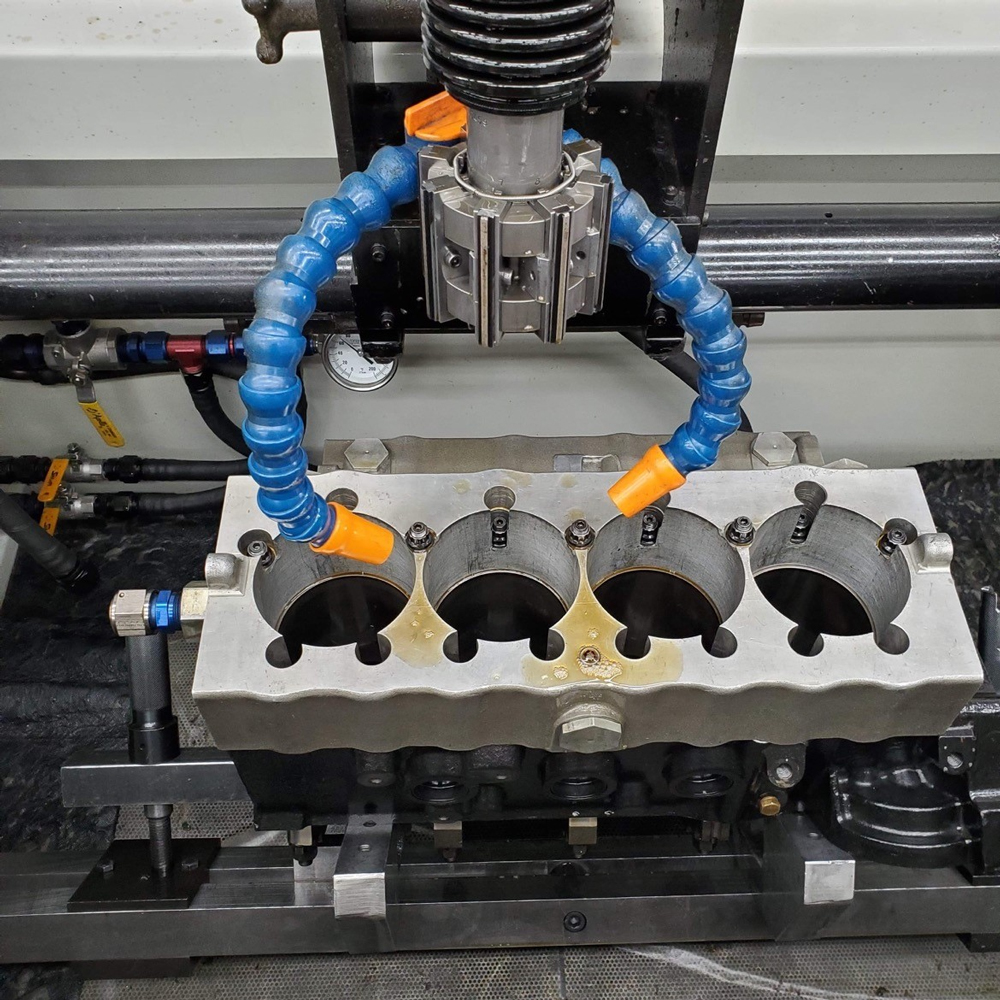
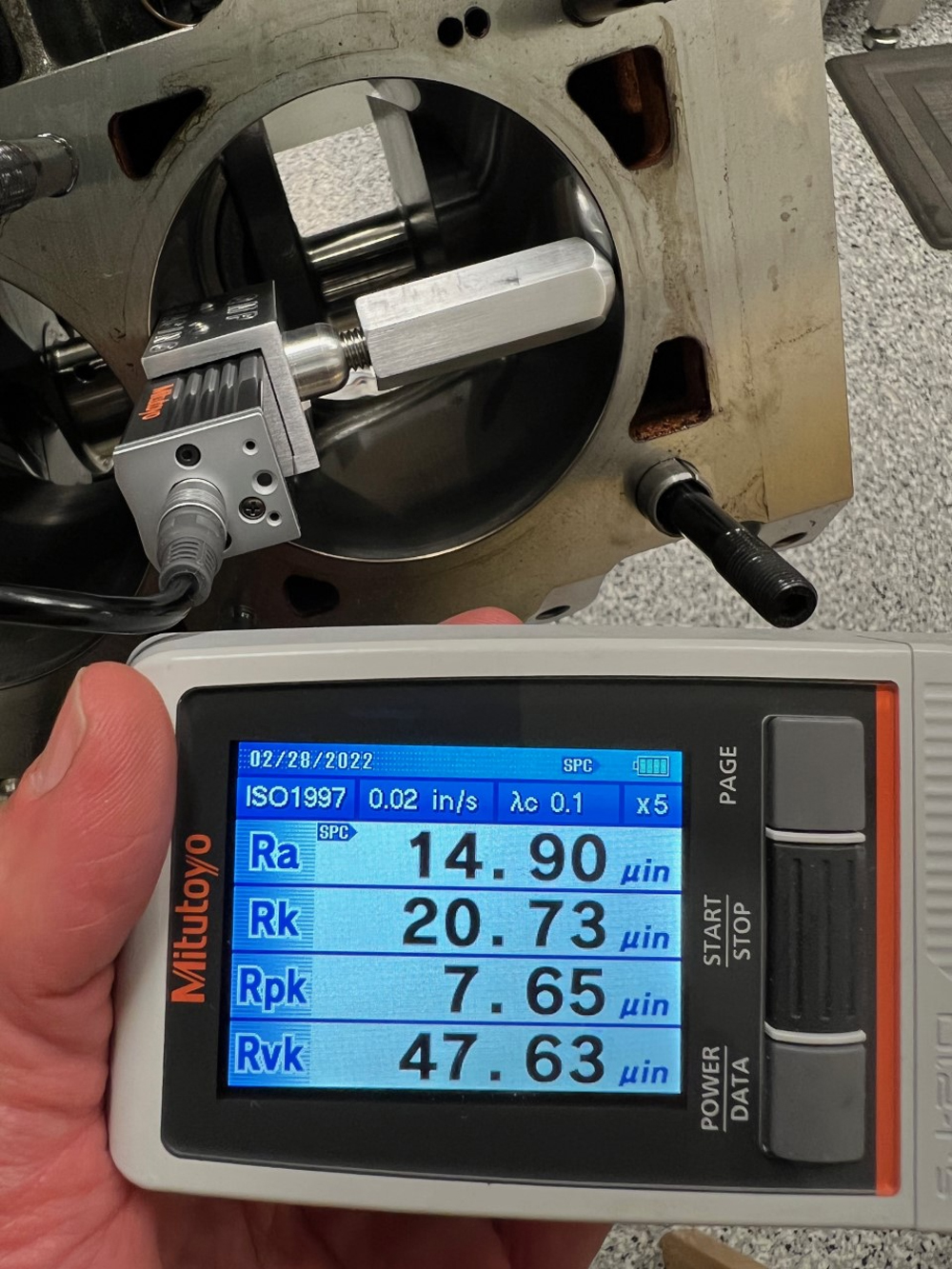
When thinking about surface finish, it helps to think in terms of things like a mesa and a mountain range. These oil-holding “valleys” can be measured with a profilometer, which is a surface finish measuring tool. When using the profilometer, there are three key measurements: Rpk, Rk, and Rvk.
Rpk is the peak height: Think about the peaks of a mountain range. The piston rings interact with these peaks, so we don’t want rough peaks.
Rk is the core roughness: Again, you’d rather have rolling hills than jagged mountains.
Rvk is the valley depth: The deeper the valley, the more oil the cylinder will hold.
Torque plates and multi-abrasive honing heads allow for better surface geometry, i.e., cylinder straightness and roundness.
To provide some perspective, the profilometer is measuring and reporting these values in micro inches. That’s a millionth of an inch, so 100 micro inches equals .0001. A good plateau finish is about 100 micro inches from the highest peak to the lowest valley. Let that sink in for a minute.
This means the entire surface texture that can make or break your engine is .0002 when measured with a dial bore gauge (.0001 per side). This is why the modern plateau honing process requires going to finished bore size with the roughing abrasive (170–200-grit diamond) and then “plateauing” with a 600-grit CBN abrasive for 10 to 12 strokes.
That process should yield the following values:
Rpk 10–15 micro inches
Rk 40–45 micro inches
Rvk 50–55 micro inches
These surface finish measurements will work for both steel and ductile moly rings.
The human eye can’t see objects smaller than .002 of an inch, so a profilometer, which measures roughness down to a millionth of an inch, is needed to accurately measure surface finish. (A fingernail isn’t accurate enough.)
When using steel rings with methanol or E85, increase the Rvk to 60–70 micro inches. That extra valley depth will hold additional oil to offset the higher volume of fuel that goes into the cylinder because of the richer air-to-fuel ratios of these fuels compared to gasoline. Essentially, the more fuel that goes in the cylinder, the deeper the Rvk needs to be. This rule applies to boosted engines as well—the more boost you run, the more fuel will be going into the cylinder, so the Rvk needs to increase to retain more oil, which is the key to increasing ring seal and extending cylinder bore/piston ring life.
Without enough oil to properly lubricate and seal the rings and cylinder bores, the performance and durability of the engine will be compromised.
Fortunately, we don’t have to guess or rely on “tricks” to get the right surface finish. Today, we have the profilometer and proven surface finish values that allow us to achieve precise surface finishes with the same level of precision as we do with other parts of our engines.
Lake Speed Jr. is the son of Lake Speed Sr., who raced professionally in NASCAR and International Karting Foundation before retiring in the late 1990s. After graduating from the University of Tennessee, Speed Jr. moved to Charlotte, North Carolina, to work for Melling Racing, which fielded Bill Elliott’s No. 9 NASCAR from 1982 to 1991. There, Speed Jr. helped develop an engineering department to test programs and improve performance. After joining Joe Gibbs Racing in 2004, Speed Jr. studied lubrication fundamentals and chemistry as part of a development relationship with Lubrizol. He later joined Driven Racing Oil as the director of research and development. In 2019, Speed Jr. joined Total Seal to advance the tribology of piston rings.
Many race businesses still don’t have them, so PRI asked some that do, as well as professional web developers, to share tips on what an effective site needs and how to launch one inexpensively.
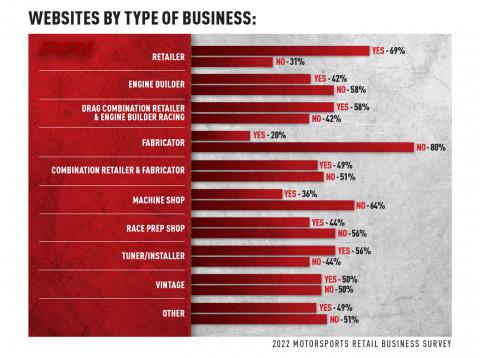
For the past several years, results of PRI’s annual Motorsports Retail Business Survey have revealed that just 50% of racing businesses that answer our questionnaire report having a website. Drilling down into the results shows that 69% of retailers have websites, but just 42% of engine builders and 20% of fabricators/builders do, too.
What benefits are businesses without a website missing? PRI talked to three website developers that specialize in motorsports clients to find out. All shared some basic website must-haves to get maximum value from the investment.
We also spoke with an oval track parts retailer that added e-commerce about two years ago and an engine builder that launched an all-new site with new features in late 2021.
We found that some race businesses use Facebook instead of a website. One, MasterSbilt Race Cars in Crothersville, Indiana, which builds dirt late model cars, uses an older website only for search results and to mirror its Facebook feed. “We’ve done more business over Facebook than we ever did with the website,” Tader Masters said.
While all three of the web developers included agree on many basics, each offers some specific actionable advice here.
In summary:
1. Even many “good” websites can use some immediate attention, especially updating contact information.
2. Social media and a website can work together to boost effectiveness of both, without increasing work for the business.
3. Launching a brand-new, professionally made, multi-page site can cost under $1,500.
4. The website developers we spoke with build sites that clients can update themselves and offer monthly packages to do that work for them if they prefer.
A Rebuild, or a Brand New Site?
Ainsley Jacobs’ company, P.TEN Marketing in Augusta, Georgia, develops and manages websites for a wide array of racing and street performance businesses. “I’d say about 70% of my clients’ sites are rebuilds or refreshes. The rest need completely new sites,” Jacobs said.
The most glaring problem she sees on older websites is a lack of basic information, such as clear descriptions of products and services, location, and hours of operation.
That becomes a place to start with a new or refreshed site. She recommends choosing a vendor that will be hands-on in taking a client through every step, from purchasing the domain and securing hosting to developing, deploying, and managing the site.
Jacobs counsels clients to use a website design that showcases their individual business’s character. “If the website looks the same as a competitor’s, the customer may assume the product is the same, as well.”
Whether you’re launching a completely new website or simply refreshing an existing one, our source at P.TEN Marketing recommends choosing a vendor that will be hands-on in taking a client through every step of the process.
Jacobs cited fresh and useful content as essential not only for search engine optimization and search rankings, but also for generating customer interest. She recommends active updating, including a 300- to 500-word blog post at least once or twice a month, plus passive content from integrating social media streams and Google reviews.
“If you think you don’t have anything to blog about, your customers sure do,” she said. “Post about their successes and wins. The search engines respond positively, and your customers get value from the recognition.”
In instances when cost comes up as an obstacle to having a website, Jacobs said it usually relates to setting up e-commerce. While e-commerce involves such complex elements as inventory integration, retail and wholesale pricing, shipping logistics, and credit card processing, available services such as Shopify can streamline the process.
The ‘Magic Formula’ for Small Race Businesses
Many race drivers, tracks, and other motorsports businesses know Ben Shelton for his former company, MSR Mafia Marketing and PR Services. MyRacePass bought the firm in August 2021, also hiring Shelton and his staff and bringing on more than 170 of their website clients. Shelton told PRI that MyRacePass in Lincoln, Nebraska, now handles roughly 70% of race track websites in North America.
PRI asked Shelton what he would advise for an engine or chassis builder with a few employees, and who either has an old website or no website at all.
“If you have a website that’s from the early 2000s and hasn’t been touched again, it can hurt you,” he said. “A potential customer will see it’s outdated and think you don’t have what they need or that maybe you’re not even in business anymore.”
Shelton agreed that the idea of adding e-commerce can intimidate some companies into thinking any website is too much to handle, and he said that many just need a web presence.
The homepage on the Vic Hill Race Engines site demonstrates the “magic formula” for a successful website, according to our source at MyRacePass: Highlight what the company offers, feature customer accomplishments, provide good contact information, and keep the content concise.
“Often, we find ourselves ‘down-selling’ to what they really need,” Shelton explained. “The magic formula for such businesses is to 1) highlight what the company offers, 2) feature customer accomplishments, 3) provide good contact information, and 4) keep the content concise. Remember, many people prefer to see photos and watch videos.”
Shelton agreed that race businesses need both a website and social media pages, with the latter’s feeds integrated into the site. He also emphasized a must-do: “Make sure the website is mobile-optimized. If it’s not, Google won’t index it.” (All the web developers we spoke with optimize sites for mobile phone viewing.)
While website developers may vary in cost, MyRacePass highlights packages on its site starting at $1,000 for a basic five-page informational site and $39 per month for hosting. A site with e-commerce starts at $2,000 and $79 per month.
Interestingly, Shelton said that some motorsports customers follow their own “old-fashioned” approach to e-commerce. “We find that, especially with dirt track clients, many go to the websites to see what products are offered, but they still pick up the phone to place an order. They want to talk to a person and make sure they get exactly what they need.”
How an Old Family Business Moved to E-Commerce
Don Kreitz at Kreitz Oval Track Parts in Sinking Spring, Pennsylvania, can relate to Shelton’s observation about “old-fashioned” e-commerce, even though he is not a client. Kreitz told PRI that the business had a web presence for 20 years, but only shifted to an e-commerce site when COVID-19 struck in 2020. He said the change increased business, though not all customers take advantage of the easy ordering through the site’s Shopify platform.
“We still have people who have been in racing for a while who only place orders over the phone, even a lot of the younger people,” he said. “We get so many calls where they say, ‘I saw this on your website.’ The way it is laid out makes it so much easier for them to find what they need. Then they call with questions and place an order.”
Kreitz’s father started the business in 1968 as a welding shop. The website, as well, has been a family project. “My daughter Kassidy did the site, said Kreitz. “She went to college for this. She was in Drexel University in the middle of COVID-19 and taking classes remotely.”
Kreitz said he would encourage similar businesses to offer e-commerce websites, but he advised that it is “a lot of work.” His sister and business partner, Vicki Ely, handles site updates.
“We don’t have all our inventory on the website yet, but we’ve sold almost everything that we feature,” Kreitz said. “We try to add a few items each week. Each item needs photos, which we do in-house. You must write good descriptions, and each item needs the weight and box size. It’s very time consuming, especially because our products are so specialized, but nowadays, I think it’s something you need to have.”
Stepping Slowly Into E-Commerce
Pro Motor Engines (PME) in Mooresville, North Carolina, which provides approved engine packages for NASCAR, ARCA, and SCCA series and the Trans-Am TA2 class, recently switched gears for its website strategy. Dennis Borem told PRI the business launched a new e-commerce website in late 2021 to replace an older informational site. Also part of the conversation was Jesse Kiser, whose firm, Earnest Marketing, handles PME’s website and content.
“We want to reach a larger customer base and have more retail sales,” Borem said about the change. “We’ve had some sales without doing any advertising, and we’ve had some inquiries on engine packages.”
He explained that the site launched with “a good foundation of our third-party products” and that more of PME’s own products and engine packages will be added.
Borem relies on Kiser’s company to keep evolving the site. Kiser offered advice for e-commerce and for developing simple sites where online selling is not needed.
An effective website “should have all vital information about your business,” said our source at Earnest Marketing, which works with Pro Motor Engines (PME) to maximize its online presence. “That is the most basic thing needed, and it is missing from many sites.”
For an e-commerce site, he said, “Don’t over-complicate. I always tell my clients to look at Holley’s site. It’s simple and functions well. They made it easy to buy parts and easy to navigate to their tech articles.”
Kiser suggested that a business needing e-commerce could get started with a Shopify account and website builder account for “under a couple-hundred dollars a month.” He contrasted that with a business doing $10 million a year that may be spending $3,000 monthly just on the e-commerce package.
“Those differences, without proper context, breed misconceptions about cost,” Kiser said.
Among businesses without a website, or still idling along with an old one, Kiser said he still encounters misconceptions about what an effective site requires. “Put simply, a website needs to be a tool that provides convenience for customers and solves problems for the business,” he said. “A good, simple website gets the customer one step closer to contacting you to buy something. It should have all vital information about your business. That is the most basic thing needed, and it is missing from many sites.”
For example, Kiser explained that providing basic information on engine packages can reduce time spent providing the same information to callers. The website information can then encourage serious customers to call.
For a small business needing just a bare-minimum web presence, Kiser suggested three essentials:
1. A simple landing page that shows who you are and has a legitimate domain name.
2. A Google My Business account, which is especially important for those serving a local area. Make sure the information is up to date and accurate.
3. Link Facebook and other social account feeds to the website and post at least once a week to show you are an active business.
Competitors are laying down times on par with their gasoline-powered counterparts. We uncover more than a dozen reasons why.
Once widely regarded as a quirky niche segment of motorsports, diesels now have the performance to sit shoulder-to-shoulder with more established forms of racing.
“Ten or 20 years ago, diesel racing was a novelty,” observed Jared Alderson of Kill Devil Diesel, Poplar Branch, North Carolina. “It was almost more of an exhibition, like, ‘All right, here comes the smoke show, then we’ll get back to real racing.’”
Fast forward to the present, and the snickering has stopped. Diesel racers are laying down ETs within striking range of the quickest gas cars. That’s brought newfound respect to the category, fueling an increase in mainstream attention for diesel as yet another option for going fast and competing.
As impressive as the performance is among today’s top-tier diesel racers, it’s worth noting that these racers are accomplishing these things with a tiny fraction of the aftermarket support that the gas-engine community has enjoyed for decades. The stunning performance of modern diesel race cars has required determination, ingenuity, and creativity—not to mention, of course, lots of money.
To find out where this vibrant, relatively young performance segment is headed, we talked with leading experts in diesel performance. They gave us truckloads of insight into the technology, culture, and business of diesel racing. From that, we picked the 15 most significant trends shaping diesel motorsports in the near future.
Mid-3-Second Diesels
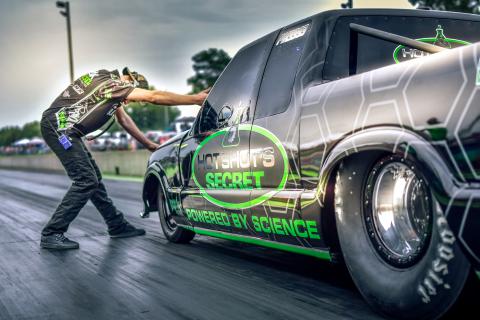
While the gas drag-racing community pursues gains in hundredths of a second or smaller, diesel racers are shattering records by whole tenths of a second. For example, Firepunk Diesel’s Cummins-powered Chevrolet S-10 Pro Mod steadily marched its way down the four-second eighth-mile range in a short period. Then, in 2021, it set a new record with a blistering 3.99 pass—the first diesel to break the four-second mark. This trend is sure to continue, according to our sources.
“Some of Firepunk’s future plans I can’t publicly release quite yet,” said Kyle Fischer of Lubrication Specialties, Mt. Gilead, Ohio. “But there’s no reason why they can’t get into the 3.7s and 3.6s, where all the fastest gas cars in the world are. And it’s coming soon.”
“It’s like Top Fuel drag racing,” said Dan Scheid of Scheid Diesel, Terre Haute, Indiana. “You’d think they would have reached a peak by now, but they haven’t. I believe it’s the same thing in the diesel market. I don’t think there’s going to be a limiting factor on horsepower for diesels. I had this conversation back in 1974, and it’s still going.”
Purpose-Built Chassis
Perhaps one of the most startling facts about the recent increases in diesel racing performance is that, so far, it’s been done with relatively little attention given to chassis development. Most racers in diesel’s top ranks are using modified stock frames or castoff gas-car chassis. This is likely to change soon.
“Going lighter is definitely the trend,” observed Alderson. “You can race a 7,000- or 8,000-pound truck. Guys do it. It’s very popular. But it’s really hard on parts.”
“The record-setting Firepunk S-10 we sponsor uses an old super stock chassis from about 22 years ago,” added Fischer. “That stuff has been kind of an afterthought because we were just trying to catch the gas guys in power and speed. Now that we’re there, some very unique chassis are being built for these platforms.
“The biggest difference between a gas chassis and one for diesel is the weight bias,” continued Fischer. “Even with a full billet aluminum block, diesel blocks are so large that the weight is just unlike what anyone’s used to seeing in a regular Pro Mod chassis. Now, some of the best chassis builders in America are getting requests for diesel platforms. It’s like starting from scratch for them. I have been told they have to completely redo what they have done in the past.”
“As more people race diesels, that creates a bigger market for aftermarket manufacturers,” observed one industry source. “At that point, it makes sense for them to start developing parts, and the whole thing just gets bigger.” Photo courtesy of Lubrication Specialties.
Greater Precision in Tuning
Diesel performance is still largely uncharted territory; it simply doesn’t have as many proven standards and baseline methods as gas engines. But as the segment gets more established, it’s getting more sophisticated about tuning, according to our sources.
“We’re pushing more of our customers to look at air-fuel ratios,” said Alderson. “Traditionally that hasn’t really been a big topic of conversation in the diesel community, which is funny, because that’s such a key component with gas racers. But now diesel racers are getting the engine calibration under much better control, so components live better. It’s been absolutely a critical evolution and continues to be looking forward.”
Less Turbo, More Nitrous
Diesels produce such massive amounts of torque that it can actually be counterproductive in drag racing. Now racers are seeking ways to reduce and control that torque more effectively. One way to do so is to use one instead of two turbos, and then add plenty of nitrous to make up the difference. This combination is quickly becoming a standard approach for diesel drag racers.
“A 2,000-horsepower diesel engine is typically making close to 3,000 lbs./ft. of torque,” explained Alderson. “And we don’t necessarily want that much. So a lot of guys have gone away from big compound turbos that make 200 pounds of boost. Instead, they’re going back to a medium or large single turbo with a bunch of nitrous. The nitrous is a lot more manageable. With a nitrous controller and a timer, you can really control the power band a lot easier than you can with just boost.”
Stronger Components
As horsepower climbs, so does the component carnage, just like in the gas-engine world. Contributing to the damage are ever-increasing rpm’s being run by diesel racers, which is another means of reducing the over-abundance of torque produced by these engines.
“One of the most common ways to control torque in a diesel is just to increase the rpm band of the engine,” said Alderson. “But then that inherently stresses components. The rotating assemblies on diesels are so heavy that it becomes a factor. And then, there’s the valvetrain. People think of these as 3,000–4,000 rpm engines. But as guys spin 6,000 rpm going down the track, the factory valvetrain becomes largely insufficient.
“At the same time, diesels have a lot of cylinder pressure,” continued Alderson. “Some of the competition diesels approach what Top Fuel dragsters see for cylinder pressure. So when exhaust valves open, they have to overcome many thousands of psi of cylinder pressure. With that environment, we find that the factory rockers just aren’t adequate. So we’re working with Jesel to develop an exclusive line of rocker arms and valvetrain components.”
“You’re starting to see billet blocks and things like that being offered for diesels,” added Ivan Snyder of Fluidampr, Springville, New York. “That trend will probably continue, especially as diesel becomes a bigger market for manufacturers, and it makes sense to come out with products for it.”
Older trucks are gaining more attention from the diesel racing community. “We’re seeing a lot of very heavy investment, both from a restoration and a modification perspective on the pre-emission stuff,” said one source. Photo courtesy of Ultimate Callout Series.
Superchargers Instead of Turbos
Several engine builders are experimenting with various types of superchargers instead of turbos on diesel engines. Although much development remains before such a setup would be a viable choice for a competition engine, the setup could prove highly effective in monster truck competition, where massive torque is beneficial, but immediate throttle response is essential. Even in drag racing, such a system has potential advantages.
“A lot of diesel guys are struggling with throttle response,” said Alderson. “They’ve gone away from compound turbos, and they end up with a giant single turbo in a competition setting—they have to use nitrous to get the turbo spooled up. If they have to lift and get out of the throttle pedal going down the track, they lose boost, and it sniffs the turbo out. But from a throttle-response standpoint, blowers are awesome. You don’t have any of those problems.”
Emission Control
Many people still associate diesel racing with vast clouds of black smoke, which was the norm not all that long ago. Now, more efficient tuning, extensive use of nitrous, and an increased emphasis on environmental responsibility are cleaning things up. Many in the industry say that doing so is necessary to preserve the future of diesel motorsports.
“Ten or 15 years ago, the diesel performance industry got themselves in trouble with guys asking for smoke tunes,” recalled Alderson. “They used a tuning calibration specifically to blast out black smoke when they roll onto the throttle. But that doesn’t put the diesel industry in a good light.
“Ryan Milliken is a good example of doing it right,” continued Alderson. “His Cummins-powered Nova can compete heads-up with gas-engine cars, but it runs very clean. There might be just a teeny puff at the starting line, and then it’s clean as a whistle the rest of the way down the track.”
Factory Power Wars
While mainstream performance enthusiasts have been going gaga for years over the factory muscle-car power wars, there’s also been a parallel fight among OEMs for the most powerful diesel crown. All of the Big Three’s diesels are now rated at 1,000 lbs./ft. of torque or very close to it. And the fight is only going to get more intense, say experts. That gives competitors a lot of ready-made raw material to start with.
“Diesel has quietly been having its own private horsepower war,” explained Jake Hopkins of FASS Diesel Fuel Systems, Marthasville, Missouri. “We’ve seen manufacturers leapfrog each other year after year with bigger torque numbers, bigger horsepower numbers, bigger towing capacity, bigger everything. We don’t see that slowing down anytime soon.”
Young Racers
As the diesel performance segment gains mainstream visibility, it’s attracting plenty of younger fans. That’s always a good sign for the future of an up-and-coming market.
“Our TikTok account, which is categorically a young audience, has exploded in the last year,” said Hopkins. “It’s our biggest platform by almost 50%. We’re seeing a lot of really young kids, 16–17 years old, getting very, very interested in diesel. They’re asking a lot of questions, going to events, and really getting into it. That’s a huge opportunity for companies in the diesel space to start talking to these kids. They might not be customers yet, but two or three years from now, they’ll get their hands on old beat-up trucks, and that’s going to be a big opportunity.”
Old Trucks
As interest in diesel racing grows, older trucks are getting more attention. This is partly because of the usual car-enthusiast desire for something nostalgic and different. But it’s also a matter of supply and demand. Diesel trucks have only recently become an option for performance enthusiasts, so there’s plenty of relatively inexpensive raw material lying around waiting to put on the track.
“We’re seeing a lot of very heavy investment, both from a restoration and a modification perspective on the pre-emission stuff—the older trucks,” observed Hopkins. “It’s been cool to see that because up until a few years ago, a lot of those trucks were almost treated as disposable.”
Common-Rail Conversions
To make older diesel trucks into viable performance machines, there’s been more interest in upgrading dated fuel-system designs to modern common-rail injection, allowing greater power, lower exhaust emissions, and more precise control over fuel delivery.
“Early computer control for diesels—late 1990s, early 2000s—was a little bit primitive,” said Alderson. “So we’re seeing more and more customers experimenting with retrofitting the more desired common-rail fuel system to earlier engines to have better fuel-system control. Right now, they typically utilize a MoTeC ECU to do it, or some combination of factory ECUs. One of our goals is to work with S&S Diesel Motorsport to bring common rail to earlier engine platforms.”
Because there are few off-the-shelf parts available for diesel racers at the sport’s highest levels, the one-off parts they need can be “ridiculously expensive,” said an industry representative. That will likely continue until more companies enter the market and can absorb some of the developmental costs. Photo courtesy of SunCoast Performance.
Heads-Up Gas and Diesel Racing
Up to this point, diesel drag racers have primarily competed in their own dedicated events, with diesels lining up only against other diesels. Now that their performance is approaching that of gas cars, we’re seeing more diesels going head-to-head with gas cars, particularly in radial-tire events. Our sources say this trend is likely to grow.
“Ryan Milliken was the first diesel racer to run a radial event,” recalled Fischer. “He had a green diesel-powered Chevy Nova a couple of years ago, and he broke the Internet when he knocked off a gas car with it. Now he has a beautiful diesel 1969 Nova, and he isn’t even running it in diesel events. He’s only running gas events all year long. And I know of another diesel car being built specifically to run a certain class in the gas world.”
More Aftermarket Involvement
Although big-name aftermarket manufacturers don’t appear to be rushing into the diesel market just yet, there will undoubtedly be more companies developing parts as the market grows more financially viable. This will further accelerate the performance improvements of diesel racers and make it easier for average enthusiasts to jump into the sport.
More diesel drag racers are going head-to-head against gas cars, particularly at radial-tire events. Ryan Milliken, for example, now only competes against gas cars with his Cummins-powered 1969 Nova. Photo courtesy of Lubrication Specialties.
“As more people race diesels, that creates a bigger market for manufacturers,” said Snyder. “At that point, it makes sense for them to start developing parts, and the whole thing just gets bigger.”
More Expense
There are relatively few off-the-shelf parts available for no-holds-barred diesel performance. While this fosters a robust spirit of innovation, creativity, and individuality, it also brings a steep price tag. This is true at the segment’s upper ranks, which are far more mechanically demanding and experimental in their approach. Unfortunately, these high costs will probably continue until more manufacturers jump into the diesel market and absorb some of the development burden.
“With the top racing diesels, everything on the vehicle is a prototype, a one-off,” explained Fischer. “So it’s ridiculously expensive. But it takes pioneers like Firepunk Diesel, who are willing to put in the money, the time, and the effort to advance the industry for the good of all.”
Even More Collaboration
As diesel racers reach unprecedented performance levels, they’re seeing the rewards of their tight-knit, collaborative community. Although they originally banded together in the camaraderie of belonging to an outcast, ‘black-sheep’ form of motorsports, now diesel racers are beginning to move into the mainstream largely because of these joint efforts.
“Compared to the gas world, the diesel community is very tight,” said Fischer. “I think a lot of that’s because diesel racers have been kind of pooh-poohed by the rest of the motorsports community for so long, sort of like, ‘Oh, isn’t that cute. These guys are racing the trucks they pulled their race cars with.’ I think that may have bonded us quite a bit over the years as a community. It really helped us work together for the overall good of the sport. And that’s advanced the technology by leaps and bounds these past few years.”
Drag racing on the quarter-mile in 8 seconds is impressive, but try doing it on 26-inch wheels. That’s what the National Donk Racing Association is about, and its lead ambassador is taking the country by storm, one Donk at a time.
We’ve all seen Donks out on the road, but how much do you really know about these particularly unusual custom cars? If you’ve seen or heard of them, you know they have big wheels, 22 inches or greater in diameter. But what else? It turns out there’s a lot that goes into these striking customs, and there’s a racing series for them, too.
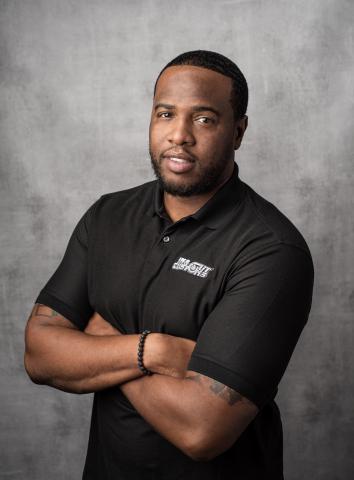
The man behind the racing series is Sage “Donkmaster” Thomas. Born in Georgia and raised in South Carolina, Thomas was exposed to the growing Donk scene as a teenager and never looked back. Thomas built his first Donk at age 16 and went straight into racing. He founded his shop, In & Out Customs of North Charleston, South Carolina, to advance the development of Donk performance. He has also starred in a successful series of YouTube videos documenting his work. Today, he’s the foremost ambassador for the Donk style and Donk racing in America, delivering his trademark “gap sauce” to enthusiastic fans everywhere.
Thomas recently took some time to expound on the Donk phenomenon, introducing us to the National Donk Racing Association and illustrating how racing support businesses can best help Donk owners when they need parts or service.
PRI: What makes a Donk? Is it just the big wheels or is there more to it? Tell me like I don’t know anything, because I don’t.
Thomas: Okay, a Donk is 1971 through 1976 Caprice or Impala. It has to be a Chevrolet Caprice or Impala, and the only years are from 1971 through 1976. It could be a convertible, a two-door, or a four-door. It doesn’t matter what style it is, but just those years.
PRI: Where does the name Donk come from?
Thomas: The name came from everybody acting a Donkey in the cars. So like when you get a Donk and it’s fresh and clean and you go out and party and hang out, you turn the music on, you just have a good time. You act a Donkey in it. That’s just a street slang. It’s what they use, and it stuck with the name of the vehicle.
PRI: Where did this style start? Is there a particular region or a city, and when did people start making those cars into Donks?
Thomas: It started in South Florida. They started doing the Donks, I want to say it was the early ’90s. At first, they used to have 17-inch wire wheels on them. But as the trend started to change over the years, they started putting the bigger wheels on the car, because the car is so big, and you can put a large wheel on it without too many modifications.
PRI: How did you personally get started with Donks and then with Donk racing?
Thomas: I started getting into those because my father lived in Florida in the early 1990s, and I used to go down there in the summer to visit him. I started seeing all those cars when I was 9, 10, 12 years old. Then I started working at a car wash in Orangeburg, South Carolina, and all the big street boys would come through the car wash with the Donks. So I saw them when I was from 9 to about 15 years old. Once I got to about 15 years old, I started knowing what they were, and how much attention they got, and how the girls like them.
I always wanted a Donk because when them fellas pulled up and they had the golden jewelry on, they looked real good, you know what I mean? The females came and they always wanted to ride in the Donk.
PRI: The usual impression of Donks is that they are street cruisers, not racing cars. Were they always about racing, or did that come along later?
Thomas: They were always about showing out. There was a DVD called East Coast Ryders, which was owned by a fellow named Vido No Shake. I talk to Vido on a regular basis. He’s the original historian of all the Donk stuff. He came out with some DVDs and VHS tapes in the early 2000s where they were showcasing all the stuff they did in South Florida with the Donks. They would leave the big wheels on the front, the 22s and 24s on the front, but they would put slicks on the back.
“Anybody who loves drag racing” will love Donk racing, said Sage “Donkmaster” Thomas. “It’s a challenge to get a car that weighs 5,000 pounds and makes 2,000 horsepower to go down the track on 26-inch wheels. It’s very exciting to watch.”
I came from a background of drag racing also, but whenever I break my Donk out, I’m fresh and clean. I don’t want to get on the ground and change tires on the back. So I thought, well, if we can race it with the wheels on it, then I can make that a thing. That way, everybody would be racing with the wheels on it. Like we leave the club on Friday or Saturday night, we go down the street with the wheels on, everybody looking clean and then we race it with the big wheels on the car without having to change it. We called it “fast and flashy racing” with the big wheels on.
PRI: Now you have this National Donk Racing Association. It’s drag racing, but do you have different classes for different years or different engines? How does NDRA work?
Thomas: As of now we have seven classes. We have a lightweight, a middleweight, and a heavyweight class for Donks, and that’s only ’71 through ’76, Chevrolet Impala body style. And then we have another lightweight, middleweight. and heavyweight for G-bodies. That would be Monte Carlos, Cutlasses, Regals, any kind of G-body from ’78 to ’88, including the El Caminos. Then we have one class called the open class, and that is any kind of truck or car on 22-inch wheels or bigger. So if you’ve got a Suburban on 24s, or if you’ve got a Pinto on 22s, or a Mustang, they all race in that class.
PRI: What’s the definition for lightweight, middleweight, and heavyweight?
Thomas: There are certain restrictions. A lightweight is an all-motor class. It doesn’t matter if it’s big block or small block. Then in middleweight you can have one power adder, so you can have a turbo or supercharger or nitrous. You have to have a full interior and you have to do a street cruise where it looks like a regular street car. Heavyweight is all-out, whatever, you can gut it and use any suspension, any motor. The only limitation is you have to have 26-inch wheels in all the Donk classes.
PRI: What are these cars doing in terms of ETs?
Thomas: Right now, some of these cars are running the quarter-mile in the eight-second range as a heavyweight car. We have cars out there all over the United States that are running mid- to bottom-8s with 26-inch wheels on right now.
PRI: I’ve seen videos of big-wheeled cars, and with the physics of those big wheels, they can snap the axle half shaft. How do you deal with that? Do you have special-made axles?
Thomas: We have been working closely with Moser Engineering. He started recommending that we put the 40-spline axles in there. We went from a 35- to a 40-spline in full spool. Then we also mandate 5/8-inch wheel studs and 1350 U-joints to participate in NDRA. The safety side of it is very important because we are going really fast with a lot of weight. Over the years, I have been working closely with Moser Engineering and also with Greg (Samuel) at FTI Performance for transmissions. They build and test a lot of the converters and transmissions for these high-horsepower, big-wheel cars. And now Mark Menscer of Menscer Motorsports has helped us a lot on moving the shock program forward. It’s something to see!
PRI: If I go to an NDRA event, who am I going to find there? Who’s competing? Are they Donk enthusiasts, or are we starting to get professionals in there now?
Thomas: Oh yeah, we have a lot of different professionals, like Alex Laughlin, who’s a Top Fuel driver, pro driver for the NHRA. We taught him a lot. He wanted to come to a couple events. Clay Millican actually came to a couple events. We had talked to him about that also. We have been talking with Antron Brown and Lyle Barnett, who are also participating in NHRA. They’re talking about building a car. So yeah, we have some of the big names in NHRA, plus a lot of the local guys who run Outlaw 10.5 and drag radial classes as well.
PRI: So in terms of the rules and the way it runs and everything else, it’s pretty similar to what we would find at an NHRA event?
Thomas: Yeah, we do a points basis, so it is on points and it’s on a class. Just like you said, if we have eight cars in the heavyweight class field, we’re doing a $10,000 payout for the class. Then you can win for the round and actual points. Every time you win, it is based off the same thing as the NHRA point scale.
Sage Thomas, at right, promotes National Donk Racing Association (NDRA) events through his video show on MotorTrend+, which gets 3–4 million views per episode.
PRI: In terms of fans, who’s your target market? Are you looking for people who are already Donk enthusiasts, or are you looking to reach out and show the cars to a broader audience?
Thomas: We’re looking to show it to everybody all over the world! Right now, the market is the 18 to 49 demographic. Right now, a lot of the race tracks we go to, we might have about 5,000 to 8,000 people come to each show. It’s starting to grow a lot because of my television show on MotorTrend, that’s doing three or four million views every episode. So fans are starting to figure out that we’re having events because they see it on TV for the first time, but then they’re trying to find it. The schedule is on my website at ndrausa.com, and then it’s all over the social media under @1_donkmaster on Instagram and Donkmaster on Facebook. Anybody who loves drag racing will love this because it’s a challenge to get a car that weighs 5,000 pounds and makes 2,000 horsepower to go down the track on 26-inch wheels. It’s very exciting to watch.
PRI: Is social media how you do outreach to young people? One of the things we always talk about at PRI is how to get the young people involved.
Thomas: Yeah. So matter of fact, this past weekend I was in Gulfport, Mississippi, and I had a group of 15-year-old boys pull up to a race we had there for the first time. They pulled up in a limousine they had for one kid’s birthday. They wanted to check out the big-wheel racing to see what we had. For outreach, I have a lot of friends in the YouTube space, so we normally collaborate and partner up to get the word out to everybody. Right now, we have the 18 to 49 and it is getting younger. So we are down into the teens, the high school students, and they want to see it because like I said, it’s something exciting to see. We’re getting fans off of TikTok, and I’m also making a lot of different, funny videos, so they get entertained.
Safety is a priority at the NDRA, according to Sage Thomas. It has been working with companies, including Moser Engineering, FTI Performance, and Menscer Motorsports, to ensure that driveline, transmission and suspension components are up to the loads generated by a Donk’s big wheels.
PRI: Our audience at PRI is racing businesses. When somebody comes in who’s a Donk racer and they’re looking for parts, or they’re looking for modifications, what do those racing businesses need to know in order to meet their needs?
Thomas: It’s very new, but I have the list of the main shops who have been building cars. On ndrausa.com we have certain shops now certified to build these kinds of vehicles. So I’m going to add some more shops to the list this year. There are shops that have been doing this for the last 10 years, and the work speaks for itself. We’re going to keep adding to that and keep the people in the loop on who is good to work on it, because it’s not the same concept to build a 2,500-pound race car as a 5,500-pound race car. That’s two different things. It’s like somebody who knows how to build muscle trucks, but they don’t know how to build a ’69 Camaro that runs four seconds in the 1/8th mile. It’s totally different.
PRI: A business owner can go to ndrausa.com and get in contact with you to see about getting certified to be on your website?
Thomas: Yep. That way we’ll keep everybody up on who has the knowledge to safely build a high-horsepower, big-wheel race car.
Sage Thomas’ website lists shops experienced in building Donks into drag racers. “It’s not the same concept to build a 2,500-pound race car as a 5,500-pound race car.”
PRI: We already talked a bit about some of the purpose-built products you’re using. Is there anything else that Donks need?
Thomas: There’s also engine diapers, transmission blankets. We use fire suppression systems inside the heavyweight vehicles. Then we use the race harnesses. We’re big on safety because drag racing is a dangerous sport. We want to try to beef up all that stuff, making sure the cars have roll cages if they’re going a certain speed. They also need parachutes on the heavyweight cars. Safety is what we like to push.
PRI: What are your short-term and long-term plans for NDRA? Where do you see this all headed in five years’ time?
Thomas: Right now, we have three events this year. We have Maryland on July 9th, we have Reynolds, Georgia, on August 13th, then we have Darlington drag race on September 10th. This is the second year of the NDRA, and I just want to showcase to everybody that you can race big-wheel cars. They can line up. They can all be in classes, and we can show everybody we can race. That’s my short-term goal for this year.
My long-term goal is to show the world what big-wheel cars can do. I want to go racing in Japan and Dubai and Australia, and just travel the globe with it. Hopefully, we’ll be on TV, just like NHRA. Just like NHRA has FOX on television. I can see a NDRA event on a major network. I’d like to see major sponsors and be selling out race tracks, a couple hundred thousand people at a time. I think the NDRA should be on the same level as that.
PRI: Is there anything you would want to say to the audience of racing professionals?
Thomas: Visit the website, ndrausa.com, and the other website is inandoutcustoms.com. And I guess you can put this quote in there: “If your dreams don’t scare you, they’re not big enough.”
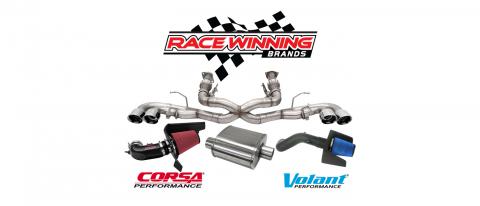
Race Winning Brands (RWB), a portfolio company of MiddleGround Capital, has announced the acquisition of CORSA Performance, CORSA Performance Marine, and Volant Performance.
The three acquisitions bring RWB to sixteen add-ons since its inception in 2017.
“Adding CORSA and Volant to our family is a natural fit for RWB,” said Bob Bruegging, CEO of RWB based in Mentor, Ohio.
CORSA Performance is based in Berea, Ohio, and specializes in performance exhaust systems, cold air intake systems, and related accessories. In addition, CORSA Performance Marine offers marine-specific exhaust systems and components.
Volant Performance, also based in Berea, Ohio, focuses on cold air intakes and filters for various applications.
The businesses will continue to operate from their respective locations.
 MEMBERSHIP LOGIN