Advocacy Corner

Submitted by jeffreyc on Mon, 06/13/2022 - 16:00


Tracking legal, legislative, and regulatory developments impacting the racing and performance industry.

PRI race track ambassador Tom Deery and the Washington, DC-based advocacy team work continuously to protect and promote tracks, sanctioning bodies, and motorsports businesses around the nation. This month we are tracking several initiatives, including a new campaign to highlight pro-motorsports legislation and election candidates; the PRI Career Center offering opportunities for job seekers; an opportunity for businesses to branch out to Nordic markets, and more.   

PRI’s All-New ‘Vote Racing’ Campaign 

PRI, the leading industry organization supporting the interests of racers, enthusiasts, builders, tracks, sanctioning bodies, and businesses, has expanded its advocacy efforts to further promote and protect one of America’s oldest pastimes and hobbies: motor vehicle racing. 

PRI’s enhanced Save Our Racecars initiative features a redesigned website (SaveOurRacecars.com) that streamlines the process for industry professionals, enthusiasts, and fans to join the fight to preserve racing. Included is an all-new “Vote Racing” program to help facilitate voter registration while highlighting pro-racing candidates in the November midterm elections. Visitors will also find PRI-created template letters, phone scripts, and other resources designed to streamline outreach to lawmakers. 

“PRI has a long history of advocating for and protecting the racing industry, and the expansion of the Save Our Racecars campaign is our latest effort,” said PRI President Dr. Jamie Meyer. “Bringing together industry, enthusiasts, and fans will be critical to driving awareness and support for an American passion that is under fire. The resources and access available on SaveOurRacecars.com make it easy for anyone to get involved, show their support, and demonstrate that support at the polls.”  

Critical to the industry’s future—and central to PRI’s advocacy efforts—is the Recognizing the Protection of Motorsports (RPM) Act of 2021 (H.R. 3281/S.2736), which must be enacted into law to protect the right to modify street cars, trucks, and motorcycles into dedicated race vehicles. Supported by both PRI and SEMA, the RPM Act aims to protect Americans’ right to convert street vehicles into dedicated race cars and the motorsports-parts industry’s ability to sell products that enable racers to compete.  

The RPM Act reverses the EPA’s interpretation that the Clean Air Act does not allow a motor vehicle designed for street use to be converted into a dedicated race car. This American tradition was unquestioned for 45 years until 2015, when the EPA took the position that converted vehicles must remain emissions-compliant, even when they are no longer driven on public roadways. The RPM Act does not interfere with the EPA’s authority to enforce against individuals who illegally install race parts on vehicles driven on public roads and highways and companies that market such products.  

Converting street vehicles into dedicated race vehicles is an American tradition dating back to the 1800s. Motorsports competition involves tens of thousands of amateur and professional participants and vehicle owners each year at more than 1,300 race tracks across the United States. In addition, retail sales of racing products make up a nearly $2 billion market annually helping drive the larger $50.9 billion high-performance aftermarket industry. The RPM Act will provide the racing community with certainty and confidence in the face of an EPA interpretation of the Clean Air Act that threatens to devastate an American pastime and eliminate jobs in our communities. 

To date, more than 150 federal lawmakers and candidates on both sides of the aisle have either signed on as co-sponsors or expressed support for the RPM Act. PRI has compiled a database on SaveOurRacecars.com that allows individuals to “Vote Racing” in November’s midterms by researching and identifying those elected officials and candidates that share their passion. The site also provides resources to register to vote, apply for an absentee ballot, and access election resources through sites such as USA.gov. 

Additionally, visitors to the site can join PRI’s Membership to show their support for the industry and stay up to date on critical developments. For more information and to get involved, visit SaveOurRacecars.com. 

Employment Opportunities On PRI’s Career Center 

PRI’s interactive job board, the PRI Career Center, offers PRI members, as well as the entire racing industry, an easy-to-use and highly targeted resource for online employment connections.  

For job seekers, the PRI Career Center is a free service that provides access to employers and jobs in the motorsports industry. In addition to posting their resumes, job seekers can browse and view available jobs based on their criteria and save those jobs for later reference if they choose. Job seekers can also create a search agent to provide email notifications of jobs that match their criteria, receive career coaching, get help with resume writing, and even validate their skills through reference testing.    

“The PRI Career Center allows job seekers and employers to access a collection of job opportunities focused solely on the racing industry. We’re proud to offer this service free of charge to motorsports professionals looking for new opportunities,” said Dr. Jamie Meyer, PRI President.    

At press time, the PRI Career Center included opportunities for several categories of motorsports professionals, including the following positions: engine builder or motorsports technician in Scotts Valley, California; track promoter/general manager in Barberville, Florida; event operations manager in Concord, North Carolina; parts manager in Santa Cruz County, California; wholesale sales representative in Garden Grove, California; service technician in Lantham, New York; regional sales manager in Columbus, Ohio, Denver, Colorado, and San Diego, California; engineering assistant for product development in Corona, California; product specialist (remote); purchasing agent in Rochester, New York; sales and marketing manager in Sterling Heights, Michigan; marketing director in Murrieta, California; and marketing manager in Clover, South Carolina.   

For more information, including how to register for the PRI Career Center and search for jobs, visit jobs.performanceracing.com. 

Rep. Soto Visits Formula Drift Event In Orlando  

US Representative Darren Soto (D-FL) joined PRI for the recent Formula Drift event in Orlando, Florida. 

In addition to watching Pro Series drivers qualify, the Congressman took a tour that included meetings with racers, PRI exhibiting businesses from Florida, and members of the US Air Force. He also met with PROSPEC driver Richard Advani and Pro Series driver Dan Burkett’s race team, along with representatives from BC Racing, Drift HQ, and LZMFG. 

“It was great to see so many local businesses working hard to make exciting drift racing events happen. Events like Formula Drift not only promote safe legal racing, but they also bring visitors from all over to Central Florida. I am happy that our region was chosen to hold this event and hope it continues to happen every year.” 

Rep. Soto was elected to the US House of Representatives in 2016 to represent Florida’s 9th Congressional District, which includes Osceola and parts of Orange and Polk counties. The Congressman has been a strong advocate for the Recognizing the Protection of Motorsports Act (RPM Act), using his position on the House Energy & Commerce Committee to advocate for the bill’s passage. The RPM Act must be enacted into law to guarantee your right to modify street cars, trucks, and motorcycles into dedicated race vehicles and ensure that the industry can offer parts that enable racers to compete. Lawmakers must continue to be reminded of the importance of passing the RPM Act, as we need your help now more than ever. 

Below is a list of things you can do right now to help to pass the RPM Act:  

• Call or send a letter to your lawmakers at: saveourracecars.com. A letter has already been drafted. It takes less than a minute.  

• Invite your lawmakers to tour your business or attend a race—email erics@sema.org to coordinate the invitation.  

• Post about the RPM Act on your company’s social media accounts using the toolkit of digital assets, or pass out a flyer at your business or events.  

• Learn more about PRI’s Political Action Committee (Performance Racing PAC) at performanceracing.com/pac. Performance Racing PAC allows PRI members to support the lawmakers that stand up for racing in Washington. 

For additional information, contact Eric Snyder at erics@sema.org.   

PRI-Supported Race Raises Awareness To Help ‘Save Our Racecars’  

Wenatchee Valley’s Super Oval (WVSO) in East Wenatchee, Washington, hosted “Save Our Racecars Night,” a PRI-supported race, on Saturday, June 4.    

Known as “the fastest quarter-mile in the Northwest,” WVSO featured four classes of racing—Rockstar Energy B-Mods, Plumb Perfect Roadrunners, WMRA Midgets, and Northwest Vintage Modifieds—along with fireworks and a special appearance by stunt man Mr. Dizzy. The event was presented by Performance Racing Industry (PRI), Jerrod Sessler for Congress, and Z Country 94.7.  

The Save Our Racecars Night event helped further PRI’s efforts to build grassroots support for the Recognizing the Protection of Motorsports (RPM) Act 2021 (H.R.3281/S.2736), a bipartisan bill in the US Congress that protects Americans’ right to convert street vehicles into dedicated race cars. 

NC Gov. Tours North Wilkesboro Speedway Ahead Of Revitalization

North Carolina Governor Roy Cooper recently visited and toured the historic North Wilkesboro Speedway in Wilkes County, North Carolina, ahead of grassroots racing’s return to the iconic short track later this summer.   

The governor was joined by Speedway Motorsports President and CEO Marcus Smith, NASCAR Hall of Fame team owner Richard Childress, legendary NASCAR driver Harry Gant, and state and local officials. Following a tour of the facility and three ceremonial pace laps with Childress behind the wheel of a Chevrolet Camaro, Gov. Cooper addressed the importance of motorsports to the state’s economy.  

“North Carolina’s speedways are strong economic drivers for communities across the state that bring friends, families, and neighbors together for a rip-roaring good time,” Gov. Cooper said.   

After more than a decade without racing, the 0.625-mile facility will host the “Racetrack Revival” with nearly a month of grassroots racing on the paved track in August. Then, following removal of the old asphalt, racing will return on dirt in October. The facility will also have upgraded water, sewer, and Wi-Fi capabilities. Smith likened his vision of North Wilkesboro Speedway to that of a resto-mod, maintaining the speedway’s nostalgic appeal while upgrading to modern conveniences.   

A total of $18 million in funding was secured as part of the American Rescue Plan allocations in the North Carolina state budget, which earmarked a total of $45.8 million to help revitalize motorsports venues across the state.  

“North Wilkesboro Speedway is hallowed grounds for the racing community,” said PRI Director of Congressional Affairs Eric Snyder. “PRI is passionate about protecting racing venues, including everything from this historic track to restoring the conditions of the Bonneville Salt Flats. PRI encourages our businesses and tracks to work with our government affairs team to host federal and state lawmakers. It’s critically important that we educate policymakers on all that racing and the industry that supports it does in the communities they represent.” 

For more information, contact Snyder at erics@sema.org. 

PRI, SEMA Invite Businesses On Nordic Trip In August  

Registration is still available for the SEMA/PRI Nordic trip set for August 24–28, 2022, in Stockholm, Sweden. Participants will have the opportunity to learn about the potential for their products in the region, plus meet with top trade buyers from Sweden and the surrounding countries of Norway, Finland, and Denmark.    

Performance upgrades are highly sought-after for vehicles in the region, which hosts the FIA European Drag Racing Championship and the Summit Racing EDRS Series. Rally racing and drifting are also prominent across the area. In addition, ample disposable income and a love of American vehicles and products, coupled with a passion for personalization, make the Nordic area an attractive region for motorsports businesses.   

Registration costs include hotel accommodation, a tabletop display, meals, and invitations to networking events. Pricing starts at $3,860 per company (not including flights). Companies may also be eligible for an instant $1,200 US government grant, which would help defray costs.   

Register now, as space is limited and participants are taken on a first-come, first-served basis. More information is available at sema.org/Nordic; for more on the aforementioned government grant, contact Linda Spencer at lindas@sema.org to schedule a call.
July 2022
By
Laura Pitts

Product Focus: Diesel Motorsports Parts & Accessories

Submitted by jeffreyc on Mon, 06/13/2022 - 15:27


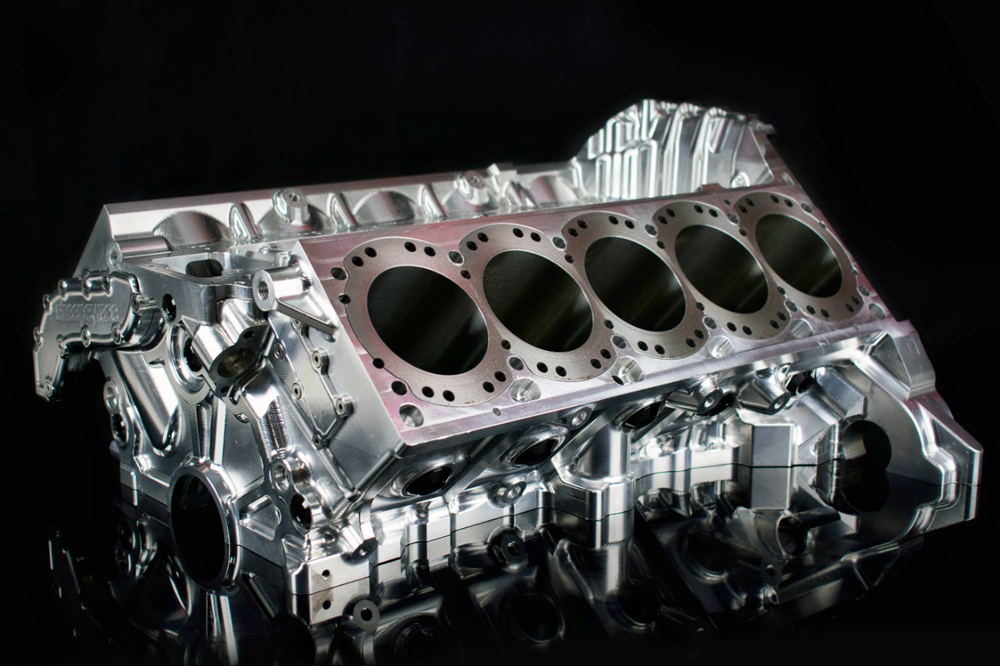
From connecting rods rated at 225 hp per cylinder to oil filters engineered to withstand 450 psi maximum burst pressure, the aftermarket continues to innovate, developing high-strength, ultra-durable products to meet the extreme demands of diesel performance and competition. In the following showcase, we highlight nearly two-dozen components and equipment produced specially for engine builders, fabricators, racers, and others seeking solutions for a wide range of diesel applications.

1

2

3

4

5

6

7

8

9

10

11

July 2022
By
PRI Staff

Business Profile: Stainless Diesel

Submitted by jeffreyc on Mon, 06/13/2022 - 14:43


This former gasoline-powered racer is filling the need for those in the turbodiesel market and setting blistering times to match.

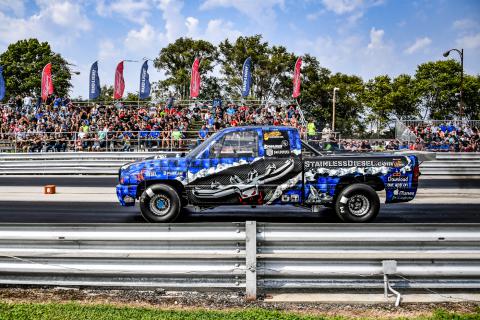
Adapting to the needs of the diesel drag racing market is what turned racer Johnny Gilbert into a business owner.

It’s 2022 and he’s adapting again. There’s a demand for stock-appearing turbochargers that Gilbert’s Stainless Diesel is supplying.

“We’re known more for high horsepower as far as drag racing and sled pulling, but what we’re looking to do more of are stock, bolt-on turbos,” he said. “We’re super excited about it and pushing it aggressively.”

That approach isn’t new at all for Gilbert and Stainless Diesel. His company in Middlebury, Indiana, specializes in single- and twin-turbo piping kits, billet five-blade turbo upgrade compressor wheels, and personalized BorgWarner turbochargers. The shop services professional customers that make 3,000-plus horsepower but also daily drivers who need just 400 to 600.

For Gilbert, it was an experience at the race track that was pivotal in his development of Stainless Diesel.

Fueled by Diesel

As he is with marketing his stock-appearing turbos today, Gilbert was likely “pushing it aggressively” when he broke the rearend in his 1971 big block Chevelle at Osceola Dragway, his home track, about 16 years ago. Officials allowed him to use the 2001 Dodge Ram 2500 diesel he used to tow his car to the event to make a pass and collect points.

“I won the round!” and two more that day, he said, the memory still worthy of exclamation.

The truck was powerful then, but it has evolved into a monster that’s won three straight Hot Shot’s Secret Pro Street titles in the Outlaw Diesel Super Series (ODSS) and holds a division record pass of 4.82 at 158 mph set at Wagler Motorsports Park in Indiana.

“It still has the original cab, and that’s about it,” Gilbert said about his truck.

The experience of putting his pickup on the track changed things for Gilbert. “I had the most fun—people were giving me a bunch of crap” about his diesel substitute. “It took me from my racing roots in the gas world to want to race a diesel.”

He began looking for diesel racing organizations, while his background helping his truck-driving father repair semi-trucks gave him a leg up on diesel knowledge. The effort soon spun Stainless Diesel from a “side hustle” into a fulltime business.

“I was enamored by the ability to make more horsepower out of a diesel pickup truck” and erase an image of slow and cumbersome, he said.

He soon realized, however, that if you wanted a new performance diesel drag racing part, “you had to make it yourself.”

Easy Replacement

Market demand explains the current push by Stainless Diesel with its stock-appearing, bolt-on turbochargers. Gilbert’s team is targeting customers who tow and want cooler exhaust gas temperatures (EGTs) and faster response, but also drag racers or sled pullers who want to move up a class and need more horsepower.

Gilbert admitted that the change is driven in part by more states inspecting street-strip vehicles. “Basically, it’s to have a guy be able to play but still have his truck be compliant,” he said.

Owners of 1990s and early 2000s trucks are also buying stock-appearing turbos as their old units fail.

2
Johnny Gilbert heads up Stainless Diesel’s R&D and development work. When he started the business 16 years ago, he quickly realized that if he wanted performance diesel parts, he would have to make them himself.

The beauty of stock replacement is the ease of installation. “You don’t have to upgrade anything,” Gilbert said, whereas a new turbo mount could set off a costly chain-reaction of new parts and fabrication.

Stainless Diesel offers stock-appearing turbochargers for all Ford Powerstroke and Dodge Cummins applications (Stainless Diesel is the original manufacturer of stainless exhaust manifolds for Cummins) and all but the past few years of Chevy Duramax.

About 90% of the stock-appearing turbos use Stainless Diesel’s 5 Blade Mafia design developed about 10 years ago when Gilbert was looking for a turbo to work specifically with compound systems. He used noted manufacturers including BorgWarner and Holset in the development.

“We tweaked them a little bit to be more diesel specific and work with our compound (systems), which are like a two-stage air compressor” that provide power at low and high ends, he said.

5 Blade Mafia wheels are light compared to a cast wheel, Gilbert said, and help keep EGTs cool while still producing big horsepower.

As a bonus, they produce a loud jet engine turbo whistle. “Guys like that,” Gilbert added.

Brandon Matthews, owner of Greenline Diesel in Jacksonville, North Carolina, a Stainless Diesel dealer, agreed that the 5 Blade Mafia sound is alluring. “It doesn’t sound like anything else out there, he said. “It’s just a distinct sound.”

At a recent race he recalled hearing a truck from a distance and noted, “Yep, that truck has a 5 Blade on it,” Matthews said.

Performance and Passion

Matthews said he sells Stainless Diesel turbochargers for reasons well beyond the sound. They also produce higher torque, lower EGTs, and faster spool time.

He said Gilbert’s crew has put considerable time into testing and development, studying things like compressor wheel design and airflow for the diesel turbo market.

“Stainless was at the forefront of all that,” he said.

Like Gilbert, Matthews revels in the success diesel racers—with backing from manufacturers like Stainless Diesel—are having against “the gas guys.”

“There are 8,000-pound four-wheel-drive trucks beating cars that really shouldn’t be beaten,” he said wryly.

Though he has raced a few times, Stainless Diesel customer Derrick Barney isn’t worried about winning on the drag strip in his maroon with gold trim 2011 Ram 2500. But don’t misunderstand, he digs the chance to make big horsepower with “Big Sexy.”

4
Stainless Diesel is a family business. Johnny Gilbert’s son, John III (leaning into the truck with his dad in the seat), went to school to learn CAD and is also a machinist, turbo assembler, and the race team’s tuner. 

The Chebanse, Illinois, resident recalls first taking his daily driver to Stainless Diesel, having learned of Gilbert’s reputation for turbocharging. “You don’t know how it’s going to go when you meet someone with a well-known name,” he said, “but he’s just another dude hanging out doing truck stuff.”

Barney has updated his turbo five or six times to get his 6.7-liter Cummins to 1,100 horsepower—and he’s shooting for 1,400 or higher. “It’s just one of those things that gets addicting,” he said. “You just keep wanting more and more.”

He credits Gilbert for his patience and taking time for any customer, and said his passion motivates other diesel owners.

Barney has come to understand that passion. “Honestly, I knew very little about diesel when I bought my first truck,” he said. “But once I found out you could make them a little bit more powerful, a little bit faster, it snowballed, and it’s more and more fun.”

In-house Advantages

Stainless Diesel, which has seven full-time employees, has a number of CNC machines in its 4,800-square-foot shop used to manufacture turbos and components, including piping kits, exhaust manifolds, flanges, and brackets.

It wasn’t always that way. Gilbert outsourced a lot, but he grew tired of vendor backups. “I realized that we really needed to bring stuff in-house to have more control over the timeframe…like when you need something done in short order,” he said.

The transition began about six years ago and quickly gained momentum.

Though the machine shop owners he had relied on were upset at first, Gilbert made it business, not personal, and now his shop is a backup for them.

In-house control also reduces inventory, which improves cash flow. And, there’s quality. “We can control the tolerances, and if I want to make a design change, it’s quick and easy for us,” Gilbert said.

CNC equipment at Stainless Diesel includes a Haas TL1 lathe, a Brothers 1000X with fourth-axis capability, and a five-axis Matsura machining center that could lead to even more production in-house. He said the Brothers’ unit is used to machine exhaust manifolds and turbo adapters—the latter in demand by customers who pull a trailer in the winter but switch to larger turbos for the pulling season.

Gilbert noted he’s purchased all of his machinery at the PRI Trade Show.

Gilbert and his son, John Gilbert III, mostly use Fusion 360 software for their designs, but are looking into using Mastercam in the near future.

Johnny Gilbert does most of the R&D and product development while his son, who went to school for CAD training, is also a machinist, turbo assembler, and the race team tuner. Other family members include Johnny’s wife, Amy, who does marketing and graphic design and manages the company’s website (stainlessdiesel.com); and daughter Brianna, who handles accounting and inventory. Trevor Lortie is lead sales manager/marketing; Stephen O’Neill, turbo assembly, sales and technical support, and part of the race team; and Eric Long is a fabricator and welder. Roy Currier is the crew chief for the race team.

The Diesel World

Gilbert’s love of diesel drag racing is driven in part by the “commonality of battling the gas guys.” But it’s not easy.

“Everyone knows you’re at somewhat of a disadvantage of technology, speed,” weight and more, he said. “In the diesel world, there is so much torque to manage—and torque breaks parts.”

This spring Gilbert said he was “very concerned” about inflation and diesel fuel prices, and he worries it might keep entry-level racers away.

In speaking with customers and vendors, however, the mentality is “keep on moving forward, but pay attention.”

Another approach is to equip race and tow vehicles with new products, including the stock-appearing bolt-ons. “Making things more efficient—that’s going to help fuel economy for sure,” Gilbert said.

Those battles aside, Gilbert is “amazed” at what his company has accomplished in just 16 years. “The connections we’ve made in this process of starting as a small shop and getting a little bit larger and a little bit larger…and meeting all the people,” he said. “I love talking to people from all over the country and helping them with their projects,” including “the gas guys.”

Gilbert wants to continue to feed off that energy. “It’s neat to see the diesel industry grow, in the racing aspect,” he said. “I’m pretty excited for the future.”

Racing With—and Beating?—‘The Gas Guys’

Competitors in the Outlaw Diesel Super Series Pro Street division likely celebrated Johnny Gilbert’s decision to give his 2001 Dodge Ram 2500 a “timeout” in 2022 after three straight championships.

Those in other high-horsepower drag racing series, meanwhile, will get to know Gilbert and his proclivity for diesel this year.

He turned in his 4,400-pound truck for a carbon-fiber, split-window 1963 Corvette that weighs 2,700 pounds “with me in it,”
Gilbert said.

Originally built by SRC Motorsports’ Wally Stroupe in North Carolina and reconstructed with help from Hammertech Racecars in Indiana, Gilbert’s Pro Mod is powered by an all-billet, 6.7-liter inline Cummins diesel with a MoTeC ECM (engine control module). It also has a one-off manifold, fabricated, of course, at Gilbert’s Stainless Diesel shop in Middlebury, Indiana, to fit the turbo in
the chassis.

With the ECM, it’ll have in excess of 3,500 horsepower.

“We want to go race with the gas guys,” Gilbert said, not hiding his friendly but competitive demeanor.

There’s no restriction on using diesel in series such as NMCA and Outlaw Pro Mod, though he admitted it is very unusual.

He believes there will be marketing value for his business, and he plans to test some new components, too. “I’m pretty excited for that this year,” he said.

A gas drag racer in earlier years who now has diesel in his veins, Gilbert’s expecting a curious reaction. “We’ll be kind of the oddity, the only diesel guys in the pack,” he said with a confident laugh. “I’m sure we’ll get the gas guys scratching their heads a little bit.” —Andy Heintzelman

July 2022
By
Andy Heintzelman

Special Report: Community Relations

Submitted by jeffreyc on Mon, 06/13/2022 - 14:33

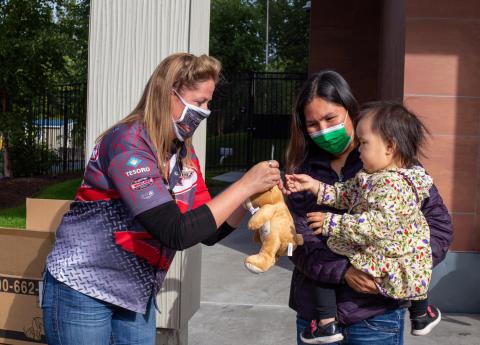
Alaska Raceway Park’s Michelle Lackey Maynor, at left, provides Speedy Bears to children at Patient Housing at Alaska Native Medical Center.

Being a good neighbor helps promote harmony with the local community, but according to these track executives, undeniable benefits exist for operators willing to invest the time in outreach.

Running a race track is not for the faint of heart. It may look like fun and games with the grandstands full, cars roaring around the track, and the concession stand line reaching to the paddock. But track operators have to walk a fine line in giving fans what they want, racers what they expect, and keeping the local community happy. 

That last part, community relations, may be the biggest ongoing challenge. Race tracks are noisy and draw traffic, and thus are easy targets for activists of all stripes. Even if the complainers are a distinct minority, they often have outsize influence among the local political class and on social media.

“We’re kind of a nuisance business. Somebody told me that term once, and I kind of liked it,” said Michelle Lackey Maynor of Alaska Raceway Park, Palmer, Alaska. “We have a lot of fun and we do racing and we really enjoy it, but not everybody enjoys the noise, so I try to make sure that we’re key players in the growth of our area, as well as try to keep up that goodwill part of things.”

Even well-established racing facilities can’t rest on their laurels, as urban sprawl has pushed new neighborhoods out toward tracks located in formerly remote locales. “The track is 68 years old this year,” said Doug Hobbs of Evergreen Speedway, Monroe, Washington. “When they first built the speedway, there wasn’t a house near this race track. And now, as communities have grown, the houses are within sight of the race track, coming down the hill. 
2
Among Pocono Raceway’s many outreach initiatives is an annual Kids Day, where local and regional non-profits are invited to set up displays, distribute race tickets, and more. “A friend of mine told me a long time ago that what we’re doing here at the race track, besides being in the fun-and-games business, we do add to the quality of life for folks,” our contact explained, “and we feel like this is a part of it for the kids and community.” 

 “I guess more than anything, noise is the problem facing many tracks across America,” he continued. “You try to let the homeowners’ association know about your bigger events, let them know the challenges of traffic you’re going to bring to the area. I think it’s all about communication. We try to over-communicate with the county officials and city officials about what to expect. Last year when we brought in well more than a standing-room-only crowd for Nitro Circus, we started hours in advance with the city to start traffic control, trying to avoid some of those issues. When you’re trying to funnel an extra 10,000 cars on a two-lane street, it gets congested.”

“Motorsports has an uphill battle compared to stick-and-ball sports when it comes to the community,” said AJ Moore of Lake Erie Speedway, North East, Pennsylvania. “A lot of people, they’ll lean more toward baseball, football, basketball, hockey, because they know it. With motorsports, you have to come out, you’ve got to taste it, see if you like it. We do a lot of thrill shows to just get them in the door. I think that is a battle because [the stick-and-ball sports are] just what everybody knows. Which in turn makes us possibly have to do a little bit more in advertising just to be top-of-mind.”

Joining Up

One key step to making community relations run smoother is to join the various local organizations that network with other businesses and coordinate promotional and charitable events. The representatives from the tracks we spoke with were all active participants in multiple organizations.

“We work really closely with our Chamber of Commerce in the northeast and also our Erie Sports Commission and VisitErie,” Moore said. “The Sports Commission has helped us tremendously throughout the years in trying to get different events to come into the area. Tracks should be working with these non-profits. Anybody who is not trying to talk to the Chamber of Commerce or look for the Sports Commission is missing something. The Sports Commissions, they really help with the hotel rooms and stuff like that to try to keep the costs down for people coming in.” 

Ben May of Pocono Raceway in Long Pond, Pennsylvania, is on the board of directors of the Pocono Mountains Visitors Bureau as well as the Pocono Mountains United Way. “We like to encourage our staff, if they have the time and are available, to find various groups in the region and join and see how they can give back,” May said. “That’s been a big deal for us, making sure that we’re approachable, that we’re not just seen as this group that brings in a ton of people once a year and then disappears. While we have NASCAR specifically one weekend a year, we’re engaged year-round.”

Membership in these organizations can lead to wider connections in the community. “One thing that I have always done, is that when it comes to schools, churches, kids, animals, we always find a way to say yes,” Hobbs said. “We work with everything from battered women’s shelters to gospel missions to helping out schools continuously. We are always giving. We take a lot of pride in that, and we get very few complaints. I think part of that is just because we’re so tied in with the Chamber of Commerce, we’re tied in with the lodging tax, we’re tied in with tourism promotion. I helped out the state in 2020 and 2021. We created a group that got race tracks open in 2020 under COVID-19, at least to competitors only. I helped spearhead that group. When you help a lot and people know you are doing it for the right reasons, they’ll be a lot more accommodating when you need something to help you. We don’t do it for the wrong reasons, we just do it because we think it’s the right thing to do.”

3
In April, Lake Erie Speedway hosted a Walk For Autism event organized by the Autism Society of Northwestern Pennsylvania. “We had the option to bring it out to the track and it was great,” said our source at the speedway. “We had about 1,900 people and raised close to $100,000. It was huge.”

Opening up the track to other groups in the community is one significant way racing facilities build relationships. “We’re pretty active in the community,” Maynor said. “I’m on the community council, I volunteer there as the treasurer and help out with various things like a clean-up project we’ve got coming up in a couple of weeks. I’m also a member of one of the local Rotary Clubs. Getting involved in the community has been really helpful for us. We help out with stuff at the elementary school, various fundraisers and such. We have a lot of space at the track so we’re pretty open to using it for whatever community events might come up.”

Sonoma Raceway in Sonoma, California, is part of Speedway Motorsports, which owns several of the major race tracks in the United States. But even while part of a larger nation-spanning corporation, Sonoma Raceway is very active in local organizations. “Sonoma Raceway is an active member in its local communities by partnering with several key groups and organizations in the Sonoma Valley, North Bay, and on a national level including the North Bay Leadership Council, Sonoma Valley Chamber of Commerce, Sonoma Vintner’s and Grower’s Alliance, and Green Sports Alliance among others,” said Jill Gregory. “These memberships allow Sonoma Raceway to connect with diverse and robust businesses that are all connected to the same community. This gives us more opportunities to enhance and grow our business through the connections and resources these groups provide.”

Helping Hands

There is no one-size-fits-all solution to maintaining good community relations. Resourceful race track promoters find creative ways to engage with their neighbors.

“We have a litany of things here that we work through, and I think the top one is that we’re proud to be a part of this community,” said Pocono Raceway’s May. “We’ve been in this community for 50 years and we are a family-owned business, which makes it a little more meaningful for us. Outside of your normal sponsorship stuff, Doc and Rose Mattioli, co-founders of Pocono Speedway, in their later years ended up sponsoring a good bit of our local health system. We have a medical emergency center and things like that. But you’re not looking at things that are direct dollar related. We just really enjoy being part of the community. Probably the number-one thing we do here is offer our Kids Free ticket program. Every kid 12 and under is welcome at Pocono for free, and we’ll do that for any race, including our Cup Series race. We’ve been doing that for three or four years now, and it has been massive for us. It’s just a small way we can give back to the community and help grow the sport.

“Secondly, we have an annual Kids Day,” May continued. “This will be our 14th or 15th year for our annual Kids Day, and this year it will be Saturday, July 23, which is our Truck Series race, Cup Series practice and qualifying, as well as the Xfinity Series race. We do it a little bit differently than just giving away free tickets. We invite all of our local and regional non-profit friends to come to the race track, set up a display, and then they’re allowed to use as many tickets as they’d like for their campers or their community, or their partners or friends. We’ll have 20 to 30 displays out and do tens of thousands of tickets for the kids and community groups. They come out to experience NASCAR, and if they’re going through a rough time, maybe it’s an easy day for them to just unwind a little bit and let their mind focus on something that’s more fun and engaging and less serious. 

“A friend of mine told me a long time ago that what we’re doing here at the race track, besides being in the fun-and-games business, we do add to the quality of life for folks, and we feel like this is a part of it for the kids and community,” May added. 

4
Also an active farm with thousands of sheep on hand, Sonoma Raceway recently initiated an Adopt-A-Sheep program to help generate funds for Speedway Children’s Charities. “Each adoption package includes a Sonoma Raceway plush sheep, reusable tote bag, official adoption certificate, and personalized photo of the sheep of your choice,” noted our track contact. “It has proven quite popular already.”

Few people in the motorsports industry have fond memories from the COVID-19 pandemic, but it did provide opportunities for tracks to step up and serve their local hometowns. “Giving back to the community, and tying into non-profits, charities, and food banks, is one of our mainstays here, and we’re very proud of it,” Evergreen Speedway’s Hobbs said. “A couple of fun things we did last year: With COVID, high schools couldn’t graduate. A lot of them didn’t get to have a graduation ceremony in 2020. So we did a couple of drive-through graduations in 2020, and then last year where everything was locked down in schools, we hosted four area high school graduations in the grandstands. We socially distanced, and we were happy to accommodate schools with classes up to 2,500 people. Normally they’d pay a lot of money for that, but we donate our facilities for those types of things, we don’t charge for them.

“Starting from Memorial Day weekend on is when we start doing more of our bigger charity events, just because of weather,” Hobbs added. “Memorial weekend we help fund and provide trophies for a local Relay For Life event that’s held in a neighboring city. June 18th is our Big Brothers-Big Sisters charity car show, and the last two times we’ve raised over $100,000 a day for that event. June 25th is our Galloway Shootout, which is our first big NASCAR track event on our calendar, and this year we’ll be working with Randy Couture and the Xtreme Couture GI Foundation. Randy will be our grand marshal. We’re hosting well over 300 veterans on bikes, with catered dinner and then we’re going to be raising charity for that event.”
When we spoke with Moore at Lake Erie Speedway in April, the track had just hosted a Walk For Autism event organized by the Autism Society of Northwestern Pennsylvania. “Our one owner, Dan Prischak, is very big into the Autism Society,” Moore said. “We had the option to bring it out to the track and it was great. We had about 1,900 people and raised close to $100,000. It was huge. It was nice to see that many people out here at the end of April. We really don’t start going full-force until the end of May because the weather is spotty. It worked well having that option to get it out to the track and bring different people to the track who have probably never been here, just so they can see it.”
5
Pocono Raceway’s core values are “tied directly into the community,” noted a track representative. Pictured here is Pocono Mountain East High School’s Class of 2020 graduation ceremony, which was held at the raceway in June of that year.   

For Sonoma Raceway, having the corporate resources for charitable outreach helps, but the focus is still local. “First and foremost is our outreach through Speedway Children’s Charities (SCC). This is our non-profit arm that raises and distributes money each year to children in need in Sonoma County,” Gregory said. “We have distributed more than $7 million locally since SCC was chartered in Sonoma in the 1990s. Some other things we have done include opening our campground to anyone who was affected by the wildfires a couple of years ago, opening our facility for charity runs, and participating in many civic events in and around Sonoma County.”

Each track’s unique circumstances allow for some creativity on the charity side. In what’s likely the only one of its type in the nation, Sonoma Raceway initiated an Adopt-A-Sheep charity program in April. “Many people aren’t aware that Sonoma Raceway is an active farm, and a part of that includes being home to thousands of sheep,” Gregory said. “In looking at new ways to generate funds for Speedway Children’s Charities, we came up with the idea to allow people to adopt a sheep. Each adoption package includes a Sonoma Raceway plush sheep, reusable tote bag, official adoption certificate, and personalized photo of the sheep of your choice. A Sonoma Raceway sheep hat is included with the premier package. It has proven quite popular already.”

Results Speak

The representatives from the tracks we spoke with have embraced charitable causes as part of being a good neighbor, and because it’s the right thing to do, not simply for gain. But there are undeniable benefits for a track that invests time in community outreach. 

“What I have found is there are a few pretty vocal people in our community that don’t like us. And by a few, I mean less than a handful,” said Alaska Raceway Park’s Maynor. “But they have the time and the energy to complain about things. What I have seen recently is when they go on social media and talk about stuff, I don’t engage because that doesn’t help anything. But it’s amazing to see the number of people in the community who stand up for us when we need it to happen. We’re providing a place for the kids to race that’s safe, and it’s not street racing. Because of the various other things we do in the community, people step up on our behalf when there are social media arguments.”

Those local fans have also opened their wallets for Alaska Raceway Park. The track initiated a crowdfunding campaign named Club 1320 to raise money for capital improvements that has been met with great success. “Our track is a little bit unique in the fact that ‘we’re it’ for this state. And so our community extends beyond where the track physically is,” Maynor said. “We touch racers all across the entire state, which is a pretty big space. Club 1320 has been, for me, very humbling to see the outpouring of support from the racers and the fans and different community members that have participated in that because they want to see us succeed. Having that large community of people of all different user groups that are kicking in to help make our race track bigger and safer and more efficient, if you start thinking about it, gets kind of overwhelming.”

Being an integral part of the community also provides conventional sponsorship opportunities. “Last year we had a great example,” May said. “Our relationship with our Destination Marketing Organization, the Pocono Mountains Visitors Bureau, used our race as a platform to showcase the region. So we had an Explore the Pocono Mountains 350, which was one of our Cup races last year. I think that’s a really good example of how that happens.”

Evergreen Speedway’s many charitable initiatives that reach beyond the motorsports community have built on their racing programs to attract additional sponsorship. “Right now, today, we’re adding another 200 feet of construction for 12x24-foot billboards. We actually exceeded the 40 sponsored billboards we had out there,” Hobbs said. “It’s worked very well, and I think this has partly to do with—and we might be the only one with this—we have a network TV show on our local CBS affiliate on Sunday nights called Evergreen Speedway Home Track Heroes, which airs for two hours. Tying in our livestream with FloSports and then our weekly podcasts, our marketing partners get a lot of exposure, and we have seen our sponsorship growing immensely from 2019 to 2021 and 2022.”

Charitable works and community outreach may not always lead to additional sponsorship or resources, but for these tracks, the appeal of improving their own communities goes beyond dollars and cents.

“It goes back to our core values, and that is tied directly into the community,” May said. “One core value here is, ‘Do the right thing.’ We think this area is beautiful, and it is beautiful. Our Pocono Green and solar farm, and waste diversion and recycling and everything we’re doing here, are just what we can do to help make sure the Poconos is still here in another 50 or 100 or 200 years from now, and it’s still beautiful.”

SOURCES

Alaska Raceway Park
raceak.com

Evergreen Speedway
evergreenspeedway.com

Lake Erie Speedway
lakeeriespeedway.com

Pocono Raceway
poconoraceway.com

Sonoma Raceway
sonomaraceway.com

July 2022
By
Steve Statham

From the Editor

Submitted by jeffreyc on Mon, 06/13/2022 - 14:21


Couple of thoughts ahead of this month’s Small Car Nationals at Slinger Super Speedway in Slinger, Wisconsin:

1) I think there’s a lot more to Donk racing than meets the eye. Beyond their blingy exterior and somewhat disorienting geometry, these custom drag cars perched atop 26-inch wheels—and the folks that champion them—have carved out a viable niche across large swaths of the US. Led by charismatic frontman Sage “Donkmaster” Thomas, the movement is certainly media-friendly: Millions have tuned into his show on MotorTrend, and viewed his (and others’) videos on Facebook, Instagram, and YouTube. Indeed, one gets the sense that we’re still in the early stages of what could be a deep run for the Donkmaster and his National Donk Racing Association. “My long-term goal is to show the world what big-wheel cars can do,” proclaimed Thomas, the subject of this month’s Industry Insights column beginning on page 26. “I want to go racing in Japan and Dubai and Australia, and just travel the globe with it.” Closer to home, some familiar names have already taken up with the big-wheel phenomenon. Thomas cited Moser Engineering and FTI Performance as steadfast partners. “And now Mark Menscer of Menscer Motorsports has helped us a lot on moving the shock program forward,” he added. “It’s something to see!” We enjoyed visiting with Thomas for this piece that showcases his big personality, big ambitions, and big plans for the future of big-wheel racing. 

2) While every motorsports complex faces unique challenges based on location, demographics, etc., I do think our Special Report this month, “Community Relations,” reveals some secret-sauce strategies that, when tailored appropriately, can help keep race tracks in their neighbors’ good graces. For the piece, which begins on page 38, author Steve Statham spoke with operators whose aims extend far beyond hosting a great event on race day. At Long Pond, Pennsylvania-based Pocono Raceway, for example, staff is encouraged to “find various groups in the region and join and see how they can give back,” Ben May told us. “That’s been a big deal for us, making sure that we’re approachable, that we’re not just seen as this group that brings in a ton of people once a year and then disappears.” Of the nearly half-dozen tracks sourced in our article, in fact, all reported significant involvement with their local business communities, nonprofits, and charitable organizations. That approach runs deep for the team at Evergreen Speedway, about 45 minutes north of Seattle. “[When] it comes to schools, churches, kids, animals, we always find a way to say yes,” Doug Hobbs explained. “When you help a lot and people know you are doing it for the right reasons, they’ll be a lot more accommodating when you need something to help you.” The accommodation Hobbs references is something Alaska Raceway Park’s Michelle Lackey Maynor has experienced firsthand, and in various capacities. Whether they’re defending the track against social media trolls or helping crowdfund a capital improvement project, racers and fans throughout the 49th state have rallied around her motorsports facility, time and again, as if it was their own: “If you start thinking about it,” she said, “[it’s] kind of overwhelming.”

July 2022
By
Dan Schechner, Editor

From the President

Submitted by jeffreyc on Mon, 06/13/2022 - 14:06


In last month’s column I talked about many of the challenges facing the racing industry, but I did not mention the threat of government overreach. This is the driving force behind a multi-year campaign to get the Recognizing the Protection of Motorsports (RPM) Act passed by Congress. 

As we go to press, the US Environmental Protection Agency (EPA) continues to levy multimillion-dollar fines on companies in our industry; and, for the first time, we have learned of criminal charges imposed on a manufacturer of race equipment. This constant, unjustified threat has put several companies out of business, cost us an incredible amount of time and money in legal fees, and prevented many race industry businesses from designing, producing, and/or selling race parts. It represents a slow death to our industry unless we do something about it. 

So, this month I want to outline our plan, as well as share with you some results.

We’ll start by discussing PRI’s Washington, DC-based Government Affairs office anchored by David Goch, Daniel Ingber, Eric Snyder, and Christian Robinson. They are backed by several other firms and specialty lawyers who are brought in on a case-by-case basis. These folks lobby lawmakers on your behalf while also fielding calls from industry members who are under threat by regulatory agencies like the EPA or the California Air Resources Board. 

Our short-term goal is to get the RPM Act passed. Without it, the racing industry is helpless. While this effort commenced in 2016, major strides have been made since. Of course, we lose this momentum with each new, incoming Congress, so the clock is constantly ticking. Currently, the bill has about 150 co-sponsors; it is also one of the most bipartisan bills now in Congress.

Our lobbying efforts include individual meetings with lawmakers and staff, calling attention to our supportive lawmakers on social media, leveraging our media company, placing billboards at local race tracks, sponsoring race events, and taking members of Congress to your businesses and tracks. The most important part…is you. You have sent more than 1.5 million letters to Congress demanding passage of the RPM Act. And lawmakers, knowing midterm elections are in the fall, must listen.

PRI has also spent a tremendous amount of time telling your story. I point to the PRI Road Tour, PRI Magazine, and the PRI website as indicators of the effort we’ve put forth. But, we must also market this industry outside of the industry. Everyday folks must hear about the fun/crazy/exciting things you do so they can at least consider getting involved with racing—as a casual fan, a hardcore fan, or even a racer themselves. 

Our long-term goal is to ensure we “have a seat at the table.” To do this, we need a strong voice so that our industry always has representation in Washington. Candidly, we are in competition with all of the other issues that surround lawmakers, be it gun rights, abortion, immigration reform, etc. To make sure that racing punches above its weight in DC, we need to speak with a unified voice. Enter PRI Membership. Strengthening this movement means more members (read: voters) that can better grab the attention of politicians. Membership is so important to the future of our industry that our Board of Directors is now requiring that everyone attending the PRI Trade Show be a registered/paying member of PRI.

The second part of our long-term plan is great communications. PRI will do our best to let you know what is happening behind the scenes in DC, especially when it affects you. And we’ll alert you when it’s time to act.

In May, we celebrated the Grand Opening of PRI’s Membership headquarters in Speedway, Indiana. What an amazing step forward for our industry. Now, we have a home for all of these activities. It is where our Membership staff will be located, but it is also a meeting place for industry leaders, big thinkers, and influential racers who want to make a difference. 

Key to a thriving advocacy group is fundraising. Last year, we formed the Performance Racing PAC, a political action committee dedicated to protecting you and your racing industry business. All proceeds donated to the Performance Racing PAC go to lawmakers who support the racing industry. Having a thriving (read: well-funded) PAC ensures that power brokers in DC know our industry means business.

At a grassroots level, PRI just launched the “Vote Racing” campaign. This is a voter registration and get-out-the-vote effort aimed at racers, the industry, and fans. And, for the first time ever, SEMA and PRI are getting the word out about candidates in the midterms who support racing. That list is available at SaveOurRaceCars.com. In November, let’s Vote Racing!

How Do You Get Involved?

Supporting PRI Membership is a great start. If you want to join the front lines, we’d like to work with you to have a lawmaker visit your business. We are in critical need of companies willing to host their member of Congress, with a special focus on North Carolina, Arizona, West Virginia, Kentucky, Indiana, Delaware, New Jersey, Montana, Ohio, and Florida. Contact Eric Snyder (ESnyder@SEMA.org) for details.

We look forward to helping you continue your racing business with one common voice to ensure a prosperous future.


July 2022
By
Dr. Jamie Meyer

Selling the D.I.Y.

Submitted by jeffreyc on Mon, 06/13/2022 - 10:58


Whether they’re analyzing telemetry data at the track or wrenching on the car back at the shop, teams need specialized workstations in order to work efficiently. Tailor-made solutions can deliver exactly what they need to perform at their best.

Lap times and ETs can provide a sense of a car’s setup and a driver’s technique, but a team’s competitiveness isn’t just about on-track performance. The work that’s done in the pits and back at the shop is also critical to their success, and optimized workflow can yield tangible benefits on race day. 

“Organization is absolutely essential for these teams,” said Randy Booth of Beta Tools, Columbia, Pennsylvania. “In the upper tiers of motorsport, just about every one of the technicians on a team has a specific job for a specific part of the car. There’s an engine mechanic, a gearbox mechanic, a suspension mechanic, and so on, and they focus on that specific aspect of the car. In order to achieve the level of efficiency they need for their race program to be successful, they need to be highly organized in terms of the tools that they use.”

That means “one size fits all” solutions for their workstations are rarely the best option, so the ability to build out customized solutions is essential. Here we’ll take a closer look at how manufacturers collaborate with their customers to develop application-specific systems to get these teams exactly what they need. 

Beta Tools

Booth said that while organization is a universal necessity for motorsports teams, the requirements for the workshop equipment can vary significantly. “Some of it depends on the size of the organization, and what they want to optimize, whether that’s workflow in the shop, at the track, or in the pit box. But in all of these situations, it comes down to having the right tool in the right spot when you need it.”

That organization can also allow teams to identify issues before they become bigger problems. “Having a custom foam cutout for tools allows a technician to immediately determine if something’s missing or misplaced. Leaving a tool in a car could become a real problem if it’s not noticed right away.” 

2
Beta Tools has an online configurator that allows shops to design custom tool storage solutions from the ground up, including special modules to accommodate multi-drawer systems, vertical storage, and other specialized needs, said our source. “It comes down to having the right tool in the right spot when you need it.”

Customers have many potential options when it comes to custom configurations with Beta Tools’ products, so the company developed an online platform that allows customers to build out their systems from the ground up. “It has all the tool box configurations, the different work surface options, and they can also select specific ‘modules’ to integrate into these systems, whether that’s toolbox storage, multi-drawer systems, vertical storage, or other the systems that are offered,” Booth explained. “The platform allows them to lay all of that out themselves, if they prefer to do it that way.”

Beta Tools also offers sets that consist of specific selections of tools that customers can choose from to fill out tool box drawers, and the presets are offered in either foam cutouts or ABS thermal form trays. “We do them in full-drawer, half-drawer, and quarter-drawer increments,” he said. “One drawer could be sockets and ratchets, the next drawer could be all T-handles, and the next could be files, or whatever configuration they need.” 

The company offers fully customized foam sets as well. “As long as I know what the individual items are that they need, we can put that together for them.”

For those who would rather not go through the configurator on their own, Beta Tools can walk them through the design process by more traditional means as well. “We can work with them in-person or over the phone to get a sense of what they need by getting information like the size of the shop, how many technicians they have, how many drawers they want a given technician to have, and what kind of storage they need based on their use-case,” Booth said. “Then we start building it out from there. We can help them configure the drawers for the tool sets as well. It’s truly full service.”

United Race Parts

United Race Parts in Troutman, North Carolina, tends to focus mainly on completely custom workstations with its UK partners Greaves 3D Engineering because, as Thomas Decker explained, the technological sophistication at the higher levels of motorsports more or less requires it today. “The IT infrastructure, the telemetry data they’re analyzing, and the communications systems—they all play a part in the equipment that they need, and each team operates differently. These systems are basically ‘race control’ for a lot of these teams, and because there’s a variety of different suppliers for radios, data acquisition systems, video processing, and things like that, it creates this huge variety of system combinations that need to be taken into account and integrated properly. That dictates things like the wiring layout for the stand and how its design will accommodate all of those different pieces of equipment.”

3
Rather than using an online configurator, United Race Parts keeps a few generalized workstation examples at its facility so teams can get a hands-on feel for what’s possible. “Their need is so specialized that there isn’t really a pre-existing configuration that makes sense to build off of,” said our source.

Decker said they typically start a project with a general concept proposal and work with the team to hone in on the ideal setup for their application and the technology they’re using. “One of the projects we’re currently working on started with a chat at the track. Within a few days Greaves had a rough concept rendering that we shared with the team, and after getting some feedback on that, we developed another rendering based on those notes, and it continues back and forth from there. It’s a collaborative process that gets us to exactly what their vision is for the system.” 

Rather than using an online configurator to give customers a sense of the look and feel of a potential workstation design, United Race Parts typically keeps one or two different configurations at its facility so race teams can check out the systems and features to get a better sense of what they need and what they don’t. 

“In some cases, the requirements are so specific that we don’t really have a standard configuration that makes sense to use as a template,” Decker said. “Typically, those teams have seen our stands before and they understand how we work with Greaves to build stands, but their need is so specialized that there isn’t really a pre-existing configuration that makes sense to build off of. In those situations, it’s about understanding the end goal, the time frame, and collaborating through those concept renderings before we move into production.” 

Badass Workbench

“The vast majority of a team’s budget is typically going into the car, but the shop needs to be considered as well,” said Cody Freeze of Badass Workbench, Kearney, Nebraska. “Whether it’s a wall of tools, fabrication equipment, or welding gear, a workbench system like this often becomes the focal point of the garage. If done right, it’s a one-time investment.”

Freeze said that when teams become frustrated with standardized systems that don’t really meet their needs, they turn to manufacturers like Badass Workbench to get something that has the features and durability required to function effectively and endure in a motorsports environment. “At some point they get tired of re-investing in equipment to address a certain issue. Our goal is to fix those problems once and for all.” 

4
“Whether it’s a wall of tools, fabrication equipment, or welding gear, a workbench system like this often becomes the focal point of the garage,” said our source at Badass Workbench. “If done right, it’s a one-time investment.”

The company offers a base template to start from, and a 3D configurator on the website allows customers to dig further into the available options in terms of general layout, drawer dimensions, tabletop materials, and other possibilities. When customers want something with deeper customization, he prefers to work with them directly. “In some cases, someone will come to us and say, ‘I need this specific type of workbench, it has to have these specific features in these dimensions, and this is what we want to do with it.’ In those situations, we work with the customer from the ground up in terms of design and have someone on-site who creates Solidworks renderings that we can share with the customer. That allows us to work together and offer suggestions or make any tweaks that might be needed along the way to ensure that everyone is on the same page.”

In other situations, customers may prefer to collaborate onsite, and that’s an option as well. “Usually, we can handle most of it over the phone, but in the past, we’ve worked together over Zoom and things like that, too,” Freeze said. “We’ve flown out to customer sites to do walk-throughs at shops to get a better idea of exactly what they want to accomplish. Sometimes laying eyes on the facility helps to clear up any potential ambiguities.”

CTech Manufacturing

CTech Manufacturing in Weston, Wisconsin, was built from the ground up to manufacture custom storage solutions, according to Max Kittleson, which includes tool boxes, pit carts, drawer inserts, and cabinets. “CTech products utilize parametric design properties to maximize the potential for customization,” Kittleson explained. “That means our engineers can easily manipulate product dimensions, drawer counts and heights, add options, and much more during the design process.”

5
CTech’s recently redeveloped website provides a completely web-based online cabinet-building experience, according to a company source, who noted that because their products are designed to allow for optimal customization, “our engineers can easily manipulate product dimensions, drawer counts and heights, add options, and much more during the design process.”

CTech recently redeveloped its website, providing a completely web-based online cabinet building experience. “The first experience is a ‘clean slate’ cabinet layout builder, which allows customers to design and order sophisticated cabinet systems from scratch in an engaging 3D rendering interface,” Kittleson said. “The second experience begins in our new e-commerce storefront, where customers can select pre-configured cabinet sections and packages that can then be customized and ordered with just a couple clicks. Both of these experiences share the same basic workflow; customers enter the online builder and adjust cabinet dimensions, select a powder-coat finish, add or remove features, and even customize individual cabinet compartments by adding drawer stacks and changing cabinet door swing directions. Once the customer has designed a custom cabinet, their creation can be added to a shopping cart and purchased via credit card.

A similar web-based cart builder option is currently in development from CTech that will allow racers to build their own custom pit carts and toolboxes from the website. This will be launched in the coming months to allow teams to purchase new equipment for the 2023 season.

Moduline

Tim Cass of Moduline in Brockton, Massachusetts, pointed out that it’s not just the motorsports discipline and the technology involved that necessitate specialized tool boxes, workstations, and storage systems, it’s also where the work is being done. “In some situations, you need to be able to get those tools to the car rather than the other way around, and that can change the requirements of the system significantly.” 

6
Moduline takes a collaborative approach to the design of its workstations, said our source. That way the company “can really tailor it to the end user’s needs based on what they want and the space that they have available.” Photo courtesy of Moduline.

Because of that, Moduline generally takes a hands-on approach to custom system design to make sure their customers get the right solution for their use-case. “It’s about discussing what the needs are with the client, and getting their ideas,” Cass said. “They may have something very specific in mind that they think they need, but when you get down to it, there might be a better solution that they weren’t aware of. So it’s a conversation where we get a sense of what the requirements are and what they’re envisioning, then we sketch it out in CAD for them and brainstorm together to make sure that they get a solution that fits the bill.” 

Moduline’s collaborative process with its clients is typically conducted through a series of phone calls, emails, and concept renderings shared with those customers. Cass said that while an online configurator system might work well for combining basic off-the-shelf elements of a workstation or tool box, it can get complicated very quickly. 

“On a basic level those systems are great, but the configurator isn’t going to ask questions,” he explained. “With an a-la-carte system like ours, we can really tailor it to the end user’s needs based on what they want and the space that they have available. Where the system is going to be installed can also have a significant impact on the overall design—whether that’s a race shop, a trailer, or somewhere else. The personal touch really matters with a product like this.”

SOURCES

Badass Workbench
badass-workbench.com

Beta Tools
betatoolsusa.com

CTECH Manufacturing
ctechmanufacturing.com

Moduline
modulinecabinets.com

United Race Parts
unitedraceparts.com

July 2022
By
Bradley Iger

Shopmonkey Announces Jeff Haynie As Chief Technology Officer

Submitted by laurap on Mon, 06/13/2022 - 10:45
ShopMonkey logo


Shopmonkey, the cloud-based auto shop management platform, has announced Jeff Haynie as chief technology officer. He joined the company in May to lead innovation and accelerate product development before formally stepping into this role. 

Haynie will focus on scaling existing capabilities and adding new security features. He will also help develop Shopmonkey’s ability to leverage analytics and machine learning to improve the performance of their software development efforts.

Prior to the appointment, Haynie served as CEO for Pinpoint and previously as CEO for Appcelerator. 

In related news, Shopmonkey recently raised $75 million in Series C funding led by Bessemer Venture Partners. 

For more information, visit shopmonkey.io. 

June 2022

Stopping Power

Submitted by jeffreyc on Mon, 06/13/2022 - 10:26


An inside look at braking components and the technology used to design them for the most extreme racing conditions imaginable.

At the pinnacle of racing, packs of cars sweep at maximum, no-lift velocity through the arcing corners of Daytona or Indianapolis. That’s one extreme of motorsports, where braking is almost superfluous in top-speed turns. Most of the rest of racing is just the opposite. On road courses, short-track ovals, and in specialized pursuits such as autocross and off-roading, the brake pedal is not for decoration. Constant, heavy use of the brakes as drivers rush from corner to corner quickly results in torturous heat and vibration. In this kind of racing, braking components can get battered like an undersized NFL lineman when the ball is snapped.

The manufacturers that design and produce braking systems for race vehicles know about the hammering their components can face under extreme-application scenarios and have engineered solutions that specifically address the worst temperatures and juddering that certain branches of the sport can dish out. Brake pads, calipers, rotors, and related hardware all exist, and are under ongoing development, to survive—even flourish—under circumstances where the driver is forced to boot the brake pedal again and again, even multiple times per lap. 

Their research makes clear that some of the worst torment directed at brakes comes on short oval tracks, or other venues including tight road circuits, where drivers are forced to max out their braking power. In conversations with technical experts from the performance braking world, they describe new products and ongoing research to effectively deal with maximal braking forces. Some products are aimed at specific branches of racing, while others are more broadly created to be effective across multiple motorsports applications.

Road Circuit Racing

Wilwood’s GT Rotor and Lug Hat Drive Assemblies are preassembled packages that eliminate the rotor bolts with a large, internal snap ring used instead to secure the rotor to the hat. The floating-type system allows the rotor to move independently of the hat as both components expand and contract through their heat cycles. Removing the heat allows the rotor to remain flat and true. The rotors are fabricated from a proprietary iron alloy that resists distortion and cracking. 

2
Wilwood’s new Lug-Drive Dynamic Mounting System replaces the traditional hardware used to mount a rotor to a hat with a single internal snap-ring. With the new system, rotor changes can be done quickly and with no tools, said our source, and the service life of the hat and rotor are extended thanks to a reduction in the distortion that can be caused by thermal cycling.

“Floating rotors are advantageous in extreme racing environments because they divorce thermal stress from mounting hat attachment points and wheel hubs,” said John Grieco of Wilwood, Camarillo, California. “When rotors are fixed, especially to different metals like an aluminum hat, they will distort through heat cycles, compromising braking efficiency, feel, and shortening their service life. Wilwood’s lug-drive mounting system eliminates traditional bobbin-style hardware, rotor bolts, thread locker, and safety wire, and instead utilizes a single large internal snap-ring and ensures longer component life. This system is competition-proven in professional Trans-Am TA2 road racing and oval racing, and is available now for Corvette, BMW 3-series, Camaro, Mustang, and coming soon for wide 5 hubs.”

Late Model Short-track Competition

Having its braking products used by three of the past five NASCAR Cup champions has left Brembo of Plymouth, Michigan, positioned to create products aimed at stock car teams racing at smaller venues. At the 2021 PRI Trade Show, Brembo introduced a new, single-package braking kit applicable to both dirt and pavement Late Model racers. Brembo’s Late Model package is aimed specifically at weekly racers who a company source said had been clamoring for products that suited their own needs. 

3
Brembo has introduced new brake kits designed for dirt and pavement Late Model racers. The kits incorporate technology and design elements honed through Brembo’s experience in the top tiers of NASCAR competition, but at a price point affordable for weekly racers.

The Brembo package is designed to provide high short-track braking performance at a price that won’t break the bank for weekly racers. The new package expanded on Brembo’s production of a Late Model-capable brake rotor, incorporating technology and proprietary design elements honed through Brembo’s NASCAR experience. Much of that development has focused on pedal feel and drag reduction, using a Brembo-specific seal-and-groove design that was considered to be a must-have attribute for Late Model use. The package’s brake calipers rely on a load-optimized asymmetrical design to further boost overall stiffness, which also helps drag reduction by helping the brake pistons retract more efficiently. 

Finding the Balance

An absolutely essential element in tuning the handling characteristics of a race car involves getting the braking forces correct at both ends of the car. BrakeOMeter, LLC, in Chicago, Illinois, makes precision brake bias adjusters that are designed to eliminate the guesswork and hassle of getting a race car’s front-to-rear stopping power properly proportioned. Its signature product is marketed as “A Knob with a Brain,” allowing micrometer-precise fine-tuning of the car’s make-or-break balance.

“Bruce Nesbitt designed and engineered the BrakeOMeter because there was a void in knowing what your brakes are adjusted,” said Glen Johnson. “By using the BrakeOMeter, racers have found out they had the incorrect master cylinders size on their cars, either having too much or too little front or rear brake.

“Another challenge was the brake bias adjuster’s cable,” continued Johnson. “The major complaint from racers was, ‘I turned my adjuster one way and it’s fine, but when I turn it the other way it doesn’t adjust.’”

4
The cable used in BrakeOMeter brake bias adjusters is a proprietary design that allows movement in both directions, as opposed to other, speedometer-based cables that only turn in one direction. The inside of the cable housing is nylon coated for easy cleaning.

BrakeOMeter bought adjusters from popular suppliers and dissected them, especially the cables, most of which, Johnson stated, were originally intended for use in speedometers, meaning they’d only turn effectively in one direction. “To fix that problem, we have a proprietary cable with a solid core, and the outside layers are biaxially wound, so one layer goes to the right, one to the left, etc., with a naval bronze coating on the outer layer,” he said. “With our cable, either way you turn your adjuster, it’s going to adjust your brake balance. We went a little bit further because people were complaining they get grit and dirt in their cable. So, we Teflon coat the inside of the housing, you can wash it out and it doesn’t need lubrication. We’ve eliminated the problem of not being able to turn the adjuster only one way.”

The click-precise adjustment that BrakeOMeter produces is a true system that allows teams to know exactly how much front or rear brake they have, according to Johnson. He said much of the feedback came from road course and stock car drivers. The BrakeOMeter’s thoroughness, plus the precise readings, has convinced drivers and crews to switch to different size master cylinders to improve their braking performance, Johnson added.

Flex-free Calipers for Short Tracks

High heat during heavy braking has a domino effect on braking components. Extreme heat can cause the pads and caliper bodies to warp, which can, in turn, distort the rotor. That means vibration, which, eventually, could lead the bolts holding the whole brake assembly together to stretch and loosen. When the brakes are being booted to the max twice every few seconds, that’s a potentially huge problem, especially on short tracks. 

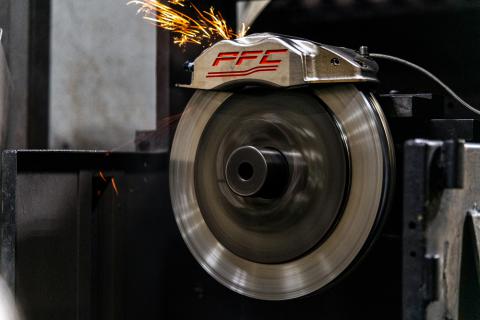
The team at PFC Brakes, based in Clover, South Carolina, think they have a solution. What PFC Brakes has developed is a new monobloc brake caliper for short-track usage, which supplants the far more common system of using caliper halves bolted together. According to Kyle Tellstrom, “Most competitors use two-piece calipers. Ours is stiffer, more rigid, it does not flex, which in turn means less maintenance over time, plus the two brake pistons are moving, rather than having the caliper halves moving or clam-shelling. That all ties into better brake feel, even at high temperatures, when you come off the pedal.”

5
The monobloc brake calipers made by PFC Brakes for short track use are stiffer and more rigid than a two-piece caliper, said our source, which means they require less maintenance over time. The calipers also improve brake feel, since only the pistons are moving, not the caliper parts.

The specific product is PFC Brakes’ ZR94 caliper model, either nickel plated or black anodized, in leading or trailing configurations, with a variety of piston diameters. Applications exist for Super Late Models, Pro Late Models, tour-type modifieds, Late Model stock cars, and SCCA Trans-Am TA2, all running on blacktop. By removing the ZR94’s external crossover and other non-critical material, the caliper’s weight is significantly reduced. An internal fluid passage system adds strength while also inhibiting failure.

“It essentially can be used for road racing applications based on short-track racing components,” Tellstrom said. “We use forged aluminum monobloc calipers and two-piece pistons with aluminum bodies and stainless steel faces, efficient tolerances for temperature ranges, plus seal grooves to make sure the pistons don’t drag on the rotors. Our rotors are built on zero failure and use mid-moly alloy, which is a grade up from the low-moly alloys that most short-track braking systems use. It’s a hardier material that will not crack or fail, even if glowing. We also do dry-machining to promote low metal contaminants.”

Endurance Racing

The latest product advance from PAGID Racing in Troy, Michigan, is its line of RSL brake pads for endurance racing, which Jim Emerson describes as the company’s primary heritage in manufacturing. “Our goal is to have longevity with performance through the life of the pad,” he said. “Traditional endurance racing lasts from eight to 24 hours. We want to ensure our customers that our products have good modulation, with controllability, which is important because most modern sports cars come with ABS. We focus a lot of our pad design to be really cooperative with the ABS systems that are in use.”

The RSL pads are aimed primarily at GT-type classes, which can be filled with ABS-equipped race cars, unlike the prototype categories. With technical partners including Turner Motorsports, consistency is a key performance goal, Emerson said. “The ABS works off friction levels, so it has to be the same on lap 10 as on lap 200. The modulation characteristic can be defined as the area where a driver enters the braking zone. We want the ability to pressure the brake with variable pressure input so when the driver releases the brake, the pad comes off the rotor, which then allows for a free-rolling condition. We want the driver to get to that threshold and be able to choose, because not every driver brakes at the same level.”

The RSL family is about to be expanded with new 1E and 2E compound formulas aimed at boosting pad longevity. “You want to get as long as you can out of the pad,” he said. “We want our pads to last 12 to 18 hours, but our goal is to create the 24-hour pad. We’re taking the feedback from our technical partners and adjusting the formula, and we’ve made some definite strides in the past two to three years.”

Broad-Based Severe Service

Hawk Performance of Medina, Ohio, is an all-around braking component supplier specializing in pads, rotors, and fluid for severe applications. “For us, the focus is on pads, because they’re our bread and butter and the main component of the braking system,” said John Butler. “In motorsport, the consistent force we always fight against is heat. Every part of that brake system is designed around heat dissipation. We make sure we have a friction component that handles that heat, performs consistently within that heat range, and creates consistent amounts of friction across wide ranges of temperatures.”

Hawk Performance operates more than 15 dynamometers at its headquarters to test and evaluate the performance of its braking components. Butler said the dynos “can replicate different race tracks, such as Daytona or Road America, to play with those pad compounds, take away different types of metals or compounds, to find that balance of thermal capabilities. A brake pad dyno is a spindle, a caliper, and a rotor, where we’ll do either a track replication or take the brake through testing procedures, such as dragging the brake through 1,500 degrees and then do five immediate stops, or do a series of 7 G stops, or 0.5 Gs.”

Hawk Performance’s most popular product is its line of DTC-60 pads, specifically formulated for cars with high deceleration rates and increased aerodynamic downforce, and applicable for everything from spec Miata classes to off-road trucks to a variety of oval track classes. Its advertised attributes include low-abrasive rotor wear, high torque, and an optimal operating range of 700 to 1,100 degrees. 

“Like a milkshake, it’s made up of a lot of steels, fibers, and resins,” Butler added. “We want it to have a smooth initial bite, release effectively, and not drag, so the driver can drive the car properly and not have it function as an on-off switch.”

SOURCES

BrakeOMeter
brakeometer.com

Brembo
brembo.com/en

Hawk Performance
hawkperformance.com

PAGID Racing
pagidracing.com

PFC
pfcbrakes.com

Wilwood
wilwood.com

July 2022
By
Jim Donnelly

Block Stars

Submitted by jeffreyc on Mon, 06/13/2022 - 10:01


From custom one-offs to next-gen makeovers, today’s suppliers are stepping in with innovative solutions for demanding applications.

Using today’s accessible design and manufacturing technologies, racers can build just about any engine they want if they have the creative vision and money to do so. Many cylinder-block manufacturers are giving them the starting point they need to fulfill unique ideas.

“Every block is custom built,” said Mark Fretz of Brodix, Mena, Arkansas. “We give the customer a menu of things we can do, and they just go down that list. We deal with so many different types of racing. We deal with every different type of racer who wants anything different done.”

Brodix specializes in cast aluminum cylinder blocks and doesn’t offer any billet products. The company does source a raw iron big block Chevrolet block casting and then machines it in-house; however, supply issues are a challenge these days because its foundry also has contract commitments with OEMs that often take priority.

“We build a block geared for sprint cars. We build a block geared for dirt late models. We build a block geared for drag racing,” said Fretz. “And then there’s the big block stuff that can be geared from street cars to Top Dragsters and Top Sportsman.”

Brodix also offers development work. One current project, for an OEM client, could not be discussed, but Fretz could tell us about another finished project for a large airboat. “They have four 632-cubic-inch, big block Chevy engines with props on an airboat to move heavy equipment,” said Fretz. “It was an interesting project, doing blocks and heads for them.”

2
Every engine block Brodix makes “is custom built,” said our source. “We give the customer a menu of things we can do, and they just go down that list.”

Rules are often the driving force for new cylinder block development. World Products in Louisville, Kentucky, recently released a BBC iron block with a 9.500-inch deck height, which is shorter than the traditional 9.800-inch measurement. It also features billet-steel main caps and is machined for a 55-mm camshaft.

“It was really designed for truck pulling and Northeast modified singles, where they run big blocks but have 500-cubic-inch max displacement in the rules,” said Jack McInnis. “The shorter deck allows racers to keep the rotating assembly lighter and the center of gravity lower.”

Demand for iron blocks remains steady, according to McInnis, who added that keeping up with the orders is the biggest challenge. “You know, a lot of that is due to foundry issues, but there’s definitely a very strong demand for iron blocks,” he said, noting that the company still doesn’t have a true LS block but offers a hybrid small block Chevy that accepts LS cylinder heads and induction gear.

“We’ve had teams, both drag racers and circle track racers, using them along with street-car people. The fact that you can run a LS top-end and still drop it into like a 1969 Camaro chassis without having to change the crossmember, motor mounts, and cooling simplifies everything,” said McInnis.

Finally, McInnis said adjustments have been made on the manufacturing side to help racers with extreme cylinder pressure applications. “Whether it’s boost or nitrous, we did make quite a few revisions. Actually, we’ve bumped the alloy for all of our blocks up to a Schedule 40 iron, which is considerably stronger than some aftermarket products that are Schedule 30 or some OEM stuff that is 20, or in that range,” he said. “We started with the Ford block, and now they’re all poured with that alloy. We thickened the main webs in the Ford block in addition to using the stronger material. We’ve also added material in the cam tunnel. We have a guy in Australia running 57 pounds of boost on that block.”

Advancements in cylinder heads has prompted block manufacturers to offer more options in the way of bore spacing, the number of fasteners, and lifter locations.

“Our R&D and product teams are always researching new applications to build engine-block solutions,” said Mike Panetta of Dart Machinery, Warren, Michigan. “We currently have two blocks in development that we can’t divulge the platforms due to confidential nature. But we can assure you that these will be game-changers for the performance market.”

3
World Products offers a BBC block with a 9.5-inch deck height. “The shorter deck allows racers to keep the rotating assembly lighter and the center of gravity lower,” said our company source.

One recent partnership had Dart develop a block-and-head combination to be used by Pro Line Racing in Ball Ground, Georgia, for a new race package. “The block and cylinder heads utilize the Dart X lifter layout,” explained Panetta. “This was done to make large improvements in valvetrain stability with the conventional big block Chevy head layout. By using the X lifter pattern, it allowed us to design a one-piece rocker bar assembly. This design has shown incredible performance over the past year during our testing.”

By offering a wide variety of options that have been developed through years of working with race teams, Dart can turn a conventional block into a special-order block. These options include oversized lifter bores, custom lifter locations, different cam tunnel diameters, main and head stud upgrades along with full prep machining services. When power demands even more strength, Dart offers billet programs.

“In extreme boost applications, many customers move up into a solid or water billet block design,” said Panetta. “The billet block design is a much stronger option over an iron or cast aluminum engine block. With a billet block, we can improve crucial areas of stress caused by high boost levels, allowing us to build a stronger block for those applications.”

4
Demand for engine blocks remains steady, though some manufacturers are challenged to fill those orders due to raw materials shortages and rising costs.

On the topic of rules, Panetta said that sanctioning body officials are kept apprised of Dart’s development work that may test any boundaries. “Our primary markets are drag racing and circle track, and we offer a large list of different blocks that fit many of the rules in either segment of racing,” he explained. “As we develop new blocks, we involve the sanctioning bodies to make sure we design these blocks around the rules that will allow them to be legal.”

Over at Edelbrock, based in Olive Branch, Mississippi, its Racing Head Service (RHS) brand manufactures an aluminum LS block. Edelbrock currently has no plans to introduce any new blocks in 2022, but it will continue serving the street, race, and marine markets where the block is popular—even in high-boost engines.

“The RHS LS engine block was designed to withstand today’s extreme boost applications by utilizing premium A357-T6 aluminum with six-bolt steel main caps designed for maximized mating surface area for increased clamping strength,” said Mike Sanders. “In addition, our block will accommodate 60-mm roller cam bearings and 1.060-inch bushings to increase valvetrain stability during high-rpm operation. Combine these features with our high efficiency, priority main oiling system, and you have a block that will withstand extreme cylinder pressures on the street and on the strip.”

Countering Challenges

From a manufacturing viewpoint, block manufacturers have been challenged by supply issues as well as soaring prices.

“It’s just the nature of the industry right now,” said Heath Norton of Energy Manufacturing, Fremont, Ohio. “Everybody thinks we’re not doing our job, but it’s the job that changes every day. We just had a 21.5% increase in the cost of the forged aluminum blocks we use.”

Norton added that sister company Callies was seeing a 56% increase in the cost of Timken steel that is used for crankshafts. “It’s painful, but it is what it is. People are getting mad at the price. It’s harder to run a business when every time you turn around your cost goes up 56%,” he said.

Energy Manufacturing specializes in solid billet blocks for drag racing. One of its most popular products is the LS block, which is getting a makeover that includes larger main caps to support the Cleveland-sized 2.750-inch crankshaft journals. “The bigger crank will have more rigidity for higher horsepower,” said Norton.

“It’s basically our third generation of that block,” added Ben Mens of Energy Manufacturing. “It will be available in a 9.240 deck, a 9.750 deck, and a 10.200 deck height. It will also be available with a .388-inch raised cam location. And with the Cleveland mains, the whole bottom end will be more robust.”

5
The LS engine block offered by RHS was built to withstand extreme boost by utilizing premium aluminum in its construction and six-bolt steel main caps, which are designed for increased clamping strength.

Some rulebooks limit the deck height to 11.700 inches and stock bore spacing on a BBC platform. Energy offers BBC blocks with 9.800- and 10.200-inch deck heights. These blocks start as 485-pound chunks of forged 6061 aluminum and are whittled down to around 115 pounds in the CNC machine.

To manufacture a block with an 11.700-inch deck height, however, would require a much larger starting block of aluminum and result in considerably more leftover metal shavings. Instead, Energy designed deck extenders that are sandwiched between a 10.200-inch block and the cylinder head using extra-long head studs. These extenders can be surfaced and O-ringed just as other blocks. Longer-than-normal cylinder liners are installed through the extenders into the parent block, so the piston and rings don’t know there’s a seam in the block structure.

“We use the deck extensions for a couple reasons,” said Mens. “You don’t have to get a large, ultra-expensive billet block and figure out how to get it into the CNC machine. Also, if a customer is running a massive dose of nitrous and has a failure in the tune-up, it could be catastrophic in a one-piece block—maybe unrepairable. With our block, you could literally replace that one section.”

Should the customer choose to race in a class with a lower displacement, the extenders can be taken off, and with a new set of liners the block would be suitable for the correct rotating assembly.

“We build these blocks up for grudge racing,” said Taylor Lastor of TRE Race Engines, Cleveland, Texas. “They’re 747 cubic inches with a 4.600 bore and 5.500 stroke.”

In the Top Fuel arena, Energy Manufacturing is working directly with teams to deliver legal blocks for nitro and alcohol racing. The company is also eyeing the endurance market with an early design phase for water-cooled versions of its race blocks.

“But that comes with a whole other set of issues,” noted Mens. “You want to make sure that you don’t create problems as you’re creating solutions.”

With power levels of Pro Street, Nostalgia Super Stock, and blown classes going through the roof, Keith Black of Clearwater, Florida, has revisited its famed A356 T6 alloy Hemi and Wedge blocks. With Top Fuel roots, this Mopar water jacketed block has been recognized for its strength. Further refinements have now been made. Adding 4340 steel main caps, to accompany the 5/8-inch threaded studs and double 1/2-inch side bolts, was the first step taken, proving reliable and stress free at virtually any power level, according to Tim Banning. 

“Listening to our dealer and customer base, many other changes were also made,” Banning stated. “KB only uses premium quality Darton cylinder sleeves. Maximum cylinder head clamping force is now attained by adding deep threaded 1/2-inch head studs, eliminating the need for O-rings in most applications. A front valley web has been added for improved lifter support and oil retention. The cam tunnel has been strengthened/enlarged allowing cores up to 65 mm. All blocks are machined for full-time top-end oiling, including lifter galleys and valvetrain. Additional ports have been added for dry sump and/or oil accumulators. The new block design also allows for fine tuning the oiling system in three locations. These changes take the Keith Black water block to another level, ensuring further success in the most demanding of racing environments.”

Ace Up Your Sleeve

There is no “chicken or the egg” dilemma when discussing cylinder blocks and sleeves. The blocks definitely came first.

“The only time we come out with something new is when the manufacturers come out with something new,” said John Catapang of Darton International, Carlsbad, California. “And there hasn’t been anything new from the factories. Coming up next for us is the VR30 in the new Nissan 400Z.”

The VR30 platform has been around, so cylinder liners may need only a few tweaks to fit the latest iteration in the Z. That leaves Darton time to expand its horizons.

“In order for us to try to stay current, we decided to jump into other markets instead of sticking with pure automotive,” said Catapang. “We’re looking to work with side-by-side vehicles. The current one that’s been just blowing up the market is the Can Am.”

Darton, along with Race Engine Development (RED) located just down the road in Oceanside, California, has introduced modular integrated deck (MID) conversion kits for the three-cylinder turbo engine in Can Am vehicles. A MID conversion involves turning a dry-liner engine into a wet-liner configuration.

“The MID is perfect for that block because it’s square and thick in a lot of good places,” said Catapang. “Putting the MID kit in there is a big difference because it makes that block a lot stronger. I mean these guys are usually trying to push 700-plus horsepower out of a little three-cylinder engine.” 

6
Darton International, working with Race Engine Development, has introduced MID conversion kits for the three-cylinder turbo engines in Can Am UTVs. The kits help strengthen the block for 500–700-horsepower applications. Photo courtesy of Race Engine Development.

“Yeah, we have gotten into the ATVs, UTVs, and watersports,” confirmed Steve Demirjian of RED. “It’s crazy. You can get 500 to 700 horsepower out of these little motors.”

Demirjian said he gets both repair and fresh race builds coming through his shop. “I get some with cracked cylinder walls, and we can get most of them back in service with a MID wet liner,” he said, adding that some European car brands are also becoming popular conversions. “I’m getting into more BMW and Mercedes blocks, especially custom work with Darton liners.”

Sleeve replacement continues to provide steady work to the manufacturers as the hot market trends that started with COVID-19 carry on.

“Honestly, we’re just busy,” said Jeff Zaugg of Advanced Sleeve, Mentor, Ohio. “We’re busy with a lot of ductile-iron product. We just seem to be really busy. But we are also tinkering with heat-treating now.”

Supply issues are also forcing the company to machine sleeves out of solid bar stock. “It’s just too hard to get ductile tubing. The foundries aren’t catering to our needs. We have the machines to do that machining, but it ties them up dramatically. That’s why we’ve fallen behind on some deliveries,” said Zaugg, adding that the machined sleeves then have to be heat-treated.

7
L.A. Sleeve is developing cylinder liners for domestic and overseas markets. Shown here is an aluminum Lamborghini block with L.A. Sleeve liners installed.

Over at L.A.Sleeve in Santa Fe Springs, California, product is being developed for both domestic and overseas markets. The company has teamed with Bullet Race Engineering in Australia to provide sleeves for its billet blocks.

“The majority of blocks they’re making are being shipped to the US, especially the Toyota 2JZ and Honda K24,” said Dave Metchkoff. “They’ve become very popular here for both drag racing and drifting.”

There were some early failures with the blocks that Metchkoff said were traced to tolerance and clearance issues. “But by putting our two minds together, they’ve really created a nice product,” he added.

Another current collaboration is with Fast Forward in Richey, Florida, a company that has found a tight niche in race-prepping factory Ford Coyote blocks. “Yeah, it’s not an aftermarket or billet block,” explained Metchkoff. “But he’s taken that motor and perfected it with our sleeves. I’ve been there, and he showed me his processes. They are so meticulous about perfecting little things. He’s producing a block that from the crank up is straighter and rounder than from the factory. Also, Lingenfelter is sleeving their LS7 blocks with our sleeves and doing much the same thing as Fast Forward.”

Finally, in a sign of the times, L.A.Sleeve is expanding its installation services. “The majority of our business is producing sleeves. But we install sleeves here for a number of guys because machine shops are shrinking throughout the US,” concluded Metchkoff. —Mike Magda

SOURCES

Advanced Sleeve
advancedsleeve.com

Brodix
brodix.com

Dart Machinery
dartheads.com

Darton International
dartonsleeves.com

Energy Manufacturing
energymanufacturing.com

Keith Black
keithblackhemi.com

L.A.Sleeve
lasleeve.com

Race Engine Development
raceenginedevelopment.com

Racing Head Service (RHS)
racingheadservice.com

TRE Race Engines
treraceengines.com

World Products
pbm-erson.com

July 2022
By
Mike Magda