How Inflation May Actually Help You Boost Profits

Submitted by laurap on Wed, 12/21/2022 - 13:01
Tom Shay at PRI 2022


Business expert and PRI Show presenter Tom Shay shares pricing strategy insights to help raise retailers’ bottom lines.  

A story is told about how a popular country music song was created. Toby Keith and Clint Eastwood were playing golf one day. Keith asked Eastwood how he remained so youthful and active. Eastwood responded that he “don’t let the old man in.”

Keith liked the response and went home to write a hit song by the same title. The song is about one’s outlook on life and remembering to do what are the special items in your life. The part of the song that catches our attention is, “how old would you be if you didn’t know the day you were born?”

While the question definitely ties to the rest of the lyrics, we know there are several areas in business where it could also apply. Today we are going to look at the question with consideration to the prices we charge our customers for both products and services. 

What Would You Charge For Something If You Did Not Know The Cost?

In business conversations, we often establish a timeline based on the pandemic, which began in the US in March 2020. With a few days left in 2022, the inflation rate since the start of the pandemic has been 11.8%, according to one method. That means a $10 item purchased in March 2020 costs $11.80 at press time. Another form of calculating the inflation rate would see the $10 purchase now being $14.68.

Inflation is a justified concern with products we purchase, services we utilize, and definitely with payroll in our business. Most likely, we have all found ourselves expressing concern about the increase in costs of some product or service. Not that inflation will continue forever, but everyone has a certain degree of “numbness” in experiencing a price increase. Hence, price increases can work in our favor when it comes to establishing our prices for products and services.

Real-World Examples

One year while teaching a seminar on pricing strategy at the PRI Show, I had the audience repeat, “What would you charge for something if you did not know the cost?” as the basis for my lesson. When you are selling something, the last thing to take into consideration is the cost. You base the selling price on your determining what you think a customer will pay for the item.

While many were in attendance, I had an interesting experience with an owner.

“I see you are going to teach your class on how to price this afternoon. I have been to it before,” was the comment from the first person walking into the room.

And while I explained this would be the first time I had taught the class at PRI, this person explained they owned multiple businesses and had heard the class at a trade show for one of their other businesses many years ago.

Retail motorsports


He shared, “After the show, I went home and talked with my manager about what you had said. I pulled a product off the shelf and told him how much we could increase the price by using your technique. As fate would have it, that same afternoon, a customer came into our showroom and asked for help in selecting that exact product. The customer asked how much it was, and I took a chance by telling him a price according to your methodology. The customer thought the price was fair, and we had a sale. I took this as a sign that we should implement your pricing lessons. That was in 2007. Because of the great recession of 2008, our sales dropped by 15%, yet we made more profit. Our sales dropped another 15% in 2009, and we made even more profit. If it had not been for what you taught, we would have closed the doors permanently.”

That’s a firsthand testimonial that correlates with our question, “what would you charge for something if you did not know the cost?”

Five-Point Strategy For Changing Prices

Well, what was the lesson that I taught? It was a five-point strategy for changing prices. First, take a look at the techniques and then remember what this one dealer said.

Everyday Sale Price - You know what your competition advertises, but have you ever taken the time to make a list of these items? You will be pleasantly surprised to find a relatively small number of items that your customer knows the price of. Matching the competition’s price on these items cancels their tremendous advertising advantage. 

Price Sensitive Items - This group can contain two types of items; the first being those which are related to an everyday sale price item. The customer may know the price of the item they came to purchase, but what about the accessories? These are the items on which you can make a decent margin. This price-sensitive group can also contain items which are similar, but not identical, to what your competition carries. A simple example we see every day: years ago, there was only one size of a Milky Way bar, and everyone knew the price. Today, that manufacturer makes several sizes and combinations of the number of bars in a package. A customer can’t know the price of each of them.

The customer may be asking for an item they saw in the competition’s advertising, but you are stocking an item with the same features. Your item may be superior, and for that, you can charge a minimal additional amount. Usually, this amount can be up to 10% more, but no more than four dollars.

Promotional Priced Items - The items contained in this group are the ones you advertise with. While you may sometimes include items that are also found in the ads of the competition, your advertising should be separate from theirs. Allow your advertising to tell your story to the consumer by showing the products you have chosen to carry and the services you offer. For this plan, your employees must be aware of the advertisement, where each advertised product is located, and how to properly use and install each of the advertised products. With the limited budget for advertising, you cannot afford to shoot yourself in the foot by having employees lacking expertise. 

Blind Priced Items - After determining the items that fall into the first three groups, thousands of items remain available for sale. What are the prices of these items? Those that fall into the blind price category, the answer is, “nobody knows.” Unfortunately, these are the items that, too often, have a price substantially less than what the market is willing to pay. Other than through the process of elimination, you can find these items by shopping the competition. Make a point to note the price on ten items every time you or someone from your business visits their store. Many may be surprised to see how much less you charge for some of these items. There is no advantage or reason to have the lowest price in town on any item you sell.

Price Rounding Items - I would like to share one more strategy with you. From years of experience, I found this unique pricing technique to be quite profitable. Think about the products you sell with a price of two dollars or more (probably just about everything in the store). Then, look at all the different prices. You don’t really need to have all of them.

For everything you sell between two dollars and ten dollars, you can round up the prices to where the items end with .29, .49, .79, and .99 cents. For products between ten and twenty dollars, round up the prices to end in .99 cents. From twenty dollars to fifty dollars, have your prices end with 1.99, 2.99, 4.99, 6.99, 7.99, and 9.99 (i.e. 31.99, 32.99, 34.99, 36.99, 37.99, and 39.99).

For items of fifty dollars and above, use the same formula for rounding up as above, making a small change to eliminate the 2.99 and the 6.99 levels. Over $100, you can round everything to end with 9.99. 

What does all of this change in rounding up do for you? For a dealer with annual sales of $750,000, you will see an additional $25,000 appear on your bottom line. All these pricing strategies work very well with each other. 

The benefits you will receive are the perception with your customer that your business is priced competitively and a substantial increase in your net profit.

Business expert Tom Shay is the owner of Profits Plus Solutions in Dardanelle, Arkansas, and has presented retail-focused seminars at the PRI Trade Show in Indianapolis, Indiana. 

December 2022
By
Tom Shay

Editors’ Choice

Submitted by jeffreyc on Wed, 12/21/2022 - 11:58


Hundreds of new product announcements cross the desks of PRI editors each month. Following are our top picks for January.

Programmable Electronic Ignition Distributor

Progression Ignition
progressionignition.com

A drop-in distributor that can be programmed with a smartphone and offers race-specific features such as nitrous retard and launch rev limiter is now available for popular V8 engine platforms from Progression Ignition in Edgewater, Florida.

“The primary market for this product was muscle car guys,” said Ted Regier. “Then when we showed it at SEMA 2019, we started getting calls from dirt track guys. They wanted to know if timing could be reduced coming out of the turns. Timing can be reduced whenever you want. Then drag racers wanted it, so we started developing more race features.”

A Bluetooth wireless connection to a smartphone app allows timing adjustments with the engine running or off. There’s also a real-time data streaming provision. All the electronics are contained in the distributor under the cap—there are no external boxes. There is an easy-to-use basic setup program, but more sophisticated programming is available in the app for fine tuning.

Racer-friendly features include a main rev limiter, boost-retard timing, nitrous retard and adjustable release delay, and launch retard tuning. Also included are data logging, automatic start retard, and automatic dwell control.

Current applications include Chevy, Ford, Pontiac, Chrysler, Oldsmobile, and Buick. The price is under $600, and the product is available only from the company website. —Mike Magda

2

Left- and Right-hand Dry Sump for LT Engines

Aviaid
aviaid.com

The new LT engine family is likely to be just as popular for engine swaps in the coming years as the LS architecture, and packaging can always be an issue—especially if you want to step up to dry-sump oiling. Aviaid in Chatsworth, California, can help solve those problems by offering a block-hugging system that is available for both left- and right-handed installations.

“Typically, the pump is mounted on the right or passenger side of the engine,” noted John Schwarz. “Unless you’re in Australia where the steering shaft comes down that side with a right-hand drive.”

There’s no denying the performance benefits of dry-sump, including eliminating power-robbing windage and assuring constant supply of lubricant during acceleration and cornering. Also, the low-profile oil pan allows for lower engine placement. 

Aviaid’s new kits are available with three- to six-stage pumps, and adapters can be ordered for pumping fuel or power-steering fluid.

“The system can also work with an external wet-sump pump,” said Schwarz. “The gerotor oil pumps on LS and LT engines can lose effectiveness after certain rpm levels—say 7,000 rpm and they’re done. There are drag racing guys that 7,000 rpm is where they start!”

The Aviaid external wet sump is designed to provide a constant flow of oil for more than 10,000 rpm. —Mike Magda

3

Smart-Tech TH400 Drum Module

Sonnax
sonnax.com

Sonnax in Bellows Falls, Vermont, has reengineered the forward/direct drum system with lighter and strong parts to help give drag racers running a TH400 transmission an edge at the track. Weighing 3.3 pounds less than an aluminum direct drum, the module’s direct-clutch components take 68% less energy to operate than others in the aftermarket, according to Sonnax’s Gregg Nader.

“For a bracket racer, the improved consistency helps dial in the number,” said Nader. “Racers at different levels of competition have reported ET gains of .010 to .020 second. Some noticed more consistency and smoother runs. Others noticed more power to the wheels and adjusted accordingly. Also, there are reports of quicker reaction times from trans-brake release.”

Prototypes first hit the track in 2020, and production units were available in early 2022.

“From the very beginning, the reports have all been positive,” said Nader.

An all-in-one kit, the Smart-Tech module includes all parts necessary for the upgrade. The module is easy to assemble and install with compatible 28-spline input shafts, including Sonnax heavy- and extreme-duty shafts. Due to its design, the Smart-Tech drum module is suited only for drag racing applications that do not use a front band. —Mike Magda

4

Bolt-in Quadralink Rear Suspension

Detroit Speed
detroitspeed.com

Trucks keep showing up more often in drag racing, drifting, and autocross competitions, and performance suspension modifications are quickly being developed to handle the increased numbers.

“With the amount of attention GM trucks have received in the last few years, it only made sense for Detroit Speed to offer a performance suspension system,” said Evan Perkins of the Mooresville, North Carolina-based company. “Many of these trucks actively see the autocross, and our track-tested suspensions offer better handling on the track and the street.”

The kit shown is a bolt-in version for the 1967–1972 Chevrolet C10 pickup as well as the GMC C15 for the same model years. The kit replaces the trailing-arm/coil-spring setup that came from the factory. It includes double-adjustable shocks with remote reservoirs and brackets that can be bolted to the factory axle.

“One of the benefits of these kits is that they are offered in bolt-on or weld-on configurations. That allows for the professional or the hobbyist,” added Perkins.

The kits allow an adjustable ride height of 5.5 to 7.5 inches of drop to set up the desired stance, depending on wheel-and-tire combination. All the major components are powder-coated for appearance and corrosion protection.

Other features include C-notched plates for additional axle clearance at low ride heights and laser-cut brackets that work with the original wiring and brake lines. —Mike Magda

4

Dynasty 300 with Wireless Foot Control

Miller Electric
millerwelds.com

Making welds in tight quarters, such as a roll cage, is much easier with the new Miller Dynasty 300 AC/DC TIG/stick with wireless foot control.

“The wireless foot control makes for easy welding around large fixtures where movement is critical,” said Andy Weyenberg of the Appleton, Wisconsin, manufacturer. “There’s no cable to get caught on obstructions or limit reach.”

Weighing just 55 pounds, the Dynasty 300 can weld up to .375-inch thick material. Other features include Pro-Set to eliminate guesswork when setting weld parameters and program memory to save and recall favorite weld settings.

“These pedals are not just simple RC technology. They have to be shielded from the electrical noise interference and magnetic fields that welding creates,” noted Weyenberg. “They also have to be digitally married to the receiver so other wireless pedals don’t cross-control other machines in a congested work environment.”

Included in the complete package are the Dynasty 300, runner cart, Weldcraft W-280 torch kit, coolant, 8-foot primary cord, Coolmate 1.3 water cooler, and wireless foot control. 

“So far race teams like the new operator interface, which makes it easier to set the machine through various scroll-and-press-to-set screens,” added Weyenberg. “Each set-up screen also gives the operator a graphic representation of what the arc will look like, eliminating guess-and-set.” —Mike Magda

5

Head-stud Kit for LS Engines

Point One Manufacturing
p1mfg.com

A new head-stud kit for Gen III and IV LS engines is now available from Point One (P1) Manufacturing in Rogersville, Missouri. Constructed from 8740 chromoly steel, the studs are rated at 190,000 psi tensile strength.

“We are a full-service fastener manufacturer with design, all machining operations, heat-treat, and finishing in-house. Our metallurgy and metrology labs ensure every part we produce meets or exceeds the customers’ requirements,” said Kevin Feeney.

Finished in black oxide to prevent corrosion and boost longevity, the kit includes 20 MJ11-2.0 x 7/16-20 x 5.115-inch studs, 10 MJ8-1.25 x 5/16-24 x 2.500-inch studs, 12-point nuts and stud washers. The kit fits 2004 and later GM LS engines.

“The feedback we have received from our customers has been incredible,” added Feeney. “They are impressed with the attention to detail not only on the quality of the product but the care we take in packaging it and ensuring they have everything to complete their installation.”

Future fastener kits include head and main stud packages for additional late-model engines in addition to a dedicated line for the diesel market.

“Point One was founded with the core principle that in high-performance engines 99.9% is often simply not good enough. We strive to exceed the customers’ expectations through our products and superior customer service,” said Feeney. —Mike Magda

6

Reaper Stiletto Left-handed Cobalt Drill Bits

Rodman Drill & Tools
rodmandrill.com

Removing broken bolts or studs can cost any engine build or chassis fabrication valuable time. The new Reaper Stiletto left-handed cobalt drill bits from Rodman Drill in Canoga Park, California, will help remove stubborn right-handed fasteners with torque applied through the left-handed bit.

“Our race shops love the Stiletto lefty drill bits. They’re made from our patented cobalt-tungsten alloy, as opposed to common M2 high-speed steel,” said Jon Epstein. “These offer superior performance in fouled parts that have been exposed to excessive heat. The aggressive Stiletto step-tip style allows faster and cleaner removal of broken parts than 135-degree split-tip bits on the market, especially when the clock is ticking and time is of the essence.”

The 15-piece set includes drill bits from 1/16-inch up through 1/2-inch in 1/32-inch increments. Additionally, the lefty Stilettos feature a shortened length for greater access in hard-to-reach areas. Sizes 3/16-inch and larger have shanks with three ground flats that prevent slippage in drill chucks.

“There’s no need for predrilling or heliarc fussing,” added Epstein. “The precision-ground flutes and wide web design facilitate fast chip removal, thus preventing the bits from overheating and becoming brittle.”

The Stiletto left-handed drill bits can be used to remove busted head bolts, manifold studs, and other stubborn fasteners. They also drill through stainless steel, spring steel, and Grade 8 bolts. —Mike Magda

7

January 2023

Stop Doing That…Do This Instead: Wasting Excess Metal

Submitted by jeffreyc on Wed, 12/21/2022 - 11:16

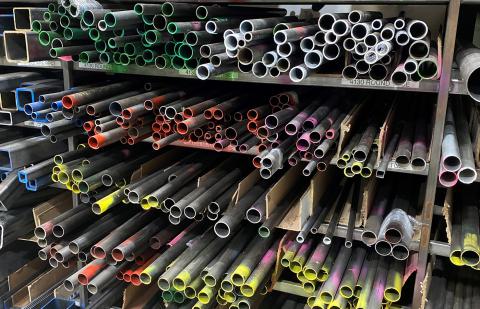
Extra material left over from custom cuts, a return, or some other reason goes into drop bins and racks at Stock Car Steel and Aluminum. “That allows walk-in customers to check out what’s available when they’re at the shop,” said Sasha Dierker, who noted these materials are usually sold at a discount. 

As efforts to improve sustainability proliferate throughout the automotive realm, the industry is developing solutions to help ensure that leftover material gets put to good use.

There’s an array of different processes that can produce metal waste during the journey from raw material to a finished motorsports product. Although most manufacturers are continually on the lookout for ways to improve their production efficiencies and reduce their impact on the environment, some excesses are inherent due to the nature of the industry and the specialized components that support it. 

That doesn’t mean the extra material has to end up in a landfill, though. Here we’re taking a closer look at how manufacturers, metal suppliers, and brokers are helping to reduce this waste in ways that can actually bolster a business’s bottom line while benefiting the planet. 

Cut to Order

Stock Car Steel and Aluminum (SCSA) in Mooresville, North Carolina, got its start back in 1996 providing metal for chassis builders in NASCAR and other series, but over the last two-and-a-half decades the company has expanded into plastics, aluminum, sheetmetal, and other materials for a range of different industries. One particularly popular service that the company offers is the ability to do custom cuts. If a customer needs a material of a particular length or some other dimension, SCSA can trim the material down to size for them. 

“It’s something we’ve been doing here since the beginning, and because of that, we were able to find a use for the excess material very early on,” said Sasha Dierker. “Any extra material that we end up with because of a custom cut, a return, or some other reason ends up in our drop bins and racks, and that allows walk-in customers to check out what’s available when they’re at the shop. It’s generally materials like steel square tubing, chromoly, and welded DOM steel tubing that’s 5 feet or less in length with a 1-inch to 2-inch outside diameter. Sheet ranges from 11 gauge to 22 gauge.” 

These ‘drop’ materials are typically discounted by 10–15%, depending on the type of material and size. If SCSA ever finds itself with an over-abundance of drops, the material is sent to the scrap yard for recycling. 

“That hasn’t really been an issue lately,” Dierker said. “Sometimes people will buy entire bins of material. And if prices on materials keep rising, I think it’ll only become more popular over time. Cup teams can contend with the costs; the people who really benefit from this are the ones who don’t have huge budgets to work with.” 

Recycling Resources

As one of the leading manufacturers of motorsports-grade crankshafts, connecting rods, and camshafts, Callies Performance Products in Fostoria, Ohio, machines and processes a vast amount of metal to produce its products. Rather than tossing out those metal shavings and chips—and in turn bearing the cost of disposal—the company has developed a storage and categorization system that makes recycling the materials a hassle-free proposition. 

As Heath Norton explained, it’s part of a larger effort at Callies to operate the business in a way that’s sustainable and cognizant of potential environmental concerns. “We’re pro-racing and pro-environment,” he stated. “We recycle scrap parts, return parts, damaged parts, the chips and shavings that come off in manufacturing, cardboard waste—anywhere there’s an opportunity to do so. It’s something we’ve done since the beginning of the company, and I think anyone who wants to run their business responsibly should be making an effort. By now there’s a well-established path for this sort of thing.”

3
Callies Performance Products works only with ferrous-based metals, “so we can recycle all of that material,” said Heath Norton. “Selling that material to recyclers allows us to turn something that would otherwise be an expense for us into something that brings money back in.”

To help reduce metal waste, Callies Performance Products divides up chips and shavings by material type and stores them in an enclosed area outside the facility to prevent any potential groundwater contamination from rain. “Everything we do at Callies is ferrous-based, so we can recycle all of that material,” Norton noted. “Selling that material to recyclers allows us to turn something that would otherwise be an expense for us into something that brings money back in. Throwing stuff away is expensive, so anything we can do to avoid adding to landfills is going to be advantageous.” 

Cash for Scrap

Scrap metal processor J. Solotken & Co. in Indianapolis, Indiana, buys excess materials from factories and demolition companies as well as machine shops and other motorsports-related businesses. As Bob Schneider explained, the company’s close proximity to Indianapolis Motor Speedway has given it a direct connection to auto racing and has provided greater awareness of the services it offers in turn. 

“This is the ‘racing capital of the world,’ so of course a lot of race teams have facilities here,” said Schneider. “As these teams machine materials on a mill, lathe, or whatever else they might be using, they produce turnings from that process. They also have a lot of end pieces and material that’s had sections cut out from sheet, bar stock, plate stock, and so on. I think that because of concerns about things like global warming and other environmental factors, folks are becoming more aware of the need to keep this stuff out of the dump. At the same time, they’re also realizing that the material has value. Every now and then I’ll talk to someone who tells me, ‘Oh, we’re just throwing that stuff away.’ And I’m like, ‘Don’t do that—I’ll pay you for it!’”

As Schneider noted, trashing this material rather than selling it to a broker tends to move a business’s money in the wrong direction. “Trash services will charge you to dispose of it, so what we’re offering is income rather than an expense,” he added. “It’s good for the environment, and it’s also good for the overall perception of the business.” 

J. Solotken & Co. also works directly with companies to advise them on how to collect and sort materials, along with ways to minimize material contamination when using different types of metals on the same piece of equipment. “Let’s say they’re working with a steel part and then they’re going to switch over to an aluminum part,” explained Schneider. “If they don’t clean the machine out properly, they’ll end up with steel in their aluminum turnings, and that can turn something with value into something with little or no value.” 

He noted that virtually all metal material can be recycled, and that the recycling process has actually been an essential part of metal production for decades. “Generally speaking, about 40% of the material that goes into making new metal comes from scrap,” he added. “Depending on how the metal is going to be used, sometimes recycled material can be preferable to new raw material because of potential differences in things like hardness and resistance to heat. It really all comes down to the application.”

Sources

Callies Performance Products
callies.com

J. Solotken & Co.
jsolotken.com

Stock Car Steel and Aluminum
stockcarsteel.com

January 2023
By
Bradley Iger

Ask the Experts: How to Improve SEO

Submitted by jeffreyc on Wed, 12/21/2022 - 10:42


Paying attention to the details will help drive visitors to your business’s website, which is invaluable in today’s online economy.

SEO, or search engine optimization, may seem like a website function that’s a little too obscure, or mystifying, for a performance racing business to deal with when it’s already at 10/10ths trying to fill orders and cope with parts shortages and supply chain slowdowns. 

That would be a mistake, said Jordan Manavian of We Design LA in Los Angeles, California, an agency that helps companies improve SEO among other digital strategies. “The one way people find businesses nowadays is by [Internet] searching, whether it’s for the product or the use case or the pain point. If your company doesn’t come up, it doesn’t matter how big you are, you’re not there.”

At BlackTruck Media + Marketing in Grand Rapids, Michigan, another firm focused on improving a business’s online efforts, “we work to best understand what’s going to make the most relevant sense for the brand to get them to show up higher in rankings to generate more traffic, generate more leads, and generate more sales,” said Jason Dodge.

Dodge and Manavian offered several tips racing and performance businesses can use to improve SEO. It’s not rocket science, but some of it may take a digitally savvy employee—or one of these firms—to make the most of a company’s website features.

2
Holley’s website page for LS swaps demonstrates “good brand presence and focus on user intent and needs,” said Jason Dodge of BlackTruck Media + Marketing. “Don’t focus on the things that don’t matter. Make sure you keep your audience in mind and understand who it is you are communicating with.” 

At the top of both of their lists was populating a website with quality content. “Google wants you to answer a person’s question with a quality experience in an informative and very detailed way,” Manavian said. “Google values what’s valuable for its user. Google’s best success is when that user uses its search product the least amount. If you can pull someone in through a Google search, and they stay on your site, Google really likes that. Google also looks at: Do they stay on your site a long time? Do they look at lots of pages? Do they convert on your site? Now that person found you and bought something on your site or signed up for something. That’s how Google values the most of what you’re providing.” 

Creating that kind of experience is “less about creating tricks or gimmicks to get someone to come to your site,” Manavian said. “It’s matching your content and your services to the right people who actually really want to see or buy it.”

Dodge tells his customers, “Don’t try to be something you’re not. Don’t write a bunch of long-form content because it ranks better. Write content to the length that it needs to be to get the point across. You’re not writing content to shove a bunch of keywords in there—you’re writing content to make sure it connects with your audience, gets the point across, and resonates with them.”

Keywords, Manavian explained, are those terms “someone types into Google search, so tying those search terms or phrases to what appears on your site is key. You want to have the keywords focused. If the content is about engine tuning, it should be in the title and used multiple times. Explain it from different angles. That’s what they’re looking for.” But, he added, “if you’re just saying the words ‘engine tuning’ 30 times in one sentence, they call that keyword packing or stuffing, and you’ll get knocked down for that.” 

3
Jason Dodge cited the importance of merchants understanding “user intent,” or the goal of the web visitor. “Are they looking for information on a subject, or do they want to buy? Those are two completely different search intents, because those users are at different points of their buying journey.” 

Cutting and pasting a manufacturer’s new product information into a website also is a mistake, according to both Dodge and Manavian. Google will pick up on that as well. 

“Write your own description,” said Dodge. “Make it different. That will help you stand out in the eyes of the search engine. 

“Focus on crafting good, unique content that hits on what your audience is looking for, and make sure your content is structured appropriately,” he added. That structure should include “a unique and compelling meta page title, the bolded text on the search engine result page that everybody clicks on. You also want to have a unique meta page description, which is the text that comes below that in the search engine results. The meta page description is not a ranking factor, but it’s an opportunity to potentially own some more real estate in search and draw the user in.” A site should have a unique meta page title and a unique meta page description “per page, per blog post, per product description or product category page, depending on the business.” 

Also make sure that content is “organized appropriately, with the various segments or subsegments, and that you’re using heading tags appropriately,” Dodge said. “That provides Google and the search engines direction on what this section is about within a page. Google is inherently lazy. It doesn’t want to crawl an entire site. It wants that information fed to it. So sites still, to this day, should have a sitemap XML file that can be fed to Google. The search engine is more or less going to look to that file, crawl it, and that will be its mapping guide to help navigate through the site faster.”  

Other tips from our experts: There is no set length for a website article to boost SEO, Manavian said. But while shorter used to be better, conventional wisdom puts the ideal length now at around 1,000–1,500 words per web page. “And don’t do all copy,” he added. “It should have images and, if possible, video as well.” 

“Search is still built on the foundation of keywords and links,” Dodge said. “Make sure those links and those resources linking to you are of like industry or like topic. That’s attribution, showing authority. Link building and links are ways the Internet functions, and search engines recognize that.” A few years ago, “Google caught wind of the fact that there were SEOs doing things that were unorthodox. There was a lot of link buying happening, a lot of link spam, so the focus was on quantity of link versus quality.” When Google recognizes links that aren’t related to a company’s core business, the site’s search ranking could actually be penalized. 

Ultimately, improving SEO is not a short-term strategy, Manavian pointed out. “It might not yield a benefit or positive traction for six to eight months.” Yet SEO “is absolutely one of the most underrated categories for companies to compete in, because essentially, if you have it built, it is yielding free traffic. I’ve seen large companies that spend a lot in advertising, that have big sales teams that have been around a long time, get beat by smaller companies that have an SEO strategy when they don’t have one.”

Sources

BlackTruck Media + Marketing
blacktruckmedia.com

We Design LA
wedesign.la

January 2023
By
Drew Hardin

Featured Vehicles

Submitted by jeffreyc on Wed, 12/21/2022 - 09:24


An inside look at some of the industry’s most intriguing builds, including a vintage chassis that sat for almost two decades, and a dragster turning heads in more ways than one.

3

1966 Chevrolet Corvette

Randy Larsen

Race series/class: CSRG classic sports racing group GT1

Engine: Small block Chevrolet 327 built by Randy Larsen

CAR: Fabrication by Randy Larsen 

Facts: The car was purchased about 20 years ago and painted, then sat in a field on Larsen’s property for about 18 years. During COVID-19 Larsen took it out of the field, cleaned it up, and built it into its current condition.

2

2003 CNE Dragster

Nick Januik

Driver: Taylor Vetter

Race series/class: NHRA Top Alcohol

Engine: 461ci HEMI built by Nick Januik

Facts: Currently, Vetter is the only female racing a blown alcohol dragster in NHRA and the only female to go 280+ mph in a blown alcohol dragster.


January 2023

From the Editor

Submitted by jeffreyc on Wed, 12/21/2022 - 09:01


Two things I think as we turn the page to a new year filled with opportunity for motorsports professionals:

1) I think the annual PRI Trade Show
is usually a good measuring stick for the state and relative well-being of our industry; a vibrant Show typically bodes well for the coming season. So if the feedback we’ve received from last month’s event is any indication, then racing and performance organizations by and large should be on sound footing for the foreseeable future. Over three-plus jam-packed days we witnessed some 1,000 exhibiting companies showcasing scores of new parts, equipment, technology, and solutions designed to help racers go faster and businesses work smarter. Speed secrets were shared and discovered not just throughout the aisles of the Indiana Convention Center and Lucas Oil Stadium, but in conversations and connections made into the evening at activities like the PRI Happy Hour and Exhibitor Reception, and venues like PRI’s unofficial after-hours headquarters, St. Elmo Steak House (and its magnificent ribeye). But I digress. As always, we’ll present full coverage of the Show in next month’s issue of PRI Magazine. But for a more immediate fix we invite you to visit our social media pages, in particular Facebook and Instagram, where our team currently is—and will continue—rolling out exclusive video, galleries, and more from an unforgettable week in Indianapolis. 

2) I think change can be a good
thing, especially when it challenges deep-rooted beliefs that may only serve to preserve a status quo. For context: Not long ago I had the opportunity to talk racing with an all-time great. This legendary sports figure wasn’t a hero of the oval, drag strip or road course, though. No, this was three-time Super Bowl champion and NFL Hall of Famer Emmitt Smith, who also co-owns the Xfinity Series team Jesse Iwuji Motorsports. Our private sit-down, made possible through the efforts of SEMA Education Director Pamela Brown-Matthis, was arranged so that PRI could gather further insight and information for our Special Report in this month’s issue. Titled “Advantage, Athlete,” it focuses on professional ballplayers’ involvement in motorsports, but with two distinct goals. First, we wanted to learn more about why pro ballers past and present were attracted to racing to begin with. What is it about the sport that draws people like Smith, Michael Jordan, and others in? Second, we sought to gauge what impact these figures had—or could have—on helping to grow the industry beyond its present reach. While the lion’s share of reporting and writing was handled by regular contributor Steve Statham, we did get to incorporate some thoughtful commentary from Smith, who I found to be extremely passionate about not just racing, but also about expanding the sport into new, more inclusive spaces. He made a number of salient points, in fact, several of which you’ll find in Statham’s piece beginning on page 42. One in particular that stuck with me was his response when asked where motorsports could advance the ball, so to speak: “It hasn’t really tapped into the diversity of thought, which has not been attractive to the whole of the masses,” he said. “In order to attract the whole of the masses, the masses have got to feel like they are appreciated and welcome and wanted. If you stay on the same path, well, you’re going to get the same results. But if you change, you may take a little risk, but the risk could be worth the reward when you start…to bring more visibility, more eyeballs onto the sport. So leveraging the sport to really what it can become, and bonding it to the vision of what it can become, is extremely important.”

January 2023
By
Dan Schechner, Editor

NGK Spark Plugs Adds Jeffrey Schlenker As GM Of Purchasing

Submitted by laurap on Fri, 12/16/2022 - 13:09
NGK Spark Plugs (U.S.A.) logo


NGK Spark Plugs (U.S.A.)—the Wixom, Michigan-based manufacturer of ignition parts and sensors—has announced Jeffrey Schlenker has joined the company as general manager of Purchasing.  

“Jeffrey joins us with extensive experience creating strategies and roadmaps to align with corporate objectives and ensure cost savings are met. We are excited to have someone of his caliber join the NGK team,” said Clair Stewart, NGK vice president of Supply Chain Management.

Schlenker will serve as a leadership team member and be responsible for the efficacy of all sourcing activities across the organization. He has over 20 years of experience in purchasing, holding positions of increasing responsibility.  

For more information, visit ngksparkplugs.com.

December 2022

Atturo Tire Corp. Announces New Regional Sales Director 

Submitted by laurap on Fri, 12/16/2022 - 13:00


Atturo Tire Corp.—the private tire brand based in Philadelphia, Pennsylvania—has announced the addition of Jeremy Wurst as its new Northeast sales director. Wurst, who holds over 15 years of sales experience, will service customers in Pennsylvania, Maryland, Delaware, New Jersey, Connecticut, Rhode Island, New York, Massachusetts, New Hampshire, Vermont, and Maine.

“We think Jeremy is an excellent fit for our growing sales team,” said Atturo Tire Corp. General Manager Karl Becker. “Jeremy has a proven track record of driving growth for several other industry brands, and we are excited he is bringing those talents to our team here at Atturo.” 

Interested dealers and wholesalers can contact Wurst at 908-319-4927 or jwurst@atturo.com.

For more information, visit atturo.com.

December 2022

MAHLE Aftermarket Opens Automated Warehouse In Olive Branch

Submitted by laurap on Thu, 12/15/2022 - 17:50
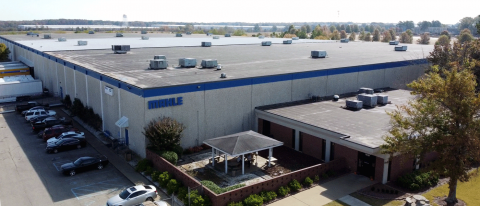
MAHLE Aftermarket in Olive Branch, Mississippi


MAHLE Aftermarket has opened a highly automated warehouse in Olive Branch, Mississippi. The facility is designed to speed up deliveries to workshops and distributors, reduce the frequency of returns, and enable an order to be commissioned within 30 minutes. 

The system MAHLE chose uses only about one-quarter of the area of a conventional warehouse, the company said. This reduces costs and decreases the amount of land needed for logistics locations. In addition, automated warehouses are extremely efficient: ten of the robotic shuttles use only as much electricity as a vacuum cleaner.

MAHLE has invested approximately $6.4 million in the fully automated facility and has plans to outfit its additional warehouse locations in Europe with similar technology in 2023, starting with Décines in France.

“MAHLE Aftermarket has been operating digitally in many areas for a long time now. We’re building upon that with automated order-picking to better serve our customers,” says Olaf Henning, member of the MAHLE Management Committee and Director of the Aftermarket business unit.

For more information, visit mahle.com.

December 2022

Eldora To Host Richest Sprint Car Race In History With ‘Eldora Million’

Submitted by laurap on Thu, 12/15/2022 - 17:44
Eldora Million logo


Tony Stewart—famed motorsports driver and track owner of Eldora Speedway in Rossburg, Ohio—has announced the legendary, half-mile dirt oval will host its third version of the “Eldora Million” on July 12–13.

The unsanctioned event, which features a winner’s purse of $1,002,023 from a total purse of $1.4 million, is a cooperative effort with the speedway’s official livestream partner, FloSports.

“All of us at Eldora are super excited to host the first million-dollar-to-win sprint car race,” said Stewart. “Back in 2003, Eldora hosted a non-wing race that paid $200,000 to winner Jac Haudenschild, but this will be the first time a sprint car driver will race for a winner’s check worth $1 million.

“This will showcase the best of the best, and you’re going to want to see how this race unfolds where in the final laps, with guys still in the hunt running close together, what they will do to win a million dollars.”

Combined with the $175,000-to-win 40th Kings Royal that takes place July 14–15 following the Eldora Million, overall posted prize money for the four-day stretch will exceed a staggering $2 million.

Eldora Speedway is known for its mammoth payouts for its mega-events. While it’s the first sprint car race to pay seven figures, it will become the 17th sprint car race at Eldora to pay at least six figures (12 Historical Big Ones, 3 King Royals, 1 Mopar Million). It will be the 48th overall race at Eldora to pay at least six figures when including late model events.

For more information, visit the announcement here or visit eldoraspeedway.com.

December 2022