Ready for Green

Submitted by jeffreyc on Thu, 12/22/2022 - 13:54


Fresh racing surfaces, new grandstands, and better customer service: How track promoters and facility owners are preparing for the 2023 racing season.

Talking to track owners and race promoters in the waning days of 2022 turned up a wide range of plans and goals for the upcoming season. 

One drag strip operator, plainly tired at the end of a busy weekend, had trouble articulating his future for all the things he had to do first. “I’m sitting here looking at a bunch of fire extinguishers that need work,” he said. “This is kind of off the subject for me.” 

At the other end of the spectrum, a road course owner had a detailed wish list for 2023 that ran the gamut from new garages to an additional race track—provided he could get the land. 

Every track operator we spoke with had a different story to tell based on location, economic circumstance, and variables as hard to control as tire availability and the weather. If there was one through-line for all of them, though, it was the hope—and often the expectation—that next year would be better, even if 2022 had been a good one. 

Booking Like Crazy

While some track operators hadn’t yet finalized their 2023 schedules, others were already filling up dates. 

“2023 is booking like crazy,” said David Vodden of Thunderhill Raceway Park in the Northern California town of Willows. “I need to build another track. We have two race tracks, and that was the best thing I ever did. We do 600 track days a year, and theoretically I would have had to turn away more than 200 of those if we didn’t have the second track. My biggest trouble for 2023 will be explaining to people we don’t have any dates for them.”

2
The two road courses at Northern California’s Thunderhill Raceway Park host some 600 track days per year, said David Vodden, filling the calendar quickly. Should land become available, he would like to build a third track for testing.

Right now, the third track is hypothetical. “We’re out of land; we’ve used all the 530 acres here,” Vodden explained. Should he be able to buy an adjacent parcel, “I want to build a test track that can be used for racing. Right now, we have race tracks that are used for testing. I just have to reverse it and see if that model will produce additional corporate business.”

Vodden doesn’t do much outreach to attract spectators, since most of the people who are at Thunderhill on any given day are participants. “We do get spectators, but we don’t charge to get in. At the 25 Hours of Thunderhill, which is our signature event, we charge a gate, but racers get in free, so that’s about 90% of those who come in.” His marketing, then, is mostly “social media blue sky so someone will think highly of Thunderhill as one of the great road tracks of America. We don’t get any ROI—I don’t sell tickets—so I’m advertising to who, the Shelby club? That’s easy, just call them up.” Vodden did hire a new general manager, Matt Busby, who came to Thunderhill after working at NOLA and the National Corvette Museum Motorsports Park. “He’s going to bring some new ideas to our facility.” 

One of Vodden’s priorities for 2023 is “the relationship of the race track property to the community. In 1992, when I got permission to build this track, the local supervisors, council members, everybody was friendly. We knew them all. But those entities change, and I think we need to reinforce our relationship with the neighborhood, the community we live in, so we can be here 50 years from now. The mission of Thunderhill is to survive, not necessarily to maximize revenue.

“By the way, we have no debt,” he added. “Things that kill race tracks are debt service, land development, and bad management. When you want to survive, you can’t be servicing debt.”

3
Justin Jones’ goal for North Carolina’s Rockingham Speedway and Entertainment Complex in 2022 was to have at least an event per weekend, “and we exceeded that. Some weekends I had three different events—a circus on a Friday, a drifting event on a Saturday, and then a Little Rock event on Sunday.”

Rockingham Speedway and Entertainment Complex in Rockingham, North Carolina, is another facility busily booking 2023 dates. In 2022, “we had 54 events total, and all the clients have been happy and have booked for the next two to three years,” said Justin Jones. His goal for 2022 was to have one event per weekend, “and we exceeded that. Some weekends I had three different events—a circus on a Friday, a drifting event on a Saturday, and then a Little Rock event [on the half-mile “paperclip track” adjacent to the 1.017-mile big track] on Sunday.”

He expects to be just as busy this year, but the calendar may have a different look. When we spoke, Rockingham’s big track was being repaved. That new surface, and other facility improvements, may lead to bigger events, Jones said, based on the calls and email requests he’s received. “I think the schedule will be flat full, but I don’t know if it’ll be 54 events like in 2022 or 30 larger events.” 

4
Justin Jones is installing new lights at Rockingham Speedway and Entertainment Complex. Once those are up, “I’m going to fill in some night racing, so I think we’ll be able to double-dip, so to speak, with monster trucks during the day and racing at night.”

What’s surprised Jones are the bookings for the summer months, usually slow for the track because of the area’s oppressive heat. “May is completely booked, I already have three large events in June, July and August are half booked, so normally the months that I struggle to schedule are filling up fast. As soon as the new lights go up, I’m going to fill in some night racing, so I think we’ll be able to double-dip, so to speak, with Monster Trucks during the day and racing at night.”

Repaving and lights for the Big and Little Rock tracks are just part of a long list of upgrades on Jones’ schedule. Because the facility was closed for much of the time between 2004 and 2019, “every kind of valuable equipment” was stolen, Jones said. He and his crew have “put every dollar from every event” back into Rockingham since then, replacing what was stolen and upgrading the infrastructure. On his to-do list for 2023 are suite renovations at the big track, adding grandstands at Little Rock, and expanding the number of camping spots inside the track. 

With a small staff—“the most we’ve had is 10 employees”—Jones is responsible for the facility’s marketing in addition to his other duties. “I personally handle all the social media accounts. We’ve had really good traffic there, gained some good sponsorships, but we’re going to put more money into marketing for 2023 and 2024. We have to have those bigger events and that revenue, because mowing, weed eating, and just doing lawn care for 270-plus acres is expensive, plus fixing everything and renovating everything. It’s a labor of love from all of us, and we’re doing all we can to get it back up and running and back to its former glory.”

Customer Focused

“It started when we were in the COVID-19 pandemic,” said Edwin Pardue of Summit Point Motorsports Park, a multi-circuit road-race facility in Summit Point, West Virginia. “We became very customer focused, listening a lot to what they were looking for in their track experience. We have made what seems like constant improvements to the tracks, whether it’s improving some of our runoff areas, improving the walls, those kinds of things, and the clients see us constantly marching forward. I think they appreciate that, and I think we do a good job with our customer service. We make people feel welcome. They know we’re glad to have them here. It’s as simple as going into the paddock and letting them know you appreciate them spending their time, spending their leisure dollar with you. I think that makes the difference.”

Pardue’s next priority is to “do more things to engage folks in the region. People from all over the country know about Summit Point”—the track’s marquee event, the Jefferson 500 vintage race, draws participants from at least 25 states—“but we have people in the county who’ve never been here.” His challenge is unique, he said, “because of the way our park is set up. Last Saturday I had six different events going on here at the same time. You can stand in one place and watch an SCCA race, or walk a few feet and there are motorcycles on that track, and on the third track you might have a drifting event going on. We need to let people know that on any weekend, there’s all these different things going on, all these different rollercoasters you can ride. Here we are, just an hour or so outside of Washington, DC or Baltimore. This is a hidden gem in the upper Shenandoah Valley, so it falls on us to do a better job of getting that word out there.”

5
The staff at Summit Point Motorsports Park in West Virginia “became very customer focused” during the pandemic, said Edwin Pardue, “listening to what they were looking for in their track experience.” As a result, they have made “constant improvements” to the tracks, including to the runoff areas and walls. “The clients see us constantly marching forward.”

One way to do that is through an open house, which Pardue hosted just before we spoke. “We sent invitations to everyone who lives within the town limits of Summit Point to come have a free day at the track. We gave them a hot dog and a soda and let them watch an SCCA race. That’s something that will definitely be an annual piece.”

Pardue also wants to adjust his marketing efforts beyond the social media he uses to interact with participants “to reach the folks who wouldn’t be consuming whatever that media is.” That strategy includes traditional broadcast media and putting ads in the local newspaper each year “to kick off the season. Part of that is just being a good community partner, and part of that is reaching that backyard.” 

He sees potential in B2B marketing with local businesses as well, “whether it’s promoting an event through their retail space, or promoting it as a customer appreciation piece, or putting together something that might be a retention program for employees, where a company has a day out here at the track.

“The pieces are all there,” he said. “I think what’s missing is letting people know what’s available.”

At Swainsboro Raceway, a 3/10-mile dirt track and kart track in Swainsboro, Georgia, Paul Purvis made a big change to his race schedule in 2022 in the interest of helping race teams and fans alike. “We had been running weekly, but last year we tested the waters and tried racing every other weekend. It worked out good for us, so we decided to set up this whole season like that. We had great crowds and great car counts all year. By backing off and taking a weekend off in between, with the tire situation, the economy and all, it helped the race teams, and we had better attendance in the grandstands.”

What also helps attendance, he said, is the efficiency of his programs. “Except for our three-day show at Thanksgiving, we do mostly one-day shows, and the focus is on running efficient: We start on time and get it over on time. We are done around 10 or 10:30. Where we are located, we depend on people from at least an hour away, so being done early really does help a lot, so people can get up and go to church on Sunday. And we keep our neighbors happy. We live in a good community that supports the race track, and the last thing we want to do is make them mad.”

Facility upgrades are constant, Purvis said. He’s adding more white gumbo clay to the track and moving a “nice tower,” formerly used on the site’s now-closed mud bog, to the speedway. While he used to allow pitting both inside and outside the track, a new Georgia law called for a 15-foot fence in the infield “if you let racers park in there, so we moved all the pits outside, and it’s been one of the best things we’ve ever done. You can see the races so much better, so the fan experience is better. And now when the racers are ready to go home, they can pull out at any time.” 

Like many of his fellow owners/promoters, Purvis relies heavily on social media to market the track, but unlike most, “we do local radio in our small town. That radio station probably won’t reach 25–30 miles, but it still reaches a lot of people in town. I can really tell when I don’t do it.” 

He augments that coverage with ads and promotions at a radio station 40 miles away that has a 125-mile reach. And racers and sponsors alike are happy when Swainsboro events are livestreamed on FloRacing. “We have a big message board right in the middle of the pit area, and they can’t hardly video the race without seeing that board. Our sponsors are just rolling on that board the whole time. I’ve gotten quite a few likes from our sponsors seeing their stuff on TV.” 

Purvis is a big fan of “if it ain’t broke, don’t fix it,” so he has no plans to alter the six classes running his bi-weekly racing programs. A class for Crown Victorias and Grand Marquis he added last year has proved to be popular. “Ex-cop cars. All they can do is put a roll cage in them and take the glass and breakable stuff out.” Meant to be fun, the class has added about 30 cars to race weekends. 

“And with those lower classes of racing, they bring more people with them,” Purvis noted. “Your Late Model guys, they’ll come in with maybe two crew guys, and that’s it. But the people racing the lower classes bring the whole family, an average of 10 people per car.” That means those 30 Crown Vics account for about 300 extra spectators at each race. 

Additions to the Program

Other track promoters we spoke to are planning additions or changes to their racing programs. At Davenport Speedway, a quarter-mile dirt track in Davenport, Iowa, IMCA stock cars will be added to the 2023 schedule, said Ricky Kay. “We have a very local class—I call it the Outlaw stock cars—which is similar to a UMP stock car. There’s only a dozen of them around by us, and we allow the UMP stock cars to race with them, but there’s just no way to have a special when that’s all you’re going to get, 12–14 Outlaws and a few others mixed in there. Hopefully, adding the IMCA cars is a way to get car counts up.” 

Kay recognized that “we probably didn’t run enough of the weekly Late Models last year, so we’ll definitely have more weekly Late Models this year. We’re a Late Model area, really good at mods and sport mods, too. Those three classes are our bread and butter.”

Kay also tried a new format in 2022 called Mayhem Madness that he hopes will grow in 2023 and attract more racers and fans. “It’s a 75-lap race with all the cars from all the classes racing against each other. If 80 cars show up, they’re all going to be on the track at the same time.” While last year’s race had fewer entries than he hoped, “it was fun to watch. It’s green flag/red flag, with no yellows, so you just stop if you get a flat tire. Or you run with it, pull off, and go fix it.” 

6
A new class for Crown Victorias and Grand Marquis—“ex-cop cars,” as Paul Purvis calls them—has been a popular addition to Swainsboro Raceway in Georgia. Modifications are limited to safety gear only, to keep the class affordable; and it’s worked, adding some 30 cars to race weekends. 

On the drag strip side of the business, we spoke to two operators who were considering a bigger involvement in the no-prep scene. 

“We’ve kind of held off on the no-prep deal,” said Wayne Styles of Centerville Dragway, Dardanelle, Arkansas. “The couple we did had some wrecks, and it kinda left a bad taste in our mouth. I think, though, that’s what spectators and even racers want to do, so we may try a little more of that next year. When the other tracks around you are doing it a lot, people want to see that stuff, so it costs us a little bit in attendance. We’re going to jump in there and do a little more of it.”

At US 131 Motorsports Park in Martin, Michigan, “We did a couple of no-prep deals this year—JJ’s Arm Drop events—and we are considering doing more but haven’t decided yet,” said Jason Peterson. He traveled to Rockingham to a Street Outlaws/No-Prep Kings race in October “to see what the event looked like, and it was very eye-opening.” The fans, for example, “are very loyal to that TV show, and there was a shocking amount of people on-site for the event.” Plus, “they don’t treat the racers as racers. The racers are the cast, the actors for the show, in how they’re treated and portrayed.” He was quick to add that “it was all honest racing, nothing like the WWE—it’s not set-up racing. But they’re actors for the show, which is probably why they’re so successful. I didn’t think it would last, but it’s lasted and it’s gaining ground, so that’s an event we’re considering.” 

The track’s strengths are its bracket programs and test-and-tune days, Peterson said. “We don’t do a lot of index racing or anything like that. We just don’t feel we have the niche market here, at least on this side of the state. The other side of the state has a different market type. They do more grudge racing. We do a couple of grudge races, but that’s all.”

And for the fans? “We try to treat our spectators the way we’d want to be treated when we go to a facility: smiling faces, kind and courteous everywhere we are, try to service them best we can. We try to be very family oriented. That’s why we don’t do a lot of different things that some tracks do,” Peterson concluded.

Sources

Centerville Dragway
centervilledragway.com

Davenport Speedway
davenportiaspeedway.com

Rockingham Speedway and Entertainment Complex 
rockingham-speedway.com 

Summit Point Motorsports Park
summitpointmotorsportspark.com

Swainsboro Raceway 
swainsbororaceway.com

Thunderhill Raceway Park
thunderhill.com

US 131 Motorsports Park
us131msp.com
January 2023
By
Drew Hardin

Race Winning Brands Adds Ross Clark To Technical Sales

Submitted by laurap on Thu, 12/22/2022 - 13:46
RWB logo


Race Winning Brands (RWB)—a Mentor, Ohio-based portfolio company of MiddleGround Capital in Lexington, Kentucky—has announced the addition of Ross Clark in a technical sales role. He will focus on the MGP Connecting Rod brand while providing supplementary support to Diamond Racing Pistons.

Clark will be responsible for providing product technical guidance and sales process support. He will report to RWB Michigan Sales Manager Steve Rhodey. 

Clark holds experience in the performance aftermarket and OE segments, with prior roles involving technical sales and analytics with various companies, including Dart Machinery, Recaro, and General Motors Accessories.

RWB consists of brands including BoostLine Products, Corsa Performance, CV4, Dart Machinery, Diamond Pistons, Haltech, JE Pistons, K1 Technologies, Manley Performance, MGP Connecting Rods, PAC Racing Springs, ProX Racing Parts, Rekluse Motor Sports, RevMax, TransGo, Transmission Specialties, Trend Performance, Victory1, Volant Performance, and Wiseco Performance Products. 

For more information, visit racewinningbrands.com.

December 2022

Determining Factors

Submitted by jeffreyc on Thu, 12/22/2022 - 13:27


Series regulations, technological advances, and evolving materials are just some of the countless considerations that influence how manufacturers design wheels for different racing applications.

Regardless of class, cost, and capabilities, every race car has something in common: The critical juncture of the contact between its tires and the racing surface is governed by the performance of the racing wheels mounted at each corner of the car. Depending on the manufacturer, a provider of racing wheels can produce them by the thousands, in a wide array of sizes, strengths, and custom appearances.

It’s up to every potential wheel buyer to do the selecting, but manufacturers can help to smooth the process through familiarity with sanctioning-body rules and sound engineering principles. Considering the number of classes that exist, the variety of surfaces racers compete on, and the technological limits of race cars, that spells plenty of potential choices for any customer. But once the right questions are answered, the industry is ready to help with wheels that can be dialed in precisely for a given application.

“It all depends on the intended use,” said Keith Kern of 3030 Autosport Forged Wheels, Terre Haute, Indiana, which markets wheels for drag racing, autocross, and other track applications, as well as muscle cars. Kern said that sanctioning bodies will typically list an SFI requirement for their common classes, but when it comes to specialty applications, such as Pro Stock or Pro Modified, 3030 Autosport will help the buyer pick the most appropriate wheel. Exhaustive testing is part of that process, he explained.

2
Aero Race Wheels specializes in steel wheels for a variety of oval track classes and offers more than 10,000 wheel variations. For the most part, racers know what they want, said Aero’s Kelli Peton. “We just have to help them with the part number, with the finish, the diameter, and width.”

“For autocross, we refer them to our Series G, or if they’re going to do SCCA road racing, to our MOD3 three-piece series, which is engineered for that,” Kern said. “With the MOD3 line, one of the big tests that we perform is like you driving a 4,600-pound car in a 1.25G turn for 250 straight miles. Everything basically falls under that envelope.”

Wheels can be fabricated from steel, aluminum, or more exotic materials like magnesium, and can exhibit varying levels of engineering sophistication depending on their intended use. For some providers, helping buyers select a wheel is a more straightforward process, due in part to the market the supplier serves. Some are narrow. One such example is Real Racing Wheels of Independence, Iowa, which specializes in steel wheels for a variety of oval track uses, both on dirt and pavement.

“As far as steel wheels go, there’s really only so many manufacturers that are making them anymore,” Real Racing Wheels’ Paul Buhr noted. “Our particular wheels feature lightweight outer shells with a strong center, which allows for deflection while still keeping the tire inflated. In our line of chrome wheels, they’re made from actual chrome, not powder-coated chrome.”

4
The friction stir welding process Race Star Wheels uses for its Pro Forged line results in a wheel that’s “lighter and stronger, which really helps 60-foot times because the wheel is more true than a wheel that’s been welded together in sections,” said Race Star’s Brian Sexton. “Even in Funny Car, with Cruz Pedregon [seen here], the cars just come off the line and don’t shake the tires.”

Real Racing Wheels’ biggest market is short-track modifieds as sanctioned by the IMCA, USRA, and USMTS organizations. “We only offer one style of wheel, so [buyers] know coming in what they’re getting,” Buhr said. “We don’t have any choices as far as rim shell thicknesses or different styles; they’re all basically manufactured with the same components. IMCA determines the exact details for each wheel, such as bead bump height, and then issues a safety sticker. Each manufacturer has to meet those guidelines, and then they’re allowed to sell them. With the lightweight outer rim shell and the strong, thick center, our chromed wheels will stay chromed for the life of the wheel.”

Aero Race Wheels of Estherville, Iowa, is another manufacturer that specializes in wheels for oval-track competition in a wide variety of classes. Kelli Peton pointed out, “We offer more than 10,000 variations of a wheel. The biggest first question we have for our buyers when they come in is whether they race dirt or asphalt. Then it goes off into some tangents: We have different series and sizes of wheels that are different weights, and then it goes down to different bolt patterns and backspacing. Generally, when it comes to the racer, they’re going to know exactly what they want. We just have to help them with the part number, with the finish, the diameter, and width.”

Aero Race Wheels’ also specializes in steel wheels, offered in sizes and capacities to suit modifieds, hobby stocks, four-cylinder and front-drive stock cars. Peton said Real Racing Wheels essentially supplies the entire stock car market with the exception of Late Models, whose sanctioning organizations generally specify aluminum wheels in their rules packages. There’s even a degree of crossover between dirt and asphalt wheels, she said, depending on their intended usage.

“On the asphalt side, we do 15x8 wheels, 15x10s and 15x15s, which covers big block modifieds,” Peton said. “We also have sport compacts on the asphalt side that run our 15x7 dirt wheel. The biggest difference between asphalt and dirt wheel series, either 15 or 13 inches, is that the asphalt wheels we make are a little bit truer, a little bit lighter weight, and they generally don’t have a safety bead. On the manufacturing side, we typically look at different vehicle weights when we’re building a wheel. When it comes to mistakes that customers sometimes make, generally, what we see is racers doing a mismeasuring of their bolt patterns. We get some customers looking for offset, which is not something we deal with, so the biggest issue tends to be the bolt patterns.”

From the Top Down

Other manufacturers have a wider footprint in terms of their offerings, sizes, and materials. With a presence in the global racing-wheel market, BBS, whose US subsidiary is BBS USA, offers wheels ranging from street applications to WEC sports cars, Indy cars, and Formula 1. In business since 1970, BBS has gained prominence nationally for providing the wheels for NASCAR’s Next Gen car. BBS is best known for its lines of monobloc race wheels, available in forged magnesium or forged aluminum designs, as well as cast-flow formed aluminum, depending on the intended track use. Craig Donnelly said technological advances in motorsports have led BBS to develop advanced lines of wheels, even in vintage racing, for cars it originally supplied when they were new more than 30 years ago. 

“We do probably the widest range in the market. We have cast flow-form wheels especially for racing, single-piece forged wheels, multi-piece forged wheels in aluminum and magnesium, even two-piece racing wheels,” Donnelly said. “It comes down to what feeds the needs most for that particular customer. Is it a club race car, vintage, or professional? What’s the environment that this car will be used in? That’s because vintage racing is huge for us, and for a lot of people in vintage, we delivered the original wheels to them back in the day when the car was new. A Porsche 962 ran on 16-inch wheels back in the day, but today, they’re running 18s. Sixteen-inch tires just weren’t available anymore, so we had to go where the rubber was. And tire technology today is worlds apart from what it was back then. You also have higher loads, so you have to design things to a higher level than we did in the 1980s. Vintage have more horsepower, more grip, and a better suspension than they ever had at Day One.”

3
Technological advances in motorsports have led BBS to develop advanced lines of wheels, including cast flow-form wheels, single-piece forged wheels, multi-piece forged wheels in aluminum and magnesium, and two-piece racing wheels. “It comes down to what feeds the need most for that particular customer,” said BBS’ Craig Donnelly. 

As Donnelly noted, BBS literally offers dozens of wheel designs and can produce them in huge volumes, demonstrated by the fact that BBS has to supply thousands of wheels to NASCAR teams to support the Next Gen program. BBS began its partnership with NASCAR in 2019, and producing the wheels takes BBS across three continents, with engineering performed at BBS headquarters in Germany, manufacturing handled by BBS Japan, and sales distribution undertaken out of BBS USA’s facilities in Braselton, Georgia. As Donnelly explained, “We are a global company and were able to use those strengths to secure the NASCAR business. It’s a lot of product. When it comes to technology, we have die forging we do for high-volume OEM projects, to reduce the amount of machining and finishing time. Because of volume in NASCAR, we went to die forging as the best solution.”

Race Star Wheels of Kearney, Missouri, focuses on straight-line competition. Race Star produces high-performance alloy wheels for street cars, light trucks, and a variety of competition vehicles, with drag racing a specialty, offering products ranging from street classes to the hardcore professional categories. Race Star Wheels relies on precision sizing and advanced manufacturing techniques when serving its customers.

“We’re aware of the rules in terms of what series allows what for wheels, whether it’s NHRA Pro Stock or NMCA,” said Brian Sexton of Race Star Wheels. “What we try to give the consumer is more of a wheel fitment within the wheel style, rather than by size, bolt pattern or offset. We’ve actually created a video that’s on YouTube about how to fit your wheels, how you measure your bolt spacing or your back spacing. Customers can call in and talk to somebody on the phone who can make recommendations. We also have a how to set up on the website.”

5
Forgeline supplies competitors ranging from SCCA club racers to the elite of IMSA and WEC road racing. All of its wheels are forged and are designed for load rating “and sometimes aero,” said David Schardt. “Aero puts an extra load on the wheel; 1,000 pounds of downforce is like putting an extra 1,000 pounds on the car.”

The bottom line in wheel choice invariably comes down to the sanctioning body’s rules, which begins the selection process, Sexton said. “We fit that to the combination of what they’re racing. It comes down to what they can run, and then style,” he said. “Do you run with a bead lock, a double bead lock or no bead lock at all? We cater 100% to the drag racing market. Some of our competitors use multi-piece wheels rather than wheels that are welded together, but our Pro Forged line uses a unique welding process, similar to how submarines are welded together, to withstand extreme pressures. It’s called friction stir welding—you don’t have excess material that has to be ground off. Once it’s done, you can’t tell where the weld is. If you look at our wheels, you can’t find the weld seam. It becomes a one-piece wheel that’s lighter and stronger, which really helps your 60-foot times because the wheel is more true than a wheel that’s been welded together in sections. Even in Funny Car, with Cruz Pedregon, the cars just come off the line and don’t shake the tires.”

The rubber that makes up those tires is a critical element in vehicle performance and wheel selection. David Schardt of Forgeline in Dayton, Ohio, focuses on sports cars and road racing as his firm’s primary market. “Most customers who call in here, whether a grassroots racer or even a manufacturer like Ford or Chevy, don’t realize the stickiness of the tires can affect the load rating of the wheel more than anything else,” Schardt explained. “So if somebody is running the Optima Street Car Challenge on a 200 tread-wear tire, they can get away with a wheel with a lower load rating, and in some cases it may not even have to be forged. But somebody running a full slick tire with a lot of aero in a professional racing series, they’re going to need a fully forged, super high-load-graded wheel, and possibly also run some aero properties in that wheel.”

6
Keizer Aluminum Wheels are cold-spun using aerospace quality aluminum “to meet precise tolerances,” said Wade Huisman. “Our forged billet blanks are CNC machined in-house” at the company’s Iowa facility. The wheels are manufactured for customers driving anything from Pro Street to formula cars. 

Forgeline supplies competitors ranging from SCCA club racers up to the elite of IMSA and WEC road racing. The company’s products, and its engineering, reflect that breadth of usage. “All our wheels are forged, designed for load ratings and sometimes aero,” Schardt said. “The more load rating, the longer it’s going to take to machine that wheel, the more focus on the stiffness of the wheel will be needed in the higher classes. Stiffness will help with load rating but will also make the car faster. We use a formula to calculate load rating, and one of the numbers we evaluate is tire friction coefficient. Aero puts an extra load on the wheel—that means that 1,000 pounds of downforce is like putting an extra 1,000 pounds on the car. We’ve been making racing wheels for 30 years now, so we have a lot of data.”

Unlike some other firms, Keizer Aluminum Wheels of Orange City, Iowa, fabricates in aluminum only, as its name implies. Wade Huisman said the company stays current by maintaining close contact with its customer base, which includes buyers ranging from Pro Street to formula cars. “It’s important to figure out who you’re actually dealing with in today’s racing wheel world. It’s the people behind the product and service that will make your investment a good experience or one you will regret down the road. Spending more doesn’t always mean better results. Research and discussion are key in not wasting your money. 

“Keizer wheels are cold spun with US aerospace-quality aluminum to meet precise tolerances right in the heartland of Iowa,” Huisman said. “We’ve been in business for 40 years. Our forged billet blanks are CNC machined in-house. We feel we have the finest service a custom racing shop can offer. All questions are welcome.”

Sources

3030 Autosport Forged Wheels
3030autosport.com

Aero Race Wheels
aeroracewheels.com 

BBS
bbs-usa.com

Forgeline
forgeline.com 

Keizer Aluminum Wheels
keizerwheels.com

Race Star Wheels
racestarindustries.com

Real Racing Wheels
realwheel.net

January 2023
By
Jim Donnelly

Slinger Super Speedway Joins High School Racing Association In 2023 

Submitted by laurap on Thu, 12/22/2022 - 13:25
HSRA logo


Slinger, Wisconsin-based Slinger Super Speedway—known as the “World’s Fastest Quarter Mile Oval”—has added the High School Racing Association (HSRA) series to its schedule in 2023. The facility joins Beaver Dam Raceway, Dells Raceway Park, Tomah-Sparta Speedway, La Crosse Fairgrounds Speedway, and Madison International Speedway as HSRA-sanctioned race tracks in Wisconsin.

“Slinger Speedway is looking forward to joining the High School Racing Association and working with local students to get involved in stock car racing,” said track owner and promoter Todd Thelen. “The skillset students can learn is one they will carry for the rest of their lives.”

HSRA will visit Slinger Super Speedway on:

  • Sunday, June 18, 2023
  • Sunday, July 9, 2023 (Slinger Nationals Week)
  • Sunday, July 23, 2023
  • Sunday, August 6, 2023


The HSRA features American Production six-cylinder sedans with numerous safety enhancements. In addition, the driver’s high school colors or mascot must be incorporated into the car’s design. Students entering their first year of high school, current high school students, as well as those just graduating from high school (minimum age of 14 and maximum age of 19), are eligible to compete. 

For more information on HSRA, including rules and regulations, visit highschoolracing.org. For more information on Slinger Super Speedway, visit slingersuperspeedway.com.

December 2022

Update On Status Of The RPM Act

Submitted by laurap on Thu, 12/22/2022 - 12:39
Save Our Race Cars UPDATE


The Specialty Equipment and Market Association (SEMA) and the Performance Racing Industry (PRI) have shared that the 2021–2022 Congressional session is ending without the passage of the RPM Act despite strong Congressional backing and extraordinary support from the racing community.  

Key negotiators in Congress could not reach an agreement on bill language that balanced the need for federal law to protect racers and motorsports parts businesses from EPA enforcement with reasonable measures to ensure that race parts are not used on vehicles driven on roads and public highways.  

The RPM Act made incredible progress in the 2021–2022 session of Congress. In addition to more than 1.5 million letters advocating for the RPM Act from the grassroots motorsports community to Congress, SEMA and PRI worked with Richard Petty to personally meet with key lawmakers in Washington, DC, and with NHRA Top Fuel driver Antron Brown to testify before the U.S. Senate Environment and Public Works Committee. 

SEMA and PRI thank the RPM Act’s lead sponsors, the Senate Environment & Public Works (EPW) Committee, and the House Energy & Commerce Committee for their efforts to advance the RPM Act over the course of the year. Their leadership was integral throughout this process, despite the outcome.  

“We wouldn’t have made it this far without this incredible effort by so many of our members,” said SEMA President and CEO Mike Spagnola. “The RPM Act was one of the most bipartisan bills in the 117th Congress, with over 165 lawmakers co-sponsoring the legislation. SEMA and PRI will leverage the momentum we built during this congressional session, assess the current challenges the industry faces, and chart a new path forward for the industry’s advocacy efforts at both the federal and state levels.” 

SEMA/PRI will continue its advocacy work to bring needed certainty to the racing community to protect a great American pastime and hundreds of thousands of jobs in communities throughout the country. For updates and information, visit saveourracecars.com.  

December 2022

Virtual Cooling Solutions

Submitted by jeffreyc on Thu, 12/22/2022 - 12:34

Photo courtesy of PWR

The emergence—and continued development—of software-based modeling and testing is challenging some longstanding beliefs in this critical performance segment.

Race engines must remain cool under high stress. 

To that end, advances within computerized modeling technology—led by computer-aided design (CAD) and computational fluid dynamics (CFD) programming—have been among the segment’s key drivers in recent years. 

Companies that produce cooling systems can now simulate precise, real-world and real-time conditions, something that was unfathomable even at the highest levels of motorsports only a couple of decades ago. These advancements in testing capability are critical—and game changing. They’re allowing manufacturers to build a better, longer-lasting product. 

“Maybe 20 years ago...the use of computer systems like CAD and CFD was never even considered,” said John Pairaktaridis of Delta PAG, Astoria, New York, which specializes in cooling products for the drag-and-drive market. “It was unheard of.” But today, he told us, this software has effectively refined production while largely debunking theories that were previously considered “commonplace knowledge” among end users. 

Indeed, several top manufacturers of performance cooling systems and related components have placed obsessive levels of testing at the core of innovation, which increasingly includes CAD- and CFD-based capabilities. To learn more, we recently connected with a handful of these suppliers for a deeper look at their processes, including how cutting-edge testing leads to improved manufacturing and, ultimately, better results on track. 

Testing, Testing

As noted, CAD and CFD were mostly unproven (or untested) within the performance cooling segment until relatively recently. But all of that changed in the last two decades. 

Software-based modeling and testing have since proven their worth as clear cost- and time-savers. Many of today’s leading cooling system suppliers swear by it. “I don’t know any respectable manufacturer that doesn’t use it to design their products,” Pairaktaridis said. 

Which means that a broad range of products—from radiators to water pumps—have undergone major advances in both quality and capability thanks, in part, to data uncovered by these technologies. 

2
In a relatively short period of time, advances in computer-aided design and modeling have revolutionized the development of cooling components, according to our source at Delta PAG. “Maybe 20 years ago, the use of [these] systems was never even considered,” he told us. “It was unheard of.”

Headquartered in Glendale, Arizona, aluminum radiator specialist Ron Davis Racing Products utilizes mapping and CAD for all major processes, according to the company. It also aligns its metal grain during flat-pattern CAD layout to ensure maximum strength at bends.

Moroso Performance Products’ Brett Corriveau noted that electric water pumps account for a sizable percentage of the Guilford, Connecticut-based company’s business, which itself consists of “a pretty large catalog that includes any category in cooling other than radiators.”

“The current generation electric water pump we manufacture is CAD-designed first, and then tested on a flow bench,” Corriveau explained. “It’s been a few years since we have introduced any new versions of our electric water pumps, but they are new enough, and that is the design process we used—off the CAD.”

In terms of CAD/CAM software, SOLIDWORKS, Fusion 360, and NX (formerly Unigraphics) are the go-to programs for a number of cooling system manufacturers, including Rancho Cucamonga, California-based CSF, which lists Honda Performance Development, Mountune, Full-Race, Titan Motorsports, and Vortech Superchargers among aftermarket customers. 

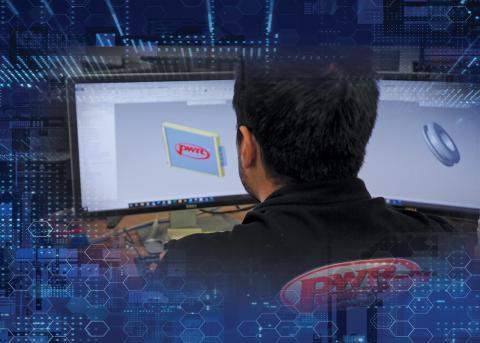
At PWR, based globally in Australia but with North American headquarters in Indianapolis, Indiana, Herb Engelhart told us that CFD is critical to the company’s testing. With CFD, it runs predictive calculations of the heat rejection of a given cooler. It can consider a variety of factors like fin height, average ground speed, and front side air pressure, he said. This allows the tailor-fit of multiple critical aspects of cooling design for any given application.

“We use CAD and CFD across all [of our] facilities to ensure we have a good starting point before proceeding with prototypes,” added Jack Anderson from PWR. “Nothing beats physically building the parts, but having some of the issues ironed out before this point speeds up the design process and prevents waste. Having the ability to do the CAD and production work under one roof gives us a massive advantage in the design and development cycle.” 

3
Cooling products—everything from fans to radiators to water pumps—have undergone major improvements in both quality and capability thanks, in large part, to data uncovered by developing technologies like CAD and CFD.

That ability to optimize design in CFD before cutting metal “has helped us get to the right design quicker and prevent wastage in the design and prototyping phase,” Anderson continued. “Improvements in our DFM (design for manufacture) and CNC software have allowed us to increase our throughput while helping to identify issues sooner.” 

Which is not to say human input doesn’t play an important role in PWR’s product—and prototype—development and evolution. Anderson elaborated: “We always look for real-world feedback on our products and try to adjust the designs where possible. We typically look to do multiple installs and gain feedback from as many people as possible in the early prototype phase to ensure we are as close as possible to the optimum solution before release. 

“As time goes on,” he continued, “we will revisit the design based on feedback to see if there is anything we need to do to make it even better. It might be a new fin or turbulator density for better performance, slightly tweaking the dimensions for better fitment, or finding a way to simplify the design for a better commercial offering.” 

Proving (or Disproving) Assumptions

The emergence and utilization of computerized systems also has advanced the category by disproving common misconceptions, according to Delta PAG’s Pairaktaridis, who said that early-in-the-process use of software gives the supplier a “competitive advantage” in which solutions often “are contrary to what is generally accepted.”

“We hit that wall every so often with customers where they have a certain belief one way,” he added, “but it’s been proven, and it’s discovered that it is the complete opposite.”

Pairaktaridis told us one persistent myth is that “you have to slow down coolant to spend more time in the radiator.”

“That’s absolutely wrong,” he continued. “You actually need to increase the velocity of the coolant so it will increase turbulent flow.”

Pairaktaridis explained, “Turbulent flow in the cooling system is ridiculously important because it is able to pull more heat and dissipate more heat into the system. You want to pull heat from the engine and dissipate it to the heat exchanger. By increasing velocity of the coolant flow, you are actually increasing turbulent flow within the cooling system, which is able to dissipate more heat.

4
CAD and CFD tools give the team at PWR “a good starting point before proceeding with prototypes,” said one of our sources. “Nothing beats physically building the parts, but having some of the issues ironed out before this point speeds up the design process and prevents waste.”

“A lot of people are saying, ‘No, I have to put a restrictor there so the coolant spends more time in the radiator.’ That is wrong.”

CFD software, in this case, shows Delta PAG engineers how air functions and moves through the system. The key, then, is figuring out how to maximize airflow through the system so it can dissipate the greatest amount of heat.

“Using those systems is extremely important,” Pairaktaridis added.

Where else has computational analysis busted commonly held beliefs? Consider radiator thickness: Whereas many still believe thicker means better, Pairaktaridis said CAD and CFD have shown evidence to the contrary.

“As air travels through the core, it picks up heat,” he explained. “At a certain point it reaches a level of saturation where no more heat is being pulled through. The thicker the core, the more restrictive it is, so air is actually slowing down; it is picking up the saturation point a lot earlier.”

Speaking to the advantage of a thinner radiator “in many cases,” Pairaktaridis pointed out that “not only are you saving in weight and space, but it also cools better. So you can have your cake and eat it, too.

5
While saving time and resources, today’s technology also has enabled cooling systems suppliers to “debunk certain ideas virtually via software,” said a source from Delta PAG, “and a lot of things are contrary to what a lot of people believe.”

“Doing that stuff, you think you have more points of cooling with more fins and tubes, but you are leaving off the table the air flowing through it,” he noted. “Without air going through the radiator, it’s pointless. You have no fluid to dissipate that.

“But you have to include all those things in your model and realize there is an optimal design for that, and it’s not thicker.”

While Pairaktaridis acknowledges “it’s very important to take your idea to the track or in the field,” he maintained that today’s technology allows suppliers to “debunk certain ideas virtually via software, and a lot of things are contrary to what a lot of people believe.”

In the area of fan development—specifically as it relates to airflow—Pairaktaridis demonstrated how the team optimized designs through simulation testing. 

“A lot of times you see these fans with a four- or five-inch diameter motor that is smack dab in the middle,” he explained. “So, we took a FLIR camera and put it up against a heat exchanger with a conventional four- or five-inch hub motor fan. [We found that] where the fan sits, there is no airflow going through there, so you are not utilizing your entire radiator. You get much better cooling if you have a much smaller hub with less dead space.

“Also, you help out with ram air by not blocking air,” he continued. “The way it moves, the coolant plus the air is very, very important in maximizing a system and making it the most efficient. You can do that virtually and relatively quickly instead of empirical.

“With empirical,” he added, “you have an idea, you make it, and then you test it on the track. That takes forever and is very, very expensive.”

Software and modeling, he said, give you “a pretty good idea of what it will do in the real world.” When the model is proven in real-world application, “then you have an advantage because everybody is going down one path that is wrong, and you are coming out of left field with an idea that is weird but works 10 times better.”

PRI Coordinating Editor Daud Gonzalez and writer Bruce Martin contributed to this report. 

Sources

CSF
csfrace.com

Delta PAG
deltapag.com

Moroso Performance Products
moroso.com

PWR
pwrna.com

Ron Davis Racing Products
rondavisradiators.com

January 2023

Fueling Development

Submitted by jeffreyc on Thu, 12/22/2022 - 12:19


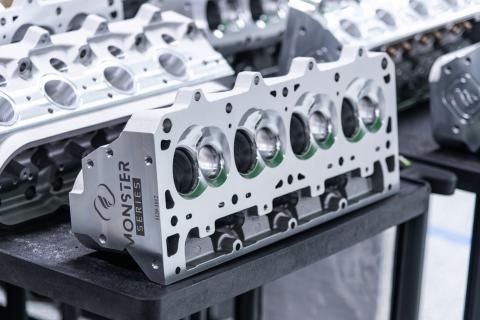
In addition to evolving performance products for the track, cylinder head manufacturers may also play an important role in the ICE vs. EV tug-of-war.

When asked about the future of cylinder head design with a sampling of aftermarket manufacturers, there were the expected replies of improving airflow with new port shapes, squeezing in bigger valves, improving valvetrain geometry, and even designing more billet heads with water jackets.

However, the topic of electric vehicles and alternative fuels came up more than once as a driving factor in cylinder head development.

“We’re constantly progressing and moving the needle forward on all designs. I think the one big thing we’ll probably see is just inevitable,” cautioned Chris Frank of Frankenstein Engine Dynamics, Weatherford, Texas. “With the competition of EVs, I think we’re going to see a lot of new fuels entering the market. We know, based on our experience, that drastically changes port design and also what the cylinder head will demand based on the new fuel requirements.”

“It’s interesting with the EV world, I think you’re going to see a lot of alternative fuels,” agreed Jason Youd of Mast Motorsports, Nacogdoches, Texas. “You’re going to see a lot of hydrogen, a lot of propane. You’re going to see a lot of alloy development in valve seats and valve materials to accommodate for hydrogen, because hydrogen is an animal in itself from the hydrogen-embrittlement standpoint.”

Youd admitted that the hydrogen future will more likely affect the industrial markets for which his company develops new cylinder heads. Frank, however, sees the possibility of more designer and synthetic fuels entering the market—which would require attention on the cylinder head much the same way the transition from carburetors to EFI did in Pro Stock a few years ago.

“There is a different demand from the cylinder head and intake manifold design than when we were running carburetors, and it’s going to be the same difference, I feel, when we’re testing and changing new fuels,” said Frank. “Fuels are going to get better, and cylinder heads are going to have to be a lot more efficient.”

Refining Current Designs

Constant improvement to maximize cylinder head efficiency is a common theme these days. The pandemic, however, presented challenges in labor, supply chain, and manufacturing to the point that some companies were forced to delay interesting development projects. Many of those are starting to come back.

“We didn’t show anything new at PRI, but we have a few projects in development,” said Mike Panetta of Dart Machinery, Warren, Michigan. “We’ll have a revised casting of our LS7 with new port designs. On the LS7, we revised the deck thickness after hearing from racers. Our head is currently .500-inch thick. With the increase in boost levels and horsepower, we’ve raised the deck thickness to .750-inch. We also made revisions to the water jackets to allow a larger port.”

2
“We’re constantly progressing and moving the needle forward on all designs,” including in the realm of new fuels, said Chris Frank of Frankenstein Engine Dynamics. “We know, based on our experience, that drastically changes port design and also what the cylinder head will demand.”

In addition, Dart Machinery is moving its as-cast LS3 Pro1 head down to the SHP line, which will bring the cost down and make it a little more user friendly. Then there will be a new CNC-machined LS3 design entering the Pro1 lineup.

Over at Brodix in Mena, Arkansas, no new cylinder heads have been released recently, but there is a big block Chevrolet head under development that might be available in the spring. 

“It’s a new design of an older head, so we’re not going to release anything on it yet,” said Mark Fretz. “The majority of racing that it will be used in is drag racing, mostly naturally aspirated.”

Brodix engineers have been working on the head for close to a year, but the company remains extremely busy filling regular production orders.

“Getting guys time to break away from their normal jobs to work on a special project is pretty tough,” noted Fretz, adding that the decision to initiate the BBC project was spurred internally and not by specific racer suggestions. “We have ideas we talk about, and we figure out what the market needs. This is just increasing power.”

Fretz stressed that Brodix is always “modifying, changing, and improving” existing product. With an in-house foundry and pattern shop, small or significant improvements can be made in short order, such as modifying the water jackets to increase cooling around the spark plug or adding supports for a different rocker-arm mount. He said that although the company hasn’t developed an entirely new cylinder head recently, it has produced specialty castings on a private label agreement for select clients.

Edelbrock in Olive Branch, Mississippi, is another cylinder head manufacturer with its own foundry and the ability to make speedy changes. “Edelbrock has invested heavily in state-of-the-art manufacturing processes, and in doing so we now have the ability to 3D-print sand cores,” explained Mike Sanders. “This technology not only gives us higher production throughput, it also gives us the unique advantage of eliminating core draft. We can eliminate dimensional constraints within the core package to move port locations, guide locations and improve bolt-column strength without reducing material thickness. More importantly, we now have the ability to go from design to prototype casting within weeks and service multiple custom applications for our customers.”

Addressing increased levels of boost, Edelbrock has upgraded its Big Vic 12-degree cylinder head for big block Chevrolets. “We have improved the exhaust port, added a conical chamber profile, and replaced the ductile-iron seats with Copper B1 and BX material,” said Sanders. “All of these combined improvements will not only help with forced induction applications, but they will also improve tunability in nitrous-injected applications.”

The BBC platform continues to be one of the hottest markets in cylinder head development. Weinle Motorsports in Cleves, Ohio, has a CNC upgrade program for a Pro-Filer Sniper X casting that changes the valve-seat angles and reshapes the bowl above the valve.

3
Mast Motorsports has developed a strong relationship with its foundry. “We retooled our entire product line in the last 14 months with the new foundry,” said Jason Youd. The partnership has improved efficiency and alleviated some supply chain issues.

“The head is already one of the most popular out there,” said Mike Weinle. “We just made our changes, going with a 55-degree seat angle compared to 50 and made the bowl a little bigger. We picked up 10 cfm. It works best on a 600- to 632-cubic-inch engine.”

Weinle has a similar program that starts with a Brodix BB-3 CNC porter’s casting. He then machines his own port design to work with a 2.375- or 2.400-inch intake valve. The exhaust is reworked for a 1.850-inch valve.

“The valves are in the standard location, so you don’t have to buy special pistons and rocker arms,” noted Weinle. “Again, these heads are great for 600- to 632-cubic-inch engines. They’re economically priced and still flow over 480 on the intake. It’s a conventional style head, which we will sell three-to-one over, say, a Big Chief style head.”

Weinle said a conventional head is still a strong performer when drag racing on eighth-mile tracks. “Everybody went to a Big Chief style, then they started going back the other way,” recalled Weinle. “In the eighth mile, if you put on a strong enough conventional head, it’s only a couple hundredths different in ET. So, a lot of people don’t bother spending the extra money. If you have 75 or 100 more horsepower, you don’t really see that power until the second half of the track. It might be a couple hundredths in the eighth mile, but in the quarter mile it would be more. Today, most tracks run only eighth mile.”

Cost considerations will drive development when companies strive to offer CNC-ported performance in an as-cast head. Mast Motorsports focuses on LS, LT, and Godzilla applications. The company’s Black Label line is CNC-ported and may run $3,000 to $4,000 for a set of heads. By digitizing the ports on its LS7 head and tweaking those numbers in CAD, Mast developed an as-cast head with a strong port design.

“I’m working from the top down,” explained Youd. “Our Black Label flows 400 cfm at .600-inch lift. The as-cast Factory Mast head flows about 10 to 15 cfm less at half the price.”

Mast also offers a Mozez line of heads for extreme performance. “It’s a specialty market,” described Youd. “We really haven’t done too much development there. We did launch a second-generation Mozez line this time last year, and that’s done really well. We haven’t done any more development on that line. From a development standpoint, we are taking on a lot of private-label projects. We have various customers that are asking us to do the CAD, design work, and CFD, and then produce those cylinder heads for them under their name.”

One of the strong points for Mast in both development and manufacturing is a strong partnership with its foundry, especially in light of so many foundries experiencing difficulties in supply chain and labor. When Youd assumed control of the company in 2020, he formed a technical partnership with a foundry. 

“We saw what was coming,” said Youd. “We retooled our entire product line in the last 14 months with the new foundry. Every single LS that we do is out of one casting at this point, because the permanent mold is almost $250,000.”

Developing News

As noted, creating a new cylinder head from a clean sheet of paper can take 18 months or longer, depending on the application. Having the versatility to produce different versions from a single mold—even if those different versions are for different-sized blocks—can be enough of a cost advantage to save a program.

For 1 Way Technologies in Washington, Indiana, a unique development story started with General Motors releasing the SB2 head for NASCAR racing in the mid-1990s, and later coming out with the SB2.2 version. Chris Grace worked for Weld Tech then, which had CNC-porting contracts with GM. Grace later purchased the company and merged with a customer to form 1 Way. When GM developed a new NASCAR block with 4.500-inch bore spacing—compared to the standard 4.400-inch—the ROX head followed, which was basically a wide-bore SB2.2. Other companies then started producing SB2.2 and ROX heads but soon discontinued their programs.

4
Big block Chevrolets continue to be a strong market for many head manufacturers, including Edelbrock. It recently upgraded its Big Victor 12-degree BBC head to accommodate increasing levels of boost “and will also improve tunability in nitrous-injected applications,” said Mike Sanders.

“There was a void in the industry, so I came up with the concept of making a single casting that I can machine an SB2 for the 4.400 block or a wide-bore ROX for 4.500 out of one mold,” said Grace. “The development process was, we had to overlay the head-bolt locations and put enough thickness there for all the head bolts. Also, make sure the valve-cover perimeter and everything would fit the port overlays. With the water jackets, we made sure that there was enough material for both shapes of intake and exhaust ports. In essence, there is less water in our casting, but I can use one mold and just have one casting poured for two different styles of cylinder head.”

Obviously, a choice has to be made between the SB2 or ROX design when the casting is released—the finished head won’t fit both blocks. But 1 Way does have some options in machining the head.

“We can stand the valve up and we can rotate the valves in the cylinder. Having more material in the casting allows us to be able to rotate the valves around as the engine builder requests,” added Grace. “We make sure there’s enough spring-pad material and guide-boss material down inside the port.”

Blueprint data were entered into a CAD model on the computer where all the design decisions were made. At times, the engineers wanted more material in certain places, but the foundry cautioned that they were already at a critical limit in those areas.

“That is one constraint we have with the head, but it hasn’t been harmful in any way,” noted Grace, adding that the casting is one of the most popular in the dirt late model market where the 4.500 ROX version is preferred. “But we’re also getting more calls from engine builders with the old SB2 Cup engines where their heads are getting too old.”

Grace said plans are in the works for another 1 Way head targeting the small block Chevy family but won’t get specific or mention the racing genre. He’s also been approached about doing a Ford head based off the D3 NASCAR design.

That is an application that Frankenstein is pursuing. “We are coming out with a canted-valve race head for small block Fords,” confirmed Frank, adding that a billet version is possible. “It would be like a hybrid. It’s not going to have the same architecture as the D3 or the [Edelbrock] SC1, but it will be in that category. It will be a full-race cylinder head, something that could be used from road racing all the way up to professional drag racing.”

Frankenstein also plans a traditional inline SBF head with raised runners. Both heads will have compatible intake manifolds. Also on the list is a LS canted-valve race head and a new 16-degree BBC. Again, dedicated intake manifolds are in the plan.

“One thing that we always take into consideration is that we like to design the entire induction package from start to finish,” continued Frank. “Just because the cylinder head is only one part of the air pump, and you really need to have an intake manifold designed specifically for the cylinder head it is being used on. We design ours to be very specific.”

Design Tools

Frankenstein has an in-house dyno and Spintron and has been utilizing CFD more in its design operations.

“One of the latest challenges in the CFD testing was optimizing spark-plug location with the chamber shape and valve locations on a new race head,” said Frank. “The valve locations were pretty aggressive, and it became slightly difficult to make sure the spark plug would be optimized. A lot of the changes were made to the intake port shape and valve job to guide the fuel charge in a different direction, to get optimal atomization and keep that plug happy.”

Computer tools are being used more often in the industry. Air Flow Research (AFR) in Valencia, California, is updating its CAD files with older products.

“We’re transitioning to have everything in CAD,” said Chris Sperling. “That’s more for internal benefit to give us flexibility with casting design.”

5
Creating a clean-sheet cylinder head can require months of development work. 1 Way Technologies discovered new efficiencies when it came up with a way to produce GM SB2 and ROX cylinder heads from a single casting.  

AFR’s latest cylinder head designed for the Mopar Gen III Hemi is now starting to hit the shelves. There was an early challenge in its development due to COVID-19, which forced engineers to work from home and hampered intense collaboration efforts. Once the team received more input from various parties and customers, changes were made in the combustion chamber size to reduce concerns from customers doing swaps where a smaller chamber might not allow the use of pump gas for street use.

“I’d say the major difference on this cylinder head from the past, we started to heavily utilize FEA and CFD throughout the development process on the ports, the water jacket, and the casting itself,” said Sperling. “A lot of what we have designed has been designed around proven methodologies that we’ve had, such as three-quarter-inch deck, our valve-job theories with different angles, and lengths of the valve job. We were able to take some of those theories, put them into CFD and FEA, prove out and/or improve upon what we’ve already developed.”

Lab testing has validated many of the computer simulations. The head will be offered in different versions to suit street and high-powered race situations. But it’s also getting harder to improve upon factory performance engines. In the past, a head and cam swap could easily pick up 50 to 70 at the rear wheels.

“In modern-day engines, the as-cast offering from the factory is very competitive,” Sperling said. “We’ve also been able to improve our casting technologies here at Air Flow Research. For a street-strip, entry-level, replacement-style head, most of our products are being transitioned to an as-cast cylinder head. The performance is just as good as our CNC-ported cylinder heads but at a lower cost. It allows more people to get into Air Flow Research products.”

For the Mopar Hemi head, AFR targeted an as-cast version with 186cc runner as a factory replacement. That same casting can also be CNC ported for larger versions. One CNC version has 2.125-inch diameter intake valves and 212cc runner, which flows about 40 cfm over the OEM head and is expected to perform well on the 6.4-liter engines. There’s also a CNC head with a 2.165-inch intake valve and 224cc runner that flows around 400 cfm at .700-inch lift.

Overcoming Obstacles

Cylinder-head development is not cheap, nor is there a quick turnaround when looking to create a new casting, especially if there’s some chaos in the supply chain. The pandemic forced the closure of some foundries, which limited options for World Products in Louisville, Kentucky, to develop new cast-iron heads for its catalog.

“We’re upgrading and retooling some products, possibly offering larger valves and updating the port design,” said Jack McInnis. “I don’t see us adding another engine family, it’s too prohibitive cost-wise. There has to be a market for iron heads that would support it. We still get requests from some loyal contingent of an engine family, but it’s not large enough to support the development.”

6
Air Flow Research is updating its CAD files with older head designs so that it has “everything in CAD,” said Chris Sperling. This allows the company more flexibility with casting design.

All Pro Cylinder Heads in Johnstown, Ohio, is well known for developing special projects for race teams, including factory-sponsored programs.

“It actually takes a lot of money and a lot of time,” confirmed Robert Williams. “Most people think that you can just make a cylinder head for $10,000 to $15,000. You’re going to spend $50,000 to $60,000 to maybe get the first part poured, and then that’s not going to guarantee that it’s going to pour correctly.

“I’ve given some serious thought to the new Godzilla engine, but I don’t think there’s enough market out there for it,” continued Williams. “Again, we’re going back to the cost of money to develop a cylinder head. You have to sell an awful lot of them to make it back.”

Technology that might speed up the process isn’t cheap, either. 3D-printed cores require engineers fluent in CAD design.

“It’s a big deal. It’s not something that an individual can do unless they’ve got a lot of money that they can put out there,” noted Williams.

Another factor driving development is the different uses for each cylinder head. All Pro has a 4.500-inch wide-bore head that dominates the dirt late model scene, but it isn’t useful in drag racing unless changes are made.

“To use that in a drag-race application, you would have to make some major changes to it to make the big horsepower numbers needed,” said Williams, adding that sanctioning bodies will also stifle new head development. “We’ve been bitten before by coming out with something new, and then somebody with a five-cent pencil said we won’t allow this. We’ve been doing this since 1983, so we’re not new to the marketplace. We’ve been stung on several good ideas.”

7
“There’s always going to be improvements” in cylinder head design, said Robert Williams of All Pro Cylinder Heads, but “the improvements now are more subtle than they used to be. I think we are advanced far enough now that it takes a lot of changes to make 10 horsepower.”

Williams said he didn’t get the written confirmation he wanted at first for the wide-bore head and postponed development. Meanwhile, GM was working on a 4.500-inch bore-space platform for NASCAR, and other cylinder head companies responded. It wasn’t until racers came to him with a request to build a competitive head.

“Because we’re not a mass producer, I feel we can make a better head. So, we built one, and it took off really well with engine builders,” said Williams.

What to Expect

As for the future, cylinder head development will follow the trends that are backed by the money. Boosted applications are certainly driving the features in today’s new products. The romance of developing naturally aspirated power is losing much of its passion because, quite frankly, engine builders have become so good at it.

“There’s always going to be improvements,” said Williams. “I think the improvements now are more subtle than they used to be. I think we are advanced far enough now that it takes a lot of changes to make 10 horsepower. Some of the builders, especially in the circle track market, are not inclined to go a new route simply because they have so many piston-rod combinations, crank combinations, and so forth on the shelf. For 10 horsepower, they’re not going to change it all.”

Williams shared the example that his 13-degree sprint car head is popular, even with global racers. He also offers an 11- and 10-degree head that can be worth an additional 10 horsepower. But on dirt, it may not be noticeable for a driver the same way a drag racer could see the improved ET.

“If anything, it might slow you down because you’re going to spin your tires more in the dirt,” he explained. “The good drivers who are going to hook a car up are going to go a little faster, but are 10 horsepower out of 950 worth it?” 

LS head technology could also provide measurable improvement in the sprint car world, but so many other changes would have to be made to the engine that the cost effectiveness of such a swap is not worth the trouble to many teams. They’d have to change headers, intake manifolds, pistons, and other components that they’re comfortable with.

“Teams would like to see an engine with a better cylinder head that fits their package,” said Grace. “So, we’re limited with that working space.”

“The development of cylinder heads will never stop,” added Sanders. “It’s a moving target year over year as engine technology and markets change. There is still power to be found through extensive research and development.”

“In development, it’s all about how big the market is,” added Panetta. “I could have one person come in and want us to do a single set of heads, with every trick in the book, and we could do that. But it’s not cost effective. So we have to look at the larger picture. How many units can we sell? How big of a market reach do we get from that? And that’s kind of how we redirect those new projects.”

Sources

1 Way Technologies
1way-tech.com

Air Flow Research (AFR)
airflowresearch.com

All Pro Cylinder Heads
allproheads.com

Brodix
brodix.com

Dart Machinery
dartheads.com

Edelbrock
edelbrockgroup.com

Frankenstein Engine Dynamics
frankensteined.net

Mast Motorsports
mastmotorsports.com

Weinle Motorsports
weinlemotorsports.com

World Products
pbm-erson.com

January 2023
By
Mike Magda

Made To Slide

Submitted by jeffreyc on Thu, 12/22/2022 - 12:04

Photo courtesy of Larry Chen/Drift Cave Motorsports

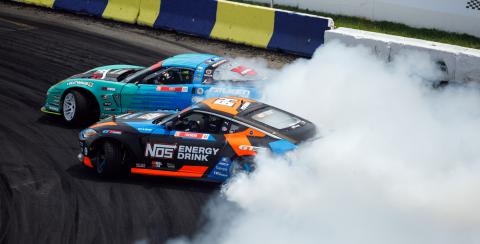
While big horsepower, specialized suspension components, and quick-change solutions still epitomize these rowdy machines, reliability remains paramount in today’s drift sector.

Drifting continues to be one of the fastest-growing disciplines in motorsports. Attracting some of the youngest fans in racing, drifting has embraced the culture associated with it as well as the technology that has helped to define the look, feel, and competitive nature of the sport. It’s an approach that has helped the drifting segment mature rapidly over recent years, not only in terms of aftermarket support, but also its willingness to innovate and advance. 

“In the grand scheme of things, drifting has evolved pretty quickly,” said Mike Skudlarek of Detroit Drifting, Livonia, Michigan. “One of the cool things about pro-level drifting is that there’s never really been any kind of limitation on horsepower. The playing field has always been leveled by limiting the grip that a vehicle can have by weight restrictions relative to tire size.”

2
Many of the rear-drive Japanese coupes first used in drifting are getting harder to find and more expensive, “which has led to a more diverse field of vehicles,” said Drift American’s Scott Umbreit. “Cars like Mustangs, Nissan 350Zs, Corvettes, and BMW 3-Series have become the cost-effective, reliable alternatives.” 

That tactic has fostered a horsepower arms race over the past decade that in turn sent competitors in search of ways to dial greater reliability into their cars. “Within a few years, 800 to 1,200 horsepower started to become commonplace, and so the supporting parts had to change as well,” Skudlarek explained. 

“Suddenly the factory components that you might’ve been able to get away with a few seasons ago weren’t cutting it anymore. That led a lot of teams to engineer their own motorsports-grade hardware that was designed specifically for drifting,” he added.

Over time those development efforts have expanded far beyond angle kits and beefed-up clutches. To build a competitive drift car today, racers must take every aspect of the car’s performance into account while also considering the rule sets that can affect the eligibility. 

Platforms 

Rear-drive Japanese coupes have long been a staple in drifting, but as the prices and availability of many of these cars have skyrocketed recently, competitors have been seeking worthy alternatives. Although some grassroots series allow purpose-built tube chassis cars, larger organizations like Formula Drift require the vehicles competing at all levels to be production based with unmodified wheelbases. That makes starting with a capable and well-supported architecture key to establishing a solid build foundation for those who wish to pursue that series and other ones like it.

“A lot of the younger guys want to build a car that’s unique to them,” said Scott Umbreit of Drift American, Fort Collins, Colorado. “Many of the popular cars early on in the sport have either dried up or are getting cost-prohibitive, which has led to a more diverse field of vehicles. Cars like Mustangs, Nissan 350Zs, Corvettes, and BMW 3-Series have become the cost-effective, reliable alternatives.” 

As Daniel Chow of Morgan Hill, California’s Drift Cave Motorsports pointed out, some platforms have inherent advantages that can streamline the build process. 

3
Most drift series have no limitations on horsepower or engine combinations, so racers are free to use whatever powerplant they prefer. “We have everything from four cylinders, V6s, straight sixes, and V8s to V10s and V12s competing today,” said Formula Drift’s Kevin Wells. 

“We started off with a Nissan S chassis when we began competing in Formula Drift’s Pro series,” said Chow. “At that level you’re looking at a minimum of 200 to 300 hours of chassis fabrication to make the car competitive. We put an LS engine in it, and we were trying to adapt all of these different parts that weren’t originally designed for that chassis. The same applies for BMWs, 350Zs, and so on. 

“When we were looking to build a new car about four years ago, we started thinking, ‘Why are we putting all of this effort into a 30-year-old platform when the Corvettes are engineered to be capable sports cars with good weight distribution, they’re relatively affordable, they have strong support, and they already have LS engines?’” Chow continued. “When we entered into the Pro series with our Corvette, I think it was a big eye-opener for a lot of people.” 

Regulations in Formula Drift have made some popular performance platforms less appealing for drift builds, but competition director Kevin Wells told us they’re always looking for ways to make the series more accessible while keeping costs in check. 

“You need the ability to add steering angle, and some cars just aren’t conducive to that,” explained Wells. “For example, the Fox-body Mustang has a spring perch built into the subframe, and the way that the lower arm is designed, you can’t get a lot of steering angle out of it with the factory subframe. While they can be modified according to the rulebook guidelines, we require the factory front and rear subframes on all of the vehicles. Right now that makes the Fox-bodies inherently more difficult to work with, but next year the plan is to allow competitors to use an aftermarket K-member from QA1 in the front of those cars.”

Powertrains

Since most series have no limitations on horsepower or engine combinations, competitors are free to use whatever solutions they prefer to achieve their ideal horsepower levels. While reliability is still the top priority for most teams, Wells said that this unrestricted aspect of the builds has led to a wide variety of engine combinations. “We have everything from four cylinders, V6s, straight sixes, and V8s to V10s and V12s competing today.”

In the interest of keeping costs under control, Formula Drift’s PROSPEC series prohibits more exotic hardware like sequential transmissions and requires a Link Engine Management ECU. “At a certain point you have to limit things a little bit because there’s always someone who wants to go further,” he said. “I don’t want to ruin the sport by making it too expensive.” 

Since a vehicle’s minimum weight is directly tied to the tire width it can run in Formula Drift, it encourages teams to build heavier cars that compensate for the weight with a lot of horsepower. To that end, the LS remains the go-to option for a cost-effective grunt that can be relied on. 

“At the sportsman level, the driver is often also the mechanic, so having something that’s going to be easy to maintain is really important,” said Skudlarek. “The obvious choice there is the LS family of engines. A naturally aspirated LS is a great option at that level, and if you need more power down the road, you can add forced induction at a pretty low cost without seriously jeopardizing reliability.” 

4
Unlike in drifting’s early days, there are bolt-on suspension systems for today’s most common drifting platforms that will increase steering angle while retaining stock spindles and other components. 

Many competitors run a nitrous system to provide additional response on demand as well. “On the courses we compete on, you can have everything from 20 to 30 mph corners to ones that you might take at close to 100 mph,” said Chow. “Because there’s so much fluctuation in rpm, you can see some lag in throttle response in some situations. We’re always looking for ways to improve that, and so initially the thought was that a 200-shot of nitrous could help get the cam lag out, or help the turbos spool up quicker. But at a certain point, it just became a desire for more horsepower for us, so we’re basically spraying all the way from 3,100 rpm to 7,700.” 

When it comes to cooling, many teams use rear-mounted radiator setups that are similar to what you’d find in a Trophy Truck. “Most of these cars’ engine bays weren’t designed for the engines that are in them, so it’s often a situation where you just don’t have the room for the radiator and fans, or having them there would make working on the car much more difficult,” Wells said. “By moving it to the back you’re getting cooler air and adding water volume, and it also helps move the weight distribution toward the rear of the car.” 

With big power and massive shock loads to contend with, transmission choice has also become an important consideration. Reinforced factory-style gearboxes might have been able to get the job done before quadruple-digit horsepower numbers became commonplace, but that’s no longer the case at the upper levels. NASCAR-style four-speed dogboxes like the G-Force RTS GSR and sequential transmissions like the six-speed offered by 6XD have become the standard of today, as they offer the strength and adjustability required to tolerate the abuse and maximize performance. 

In that same spirit, quick-change differentials have also become a common sight at the upper levels of competition. “It allows you to do a final drive change in less than three minutes, and that’s a huge benefit,” said Chow. “We’ll make anywhere from four to eight gear ratio changes over the course of a weekend.” 

Chassis and Suspension

Although series like Formula Drift require factory chassis and wheelbases, some modifications are allowed in order for teams to improve durability and make the cars easier to repair. According to Wells, 99% of the teams are using aftermarket bumper structures of some kind. “These are for the protection of vital engine parts and ease of service, and with the body work installed you’d never know they’re there. Most of these structures are removable, and teams bring spares to change out during the events—especially for the rear.”

Drift car suspension systems, meanwhile, have advanced significantly over recent years. Since Formula Drift requires suspension components to mount in the factory locations, in the early days many teams needed to figure out a custom solution to get the performance they needed. This too has changed. “There are full bolt-on systems for pretty much all of the common platforms in drifting now,” said Umbreit. “For folks who might be just starting out, there are now kits available that allow you to get more steering angle out of the car while keeping the stock spindles and things like that. Companies like Wisefab, Scotidi Race Development, and FDFRaceshop now have options that cover a wide range of applications.”

5
Because contact is not uncommon in drifting, most teams bring spare aftermarket bumper structures and other body components to make them easier to replace between heats, “especially for the rear,” said Kevin Wells of Formula Drift. 

Skudlarek noted that the more comprehensive solutions tend to fix issues that typically cannot be addressed by basic angle kits. “At the grassroots level, people are often looking for the least expensive way to add more steering angle, and they’re willing to compromise on other aspects of the suspension’s performance to get it. More advanced kits are usually engineered to correct some of the issues that arise in the suspension geometry when you start swapping out factory components. These kits are CAD designed and include purpose-built components like steering knuckles, and oftentimes there’s a different camber plate or top hat for the strut that relocates the pivot point to be more conducive to the geometry of the kit. It’s more of an all-in-one solution.” 

Of course, a hydraulic handbrake system is par for the course at virtually all levels. “Wilwood offers all of the components for these handbrake systems, and most of the handbrake handles are designed around their components,” Skudlarek added. “You’ll see a Tilton setup occasionally, but Wilwood has really become the go-to there.” 

Bodywork

Contact—be it with a wall or another car—is pretty common in drifting. As such, teams have sought ways to minimize the damage and make repairs as quick and painless as possible. “Pretty much everything has gone to fiberglass or carbon fiber, and a few teams have done carbon Kevlar,” said Wells. “Carbon Kevlar is an interesting option because it’s flexible and will pop back into shape, whereas a piece of fiberglass isn’t going to do that. But about three-quarters of the field still run the factory metal doors—the doors just get hit so often that its cost prohibitive to use carbon there.” 

6
The use of data acquisition is ubiquitous at drifting’s professional level and will likely spread to other tiers as competitors seek ways to maximize the capability of their powertrains. Photo courtesy of Larry Chen/Drift Cave Motorsports.

Many aftermarket kits have integrated front splitters, diffusers, fender flares, and other features that add both style and functionality to the car without bringing additional pieces into the mix that would make repairs more complicated. Wells said teams also utilize aftermarket mounts to make it less time-consuming to replace damaged panels. “For instance, with the rear quarter-panel, the teams are allowed to cut the whole thing off aside from a one-inch lip that goes all the way around the car, so the majority of teams use that lip to rivet in the aftermarket panel. Others will use quarter-turn fasteners, but it can be difficult to get the panel back on after you’ve gotten into damage with those. At the front end of the car, we only allow for modifications in front of the strut towers on the top side. So everything forward of the rail that the fender would attach to is usually aftermarket.”

Because of the format of competition, ease of replacement is really the highest priority here. “Some guys will just use really strong cable ties to hold it together,” said Chow. “These cars aren’t going to do 150 mph around a race track for long periods of time. The panels need to stay together for the 45 seconds that we’re on track and be easy to replace if there’s a collision.” 

What’s Next

After a few years of big rule changes in Formula Drift, Wells said that the series is giving competitors some breathing room going into 2023 while the organization mulls over long-term considerations. 

“There aren’t many rear-wheel drive cars left on the market at this point, so we need to make sure all of the ones that are out there are eligible to compete. We’re also trying to figure out what we can do with EVs. We’ve had electric drift cars in the series before, but it was challenging because some of the tracks weren’t set up for it, and they wouldn’t let them run. We want to figure out how to bridge that gap a bit without forcing it to be some kind of spec car.” 

In the meantime, Skudlarek expects to see technology becoming a larger aspect of most teams’ programs over the next few years. “The use of data acquisition is definitely on the rise—it’s already huge at the pro level, and I think that’s only going to increase over time. In order to keep a handle on some of these really high-strung engine packages and maximize the capability of these cars, it kind of has to happen.”

Sources

Detroit Drifting
detroitdriftingco.com 

Drift American
driftamerican.com

Drift Cave Motorsports
driftcave.com 

Formula Drift
formulad.com

January 2023
By
Bradley Iger

Business Profile: Wild Irish Engine and Machine

Submitted by jeffreyc on Thu, 12/22/2022 - 11:55


This self-titled ‘boutique’ engine shop chooses its customers just as carefully as it does its employees, and is just as strategic with its promotion as it schedules an annual open house to coincide with the three biggest business days in racing.

Mention the city of Indianapolis and images of the Indy 500 or NHRA’s “Big Go” instantly come to mind. Through the years, many race teams set up headquarters in the area because of these two legendary motorsports events, and because of Indy’s somewhat central location in the nation. Where major teams are located, other motorsports events spring up, as well as the companies necessary to support them. 

One such company is Wild Irish Engine and Machine in nearby Danville, Indiana. Wild Irish Engine is owned and managed by Craig Sullivan, who is becoming a well-known name in Pro Mod drag racing. Although Sullivan didn’t intend to be the owner of an engine shop, his racing path led him to that destination. 

“We started Pro Mod racing seven years ago,” Sullivan recalled. ”We had purchased an engine or two from some guys, and they wanted to partner with us because of our previous success with our Super Stock and Top Dragster programs. I couldn’t get them to do exactly what I wanted, so I started my own engine shop. We pieced equipment together and kept buying back and forth. Pretty much to date we do everything in-house.” Part of those services are accomplished on a recently purchased SuperFlow SF-4000HD dyno that will handle speeds up to 12,000 rpm and 4,000 horsepower.

“We’ve done some BMW four-cylinders, two-liter four-cylinder class racing stuff that’s been successful,” said Sullivan. “We have a couple boat engine customers with ProChargers who have been successful.” 

Sullivan claimed that his shop is “not a production-type facility.” Instead, he carefully selects customers. “They’re typically people who are in the middle of the pack who want to go to the top of the pack,” he explained. “Their funds are available, they’re good working people. We bounce ideas back and forth and continue to develop their program.” 

2
El Mero Mero, Craig Sullivan’s 1949 Mercury, represents Wild Irish Engine and Machine on the Pro Mod circuit. “We wanted to stand out,” Sullivan said, and the vintage bodywork certainly does. Its paint and graphics scheme also pay tribute to the craftsmanship of Southern California’s low rider culture.

Listening to Sullivan talk about the beginnings of his business, it quickly becomes apparent he has a deep-rooted love of the sport and a respect for the process to support it behind the scenes.
The enthusiasm in his voice was unmistakable as he told part of his own story: “I’ve been a car enthusiast all my life. Right now, I have a 1961 Lincoln convertible and Dave Hirata’s fuel dragster, which has been restored. I have a 1962 Thunderbird roadster that I purchased from another racer, and it’s something that I drive quite often. My father for a long time helped a little bit with Ford back in the 1960s and ran Modified Production. It’s one of the things we’ve branched out with.”

As a veteran of the automotive aftermarket for almost 30 years, including experience in the paint and body segment, Sullivan’s appreciation for cars has expanded to popular cars of other locales. He cited his Pro Mod, El Mero Mero, which is Spanish slang for the best or leader, and its nod to the low rider culture that is popular in Southern California. While he wasn’t originally an enthusiast of low riders, as he aged, he began to appreciate the skill that goes into these types of cars. “That’s why El Mero Mero is carrying the colors that it carries. It’s the appreciation for the craftsmanship,” he said.

“I’ve lived here in Indianapolis, and when you look at how the Offenhausers manufactured their own engine from back in the day, and Stutz manufactured its own engine back in the day, and look at how some of these vehicles were built, these were hand-made precision products that nobody really does any more,” he continued. “That’s why Larry Jeffers and I put together this 1949 Mercury package. It’s something nobody does anymore. Everything’s a carbon copy. We have two or three models of Mustangs, and three or four models of Camaros, and three or four models of Corvettes, and it’s kind of what everybody sees at the race track. We wanted to stand out. 

“I’ve always been known to have a different type of vehicle that may or may not fit the class we’re racing,” he added. “It’s about being different, standing out. We really look forward to, on the sponsorship side, people seeing you standing out. Craig Sullivan Motorsports may only get one No. 1 qualifier in Pro Mod ever in our life, but when you’re competing with the Tutterows and the Salemis, you just want to qualify and win a race. When you do beat those people, it’s like winning the world championship in my eyes, because these are generations of racers. We’re just dumb bracket racers, and I feel very fortunate to race with these people.” 

Efficient Operation

While Wild Irish Engine and Machine is not a huge operation, it is a well-organized and well-managed company that is growing at a rate that makes sense in order to maximize its value to the customer and keep its three employees busy but not overwhelmed. 

Sullivan brought Tommy Radloff on board in 2020 to run the engine shop. “We’ve been blessed with his expertise and what little bit of knowledge I have to excel at what we do,” Sullivan said. Radloff’s diverse engine building resume includes stints in NASCAR, drag racing’s Pro Stock and Competition Eliminator classes, plus he is a two-time Jegs Super Quick Series champion.

2
Craig Sullivan didn’t intend to be the owner of an engine shop, but found himself in that position when he started Pro Mod racing seven years ago and couldn’t get the results he wanted from a local engine builder. 

“We operate in a building that I own, that’s 16,000 square feet, and we run the engine shop out of about 4,000 square feet of it,” Sullivan said. “We’re located in Danville, Indiana, so we’re only seven miles from the Top Fuel teams and Funny Car teams in Brownsburg. There’s also a lot of sprint car guys around us. Sprint car racing is pretty large in the Midwest.”

Wild Irish Engine offers all of the services these and other kinds of customers need. “We do anything from the manufacturing side with our CNC mill application. We do all kinds of block work and block repair. We just made some main saddles two weeks ago to repair a Miner Brothers Hemi. Line bore and line hone, cam research, head development, valve jobs, cleaning with ultrasonic cleaners. We work with Phil Esz of UltraSonic LLC on a lot of our ultrasonic products,” he said. 

With a location that’s so well-suited to bring in a variety of racing customers, highly competent employees are required to keep the business successful and in demand. Finding and keeping these team members happy is the biggest challenge Wild Irish Engine is faced with. Although the majority of the employees have come to the company already experienced, Sullivan knows that’s never enough, himself included. 

“We still look for continuing ed for everybody,” he explained. “Education’s important when you’re trying to be on the cutting edge.” 

Going hand-in-hand with continuing education is internal training for new employees, which can be tedious at times. As Sullivan shared, “It’s a slow process. It’s a lot of shadowing, a lot of trial-and-error, but in the engine business, when a customer brings his block in for repair, you can’t afford failure. We take somebody who knows exactly what they’re doing, and they come in and it’s a one- or a two-hour process. When training that person, it’s going to take two to three hours by the time we have to check in the middle and check in the end until they’ve earned that spot to know that we don’t have to check it because they fit our expectations and our customers’ expectations. 

“If you’re looking at someone who’s blowing a main bore out or straightening a main line out, and they make a mistake and we have to create inserts, well, the customer’s not happy at that point,” he continued. “When you’re taking 0.004 inches out to align the main bore, now you have to take a 0.350-inch cut out of it, and you have to make a saddle to go in the main. That’s hard for a customer to accept that kind of mistake. You take a block that’s thrown a rod out of it, go in to hone it and it’s 0.008 inches out of round. It takes a skilled technician to get that there. If you put someone inexperienced on it, the piston’s never going to fit it, because you have to go 0.014 inches to 0.018 inches to get it there, then you have a set of pistons to buy. If you’re in a class situation, you go past the max bore and then you have to put a sleeve in it. It’s very difficult to find that person that you trust to get in the door and then still be able to maintain profitability.” 

3
Wild Irish Engine and Machine does “all kinds of block work and block repair,” Craig Sullivan said. Its location west of Indianapolis puts it in close proximity to Top Fuel and Funny Car teams in nearby Brownsburg, as well as “a lot of sprint car guys around us.”

Sullivan said he has three positions “available today, and I have under-qualified or not-qualified people who want to be hired, but still want to be paid as if they’re a productive employee. You can’t make a profit that way, so it’s difficult at that point to hire anybody. Somebody who’s fresh out of school may think they’re worth $45,000–$50,000, and they have no experience. They have a general knowledge of a piece of equipment that they’ve learned to use, or a general knowledge of how they might be able to take a transmission out of a Pro Mod, but they haven’t done it. So they can’t turn that out in 30 minutes like a professional can. They’ll take three hours, and they’re going to make mistakes. Mistakes cost money as well. So I really have to look at you closer, and you have to look closer at who you’re hiring to be able to sustain profitability.”

When he does find these top-quality employees, the biggest factors in keeping them is providing benefits, treating the employees fairly, and creating a good working environment, which are challenges that Wild Irish Engine and Machine meets to the best of its ability. 

“The problem with small business is you can never give good benefits,” stated Sullivan. “We’ve found a way to be able to provide a good quality healthcare product for our employees, and for our older employees that really matters. We have paid sick days, holiday pay, vacation, 401(k) is available. We do everything we can to keep these people in the market. We try to make it the best it can possibly be. We make it a family-type environment. It doesn’t mean that it’s perfect—we all fight with brothers, sisters, moms, and dads, it’s just part of life. We try to keep everybody happy. When someone wants a raise, we have to say, ‘Show me how you’re going to make me more money.’ It’s a little rough on them the first couple times that happens, but then when they put their head to it and consider the overhead and income there is to it, they find a way to make more money. We just put our heads together and do some unconventional things, ways I won’t get into because we have to keep ahead of our competition. It’s taking care of business. You can’t treat all employees the same because they’re not.” 

Customer Accolades

The management approach taken at Wild Irish Engine and Machine has proven successful, and customers take notice of this by recognizing the quality of the end product. One such customer is racer Mark Woodruff, who said, “We use Wild Irish engines in our Pro Mod and our RvW [Radial vs. the World] car. In the high-performance engine business, one of the struggles I see with some companies is the management, you know, ordering parts, done in a timely fashion, over-deliver and under-promise, because most of them don’t meet the deadline. It always costs more than what they said it would be, or there are parts delays. 

“One of the reasons I moved my engine program to them is Tommy Radloff being there running the engine shop and Craig managing the business,” Woodruff continued. “From my years of experience competing against Craig in business, I knew I was going to be dealt with right. In all the years I’ve known him, at the end of the day he tries to do the best job he can possibly do for the customer. All of his cars and engine programs I’ve been able to be a part of, with tuning and helping and bouncing ideas off one another, they’ve really turned that screw-blown Hemi in the Mercury to where that thing makes some good power. Tommy has a really good handle on what it takes to make that engine platform perform. That’s part of the reason I made the switch. They do what they say they’re going to do. It’s done in a timely manner; race-proven horsepower. With the horsepower they make, that thing speaks for itself. I came out with that new car and won the first three races I went to with it. That’s pretty spectacular in my opinion.”

‘Boutique’ Engine Shop

The customers see the Wild Irish Engine and Machine team as thinking out-of-the-box from top to bottom to get results. This perspective goes hand-in-hand with how Sullivan himself views the company. “There’s been a lot of these boutique coffee companies, boutique clothing stores, we just look at ourselves as a boutique engine shop,” he explained. “Until we can get the employees brought into our facility, we really have all the work we can do. We’re constantly looking for the employees to build the racing business and the engine business, because once you find good ones, you make room for them whether you need them or not, and then figure out what you can do to turn that into a profit center.”

The boutique engine-building attitude and the quality of the employees the company develops results in a product that attracts loyal customers, including Darren Meyer, whose main business is building superchargers.

4
Cylinder head development is among the services available at Wild Irish Engine and Machine. Its small but versatile crew, including Tommy Radloff, who runs the engine shop, regularly thinks out-of-the-box to get results.

“I’m not an engine builder,” he explained. “I’m good at it, I enjoy doing it, so I usually do it on a limited basis. When I need to get something done—let’s say I have a guy who needs an engine, and I just can’t do any more—I’ll send him to Craig. And Craig, I know, will do the work how I want it done. They’ve been doing things this way for a number of years, the right way. The nice thing about Craig is, if I want it upside down and purple, when I get it, I get it upside down and purple. It’s exactly what I want. Some machine work I’ll send his way or customers that I can’t get to right away. I like to guide my customers to success. It’s part of what I do as well at the race track, above making superchargers. 

“Other customers come to me for help on how to run a Pro Mod car or help to run a program, and I usually educate them,” continued Meyer. “Because I want to keep that kind of reputation, when I can’t do the work, I want to be able to look the guy in the face and say, ‘It’ll be done right.’ I lay out the build for Craig. For this guy, he gets what he wants, I know he gets what he wants, and when he calls me at the track and needs help or guidance, it’s easy to do because what you perceive sitting there in their pit is what is sitting there in their pit. That’s why I send stuff to Craig. For me, I don’t like being the guy who guided somebody wrong. The customer would be unhappy about it, and I wouldn’t be happy about it either.”

Marketing is often required to attract and retain customers. Like everything else, Wild Irish Engine doesn’t follow a standard formula, though. Sullivan reported, “We don’t really do a whole lot of marketing for the engine shop because at this point, we’re trying to manage the amount of work we have for our employees. We have some Factory Shootout engines that we maintain, and those need to be ‘quick-turnaround,’ but at the same time, Tommy runs the racing side as well. So there are gaps there where we might be out two weeks racing, and he’s not there to manage, so we’re having the employees march on those five days when he’s gone. 

5
“Race-proven horsepower” done in a timely manner is what drew one racer to Wild Irish Engine and Machine. “They do what they say they’re going to do.”

“There are more engine customers out there than there are machine shops and engine builders,” Sullivan continued. “With the employees we have, we’re working them at a max load now, not trying to overwork them and burn them out. We’re not letting the greed or the want of success drive everybody’s work. We want to keep happy employees, a good work ethic, and a quality product.”

One method Sullivan uses to showcase his business to customers and prospective customers is having an open house that coincides with the annual PRI Trade Show. When asked about how this strategy works, Sullivan said, “It’s all about customer expansion. We have manufacturers that come in and want to talk about development of products. If somebody comes up with a product for a blower application, and they’re not really blower manufacturers or don’t have a lot of knowledge, there’d be at least two blower manufacturer guys there they could talk with, so it’s a real good networking situation. We usually have anywhere from 80 to 250 people who show up. We’ve done it, I think, two years with COVID-19 coming into it. But it’s definitely opened some eyes when people have walked through and seen
some of the services we offer and our employees.”

January 2023
By
Dana Ford

Road Trippers

Submitted by jeffreyc on Thu, 12/22/2022 - 11:44

Photo courtesy of Scott Witty, 1320 Video/Rocky Mountain Race Week

The multi-day race format is more popular than ever, and unprecedented demand is poised to create a new niche for drag-and-drive events within road-legal competition.

Back in the early 2000s, hot rodding luminary David Freiburger was looking for a way to bring the challenge and intensity of Brock Yates’ annual One Lap of America to the drag racing world. As the spiritual successor to the Cannonball, One Lap’s cross-country, multi-day road racing format puts both man and machine to the test while also incorporating the pragmatic strategies that are required to make a race-tuned production vehicle reliable—and bearable—for extended periods of time on America’s highways. 

The concept led Freiburger to debut the first Hot Rod Drag Week in 2005, an event that sees racers compete at four different tracks over the course of five days while also doing the trek between those locations using the cars that they’re racing. Competitors are required to drive anywhere from 700 to 1,000 miles on public roads over the course of a given Drag Week event, a factor that makes the car’s street drivability a crucial element to a team’s success. 

“There’s a lot of debate about what’s considered a street car and what isn’t,” noted Hot Rod magazine editor-in-chief John McGann. “But if you can register it and you’ve got license plates on the car, you can compete at Drag Week. Originally that meant the fastest ‘street cars’ at the events were doing quarter-mile times in the 8s. Now we’re in the 5s.” 

2
Multi-day race events are attractive to sponsors, said J. Heid of the Summit Racing Midwest Drags. “For what it would cost Summit to buy two days at a national event, I can put on several entire drag-and-drive events. And while they might sell a dozen or so products that are relevant to a fuel car, the sky is the limit for a guy who is competing in his Camaro.”

The event has become an institution for the Drag Week faithful and has convinced many racers to build cars specifically for the competition and its unique demands. That enthusiasm has in turn helped to foster the creation of new events that are inspired by its format and ruleset, a trend that is bringing this unique take on drag racing to new regions of the US and beyond. 

Relatable Racing

“It’s really the ultimate test, and ultimate bragging rights come with it,” said Matthew Frost of Rocky Mountain Race Week (RMRW). “If you can complete one of these events it allows you to say, ‘My drag car runs such and such number, and I was still able to drive it a thousand or 1,200 miles in conditions that most drag cars will never see.’ The challenge of being able to build something that can do that is a big part of the appeal for racers. I think a lot of people don’t realize what they’re getting themselves into when they initially sign up. Once they’re in, they discover how much strategy and critical thinking is involved.” 

The street-legal element of drag-and-drive events makes them more relevant to would-be fans as well. “Part of it is the spectacle of seeing what are essentially Pro Mod cars driving down the freeway towing a trailer,” McGann said with a laugh. “Someone looks at that and then they look in their garage and think to themselves, ‘OK—I’m not going to run 5s or 6s, but could I turn my 11-second car into a 9-second car and compete in Drag Week?’ One of the most popular classes we have is Street Race, and those cars are not allowed to run faster than 8.50.” 

3
The wide range of classes at drag-and-drive events also attracts a similarly diverse roster of cars and fans. It’s where budget builds can line up next to 6-second machines and enjoy the same sense of challenge and camaraderie as their deeper-pocketed brethren. Photo courtesy of Scott Witty, 1320 Video/Rocky Mountain Race Week.

That relatable aspect also makes these events particularly attractive to sponsors. “It’s very affordable for them,” said J. Heid of the Summit Racing Midwest Drags presented by Mickey Thompson Tires in Westfield, Indiana. “For what it would cost Summit to buy two days at a national event, I can put on several entire drag-and-drive events. And while they might sell a dozen or so products that are relevant to a fuel car, the sky is the limit for a guy who is competing—or wants to compete—in his third-gen Camaro.”

The wide range of classes at these events also attracts a similarly diverse roster of cars and fans. While the 6-second machines might get the lion’s share of notoriety, racers on tighter budgets can still build competitive cars and enjoy the same sense of challenge and camaraderie at these events. “We have racers that show up with $5,000 cars and other ones that show up with builds that are well into six-figure territory,” said Dustin Watts of Miles of Mayhem in Red Deer, Alberta, Canada. “You can show up in just about anything and do one of these drag-and-drive events, and I think that has helped draw more and more people in.” 

Redefining the Street/Strip Setup

The fundamental strategies of building and tuning fast drag cars have been well known for some time now but adding hundreds of miles of driving on public roads over the course of a few days adds a significant twist to the formula. While a purpose-built drag car will spend most of its life running at wide-open throttle for a few seconds at a time in a highly controlled environment, the real world adds an array of circumstances that normally don’t need to be taken into consideration. Events like Drag Week allow for a co-driver but forbid any kind of support vehicle, which means that not only are the journeys from track to track being done in the car you’re competing in, you’re also hauling all of your gear in the car or towing a trailer while contending with traffic and other real-world driving factors. That means a competitive combination needs to be able to perform at the drag strip while also remaining reliable and relatively comfortable for long stints behind the wheel. 

“A two-speed Powerglide is the type of transmission that you’d typically find in faster production-based drag cars,” said McGann. “We also see a lot of TH400 three-speed automatics. But if you were to gear a car for drag strip performance with a transmission like that without doing anything else, the rpm’s on the highway will likely be way too high to be usable for this type of event. To get the best of both worlds, a lot of people will run an overdrive like a Gear Vendors’ unit that they can engage when they get on the highway to bring the revs down.” 

Meanwhile, sportsman and grassroots racers will often opt to compete in a car with a modern automatic or six-speed manual transmission, both of which already have overdrive gears built into their designs, while others will simply opt to bring a set of wheels with tall tires that they can install on the car before they hop on the road in order to bring the engine speeds down to a reasonable level while rolling down the highway. 

4
It’s typical for these events to allow co-drivers but not support vehicles, so the race car has to transport all of its gear and spares, whether inside the car or in a trailer. Photo courtesy of Scott Witty, 1320 Video/Rocky Mountain Race Week. 

“We see a lot of cooling upgrades and people swapping in more comfortable seats,” said Watts. “Radios for communication between the driver and co-driver are also common because the cars are so loud. And something we’ve been seeing a lot of lately are dual-fuel tank setups. One will be filled with methanol, E85, or something similar, while the other will be the normal pump gas tank, and they’ll switch back and forth as needed between the track and the road drives.”

The ability to create two distinct personalities for road and track use plays heavily into this type of setup. “A lot of folks are using Holley EFI systems and HP Tuners systems to create multiple tunes for the car,” Heid said. That can tie into using two different fueling systems while also allowing racers to make adjustments based on track conditions and weather. But a lot of the setup ultimately comes from trial and error. “Novices will want to make the car as fast as possible. The folks who’ve been doing these types of events for a while will want to make the car serviceable on the side of the road at 3 a.m.” 

That typically means using less-exotic parts so it’s easier to track down replacements or remembering to bring along a wide variety of spares. “If you’re stuck on the side of the road and you can’t buy an alternator at the local parts store because you decided to use a 16-volt charging system, you better have an extra one with you,” Heid added.

Frost told us that many of the parts that were problematic specifically in this type of event format have been sorted out over recent years, but drag racing-related parts failures are still common occurrences at the track. “Valvetrain issues aren’t as big of a problem as they used to be. The major stuff is typically driveshaft and rearend failures,” he said.

Getting the Word Out

While Hot Rod Drag Week has become a well-known commodity within the racing community thanks to many years of publicity and development, there are a number of newer annual events that are also starting to pick up momentum thanks to strategized promotion. 

“We approach this in several different ways,” said Heid. “The first way is that I’ll go out to tracks, and when I see a really nice street car, I’ll give them a card with a personal invite. We also have an aggressive social media campaign where we’re targeting specific audiences, and I go to similar events to help promote what we’re doing and meet some of these racers as well. All of the other national events are part of my marketing budget.”

5
Officials with Rocky Mountain Race Week decided to offer added support to racers in the form of a welder that follows the route and helps make repairs to vehicles. There’s also a support car that racers can use at the track to fetch parts as needed. Photo courtesy of Scott Witty, 1320 Video/Rocky Mountain Race Week.

Other organizers stand out from the crowd by offering elements that other drag-and-drive events don’t. “Our event is a bit more family-oriented in a sense,” said Frost. “We have something called Road Week, where you and your family can pile into the car and follow along with the racers for the week for a set price, and it can also be a great way for folks who’re considering participating to see what it’s like first-hand.” 

To provide a bit more help to the racers, RMRW also offers access to a portable car hoist, and a welder follows the route and helps make repairs to cars. There’s a support car that racers can use at the track to go get parts if they need to as well. “We also have about $50,000 worth of payouts at any given event, and our format is a bit unique. For us, the ET average for the week stops on the fourth day, and on the fifth day of racing we move to a heads-up shootout format. So you can win your average and you can win the shootout, too,” Frost added.

But as Michael Narx explained, drag-and-drive events aren’t exactly hurting for entries these days regardless. Narx and Heid are co-founders of Drag-n-Drive.com, a site that collects both current and historical data about these types of events. “At the end of this year, almost 2,000 people will have competed in a drag-and-drive event, and in 2019 there were maybe 600. So in just three years the numbers have basically tripled. I think a lot of folks that were stuck at home during the lockdown got their cars finished during that time, and now they’re ready to do something with them.”

Looking Ahead

With a standardized ruleset in place and significant momentum now behind drag-and-drive competition, McGann envisions the potential for these events to work off of one another. “I could imagine a scenario where these other events kind of culminate at Drag Week, kind of like the Superbowl. Drag Week happens in September, so it’s near the end of the racing season for most people, and I could see a situation where whoever won Sick Week in March goes up against the person who won Rocky Mountain Race Week in June. Something where these regional events basically lead up to Drag Week.” 

Frost noted that shorter, weekend-style drag-and-drive events are becoming more prevalent as well, partially as a result of unmet demand for these larger events. Although he sees this as a positive sign for both racers and fans, he’s concerned that it could undermine the original precedent set by Drag Week. “We typically have 300 to 400 people on the waiting list for every one of our events, so there’s plenty of people who want to do this. But I feel like a similar situation played out with no prep. Initially there were solid events with good payouts and people would travel to those events. Then everyone started thinking that they could do this in their own backyards, and now the bigger events aren’t as prevalent as they were because the crowds are smaller, and the sponsors are harder to get. I just don’t want to see this get over-saturated.” 

It’s a delicate balance to achieve, but right now it’s clear that demand is significantly outweighing supply. “Over the next few years, I think more and more people are going to get involved and the cars are going to get really dialed in,” said Watts. “The difference between just the first year the second year was huge for us—the number of fast cars out there probably doubled, and I bet it’ll double again next year. We haven’t hashed out all the details yet, but we’re thinking we could probably add a second five-day event in British Columbia as well. The demand is definitely there. There are people who tried to pay for next year’s event before we had even done this year’s event.”

Sources

Hot Rod Drag Week
motortrend.com/events/hot-rod-drag-week/

Miles of Mayhem
milesofmayhemdnd.ca

Rocky Mountain Race Week (RMRW)
rockymountainraceweek.com 

Summit Racing Midwest Drags
summitmidwestdrags.com

January 2023
By
Bradley Iger