Officials with NGK Spark Plugs (U.S.A.)—the Wixom, Michigan-based manufacturer of ignition parts and sensors—have announced its corporate company has rebranded to Niterra. While Niterra will become the Group's overall name, the brands NGK and NTK will continue to exist for the company's respective ignition and sensor businesses.
The move is in alignment with the company's "2040 Vision" and "2030 Long-Term Management Plan," which will see the company "transform its portfolio in more sustainability-driven directions."
Officials with Extreme E—the off-road racing series featuring electric SUVs and founded by the same team behind Formula E—have announced new appointments within the organization.
Peter Gallagher has been named to the newly created role of commercial director. He will be "targeting new race locations and even more industry-leading partnerships." He most recently served as the head of Partnership Development at Arsenal F.C. soccer club.
"I am looking forward to working with our stellar roster of current partners, those who are yet to join the family, and the whole Extreme E team to help push the agenda for environmental sustainability, equality and innovation forward," Gallagher said.
Kris Reid has been appointed to head of Marketing. He served as marketing lead for the Formula E London E-Prix, where he was responsible for overseeing all marketing initiatives for the event. Reid has several years of experience across a range of industries, including sports, music, and fashion.
"I'm looking forward to working with the team to develop innovative campaigns and initiatives that will further engage our ever-increasing fan base and drive awareness for these vital missions," said Reid.
Nic Makepeace, meanwhile, is now the senior digital manager. He most recently worked for Seven League, where he managed the social output for the National Basketball Association (NBA) in Europe and the Middle East.
"A big focus for me here will be bringing stories of the drivers to our audience and working really closely with the teams and partners; they are such a huge part of any motorsport but, in particular, with Extreme E," Makepeace said.
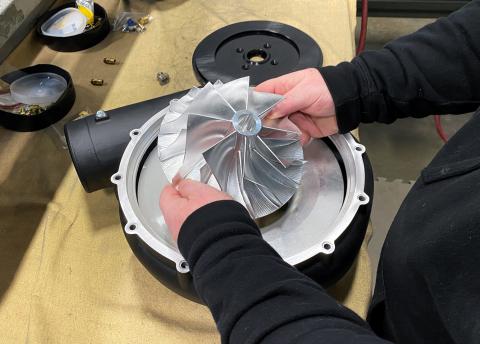
Bigger is not always better when selecting a centrifugal supercharger. A supercharger that is too big for the engine will deliver too much air, causing boost lag at low rpm.
Horsepower goals, engine size, and type of driving are just some of the factors to consider when choosing one of the most popular power adders—a centrifugal supercharger.
We all know superchargers provide additional power and performance by supplying more air—or “compressed,” denser air—to the engine. In fact, they are the power adder of choice for countless competitors and enthusiasts across the racing spectrum.
Among their primary benefits is ease of installation, i.e., relatively simple intake and discharge ductwork compared to other power adders.
There are also multiple types to choose from, including Roots, twin-screw, and centrifugal. For this piece, however, we’ll focus on the latter.
Centrifugal superchargers, also known as compressors or blowers, are belt-driven, or in race applications, direct gear driven units powered by the engine’s crankshaft. Supported by brackets, they can be mounted in multiple locations across the engine compartment.
This design element means the unit doesn’t have to sit directly on top of the engine, which in turn helps minimize under-hood temperatures, as well as compressor discharge temps. It also doesn’t require you to re-configure or replace the engine’s intake manifold, which has gone through the timely process of OEM-level R&D to determine the designated runner length.
Centrifugal superchargers have a variety of different gear case options depending on the application, including:
• Configurations according to street or race engine heads
• Standard or heavy-duty bearings
• Compressor stages (impeller and volute sizes)
Thus, it is important to choose the right supercharger head unit for a vehicle’s engine size, horsepower goals, and type of driving. Let’s examine a few of these factors in more detail.
Pursuing HP Goals (Not ‘Boost’ Or ‘PSI’ Numbers)
Consider that boost is a measurement of airflow restriction or backpressure at the intake manifold. Aftermarket products like high flow heads, headers, cams, or intakes will have different boost outcome numbers associated with the same supercharger. Thus, it is unwise to use boost targets as a determining factor in deciding which blower unit is right for the application.
By zeroing in on a horsepower-based goal instead, you can build your current engine—or select another one—to achieve those goals in conjunction with the properly sized supercharger head unit.
For reference, street supercharger head units typically support “up to” a set range of horsepower levels. These ranges tend to follow certain increments:
• 525
• 775
• 950
• 1,000
Race supercharger head units, on the other hand, support “up to” horsepower increments in the following:
• 1,200
• 1,400
• 1,500
• 1,600
• 1,700
• 2,000
• 3,500
Consider: most engine builds’ inevitable fate is gradually increasing horsepower. Thus, it is wise to consider both future and current power goals when selecting a centrifugal supercharger.
Using Displacement To Select Blower Size
In general terms, a supercharger that is too big for the engine will deliver an overabundance of air and cause boost lag at low rpm. Conversely, one that is too small won’t be able to supply enough air for the engine to run efficiently and will nose over at higher rpm.
For optimal performance, a supercharger’s impeller speed must be within a certain rpm range. This range is dependent on the supercharger’s size, the engine’s size (in cubic inches), and the engine’s power level. When a blower is appropriately matched to the engine, its benefits include lower discharge temperatures, increased air charge density, and extended unit longevity.
Engine Build Levels (Forged Internals vs. Stock Internals)
Many of today’s modern engines are capable of making more power than when they came from the factory. Models such as the Chevy LS, Dodge HEMI, or Ford Coyote can support a decent amount of additional horsepower—typically up to a 40–50% increase in horsepower—before requiring internal upgrades.
Most supercharger manufacturers offer 50-state CARB-legal supercharger kits that stay within these 40–50% incremental horsepower boundaries, providing a safe and long-lasting product.
Older engines can certainly benefit from upgraded forged internals to avoid potential engine failures. But like anything performance-related, it’s all based on matching the intended horsepower goal to the application.
Supercharger Pulley Size Changes’ Effects On Boost & HP
These can vary by application, but for every .10-inch you go down in supercharger unit pulley size, you gain about 1 lb. psi/boost. Conversely, for every .10-inch you go up in supercharger unit pulley size, you lose about 1 lb. psi/boost. Typically, you will have a starting baseline reference from the stock supercharger pulley that came with the kit. There will always be sizing differences depending on the application.
Centrifugal superchargers have a variety of different gear case options depending on the application. Choices can be determined by several factors, including the cylinder heads, the bearings in the case (standard or heavy-duty), and the compressor stages.
Consider that when changing either the supercharger pulley or crank pulley, you must be careful not to overspin the blower’s max rpm limit. This can be determined by using an impeller speed calculator and plugging in various pulley sizes and shift max rpm’s. For those savvy with numbers, we provide the relevant formula below:
Crank Pulley Size x Max rpm x Blower Step up Ratio / Supercharger Pulley Size = Impeller Speed
Further information can usually be found on a manufacturer’s website.
Engine Oil Fed vs. Self-Lubricated
Most street and street/strip centrifugal supercharger head units are offered in both engine oil-fed and self-lubricated variants. Race-specific supercharger head units are only offered as engine oil-fed units.
Engine oil-fed units are required for serious drag racing, road/track racing, drifting, or any other type of driving that subjects the car to high G-force levels. One notable benefit of oil-fed is the existence of an oil feed line injector that squirts oil directly onto the unit’s gears for constant lubrication. This method helps keep the supercharger bearings and gears consistently at a cooler temperature.
Self-lubricated units are great for most vehicles where street driving or milder street/strip or sport touring is the intended use. Supercharger head units that are self-lubricated also have a simpler/easier installation, as there are no oil feed or drain lines to run.
Straight-cut (Loud) Gears vs. Helical-cut (Quiet) Gears
There are two options for gear sets in centrifugal superchargers gearcases. The first are straight-cut, also known as “loud” gears, whose design results in greater friction (thereby making more noise) across the gear mating surfaces. By contrast, helical-cut gears are labeled as “quiet” gears, as their layout utilizes a helical curvature to mesh gears more seamlessly.
Centrifugal superchargers are driven by the engine’s crankshaft, but unlike other kinds of superchargers, they can be mounted in multiple locations, not just on top of the engine. This minimizes compressor discharge temperatures as well as underhood temperatures (in race cars that have an enclosed engine bay).
There really is no performance advantage or disadvantage to using one or the other—it’s more a preference on the overall sound the supercharger makes. Some supercharged vehicle owners prefer a quieter operating unit; others want the inherent mechanical sounds of the gears to be louder.
Always Consult The Professionals
While the above provides general knowledge and helps explain some of the options and distinctions between different centrifugal superchargers, vehicle owners planning a build should consult an experienced, reputable engine builder, installation shop, tuner, and perhaps most importantly, their supercharger manufacturer, as these resources can help prevent mistakes while offering guidance on the right parts for the vehicle and engine combination—the first time. P
Brian Cox is a marketing manager at Vortech & Paxton Superchargers in Channel Islands, California, and has been in the automotive industry for more than 25 years. Starting at Hot Rod magazine and Petersen Publishing in 1997, he has been involved in most facets of the aftermarket industry, including sales, publishing, PR, editorial, and marketing. His lifelong hobbies include dirt bikes, off-roading/4x4s, and muscle cars.
The cofounder of GridLife brings a fresh perspective to these events that combine high-intensity track days with a fun-loving music festival, plus a car show, vendors, and more. Discover why he believes “the next golden era” in racing is here for the taking and how organizers can seize this opportunity to make a sizable impact on the motorsports community.
Chris Stewart didn’t set out to found a new sanctioning body bringing young people into motorsports. That’s just how it worked out.
After graduating from Kendall College of Art and Design with a Bachelor of Fine Arts degree, Stewart went to work in the advertising business, rising to become the senior art director for Harley-Davidson as well as holding a series of creative director posts.
It might seem like a strange turn, but GridLife was a natural outgrowth of Stewart’s twin passions for cars and marketing/communications. “It’s kind of a combination of my automotive enthusiasm plus the things that I was thinking about in my professional career in advertising. I ultimately smashed all of those things together to create GridLife,” he said.
For those who haven’t seen it, GridLife combines a track day and livestreamed racing with a car show, music festival, vendors, and food. Of course, all that didn’t just spring to life from an idea. Stewart had been organizing car events since he was in college, together with his business partner Adam Jabaay. “We met because I left a concert and saw this slammed 1989 Honda Civic in the parking lot. I left a note on that car asking if they needed any parts. They called me and that was Adam.”
Even when he was working a high-powered advertising executive job in Chicago, Stewart was still in the motor hobby as much as he could be. Today, GridLife takes all his attention as he tries to stay on top of its explosive growth nationwide. We caught up with Stewart on a rare day when he was actually in his office.
PRI: What gave you the idea to combine a track day with a live music event?
Stewart: I was looking at all these different sub-divisions within my friend groups. I’ve got people who are into drifting and drag racing or just the street scene and cruising around on Fridays, and I’m in the track scene. I was just thinking, how do I get more of my friends to come to the race track? Simultaneously, the festivalization of a lot of different things was happening. I’m a huge music fan and go to tons of festivals—I’m kind of a Deadhead and a Phishhead. So I’m a fan of cult-like music communities, whether that’s dance music or jam bands or whatever.
I like the way that festivals build communities for a moment in time. So I took that feeling and that intention and applied it to a track day. The thinking is, if I’m driving on the track, that’s a great weekend. But if I’m not driving and I go, even though I’m into cars I’m done in an hour or two hours. You kind of fade out of attention span.
So I wanted to build an event you can bring anybody to, even if they just have a little bit of car curiosity. We’re going to try to crosspollinate as many things as possible. That was really the idea, to get all the cool stuff and cut the corny things out of car culture. We try to focus on the core and authentic cool things that are in all these different segments and glue them together with a festival experience.
GridLife combines a track day and livestreamed racing with a car show, music festival, vendors, and food. “I wanted to build an event you can bring anybody to, even if they just have a little bit of car curiosity,” said GridLife founder Chris Stewart.
PRI: What makes a GridLife event special?
Stewart: If you ask us what our product is, we sell community between individuals with a similar passion. It can take the form of wheel-to-wheel races, or time attack racing, or a track day or drift experience or whatever. But when it all boils down, we’re really trying to build this experience for people to come together with their friends and create new friendships. That’s paramount. I can’t tell you exactly how we do it or what the specific touchpoints are that make us different, but that’s the thing that we’re very focused on. Maybe the youth term is, it’s all about the vibe. That’s a word that gets chucked around probably a little bit too much. But we use that as a point of measurement.
There’s a bit of growing pains with us because our series is professionalizing at a very rapid rate. So we’re playing defense just to make sure that we don’t overstep the line from an accessibility and a tonal perspective; we don’t want to go too far. It’s a little bit of a dance: How pro is too pro? Not to accuse anybody, but the first track events that I went to were intimidating. It took a long time for me to break through. It never felt like a real open environment. It wasn’t closed necessarily, but there was some gatekeeping. Some rules are there for safety, but we are very conscious of how everyone is treated.
PRI: Can a driver get serious about competition in GridLife?
Stewart: You can come in from another organization, or if you’ve been doing track days, you can come to GridLife, and we can figure out where you are and adjust the curriculum to get you to where you want to drive. It’s gotten harder to keep HPDE [High Performance Driving Events] as a core part of our festival weekends because the competition part has gotten so intense.
So what we’ve done this year is create two different types of events. We’ve got what we call our festival weekends, which are competition focused. The competition is Friday and Saturday, it’s competition only, but then Sunday is just an HPDE all day. After the competition winds down, if you came to spectate, then you get your opportunity to be on the track.
We also have a new program called Single Session for first-timers. It’s a little taste of a track experience at a lower cost. It includes a full classroom session, a drivers’ meeting, and then it’s three cars per instructor running 6/10ths “duckling” laps. You can do that for 70 bucks and drive on the race track. This allows people to get a taste of it, and then they can jump a little bit further.
“We sell community between individuals with a similar passion,” said GridLife’s Chris Stewart. “It can take the form of wheel-to-wheel races, or time attack racing, or a track day or drift experience. We’re trying to build this experience for people to come together with their friends and create new friendships.”
PRI: How are you going to get the next generation of drivers into your organization?
Stewart: We’re always thinking about different ways to get people in. I think eSports and gamers in general are a big focus for future drivers. When you think about people who are technical enough to get into the automotive hobby, especially in a tuning and racing capacity, I think gamers index pretty high. They like customization, and they like competition. We’re also thinking a little bit further ahead about who has the ability to become car-curious and ultimately become either fans or participants.
PRI: Let’s talk about the GridLife community. What are the demographics of a GridLife event?
Stewart: GridLife is 10 years old now, which is really wild to say, and some of the core demographic is getting a little bit older, but the core of our drivers are about 24 to 41 years old. I would say that represents 90% of the driving pool, and then our spectators are maybe 23 to 32 years old. There’s a demographic that’s a little bit younger than that, and another that’s a little bit older, but that’s the core of it.
Everyone in the industry has been hammering on getting young people into racing for the last five years to a decade. I feel like it’s actually starting to click now because we’re all collectively attacking the same thing. Now we’re seeing more young people come into it. I think the rise and the dramatization of Formula 1 is helping put a spotlight on racing in general. I feel like this is our opportunity to push the next golden era.
PRI: What has to change to make that golden era happen?
Stewart: I watched the NASCAR Clash at the Coliseum. I saw a lot of young, hip people watching NASCAR. But when I go read the posts online about it, I see a lot of gatekeeping and a lot of anchors in the ground about trying to do something different or adjusting things to try to appeal to somebody other than a traditional racing fan. The point is, I think NASCAR is making some very interesting and appropriate moves in its efforts to reinvent the sport. I think we definitely need to adjust what we’re doing. There are a lot of ways to remix and present motorsports and the culture of cars. A lot of times, much like some peoples’ perspective on the Clash, you’re going to swing hard and miss. But it’s to your advantage to take that swing and see what works and what doesn’t.
Chris Stewart’s path to GridLife included a stint as a senior art director for Harley-Davidson and advertising agency creative director posts. “I ultimately smashed all of those things together to create GridLife.”
PRI: Are you optimistic about the future of racing?
Stewart: I think we’re in a really interesting time of transformation in motorsports. Participatory motorsports feels like it’s on the rise. I know we talk about race tracks closing down, but it also feels like there’s a lot of race tracks being built. We’ve got a demand problem at our events. Watkins Glen, Mid-Ohio, Lime Rock, and the GingerMan events all sold out in three minutes. Now we have 200 drivers who wanted to drive and can’t. That’s a great problem to have, but I don’t want them to be disappointed. I’d love to let them all drive, but there’s only so much space.
PRI: How do you plan to grow your business to the next level and meet that demand?
Stewart: If you figure it out, you let me know! I’ve been reading a bunch of stuff about leadership and business cycles, and I think the point we’re at right now is the pre-execution phase, where you’re in process. Up until this point it was, “Let’s do what’s cool.” I know how to build a thing, so let’s build it. But now it’s gotten to the point where we’re at this scale where that becomes harder. It’s harder to get ideas off the ground because of the volume of things that we’re doing.
We’re in the sanctioning body business with an ancillary events production business, which are the two halves of it. Event production is a hard business, and sanctioning bodies are usually volunteer-based, so they’re barely a business at all! There’s no margin, especially when you’re trying to keep costs low and the events accessible. I don’t totally have the answer yet, but our strategic structure is we’re trying to build this Festival Tour, which is six events now and will theoretically be a maximum of eight events. Those are going to be our big pushes, so those are the events that are going to get all the sauce; everything that we do.
We’re planning on those eight “tent pole” events and then two to three support events that allow the community to be engaged. That’s what we’re now calling our club weekends, with more of a track day focus that’s a little bit more relaxed. It’s just about the drivers. You can come spectate, but it’s not produced as a spectator event. Overall, we’re trying to find sustainability with all the stuff that we do. It really comes down to having strong partners in brands that believe in what we do and who want to support that vision.
Chris Stewart calls himself a “huge music fan” who often attends music festivals, and he wanted to bring that sense of community he feels at festivals into the GridLife track day events. “Maybe the youth term is, it’s all about the vibe.”
PRI: When you were getting started, were there many naysayers—people who thought you would fail?
Stewart: For sure, at first. People said we were unsafe, and that our drivers were wild. But if you do the math, on average a track like Road Atlanta eats one car out of 100. So we’d put 300 cars on track and have a couple incidents and be under the magnifying glass. But now, GridLife TC has run almost 200 races, and we’ve never totaled a vehicle.
PRI: Let’s talk about sponsors. Everyone wants to be part of success, so what are you looking for in an event partner?
Stewart: We think about things from a creative approach, so we think about the strategic connection: Does this partner align with what we do? Is there a story to tell? In the early days we were very much just proving the concept. I remember walking around the SEMA Show and awkwardly introducing myself to people, trying to do a five-minute pitch on this new type of motorsports event. Really it was the persistence of networking and meeting people within the industry and then bringing people to our events and into the culture and community that resulted in the partnerships that we have today. We’re getting pretty good at extracting value for our partners out of the ecosystem and the experience that is GridLife.
As an example, one of our really good partners is Valvoline. They’re putting a lot of efforts and energies into influencers and content and a bunch of stuff in all different places. They use GridLife as the conduit for all those narratives to come together. What we ultimately strive for is brands who understand the vision of how we want to grow the sport, what we’re trying to do, and who want to be a part of that movement.
Demand for participation at GridLife is escalating to the point where events are selling out in minutes. “That’s a great problem to have, but I don’t want [drivers] to be disappointed,” Chris Stewart said. One solution he’s working on is expanding the number of Festival Tour events.
PRI: You livestream your events online, and obviously social media is a big part of your strategy. How does that work?
Stewart: I want racing to be presented as exciting as possible, as digestible as possible, and with the highest level of creative polish possible. I think it comes down to how it’s packaged. What’s the most exciting part of a race? The start and the finish. So GLTC is formatted as 20-minute sprint races so that you have four starts and four finishes. That’s the reason GLTC isn’t multi-class; it’s one class. Multi-class racing is hard to understand.
PRI: What’s in the near future for GridLife?
Stewart: By the time this article comes out, this will already be public knowledge, but we just got offered the support race for the NASCAR weekend at Road America, which is incredible. I want to throw a mini festival inside of the NASCAR paddock and really bring the energy of what we do to that event. It’s cool for us and cool for our drivers and the whole GridLife community. I think that’s a big deal, and I want to yell about it!
PRI: What advice would you give to a promoter, a track owner, or the president of a racing club who is trying to grow their business?
Stewart: It’s hard because if you were to ask me what I’m doing, I don’t even know. I’ve talked a lot about philosophy and a high-level view, so it isn’t one particular thing. Focus on this: Be the person you want to hang out with, and build the event that you want to attend. Think about the person you want to come to your event and just build something authentic. There’s no silver bullet, but it’s all about authenticity and accessibility. Make it as approachable as possible.
The new announcer for the World of Outlaws CASE Construction Equipment Late Model Series has been calling dirt races since he was 12. Needless to say, he’s more than ready for this latest opportunity.
The World of Outlaws CASE Construction Equipment Late Model Series named Ruben Mireles as its new series announcer this past December. He started in his new role during the Sunshine Nationals at Volusia Speedway Park in De Leon Springs, Florida, in January. Mireles previously served as a pit reporter for the World of Outlaws CASE Late Models and has been the DIRTcar Summer Nationals announcer for the past five seasons.
Many may know Mireles as “The voice of the Southwest” who started professionally announcing races at El Paso Speedway and Southern New Mexico Speedway in 2012, at age 13. He had called his first races just before his 13th birthday. A series of hard-earned steps took him to the regional stage and beyond.
Speaking with PRI Magazine recently, Mireles was quick to credit a “Who’s Who” of dirt racing for taking a chance on him, for presenting opportunities, and for offering encouragement and mentorship. That includes especially Rick Eshelman, the World of Outlaws announcer who passed away in October 2022.
From six years old, Mireles and his father were fixtures at El Paso Speedway. As a boy, Mireles immersed himself in the sport and spectacle of dirt racing. He studied the drivers and cars and tracked their careers. He absorbed what he heard from the announcer at both tracks, Bryan Hulbert, never having a thought that he would one day step into that job.
Here’s how Mireles looks at his career.
PRI: You started announcing dirt races when you were just 12, which seems incredible. What was the spark that got you into racing?
Mireles: Instead of watching TV and movies as a kid, I got hooked on watching NASCAR on TV at six years old. The first race I saw was from Talladega, where Jimmie Johnson came from the back to win. I was hooked! I told my dad, “We’re watching NASCAR every Sunday.”
PRI: What’s your first memory from a track?
Mireles: When I was six, I spotted a big ad in the local paper for a NASCAR race coming to El Paso on July 4. It was May, and I told my dad I wanted to go. No one in my family followed racing. I was the only one. But we went, and it was great. There were sprint cars, X-mods, all sorts of classes. I wanted to go every weekend, and we did, to El Paso and to Southern New Mexico Speedway. From watching in the stands for six years until I started announcing at 12, I think I missed just two race nights, one at each track. Through all those years, my dad took me to all of them.
PRI: Did you think about one day getting involved as more than a spectator?
Mireles: I told my dad I would love to race one day. He said, “That’s a little expensive.” An older couple that would always sit two rows in front of us at El Paso rooted for the #12 car in the modified division. He was always toward the back, but he was a good racer. My dad said, “Let’s sponsor this guy.” His masonry company did, and he ended up winning the championship at Southern New Mexico Speedway the next year.
PRI: Did that make you want to race?
Mireles: It did. But the racer suggested that I might be better at writing the racing program. He knew I didn’t root for just the biggest names, that I always liked to get the inside story on all the drivers. I was just 12 years old, not even in high school.
PRI: How did you end up behind the microphone?
Mireles: A lady named Candace at Southern New Mexico Speedway used to walk me down to the pits to meet the drivers and get autographs. She knew all the officials and introduced me to Bryan [Hulbert] and his parents, who were doing race directing. She said to Bryan, “I know someone who’d love to do your job.” I couldn’t believe it, but they let me call two four-lap $100 trophy dashes the following weekend. I blew the roof off the place, and it didn’t even have a roof!
PRI: How quickly did things escalate from there?
Mireles: At the last race of the season, Bryan announced he was leaving to announce the ASCS National Tour. Royal Jones, who owned El Paso and Southern New Mexico Speedway, hired me as announcer for both tracks in 2012. I did that through 2017.
PRI: Did you have the gift of gab as a boy? Did anyone ever suggest this line of work to you?
Mireles: I was a shy kid in elementary and middle school. I was in band. But announcing instantly became a love and a passion for me. Now you can’t get me to be quiet.
PRI: How did you make the jump to regional announcing?
Mireles: In August 2012, Cory Moul, who owns the CLMA [Colorado Late Model Association] DIRTcar series, asked me to go to Arizona to announce a 74-lapper at USA Speedway in Tucson. Then I did races at other Arizona tracks. People started calling me “The Voice of the Southwest,” and I started doing more CLMA races. I traveled all over with them.
PRI: That was still in your first year as an announcer?
Mireles: Yes. I started high school in 2013. So, I was a regional announcer and local announcer, and I also had an after-school job at Garrett Alberson’s Late Model shop until I was 16. I was working on the tires, but also learned some body work, suspension, and helped take apart engines.
PRI: How did you get the DIRTcar Summer Nationals gig?
Mireles: I did the Arizona Mod Tour and the Winter Extreme in 2014 and met Rick Eshelman. He heard me work and said, “You’re pretty good.” We exchanged numbers, and we’d talk occasionally. In December 2017, I met him for lunch when he was delivering a car to Arizona. He said he was leaving the Summer Nationals to focus on the Outlaws. He asked if I’d like to take over. I thought, “Holy cow, this is a dream come true!” I started the Summer Nationals in 2018 and did that for five years.
PRI: Let’s talk a little about the work. When you started announcing, did some people not know that you were so young?
Mireles: At the beginning, there were some bad comments on YouTube and Facebook, but Royal Jones would go on and tell them, “He’s only 12 and trying.” One of the first lessons I learned is to stay positive and to take constructive criticism.
PRI: Since you started announcing at 12, there’s the understandable question—how did you handle your voice change?
Mireles: My voice began to crack during a race. I got through it. For a while I wasn’t confident in my voice, but I am now.
PRI: Can you share a mistake that you’ve learned from?
Mireles: Yes, speaking before having all the facts. I was announcing a Summer Nationals race at I-96 Speedway in Michigan. A racer blew something, and there was white smoke coming out of the car. I automatically announced, “The engine blew.” It turned out to be the rear, not the engine. I realized that my comment could have made the engine builder look bad. Today, I would just say, “Something went awry on that car, and we’ll try to find out what happened.”
PRI: How would you describe your announcing style?
Mireles: I never tried to imitate anyone. I kind of took little bits and pieces I liked and put it into my own memory bank to create my own style. I just go with a flow and the enthusiasm kicks in.
PRI: Aside from Bryan and Rick, are there any other announcers who influenced you?
Mireles: Royal would always tell me to listen to Johnny Gibson [the voice of the World of Outlaws Sprint Cars since 1997]. He loved the way Johnny explained things for the fans. So, that’s what I do. I always go down to the pit to get the drivers’ hometowns, engine specs, and all their sponsors. I share the information with the fans to give them more engagement. When you create engagement, that makes them want to come back.
PRI: That sounds like a marketer talking.
Mireles: I graduated New Mexico State University with a Bachelor’s degree in marketing and a minor in sports marketing and advertising. I love marketing. it fits well with announcing.
PRI: By the time you started college, you already had five years into a professional announcing career. What motivated you to continue your education?
Mireles: When I did the Winter Extreme, which is now the Wild West Shootout, I said to [DirtonDirt.com co-founder and general manager] Michael Rigsby, “Michael, just give me a full-time job. I’m ready to announce all your races.” And then Ben Shelton [now at MyRacePass] said to me, “Ruben, slow down. You don’t know where you’ll be in 10 years. You’ve got to go to college. You need something to fall back on.” I was never a straight-A student, but I loved school. I love learning.
PRI: At World of Outlaws, you’re taking the place of a legendary announcer, and a man who was a personal mentor and friend. How do you remember Rick Eshelman?
Mireles: Rick is my announcing hero. He got me to where I am now. He always motivated me, but he could be tough when I made mistakes. He’d say, “Ruben, you’re better than that!” He was always trying to make me better. One day he told me that the day he retired, he’d tell me three big things that he learned from me. I’ll never get to know those things. It breaks my heart.
I’ve got big shoes to fill, and I’m going to work my tail off to fill them as best I can. The drivers are always the show. The announcer is just a part of it. Whether it’s a weekly show, an enduro, or the World 100, I am always going to give the fans 100%.
RUBEN MIRELES
TITLE:
Series Announcer
ORGANIZATION:
World of Outlaws CASE Construction Equipment Late Model Series
HOMETOWN:
Anthony, New Mexico
FAST FACT:
Ruben Mireles is also a musician. “I was in marching band in high school and my whole five years at New Mexico State. I played saxophone and, for my two final years, I was one of the three drum majors, the highest leadership position in the marching band.”
The aluminized face on the outside of Thermo-Tec’s Cool It Suppressor mat “does help reflect heat and prolong the life of the material,” said Jeremy White. “But we normally recommend also applying a heat shield in between that mat and the heat source so that each product can properly do the job it’s designed to do.”
Vehicle layout and use-case can help determine which heat- and sound-dampening materials are chosen and where they’re applied.
Weight is typically considered the mortal enemy of performance, but there are instances where the compromise of a few pounds here and there can actually yield improvements at the track. Heat and sound control by way of specialized insulation and shielding materials are two such exceptions. While they won’t benefit your power-to-weight ratio, these measures can improve a race program in a variety of different ways.
“One of those aspects is driver comfort,” explained Mike Buca of Design Engineering, Avon Lake, Ohio. “Prolonged exposure to heat can worsen fatigue, and that can impact a driver’s ability to concentrate and perform at the top of their game.” Along with the ability to improve situational awareness around the car and effectively use communications systems, controlling and limiting noise can also have a measurable impact on driver comfort as well. “That’s particularly useful in endurance formats.”
Jeremy White of Thermo-Tec in Greenwich, Ohio, pointed out that controlling heat can also have a significant impact on vehicle performance as well as overall reliability. “Excess heat can cause anything from vapor lock to electrical shorts. There are a lot of different problems that can pop up when you overlook heat control.”
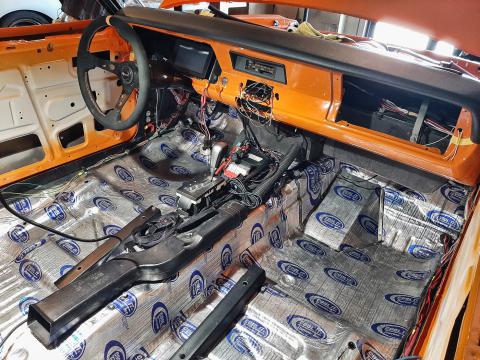
Although some materials can address both heat and sound control, the type of product that should be used—and where it should be installed on the car—often comes down to application-specific factors. “There’s some crossover between heat and sound control materials; a lot of the materials that we use for heat management will also reduce some sound transmission,” said Buca. “But on both sides of the equation, there are materials that are better suited to handle one of these specific tasks because of their design. One of the most common misconceptions we see is that people will put a damping material down on the floor of the car and think that it’s both sound and heat insulation, when in reality it’s designed to control a certain type of sound. This material is a butyl rubber, so it’s designed to absorb metal-born vibrations that transmit sound through the floor of the car. We put an aluminum layer on the top of it basically so that the rubber isn’t sticky on both sides, but that really won’t do a lot in terms of heat control.”
“A lot of race cars have bare metal interiors, and sometimes racers don’t want to add interior insulation that might be a half-inch thick, non-woven material,” said Mike Buca of Design Engineering. “In those cases, putting something underneath the car that reflects the heat away is a better option because it’s much thinner and lighter.”
Most damping material can also only be subjected to a comparatively limited amount of heat, White noted. “For instance, our Suppressor mat has an aluminized face on the outside of it, so it does help reflect heat and prolong the life of the material. But when somebody applies something like that, we normally recommend also applying a heat shield in between that mat and the heat source so that each product can properly do the job it’s designed to do.”
With that in mind, product choice often comes down to the particulars of a given application. “First you have to look at the car and figure out what you have access to in order to put down material,” said Buca. “We’d use a different type of material inside the car than we would on the outside. A lot of race cars have bare metal interiors, and sometimes racers don’t want to add an interior insulation that might be a half-inch thick, non-woven material. In those cases, putting something underneath the car that reflects the heat away is a better option because it’s much thinner and lighter. That material can deflect the heat created by the engine, transmission, and exhaust system away from the floor pan or firewall, and that way it never makes it into the car.”
The foot box and transmission tunnel tend to be areas of focus when the goal is to prevent heat from being transmitted into the cabin, but racers should take note of how the exhaust is routed through the car. “In a Trans-Am car, they typically run the exhaust up and above the back of the motor,” Buca said. “That sends a lot more heat through the transmission tunnel than you’d typically see in a road racing car. But on NASCAR’s Gen-7 car, the exhaust runs inside the door skin next to the rocker panel, right where the driver’s left leg would be. So, it really depends on how the car is set up.”
Protecting wiring, cables, lines, and hoses is a good idea in any racing application, as underhood temperatures can degrade performance. Design Engineering offers various types of wraps and sleeves for underhood protection, sold in fixed lengths and also by the spool.
The amount of space you have to work with in a given area of the car can also play into which type of product is chosen. “For instance, with a land speed car you don’t have a lot of extra room in the engine bay—everything’s packed in very tightly, and there’s not a lot of air movement,” said White. “In that situation you need a very good shield to keep heat off of components, and that’s where something like our Kevlar mat comes into play. It’s thin and it can withstand higher temperatures than fiberglass products can. That’s especially important when you’re running an engine wide-open for a long amount of time.”
White also said that adding protection to wiring, cables, lines, and hoses is a good idea in any racing application, regardless of the temperature ranges typically seen. “Even temperatures of a hundred degrees can start degrading performance when you start heating up things like the air intake and fuel lines. Cooler air and cooler fuel are going to improve performance, and with something like a drag car—where you run it for a period of time and then it sits with all of that heat trapped in the engine bay—things are going to be warmer than they initially were unless you’re using sleeving that keeps those lines at the same temperature throughout the day.”
Considering the expense of a race car build in the grand scheme, adding heat and sound control is a drop in the bucket. “Aside from a turbo shield, which can cost anywhere from $150 to $500 depending on the size of the turbo, a racer can do a pretty good job of insulating their car for around $400,” Buca said. “You might double that if you’re also doing sound insulation. It’s not a big investment when you consider what you’re getting out of it.”
Using social media for a business “is a fun, backdoor way of advertising,” said PRI’s Christen D’Alessandro, seen here at work in the field. “You don’t want to put a typical ad like you’d see in a magazine on social. That’s not very exciting. People want to see exciting stuff.”
Effective strategies can make these digital networks a powerful marketing and promotional tool for your motorsports operation.
Since it’s just a click or a tap away, social media can feel like an easy way to promote a brand, a shop, a driver, or just about anything else related to the racing and performance industry. Yet because social media “is perceived to some degree as sort of free marketing, people spend a lot of time chasing the shiny, acting because they think they have to,” said Jennifer Cario of SugarSpun Marketing, Bentleyville, Pennsylvania. “Maybe they read about a new trend in an online article, or a friend of a friend said, ‘You gotta be on this channel.’ They’re doing it because someone said to do it, not because when they really looked at building out a strategy, it was the thing that made sense.
“People don’t treat social media as another business decision,” Cario added. “It has to be treated as a business decision with a strategy behind it.”
Which Platform?
Among the first steps in that strategy is determining which social media platforms will be right for a business. To answer that question, “the first thing they need to do is determine who their audience is,” said Christen D’Alessandro, PRI’s social media manager and senior editor. “What the business is and who their customer is will determine which social platform to use.”
To do that, Barry Alt of Motorhead Digital in Palmyra, New York, recommended developing a customer profile. “Who is your customer? What are their ages, income level, hobbies, things like that to really understand them?” Getting that information “is an easy email or phone call away. Talk to your favorite customers, the ones you would want all your customers to be like.”
Customer demographics are important because the various social media platforms “cater to different demographics,” D’Alessandro said. “Facebook is still the biggest platform overall in terms of users, so I think it’s a given you should be on Facebook.” But since it was one of the first main social media platforms, “it tends to be used by an older generation. To hit a younger demographic, TikTok and Instagram are the top two.”
In her PRI Education seminars, Jennifer Cario advises small businesses that they often post too often on social media. “You’re working too hard, and you’re shooting yourself in the foot. I’m actually telling you to do less work and you will accomplish more.”
“We know that Twitter has among the highest usage rates for people of color and urban environments, as opposed to white Americans who live in rural America,” Cario said. “If you are targeting older people that have a little bit more money and are doing something on a hobbyist basis, a channel like YouTube better fits that demographic.”
“If you’re a business building race cars or high-dollar engines, where do the people live online that have that kind of money? Who are they?” asked Alt. “Are they CEOs, CFOs, business owners? Are they even on Facebook, Instagram, or YouTube? They may only be on LinkedIn. LinkedIn is a social media platform as well, it’s just more business oriented. We push our customers to set up LinkedIn business pages. Most of the time you can post the same things you’re posting to Facebook, but you have to think differently about the post because the audience is different.”
Brand Awareness or Product Sales?
While it’s becoming easier to sell products through social media channels, “the need to build relationships on social media is more important than to sell stuff outright,” Alt said. “Sales will come if you build those relationships. People do business with companies and people they know, like, and trust.”
“Your brand needs to be out there for people to see your products,” D’Alessandro said. “Even though you can sell through these platforms, it’s important to have your name out there as much as possible and have people see your products on people’s cars. People remember that, and that will help sell your products.”
While it may be possible to sell directly through a social media platform, Cario said it’s important “to be aware of the nuances of the different channels. For example, Facebook has said if a post directly sells a product, it needs to go up through Facebook advertising, not as part of the Facebook news feed. Facebook will downgrade your visibility in the news feed if you try to do the hard sell there.”
Quality Versus Quantity
“If social media is done right, it’s not as easy as people think,” Alt said. “If you are just posting something and don’t post it correctly, don’t add hashtags, don’t add copy to it—you’re wasting your time. If you’re doing it right, there’s a lot of thought that goes into it. What are we going to say, and will it resonate with our followers? What hashtags are we going to use? When are we going to post? How often are we going to post?”
The “how often” question is key. “With this market, a good average is three to five posts a week,” said Alt. Figuring that out can take “some trial and error. You need to look at page data and determine the interactions and see how many views, likes, comments, and new followers you’re getting.” Also, “post when people are actually online,” he said. “When scheduling a post, META Business Suite will tell you when your followers are most active online. You can look at that and determine when will be a good opportunity for people to see your post.”
“Quality is more important than quantity,” D’Alessandro said. “If your followers start seeing a bunch of crappy posts, they might unfollow you. But it’s still important to post enough to keep the brand out there. Personally, I would try to post at least once a day. If that’s not possible, four to five times a week would be a decent amount.”
Cario believes a business should “post the amount it can produce that’s high quality, and content its audience is willing to engage with,” rather than aiming at a set number of posts. In fact, she has found most small businesses post too much. If a platform’s algorithm determines a user is seeing posts but not interacting with them, “the algorithm says, ‘I’ll show you less from that company,’” Cario said. But when “someone is putting out content and not getting the interaction they want, their gut reaction is to put out more content. That’s kind of like meeting someone, being interested in them, and going, ‘Okay, they’re not returning my call, so I’ll call them 47 times a day.’ Now you’re going to scare them off.”
When she presents this way of thinking at her PRI and SEMA Show seminars, Cario said “most people tell me, ‘Are you kidding? I can do less stuff and actually get more response from it?’ Yes, you’re working too hard, and you’re shooting yourself in the foot. I’m actually telling you to do less work and you will accomplish more.”
Universal Technical Institute Inc. (UTI) has announced the appointment of Tracy Lorenz as president of the UTI division, which is comprised of the company’s skilled trades, transportation, and energy offerings.
Lorenz most recently served as the president and CEO of Triumph Education, where she grew revenue dramatically during her six years leading the Auguste Escoffier School of Culinary Arts, according to the company. Prior to that, Lorenz spent nine years at Apollo Education Group in various roles, including as president of Western International University.
UTI operates 16 campuses across nine states and offers a wide range of skilled trades technical training and more programs under brands such as UTI, NASCAR Technical Institute, MIAT College of Technology, Motorcycle Mechanics Institute, and Marine Mechanics Institute.
Mooresville, North Carolina-based Turn 3 Media has announced Angie Skinner has joined its team as the director of Sales.
In her new position, Skinner will be responsible for developing and managing advertising and sponsor relationships against SPEED SPORT's portfolio of editorial, digital, and television media projects and services, as well as the new SPEED SPORT 1 TV network. She will also play a key role in developing new business and strategic partnership opportunities, the company stated.
Prior to the appointment, Skinner helped manage the career of her husband, Mike Skinner, a longtime NASCAR driver. She served as the VP of Business Operations at Mike Skinner Enterprises in 1999 before joining SiriusXM NASCAR Radio in 2011 as co-host of Sirius Speedway and later on Skinner Round-Up, a program she still works on with her husband today. She also owns Accelerated Communications Solution and Skinner 5 Media.
For more information, visit the announcement here or visit speedsport.com.
Concord, North Carolina-based Speedway Motorsports has announced Michael Hodge has been promoted to chief financial officer (CFO).
Hodge, who previously served as the company’s chief accounting officer, brings more than 15 years of financial and accounting experience with the company to his new role. As CFO of Speedway Motorsports, he will be responsible for overseeing the company’s financial strategy, reporting, and analysis.
In addition to his role at Speedway Motorsports, Hodge will also serve as CFO at Sonic Financial Corporation, where he has been an officer since 2016. Since 2022, Hodge has also served as a member of the board of directors at Sonic Automotive, the automotive retailer based in Charlotte, North Carolina.
Hodge joined Speedway Motorsports in 2006 and has served in various financial management positions with the company. Prior, he worked as an Audit and Assurance Manager at Deloitte.
 MEMBERSHIP LOGIN