Squeeze Play

Submitted by johnc on Mon, 04/17/2023 - 13:26
image 1


Nitrous oxide is a simple, proven way to economically add significant power, but it must be set up and managed properly to safely achieve its full potential.


“There’s nothing you can do to a motor that I can’t do a whole lot cheaper, a whole lot faster, and a whole lot easier with nitrous,” declared Ernie Wrenn of Compucar Nitrous Systems, North Augusta, South Carolina.

In that spirit, nitrous systems surely had to have been dreamed up by a sportsman drag racer. The easy, quick, simple, and cheap horsepower of this potent elixir is tailor-made for the average weekend competitor looking for fun and glory without breaking the bank.

But, like most things that are easy, there are still plenty of ways to blow it. And with nitrous, the results of doing so can be catastrophic. To learn more about these potential traps, we called on the experts, including one of today’s top nitrous-engine builders and several industry pioneers with decades of experience going back to the formative years of nitrous system development.

Here’s what they told us are 12 key steps to success when adding a nitrous system to any sportsman drag car, whether it’s a K-motor Civic or a big block Chevelle.


1. Get the Right Mindset

It’s all about respect, not fear, according to the specialists. “You shouldn’t be afraid of nitrous,” said Pat Musi of Musi Racing Engines, Mooresville, North Carolina. “Yeah, when you’re putting six stages of nitrous on an engine, it’s a whole different animal. But a sportsman guy can be running nitrous all day long and be fine. It’s not that hard.”

image 2
“You shouldn’t be afraid of nitrous,” said engine builder Pat Musi, whose engines are above. “A sportsman guy can be running nitrous all day long and be fine. It’s not that hard.”


2. Check Overall Engine Condition

Adding a hit of nitrous to an engine that’s on the ragged edge of grenading generally isn’t a good idea, unless it’s in pursuit of the final hurrah before sending the engine off to the dumpster. Nitrous has a way of exposing the weak spots in any engine and hastening their demise.


3. Strengthen Where Needed

No matter what amount of nitrous is added to an engine, cylinder pressures will increase significantly; that’s how more power is made. To cope with those additional pressures, a forged crankshaft, pistons, and connecting rods should be considered essential for anything beyond a mild shot of nitrous.


4. Set Safe Limits

One of the biggest keys to successfully adding nitrous to an existing engine is keeping the power increase to reasonable levels. For stock engines, that limit is relatively low. “You can easily get away with a 50-hp shot on four-cylinder applications, a 75-hp shot on six-cylinder applications, and a 100-hp shot on eight-cylinder applications without any concerns,” said Dustin Wilson at Holley Performance Products, Bowling Green, Kentucky. “When you get above that, you’ll have to start looking into the rotating assembly and other things as far as how the engine is built.”

For V8s that have already been fortified somewhat for racing, that safe rule-of-thumb power figure is significantly higher. “If you’re going to bracket race, a good number for those engines is about 250 to 300 hp,” said Musi. “It’s really hard to hurt an engine with that amount of nitrous.”


5. Plate or Direct Port?

Plate systems are simple and relatively easy to set up, and they don’t require the user to remove the intake manifold. In contrast, direct-port systems—also known as “fogger” systems—are more work to install on carbureted engines. “To add a direct-port system to a carbureted motor, you have to take the intake off, it has to be drilled and tapped, then you have to run all the plumbing to it,” explained Wrenn.

Despite the additional work required to install direct-port systems, they can offer significant advantages. “You can use a plate system up to about a couple-hundred horsepower,” said Mike Thermos of Nitrous Supply, Huntington Beach, California. “But if you’re going to really get serious, you need to go to a fogger-type kit where you have individual plumbing for each cylinder, because you can fatten or lean each one as needed. If one’s showing you that it’s a little bit lean, you can fatten it up. With a plate, you have to fatten up all of the cylinders.”

image 3
“You can use a plate system up to about a couple-hundred horsepower,” said Mike Thermos of Nitrous Supply. “But if you’re going to really get serious, you need to go to a fogger-type kit where you have individual plumbing for each cylinder.”


6. Wet or Dry?

Generally, wet systems are best for racers looking to add nitrous to a carbureted vehicle, or one with a stock ECM. Most other engines are best served with a dry system. That said, it’s typically worth the effort to add an aftermarket ECM to run a dry system on modern EFI-equipped engines, for the additional control that allows. At the same time, it also adds a valuable safeguard to avoid fuel-distribution issues.

“In fuel-injected cars, the intake runners aren’t designed to flow fuel,” said Wrenn. “They’re designed to flow air. So when you try to put a heavy object into that intake, it falls out of suspension. Then you started having backfires and fires period because these intakes aren’t designed to flow liquid.”


7. Pick the Right Cam

Although many first-time nitrous users start with whatever camshaft they were already running on their engine, it can be beneficial to change it. “Cam timing becomes an important issue with nitrous,” said Thermos. “You need to open the exhaust valve a little sooner, because you’re done with the exhaust earlier. Plus, the weight of the air coming through the intake tract is a little heavier now, so you might be able to do what we call inertia feed the motor—in other words, hold the valve open a little longer to fill the cylinder better. Overlap also plays a role with nitrous. Shorter overlap tends to work better.”

image 4
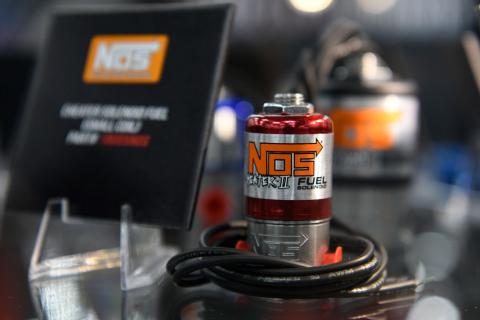
A direct-port nitrous system is more complex to install, but it allows the engine builder to tune each individual cylinder with the precise amount of nitrous needed to optimize performance.


8. Soften the Hit

Nitrous controllers allow the user to precisely manage the parameters of how nitrous is injected into the engine, and when each stage will trigger on multi-stage systems. This not only helps preserve the engine, but it can also get the car down the track faster by allowing it to hook up better and stay under control.

One method of softening the hit of a V8 or V6 direct-port system is to introduce nitrous on one bank of cylinders when launching and then bring in the other side soon after. “On, say, a 400-hp engine, if you try to turn on 400 hp at one time, it’ll probably spin the tires,” said Wrenn. “So you have two options—go progressive or bank it. With banking it, you take the left-hand side, leave with that, and then turn on the right-hand side. It works out because the cylinders in the two banks are actually firing across from each other.”

Additionally, the length of the line connected to the solenoid can also make a big difference in how hard nitrous kicks in. This can be valuable in tailoring the response of the system for the car and track conditions. “Our kits come with about 12 inches of braided-steel line,” said Wrenn. “If you get to the track and the starting line is absolutely horrible, you can add a 6-inch or 12-inch piece, so it’s 18 or 24 inches. You’ll still get the same horsepower, but the impulse to the engine is smoother and slower. Then you can do that same little trick down range. So, let’s say if you have a two-stage plate, in the transition, when you’re changing gears, if the car wants to move around, okay, make the line 18 inches instead of 12 inches.”


9. Get the Ignition Timing Right

The biggest killer of nitrous engines is improper ignition timing, according to our experts. Although the specific amount that timing should be retarded varies somewhat from one engine to another, it’s recommended to start with an established baseline.

“A lot of guys have this theory that you can run lots of timing advance and compensate with fuel,” said Musi. “But it doesn’t work like that. You’re increasing the burn rate with an oxidizer, which is nitrous. So you have to fire the charge later. A good rule of thumb for retarding timing is three degrees for every 100 hp you add. So let’s just say the motor runs well at 36 degrees of advance and you’re going to put a 250-hp nitrous system on it. You would take seven-and-a-half degrees of advance out of it. And that’s a pretty known number for all engines.”

image 5
The length of the line connected to the nitrous solenoid can make a big difference in how hard the nitrous kicks in. This can be valuable in tailoring the response of the system for the car and track conditions.

Additionally, the shape of the piston can significantly influence ignition timing in nitrous engines. This should be factored in when deciding how much to retard the ignition. “Nitrous doesn’t like a piston with a dome,” noted Thermos. “It wants a clean burn across the cylinder. So if you need to get your compression up, do it by raising the height of the piston. Don’t put a big knuckle on the top of the piston, because it has to go around that, and it doesn’t have clean combustion. Guys who have domed pistons are the ones who call me and say they have 40 degrees of advance in their motor. That’s telling me that the combustion is really inefficient if you have to lead the motor by that much.”


10. Get Carb Jetting Right

Adding nitrous oxide to an engine radically alters its balance of fuel and air. So carburetor jetting is vital for its long-term health and longevity. Many racers fear going too lean with the fuel mixture when running nitrous. But more nitrous engines are killed by an overly rich mixture than a lean mixture, said experts.

“When we turn nitrous on, we’re bringing 950 positive psi of air at minus 128 degrees in the cylinder,” explained Wrenn. “Now you’ve created a pressure differential below the carburetor. When you do that, the vacuum through the carburetor is going to more than double. Your .090 jet is going to act like it’s a .110. So now you’ve created a problem instead of solving one. The motor is showing that it’s rich, and some people start tuning their nitrous system to make up for it. Using nitrous to tune the motor like that is a death sentence.”

image 6
Using nitrous oxide safely goes beyond not harming the engine. Taking care with handling, installing, and warming the nitrous bottle ensures the safety of those around it.


11. Sneak Up on It

Experts recommend working slowly up to maximum power levels with nitrous. “A big mistake we see is trying to go too big too quick,” explained Wilson. “They don’t ease into it. They don’t see what they’re getting into, and they jump straight to the biggest jet. That’s really not the best way to handle it. You want to start out with the smallest and work your way up.”


12. Recognize Signs of Trouble

Even when gradually building to higher power levels with a nitrous system, it’s still vital to learn the signs of when things are about to go wrong. “A very important tool when you’re using nitrous is to monitor your crankcase pressure, meaning your vacuum,” said Musi. “If you have a vacuum pump on a motor, let’s just say you have 12 inches of vacuum—I’m just picking a number. If everything’s happy, that thing should be 12 inches at the finish line or climbing with rpm. The minute you see that vacuum go down, that means you’ve blown by the rings, and that’s when you get into the danger zone.

“The other factor that is really important is reading spark plugs,” continued Musi. “You have got to know how to look at the spark plug strap and check your timing. If you ever see a little bit of wear on the end of the electrode, you are definitely in the danger zone.”

Nitrous is easy, simple, inexpensive horsepower, and it’s relatively foolproof if it’s done with proven methods. Sure, there’s a lot of science involved in how nitrous oxide works. But adding it to an existing engine isn’t difficult. The magic is well within the reach of average racers. “It should never take a year or two years of people never getting their nitrous combination together,” said Wrenn. “It’s simple.”


Nitrous Safety

When people speak of nitrous oxide’s potential dangers, they’re usually talking about how this potent gas can hurt engines. But the plain fact of the matter is that nitrous can also be plenty dangerous to human beings, too. “What you’re doing is bolting on a bomb and seeing how far you can go before it goes off,” said Ernie Wrenn of Compucar Nitrous Systems, North Augusta, South Carolina. “If you don’t understand the basics, that’s what gives nitrous a bad reputation.”

Although nitrous has been around for decades and there are well-established protocols for using it, injury and death from misuse still occur too often. It has even reached the point where outside agencies have threatened to monitor and control the use of it in automotive applications.

“The dangers need some discussion,” said Mike Thermos of Nitrous Supply, Huntington Beach, California. “I’ve been called on the carpet by the cryogenic companies about what racers do with nitrous. Along with the California Highway Patrol, they said, ‘If you don’t police your industry, then we’re going to police it. And you probably won’t like it—every hose and every fitting will have to be sent to a lab and get tested.’ It would go from being a $500 kit to being $5,000, which would take it right off the market.”

To some degree, the dangers of nitrous are inherent in the technology. Nitrous is stored in tanks under high pressure. If someone accidentally drops the bottle and the valve gets knocked off, the tank instantly turns into a wild, unguided rocket traveling with enough force to injure or kill anyone who happens to be in its way.

But just as bad is the improper heating of bottles, which is commonly done with a propane torch. “I cringe when I see a lot of the stuff the racing industry thinks is normal,” said Thermos. “Propane torches boil the nitrous a little bit, and the pressure comes up. But it also anneals the aluminum that the tank is made of. You’re actually changing the integrity of the metal. It might not let go until 50 times later. But eventually, it will.

“A lot of guys think, ‘Well, nitrous is non-flammable, so I’m okay,’” continued Thermos. “But when it reaches the temperature of 570 degrees, the atoms of the nitrous molecule let go of each other. That’s called disassociation. When the molecule breaks up, it expands to 419 times its original size. At that point, the safety valve opens and relieves the pressure. But the safety is only a little quarter-inch hole, and the nitrous expands so quickly that it can’t get out of that tiny hole. So it just blows the side of the bottle out.”

Fortunately, most sanctioning bodies have very specific rules on how nitrous bottles should be heated. Such rules typically require heating blankets designed for the purpose. However, those also should be watched carefully when being used.

“Even a blanket warmer has to be controlled,” said Thermos. “Otherwise it can warm the bottle until the safety blows. It’s happened in my shop. I’ll put a heater on a bottle, knowing I’m going to take it off in five minutes. Then the phone rings or something and I forget about it. In the back of the shop, I’ll hear the safety pop like a firecracker.” —David Bellm


SOURCES

Compucar Nitrous Systems
facebook.com/compucar.nitrous

Holley Performance Products
holley.com

Musi Racing Engines
musiracing.com

Nitrous Supply
nitrous-supply.com
May 2023
By
David Bellm

Fuel To Fire

Submitted by johnc on Mon, 04/17/2023 - 12:22
image 1


EFI supports more horsepower now than ever, and aftermarket companies are racing to develop larger and improved injectors along with more sophisticated electronic controls.


At the start of every NASCAR season, a couple of teams will each send 100 or so fuel injectors to the Fuel Injector Clinic (FIC) in Hobe Sound, Florida. Using a purpose-built test bench that cost $250,000, Randy Earle and his crew will evaluate and record extensive data for every injector.

“The teams want us to pick the very best set of eight, or if they have two cars, then the two best sets of eight,” explained Earle, noting that teams are prohibited from modifying the injectors, which accounts for the intense selection process. “We match the best eight for flow at less than 1% difference, and they’re matched for dead time as good as we can get it, hopefully around 2%.”

Such precision is needed in many of today’s highly competitive racing divisions where the rules allow or mandate electronic fuel injection (EFI). A set of injectors off the shelf could vary around 5% flow, and the open-shut time could vary as much as 38%. A set of matched performance injectors should be close to 2% for flow rate, yet FIC has seen the dead times off as much as 30%. Such a discrepancy can lead to tuning headaches or a loss of overall efficiency.

“How many times have you seen a guy lose a race on the last lap because the car runs out of fuel?” asked Earle. “The more efficient the fuel injectors, the better the engine will be in terms of fuel economy and how that race car performs.”


Results Focused

The EFI market has expanded considerably in the past decade, and so has the need for race-worthy components. Only a handful of aftermarket companies used to offer performance replacement injectors and racing-quality electronic control units (ECU). Other support equipment like throttle bodies, dedicated intake manifolds, and high-pressure fuel pumps were also in limited supply.

A couple of trends set the stage for the increased interest in EFI. First, speedy and cheap import cars that were all fuel injected became popular with younger enthusiasts who rebelled against big block engines and muscle cars. This next-generation hot rodder was brought up on laptops and video games and had no fear of fuel and ignition maps.

image 2
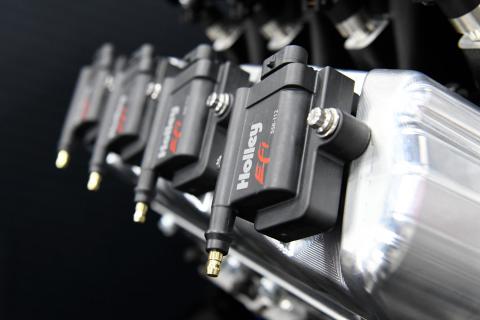
Holley has been a leader in EFI development, so much so that many racers don’t know the full list of features available in the company’s performance ECUs. Some of the confusion may originate in the early configurations of EFI setups that had separate boxes for different functions. Current ECUs combine many functions related to ignition timing, nitrous delivery, traction control, and more.

Then came huge boost numbers from the explosive growth in outlaw and small-tire drag racing. Even though these racers were bullish on V8 engines and classic doorslammer cars, boost from turbos and powerful centrifugal superchargers required precise fuel delivery that even the best blow-through carburetor couldn’t deliver.

Along the way, NASCAR and NHRA Pro Stock converted to EFI, basically completing the circle of technology in the motorsports arena and encouraging continued development.

More fuel is the mantra of today’s EFI development. That means larger, more responsive injectors that can handle different fuels, such as E85 and methanol. Also, there is growing interest in direct injection (DI), a form of fuel injection that delivers fuel directly into the combustion chamber under very high fuel pressure. Many of today’s high-performance factory cars have DI, and customers want even more performance from those systems. Regardless of the delivery method, aftermarket ECUs have increased in versatility and boast software advancements that support increased power levels.

“We’ll have software updates for our current products,” said Doug Flynn of Holley Performance Products, Bowling Green, Kentucky. “But I can’t talk about the new products we’re working on.”

Holley has been one of the leaders in EFI development, so much so that many racers don’t know the full list of features available in the company’s performance ECUs.

“We have a ton of stuff now that we have given the racers, and I don’t think 80% know half the features in it today,” explained Flynn. “That is proven because people say to me, ‘Hey, you need to do this, this, this, and this.’ But that is what we have had for the past two years!”

Some of the confusion may originate in the early configurations of EFI setups that had separate boxes for different functions, such as start retard or nitrous retard. Current ECUs now combine many functions related to ignition timing, nitrous delivery, traction control, and more.

“Everybody has too much power, and getting that power managed down the track through engine control, transmission control, transmission dumps, converter lockups, electronic shocks—all that stuff,” explained Flynn. “Having all that control plus data acquisition in one piece of software is, I think, probably the biggest area that people are looking for today.”

Supporting technology for EFI systems has also improved greatly over the past few years, starting with more powerful brushless fuel pumps with PWM control that can be managed with the ECU. Even fuel filters had to be designed to maintain precision in the fuel injector.

“The number-one problem for any fuel system is dirt,” explained Brad Cauzillo of Kinsler Fuel Injection, Troy, Michigan. “All EFI injectors and pressure-relief valves need 3-micron protection, but 3-micron filters plug up too quickly. So, most racers used 10-micron, which is too coarse.”

image 3
“The number-one problem for any fuel system is dirt,” explained Kinsler Fuel Injection’s Brad Cauzillo. Some filters are too fine and will plug up; others are too coarse and won’t filter properly. Kinsler has developed a line of filters with a finer bottom layer beneath the top layer, a combination that removes about 95% of debris.

Kinsler responded with a new 10/3 filter for NASCAR teams that featured a 10-micron premium paper top layer that removes about 95% of the debris. Then there’s a 3-micron precision lower layer.

“NASCAR Cup teams have found this filter to work so well that about 75% now run it,” added Cauzillo. “It’s also suitable for other EFI systems.”

An improved pressure relief valve is another upgrade that has been critical to high-power EFI systems. Carbureted systems used a pressure regulator that held the fuel back in the system to achieve the desired pressure. In EFI systems, a pressure-relief valve will bleed fuel out of the system back to the tank to maintain the required pressure.

“It is important to control the fuel pressure precisely,” said Cauzillo. “If the pressure to the injectors varies, then the fuel flow through them will vary.”

Working with the GM IndyCar program, Kinsler designed a more precise valve. Most valves rely on a ball bearing to close off the seat and control the outlet flow. But if the ball can’t find the center of the seat, that design will show a large hysteresis curve; that is, the opening and closing pressures will differ dramatically. Kinsler’s design features a flat-faced pintle that swivels freely down to a flat, precision-ground seat.

“It closes precisely every time,” said Cauzillo. “There has never been a failure in the field among the 10,460 valves shipped to date.”

image 4
One of the “biggest areas people are looking for today,” said Holley’s Doug Flynn, is power management down the track “through engine control, transmission control, transmission dumps, converter lockups, electronic shocks—all that stuff. Having all that control plus data acquisition in one piece of software.”

Another component that has been upgraded is the throttle body. Even though its basic function is to control the airflow to the intake manifold plenum, there are options in design and size. Most throttle bodies feature round throttle plates in one-, two- or four-blade configurations. Other throttle bodies have a single oval plate. As with other engine components, throttle bodies are being manufactured from billet aluminum.

“We have size options, and durability is a priority with so much boost these days,” said Joe Hilerio of BLP Racing Products, Orlando, Florida. “We use a proprietary polymer bushing that allows us to tighten up our tolerances around the shaft.”

One option available to some V8 racers is eight throttle bodies, or an EFI system with individual runners (IR). Hilborn, which is a division of Holley, offers a version of its big block Chevy fuel-injection setup with ram tubes. This classic look is reminiscent of the 1960s gasser cars that ran mechanical fuel injection, yet it can also offer performance advantages when rules allow an IR system.

image 6
FiTech is helping racers make the conversion to EFI while retaining their fuel cell with an expanded line of fuel pumps. “We have a really trick pump that uses the most common bolt pattern for fuel cells, and it can support 1,600 horsepower,” said Mike Wahl.

“It is being used in racing and actually has really good performance,” said Flynn. “The cost and complexity of the linkage, I think, is prohibitive to gaining a lot of volume. I personally know of some racers that run it, and it actually performs better than other designs, if sized properly.

“The problem with a common plenum in a manifold is that you get a lot of crosstalk,” continued Flynn. “It can rob one cylinder of air, and it can even rob fuel from another port. It gets pretty nasty inside there. When you have individual runners, that problem is gone. So if you size the port properly and tune with the trumpet, you can get the best of all worlds. But it’s for a naturally aspirated engine. If you want to put on a turbo, you’re back to a common plenum.”

Over at FiTech, based in Riverside, California, an expanded line of fuel pumps is helping racers make the conversion to EFI.

image 5
Hilborn, a division of Holley, offers a version of its big block Chevy fuel-injection setup with ram tubes. The classic look is reminiscent of the 1960s gasser cars that ran mechanical fuel injection, yet it can also offer performance advantages when rules allow an individual-runner system.

“We go to PRI every year and hear that someone doesn’t want to get rid of his fuel cell to go to fuel injection,” said Mike Wahl. “He also doesn’t want to run an inline pump. We have a really trick pump that uses the most common bolt pattern for fuel cells, and it can support 1,600 horsepower.”

The majority of aftermarket performance EFI systems are based on port injection with each intake runner having one, two, or even three fuel injectors providing the fuel above the intake valve. Many OEMs have transitioned to DI to improve fuel economy and emissions; however, direct injection is more complex and expensive.

Some aftermarket companies are offering DI-delete kits that plug up the injector mounting location in the cylinder and then repurpose the intake manifold for traditional port injection. Driving this conversion trend is the scarcity of salvaged LS engines and growing availability of used LT engines after GM introduced the DI-equipped LT family in 2014.

“We’re diving into the LT engine and selling a complete delete kit. We’re getting a lot of circle track guys because they’re running out of LS engines,” said Wahl. “What we noticed on that platform is that everything above the injectors is getting kind of dirty. It’s holding all the contaminants from the air. When we do the port injection, we get a much cleaner engine. And it seems they stay tuned, and performance stays longer.”

Wahl said that a DI upgrade is in the works at his shop.

Ron Sievers at AUS Injection in Tempe, Arizona, also hints of a DI offering. “We haven’t introduced it,” said Sievers. “But we know that will be in the future. What we’re looking at is taking a DI injector and modifying it, like we do with our other high-performance injectors. But it has a different set of hurdles to overcome because it’s a totally different system that runs under much higher pressure. There are a lot of factors to get it right.”

AUS specializes in upgrading a factory Delphi injector and offers a wide range of flow rates from 114 lb/hr up to 190 lb/hr. With a different style Bosch injector as the starting point, AUS can work up to 220 lb/hr. The upgrade starts with a complete disassembly of the injector.

image 7
If left sitting in a fuel system, ethanol can clog injectors. Randy Earle of Fuel Injector Clinic recommends racers using ethanol fuels “run the car on a regular basis, or start it every two, three weeks. Make sure that it doesn’t sit a couple of months. The nice thing about our setup is all of our injectors are serial numbered. So if one goes bad, we can pick one to match your set.”

“Some of what we do is obviously proprietary,” said Sievers. “We actually re-engineer them to get a specific flow rate. We use the Delphi injector because it has a very fast response time and holds up through the whole cycle. We use all stainless-steel internals, so there are no issues with E85.

“Believe it or not, it started in the marine world because marinas started selling E85,” continued Sievers. “When they did that, it was a mess, because E85 is really harsh and busts everything loose. It cleans everything and then pushes debris through the fuel system and clogs everything up.”

While E85 is generally used for street-strip applications, hardcore racers will use ethanol and need to be aware of similar issues if the injector isn’t prepared properly.

“If ethanol sits around in those injectors, then we recommend that you run that car on a regular basis, or start it up every two, three weeks,” said Earle. “Just make sure that it doesn’t sit a couple of months. The nice thing about our setup is all of our injectors are serial numbered. So if one goes bad, we can pick one to match your set.”

Larger injectors that are compatible with all fuels will likely be an industry priority in the future, as will injectors that receive blessings from the EPA and CARB. Another growing opportunity will be powersports.

“Right now, it’s looking at what those customers are needing in terms of their power goals, trying to figure out the fitment issues in their applications and what sizes they need,” said Earle. “Then we have to figure out what injectors they need and determine the data needs for the tuning process. It’s kind of a whole new emerging market that’s certainly out there for the taking.”


The Crusade For Efficiency

Electronic fuel injection is a key reason why the thermal efficiency of the gasoline internal combustion engine (ICE) has improved over the past few decades, but there remains a large gap with other forms of vehicle propulsion. Conventional wisdom said ICE are about 20% thermal efficient. That is, for every gallon of gasoline, only 20% of potential energy becomes mechanical energy used to propel the vehicle. Much of the wasted energy is heat dissipation in addition to losses due to friction, drivetrain, etc.

Diesel engines are said to be in the 40%–50% range of thermal efficiency. Formula 1 engines are also in this range, but they boast advanced design, exotic materials, designer fuels, direct injection, electric turbochargers, and energy recovery systems. Still, ICE are slowly gaining efficiency as other technology is passed down, including fuel injector design.

“To improve the thermal efficiency of the system, I think that’s more engineering in other areas of the engine,” said Doug Flynn of Holley Performance Products, Bowling Green, Kentucky. “That being said, when you push the limits of everything that far, you need to make sure your fuel and ignition timing are spot-on accurate.”

“We’re playing with different angles on injectors and different spray patterns to see if we can get a cleaner shot into manifolds, versus straight down and then the manifold does the work,” said Mike Wahl of FiTech, Riverside, California. “We’re trying to help out the spray pattern and get it there faster. Jeremy, our engineer and co-owner, is constantly doing testing on fuel injector efficiency and sensory efficiency.”

Still, conventional port fuel injection is improving, if only because advanced testing is revealing where to find and correct inconsistencies. “In the early days of EFI, hardly anyone was aware that there were all sorts of fuel-pressure fluctuations at the injectors,” recalled Jim Kinsler of Kinsler Fuel Injection, Troy, Michigan.

When an injector is open, a small fixed-size orifice is uncovered, allowing fuel to pass through the nozzle. More fuel-line pressure will deliver more fuel flow, but there are pressure fluctuations as the injector operates.

“These fluctuations are extremely rapid and can only be measured using a super-fast piezoelectric pressure sensor, such as one made by Kistler,” said Kinsler. “We once flowed an IndyCar engine that indicated 130 psi on a normal gauge and noticed a little vibration of the needle. Using the piezoelectric sensor, the actual pressure was bouncing between 100 and 160 psi, which is plus or minus 30 psi.”

Based on this research, Kinsler helped the race teams he worked with reduce pressure fluctuations and equalize fuel delivery to the cylinders. “The fuel use was reduced, and more power was made,” summed up Kinsler.

The future, however, will lead to DI. “With direct injection, there’s 1,000 psi,” noted Ron Sievers of AUS Injection, Tempe, Arizona. “It’s a really good design for fuel efficiency because you’re getting the fuel exactly where it needs to be, and it’s atomized very well.” —Mike Magda

SOURCES

AUS Injection
ausinjector.com

BLP Racing Products
blp.com

FiTech EFI
fitechefi.com

Fuel Injector Clinic
fuelinjectorclinic.com

Holley Performance Products
holley.com

Kinsler Fuel Injection
kinsler.com

May 2023
By
Mike Magda

Going The Distance

Submitted by johnc on Mon, 04/17/2023 - 11:45
image 1


While some budget-focused endurance series take an anything-goes, lap-time-based approach to eligibility and classing, others use price caps or performance indexing systems that are designed to strike a balance between cost and competitiveness.


Nobody has ever claimed that racing is inexpensive, but amongst its various disciplines, road racing can be particularly bruising to one’s wallet. Even for those looking to compete at the grassroots level, wheel-to-wheel racing with sanctioning bodies like Sports Car Club of America and the National Auto Sport Association has long been a costly proposition that’s simply out of reach for many would-be participants.

As a result, a group of racers decided to take matters into their own hands and created the 24 Hours of Lemons back in 2006. In contrast to traditional club road racing, Lemons shifted the focus away from out-spending the competition with a purposely low-cost alternative where the top priority was simply having fun at the track with your team and the wider racing community.

The series has inspired others to follow suit in the years since, and these days a number of different options exist for competitors who want to get involved in endurance racing without breaking the bank. Although each series takes a slightly different approach to the overall concept, the primary goal of making wheel-to-wheel road racing more accessible remains the same.


24 Hours of Lemons

Jay Lamm said that the idea to create the budget endurance road racing series 24 Hours of Lemons in Emeryville, California, was inspired by the frustrations that he and his friends shared about the various motorsports events they were participating in.

“People were using their checkbooks to compete rather than their own skills and creativity,” Lamm said. “This just seemed like a fun, quirky way to take the checkbooks out of the equation. Let’s drive cars where we don’t really care what happens to them. If something blows up, no big deal.”

The first race was intended to be a one-time event. Lamm and his friends had no aspirations of creating a lasting, organized series. But Lamm’s background in automotive journalism put the 2006 event on the radar of some colleagues who wanted to get involved as well. “It was supposed to be 12 cars. I was going to rent a little circle track, and we were going to have a fun weekend. But as we started putting it together, more and more people wanted to do it and asked if we had room on track for another car. We actually wound up having 33 cars at that first race.”

image 2
The 24 Hours of Lemons got its start in 2006 as a contrast to traditional club road racing. It’s a purposely low-cost alternative where the top priority is having fun at the track.

Word quickly spread to the wider automotive community after those journalists published their stories from the event, and a flood of racers wanted in. “It wasn’t intentional on our part, but it became clear, in retrospect, that there was a larger issue in road racing. If you want to race dirt track, for instance, there’s always a place you can go and figure what you need to do in order to participate. But road racing—and particularly endurance road racing—always had this artificial mystique around it that made it seem impossible to get there. It was just wrapped in this sense of exclusivity. More than anything else, the psychological barriers were very high. By making this thing cheap and funny, we kind of addressed that without even knowing it.”

The series puts a $500 cap on the purchase price of teams’ cars, and for every $10 they go over that cap, the team is given a penalty lap. While the fun-loving nature of 24 Hours of Lemons brings with it a sense that the events are more about the experience than where a team could potentially place in a given event, he admitted that there are some who are there to win.

“Every car goes through tech inspection at every event to be checked for safety and re-judged for its value. There’s basically two sets of cars and teams that show up: About 80% of the field has no chance of winning A, B, or C class. Whatever class we put them in, they just don’t have a prayer. And frankly, we don’t worry about those cars too much. If they overspend, or if they’ve got a ‘cheaty’ motor, it doesn’t matter if they have no chance of winning. But there’s also a much smaller set of teams that are going to be competitive in their class, or even for an overall win, and with those teams we need to be a lot more strict. ‘You say it’s a $500 car—do you have documentation that proves that? You say you sold off this expensive part to some guy—do you have documentation of that?’ But the fact of the matter is, a lot of the expensive, cheaty stuff that people do doesn’t improve their chances. In most cases it harms them. Being reliable and staying out of trouble is way more important than having an extra 30 horsepower.”

image 3
When Jay Lamm and his friends created the 24 Hours of Lemons, they expected 12 cars at what was to be a one-time event. More than 30 cars showed up, and the series has grown ever since. “Ultimately the main idea is to go out racing with your friends for a weekend and have a good time,” he said.

As Lamm mentioned, teams are allowed to sell off parts from a car to lower its effective value. “So, for example, if you buy a $1,000 car and can prove that you sold the seats to someone for $500, then we consider that a $500 car.” Components that are engineered by the teams are also not counted against the value of the car.

“If you want to put on forced induction, fine. Do it without overspending the limit, and show us how you did that,” he continued. “We have a team with an Audi A6 that’s using an active aero system made from snowmobile parts that they mounted in the back seat. Knock yourself out—just don’t overspend the limit.”

He also pointed out that teams that aren’t concerned about actually taking home a win have plenty of incentives to bring out a car and compete. “We have plenty of guys and gals who show up with cars that regularly get a lot of penalty laps, and they’re never going to be in contention for a win. There are a lot of other awards—there are trophies for making everyone laugh, or for cooking a good BBQ, or for making some kind of heroic fix on your car. A lot of different things can motivate a team, but ultimately the main idea is to go out racing with your friends for a weekend and have a good time.”


ChampCar Endurance Series

Founded in 2009 and formerly known as ChumpCar, the ChampCar Endurance Series based in Arrington, Virginia, is a not-for-profit, member-owned club that essentially started as a spin-off of the 24 Hours of Lemons series. The idea was to create a series for teams that wanted to take the racing a little more seriously while still maintaining a similar approach to costs.

“Although we have classes, they’re kind of secondary here,” said Dana Morrison. “Our structure is built around the idea that every single car can run for the overall win at an event. The system is centered around equalizing all of the cars in the race so that any car that a team chooses to run could potentially be an overall winner.”

image 4
The ChampCar Endurance Series created a Vehicle Performance Index to classify its entries, a metric based on the E36 3-Series BMW. “We looked at its performance and potential lap times and valued every other car off of that E36 metric,” explained Dana Morrison. Photo by Bill Strong/RacingStrong LLC.

During the ChumpCar days, the series put a $500 market value price cap on the cars that teams could use—a concept borrowed from the 24 Hours of Lemons series—but Morrison said that they eventually scrapped that idea entirely, choosing instead to establish a Vehicle Performance Index (VPI) system that would assign a point value to a given car based on its performance potential.

The series essentially caps a given car’s VPI at 500 points, and penalty laps are given to teams for every 10 points over the limit that their car exceeds. If a car is valued at a VPI of 530, for example, that team would start a typical ChampCar race with three additional penalty laps. For races that are longer than eight hours, that penalty is increased—12-hour races increase the penalty to one-and-a-half laps for every 10 points over the mark, while 14- and 24-hour events raise that figure to two laps.

“When we adopted that system, our president at the time selected the BMW E36 3-Series as the benchmark,” Morrison explained. “In other words, if you do nothing to this car other than basic race prep and the required safety upgrades, that’s your 500-point car. We looked at its performance and potential lap times and valued every other car off of that E36 metric.”

While that obviously encourages minimal performance modifications for that particular vehicle, the situation is substantially different for other popular platforms. “The idea was not to just say, ‘Okay, you need X amount of horsepower in order for, say, a Miata—which has a VPI value of 250—to make the same power as an E36,’” he continued. “It was more about how these teams would choose to set up the car in order to run similar lap times. One Miata team may decide they need power, but another might want aero, adjustable suspension, and upgrades that will improve durability.”

image 5
The idea behind the ChampCar Endurance Series was to create a series for teams that wanted to take the racing a little more seriously than the 24 Hours of Lemons while still maintaining a similar approach to costs. Photo by Bill Strong/RacingStrong LLC.

Modifications are assigned a specific point value—typically between 10 and 50 points, depending on what the modification is. While ChampCar allows some engine upgrades, the point structure is designed to encourage teams to avoid touching engine internals. “So, a wing or a splitter will be 10 points, while coilovers are 10 or 20 points per corner, but a camshaft swap might be 50 points,” said Morrison. “We want the internals to remain mostly stock because ChampCar is supposed to be a fun series. I don’t want this to become a place where we have to tear down engines and start measuring components. We rely on our competitors to adhere to the spirit of the rules and the series, and we don’t want to be sending out engines to machine shops three days after the event while we wait to award a race winner.”

He also noted that engine swaps are usually valued at about 50 points for the swap itself, and the additional horsepower gained by the swap typically adds to the point value on top of that. To give teams an idea of what a given engine swap will cost them in points, the series provides teams with an online calculator.

Safety elements, which include brake upgrades and the mandated six-point roll cage, do not affect a car’s VPI. Although the structure encourages teams to keep their cars at or under 500 VPI, Morrison explained that some will choose to accept the lap penalties in order to run the car how they want to. “If a car is over 1,000 points, it goes into what we call our Exception Class. We designed this class for people who might have a race car from another series that they want to try out in ChampCar. The EC class is scored and the first-place finisher in the class gets a trophy, but they are not scored amongst the rest of the field outside of their class. It’s basically its own race within a race, and it allows people to try out the series without making major changes to their existing race car.”


Lucky Dog Racing League

Like ChampCar, Lucky Dog Racing League in Martinez, California, was created to give would-be Lemons racers a series that takes the racing a little more seriously, but stops short of the perceived complexity, cost, and politics involved in SCCA and NASA club racing.

“The concept behind Lucky Dog has always been about being easy to work with,” said Cathy McCause Fuss. “What we saw was that complex rulebooks and car evaluation processes in other series had gotten to a point where folks didn’t really understand what kind of car they needed to build, and new car builds were starting to level off as a result.”

To address that, the series is designed around two main rules: All cars must be a 2006 model year or older, and all cars must run the series’ Hankook RS-4 spec tire. To keep the playing field level, qualifying sessions are held before each race, and cars are categorized into A, B, and C classes based on the resulting lap times.

“We’re looking at average lap times for whatever has shown up at the track for a given event,” Fuss explained. “If they go out and qualify as a Chihuahua but prove to be a Greyhound in the race, I’ll move them up a class—or even two classes, depending on where they’re at. The same thing applies the other way around—if a team has a great qualifying session, but they’ve lost a cylinder during the race and they’re running like a Basset Hound, we may move them down for the day. Classing typically just comes down to the capabilities of the cars and their drivers.”

image 6
The Lucky Dog Racing League approaches racing a little more seriously than the Lemons series, but stops short of the complexity, cost, and politics of traditional club racing. Teams aren’t confined to a specific cost or performance cap. “It’s more about reliability and carefully executed pit stops,” said Cathy McCause Fuss. Photo courtesy of Dak Snow and Lucky Dog Racing League.

That means that teams aren’t confined to a specific cost or performance cap, but Fuss is quick to point out that endurance racing formats tend to favor durability over pace.

“Generally speaking, there are no penalties for car modifications. There’s a large number of E36 and E46 BMW 3-Series cars—probably half of the field is BMWs at this point—and Mazda Miatas have always been part of the landscape. We have BMWs and Miatas that are mostly stock, and we have Miatas that have GM 2.4-liter Ecotec engine swaps as well as E36 BMWs that have LS swaps. A lot of these folks are coming over from disciplines like autocross and circle track, and they feel like they’ve got to build a really fast car in order to be competitive. But what they eventually come to understand is that it’s more about reliability and carefully executed pit stops. It’s always interesting to see who the champions are at the end of the year. It’s usually not the teams that spent a lot of money doing crazy things to the car. The LS swap thing has gotten incredibly popular in the series, but doing that tends to introduce reliability problems.”

As with other series, Lucky Dog requires safety equipment like SCCA-spec roll cages, and it also requires a dash bar as part of that system. Fuel cells are limited to 24 gallons, and Fuss noted that most race teams have an in-car fire suppression system installed as well.

As a result of the series’ design, tech inspection focuses mainly on the safety elements of the car, but there is a ceiling for the performance capability of the cars that teams can race with Lucky Dog. “If teams are running times that are much faster than the rest of the field, they may be hit with a Super Dog penalty,” said Fuss. “We give teams four instances to hit Super Dog, and then we pull them off of the track for the day. This is ultimately an amateur racing series, and a newer driver is not going to understand the difference between a skilled, careful pass and feeling like their doors were just blown off. We don’t want to terrify the core group of racers with cars that are going crazy-fast.”

That said, the faster A-Class cars in the Lucky Dog series tend to have race-prepped suspension setups, well-sorted aerodynamics packages, and a power-to-weight ratio that keep things interesting. Fuss told us that the spec tire rule tends to be the greatest equalizer. “That has helped to manage the speed in my fields, and it has also helped with costs,” she said. “I don’t want this to be a ‘wallet’ race series. I have to regularly remind these teams that IndyCar is not going to be out there scouting you. You’re racing for trophies made from car parts that look like dogs.”


American Endurance Racing

American Endurance Racing (AER) in Philadelphia, Pennsylvania, is another series that uses qualifying session lap times and historical performance data to classify vehicles rather than limiting teams’ spending through a price cap or VPI. John Kolesa said that American Endurance Racing tends to appeal to sportsman-level road racers—those with club competition licenses who are looking to build and tune a car in their own shop and campaign it at a level beyond grassroots racing. “Performance-wise, there are a lot of cars in our series that I’d call ‘BMW Spec E46 Plus’—cars that might’ve started out as Spec E46 cars that have been modified to be a bit faster and more durable for an endurance format.”

image 7
American Endurance Racing uses qualifying session lap times and historical performance data to classify vehicles rather than limiting teams’ spending through a price cap or Vehicle Performance Index. “People coming from grassroots series to race with us like having the freedom to build and spend as much or as little as they want to,” said John Kolesa. Photo courtesy of AER, Rudy Archuleta.

AER requires teams to use a tire with a treadwear rating of 200 or higher, but outside of that, Kolesa said that teams are free to do what they’d like. “The modifications don’t necessarily affect classing—it’s done strictly by lap times. Logic dictates that performance modifications will generate faster lap times, and we reserve the right to move people around if they’re much faster in the race than they were in qualifying, but that doesn’t happen very often.”

While that opens up teams’ options for powertrain upgrades, he told us that most focus on suspension, aerodynamics, cooling, and other improvements that will keep the car happily humming along for eight hours on-track. “One thing we often hear from people who’re coming from grassroots series to race with us is that they like having the freedom to build and spend as much or as little as they want to,” Kolesa explained. “They don’t have to use junkyard stuff, and they also don’t have to use the most expensive stuff out there in order to make the car competitive.”

Cars in the series get an annual safety tech inspection, and teams supply the series organizers with build sheets so that they know what to expect, but the on-track performance is ultimately the biggest factor when it comes to determining which class a team will land in. “We have an analytic that we can run that sorts the field in more than a dozen different ways, and that includes some weighed averaging of all the drivers on a team during their qualifying sessions. That helps us look at a team’s overall performance rather than just the fastest driver’s fastest lap. We are trying to group cars so that, at the end of eight hours, everybody in the class is pretty close to each other.” 

SOURCES

24 Hours of Lemons
24hoursoflemons.com

American Endurance Racing (AER)
americanenduranceracing.com

ChampCar Endurance Series
champcar.org

Lucky Dog Racing League
racelucky.com

May 2023
By
Bradley Iger

Open Season

Submitted by johnc on Mon, 04/17/2023 - 10:54
image 1


How today’s race series, engine builders, and drivers are working within rule sets to ensure the continued growth of dirt late model racing.


Bill Schlieper’s engine building company, Pro Power Racing of Sullivan, Wisconsin, is a prolific supplier of engines for all kinds of racers, including a number of dirt late model clients. Over the years, he has seen racing series and sanctioning bodies write, re-write, borrow, and adapt engine rules in attempts to save competitors money, achieve parity on the track, do a better job of filling Saturday night events, or some combination of all three. In many cases, he believes, those attempts have backfired and done just the opposite.

“I’ve watched it happen over the years, where racers picked their favorite engine,” he explained. “Whether they helped design it or were a part of it, they were excited to have it. Then all of a sudden, a series or sanctioning body would decide, ‘Hey, we have a better idea, and we’re going to save you money.’ Well, they took what you had picked and made it worthless, made it something you couldn’t use. It was very frustrating for a lot of teams. A lot of sanctioning bodies made whole complete teams quit. Guys were sick of the rules changes and sick of having assets that they loved that became worthless.”

image 2
On the Dirt Kings Late Model Tour, “we give competitors the option of running an open motor with a restriction, or a limited-cubic-inch engine with a steel block,” said Jason Shultz. “Our races are split almost right down the middle between open motors and WISSOTA motors winning.”

Schlieper also sees danger in engine rules that are too complex. “When there’s a large rulebook and a lot of rules, there’s more cheating. When rules are very strict and very specific, where you have to measure within thousandths and cc’s and cubic inches, often they just let it go, they don’t even check it. But when the rules are simple, everybody can understand them, and they’re easy to follow and they’re easy to tech, tech guys tend to tech them.”

Mark Campbell of the Edelbrock Group in Olive Branch, Mississippi, agreed. “If you don’t have qualified personnel or enough personnel to properly tech engines, absolutely it can get carried away. I’m a racer myself, and I was previously an engine builder for 20 years, so I know exactly what Bill’s talking about.

“Even in these crate motor classes, where they’re supposed to be sealed engines, these guys are crafty,” Campbell continued. “It’s the engine builder’s job to make as much power as they can, and, of course, find the gray areas in the rules. But if you don’t have an educated or a big enough group of people to properly inspect those engines and tech them, things can get out of control very quickly.”

“The bigger you write a rulebook, the more loopholes you write into it, and that’s exactly what it is with crate motors,” said Jason Shultz of the Dirt Kings Late Model Tour, Freedom, Wisconsin. “They say you have to run this valve spring; now somebody’s going to make a valve spring that looks identical but it’s a different material, so the tensile strength of the spring has a different rate. That makes a big difference. Or they’re going to find a way to change the camshaft or regrind the cam and do what they need to do to change the entire performance of the engine. Really, the only way you’re going to find it is completely tear down a crate motor. I have huge issues with the idea of tearing down a crate motor, when the cost of the tear-down will outweigh the winnings the driver might take home.”

Engine rules have been “a hot topic for many years now,” Campbell said. “We see a lot of challenges out there, with all the different classes and different rules. Things start to divide. We only have so many racers. If you make too many rules in too many classes, you wind up paring down a lot of the classes to where they’re a lot smaller. Or some of them just end up dying off because they simply don’t have any car count. If you leave the rules too open, then it becomes a money game, and then you segregate a lot of the classes based on just dollars. It becomes a rich man’s sport.

“We want to keep racing strong and going hard, but when you start making too many rules or making it too challenging for the people to do it, it becomes a big problem,” he said. “I don’t envy the rule makers. It’s very challenging and very tricky to find a happy spot in the middle.”


The Open Motor Solution

What Schlieper advocates to address these various problems is simplifying engine rules. Allow dirt late model racers to run open engines while allowing the race series to set power limits on those engines by using restrictor plates.

“In the WISSOTA series there’s a spec limit of 700 horsepower, and when the track’s slick or it’s a small track, you actually have a competitive car against an open car straight-up,” Schlieper pointed out. “But what WISSOTA did was put a restrictor on the open motor to match the 700 horsepower. That made it so local engines could race against travelers when they came to town. More and more guys saw that they could run an open engine, and be competitive at the local race track, because they ran the same rules.

image 3
Allowing open motors—with restrictors as needed—gives drivers flexibility in terms of where they race. “A racer like Bobby Pierce can unload his car that’s legal anywhere in the country, put on a carburetor restrictor that he already has in the trailer because they run it when the track dries out, and he’s Dirt Kings Tour legal, no questions asked,” Jason Shultz said.

“The rules are a $30 restrictor. They can change your engine package for $30,” Schlieper added. “Now you don’t have to start over or throw your engine away.”

Plus, “you never hear that somebody got cheated with an open engine,” Schlieper said. “It doesn’t even exist. That’s why I’ve always been a proponent of open engines. Guys like my little brother [Dan Schlieper] started with used open engines, and he won the World 100 with a used engine. If you can win at the highest level with a used engine, that’s probably the best rule you can have. Because most guys have more power than they need. It just helps the guys who are getting new ones to sell the old ones because the old ones are just as competitive.”

Allowing open motors—with restrictors as needed—gives drivers more flexibility in terms of where and in which series they race.

“A racer like Bobby Pierce can unload his car that’s legal anywhere in the country, put on a carburetor restrictor that he already has in the trailer because they run it when the track dries out, and he’s now Dirt Kings Tour legal, no questions asked,” Shultz explained.

Pro Power open motor customer Taylor Scheffler “has the opportunity to race against WISSOTA motors and against the Dirt Kings, but he can still race across the border in Illinois when Farmer City comes for $25,000 to win,” Schlieper added.

Racer Andrew Kosiski, whose father Joe started the Super Late Model Racing (SLMR) series, has open and spec-headed engines for his dirt late model. “I have two spec-headed motors. I like the way they drive, but when there’s an open motor race coming up, those ain’t gonna keep up. Then I have to put this open motor that Bill Schlieper just got done with, put it in the car and race it. I’ll race it with three or four of our Malvern Bank races because it happened to be what’s in the car. Throw a restrictor plate on it, run it with the SLMR, take the restrictor plates out, and race it wide open.”

image 4
Bill Schlieper provided this photo of the kinds of engines Pro Power Racing brings for track support (left to right): a 450 D3 Ford, Chevy 10-degree wide-bore 440 package, Chevy 11-degree 454 wide-bore, and a 436 Ford RY45 package.

Schlieper also contends that an open motor makes the drivers better and makes for better racing. “When you have more power than you need, you end up with guys who have to use their foot. They become throttle jockeys, guys who can control every part of the race car. It becomes very much of a driver’s race, instead of a horsepower race, or just the guy who had the most money race. Many of these drivers who work on their talent and use their foot become better and better, and that’s really what pays off in the long run, whether they stay in dirt late models or move on to NASCAR. They also can be competitive with the open motors when a Lucas Oil or a World of Outlaws race shows up. Now they’re racing for $10,000 to win versus $1,000 to win at a local show and another $1,000 to start, versus $200–$300 to start. So a lot of racers are getting more excitement in their team and into their sponsors, and it’s started to become infectious. It’s made for more cars and better car counts.”

Engine builders, too, appreciate the freedom of working on an open motor. “A more open set of rules is better for us,” Campbell said, “because it lets us be a little more creative, lets us do what we do best at Edelbrock and COMP Cams—design and develop really good parts to make as much power as we possibly can.”

“It allows us to use what we have,” Schlieper said. “Say we have a used spec motor for WISSOTA. We can sell that to a customer, or we can sell them an open motor, and there can be a $10,000 difference between a used WISSOTA motor versus a used open motor, and the guy has a legitimate shot at winning once he gets one of our used packages, much less getting one of our new packages.

“A dirt late model in its purest form is such an exotic machine,” he said. “You surely don’t want to have the most expensive car, the most expensive chassis setup, or the most expensive shocks with the cheapest engine package. A lot of the drivers aren’t looking for that. They’re looking for speed. They want to go fast.”


Variations on the Open Motor

“On the Dirt Kings Tour, we give competitors the option of running an open motor with a restriction, or a limited-cubic-inch engine with a steel block,” Shultz explained. “It’s something like the WISSOTA-style motor, but then we open up some of the rules that WISSOTA puts on. We don’t make them run an rpm chip. WISSOTA makes the cars put weight up in front of the motor, but we let them take all that stuff off to try to make it as competitive or as equal to the open motor as we can. With the open motor we make them run either an inch-and-a-quarter restrictor plate or 50 pounds in front of the motor plate.”

image 5
Andrew Kosiski (#53) said he likes the way his two spec-headed motors drive, “but when there’s an open motor race coming up, those ain’t gonna keep up.” He’ll then install one of Bill Schlieper’s open motors, race it, then “throw a restrictor plate on it and run it with the SLMR.”

The Dirt Kings Tour “runs a lot of races near WISSOTA race tracks,” Shultz continued. “They can unload just the way they are, and their car’s legal and competitive. We’ve found a nice balance. Our races are split almost right down the middle between open motors and WISSOTA motors winning, and it’s really just a matter of preference and cost.”

On the subject of cost, Shultz said what a lot of his drivers do is “find what used to be a restricted or WISSOTA motor, one where the block’s already had two freshens. Now they can punch the block out, make it bigger. It’s no longer going to meet that WISSOTA rule, it’s now an open motor, but they can keep some life in the motor.

“We’re not seeing most of our competitors going out and buying $45,000–$50,000 motors, even though we allow it,” Shultz continued. “They’re keeping it to a reasonable cost, and they’re getting more life out of their engine that no longer meets the rules because it’s been freshened or done. I’ve got a really smart group of racers who know that when my shows average $2,500 to win, and my biggest purse is $5,000 to win, and three-quarters of them have day jobs, it doesn’t pay to spend 50 grand on a motor.”

The Dirt Kings Tour is “getting ready for our seventh year,” Shultz said, “and we’ve averaged over 23 cars every year every race. Most years have double-digit car counts of 100% participation, which again is better than most regional tours. We race side-by-side and fast, and because we do, the fans aren’t going to know the difference between a 15-second lap and a 16-second lap. All they care about is that they’re seeing a good race.

“And it’s loud. I guarantee we’re still very loud,” he added.

For the Malvern Bank Series and Hoker Trucking Series that make up SLMR’s racing, Joe Kosiski developed a set of engine packages so “you can run anything in our series,” Andrew Kosiski said, “where you can’t really do that everywhere. There’s absolutely no reason why, if you have a dirt late model with a motor in your shop, you can’t come race with us.”

image 6
We had no trouble finding engine builders to list the benefits of open engines in dirt late model racing. “If you have an engine that can be built and rebuilt by any and all engine builders,” said one, “it allows for racers to make decisions according to what they feel is the right thing for them. That’s what it’s all about.”

It has taken years, and “many, many hours on Speedway Motors’ dyno” for the Kosiskis to design these packages, which now produce around 650 hp, no matter the engine. “He’s really got it to where three or four of the motor options are wide open, and then the other ones have to be restricted” by running prescribed cup sizes in the restrictor plate, Kosiski said. “But he’s keeping it so close, and we’ve gotten it so I can damn near tell you what one or two cups do for horsepower and torque. We’ve tried to make it as user-friendly as we could, so a guy could go race for $30,000 to win in Wheatland, Missouri, and on his way home stop at one of our races, put some cups in his motor, and race with us.”

In 2022, “we had six different motor options win in our series, so that tells you they all can win at any given weekend in any given race,” Kosiski said.

It was from Kosiski that we heard the term tweener motor. “There are a lot of motors out there that people haven’t used. ‘Where am I going to take this motor and race? It’s not good enough to race with these guys, and it’s too good so it’s not legal to race with these other guys.’ We call it a tweener motor. ‘What am I supposed to do with this tweener motor?’ Well, guess what? Here’s a series that’ll let you run that tweener motor.

“Let’s say it has 1,000 laps on it and needs to be freshened. Call Bill Schlieper, call one of the other motor builders, and say, ‘I got this motor, can you freshen it? I want to run the SLMR series.’ At that point the engine builder says, ‘Hey, I know motors in that series. We can put some different heads on that motor if you want, and it would be even better.’ It really has opened up more opportunities for the racers and the engine builders,” Kosiski added.


National Championship

As it turns out, Bill Schlieper has an agenda that’s bigger than just getting more racers to use open engines.

“I’ve always been a proponent of PRI being positive toward the whole industry and engines built by any and all engine builders because that’s what you have for a market to sell,” he said. “You have all these competitors in pistons, all these competitors in rods, all these competitors in crankshafts, or cylinder heads, or blocks, or all the other parts that go in engines. You’re basically limiting them with crate motors coming in and becoming part of the series. So if we could work together and build point funds and national championship point funds for open engines, where any and all engine builders can participate, that allows all those parts manufacturers that are on the PRI Show floor to be a part of it. That’s what we gotta push for.”

SOURCES

Dirt Kings Late Model Tour
dirtkingstour.com

Edelbrock Group
edelbrockgroup.com

Andrew Kosiski
andrewkosiski53.com

Pro Power Racing
propowerracing.com

SLMR
slmrseries.com

May 2023
By
Drew Hardin

Local Variables

Submitted by johnc on Mon, 04/17/2023 - 09:40
image 1


From the red clay of Georgia to Ohio’s black dirt, late model racers across the country must adapt to conditions that fluctuate by region or, in some cases, within the states themselves.


Bull rings and half-miles. Clay, sand, and gumbo. Crate engines and open motors. A 12-car field. A 30-car field. All these characteristics and many more make up dirt late model racing in the USA.

To the casual fan, all dirt late model racing may look the same—that’s why one series boldly went topless (more on that later). But series promoters and the racers themselves know that each area of the country has its idiosyncrasies. A traveling team has to be adaptable to meet different circumstances, not just from region to region, but even from track to track in the same state.


THE NORTHEAST

“Dirt late model racing in Pennsylvania is pretty healthy overall,” said Chris Zuver of the Jay’s Automotive United Late Model Series (ULMS) based in Pittsburgh, Pennsylvania. “We have a lot of tracks you can go to, and we have some race tracks that are paying some really good money.”

Three late model classes are the most popular in the area. “We do a super late model class, same as the Outlaws and the Lucas Oil Series—it’s just more regional Saturday night racers,” Zuver said. “There’s also a 604 crate motor class, which is really big and has come on strong in the last 10–12 years. Down in central Pennsylvania, they have a steel-block limited late class that’s a really strong class. From the open motors to the crate class, all have pretty healthy car counts, depending on what track you go to and the payout. You can have anywhere from 12 late models in a night to 30. Central Pennsylvania is really stepping up its late model program, especially Port Royal. When we go to Port Royal, it can be 40–50 cars, depending on the weekend.”

image 2
“Dirt late model racing in Pennsylvania overall is pretty healthy,” said Chris Zuver of the ULMS. “We have a lot of tracks, and we have some tracks that are paying some really good money. I think our region pays better than a lot of places do in the country.” Photo courtesy of Gary Shrey.

Track surfaces vary according to where the track is in the state, Zuver said. “Up in northern Pennsylvania most of our tracks are pretty dry and slick. We don’t have too many cushions. Then we’ll go to a couple central Pennsylvania tracks—basically they’re sprint car tracks—where the cushion is 12–18 inches high. Central Pennsylvania is all red clay, while the northern Pennsylvania area is more or less a sandy, gray clay mixture that doesn’t lay much rubber down like the red clay race tracks do.”

Zuver believes “we’ve had some of the toughest racers around come out of our region, not just recently but over the last two or three decades. We’ve had Hall of Fame racers come out of our area, like Chub Frank, Gary Stuhler, Lynn Geisler, and Rick Eckert. They raced in central and western Pennsylvania. They grew up there, they cut their teeth there, and they became professional racers from there.

“I have two drivers on the World of Outlaws tour that are past ULMS champions, so our region is a really strong region when the national series come into Pennsylvania,” Zuver continued. “They know they have to face some tough competition. The weekly regional racer can win a national event at their home race track. They have proven it time and time again. I am proud to be part of that region.”


THE MIDWEST

“The first thing you think of when thinking of late model racing in different regions of the country is the dirt,” said Bobby Pierce, currently on the World of Outlaws tour; his Bobby Pierce Racing is headquartered in Oakwood, Illinois. “Once you get to the Ohio/Pennsylvania area, we always just call it Ohio dirt—it’s loose brown. When you get to Illinois, Iowa, and Minnesota, most of the time it’s pretty black, almost completely black. You can feel it racing on different types of dirt, how it will make the car handle, your entrance to the corner, just everything as far as the driver’s feel of the dirt right underneath them. You have to have different driving styles for those different types of dirt.”

“Midwest dirt is completely different,” agreed Kelley Carlton. Based in Woodruff, South Carolina, Carlton is race director for the Ultimate Super Late Model Series and works with the FloRacing Night in America series. “It’s more of a black dirt, very rich in nutrients, which is why agriculture is so good in the Midwest. It races really well, holds moisture really well, compacts really well. It’s not as sandy, not as abrasive, doesn’t take rubber quite like our places in the South do.”

In the Midwest, “you have to be prepared for anything,” Carlton said. “You can have three-wide racing, it can be super sloppy wet, or a place like Fairbury [Speedway in Illinois] can stay pretty tacky throughout the night but will slick up in places, too.”

“You can kind of narrow it down to the states,” Pierce added. “In Tennessee, you know nine times out of 10 you’re going to be racing on a very banked race track. If you’re racing somewhere in Illinois, you know it’s probably going to be a little quarter-mile bullring. If you’re racing in Iowa, they’re really known for their big half-mile flat tracks.”

image 3
Bobby Pierce, currently racing on the World of Outlaws tour, said dirt late model drivers get a feel for the different kinds of track surfaces they race on, “how it will make the car handle, your entrance to the corner, just everything as far as the driver’s feel of the dirt right underneath them.”

Hall of Fame driver Ronnie Johnson, the Chattanooga Flash, said that when he raced in the Midwest, the tracks would “typically start out with a lot of traction in them early on. A lot of those tracks that we would go to in Indiana and Illinois were pretty small, so you had all these cars on this one little piece of real estate.

“The track really changed throughout the night and really goes away,” Johnson said. “By the end of the night, we’d wind up racing clear in the infield, like in the grass. You’d find more traction in the grass than you could on the race track because it’d get so slick. When we used to go to Brownstown [Indiana], I’d see guys make time actually driving the right-side wheels off the race track going down the straightaways because there was still traction out there, even though it looked like they were off the track.”

Track conditions dictate the tune, as well. For a track like Fairbury “that stays pretty wet all the time, you want as much horsepower as you can get to the ground,” Carlton said. “Or if you go to a place like Knoxville for the Late Model Nationals, you’re on the wood constantly. You need all you can get and then some until it starts to slick off at the end of the night.”

image 4
When racers remove their roofs to run with the Topless Outlaws, “it lets the air hit the spoiler a little different,” said Michael Robinette. “The drivers utilize the spoilers a little more with us, because they have a lot less turbulence when air reaches the spoiler. But there’s not a big difference in lap times. The drivers say they don’t change anything about their cars to race topless.”

Pierce said the different areas of the Midwest support different dirt late model classes. “If you head to somewhere in Illinois, you’ll have super late models, then two or three different classes of modified. Farther out into Iowa, you’ll start to get into the IMCA region, so there’ll be IMCA cars. Or if you go into Texas, or maybe like Oklahoma, you’ll be racing with USMTS modifieds. It’s cool to see the different scenery that you get from most places.”

Car counts, Pierce said, “kind of vary. A good car count starts if a track has a good local following of cars. You can go somewhere that has a great car count, then you can go somewhere the next day that’s only 30 minutes away, and they don’t have a good car count at all. It always seems like when we go somewhere to race, if it’s a track that doesn’t have late model racing on a local weekly basis and doesn’t have a local following, then when you go there it’s mostly your guys running the series.”


THE SOUTH & SOUTHEAST

“The most glaring difference” between the rest of the country and the South, Carlton said, “is that the formats are different. Compared to the Northeast or the Midwest, the South is its own world. Our formats have a little less racing because of the track surfaces and the numbers of classes.”

In other parts of the country, the dirt late models “will qualify, then go to a heat race, and then transfer a certain number of cars from the heat race. Everyone else will go to a B Main or Last Chance race, which will also transfer another amount of cars to the A Main.” By contrast, in a Southern Super Late Model series, “they’ll take a certain number of cars from qualifying directly to the A Main, and all other cars to a series of B Mains or heat races. That will be the last thing before the A Main.”

The tracks in the South, “particularly in the Southeast, are a little more sandy, a little harder on tires,” Carlton explained. “So fewer laps lead to better racing. The surfaces don’t hold up as long, with the heat index and humidity. So the longer you go, the later in the night and the more racing you put onto the track, the less competitive the track becomes. Everybody wants to have the best racing during the A Main when it pays money, so that’s an adaptation that’s happened here in the South.

“That has nothing to do with the preparation that these track guys are doing,” Carlton added. “They’re working their guts out trying to do track prep, but the surface just doesn’t hold moisture as well, doesn’t stay as racy through the night as it does in some places in the Midwest where the water table and the temperatures are completely different. We have such hot summers in the South, and horribly high humidities, which you’d think would help with that. But it’s actually the reverse. The humidity draws moisture out of the surface.”

image 5
Car counts vary depending on where you are in the country, said Kelley Carlton. “We’re lucky to get a full field of 20–24 cars or close to a full field in the South. When we go to Eldora [in Ohio, seen here], we’ll be in the 60-car range.”

After the local climate, “the make-up of the surface, what the dirt is made of, is critically important,” Carlton said. “We have places here in the South, like Senoia Raceway [in Senoia, Georgia], which has a gray clay mixture that they call gray gumbo. It doesn’t require a lot of moisture to be racy. It’s super slick top to bottom. That’s my favorite kind of racing, when the track slows way, way down and you can race all over it because it’s so slick. Nobody really has an advantage for traction, so you kind of have to race all over it to find where your car handles the best.”

“Because I’ve raced for a long time, most of the tracks that I’m going to I have experience at,” said Johnson, still actively racing at age 67. “So going in, if there’s a Topless Outlaw race at Wartburg, we know that track has a certain type of dirt on it, with a little bit of gravel in it. So it’s going to call for a more aggressive chassis setup, a more aggressive driving style than, say, the Talladega short track. That track is much smaller, so when you go in there you drive with more finesse. You have more traction in the car.”

Johnson said he “really enjoys” running at his local race track near Chattanooga, Tennessee, which is Boyd Speedway in Ringgold. “Those guys work really hard. When racing gets stagnant, they will go out and re-clay the track, shake it up. Those guys out there do a lot to put on a good show and get it done in a timely manner.”

Michael Robinette started the Topless Outlaws Dirt Late Model Series of Tennessee about five years ago as a way to have a class that looked different than the other dirt late models. “When you go to a dirt track now, anywhere you go in the US, they have three to four late model classes—crate, sportsman, supers, limiteds—and they all look like the same cars that just pulled off the track. When we roll onto the race track, the wives and everybody in the grandstands can recognize the difference because we don’t have roofs. We adopted it as our identity. When we’re on the race track, everybody knows that’s us.”

Robinette could describe the surface characteristics of every track his series’ roofless cars race on, including Tazewell Speedway in Tazewell, Tennessee, which “has been a hooked-up race track that has stayed incredibly smooth. One of our drivers, Austin Neely, set a limited track record at Tazewell at the first race last year—an 11:29 on a one-third mile dirt track. That track never rippled up, stayed really fast, and produced good racing. Then you go right down the road to 411 [Motor Speedway in Seymour, Tennessee], and that thing will get black. They call it black ice. They’ll race three-wide around it. From the bottom to the top it’ll be black and just race great.

“Senoia has some kind of dirt on it that’s actually a byproduct of a mining company in Macon, Georgia. They call it black gumbo,” Robinette continued. “That thing is smooth, slick as glass. You can’t use any horsepower. It’s a big, nice race track, wide as it can be, but it’s one of [those] where a crate motor is liable to win a super race because you just can’t use horsepower on it. It puts it back in the driver’s hands.”

“The engine that you choose makes a big difference,” said Carlton. “The slicker the race track is, the less horsepower you want. A guy like Michael Page can run a 525 crate engine at Talladega and Senoia and be just dominant because the race track was so slick. You could not get power to the ground. He had a perfect storm—just enough power that he needed, but he kept from spinning his tires.”

Car counts are “all over the board” in the South, Carlton said, due in part to a certain amount of regional fragmentation. “Guys who race around Senoia, east Alabama, the Dixie region, they kind of just stay in that area. We have a group of cars in the Carolinas, and Florida does its own thing.”

Car counts in the Midwest, “like at Fairbury in Illinois, they’ll have 30 dirt late models at a regular Saturday night show,” Carlton pointed out. “In the Southeast, 30 late models is a dream. We’re lucky to get a full field of 20–24 cars, or close to a full field. When we go to Eldora [Speedway in Rossburg, Ohio], we’ll be in that 60-car range, Brownstown [Speedway in Brownstown, Indiana] the same, but it fluctuates all over the board. When we go to West Virginia, who knows? It could be 28, or we could be 48. It depends on a lot of factors. Like the weather. Everybody’s being smart now, with the economy like it is. If the weather doesn’t look good, they’re probably going to stay home and save the fuel, or stay closer to home to race.”

For the Topless Outlaws, “car counts have been really healthy, averaging around 29,” observed Robinette. “We had two races with 40 cars, which helped our average, but throughout the year our races had 28–29 cars.”


THE HIGH PLAINS

Jerry Hanson started the High Plains Late Model Series in 2016 “to salvage late model racing in the Rocky Mountain region,” he explained. Based in Arvada, Colorado, the series started with six races its first year, with car counts averaging eight and topping out at 15. Last year Hanson put on more than 20 races, “and at our Dave Garmann Memorial race we had 30 cars, the most we’ve had in 25–30 years out in this area.”

How does he explain the growth? “Being supportive of the racer is the biggest difference you’re going to find in our region from some others. We don’t have five tracks within an hour or a couple of hours of each other. There may be a five- to six-hour drive between tracks.” So Hanson fosters an atmosphere of fun and camaraderie among his participants. “If you talk to the racers, it’s like a big family. It doesn’t matter where you come from, if a racer goes down, everybody’s pitching in to try and get him back out on the track.” Hanson puts on multiple cookouts for the racers during a season “as a way to say thank you for your devotion.” And if he finds he has extra money, “I just put it out there. In a couple of different cases, we had a track that was way overwatered, and I gave everybody an extra $30 to spend extra time rolling in the track and getting it race ready.”

image 6
The High Plains Late Model Series was started in 2016 “to salvage late model racing in the Rocky Mountain region,” said Jerry Hanson. Since those early years, car counts and the number of events have climbed steadily, and the series races in a half-dozen states around its Colorado base.

The High Plains classes “mirror Malvern Bank, but not as detailed,” Hanson explained. “We are a run whatever you have, but you’ll have to run a restrictor plate, and that depends on cubic inches. I have everything from a LS7 to a 604 crate to a Pro Power 430 running with us. We have guys that run IMCA spec motors, WISSOTA spec motors, and CP525s. It’s an inclusive engine package on restrictor plates.”

Due to the region’s dry climate and elevation, “our tracks will predominantly go dry slick and take rubber, depending on the weather,” Hanson said. “Our clay here is more a sandy abrasive clay than back East.”

Even with his growing car counts, Hanson realizes “there are still a lot of cars here that aren’t being raced. In the Denver metro area, I would speculate there are 30 cars. Some of them are race ready, some wouldn’t take too much to get them race ready.” He is working to recruit them, “but out here there’s so much more to do, with the lakes, mountains, camping with family. There are other things to do than just racing.”

“Competition for the dollar is something we battle,” Carlton said, no matter what the region. “We did a promoter’s roundtable recently where we realized race tracks are not competing with each other as much as they are competing with outside interests—bowling, baseball, football.

“One of the things we talked about at that roundtable is we need to improve the fan experience,” Carlton said. “Work toward having more satisfaction, shorter programs that finish at a decent hour, higher quality concession foods, creature comforts, better seating, good bathrooms. There’s just competition at every corner we turn.”

Zuver agreed with Carlton, adding the “biggest thing” he learned as a former track owner is “you do not race on opening day of NFL football.” 

SOURCES

FloRacing Night in America Series
floseries.com

High Plains Late Model Series
facebook.com/HighPlainsLateModels/

Jay’s Automotive ULMS Racing Series
ulmsracing.com

Ronnie Johnson
facebook.com/RJ5ChattanoogaFlash/

Bobby Pierce
bobbypierceracing.com

Topless Outlaws Dirt Late Model Series
toplessoutlaws.com

Ultimate Super Late Model Series
ultimatesupers.com

May 2023
By
Drew Hardin

Fast Movers

Submitted by johnc on Mon, 04/17/2023 - 09:30
image 1


A look at some of the country’s in-demand motorsports products and services by region and racing segment.


Motorsports retailers and service providers are constantly tracking the latest parts and trends to give their customers a competitive edge. For the latest on which products and services are moving the retail needle, we present the following sales snapshot from shops across the US.


Competition Motorsport

Austin, Texas

As one of the retailers situated near the Circuit of The Americas (COTA), Competition Motorsport primarily sells road racing and high-performance driving event (HPDE) safety components, Nico Watkins told us. “A lot of people are getting into HPDE here but don’t want to rent a helmet, so we’re selling a lot of Stilo ST5.1 GTs,” available in composite or carbon fiber, with the option to add communication capabilities, custom visors, and top-air cooling systems. “Stilo is one of the few companies doing a great job of keeping products in stock right now. Other good examples are Alpinestars and Sparco,” Watkins said, pointing to a large amount of inventory ready to ship.

image 2

Another standout is actually one of the company’s newest offerings: the forced air FluidLogic Coaxial System (pictured), a hydration and forced-air combo that keeps drivers comfortable during long races. It provides air, but the biggest selling point is its ability to “communicate” to the driver when it’s time to hydrate—and even shoot a pre-determined amount of water straight into their mouth.

“You just press a green button on your steering wheel. It keeps your mind on racing,” Watkins explained. “The big challenge in endurance racing is driver changes. Getting these to be quick is tough, but the cool thing about this FluidLogic system is its easy magnetic connection. You put the tube close to the driver’s head and click, hydration and cool air are set. It takes a process that’s normally 15 seconds down to about one second.”


Hammer’s Precision

Deltona, Florida

This engine builder and rebuilder—located about a half hour from Orlando Speed World in Florida—sees “a lot of Corvette racers from Sick Week and Drag Week. Our No. 1 seller is something we call our 1,000-hp package (pictured) primarily for the C7 ZO6,” said owner Ryan Hammer. “We’ll replace the stock GM supercharger with a Magnuson, which comes with a 95-mm pulley. This only makes about 13 lbs. of boost—not enough to take it to 1,000 hp, so we change the pulley to a GripTec 80 mm, which makes 19 lbs. of boost. Then we use Speed Engineering & Performance 2-inch primary headers and X-pipe kit. We also add a flex fuel sensor to have the ability to run E85 and add a DSX Tuning auxiliary fuel pump to feed enough fuel to support the horsepower level. After this, we typically see between 1,040–1,060 hp on a Dynojet.”

image 3

The package features some additional dozen-plus parts from brands like Texas Speed & Performance, PAC Racing, Manton Pushrods, CHE Precision, and ARP. “We’ve been getting these [components] from Texas Speed. I’m a very proud dealer for them and work with them closely on different camshaft choices depending on our customers’ needs. They’re fantastic.”

Package customers are typically running the quarter-mile with a time of 9.32–9.45 seconds at 148–152 mph, Hammer said, but are also having to upgrade to beadlock wheels to prevent them from spinning inside the tire from the increased power. “We recommend WELD Wheels,” Hammer said.


Racers Safety Source

Irvine, California

This SoCal driver-safety retailer tabbed helmets as some of its fastest movers when we recently connected with owner Chris Emery, who pointed to Arai and Schuberth (pictured) as the most popular brands right now. “Depending on what you’re driving, your body takes a lot of strain around the neck. With a heavier helmet, you can tend to get tired more quickly. So, I suggest lighter helmets that allow them to enjoy the sport a bit more,” Emery said.

image 4

Customers—mainly road racers and endurance drivers, but off-roaders, too—are also buying up driver suits like Alpinestars Hypertech v2, Alpinestars GP Tech v3, or the Sabelt Hero Superlight TS-10.

“I’ve been working with a lot of newer drivers who are asking questions about pricing and why a suit or helmet would cost less than a more expensive one,” Emery added. “Educating the customer on the benefits of particular products has helped move more carbon fiber helmets and lighter, more comfortable suits.”

May 2023
By
Laura Pitts

Editors’ Choice

Submitted by jeffreyc on Fri, 04/14/2023 - 12:03


Hundreds of new product announcements cross the desks of PRI editors each month. Following are our top picks for May.

Brushless Aluminum Powerpack Cooling Fans
Derale

derale.com

Derale in Los Angeles, California, has introduced shrouded aluminum powerpacks with brushless motors and PWM control, now available in single- and dual-fan configurations.

“Brushless technology is the wave of the future,” said Tom Longo. “There’s more longevity, a lower amperage consumption, and the fans provide more cfm.”

There are two single-fan powerpacks that feature a 17-inch puller fan and can provide up to 2,800 cfm. And there are three dual-fan setups with 12-inch puller fans that provide a total of up to 4,400 cfm. The units feature TIG-welded aluminum shrouds, a plug-in harness, and multiple mounting options.

“They’re universal kits with applications in typical race markets as well as muscle cars and street rods,” added Longo. “Cars in those markets need more cfm and may have limited space.”

The fans all have integrated PWM control, which runs the fan from zero to 100%, depending on the cooling requirements. Sensors are available for 185-, 195-, or 215-degree max temperatures. Kits come with complete mounting hardware and an illustrated manual.

“Most race cars today, you flip the switch, and the fan is on all the time, and you’re drawing power that you don’t need,” explained. Longo. “PWM will run the fan at the speed it needs to cool the engine. If you need 60%, get 60%.” —Mike Magda

derale


3FP Pressure Sensor
Trensor

trensor.com

What better environment to test a pressure sensor than a 10,000-horsepower, nitro-burning Hemi engine?

“The first class of racing we partnered with was Top Fuel,” said Kris Gilman of Trensor, Irvine, California. “Our thinking was, if these sensors can survive and provide accurate data, then we should be good for the rest of the classes.”

For the first release of the company’s new 3FP pressure sensors, there are seven part numbers with different pressure ranges from zero to 500 psi. More are expected to be released in the near future.

The sensors use OEM technology as the foundation and then apply added features, such as an atmospheric reference with a waterproof/dustproof membrane. This allows the sensor to automatically recalibrate with elevation changes.

Other features include standard three-pin APTIV electrical connection, standard 22-mm hex 1/8-27 NPT male mounting thread, and stainless-steel pressure port. The sensors are compatible with all popular racing data recorders and gauge clusters.

Gilman said the Top Fuel teams Trensor worked with would often have sensors fail within a race weekend. “They used ours and they wouldn’t fail,” noted Gilman. “We’ve received a lot of anecdotal evidence that supports that from motorcycle racers where there’s a lot of vibration. Our sensors are rated to 40 G of axial vibrational force.” —Mike Magda

trensor


MS8000 Main Bearing For 6.6L Duramax
Daido Metal USA

daidometal.com

Daido Metal USA in Farmington Hills, Michigan, is leveraging its motorsports technology in developing the MS8000 main bearing set for the 6.6-liter Duramax diesel engine.

“Daido was the OEM supplier for the original Duramax design,” noted Dustin Kull. “The OE spec for that design was a lead-indium material.”

The aftermarket version retains the lead-indium overlay plating on a bi-metal copper-lead alloy base. The bearing is also constructed using Daido’s proprietary boring process that helps reduce oil leakage by eliminating the crush relief.

“This is especially beneficial on large-bearing applications,” said Kull. “This design maintains oil film better near the parting line, compared to a conventional crush relief, which always loses oil film at the parting line. Saving that oil helps supply more oil to the rod bearings.”

The lead-indium overlay on copper-lead alloy has been proven in Formula 1, World Endurance Championship, IndyCar, Moto GP, and other leading motorsports disciplines. Daido representatives said its materials offer a combination of conformability or softness to strength or hardness. Conformability helps the bearing surface adapt to load and shaft bending to distribute the oil film better. —Mike Magda

diado


Billet Transbrake Valve Body For Powerglide
TCI Automotive

tciauto.com

The TCI catalog now boasts a new billet transbrake valve body for Powerglide transmissions.

“It’s a new product for TCI,” said Shane Pulido of the Olive Branch, Mississippi-based manufacturer, noting that it was developed with TCI engineer and racer Jeff Reed. “It hit so hard the first time he tested it that we had to bring down some of the power.”

Constructed from billet aluminum, the valve body will show much less wear than a modified cast-iron factory unit. Other benefits include more consistency through precise tolerances, and it weighs less than a conventional unit. Another major feature is a Pro Tree design and heavier reverse springs for faster release.

“We developed it over six months,” said Pulido. “We have a valve-body machine at work and were able to test it and make sure that the reaction times were as good or better than what was available before.”

TCI also has a transmission dyno in its shop that can load up the torque converter with various load pressures and launch the transmission.

“Then we put it in a car to test at the track. That’s three different ways we tested it,” said Pulido. “One of the benefits is that we are using stock-style valves, so anyone can rebuild it themselves. It’s very racer friendly.” —Mike Magda

tci


Hyperformance Pistons
Speed of Air

speedofair.com

Developed to enhance the efficiency of medium-duty diesel engines, Hyperformance Pistons featuring Speed of Air’s patented technology is also finding success at the drag strip and on the dirt track. Speed of Air (SoA) in Reno, Nevada, has licensed the technology to United Engine and Machine (UEM).

The SoA technology consists of precise, CNC-machined indentations on the piston crown called turbulators. Also known simply as dimples, these turbulators create a thinner, well-attached boundary layer between the air-fuel mixture, its flame front, and combustion chamber walls, allowing the flame front to burn closer to the cylinder walls. According to a two-year test program by a large diesel engine remanufacturer, the results show a reduction in fuel consumption, reduced emissions, and increased power.

In addition to the diesel applications, some of this technology is being run in competition. IMCA dirt modified racer Bobby Hogge IV is a major event winner in California, and Daniel Schierholt runs a 506 Mopar-powered dragster at the strip. He set up a straight A-B test with his engine, replacing only the pistons while keeping the same compression ratio.

“Even though I lost a little at the 60-foot, the car gradually picked up all the way down track,” said Schierholt. “The car also began to use less methanol during these passes, which to me is a testament to the more complete burn we are seeing during the combustion process.” —Mike Magda

speed


Merlin IV Cylinder Block
World Products

pbm-erson.com

The Merlin IV iron big block Chevy cylinder block from World Products in Louisville, Kentucky, has been available in numerous deck heights and bore sizes for some time, and now special features like billet main caps, 55-mm cam bores, and .904-inch lifter bores are offered in the catalog.

“Before, you either had to take it to a machinist or special order those features,” said Jack McInnis. “We had a lot of requests for those features, so we decided to make it a stocking part number.”

Cast with thicker main webs and thicker cylinder walls than previous Merlin blocks, the Merlin IV also features front oil feed for dry-sump systems and relocated oil feeds and restrictor provisions to the front of the block.

The Merlin IV can be ordered in conventional deck heights of 9.800 and 10.200 inches, with either nodular iron or billet-steel main caps. It’s also possible to get them in a Gen VI configuration with a one-piece rear seal. Bore sizes range from 4.250 up to 4.595 inches

The block is also available in deck heights of 9.500, 9.850, and 10.250 inches. Most blocks come with standard cam journals of 2.120 inches and .842-inch lifter bores. However, some blocks are available with 2.283-inch cam journals that support 55-mm Babbitt bearings and .904-inch lifter journals.

“These blocks are really popular with sportsmen drag racers,” added McInnis. —Mike Magda

world products


Hot Rod Ties
Heatshield Products

heatshieldproducts.com

Plastic ties are often used to secure wrappings, wiring, and other components on a race car, and lately the quality of these ties hasn’t been up to the task, especially in a high-temperature environment.

Heatshield Products in Escondido, California, has now developed Hot Rod Ties from a specially formulated plastic that can withstand radiant heat exposure up to 220 degrees F. 

“Hot Rod Ties allow you to quickly secure items near heat sources without fear of them failing,” said Cole Quinell. “You can even use them to secure heat shielding over wires and fuel lines, which is very helpful in areas that you may need to open up frequently.”

These American-made ties are available in .14-, .18-, and .30-inch widths, and also in 8-, 11-, and 15-inch lengths.

“These are a staple in the racers’ tool box for quick fixes and are often used in areas that you need to get into frequently and quickly. Poor-quality plastic ties melt or become heat-soaked and brittle easily,” said Quinell. “Before Heatshield Products releases any product for sale, it tests it with racers of all types. The feedback has been great. Hot Rod Ties are made specifically for automotive applications. That means they are available in sizes and pricing that makes sense for a racer.” —Mike Magda

heatshield\

May 2023
By
PRI Staff

Special Report: Degrees of Safety

Submitted by jeffreyc on Fri, 04/14/2023 - 10:17


Fire imparts fear in the hearts of even the most confident racers. So, how well-prepared are today’s drivers, especially in the grassroots and mid-level ranks, to avoid or minimize a serious fire-related injury?

In the catalog of things that can go wrong in auto racing, getting trapped in a burning race car ranks as the most terrifying. Fire sparks an instinctive, elemental fear that drivers have to keep tucked away or else few would venture on track.

Of course, one way to mitigate that fear is to be prepared with the proper training and safety gear that makes such risks manageable. But are most drivers prepared? At the top ranks of motorsports, in the series with huge budgets and millions of viewers, fire safety training is a given. But what about at the grassroots and mid-levels? Local tracks cater to armies of low-budget hobby racers, part-timers, veteran competitors happy in their niche, and hungry young people clawing their way up the racing ladder. 

Certainly, there have been huge strides in recent years in fire protection safety gear, especially in the areas of materials and automatic systems. But fire safety gear is no magic bullet. Training is essential. Knowing what to do when blinding smoke is billowing through the cockpit, the car is upside down and flames are flaring up, can literally be the difference between life, death, or long-term pain and incapacity. 

We set out to analyze the state of fire safety awareness and preparedness in the sport along with what racers can do to improve their odds should the unthinkable happen.

Practice Makes Perfect

As with everything in racing, speed is of the essence. “In term of an egress situation in fire events, every second absolutely counts,” said Ben O’Connor of Impact Racing, a manufacturer of driver suits, helmets, and other safety gear in Indianapolis, Indiana. “More so in series or types of racing where first responders are not immediately present, like off-road or rally, things like that. On long road courses, the fire safety crew may be at one end of the track and you might be a mile away on the backstraight. In a fire event, every second counts. You may be knocked out for a few seconds and not even know it. And when you come out of it, you may be engulfed in flames, and then you have to figure your way out of the vehicle.”

For a gut-check, real-world example of what can happen when a racing crash leads to a fire, Mark Petronis, owner of AMT Motorsport in Clifton Park, New York, went through just such an ordeal. On May 23, 2021, he was racing his 2004 Corvette in the ST2 class at a NASA Northeast race at New Jersey Motorsports Park. After a passing maneuver went awry, he left the track at 115 mph, slid in the grass, and slammed backward into a tree at 70 mph, rupturing the fuel tank and triggering a fire.

2
Following his recovery from a road race accident and fire in 2021, Mark Petronis now presents fire safety and preparedness seminars at races and events, including at the Racing Goes Safer symposium at the 2022 PRI Trade Show. His scorched helmet illustrates the importance of the helmet’s visor. “I wouldn’t have much of a face if my visor was up.”

Petronis was unconscious and on fire for three minutes and 15 seconds before volunteers and safety workers extracted him from the car. The Corvette was equipped with a fire suppression system, but it was a manual system, which he was in no condition to operate. Fortunately, Petronis had invested in quality safety gear, including an Alpinestars suit, gloves, shoes, and underwear, and a Stilo ST5 composite helmet. The equipment far exceeded minimum safety specifications, but even so, with Petronis spending that long in a burning environment, he suffered 3rd and 4th degree burns over 35% of his body. 

He was flown by medivac helicopter to a burn unit in Philadelphia and spent the next several months in the hospital, part of it in an induced coma. Many surgeries and an arduous recovery followed. Petronis filmed a documentary about his crash and recovery called “Survival” and released it in early 2022 on AMT Motorsport’s YouTube channel. 

When not running his business or working his way back into the driver’s seat for track days, Petronis gives driver fire safety and preparedness seminars at races and events, including at the Racing Goes Safer symposium at the 2022 PRI Trade Show. One of the points he emphasizes is the importance of actually practicing fire safety drills. 

“For those who have caged, competition cars racing wheel-to-wheel, pretty much any organization is going to test you either at yearly intervals or sometimes a surprise check. But for the most part, once a year you are expected to demonstrate that you can get out of a car between 10 to 15 seconds,” Petronis said. “With my organization it was 10 with the door open, and 15 through the window. And before this thing happened to me, I was certainly one of those guys who did that literally once a year. Maybe I would try it once or twice before the demonstration so I could beat my other competitors in how fast I could get out of the car. In my Corvette I was able to get out in about six seconds when everything was going well. 

“On the road racing level, I’ll bet that most drivers aren’t doing that but once or twice a year as per the requirements,” he continued. “And having gone through this thing, realizing that not everything is going to go to plan the way you hope that it does, I guarantee, if guys are practicing one or two times a year going out their driver’s side, no one is practicing going out the passenger side. No one is practicing while wearing a blindfold, as if they couldn’t see because the car is full of smoke. I think on the average, people are doing the minimal amount of training they need to do to get out of a car to pass the test, but I don’t think the vast majority think ‘what if this thing really happens?’”

3
Many race organizations, including NASA, shown here, test drivers for their ability to get out of their car in a set period of time in the event of fire. 

Ralph C. Browning is the director of safety for Performance Open Wheel Racing inc. (POWRi), based in Belleville, Illinois, and former director of fire safety at Lake Ozark Speedway in Eldon, Missouri. He has 50 years’ experience in track safety in all forms of motorsports, specializing in dirt track safety. He also has 33 years of firefighting and Specialized Rescue and Fire Instructional experience and is a trauma-certified registered nurse, and has his own track safety consulting business. He has seen the full spectrum of driver attitudes on safety issues. 

“I would say it is about 40/60—40% do take it seriously and ensure they have excellent fire safety, and 60% do not. It is the ‘It will not happen to me’ or ‘I can’t afford it’ mentality,” he said.

“When it comes to a driver safety perspective, we highly recommend training, but it’s not mandatory in the POWRi Series. In other words, we’re not going to do like F1 or IndyCar or NASCAR and say, ‘You have to prove to me that you can get out of your car in less than 30 seconds.’ We’ve looked at different avenues in trying to ensure that the drivers are aware of safety and that they’re aware of how to get out of their cars in the event of an accident. 

“From a safety crew standpoint, we pay a lot of attention to our younger drivers because sometimes their first roll-over is life-changing for them because it scared them so bad,” he continued. “And then there are those who say, ‘That was really great. When is the next time I’m going to roll over?’ As they grow and mature, the degree of safety that a driver puts on themselves is dependent upon what they’ve done in their history. You find those who have had that bad crash, and they are a little more in tune to their safety and how to get in and out of their car, versus the guy who hasn’t had the bad crash yet. So those who have not had the bad crash are the ones who have that ‘it’s not going to happen to me,’ mindset. They learn from their experiences.”

O’Connor is in the safety equipment business, but he said that there’s no substitute for practicing emergency procedures until they become second nature. “I think practice is very valuable because, you never think about it, and then you’re in that situation, and you could be in real trouble if you’re disoriented. Building that muscle memory, practicing it over and over, is going to ensure your best chance of getting out of the vehicle in the quickest time possible.”

Safety training does not have to be overly complex. The gist of it can be boiled down to a short list of priorities. “A lot of people have this misconception that if my car’s on fire, I’m going to hop out and put the car out. That shouldn’t at all be your concern,” Petronis said. “As far as I’m concerned, the only important thing you need to do when the car is on fire is get the hell out of the car.”

Petronis identified a simple order of operations. “Make sure the car is stopped,” he said. “Number two, take off your belts, because you’re not going anywhere unless those are off. Number three, take down your window net because you’re surely not getting through the window if that’s up. Number four, for me, take the steering wheel off if you’re in a car that has a removable steering wheel, and you can’t get out with it still attached. For me, those are the four things—stop the car, seat belts, window net, steering wheel release if you have one, and then get the hell out of there. Forget everything else that’s in there.”

Even with these fundamentals in mind, the order can vary from car to car and series to series. “You don’t always know what the order is. What works for one vehicle, one driver, may be different for somebody else,” O’Connor said. “Maybe taking the steering wheel off is the first thing you do, but maybe it’s not, because of some chassis configuration change, or whatever. It may be better to remove the net first, and then restraints. That’s why you have to practice.”

Following Directions

Racers place a lot of faith in safety gear, and for the most part, that is justified. Safety equipment has come a long way. But drivers still need to be diligent in making sure they are using the gear correctly, as the manufacturer intended.

Part of Petronis’ safety talk involves showing his scorched helmet. Had he not had the visor down, he would be in much worse shape today. “I wouldn’t have much of a face if my visor was up,” he said. “The only reason I have a face is because I had a visor that was down. I stress the importance of that as well.”

4
“At POWRi, we bring everything with us to support all our traveling series,” said Ralph C. Browning. “We do an assessment of the fire and rescue capability the track has on hand and then provide the necessary fire extinguishing agent and specialized tools for rescue that meet our standard.”

Safety preparation also includes selecting parts that won’t hinder safety crews. “Having a properly set up window net, having the latches done in a way that’s most beneficial to egress, being able to reach the latch mechanism and easily undo it, particularly in instances when you’re not right-side up, or there’s a fire involved, you want to make sure that’s the least bit of confusing as possible,” O’Connor said. 

“But also set up in a way that first responders can get to it and undo it if need be,” he continued. “Most of the sanctioning bodies have rules about where the latch is located, and many of them will dictate what type of latch mechanism. A lot of that is for that reason—it’s more for the first responder than the individual driver. The driver may have a set-up that works for them, but if the first responders are not aware of that setup, it can cause a lot of confusion and delay in being able to get to you. We do a lot of custom window nets, so we see a lot of latch mechanisms and things like that.”

Sometimes, little details in equipment choice that were overlooked at the time of purchase, or were chosen for aesthetic reasons, can hinder the ability of rescue crews to extract a driver. “Because my belts were black, my suit was black, and my car interior was black, nobody knew where the hell my seatbelts were,” Petronis said. “So I was unconscious, I couldn’t get them off, and neither could anybody else. They were reaching into the car and it was too hot and smokey, so they got a knife to cut my belts off.”

Shared Responsibility

Driver preparation and parts selection is one side of the issue. But when it comes to fire safety, everyone involved in motorsports has a stake in improving awareness and preparedness—drivers, team owners, tracks, and sanctioning bodies. That cooperation can take many forms.

“Part of what I do when I’m traveling around and doing my speeches and seminars, is to encourage people,” Petronis said. “‘Look, you may be a track that has been a little bit lax on safety. What is your plan? What are you going to do to prepare? What are you going to be aware of?’ The onus on safety should not only be on the driver. There should be a shared responsibility between tracks and drivers. I think if everybody took that to heart, there would probably be a lot less overall injuries, especially from fire.”

For sanctions, an evolving rulebook can nudge the effort in the right direction. “Our POWRi safety rules cover the safety requirements for drivers, car construction, and seat requirements. Some rules are put in place to protect the drivers from themselves because they are focused on winning at all costs and not their own safety,” Browning said.

5
This safety demonstration by the International Council of Motorsport Sciences at the 2019 PRI Trade Show displays how car construction—beyond an onboard fire suppression system—contributes to driver safety in the event of a fire. POWRi revised its rules on the amount of open space on a car’s side panel to make it easier for the driver to exit.

“You take body side panels for instance. Open wheel cars, the midgets and sprint cars, you used to be able to see the driver’s knees. Now, about all you can see is their eyes. So we had to write the rules a little differently to ensure that their safety is protected in limiting the size of the side panels. Because everything is about aerodynamics now, and weight, which can mean the difference between first place and third place. So we allow them to run the side panels on the right side and the left side, but they can only be 36 inches tall. They have to have 150 square inches of open space. That’s so that if you come to rest on your lid, completely upside down, you can still get out the side of the car.

“The open wheel racing industry is moving toward requiring on-board fire extinguishers for sprint cars and midgets,” Browning continued. “This was missing due to a lack of suitable systems for the open wheel cars. There have been great advances in this technology. The World Racing Group has adopted the technology and is requiring it for their sprint cars beginning in 2023 and in the Xtreme Series beginning in 2024. I am confident that POWRi and USAC will follow since many of the same cars and drivers drive in all three sanctioning bodies.”

Budgets are an issue at every level of racing, and some tracks eke out just enough profit to keep the gates open. Sanctioning bodies have a role to play here, too. “At POWRi, we bring everything with us to support all our traveling series, from the micro sprints, midgets, to the wing and non-wing 410 sprint cars. We do an assessment of the fire and rescue capability the track has on hand and then provide the necessary fire extinguishing agent and specialized tools for rescue that meet our standard. Many tracks do not have the correct fire extinguishing agent because of the fuel our cars race with due to cost. So we provide the AR-AFFF Encapsulating foam for them. One thing we want the local track safety personnel to understand is that the POWRi Fire Safety Team is not there to replace them but to enhance their capability.”

There are plenty of race tracks that take the lead on issues of safety as well. “Some tracks are very progressive,” Browning said, “and those are usually tracks that are owned by previous drivers. Port City Raceway outside of Tulsa, Oklahoma, is one. Shane Stewart, a former World of Outlaws sprint car driver, owns that track. He is keenly aware of safety and what it means, and they have a good program. They have their own safety team; they have a fire rescue team provided by a local fire department. At Lake Ozark Speedway, they use a combination of paramedics and paid professional firefighters.”

Fire safety can be an uncomfortable subject, but racers are open to the message. On his speaking tours, Petronis said he has had hundreds of drivers tell him how his message has changed their perceptions and actions.

“I go to these track days now and I’m recognizable, for one. It’s hard to miss the guy with all the burned up arms and hands and whatnot,” he said. “So everybody kind of knows who I am. If they didn’t before they pretty much do now. They’ll come up to me and say, ‘I’m wearing this firesuit because of you, I swapped out my fire system to an automatic.’

“It doesn’t take many people to get into my ear to tell me I’m affecting some sort of positive change for me to feel like what I’m doing is worth it. I don’t need to be touched by tens of thousands of people. If a dozen people a year tell me that they took it to heart and they’re safer because of it, then I’m happy,” he concluded.

Sources

Mark Petronis, AMT Motorsport
amtmotorsport.com

Impact Racing
impactraceproducts.com

POWRi Racing
powri.com

Resources

National Fire Protection Association Standard 610: Guide for Emergency and Safety Operations at Motorsports Venues 
nfpa.org

Racing Goes Safer
racinggoessafer.org

May 2023
By
Steve Statham

MOTORTREND Announces 2023 HOT ROD Drag Week Dates, Stops

Submitted by laurap on Thu, 04/13/2023 - 18:02
HOT ROD Drag Week 2023 logo


MOTORTREND has announced the 19th annual HOT ROD Drag Week, presented by Gear Vendors Overdrive, will return to four Southeast cities and race tracks across five days, September 12–17. 

The title of the "Fastest Street Car in America" will be up for grabs in one of the world's most demanding street-legal drag events, which requires competitors to drive their vehicles on a specified route, upward of 1,000 miles, while securing the quickest possible elapsed time across the five days. During the competition, drivers provide photographic evidence to prove they have adhered to the prescribed route. 

To register for the 2023 HOT ROD Drag Week, visit here. Spectator tickets will be available at each track for $20, with children 12 and under free with paid adults. For more information, including access to the livestream during the event, visit motortrend.com/events/hot-rod-drag-week.

Photo by Kevin DiOissi

HOT ROD DRAG WEEK 2023 PRESENTED BY GEAR VENDORS OVERDRIVE SCHEDULE
(Daily end times as stated or until complete)

  • Tech Inspection, Registration, Test 'N' Tune – Sunday, Sept. 17
    • Darlington Dragway (Hartsville, S.C.) - 8 a.m. to 9 p.m. local time for registration, tech inspection, and test' n' tune (tech open from 8 a.m. to 6 p.m., test 'n' tune begins at 2 p.m.)
  • Day 1 Racing – Monday, Sept. 18
    • Darlington Dragway (Hartsville, S.C.) - Gates open 7:30 a.m. local time, racing hours 8 a.m. to 2 p.m. local time.
  • Day 2 Racing – Tuesday, Sept. 19
    • Rockingham Dragway (Rockingham, N.C.) - Gates open 7:30 a.m. local time, racing hours 8 a.m. to 2 p.m. local time.
  • Day 3 Racing – Wednesday, Sept. 20
    • Bristol Dragway (Bristol, Tenn.) - Gates open 7:30 a.m. local time, racing hours 8 a.m. to 2 p.m. local time.
  • Day 4 Racing – Thursday, Sept. 21
    • Carolina Dragway (Aiken, S.C.) - Gates open 7:30 a.m. local time, racing hours 8 a.m. to 2 p.m. local time.
  • Day 5 Racing (Finals) – Friday, Sept. 22
    • Darlington Dragway (Hartsville, S.C.) - Gates open 7:30 a.m. local time, racing hours from 10 a.m. to 6 p.m. local time, followed by awards.
HRDW
Photo by John McGann


April 2023

Chris Anderson Appointed EVP Of Elgin Industries

Submitted by laurap on Thu, 04/13/2023 - 17:45
Elgin Industries logo


Elgin Industries—the Elgin, Illinois-based manufacturer of engine and chassis components— has announced the appointment of Chris Anderson as executive vice president. Anderson, who joined Elgin in 2000, most recently served as executive vice president of the Elgin World Trade operating unit. He reports to Elgin president and CEO Bill Skok.

In his new role, Anderson will assume additional operating responsibility for the company's domestic and overseas businesses.

"Under Chris's leadership, Elgin World Trade has experienced tremendous growth, both in the range of products offered and the regions and customers we serve," said Skok.

For more information, visit elginind.com.

April 2023