The Motorsports Hall of Fame of America (MSHFA) has announced its 2024 Induction Class.
The Class of 2024 includes the all-time winningest NHRA Top Fuel Funny Car crew chief Austin Coil (Drag Racing), six-time IndyCar Series champion Scott Dixon (Open Wheel), HANS Device inventors Jim Downing & Dr. Robert Hubbard (Technology), desert racing legend and Hollywood stuntman Bud Ekins (Motorcycles), seven-time NASCAR Cup Series champion Jimmie Johnson (Stock Cars), four-time SCCA national champion and eight-time IndyCar title-winning owner Paul Newman (At Large) and 1966 Can-Am champion and championship-winning constructor John Surtees (Sports Cars).
"I'm extremely honored to be thought of in this way and mentioned among many of the greats across so many forms of motorsports," Dixon said during a special announcement at the 2023 Acura Grand Prix of Long Beach.
Two additional Historic Category inductees will be announced this summer. The honorees will be formally celebrated during the 36th Motorsports Hall of Fame of America Induction Celebration presented by Toyota Racing in Daytona Beach, Florida, in March 2024.
For more information, including honoree bios, visit the MSHFA announcement here or visit mshf.com.
Officials with NASCAR have announced its first long-term carbon emissions goal as part of NASCAR IMPACT—an umbrella platform spotlighting sustainability, community engagement, and other social initiatives. Highlighting NASCAR IMPACT is a plan for the organization to reduce its carbon footprint to zero across its core operations by 2035.
"It's an ambitious goal but one that holds us accountable as we begin to think about sustainability differently," said Eric Nyquist, NASCAR's Chief Communications & Impact Officer. "There is much work to be done but the fundamental objective is clear: we must reduce our emissions over time."
Additional sustainability priorities include 100% renewable electricity at owned race tracks and facilities, the development of a sustainable racing fuel, expanded recycling efforts, and on-site EV charging stations. NASCAR will track the progress of its sustainability goals in an annually published NASCAR IMPACT Report, which will also measure the collective impact of other impact-driven functions, including The NASCAR Foundation, diversity, equity and inclusion, STEM education, supplier diversity through sourcing and procurement, and more.
With the launch of NASCAR IMPACT and its new sustainability strategy, NASCAR has discontinued its NASCAR Green platform, which was established in 2009 as the sport's first industry-wide sustainability platform.
For more information, visit the NASCAR announcement here or visit nascar.com.
Allan Brown, the founder of the National Speedway Directory, has passed away. He was 75.
National Speedway Directory is the go-to reference guide for North American race tracks. Brown, with partners Ross and Nanette Ferguson, purchased the directory from Larry Yard in 1980. Brown later bought out the company from his partners in 1989 until the company was purchased by Tim Frost of Frost Motorsports in 2009.
Brown proudly visited more than 2,300 race tracks throughout his career, according to published reports. He also helped publish additional books, including "The History of America's Speedways Past & Present," "Michigan Auto Racing Guide," and "The National Late Model Annual."
Brown was inducted into the National Sprint Car Hall of Fame, the National Dirt Late Model Hall of Fame, the Michigan Motorsports Hall of Fame, and the Living Legends of Auto Racing. He also served as the secretary-treasurer of the Michigan Speedway Promoters Association (MSPA) for several decades.
For more information, visit the Allan Brown obituary here.
The PRI and SEMA Government Affairs staff recently provided its members with an update on PRI and SEMA’s advocacy efforts during an open virtual meeting.
All PRI and SEMA members are invited to watch the webinar on-demand, where they will gain an understanding of how the government affairs team in Washington, D.C., is advocating for the industry and its businesses. Click here to watch the webinar.
Attendees received both federal and state legislative updates, including on the RPM Act, the REPAIR Act, the Right to Modify, the Preserving Choice in Motor Vehicle Purchases Act, tax incentives and liability reform for race tracks, off-road issues and protecting the right to purchase a vehicle with an internal combustion engine. The webinar also highlighted the advocacy communications strategy that PRI and SEMA are utilizing to protect the industry.
*Any rebroadcast, retransmission, or account of this meeting, without the express written consent of PRI and SEMA, is prohibited. For more information, contact Eric Snyder at erics@sema.org.
The U.S. Environmental Protection Agency (EPA) has proposed new federal emissions standards intended to dramatically increase sales of electric vehicles (EVs). The sales would be achieved by reducing multi-pollutant emissions, including greenhouse gas (GHG) and criteria pollutants (particulate matter (PM), ozone, nitrogen oxides (NOX) and carbon monoxide (CO) from new light-duty and medium-duty (8,501 to 14,000 lbs.) vehicles for model years 2027 to 2032. The EPA maintains its proposal would reduce average fleet GHG levels by 56% between model years 2026 and 2032, resulting in an industry-wide target for light-duty vehicles of 82 grams per mile of CO2. As a result, the EPA estimates that two-thirds of new passenger vehicles sold in the United States would be EVs by 2032 under its proposed standards.
California is already pursuing stricter greenhouse gas standards with a goal that 70% of new vehicles sold in the state will be zero-emissions vehicles by 2030. California is also seeking to ban the sale of new gasoline-powered cars by 2035. This is significant, as 17 other states have followed all or part of California's previous clean-car rules.
"We fully support the efforts to reduce greenhouse gas emissions, but actively advocate for the ability of consumers and the marketplace to choose what works best for them. There are many options on the road to zero emissions, and we feel it is crucial for government policy to remain technology neutral," said PRI and SEMA CEO Mike Spagnola in a statement. "[The motorsports and specialty automotive aftermarket businesses] have been built around the internal combustion engine. They are also the same industries that have led the way in fuel innovations and conversions of old vehicles into new and cleaner technologies. Yet it is clear from the Biden administration's actions and words that electrification is their technology of choice. Hydrogen and other renewable fuels, including synthetic eFuels, will allow legacy vehicles to operate in a carbon-neutral manner. Ultimately, consumers, not the government, should be allowed to choose the type of vehicle technology that best serves them and their families."
While the EPA cannot directly mandate EV sales under the Clean Air Act, sales of zero-emissions vehicles (ZEV), including battery electric, plug-in hybrid electric and fuel-cell electric vehicles may be the only practical way for the automakers to meet strict standards for carbon dioxide (CO2) and other greenhouse gases. Simultaneously, the agency expects automakers to increase the use of filters to reduce gasoline particulate matter emissions and deploy new CO2-reducing technologies for gasoline-powered vehicles.
In a related move, the U.S. Department of Energy (DOE) has proposed changes to the way it calculates the "miles per gallon equivalent" (MPGe) ratings for EVs and hybrids versus gas-powered vehicles. The rule was last updated in 2000. The DOE is reassessing the energy efficiency of gasoline-powered vehicles versus EVs when taking into account the entire production and distribution system for electricity and petroleum. For example, here are two proposed recalculations: the current Ford F-150 EV would drop from 237.7 to 67.1 mpg, and the Volkswagen ID.4 EV would drop from 380.6 to 107.4 mpg.
The MPGe calculation is incorporated into NHTSA's Corporate Average Fuel Economy (CAFE) standards, which set mileage requirements for vehicle fleets produced by the automakers. The automakers buy credits or pay fines if they cannot meet the CAFE requirements. The reduced MPGe ratings for EVs would mean that the automakers would need to sell more EVs to help meet their CAFE fleet obligations. The NHTSA CAFE standards run parallel to the EPA greenhouse gas standards since there is an equivalence between CO2 emissions and the amount of petroleum that is burned. NHTSA is expected to soon issue proposed CAFE standards for the 2027-2031 model years.
Stay tuned for more information on how to file public comments through our action centers.
For more information, contact Eric Snyder at erics@sema.org.
Personalized attention to customers combined with tireless R&D work have won this Midwest-based shop multiple engine builder of the year crowns, and the loyalty of dirt late model competitors that are typically treated “like family.”
Scott Bailey and Josh Poe consider the customers of Scott Bailey Racing Engines (SBRE) family. And dealing with family sometimes requires tough love.
Since the start of the COVID-19 pandemic, and continuing through the present day, Bailey and Poe are clear with their dirt late model customers that the time it takes to get a new or refreshed engine has changed because of ongoing struggles with parts availability.
“I feel like the best thing we can do to provide service to our customers is explain to them the timeframe it is going to take to get them the engine they need,” which is now a year in advance, not month to month, Poe said.
Though it’s been a period of “extreme” stress, Bailey said, no SBRE customers have gone without getting the engine they wanted, proof that the company’s small size works as a benefit.
Tad Pospisil, at left, celebrates with SBRE’s Scott Bailey, right, at the Knoxville Nationals. Time at the track is “one of the most valuable aspects of what we do,” said SBRE co-owner Josh Poe. “I truly feel like that’s why a lot of our customers are here, because they know that Scott’s going to be at a majority of the races they’re at.”
“I think it’s really important to say we’re not the biggest; we’re a very small company,” Bailey said. “But we give our customers very close attention.”
Bailey started Scott Bailey Racing Engines about 15 years ago and worked by himself until Poe came on as co-owner about seven years ago. They’re a two-man show today: Bailey spends most of his time in sales, R&D, and helping customers at the track, while Poe builds a majority of the 40 new and refreshed engines they produce per year from their 1,500-square-foot shop in Peculiar, Missouri.
Similar Backgrounds
Scott Bailey Racing Engines has victories and track championships too numerous to count, but its eight regional touring championships in series that include Midwest Late Model Racing Association (MLRA) and Malvern Bank Super Late Model Racing (SLMR) stand out, according to the co-owners.
Ninety-five percent of their work is in the dirt late model market, though they also service a few modified customers.
Bailey said he and Poe came from similar backgrounds, and both had fathers who were accomplished mechanics and body men. “We grew up helping our dads back in the 1970s and 1980s just handing them tools,” Bailey said.
Bailey did some drag racing, while Poe had more experience behind the wheel of modifieds and street stocks.
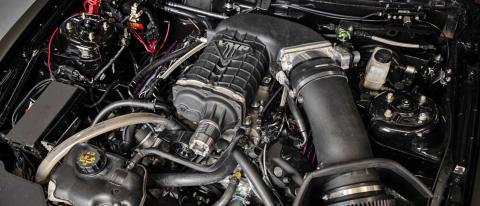
Bailey’s interest in building dirt racing engines goes back to the late 1980s, but he “got serious” about it approximately 15 years ago, when he began buying more equipment. The shop today is loaded with boring, honing, seat-and-guide and surfacing machines, a few Bridgeport mills, and a Stuska Dynamometer.
Despite supply chain and parts supply challenges, SBRE has done whatever it takes to make sure none of its customers was out of an engine through the past three years, Josh Poe said.
A turning point for the business was when Poe “darkened my doorway,” Bailey said, joking that he’s never allowed him to leave.
They knew of each other before then through racing circles, but one day Poe, who worked long hours in industrial machining and fabrication, went looking for a closer shop to machine his racing components and drove to SBRE, about 15 miles away.
“We just kind of started helping each other at night and on the weekends,” Poe said. Before long, “we had more work than we could deal with just one of us.”
The seven years since have been a “godsend,” Bailey said about the help from Poe. “It really grew from there. It wouldn’t be what it is without Josh.
“I think it’s both of our passion,” he added. “We complement each other very well.”
The Dirt Market
Despite the struggles with parts availability and rising costs in racing, business is humming at SBRE. “Things are very expensive, but some of our series in the Midwest are doing a good job,” Poe said, noting that SLMR has increased payouts and is enjoying strong car counts.
Shelby Cooper, a representative of the series, said the start pay has been raised by $100, to $500 for 2023, the increase made to help those in the regional racing series offset rising costs.
She noted that the SLMR Hoker Trucking East Series had an average of 33 cars for the 2022 season, and the Malvern Bank West Series had 27, each increasing by a few cars from the season prior. The series’ highest car count in 2022 was 49.
Poe pointed out that despite its pricey buy-in, dirt late model racing still receives plenty of attention. “The expense is getting pretty close to intolerable, but people are still wanting to do it,” he said.
He believes its popularity among spectators is based largely on entertainment value. “They have a product that people want to watch,” Poe stated.
More than just the thrill of fast cars, fans make a connection with the drivers, he explained, traveling up to a few hours to see top competitors from the region or even the nation.
“They can interact with their favorite drivers and teams by going right down in the pits and talking to them,” he said, “whereas obviously in other professional sports settings that is far more difficult.”
He believes the diehard race fan is gravitating away from the “NASCAR-type stuff” and finding local heroes who they know support racing in their area. As business owners get out of the driver’s seat and put younger talent into their race cars, they stay involved at the track.
“I feel that the fans have some background knowledge of who they are rooting for each week, making them look forward to the next race on the schedule,” he said.
There remains, however, a good mix of veteran drivers and young talent, Poe noted. “It’s nice to see the guy who’s expected to win have a challenge from a young rookie with maybe an underfunded team giving it everything they got,” he said, further building the fan base.
MLRA currently has an unusually high four legitimate drivers competing for rookie of the year. “Josh and I grew up working and spending that money to go race. It’s changed now; these younger kids are racing on their families’ money,” Bailey said.
With today’s costs it would be impossible for a 20-year-old driver to fund a car without family help, Poe added. “In our day, it was possible at a certain level. Now, it’s not even fathomable.”
R&D Work
For their part in helping customers thrive, SBRE has spent time in the past five years trying to make the most of the SLMR series restrictor/governor plate rule. “We’ve had a lot of success. We’ve done a lot as far as R&D work to stay ahead,” Bailey said. “I think that’s probably been our highlight.”
Time on the dyno and work specific to the intake and the governor plate rule has paid dividends for SBRE. As a result, the company has won numerous engine builder of the year awards for the series, which races at tracks across Iowa, Missouri, Nebraska, South Dakota, and parts of Kansas.
To stay ahead in that market, you first have to figure out what doesn’t work, Poe stressed. “That’s frustrating and very time consuming,” he said. “The gains are small and don’t come easily.”
The goal of the restrictor rule is to keep all the engine packages at a certain power level, even though anything from a crate engine to unlimited cubic-inch engines are permitted.
Time on the dyno and work specific to the SLMR’s restrictor plate rule has paid dividends for Scott Bailey Racing Engines. The company has won numerous engine builder of the year awards for the series.
“The rules package is very fair, but our customers would come to us and have us look at those rules and say, ‘Given these rules, which engine package would you choose?’” Poe said. “Obviously we’d pick one we thought we could squeeze a little harder.”
R&D is important, but so is time spent at the track. “That’s one of the most valuable aspects of what we do,” Poe said. “I truly feel like that’s why a lot of our customers are here, because they know that Scott’s going to be at a majority of the races they’re at.”
The next new customer could be parked right beside a current customer in the pits—as was the case a few years ago, when Bailey found himself at an MLRA race at Lucas Oil Speedway, among SBRE’s local tracks about an hour away in Wheatland, Missouri, when he helped a driver get his engine back together. Since then, that team has purchased five new powerplants from SBRE.
Parts Challenges
Poe estimates SBRE could have built 30% more new engines in recent years had supplies been adequate.
Parts availability will remain a challenge throughout 2023 and likely beyond, according to Bailey and Poe. “We are still struggling with that a little bit. We used to be able to—start to finish—pick up the phone, order everything you need to build a dirt late model engine, and most of the time have it here in three weeks to a month,” Poe said. “Now the parts just aren’t readily available.”
Specifically, suppliers are having trouble getting the raw material to build crankshafts. And Brodix, as the sole supplier of aluminum blocks and cylinder heads, is “carrying the weight of the world right now,” he said.
“It’s a challenge getting things in a timely manner to meet the demands of the customer, for sure. A lot of times we have to tell them things they don’t want to hear, but that’s the reality,” Poe said.
Peter Harris at Crower Cams and Equipment Co., the San Diego, California-based manufacturer of race engine components, offers the same advice to its customers, which include SBRE.
“Plan ahead,” Harris said. “Prepare the customer to have to wait.”
He said shops like SBRE that build mostly similar engines are in a bit better position. “The only guys who get parts on a really reliable basis are those who use a lot of the same parts,” he said.
While larger shops face impossible odds in keeping customers supplied with engines, SBRE has done whatever it takes to make sure no one was out of an engine through the past three years, Poe said.
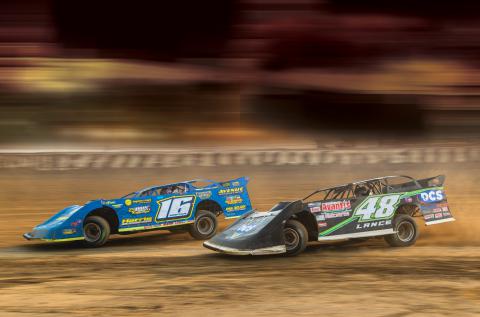
Dirt late model racing’s popularity is based on entertainment value, Josh Poe believes. “They have a product that people want to watch.” Plus, fans can “interact with their favorite drivers [like Tad Pospisil, seen here] and teams by going right down in the pits and talking to them.”
“We were able to stay in contact with our customers,” he said.
“It was an extreme amount of stress,” Bailey added.
For 2023, the lead on crankshafts remains “out there quite a ways,” Poe said, about four months when we spoke in mid-March.
“Brodix has done a good job ramping up production, blocks are becoming more readily available, and the cylinder heads are OK,” Poe said. “We’re still seeing some long lead times with custom-made rocker arms.”
For things like titanium valves, the raw materials are rare, as are the suppliers, so options are few, Poe noted. “I think things have stabilized to a certain degree. We’re not running out. During the height of the Coronavirus during the lockdown, we ran out of simple things like engine bearings and rear main seals.”
Still, “the crankshafts, the blocks, and the rocker arms are going to continue to be a problem for quite some time,” Poe added.
Bailey said piston companies have done a “real good job” getting caught up, with current lead times of eight to 12 weeks after having been considerably longer.
Harris from Crower agreed that crankshafts and rocker arms are among the parts that are most difficult to get because of the time it takes to produce them and their many varieties.
Smaller, Better
From 1 a.m. phone calls from teams traveling track to track, to putting every refreshed or new engine on the dyno before it leaves the shop, SBRE is succeeding because of its personal connections.
“We know most of our customers like family,” Poe said. “Most of the dirt late model teams have at least two engines, if not more, so we have a lot of repeat customers.”
They also know, however, that every customer is unique. “We don’t build cookie-cutter engines; we listen to our guys,” Bailey said. “We understand there are different driving styles; drivers expect and want different things out of their engines. We’re not one to say, ‘Well, so and so is winning with it like this.’”
Not that larger shops ignore their customers, it’s just impossible for them to tailor their engines and manage everyone’s needs around the clock, according to Bailey and Poe.
For SBRE, this personal connection has been vital over the past three years. Poe recalled the effort to inform customers about longer timeframes to get engines. “If we don’t get them that information, we’re leaving them vulnerable,” he said, “and they’re going to call with demands that are impossible to meet because they didn’t know the situation. This way, they have the information they need to make choices for their team.”
Initially a point of contention for some dirt late model racers, the “droop rule” gets updates for 2023 and puts the major series on the same page while preserving creativity and competition.
Across the vast motorsports spectrum, builders and racers have historically grappled with rules changes designed to help even out competition or improve safety, or sometimes to correct problems caused by previous rules changes. It’s all part of the racing landscape. And almost universally, racers can be resistant to change, often due to confusion over a new rule or the cost to meet it. The “droop rule” in dirt late model (DLM) racing was no exception.
Cutting to the most important point, the droop rule remains part of the 2023 Unified Dirt Late Model Construction Rules meant to get all DLM series on the same page. The rule had been a part of the 2022 Unified Rules, but in September 2022, it looked like one tour, the XR Super Series, was going to drop it. In fact, that did occur, but only for two races: Kokomo and Las Vegas.
A significant change to the 2023 droop rule implementation brought XR back to using it, according to event director Bucky Doren. We’ll explain in a moment.
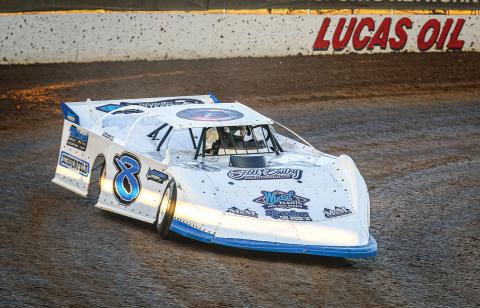
The latest version of the Rear Travel Limiter Rule—a.k.a. the droop rule—specifies post-race left rear deck height not higher than 51 inches. Violations used to result in disqualification, but that has since been amended and is now a position penalty.
First, those not versed in the often deceptively complex workings of dirt late model chassis construction and aerodynamics might well wonder why the bodies tilt (or “droop”) rightward and move the chassis geometry sideways when the cars enter the track. It’s a design feature that pushes the left rear deck spoiler higher into the air to generate added downforce. Prior to the rule, cars were pushing their left rear corners 58 inches into the air. The post-race inspection called for 39-inch rear deck height as measured at the center, and drivers were known to stand on the cars to compress the suspension long enough to pass through.
How much benefit the high left deck height provided depended on where a driver was in the pack. A car following the leader closely might lose downforce, because the front car was blocking the air. Some believed, as well, that the setup could turn a minor bump from a competitor into a major rollover mid-apex.
Did Limiting Droop Dampen Competition?
By most accounts, the “droop rule” first appeared in the Southern Nationals races promoted by Ray Cook at the start of the 2018 season to limit vertical travel of the left rear suspension. The rule required DLM cars to have a chain connecting a collar or bearing-type mount on the left rear axle tube to a mount on the left rear frame directly above it.
Because the droop rule was not universal across series, some racers built different cars for each, an expensive proposition not all could afford. The 2022 Unified DLM Construction Rules were meant to address that concern.
Steve Francis, current director for the World of Outlaws Late Model Series, affirmed his support for the rule but admitted he was not initially a fan of it. Francis had retired from a stellar 35-year racing career in 2017 after achieving nearly 300 victories, then at first became technical director for the Lucas Oil Late Model Dirt Series. He told PRI that he does not believe increased rollover potential was the biggest driver in adopting the droop rule.
“The whole idea was to get the rear spoiler out of the air some,” he said. “We’d gotten to the point where the guy that could figure out how to get his car the highest in the air would win the race. Naturally, with a car 58 inches in the air versus 51 or 50 inches, there is a difference in how easy it is to roll that car over, but I’d say the biggest thing is allowing the car behind it to be able to get air on it.”
The World of Outlaws Late Model Series’ Steve Francis sees adoption of the droop rule as beneficial to dirt late model racers. “It has allowed racers to get out of the very complicated stacks in the springs and things like that. Now, there’s a lot of conventional single springs being raced.” Photo courtesy of Jacy Norgaard and World of Outlaws.
In response to numerous racer arguments and complaints over the droop rule, Francis initiated dialogue with other series in late 2021. At the PRI Trade Show that December, Francis, Kenny Kenneda from World of Outlaws, and officials from other series hammered out what became the 2022 Unified Dirt Late Model Construction Rules. Among these was the Rear Travel Limiter Rule, a.k.a. “droop rule.”
That version of the rule specified post-race left rear deck height not higher than 51 inches, checked with both tires just off the ground to let a .040-inch shim slip beneath them. Violation called for a disqualification. Those two elements would become sticking points for Doren at XR Super Series, leading to his fall 2022 attempt to drop the rule.
Overcoming Obstacles
“The biggest issue that we had behind the scenes in 2022 was that the right rear wheel had to be off the ground at inspection,” Doren told PRI. “We started the season with it, but by mid-season, we felt we would try dropping it to gauge driver reaction, and to evaluate the competition.”
For the two races where XR dropped the rule, Doren said it appeared to help the competition somewhat. “Driver feedback was mixed,” he said, “but most said to keep it so that they didn’t have to build two cars. So, the biggest reasons we agreed to go back to the droop rule were that the right rear wheel was no longer a factor, and it would not encourage racers to build two cars.”
Doren was also concerned that the droop rule, as implemented last year, could have limited racers’ ingenuity and dampened fan enthusiasm. “We want to make sure that these teams can still be creative with their setups,” he said. “They’re still finding ways to get around it, regardless, but that mystery is also part of the fun for the fans. If somebody goes too far, it’s an infraction, but now it’s a position penalty, not a DQ as in 2022.”
Working for Racers
Francis sees wide adoption of the droop rule as beneficial to dirt late model racers, starting with reducing chassis complexity. “There are still arguments over the droop rule, but it’s maybe a third of what it used to be,” he said. “Before, you’d have to have an engineer trying to figure out how to get the car higher in the air. As you pull them all back down, it’s less technical. It has allowed racers to get out of the very complicated stacks in the springs and things like that. Now, there’s a lot of conventional single springs being raced.”
The whole idea behind the droop rule “was to get the rear spoiler out of the air some,” reported a dirt late model source. “We’d gotten to the point where the guy that could figure out how to get his car the highest in the air would win the race.”
Francis told PRI he believes the droop rule still allows room for creativity and exciting competition. “I feel like the current version of the rule and the current tire rules, where race teams have choices, have made dirt late model racing much better,” he said. He cited “really good racing” at the start of the season, with plenty of passing and lead changes.
“We had a guy at Volusia who started around 23rd and won in a 50-lap race,” Francis said. “I think that speaks well for the sport right now and where the rules packages are.”
Officials with the Sprint Cars Of New England (SCoNE) have announced the addition of two officials for the 2023 season. Racing veterans Justin St. Louis and Dan Douville will help to lead the organization for its 20th year of operation.
St. Louis has been named the president of SCoNE. He will manage day-to-day operations and work closely with the SCoNE Board of Directors and member promoters. St. Louis will also handle media and marketing duties and will serve as the play-by-play announcer on race days.
"I've spoken with the promoters of all four of our member tracks, and I'm really looking forward to the summer. The SCoNE schedule is the best that I feel it has been in many years, and we should have a lot of fun this year," St. Louis said.
St. Louis has 23 years of experience in short track racing, serving in many roles across corporate staff and race day official positions, according to the series.
Douville, meanwhile, has been hired as the race director and will control on-track operations. He brings 35 years of racing experience and notably ranks second on SCoNE's all-time win list with 28 feature victories. He was also the tour's champion in 2011 and 2015.
SCoNE features winged, open-cockpit, open-wheel race cars with 360-cubic-inch, methanol-fueled engines producing around 600 horsepower. Theschedule features Bear Ridge Speedway (Bradford, Vermont), Devil's Bowl Speedway (West Haven, Vermont), and The Flat Track at New Hampshire Motor Speedway (Loudon, New Hampshire). The season opens on Saturday, May 13, at Devil's Bowl with a $1,000-to-win event.
Jasper, Indiana-based Meyer Distributing has announced the addition of its Goldsboro, North Carolina, cross-dock. The cross-dock will have a direct feed from Meyer's Northeast distribution hub.
"Eastern North Carolina has always been a logistically difficult area for Meyer to serve," states Jeff Braun, CEO of Meyer. "This new dock will solve those logistical challenges, taking these customers on the Carolina coast from once or twice per week delivery to next-day delivery up to five times a week. This was one of the last regions of the US with populations of this size not getting daily delivery opportunities, and we are excited to put that pin in the map."
Meyer Distributing is an automotive specialty products marketing and distribution company with numerous warehousing facilities. It serves customers nationwide via Meyer Logistics direct shipping.
New race track surfacing technologies and a specialized approach to the needs of different motorsports disciplines is helping to topple established records, enhance the fan experience, and improve the bottom line for race organizers.
Whether you’re going 11/10ths on a circuit or just headed to the grocery store, surface quality plays a role in just about every stint behind the wheel. Paved roads have existed in the United States for well over a century, and while it might be easy to assume that there’s not much to them from a design standpoint, there’s actually a stunning amount of application-specific science that plays into today’s surface constructions.
To create track surfaces that provide motorsports-quality grip as well as the durability to handle the abuses of competition year after year, builders must take a range of factors into account. Everything from the types of cars that will use the surface and the annual climate in the region to the characteristics of the rocks that are sourced from their local quarries play a role in the process before a single foot of pavement is applied. As a result, the most esteemed race tracks use a surface that’s truly bespoke to their needs.
Fast And Made To Last
Frederico Bastos of Phoenix Industries in Prescott Valley, Arizona, explained that while there’s some obvious commonality between the desired traits of a typical roadway surface and a race track surface, an ideal version of the latter requires some unique attributes.
“You want the asphalt to be smooth and not tracking or segregating—those are things that we look for even when we’re driving down our streets and highways,” Bastos explained. “But in racing you have higher speeds involved, so any imperfections on the track surface will be exacerbated when you drive over them, especially if you’re in a lighter car or on a motorcycle. And you want an asphalt that protects the surface from the natural stresses that can come up from the ground underneath it as well as the stresses that are being applied to the top of the track surface. On a typical public road, your biggest concern is usually weight caused by traffic loads. But on a track, you have a relatively small number of vehicles traveling on it at a given time, and they’re very light. There, your bigger concern is more about lateral stresses—the sheer forces from high-grip tires that are exerting a lot of torque on that surface.”
A racing series’ track use requirements affect track surface design, said Cedric Burkhardt of Topcon Positioning Systems. “With a Formula 1 circuit [such as Britain’s Silverstone race course, shown here], delivering the maximum amount of grip available from the car is a priority. The surface on an FIA Grade 1 race circuit is often a little bit different than on tracks used by IndyCar, IMSA, or even NASCAR.”
Cedric Burkhardt of Topcon Positioning Systems in Livermore, California, pointed out that the requirements of the racing series that use the track can also come into play in surface design. “For example, with a Formula 1 circuit, delivering the maximum amount of grip available from the car is a priority, so the surface you’ll see on an FIA Grade 1 race circuit is often a little bit different than on tracks used by IndyCar, IMSA, or even NASCAR. For instance, at the Rolex 24, you’ll see the back end of the cars will come out of line as they’re exiting the Horseshoe, and that really just comes down to the grip available from that surface.”
Those changes in grip can make the racing more exciting for the fans, but Burkhardt noted that durability also plays heavily into the design of a track surface. “If you’re an F1 track, you might have the capital to repave your track every five years if need be, but that might not be something other types of tracks want to do,” he said.
While the surfaces at most road courses and oval tracks have been designed to last significantly longer than that, a range of different factors can affect their longevity. “Since Daytona and Sebring are based in Florida, they’re not dealing with the same climate conditions that a track like Road America up in Wisconsin has, where the winter months are more abusive to the surface. The friendlier the climate is, the longer the track surface will stay intact,” Burkhardt added.
And as Bastos noted, the geographical location of a track plays a fundamental role in the surface design on several different levels. “The asphalt needs to exhibit the right adhesive properties to keep the aggregate—and other elements that make up the surface—glued together, and it also needs to have the proper flexibility,” he explained. “Flexibility is what’s going to allow the asphalt to withstand those stresses without cracking, which can allow water and other contaminants to get in and accelerate the deterioration of the asphalt. Getting the ideal amount of adhesion and flexibility comes down, in part, to the asphalt oil content in the mixture, and the type of rock that’s being used is a significant factor in determining what that should be. You’re getting rocks from a quarry that’s probably within a 60-mile radius of the facility when you start a project, and those rocks are the heaviest component used in the process, so you don’t want to truck that material in from very far away. So, the type of rock that’s available locally ends up being an important factor in that mix design.”
While weight from traffic loads is a concern on public roadways, the bigger concern on a race track “is more about lateral stresses—the sheer forces from high-grip tires that are exerting a lot of torque on that surface,” said Frederico Bastos of Phoenix Industries.
Track location plays into the mix design for other reasons as well. “At Atlanta Motor Speedway, the surface is designed to be porous—water drains through the track surface instead of going over the surface to drain,” Burkhardt said. “That leaves little holes in the surface, which cause more abrasion on the tires, but those holes also allow water to be drained away from the racing surface quicker and more effectively than it would be without it. That potentially means shorter—and fewer—rain delays.”
The modifier used in the asphalt mixture can also have a significant effect on the track surface. Phoenix Industries handled the repaving process of Buttonwillow Raceway Park (BRP) back in 2014, and the mixture that it used for that project included a rubber modifier in the asphalt. Bastos told us that this rubber modifier is particularly beneficial in race track applications. “It can give you the flexibility and adhesiveness that you want, and it undergoes a chemical reaction with the asphalt oil that helps to protect it from deteriorating,” he said. “All factors being equal, this should roughly double the life expectancy of a track surface versus regular asphalt.”
Bastos said that Buttonwillow was the first track in the country to use Phoenix Industries’ rubber modifier in the resurfacing process of its track. The company will also construct the surface of a new, 2.5-mile road course that’s being added to the facility this year.
BRP President Les Phillips said that the unique asphalt mixture not only enhanced the surface’s longevity, it also improved on-track performance. “Every class immediately reported faster lap times. We have many SRF cars that race here, and they reported two-second improvements. That’s typical of what we saw across the board.”
Building For Straight-Line Speed
While the construction of any track surface is essentially purpose-built for the reasons mentioned above, drag strip track surface design is truly an animal all its own. “Asphalt’s fine for half-track or farther down, but concrete is really the way to go for a drag strip launch surface,” said Kurt Johnson of Total Venue Concepts, Petersburg, Indiana. “The surface needs to be as flat as possible, and it has to have enough texture in it to grip rubber.”
Johnson said that while most drag strips are repaved every 15 to 20 years, regular maintenance is crucial to keep the track not only fast and consistent, but safe. “As the surface degrades over time, it loses the ability for rubber to stick to it, and any time you take away surface area on the tire, you’re creating a safety issue. But we can go in every five to eight years or so and do a grind process that cuts the strip flat.”
He said that some folks are concerned about the aggregate, but advances in the technology used in this process has progressed significantly in recent years. “The big grinder leaves the track looking like corduroy, and you’ve got to get that out, so we use large floor grinders to remove those ringlets,” Johnson explained. “Companies used to use carbide tips to do that, and they weren’t hard enough to cut most aggregate, so you’d end up with an adhesion problem once you showed the aggregate. But now we’re using diamonds to finish the surface and put texture in it, and we can use one that’s specific to the geographic location that allows us to cut that particular type of rock.”
The concrete surface is only one piece of the drag strip puzzle. “The subgrade and subbase are just as important as what’s on top,” he continued. “Concrete and asphalt are porous, and we’ve got to be able to get the water away from the racing surface from underneath, or else it’ll wick right through and rubber will never adhere to it.” As a result, a properly designed drag strip will be raised up higher than the surrounding area, and the surface mixture will employ the use of aggregates in the subbase that allow for water to flow away from the racing surface without compromising the high compaction needed in order to prevent the drag strip from physically shifting around.
As with road course and circle track surfaces, fluctuations in temperature cause the drag strip surface to expand and contract. Since more than one type of surface material is often involved in the construction of a drag strip, Johnson said it’s crucial to design the track with that in mind. “Expansion joints are very important, and we typically don’t see enough of them put into race tracks. If you don’t have a big expansion joint wherever the concrete meets with the asphalt, you’re going to get a bump in the surface because the asphalt expands at a much higher rate.”
The surface of a drag strip’s launch area “needs to be as flat as possible, and it has to have enough texture in it to grip rubber,” said Total Venue Concepts’ Kurt Johnson.
Since consistency plays such a key role in competitive drag racing, the mechanical grip offered by a drag strip surface is also an important factor in its overall quality. That’s where top-layer treatments and traction compounds start to come into play. “Powdered resin can help with adhesion to the substrate before the traction compound glue is applied,” said Brian Parish of Rocket Track Products, Ostrander, Ohio. “And that can improve the glue’s longevity. But regular maintenance is always required to keep the track in good working order. While you want some amount of rubber on the track, too much of it will cause the surface to get soft, and the glue will get gummy as a result.”
He added that, even on a well-maintained track surface, the type of traction compound used and how it’s applied can have a significant effect on the quality of the racing. “Some tracks might want something that’s just ready to use straight out of the drum, while others want a concentrated solution so that they can adjust the mixture on their end—they know the track really well, and they know how it’s going to react to changes in the mixture. They might want to make adjustments based on the weather that day or the event that’s running, and that allows them to get the best surface that they can,” explained Parish.
Return On Investment
Paving a track is a costly endeavor regardless of the approach, and that can lead to deferred maintenance or just generally shoddy track conditions. But beyond addressing potential safety concerns, a good track surface ensures that teams can perform at their best.
The type of traction compound used and how it’s applied can have a significant effect on the quality of the racing. Some tracks may apply a compound that’s ready to use straight out of the drum, while others may want to adjust the mixture to suit ambient conditions or the cars running in the event.
“In downforce cars and other cars that rely on a floor to produce grip, the lower we can run the car, the more efficiently it will work,” said Indy NXT series driver James Roe. “A smooth track allows the car to really come alive because we can run it a lot lower than we can at a track that’s in rough condition, and it also creates less mechanical wear and tear on components like springs and dampers. Everyone loves a repaved race track; we’ve got several tracks on the race calendar this year that have recently been repaved, or are currently in the process of being repaved, and they’re the talk of the town because we know that new lap records are coming.”
And that can make a track more attractive to racers who are looking to make history as well as those who are eager to witness it.
“It brings the performance of your race track to the cutting edge of the existing envelope,” said Johnson. “That allows racers to run those record numbers, and that’s what the fans want to see.”
 MEMBERSHIP LOGIN