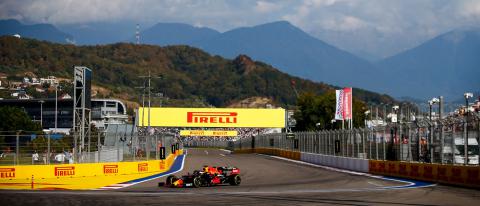
Honda Motor Company has announced that it has decided to conclude its participation in the FIA Formula 1 World Championship as a power unit supplier following the 2021 racing season.
Honda had resumed F1 competition in 2015, most recently working with Red Bull Racing and AlphaTauri to secure three wins in 2019, and two so far in 2020.
“Now, shifting focus onto the business environment facing Honda, we see the automobile industry is undergoing a once-in-one-hundred-years period of great transformation...,” President, Representative Director, and CEO of Honda Motor Co., Ltd. Takahiro Hachigo said during a press conference at the company headquarters in Tokyo. “At this time, Honda made a decision to further accelerate such initiatives and strive for 'the realization of carbon neutrality by 2050' in order to realize a sustainable society. To this end, our current goal of 'electrifying two-thirds of our global automobile unit sales in 2030' will become a checkpoint we must pass before we get to the 2050 goal, and therefore we must further accelerate the introduction of our carbon-free technologies.”
“Racing is in Honda’s DNA, and therefore Honda will continue to be passionate about taking on challenges and striving to become No. 1 in all categories of racing in which Honda participates.”
Mercedes, Ferrari, and Renault will remain as the three power unit suppliers for F1 following the 2021 season.
Camping World, the retailer of recreational vehicles (RVs), RV accessories, and RV-related services, has partnered with the National Hot Rod Association (NHRA) to become the sponsor of NHRA’s premier professional series, which will be known as the NHRA Camping World Drag Racing Series.
“I look at NHRA and I see a growing and loyal fan base,” said Marcus Lemonis, chairman and CEO of Camping World. “NHRA recognizes the product it has in the sport of drag racing and its responsibility to serve its fans. We at Camping World look forward to this new relationship.”
The news follows NHRA's announcement that the sanctioning body filed a lawsuit against series sponsor Mello Yello and The Coca-Cola Company.
The sponsorship, which begins immediately, will be in full swing as the NHRA celebrates its 70th anniversary and Camping World celebrates its 55th year in 2021.
“Camping World has a strong history in motorsports, and we can’t wait to introduce them to the incredible action of NHRA’s 11,000-horsepower, 330-mph racing,” said NHRA President Glen Cromwell. Our fans, drivers, teams and partners are thrilled about the potential of this relationship as we welcome Camping World as a partner and entitlement sponsor for the NHRA and its premier series.”
BorgWarner Inc. has announced it has completed the acquisition of Delphi Technologies.
"We are pleased to complete our acquisition of Delphi Technologies,” BorgWarner President and CEO Frederic Lissalde said. “Through this combination, BorgWarner is even better positioned with a more comprehensive portfolio of industry-leading propulsion products and systems across combustion, hybrid and electric vehicles. We expect that the combination will also strengthen our commercial vehicle and aftermarket businesses.
"The combination of BorgWarner and Delphi Technologies is expected to strengthen BorgWarner’s electronics and power electronics products, capabilities and scale, creating a leader in electrified propulsion systems that BorgWarner believes is well-positioned to take advantage of future propulsion migration.
"We welcome Delphi Technologies’ colleagues around the world to the BorgWarner team and are excited about the opportunities we have together to address market trends towards electrification."
The acquisition is expected to strengthen BorgWarner’s electronics and power electronics products, capabilities, and scale. The combined company will offer customers a suite of integrated and standalone offerings of power electronics products including high voltage inverters, converters, on-board chargers and battery management systems and capabilities including software, systems integration and thermal management.
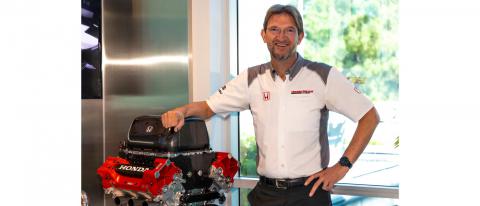
Honda Performance Development (HPD), which leads all Honda and Acura high-performance racing programs in North America, has announced David Salters as the new president. He will become the seventh president in its history and will succeed Ted Klaus, who will retire from HPD on December 1, after a 30-year career with Honda.
"Ted Klaus has been a great leader for Honda Performance Development, demonstrated by the success we have enjoyed in both IndyCar and IMSA racing in the two seasons he has led HPD," said Dave Gardner, executive vice president of National Operations for American Honda Motor Co., Inc. "As we prepare for the exciting electrified era ahead in North American motorsports, we are confident in turning to someone with the experience of David Salters from inside HPD to lead us into the future."
Salters joined HPD in 2015 as a chief engineer and engine technical leader, serving as technical director since 2019. As president, he will have responsibility for overseeing Honda's racing and engineering activities and working directly with the company's racing teams and sponsors.
Prior to joining HPD, Salters had a series of roles in high profile racing programs, including serving as the head of ICE power unit development for the Ferrari Formula 1 program, as head of F1 engine development at Mercedes-Benz High Performance Engines (formerly Ilmor) and as a development/design engineer for the CART Indy car program at Cosworth Racing Ltd.
The International Motor Sports Association (IMSA) and Sports Car Club of America (SCCA) have announced a new partnership to offer a clear-cut path for involvement in both amateur and professional US road racing and foster the next generation of workers, crew, and drivers.
“As the leader in professional sports car racing for more than 50 years, IMSA has introduced millions to motorsports and the motorsports lifestyle,” IMSA President John Doonan said. “As the leader in amateur motorsports for more than 75 years, SCCA has provided an outlet for people to make motorsports a part of their life as drivers, crew, event organizers, and officials.”
The partnership will jointly establish a certification curriculum for select specialties. The goal will be for all IMSA volunteers to be certified for specialties through SCCA. When applicable, IMSA and SCCA also will look to develop and test new technologies pertaining to race day operations.
Also discussed is a possible future ladder program through SCCA for young drivers, team members, and officials. SCCA Road Racing already has car classes for previously eligible IMSA race cars, including Prototype X for Daytona Prototype and Le Mans Prototype cars, as well as older IMSA GTP vehicles. SCCA also offers the GT-X class for GT3, GT4, and TCR specifications.
The effort also includes a new “SCCA Got Me Started” campaign highlighting how SCCA members first became engaged in motorsports on their way to professional IMSA involvement.
“Sports Car Club of America has been working to demystify motorsports for auto racing enthusiasts,” Mike Cobb, SCCA President/CEO, said. “SCCA Track Night in America and the longstanding Solo program offer low-barrier options for people to explore motorsports. If they wish to dive deeper into auto racing, the Summit Racing Equipment SCCA Road Racing program provides that opportunity for drivers, crew, and volunteers. This new collaboration with IMSA is another spoke in SCCA’s wheel of influence for those looking to expand involvement and realize a professional career in IMSA road racing.”
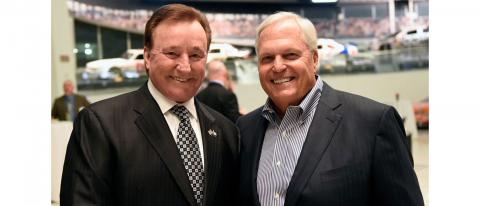
Hendrick Motorsports and Richard Childress Racing have confirmed that the two teams will combine forces to establish one common Chevrolet engine specification.
In doing so, Chevrolet joins manufacturers Ford and Toyota in streamlining engine building to one supplier.
“Following the 2020 NASCAR Cup Series season, Hendrick Motorsports and Richard Childress Racing will formalize a joint venture focused on engine R&D and the establishment of a common Chevrolet engine specification,” the organizations announced in a joint statement. “While our two championship-winning organizations will collaborate on research and development, our respective engine shop operations will continue to function independently as they currently do. We look forward to working together to fully leverage the knowledge and intellectual property of our two successful programs to advance Chevrolet’s engine for NASCAR.”
Both Hendrick Motorsports and Richard Childress Racing (via ECR Engines) have developed powerful engine programs over the years. Engines produced by the two have earned a combined 39 NASCAR national series championships, including 20 at the Cup Series level. Additionally, Chevrolet race cars fielded by the two organizations have won a combined 369 NASCAR Cup Series points-paying events.
IndyCar officials have announced a 17-race schedule for the 2021 NTT IndyCar Series.
The 2021 season will begin Sunday, March 7, on the streets of St. Petersburg, Florida, marking the 10th consecutive year that St. Petersburg will host the launch of a new season.
“We’re really pleased that the current plans provide for one additional race on NBC’s network than we had this year,” said Mark Miles, president and CEO of Penske Entertainment Corp. “In particular, the season will start with NBC coverage of the St. Petersburg event, a spectacular start for those in attendance and for those watching from home.”
For the first time, the Series will race at Texas Motor Speedway in the month of May during a doubleheader weekend May 1-2, before the 105th Running of the Indianapolis 500 presented by Gainbridge, scheduled for Sunday, May 30.
The Detroit doubleheader has moved to June 12-13, while the Mid-Ohio Sports Car Course will host INDYCAR during the July 4 holiday weekend. IndyCar will make a debut on the streets of Nashville, Tennessee, for the first Music City Grand Prix on Sunday, August 8, followed by the road course at the Indianapolis Motor Speedway on Saturday, August 14. The three-weekend stretch culminates with a return to the oval at World Wide Technology Raceway, Saturday, Aug. 21.
The 2021 season champion will be crowned Sunday, September 19 at WeatherTech Raceway Laguna Seca.
Aftermarket suppliers are pushing the tech envelope under the most extreme racing conditions.
Is there a more punishing environment for racing than off-road? All the enemies of performance come out where the pavement ends, including brutal heat (or numbing cold), brain-rattling vibration, and every kind of dirt imaginable, from talcum-fine silt to gooey muck.
And yet, the lure of off-road racing and the drive to conquer those obstacles has done nothing but grow. As in every form of motorsports, the challenges spur innovation, as teams seek to improve speed, reliability, and safety. The difference is that their solutions must be far more robust than anything used on smooth ribbons of asphalt. In that vein, following are eight tech innovations that are driving the sport’s evolution ever faster.
1. All-Wheel Drive
“People always assume we’re racing four-wheel-drive vehicles,” noted Matt Martelli, whose marketing company, Mad Media of Oceanside, California, represents a number of clients in the off-road racing community, including the Mint 400 desert race in Las Vegas, Nevada. “But we’ve never been able to get four-wheel drive to live with the same amount of suspension travel as two-wheel-drive trucks have.”
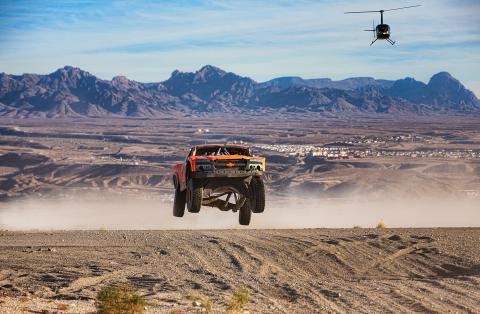
To date, Mason Motorsports has finished seven all-wheel-drive Trophy Trucks, described as a “total game-changer.” Among Mason’s customers is Bryce Menzies, who won this year’s King of the Hammers and the Best in the Desert series’ Vegas to Reno off-road race in August, seen here. Photo courtesy of Toyo Tires.
That is, until now. One of the pioneers in adapting all-wheel-drive to long-travel suspensions is Neal Mason of Mason Motorsports in Lake Elsinore, California. “His truck is a total game-changer,” Martelli said. “Its acceleration is totally bonkers.”
Mason’s approach was straightforward, if difficult. Instead of trying to adapt existing components from other forms of racing (which often weren’t up to the abuse), his shop designed and fabricated whatever parts were needed.
Nearly the entire driveline is built from scratch, including a front differential/transfer case, a five-speed automatic transmission with adjustable ratios, custom 300M-style driveshafts, and portals for the front wheels that “offset the CV joint vertically as compared to the wheel centerline and do gear reduction out at the wheel,” Mason said.
Using the portals accomplished two things: First, they “make our front CVs and axles live longer,” Mason noted. “Since we’re doing some of the gear reduction out at the wheel, the CVs and axles see about 40% less torque than in a standard configuration.”
Those portals also enable the truck’s front suspension to have 24.5 inches of wheel travel, “only about an inch less than our two-wheel-drive trucks,” Mason said. “By offsetting the CV vertically, we can get it close to the bind number in bump and droop.”
The AWD system does not engage all four wheels all the time. In fact, Mason said, “It’s got 100% drive to the rear.” A one-way sprag between the transfer case and front differential engages the front tires “once the rear tires slip. Under acceleration it locks. When your foot’s out of the gas, it unlocks.”
The advantage of putting AWD in a Trophy Truck “is the same concept as in rally, really in all racing,” Martelli said. “It’s the mini race-within-a race: How fast are you corner-to-corner? Because you get better traction with all-wheel drive, you have better acceleration, better control of the vehicle. And now they’re able to put down more horsepower because it’s spread over four wheels versus two. Once you hit that 800-horsepower mark with a 5,000-pound vehicle, you’re just spinning tires. Now you can run about 200 to 300 more horsepower and use it, because you can get all four wheels to stay on the ground.”
Mason’s trucks weigh between 6,800 and 6,900 pounds “and top speeds are right around 150 mph,” he said. The most popular engines going into his AWD trucks are 555-inch, 1,050-horsepower big blocks from Dougans Racing Engines and 468-inch V8s from Joe Gibbs that “make about 1,100 horsepower.”
To date, Mason Motorsports has finished seven AWD Trophy Trucks. Among Mason’s customers is Bryce Menzies, who won the King of the Hammers race and drove it to second-place finishes in both the Mint 400 and Best in the Desert’s Silver State 300. Jesse Jones, with co-drivers (and Dakar rally champions) Nasser Al-Attiyah and Toby Price, came in second in last year’s Baja 1000 in a Mason AWD Trophy Truck “that was delivered two days before the race,” Mason said.
Weddle Industries of Goleta, California, is also building AWD systems for Trophy Trucks and open-class buggies. “We’re sort of buggy dorks at heart, so we’re pretty stoked to see the all-wheel-drive buggy thing come along,” said Ron Weddle.
Weddle Industries is working with Australian transmission manufacturer Albins to build AWD packages for off-road racing, Weddle said. Five trucks currently use the system—two desert racers and three Pro 4 trucks in the Lucas Oil Off Road Racing Series as well as the newly formed Championship Off-Road series.
The Albins AWD transmission has a pneumatically controlled wet clutch assembly to control the output to the front drive. “You can shift it on the fly, turn it on and off depending on what’s going on with the truck at any given time,” Weddle said. “If you come flying into a corner really hard and you need to jam on the brakes to rotate the truck, you can set it up so as soon as you hit the brakes it disconnects the front drive so the front end floats. You don’t have those braking bump loads going backward and forward in the driveline. It lets the truck rotate, and as soon as you get off the brakes and back on the gas, it locks up the all-wheel drive so you start pulling all four wheels back out of the corner.”
Weddle recently had the opportunity to ride in an AWD Trophy Truck with a driver “who’s one of the best in off-road. Even he didn’t realize how fast he was going corner-to-corner and was missing corners. He couldn’t slow down enough. Through the bumps you can literally feel those front tires grabbing the tops of the bumps and trying to pull that truck along, even from the passenger seat.”
2. Godzilla
Blue Oval fans were understandably excited when Ford Performance released a crate-engine version of the 7.3-liter, cam-in-block V8 originally designed for the 2020 Super Duty pickup. With 430 horsepower and 475 lb-ft of torque, and an MSRP of $8,150, the engine Ford called Godzilla looked to be a viable swap alternative to the ubiquitous LS.
Jason Youd of Mast Motorsports in Nacogdoches, Texas, agreed. “Just like ‘LS swap the world,’ this is going to be ‘Godzilla swap the world.’”
Weddle Industries is working with Australian transmission manufacturer Albins to build AWD packages for off-road racing, which feature a pneumatically controlled wet clutch assembly to control the output to the front drive. “You can shift it on the fly, turn it on and off depending on what’s going on with the truck at any given time,” said our source from Weddle.
Well-known for its potent LS engine packages, Mast Motorsports is hard at work on a tuned-up Godzilla that should make “roughly 550 horsepower and 480 lb-ft of torque,” noted Youd. A second, stroker version will be good for even more.
Mast will upfit the engine with “a camshaft, ported cylinder heads, valvetrain, valve spring kits, and integration of the computer controls,” Youd said. “But the biggest thing we’re going to have is a commonly available controls package that anybody can tune.”
Ford is particularly interested in having Godzilla available for off-road racers. “Because Ford is trying to align the new Bronco release with the Ultra 4 community, they’ve announced that they’re supporting the people who want to make the transition from the LS engine to a Ford engine,” Youd said.
Mast’s Godzilla was still in development at the time of this writing, but Youd planned to have it ready by press time. “This engine will retail for about $12,000 with all the controls, a drop-in, turnkey engine ready to run.”
3. Electronic Shift Assist
In addition to Albins AWD systems, Weddle Industries is developing electronic shift-assist systems. “In Class 5 [SCORE’s class for open wheel Baja Bugs] and Class 10 [single- or two-seat buggies with a stock, sealed engine of 2.2 to 2.4 liters], most of the front-running cars have transmissions with some sort of electronic assist for shifting, like a no-lift shift setup or throttle blipping,” said Weddle. “We are working on our transmissions to make them capable of that.”
When we spoke, Weddle had just returned from a weekend of testing a buggy equipped with a “strain-gauge shift knob that sends a signal to the ECU, whether you’re upshifting or downshifting, that actuates either a shift-cut system for upshifts or a throttle-blipping system for downshifts. It relies on a time delay and a really accurate potentiometer to measure drum rotation, so the computer knows when the transmission is in the next gear. Then it can reactivate everything and put on full power.”
4. Fuel
For years, C12 race gas from VP Racing Fuels in San Antonio, Texas, was “extremely popular in the off-road truck category,” said VP’s Bruce Hendel. But that, he said, was in the days when top-tier truck engines were making 500 to 600 horsepower.
“As things advanced, and trucks were powered by engines with 800 to 1,000 horsepower, C12 was no longer the preferred fuel for those trucks.” Instead, he said, Trophy Truck racers migrated to VP’s Late Model Plus. As its name implies, it was formulated for high-compression Late Model dirt track engines, those squeezing to 14:1 or 15:1 and putting out 800 to 900 horsepower. Late Model Plus has more octane than C12, a 117 R+M/2 rating compared to C12’s 112.
It also has a lower RVP than C12. RVP, or Reid Vapor Pressure, is a measure of a fuel’s volatility and, therefore, its tendency to vapor lock. That’s an important factor in a race fuel, especially in the desert, where high temperatures and the thin air at altitude can create “the perfect storm for vapor lock,” Hendel said.
5. Lubricants
The cutting edge of engine oil these days is its diversity. Beyond the basics of synthetic versus synthetic blend versus mineral-based stock, additive packages can be customized to achieve some very specific results.
“We communicate a lot with engine builders to find out what they need,” said VP Racing Fuels’ Richard Glady. Engine clearances help determine viscosity, but beyond that, parameters like engine temperatures, the length of time an engine will be under extreme loads, engine speeds, and other race-specific conditions are examined to arrive at the right oil formula.
Engine clearances help determine proper oil viscosity alongside parameters like engine temperatures, the length of time an engine will be under extreme loads, engine speeds, and other race-specific conditions. “We communicate a lot with engine builders to find out what they need,” said our source from VP Racing Fuels.
“For instance, somebody who’s doing rock climbing, where the engine is moving back and forth and oil sloshes back and forth, may select a mineral-based oil with better clingability than a full synthetic oil to protect the engine parts,” Glady said. “Other engine builders will want high temperature protection, good low temperature protection, and want engine oil life using a full synthetic versus a mineral-based product.”
Glady recalled one engine builder who “was concerned about the higher temperatures he was experiencing with a particular LS engine. We have a Pro Grade full-synthetic racing oil that is formulated with some unique friction modifiers that help reduce temperatures within the engine, reduce the fluid-to-fluid friction and metal-to-fluid friction.” The engine builder switched to the VP Pro Grade oil “because he saw a significant drop in engine temperature.”
When formulating an oil, “you have to have a balance of additive systems,” Glady said. “Not only anti-wear additives but detergent dispersants and anti-foam additives. It comes down to balance, and years of experience in tweaking formulations to give you the optimum performance to protect the engine.”
Shane Terry of Maverick Performance Products in Chandler, Arizona, one of VP’s formulating partners, said the “most pertinent” new technology the companies developed for off-road racers “has actually been a gear oil.”
A race like SCORE’s Baja 1000 “is a difficult application for a rearend differential. Not only do you have the heat, they’re running nine or 10 straight hours at full throttle, plus they’re hitting jumps. When those off-road trucks hit jumps, it creates an enormous amount of shock load on the rearend differential.” The new gear oil “really focused on those key areas.”
Its effectiveness, Terry said, is due, “in layman’s terms, to the fact that it is a thicker oil than what your average passenger car or even a heavy-duty truck would use. A thick oil doesn’t do any good if it’s thermally broken down. You can start really thick and end up with some burned gear oil if it can’t handle the temperatures. This was a unique challenge—to handle high temperatures on a constant basis, handle the shock from jumps, and handle the ongoing torque and horsepower the motor is creating. The resulting oil is a culmination of a proprietary mixture of multiple base oils, and then a custom additive package to really target those three critical performance attributes.”
6. Spring Metallurgy & Design
Suspension travel that can be measured in yards does have its outer limits according to Youd, who runs Magnitude Performance in addition to Mast Motorsports. “For the most part you’re maxed out on the tensile strength of the spring material.”
Most performance springs are made from a chrome-silicon-vanadium material. A super-high-strength alloy could potentially be used to make a longer-travel spring, but at significant cost. “You’re at $1.40 per pound for standard chrome-silicon-vanadium, compared to around $40 per pound for a very super-high-strength alloy,” he said. “That would drive the cost of the spring to over $1,000 apiece, and you’d really only gain an inch of travel for that price difference.”
Changing the wire shape could present an alternative to expensive wire material. “Traditional suspension springs are made from round wire, where a valve spring is made from shaped wire, which allows you to distribute the stress over a different shape and still increase travel. Imagine an oval wire or elliptical wire section, where your wire section is shorter but fatter. You still have the same stress management ability of the wire, but you can increase travel.”
Youd said Magnitude has been “exploring” shaped-wire alternatives, but “it’s extremely complicated to manufacture, which is why it’s not traditionally done. It would probably double or quadruple the price of the spring. If you’re looking at the scale, super-high-strength spring steel would be, in round numbers, $1,000, this shaped wire would be $500, and the traditional spring might be $100. In off-road racing there aren’t many teams who would even care. They would all be Baja 1000 Trophy Trucks. It’s such a limited market that there’s not much need for it.”
Where that need could grow is in Ultra 4 racing, Youd said. “Because of the IFS suspension, they need a lot more travel in a smaller space. They may get there at some point. It depends on if they really keep going with the Unlimited package, or if they put rules on travel or something like that.”
7. Air-Controlled Shock Absorbers
Longtime desert racer Rob MacCachren is as successful as he is because “he tries new stuff more than most,” said John Marking of Fox Factory, Braselton, Georgia. “He is really continually trying to make his vehicles better.”
Among the “new stuff” is an air-pressure system on his Fox bypass shocks. Marking pioneered the idea back in 2003, when he was looking for a way to firm up the suspension on his Unlimited buggy for those portions of the Baja race courses that ran on the highway.
“Bypass shocks can be quite a bit to handle on a fast road because they’re so loose at ride height,” he explained. “In those days, when you got on the Mexican highway there was no speed limit, and my car would go close to 140 on those highways.”
Via a switch on his dash, Marking could pressurize the bypass tubes in the shocks up to 300 psi. “Basically, it’s closing all those bypass tubes. It would make the car like an Indy car. You could roll down the road much more safely. And if you did hit something big, the system was designed so it would blow off, and you’d still have a bypass shock. It was basically adding tons of low-speed compression.”
Not long after, speed limits were imposed on the highways, “so there was no huge advantage in having it,” Marking continued. But MacCachren recently “started playing with it more,” varying the air pressure depending on conditions.
“Normally with a system like this, you adjust your bypass valve manually when you’re stopped, or doing the initial tuning on the car, but that doesn’t really help you when the course gets extremely bad. Like the Mint 400 just gets atrocious on the last lap.”
With the air-pressure system, “you can start the race in one setting, and as you’re going along you can lower the pressures, let the valve open more, so it’s flowing more fluid toward the end of the race. It makes the ride better, especially as the course gets beat up. You also have the advantage of being able to bump the pressures up if you’re on a smooth, graded road, so you have a much more stable vehicle on faster sections,” he concluded.
8. Quick-Change Gears
SCS Gearbox of Bellevue, Ohio, cut its teeth (pun intended) building bulletproof gearboxes and transfer cases for mud-bog, tractor-pull, and monster-truck racers. These boxes feature quick-change gears that enable racers to tailor gear ratios to track length and conditions. Recently, SCS has applied the same technology to build transfer cases for Ultra 4, rock-bouncing, and other smaller, off-road race vehicles.
“You can order a 1,000-horsepower motor for an Ultra 4 car out of the Summit catalog without breaking a sweat,” said SCS’s Craig Sage. Other transfer cases used in these cars “can start giving up the ghost” when an engine gets past the 600–700-horsepower range, “but we can foot that bill as the guys go to more power.”
SCS’s contacts with Ultra 4 builders have helped the company refine its product specifically for those cars, Sage said. “We’re doing a redesign on our case right now to give them a better way to hold the case in the chassis, so it’s simpler for them when they’re taking it in and out to do gear changes. We’re putting some bosses on there more like a urethane-style mount rather than the traditional hard mount we’re used to.”
Sage admitted that, despite their size, the monster trucks “are easier on the boxes than the little off-road vehicles are because they have the wheel planetaries. The stress in the driveline is mostly out there at the wheel. There’s not a lot of torque involved in the driveline itself.” So SCS finds itself in a state of “constant evolution of trying to build a better mousetrap that’s obviously lighter, but still can withstand more horsepower.”
Arguably the fastest growing segment in off-road racing is the UTV/side-by-side market. “It’s crazy,” said Ron Weddle of Weddle Industries, Goleta, California. “At most of the bigger off-road races, like SCORE and Best in the Desert events, they are among the biggest, if not the biggest classes in terms of car counts.”
Arguably the fastest growing segment in off-road racing is the UTV/side-by-side market, where modifications are seemingly limitless and include performance upgrades alongside “suspension, wheels, tires, gauges, seats, safety equipment—all are very popular and, in many cases, mandatory for racing,” one source said.
“As you can imagine, the modifications are limitless,” added Les Figueroa of Figspeed, Henderson, Nevada. “Suspension, wheels, tires, gauges, seats, safety equipment—all are very popular and, in many cases, mandatory for racing.” And that doesn’t even touch on the performance upgrades, which run the gamut from an ECU flash to turbo kits and complete engine swaps.
Following are a handful of the component areas that stand out for their popularity and sales potential.
1. Engine Upgrades
Customers at Evolution Powersports in Somerset, Wisconsin, are looking primarily for power, “from a simple ECU tune all the way to the guy who’s building a drag car for the Sand Outlaw Series,” said Todd Zuccone. ECU tuning “is where a lot of the power is gained for these vehicles,” but the company goes deeper with clutching components, exhaust components, fuel systems, intercoolers, and turbochargers, all built in-house. “We like it when they buy everything together as a complete, tuned kit because we’ve tested everything together, so everything works in conjunction with all the other parts.”
The shop also has an engine building program “where we make these engines capable of up to 700 horsepower,” Zuccone said.
2. Tires & Wheels
PJ Jones said tire and wheel upgrades are a big part of what they do at PJ’s Performance in Scottsdale, Arizona. “We work a lot with Method [wheels] and Tensor [tires]. If you mount a 33-inch tire, you’ll improve the ride right off the bat. And looks-wise, it’s the biggest bang for the buck.”
3. Electronics
Jones considered this “the biggest area for growth” in UTV accessories. “We do a lot of radios, navigation, and sound, even lead-follow-type things where you can see the other cars out with you.”
PCI Race Radios makes kits that easily adapt to UTV installation, he said, and the systems include both a radio for car-to-car communication and an intercom for in-car conversations.
4. Cooling Systems
Factories mount UTV radiators right up front for airflow, but that makes them vulnerable to rocks and other on-course hazards. One of the most popular upgrades at Figspeed is the swap to a larger, aluminum radiator mounted “where the rear window would be in a pickup,” said Figueroa. The radiator is better protected there, and it’s up high for direct airflow. Figueroa said his bestselling radiator models are those made by Ron Davis and C&R.
Radiator relocation also removes the water lines from their factory location under the driver’s compartment, “where they can really heat up the inside of the vehicle,” Figueroa said. “In a long desert race that can get very uncomfortable.”
5. Fuel Systems
Figspeed covers fuel system upgrades as well. They range from Aeromotive or Holley in-tank fuel pumps with external regulators to a complete system relocation or replacement, including the addition of a fuel cell. Replacing a stock nine- or 10-gallon tank with a 22-gallon fuel cell “really helps,” Figueroa said. “These cars typically get eight to 10 miles per gallon, depending on if they’re boosted or not. With the engines making more horsepower, the fuel demands are much different, so the fuel cell is a big advantage.”
6. Fuel
Just because a UTV can run on pump gas doesn’t mean it necessarily should, said Bruce Hendel of VP Racing Fuels in San Antonio, Texas. “Pump gas is not a very good performing product, and it can run into vapor lock issues in the heat of the desert.”
VP’s UTV-specific race fuel, UTV96, is formulated to make more power than pump gas, has a higher-octane rating, and has a low RVP to resist vapor lock.
“Racing is a big investment,” Hendel pointed out, “and your fuel bill is a small part of that. If you ran $3-a-gallon pump gas or $8-a-gallon good fuel, the difference is $5 per gallon. For a drum of fuel that’s $250. So, for 250 bucks you basically have an insurance policy that you won’t be sitting on the side of the course vapor locked on pump gas.”
7. Transmission Rebuild
“The stock equipment that comes in these transmissions is not put together very well, at least in the Polaris and Arctic Cat models,” said Weddle. “They need a lot of work to make them what we call ‘race ready.’”
Weddle Industries’ transmission rebuild includes a fresh set of quality bearings and a hand-polish of the “critical gears,” Weddle said. “We give them a nice chamfer to eliminate as many stress risers as possible on the corners of the gears.” The gears are shot-peened and then REM polished “to give them a good surface and finish off stress risers we may have missed.”
When the transmission case goes back together, “we found there’s no preload on those bearings and shafts, so even at room temperature they have movement back and forth,” Weddle said. “Those shafts act like jackhammers going back and forth when you’re going over bumps or getting on and off the gas.”
Shims fix the issue by preloading the shafts, “so that even when the transmission is warmed up to temperature and the housing has expanded, they’re not letting everything move around and get out of alignment.”
Weddle called the rebuild process “labor intensive, but it seems to really work. Racers are getting probably three or four times the mileage out of them than what they were getting beforehand.”
8. New Factory Equipment
Zuccone has heard that Polaris and Can-Am “may be coming out with some different transmission technology. They pretty much all use the CVT, so it will be interesting to see what comes out in six months and see where these vehicles go.”’
Jones has heard similar rumors. “They may be going to a sequential transmission, maybe a combination of a CVT and an automatic you can shift. And power may be changing. These engines are making about 200 horsepower now. We will probably see cars being pushed to the 300-horsepower mark, with more reliable belt systems.”
Jones sees a new player entering the field, too. “Robby Gordon is developing his own brand of UTV, called Speed. He will be a force to be reckoned with. Next year may be a big year for UTVs.” —Drew Hardin
BEHIND THE WHEEL: AT SPEED WITH THE 2021 KAWASAKI TERYX KRX 1000 –
It’s no secret that the UTV market is among the fastest growing segments of the off-road world right now. But even when you take that into consideration, the figures are still remarkable.
“In the powersports industry, UTV sales are starting to surpass motorcycle sales,” said Ken Essex of Kawasaki Motors Corp., USA, Foothill Ranch, California. “Across all segments in the US, we’re talking about a market of roughly 500,000 units annually.”
The author (pictured) recently spent a day tearing around the OHV trails of Southern California’s San Bernardino National Forest with Kawasaki’s Teryx KRX 1000 Trail Edition and Teryx KRX 1000 Special Edition.
Some of the core factors contributing to the trend’s momentum are obvious: performance, modularity, and financial accessibility. But to get a better understanding of what’s really driving the popularity of side-by-sides, we spent a day tearing around the OHV trails of California’s San Bernardino National Forest with Kawasaki’s latest offerings, the Teryx KRX 1000 Trail Edition and Teryx KRX 1000 Special Edition.
Although we were anxious to start kicking up dust as soon as possible, we wanted to take stock of what we’d need in order to hit the trail and get a closer look at the hardware we’d be piloting before setting off from the Pinnacles OHV Staging Area.
The Gear
While standard dirt biking equipment is ideal—think a moto-style helmet and gloves, goggles, and a breathable long-sleeve shirt—we ended up using a closed-faced auto racing helmet with a visor, along with a simple button-down and a pair of basic gloves. Head protection is, of course, the top priority here, followed by visibility and comfort; keeping dust out of your eyes and line of vision are important considerations out on the trail, too—especially during the drier months.
As with any off-roading excursion, it’s also a good idea to bring along some spares just in case. A full-sized wheel and 31-inch tire can be mounted to the bed of the Teryx KRX 1000, and because many UTVs are equipped with a CVT (continuously variable transmission) automatic gearbox (including these Kawasaki models), it’s wise to bring along a spare drive belt as well. The service guide for the Teryx KRX 1000 recommends inspecting the belt for wear every 1,200 miles or 100 hours of operation, though driving style (and the resulting heat generated) can have a significant impact on belt life. Fortunately, these Kawasaki UTVs feature a CVT temperature gauge and warning lamp that are designed to warn the operator if conditions are reached that may impact the belt’s longevity.
The Machines
Although the Teryx KRX 1000 Trail Edition and Teryx KRX 1000 Special Edition are mechanically identical, each is targeted at a slightly different subset of enthusiasts. As you’d expect, the Trail Edition ($22,999 MSRP) includes a selection of Kawasaki accessories aimed at enhancing the machine’s off-road prowess, sporting add-ons like tubular steel bumpers and nerf bars. The Special Edition ($22,599 MSRP) takes a more lifestyle-oriented approach, adding creature comforts like a 600-watt audio system with Bluetooth connectivity so the tunes can come along for the ride. Both are outfitted with a 4,500 lbs.-capable Warn winch as well as a quick-release roof section.
A 999cc liquid cooled four-stroke engine provides the grunt, delivering 76 pound-feet of torque (Kawasaki doesn’t provide horsepower figures, but estimates peg it at around 110), which is enough to get the 2,000-pound machine to a top speed of about 70 mph. The CVT can send the power to either the rear wheels or all four with the flip of a switch on the dashboard, while the gearbox offers Hi/Lo, and reverse modes as well as a crawler setting.
The chassis and suspension are where the real magic happens, though. On that front the Teryx KRX 1000 is a seriously capable machine right out of the box, boasting 13.6 inches of ground clearance (or more, depending on configuration), and more than a foot and a half of suspension travel at either end, as well as 15-inch beadlock wheels wrapped in 31-inch Maxxis extreme-terrain tires as-standard. Joslyn Petty said the company looked at the most common modifications that UTV customers make early on and sought to anticipate those needs.
Fox Podium 2.5 internal bypass shocks are on hand as well, and feature 24 different compression settings to allow drivers to fine-tune the suspension as experience and pace increase over time, or to dial it in for the demands of specific terrain.
On The Trail
After settling at the helm, it’s clear that ease-of-use is another big factor that UTVs have going for them. If you’ve ever driven a car with an automatic transmission, everything is exactly where you’d expect it to be—a digital dash displays engine vitals, speed, and settings information, a floor-mounted shifter provides access to the CVT’s various modes, and the traditional combination of steering wheel, throttle, and brake inputs tell the Teryx KRX 1000 what to do. Engine braking slows the vehicle whenever you’re not on the throttle, and when that’s not enough stopping power, the Teryx KRX 1000 is outfitted with 10-inch disc brakes at all four corners.
Whether in Hi or Lo range, the engine feels torquey at low speeds and acceleration is brisk—we were never wanting for more power. After getting acclimated to the vehicle and the trail, we started to pick up the pace and soon discovered that the faster we went, the more settled and balanced the KRX became. We were simply stunned by the capability that these machines offer—low-speed rock crawls, deep sand washes, steep hill climbs, and high-speed riverbed blasts were repeatedly dispatched without missing a beat. At one point, when a boulder required a second attempt to climb, we simply put the transmission in Lo and bounded over it without incident—only to later discover that we’d been in 2WD mode at the time.
The KRX is happy to quickly pile on speed when asked to do so and scrub it off with equal aplomb, while the seemingly endless suspension travel and tenacious tire grip encourage driver confidence, all of which contribute to the high overall fun-factor.
By the end of the trek we wanted one of our own, lending credence to the notion that the popularity of UTVs isn’t some sort of fad that’s soon to pass. —Bradley Iger
PRI previews the race for the White House and control of Congress and state legislatures, as well as their impact on the racing community.
With this year’s presidential election season in full swing, the race is shaping up to be unlike any other in recent memory. While the battle between President Donald Trump and former Vice President Joe Biden for control of the White House has taken up most of the space in print, broadcast, and online news reports, thousands of congressional and state legislative races will also take place on November 3, races that will directly impact the motorsports world for years to come. To help you sift through the noise and make the best choices for you and your business, we offer the following guide as a lead-up to election day, along with profiles on the members of Congress and state lawmakers who are true allies of racing.
Presidential Election
In the aftermath of the 2016 presidential election, political pundits of all stripes have been trying to make sense of why their predictions were so wrong. While presidential polling numbers keep rolling in on a daily basis, the “X” factor that will determine who controls the White House for the next four years comes down to which campaign does a better job of turning out their supporters to vote.
The showdown between President Trump and Vice President Biden got off to a slow start due to the COVID-19 crisis, which had shuttered much of the country by mid-March. In addition to impacting nearly every facet of our personal and professional lives, the pandemic has completely upended the presidential race, impacting everything from the issues that matter most to voters to the way in which the respective candidates try to connect with the American people. While President Trump and Vice President Biden were not able to campaign the way they intended over the summer, both candidates have been traveling around the country and holding events with their supporters since early September, albeit in a modified way as a result of COVID-19.
The winner of the 2020 presidential election will be determined by how the candidates fare in swing states, including Arizona, Florida, North Carolina, Pennsylvania, Michigan, and Wisconsin. The residents of these states will be targeted through mail, online, and when they turn on their televisions, as the candidates and outside groups will spend over $1 billion to shape the outcome of the election in these battlegrounds. Additionally, President Trump and Vice President Biden will spend most of their time on the campaign trail in these six states.
US Congressional Elections
The race for the presidency will consume the national media’s attention, although the results of the election will also have a considerable impact on who controls both houses of Congress for the next two years. Presidential elections typically bring out a higher turnout of voters, which includes many people who are more focused on what takes place at the top of the ticket and less likely to pay attention to the candidates running for the US House of Representatives and Senate. Accordingly, the fate of many Republican and Democratic candidates for Congress depends on how well Trump and Biden fare in their state or congressional district.
While Republicans control the Senate by a margin of 53 to 47, they are forced to defend 21 of the 33 seats up for re-election, since Republicans fared so well six years earlier in 2014. Based on current projections, Republicans face an uphill battle to defend Senate seats in Arizona, Colorado, North Carolina, and Maine, in addition to the challenge of holding on in hotly contested races in Iowa and Georgia. Democrats will have their hands full keeping the Senate seat they hold in Alabama, and Michigan could be a closely contested race, too. Almost all of the previously mentioned US Senate races feature a lawmaker who has cosponsored the Recognizing the Protection of Motorsports Act (RPM Act), a bill that would clarify federal law to ensure that it is legal to modify and convert production cars, trucks, and motorcycles into dedicated race vehicles. The RPM Act is a top priority for PRI and motorsports parts businesses, and is cosponsored by the following US senators running for re-election in key races in November: Martha McSally (R-AZ), Cory Gardner (R-CO), Thom Tillis (R-NC), Joni Ernst (R-IA), David Perdue (R-GA), Doug Jones (D-AL), and Gary Peters (D-MI).
The race to control the US House of Representatives in 2021 and 2022 will likely be determined by which party comes out on the winning end of closely contested races in November. The Democratic Party faces the challenge of trying to protect its 233 to 198 majority in the House, while Republicans seek to win back at least 18 seats to regain the majority in the chamber it controlled from 2011 through 2018. If 2020 is anything like the 2018 mid-term election, which saw 19 House races won by a margin of less than 2%, the fate of the House could be a nail-biter.
State Legislature and Gubernatorial Elections
State-level elections receive little attention, fanfare, or excitement, as newspapers and talking heads on cable news are almost singularly focused on the race for the presidency and key congressional races. They are usually put on with less funding, and those running are generally not well-known, save for yard signs that pop up in your community in the weeks leading up to election day. However, the importance of the outcome of these elections cannot be overstated…especially in 2020, with 44 states holding state legislative elections (Alabama, Louisiana, Maryland, Mississippi, New Jersey, and Virginia do not have state legislative elections in 2020).
SEMA President and CEO Chris Kersting, at left, discusses the Recognizing the Protection of Motorsports (RPM) Act with industry members at the 2018 Washington Rally.
There are multiple states where control of the House, Senate, and/or governorship is within reach of either party. These elections are important for several reasons, one of which is that the US Census is being counted in 2020. New districts will be drawn up the following year for state legislators and US House members to represent. In most states, state legislative and Congressional district lines are redrawn by state legislatures—based on the results of the census—and will remain in place through 2030. The party that controls the statehouse after the 2020 election will have greater control of redistricting, which in turn can influence elections for an entire decade.
While the balance of power in states following the 2020 election can impact redistricting, it also influences which state bills are introduced and passed in the next couple of years. The party that controls the state legislature generally controls the bills that are passed, and the views of the governor can impact whether that legislation becomes law.
State laws have an enormous impact on racing, more than most people may realize. Below are examples of states with competitive races in 2020 where the balance of power could easily shift on election day, shaping the laws that impact you over the next decade.
NORTH CAROLINA
The North Carolina state government is locked in a tight race for party control. The governorship and all the seats in the House and Senate are up for grabs in November. Currently, the state has a Democratic governor, while both the House and Senate have Republican majorities. Republicans have maintained a stronghold over the state legislature in recent history, with both houses containing Republican majorities since 2011. Democrats chipped away at the Republican majorities during the 2018 election, gaining seats in both houses but failing to secure majorities. This year, Democrats would have to gain six seats to become the majority party in the North Carolina House and only five to control the state Senate. Current Democratic Gov. Roy Cooper holds a slight lead in recent polls over his Republican opponent Dan Forest. The direction of policymaking in the
Tar Heel state for the foreseeable future depends on whether one party controls the governor’s office and both houses, or if there is split control between the parties.
COLORADO
While North Carolina is seen by Democrats as an opportunity to flip control in their direction, Republicans look to reclaim control of the Colorado Senate, which would break the state’s Democratic trifecta (i.e. a state where majorities of both chambers of the legislature and the governor are from the same political party). Colorado just became a trifecta state in 2018, when Democrats took control of the state Senate. To break this control, Republicans need to flip only two of the 18 seats up for election in November while holding onto the seats they currently have. Winning back a majority in the state Senate and dismantling the trifecta would give Republicans considerably more negotiating power during the 2021 legislative session.
Don’t Forget to Vote
There is a lot at stake on the ballot box come November 3, as many of the racing and performance industry’s closest allies are up for re-election. It is imperative that we do everything we can to ensure that pro-racing lawmakers are re-elected and back in office next year to fight for the industry and the racers that make it possible. Please note the members of Congress and state lawmakers profiled in this article, and take time to research the people running to represent you in Washington and in your state capitol.
Given the importance of the upcoming election, it is critically important that the men and women that make up the racing community make their voices heard by voting in November. Exercising your right to vote is the only way to help ensure the people who represent you on the local, state, and federal level align with your values and can best represent your interests. The voter-information tool at www.SEMAsan.com/SEMAvotes provides you with information on your state’s voting dates and deadlines.
If you won’t be able to make it to the polls on November 3, don’t forget to make plans to vote absentee or early vote.
KEY STATE & FEDERAL LAWMAKERS
Dave Maloney (R-PA)
When Pennsylvania’s emergency COVID-19 orders prevented race tracks from reopening, state Representative Dave Maloney knew he had to act. As chairman of the Pennsylvania Motorsports Caucus, Rep. Maloney introduced PRI-supported legislation designating motorsports as an essential activity. After the bill advanced quickly through the legislature, Governor Tom Wolf amended his orders and allowed motorsports to restart.
MARK Maynard (R-WV)
Prior to his election to the West Virginia state Senate in 2014, racing wasn’t just a passion for Mark Maynard, it was his livelihood. From 2006 to 2010 he served on Jim Head’s NHRA Nitro Funny Car crew. He also joined John Bojec’s team for a three-race run at the end of the 2014 season. As a senator, Maynard has not forgotten his roots. In 2019 and 2020 he introduced PRI-supported legislation to aid and incentivize the construction of motorsports complexes in his home state.
BILL Stanley (R-VA)
While he may be an attorney by trade, Virginia state Senator Bill Stanley knows the impact racing has on his state’s economy. In 2020, Sen. Stanley introduced PRI-supported legislation to create and implement a NASCAR and stock-car racing heritage trail throughout Virginia. With the bill having become law, the Department of Historic Resources will now convene a group of stakeholders to create the racing trail.
Sanford Bishop (D-GA)
With five race tracks in his South Georgia district, US Representative Sanford Bishop proudly serves as co-chair of the Congressional Automotive Performance and Motorsports Caucus in the US House of Representatives. Rep. Bishop is a senior member of the Appropriations Committee and has been serving in Congress since 1992. He’s been a longtime supporter of the Recognizing the Protection of Motorsports (RPM) Act, which clarifies that it is legal for companies to manufacture, sell, distribute, and install race parts that modify the emissions system of a car, truck, or motorcycle that is being converted for race use only.
Anthony Brindisi (D-NY)
A first-term member of Congress, US Representative Anthony Brindisi has proven himself to be strong supporter of motorsports. Given that Rep. Brindisi’s upstate New York congressional district is home to four race tracks, he enthusiastically agreed to support the RPM Act shortly after becoming a member of Congress, and has since worked with senior lawmakers to advance the bill. Rep. Brindisi is co-chair of the moderate Blue Dog Caucus, and is a member of both the Bipartisan Working Group and the Career and Technical Education Caucus.
Richard Hudson (R-NC)
During his time in Congress, US Representative Richard Hudson has proven himself to be a defender of motorsports. As a passionate racing fan and the hometown congressman for Charlotte Motor Speedway and much of the race parts industry, Rep. Hudson is the only member of Congress who prominently displays the hood of a race car in his Washington, DC office. He is a leading voice on the Energy & Commerce Committee for the RPM Act, and has questioned the two past US Environmental Protection Agency Administrators during public hearings about their position on the conversion of motor vehicles for racing.
Doug LaMalfa (R-CA)
While there are more than a few gearheads in Congress, the zeal US Representative Doug LaMalfa has for the hobby and collection of classic vehicles puts him in a class by himself. Rep. LaMalfa started wrenching on cars during his formative years, and his passion for buying and personalizing vehicles continued to grow in the decades since. Rep. LaMalfa is the proud owner of a “Petty Blue” ’69 Ford Torino Talladega with a #43 on the roof. He is a member of the Congressional Automotive Performance and Motorsports Caucus, and is a strong advocate for the RPM Act.
Patrick McHenry (R-NC)
Elected to Congress at the age of 29, US Representative Patrick McHenry quickly rose through the ranks and distinguished himself as a leader in the House. A longstanding member of the Congressional Automotive Performance and Motorsports Caucus, Rep. McHenry contacted the SEMA/PRI Washington office upon hearing about the EPA’s efforts to regulate race parts and prohibit motor vehicles from being converted for racing. Within a matter of days he had introduced the RPM Act, and he’s been a leading advocate for the bill ever since.
Markwayne Mullin (R-OK)
Since being elected to the US House of Representatives in 2012, Representative Markwayne Mullin has been a strong ally of racing and automotive enthusiasts on the powerful Energy & Commerce Committee. Prior to running for Congress in 2012, Rep. Mullin grew his family’s plumbing company from a small business to one of the largest service companies in eastern Oklahoma. Rep. Mullin is an automotive enthusiast whose hobbies include rock crawling, working cattle, and mixed martial arts.
Bill Posey (R-FL)
A longtime racer, US Representative Bill Posey is also co-chair of the Congressional Automotive Performance and Motorsports Caucus. Growing up near Los Angeles, California, Rep. Posey spent his early days attending races with his father. Rep. Posey started racing midgets at age 5, and raced for many years afterward before running for Congress. He is a champion of the RPM Act and all things racing.
Raul Ruiz (D-CA)
Before he was elected to Congress, US Representative Raul Ruiz spent his formative years working on the pit crew of his father’s Southern California midget team. The four-term congressman is the lead Democrat sponsor of the RPM Act, and has been a prominent voice on the Energy & Commerce Committee for the bill. Prior to running for Congress in 2012, Rep. Ruiz was an emergency physician at the Eisenhower Medical Center in Rancho Mirage, California, and founded the Coachella Valley Healthcare Initiative, which brought together stakeholders from across the region to address local healthcare needs.
Kurt Schrader (D-OR)
As the proud owner of a midnight-blue ’14 Ford Shelby Cobra Mustang that’s equipped with a 662-hp engine and racing tires, US Representative Kurt Schrader has a passion for speed. He is a member of the Congressional Automotive Performance and Motorsports Caucus and is a leading voice for racing on the Energy & Commerce Committee, which has jurisdiction over the RPM Act.
Mike Thompson (D-CA)
As the longtime congressman representing Sonoma Raceway (and the surrounding communities), it is no coincidence that US Representative Mike Thompson is a champion of all things racing. Rep. Thompson is co-chair of the Congressional Motorsports Caucus and a co-sponsor of the RPM Act. He was the lead sponsor of the Motorsports Fairness and Permanency Act, a bill that made permanent the seven-year cost recovery period for motorsports entertainment complexes.
Shelley Moore Capito (R-WV)
Having become the first female US Senator in West Virginia’s history in 2014, Sen. Shelley Moore Capito has proven herself a strong advocate for the state. Sen. Capito chaired the Environment and Public Works Subcommittee on Clean Air during the 2017–2018 session of Congress, marshalling the RPM Act through a hearing on the bill. She has been a strong supporter of racing and is an original cosponsor of the bill.
Gary Peters (D-MI)
A longtime motorcyclist, US Senator Gary Peters is a member of the Congressional Automotive Performance and Motorsports Caucus and co-chair of the Senate Motorcycle Caucus. When Congress is out of session in August, Sen. Peters is known for spending a week traveling across Michigan by motorcycle to meet with his constituents. He has been a strong supporter of the RPM Act during his first term in the Senate.
Thom Tillis (R-NC)
Hailing from a state with a rich racing heritage, US Senator Thom Tillis understands the importance of motorsports to North Carolina, and is a passionate advocate for racers and the race parts industry. Sen. Tillis is an original sponsor of the RPM Act and has worked closely with North Carolina’s Senior Senator Richard Burr (R-NC) to support the bill.
Special Recognition
PRI would like to recognize US Senators Richard Burr (R-NC), Jon Tester (D-MT), Mike Braun (R-IN), and Joe Manchin (D-WV), who are among the strongest allies of the racing industry.
It is important to highlight each of these senators while noting that they are not up for re-election in 2020.
Senators Burr and Manchin serve as RPM Act lead sponsors, and Senators Braun and Tester have been tireless advocates for the bill. Additionally, Senators Burr and Tester serve as co-chairs of the Congressional Automotive Performance and Motorsports Caucus. —Eric Snyder
NASCAR has announced the 2021 NASCAR Cup Series schedule, a slate that includes the introduction of three new race tracks–and new layouts at two iconic venues–to the sport’s top level.
Not since 1969 has NASCAR added this many new venues to its premier series schedule.
The 36-race slate includes races at three new road course layouts, and the first Cup Series dirt race in more than 50 years.
The road course at Circuit of the Americas (May 23) joins the schedule for the first time, Road America (July 4) returns for the first time since 1956 and, after a thrilling debut in the NASCAR Xfinity Series in 2020, the Cup stars will race on the Indianapolis Motor Speedway Road Course in 2021 (August 15).
The high banks of Bristol Motor Speedway will transform into a dirt track for a NASCAR Cup Series race on March 28, the first premier series race on dirt since September 30, 1970 (North Carolina State Fairgrounds in Raleigh, N.C.).
And as previously announced, NASCAR returns to the Music City with a race at Nashville Superspeedway on June 20, which will kick off the NBC Sports portion of the season.
“We developed the 2021 schedule with one primary goal: Continue to take steps to create the most dynamic schedule possible for our fans,” said Steve O’Donnell, NASCAR executive vice president and chief racing development officer. “Extensive collaboration between NASCAR, the racetracks, race teams and our broadcast partners allowed NASCAR to create what promises to be an exciting 2021 schedule of races.”
 MEMBERSHIP LOGIN