While this critical device improves driver safety, several important factors will determine optimal performance.
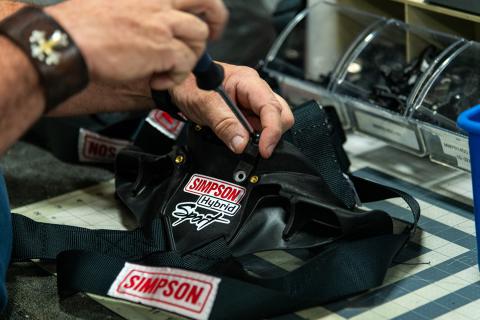
The original HANS (head-and-neck support) device was developed to prevent drivers from sustaining basilar skull fractures by maintaining the relative position of a driver’s head, neck, and body during a frontal impact. As other companies entered the market, the general term for these devices has been head-and-neck restraint (HNR); but Jay Braxton of Simpson Performance Products in Mooresville, North Carolina, said it’s more accurate to refer to them as frontal head restraints (FHR).
“Some racers have incorrectly believed an FHR could provide protection in side impacts,” Braxton explained. “While they help ever so slightly, they provide no real protection in a side impact. They are designed to prevent the basilar skull fracture, historically the leading cause of race car driver fatalities. They work in 0- up to a 30-degree-offset frontal impact. The only pieces of equipment that protect drivers in side impacts are full-containment seats with a proper head surround or driver’s side nets. A correctly set up driver safety system (seat, belts, FHR) offers the best chance for preventing injury or worse.”
A correctly set up driver safety system, which includes the seat, belts, and frontal head restraint (FHR), offers the best chance for preventing injury, according to a source from Simpson Performance Products. This diagram displays the company’s seatbelt installation recommendations for best results.
Before FHRs were mandated, some racers were slow to accept them. But acceptance did grow, particularly among racers young enough that the FHR had always been as much a part of their safety gear as a helmet and gloves.
“That’s one of the reasons we came up with a child device,” Braxton said. “It was important that they start using it when they start racing. It’s a lot easier to get your kid to start doing their homework in first grade than it is in tenth grade.”
Yet, some racers still have fitment problems with FHR devices. “The number-one issue we still see today is incorrect shoulder belt mounting when it comes to not only the use of FHRs, but for driver safety, period,” Braxton said. By “incorrect,” he is referring to the proper mounting angle for the shoulder belts. “Thirty years ago, drivers wanted to mount them about halfway down the back of the seat. They basically came up and over the driver’s body at about 90 degrees. Drivers did that because they wanted to feel like they were pulled down into the seat. But what that does, especially with an FHR, in a frontal to offset-frontal impact, the driver’s body wants to rotate inside those belts, so instead of holding the body back, it’s still allowed to rotate downwards.”
Instead, the shoulder belts “should come over the device and mount at a 0- to 20-degree angle,” Braxton said. “This ensures both a most effective use of the FHR shoulder pad friction in an event, and maximum comfort for the user. Seatbelt harnesses mounted too low can cause compression in the spine, while harnesses mounted too high will not engage the FHR shoulder friction in the event, which is required for the FHR to work properly.”
Frontal head restraints have advanced technologically, yet are offered at a more attractive price point. In fact, these products have become just another standard safety item, especially with younger competitors who have accepted their use from the start of their racing careers.
Braxton has also fielded questions from racers about the horizontal helmet tethers that are specific to HANS devices.
“They would put a HANS on and attach it to their helmet, and we’d get the call: ‘I don’t think these tethers are short enough. I can still touch my chin to my chest. I can still move my head.’ We’d explain that you should still have a complete range of head movement. In an accident, at the beginning of the event their head isn’t swinging forward. First it stretches out forward and then it swings down. Because of the way the HANS is made, in an impact, as the belts stretch and the driver’s body moves forward, the friction of the belts in the device pretty much holds it in place. The driver almost moves out from under it. At the end of the event the tethers have become taut.”
CLICK HERE TO LEARN HOW TO PROPERLY INSTALL HELMET TETHERS AND MAKE ADJUSTMENTS WITH TREVOR ASHLINE AND JAY BRAXTON OF SIMPSON PERFORMANCE PRODUCTS.
This is not the case with a Simpson Hybrid device, Braxton pointed out. “Because the hybrid is attached to the driver’s body and it moves with him in an impact, it is very important that the tethers be adjusted so that while the driver is sitting stationary in the seat, if they stick their head forward, almost like a chicken, they should feel the tethers catch at the furthest point they can stick their head out. Both tethers, once adjusted, should make the shape of a triangle.”
Braxton noted that FHR products “are the only piece of driver safety equipment that don’t have a fixed life span. While needing to be recertified every five years, they can be used for a racer’s entire career. From a mile-per-dollar perspective, they are the least expensive piece of driver safety equipment a racer will ever own. If it saves you a trip to the ER or worse, it has paid for itself many times over.”
Air Flow Research (AFR), the CNC ported cylinder head manufacturer for street enthusiasts and racers, has announced that Alex George has joined its team.
George will be responsible for growing the company’s online presence and overall customer engagement in his new position. He brings over six years of automotive aftermarket experience, holding positions in sales, marketing, and operations.
“It’s no secret that digital marketing, and more specifically social media marketing campaigns, are critical to automotive aftermarket awareness,” George said. “I am very fortunate to join such an innovative company that has dedicated itself to the highest standards in the industry.”
A third-generation drag racer, George has several wins under his belt, including the 2016 and 2017 NHRA Summit Series Super Pro Track Championship at Irwindale Speedway and the 2018 Heritage Series Hot Rod Championship at the California Hot Rod Reunion.
George will also play an instrumental role in AFR’s marketing communication strategy.
George Lane has passed away at 83. He is the founder of Lane Automotive, Motor State Distributing, and Allstar Performance, all based in Watervliet, Michigan.
“From humble beginnings to building an automotive powerhouse, George, a devoted husband, father, grandfather, entrepreneur, and racer, was a true pioneer. He had an unparalleled passion for cars, racing, and really anything with an engine,” a release stated.
Lane Automotive, which began operations in 1964, is a racing and high-performance automotive parts and accessories provider. Over its 57 years in business, Lane Automotive has grown into a multi-generational entity led first by George, then his children, and most recently, his grandchildren.
In 1970, Lane launched the company’s wholesale division, Motor State Distributing, which still brings performance and racing parts from manufacturers across the country to locally owned speed shops and retailers today. He later launched Allstar Performance, a brand focused on specialty racing parts and equipment.
Lane was also inducted into the Michigan Motorsports Hall of Fame in 2001 to recognize his support of local tracks and racers, along with his advocacy for standardizing safety and certification processes across sanctioning bodies.
“Heavily involved with helping to promote and expand the automotive aftermarket industry, George saw the value and importance of supporting the industry’s organizations, shows, and conferences through membership and participation.”
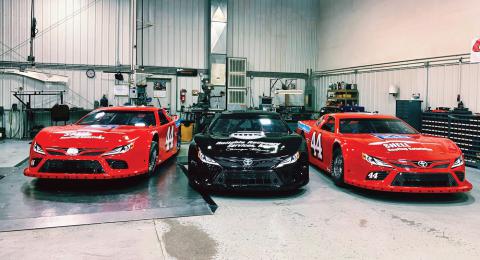
Since a change in ownership in late 2018, the Rowdy chassis has been making its own imprint on Super Late Model racing with a focus on driver safety, effective engineering, and customer support.
According to Cody Glick, the hit that veteran short-track racer Boris Jurkovic took during the 2020 Snowball Derby in December was “one of the three worst” he’d ever seen. (The car was toast, but Jurkovic confirmed for PRI a week later that he wasn’t hurt, just feeling some body soreness).
“The Rowdy car did well,” Jurkovic said. “I hit it pretty hard, but everything did what it should.”
Glick, the general manager at Hamke Racecars and Parts in Mooresville, North Carolina, and owner Justin Oertel told PRI Magazine that Jurkovic’s experience speaks to the company’s focus on driver safety—a commitment that’s engineered into the 55 Rowdy chassis that Hamke has built.
“If things were done like they were done five years ago, he would have gotten hurt,” Glick added. “One thing that really stands out for us is safety. That’s something we really strived to focus on.”
While proud of their safety record, Oertel and Glick are equally focused on putting more racers into Rowdy chassis and putting more Rowdy cars into the winner’s circle. In fact, a Rowdy car won the Snowflake 100 in December, and Rowdy cars took 4th, 5th, 6th, and 7th in the 2020 Snowball Derby, both at Five Flags Speedway in Pensacola, Florida. Glick is already looking ahead to this year’s edition.
“I set a goal each year for how many cars we have at the Snowball Derby,” he said. “For 2019, I projected 10, and we had eight. I projected 20 for 2020, and we had 18. We want to have 30 at the 2021 Derby.”
Oertel and Glick are, of course, well aware that it will take more than driver safety to achieve that goal. They explained that attention to chassis quality, aerodynamics, and wide-ranging customer support will get Rowdy there.
Hamke Racecars and Parts, which produces the Rowdy Chassis, has ambitious goals, aiming to expand its client base by paying close attention to the fundamentals. “We’re trying to make things better, safer, and more affordable to help racers buy more and be able to race more,” said business owner Justin Oertel.
ROOTED IN RACING GLORY
Oertel has been involved in racing for decades, backing race teams with his business partner, Chrystal Beinlich. Twenty years ago, they started CJ Materials and Recycling, a concrete recycling company in Lincolnshire, Illinois, which sponsored race teams. They decided to switch from racing cars to building them for customers, including engines to chassis. (Oertel also operates Hamner Sealed Engines, also in Lincolnshire.)
“We wanted to make racing better for everybody,” Oertel said. “We spent a lot of our own money to do that, but we couldn’t have done it without Cody and our employees; and Chrystal is a big part of what we do. I wouldn’t be here without her.”
The partners purchased Hamke Racecars and Parts from legendary racer and car builder Robert Hamke when he retired in 2018. (Hamke passed away in July 2020.) Then, they teamed with Kyle Busch’s Rowdy Manufacturing brand to focus on Super Late Models. Busch remains affiliated with the venture but is not an owner. The budding company employs 12, including a few carried over from the former Hamke operation.
SIMPLIFY AND IMPROVE
Hamke’s approach to building the Rowdy chassis is based on reducing complexity that Glick said has made things more difficult for racers.
“We’re taking out over-complicated engineering to make it simple again for the average racer,” he said. “Repeatability is key for us. We spend tens of thousands of dollars on fixturing to make sure that happens. So, if you buy one chassis from us and then a second, you can take the shocks and springs off one and put them on the other and hit the race track driving.”
Hamke Racecars and Parts’ management team has invested extensively in facilities and equipment, but nonetheless considers its 15 employees to be the company’s key asset. “We could not do this without them. They’re the heart and soul of this place,” said General Manager Cody Glick.
That approach certainly works for Matthew Craig, who, at 21 years old, has already won five Super Late Model championships.
“The Rowdy cars have been really great,” Craig said. “They’re easy to work on. What I like most is that, at the track, if you make an adjustment, you can really feel the changes. It makes it a lot easier to dial in the car.”
While underscoring that they are continually looking for ways to make racing more affordable, Oertel and Glick said their team does not cut corners on safety and performance. In addition, Glick explained that the Rowdy chassis incorporates some proprietary features that aid aerodynamics, though he preferred not to describe those for publication.
“We don’t spare expense, but we don’t exaggerate it, either,” said Oertel.
While highlighting the investment in equipment to build high-quality chassis, Hamke’s management team does not consider any of its machinery as the company’s most important asset. Rather, they point to the employees. Among the 12 are a core group of techs whose skills are praised by management and customers alike.
“Racers see Cody and me, but they don’t usually see the faces of the people who make it possible for us to do our jobs,” said Oertel.
“We could not do this without them,” added Glick. “They’re the heart and soul of this place.”
The racers, however, do notice. Jurkovic, in addition to being grateful for the cars’ safety, acknowledges Rowdy’s engineering and build quality.
“I’ve gotten to know the crew pretty well,” he stated. “Everything they do is top quality. The welders are great. The craftsmanship is amazing. I do not think you’re going to get better equipment or support. I wish I had this stuff 20 years ago!”
SUPPORT NETWORK
Oertel and Glick see the Rowdy product as much more than a car. While crediting other manufacturers for stepping up track support, the management believes they have elevated that aspect. The support they provide their teams at the track, in turn, supports continual development that benefits all Rowdy drivers.
They tout this feedback loop as a major factor in Rowdy’s growth, because it keeps improving the product. It has, Glick explained, also helped bring new drivers into the sport.
“They want to help all the Rowdy cars get better,” said Craig. “They always come to you on the track to see how you’re doing and to offer help. They bring all the Rowdy drivers together. So, you get four to five teams adding their input and more people working toward making the cars better.”
“Their input is great,” agreed Jurkovic, “and their knowledge is second to none.”
BACK TO SAFETY
Oertel and Glick do not hesitate to steer the conversation back to driver safety. They stress that development there never stops. While maintaining that everything in the cockpit did its job in Jurkovic’s recent hit, they see each wreck as an opportunity to make further tweaks and changes.
“Any advancements we’ve made since starting in December 2018 have focused on keeping the driver safe,” said Oertel. “For example, we’ve got steel plates where others don’t.”
Glick also cited carbon fiber seats, though he acknowledged that not all in the sport agree on its benefits. “I think it’s a great seat,” he said. “It’s also the way we mount it that makes it a good, safe seat.”
For Hamke Racecars and Parts, track support is an important component of its product development and customer relations efforts. “They want to help all the Rowdy cars get better,” said champion Late Model driver Matthew Craig.
As Glick explained, seats are often mounted in two places in the race car, at the back plate and under the driver’s legs. “We go one step further and do three,” he said. “Our seat is mounted with a back plate as well as through the chassis again, right behind the mid-back of the driver, and also under the legs of the driver.”
Both agree that the drive for innovation is based on their experience in racing over the last 20 years. “Everything needed to be changed,” Oertel said. “Where before it might have taken somebody to get hurt to make a change, we’ve taken the necessary steps to eliminate that situation before somebody got hurt.”
Glick elaborated, describing an approach that’s not too different than what the leaders in passenger car safety might do. “We’ve thought of worst-case scenarios, such as ‘if the car hit the wall here’ or ‘if it catches on fire’ to try to prevent things we’ve seen in the past and incorporate into our chassis,” he said.
The decision-making extends into the shop. Management relies on the expertise of the techs to implement new ideas. “It’s a company decision on all things,” said Glick.
GETTING THE WORD OUT
For any racer, the proof is always on the track, and Oertel and Glick have embraced social media to make sure more people see the proof. They hired Molly Helmuth, owner of 9D Creative, to start and manage the program, and it now plays a significant role in their marketing.
Helmuth, who previously drove in the CARS Super Late Model Tour, moved from her home in Seattle, Washington, to North Carolina. She has been managing Rowdy’s social media platforms since the shop started just over two years ago, and also handles the website and other marketing.
One of Hamke’s top priorities is driver safety, and it remains core to the company’s approach. “We’ve thought of worst-case scenarios, such as ‘if the car hit the wall here’ or ‘if it catches on fire’ to try to prevent things we’ve seen in the past and incorporate into our chassis,” said Cody Glick.
Helmuth steadily posts on the company’s Facebook page, Instagram and Twitter accounts, including her own photos and video from races and the shop.
“I like to highlight all the teams, all the pole positions and, of course, any wins. You have to keep the content fresh and relevant to the fans,” said Helmuth, who conveniently lives close to the shop. “It’s important for me to post up-to-date photos every week since operations move so quickly in the shop.”
NEVER STOP LEARNING, IMPROVING
Whether in the shop or on the track, Oertel and Glick express a clear vision for how they will achieve their goals for Rowdy and their drivers. Keeping those goals in sight is an ongoing race.
“It’s a non-stop learning process,” said Oertel, who applies a long-term view to that philosophy. “On a daily basis, we’re trying to make things better, safer, and more affordable to help racers buy more and be able to race more. That is what’s going to keep us around for the next 20–30 years. Whatever we can do to give back to the sport and help the racers is better for everybody.”
Engine Parts Group, also known as Engine Pro, has announced the addition of NPW Companies as its newest member. NPW is a Florida-based automotive parts distributor with 30 warehouse locations and more than 50 store locations across the US.
NPW had recently purchased Engine and Performance Warehouse Inc. (EPWI), a founding member of the Engine Parts Group.
“We are thrilled to welcome NPW to the group. The move strengthens all of us and puts Engine Pro in an even better position to serve professional engine builders with the parts they need,” Engine Parts Group President Jesse Jones said.
With 98 distribution centers, Engine Pro is one of the largest engine parts distribution networks in the US. It also maintains warehouses for European and Australian markets and carries more than 100 brands, including its own Engine Pro and Nitro Black products.
NPW distributes more than 700 brands and has more than one million part numbers in stock.
SEMA, the Specialty Equipment Market Association, is accepting nominations for its Hall of Fame at sema.org/hof.
Established in 1969, the SEMA Hall of Fame recognizes people who have contributed a significant body of work to the industry over a long period of time and is the most prestigious award presented to an individual by the association. It is designed to honor the leaders, innovators, creators, and enthusiasts who transformed small, burgeoning businesses into an industry worth more than $46.2 billion annually.
To nominate an individual who epitomizes the essence of ingenuity in action, visit sema.org/hof before the deadline on Friday, March 19.
To see the complete list of SEMA Hall of Fame Members, visit here.
To learn more about the SEMA Hall of Fame and for a list of inductees, visit semahof.com or contact Lindsay Bianco at lindsayb@sema.org or 909-978-6692.
While manufacturers aren’t completely reinventing their suspension components, they are releasing new products with notable improvements for better results in 2021.
Suspension setup and tuning continues to play a pivotal role in the development of competitive race cars. Although the fundamental strategies that teams call upon to more effectively put power down at the drag strip or coax more cornering speed out of the car have held true for decades, the methods and components used to accomplish those goals continue to evolve. And that, in turn, has seen trial and error give way to a more sophisticated and nuanced approach.
“The design of suspension components often evolves gradually over a long period of time, and big innovations usually take a while to see widespread adoption,” said David Cardey of Eibach Springs, Corona, California. “But the way racers are using the available components changes at a much faster rate, and those trends can help indicate where development focus is headed.”
Cardey said that as load raters and pull-down machines have become more accessible in recent years, teams are using a more targeted technique when it comes to tuning in general. “With the car simply sitting on a flat surface it’s not going to represent the forces each corner is seeing on a dirt track,” he explained. “For example, a pull-down machine allows you to pull down or push up to get the car at a race position to really see what the wheel loads are out on the track. More and more people are starting to realize that they’re racing against folks who are using these machines, so it’s becoming an increasingly important part of a lot of teams’ racing programs.”
And as such, the newest products and trends in competition suspension are more about providing racers at all levels of motorsports with the tools to better dial in their cars than it is about reinvention.
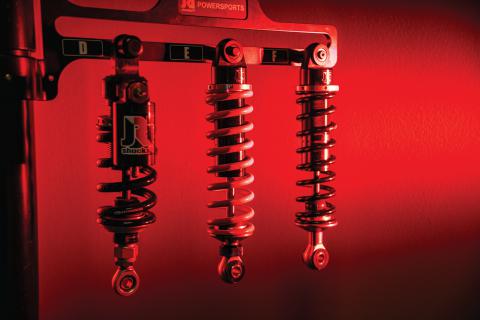
Although basic theories of race-car setup can remain the same for decades, specific methods and components are constantly evolving. For example, QA1’s new MOD Series shocks are designed for faster valving changes, enabling racers to tune their cars more effectively for different tracks and conditions.
“This past season has obviously been really unique in that racers haven’t had as many options for events to go to as they did in the past,” said Dave Kass of QA1 Motorsports, Lakeville, Minnesota. “So what we’re seeing a lot of racers do is establish a number of different setups for the varied events that are available to them, and that requires components that can be easily dialed in to the requirements of each.”
PRECISION TUNING
Kass cited QA1’s new MOD Series shocks as an example of this development trend. “This design transforms how racers look at tuning their shocks. What makes it unique are the patented QuickTune valve packs. These packs allow you to completely remove the existing valving in the shock and put in new valving without removing anything but the valve pack. It’s a totally dry system that gives you the capability to completely change the shock characteristics in about two or three minutes. In that respect, it’s unlike any other shock on the market.”
With a conventional system, shock valving changes would normally require the shock to be removed from the car and disassembled in the pits to be re-valved or sent to a shock tuning specialist to make changes. “There’s a lot of time and effort involved in that—it’s usually not feasible in between runs or sessions in a given weekend,” Kass said. “But with this design you can just keep a handful of these valve packs in your toolbox—each one is about the size of a quarter—and pop them in and out of the shock to change your valving as needed, depending on what you’re doing and how the car is behaving. Each pack is held in with five Allen bolts—unbolt the one, pop in the new one, done. And if you think about it, in terms of corner balancing the car and getting everything dialed back in from a chassis standpoint, it’s really convenient because you don’t need to mess with any of that.”
All motorsports require their own unique approach to car setup, which has fostered intense development of shocks, springs, and struts. “If you’re looking at two different products that do the exact same thing, and one weighs half as much as the other, the benefit is pretty obvious,” said our source at RE Suspension.
He added that the development of the MOD Series shock was influenced by identifying an area where racers’ ability to tune their cars at the track had plateaued. “We really wanted to make sure we were building a shock that was solving a legitimate problem that people were having out there in the field. We wanted to solve an issue that hadn’t been solved before,” he said.
VERSATILITY BY DESIGN
With production-based competition continuing to see strong interest across various motorsports disciplines, the ability to use race technology within the confines of OE suspension designs has also become increasingly important for many racers.
“Our new universal strut insert allows us to take an existing strut application like a Ford Mustang or a Porsche 911, remove the stock internals of that strut housing, and simply drop our insert in,” explained Aaron Lambert of Penske Racing Shocks, Reading, Pennsylvania. “In the past we’ve often been somewhat limited on the actual fitment of our inverted strut, so by designing a universal insert, we can make that racing technology work within the packaging of a stock strut. And that also allows customers to utilize existing spring mounts and things like that, so it’s a simple, bolt-in application.”
In off-road racing, the suspension tuning strategy often focuses on maintaining stability over varied terrain. And accomplishing that requires the system to behave differently depending on the specific situation. As a result, manufacturers have responded with a number of different solutions. As one of our sources explained, “It’s all about finding the right combination for the car and the terrain of the event.”
Lee Grimes of KONI North America in Hebron, Kentucky, said that the use-case for universal strut inserts also goes beyond late model production-based race cars. “Some older cars just aren’t supported by the aftermarket at this performance level, and there are a lot of people who’re building these cars to higher degrees than they have been in the past. A 25-year-old Toyota MR2 can be really fast with some modern upgrades, but there aren’t a lot of plug-and-play solutions out there for those suspension systems. By being able to upgrade the existing strut housing with our racing single or double-adjustable universal inserts, you’re effectively solving that problem. We’re seeing these used more and more not only in grassroots endurance series like ChampCar and American Endurance Racing, but also in SCCA and NASA autocross and time attack events. And those solo disciplines continue to have the biggest car counts in road racing.”
ADAPTING TO THE SITUATION
In disciplines like dirt and asphalt circle track racing, suspension setups often require a highly specialized approach in order to maximize stability and grip, and that’s led manufacturers to develop a number of different ways to approach common issues.
“We recently developed a device that’s designed to add pre-load to existing bump springs,” said Jason Enders of RE Suspension, Mooresville, North Carolina. “These are useful when you’re looking for a specific load number but want the least amount of rate gain throughout the suspension travel. That’s important when you’re trying to really mitigate instability on rough tracks and prevent the suspension from over-traveling, which in turn helps to improve grip. Using these bump spring preloaders in the left front of an asphalt car can help to control sway bar wrap—as the suspension goes down, that bump stop is not gaining near the amount of load that it would otherwise. We’re basically eliminating variables; if we can help reduce some of that bar wrap by maintaining a more stable platform that doesn’t rely on that bar so much, your bite off of the corner tends to be a lot better. So, where you’d normally have to run a 1,500-lb. bump spring in a corner of the car, we can back that off to, say, 800 lbs. and not gain the rate through the suspension travel that we would with the 1,500-lb. bump spring.”
Enders said that while other preloaders have been on the market for a while now, RE Suspension has taken a different approach with its design. “The reason we developed this is because what was out there was big and heavy—they’re like a big can that you put the bump spring inside of and screw together. So instead of grabbing the outside diameter of the spring, we grab the inside diameter. Weight is always a concern when you’re building a competitive race car, and this design allowed us to take a lot of weight out of it. If you’re looking at two different products that do the exact same thing, and one weighs half as much as the other, the benefit is pretty obvious.”
Penske’s approach to maximizing stability in dirt late model racing focuses on making it easier for racers to adjust the spring rate with an air shock design, according to Lambert. “The shock itself works like any normal damper, but then it has an external body that seals and creates an air chamber that we use as the spring,” he explained. “By designing it that way, it allows you to simply adjust the air to change the spring rate. That really allows these guys to dial in the compliance to make sure the car maintains grip and doesn’t lose stability over bumps. And by being able to tune your spring rate with air, it also saves the customer money because they don’t need to have a ton of different coil springs in their inventory.”
Load raters and pull-down machines allow teams to tune their suspension setup with greater precision by more accurately simulating real-world conditions. “With the car simply sitting on a flat surface it’s not going to represent the forces each corner is seeing,” said one of our contacts.
For off-road racers, much of the suspension tuning strategy is centered on effectively maintaining stability over a wide variance of terrain, and accomplishing that requires the system to behave differently depending on the specific situation. This, too, has brought a number of different solutions to the table.
“Stacked setups are becoming very popular in the UTV market,” Cardey said. “By using two springs in series, the dual setup allows them to have a softer ride over the small choppy stuff and also have a heavier rate when the vehicle is really starting to travel. If the rate is too heavy the car will want to buck over everything, and if the setup is too light it’ll want to bottom out, so it’s all about finding the right combination for the car and the terrain of the event.”
While the concept is similar to that of a single, progressive-rate spring, using two springs in series allows for greater adjustability. “The problem with a progressive spring is that it’s locked into specific rates and a specific point of transition,” he added. “With a dual-rate design, you have a slider and lock-out that allow you to control when that transition happens in the suspension travel, and you can change the rate of each spring by simply swapping one out for another, so there’s a lot of tuning available that you can’t do with a progressive spring.”
Spring rubbers are also a popular option for racers who’re looking to change the effective rate of a linear spring without actually changing out the spring itself. “If you’re in practice and you’ve got a 300-lb. right rear spring in the car and want to see if a 325-lb. or 350-lb. spring is going to work better, you can put one of these in and temporarily change that spring rate,” Enders said. “It’s a quick way to determine if that’s what you need in order to improve the car or not. After practice a team might take that spring rubber out and put in a 350-lb. spring and go racing, but some folks will run spring rubbers for an entire season or more.”
Spring rubbers are a popular means of changing spring rates, without changing the spring itself. “It’s a quick way to determine if that’s what you need in order to improve the car or not,” said our source at RE Suspension. Many racers then change springs based on this information, but some simply leave in the spring rubber.
He also noted that these spring rubbers can be a low-cost way to turn a linear spring into a progressive one. “When you start adding multiple spring rubbers, you’re essentially turning it into a progressive spring because it’s functioning at different spring rates across the travel of the suspension. So that’s become a pretty big tuning tool—it’s becoming more and more common in asphalt circle track racing for teams to run a right rear spring with four or five spring rubbers in it to make it progressive. And the cool thing about it is that you can actually tune that progressiveness, both with the durometer of the spring rubber material and the height of it. That allows you to determine when it gets progressive, and by how much,” Enders added.
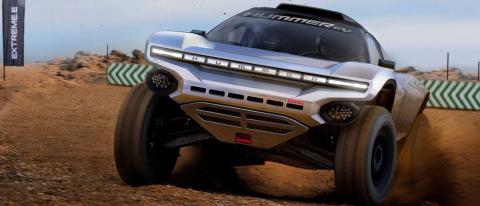
GMC has announced a new multiyear sponsorship with Chip Ganassi Racing (CGR) for the team’s first electric racing venture in the inaugural Extreme E season in 2021.
CGR will compete in a 550-horsepower electric SUV inspired by the GMC HUMMER EV.
“It’s truly an honor to represent GMC, especially during such an exciting time in auto racing,” CGR Team Owner Chip Ganassi said. “The new GMC HUMMER EV is going to be a game changer in terms of how the world views off-road EV capability, and we couldn’t be more proud to represent GMC in such an innovative new series.”
Noted off-road racers Kyle LeDuc and Sara Price will serve as drivers for CGR in the series.
The Extreme E five-race global championship will take place in some of the world’s most remote locations and promotes the adoption of electric vehicles.
Season 1 Extreme E Calendar
Desert X Prix: AlUla, Saudi Arabia: April 3-4, 2021
Ocean X Prix: Lac Rose, Senegal: May 29-30, 2021
Arctic X Prix: Kangerlussuaq, Greenland: Aug. 28-29, 2021
Amazon X Prix: Para, Brazil: Oct. 23-24, 2021
Glacier X Prix: Patagonia, Argentina: Dec. 11-12, 2021
An award-winning TV sportscaster embraces the opportunity to promote the personalities and stories of IndyCar racing.
Hoosiers—or people from Indiana, for those unfamiliar with the nickname—love their auto racing; they love their basketball, too. And many of them likely miss watching the Emmy Award-winning coverage of those and other sports by Dave Furst for Indianapolis ABC-affiliate WRTV Channel 6.
After 23 years, Furst recently left the station to work inside the sport he loves, joining the NTT IndyCar Series as vice president of communications. Among other responsibilities, he’ll be working to raise the profiles of drivers and teams, a role that seems ideally matched with his broadcasting experience.
Furst began his sportscasting career with ESPN, covering Indiana University football while he was a student there. In his time at Channel 6, he became sports director and won 25 regional Emmys, including one for a 2006 story on Danica Patrick, along with features on renowned sportscaster and Indy 500 announcer Tom Carnegie and racers Dan Wheldon, Ryan Hunter-Reay, and Tony Kanaan. The “Trackside 6” features Furst did with 2013 Indy 500 winner Kanaan also won awards.
Not long ago, PRI sat down with Furst to learn more about his vision and goals for the NTT IndyCar Series.
PRI: Who or what brought you into the racing world?
Furst: My dad. Growing up in southwestern Indiana, we would attend races in Haubstadt. Tri-State Speedway was where I was first introduced to the sport. Then, it was a trip to my first Indianapolis 500 in 1979. My family rented a camper, and we stayed in the North 40. I remember the sights, smells, and sounds the night before the race. Race day was unforgettable. We sat in the middle of a huge group of fans wearing white “Mears Gang” T-shirts. I didn’t know who Rick Mears was at the time, but I did by the end of that day. I returned to see all four of his Indy 500 wins. I was hooked on racing.
PRI: Why is this position a good fit for you?
Furst: One of the things I enjoyed in my years at WRTV was telling the stories of the Indy 500. What these men and women could do on the track was special, but to be able to show their off-track personalities also really interested me. WRTV had a long history of doing that, led by legendary WRTV Sports Director Tom Carnegie. To be able to carry that tradition was an honor and something I never took for granted. Now, I get to amplify those stories in a whole new way.
PRI: How are you planning to enhance this role at the NTT IndyCar Series?
Furst: My career remains about storytelling. That’s what intrigues me in making the transition. The Penske acquisition has given this sport I love even more momentum. An opportunity to join such an outstanding marketing and communications team is a chance I could not pass up.
PRI: What do you see as the biggest challenges ahead of you?
Furst: It’s about pivoting to new learnings and new aspects of the sport. In some ways, it’s like a different language. But, there’s a hardworking team here that has helped me get started and will continue to do so as we go into 2021.
PRI: How would you say COVID-19 might impact your efforts there in the near term?
Furst: If 2020 has taught us anything, it’s that being nimble is key. At its heart, it’s about telling the stories that make each season special. Challenges come in many ways; champions are able to overcome and persevere in the midst of it.
PRI: Can you share your top strategic goals for the next 12 months?
Furst: Storytelling will be key. There are so many good stories in the NTT IndyCar Series, and the people are second to none. The racing is as good as you’ll find anywhere—the best, I would argue.
PRI: What changes would you say race teams, race fans, and business partners will notice—or what do you hope they notice—as a result of your efforts?
Furst: It’s not about me. It’s about a highly accomplished group that will work with race teams, partners, and others while also keeping up with the many avenues that deliver information to the fans, young and older alike.
PRI: What’s your most gratifying professional accomplishment?
Furst: The relationships I’ve had with drivers, crewmen, owners, and others—that’s something I take to heart and something I’ll take with me for years to come.
PRI: Who inspires you, and why?
Furst: My grandfather. Smartest man I know and someone who pushed me to be a better person. He was a WWII vet, Purdue grad, and an engineer at General Electric. He passed away several years ago, but I always wonder what he would say about current events. It was all a part of a family who had dealings with Tony Hulman during the “Hulman and Company” days. Life has a way of circling around.
PRI: What can you not live without, and why?
Furst: My kids—returning home after a crazy day and having them bring me back to what matters.
PRI: What do you enjoy in your off-hours?
Furst: Coaching basketball. Zach, my 9-year-old, loves playing and working on his game and, having grown up playing basketball myself, I enjoy coaching it. If he’s not playing, we’re catching up with the Indiana Pacers or Indiana Hoosiers. Basketball and racing—we love them both in Indiana.
DAVE HURST
–
Title:
Vice President of Communications
Organization:
NTT IndyCar Series
Hometown:
Indianapolis, Indiana
Fast Fact:
Furst has won 25 regional Emmy Awards for his broadcasting work dating back to the late 1990s, including one for a story he did on retired racer Danica Patrick in 2006.
The PRI Road Tour sat down with Daniel Vehse of Track Master Products in Ventura, California, to discuss its beginnings, which started with a vision by the late Jerry Magnuson.
Track Master Products manufactures performance parts to fulfill garage builders' dreams. Vehse touches on Magnuson's influence on the supercharger aftermarket, how Maureen Magnuson continues Jerry's legacy today, and more.
Plus, you'll want to hear Track Master Products' five-year goal!
 MEMBERSHIP LOGIN