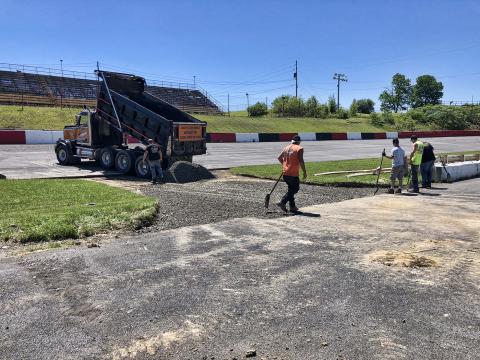
Shannon and Denise Littleton, along with Ken Brewster, have taken ownership of I-75 Raceway in Sweetwater, Tennessee. The group has purchased the 1/3-mile dirt track from longtime owners and operators Tim and Angie Kyle.
“We cannot wait to watch them take I-75 to a new level. You’ll still see the same smiling faces as you enter the gates, as we all plan to stand behind them and support them in their great adventure,” the Kyle family said in a written statement.
Plans for a track reconfiguration for the new season have begun, with racing expected to start in March or April, depending on the weather.
Officials have also announced classes and rules will remain the same in 2021, except for the dropping of the A-Hobby class and the addition of the 602 category.
Cometic Gasket, the provider of gaskets and engine sealing solutions, has announced the acquisition of Klotz Synthetic Lubricants, according to published reports.
Klotz Synthetic Lubricants was founded in 1959 by John C. Klotz Jr. in Fort Wayne, Indiana. The company specializes in racing, high-performance, and traditional lubricants, and markets include automotive, karting, marine, motorcycle, and RC categories.
As part of the acquisition, Brad Kruckenberg has been appointed as the new president for Klotz Synthetic Lubrication. At the same time, company founder Klotz will continue in a leadership role as Chairman Emeritus.
The business will continue to engineer, formulate, and package its purpose-built lubricants out of its Fort Wayne headquarters.
How supercharger, turbocharger, and nitrous manufacturers are helping racers and engine builders get more out of their performance packages.
“We’ve hit one of these golden ages of horsepower again.”
That’s how Ryan Witte of Holley Performance Products in Bowling Green, Kentucky, summed up what many in the performance industry are thinking about engine power.
“Back in 1994 when we were founded, when you bolted a ProCharger to a 1993 Mustang Cobra, you’d be blown away that you could end up with nearly 400 horsepower from that pushrod 5.0-liter motor,” recalled Erik Radzins of the Lenexa, Kansas, supercharger manufacturer. “Now you can take a bone-stock GT or Bullitt Mustang, add our standard Stage 2 system with a P-1X, and make 1,000 horsepower at the crank—900 at the wheels—with ease. All it takes is our kit, a fuel system, and some E85 in the tank. If you had told me 15 years ago it was going to be that easy, I might have looked at you a little funny. But here we are, and it’s amazing.”
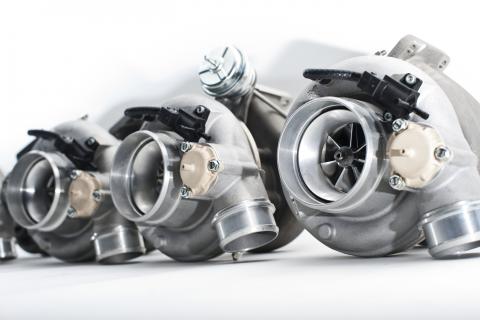
Bolt-on supercharger kits have made it relatively easy to attain unprecedented horsepower levels. Engineers now see efficiency improvements as the key to further gains. “Parasitic drag and air temperatures are the enemy of making power,” said our source at Edelbrock.
“Racers are constantly pushing the envelope for power needs,” added Jimmy Martz of Vortech Superchargers, Channel Islands, California. “We can see our V-30 race superchargers continue to evolve and support upwards of 3,500 horsepower and beyond in the next couple of years.”
To better understand how racers are achieving those ever-growing power numbers, we recently polled several key players in the power adder category—supercharger, turbocharger, and nitrous manufacturers—to get their read on how to maximize engine output, new products they’re excited about, and how racers and engine builders can better take advantage of this new golden age.
Efficiency
“Bigger is not always better” was a common theme among several of these companies when discussing making power.
“It’s easy to cram a bunch of air into an engine and make a lot of boost,” said David Page of Edelbrock, Torrance, California. “But that’s not always the best strategy. As supercharger and turbocharger designs have become more refined, engineers have looked at things like efficiency. Parasitic drag and air temperatures are the enemy of making power.”
Managing air temperature is “a huge factor in making power,” Page added. “I wouldn’t call it free horsepower. It takes energy of some kind to reduce temperatures.” But products like Edelbrock’s Dual Pass three-core intercooler “uses three oversize intercooler cores and passes the air through twice for reduced air temperatures. That equals a cooler air charge, which equals more power and reliability.”
“People are constantly looking for and focusing on a big boost number, but an overspun blower will lose efficiency and make less power even if the boost number is high,” said Martz. “That’s the hardest thing to get across to customers now. Size doesn’t always mean more power. Sometimes you can have a blower that’s too big for an application. It’ll be sluggish down low and make too much boost up top. We try to design for specific applications and specific motor combinations.”
Kevin Kenney of AGP Turbo in Tempe, Arizona, has had similar issues with customer preconceptions about turbocharger size. “They’ve read something online from a guy who put a giant turbo on a small engine. The car did do the quarter-mile very fast, but it might have gone just as fast with a much smaller turbo that would have also spooled up much quicker, been easier to race, and given you a lot of streetability. If that person had actually tested both back-to-back, they would have picked the smaller turbo because it actually did work better.”
Durability
The quest for power is having a downstream effect on engine components, according to Witte. “We’re going to have to find the limits of engines again before we can add more power to them. Things like cylinderhead sealing, and block and cylinder-head strength and integrity are going to come up,” he explained. “From what I’ve heard, some drag race teams are only getting between five and 20 runs out of a crankshaft anymore. I don’t know if adding power is what they’re concerned about as much as increasing durability while decreasing ET. If you can work with data and better controls so that the entire car and powertrain are working less to do the same thing, you can increase durability.”
Durability is also a concern with the power adders themselves. “Hardcore, exotic turbos are now creating engines that make two, three, even four or more times their original engine output,” said Geoff Raicer of Full-Race Motorsports, Phoenix, Arizona. “When you’re tripling engine output, you have to expect things to fail. But the fact is, that’s not an option if you’re trying to win races.”
3D printers and CNC machines, combined with information gathered from data loggers, have been major influences that directed the team at Nitrous Express to develop products at a standard that would not have been achievable in years past, reported a company source.
A turbocharger rotates at anywhere from 80,000 to 200,000 rpm, Raicer pointed out. “For reference, a jet goes supersonic—Mach 1—at 767 mph. The bullet out of a .357 Magnum is traveling at 917 mph. The rotational speed of a performance turbo at full tilt is 1,342 mph, Mach 1.7. There’s so much energy contained in these turbochargers at these rotational speeds, that when a turbo fails during overspeed, the turbine wheels explode. Can the housing contain the shrapnel of the wheels exploding? Losing races sucks. Blowing up your parts is even worse. But failed turbos can hurt people.” That’s why Full-Race works with companies that perform burst-containment validation testing on their turbos, like BorgWarner, Garrett, IHI, and MHI. “These are massive companies with a lot on the line. They cannot allow an accidental death to occur.”
Crunching the Numbers
The search for more power isn’t always in the hardware. “Data loggers are showing us more data than ever,” said Ryan Lewis of Nitrous Express, Wichita Falls, Texas. “They’re giving us more knowledge about what nitrous and fuel are doing while traveling through the intake manifold, into the cylinder and out the exhaust. This, paired with 3D printers and CNC machines, has helped us develop products at a standard that would not have been achievable in years past.”
Sometimes, though, improvements can be made through lower-tech means. “The simplest thing that is often overlooked is the nitrous bottle valve,” Lewis said. “We have seen people switch from a conventional bottle valve to one of our billet aluminum Lightning 500 valves and pick up as much as 20% in nitrous flow.”
Holley recently released a Version 6 of its engine controller software that includes “a new view in the software to look at all the nitrous stages together on one screen,” Witte said. “You can see what the cumulative nitrous and fuel was in all the stages when they’re all on. That came from talking to racers who wanted an easier way to see what their six-stage nitrous system was doing at any point during the run.”
When talking about nitrous control with his racing customers, Witte has heard that “the fuel is becoming more critical to control than the actual nitrous. Nitrous control is fairly simple when you get to the higher-level stuff. They turn the solenoid on, and it flows a certain amount. But making the fuel do exactly what they want at every point of the run to keep the engine happy has been where we’ve been concentrating with our products.
Monitoring and controlling stages of nitrous is increasingly seen as the biggest key to success with this power adder. Our source at Holley said racers wanted “an easier way to see what their six-stage nitrous system was doing at any point during the run.”
“Putting in more fuel and adjusting the timing in a motor for the additional power is easy for any EFI system these days,” he continued. “What separates one EFI from the other is how well you can control that power, how good is your boost control, how good is your nitrous progressive controller, what sort of timing management can you do. It’s more about managing power than making it these days as far as an engine controller is concerned.”
The sensors in an EFI system can also help the car go down the track faster and more reliably, he added. “We can add sensors to everything. For example, the amount of data we can collect from the torque converter to the back of the car is immeasurable in making a car go faster. Many engine guys get caught up with the engine making more power, when a converter can be worth five to six mph in the eighth-mile, and that’s so much easier to do. All you need is a driveshaft sensor plus your engine rpm to figure it out.”
At the Shop
The relationships these power adder companies have with engine builders run the gamut from a close partnership to more of a “you do your thing, I’ll do mine” situation.
“We pride ourselves in working directly with our customers, engine builders, and racers,” said Martz. “They have access to our knowledge base on what works and what doesn’t. We like to think the users of our products are an extension of the Vortech brand, and we do everything we can to make sure they are using the correct blower for their application to make the most power available.”
That relationship can be beneficial to both the racers and Vortech, Martz said. In working with drag racer Terry Leggett, “who was running our 131A, he needed a little more power up top. We observed his engine, looked at the airflow requirements to make more power, and made a new iteration of the 131A specifically for him, to make sure he’d have the power he needs to be competitive.” Vortech then replaced the 131A in its lineup with that new supercharger, now called the 131B. “The 131B is now proven to make more power in all situations, so it becomes the new production blower.”
“We usually work just with the racers,” said Kenney. “Engine builders stick to the engines, mostly, and usually we’re dealing with the guy building the car or the guy who owns the car. And his engine builder is fine with it. He builds an engine that’s capable of making 2,000 horsepower, and we tell them which turbos are going to be the best to make 2,000 horsepower for that engine.”
“Full-Race works with engine builders around the world and in many different types of racing venues,” Raicer said. “Some guys are awesome to work with. They totally get what we’re doing and are all about it. Others are like, ‘None of this is new. I’ve been using turbos forever. I know how to do this and don’t need math.’ But if we can work together and have an open mind, reaching across the aisle and learning from one another is the best way to get something done.”
Because of their high-efficiency design and minimal heat transfer, centrifugal superchargers can produce greater power gains than positive-displacement units. In addition, centrifugal superchargers can more effectively utilize intercooling for further gains.
The most successful engine builders are “using all the data that’s given to them,” said Witte. “They’re looking at any and every line of data in the logs from the engine, from the car, and from their customers, and making science-driven choices based on them.”
“One common factor in any successful race effort is preparation,” added Page. “Those who spend the time researching and preparing for competition will consistently win.”
What’s New?
Not everyone we spoke with was ready to reveal the new products they have in the pipeline—we did get a few, “We are keeping these developments close to the vest right now,” and “We can’t release further information at this time.” Some, though, were happy to share.
Vortech has developed a new billet bracket to mount its popular V-30 race superchargers to any LS-based engine. “Our V-30 superchargers are modular,” Martz explained. “The same gear case is used from 1,200 horsepower all the way up to 3,000 to be utilized for different race classes.”
Engine compartment constraints can dictate supercharger mounting. For cars where space isn’t an issue, an external gear drive such as this one is often a preferred option. A source from ProCharger said their team is continuing to expand the CrankDrive gear drive line, aiming to offer a complete solution for a wide array of engines.
Vortech also offers gear-drive packages, as racers like the V-30’s gear drive “but sometimes they don’t have the space for it. We’re designing these race brackets for alternative mounting solutions.”
Walt Sipp at ProCharger said the company is “continuing to round out fitment for our popular CrankDrive gear drive. This gives racers, engine builders, and chassis builders a complete solution for more engines than ever without having to modify or buy parts from multiple places. We now have direct fitment for small block Ford, small and big block Chevy, LS, Noonan, AJPE, BAE, Visner, and MBR. We also continue to evolve and improve race blowers to maximize power and durability, and recently released our new Pro Mod-focused Competition Bypass Valve.”
Raicer mentioned upgrades made by turbocharger manufacturers—some of them ongoing—to improve their components.
In the decade since BorgWarner introduced its EFR (Engineered for Racing) ball-bearing turbos, “we’ve seen them prove themselves to be just crazy reliable,” Raicer said. “The IndyCar teams focus on tires, suspension, aero, and they never have to think twice about the EFR turbo reliability. The other really cool thing about their turbo is the Gamma-Ti turbine wheel material. It’s not metal and it’s not ceramic. It’s called an interstitial compound that’s part titanium, part aluminide, and one-half the rotating mass of a traditional Inconel turbine. This really makes a difference, especially in a road race, circuit, street, or drift setting where spool is everything. They’re remarkably responsive.”
Garrett has recently “brought out their latest turbo technology they call the G-Series turbos,” Raicer added. For its turbine wheel material, “Garrett went to an exotic superalloy called Mar-M247. It’s not as low mass as BorgWarner’s, but it can be used in larger diameter turbos and handle higher exhaust gas temps for applications where EGT may exceed 1,000 degrees Celsius. The Garrett turbos can do things that the BorgWarner can’t, and the BorgWarner can do things the Garrett can’t. It’s different approaches. It’s truly racing.”
Reliability is an important aspect of supercharger and turbocharger development. BorgWarner’s ball-bearing turbos allow teams to “focus on tires, suspension, aero, and…never have to think twice about the EFR turbo reliability,” said our source at Full-Race Motorsports.
Further into the future, Raicer sees potential in e-Turbos. “These are turbos with a brushless electric motor in their center section,” he explained. “You don’t have to wait for exhaust gas to spool the turbo. You can have boost any time you want it at the touch of a button.” E-Turbos also don’t necessarily need a wastegate to expel excess boost. That energy instead can go to regenerating power for the battery.
E-Turbos are already in use in Formula 1 racing, and they’re beginning to appear in OE and commercial vehicle applications. The challenge in further adaptation, said Raicer, is how to power and control them. “You need a huge amount of energy to power an e-Turbo. Most cars use 12-volt electrical systems, but to run an e-Turbo you need a minimum of 48 volts, ideally more.”
While e-Turbos may be a decade or more away from impacting the aftermarket, “in the near-term electronic wastegates are the first sign of turbo electrification,” Raicer said. “Every new Honda, Ford, and BMW has an electronic wastegate. They are without question the first electrification we’re seeing. And it’s our job to begin bringing electronic wastegates to the racing and performance community.”
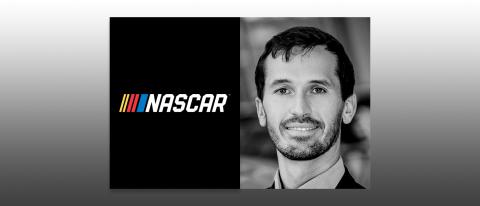
Drawing from his motorsports background—including 11 years as a driver—NASCAR’s vice president of racing development and his team are focused on the premier sanctioning body’s continuity through an expanding fan base and changing technological landscape.
For every day of his life, motorsports has been close at hand for Ben Kennedy. The great-grandson of NASCAR founder Bill France (Big Bill), Kennedy embraced auto racing on his own terms when he began a successful driving career that progressed to a full-time presence on the NASCAR Camping World Truck Series from 2014 to 2016.
A graduate of the University of Florida, Kennedy’s career path took a turn in recent years as he stepped away from driving to focus on the family business—NASCAR. At 29 years of age, Kennedy is regarded as an important member of the next generation of motorsports leadership. In February 2020, he was elevated to vice president, racing development of NASCAR, with a focus on scheduling and the regulations that govern the sport. Kennedy previously served as general manager of the NASCAR Camping World Truck Series.
Kennedy’s ascension to vice president came during a year teeming with challenges. The COVID-19 crisis threatened the NASCAR season this past March, just as NASCAR was in the midst of developing several key initiatives such as the Next Gen car and the first major schedule realignment in many years. But Kennedy and his colleagues rallied, and the 2020 NASCAR season was successfully completed this past November at Phoenix Raceway.
In the brief interlude between racing seasons, Industry Insights caught up with Kennedy to discuss a range of topics, including the 2020 race season, his leadership goals, and NASCAR’s future plans.
PRI: When the checkered flag waved at Phoenix for the 2020 season-ending weekend, what was going through your mind? Relief? Happiness? Amazement?
Kennedy: I think a little bit of everything. It was great not only to get Phoenix and our championship in, but our entire season. We’re one of the few—if not the only—sports out there to get our season in, in its entirety. We were able to crown a champion without any asterisks. We were excited to get the weekend in, and to get our season in. We’re ready to focus on next year, with an eye on Daytona 2021. (Editor’s Note: This interview was conducted in December 2020.)
Ben Kennedy assumed the role of vice president, racing development at NASCAR in February 2020, a year packed with challenges for all motorsports. “We’re trying to figure out what the new normal looks like,” he said. “Not only globally but within our sport.”
PRI: You moved into your current position at NASCAR just weeks before the COVID-19 crisis arrived. I suspect it’s been difficult to figure out what “normal” will be like in your new position.
Kennedy: Without a doubt. We’re trying to figure out what the new normal looks like. Really, not only globally but within our sport. This past year has challenged all of us, and it’s challenged the sport and the industry. We certainly accomplished a lot in 2020 getting our season in and being the first major sport to do so.
It’s brought a unique opportunity for us to continue to work together better than we ever have before. It’s also been an opportunity to try new things, too. We’ve tried things like midweek racing and double-headers, shaking up the schedule. We went to the road course here in Daytona in August, for example. It was an opportunity for us to take a step outside the box that we wouldn’t have had otherwise. From race procedures and everything that goes into a weekend, it’s really challenged us. To see the entire sport lean into something like this and make the best of it, that’s incredible.
PRI: You raced extensively the past few years, and that’s obviously very valuable experience. How much does your experience shape the management approach you take?
Kennedy: It’s been very helpful. There are times when I look back on my racing career, and at times I didn’t think I’d be able to apply what I learned to anything except driving a race car. There are so many things that were easily taken for granted; now I look back and say, “Wow, those were really valuable experiences.” They added a lot of perspective. But being able to be a driver and being on the team ownership side and competing every weekend, it has given me so much insight into things that I otherwise wouldn’t have had the opportunity to learn. Particularly on the competition side, it’s been really helpful, and we actually still have a (Late Model stock car) race team we own and operate. Having that perspective as you talk to drivers and team owners is really helpful because you can see the world from a different light.
One of the things that makes our sport so unique and interesting is that we come to the track every weekend, whether you’re on the NASCAR side, the officiating side, the broadcasting side, the driver’s side, the team’s side, the fan’s side—everyone comes and experiences the race weekend in a completely different way. But the cool thing is that we all come together to race and put on a great show for our fans. It’s unique how we’re all living a different world, but at the end of the day on Friday and Saturday and Sunday we all come together to put on a great show.
Although the pandemic limited attendance for races like the Go Bowling 235 at the Daytona International Speedway Road Course, pictured below, Ben Kennedy is proud that NASCAR completed its full 2020 season. “We were able to crown a champion without any asterisks.”
PRI: You’ve had the opportunity to experience racing in Europe. Do you foresee NASCAR holding races with your three national series outside the US? Where’s the most likely place that could happen?
Kennedy: That’s a good question. We have a lot of great international series right now, our series in Canada and our series in Mexico, our series in Europe. It’s amazing when you tell people that we race in 10 different countries, and we have a fan base in each of those markets. At our races in Mexico, we have 25,000 to 30,000 people there. Even Europe has grown significantly over the past few years. When we go to Brands Hatch, we have 40,000 to 50,000 people. It’s great to have that international presence from a touring standpoint. From a national series standpoint, that’s something we’re interested in, particularly in North America. Our international series gives us the opportunity to test the water a little bit in those markets where we have interest. At the same time, we’ll keep it on our radar as we think about expansion of our national series as well.
PRI: From day one you’ve been surrounded by motorsports. What are your earliest memories of racing?
Kennedy: Probably my earliest memories are coming out to Daytona 500 every year. We’d come out here every February and every July. Those were the events when I was really young. Then, as I was growing up we would go to probably 15 to 20 events a year. As soon as I got out of school at 3 p.m. on Friday we’d head straight for the airport and head for wherever we were racing that weekend. There were a lot of trips to Talladega, a lot of trips to Michigan, a lot of trips to Darlington and a number of other tracks. It was just so neat to be around the industry at that time and get to experience it from that perspective growing up. It’s amazing the different relationships you make through the years. And we still have those relationships today in the garage area within our sport. It has certainly proved valuable to grow up around this and take on the position I have at NASCAR.
PRI: I’m going to look beyond the NASCAR horizons for a moment, to motorsports as a whole. By many indicators our sport is healthy, but we still seem to be challenged in some areas. For example, reaching and maintaining fans outside of our traditional boundaries is still very challenging. What’s the greatest challenge facing motorsports in the next generation?
Kennedy: I think this is both a challenge and an opportunity, but the acceleration of the changing car culture we have today is something. And figuring out what that looks like for the future of motorsports. It’s a challenge in the sense that (automobiles) are quickly going to the hybrid or even autonomous platform, and all the manufacturers today are pursuing this very hard. GM coming out with the (electric) Hummer and announcing it a few weeks ago (in late 2020); Ford certainly has their focus on that as well, and Toyota, too. Along with different types of power plants as well. That brings up a lot of questions surrounding the future of motorsports, and what it might look like. At the same time this is an opportunity for us to continue to think about what our current series looks like going forward. I’m not saying that we’d change everything with the Cup series tomorrow, but this is an opportunity to be innovative.
The cool thing about our sport, unlike others, is that not only do you have the driver and the machine and the team around them, but you also have everything that goes into that and how it’s created. There is a unique opportunity for us to continue to tell that story on how they built the car, how they developed the car, and all the technology that goes on around it. So I think to answer your question, it’s a challenge but it’s an opportunity for us to think about.
Ben Kennedy brings extensive racing experience to his current job, having competed successfully in several NASCAR national divisions. He also owns and operates a Late Model team. “Having that perspective as you talk to drivers and team owners is really helpful because you can see the world from a different light,” he said.
PRI: As you raced, and as you prepared for your current role, who influenced you, Ben? Who had a big impact on the way you look at things?
Kennedy: Hmm...I’d say naturally, my mother (Lesa France Kennedy) probably had a big role in that. Not only having the personal relationship, but having the professional relationship as well. Growing up around her, getting to see her go through some of the big wins throughout her career, and frankly, some of the big challenges, too. I think that’s given me some perspective on my role and my day-to-day life. Growing up and having racing be the dinner table conversation every night, about our sport and our industry and all the things going on, that helped give me a lot of perspective.
More recently, being able to work with (NASCAR President) Steve Phelps and (NASCAR EVP and Chief Racing Development Officer) Steve O’Donnell and the group here at NASCAR, it’s amazing to see not only the amount of talent and intelligence there, but the amount of experience. Our entire team, with a number of people who have been here for 25, 30 years or more. They know this industry through and through.
That’s something I didn’t realize as a driver. I thought I knew a lot about the sport, but coming over to the business side, I realized there are so many things I didn’t understand. Decisions were being made at that time and I didn’t know the background on, and why we were going in a certain direction. When you learn that perspective it certainly brings a lot of things to light. But working with Steve Phelps and Steve O’Donnell, they’ve shared a lot of that with me and it has given me a whole new perspective on where our sport is today and where we want it to be in the future.
PRI: Many of us follow one of our parents into their profession. Your mother was involved in racing, and your late father was a surgeon. Was there ever any debate in your mind on what you might want to do? Did you ever consider the medical field?
Kennedy: That’s a good question. I’ve always been intrigued with medicine and health care and have a ton of respect for those individuals, especially now more than ever. Thankfully, I had many great experiences with my dad in and around his office and practice, and really enjoyed watching him do what he was so passionate about. With that said, my passion has always been around racing and motorsports. Growing up at a young age and going to all of the Daytona 500s as well as many other races, naturally you’re drawn to the sport. This was elevated even more when I had the opportunity to get behind the wheel of a car as well. There is nothing that can replace making laps around the track, and I believe I have tried to carry that passion over to the business side of the sport as well.
PRI: Obviously the challenge for any young leader is to set themselves apart. Along that line, what’s the most important element that you want to define you personally? When people think of you, what qualities do you want them to associate with you?
Kennedy: I want to not only be a good leader, but also a good friend and ally to the industry. My biggest thing is that I want whatever is best for the sport. I can tell you first and foremost that I don’t have any personal agendas at all. Whatever is best for this sport, that’s what I want to see happen. Whether there are changes in our schedule, the Next Gen car, redevelopment projects, whatever. I want to be behind the things that are good for the sport. That’s the biggest thing. And I want to focus on our future. I know we’ve talked about it here a little bit, but just to strategically position our sport over the next five, 10, 15 years. It’s a road map to our future, and we want to be a leader in that perspective. And we want to do it with a measured and thoughtful approach. Those are the biggest things I try to focus on every day.
Ben Kennedy has joined NASCAR’s management team at a unique time—besides the hurdles the pandemic presents, new automotive technologies are reshaping expectations of fans and drivers. But he embraces the challenges optimistically, explaining, “This is an opportunity to be innovative.”
PRI: We all look back at our formative years and think about things we might do differently, or maybe might smooth out a little bit. What advice would you give to a 15- or 16-year-old Ben Kennedy? What would you tell him if you could?
Kennedy: I would tell him that whatever you are passionate about, whatever you want to do, push yourself 110 percent in that direction. Working in NASCAR, being a racing driver, whatever that career looks like, push yourself to get out of your comfort zone and lean into whatever space that is. I would tell him that, and I would also tell him, hey, it’s going to be okay. When you’re young and don’t know what you don’t know, in high school and college and with no business experience, frankly that can be intimidating to try and understand what’s on the other side for you. Everything is going to be okay at the end of the day. That’s what I’d tell him.
PRI: We’ll close with this. Over the next couple of years, Ben, what’s the most exciting development that’s coming for NASCAR? What one thing would you point to with a genuine sense of enthusiasm?
Kennedy: It’s a number of things. And that’s a testament to the leadership group we have here, working better together than we have in a really long time. Thinking about the 2021 schedule we have on the board, it’s going to be fantastic. And the evolution of the schedule in 2022 and 2023 and beyond. Everything that we are doing with the Next Gen car, that’s going to open so many doors to continue to bring development to our sport, building a racing car that is better than we’ve ever seen before. And opening the door to new team ownership, that’s exciting as well. I think we’ll see a lot of new teams, and the next generation of new drivers as well. We’ve got quite a pipeline right now. And the overall fan experience, we’re living in a day and age when technology and innovation is changing more quickly than it ever has before. Developing the fan experience and the future of our tracks is good, and a lot outside of that, too. And there are other areas that are exciting, too. The future is certainly bright.
PRI: We appreciate you giving us some time, Ben. We wish you and everyone at NASCAR all the best for this coming racing season.
Paired with designers and programmers skilled in the latest CAD/CAM software, modern CNC machines are saving shops money and improving performance at the track.
Ask 10 race shops what technological advancement has made the most impact on performance in the past 30 years and you may get five different answers—valve springs, tires, shock absorbers, etc. One likely standout response, however, is the CNC machine.
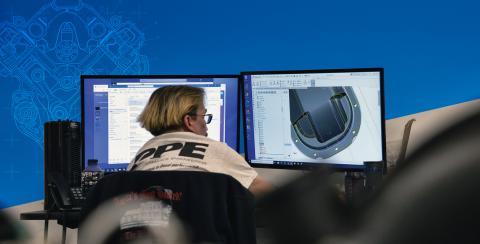
Short for computer numerical control, a CNC machine is an automated tool that will process metal (usually aluminum in the racing industry) to the exact specification designated by coded program instructions. Alone, however, a CNC machine is quite useless unless it’s properly programmed through computer-aided machining, or CAM, software. And those precise machining instructions don’t just flow telepathically from the creator’s mind to the machine. Computer-aided design, or CAD, software is used to define the shapes and dimensions of the part before CAM can provide the usable code language that the CNC machine understands.
Before CNC machines, improvements in racing and performance shops were usually hardware-centric—teams relied on lathes, upright mills, and hand-tool skills to make changes to parts or develop new components. This work leveraged the experience and observation of racing veterans—which is a fancy way of saying trial and error drove performance development. Those changes were cycled through prototype stages, tested either on the bench or at the track, and optimized or discarded with each iteration.
Now, virtual design and testing, along with reverse engineering, are at the forefront of racing development. And CAD/CAM software is itself advancing at a rate faster than many race teams can match.
“From what I’ve been told, we probably use just 15 percent of the capabilities of Mastercam,” said Tom Vigue of 3V Performance, Denver, North Carolina. Mastercam is a leading CAM software that writes the G-code programming used to operate the five-axis Centroid CNC machine in Vigue’s shop. “We use a small portion of it just for the features we use on the machine.”
While many different types of parts can be created in a CNC machine, cylinder head work seems to draw the most attention in racing circles. Vigue will design a port by hand, then his Centroid can autonomously digitize the port with the same spindle used for cutting.
“I then import into Mastercam and manipulate it to create the surfaces,” said Vigue, who added that he could do cylinder blocks in the Centroid but decided to purchase a Rottler CNC machine dedicated to blocks. “The problem is mixing cast iron and aluminum in the coolant, so I decided to get the Rottler for blocks only.”
Brad Lagman of QMP Racing Engines in Chatsworth, California, has four CNC machines, and cylinder heads are the main priority. He also shapes the ports by hand, then digitizes them to be replicated in the CNC machine.
“I’ve also designed a few oddball parts, like an oil-pan spacer for a Hemi engine,” noted Lagman, adding that he can program the machines to work on cylinder blocks. “Production-wise, it’s faster. I don’t have to stand over it like an old-style boring bar. It’s also more accurate, especially when we do custom lifter-bore locations.”
One of Lagman’s most closely guarded secrets is his cylinder honing strategy, so it may be surprising to learn that he also has a CNC honing machine. “I only let it run unattended to get close to a size,” he explained. “If I have to hone out .005-inch out of the block, I can program it to hone .004-inch, then I go in and finish by hand. It still saves me three hours of standing by a machine.”
In even larger shops, CAD/CAM work is an absolute necessity. Over the past 20 years, Don Schumacher Racing (DSR) has brought more parts development in-house, manufacturing everything from engine blocks all the way down to fasteners. The move’s two-fold objective: to save money and win more often.
“The competitive edge is always going to be there,” said Scott Cutler, manufacturing engineer at the team’s sprawling Brownsburg, Indiana, facility, where 25 CNC machines are in operation. “But the biggest thing is quality and cost. We can produce better quality parts at a lower cost. And we have more control. If we want to make a change, we’re not asking anyone. We make the change.”
Few innovations have impacted motorsports as much as CNC machining. Among the most popular uses for the technology is cylinder head work. In many cases, port shapes are created by hand, and then replicated by CNC equipment for greater consistency.
For its 11,000-horsepower nitro engines, DSR designed a new cylinder block that starts as a 750-pound chunk of billet aluminum. After it’s finished in the CNC machine, it weighs 140 pounds. Each year the shop has a goal of producing 50 blocks.
“We’re currently on our third iteration of the block, and without Mastercam there is no way we could make it into a part,” said Cutler, noting that each generation of the block is stronger, and the advanced CAD software used to design it allows for virtual testing. “We run FEA (finite element analysis) simulation on it, which gives us strength analysis. Then we are also able to simulate reciprocating motion, so we can put in the crankshaft, the connecting rods, and pistons to check clearances before we ever get to the real part. We know everything is going to fit.”
BENEFITS FOR MOTORSPORTS
Beyond engine development, the chassis also can benefit from CAD/CAM programing and CNC machining. Rocket Chassis of Shinnston, West Virginia, is a leading supplier of dirt late model chassis, and in 2015 the supplier designed its latest generation, called the XR1. Kyle Kampenga of Keyser Manufacturing in Coopersville, Michigan, worked closely with Rocket designers to develop brackets and other suspension components.
“We had just switched to SolidWorks, so that was a big help for us. Using 2D models, I could adjust rod lengths to see how the birdcage moved, and I could adjust pickup points,” said Kampenga. “Because of all the equipment we have in-house, we were able to produce prototypes very quickly. That allowed us to help get the XR1 ready for 2016 Speed Week.”
CAD software allows more efficient design of complex components such as engine blocks. “We are able to simulate reciprocating motion, so we can put in the crankshaft, the connecting rods, and pistons to check clearances before we ever get to the real part,” said our source at Don Schumacher Racing.
Before Keyser adopted CAD, Rocket would send parts to Keyser to determine the best production method. Keyser then produced samples and sent them back to Rocket. “It was a week of back and forth with Red Label freight,” recalled Kampenga. “This time it was much easier with SolidWorks. If they had minor changes to a specific part number, it’s easy to move a couple dimensions, update the file, spit out a blueprint, and send it to the machine. Hands down, it’s been our greatest time-saver.”
As noted earlier, users don’t always capitalize on the full potential of the software.
“There is a motion simulation option, but I haven’t used it to its fullest extent,” said Kampenga. “I would especially like to work more with the rear four-link setup to see how everything moves.”
SolidWorks and Mastercam are arguably the leading CAD and CAM programs, respectively, but one shop is also working with Fusion 360 in the event that company starts to develop groundbreaking features.
“I felt if we got in on the ground level and they got stronger, possibly offering something better in the future, we’d be a part of it and it will speed up the learning curve,” explained James Nunn of Machine Nunn, Statesville, North Carolina, a shop with four CNC machines that helps produce threaded weld-in bungs and suspension components for race shops and aftermarket suppliers.
CAD/CAM removes guesswork, allowing chassis builders to prototype products and get them to market faster. “Using 2D models, I could adjust rod lengths to see how the birdcage moved, and I could adjust pickup points, [so] we were able to produce prototypes very quickly,” said our source at Keyser Manufacturing.
Regardless of the program, the objectives are the same: improve performance both at the track and in the shop.
“It is a parallel that we actually make with the motorsports industry quite a bit because there are a number of things that we do in the CAD/CAM world or the machining world that folks in the motorsports world do as well,” said Ben Mund of Tolland, Connecticut-based Mastercam. “Similar to what happens in motorsports, where potentially you have thousands of data points coming in real time to help the team make adjustments and refine what they are doing, CAD/CAM is similar in that aspect. As technology improves, there is a constant inflow of more information that can be used to streamline and optimize those toolpaths and cutter paths to make the machining process faster.”
By understanding the precise needs of its motorsports clientele, Mastercam can tailor features to help improve on-track performance.
“There are things that are done in CAD/CAM that are very specific to motorsports. In Mastercam, we have an add-on called Port Expert. It is used for other things, but its sole design purpose was to design, machine, replicate, and improve porting,” explained Mund. “As I am sure you know, that is an art that people perfected over decades. The repeatability and the slight adjustments were always something that folks in motorsports want to make sure they could get in. The Mastercam Port Expert is designed to do exactly that.”
Reverse engineering is a buzzword heard often when discussing CAD/CAM opportunities. As noted, it’s used in cylinder-head development after a specialist hand-designs a port; then that port shape is 3D-scanned or digitized before being manipulated further in CAD/CAM software.
DezignWorks, based in Mooresville, North Carolina, previously used SolidWorks and now has developed its own software just for reverse engineering. In a rather ambitious project, the company is taking a well-known German engine and adding cylinders to develop a marine version.
“We scanned the block and heads to have 3D models because no one is going to give you prints for them,” said Jim Watson. “They’re going to add a cylinder, and the first prototype will be all billet. They were going to increase the displacement, make it stronger, and put twin superchargers on it. The engine is designed for 2,500 horsepower.”
Working with numerous race teams over the years, Watson maintained a front-row seat in watching the evolution of CAD/CAM in the industry. “It has really changed everything, even with helmets,” he observed. “If you would see how helmets are fitted on people, it is crude. They actually just pull the foam out and they cut it and see how it fits. In one company we were working with, we put the fire mask on the driver and scan the head. Now you can CNC machine the plug to fit the person’s head exactly.”
Watson noted that this strategy is used on helmets designed for professional bull riders. The inserts can be changed as younger riders, or even racers, mature. If there’s a broken helmet, the current head scan will facilitate the new helmet much quicker.
In addition to creating its own design software, one company has expanded into designing and building machines to help shops improve their manufacturing processes.
Although CAD/CAM technologies are more typically used in machining, they’re also increasingly being applied to fabrication. According to our source at Bend-Tech, chassis fabrication time can be cut in half just by using CAD systems to handle cutting and bending information.
Bend-Tech in Osceola, Wisconsin, is best known for its tube-centric software that’s used primarily to design chassis, roll cages, and bumpers—almost any product where round or square tubing is used. Now Bend-Tech has developed automatic plasma cutters to process long lengths of tubing.
“They will not bend the tubes, but [instead] will mark the bending information calibrated to a bender on the tube,” explained Ron Dabill. “The operator can then take the tube over to their bender and line up the marks. It takes all that guesswork out. Of course, in the motorsports world that was huge. For guys who were building a chassis that took 50 man-hours, we were cutting that time in half by just taking care of all the cutting and the bending information.”
Plus, Bend-Tech’s software is improving, with new add-on features being developed to handle specific tasks more quickly. “There’s a template module with about 150 simple sheet-metal parts. A lot of our customers have plasma tables that aren’t really user-friendly, and a lot of these guys aren’t into CAD—they’re fabricators,” said Dabill. “So they want to be able to cut out a tab, a bracket, a beadlock—you know some of these simpler parts. Well, we give them a shape of what they want, and they put in their dimensions. They then save that off as a DXF file and bring it over to their CAM software for the plasma table.”
FUTURE NEEDS
Looking ahead, expect to see more partnerships between CAD/CAM developers and the machines they serve. Software will be better integrated to speed up the parts design and manufacturing process. As CNC machines and tooling bits become more sophisticated, software companies will move forward to ensure that users can get the most out of the operation. Even AI, or artificial intelligence, will be integrated into the software to create “smart toolpaths” that actually learn from previous jobs.
“It’s really such a wide-open field that anything could happen as we go forward,” claimed Mund.
Despite the unbridled optimism brought forth by CAD/CAM and CNC machining, many racers who rely on this technology nonetheless share a gloomy outlook due to difficulties finding qualified help to learn and program the software.
“There’s a gap between the engineer and the actual guy entering the toolpath,” said Nunn, who works with a local community college in hopes of getting more students into machining. “There just aren’t enough programmers.”
“In today’s age it is extremely tough—we’re constantly looking at new ways to train young people and get them interested in manufacturing and CNC machining,” said Cutler, adding that the DSR shop is also a full-service contract manufacturer to keep the machines running when racing needs slow down. “We have good equipment, which helps keep people around. We are always innovating, but finding good help is getting, without a doubt, harder and harder every day.”
CAD/CAM is increasingly vital to success in motorsports—and users aren’t even applying the technologies to their fullest yet, noted several sources. One of the biggest hurdles is finding qualified personnel. “Manpower is a problem we’ve struggled with,” said our source at 3V Performance.
Vigue agreed, noting, “Manpower is a problem we’ve struggled with over the past year.”
While the line at this particular complaint window stretches around the block, some schools are in fact making an effort to bring students into the trade. And it should be easy, given the obvious widespread demand—i.e., the auto industry is also competing with petroleum, aerospace, and medicine for these same skilled workers.
“Ninety-seven percent of our students are hired before they graduate,” claimed Jud Massingill of the School of Automotive Machinists and Technology (SAM Tech), Houston, Texas. “We have an entire CNC course that includes programming.”
One of the stumbling blocks to entry, however, is that all students must pass a mechanical aptitude test to be accepted into SAM Tech. Then, a second math-based test is required for the CNC programming class.
“Some who fail the second test will take courses at the community college to improve their math skills,” said Massingill. “The future holds that more shops will upgrade to CNC machines and take on high-volume workloads. If you’re educated in CNC work and can put chips on the ground, you’ll get a job.”
To meet the pent-up demand from reduced racing schedules last year, facilities have renovated and revamped in preparation for a promising 2021.
Good news was sometimes hard to find in 2020, but one bright spot was the fact that racing didn’t just persevere…in many ways, it thrived. It may not have looked the same—empty, quiet grandstands are eerie whether you’re at Indianapolis or the local bull ring—but once tracks reopened, pent-up demand saw racers head to them in droves.
Track operators and promoters faced their own challenges, from finding ways to keep employees on the payroll during mandated shutdowns to dealing with the absence of spectators and the income they generate. But many track operators used the downtime to tackle maintenance and improvement projects that would have been tough to do between race weekends. The vitality of the 2020 race season, once it got underway, gave many of them hope for a robust 2021.
We recently reached out to tracks across the country to get a sense of how they were renovating their facilities and what they expected in the coming year.
AUTO CLUB SPEEDWAY
Fontana, California
NASCAR submitted a proposal to San Bernardino County in September to reconfigure the current two-mile oval at Auto Club Speedway into a half-mile short track. The proposal, called Next Gen in California, would result in a track with long straights (like Martinsville) and high-banked corners (like Bristol).
NASCAR executive vice president and chief innovation officer Craig Neeb, in a statement to The Athletic, said NASCAR is “excited about what this ambitious project could mean for our loyal fans in Southern California. This is our first step toward creating a state-of-the-art facility that would deliver the intense short-track racing our fans love, an intimate viewing experience, and upgraded suites and hospitality areas that would position Auto Club Speedway among the top entertainment venues in the market.”
Some existing structures would be incorporated into the new configuration. Part of the existing front stretch would be retained, and a portion of the current pit road would become the new back stretch. Overall seating capacity would be reduced, though some of the capacity lost in shortening the front stretch grandstand would be made up by new seating in the turn areas and repurposing the current pit-road buildings. If work begins this year, the new track would be ready for the 2023 season.
BOWMAN GRAY STADIUM
Winston-Salem, North Carolina
Bowman Gray Stadium, the historic, quarter-mile paved oval that encircles Winston-Salem University’s football field, has kicked off a multi-year, $9 million renovation. The first phase of construction, which began in late 2020, upgrades the stadium’s concession stands and restroom facilities. Among the final phases will be a fresh asphalt surface laid in time for the 2022 racing season.
According to Bowman Gray’s Gray Garrison, the upgrades will not impede a 2021 racing season or the university’s football season. “There are things they can do for racing during the football season, and things they can do for football during the racing season.” Racing runs from April to August, and football is played from September to December, leaving “three to four months to get work done when nothing’s happening.” The COVID-related cancelations of the 2020 football and racing seasons enabled the construction companies “to get things started a little quicker and gives us a bigger time window to do things,” he said.
The stadium’s infrastructure was ready for an update, Garrison explained. “It’s a 75-year-old facility, so it needed the upgrades,” he said. Racers will appreciate the new surface, he added, since the track hasn’t been redone since the 1980s.
Fan amenities, though, are the prime motivator for the renovations. “There’s so much more competition out there now, you have to have things nice,” Garrison explained. “Bowman Gray was probably above average among weekly race tracks with what we had, but we’re taking steps now to make those amenities even nicer. It’s all about making things much more fan-friendly.”
Although the COVID-19 pandemic shut down tracks and kept fans out, many track owners used the downtime for improvements. Often these efforts are driven by market pressure. “There’s so much more competition out there now, you have to have things nice,” said our source at Bowman Gray Stadium.
BUNKER HILL DRAGSTRIP
Bunker Hill, Indiana
“I bought it to save it,” said Mark Cregier, the new owner of Bunker Hill Dragstrip. Opened in August 1956, Bunker Hill is the oldest drag strip in Indiana. It has remained active, though Cregier felt it hadn’t received the maintenance and attention it needed recently and took over the eighth-mile track near the end of the 2020 season.
A “fiberglass guy” by trade, Cregier is a drag racer, too, bracket racing a series of Camaros over the years. He raced at Bunker Hill and remembered it as “not a bad track. It just needs cleaning up.” During the offseason he is “getting it up to par,” doing tasks like fixing the electrical system so the lights are functioning properly and installing additional guardrail that his insurance company requested.
The track surface “has a lot of life left in it,” he said, so there are no immediate plans to resurface it. In the spring he’ll upgrade the timing system and tend to the sand trap. “Since no one’s been working it, it won’t do a lot of good,” he admitted.
Cregier has no firm opening date yet for 2021, “but probably around the beginning of April we’ll start test-and-tune. We’d do test-and-tune every Friday night, and on Saturday do bracket racing pretty much every week in the season.”
The IHRA-sanctioned track had been home to points races and some no-prep events, which Cregier wants to continue. “I have a Pontiac deal scheduled, and I’d like to do a Mopar race, too,” he said. “I have a friend who runs Top Sportsman, and I’ve been talking to him about running one or two Top Sportsman events. They used to have wheelie contests here, too. I’m trying to bring some of that back.”
CAROLINA DRAGWAY
Aiken, South Carolina
Carolina Dragway used the COVID-related racing shutdown to complete some maintenance work. “We were down from the middle of March to July,” said the track’s manager, Jimmy Owen, “so we painted buildings, renovated the bathrooms, and put a new roof on the bathrooms and concession stands. We took that time to pretty things up. Paint’s cheap, and it kept my guys busy.”
In a normal offseason, the crew does one or two bigger projects in addition to maintenance, Owen said. This winter they planned to “expand on a building we put up last year so we can move our traction compound storage and fuel storage all under one roof.” They will also do some new paving in the staging lanes to “widen them a little bit to make it easier to turn into the staging lanes and relieve some congestion in the lanes.”
A new track surface is coming “in the next three or four years,” Owen said. “This track was built in 1956, and it was literally a dirt drag strip with a concrete slab for the starting line.” That surface has been paved and repaved over the years; when the current owner, Roger Starrette, bought the property about three years ago, “one of the first things he did was resurface from the eighth-mile all the way to the first turn-off,” Owen said. “This is a quarter-mile facility, so there’s a half-mile of fresh asphalt. But that’s two-and-a-half years old now.”
The repair and replace strategy has been Starrette’s “plan of attack,” Owen said, “probably from his background in the trucking industry. Do your maintenance, and you rotate equipment out on a regular basis. You don’t wear it out, you rotate it out before it’s worn out.”
Track improvements are often done in stages, mixing maintenance, repairs, and upgrades. Case in point: The Carolina Dragway crew recently painted, replaced roofing, and renovated bathrooms. And in the next few years the track will be resurfaced, having been last redone two-and-a-half years ago.
UMI MOTORSPORTS PARK
Clearfield, Pennsylvania
During its 50-year history, the half-mile oval track that is now UMI Motorsports Park (UMIMP) went from dirt to asphalt multiple times before UMI Performance bought it in 2017. The suspension manufacturer had planned to test products there and occasionally put on autocross events. But company president Ryan Kirkwood saw more potential in the facility, said UMI’s Ramey Womer, and decided to turn it into “a racing destination rather than just a place to race.”
New pavement was added to the track’s existing infield connector roads to make it “a configurable oval, like Charlotte only smaller,” said Womer. Camping sites were put in, as was a VIP pavilion, a music park, and a playground, with the intent of making UMIMP a family destination. “It’s a whole experience rather than just racing,” Womer said. “And as its popularity goes up, that gives us incentive to keep improving it.”
Renovations planned for the 2021 season include additional infield paving to allow more track configurations, adding more camping spots, and upgrading the press box and announcer booth.
Purchased originally to be a test facility for suspension manufacturer UMI Performance, the new owners of UMI Motorsports Park decided to turn it into a complete racing destination. Among many upgrades to the track, new pavement was added to make it “a configurable oval, like Charlotte only smaller,” said our source.
WEST VIRGINIA MOTOR SPEEDWAY
Mineral Wells, West Virginia
West Virginia Motor Speedway will reopen for racing in April 2021 after sitting dormant since 2013.
“When fans get here, they’ll see a lot of improvements,” said Cody Watson, who has spearheaded the track’s rejuvenation. “It will be better than ever.”
One of the biggest changes Watson made was returning the track to its original 5/8-mile configuration after previous management shortened it.
“I think it lost some of the luster, some of the prestige that it had,” Watson said of the shorter oval. “What drew people in was that big 5/8-mile and the high speeds. We didn’t want to open the gates on a track that wasn’t as highly regarded. To create the buzz and excitement we wanted, we needed to take it back to where it was in its prime in the 1990s.”
It took weeks to cut back the “jungle” that the unused facility had become, Watson said. A friend with an excavation company returned the track to its original length and then put down a surface of “good red clay. We had two graders going for about a month to get that old track back into shape.”
Watson’s crew has renovated the grounds with a new pit lane and exterior pits, upgraded and modernized buildings, and added new LED lighting. He considers this restoration Phase 1, “making everything nice to get it reopened and relaunch our brand.” Phase 2 is still on the drawing board but may include new aluminum bleachers, a video board, and new VIP buildings. The eventual Phase 3 may add a restaurant and hall of fame building to the site.
The Speedway’s 2021 schedule will be made up of “special events, about once a month,” from April to October, Watson said. A highlight will be the Historic 100 in June, which “pays tribute to national dirt late model history and, more importantly, the history of this race track and getting to bring it back.”
West Virginia Motor Speedway (WVMS) is poised for a comeback after being dormant since 2013. Recent improvements aim to address reasons the track had lost its luster and closed. “We needed to take it back to where it was in its prime,” said our source at WVMS.
INDYCAR officials have announced the NTT IndyCar Series season opener at Barber Motorsports Park has been rescheduled from Sunday, April 11, to Sunday, April 18.
With the move, the Honda Indy Grand Prix of Alabama presented by AmFirst will be featured live on air on the NBC network. A record of nine events will air on NBC this season.
“The schedule changes we’ve had, while partially prompted by ongoing pandemic conditions, give us a powerful start to the 2021 season,” Penske Entertainment Corp. President and CEO Mark Miles said. “With six of our first eight races on network television and all in a more compact timeline, it’s an enormous opportunity to drive even more momentum as we deliver our exciting brand of racing to our fans.”
 MEMBERSHIP LOGIN