Nick Bublitz has been named Sonoma Raceway’s Drag Strip Manager and will manage the raceway’s 1/4-mile drag strip and drag racing programs.
In his new role, Bublitz will be responsible for the drag strip’s day-to-day operations, including the weekly Wednesday Night Drags program, which is set to kick off on March 17. Bublitz takes over for Kyle Seipel, who has been the drag racing manager at Sonoma Raceway since 2017 after stepping in for his mother, Georgia, upon her retirement after 30 years at the raceway.
“I’m the first non-Seipel track manager in over 30 years, and I am honored to be chosen to stay the course. This is one of the best tracks on the west coast with some of the best people, racers, and staff, so I look forward to getting started,” said Bublitz, who officially starts on February 1.
Bublitz, 29, began drag racing at the Northern California track 10 years ago when he attended Sonoma State University. He has earned six Wally trophies from Summit ET Series bracket drag racing events and was the 2015 Division 7 ET Challenge Sportsman Champion. Bublitz is also currently the Track Announcer and Race Director at Redding Drag Strip.
The drag strip is set to host the NHRA Sonoma Nationals on July 23-25, 2021.
LSI Chemical has announced a new international distribution partner, Eco Lubricantes. The move will help bring innovative chemical formulations and nanotechnology to multiple markets in Costa Rica.
“Eco Lubricantes was created in 2020 to support lubrication and hydraulic power needs in Costa Rica. Our main goal is to strengthen sustainable development by providing our clients with eco-friendly automotive and industrial solutions,” Eco Lubricantes Founder and General Manager Danny Huertes said. “LSI Chemical’s products provide microfiltration in the form of high-quality oils and additives infused with carbon nanoparticles that extends the life of engine lubricants to keep operating conditions and internal cleanliness ‘as good as new,’ aligning with our goals.”
Eco Lubricantes is now authorized to distribute the entire line of LSI Chemical fuel and oil additives, plus the full line of Hot Shot’s Secret consumer products.
Organizers for the King of the Hammers (KOTH) have released guidelines for the Johnson Valley, California-based event.
“As the organizer, we have worked diligently for many months to progressively and proactively execute the event as safe as possible. San Bernardino County and Bureau of Land Management have reviewed the plans and determined the competition can take place,” a release stated.
Officials will require fans, drivers, vendors, staff, and media to provide a negative COVID test and adherence to increased safety guidelines if they would like to participate in the “Hammertown” gated and fenced outdoor area on Means Dry Lake Bed. Hammertown encompasses the start/finish line, team pits, and vendor booths.
Organizers will provide Rapid Response Testing onsite (for $30) to those that did not get tested before the event. Attendees may also submit documentation of a vaccine instead of a negative test.
Everyone must wear a face covering, wash their hands regularly, and practice social distancing as aligned with state and local guidelines. Officials will also provide hand sanitizer stations, signage, and additional cleaning procedures.
Those that want to watch the racing on the public land surrounding Hammertown will not require a negative COVID test but will be required to take a temperature check and provide a health declaration. Organizers are also encouraging fans to watch the live stream from home, available at ultra4racing.com/ultra4-racing-live.
The outdoor off-road racing event spans over 92,000 acres in a remote desert location and is taking place in Johnson Valley, California, through Saturday, February 6. For more information, visit ultra4racing.com.
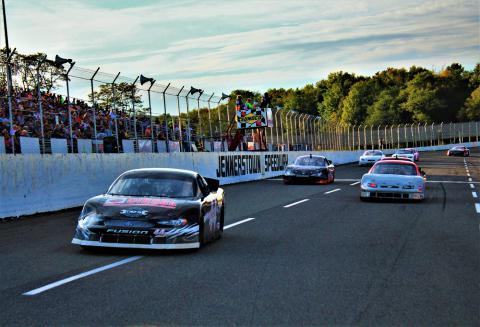
As feeder series to NASCAR, many stock car sanctions are developing next-level competition strategies that include cost containment, co-sanctioned events, and dare we say, a possible national championship?
Like a big roan bull in a Tennessee barnyard, stock car racing is an unstoppable force. As one of America’s classic motorsports, it’s part of the national fabric, an institution that remains at the core of the nation’s collective psyche. It’s had its ups and downs, ebbing and flowing with the tide of taste and temperament. But it endures. Evolves. Adapts.
Born and raised in the South, stock car racing spent many years as a regional confection until blossoming across the country in later years. And now some feel it’s outgrown its ancestral home, with other regions carrying the flag of pavement circle track racing for a new generation.
The sport remains in good health as we enter 2021, but it does face challenges, including a limited pool of competitors, high costs, and the need to attract new fans amid the clutter and distractions of modern (read: digital) entertainment. But stock car racing has overcome significant hurdles before.
To get a feel for where pavement stock car racing is now, we spoke with leaders from some of the sport’s most prominent sanctioning bodies. In doing so we gathered insights and trends from the people making news and shaping the sport every day. And we learned that by most accounts, stock car racing is well equipped and thoroughly prepared to adapt to any challenge that may come its way.
MOVING FORWARD
Of course, the biggest factor affecting all motorsports has been the COVID-19 pandemic, which radically disrupted all series schedules in 2020. But through some clever shuffling of race dates, most sanctioning bodies were able to put on a fairly complete season. Some even feel this rearranging may actually bring some benefits to this year’s season.
“In 2020 we did have to move some events to tracks that we had never been to before,” observed Jack McNelly of the CARS Tour, Mooresville, North Carolina. “But that wasn’t a bad thing, because it helped us expand our footprint a little bit, and we gained some new fans. This year we’re scheduled to go back to two of those tracks,” which are Florence Motor Speedway and Greenville Pickens Speedway, both in South Carolina.
The sport of pavement stock car racing is generally in good health heading into 2021, but it does face challenges. One of the most critical hurdles is the rising cost of competing. “We’ve lost so many participants…just because this has gotten so expensive,” said our source at ARCA.
Even if not all series were able to capitalize on those types of opportunities, stock car sanctioning bodies are ready to get the new season fired up and on the starting line. This has played out in some unique ways for the multi-national American-Canadian Tour (ACT), which races in both the US and Canada. “With the border closed in 2020 it really hurt not having our Canadian drivers and fans,” noted Cris Michaud of the Waterbury, Vermont-based ACT. “But we’re very optimistic. The support we had from the teams and fans was huge. I think it made our group stronger, and I think that support will carry over into 2021.”
DRIVERS WANTED
Most series are reporting solid car counts and expect that to continue into the upcoming season. Nonetheless, maintaining that level of participation and attracting new drivers to a series is a constant battle. Drivers’ choice of series is increasingly a matter of career development, as some try to progress to one of NASCAR’s top national series.
“When people ask me what we do, I tell them it’s like Triple A baseball,” explained RJ Scott of the Champion Racing Association, Salem, Indiana. “If you look at the people that are having success in NASCAR, so many of them have raced with us along the way.”
For this reason, many series have started paying more attention to career development possibilities for drivers, including the exposure their series can offer. “One of the things that draws people to our series is our media presentations,” said McNelly. “Productions of our events live-streamed are pretty doggone good—two or three different camera angles, pit road interviews. It’s a first-class production. Mom and Dad sitting at home watching this think, ‘We can get our son or daughter involved in this and raise the awareness of them.’”
Along with this, stock car series are increasingly looking at the “Hero Factor” as a means of attracting drivers. “How do we put these guys on a pedestal and make them feel special, that their investment is worth something?” said Scott. “Not everybody gets to go home with a trophy, so we’ve got to make that good feeling go as far back in the field as we can. It can come down to things like the style of victory lane and driver introductions.”
Stock cars often pass from one series to the next, ending up in sportsman ranks like the Super Cup Stock Car Series (SCSCS). This reduces costs and brings newer car designs with greater safety. “These cars were made to run 150, 175, 200 miles an hour, and we use them at half-mile tracks,” said our source at SCSCS.
For attracting drivers to a particular series, the old real-estate saying applies—it’s location, location, location. But traditionally strong regions of the country for stock car racing now seem to be less fertile for some series than they used to be.
“The southeastern part of the United States is where stock car racing started,” observed Joe Schmaling of the Super Cup Stock Car Series, Statesville, North Carolina. “But it seems that it died here as well. The thinking in the Midwest is completely different. If I put a race on here in North Carolina or South Carolina, I lose $2,000 or $3,000 that day, plus my time and my beautiful trophy they gave away. But if I go to Indiana, they pay my full purse, they pay my sanctioning fee, and they all but bow when I come through the gate.”
COST CONTROLS
In our conversations with officials from various stock car series, one theme that came up often was limiting costs for racers. “We have to keep it so that it’s affordable to come and do this,” said Charles Krall of the ARCA Menards Series, Temperance, Michigan. “We’ve lost so many participants at all levels, from the Cup series all the way down to local quarter-mile hobby stocks, just because this has gotten so expensive.”
Of course, the biggest means of reducing costs is the car itself. Throughout stock car racing, cars pass from one series to the next, typically moving downward from top series and filtering eventually to the sportsman ranks. This flow of used cars from one series to another is vital to the health of any series, so sanctioning bodies are monitoring this progression carefully. Besides potentially saving racers significant amounts of money, using hand-me-down race cars from upper series also pays dividends in the technology and safety they bring. “These cars were made to run 150, 175, 200 miles an hour, and we use them at half-mile tracks like Jennerstown,” observed Schmaling. “These are super race cars. They’ve got all of the technology that NASCAR built into them for safety. And we run them at half the speed.”
Controlled pit stops can reduce costs and intensify on-track competition, but at the expense of pit strategy options. Many, though, feel the sacrifice is justified. “We love being able to do live pit stops…but the economics of it just aren’t in line with where we’re at in 2021,” said our contact at ARCA.
But despite the advantages of allowing drivers to run used cars from other series, sourcing cars this way doesn’t work equally well for all series. “We’re really the only ones running this platform of race car,” said Krall. “Years ago, a lot of the cars were Cup cars that got phased out. If you wanted to come and run an ARCA race, you could go down to Charlotte and buy a used car for a couple thousand bucks and go race. Well, it’s hard to do that now because Cup teams run cars that are specially built in-house. When they’re done with them, they don’t want the competition to see what they have. So they either throw them in storage, or they crush them. That really hasn’t helped us build up our car count.”
Along with cost-cutting elements like embracing used cars from other series, some of the biggest strides in affordability are now coming from engine rules. More frequently, series are mandating sealed, standardized engine packages that can pay dramatic cost-reduction dividends for teams.
But it’s not always big things that make a difference in the overall affordability of a racing series. Sanctioning bodies are also focusing more on subtle changes that are adding up to significant cost savings. Included among these small gains are things like body designs and materials. “Our body program with the Five Star composite body is very cost effective,” Krall pointed out. “You don’t have to replace the entire body if you get up into the wall—you can just replace the damaged body panels.”
Along these lines, many series are also carefully scrutinizing the use of consumables as a means of reducing costs for racers. For example, tires can add thousands of dollars to the cost of a race weekend. “With a 16-tire race we might say, ‘Hey, I think we can do this on 12 tires and save these guys $800,’” noted Scott.
Pit road is also being targeted for significant cost reduction. “Every one of our top-12 teams is flying in a pit crew for race day,” said Krall. “They don’t work on the race car. They’re just there to change tires. That’s an expensive proposition. We could eliminate that cost by going to a controlled pit stop where you come down pit road, you have five minutes to change four tires, add your fuel, make chassis adjustments, and then head back out onto the race track without losing a position. It could save tens of thousands of dollars.
Some stock car sanctioning bodies observe a widening age gap between competitors and spectators. And many of today’s young drivers quickly pass through the sportsman level on their way to the upper ranks, leaving little time to build their own fan base along the way. Photo courtesy of Super Cup Stock Car Series.
“The downside is that it does kind of take away pit strategy,” Krall added. “But we think it’s a fair trade at this point to save those cash-strapped race teams money. We love being able to do live pit stops, but just right now, the economics of it just aren’t in line with where we’re at in 2021. It just doesn’t make sense to do it. So we’re just going to take that off the plate for the race teams, and whenever we get back to that more normal footing, we’ll add that back to the mix.”
Because taking such breaks does diminish pit strategy, some sanctioning bodies remain adamantly opposed to the idea. That said, they may still try to incorporate other forms of controlled pit stops. “This is racing. It’s not football,” stated McNelly. “We don’t have halftime here. But we do have competition cautions. Once the pits open, competitors can come in [and] do whatever work they need to be done as long as they get back out before the time is up for the competition caution.”
FEEDING THE FRONT GATE
Along with making a series more attractive for drivers, stock car sanctioning bodies also face the challenge of drawing spectators. One of the biggest hurdles for that is an aging fan base. “I think we would all be shocked at the average age of fans,” observed McNelly. “It just seems to me that the interest in cars isn’t what it used to be. I think that’s the biggest challenge that we all have.”
This is compounded by the fact that, in many series, the typical top driver’s age is actually getting younger. This results in a growing disparity in age between fans and drivers. “We’ve had a champion, Jesse Love, out west, who was just 15 years old,” said Krall. “Our ARCA Series champion (Bret Holmes) was 23. He was the old man of the group. Our competitor base continues to get younger each and every year. For some of our fans who have followed our series for 30-plus years, it’s hard for them to connect with a 15- or 16-year-old driver.”
The concept of a multi-series stock car championship is gaining momentum, and many feel the idea offers some powerful benefits. “It could be very financially rewarding for the competitor and certainly lift the level of awareness,” noted our source at CARS Tour.
Further intensifying the issue is the fact that many of these up-and-coming drivers don’t have a chance to bond with their audience. “There are certainly young drivers out there,” noted McNelly. “But they move through the system so fast they don’t even have time to establish a fan base of their own. Within three or four or five years, they’re into Cup.”
These challenges all run within the larger difficulty stock car sanctioning bodies face—a distracted public with short attention spans. “I think the whole short-track industry battles an immense market of competition for entertainment dollars,” said Scott. “You think about all the entertainment options that people have now that we didn’t have years ago. Getting new people to short-track racing is one of our bigger challenges, both on the fan side and the competitor side.”
ALL TOGETHER NOW
Many in the sport feel that cooperation and collaboration are the best means to overcome stock car racing’s current challenges. Some sanctioning bodies have already taken significant steps in this direction. “You’ll see a number of our events over the course of a year where we’ve tried to co-sanction with other sanctioning bodies,” said Scott. “And that’s really exciting for the fans because they know they’re going to see stars from all over the country battling each other, as opposed to normally just some of their best regional stars.”
Along with the benefit of increased promotion and visibility, this kind of cooperation also brings the advantage of rules commonality, allowing competitors to use the same car in different series and regions. “I think we probably had, I’m guessing, at least four races on our schedule in 2020 that were co-sanctioned,” added Scott. “That benefits the industry, because we’re all using the same set of rules. Now you can buy a car in Michigan and race it in Florida, and anywhere across the country, and sell it there versus being very regionalized because the rules were so different.”
These types of collaborative efforts may culminate in a multi-series championship, a popular idea that’s gaining momentum among stock car sanctioning bodies. “I think it would be very intriguing to put these guys together and truly come up with a national championship,” said McNelly. “I’d be all for it. It could be very financially rewarding for the competitor and certainly lift the level of awareness.”
Although no tangible steps appear to have been taken toward establishing a multi-series stock car championship to date, some within the industry feel it’s almost guaranteed that it’ll happen, and relatively soon. “We had multiple conversations with all of the major sanctioning bodies for super late models about doing just that,” said Scott. “And we’ve got some good partners, not just in the sanctioning bodies, but within the industry that are really pushing toward that. I think COVID set it back a year, so I don’t see it happening in 2021. But I wouldn’t be at all surprised to see a co-sanctioned National Super Late Model tour in 2022.”
SOURCES –
American-Canadian Tour (ACT) acttour.com
VP Racing Fuels, Inc., the provider of performance fuels, lubricants, and additives, has announced James McVey’s appointment to Business Development to focus on the OEM business.
“James has a significant background, including thirteen years of executive-level leadership experience,” VP Racing Fuels President and CEO Alan Cerwick said. “He has over twenty years of sales experience across a broad range of industries in domestic and international markets, and we can expect big things to come in a very short matter of time.”
McVey earned a Bachelor of Multidisciplinary Science degree at Texas Tech University. He previously served as Vice President of Sales & Marketing at GreenStar LED, where he led the conversion of high-pressure sodium street lights to smart city LEDs in San Antonio and other cities in North America and overseas.
Speedway Motorsports has promoted Jason Bowling to the position of Senior Vice President of Ticket and Marketing Information.
In his new role, Bowling will oversee all consumer experience platforms for the company, including CRM, ticketing, email, and mobile applications for Speedway Motorsports facilities.
"Jason's leadership and experience through the years have been pivotal to keeping Speedway Motorsports at the forefront of the entertainment industry, Speedway Motorsports Executive Vice President and Chief Strategy Officer Mike Burch said.
Bowling holds over two decades of experience with Speedway Motorsports, having joined its facility Texas Motor Speedway as its credential coordinator in 1999. He later spent a decade as the Director of Tickets at the race track before being named Speedway Motorsports' Vice President of Ticket and Marketing Information in 2014.
General Motors (GM) has announced that it plans to become carbon neutral in its global products and operations by 2040 and has committed to setting science-based targets to achieve carbon neutrality.
The company has also signed the Business Ambition Pledge for 1.5⁰C, a call to action from a global coalition of UN agencies, business, and industry leaders.
“General Motors is joining governments and companies around the globe working to establish a safer, greener, and better world,” GM Chairman and CEO Mary Barra said. “We encourage others to follow suit and make a significant impact on our industry and the economy as a whole.”
In addition to GM’s carbon goals, the company worked with the Environmental Defense Fund to develop a shared vision of an all-electric future and an aspiration to eliminate tailpipe emissions from new light-duty vehicles by 2035.
GM plans to decarbonize its portfolio by transitioning to battery electric vehicles or other zero-emissions vehicle technology, sourcing renewable energy, and leveraging minimal offsets or credits. GM is also investing $27 billion in electric and autonomous vehicles in the next five years.
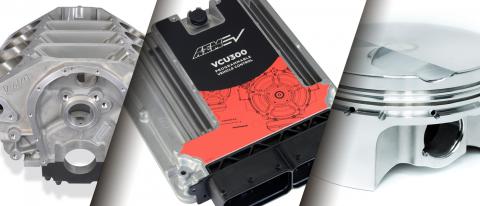
The motivation for Bill Mitchell Products (BMP) developing an aluminum version of the Chevy 409 cylinder block was simple. “It gives the guy a reason to drag his car out of the garage,” said Bill Mitchell.
Before Mitchell teamed with 409 specialist Lamar Walden to design the block, early 1960s enthusiasts had to scour salvage yards for months to find a block that wasn’t cracked, then hit the swap meets to find NOS parts that fit. Now the restoration process is much easier.
“We wanted to simplify it because nothing parts-wise was available for some 50 years,” Mitchell said.
BMP first tried to modify a traditional Chevy big block to accept the W-series parts, but it was apparent that completely new tooling was needed. “So, we decided to use BBC parts to keep it simple,” Mitchell noted.
The 409 block is constructed of 357-T6 aluminum and features billet-steel main caps and ductile-iron liners. It’s designed to accept a BBC crankshaft, bearings, rear seal, connecting rods, oil pan, and timing set while working with 409 cylinder heads.
Since the block was first introduced, BMP has changed foundries and upgraded the machining process.
“Lamar had been bugging me for years, but who the heck wanted a 409 block,” Mitchell recalled. “It sure has turned out to be a hidden gem.” —Mike Magda
The VCU300 from AEM Electronics is an extremely sophisticated and technologically advanced vehicle control unit for electric vehicles (EV) that gives the user a wide range of “tuning” capabilities.
“We developed, like on an internal combustion engine, different mapping strategies to allow it to have multiple power and traction settings,” explained Lawson Mollica. “You can control those using our eight-button keypad.”
The VCU300 is designed for EV motorsports applications and performance EV conversions. It works with a wide range of EV systems and components and can manage up to four inverter/motor systems. It will also communicate with three CAN bus networks, so systems such as thermal management and charging are fully integrated into the VCU’s management strategies.
“Our PDUs provide switched 12V power, which are programmed through the VCU300. These are a little different than your standard power distribution modules. Typically, power distribution modules need to be programmed separately from the controller unit. We make smaller eight-channel units that you can daisy-chain together, and mount closer to the functions they control, which reduces weight and wiring complexity,” said Mollica.
The VCU300 features 196-pin connector and a waterproof aluminum enclosure. Besides hooking up to the CAN keypad, it’s also compatible with the CD-7 logging dash display, giving the driver complete visual feedback and logging capability on all the systems. —Mike Magda
An improved line of pistons designed for boosted applications is now available from RaceTec Pistons. Called the AutoTec II, this new piston series fills the gap between the competition-bred RaceTec line and the street-performance AutoTec line.
“Our standard AutoTec is good for small boosted applications, and the AutoTec II is for mid-line boosted engines,” explained Stacey Stone. “For extreme boost, we recommend our RaceTec line.”
The base AutoTec is forged from 4032 aluminum alloy, while the AutoTec II steps up to 2618 aluminum—same as the RaceTec series. The 2618 alloy has higher tensile strength and a higher melting point. It is also more malleable, all of which makes 2618 more suitable for high-boost applications.
“We also design it to be a little heavier than the standard AutoTec to withstand boost pressures,” Stone added. “The AutoTec II is good for up to 20 pounds of boost. Certainly, anything over 20 pounds we will recommend going with the RaceTec series.”
Current applications for the AutoTec II series include the LS, small block Ford, and Gen III Hemi. All pistons come with a standard 1.5, 1.5, 3.0 ring package. Check the catalog for available compression ratios with each application. —Mike Magda
ONLINE BONUS
M390HV and 10390HV Pumps Melling Performance
Melling Performance has introduced high-volume versions of its M390 pumps for the 3.5L and 3.7L Ford EcoBoost engines. Designed for applications where the valvetrain needs additional capacity, these pumps offer 20% more volume and higher pressure versus the factory setting. Click here for our exclusive video.
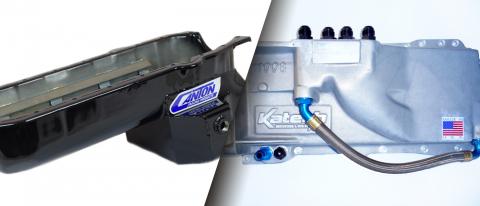
Cost, horsepower, and placement are just some of the considerations when determining which type of oil pump is correct for a certain racing application. In this month’s column, Canton Racing Products’ Iann Criscuolo stumps for wet sumps, while Gary Armstrong of Armstrong Race Engineering testifies on behalf of dry-sump systems.
WET-SUMP ADVOCATE:
IANN CRISCUOLO,
CANTON RACING PRODUCTS
Wet-sump systems lack the complexity of dry-sump systems, and that offers a number of different benefits.
An important point to consider is that a dry-sump system can indeed reduce the reliability of the car. You have more plumbing and more fittings involved, and that increases the potential for leaks. External pumps can also fail without warning, and that can ruin a race day.
Some folks tout the horsepower gains that can be had with a dry-sump system, but ultimately, we’re talking about a negligible difference, if any. Dry-sump systems are often considered superior in that regard, since you don’t have to deal with oil slosh in the bottom end, windage, and the aeration of the oil by the rotating assembly. However, those benefits can also be achieved with a properly set-up wet-sump system by using an Accusump, or a system that has a windage tray and proper baffling inside the oil pan.
An Accusump is an accumulator that holds oil in reserve off-site of the oil pan, and that makes the oil less susceptible to being sloshed around or aerated and having the oil pickup cavitated due to air during high lateral loads. It essentially mimics the general principles of a dry-sump system, but it’s really a wet-sump system with a holding tank. The Accusump has stored pressure from the oiling system, and when there’s a drop in the system’s pressure, the Accusump will push the oil out to the engine to maintain lubrication.
The key concern here is that windage and the aeration of oil can negatively affect the oil’s ability to do its job and increase the possibility of engine damage, and that’s why wet-sump systems often get a bad rap. But even just using a windage tray and baffling can make a big difference—they require minimal modification and can do a very good job of controlling the oil inside the pan.
You also have to consider the differences in complexity when it comes to packaging. An oil pan is a pretty straightforward install, as is the Accusump. But the story changes when you’re building out a dry-sump system. That’s when you have to start considering the constraints involved—where you’re going to put a 10-quart tank and mount external pumps, and what’s going to need to be moved around to accommodate that. And that can have an effect on what options are available to you in terms of engine setups.
Then there’s the cost. If you’re building a race-ready wet-sump system for the drag strip, circle track, or even road racing use, you’re looking at about $500 for a pan and pickup. If you wanted to combine that with an Accusump system, that would be another $500.
If you’re putting together a dry-sump system for a similar application, you’ll need a dry-sump pan, a tank, lines and fittings, and pumps. While the rest of the hardware is roughly equivalent to the cost of a wet-sump system, pumps add $2,000 to $4,000 more to the cost, depending on what you need. Realistically, a race-ready dry-sump system is going to be about $3,000 at the bare minimum. And that doesn’t include the labor involved in getting everything plumbed, mounted, and set up.
DRY-SUMP ADVOCATE:
GARY ARMSTRONG,
ARMSTRONG RACE ENGINEERING (ARE)
The simple truth is that, with something like a road racing application where you’re regularly pulling more than one lateral G, there’s no way you can design a wet-sump pan to contain the oil properly. Dry-sump systems were invented for that reason—to store the oil in a separate container that allows you to control the sloshing and maintain proper pressure.
Windage trays and baffles are only effective up to a point. You have to contain quite a bit of oil in a wet-sump pan, and you have to have an opening for the oil pump to fit down in, so that creates a giant opening in the windage tray. There’s also a lot of delay involved with the opening and closing of baffles when cornering, and no matter how tight you try to seal it, the oil is always going to sneak up the sides. These solutions are basically band-aids.
And a wet-sump system can cost you horsepower. The best analogy is to imagine operating a trolling motor out in a lake. If you pull the prop out of the water, you’re immediately going to pick up a thousand rpm or so, and that’s because of the difference in drag between the water and the air—air creates hardly any drag. Similarly, there’s a tremendous amount of viscous drag created by the crankshaft being in the oil. With our Corvette dry-sump system the car is running around the race track with less than a quart of oil in the engine at any given time, so the crankshaft is mostly turning in air, and that is providing horsepower that would otherwise be lost to drag in a wet-sump system.
Dry-sump systems also offer performance benefits that go beyond horsepower, like the ability to set the engine lower in the car because you don’t have to accommodate a deep oil pan. You can also play around with weight distribution in terms of where you put the dry-sump tank, and being able to do that strategically is a huge advantage. It’s not just about engine reliability, and that’s something that people often overlook. If you’ve got a driver off to one side of the car, being able to put the weight of the oil over to the other side of the car to offset some of that can make the car more competitive, and that’s something you can’t really do with a wet-sump system.
Yes, there is more complexity, and yes, a dry-sump system is going to be significantly more expensive. But ask yourself how much your engine costs. How many engines can you afford to blow up over the course of a season? If the answer is one or more, you’ve probably already paid for the cost of a dry-sump system three times over. Consider it an insurance policy. p
What competitors and suppliers need to know about the ABC Next Gen Late Model platform.
Back in 2002, a coalition of organizations in the asphalt Late Model industry created the Approved Body Configuration (ABC) program. The idea behind this program was to establish a universal race car body standard for series operating across the country in the interest of keeping costs down for teams while also maintaining parity in competition.
The effort proved successful, and for more than a decade and a half, Late Model racers throughout the US have competed against one another using that ABC body shape. Eventually the body started to show its age, though, and in recent years it had become increasingly clear that it was time to introduce a new body style that offered contemporary aesthetics and modern technological benefits.
But change can be difficult to implement in motorsports—particularly in wheel-to-wheel disciplines—and the process of developing the ABC Next Gen body has received its fair share of controversy along the way. Still, after extensive testing and a nod from the powers that be, this new body shape is poised to bring some changes to Late Model fields in the near future. So, as teams begin to prepare for the 2021 season, we’re digging into the details of the ABC Next Gen body to get a better sense of what that means for both competitors and racing suppliers.
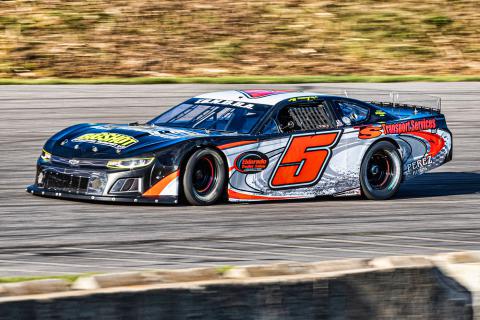
Fans and racers were ready for a change to the Late Model body standard, which dates back to 2002 and was called “too generic.” Bodies like this new Five Star Mustang design have more brand identity than before, but still keep most of the body consistent with other models.
LONG-AWAITED MAKEOVER
“Style changes have always been part of the culture of pavement Late Model racing,” said Corey Schultz of Five Star Race Car Bodies, Twin Lakes, Wisconsin, the shop that produces the ABC Next Gen body. “Appearances matter—to racers, to fans, and to sponsors, so it’s important to be consistent with what’s currently running in NASCAR and what’s out on the streets today.”
Schultz noted that even though the NASCAR Cup Series transition to the current-running platform was a clear sign that it was time for a Late Model update, the writing was on the wall long before then. “The root of it all was the fact that we were getting quite a bit of feedback from both customers and race fans about the cars’ style being too generic. They all looked a lot alike—they didn’t have much factory identity to them. That was awesome for us back when we first introduced it because common bodies means less inventory for us, and less tooling in order to provide these bodies to our customers. But the racers eventually got tired of this, and the message from them was loud and clear: The generic look is out, they wanted factory identity. That body was based on a 2003 Ford Taurus—a vehicle which is no longer being built and never really screamed performance in the first place. So when NASCAR came out with the new platform for the Cup car and the shift away from common styling was popular there, we wanted to follow suit.”
Jack McNelly of the Mooresville, North Carolina-based CARS Tour series agreed that the car was due for a revamp. “We’d had the same body for 13 years and we wanted something that was more modern looking,” he said. “There’s nothing wrong with that original body—we just felt that it was time to try to move forward a little bit.”
The Next Gen design has a wider roof that allows the body to be mounted as far right as possible to improve aerodynamics, while still leaving room for the driver’s head. The new body also is aerodynamically identical to the old style, maintaining parity during the transition.
AN EVEN PLAYING FIELD
As a member of the ABC Next Gen body committee, McNelly said two fundamental goals were established for the new project early on in development. “First, we needed to make sure the new body would not have a competitive advantage over the first-generation body. Secondly, the price needed to stay in line with what the racers had been paying for these bodies in the past. Those issues had to be addressed before we were ready to continue on.”
While “newer” often equates to “better” in the context of racing, it was crucial to ensure that the Next Gen body did not offer an outright competitive advantage that would favor the more well-funded teams. In order to maintain that performance equity, Five Star Race Car Bodies performed extensive testing with the new design on and off the track.
“We wanted to be certain that the old body and the new body would be aerodynamically identical,” said Schultz. “The last thing we wanted was for people to think that they had to throw away their perfectly fine old body because they felt like they needed the new body to be competitive. That’s why we did extensive wind tunnel testing to make sure the aero matched, and that’s why we also invited all the major sanctioning bodies around the country to join us at that test.”
The new body promotes honest competition in other ways as well. “It’s going to be much more difficult to ‘cheat up’ these new bodies, as they say,” McNelly explained. “They’ve squeezed it down a bit in terms of what these guys can and cannot do with these bodies.”
Schultz described the anti-cheating measures that have been baked into the Next Gen design. “There was some potential in the old bodies to manipulate the shape to beat the rules, and we took a lot of that into account when developing this body,” he explained. “That should save teams some money—they won’t feel the need to take their car to the wind tunnel to do a lot of aerodynamic testing to maximize the body’s performance. With the template tech inspect package and the way the body is designed to fit together, it’s harder to manipulate than it was before. Our philosophy is that body manipulation only provides an advantage to the well-funded race teams; to do so is very costly, so it put the under-funded teams at a disadvantage. We can’t ignore that. Also, this body was designed to provide the optimal balance of front to rear downforce, so we’re hoping that the teams will feel less of a need to manipulate the bodies anyway.”
Another big priority was reducing the possibility for teams to gain an edge with expensive aerodynamic testing. “With the template tech inspect package and the way the body is designed to fit together, it’s harder to manipulate than it was before,” said our source at Five Star Race Car Bodies.
MORE THAN JUST A PRETTY FACE
Although the Next Gen body doesn’t provide performance advantages over its predecessor, the new design does offer some important benefits. Schultz noted that the body has been adapted to provide better clearances for modern suspension systems, and safety improvements have been implemented on several fronts.
“Teams were pushing the old body as far right on the car as possible to get more downforce on the right side of the car,” he said. “By doing that they were pushing the roof dangerously close to where the driver’s head is, and chassis manufacturers were actually modifying the halo bars to accommodate that shift in the body. So now the roof is wider from left to right, and that provides more clearance on the driver’s side. Also, when the old body was designed there were no containment seats, and now there are, and we don’t want to see the seat actually hanging outside of the body. So with this new design, we feel that chassis manufacturers will now be able to build the halo bars out farther to the left due to the wider roof.”
Along with this packaging change, the Next Gen body materials have also seen some revision in an effort to yield a safer race car. “The roof is also made out of flame-retardant resin, which is a really cool feature,” Schultz added. “The fiberglass composites used in older bodies burn and are hard to put out, and when that resin starts to melt, it gets drippy—it’s a nasty fire. So with this Next Gen body we have this really nice, high-tech resin that we’ve developed and put in here, and we feel really confident in its flame resistance.”
Sanctioning bodies are bullish on the Next Gen design and its potential impact on racing. “We’d had the same body for 13 years and we wanted something that was more modern looking,” said our source at CARS Tour, who noted that many races are already a 50/50 split between new and old bodies during the transition.
And the modularity built into the Next Gen design will also help future-proof these bodies to a substantial degree. “The majority of the body is still common, but we focused on providing more options for factory-specific styling,” Schultz added. “We have three wholly unique looking and interchangeable noses that incorporate aspects of the current Mustang, Camaro, and Camry street car designs, along with unique graphics packages.”
And that interchangeability should make it easy for teams to keep their cars’ aesthetic up to date. “For instance, there are rumors that the Camaro may be going away in a few years—whatever Chevy decides to roll out as their high-performance replacement for it, we can just update the nose to reflect that change. It’s very updatable.”
Five Star Race Car Bodies is currently the supplier of the ABC Next Gen body, while AR Bodies in Greenbrier, Tennessee, continues to supply racers with the original ABC body. Both are approved by the committee for use in pavement Late Model racing, and most series are already starting to see a mix of the two in their race fields.
“The new bodies are approved for use pretty much everywhere now,” McNelly said. “They’re already seeing use in CRA Super Series, the Southern Super Series down in Pensacola, the ARCA Midwest Tour, the SRL Southwest Tour, the Pro All Stars Series, and of course, the CARS Tour.”
Right now, there are still far more old bodied cars running in these series than new—as you’d expect at this early stage in the Next Gen’s rollout—but Schultz told us the tide is shifting. “Last year we were seeing about a 50/50 split, but this year it’s starting to trend heavily toward the new bodies. It’s hard to say how quickly it will see mass adoption—with the old body, the replacement of perimeter panels can continue on for years, so we’ll carry inventory for the old style until there’s no more demand for it. But building season is over the wintertime—that’s when these cars get stripped down and rebuilt. So, considering that the Next Gen body was nationally approved in the middle of 2020, we expect to see a sales spike in preparation for this upcoming season.”
 MEMBERSHIP LOGIN