Thousands of new products were introduced or highlighted during the PRI Trade Show in Indianapolis. Following are our top picks from a bountiful Indiana Convention Center and Lucas Oil Stadium.
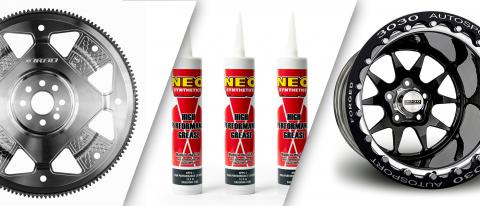
SunCoast’s 10R80 flexplate is manufactured from 4140 forged billet steel and features a solid one-piece design, redesigned relief ring, an integrated heat-treated and oil-quenched ring gear, and is almost twice the thickness of the factory unit—rendering deflection virtually non-existent. SunCoast has also designed this flexplate with twice the bolt holes, allowing you to take advantage of the additional clamping opportunities that come with its 10R80 Pro-Loc Bolt-together Converter. It is SFI-certified to 29.2.
Drag Ops Series MACH-10 Street & Strip Drag Wheels
3030 Autosport focuses on performance wheels for the street and the strip, and they do it all right here in the USA. With over 30 years’ experience in wheel making, their focus on superior engineering, quality, and performance is best described as obsessive. Pictured here is the MACH-10, which debuted at the 2021 PRI Show. Available in 15x3.5 through 15x15, as well as 17 inches and 18 inches for Modern Muscle fitments.
NEO Synthetic Oil’s NEO HPCC-1 is a truly designed CV joint grease for the application. It provides lower friction and wear protection for the service of the CV joint. HPCC-1 CV Grease was designed to help absorb the vibration, and improve friction and wear resistance in the unit. NEO uses the best additives for this application; anti-wear additives, friction modifiers, antioxidants and corrosion inhibitors are added to improve the quality and performance of the grease.
This 3-cubic-foot Vibratory Finishing Bowl with internal separation is ideal for deburring and finishing small parts. Eliminate the tedious, hand-finishing labor by just throwing multiple parts in your machine. Utilize the standard discharge ramp and screen separation deck to eliminate searching for small parts in your media. This machine is the perfect fit for all precision race shops.
Online Cabinet Layout Builder
CTech
ctechmanufacturing.com
Design, visualize, customize, and order high-performance cabinets 100% online with CTech’s innovative cabinet builder. Whether you’re looking to add overhead storage in the trailer or outfit multiple work bays in the shop, get the exact storage solution you need without leaving your home or office. CTech’s high-performance aluminum cabinetry offers an unbeatable fit and finish, packed with exclusive features like MotionLatch drawers and doors, fastener construction, powder-coat finish, and many others. Try CTech’s online cabinet builder today and visualize before you buy. No storage experience necessary.
BBS was selected by NASCAR as the wheel supplier for the new Next Gen Cup car. This 18x12 forged aluminum wheel is produced using BBS’s die-forging technology. The series of special forging dies used in the production process greatly reduces the cost and manufacturing time over a traditional four- or five-axis milling operation. Die-forging provides a better grain structure while also improving durability.
The BuildPro-Alpha five-sided tables are designed with the patent-exclusive, reversible, and replaceable table-top and side plate system. Each table plate is reconfigurable to expand the width or “re-shape” the table to accommodate more complex workpieces. The Alpha modular fixturing table system is available in both 5/8-inch and 28-mm tooling with 2-inch and 200-mm hole spacing, respectively. It increases quality, consistency, and productivity while reducing scrap and setup times in repeating jobs.
WCFab’s Duramax Billet Exhaust Manifolds replace the restrictive factory cast parts with high-strength, TIG-welded high-flow billet steel components. These manifolds are exhaust port matched and internally divided. Outlet locations allow full compatibility with OEM-style up pipes and are designed to be paired with WCFab’s 2-inch Stainless High-Flow Up Pipes (sold separately) for optimized performance. Models available for 2001–2016 and 2017+ Duramax engines, which are fully compatible with vehicle emissions systems. Includes new gaskets, ARP 12PT fasteners, and assembly lube for easy install (up pipe fastener kits sold separately). Finished in Black Ceramic Coat rated for 2,000 degrees F.
Pyrotect’s new revolutionary Pro Air Tri-Flow SNELL SA2020 approved helmets come with a full set of covers for drinking tube and communication ports as well as forced air attachments so it can be converted from a standard helmet to a mid-forced or side-forced air in minutes. Available full Carbon or Composite in white, gloss black, or flat black and sizes from XXS–XXXL, MSRP $1,199.
Derived directly from the SS1R-GT wheel, which is engineered specifically for IMSA and WEC GT3 racing, the one-piece forged SS1R wheel is Forgeline’s lightest, strongest, and stiffest racing wheel made to date. The center-locking Forgeline SS1R wheel is an ideal choice for the Porsche 911 and other center-locking sports car applications and is available in a range of widths and custom offsets in diameters from 18 to 21 inches.
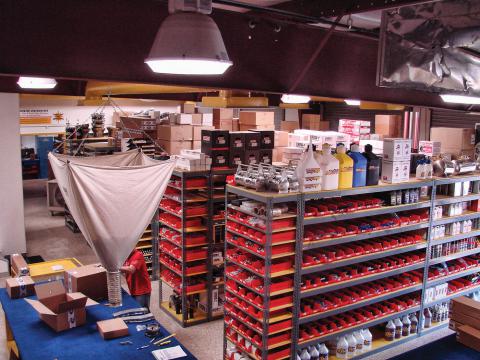
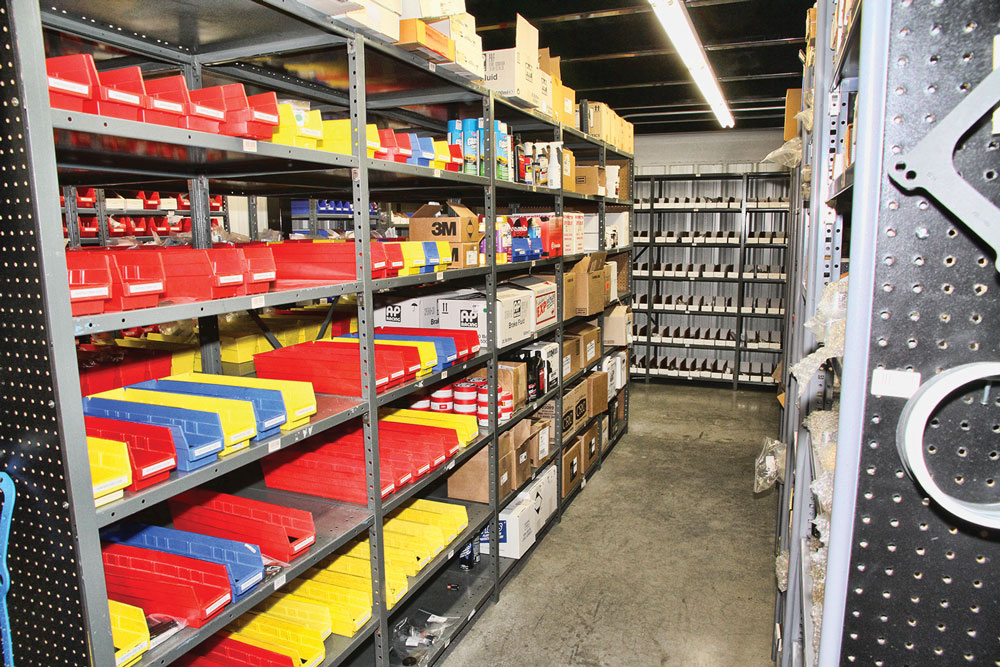
“You can’t sell out of an empty wagon,” noted our source from BR Motorsports, who pointed to several of today’s online retailers that “have a storefront on their website, but they don’t actually inventory anything. They’re relying on the manufacturer, or another warehouse, to supply the product.”
Create a winning action plan that incorporates inventory management strategies rather than turning those decisions into a game of chance.
Finding an equilibrium between supply and demand is a fundamental goal of just about any business that offers a physical product. Achieving that balance has been a tricky proposition since the advent of organized commerce. For those who support motorsports—a time-sensitive industry with customers who often have very specific needs—it can directly equate to the success or failure of a company. Ongoing global supply chain issues have added another level of complexity to the mix that has frustrated owners and customers alike.
“You can’t sell out of an empty wagon,” said Blake Robertson of BR Motorsports, Visalia, California. “There’s no point in advertising something when you can’t actually supply it. It’s something we see a lot with online stores these days. They have a storefront on their website, but they don’t actually inventory anything. They’re relying on the manufacturer, or another warehouse, to supply the product. Now more than ever, that’s how mistakes happen. Putting the responsibility on somebody else is not good business. These things should be on the shelf.”
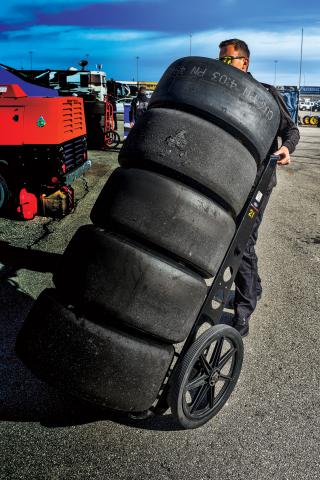
Robertson is also quick to point out that some strife remains unavoidable due to current circumstances. “Consumables have been an ongoing issue—tires in particular. Hoosier had been backordered so much last year that races had to be canceled because they simply couldn’t get tires to the track. High-demand components are just hard to get right now. Where in a normal year we might carry 10 or 15 units of an item and it would take us two weeks to replenish our inventory, it’s six to 10 weeks on a lot of consumable things now. The demand is a double-edged sword in that way.”
Leveraging experience and past performance can pay dividends for shop managers, said one of our sources. “My question to a business that’s been operating for 10 years would be, ‘Do you have 10 years of experience, or have you had 10 first-year experiences?’” he said. “Ten years of experience should provide a feel for the ebb and flow of the market.”
Keeping a large amount of inventory on hand can be a costly proposition, especially when it comes to motorsports products. That’s why Tom Shay of Profits Plus in Dardanelle, Arkansas, said it’s crucial for racing businesses to establish a specialized game plan. “That plan should not only define the quantities of inventory that you want to order, it should also be part of a larger overall strategy that determines whether or not you have the money to actually do it.”
Trying to be a one-stop shop for every customer that walks in the door isn’t really feasible, Shay said. “That’s expensive to do, and it generally doesn’t make money for the businesses that attempt it. You can’t be everything to everybody. Instead, take a step back and really consider who your target customer is and what those particular customers need.”
Catering to specific groups of racers tends to prevent a variety of inventory issues from popping up unexpectedly, Robertson noted. “We pay more attention to the sprint car and midget market because that’s where our expertise is,” he explained. “The main thing is to know your market. Otherwise, you’re going to end up ordering stuff that’s going to sit on the shelf. That’s a waste of money and a waste of your time. But understanding the market and how it moves during certain times in the race season prevents a lot of that.”
That’s where leveraging experience and past performance can pay dividends. “My question to a business that’s been operating for 10 years would be, ‘Do you have 10 years of experience, or have you had 10 first-year experiences?’” Shay said. “Ten years of experience should provide a feel for the ebb and flow of the market. There are ups and downs in terms of what’s in demand and when. I would hope these businesses are somehow tracking the items that they sell by SKU. That allows them to go back and determine where those fluctuations tend to occur.”
Robertson pointed out that analyzing that data allows a business to predict what the future will bring. “It’s important to have some foresight and know what’s coming up. I often look at the history of what we’ve sold, and when, to try to prepare at least 60 to 90 days ahead of time. Use the knowledge available in order to lay out a forecast for the months ahead.”
Shay said it’s really about specializing in “who” rather than “what.” “Inventory control is like a game of Whack-A-Mole. If you pay attention to your sales history, it will tell you which mole is going to pop up next.”
Shortages plagued the 2021 race season, but these manufacturers have plans to keep tires rolling down tracks this year.
As PRI reported in August 2021, race tire manufacturers spent 2020 dealing with COVID-19 related shutdowns, and then trying to meet spiking demand in 2021 while dealing with disruptions in the labor and global supply markets. We spoke again with these tire manufacturers in December to re-assess the current situation and gauge their outlook on the tire supply for 2022.
American Racer
Scott Junod of American Racer in Indiana, Pennsylvania, gave a blunt assessment of the year behind and the year ahead. He cited the same challenges with material supply and labor as other tire companies while outlining steps the company put in place to keep racers supplied.
“We’ve left no stone unturned in getting people and material to build tires,” Junod said, adding that he expects continued limited supply in all raw material markets through 2022. “I might get enough nylon to run for a couple of weeks but run out of something else and have to shut down a tire line.”
The main strategies that American Racer put into place in 2021 included focusing on supplying existing customers and high-volume products, Junod said. “Last year, we didn’t bring any new customers onboard. We made that decision in January 2021. We focused on our existing book of business to help them get through the season, and we did a good job of doing that. The phone was ringing, but we didn’t feel it was right to sign up new customers and not be able to supply the tires.”
He said that demand from existing customers drove business 10–20% higher than 2019. “You can’t compare to 2020,” he added. “Everybody needed more tires coming out of 2020.”
American Racer also streamlined its product line, preferencing longer-run models over shorter-run specialty tires. “We didn’t shut down too many things,” Junod said. “We met our obligations to events and racers.”
He expressed some improvement on the labor front, reporting more hires and lower turnover in recent months. At the same time, however, Junod said that availability of workers does not always align with raw material supply. “It seems the more labor we have to make tires, the less likely it is to have all the materials we need to build them.”
Junod expects to continue the company’s plan through 2022. “We’re going to do our best to supply existing customers and won’t be signing on new ones. I’m optimistic for the customers that we have, but it’s going to be another challenging year, maybe longer. If we can get tires to an event where somebody needs them, we’re going to do anything possible to make that happen.”
Tire manufacturers are struggling against pandemic-triggered shortfalls of materials and manpower. Hoosier Racing Tire has implemented more than 70 measures aimed at easing workforce shortages.
Hoosier Racing Tire
Paul Menting of Hoosier Racing Tire in Lakeville, Indiana, echoed the issues about material supply and labor but also said the company’s steps to address the latter are helping to increase tire production.
“We are seeing shortages of nylon, carbon black and other materials mainly due to labor shortages and logistic constraints our vendors are experiencing,” he explained. “This situation would appear to be continuing in 2022.”
Focusing on the labor issue, Menting offered somewhat better news. He first explained that pressures put on the Hoosier workforce, including mandatory six-day work weeks with voluntary Sundays for over nine months in 2021, caused many to resign and will not be repeated.
“We instead need to fill the gap with more workers working fewer hours,” he said. “We put into place no fewer than 70 different action items to address hiring more people and keeping the people we have and do hire. One of the largest was a 20% wage increase in 2021, with more increases planned for 2022.”
Menting disclosed that those measures have already helped attract and retain new employees, but he said such progress takes time to have an overall positive effect on business. “It takes three to six months to bring a new hire up to speed and productive in the tire plant, depending on the job skill.”
Menting confirmed that the new labor measures have resulted in increased production output, and that Hoosier will make more tires this year than in 2021. He cautioned, however, that the company is starting 2022 with less inventory than it did entering 2021, and that the supply pressures will be the same in 2022, if not worse.
“We are asking all customers to conserve and limit tire consumption where possible in order to help the entire market achieve our goals of running every race scheduled,” he said. “We are very proud of the effort all our employees, distributors, and customers put into the problem of supply in 2021, and through that group effort we were able to manage the situation. We will need the same focus in 2022 and, hopefully, toward the end of the season we will see light at the end of the tunnel.”
Despite recent challenges, some manufacturers are optimistic for this year’s race season. “We are hopeful that 2022 will be an improvement over 2021,” said our source at Toyo Tire USA.
Toyo Tire USA
Toyo Tires is a leading brand in motorsports spec-tire classes, and Cameron Parsons told PRI that the Cypress, California-based company plans to continue supplying racers for the upcoming season.
“The current climate in the tire business unfortunately forces us and just about all other tire manufacturers to re-prioritize efforts,” Parsons stated. “We are working within strict material and shipping limitations, so our highest priorities are to fulfill our existing agreements and contracts as best we can.”
He explained that while production and shipping are limited, Toyo is allocating resources to serve the spec-tire classes specifically. “We will produce our other motorsports products and sizes outside of these spec-class products as we are able,” he said.
Parsons offered a ray of optimism for the new race season. “We are hopeful that 2022 will be an improvement over 2021,” he added. “The impact of material shortages and supply chain limits caught many by surprise in 2020, and we are still seeing the effects. We have been adapting to this situation and aim to be better prepared for 2022. We expect our supply to improve as we now have a better idea of prioritized products for the current automotive and motorsports climates.”
Industry insiders and trendsetters tabbed select motorsports parts and accessories, from composite engine parts to welding products, for recognition in Performance Racing Industry’s first-ever Featured Product Awards program.
Alex Taylor knows what’s best for her race car and didn’t let a little personal apprehension keep her from selecting the innovative StraightGate 50 wastegate from Turbosmart in Ontario, California, as her Judge’s Pick in the first-ever Featured Product Awards at the PRI Trade Show.
“Something that we’ve dealt with back and forth with our own car is the CO2-controlled wastegates,” said Taylor, a popular YouTube star with an in-depth series that details the start-to-finish buildup she and her father, Dennis, performed on a rusted-out 1955 Chevy 210. Powered by a 3,000-horsepower 525-cubic-inch twin-turbo BBC, the car has run in the mid-7s at more than 185 mph.
“We’re actually running Turbosmart wastegates, but we go back and forth with trying to figure out fluctuating air pressure. With the precision and consistency that the StraightGate50 would allow, I can see it being a game-changer,” she added, noting that choosing a product based on her personal needs was somewhat self-serving. “I hated to choose it based on that. There were lots of great new products. But that one stood out to me because I have a newfound understanding of why it’s important. That’s the reason I chose it.”
Featured Product Awards judge Garrett Reed of AmericanMuscleHD reviews hundreds of new parts and accessories on display in Lucas Oil Stadium’s dedicated product showcase. His top pick: Composite Lifters by AWA Forged Composites.
Taylor was soon comforted after hearing three of the other judges also selected the StraightGate 50 as their top pick. The panel of 12 judges boasted a wide diversity of racing backgrounds, including track operators, sanctioning body officials, social media influencers, and traditional media. As a team, they selected standouts in eight different categories from some 350 entries in the PRI Show’s Featured Products Showcase, and then made a Judge’s Pick of a product that had the biggest impact on them individually.
NHRA Director of Multimedia Content David Kennedy selected the Pro Series brushless spur-gear fuel pump from Fuelab in Collinsville, Illinois, as his Judge’s Pick.
“The idea of the spur gear, based on the specs, it’ll support 2,500 horsepower,” explained Kennedy. “It’s a flow-through design with a brushless pump. It’s going to be durable and flow a ton of fuel. And I have great experience with Fuelab products.
“It’s the idea of having a reliable, consistent fuel supply,” he added. “The fuel pump is usually at the opposite end from the engine on the vehicle and can often cause many problems. So, if they can make that one choice easy, then every racer benefits.”
Garrett Reed has an Instagram page called AmericanMuscleHD that has more than 2.2 million followers. He chose a product that is still in the prototype and testing stage, but one he feels is very unique.
A 12-judge panel of race track operators, sanctioning body officials, social media influencers, and traditional media selected standouts in eight different categories from some 350 entries in the PRI Show’s Featured Products Showcase.
“I’ll be honest, it was just the only thing that seemed really different,” he said of the composite lifters from AWA Forged Composites, a company based in Rolling Hills Estates, California, that is developing and testing composite engine parts, such as pushrods, rocker arms, connecting rods, and pistons. Those components are traditionally aluminum or steel.
“All the other products that we saw were a new design, but I’ve never seen somebody take composite materials and use it as an internal engine part,” Reed explained. “I know it’s obviously lighter than standard material used on lifters. I want to see how this works. I want to know if it can hold up to the stress of standard materials that have been used for years. So, it’s the one thing that just caught my eye.”
About two-dozen PRI exhibitors received either a Judge’s Pick or a Category Award through the Featured Product Awards program. Following is the complete list of winners.
Best Accessory Product
FLASH Integrated Scale Ball Mount Fastway Trailer Products
The integrated mechanical scale ensures repeatable scale accuracy when measuring tongue weight. With a properly balanced load, you can enjoy improved steering, better braking control, and reduced trailer sway. Features include: 1,000 lb. max tongue weight; 10,000 lb. max trailer weight; 2" receiver; 2" and 2-5/16" chrome hitch balls included. fastwaytrailer.com
FIA Composite Full Containment Seats RaceQuip
FIA certified to 8855-1999 specs, this seat is suitable for pro racing with increased thigh and hip support along with extended shoulder and rib bolsters. The halo protrusions at the top provide additional head support, which is why this seat is considered full containment. Available in 15" medium and 16" large sizes from any RaceQuip dealer for under $700. racequip.com
VP Trigger Hose VP Racing Fuels Inc.
This is a fuel hose system unlike no other. Its patented push-button, self-venting control-flow valve is developed for use with VP Motorsport Containers. It takes seconds to install and makes refilling extremely efficient. Simply tilt your container, press the Trigger button for flow, and release the Trigger button to quickly stop the flow. vpracingfuels.com
Best Chassis Product
PE Mounting Clamps PE Racing
An easy and strong solution to mounting panels, cables, or objects securely to common tubes sizes and roll cages. The line of clamps includes: steering wheel/helmet hooks; tube to panel mounting brackets; tube clamp mounting brackets; and fuel pump/filter mounting brackets. peracing.com.au
Front Lightweight Tubular Subframe Mercedes-AMG GT GT S GT C GT R Pro Verkline
Cuts weight by 40% over OEM, resulting in 45/55 front to rear weight distribution. It is similar to the tubular subframes used in Mercedes AMG GT3 and GT4 race cars. It is CAD designed from a 3D scan of the OEM subframe, finite element analysis 3D tested (FEA), and made from T45 tubing. verklineusa.com
Full Suspension Set Bundle-Toyota GR Yaris Verkline
Features front and rear lightweight billet uprights, aluminum rear diff carrier, front and rear adjustable upper and lower arms, rear lower arm inserts, and rear sway bar links. It is designed for both road racing and long-travel rally applications. verklineusa.com
Best Drivetrain Product
Carbon Fiber DriveShaft PEM Racing
Proudly manufactured in the Heartland of the USA, these carbon fiber driveshafts are available in sizes 2.25", 2.75" and 3.25" OD for circle track applications. Features include: 1310 series Neapco Performance Solid Cross U-joints; aluminum extra clearance bondable yokes; and built on modern driveshaft equipment. Trakhook Superflex Tubing is available in 2.25" OD. pemracing.com
4L80-E, 4L85-E Heavy Duty Input Shaft Sonnax
This high-strength, 300M Sonnax input shaft combines unique design features with advanced manufacturing processes for exceptional performance, durability, and value. A torsional design and spline/cross-hole refinements add strength, as does elimination of the deep undercut at the OD carrier spline where other shafts fail. sonnax.com
These quick change gear sets are constructed from high-strength alloy steel for higher HP cars with bigger tires. They are lightweight, which decreases the rotating weight. Sets also feature REM polished surfaces for less friction and longer life. speedwaymotors.com
Best Engine Product
Composite Lifters AWA Forged Composites
AWA’s composite lifters are stronger and 30% lighter than competing lifters. Lighter lifters lead to less spring pressure, putting less stress on parts and decreasing deflection. The composite material also reduces harmful harmonic effects. Moreover, AWA has eliminated the use of needle bearings that catastrophically damage an engine during failure. awacomposites.com
Features Clear View’s patented see-through oil filter tank. All are components CNC-machined with no welds inside or out. Has superior venting and baffle system that mounts to the top and removes in one piece for easy maintenance. Tanks come clear or black anodized. clearviewfiltration.com
Electronic StraightGate 50 Turbosmart
The e-StraightGate50 is a world first in electronic boost control technology. Gone are the flow disadvantages of poppet-style wastegates. Its proprietary butterfly valve design makes it the fastest and highest flowing wastegate in the world. This allows the response of a small wastegate, with the flow of a large one, while providing linear control. turbosmart.com
Best In-Vehicle/Electronic/Telemetry Product
FT550 EFI System FuelTech ECU
The FT550 is an engine fuel control and monitoring system from FuelTech: electronic fuel injection, integrated dashboard, data acquisition and power management. fueltech.net
MPVI2+ HP Tuners
Combine the MPVI2+ with VCM Suite for the most comprehensive scanning, logging, and calibration tools on the market. Whether you are building a dedicated track car, a next-level street car, or just want more fuel efficiency or better towing for your daily driver, HP Tuners has the tools to get the most out of your vehicle. hptuners.com
VBOX Video HD Lite VBOX Motorsport
A combined video and data logger designed specifically for motorsports. Features a compact and aerodynamic form with GPS data and 8 CAN channels allowing connection to a third-party dash or ECU. Review synchronized video and data in the easy-to-use Circuit Tools software supplied. vboxmotorsport.co.uk
Best Race Fluid
High Performance Snowmobile and Winter Coolant and Antifreeze Engine Ice
From the trusted makers of Engine Ice Hi-Performance Coolant comes this new coolant and antifreeze engineered for the specific demands of snowmobiles and winter SXS, UTV, and ATV use. Features: maximum cooling and freeze protection to -45°F; maintains optimum temperature, reducing possible power loss from excess heat; and biodegradable. Also, no mixing required—ready to use. engineice.com
Speed Sauce VP Racing Fuels Inc.
VP Speed Sauce is a proprietary water-methanol injection fluid that helps control detonation and can increase horsepower and torque with proper tuning. Speed Sauce water-methanol mix comes premixed, so it’s ready to use straight from the bottle. Another key point is that it’s relatively non-corrosive in certain circumstances. vpracingfuels.com
XR RacE-ONLY Brake Fluid Wilwood Disc Brakes
Wilwood’s new XR Race-Only brake fluid is the same extreme high-temperature fluid used in Formula 1, World Rally Championship, FIA World Endurance, and Moto GP. Laboratory testing indicates XR Race-Only fluid has a dry boiling point of 645°F thanks to a proprietary blend of high-performance polymer electrolytes and borate esters. Sold in four packs. wilwood.com
Best Shop Equipment
BlueArc 140MSI MIG-STICK Inverter Machine Blue Demon Welding Products
This 120V x 140A DC MIG-STICK Welding Machine offers gas and gasless MIG welding functionality; includes a Synergic Control Feature; is portable and light weight (only 19 lbs.); fits standard 2 lb. and 11 lb. spools; includes integrated MIG torch, ground clamp, and stinger; and welds steel, stainless steel, copper, and aluminum. weldingmaterialsales.com
Tire Scraper United Race Parts
With a molded handle for user comfort, the integrated heat gun has variable temperature and fan speed; 2,000 W output and a 100- to 600-degree temperature range. Avoid damaging your tire compound by using unsuitable tools and/or excessive temperature. This product features an adjustable handle and blade position to suit the user, and is ergonomically designed to increase productivity. unitedraceparts.com
Square Wave TIG 200 TIG Welder Lincoln Electric
The Square Wave TIG 200 is a portable TIG and stick welding machine that lets hobbyists, makers, and fabricators explore their creativity. This machine is TIG and Stick capable with a user-friendly interface and advanced aluminum controls that make welding fast and easy while also providing room to expand your welding experience. lincolnelectric.com
Best Suspension Product
RFX Wireless Suspension Load Stick Intercomp
RFX Wireless Weighing Technology eliminates indicator cables. Rate one to four corners using up to four load sticks with one indicator. Allows you to analyze and adjust spring rates for maximum performance, and quickly determine static load at ride height for each wheel; individual load sticks are also available without the indicator. intercompcompany.com
C5/C6 MOD Series Coil-Overs QA1
Convert your Corvette’s leaf spring suspension to QA1’s MOD Series coil-over shocks to maximize handling performance, suspension tunability, and ride height adjustment for the perfect stance. These four-way adjustable Corvette coil-overs are perfect for pushing your car to the limit at the track then setting the valving for comfortable street use. qa1.net
GM 2.0 Control Arms QA1
QA1 Control Arm 2.0 was designed to be the lightest, strongest, and best-looking control arms available for your ride. Uniquely engineered with key features optimized for either street performance, pro-touring, or drag race vehicles, these American-made control arms will ride better, corner harder, and launch faster than anything you’ve experienced in the past. qa1.net
Judge’s Picks
Composite Lifters AWA Forged Composites
* Awarded by Garrett Reed, AmericanMuscleHD
BlueArc 140MSI MIG-STICK Inverter Machine Blue Demon Welding Products
* Awarded by Joe Skotnicki, Race of Champions
123 Count with Car Parts Book EAT SLEEP RACE
* Awarded by Wes Buck, Drag Illustrated
Flagtronics FT200 Kit Flagtronics by Ballenger Motorsports
* Awarded by JA Ackley, Outside Groove
40501 Brushless Spur Gear 6GPM FUELAB
* Awarded by Chris Blair, World Wide Technology Raceway and David Kennedy, National Hot Rod Association (NHRA)
CrankDrive F-4X-140 ProCharger Supercharger Systems
* Awarded by Brian Dunlap, World Racing Group
RaceQuip PRO20 Carbon Fiber Top-Air RaceQuip
* Awarded by Karl Fredrickson, Speedway Illustrated
Electronic StraightGate 50 Turbosmart
* Awarded by Alex Taylor, Alex Taylor Racing; Chad Reynolds, BangShift; Kevin Wells, Formula Drift; and Mike Galimi, ProMedia
The Specialty Equipment Market Association (SEMA) and Performance Racing Industry (PRI) welcome the installation of a new water well and weather and hydrologic equipment used for measuring salt growth conditions as part of its broader Restore Bonneville program. Federal and state funds were released last year to install the monitoring equipment and help increase the volume of salt pumped onto the Bonneville Salt Flats this year to a total of up to 500,000 tons.
As part of the Restore Bonneville program, SEMA, PRI, and the racing community joined forces with the U.S. Bureau of Land Management (BLM), Utah Department of Natural Resources (DNR), Utah Geological Survey (UGS), and Intrepid Potash Inc. in the collaborative restoration effort. Originally in the 1960s, the racing venue was over 13 miles in length, but the course is now eight miles or less. According to a study by the BLM, the Salt Flats have also shrunk in size from 96,000 acres to about 30,000 acres.
Located in northwestern Utah, the Bonneville Salt Flats are composed of densely packed salt remnants of an ancient lakebed formed over thousands of years. They serve as a unique stage set for movies, commercials, marathons, and rocket club launches, and possess rare physical qualities that make it the perfect venue for land speed racing, such as providing a cool surface that doesn’t overheat tires. Since 1914, hundreds of land speed records have been set and broken in a variety of automotive and motorcycle classes. Speed Week, the marquee event at Bonneville, began in 1949, with scores of racers and thousands of spectators descending on Bonneville in the quest for records.
Bonneville serves another important role as a crucial natural resource for potash used primarily in fertilizers. To obtain potash, salt brine is collected in large solar evaporation ponds, from which potash is separated out and processed. The remaining salt is stored and may then be returned to the Salt Flats as salt brine.
Beginning in the 1960s, the BLM issued leases to the north of Interstate 80, where motorsports racing and other recreational activities take place, allowing salt brine to be collected in open ditches for commercial potash processing. The mine operator began pumping the processed salt back onto Bonneville in 1997 as a result of a pilot project SEMA advocated to create. The Restore Bonneville program will help address salt losses that occurred before 1997, when the potash project was operated by previous companies.
The BLM and DNR signed a Memorandum of Understanding in April 2020 to jointly pursue restoration efforts. The program, which SEMA calls Restore Bonneville, will be managed by DNR, in conjunction with the BLM, and operated by Intrepid Potash. The endeavor is strongly supported by SEMA and the Save the Salt Coalition, a collection of companies, organizations, individuals, and land speed racing teams.
In working with Intrepid Potash, the volume of salt laid down on Bonneville will be increased by updating and improving the efficiency of the current pumping infrastructure and water conservation efforts, which includes rebuilding water wells, covering ditches, and installing new pipes and pumps. Great efforts to use water more efficiently will help achieve the goal to increase the volume of salt returned to the salt flats. It will likely take several years to upgrade the infrastructure and gradually increase pumping volumes.
The summer 2021 installation of the new water well and equipment to measure water evaporation rates and collect scientific data represented a tangible start to the ambitious restoration effort. The program will seek to identify the best ways to take advantage of the salt laydown and study the effects on the salt crust and underlying brine aquifer. For example, the program will consider ways to contain the salt within the large pumping area. If current research proves beneficial, efforts may be extended into the future upon funding availability.
Stakeholders are now identifying projects to be pursued in 2022 and beyond to continue increasing the volume of salt being pumped. While the bulk of the program funding will come from federal and state appropriations, both industry and the land speed racing community will voluntarily help pay the costs. Financial contributions from the racing community are gratefully accepted at savethesalt.org, a 501(c)(3) organization.
Initiatives like these are one of the many advocacy efforts supported by PRI Membership, which is actively working to address challenges and needs, such as providing support for race tracks to prevent them from closing, advocacy for the racing community against current legal threats, and educational programs that help businesses and racers succeed. For more information on PRI Membership, visit performanceracing.com/membership.
NASCAR Executive Vice President & Chief Legal Counsel Gary Crotty has been elected by the FIA General Assembly as one of 36 judges to serve on the FIA Courts. A member of the NASCAR Board of Directors, Crotty is the first NASCAR representative to serve in this capacity. Crotty’s term, which began on January 1, runs through December 31, 2025.
As an FIA judge, Crotty may be appointed to sit on the FIA International Tribunal or International Court of Appeal. The International Tribunal is the first instance level of the jurisdiction of the FIA and can hear disciplinary matters brought before it by the FIA President. The FIA International Court of Appeal is the appeal level of the jurisdiction of the FIA and hears appeals of decisions taken by various sporting and disciplinary bodies, such as stewards or the FIA International Tribunal. Both entities act independently from the other FIA bodies and FIA Members.
Crotty joined NASCAR as Secretary and General Counsel in 1996 and was named to the Board of Directors in 2006. He oversees the company’s legal department located in the corporate headquarters in Daytona Beach, Florida.
“It is an honor to be recognized and named to this prestigious post,” said Crotty. “I thank the members of the FIA General Assembly for placing its faith in me, and look forward to serving. It is one of the true highlights of my career.”
Attention to detail and out-of-the-box thinking have resulted in more than 100 victories for customers of this Michigan-based shop since the company opened in 2008. Steadfast support and its ability to adapt has kept the builder at the forefront of Outlaw and Super Late Model circle track racing.
When Terry Senneker decided to turn his self-described side hustle into a full-time business back in 2008, he’d already amassed a wealth of experience competing in—and wrenching on—Outlaw cars. In many ways the shop was a natural progression for Senneker. He’d worked for several different chassis manufacturers over the years, and eventually he began developing his own solutions for shortcomings that he identified in the suspension systems of his cars.
“I did a lot of dumpster diving for other peoples’ parts, basically fixing their throwaways,” he recalled. “For a while I was just dabbling in it on the side when I could find the time. I had a couple of customers who wanted me to build cars, so I would work on those at night. At a certain point I felt like I had a big enough workload that I could just focus on doing this, so I decided to give it a try.”
Turning Senneker Performance into a full-fledged shop was a fairly hassle-free transition, Senneker said, because most of the typical obstacles that face new small business owners had already been addressed. “I was fortunate enough to be able to run the shop from my home. We had a pole barn in the backyard, and I already had all of the welding and fabricating equipment I needed to get started. I didn’t have to take out any bank loans or anything like that, so that made it a lot easier to get the ball rolling.”
In its earliest incarnation, Senneker Performance was a partnership, but differing priorities convinced Senneker and his business partner to part ways amicably. “We started with a couple of IMCA modified builds and a few Outlaw cars, as well as some work on sportsman cars, anything we could do to make some money,” he said. “But we soon realized that we had different goals: I wanted to grow a business, and he wanted to continue doing this as more of side hustle. We parted ways on friendly terms, and that’s when I really started focusing on what I needed to do to make this a viable operation.”
Senneker set to work developing the fixtures and jigs he needed, and shortly thereafter, several Outlaw customers jumped on board. “JR Roahrig and his son Tyler were some of the first customers we had that really started winning,” he explained. “My success at the track in my own car helped the business to a tangible degree, but when customers began taking podiums, that took it to another level. It really solidified this shop as a business and helped us gain some momentum.”
In a relatively short amount of time, Terry Senneker has taken Senneker Performance from side hustle to regional success. “It got to the point where about half of the field was running our cars.”
Senneker Performance soon became a dominant force within the Midwest Outlaw ranks. “It reached a level where it was basically a case of strength in numbers,” Senneker said. “We had premier teams in our cars, and by 2012 or so, it got to the point where about half of the field was running our cars on any given night.”
These days the company operates out of a 5,000-square-foot facility in Wayland, Michigan, which puts it about a half-hour’s drive from both Berlin Raceway and Kalamazoo Speedway. The shop has nine stalls and six car hoists for its half-dozen technicians to utilize, along with a wide variety of fabrication equipment that includes MIG and TIG welders, vertical and horizontal band saws, a manual lathe and a manual mill. Since tuning and setup is such an intrinsic part of chassis building, Senneker Performance also has a pull-down rig to simulate suspension behavior at speed, along with a shock dyno and the requisite data acquisition equipment. While the company outsources its machine work, all of the engineering is done in-house.
Besides building complete chassis, Terry Senneker and his team also repair and service cars. The shop can even adapt the unique Senneker front and rear suspension to other brands of chassis.
“Most of the folks we’ve hired over the years have been through word of mouth,” Senneker said. “We haven’t had a high turnover rate, and we’re fortunate in that way because it’s a very specialized market. We can’t just put out an ad for a general welder or fabricator. Being a chassis builder makes us kind of a jack-of-all-trades, yet the skills are specific to this kind of work. We’re hanging the bodies on the cars, we’re wiring them up and we manufacture most of the suspension components that we use.”
Recent years have seen the shop shift its focus beyond Outlaw cars, a move that Senneker said came from necessity. “Early on it made a lot of sense because that’s the kind of racing I was doing at the time, and it was very popular. There were 30 or more cars at any given event we went to. But at a certain point that market started to get saturated with our cars, and the Outlaw car counts started to level off. It got to a point where we had so many Outlaw cars out there, there wasn’t really a market for brand new ones. It kind of turned into a used-car market after that.” As a result, Senneker Performance began to shift its attention toward Super Late Model racing.
Along with its chassis builds, the company services and repairs the cars, and it can adapt its components to existing chassis. For instance, if a customer has another builder’s car and they don’t want to invest in a brand new car, the shop can adapt its front and rear suspension systems on the car.
“We’ll take on just about anything, whether it’s repairs, re-working an existing chassis, hanging a body on someone else’s chassis, or just doing setup work,” said Senneker. “Our flexibility has been really important to our success.”
It’s a sentiment shared by Mike Garvey, a longtime Senneker Performance customer who has been campaigning cars in various short-track disciplines for nearly four decades. “We’re always trying to keep an eye on what’s going on around us. At a certain point, I started to notice that the Senneker cars were running really well. What really impressed me was that Terry was thinking completely outside the box. Most of these cars are very similar to one another, but Senneker designed a totally different suspension, and I really liked that. With a Senneker car, we kind of have to forget about the other cars when it comes to what we’re doing. These are completely their own thing. We saw a lot of success once we started racing with them, and we also became really good friends with those guys along the way.”
Terry Senneker started his business out of his home, but now has a 5,000-square-foot shop with nine stalls and six car hoists—ample workspace for the company’s six technicians.
These days Garvey spends more time coaching and consulting young racers, and he told us that he points them toward Senneker’s shop whenever applicable. “We’ve been really happy with Terry’s work and the support that the shop provides,” he explained. “They build the best cars out there, and they provide consistent, repeatable performance. But importantly, Terry’s team is also easy to work with. If you have something you want to try, they’re receptive to new ideas.”
Senneker pointed out that being willing to adapt to change is crucial if the goal is to stay competitive. “Some manufacturers take a ‘Gen 1’ and ‘Gen 2’ type of approach to chassis building, but our philosophy has been more about tweaking them as we go. Instead of just establishing these specific generational templates, we want to be able to react to rule changes and adapt to the times. It’s more of a progression.” Rather than investing all of its engineering effort into developing and producing a new chassis every few years, for Senneker Performance it’s about making incremental changes to its existing designs on a regular basis in order to improve the breed.
Terry Senneker, pictured second from right, believes his experience behind the wheel is vital to the company’s success. “You need to understand what’s going on from the driver’s perspective,” he said.
Taking a hands-on approach to development right from the start helped the company establish a larger engineering philosophy for the products it produces. “For me this has very much been about doing it myself—being in the seat and being able to feel how the changes we are making are affecting the car,” Senneker said. “Rather than approaching it from the perspective of a typical business owner, I want to be able to provide first-hand information. That’s especially important with a racing business. If you’re trying to get feedback from a customer and interpret what they want out of the race car, you need to actually be there working on the cars. You need to understand what’s going on from the driver’s perspective.”
The shift toward spec and crate engine packages across stock car racing has reduced the number of powertrain combinations available to racers in many series and classes, but prospects still exist for engine builders willing to do their homework.
As stock car sanctioning bodies look for ways to reduce costs to racers and drum up sponsorship support from heavy hitters like Edelbrock and General Motors, spec and crate engine requirements have become increasingly prevalent. This shift has reduced the importance of the powerplant as a strategic element of teams’ racing programs within certain series and classes, and it has yielded some consternation among engine builders as a result.
“I think that money is the number one factor,” said Clint Anderson of CNC-Motorsports, Brookings, South Dakota. “And by that, I mean some kind of financial backing to the organization in the form of a large sponsorship agreement. The incentive is much greater for the sanctioning bodies than it is for the racers. If the organizers were so concerned about curbing costs, we’d see the regulations focused elsewhere. Even if they’re marginally curbing the cost of the engine, it still doesn’t stop racers from spending $30,000 or $40,000 on a chassis.”
That shift has convinced outfits like Dakota Engine Builders in Jamestown, North Dakota, to adjust its focus over recent years. “The crate engine trend has definitely taken a toll,” Jim Beyer explained. “It has taken business away from shops like ours, and we have put more energy into other disciplines as a result—drag racing, truck pulling, mud runners and so on. That said, we still have a pretty strong amount of business from circle track racing with the sanctioning bodies that aren’t building their rule sets around crate engines. We’ve been staying busy.”
IMCA President Brett Root said that demand for engine builders still exists with the Vinton, Iowa-based organization and others. “There is plenty of opportunity for engine builders within IMCA to build non-crate engines, and we also select engine shops to repair broken crate engines through IMCA’s sealing process.”
As we discovered, negotiating these changes comes down to identifying which classes to target and what support is needed.
The Crate Game
The growth of crate engine requirements in stock car racing has narrowed the field for would-be engine builders within the discipline, but Anderson said that there are still a few avenues to explore even within these limited confines. “Shops can’t really compete from a pricing perspective with a stock-style engine that’s built in mass quantities,” he observed. “They can become a certified crate engine rebuilder, though, and anybody can become a reseller for those. There’s also the option of becoming an approved crate engine builder, but there’s usually a fairly lengthy certification process associated with that. We never really looked into that very much because it would require taking a significant amount of money away from our other markets to support it.”
Jack McNelly of the CARS Tour in Mooresville, North Carolina, sees a clearly defined pathway for engine builders within crate motor stock car classes, though he also admits it’s a tight market in which to gain a foothold. “There’s a list of engine builders all over the country that are SEAL [Sealed Engine Alliance Leaders] approved. Builders are brought into the mix through an application process that is brought in front of the SEAL board and considered.”
Beyer also said some series provide racers with a wider range of options within classes where crate engines are often utilized. “The WISSOTA series, for instance, allows crate motors, but the majority of people racing with that series still run custom-built engines. WISSOTA also came up with its own plan to put together a ‘concept engine’ specification, where we control the rpm’s along with the lift of the cam in some classes. It basically created these rules to help us engine builders stay in business and provide these engines, and it’s good for the racers because it allows them to race with the engine of their preference. And the racing is good. Some nights in the Late Model races the 525-cubic-inch engine does well, and on other nights the open motors do well. It’s not one-sided. On any given night, either of those motors could win the event.”
Meanwhile, Root noted that engine decisions often come down to cost for many racers. “I sympathize with the anti-crate crowd to a certain extent, but the reason the crate has become so widespread is because of the perspective of some of those engine builders,” he said. “Racers, particularly IMCA racers, tend to migrate to what they can afford. In the end, the racer drives much of the market demand. If the crate is winning those racer decisions, that said it all to us.”
Spec, Not Stock
Although crate motors don’t provide stock car racers and engine builders with many options in terms of strategy, the same is not true of most spec engine rule sets. “In Late Model stocks, for instance, we use a ‘spec’ motor that isn’t sealed,” McNelly said. “In a rule set like that, the racers are told what parts must be in the motor, but there’s more leniency as far as the rest of the combination goes. The requirements mostly pertain to the main ingredients—camshaft, crank, rocker arms and that sort of thing. But because it’s not a sealed type of situation, competitors and builders have a bit more room to apply some strategy.”
Spec- and crate-engine stock car rules restrict engine builders, forcing many to consider alternative markets. “We have put more energy into other disciplines,” noted our source at Dakota Engine Builders.
These classes also do not require engine builders to be part of an approved supplier list. “Any engine builder can get involved with the spec classes,” Beyer said. “With something like IMCA SportMod, we can build engines, and we do a fair amount of them. We have to abide by certain restrictions for things like compression and the type of cylinder heads that can be used, but there’s some flexibility there. And a lot can be
done with classes like A Mod and Late Model. There are restrictions as far as
cubic-inch limits, there’s a spec head we have to use, and we can only do so much porting in the head, but there aren’t a lot of other limitations. That allows us to develop the engine combinations we want to build.”
Root added that IMCA’s stock car division also has several other non-crate engine options available that land somewhere between spec and an anything-goes open rule set.
“The 350-cfm and 500-cfm carburetor engines fall into that category,” Root explained. “We use the 350-cfm carb to control the performance of that engine, and rule structure is fairly liberal with that one: No compression limit, no cubic-inch limit, no ‘spec’ parts per se, but we still utilize some rules in regard to things like steel heads, blocks, flat-tappet cams and such. The 500-cfm carb engine is more controlled, with a cubic-inch limit, compression limit and a spec head that is required. Those requirements come in addition to the rules that apply to the 350-cfm engine regarding the use of steel blocks, steel heads and flat tappet cams. But it also includes the most important rule for many engine builders: No crate motors allowed.”
Reliability is often more important than outright horsepower anyway, Anderson pointed out. “There’s still a lot of room for improvement. Some classes require a
stock rocker arm, and that’s not really a cost-effective solution for the racers when they’re tearing through a couple sets of them every season. Putting a full roller rocker
While spec and crate engines are increasingly the norm in stock car racing, some sanctions, such as IMCA, also offer options that allow considerable leeway for engine builders.
arm on there would have saved them some money in the long run. The same goes for exhaust manifolds. A header is going to save that racer some money in the long term because manifolds tend to create more heat and fail in a shorter amount of time.”
The Road Ahead
As with most motorsports disciplines today, the costs to campaign a stock car are on the rise despite efforts to stem the tide. “Let’s be honest here: What are you buying today for the same price or less than you paid six months ago?” McNelly asked. “Over the next few seasons, we’ll see measures taken to try to contain the costs, but this kind of racing is very expensive. These racers are spending an inordinate amount of money right now, and we’re reaching the point where our grandstands cannot support what these racers should be getting paid. The two numbers seem to be getting further apart.”
At the same time, Anderson identified some of the same issues as being potential catalysts for more open engine rule sets. “It’s tough to say how things will shake out, but I believe there’s a lot of incentive to loosen up some rules because of the supply chain problems we’re dealing with right now. Tire shortages have been one of the biggest issues that we’ve seen, and car counts may suffer if we don’t find a way to loosen things up so racers can still compete while keeping things balanced. That includes the engine rules. We may see sanctioning bodies ease up on the engine restrictions a little bit more, but that could also potentially add another level of complexity to tech inspection in the interest of keeping things fair. It’s a tough problem to solve.”
Like any other business challenge, navigating adverse engine rules is largely a matter of attitude. “Sometimes things change in fairly dramatic ways, and you just have to adjust,” said a source at Dakota Engine Builders.
Beyer agreed that signs point toward costs heading upward despite everyone’s best efforts, but he also identifies some strategies to lower engine costs that may become more commonplace in the race seasons to come.
“One thing I do think we’ll see more of is rpm limits on the engines,” he said. “Lower rpm usually results in more longevity out of the engine, and that’s one way to address the increasing costs to run these cars. Most sanctioning bodies already have begun to incorporate rpm limits in certain classes, but I could imagine a scenario where they drop the limits further to get the engines to last a bit longer.
“It’s hard to say though,” Beyer admitted. “Racing is a unique business. Sometimes things change in fairly dramatic ways, and you just have to adjust to it. But the folks who really want to do it always seem to find a way.”
XR has announced an agreement to acquire the Southern All Star Dirt Racing Series, one of the nation’s longest-running Super Late Model Series. The 2022 season marks its 40th anniversary.
In assuming ownership of the Huntsville, Alabama-based Southern All Star Dirt Racing Series, XR will work with current series personnel to conduct, produce, and promote all races on the current schedule.
“I bought the series 10 years ago because I didn’t want to see it shut down. We kept things simple and that’s what I know XR will do. With the resources, people, and time XR has, the series is in great hands,” said Matt Wagner, the former series owner.
The series joins XR’s portfolio of events and racing series, including the inaugural XR Super Series for Super Late Models, the Karl Kustoms Bristol Dirt Nationals at Bristol Motor Speedway (Tennessee), and the Duel in the Desert at The Dirt Track at Las Vegas Motor Speedway (Nevada).
XR also announced its plans to purchase the Texas-based Southern Touring Late Model Series. More details will be announced at a later date.
Allen Thomas has been elected president of the National Electric Drag Racing Association (NEDRA), while Lowell Simmons was elected vice president, the organization announced. Votes were cast by either lifetime members or current members of the Texas-based group.
The new office-holders will serve two-year terms, which began on January 1.
Additional executive board positions will be filled by appointment of the president, according to NEDRA. These are also two-year positions and begin at the same time the president and vice president take office. They include directors and liaisons, and are approved by the executive board following appointment by the president.
NEDRA is a coalition of drag racing fans, electric drag racing vehicle owners and drivers, individuals interested in promoting the sport of EV drag racing, EV parts suppliers, EV manufacturers, and other environmentally concerned companies and individuals.
 MEMBERSHIP LOGIN