Melling Engine Parts has announced the acquisition of Casalandra Metal Stamping, a manufacturer of expansion plugs based in New Castle, Pennsylvania.
“Casalandra has been a key vendor to Melling for years, and we were excited when the opportunity presented itself,” said Melling Engine Parts CEO Mark Melling. “We are committed to becoming basic in more product lines and, of course, love the fact that the parts are made in the USA.”
“Casalandra Metal Stamping... [has been] grateful to have served our customers for 70-plus years and have the utmost trust in Melling to continue this service. While passing on our family business was not an easy decision, it is one made with confidence in Melling’s ability to continue business on a personal level,” said Merit Wish Phillips of Casalandra.
Adam Keiser has been named content and communications specialist for the General Tire brand at Continental Tire.
Since 2019, Keiser had been director of marketing at PFC Brakes, where he oversaw marketing for the company's motorsports, fleets and manufacturers units. He began with PFC in 2016 as advertising art director.
Keiser's experience also includes stints at Speed Digital in Charlotte, North Carolina, and Callies Performance Products in Fostoria, Ohio. He has a BA in Visual Arts & Design and an MBA in Marketing from The University of Findlay (Ohio).
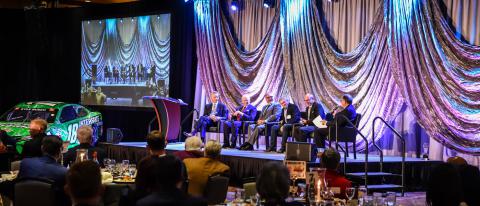
The North Carolina Motorsports Association (NCMA) recently hosted its NC Motorsports Industry Ceremony presented by Fifth Third Bank. The event, held in Concord, North Carolina, honored NASCAR Hall of Fame championship team owner Joe Gibbs for his outstanding contribution to the sport with the Achievement in Motorsports Tribute Award.
Additional honorees included Rockingham Dragway and longtime owner Steve Earwood; the Town of Mooresville, North Carolina; Speedway Children’s Charities; and Toyota Racing Development. Larry McReynolds was also honored with the Jim Hunter Memorial Media Award.
PRI Track Ambassador Tom Deery was on-hand to support the event, which took place at the Embassy Suites Charlotte Concord Resort. PRI was joined by District Director Brett Keeter and Regional Director Will Bowen from the office of U.S. Representative Congressman Patrick McHenry (R-NC), who is the lead sponsor of the RPM Act. Also attending the ceremony was former Governor Pat McCrory, who is running for the U.S. Senate.
“With NCMA focused on racing and high-performance applications in the state of North Carolina—which I put on par with Indiana in that we’re highly dedicated to the industry—it’s great to see PRI, which is on a national scale, take an active role in supporting our state. It gives significant weight to what we do,” said NCMA Executive Director David Miller.
The ceremony also provided the opportunity to update the industry on the latest advocacy efforts affecting motorsports, including PRI Membership and the vital RPM Act. The RPM Act (H.R. 3281 and S. 2736) is common-sense, bipartisan legislation to protect Americans’ right to convert street vehicles into dedicated race cars and the motorsports-parts industry’s ability to sell products that enable racers to compete.
“There are several things we’re working on with PRI, but the biggest might be the RPM Act. We are raising awareness of this bill throughout the state, and as a result of these efforts, several congressmen in the state of North Carolina are co-sponsors of the RPM Act,” Miller said.
SRI and Stock Car Steel & Aluminum President and Owner Greg Fornelli—who is also a PRI Founding Member and NCMA Chairman—echoed Miller’s sentiments and, during the ceremony, stressed the importance of the passing of the RPM Act to those in attendance.
Tierp Arena, known for the FIA European Drag Racing Championship and about 90 minutes from Stockholm, Sweden, which is the location for the 2022 SEMA/PRI Nordic Trip.
Registration is now open for the SEMA/PRI Nordic trip set for August 24–28, 2022, in Stockholm, Sweden. Participants will have the opportunity to learn about the potential for their products in the region, plus meet with top trade buyers from Sweden and the surrounding countries of Norway, Finland, and Denmark.
Performance is among the top upgrades sought for vehicles in the region, which hosts the FIA European Drag Racing Championship and the Summit Racing EDRS Series. Rally racing and drifting are also prominent in the area, and robust sportsman programs allow enthusiasts to use their more modestly upgraded rides in numerous types of competition. In addition, high disposable income and a love of American vehicles and products, coupled with a passion for personalization, make the Nordic area an attractive region for motorsports businesses.
Registration costs include hotel accommodation, a tabletop display, meals, and invitations to networking events. Prices start at $3,860 per company (not including flights and for qualified companies eligible for the instant $1,200 U.S. government grant).
More information is available at sema.org/nordic. For more information, including about the government grant, contact Linda Spencer at lindas@sema.org to schedule a call.
Arkansas-native Brian Rowland has been appointed as Chief Executive Officer (CEO) of JEGS High Performance Parts, the aftermarket auto parts mail-order retailer founded in 1960 by the Coughlin family.
“I couldn’t be more excited to join JEGS High Performance as CEO. Great team, great brand, and great things to come,” Rowland stated in a LinkedIn post.
In his new position, Rowland will help oversee the company, which features a 10,000-square-foot retail store and 225,000-square-foot warehouse and corporate headquarters in Delaware, Ohio, among other duties.
Rowland comes from Walmart eCommerce, where he served as the vice president/general manager of the Automotive, Tires, and Powersports division. Prior, he was with Nissan Motor Corporation as the director of Marketing and Technology.
General Motors (GM) has announced plans for a hybrid Chevrolet Corvette sports car, followed by a fully electric model, as GM President Mark Reuss announced in a LinkedIn post. The hybrid Corvette is expected in 2023.
The fully electric Corvette will feature GM’s Ultium-powered batteries. In addition, it will likely feature Ultium Platform’s energy recovery system, a patented onboard system designed to take the heat generated by EV batteries to warm the cabin, create more efficient charging conditions, and increase vehicle acceleration.
Additional details, including the names of the new models, will be announced later.
Reuss stated that the new models would be in addition to the new Chevrolet Corvette Z06 and other gas-powered variants.
While nitrous systems are relatively easy to install and use, improper setup and maintenance can have serious consequences. Here, experts provide insight into some of the most common mistakes engine builders and racers make with their nitrous combinations, along with best practices that can help avoid major headaches down the road.
For more than 60 years, nitrous oxide has been one of the best bang-for-the-buck methods to add more power to an engine. But the trail of fried engine components that has been left in its wake also illustrates a path that can be fraught with peril. Fortunately, shared knowledge and experience have helped engine builders and racers zero in on increasingly dependable setups over the years. As competitors continue to push the envelope and more sophisticated technologies are introduced into the mix, today’s nitrous setups are more efficient and reliable than ever before.
“One of the biggest changes I’ve seen in recent years is the adoption of EFI and dry nitrous setups,” said Doug Flynn of Holley Performance Products, Bowling Green, Kentucky. “Ten years ago, people were saying that you couldn’t do that, but now nearly all of the Pro Nitrous cars are running fuel injection. Tied to that is the more widespread use of data acquisition. A lot of racers are running eight wideband 02 sensors to monitor the air/fuel ratio in the cylinders to tune each of them individually. That allows things to be safer, and that in turn allows them to run more nitrous.”
One area where problems tend to arise is with solenoid fitting installation, noted our sources, one of whom cited the introduction of debris as a particularly common occurrence in improperly set up nitrous systems.
Cody Sprague of Nitrous Express in Wichita Falls, Texas, said that the latest progressive controllers can provide a level of adjustment and automation that was unheard of just a few years ago. “Controllers like our Maximizer 5 have the capability to data log and set up numerous safety features to keep a vehicle making great power safely. This controller monitors throttle percentage, engine rpm, nitrous PSI, boost or pan vacuum, as well as other user-defined sensors to ensure that the engine is in the correct state to accept nitrous. If it detects any condition that is outside the safe range, the controller will shut down or pull back nitrous flow to protect the engine from any damage.”
Yet despite these advances, nitrous still has the potential to trip up newcomers and seasoned veterans alike, and the consequences can still be disastrous. “It’s the easiest way to get horsepower, but there’s a lot of bad information floating around out there,” warned Ernie Wrenn of Compucar Nitrous Systems, North Augusta, South Carolina. “If the guy next to you has blown his motor up, you probably don’t want his tuning advice.”
Nitrous is a relatively simple route to big power gains, but it demands diligent setup and maintenance. Without such attention to detail, engines can be ruined in seconds.
Dave Vasser of Nitrous Outlet in Waco, Texas, said that bad habits can be tough to break. “A common struggle for us is the guy who believes, ‘I’ve been using nitrous for 30 years, you can’t tell me to do it this other way.’ We’ve spent a lot of time telling customers that they’re going to blow their car up. It does us no good to make that one-time sale and lose a customer for life because they didn’t listen to us and then ran into problems later.”
With that in mind, let’s take a closer look at where things tend to go wrong with nitrous combinations in racing applications, and what can be done to ensure that an engine lives to spray another day.
Setup and Tuning
Vasser said many folks make the false assumption that the installation guidelines for nitrous oxide systems haven’t really changed over the years. “Back in the day, people were told to take everything to a chassis ground. But today with things like high-voltage fuel pumps, modern ignition systems, and the other electronics that are often involved, there’s no such thing as a clean chassis ground anymore. It has to go directly to the battery because all of those electronics transfer noise, and nitrous controllers are very susceptible to that noise. The battery acts like a noise filter, and it’ll keep that noise from traveling back up to the controller and causing it to malfunction.”
Another area where problems tend to crop up is with solenoid fitting installation, according to Sprague. “We send filtered fittings in all of our nitrous systems to protect the nitrous solenoids and jets from debris,” he said. “If this is done wrong, a racer could end up with leaking solenoids or clogged jets, and that’s going to have an effect on performance. Avoiding that is really just a matter of following the installation guidelines in the instructions.”
Flynn said that in nitrous-heavy combinations, racers often make the mistake of trying to run too much timing in hopes of extracting every last bit of performance on the table. While that aim is certainly understandable, it often does more harm than good.
“A lot of people are running timing well into the single digits—five, four, or even three degrees,” Flynn explained. “And I think some people have this perception that this can’t be right and that they’re losing too much power as a result, so they’ll add more and hurt the engine. More often than not, it didn’t need that additional timing in the first place because they’re not leaving power on the table. Some cylinders make more cylinder pressure, and you need to take more timing out of those, otherwise you run the risk of all sorts of problems. That can lead to detonation, loss of ring seal, and then if you get oil inside the combustion chamber, you can end up with a melted piston.”
Leaving pressure in the system can damage nitrous pistons and solenoids, causing leakage or restricted flow. Closing the bottle and purging the system after every run can help prevent such issues.
He suggested that the best approach is to start off conservatively and dial it up slowly. “I always tell people that they can add it back in, but they can’t take it back out after the engine is burned up. Start lower than you think you need to and sneak up on it,” Flynn advised. “Guess too high the first time around and there might not be a second chance.”
With a nitrous motor, “reading the spark plugs is probably the most effective tool to determine if you’re on the right track,” Flynn added. “Look at the ground strap and the coloration of the threads, and also look at the porcelain for a read on the air/fuel ratio. There’s a science to it.”
Wrenn said that tuners also need to pay close attention to jet spread. “Different manufacturers use different jet spreads because some of them use higher fuel pressure than others,” he explained. “The idea there is to get better fuel flow through the nozzle, but with nitrous spraying at 950 psi, when it comes out of the end of that nozzle, there is actually a vacuum going up through the fuel side. If you ignore how that vacuum is affecting the mixture, you can get into a situation where the fuel-to-nitrous ratio is unstable. You basically need a 5:1 ratio. Get away from that and you’re not going to be able to tune accurately. You have a rich motor to begin with, and now you’re trying to lean the nitrous system down to make up for it, and you could end up lifting rings.
Although nitrous systems have been in use for decades, installation and setup procedures have changed significantly over the years. Users should always follow manufacturer instructions carefully when setting up a system.
“Very few motors are ever hurt because of lean conditions; most of them are hurt because they’re too rich,” Wrenn added. “Spraying 950 psi creates a vacuum behind that pressure, and that vacuum makes the carburetor draw more air and makes the jets run richer. So consider the cubic inches of the motor, the compression ratio, and what carburetor and intake the engine is running. That’s going to tell us how much vacuum it’s drawing, and then you can determine which jets are right for the combination. You’ve got to get that right first.”
A general lack of understanding about how fuel pressure affects the tune in a wet system is a prevalent issue among racers running nitrous combinations, Flynn said, but he also noted that it’s a problem that’s entirely avoidable today. “When running a wet system, you need to flow the fuel system to set the pressure because that has a huge impact on the tuning,” he explained. “It’s critical. A nitrous tune is based on a specific fuel pressure within a quarter of a PSI. If that’s far off from what the fuel pressure actually is, the correct tune is going to be completely different. So it could end up too rich, or too lean, and that could damage the engine. That’s one of the nice things about dry nitrous systems: You don’t have to worry about any of that because there’s nothing there to put through the injectors.”
Keeping Up on the Upkeep
When it comes to maintenance issues, Sprague pointed to nitrous filters—or the potential lack thereof. “It’s a mistake to think that removing the nitrous filter on the inlet fittings on the solenoid will provide more flow.” A tune that starts to go rich is a good indication that the filter is clogged and needs to be cleaned.
“It’s going to be down on performance because it’s restricting the nitrous flow, but the fuel flow is still there,” Vasser said. “Racers will often pull fuel out over and over again before realizing that there’s actually something causing a blockage. But not running a nitrous filter can lead to much bigger problems. Without a filter, that debris would be able to get underneath the solenoid and could potentially hang it open. If it leaks, what tends to happen is that it still lets nitrous by even after the system is turned off, and that’s going to cause a backfire.”
Regular maintenance is crucial to safe, effective functioning of a nitrous system. Included in that is the solenoid inlet filter; racers sometimes ignore these filters or even remove them, often with disastrous consequences.
Even with a regularly maintained filter in the system, it’s important to routinely check the pistons and solenoids. “They tend to mushroom over time, and you can end up with a leak through the piston, or the piston will actually start to restrict flow as it mushrooms out. At that point you’re losing performance,” Flynn said. “One of the leading causes of that damage is leaving pressure in the system. Closing the bottle and purging the pressure out after a run is the best thing to prevent that.”
Improperly gapped spark plugs can also lead to problems. “A lot of racers take the spark plugs out of the box and just screw them into the motor, but the gap needs to be set correctly,” Wrenn said. “The gaps are set from the factory for a normal street car, not a racing application. They could be 40 thousandths, and they need to be between 22 and 25 thousandths. We have to close up that gap so the kernel will be small enough to get good ignition under high cylinder pressures. If the gap is too big, you have the potential to drop a cylinder going down the track, and that’s a good way to hydraulic a cylinder. It’s also important to have the right ignition system for the job. An MSD 6AL is great for a street car or light competition, but it’s probably not going to cut it in a purpose-built racing application.”
When it comes to safety, Vasser said that bottle certification is something that everyone running nitrous oxide should take seriously. “Aluminum bottles are supposed to be recertified every five years, and carbon bottles are supposed to be recertified every three years,” he stated. “If someone comes to us with a bottle that’s out of certification, we won’t fill it. It’s a vessel that’s pressurized to 1,000 PSI. If that bottle explodes, it could kill you. The guys who you see at the track using torches to heat up bottles are really putting themselves in jeopardy. In cars where the bottle is mounted under glass—like in a hatchback—sunlight can be magnified through the glass, and bottles that have been continuously heated over and over again like that can develop weak spots in the aluminum. It costs $25 to have a bottle recertified, and I’d consider that money well spent.”
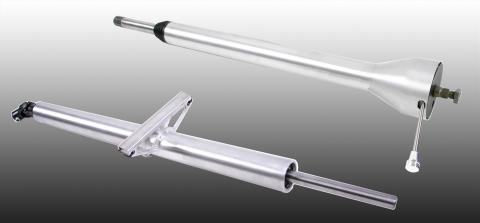
Steering columns are available either in a fixed shaft length, above, or extra shaft length, below, which allows the driver to trim the shaft to the proper length after determining the most comfortable position for driving the race car. Photos courtesy of IDIDIT and Stephanie Davies Bardekoff.
Ensure driver comfort and safety with these tips on how to properly install a steering column.
When situating a steering column in a race car, driver comfort is of the utmost importance, as the driver must feel comfortable in their seat to drive effectively and safely. Correct measurements are the most important factors in a steering column installation to ensure the highest level of comfort, and below we will go through the measuring process to properly mount the steering column.
Preparation
When preparing to measure the steering column setup, be sure to use the driver’s seat that will be installed in the car. The seat needs to be in place to determine steering wheel, shifter, and pedal position, as these all relate to each other and impact the driver’s comfort. It is also important to have the steering wheel and adapter or quick-release steering hub that will be used on the column.
Centering and Adjusting
Once the seat is in place and the location of the engine, cylinder head, headers, and transmission are determined, make sure the steering wheel is centered to the seat. Installing the column offset or at an angle will make it feel awkward and uncomfortable. With the column centered, adjust the seat forward or back for optimal pedal and shifter position. Then, adjust the column (with an adapter or quick-release steering hub) and steering wheel so that the driver’s arms are in a relaxed, comfortable position. Some columns are made in a set length, while others offer extra shaft length so the driver can trim it to the proper length after determining the correct position. For these kinds of columns, it’s at this point where the shaft is trimmed to the desired length and the adapter or quick-release steering hub is welded in place.
When installing the steering column, first center it, then adjust the seat forward or backward for optimal pedal and shifter position for comfort. Next, adjust the column—with an adapter or quick-release steering hub—and steering wheel so that the driver’s arms are in a relaxed, comfortable position.
Once all the positions are determined, next is the installation of the column drop/mounts. A retrofit column made specifically for a car’s year, make, and model should bolt right into place. With a universal-fit column, however, place the drop/mount onto the column and adjust the drop/mount’s position to the factory mount location. The drop/mounts should fit snugly to the underside of the dash with no wobbling or vibration. The lower mounts should be stable and able to fit the angle of the firewall where the column will pass through. If the car has a floor-mounted brake or clutch, make sure there is enough clearance for the column. Once the firewall mount is in place and secured, it’s vital to make sure that this mount is sealed tightly to prevent exhaust fumes, heat, dirt, and water from entering the interior.
Measuring to Find the Right Length
For those who do not have the steering wheel and adapter or quick-release steering hub but are trying to measure to find the right column length, the steering column and wheel assembly can be simulated with an aluminum pie tin or large paper plate and a three-foot wooden dowel. Add between 1 1/2 and 3 inches beyond the firewall/floor if using a steering box. If using a rack, the column can go as far as 5 inches into the engine compartment. Watch for clearance. First, tack the tin or plate to the dowel (steering wheel to column), then position the driver comfortably in the seat while holding the dowel system in place. Have someone measure and mark the essential dimensions: overall length and the distance between the center of the column and the bottom of the dash. Do not forget to mark the point where the column will pass into the engine compartment and the centerline of the driver’s body and seat, as they are also important measurements. When using this method, remember that the wheel and adapter or quick-release steering hub will add length to the column. Most aftermarket steering wheels will add 3–6 inches from the gripping surface of the wheel to the adapter, and most aftermarket adapters or quick-release steering hubs will add another 2–5 inches from the steering wheel to the top of the outer housing of the steering column. Make sure to allow for these additions and mark the dowel accordingly.
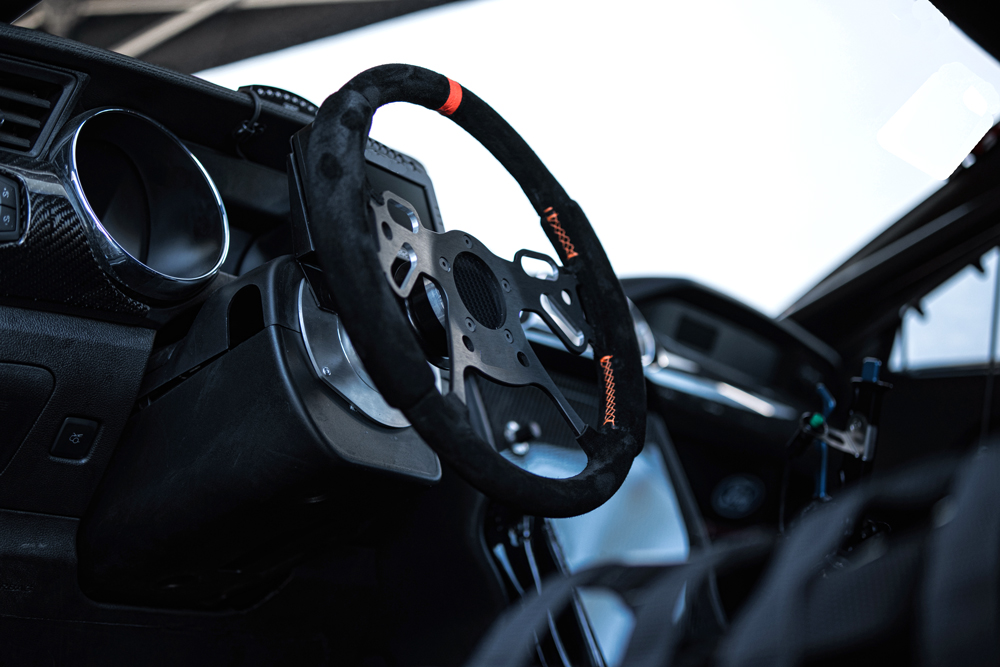
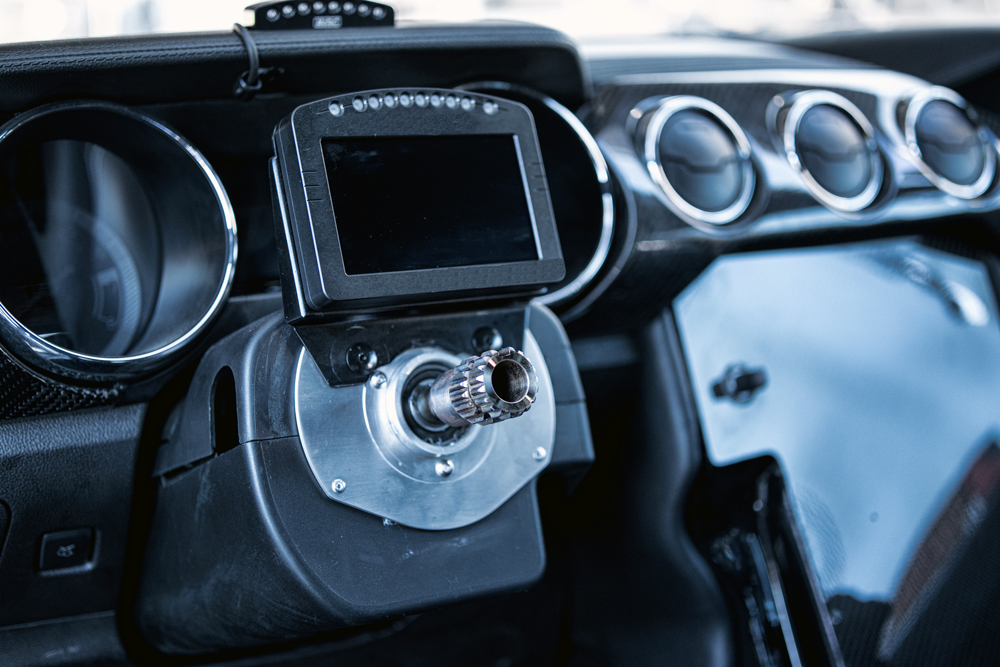
Proper measuring is the most important factor to ensure driver comfort and safety when installing a complete steering column assembly. Here is an installed column with the original plastic shrouding and center ring of a quick-release steering hub attached.
For safety consideration, utilize a collapsible steering column and/or shafting. But, in short, there is no right or wrong setup for a steering column assembly as long as it is installed safely and securely, and the driver is in the most comfortable position possible. After all, a happy and relaxed driver is most likely to make it to the podium!
Kelly Tuttle is the Marketing Manager for IDIDIT, LLC in Tecumseh, Michigan, where she oversees all aspects of the company’s marketing efforts. She’s been involved with marketing in the automotive industry for the past six years, but has had a passion for all things motorsports—especially those that involve speed on both two and four wheels—since she was a young girl.
PRI race track ambassador Tom Deery and the Washington, DC-based advocacy team work continuously to protect tracks, sanctioning bodies, and motorsports businesses around the nation. This month, we are tracking several initiatives, including PRI’s new Membership headquarters in Speedway, Indiana, an update on supporters for the critical RPM Act, a lawmaker’s recent visit to a motorsports retail superstore, a dedicated “Motorsports Day” in West Virginia, and more.
PRI SET To Open New Membership HQ
PRI’s new Membership headquarters in Speedway, Indiana, will open its doors later this month—ahead of the 106th running of the Indy 500. PRI will celebrate the occasion with a ribbon-cutting ceremony that will see the unveiling of renovations and tours of the 42,500-square-foot facility that will serve as the home for PRI Membership.
The building is within walking distance of the famed Indianapolis Motor Speedway and also houses Bryan Herta Autosport’s IMSA and SRO multi-team program, and a retail location for helmet and accessories manufacturer Bell Helmets.
“The building was formerly an IndyCar race team facility, and we wanted to keep racing in the building,” said PRI General Manager Jim Liaw.
The Membership HQ includes spaces and programs dedicated to supporting motorsports businesses and track operators, such as live and virtual education opportunities that will expand world-class PRI Education programming from the PRI Trade Show into a year-round endeavor. In addition, there are plans to open a “Content Factory,” a diverse multimedia facility for photo and video production with car lifts for builds and technical videos, as well as a podcast studio.
“PRI is dedicated to building, promoting, and protecting the racing community. We want to continue to expand on the PRI Membership promise to unite the industry and remain a strong voice for motorsports. The new PRI Membership headquarters allows us to do that,” Liaw said.
More details about this exciting new chapter for PRI will be announced throughout the year leading up to the 2022 PRI Trade Show in downtown Indianapolis, December 8–10.
Support for the bipartisan Recognizing the Protection of Motorsports Act (RPM Act) continues to expand as members of Congress receive an outpouring of support for the bill from racers and the motorsports parts industry. Several members of Congress have recently agreed to co-sponsor the RPM Act, H.R. 3281 and S. 2736, including Sen. Catherine Cortez Masto (D-NV), Sen. Marco Rubio (R-FL), Rep. Sean Patrick Maloney (D-NY), and Rep. Garret Graves (R-LA). Some 150 federal lawmakers are currently co-sponsoring the RPM Act, making it one of the most bipartisan bills introduced in the 2021–2022 session of Congress.
New RPM Act co-sponsors include, from left to right, Rep. Garret Graves (R-LA), Rep. Sean Patrick Maloney (D-NY), Sen. Marco Rubio (R-FL), and Sen. Catherine Cortez Masto (D-NV).
“The racing community has sent members of Congress over 1.5 million letters in the last year, which has been a driving factor in getting lawmakers to publicly support the RPM Act by serving as co-sponsors. It is imperative that members of Congress continue to hear from their constituents about the importance of supporting the RPM Act and using their political capital to pass the bill. The future of racing and tens of thousands of motorsports parts jobs are on the line,” said Eric Snyder, PRI’s Director of Congressional Affairs. “Congress must pass the RPM Act in 2022 to protect this great American tradition that creates economic opportunity and provides entertainment in communities across the country.”
PRI’s government affairs staff recently had a chance to catch up with Rep. Maloney to discuss the RPM Act. Congressman Maloney represents New York’s 18th district in the US House of Representatives, as his Hudson River Valley district is home to Orange County Fair Speedway in Middletown, New York, and a passionate racing community.
“Car racing is a treasured American pastime that extends from Daytona Beach down to the hundreds of local tracks where hobbyists and professionals alike work on their cars and prepare for race day,” said Rep. Maloney. “I am proud to support the RPM Act, a critical bill that will ensure well-intentioned policies to protect the planet don’t inadvertently undermine a sport beloved by so many folks here in the Hudson Valley, and all across the country.”
The RPM Act must be enacted into law to guarantee your right to modify street cars, trucks, and motorcycles into dedicated race vehicles, and ensure the industry can offer parts that enable racers to compete. It is imperative that lawmakers continue to be reminded of the importance of passing the RPM Act, as we need your help now more than ever.
Following is a list of actions you can take right now to help pass the RPM Act:
• Call or send a letter to your lawmakers at: saveourracecars.com. A letter has already been drafted. It takes less than a minute.
• Sign a letter to your lawmakers on company letterhead. Email erics@sema.org for a template and more information.
• Post about the RPM Act on your company’s social-media accounts using the toolkit of digital assets, or pass out a flyer at your business or events.
• Learn more about PRI’s Political Action Committee (Performance Racing PAC) at performanceracing.com/pac. Performance Racing PAC allows PRI members to support the lawmakers that stand up for racing in Washington.
For more details, contact Eric Snyder at erics@sema.org.
Rep. Ellzey Visits Summit Racing In Texas
US Representative Jake Ellzey (R-TX), who won a 2021 special election to represent Texas’ 6th Congressional District in Congress, recently visited Summit Racing Equipment in Arlington, Texas, for a tour of its retail superstore, order fulfillment center, and distribution center, which totals nearly one million square feet.
Organized by the PRI and SEMA advocacy team, Rep. Ellzey’s visit provided the chance to learn more about the specialty automotive aftermarket and the industry’s role in Texas’ 6th Congressional District, which is located to the south and west of Dallas and includes parts of Fort Worth and Arlington.
While touring the superstore, the Congressman spoke fondly of the ’67 Mustang he once owned, and aspirations to one day restore a vintage Ford truck that’s been in his family for over 40 years.
“The tour of Summit Racing was nothing short of remarkable,” said Rep. Ellzey. “You all have a tremendous facility, but what was most impressive was all of the employees. The afternoon I spent there, I could tell that everyone cared about their job, each other, and the customer. I am glad that Summit Racing is in our district. It is something we can all be proud of, and I look forward to rebuilding my ’79 F-150 with a little bit of help.”
The Congressman is a graduate of the US Naval Academy, and throughout his 20-year Naval career, he flew H-60 helicopters, F-14 Tomcats, F/A-18 Hornets, and Super Hornets in defense of our nation. He currently serves as a member of the US House Committees on Veterans’ Affairs and Science, Space, and Technology.
Upon learning about the Recognizing the Protection of Motorsports Act (RPM Act), Congressman Ellzey agreed to co-sponsor the bill and is passionate about enacting the bill into law given the importance of the issue to his constituents.
“Thank you to SEMA/PRI for organizing and participating in the meeting, and to Rep. Ellzey for taking the time to visit and get to know our company, and for reinforcing his support of the RPM Act. Supporting this bill helps protect the livelihood of our company and employees, our business partners, and race tracks throughout the country,” said Dave Ritchey, Summit Racing’s manager of Phone Sales.
“One of the best ways to stand up for racing and the motorsports parts industry is to get to know your state and federal lawmakers,” noted Eric Snyder, PRI’s Director of Congressional Affairs. “The first step in developing a relationship with your lawmakers is to introduce yourself and invite them to your business. PRI staff will make this process painless, as we are ready to assist. If you’d like to host your elected officials, please email me. We will extend an invitation to lawmakers on your behalf and facilitate the visit.”
For more information on planning your own Congressional District site visit, please contact Snyder at erics@sema.org.
WV Hosts Successful ‘Motorsports Day’ At State Capitol
A number of area motorsports venues, manufacturers, and businesses attended a first-ever “West Virginia Motorsports Day” at Charleston’s State Capitol in March. PRI and SEMA representatives participated in the event, which was created to show lawmakers the impact that motorsports has on commerce and tourism in the state. Participants also included sanctioning bodies like American All-Star Series, US Motorsports Association, and the Red Clay Series, and tracks including Beckley Motorsports Park, I-77 Speedway, Summit Motorsports Park, Pennsboro Speedway, Ona Speedway, Tri-River Dragway, and Tyler County Speedway.
A vendor display of motorsports manufacturers and businesses in the State Capitol’s rotunda, and a show of powerful race cars—including dirt late models, modifieds, and dragsters—in front of the Capitol preceded a meeting organized by the West Virginia Motorsports Committee. Among topics covered were issues facing the industry such as noise ordinances, along with goals for the 2023 legislative session, including the reintroduction of legislation incentivizing the construction of new race tracks.
The first-ever West Virginia Motorsports Day was held in March and organized by the West Virginia Motorsports Committee.
The West Virginia Motorsports Committee was created by West Virginia Governor James Conley Justice in 2021 to promote motorsports in the state. Current members include Acting Chair Laura Bowman of Summit Point Motorsports Park in Summit Point, West Virginia; John Fekete of Hatfield McCoy Trails in Mingo County, West Virginia; Joseph Rush of the American Crate All Star Series based in the Southeast; Tim Cotter of Grand National Cross Country (GNCC) based in Morgantown, West Virginia; and Chris Pierce of 304 Speedway in Princeton, West Virginia. In addition, West Virginia State Senator Mark Maynard, Edwin Pardue of Summit Point Motorsports Park, Eric Barber, and Al Harshbarger are honorable members.
“This first-of-its-kind event demonstrated the passion and strength of the motorsports industry in West Virginia. Being able to work together toward common goals will pay huge dividends for the industry as it considers legislative issues in the future,” said Christian Robinson, Director, State Government Affairs & SEMA PAC.
Racing businesses interested in more information about a motorsports committee in their state can contact Laura Bowman with Xator/Summit Point Motorsports Park at laura.bowman@xatorcorp.com.
In related state news, The West Virginia legislature failed to pass PRI-supported legislation in 2022 prior to the adjournment of the session, including:
• Legislation (S.B. 467) to aid and incentivize the construction of motorsports complexes. The Senate Economic Development Committee failed to advance the bill.
• Legislation (S.B. 602) to protect motorsports venues which have been in operation for more than one year from nuisance claims. The Senate Judiciary Committee failed to advance the bill.
“Although these bills may not have passed in 2022, given the show of strength at the West Virginia Motorsports Day, there is great optimism that we will be able to get over the finish line in 2023,” Robinson said.
Disorganized Grime is a low-impact social network that provides opportunities to compete in race cars that are less sophisticated—and costly—than the pro categories, and with no fees involved. It’s run by sportsman racers John Muhr, seen here, and his wife Cheryl.
Understanding that entering a motorsports event can be intimidating for the uninitiated, this particular team’s mission is to provide a place where “everyone knows your name.”
Motorsports is competition and, frequently, much more than that. After a long tow and endless grunt work on the car, the pit area at a race offers an opportunity to socialize, trade tech tips, kick back around the grill, and just enjoy one’s peers. It’s a community thing, a world that John Muhr has occupied since he first strapped into a drag car more than three decades ago.
Muhr and his wife Cheryl live in Littleton, Colorado, and have an unfolding plan that they believe will make it easier for racers to find relaxation, and not just the normal blend of frustration and exhilaration that usually permeates any race meet. Their effort to help racers has recently been rebranded, whimsically calling itself Disorganized Grime, and has more recently joined the ranks of PRI as a Founding Member. What is it? Disorganized Grime is neither slapdash nor dirty, but instead presents a variety of strategies to help racers unwind, make friends, and swap ideas.
“Disorganized Grime is simply a racing team that was organized in 2012, because there were many racers who were just standing at the fence and didn’t have the courage to jump into the swimming pool,” Muhr explained. “We formed it so they would have a place to go, and to have a medium where they could share information about becoming branded drag racers, and the chance to join a team competition. That team has flourished like a wildfire. We don’t have any services, per se. We have a team, and through that we offer free apparel with three new cars on the shirts every year, we sponsor racers, and we’re branching out this year into sponsoring circle track.”
As the Muhrs envision it, Disorganized Grime’s team concept essentially functions as an escalator for people who are seriously interested in getting involved in motorsports as competitors, but still haven’t made the all-important commitment of time or money. “We’re basically like Cheers, the bar. We’re a place where anybody can go, and we’ll know your name. We’ll put you in our club, and then you can join our team competition, which is held at a local track, of which we’ve so far had three of them around Denver.”
Disorganized Grime has a private Facebook page to attract interested parties, which Cheryl plans to make public for wider potential participation. Right now, its team competitions generally follow a drag racing format. “We’ve presented it pretty vigorously,” Muhr said. “It allows anybody to become a team participant, whether they have a 22-second minivan or a 10-second hotshot street car. They’re able to join the team and take part.
“Our mandate is to welcome those new racers in,” Muhr continued. “Additionally, we do what are called drag-and-drive events, which started for us in Denver during Rocky Mountain Race Week. Right now we’ve expanded to Bradenton Motorsports Park in Florida, where we’re part of Sick Week 2022.”
That underscores the reality that Disorganized Grime has catered to the straight-line nation up to this point, but that’s currently undergoing a change. One of the team’s newest sponsored drivers is a two-time Bandolero champion who’s looking to step up to Legends car competition.
Racers, or prospective racers, interested in hooking up with Disorganized Grime will have the opportunity to connect with the team through the public Facebook page that Cheryl expected to be live by the time this article is published. The Muhrs promise a unique and rewarding social experience for those who get involved.
“There are a number of other such clubs and organizations,” Muhr said. “Ours happens to be free, ours happens to have a medium for sharing ideas, racing theory, and racing stories. There’s no membership fee. All of our apparel and dinners are free. Those are some of the enticements to join. It’s a very social club. We do have competitions that have Stanley Cup-sized trophies. We have some very serious racers in our group, and they tend to foster the brand-new, more social racers.”
A typical Disorganized Grime event, which often takes place at the team’s home track of Bandimere Speedway, involves elimination-style racing from mid-afternoon until the track closes for the night. After the races, the club meets for dinner and to hand out awards and apparel. Their concept has since expanded into drag-and-drive events, which usually last a week to 10 days.
The operation is entirely funded by the three founding partners: Muhr and his wife Cheryl, along with his brother Mike.
Among current members are Chris Vang, a Pro Stock tuner and Super Comp driver; Derek Kramer with American Ethanol; and multiple track champion Rick Schillereff. So is the Thorpe family, which has been recognized as Cornerstone racers by Bandimere Speedway outside Denver, consisting of parents Rich and Sara plus sons Cameron and Tyler. Total current membership consists of 40 drivers and another 40 members that Muhr describes as the drivers’ cheering section.
A typical event, which frequently is held at the team’s home track, Bandimere, involves elimination-style racing from midafternoon until the track shuts down for the night. After the races, the club meets for dinner and to hand out awards and apparel. This happens about seven times annually. Perhaps more ambitiously, Disorganized Grime also presents drag-and-drive events, which typically last a week to 10 days. Three such gatherings have taken place to date. One recent outing went from Denver to Kearney Raceway in neighboring Nebraska, then to Great Bend, Kansas, and headed back into Colorado through Pueblo. The tour raced at five different tracks over five days. Trailers are banned: All participating drag cars have to be street legal.
Ultimately, Disorganized Grime is a low-impact social network that also provides opportunities to compete in race cars that are less sophisticated—and costly—than the pro categories will allow, with no fees involved. And it’s run by sportsman racers: John Muhr, who runs a property management firm in Denver, has a 1978 Malibu running in Sportsman and Pro ET, and Cheryl has three cars, including a 1967 Impala in Pro ET.
“I love the game of chess that drag racing is,” he said. “We do this to pay back for 37 years of racing that my wife and I have enjoyed. Many people have done very nice things for us, and this is our payback.”
 MEMBERSHIP LOGIN