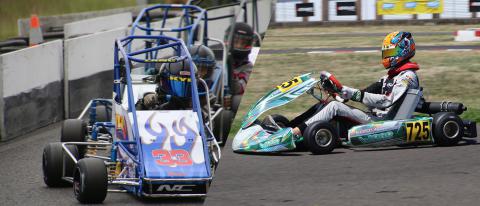
Building a solid foundation of race craft and sportsmanship is critical for any young driver with aspirations of establishing a career in motorsports. While the formats of karting and quarter midgets emphasize different elements of racing, both offer established paths for competitors to move up the ranks—or transition into other racing disciplines—as they gain experience. So, which offers the more advantageous entry point?
Quarter Midget Advocate:
Denise Smutny, Quarter Midgets of America
Our racers start at the age of five, and at that point you’re really focused on the core fundamentals of motorsports: Understanding a sense of fair play, how to win and lose graciously, how to be responsible for your race car, and how to work with a team.
When you’re talking about kids in that age range who are just starting out, I also think that one of the most important things to consider is safety. You want to keep those kids safe, and you want their parents to know that they’re safe. One of the big advantages we have with quarter midgets is that the cars have full roll cages and five-point harnesses, so we’re doing everything we can to keep them encapsulated to prevent them from getting hurt.
I also believe that it’s really important to provide these kids with a supportive environment at this early stage in their racing careers. Here they’re surrounded by their families and friends—people who want them to succeed at all times. So while there’s fierce competition out on the track, afterward the kids jump out the cars and head off to the playground together. It’s a very family-oriented way for them to build up those fundamentals.
As they gain experience, there are also clear paths to move up the ranks. There are several platforms and engine types that are available to racers between the ages of five and eight, and as they develop their skills, there are faster platforms available for the older kids. But race craft is always a part of it. You’re going to see our five-year-olds making passes wherever they see a gap. As they get older, their abilities mature. They go from kind of driving wherever they want to go to a tight racing line. When you think about the fact that we’re on a 1/20th of a mile oval and there are 10 cars out there, the kids are learning a lot about how to race in traffic. On a track that size with that many cars on it, you have to be constantly thinking about what your next move is going to be, and that’s obviously a core fundamental in racing.
There isn’t a rigidly defined ladder system here, but we see a lot of kids who move from quarter midgets into micro midgets, and then later to dirt ovals. We also have kids who have moved into the karting world from here and then onto open wheel disciplines, and some of the others have transitioned to hobby stocks, Legends, and pro stocks racing. Sometimes where they end up going is determined by factors like where dad raced, and the costs involved can be a factor as well. As with any form of motorsports, the families often have two questions to ask themselves: How fast do you want to chase the dream, and how much do you want to spend?
For kids of this age, the supportive atmosphere of quarter midgets is hugely important and can’t really be replicated elsewhere. Karting generally lends itself to a much broader age group, and that can have an effect on the dynamic. And quarter midgets is an all-volunteer sport—the families are running the whole show. It’s a labor of love for everyone involved, and that creates a really encouraging environment for the kids.
Karting Advocate:
Randy Word, Word Racing
When kids are starting out in motorsports, I see two things that are very important. The first one is seat time—they need to gain the experience and learn how to drive well. Coaching is a big part of that, too, because good coaching means they won’t have to un-learn bad habits later on. The other important thing is to keep it fun. I see too many parents putting too much pressure on their kids and taking the fun out of it. If a kid really wants to do well and is very competitive, they can achieve without that.
As a motorsports discipline, karting is about as close as you can get to a formula car, and it’s remarkable how much these kids can learn here. The karts are incredibly responsive—with no suspension and a solid rear axle, everything you do is just instantaneous. It teaches good reflexes and car control, and there’s a lot you can do with the setup, so they also learn how to communicate with an engineer about what the car is doing and what it needs.
I also believe that karting allows these kids to establish a wider skill set when it comes to technique. Road course-style tracks provide more variety in terms of overall layout as compared to circle tracks. At the national events, the fields are very large, so there’s a lot of competition and race craft to be learned.
On a course with a lot of different types of corners and other features like that, they’re going to learn more about things like braking points, different types of apexes, and how to pass. Even at this level the kids are setting up passes three or four corners before they actually make their move. It’s a different situation if your goals are strictly focused on oval racing, but I think that it’s beneficial for these kids to establish a wide variety of skills. That allows them to have more choices—and more potential career opportunities—down the road.
Here in the US, there are a couple of different options for karting drivers to move up the motorsports ladder. The one that probably sees the most focus is the Road to Indy. The cars are similar to karts, and there’s a strong connection between the karting teams and the Indy teams.
The first steppingstone in the Road to Indy is F2000, but there’s also a more affordable option with the Formula Speed 2.0 series. We’ve also seen a lot of kart racers move on to closed-wheel racing in IMSA and NASCAR, while others have gone on to dirt oval track racing and things like that.
There are a lot of different routes these kids can take, and the skills they learn in karting will help them with just about any motorsport that they choose to get into.
From gauges to pull-down rigs, it’s the gear that’s bringing more sophisticated setup capabilities to budget-minded teams.
As rule sets have evolved to put a greater emphasis on chassis setups across many motorsports disciplines in recent years, the related equipment has become an increasingly vital element of racers’ programs.
“Back in the day everybody built their own cars, and that was a big factor in a team’s success,” said Keith Berner of Accu-Force Dynos & Testers, Millersburg, Ohio. “Now these cars are using many more common components, so it’s more about making sure that the car is set up and adjusted appropriately. If I’ve got the same mouse trap as you, I’ve got to make sure my spring is going to work better at this track. And a lot of that comes down to the equipment you have access to. We used to be looking for tenths; these days we’re looking for thousandths.”
Although most of these tools have been around in one form or another for some time now, much of it has been relegated to professional or semi pro-level teams with substantial financial backing. But that’s starting to change.
“Some of the technology that was beyond the reach of most teams a decade ago is now much more attainable,” said Lynnie Doughton of DRP Performance Products, Rocky Mount, Virginia. “The price points have come down enough that even teams at the short track level can access it.”
And with that in mind, we’re looking at some of the most popular pieces of chassis setup equipment that are designed for racers who don’t have a blank check to work with.
Maxwell Industries
“This year, in particular, I’ve noticed that a lot more of the weekly guys are buying shock dynos and getting more involved in the technical aspects of suspension components,” said Steve Watt of Maxwell Industries, Ventura, California. “The tech has trickled down to the local Saturday night racers—they have to have it because they can’t really be competitive without it. If one local guy gets their hands on the equipment, it’s only a matter of time before it becomes almost obligatory, and these younger guys are much more tech-savvy than the generation before them.”
Watt said that among the various pieces of chassis setup equipment available on the market, shock dynos are going to be the most valuable tool for budget-minded competitors.
“That dictates most of the adjustment that you’re going to do on a race car,” he explained. “A torsion bar or a coil spring is a spring rate, so that’s going to tell you how much the car is going to move. Meanwhile the shock absorbers are all timing—that tells you how fast they’re going to get to those points in the suspension travel. So that’s going to be a more important tool than a spring or torsion bar dyno. Once you know your spring rate it’s pretty straight-forward, but because of how advanced shocks are now, you can adjust the compression and rebound almost infinitely on all four corners. So you need to know exactly what you’re adjusting it to, and what the value is when you get there.”
And Watt said because of that, more shock dynos are being designed with the intent of keeping costs to a minimum without compromising functionality and accuracy. “Our two-horsepower shock dyno is a good example. This is our most popular shock dyno—I would say probably 99% of the World of Outlaws teams have one in their trailer. It’s really popular with the dirt modifieds, USAC sprint cars, and Outlaw sprint cars in part because it basically provides the most bang for the buck.”
Beyond keeping the costs down, Watt noted that their primary focus was to make these shock dynos as intuitive to use for the customer as they could, in turn minimizing the amount of time racers would need to spend on the dyno so they can get to work in the shop.
“You punch in the name and serial number of your shock and you’re up and running—it’s all in the database,” he explained. “And we wanted to make it as foolproof as possible, so everything’s automatically saved and you can’t delete a file without confirming, like, four times. It’s made for someone like me who tends to be click-happy. When they wrote the software, they used me as the guinea pig. For a mechanically focused guy like me, it’s perfect.”
Intercomp
Intercomp in Medina, Minnesota, continues to improve racers’ chassis setup experience with its wireless group of products, including its recently released RFX wireless suspension load stick. The company’s RFX Wireless Weighing Technology eliminates the cabled indicator found on most current load sticks and allows anywhere from one to four load sticks to be read on one RFX Wireless Handheld Indicator. “Without a cable to mind, our load stick allows racers to concentrate on obtaining the correct measurement and less about breaking an indicator cable and rendering the tool useless,” said Aaron Van Heel. Individual load sticks are available without an indicator, he noted, which allows single- or dual-load stick systems to be expanded at a later time.
Intercomp’s RFX wireless suspension load stick eliminates cabled indicators and allows one to four load sticks to be read on one handheld RFX indicator.
Van Heel explained that load sticks that are mounted on all four corners of a race car can provide a picture of a car’s load distribution in different chassis attitudes. “This allows racers to determine the exact spring rates needed to get the car into the dynamic ride heights needed to carry maximum speed and momentum through a turn. The two-load stick system allows a racer to collect dynamic load data at left-side, right-side, or opposing corners of the car. These can be critical measurements that can mean the difference between a fast or slow car in dirt and paved oval racing,” he said.
Each Intercomp load stick features an industrial-strength 3,000-pound capacity load cell and can span shock mounting points 15–25.25 inches apart, using three interchangeable bodies, while the actual bodies are made from hex-shaped billet aluminum, with high-quality spherical rod ends with low-friction PTFE inserts. A single load stick and indicator allows for use at one corner of the car, while the two- and four-piece systems allow for complex attitude adjustment.
Accu-Force Dynos & Testers
Berner noted that while the most important tools in chassis setup are often dependent on what class a racer is running in and the rule set that’s involved, there are some pieces of equipment that tend to be crucial across the board.
“For instance, you definitely have to have a front-end gauge to make sure that your caster and camber are set correctly,” he said. “But these days we’re getting to the point where you more or less need to have a spring smasher to be competitive in something like crate Late Model. It has changed the sport in a way—it’s almost more important to a racer’s competitiveness now than a set of scales was 20 years ago. Being able to understand a spring curve and make changes is really important because, at this point, the guy beside you probably does. And if you don’t, he has a clear advantage.”
With that in mind, he pointed to Accu-Force’s standard manual spring smasher as a piece of equipment that can even the playing field without breaking the bank. “It will give you center-to-center of your coilover spring, it gives you the weight, and you can do an off-set weight as well.”
With race cars increasingly using standard components, chassis setup is more critical than ever. “If I’ve got the same mousetrap as you, I’ve got to make sure my spring is going to work better at this track,” said our source at Accu-Force Dynos & Testers.
But he also said that in order for racers to get the most value out of this equipment, they really need a thorough understanding of its capabilities. “If we wanted to change the springs at the race track when we were using these very early on, as long as we knew what that center-to-center was and we had the load information, you could put any spring you wanted in there and put that dimension back. You didn’t have to scale it, you didn’t have to get the tape measure out—you just did it. It made it really fast and easy to change out springs at the race track. And it would make you better. If the track slowed up two seconds, a lot of times you would need to change the spring in the right front. This made it easy.”
But once they started doing that, they soon realized that they often needed to change the spring curve as well. “That is where you’re getting into spring rubbers, bump stops, and everything else,” he said. “We might lighten the spring up and then we knew that at full travel it was at, say, 2,100 pounds. So we knew we could use a lighter spring in it with those bump stops and spring rubbers to let it get there easier, and we’ve changed that curve to where it’s still 2,100 pounds at 4 inches of travel. We started out doing that kind of tuning on the right front, but now we’re doing that on every corner. And if the guy running beside you is smart enough to understand that and you don’t, he’s going to be a little bit quicker than you are. So to keep up you’ve got to be able to do that, too, and it’s pretty hard to do without a spring smasher.”
PROFORM
While advanced setup gear like shock dynos and pull-down fixtures are becoming increasingly important to racers at the grassroots and sportsman levels, Dennis Grzebyk of PROFORM in Warren, Michigan, confirmed that the basics are still essential in order to provide a solid foundation for more sophisticated tuning.
“Each team is going to have a chassis setup in their head, percentage-wise, for every corner of the car, and it’s going to be very difficult to get that without a set of scales. It’s also going to tell you if your chassis isn’t set up the way you want it, so you can adjust your bars, move the percentages around and get it wherever you want it to be. For track guys it’s usually 40/60 front and rear, but the dirt and the modified racers tend to do each corner differently to their own specifications. Circle track guys generally need more pressure up front to get the bite going into the corner, but they need to finely balance that to make sure there’s also enough grip coming out.”
PROFORM’s scales are available in wired and wireless configurations, and feature a low-profile pad designed to be used without ramps. They also have a built-in support, so they can’t flip over when placing the car on them.
He added that teams tend to do a lot of initial adjustment, but once they’ve found a formula that works, they’ll want to ensure that the car can be quickly and accurately set up to that formula according to the scale measurements. And with that in mind, PROFORM designed a corner scale system that’s both simple and accessible to racers that need to keep costs out of the stratosphere.
PROFORM’s scales were designed with the grassroots racer in mind. “Before this, you couldn’t touch a set for less than two grand, and we released ours for under $800,” said Grzebyk. “Aside from the cost, I think that another reason that they’ve been so popular for us is because we designed it so you can just drive up onto them without ramps. It’s a low-profile pad that eliminates the need for those, and it also has a built-in support so it can’t flip over when you’re placing the car on them.”
While PROFORM offers these scales in both wired and wireless configurations, Grzebyk said that most racers opt to spend a little bit extra in order to ditch the cables. “The price gap between the two isn’t very wide, and folks generally like to avoid having wires running all over the place so people won’t trip on stuff and possibly damage the controller by knocking it over. Things can happen when you’re focused on getting the car ready.”
DRP Performance
Doughton said that the core basics like scales, camber/caster gauges, and tire barometers are essentially mandatory in order to perform accurate measurements at the track. “You need stuff like that to even be remotely competitive at this point. At the next level, you should be looking at setup struts and spring load machines, and pull-down fixtures would be the next step up from that.”
And although the cost of a typical pull-down rig is beyond the means of most budget-minded racers, DRP Performance offers a much more affordable option for those who’re willing to put in a bit of elbow grease.
“We offer DIY component kits for a lot of our equipment, including our pull-down fixtures,” he explained. “The name said it all—this is for the guy who is willing to do a little bit of fabrication work in order to put together his own system, and the kit comes with all of the electronics sorted out. For around $3,500 someone can put together a piece of equipment that normally would have cost them anywhere from $12,000 to $20,000. You give up a few features with that savings, but for smart teams that are willing to put in the work, there are absolutely ways to get around spending that kind of money. And we’re here to help them do that.”
Pull-down rigs are becoming essential for competitive chassis setup, but they’re often too pricey for grassroots racers. DRP Performance’s DIY Pull Down Kit is designed as an affordable option for racers willing to do some fabrication work.
But he’s also quick to point out that if a racer wants to utilize this kind of equipment to its full potential, education is absolutely key. “You’ve got to be willing to invest in that as well. There are ways to get around spending crazy amounts of money in this realm—the equipment just makes the job quicker and easier. If you can’t afford to invest in that equipment, you’ve got to invest in the knowledge.”
And in that regard, he pointed to DRP University as a low-cost option for racers who’re willing to put in the time. “The site has dozens and dozens of training videos that can teach people things that would normally take a lifetime to learn in a matter of a few weeks or months,” he said. “We’re talking about topics like setup strategies, dynamic balance, dynamic wheel positions, and the physics behind how it all works. There’s also training that focuses on how to analyze what you’re getting from data acquisition systems. Having the data is one thing; understanding what to do with it is another. It’s our belief that the more knowledgeable race teams get, the more money they can save.”
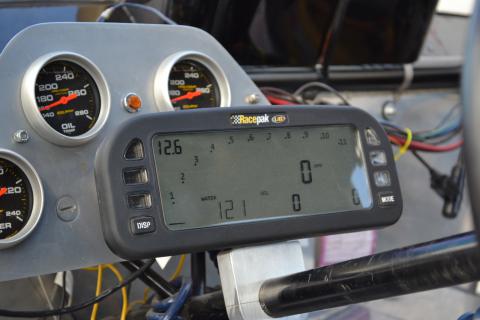
Racers often fail to order extra sensors over fear they’ll be overwhelmed by the data in front of them, especially if they’re new to data acquisition, noted our source at Racepak. “What bites them down the road is, for example, if they didn’t order fuel-pressure sensors, and now they’re having fuel delivery issues,” he added.
Today’s missteps often involve picking the wrong system for the race car, or not installing it properly once it arrives.
Look at it this way: Until data acquisition systems and loggers gained widespread acceptance in motorsports, most racers had no real idea how their cars were performing. They guessed at it, and sometimes got it right. The emergence of data gathering has since turned the tuning of race cars into an empirically driven process, with systems available that can keep real-time track of 100 vehicle functions, or more.
The information’s there, finally, but some guesswork has persisted, morphed into a different entity. Today, it’s less common for crew chiefs to misinterpret data. Instead, the imprecision more realistically extends to picking the wrong data system for the race car, or not installing it properly once it arrives. The manufacturers that produce these sensitive, highly specialized instruments have a vested interest in helping their customers get the setup basics right and do so on a regular basis.
“A lot of racers are afraid to order extra sensors, especially when they’re new [to data acquisition], because they think they’re going to be overwhelmed by the data since they’ve never seen it before,” said Donny Cummins of Racepak LLC, part of Holley Performance Products, Bowling Green, Kentucky, which produces both pro and sportsman data devices. “What bites them down the road is, for example, if they didn’t order fuel-pressure sensors, and now they’re having fuel delivery issues. My suggestion is to get the system that this [competition] category needs to tune the car, be consistent, but also be able to diagnose problems. When something happens, and something malfunctions, that’s when you’ll need to look at that sensor data.”
Racepak systems exist for more basic sportsman categories such as Super Gas, with cars that have about 1,000 horsepower, and for pro applications like Pro Modified, whose 5,000-horsepower tire shake might beat a sportsman data system silly in a few runs. Cummins said making the system appropriate to the car, and to the number of functions it needs covered, is a crucial consideration.
Another is being able to properly set up the system, since doing it wrong poses its own set of problems. As an example, Marc Erickson of AutoMeter in Sycamore, Illinois, pointed to earlier types of systems that came with unfinished data cables, which the customer had to crimp with specialized tools. “That was basically self-inflicted,” Erickson explained. “Now, it’s all plug and play, so our biggest issue usually involves grounding. Our cables are wrapped in shielding to send RF interference to the ground, so if it’s not properly grounded, the RF will go to the data unit itself. Another mistake is running cabling or a power wire next to an ignition source, which will do the same thing.”
RF interference can also drive other electronics, such as delay boxes, absolutely crazy. Most ignition providers will include specific grounding instructions with the products, and furnish good-quality ignition wiring, which Erickson said is essential for a data system to work properly.
“Another big issue, for us, is that people will wire the actual system, or playback tach, to the ignition switch, so it will still be recording when they go through the lights and shut the car off. It scrambles the data because it’s still recording,” Erickson said. “We always say, wire our stuff to the main power, not the ignition switch. Even if you shut the car off, it won’t drain the battery immediately, because our system draws maybe 3 amps.”
Stripped to its basics, the core function of data systems is to create a bunch of wriggling lines on a graph. At AEM Performance Electronics in Hawthorne, California, techs frequently see racers who either can’t properly interpret their data or don’t know how much they have.
Our contact at AEM cited competitors that either can’t properly interpret their data, or don’t know how much they have in the first place. “We have seen racers who are new to data analysis log every channel coming into the unit but have no idea how to organize it,” he said, “leading to paralysis by analysis.”
“We have seen racers who are new to data analysis log every channel coming into the unit but have no idea how to organize it, leading to paralysis by analysis,” AEM’s Lawson Mollica said. “We also see the complete other side of the spectrum, where a racer will buy a basic logger that provides a handful of specific channels that are helpful, but as the driver becomes more experienced and wants more data, there is no way to expand the dataset with their current logging solution. The challenge of buying too little can cause racers to have to reinvest in a more powerful logger. That is where a system like our CAN-based CD Carbon logging displays become advantageous because they provide both data visualization and logging capability with near limitless expandability.”
By dint of what they do, racers acquire technical knowledge as they gain experience, but computers can get fuzzy for most mortals. That’s why the industry invests in tutorials that can keep racers from getting hopelessly lost. At AEM, setup templates are provided for bringing a new data system online. Racepak produces quick-start guides and YouTube videos demonstrating proper installation. Like other providers, AutoMeter urges buyers to know and understand the tech basics involved in data acquisition.
“We always try to give our racers the tools they’re going to need before they get to the race track,” Cummins said.
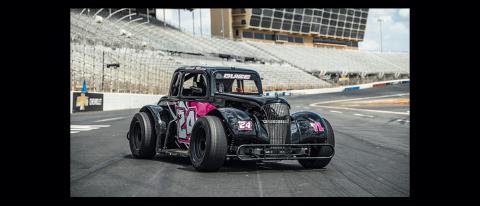
US Legend Cars International has introduced the newest Legend vehicle designed to be a “superlight track machine” at 1,250 lbs.
Powered by a 125-horsepower Yamaha FZ09 sealed engine, the car honors the original design—first launched in 1992 at Charlotte Motor Speedway—with a five-eighths scale fiberglass full-fendered silhouette of a classic modified American race car.
“Our 2022 Legend car is set up to provide a convenient way to drive at the track at any level... and offers young enthusiasts interested in getting into the sport professionally the perfect platform to learn in a track environment,” US Legend Cars International Managing Director Graham T. Smith stated in a release.
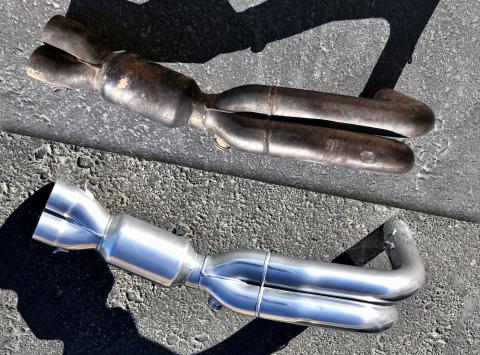
Headers before and after being coated with CermaKrome from Tech Line Coatings.
We asked suppliers to identify their best coatings for specific race engine components, what goes into them, and why they’re so effective. Their answers could mean the difference between victory and defeat.
We’ve all heard the expression, “Winning by a razor-thin margin.” Yet for coating suppliers, the thickness of a razor blade is massive. For them, victory can be a matter of just a few microns of coating—less than 1/100th the thickness of that oh-so-slender shaving device.
That tiny layer of protection can easily mean the difference between grenading an engine in the final lap or hammering it home to take the checkers. “People tell us all the time, ‘I lost oil pressure, but we finished the race,’” said Gary Huffman of Calico Coatings, Denver, North Carolina. “It survived because of the coatings.”
For many years, coatings had their doubters and detractors. It was one of those advantages that maybe just seemed too good to be true. Now the industry has matured and gained mainstream acceptance. Coatings have become a necessary ingredient to be competitive in many forms of motorsports.
In a recent article, we detailed this highly specialized, deeply technical field, what these processes can do for racers, and how to benefit from them (see PRI Magazine, October 2021). Here we’re taking that a step further, asking those same top sources to discuss their best coatings for individual components and why they recommend them.
The examples they gave us are a wide array of clear, proven products that racers can choose from to boost power, increase longevity, and sometimes even improve the looks of their engine.
Pistons
Of all the components in an engine, pistons arguably take the most abuse. They face the full brunt of the combustion process while dealing with side loads from the swinging crankshaft and riding on just a thin film of oil between the rings and the cylinder wall. For this reason, pistons receive considerable attention from the coatings industry.
PolyDyn Performance Coatings in Houston, Texas, is a pioneer in piston coatings, with origins that stretch back to NASA’s mid-1960s Gemini space program. Armed with lessons he learned from the brutal forces of rocket motors and space flight, company founder Carl Benton then brought his developments to other fields—first, the rough and rugged world of oil drilling, then the punishing ranks of NASCAR Cup competition.
PolyDyn Performance Coatings draws on its experience with NASA to develop piston coatings, such as its HS Gold formula, seen here on the top of a diesel piston. “It uses a particle called yttrium zirconium oxide, which is often used on rocket nozzles,” said our source at PolyDyn.
PolyDyn now offers a number of different coatings for piston skirts and piston domes. The company’s RP piston skirt coating was the first product PolyDyn offered, and it was developed directly from Benton’s work with NASA. “It’s highly enriched with a polymer called FEP [fluorinated ethylene propylene],” he explained. “This material is unique in that it attracts oil to itself. So it holds the oil on the skirt of the piston much better than the bare metal itself. But piston slap on a cylinder wall can really put the hurt on the piston skirt. So we added another very similar coating. We figured out that if we sprayed that right on top, wet-on-wet, and then baked it, the performance increases are rather significant.”
For those who need additional protection on piston skirts, the company offers its PD-14 coating, which uses a unique resin system related to nylon. For even more extreme applications, PolyDyn created its 52-G coating formulation.
“Our 52-G coating was developed for David Reher of the Reher-Morrison drag racing team,” said Benton. “I had worked with them a lot during their Pro Stock days. Then they started building these huge-cubic-inch Pro Mod motors. Because they’re big stroker motors, the piston moves rather violently in the cylinders. Our original RP coating did well with that, but it wasn’t as good as we were hoping for. That’s when I went to the drawing board and a couple of the chemists that I always rely on.”
On the recommendation of those chemists, PolyDyn came up with a coating that uses a unique dry film lubricant, with graphite and other materials added. The result was PolyDyn’s 52-G coating, the company’s top-line piston-skirt coating, designed to handle extreme abuse.
The skirt isn’t the only part of a piston that gets punished. The top of the piston takes the full force of extreme heat and pressure dealt by high boost, heavy nitrous loads, and exotic fuel blends. To help mitigate these forces, PolyDyn developed several proprietary coatings for piston domes.
Tech Line Coatings’ CBC-1 water-based thermal barrier coating is formulated to prevent hot spots by more evenly distributing heat, while acting as a thermal barrier for additional protection.
“To protect the top of the piston and keep it from burning, I started working with a company that had a unique technology called synthetic polymetric ceramics,” explained Benton. “We started putting different materials into the resin system to create PolyDyn HS Gold. It uses a particle called yttrium zirconium oxide, which is often used on rocket nozzles.”
Over time, the company found that an even more robust coating was needed for extreme applications such as diesel pulling and high-strung, pushed-to-the-limit Japanese-engine drag cars. For those intense uses, the company developed its top-of-the-line HS Titanium piston dome coating.
“HS Titanium uses a material called boron nitride,” said Benton. “Boron nitride is actually a lubricating ceramic, and it’s stable to 3,200 degrees Fahrenheit. At first, I didn’t think I could actually get it to blend into the resin system. But my chemist buddies figured out how to do that. Once we got it to where it would stay suspended, then off to the races we went.”
Like most coaters, PolyDyn does all the work for the customer, including prep, application, and any necessary final finishing. There are DIY piston coating alternatives for racers who are more inclined to handle the job themselves.
Tech Line Coatings in Rutledge, Tennessee, offers a range of user-applied coatings for piston crowns, formulated to protect the surface and control heat. “Our CBC-1 water-based thermal barrier coating is for lower-compression engines, up to about 11.5:1,” said Rick Williams. “This coating helps to spread heat out over the piston to prevent hot spots, and it’s a thermal barrier for the piston itself to help everything run cooler.
“Our CBC-2 piston coating is in the same family, but it’s cured after it’s sprayed on,” continued Williams. “All of these cure at 300 degrees because we’re dealing with aluminum, and you don’t want to get it too hot. Once it’s cured, you can polish it and have almost a chrome-like finish. Then our CBX-1 piston coating is what I call the ‘mack daddy’ of piston-crown coatings. That’s the top performer. It can handle anything—nitro, turbo, supercharged, diesel.”
While some racers may not initially feel confident taking on the job of coating pistons, Williams explained that the process isn’t beyond the abilities of anyone with good basic shop skills. By doing so, racers can reduce the cost of coating parts significantly, he said. “Applying these coatings is pretty simple and straightforward. It does take a little bit of time when you’re prepping every piston, but it can save a lot of money. A small bottle of coating from us can spray, on average, at least 20 pistons. I think most shops charge more to spray one piston top than what the whole bottle of our coatings cost.”
Valves
All parts of the valvetrain face their own unique forms of punishment in a race engine, which can sap performance and significantly reduce longevity. This has made them fertile territory for coating suppliers, who apply their magic to valves and other components to give them increased efficiency and longer life.
One such supplier is Calico Coatings, which, among other things, specializes in diamond-like carbon (DLC) coatings for valves. “DLC coatings are extremely hard,” said Huffman. “They’re extremely thin, too—typically only two to three microns in thickness. At the same time, their hardness is off the Rockwell scale, so they’re very wear resistant. They also have a very high lubricity rating.
“A lot of engine builders specify DLC for coatings, but they don’t necessarily understand that DLC comes in a lot of flavors,” continued Huffman. “You have to be very specific about the application. You may put a DLC on a wrist pin, but it might not be the best DLC formula for valvetrain components such as the valve itself.”
Calico Coatings’ diamond-like carbon (DLC) coatings for valves are engineered to increase valvetrain longevity by improving the lubricity of surfaces. According to a company source, this is especially beneficial with softer metals such as titanium.
In general, DLC coatings are difficult to apply, making them typically more expensive than other coating technologies used on valves, such as chrome nitride. Nonetheless, DLC coatings offer a number of advantages that can justify the higher cost.
“If you want to run tight clearances, you really need a good lubricity film,” said Huffman. “A DLC is a very good option that allows you to go there. When you put it on the face of a softer material, like a titanium valve, it’s a big advantage because valves rotate. Every time they hit the seat, with whatever the spring pressure is, it’s hitting at a rotation angle, and it’s coming off at a rotation. That can be a problem without good lubricity.
“That wasn’t an issue when there were leaded fuels,” continued Huffman, “because the sulfur in lead is a lubricant. Without it, you start beating up the face of the valve, because there’s no lubrication between the seat and the face. But coating them with a DLC puts the lubrication back in between those two mating surfaces and toughens the face of the valves, so they last longer.”
Bearings
Other components on the list of most abused engine parts are bearings, many of which have to sustain the massive energy transferred from the pistons and connecting rods. Accordingly, engine bearings of all types are the subject of much attention from coaters.
Line2Line Coatings in Clarkston, Michigan, is best known for its abradable graphite coatings that are used to minimize running clearances and protect everything from pistons to oil pumps. After considerable development and research, the company recently expanded its offerings to bearing coatings.
“For years, customers have been coming to us to coat pistons and other parts,” said Andy Suman. “They kept asking if we did bearings. We didn’t back then because there were some things we needed to develop further. Now we’ve put in the research to develop a great product that provides improved lubricity and offers a big margin of insurance against damage from oil starvation in bearings.”
Like the company’s other coatings, Line2Line’s bearing coatings can be applied with its unique powder-coating process. This offers the advantage of allowing them to build up much thicker coatings than other coaters can. “Most shops have to do multiple coats to get the thickness that we can,” explained Suman. “That can cause issues with layers peeling off later. Powder coating allows us to build up thick coatings in a single application, so we don’t have that problem. We can ultimately go much thicker with our coatings, too.”
Line2Line Coatings has introduced new bearing coatings applied with a dry-powder process, allowing thick, single-layer applications that can be used to tailor clearances as needed.
These thicker coats can be used to take up clearances in parts. When components are assembled and run initially, the coating then wears itself to an optimum clearance, harmlessly shedding the excess in tiny particles that drain out with the engine oil.
In addition to applying coatings in powder form to build up clearances, Line2Line can also apply its bearing coatings in liquid form. This is done to achieve a thin coat of extremely uniform thickness to preserve oil wedge set-up and provide insurance in case journals contact the bearings. “Even a split second of oil starvation can ruin bearings,” said Suman. “The lubricity of this coating protects the bearing if that happens.”
For the most part, bearing manufacturers don’t apply coatings to their bearings—it’s something the customer typically initiates. But some bearing suppliers, such as Precision Products Performance Center in Arden, North Carolina, believe so strongly in the value of coatings for racing engines that they sell bearings with the appropriate coatings already applied. “It started with an engine builder named Nick Ramey at Yates Racing, before it became Roush Yates Racing,” recalled Debbie Jackson at Precision Products Performance Center. “We built titanium pins for him and used a Casidiam DLC coating from Anatech [now IHC coatings]. Using a DLC coating enabled engine builders to use materials they once couldn’t even consider, like titanium and C350 Vascomax.
“Coating resolved galling issues and other incompatibilities,” continued Jackson. “On standard wrist-pin materials that didn’t require coatings, it improved wear, reduced friction, and some engine builders even saw gains in horsepower by being able to restrict oil.”
The success of these offerings made believers out of Precision Products Performance Center, helping to popularize coated bearings, while creating rapid growth for the company and its suppliers. “The market for this grew so rapidly that Anatech moved its facility to North Carolina to be closer to us and other racing facilities,” said Jackson. “Precision Products also built the first rub test fixture to test these coatings. To date, there are numerous DLC coating facilities, and nothing has surpassed their coatings on our rub test.”
Exhaust
While most coatings do their work inside the engine, far away from what can be witnessed with the naked eye, exhaust components are out in the open where they can be seen—and all too often felt. The latter effect can result in burned hands when working on engines, or heat-induced component failure for other parts in the engine compartment.
To help minimize such issues, Swain Tech Coatings in Scottsville, New York, specializes in hard coatings designed to contain heat. Unlike paint-based coatings with ceramic material added, Swain Tech’s coatings are an actual ceramic, which requires a unique application process. “As a true ceramic, they start out as solid materials,” explained Richard Tucker. “Those solid materials are fed into a high-energy gun that changes them from a solid to a molten state. The material is sprayed or blown onto the part at near supersonic speeds, where it impacts and bonds to the part.”
These ceramic coatings provide significantly higher heat insulation than paint or powder coating, according to Tucker. There is one very noticeable downside—Swain Tech’s Coatings aren’t visually attractive in the traditional sense. “We affectionately call it an ugly coating because it looks like white sandpaper when it’s freshly applied,” said Tucker. “Then that white will mark or scratch in normal shipping, handling, and installation. It doesn’t really damage the coating. It just shows blemishes on the surface. Then when it sees heat, it might discolor.”
The upside of this relatively low visual appeal is its effectiveness as an insulator. “Results vary, but our coatings typically reduce radiant temperature by about 30%,” said Tucker. At typical exhaust-system temperatures, that percentage works out to be a 100-degree or more drop in heat.
Swain Tech Coatings specializes in true ceramic coatings to insulate high-heat components such as exhaust headers. According to a company representative, these coatings typically reduce radiant temperature by about 30%.
“The main things people seek us out for is that they either have too much heat in the engine bay, too much heat in the cockpit, or there might be sensitive electronics in proximity to where they have to route the exhaust,” explained Tucker. “Or in a type of vehicle where you have to wrench on it pretty frequently, like in drag racing. With our coating, adjustments can be done without as much fear of getting burned. The part can be touched relatively quickly after the engine is shut down.”
Not everyone demands that kind of intense heat insulation. And with the hottest components in an exhaust system typically sprawling out in the open, many racers still seek a more visually appealing coating, even if it doesn’t insulate quite as well. For this, Tech Line Coatings offers a wide range of user-applied spray-on coatings for exhaust systems, along with other coatings formulated for chemical resistance, thermal management, lubrication, and more.
Although these coatings do insulate to some degree, and they can improve performance by trapping heat and thereby accelerating exhaust flow, their primary selling point for many customers is the visual appeal they can add to components.
One of the company’s most popular exhaust coatings is its CermaKrome line, which has a silvery, almost chrome-like appearance. “CermaKrome is an aluminum ceramic,” said Rick Williams of Tech Line. “It’s an appearance coating, but it’s definitely just as functional as all of the rest of our exhaust coatings. It’s chemical resistant, corrosion resistant, and rust resistant.” Williams reported that some users have gone as long as 16 years without significant wear or failure of the coating.
Along with the CermaKrome line, the company offers a rainbow of hues, in various product lines formulated for different specialized uses. Yet even with the vast choices offered, Tech Line Coatings’ second most popular color is far less flashy. “Right behind CermaKrome, our most popular colors are black, black, black, black, and black,” said Williams. “I say that because we offer about five different types of blacks. And we have a different family name or series for our blacks. They were formulated over the years for slightly different purposes, but each one of them provides pretty much the same performance.”
To dispel any notions that these are purely cosmetic coatings, Williams shared one particular black-colored coating’s history, a rather ‘out of this world’ project from the company’s early days. “Our BHK line was one of those original black formulas,” said Williams. “It’s good up to 2,000 degrees F on the metal itself. It actually was used in experimentation for NASA’s X-30 Space Plane project years ago.”
Alabama, Georgia, and Minnesota will hold their 2022 primary elections on Tuesday, May 24, and it’s important to know which candidates support racing when going to the polls or voting early. Visit PRI’s Vote Racing page for information on voting in the primary, including absentee and early voting, registering to vote, and identifying your lawmakers and the candidates running in 2022.
The Recognizing the Protection of Motorsports Act (RPM Act), H.R. 3281 and S. 2736, enjoys strong support from Alabama, Georgia, and Minnesota members of Congress. The bipartisan RPM Act guarantees the right to modify street cars, trucks, and motorcycles into dedicated race vehicles and safeguards the industry’s right to offer parts that enable racers to compete. For more information on the RPM Act, visit performanceracing.com/rpm-act.
Below are the names of federal lawmakers who have co-sponsored the RPM Act in the 2021–2022 session of Congress and are running for re-election in 2022.
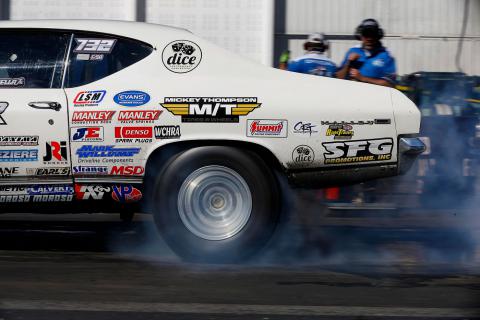
At the track, tire temperature generally should be about 20 degrees over the track temperature. “On colder days, do a longer burnout,” recommended our source at Mickey Thompson Performance Tires & Wheels. “On hotter days, just get a little smoke and clean them off. The shorter the burnout, the less rubber will wear away, so the tires will last longer.” Photo courtesy of Evan Smith/Mickey Thompson Tires & Wheels.
Bias-ply vs. radial is often the first decision for these racers, but additional factors should be considered, too, before they burn that rubber on the drag strip.
It’s as simple as this: “Racers are looking for traction, something that can move their car as quick as it can,” said Faron Lubbers of Hoosier Racing Tire, Lakeville, Indiana. Sounds easy enough.
But while the goal is straightforward, the best choice for straight-line competitors isn’t always cut and dried, even for a class whose very name (“small-tire”) suggests a measure of structure. How to know, then, what specific requirements and factors racers should consider when choosing racing rubber for small-tire drag classes? We tapped Lubbers and other tire experts to find out.
The Basics
“When determining the tire for a race application, there are several things to consider,” said Mike Crutchfield of Coker Tire, Chattanooga, Tennessee. First among them are “the height, width, and circumference of the tire, along with the construction—whether to use a radial or bias-ply.”
“Radials have come a long way in the last few years, but if a racer is dealing with marginal surfaces and a lot of horsepower, a radial is tough to make work, because it has to dead hook,” Lubbers said. “That’s why they spray the track so much at those radial events. But on an unprepared surface or a marginal track, it’s more of a challenge to hook up the radial initially than a bias-ply.”
“Definitely in a no-prep situation the bias-ply tire will absorb more energy on the starting line,” said Jason Moulton of Mickey Thompson Performance Tires & Wheels, Stow, Ohio. “But it’s also absorbing energy down the track, which makes the bias-ply slower than the radial, ultimately. We’ve seen people pick up anywhere from five-hundredths to a tenth in the eighth-mile on a radial. If track conditions are good, or the tuning setup can work with the radial, it is going to be quicker.”
While they seem like separate considerations, tire size and construction are interrelated, particularly with bias-ply tires. Bias-ply slicks grow at speed, as much as an inch and a half at 150 mph, Moulton said. When determining how much tire will fit under the car, he recommended clearance of “no less than 3/4 inch side-to-side, depending on the suspension. For a leaf-spring-style suspension, or an old coil-spring suspension, it’s best to leave at least an inch.”
The circumference of a bias-ply tire can vary as well, Moulton said, which is why the company writes the circumference on the tread of the tire. When buying a set of slicks, “make sure they’re matched up within half an inch. If the difference is more than that, with a race car with a locked or spooled rearend, the tires will try to steer the car in one direction or another. You definitely don’t want that.”
Hoosier marks its bias-ply tires with a reference number that correlates to the tire’s rollout length as it comes out of the mold and has gone through the company’s post-inflator process. When a set is ordered, “we pull two tires with the same numbers on them and send them out together, so 9.9 out of 10 times, if they’re aired up the same way when they’re mounted, they’ll have a matched set,” Lubbers said.
From there, decision parameters “go into the horsepower level and weight of the car,” Moulton said. In heads-up classes, for example, “the horsepower levels tend to get a lot higher, so racers want a tire with a compound and sidewall that’s going to hold up to the weight and horsepower. With a heavier car—which in our world is something above 3,000 pounds—and high horsepower—say north of 800—they’ll want something with a firmer compound and stiffer sidewall. Stiff sidewalls tend to scare people. They think they won’t absorb the energy needed with their application. But the sidewall stiffener tends to keep the tire round and keeps the footprint a little bit bigger on the ground.”
The 28x10.5-15 Phoenix PH18S “was developed with Phoenix proprietary features and placement of construction parts to enhance the performance and grip with no-prep racing in mind,” said our contact at Coker Tire. “With the F9 compound the combination has produced a very good tire for this type of racing and is also a great fit for the weekend bracket racer.”
When racers “talk tires, they like to just talk about hard and soft,” Lubbers said. But they should look for a tire “that has some toughness. They want to get as much traction as they can, but they also need toughness, because those cars get wheel spin. They’re not usually dead hooked in a marginal condition. The racers need something that, when it’s spinning, doesn’t ruffle up and get the wavy tread to it. That’s the toughness part.”
Tire Care, On-Track and Off
At the track, the general rule regarding tire temperature is that it should be about 20 degrees over the track temperature. “On colder days, do a longer burnout,” Moulton recommended. “On hotter days, just get a little smoke and clean them off. The shorter the burnout, the less rubber will wear away, so the tires will last longer.” This holds true for both radial and bias-ply tires, he said.
Between race seasons, “keep them out of the weather and in a controlled environment,” Lubbers said. “You don’t want them to freeze.”
Keep air in the tires and weight off of them in the offseason, Moulton said, as that will help them hold their shape. Also, store the tires away from “high heat or high electrical sources, like a furnace, a welder, or an air compressor,” he added. “That will prematurely age the tires.”
All of our sources agreed with Crutchfield when he said, “We do not recommend any type of chemical treatment for race tires. It could damage the integrity and corrupt the rubber compound of the tire.”
“And don’t put them on chassis dynos,” said Lubbers. Strapping down the car and running the tires on rollers “creates all kinds of heat, which will tear the rubber right off.” Wheel Considerations
When it comes to wheel selection, “wider is better up to a certain point,” Moulton said, “but that’s dictated by the height and tread width of the tire.”
“I wouldn’t put a 10-inch tire on anything less than an eight-inch wheel,” Lubbers said. “The ultimate thing would be around a 10-inch wheel. The wider wheel is an advantage because it gives a better profile of the tire’s tread on the surface of the track.”
Securing the tire to the wheel with rim screws or beadlocks is recommended when using a bias-ply tire to keep the tire from slipping on the wheel. Racers using wheels wider than the tread width to maximize the tire’s footprint should step up to beadlocks, Moulton said.
“Some of these guys are running 28x10.5s on a 14-inch-wide wheel. When the bias-ply tires grow going down the track, they also try to pull the beads in.” If that happens, especially with low air pressure in bias-ply slicks, the bead can unseat “pretty quick,” Moulton said. “Usually that happens at the top end of the race track, which is the worst place for it to happen.”
“I know they’re a lot of money,” Lubbers admitted, but beadlocks “are the ultimate setup.”
Custom pistons are in heavy demand as engine builders test the limits of their motors. One manufacturer alone has engineered more than 600 different models in the past year.
With few rules to respect, grudge racers will test critical limits when building an engine. As a result, they send in numerous parts for failure analysis.
Chris Madsen of Ross Racing Pistons in El Segundo, California, recalled one such powerplant: “It was a long-stroke, large-displacement small block with a lot of nitrous. It was a typical, all-they-could-stuff-in-there to make it as big as possible. But they just could not keep pistons in the engine for more than a couple runs.”
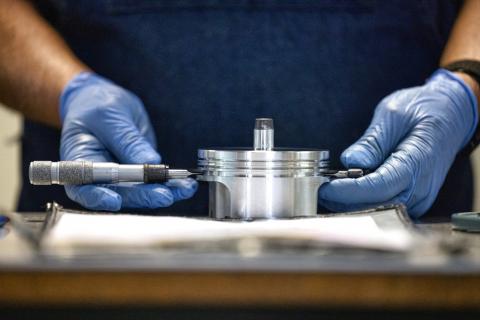
The team also complained of inconsistent vacuum readings in the oil pan before sending a sample piston, which was built by a competitor, to Madsen. He recognized the issue with a cursory inspection but double-checked the profile dimensions on a CMM (coordinate measuring machine) to verify.
“We could tell by the wear pattern on the skirt,” said Madsen. “Where it changes direction at bottom-dead-center (BDC), it rocked really hard and left a witness mark. We had a pretty good idea of how far the skirt was hanging below the sleeve at BDC, and it would rock so violently that it would collapse the skirt.”
Ross engineers applied a different profile to the piston, essentially moving the gage point higher to help maintain cylinder seal at BDC.
“But there is a point of no return where you can’t do anything,” added Madsen. “We’ve seen it before. You’re never going to get away from some problems unless you change your combination.”
Engine builders often go to piston manufacturers to help solve problems, even when the piston isn’t the complication. Pistons happen to bear the scars of poor tuning, improper valvetrain setup, or excessive boost. Whenever a struggling engine is disassembled, there can be a pause for reflection and consolation with a piston tech. And when a new engine with high hopes is coming together, engine builders will bypass the off-the-shelf units in favor of a custom piston to gain an advantage.
“Yes, we have a custom piston program,” explained Joe Maylish of MAHLE Motorsport, Fletcher, North Carolina. “Last year, we made nearly 600 different designs. Our engineers deal with that every single day. One thing we’re able to do more with engine builders is 3D printing. We can take their concept, make a 3D-printed plastic piston, and send it to them for mock up. While 3D printing has been around for a while, we’ve been doing it more often because the designs have become more exotic.”
Pursuit of Power
Still, the driving force for custom pistons is the pursuit of more horsepower.
“We are seeing even more extreme engine applications where engine builders and end users alike are pushing power and rpm levels far beyond what we have seen in the past,” said Nick Diaz of CP-Carrillo, Irvine, California. “Some of this can be seen in compound turbo/supercharging and higher use of E85 to E100 fuels. Also, thinner piston rings for lower drag and better sealing are finding their way into various applications, and piston coatings are becoming more commonplace to help longevity in endurance applications.”
Pistons are receiving intense scrutiny in the never-ending quest for more power. Among improvements being pursued are thinner piston rings to reduce drag and improve sealing, and coatings used more extensively to improve longevity, said our source at CP-Carrillo.
Over at Diamond Pistons in Clinton Township, Michigan, custom pistons are the company’s core business. “With many racing applications, engine builders are constantly reviewing and making changes to better the performance of their engines,” said Mike Panetta. “More common than not, pistons are subject to changes and improvements with every rebuild. We work with the builders on areas of improvement, with the intent to produce a better performing piston, improving ring seal and horsepower.”
One market that has caught the eye of many piston manufacturers is the European supercar. “We are currently working on new product lines to expand our offerings for European engine platforms, along with other sport-compact offerings across multiple engine platforms,” added Panetta.
Diamond Pistons has launched new pistons for the Audi/Lamborghini 5.2-liter FSI platform, while JE Pistons in Cypress, California, has introduced pistons for Lamborghini, Audi, and Ferrari.
“I think that’s a huge, growing market,” said Nick DiBlasi of JE Pistons, noting that the popularity of track days, standing-mile competitions and roll racing is bringing new entrants into the performance arena. He also said there are unique challenges to developing product for some of the import engines. “They’re really weight-sensitive relative to, say, an LS engine. Also, there are huge variants to an LS bore, from LS1 out to an LSX. But with some of the European stuff, it’s basically one aluminum block that’s Nikasil coated. So, you don’t have a lot of wiggle room.
“Also, these pistons have direct-injection bowls,” added DiBlasi. “It’s extremely important to get those angles correct because the combustion event happens above the piston, and it has to be there for emissions and power. Otherwise, if you blow past that, you’re going to wash the cylinder walls and have catastrophic ring failure.”
The domestic market is certainly not forgotten as piston manufacturers keep up with increasing demand.
“We’re getting further into the LT and late-model Hemi market,” said Alex Gonzales of RaceTec Pistons, Huntington Beach, California. “We’re making them for all-out race motors. It’s a high-boost, high-compression product. It’s just a matter of designing it and getting it on the shop floor into the machines. It’s nothing that difficult. It’s just new.”
Wiseco has introduced pistons for Ford’s Gen II 3.5-liter EcoBoost and the 7.3-liter Godzilla V8. “The Godzilla engine has a stout foundation, giving builders a lot of room to make a lot of power,” said our source at Wiseco.
Following the unexpected demand for racing products during the pandemic, there is still a hangover for on-time production. Supplier difficulties in acquiring raw materials and labor issues have combined to increase pressure on piston companies to deliver.
“We’ve had multiple people come to us asking for quicker turnaround times. We’re just trying to please the masses now,” admitted Gonzales, adding that developing new shelf products is taking a back seat to custom orders. “We’re constantly making new stuff. Somebody will have a cylinder head and say nobody has a piston for it. We’ll make it. It’s just a matter of getting in line and getting it done. We don’t develop stuff for shelf without needing to. We’re not going to invest time and engineering and development for something that we’re not going to sell that very moment. We’d rather focus on a sale that’s waiting.”
One ongoing effort at RaceTec is building a customer base that orders multiple sets of pistons. “We have the ability to mass produce,” said Gonzales. “We have a guy up in the Washington area who builds a lot of LS-type crate engines. He’ll call and say he has X amount of blocks at this bore size, X amount of this crankshaft stroke, and X amount of this connecting-rod length. Now make me pistons for this much compression using this head.”
While different types of LS builds are seemingly endless in the performance market, Matt Polena of Wiseco Performance Products in Mentor, Ohio, is seeing more interest in engines with a 3.900-inch stroke crankshaft. “Between internal experience and input from leading racing and engine building partners, Wiseco’s line of LS 3.900-inch-stroke pistons was designed specifically for that rod angle, optimizing both performance and durability,” said Polena. “The skirt shape was specifically designed to reduce piston rock with 3.900-stroker rod angle, allowing the rings to maintain better ring seal.”
Wiseco also introduced pistons for Ford’s Gen II 3.5-liter EcoBoost and the 7.3-liter Godzilla V8. “The Godzilla engine has a stout foundation, giving builders a lot of room to make a lot of power. Wiseco’s forged pistons are designed with this in mind. Features include 2618 material, proprietary ArmorGlide skirt coating and H13 wrist pin,” said Polena. “The EcoBoost pistons have lateral gas ports for improved ring seal.”
Budget-Friendly Options
While high-end, big-horsepower engines draw many of the headlines, there’s still a huge market in sportsman categories where engine builders are seeking performance on a budget.
“We cater to the grassroots racers, and most of it is pretty basic,” said Kirk Peters of Howards Cams, Oshkosh, Wisconsin. “We use a 2618 material. The edges are already radiused, as opposed to when I was younger and had to take pistons to the belt sander to break all the edges, so you don’t get hot spots.”
The Chevy four-valve, four-cylinder engine is a favorite with entry-level hobby stock and sport mod-type racers at local circle tracks, so Howards has developed a piston that falls within a typical rules package.
“They’re allowed to have four valve reliefs on a flat top, no domes,” said Peters, adding that racers required to use the Chevy Vortec cylinder head are also active customers. “They have to run a two-barrel carb, and there are valve lift and vacuum rules. We have to make everything match up to those rules.”
Manley Performance Products is putting increased emphasis on domestic late-model engines, with offerings such as these pistons for the 6.2-liter Hellcat Hemi.
More sanctioning bodies are requiring spec pistons along with other restrictions in an effort to reduce engine costs.
“We sat down with Mazda, which wanted a spec piston for one of its series,” recalled MAHLE Motorsport’s Maylish. “Now, Mazda bought the pistons and supplied them themselves. Then, last year we made an LS3 piston for Trans-Am TA2 racing. If they request it, we can laser-etch a logo, like we did with WISSOTA.”
When developing a spec piston, the objective is to equalize the compression ratio, use a material specified by the organization and develop an appropriate ring package that is durable and readily available. Another noteworthy line from MAHLE is the PowerPak set, which takes a popular racing design and makes it always available.
“The concept is to have a shelf-stock piston that is a high quality and that engine builders will find is consistent and available,” said Maylish. “As an engine builder, you certainly don’t want pistons that are all over the chart as far as gram weight. It’s definitely been more difficult with the onset of the pandemic, but having parts available is something that we continue to strive for.”
Another manufacturer with strong ties to the sportsman classes is Manley Performance Products in Lakewood, New Jersey. Boasting a very large catalog of pistons, Manley is stepping up development of product for domestic late-model engines, such as the 6.2-liter Hellcat Hemi. There’s also a separate catalog for sport-compact applications.
The extensive Manley offerings place the company in a strong position to serve sportsman racers in addition to select custom work. “We’re really good at doing shelf stock and custom private label programs. One of our strengths is we’ll work with specific customers, create some platforms and custom work for them,” explained Trip Manley. “In our small block Chevy offerings, we’ve got two-barrel and four-barrel pistons for dirt tracks, we’ve got some big block pistons, but we don’t have a Brodix SR20 piston. We don’t have pistons for the massive amount of different cylinder heads that are out there for big blocks. That’s not our wheelhouse.”
What’s in the Manley wheelhouse is a 2618 piston with a competitive skirt design for many of the sportsman applications.
“I like to say that we’re really good at developing pistons that may not be the lightest, but they provide a great combination of features,” added Manley. “We don’t go after the crazy lightest piston. We’re really all about making power and having durability.”
Newer Materials
The topic of lighter weight pistons revolves around both design and new materials, the latter having manufacturers working with suppliers to evaluate new alloys. The choice between 2618 and 4032 aluminum has served the racing market well in both performance and price point. However, as other industries, such as aerospace, develop new alloys that are lighter and stronger, racers will be attracted to them.
“We have been testing a lot of new materials,” said DiBlasi. “I can’t specify the alloy, but the name of the game is: How do we get a product that has the durability of 2618, but has the wearability of 4032?”
AWA Composites is developing pistons made from a new, highly durable composite material. Although the up-front cost would be pricey, the company believes these pistons could sustain an entire season of Top Fuel racing.
JE is working with a college that is using a federal grant to test alloys with Materion, an engineering firm with considerable experience in advanced materials.
“Some of them are good, but some of them are just out of the price point of most companies altogether,” noted DiBlasi. “We’re talking 25 times the cost for the material. But it has the properties we’re looking for. At some point, though, you can change the pistons five times and it’s still cheaper.”
On the exotic side, pistons are made from metal matrix composites (MMC), but most sanctioning bodies have banned that material. Another composite that is undergoing testing in the hopes of being approved by racing organizations is offered by AWA Composites in Rolling Hills Estates, California. This “forged” composite material was first seen as a connecting rod a few years ago at the PRI Trade Show. Last December the company showed off a composite piston that featured titanium ring grooves. AWA is currently testing the piston and rod with a leading Top Fuel team in addition to building a KB500 engine for dyno testing. Even though such a piston would be quite expensive up front, Bryan Gill of AWA believes it will withstand an entire season of racing.
“We’re in probably the last stage of testing. We’ve run them on alcohol and a small percentage of nitro,” said Gill. “The next test will be to run on a full complement of 85% nitro. We’re very encouraged with what we’ve seen this far. We feel like we have something that’s disruptive in its technology.”
The goal is to validate the piston’s durability and complete a cost-versus-benefit analysis using the composite piston in place of a traditional aluminum piston designed for nitro engines. Gill has said his piston conceivably could run a full schedule of NHRA events compared to the current pistons lasting only two or three weekends.
“We can’t make claims of durability if they’ve run only two or three passes on our pistons. We just need more laps before we can conclusively say,” claimed Gill, adding that his pistons are 40% lighter than standard models. “Once the data is complete, then AWA can present a viability argument to NHRA for consideration.”
Forging Advances
Regardless of the material used, piston manufacturers still need raw forgings to machine into the final product. Some companies will machine one-off piston designs from billet stock; however, most racing manufacturers will source their forgings from large, independent suppliers, such as Performance Forge.
Based in Montebello, California, Performance Forge works with piston manufacturers to develop tooling, which itself is undergoing a transition of its own.
“The design of the tooling itself; that is, how we go about making the tooling in order to make it live longer and maintain dimensional tolerances, has changed in the past five years,” said Wayne Ramay. “We’ve changed the materials that we make the tooling out of and the designs that we use. It still will yield the same piston, but we just make the tooling different.”
Performance Forge provides raw forging to many piston manufacturers. The company has recently introduced new tooling materials, and an oven that heats forgings faster to create a tighter grain structure.
Another significant change at Performance Forge is the oven used to preheat the metal to a malleable temperature. “We’ve come up with a new oven that heats up the raw material more efficiently and quickly. This helps us with a lot of things but mainly the grain,” said Ramay. “Grain size is a real key. You can think of large grains like a blob of curds in cottage cheese, and that’s not very strong. Smaller, tighter grains that are more compressed will flow with the forging and make it stronger. These ovens help make grains small. Between the oven and our mechanical presses, we have the tightest grain structure in the industry.”
Still, piston designers keep coming up with demands that can’t always be delivered. “Right now, they are asking for some crazy stuff that you wouldn’t even be able to get the tooling out of the part,” said Ramay. “They’re asking for undercuts to be forged into the part, and we’ve not been able to figure it out. But I’ve had people ask me about it.”
Piston Ring Trends
In the domain of piston rings, racers are seeing two distinct trends: transitioning from cast-iron to steel and replacing moly coatings with physical vapor deposition (PVD) coatings.
“In the last 20 years, NASCAR and top-level race teams have moved toward the steel/PVD combination,” said Lake Speed Jr. of Total Seal, Phoenix, Arizona. “But in the grassroots levels, ductile iron/moly is still the predominant choice because of cost.”
Speed, however, is quick to remind customers that he’s implying purchase price, not the total operating costs of switching to steel/PVD. He noted that for a NASCAR team 20 years ago, the state-of-the-art ring package was .043, .043, 3 mm.
In the upper tiers of motorsports, teams tend to favor steel piston rings over cast-iron, and physical vapor deposition (PVD) coatings over moly coatings. But in the grassroots ranks, racers still prefer lower-cost ductile iron/moly, according to our source at Total Seal.
“Fast forward to today and the teams are running PVD-coated steel rings with a top ring around .020 to .024,” said Speed. “So it’s half the thickness. But with that old package, that engine ran one race, and the engine would be down five to eight horsepower by the end of the race. Today you have engines running three races, so those rings are living three times longer.”
Over the course of a season, racers using the stronger-yet-lighter ring packages will see less wear on the cylinder liners, so there’s less to bore out on the next rebuild.
“That means the block and sleeves will last longer, so the overall operating cost will be lower, even though some of these parts will be more expensive on the front end,” said Speed. “But people have been hesitant to make the move for different reasons.”
With the new ring material and coating, engine builders will have to adjust their honing strategies.
“Ductile/moly is porous, and PVD is not. So, the porous ring will hold oil and it’s soft, so it will break-in easier,” explained Speed. “Since the PVD coating doesn’t hold oil, the surface finish on the cylinder walls becomes much more critical. The cylinder finish has to hold oil because the ring won’t. You don’t want the finish too smooth or too rough, but you need enough Rpk (reduced peak height) to get the steel rings to break in properly.” —Mike Magda
What’s New in the Manufacturing Plant?
Automation and streamlining are two buzzwords often heard when discussing piston manufacturing. Due to the high standards of precision required to produce pistons for racing applications, suppliers are taking steps to ensure critical tolerances are met while meeting turnaround deadlines that never seem to keep up with engine builder demands.
“We have been working for the better part of the year to implement various stages of automation during our production process. This will allow us to streamline different operations during the manufacturing process,” said Nick Diaz of CP-Carrillo, Irvine, California, noting that automation will free up time needed for other hands-on procedures in custom work while allowing larger runs of shelf items.
CP-Carrillo’s manufacturing process has roots in the design software used to create both custom and shelf pistons. “As the design is completed, the data is uploaded directly into the system, which verifies the information is correct and then launches G-code from our automation server to the machines on the floor,” explained Bryan Moreland. “When features deviate from our automation, it flags the job and puts the job in a queue for custom programming. As the programmers finalize their portion of the job, they then launch it into the CAM system, which has all the tools to produce the part designed.”
CP-Carrillo is automating much of its piston production. Along with the greater precision it brings, automation allows larger runs of shelf stock and frees time for hands-on procedures in custom work.
The system is flexible enough to allow the sales staff to pull up any piston design on their computers while talking to customers and make changes as requested. A CMM file is created for every piston, which then allows the production team to validate measurements at any time during or after the manufacturing is complete.
“The files are automatically stored on the network under the job number and accessible at a moment’s notice,” added Moreland. “The programs used by the CMM are customized by the design of the piston and use our custom design interface to determine what styli are needed to get into the narrow ring grooves and other features of the piston. Base alignment is established from basic features that hold the piston in the cylinder, so the data correlates with the customer’s installation in the engine.”
Ross Racing Pistons in El Segundo, California, is another company that has been streamlining manufacturing to help ensure accuracy. It developed advanced fixtures that stay with the piston longer to reduce the frequency of changing fixtures for different machining operations.
“Every time you change that piston and you put it in a different fixture, it gets a little harder to maintain that accuracy, because you get tolerance stacking,” said Chris Madsen. “We’re working on a balance between multiple machines and more operations in one machine. The secret to us is our fixturing.” —Mike Magda
Investment in the performance aftermarket is on the rise. But why, exactly? And what does this infusion of capital mean for the industry going forward?
Racers who don’t make a habit of paying attention to business media might be surprised to learn there’s a quiet financial revolution going on in the background of the motorsports industry. Many of the companies and brands that racers grew up with, including legendary brands that originated in modest garages and still carry the founder’s name on the box, have been acquired by private equity firms and often combined with other companies to form “super brands” that control large sections of the market.
These iconic racing brands are still out there producing quality parts, but they are no longer the independent mavericks of popular lore. What does this shift in ownership mean for the motorsports industry at large?
This private equity interest is not entirely new, but in the last couple of years the pace has accelerated. In February of this year, New York City-based MidOcean Partners acquired timing drive manufacturer Cloyes from private equity firm Hidden Harbor Capital Partners, which has held Cloyes since 2018. Taglich Private Equity, another New York City firm, acquired Air Flow Research and SCAT Enterprises in 2021.
Industrial Opportunity Partners (IOP), based in Evanston, Illinois, invests in middle-market companies in North America, which are defined as companies with between $50 million and $500 million in revenue. It added COMP Cams to its portfolio in early 2020. IOP folded the COMP companies into the Edelbrock Group, forming a larger entity that includes performance brands such as Russell, TCI Automotive, FAST, and RHS.
Large private equity firms are increasingly acquiring and merging iconic performance aftermarket companies, such as SCAT Enterprises, which was bought by Taglich Private Equity in 2021.
MiddleGround Capital (MGC), with offices in Lexington, Kentucky, and New York, New York, targets lower middle-market companies. It currently owns 11 companies, including Race Winning Brands, which it acquired in late 2021. Race Winning Brands includes heavy hitters such as Dart Machinery, Wiseco, Manley, and JE Pistons.
Greenbriar Equity Group of Rye, New York, announced in February that it had acquired a majority position in Ohio-based JEGS Automotive, which had been in family hands since 1960. All told, these five private equity firms alone own outright or majority control of nearly 30 aftermarket performance companies.
Speed Appeal
Some might find it surprising that relatively small brands that appeal primarily to gearheads, with advertising more commonly limited to sponsorship stickers on race cars than national TV ads, would appeal to the centers of high finance. But from other perspectives, it’s not that surprising at all.
“It was only a matter of time before private equity noticed the motorsports industry,” said Daniel Ingber, PRI’s Vice President of Government and Legal Affairs. “PRI Members are some of the most innovative and entrepreneurial businesses in the world and know their products and their customers extremely well. Most of our Members are small businesses that are attractive to private equity.”
Hart Marx Advisors in San Rafael, California, specializes in mergers, acquisitions, divestitures, and succession plans in the automotive and heavy-duty trucking industries. It has seen firsthand the factors that make motorsports companies attractive investments for private equity.
“The brands tend to develop really strong followings, so it’s a good base for an investor to be able to grow from,” said Chris Bovis of Hart Marx Advisors. “If you have a good company, making pistons, valves, whatever, and you have a whole contingent of engine builders who swear by your products and have been using them for 30 years, that trust in the quality of that brand has been built up. That’s a tremendous platform to grow from. It makes it very difficult to break in, so it does provide a bit of a barrier to entry.”
Preserving the character of brands is vital in merging performance companies. “I believe we’ve done a nice job trying to develop a new culture but not throwing out the two old cultures,” said our source at Industrial Opportunity Partners, owner of COMP Cams and Edelbrock.
Those hard-earned reputations established at the race track do tend to attract notice far beyond the paddock. “That equity in the company, the brand, it’s hard to define and it’s probably impossible to value,” Bovis said. “But it’s extremely hard to create. It’s something that happens over time. If you’re a valve spring company that’s been building quality products for 30 or 40 years, and you’ve developed that following, a private equity firm would look very kindly on that and see that as very attractive. No private equity has the time or interest in investing 40 years to build that up themselves.”
Beyond the brand equity, the appeal of performance parts manufacturers makes sense from a nuts-and-bolts financial perspective. “The performance automotive and powersports aftermarket segment has been an attractive asset class to private equity for several reasons,” said Mike Bridge of MiddleGround Capital. “First, there is sustainable end market growth, with the automotive performance segment growing at a historical compound annual growth rate of 2–3% and the powersports segment growing at 4–7%, which we anticipate continuing for the foreseeable future. Second, these companies often boast strong financial profiles with high margins, limited capital expenditures, and high free cash flow. Third, consumers still tend to pursue their hobbies and passions, even in a recessionary environment. Furthermore, customer relationships tend to be very sticky, as consumers stay loyal to quality brands. Fourth, this is a highly fragmented market comprised of companies that are typically founder owned, providing a robust acquisition pipeline of businesses that can benefit from operational best practices and additional capital to fuel growth.”
There are other factors that make performance products manufacturers attractive to private equity that are not readily apparent to the fan in the stands. “Given the plethora of deals in the industry for lower- and middle-market companies, I believe that private equity firms are seeing a nice diversity to perhaps a portfolio they may already be holding in transportation, that the performance aftermarket brings to establishing a balance,” said Phil Fioravante, Operating Principal with Industrial Opportunity Partners, owners of the Edelbrock Group. Although it’s not a strategy that IOP currently employs, Fioravante said, equity investors may have investments in Tier 1 OEMs, heavy trucking, or powersports companies, with motorsports companies attractive as final pieces of the transportation puzzle.
“I truly believe, in terms of a balanced pie chart, if you will, that the performance aftermarket is becoming increasingly something on peoples’ radar screens to balance out the cyclical nature of the other three,” he said.
Although these transactions for motorsports brands usually boil down to the money that can be made, that’s not always the primary motivator when a company allows itself to be sold. “The decisions that we see from the companies that we deal with tend to be very personal,” said Bovis with Hart Marx Advisors. “They tend to be family oriented—what’s in the best interest of the family?
The devoted customer base of performance products companies makes them appealing investments, noted M&A specialists Hart Marx Advisors, allowing private equity firms to sidestep the relatively long process of entering markets and building a base from scratch. Pictured here, from left to right at the 2019 SEMA Show, are Hart Marx’s Chris Bovis, Devin Hart, John Nodson, and Tom Marx.
“Probably the most common reason for owner-founder businesses, which is primarily what we deal with, is they oftentimes don’t have a next generation to pass the business to, or the next generation is a firefighter, a lawyer, they’ve found their own path and haven’t really had the interest in the family business,” Bovis continued. “It starts to become an economic question of not just what’s best for the family, but also what’s best for the business. In a lot of cases, they’ve invested 40 or 50 years of their life into these companies, in developing the brand that’s so tied to who they are personally, that just closing down is unthinkable from an emotional perspective. It’s unthinkable from the perspective of what it would mean to their employees. They want to create a home and a future for their employees that have given so much to the business. It’s a blend of emotion and rational financial planning.
“I would say the trend we’re seeing is that fewer and fewer members of that next generation are interested in carrying on the business. That tends to be rarer than I think it has been in the past,” Bovis added.
Secondary Effects
Is this consolidation of brands good for the motorsports industry? History teaches that, in a general sense, a reduction of true competition usually doesn’t work to the benefit of the end customer. Employees are sometimes shed to deal with “redundancies” as companies are merged together. Relocations can transform communities. And if the last couple of years has taught the world anything, it is that larger corporations will often feel pressured to enforce government dictates whether they are good for an industry or not.
But there are obvious upsides, too. Private equity investment in a business that is treading water means access to capital for expansion, modernizing equipment, and breaking into new markets, plus expertise for navigating the digital age and avoiding legal minefields.
“My experience, in my career, it was quite good for the company,” Bovis said. “I worked for a company that was struggling until it was purchased by private equity. They put in a lot of resources. They have expertise that we were able to take advantage of to grow the business, and the company is on very strong footing now. The brand is back, and the products are back, and everything has worked out very well. So I’m very biased toward seeing that side of things because that’s been my experience. I see a lot of companies and brands that couldn’t have negotiated and managed their way through their growth quite as well.”
Company founders often sell businesses to private equity firms to preserve the company and its legacy, while at the same time ensuring a healthy future for current employees. Photo courtesy of Holley Performance Products.
A big-picture view from private equity can also lead to improvements on the shop floor. “MGC is unique when it comes to how we support the employees of all our businesses,” Bridge said. “First and foremost, we bring first-hand experience to our approach on safety and the physical working conditions in all our investments. We expect facilities to be clean, bright, and free of un-protected critical safety risks. Second, we desire for all our employees to earn a livable wage, which is why last year all our portfolio companies enacted a minimum pay rate of $15 per hour. Although most of the employees across our portfolio make much more, we saw this as a good starting point. By 2025, we seek to increase our minimum pay rate to $25 per hour. We feel this will allow us to attract and retain top talent.
“Our motto is to ‘leave everything better than we found it.’ We are not perfect, but we are proud that we are not a firm that makes money on the backs of others,” Bridge said.
Combining companies with distinct cultures into a larger organization is a challenge all private equity firms face, but most have experience in that aspect of operations. “Typically, our perspective and approach is the development of an operating plan or an operating thesis upon initial investment,” IOP’s Fioravante said. “In this case we knew how Edelbrock was performing and performing well. We know that COMP Cams is performing and performing well. We were looking at one plus one is three. By instituting the IOP operating thesis that we reviewed with Edelbrock, and we reviewed with the new team at COMP, we started working through synergies that I call ‘people, process, and products.’
“From the people perspective, with the merging of two organizations, do we end up having some redundancies? Then we sort that out, and some of it happens through attrition. There were no forced layoffs. It was happening over time; it’s been almost two years. There are a lot of great technology leaders on both sides. We brought in some new thinkers from outside the two companies, and it has been a great addition to our product management and our engineering team. Most of the leadership today at Edelbrock Group is primarily COMP Cams folks. At the senior level, the CEO is from outside of the industry, the CFO is from outside of the industry, the chief commercial officer, Chris Douglas, has the largest portion of our organization. Our chief operating officer role, that will be a new role for us here in the coming weeks. From a synergistic operating thesis plan, everybody gets together, and we try to figure out what we can gain by doing this, what can we gain by doing that.”
Don’t Lose the Spirit
The motorsports world is full of stories about entrepreneurial racers who started building parts out of modest shops and garages, creating their future empires through word of mouth, one sale at a time. Preserving that independent spirit is a crucial part of maintaining a brand’s reputation. “Private equity has upsides and downsides for the industry,” PRI’s Ingber said. “It can help some companies reach their full potential, but when private equity companies ignore the judgment and expertise of the individuals who built the company, who know the product, who know their customer and are passionate about motorsports, it can change a company, brand, or product in bad ways.”
The people we spoke with seemed aware of that potential danger and appear to be taking a hands-off approach to how to best meet the needs of the racer. “We partner with the management team and employees. Our role is to make sure the team has the resources needed to execute their vision and strategy,” MiddleGround Capital’s Bridge said. “The Race Winning Brands management team has deep roots in the industry with some brilliant minds leading engineering and R&D. The goal of our operations team is to give the management team incremental resources to execute on discrete initiatives to free up their time to continue doing what has made this company great.”
Operating in a market driven largely by passion, performance products companies like Edelbrock are generally resistant to swings in the economy. This adds to their appeal as investments, particularly among firms with a transportation emphasis.
The infusion of capital can lead to an increase in new parts on the shelves as companies gain resources. “From a products perspective, we’ve been developing some really cool new products like black chrome intake manifolds and carburetors,” Fioravante said. “We launched a whole lifter assembly at the PRI Show that’s getting rave reviews. So we saw a lot of synergies and we’re continuing to work through the branding.”
“There are different sizes and phases of businesses that require different resources and skills and different capabilities,” Bovis explained. “There’s the financial side of things. The financial resources necessary to buy the inventory, to fund the marketing, to grow a national footprint in terms of sales or dealers, that takes time and money. In a lot of cases, private equity has access to those resources, be it direct investment or however they want to structure it. But they bring that next level of financial sophistication and financial resources. They tend not to be experts in any one particular field, but they tend to be experts in growing businesses and helping fund and manage through the challenges of growth and adding staff and adding resources. As businesses grow from family-owned or generational businesses to first level of professional investment, they do tend to get a little bit of sophistication on managing through the challenges of that growth.”
There’s more at stake than just funding new products. Private equity conglomerates have the ability to shepherd performance brands into entirely new financial realms. Holley Performance Products, controlled by Sentinel Capital Partners, in 2021 merged with Empower Ltd. for the purpose of becoming a publicly traded company. With private equity backing, Holley is now listed on the New York Stock Exchange (HLLY).
Looking Ahead
Private equity interest in the performance aftermarket appears to be here to stay, at least for the foreseeable future. “Certainly, there will be more and more competition for fewer and fewer really good companies and brands. There’s been a lot of consolidation among maybe three or four major players,” Bovis said. “To the extent that there are good companies and good brands and good market niches to pursue, then yeah, it will continue.
“This is highly speculative, out on a ledge a little bit, but where I think there is probably more to be gained is these adjacent markets. Much like SEMA and PRI saw a connection between their core audiences, you see some of the big private equity conglomerates start to see a crossover between the SEMA and PRI crowds and the powersports markets—ATV, UTV, motorcycle, maybe to a lesser extent personal watercraft and some of those things. You’ll start to see them pick up and have increased interest in some of these adjacent markets that still have the core attributes of an emotionally connected enthusiast buyer, a true outlet for the end-user, the passionate hobbyist, premium products with good margins and good performing businesses. I think you’ll start to see more of a reach out to these adjacent markets,” he added.
Although many top names in the performance aftermarket have been snatched up by private equity investors, the industry is constantly evolving and creating opportunities for the next generation. “There’s an emotional side, where you wish the products were still being built out of somebody’s garage, that romantic, entrepreneurial side of things. You wish that was still around in some of these companies, but it’s around in different companies. There are still companies being built today out of peoples’ garages and basements. We just haven’t seen them grow to national status yet. They’re in the process of doing that,” Bovis said.
“There are some things in my life that I don’t even know who we’re buying a product from,” he added. “Half the time I forget who my cell phone provider is. It’s just an anonymous company that I only know about when something goes sideways. But I know everything that’s in my race car. I know every part we buy, I know the company, I know who we buy it from. It’s such an unusual market and industry in that regard. You’re so close to the customer. I couldn’t imagine anything better for a private equity group.”
From corporate boardrooms to herding sheep—not to mention race teams, fans, and sponsors—at Sonoma Raceway, this former NASCAR executive’s motorsports career has been about managing change.
Jill Gregory took over management of Sonoma Raceway at the beginning of 2021. It would take going back to early 1942 to find a more challenging time to successfully run a race track. Gregory came to Sonoma with a strong background in marketing and motorsports management. Before moving west, she served as executive vice president and chief marketing and content officer at NASCAR. In that role, she was responsible for marketing, media relations, communications, and broadcasting, as well as diversity and inclusion functions for NASCAR. Finally, she was responsible for the sanctioning body’s digital presence, including NASCAR.com, the NASCAR Mobile app, social media, and fantasy games.
Before joining NASCAR, Gregory ran motorsports marketing for Bank of America, and managed the marketing of the NASCAR Sprint Cup Series for Sprint Nextel. In 2011, she was selected for the inaugural class of “Game Changers: Women in Sports Business” by Sports Business Journal and Sports Business Daily.
Compared to all that, just running a world-class race course in California’s wine country would seem like a vacation. To top it off, this was a homecoming. Gregory is originally from California, having grown up in the state’s vast Central Valley in the city of Modesto. She earned a degree in journalism from California Polytechnic State University in San Luis Obispo.
We caught up with Gregory to talk about the state of racing as the nation emerges from the pandemic, and her ideas on how to bring more people out to the nation’s race tracks in the future.
PRI: You’ve come to Sonoma with a great background in racing and motorsports. How do you think your prior experience prepared you to lead this unique facility?
Gregory: Like any other business, motorsport seems to be one of those where relationships and connections are everything. All of my previous stops along the way have given me the right experience to take on the challenge at Sonoma. To your point, it’s a little different in layout than a traditional NASCAR track, but NASCAR is only one component of what we do here. The branding and the marketing experience that I’ve had from a sponsor side, and from the sanctioning body side, have given me a well-rounded approach to what we want to do here at Sonoma.
PRI: Among the biggest challenges at any raceway anywhere in the country are the neighbors and the neighborhood. Sonoma has had its share of resistance in the past. How are you dealing with that, and do you have any advice you could give to other facility managers?
Gregory: Being a good neighbor is a good rule, whether in your personal life or your professional life. As a race track, we have a unique assignment and responsibility to be mindful of our neighbors. No track more so than ours. We’re almost in the gateway of the Sonoma Valley, so we need to be mindful of our role in this community. A lot of [track] neighbors have the same concerns. If we are being good neighbors and staying in good communication, that puts us in a good position.
With an impressive motorsports background that includes marketing and management roles at NASCAR, Jill Gregory is well-suited to running one of the nation’s top road racing venues.
PRI: How do you do that? What steps have you taken?
Gregory: Through COVID, we’ve been able to contribute even more to the neighborhood. We’ve had several community events here at Sonoma Raceway, but we’ve always been very connected to the community through our charitable donations. We’ve also acted as emergency centers for some of the wildfires and other natural disasters out here in Sonoma.
We’ve been able to act as a command post for the Sonoma County Sheriff and other law enforcement and various firefighters here. There’s fair amount of elevation here. Our command center that plays a crucial role during a race weekend was also a place where a lot of our first responders could take advantage of the viewpoint to assess different situations. We also had a lot of displaced residents here during the wildfires. This is pre-pandemic obviously, but with a lot of campgrounds and a lot of real estate here, we’ve been able to act as a location to take care of people. So, all of those things go into being a good community member. Then when it’s time to figure out how to get back to business during COVID, we have a lot of strong relationships that help us do that.
PRI: Has the pandemic changed the way you do business with both big public events and smaller events like SCCA races or other track uses?
Gregory: It really has. The 2020 racing season was essentially canceled here in Sonoma and in all of California. While I was at NASCAR, we spent the better part of 2020 trying to determine what would be the right way to resume our business, whether that was without fans or virtually through iRacing and then moving on slowly to bring fans back in a safe manner.
That was on a national level in 2020, but when I arrived in 2021, California was still in a more restrictive situation than some other race tracks. I can’t speak for everyone, but we really had to become more nimble and more flexible in our business model. Now that we’re coming out of the pandemic, our challenge as business leaders is to determine what changes we made during 2020 and 2021 will make sense to keep, because they led to a nimbler operating model.
After taking the helm of Sonoma Raceway, Jill Gregory’s first order of business was to navigate through the pandemic; although racing had resumed by 2021, California still had significant restrictions.
PRI: Can you detail some of those changes?
Gregory: Whether it’s big fan-facing events like NASCAR races or car enthusiasts and clubs and racing experiences, we’re trying to evaluate what is the best way to keep fan engagement going, but how do we do it in a way that takes into account some of the new expectations that either a fan or a partner or a community has.
PRI: What are those new expectations?
Gregory: If we didn’t have a race track on the property, it could be called a working farm. We’re working on water collection and mitigation issues. I’m looking out my window right now, and our flock of sheep is out here mowing the grass. We have a lot of environmental assignments here, to make sure that we are conducting and running this facility in the most efficient way possible. You’re really going to see us lean into green and sustainability efforts. We’re a natural fit for that effort here at Sonoma. Even the clients that we have, we’ve been hosting several electric vehicle brands and models here for proof of concept.
We also have a significant autonomous vehicle testing program that’s been out here since November.
The challenge we have is trying to make sure that we can conduct all of these commercial endeavors but do it without ignoring our environmental impact. We have a lot of programs that we need to put in place to make sure that we are delivering on sustainability and green messaging.
One other challenge that I’d be remiss by not mentioning, and I know this is not unique to our race track, but as we ramp back up and add to our staff after a couple years of contraction, we have to find good people to come and help us run this race track. Hiring and retaining employees and providing a great work environment is something that’s a priority across every facility. The workforce challenges are fairly well documented in the world right now. We’re not immune to that.
PRI: You’ve been involved in promoting diversity and inclusion at NASCAR. That has been a very public effort NASCAR has made. How do you think the motorsports industry can encourage diversity and inclusion and make the sport more welcoming to more people?
Gregory: It was really important to me as I shifted my career from NASCAR to Sonoma Raceway to make sure that diversity, equity, and inclusion are still a priority. You’re seeing a lot more entities make this a priority. My feeling is, if we don’t state it as a goal and set metrics and objectives toward it, then it’s not going to be successful. We’ve gotten better as an industry, but we need to stay diligent in promoting those programs.
For us, we need to attract fans and market specifically to them, make a wider group of fans feel welcome here at the track. We want any fan who loves racing, who loves speed, who loves the passion and excitement of NASCAR. It will be our job to bring those fans out here, because once they’re out here and they see racing, whether it’s a big NASCAR weekend or even getting in a hot lap car, we know they’ll be hooked. We just have to tell more people and showcase what the excitement of racing is all about.
Besides its annual NASCAR weekend, Sonoma Raceway hosts a vast array of smaller events, such as the Winter Jam drifting festival. The busy schedule is now being conducted with lean staffing brought on by the pandemic.
PRI: You’ve worked a lot in digital marketing. Do you think influencers are important, or are they noise at the periphery? How can facilities utilize influencers to get their messages out?
Gregory: I don’t think there’s been a formula that has really proved tried and true. Influencers, used properly, can really showcase and accelerate your fan appeal and awareness. An influencer program where you put NASCAR or any form of racing in front of someone who doesn’t really understand it, or has been intimidated, or doesn’t know how to follow our sport, can be very impactful, but we need to make sure that we have a plan.
To be effective, you really have to understand what you’re trying to get out of it. That might be different from market to market. You may just want a lot of eyeballs on your event, in which case it could be about awareness. But if you’re really trying to drive engagement, then you have to have a very calculated plan, with metrics. That’s where some influencer marketing programs fall down, because it’s not enough to get someone to your event. You need to have them engage with it and show their enthusiasm and passion. It has to be that next step, or you might not get as much out of it.
PRI: Pulling the lens back, what do you think is the role of marketing and branding in motorsports in the modern era?
Gregory: Sponsor branding has always been a part of motorsports, but if we’re going to continue to grow, what we’re looking at here in Sonoma is, what is the brand of the raceway? What makes it unique for someone to come to Sonoma, or any location? I feel pretty lucky because some of those answers are fairly obvious in a market like Sonoma.
We’re now competing for people’s time, which is their most valuable resource in addition to their dollars, so we have to make it meaningful when they come and enjoy an event here. Making people understand what the Sonoma experience is all about, that’s our responsibility.
PRI: Does social media have a place in all that?
Gregory: Absolutely. The social component is becoming less transactional and more branding focused. We will always use social media channels as a communication tool, to say, what time do the gates open, and where can you find a ticket. Those functions are important. But your social media channel should also be a way to showcase the experience. We’ll create different content through different channels. If we are not using social media as a tool, either as a fan engagement tool or a ticket selling tool, then we are missing the boat.
Beyond the work of overseeing racing at the track lies a number of ongoing challenges for Jill Gregory, including encouraging diversity, regional environmental concerns, and the need to market to ever-more-distracted consumers.
PRI: Thinking in the other direction, how do you make motorsports an attractive place for sponsors?
Gregory: Sponsor engagement goes directly back to the fans. Our sponsors are here to reach the fans, whether it’s the fans here in the stands, or the fans watching at home, or the fans consuming on social media. If we bring more fans with the track, then we will attract more sponsors.
The other thing we have at our disposal is the ability to understand what a partner wants to do, and then how to help support that. If Toyota’s trying to sell more trucks in the Northern California market, what can we do to put Toyota vehicles in front of the fans, either on a race weekend or leading up to the race? We have a unique set of tools to provide to those sponsors, but the most important thing is to understand what they’re trying to achieve and help them achieve it.
PRI: Do you think drivers have a role to play in terms of their personal fan base?
Gregory: Drivers are the most visible piece of our sport. They deliver against that excitement and passion message. Their back stories are what engages fans. Social media is a great tool for drivers to really let them show their personality in a way that they can’t do one-on-one. Doing that fan outreach just strengthens our sport even more.
PRI: Who have been your major influences or heroes in your life, and why did they inspire you?
Gregory: My parents are the two major heroes. The biggest reason is that they taught me an incredibly strong work ethic and intellectual curiosity and really encouraged us to try new things. They instilled in me the confidence to go try new things. As I’ve gotten further along in my career, I’ve come to realize that you can go home again, no matter how things go. That’s given me the confidence to jump in on opportunities that maybe I wouldn’t have if I had not had that support.
PRI: Are there any top principles that you follow in your career, and are there things that you avoid because of those principles?
Gregory: There isn’t a lot of magic to it. You have to do what you say you’re going to do, treat people well, and understand what you’re trying to achieve. I’ve also learned over time, and this was not true earlier in my career: Don’t let perfect be the enemy of good. We’ve learned in the pandemic to do the best you can with the situation in front of you, make the most informed decision that you can, and then move on.
PRI: Last thing: What is the best piece of advice, whether personal or professional, that you’ve ever received?
Gregory: It was not that long ago. Someone said to me, “Don’t be afraid to take your seat at the table. Then when you have it, don’t be afraid to participate and contribute.” Many times, if you’re unsure or there is a tentativeness, then you might miss some opportunities. So, go sit at that front table. When you have your chance to speak, have an opinion. People may not always agree with it, but that’s okay.
 MEMBERSHIP LOGIN