Best In The Desert’s race operations manager, Jeff Phillips, has announced his departure from the off-road racing organization based in Las Vegas, Nevada.
“While Jeff and the entire Phillips family will be missed by our staff, we understand that life often brings opportunities to do other things. We understand this is the case, and we all wish Jeff and his family nothing but the best,” a BITD press release stated.
Brothers Bryan and Daryl Folks—sons of BITD founder Casey Folks—will handle the day-to-day operations and serve as co-race directors, including for the 2022 Method Race Wheels “Casey Folks” Vegas to Reno Race on August 10–13.
Additional events include the 2022 Battle Born 200, September 22–25; 2022 King Shocks Laughlin Desert Classic, October 20–23; and the 2022 World Hare & Hound Championship, November 4–6.
Based in Jackson, Michigan, Melling Engine Parts has announced the acquisition of Sigma Engineering, a developer and manufacturer of rocker arms and shafts located in Pontiac, Michigan.
The announcement marks Melling’s second acquisition of manufacturing companies in recent months, following its acquisition of Casalandra Metal Stamping in late April.
“We are focused on controlling our supply and quality, and this acquisition checks both those boxes,” said Melling CEO Mark Melling.
Sigma has supplied key automotive aftermarket customers with private label products for 26 years. Sigma Engineering owner Arshad Suri will remain with Melling to help design and develop new valvetrain products.
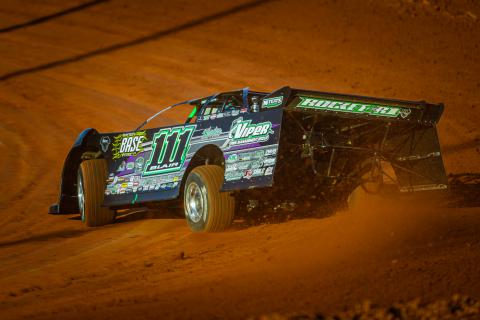
Photo courtesy of Jacy Norgaard and World of Outlaws Case Construction Late Model Series
Concerns about inconsistent rule enforcement and rising costs led to a meeting of the minds at last year’s PRI Trade Show. Here, we examine the agreed-upon solutions and what these changes mean for the future of Super Late Model racing.
Over the past few years, Super Late Model racing has seen a noticeable uptick in engineering sophistication at all levels of the sport. Innovation has long been a cornerstone of healthy competition, but with budgets varying significantly between racers campaigning cars in local, regional, and national series, staying competitive has become especially tough for smaller teams.
“It’s been more than 20 years since Mike Swims got a bunch of Late Model pundits together and established a common rule set, and they did that because everyone was kind of doing their own thing at the time,” said Kelley Carlton of the Ultimate Super Late Model Series Southeast Region, Woodruff, South Carolina. “The idea was to be able to take a car to a race track in Florida, Illinois, or anywhere else and not have to make changes. But over the last several years, racers have pushed into the gray areas, and those rules have been interpreted differently among the various sanctioning bodies. A lot of engineering and technology from NASCAR has been making its way into our ranks recently, so more and more teams have been devising ways to make things better and faster. But, of course, all of that comes at a premium, and there just wasn’t a lot of consistency in terms of how the rules were being enforced.”
That inconsistency has only made things harder for those local and regional racers. “Dirt cars are getting incredibly sophisticated,” said Steve O’Neal of Port Royal Speedway, Port Royal, Pennsylvania. “There’s so much money in the sport right now that it’s becoming tough for the weekend guy to keep up with big teams that can afford dedicated engineers for suspension, aero, and things like that.”
Our source at CT Promotions told us the rule package variance across sanctioning bodies led to many teams building multiple different cars to ensure compliance among the different series. “That was really the catalyst to make some changes,” he said.
Chris Tilley of CT Promotions in Somerset, Kentucky, which puts on the Valvoline Iron-Man Late Model Series, told us that the rule package variance across Super Late Model sanctioning bodies led to many teams building two or three different cars to ensure that they were compliant amongst the different series. “They were basically tuning them for two or three different rules packages. That was really the catalyst to make some changes. We wanted these guys to be able to build one race car and be able to run any event with it.”
With that in mind, organizers among the major sanctioning bodies in Super Late Model racing seized an opportunity late last year to collectively correct course.
“We all needed to get on the same page,” said Casey Shuman of World Racing Group, Concord, North Carolina, which is the sanctioning body for the World of Outlaws Case Construction Late Model Series.
“That got the conversation started. Then a group of the main sanctioning bodies found themselves all together at the 2021 PRI Show, and at that point it was like, ‘We’ve been talking about getting this figured out—let’s just do it now.’ We made some calls, got everyone in the same room, and sat down for an hour or so and hashed it out. It was really productive, and it seems to be working out well so far.”
The group established seven rules that would be common among the major Super Late Model sanctioning bodies, but the core focus of the meeting centered on two mandates that were designed to provide more competitive parity while also helping to curb costs.
Rear Travel Limiter
Also known as the droop rule, this suspension mandate ostensibly revises an existing rule to provide more reliable tech inspection methods while also addressing some of the tactics that teams were using to work around the measurement procedures that were previously in place.
“This essentially replaces the deck height rule,” said Carlton. “The [World of] Outlaws adopted a similar rule recently and it’s much more reliable. You can check it at any time and on any car and the results aren’t going to change. The problem with the deck height rule was that you measured with the car sitting on the ground with the suspension compressed by the weight of the car. But the suspension on the cars is position-sensitive, and because the teams are trying to get the rear spoiler up as high as possible for the most aerodynamic advantage, there really wasn’t a way to reliably get accurate measurements.”
The new rule specifies that the car’s deck height cannot exceed 51 inches when measured after a race, but more importantly, it incorporates a new measuring method that’s far more reliable.
Leading sanctioning bodies met at PRI 2021 to address concerns, leading to new rules for deck height and how it’s measured. “The [World of] Outlaws adopted a similar rule recently, and it’s much more reliable,” said our source at Ultimate Super Late Model Series.
“It had gotten to the point where crew members would ride on the car and jump up and down on it to try and get it down as far as possible so it would get to that measurement, even just for a second,” Shuman explained. “As soon as they rolled away, it was back up. Now we measure it after the race on a flat surface by jacking the car up and measuring overall height with the suspension fully extended and the tires just slightly off of the ground. We have a little shim that we slide underneath the tire to check that, and as soon as it’s off the ground, that’s where we measure from. Doing it after the race allows us to take our time and make sure we get it right. I feel like that is a much more fair and accurate way to do it, and it gets rid of a lot of ambiguity for the teams.”
Tilly said that there was some initial pushback when similar droop rules were enacted in other series, but he considers it to be the most important rule change to come out of last year’s PRI meeting. “It keeps that left-rear at a specific, repeatable height, and it’s much more difficult for teams to get around that now.”
Cars that are found to be out of compliance after a race will result in a disqualification that either disallows the driver’s time trials or puts that driver in the back of the pack for the subsequent race, regardless of the previous race’s finishing order.
The Body Skew Rule
As with the droop rule, the body skew rule addresses a growing trend among teams looking to extract more aerodynamic efficiency out of their setups. “Essentially these guys were mounting these bodies offset relative to the chassis—sort of twisted to the right up front,” said Carlton. “That provides more surface area when the car is rotating through a corner, which in turn provides an aerodynamic advantage.”
Beyond potential safety concerns regarding how this body orientation might affect a car if the nose digs into the ground, Carlton noted that the engineering required to do this correctly is often out of reach of smaller teams. “The guy racing on the weekends at Laurens County Speedway doesn’t have the same wind tunnel and pull-down rig data that these bigger teams have access to. We’re trying to give everyone a level playing field by not requiring so much engineering support in order to remain competitive.”
Recent rule changes are leveling the playing field between small and big teams, and have proven relatively easy to comply with. “In cases where changes were needed, they were really minor,” said our source at Port Royal Speedway.
The group devised a set of measurements to provide to teams and manufacturers that spells out what the maximum allowable body offset is in no uncertain terms. “We took a whole year to measure this body skew and figure out where all the teams were at with this,” Shuman said. “I think the rule that we came up with might have affected 10% of the cars, if that. Most of the cars out there already fit into this new rule anyway. This was more about addressing the outliers.”
The new rule dictates that the measurement of the left-rear quarter panel from the center of the hub to the rear of the quarter panel cannot exceed 54 inches. When measuring six feet from the left-rear quarter panel to the right-rear quarter panel and eight feet forward along the right-side door, the diagonal measurement from that point to the top of the left-rear quarter panel must be at least 118 inches.
An Ongoing Process
Although the majority of Super Late Model teams were already racing cars that are compliant with these new rules, Carlton admitted that there may be some initial costs involved for those with setups that were pushing the previous boundaries. “With the body skew rules there’s sheetmetal involved, and it does involve moving some brackets and bars around in order to get the situation corrected,” he said. “And the rear travel rule may affect some teams’ setup strategies because of the way we’re limiting that rear droop, so it might take some time to figure out what the car likes in order to get the same result that the team had previously.”
Tilley agreed that there may be some teething issues, but he was quick to point out that changes were necessary in order to ensure the health of the sport going forward. “The vast majority of the race cars in the country at the end of the 2021 season were legal. We had about 5–10% of the cars out there that were not. Those were the big teams, and they had to get in line with the rulebook. You’ll always have guys who want to push the envelope, and going that extra mile is part of what makes our sport unique. But at the same time, we all need to be on the same page so that the guy who runs at a weekly or regional level can feel like he’s getting a fair shake compared to the guys who are running with the national tours every night. I’ve had some racers tell me that they’ve had to make major changes, and I’ve had others tell me that they didn’t need to change a thing.”
Revised rules successfully address skyrocketing costs while bringing greater uniformity to their interpretation. “There just wasn’t a lot of consistency in terms of how the rules were being enforced,” said our source at Ultimate Super Late Model Series Southeast Region.
O’Neal said that since the adoption of the new rule set, Port Royal Speedway has seen very few problems getting Super Late Model cars through tech. “In cases where changes were needed, they were really minor, so minor that those teams were able to correct the issues right there in tech. So the new rule package hasn’t really been a big problem for us.”
With all of the major series implementing the new rules package for the 2022 season, Shuman said it’s already helping to bring the teams into closer competitive parity, but change hasn’t been dramatic otherwise. “I feel like they were putting on good races before, and I think they’re putting on good races now. It’s just put everyone into a slightly smaller box.”
Tilley noted that with the ongoing evolution in Super Late Model racing, it may be necessary to make some additional updates down the road. “Guys will always try to push the envelope. I wouldn’t be surprised if there’s a new reason to come back and make more changes within the next year or two. Somebody will figure something out that we haven’t figured out yet.”
Carlton pointed to tire rules as the next area where racers are likely to see some tweaks. “Right now, there’s a multitude of different compounds and configurations for dirt late model racing tires out there, and what everyone’s using varies from area to area,” he explained. “Because of that we’re really pushing Hoosier Racing Tires to pare down to three tire compounds so we can establish a national tire rule. Hoosier has been open to the idea—they’re in a tough spot right now with material shortages and things like that, so this seems like a good opportunity to address it. That’s something we’re looking at slowly rolling out during the 2023 season, and hopefully it will be in full effect by 2024.”
Potential changes like this upcoming tire rule point the way toward more collaboration among series organizers going forward. “I’d like to see that PRI meeting happen annually,” Carlton added. “It gives us all a chance to discuss things that need to be addressed in order to keep moving in the right direction. I know that racers think that we don’t try to save them money, but that’s not the case. We want to keep the sport healthy and make sure that people are able to race.”
Two years ago, our world faced off against the COVID-19 pandemic, and the racing industry suffered quite a setback. Together with your entrepreneurial spirit and the work ethic from the racing industry, you bounced back quicker and better than most other industries. And PRI was there with local and federal support, educational programs, and grassroots-level advocacy to help tracks, sanctioning bodies, and parts manufacturers across the country. Now, as the world adjusts to a “new normal,” the racing industry is faced with a whole new group of challenges. I wanted to spend some time this month sharing what we have learned as well as offer up what PRI is doing to help you. Of course, we are always looking for ideas that can help your industry partners, so shoot me a note with how we can do better. So here, in no certain order, is what we are watching:
Challenges to the Racing Industry
The US is facing its highest inflation rate in over 40 years. The amount of money printed through the pandemic (hidden as stimulus packages) as well as an increase in wages (employee retention and acquisition) is fueling this. We are hearing reports from across our industry about the high prices of, well, everything. Still, industry leaders are sharing positive news. In fact, our largest distributors are reporting strong sales well into Q2, and we still see new race cars being assembled and brought out to race. As this issue goes to print, the Fed continues to adjust the interest rate in an attempt to bring spending into check. Watch for the housing market to react, and for bigger-ticket goods (trucks, trailers, large equipment, etc.) to be impacted. Obviously, if you are looking to expand your business, this is going to affect you.
Without question, all of us are getting stung by high fuel prices. I honestly cannot remember ever paying this much for gas. And for those of us that are towing each week, the cost of diesel fuel is slowing our economic health as well as adding to the cost of goods and services. While our expert sources don’t foresee a break in this trend anytime soon, PRI continues to communicate with fuel suppliers and will bring you any additional information as it becomes available.
With inflation on the rise, and the cost of goods going up, the racing industry supply chain has been as bumpy as the back straight at your favorite dirt track. A year ago, the industry was shocked by an unprecedented surge in demand for product. As raw material supplies became limited, now we are hearing about “parts we never thought would run out” coming into question. Fasteners, small parts, and gaskets seem to be leading to shortages for more complicated products (engines), and suppliers are scrambling to make more. You are all caught up in this right now. But our contacts tell us they are starting to recover, and we have information on some of the largest names in the entire PRI universe starting to get back on track. So, look for better times ahead; but for now, some key products remain in short supply.
Candidly, nothing has us as nervous as the immediate need for tires, as we face the largest tire shortage in the history of our industry. All forms of racing are affected, and this shortage has already caused the cancelation of race events, with many, many more in jeopardy this summer. Sanctioning bodies are loosening the rules for spec tires to open options for racers. And manufacturers are looking at the most-used tires in racing to streamline their product mix. In the meantime, PRI staff are working daily with tire manufacturers, sanctioning bodies, and race tracks to try to find solutions for you.
Hand in hand with the supply chain issue are staff shortages that have crippled some companies through the pandemic. We are happy to report that the workforce is bouncing back with skilled professionals in high demand. If you are looking for your next career move, or you are an employer who has openings in your company, list those positions on the new PRI Career Center website at jobs.performanceracing.com. We have already placed a number of folks in our industry, and we are going to continue to grow this critical connection between employer and employee.
We are all aware of a series of track closures over the past two to three years. While no type of racing is immune to these closures, big drag strips that are strategically close to (or closer to) large population areas seem to be the most vulnerable. In the coming months, PRI will launch a special investigative series examining track closures to bring you closer to the story, while at the same time examining possible solutions. We remain in regular contact with a handful of these tracks and are working to determine how PRI’s lobbying efforts may be able to help their situations. Still, this trend is a big bag of not good.
As we have since 1986, PRI will focus on bringing our industry together to solve problems and grow the racing community. In fact, we are embarking on another series of town hall meetings soon where we will leverage experts from across our industry to help address these issues and more. In summary, I still believe we are living through the golden age of racing, and PRI will continue to do everything in our power to help you expand your business and enjoy this great American pastime.
Three things I think as we prepare for the 100th running of The Race to the Clouds later this month:
1) I think our Special Report on private equity firms’ mounting interest in the motorsports sector offers some really good insight into why this industry has become so attractive to investors. For the piece, which begins on page 36, author Steve Statham spoke with representatives from both MiddleGround Capital, whose portfolio includes Race Winning Brands, and Industrial Opportunity Partners, which owns the Edelbrock Group, and others to understand the “why” behind this emerging trend. It’s important to note that our goal in this exercise was not to weigh the positives vs. negatives of PE involvement in the performance sector—that’s a debate for another place and time. What we did seek to uncover, and I believe we accomplished, are the factors driving these acquisitions…from both the buyer’s and seller’s perspective. So give it a read, see what you think, and as always, feel free to share your feedback with us at editorial@performanceracing.com.
2) I think it’ll be interesting to see how a new unified rules package for Super Late Models plays out at dirt tracks across the US. Billed as one of the category’s most significant developments of the last two decades, the seven-pronged rule set was developed during an impromptu meeting of sanctioning body officials at last December’s PRI Trade Show. After a bit of fine-tuning it was soon set in stone, and has since been adopted by the World of Outlaws Late Model Series, the Lucas Oil Late Model Dirt Series, the Iron-Man Late Model Series, and others. Officials we spoke with for our report on the matter, which begins on page 48, are optimistic that racers will embrace the effort to establish greater uniformity in the segment. “You’ll always have guys who want to push the envelope, and going that extra mile is part of what makes our sport unique,” noted Chris Tilley, whose CT Promotions puts on the Iron-Man series. “But at the same time, we all need to be on the same page so that the guy who runs at a weekly or regional level can feel like he’s getting a fair shake compared to the guys who are running with the national tours every night.”
3) I think the first entry in this month’s Advocacy Corner column (Motorsports Businesses: Time To Host Your Lawmakers, page 108) is worth a closer look for almost any entrepreneur in the racing and/or performance space. Large or small, the opportunity to meet and forge a relationship with your member of Congress is, in a word, invaluable. Callies Performance Products and Summit Racing Equipment have already taken advantage of this program offered by PRI’s government relations team in hosting US Representatives Bob Latta (R-OH) and Jake Ellzey (R-TX), respectively, for tours and meetings at their facilities. As noted, our team handles the heavy lifting—invitations, pre-visit briefings, day-of logistics management, etc. It brings us back to the old political saying: If you’re not at the table, you’re probably on the menu. So why not pull up a chair and get better acquainted with the folks who cook for a living.
Born at the dawn of the ICE age, Holley today has 70 brands that almost exclusively cater to gas performance and racing. With the EV market in its sights, though, the Holley High Voltage Experience scheduled for July is attracting some of the biggest names in the performance and racing industry.
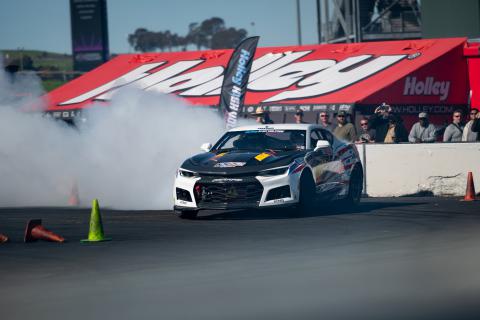
Holley began as a carmaker 120 years ago and then turned to supplying carburetors for OEMs before expanding into a leading provider of high-performance automotive aftermarket products for car and truck enthusiasts. The company’s enthusiast-focused events, including LS Fest, are celebrations of high-octane fun. This July 9–10 at Sonoma Raceway in Sonoma, California, though, the only cars using fossil fuels will be in the parking lot. There will be, however, plenty of burning rubber.
The second annual Holley High Voltage Experience presented by eBay Motors is designed to build a community linking EV enthusiasts to each other and the performance aftermarket and OEMs, according to Holley events manager Blane Burnett.
“While the EV population is still relatively small in the United States, they’re quickly becoming more common and many enthusiasts have taken notice of their performance,” Burnett said. “That’s evidenced by the volume of interest we’re seeing through both Holley and our AEM EV brands.”
The 2021 High Voltage event had great participation in its inaugural year and Burnett looks forward to growing the event for 2022. Burnett explained that Holley designed the High Voltage Experience around three main audiences: 1) owners of production EVs who want to do some track driving, participate in the car show, or meet like-minded enthusiasts; 2) tuners who are modifying EVs for higher performance or improved appearance, and 3) enthusiasts who are converting classic or modern ICE vehicles to EV powertrains.
The 2022 event will again offer car show classes, road course track lapping, autocross, drag racing, and more. Burnett said the event is also structured to attract aftermarket brands that are entering the EV field. The vendor midway features manufacturers, tuners, and OEMs. Last year the event saw participation from Ford Performance, Tesla, Simpson Racing, Summit Racing Equipment, Lingenfelter Performance Engineering, and others.
Grassroots Builders
Just as Holley components have long been used for engine swaps, the company sees business potential in the EV swap trend. The event will showcase EV conversions built using components from a variety of Holley’s brands, including the “Salvage to Savage” C10 pickup truck and a DeLorean that attended the 2021 High Voltage event.
“We’ll also have ‘Teslonda,’” a 1980s Honda Accord EV conversion using a Tesla engine with the stance of a 1960s era gasser, “as well as a Tesla-powered Porsche 935 from Bisimoto Engineering,” Burnett said.
Through its Rekudo brand, Holley offers suspension products and custom steering wheels for Tesla vehicles. Events like this, Burnett explained, help build awareness.
“A lot of people in the EV world weren’t as familiar with Holley before our first High Voltage Experience,” he said. “High Voltage changed that for us. Events build a sense of community that excites passion for performance. It’s a great opportunity for us to get to know each other.”
Burnett told PRI that he sees no issues with Holley balancing its ICE and EV product lines. “We’re in the business of going fast and having fun in cars and trucks no matter what powertrain turns the tires,” he said. “We will continue to offer performance products for classic and late-model vehicles, whether they’re ICE or EV powered.”
The Holley High Voltage Experience offers an array of activities designed to showcase the performance potential of EVs. Road racing, autocross, and drag competition will be among the featured events. Photos courtesy of Holley.
A Retailer’s Perspective
Summit Racing Equipment in Tallmadge, Ohio, is going to the High Voltage Experience with a bullish view on the emerging EV performance market, according to Alan Rebescher of Summit.
“It’s about being where EV enthusiasts are,” he said. The retailer is walking the walk, too, by entering its own Tesla Model 3 Dual Motor test and development vehicle, “White Lightning,” in all of the event’s racing competitions.
“Racing our Tesla Model 3 gives us the opportunity to engage directly with racers and experience firsthand what it takes to compete with an EV,” Rebescher said. “We learn about how folks are getting more performance out of their vehicles, and what they want to see in terms of parts.”
Rebescher is particularly looking forward to seeing all the professional and DIY conversions. “Just like in the early days of hot rodding, it’s the tinkerers and backyard inventors who are moving things forward,” he explained. “If we can get tech-savvy enthusiasts to daydream about bigger electric motors, more powerful batteries, and enhanced control systems, the industry will continue to grow.”
He expects the younger enthusiasts that EVs attract to play a major role in the company’s plans. “We are in the beginning stages of EV performance,” he said. “Younger enthusiasts are interested and appreciate the tech but don’t yet have much experience with electric vehicles. It will take some time for EVs to become a bigger part of the vehicle mix and for people to be familiar with them.”
Rebescher sees traditional performance enthusiasts as another potential audience. He compared the emergence of EVs with other major changes in the category’s history, including the rapid transition from Ford flatheads to small block Chevys, and from carburetors to fuel injection.
“There was hesitation and a learning curve, but once people got familiar with the new technology and how much it improved performance, they embraced it,” he said.
As with previous ICE performance trends, Rebescher said the growth of the EV performance aftermarket will be driven by availability of cars and parts.
Participating vendors include Forgeline, which has embraced the EV segment. “The electric car market is probably the fastest-growing market, as EVs are getting more accepted,” reported a company source.
“As more electric vehicles show up on the used car market and in salvage yards, and enthusiasts get their hands on them, demand for performance parts will also grow, especially products that allow racers to unlock and modify their car’s powertrain,” he said.
Rebescher also pointed out that many traditional product types are applicable to EVs, including safety gear, tires, brakes, and suspension. He said he did not see balancing ICE and EV business as “either/or,” adding that the company treats EVs as it does any new market. “It’s simply a matter of adding new applications,” he said.
THE Manufacturer’s Perspective
While kilowatt-boosting mods are inevitable for the EV aftermarket, manufacturers of universal-type parts, such as wheels, have plenty of opportunity.
“We’re set for the EV market,” said Dave Schardt of Forgeline, Dayton, Ohio, one of the sponsors of the Holley High Voltage Experience. “The electric car market is probably the fastest growing market, as EVs are getting more accepted.”
Most customers right now, not surprisingly, are Tesla owners, and the reason is simply sheer volume. Tesla sold about 1 million vehicles worldwide in 2021, with around 352,000 estimated in the US, according to Cox Automotive. (Tesla does not break out US sales separately.)
Schardt confirmed for PRI that the company currently manufactures private-label wheels for a “very large” Tesla aftermarket distributor.
“I’ve seen people who weren’t car enthusiasts buy a Tesla and become car enthusiasts just because they love the car so much,” he said.
Schardt sees the Holley event as an opportunity to establish itself with EV owners at an early point in the market’s growth. “A lot of EV owners who were not necessarily car enthusiasts aren’t knowledgeable about wheel brands,” he observed. “They’re just learning who’s out there and what’s available and forming opinions on performance brands. It’s important to get in front of those people early.”
A Weighty Issue
Another reason to sponsor events such as Holley High Voltage Experience, Schardt explained, is to educate customers. “EVs are heavier, so the wheels require a higher load rating,” he stated. “Tesla owners typically want the lightest possible wheel they can get. There are a lot of light wheels out there, but many EV owners may not realize that, while some may fit their vehicle, they might not be load-rated for it. We try to educate them about that.”
While the EV aftermarket seems Tesla-focused today, Schardt sees it expanding soon as more performance-oriented EVs come on the market. “We’ve done some Audi e-trons. I think the new electric Hummer will be popular for aftermarket wheels, and so will the Tesla Cybertruck, when it comes out. It’s only going to grow.”
Quality products, outstanding customer service, and multi-tiered promotion have all contributed to this diversified shop’s success in the dirt late model market.
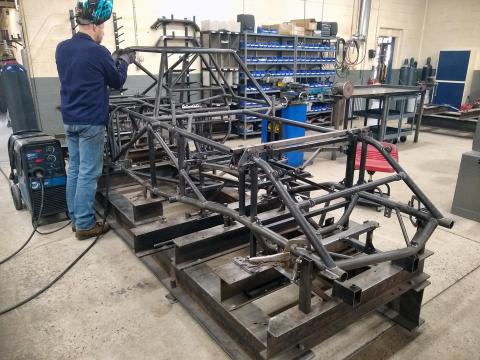
Diversify and specialize: Where some people would see opposing concepts, Jim Bernheisel sees a formula for success, an operating philosophy that has grown the parts franchise he opened in 1981 into today’s Bernheisel Race Cars, Inc., an industrial complex encompassing Bernheisel Race Components, Lazer Chassis, Focus Shock Technologies, and the newly expanded Precision Powder Coating—totaling 25,000 square feet on a three-acre campus in Jonestown, Pennsylvania.
Lazer builds both dirt late models and modifieds, but of the two, “dirt late models are our main focus, by a landslide,” said Bernheisel, representing “probably 90% of our chassis-building and fabrication, and 70% of our parts sales. We build 30 cars a year, which is bigger than a lot of people, and not as large as the mass producers. But I like knowing my customers, almost all of them on a first-name basis. Most of my customers have my cell phone number, and I answer every one of their emails.”
Bernheisel explained the synergy of his multiple operations: “The racing business has become very specialized. You have to know your field of expertise, your type of race car. Having those various companies under our umbrella allows us to diversify, without stepping away from what we’re good at doing. We build chassis. We also powder-coat them and powder-coat the parts that go on them. Our shock division builds the shocks that go on them. Through our parts division, we source what we believe to be the best parts for the job. So all our operations tie together, they all build sales for each other, and they allow us to tightly control how things are done. That suits us.”
What doesn’t suit Bernheisel doesn’t stand for long. He attributes at least part of his success to being “a little bit hard-headed. When things get tough, I just lower my head and run it into that brick wall one more time.”
That is, in fact, how Bernheisel started the company. He built his first race car in 1978, in Lebanon, Pennsylvania, using a CSC cage kit on a 1969 Chevelle frame. “I went to one of the most famous speed shops in the country, which will remain nameless, because I am not going to badmouth them. I wanted to buy some parts that I had seen in a magazine ad. They told me those parts were junk, that nobody wanted them. And I said, ‘Well, I want them, and there have to be other people who want them.’ So I went to a bank and borrowed enough money to buy a dealership. I sold zillions of those parts—and I was in the race car business.
“Then, about seven years later, I quit my regular job and said, ‘Well, we’re either going to do this or we’re not,’” he added.
Jim Bernheisel began his business as a performance-parts dealer in the late 1970s. His younger son Bryan now runs the fabrication shop and drives the company’s dirt late model, seen here. Older son Brandon is the team crew chief, and helps manage the overall business.
Growing Family, Growing Business
Later still, Bernheisel’s sons Brandon, born in 1983, and Bryan, born in 1985, joined the business. Bernheisel calls Brandon “the heir to the throne” and expects that one day he will head up the Bernheisel complex. “Just like me, he’s been crazy about racing since he was a little kid. He’s taking on more and more management responsibility,” while also designing new suspension components for production. As crew chief for Bernheisel Racing, Brandon sets up and maintains the family race cars.
Bryan, “who had to learn to like racing,” is now the team driver, when he isn’t running the fabrication shop. “I know everybody is proud of their kids,” said Bernheisel, “but Bryan is absolutely one of the most talented fabricators in the country and has a reputation as such.
“And I would be remiss if I did not mention Donna, my wife of 40 years, who has been a huge source of support and encouragement.”
Including Brandon and Bryan, Bernheisel employs 12 people. “I have a good group,” he said. “We like this to be a nice work environment. It has those pressure-packed moments, as any job does. But for the most part we think it’s a nice place to work. I treat my people well, I try to pay them well, and to make it worth their while to stay here for a long time.”
Finding those employees hasn’t always been easy. “It’s a challenge for any industry,” said Bernheisel, “especially this industry, because the skill sets are so specialized.” Any automotive experience is a plus. “For example, when we are looking for someone to work in the body shop, or even the powder-coat shop, we look for someone with an auto-body background. They tend to be able to do what we need them to do. And we teach them from there.” Similarly, “in parts and shipping, we look for someone who has an understanding of what’s going on in that world.” But always, “we look for people with good attitudes, who are going to fit in,” and who show “an enthusiasm for racing. One young man in our shipping department came to us fresh out of school, but he loved racing and was anxious to learn.”
Cultivating Customers
Bernheisel battered down another brick wall when popular opinion announced the death of brick-and-mortar stores. “They kept saying, ‘The world has changed. Everybody buys online. Stores don’t stock anything anymore.’ Well, we think that’s incorrect,” he explained. Online sales have their place, “but the racing business is still very specialized. People want to touch the product. They want to feel it. They want someone who can give them good advice when they are looking for the parts they need. So we house about $1 million in product in our store at all times, and we represent it well in our 5,000-square-foot showroom. We know what we are talking about. And we bend over backward to help a customer through a problem.
“We’re not trying to sell someone something they don’t want,” Bernheisel emphasized. “We are helping customers get the right product for the best value. Not every business appreciates that, but in the long run it’s the business philosophy that the customer appreciates.”
Similarly, Bernheisel’s approach to promotion is “multi-tiered,” encompassing both traditional and digital platforms. “We still do a fair amount of print advertising, and we still print a traditional catalog, which we hand out at shows. I’ve been going to trade shows since I started this business, and I still enjoy them, which is one of the reasons we’ve shown at PRI for many years. We try to keep our name in front of people wherever it’s appropriate.” That includes mall shows, and even speaking at school events. But because he categorizes himself as “old school,” Bernheisel leaves social media to Brandon and Bryan, “whether it’s Facebook or banner ads on various platforms.
“We go to the races, which is another way to put our name out there,” he continued. Bernheisel Racing fields two cars, driven by Jim and Bryan. “We have a two-seater that we can give rides in as well.”
Jim Bernheisel has found a size and niche that suits his business. “We build 30 cars a year, which is bigger than a lot of people, and not as large as the mass producers,” he said.
Even at the track, Bernheisel encounters another dichotomous, head-to-the-bricks situation. Ranging over eastern Pennsylvania, with forays into Maryland, New Jersey, the Virginias, and as far south as Charlotte, Bernheisel Racing runs against its own customers. “It’s a Catch-22,” Bernheisel lamented. “If our cars run good, people say, ‘You’re not going to give me the good information, because you’re running against me,’ which is ludicrous, because I’m in the racing business. We are the only manufacturer in the late-model industry to publish our set-ups online, for anybody to see.
“And then if my cars don’t run good, the same people say, ‘Why should I buy anything from him, when he can’t even beat me.’” Still others seem to doubt that one manufacturer can deliver build quality, customer service, and winning speed. “They must think, ‘Okay, what’s the catch?’ But it’s all part of the business, and we’ve learned to manage it the best we can.”
Bernheisel doesn’t bring a parts truck to the track. “The first year I was in business I tried it, and I realized that trying to do that and race is virtually impossible,” he explained. Instead, he makes sure that other companies’ parts trucks are well-stocked with Bernheisel components. “And we’re available at the track to answer our customers’ questions. If they need help, we will help them. Plus, we bring more than enough parts to repair our own cars. Our customers know that if they need something and we have it with us, it is available to them, also.”
Bernheisel knows he has customers who rely on his team for spares at the track. “So when we came out with a new car this year, we called them to let them know that some of the parts on the new car would no longer work for them.”
Track Champions
“It’s not only the equipment, but the knowledge that sets them apart,” commented Chad Homan, who has driven Lazer dirt late models to six track championships, in six years, at four different venues—his latest at New York’s Fulton Speedway in 2021. “They’ve been so good to me, not only telling me what they know works, but what they are experimenting with, and giving me the chance to try it.”
By 2016, Homan had raced for a quarter century, advancing from micro-sprints to pro stocks to big block modifieds. But he “was getting frustrated, going broke, and ready to try something different,” when he spotted a brand-new Lazer dirt late model up for auction at what was then the National Parts Peddler (now the Northeast Racing Products) Trade Show in Syracuse. “I talked with Jim Bernheisel at the show, and I ended up buying the auction car.
“And my first night out, I ended up getting lapped,” continued Homan. “The car just wasn’t where I wanted it. So I called Jim and told him what was going on. And he said, ‘Do this, do this.’ He suggested three or four changes. And I went out the next week and won.”
Dirt late models, like that of driver Royce Bray, represent roughly 90% of Lazer’s fabrication work and 70% of its parts sales. In addition, the company also offers dirt modified chassis and components.
In fact, Homan won “a bunch of races” over the next two years. “Then we went to the Steel City Stampede at Lernerville, and just got absolutely smoked.” This time he spoke to Brandon Bernheisel. “Regionally, we’re good,” Homan added. “But we’re not up to the RUSH tour level yet. And Brandon said, ‘We didn’t want to mess with your program because you’ve been winning so much—but we’ve been waiting for you to say this.’ They had a whole new shock package for me, ready to go. They completely changed out what I was doing. They updated my car with what they had learned in the prior two years. And we won eight or nine races that year at Outlaw Speedway in Dundee.”
Bernheisel has also helped Homan set up for different track surfaces, as he “bounces around” from Fulton to Genesee to Woodhull; to Skyline in Ohio and across the Canadian border to Humberstone. Beginning last year Homan has campaigned two cars—his third and fourth Lazer chassis—continuing to run a RUSH 604 crate motor in one, while exploring the Super Late Model division with the other. “In 10 years running big block modifieds,” Homan concluded, “I won three races. But in six years with Lazer I’ve won 175. They have completely turned my career around.”
Seven hours south of Fulton, Scott Sweeney Jr. clinched the 2021 track championship at Virginia’s Winchester Speedway, driving a 10-year-old Lazer dirt late model. “I really liked that car a lot,” Sweeney reported. “I wouldn’t say the car I had before it was a bad car, but the Lazer handled a lot better. It didn’t need as much input from the driver to initiate a turn. I was so impressed with how it entered the corner, and how stable it was. I was able to hang in the top five, or even in the top three, every night, against a lot of new cars. The way the Lazer performed was just awesome.”
Sweeney bought the 2012 Lazer in 2019 from his father, himself a racer for 38 years. Scott Sweeney Sr. “was so impressed with how [the Lazer] drove that he went out and bought a brand-new one.”
We spoke with the younger Sweeney in mid-April, the day after his first night in his own brand-new 2022 Lazer. “I was super happy with how that car come out of the box and ran like my old one, only better. I started ninth and was up to fifth” when his thermostat sprang a leak. “It’s a really high-quality car,” he added. “The welders and the chassis builders at Bernheisel are awesome.”
Sweeney was impressed with the buying experience as well. “When you go up there and look at a chassis, you get a one-on-one experience. Jim will talk to you about anything you want to know. Whenever I’ve called since, he’s been the same way. I bought my new car as a bare chassis and had to assemble it on my own. I asked a lot of questions, and he didn’t have any problem helping me through it. I had an issue trying to figure out some of the bracketry on the rearend, and Jim said, ‘Here’s my personal number; shoot me some pictures or a video, and we’ll get you squared away.’ A lot of places won’t do that for you.
“While other cars are more expensive, I really don’t think you can buy anything better,” Sweeney added. “Hopefully, 10 years from now I might still be winning track championships with it.”
Over the last four decades, Bernheisel’s business has grown from a spare-time parts dealership to a multifaceted racing company, encompassing Bernheisel Race Components, Lazer Chassis, Focus Shock Technologies, and Precision Powder Coating.
Building Better, Buying Smarter
For all of Bernheisel’s diversification, the company can’t manufacture every component that goes into its cars. So we wondered how Bernheisel decides what to build onsite and what to buy from outside. “It’s a matter of knowing your strengths,” he explained, and making the things you’re good at making. Even then, there are exceptions. “We are really good at fabricating steel parts, and if it’s a part for one of our cars, we know how many we are going to need. But there are pieces we are capable of making, but if we can’t sell enough volume, then we purchase them from someone else.”
How Bernheisel chooses his suppliers “has morphed over the years. When I started this business, manufacturers gave retailers protected territories. That allowed us to grow without getting trounced by bigger competitors. Now it’s all about buying power, and how much money you want to spend. We’re strong enough now that that doesn’t matter to us. So when we choose a supplier, it’s based on a number of factors.” Reputation is a big one, with multiple facets. “Are they someone we are going to like dealing with? Are they someone we want to be associated with? And is their reputation going to create demand for their products? We do business with some suppliers simply because customers have called us and requested their products. We do a ton of business with another company because my son went to pick out something for himself at the PRI Show, and we both liked it so much we became one of their biggest distributors. Or a company may simply have a product that meets a need we haven’t met.”
In every case, however, Bernheisel looks for a fair price and a reliable supply. “We’re not concerned with being the cheapest, but the price has to be reasonable and palatable,” he explained. “Then we have to be able to actually get the product, because the best products that you can’t get do you no good.”
The Unconventional Path
Unlike his sons, Jim Bernheisel was not born into a racing family. But he has “been in love with racing as long as I can remember. I was the first person in my family to own a business or have a race car, and I’ve been very fortunate. I didn’t know what I didn’t know, which was probably a blessing from the Lord, because if I did know, I probably wouldn’t have done this. But I learned the hard way. Sometimes it was from being a little hard-headed, rather than taking the conventional path. Sometimes that would have been easier and smarter. But other times we found different ways to do things, just by exploring things on our own.”
Bernheisel said he had to learn about “buying and selling, dealing with banks, dealing with lawyers and insurance. There’s nuance to all of that, and I didn’t have anybody to teach me. So I tried to align myself with people who were honest and forthright, and I soaked in everything I could learn from them.”
Cash flow often presented a challenge, and sometimes Bernheisel took risks to grow the company. “I’m a pretty nice guy with a good reputation,” he stated, “but if I want to pick up a new line, they still want me to pay for those parts.
“Another challenge has been learning how to lose customers. I used to get my feelings hurt and get kind of bitter about it, and I literally prayed to God to be better at it. Now, I still don’t like losing customers, and I wish everybody bought their race cars from me. But life’s not like that, and if you buy a race car somewhere else, that’s not going to affect my relationship with you. If you treated me fairly and honestly, I’m okay with whatever you do.
“I live in a very unique situation, in that I work with my sons every day; then I go racing with them on weekends; and then I go to church with them, and, remarkably, we get along pretty well. I am very blessed.”
As the head of Wisconsin’s High School Racing Association, this competitor is laser-focused on attracting high school-aged youth to
stock car racing—and hopes to one day reach a national audience.
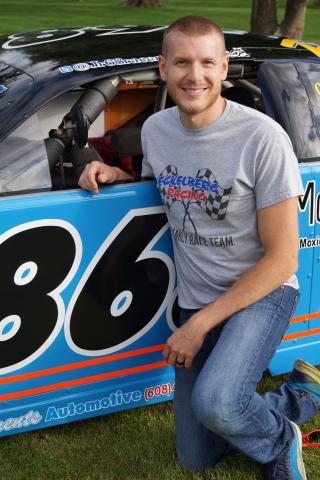
The High School Racing Association (HSRA) started in 2020 to give young adults an economical way to enter stock car racing. The organization recently hired Late Model racer Jonathan Eckelberg as director to expand its reach.
It seems like a “Why didn’t someone do this sooner?” idea. Started in Wisconsin, the HSRA enables high school-aged drivers to compete with pre-2005 American V6-powered sedans on dirt and asphalt oval tracks up to a quarter-mile long. Cars are modified only with safety equipment and display their high school’s colors and sports team mascot. The HSRA season runs June through September.
Chuck Deery and Gregg McKarns, promoters of La Crosse Fairgrounds Speedway in West Salem, Wisconsin, and Madison International Speedway in Oregon, Wisconsin, respectively, started the HSRA. Tomah-Sparta Speedway in Tomah, and Dells Raceway Park in Wisconsin Dells joined this year.
As HSRA’s newly appointed director, Jonathan Eckelberg comes with the experience of racing with the family team started by his father, which has been a staple at La Crosse for 35 years. Eckelberg spoke with PRI to share his plans for growing the HSRA to other tracks and states and increasing driver participation. He will also manage race schedules and points rankings.
PRI: Tell us how you got into racing.
Eckelberg: I grew up in auto racing at La Crosse Fairgrounds Speedway. My dad retired from driving a few years ago, and my sister and I have made our way through the divisions to the NASCAR Late Models. I have raced for 16 years, but 2022 will be our team’s final season.
PRI: What attracted you to the opportunity to lead HSRA?
Eckelberg: I grew up in the racing community and enjoy the extended family I have gained. I want that for other young people who are interested. As I transition from being a racer, I’m thrilled at the opportunity to help build a sport from the ground up and attract young racers.
PRI: What qualities do you possess that you believe make you a good leader for this organization?
Eckelberg: Growing up in the sport and racing myself for years in multiple divisions equips me to help guide new racers and serve as a resource to all the tracks participating in HSRA. As we work to expand the HSRA to other tracks and more states, my planning skills and attention to detail come into play. I will also produce photo, video, and TV shoots and manage social media for HSRA.
PRI: What are you most looking forward to in this new role?
Eckelberg: I’m excited to be connecting and working with other race tracks. I’m also looking forward to watching this grow into something big and impactful.
PRI: What are your goals at the HSRA?
Eckelberg: My immediate goals include expanding HSRA in the Midwest. We’ve already added one new track for 2022, Dells Raceway Park in Wisconsin Dells, and are hoping to add more in Wisconsin and other states. I would love for HSRA to be nationwide. In addition, we want to increase the number of drivers at each HSRA-sanctioned track. We recently had our first school district make auto racing a letter sport at the high school. This was a huge leap forward for HSRA!
PRI: How is HSRA reaching out to youth?
Eckelberg: We’re getting in front of students and their families through high schools regionally based around participating tracks. I make contact both with the athletic director and with any technical education or automotive program instructors. They’re helping to spread the word to students interested in automotive and racing, and about the opportunity to build a car and race it at the local track.
As students express interest, I’m connecting them with veteran racers who can serve as mentors and help them understand the inner workings of their cars and what to expect on race night. In addition, I immediately began working on social media growth to get HSRA in front of students.
PRI: What programs do you offer to generate interest in motorsports?
Eckelberg: Right now, the focus has been on adding tracks and increasing driver counts at the established tracks. Developing HSRA educational materials and programs is certainly a long-term goal.
PRI: How do you think this industry can better serve the youth motorsports market?
Eckelberg: The biggest barrier to entry is cost. The motorsports industry is expensive, and the investment to get started is what deters so many. To make it easier for high school students to enter the sport, we’re doing what we can to provide cost savings, including for safety equipment, gas, and food on race nights.
HSRA racers are not paid a monetary purse. If we pay student athletes, we run the risk of them being ineligible for other sports per the NCAA and state athletic association regulations. Since they are unpaid racers, their $25 annual HSRA membership gets them greatly reduced admission fees to enter the tracks and pits.
PRI: What is one trait that you admire in others, and why?
Eckelberg: I admire people who can focus on one thing at a time.
PRI: Excluding your cellphone/tablet/computer, what’s one thing you can’t live without? Why?
Eckelberg: Can koozies. Who wants cold hands? I’ve got one stuck everywhere and usually have at least one in my pocket.
Jonathan Eckelberg
Title:
Director
Organization:
High School Racing Association
Hometown:
Morrisonville, Wisconsin
Fast Fact:
Jonathan Eckelberg co-hosts a podcast “by beer lovers, for beer lovers” called “Pour Another Round.” It features interviews with brewery owners about their businesses and brews. His favorite beer is Milwaukee’s own Pabst Blue Ribbon, which sponsors the family race team.
Lamborghini Squadra Corse, the motorsports department for Lamborghini, has announced its first LMDh prototype will debut in 2024 in the FIA World Endurance Championship (Hypercar class) and the IMSA WeatherTech SportsCar Championship (GTP class).
The commitment allows Lamborghini to compete for victories at some of the world’s most prestigious endurance races, such as the 24 Hours of Le Mans, 24 Hours at Daytona, and 12 Hours of Sebring.
“This step up into the highest echelon of sports car racing marks an important milestone for our company,” said Stephan Winkelmann, the Chairman and CEO of Lamborghini, which announced plans to fully transition to hybrid technology by the end of 2024.
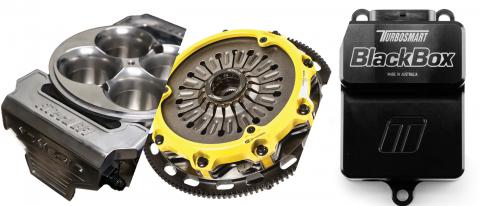
High-powered, all-wheel-drive cars like the Mitsubishi Evo and Subaru STI will probably eat up the stock clutch in short order when racing at the drag strip or road course. Swapping in a new Mod-Twin 225 HD kit from Advanced Clutch Technology in Lancaster, California, can help prevent any setbacks before they occur.
“Turbo four-cylinder engines have a lot of torsional vibration and are notorious for being hard on clutches, specifically stripping out the splines in the hubs,” said Richard Barsamian. “We created a clutch that is completely modular, and both friction plates mount to one mono-drive hub.”
The clutch achieves a high torque capacity of 700 lbs.-ft. by combining a double dose of organic friction surfaces with a spring-center mono-drive hub. Each of the diaphragm springs is put through a four-stage, heat-treat process. The result is a light pedal effort and a soft, progressive engagement.
“We have had requests for years from racers to develop a kit like this. The number-one challenge was finding a way to engineer a spring-centered hub because racers were blowing through discs,” said Barsamian. “With the modular design, you don’t have to buy another clutch. Simply change out the discs or mono-drive hub and you can go from a street to race setup or vice versa.” —Mike Magda
Bolt-on, self-tuning electronic fuel injection is now available for big engines making up to 1,600 horsepower. The Nemesis 4500 features a 4500 footprint so that it can be easily swapped onto intake manifolds designed for Dominator-style carburetors.
“FiTech offers racers an easier tuning interface to manage the complexity of a high-feature EFI system,” said Jeremy Schmidt of the Riverside, California-based company. “The Nemesis’ huge throttle blades, accompanying airflow, and up to 12 injectors will allow maximum power, while the parabolic ramps on the throttle bores gain a lot of low-throttle drivability. Dual throttle-position sensors and progressive linkage takes drivability to another level of control.”
The Nemesis is constructed from CNC-machined billet aluminum. The hidden injectors fire into annular discharge rings that can be changed for different spray patterns and other performance adjustments. The kit includes the throttle body, ECU, wiring harness, sensors, and handheld tuner.
The ECU works off speed-density metering and is mounted remotely to avoid engine or ignition electrical noise. The system can be programed to work with gas, E85, and other race fuels. In addition to dual TPS, the system comes with dual IAC motors, the latter being helpful for tuning large-displacement engines that require additional airflow. —Mike Magda
Race Star Industries in Kearney, Missouri, already offered a 16x18-inch wheel in its popular 63 Pro Forged line, but Outlaw street racer Kye Kelley was seeking a very large footprint for better power transfer to the racing surface.
“He knew Race Star was the only company in the market today to make a one-piece configuration,” said LB Davis, noting that wheel designer Mike Kent made the necessary tooling adjustments so the company could manufacture the wider wheel. “We know run-out is important in large wheels. At Race Star, our tolerance requirements are less than .004-inch run-out, which is among the best in the industry. Everyone else in this larger wheel market makes a multi-piece wheel, which has a much harder time reaching that spec as well as being as lightweight as a Race Star wheel.”
The introduction of the 16x19- and 16x20-inch wheels complements Race Star’s existing 16x16- and 16x18-inch wheels in the wide-tire category.
“It gives the big-tire racer a one-stop shop for the wheels he needs to make his car hook up correctly,” said Davis, noting that the wheel meets SFI 15.3 standards. “The largest benefit to this wheel is the flat footprint it allows the tire to have on a no-prep surface. This definitely gives you the advantage over the smaller width, large-tire wheels on the street today.” —Mike Magda
Following the release of electronic wastegates by Turbosmart in Ontario, California, customers started asking for help controlling them. The concept was definitely new to the aftermarket, and only a few dedicated ECU manufacturers developed their own native control strategies.
“We took matters into our own hands and worked closely with some of our industry partners to develop the BlackBox to bring electronic wastegate functionality to the broader market,” explained Joshua Burney. “Now, anyone with nearly any ECU can control our electronic wastegates.”
The BlackBox is a dual-channel, high-current-capable H-bridge driver that works with any of the Turbosmart electronic external wastegates. It’s capable of multiple strategies and will accept PWM inputs as traditional boost-control solenoids. The BlackBox is pre-configured with the flow vs. lift calibration data of all Turbosmart electronic wastegates, and settings can be adjusted via a simple USB connection and PC-based application.
“Feedback from our customers was the primary motivator in developing the BlackBox,” added Burney. “For several decades, pneumatic-style wastegates have been the norm in the industry. Our electronic wastegates have been years in the making with thousands of hours of development and testing. With their introduction came the need for an equally advanced dual H-bridge driver to control it properly.” —Mike Magda
With more interest in the Gen III Hemi engine platform, performance engine builds are requiring a consistent and generous oil supply. The new high-volume Hemi oil pump from Melling in Jackson, Michigan, produces 20% higher volume than stock on 5.7- and 6.1-liter engines found in a variety of Dodge, Chrysler, and Jeep production vehicles.
“The Chrysler Hemi engines tend to have some valvetrain issues that can, in some cases, be significantly reduced with added oil flow/pressure,” said Cale Risinger.
Basically, the engine has an intricate oil path from the rocker-arm shafts, through the rocker arms, down through the pushrods to finally lubricate the lifters.
“All of these essentially slip fit connections can create the perfect storm for oil-pressure-robbing internal oil leaks,” Risinger explained. “Adding the additional volume that the HV pump supplies can greatly
help to overcome these types of issues.”
The pump comes with the high-pressure spring installed, and a stock pressure spring is included. Made from a cast aluminum housing, the pump has an anodized hard-coated body and cover. Other features include a threaded pressure-relief nut, standard bolt-on screen, and an exclusive rotor set.
“The primary benefit would be the added oil volume needed in many performance engine builds. Adding things such as a remote oil filter, oil coolers, and oil-cooled power adders would all be good reasons to install a high-volume pump,” concluded Risinger. —Mike Magda
The SR21 brake pads from EBC Brakes in Las Vegas, Nevada, are constructed from sintered materials specially formulated for racing applications.
“There were many teams we worked with to develop SR,” explained Preston Lapping, “from club racing in SCCA/NASA—such as GT, Trans-Am and American Iron—all the way up to the demanding IMSA GT vehicles. There are even a few sponsored series in the UK that now have SR as the homologated brake pad.”
The pad materials feature stable friction-coefficient temperatures up to 1,700 degrees F, which is suitable for endurance and sprint racing. Another significant benefit is that zero bed-in is required.
“Racers can spend their time collecting data or just enjoying their HPDE activities instead of trying to get their brakes to settle in,” added Lapping.
He said testing has shown improved wear life for the brake system as a whole. The brake pads don’t exhibit the typical negative side effects of sintered materials being hard on the rotors. Also, strong pad bite is observed through a wide operating range.
“There is no need to stay conservative after caution, which can be a huge advantage in the chaotic Turn One restart,” continued Lapping. “The pad works for the HPDE driver operating at 400 degrees C/750 degrees F rotor temps as it also does the 800 degrees C/1,500 degrees F IMSA guys. Also, the pad release and subsequent modulation is excellent and has been echoed in every vehicle test we have performed. This means great trail braking and predictable weight transfer.” —Mike Magda
Titanium retainers from Tick Performance in Mount Airy, North Carolina, are now 1.5 grams lighter than its previous model. Each retainer weighs 8.2 grams.
“A competitor reached out and claimed our retainers were similar in appearance to theirs. Rather than get into a battle over looks, we took the opportunity to design something better,” said Jonathan Atkins. “Engineer Matt Goins had a good idea, and we ran with it.”
The new two-step design reduced weight from a three-step configuration. Dual springs now locate on the retainer and locator/seat at the bottom. The same design was also carried over to the H13 tool-steel model, making it 2.2 grams lighter than the previous edition.
“Matt designed the retainer and locators on Autodesk software and then went to 3V Performance in Denver, North Carolina, for Spintron testing,” added Atkins. “They performed high-rpm endurance testing and multiple simulations of a car shifting and driving. They also performed endurance testing at a lower rpm, around 4,000 rpm, which puts more load on the retainer and is more like a street-driven car.”
The retainers are manufactured in-house from 6AL4V titanium and fit most 1.270- to 1.300-inch dual springs. The outer step is .925 inches, and the inner step is .670 inches. They also fit PAC 1206x and 1208x springs. —Mike Magda
 MEMBERSHIP LOGIN