Power Pushers

Submitted by jeffreyc on Thu, 09/15/2022 - 15:24


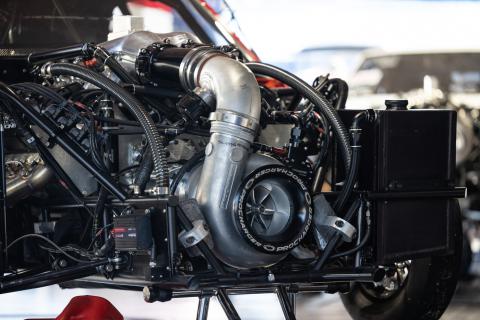
With recent advancements in design and production, superchargers are more capable and efficient than ever before. And while that’s allowed the horsepower potential to reach new heights, maximum output isn’t always the primary target.

Blowers have been an object of desire for speed freaks since the dawn of hot rodding, and roughly a century after the first supercharged automobiles started competing in organized motorsports, they’re still sought-after commodities today. It’s no secret that forced induction is the key to big horsepower numbers, and today’s supercharger designs offer capability that eclipses what was possible even just a few years ago. 

“Right now, our largest impeller is 131 mm, and no one has maxed out the capability of that unit yet,” said Brian Cox of Vortech Engineering, Oxnard, California. “We’ve seen a few racers making as much as 3,600 horsepower at the wheels with it. But we know that they’ll find the ceiling soon enough, so we’re already working on the next iteration.”

These strides in supercharger performance come from a variety of different improvements in design, construction, and production, but each manufacturer has its own strategy for success. We spoke with some of the companies that are driving innovation in the segment to get a better sense of how they’re pushing the performance envelope today, and what they have planned for the future.

ProCharger

While improvements in simulation software have helped ProCharger of Lenexa, Kansas, in some aspects of design, Erik Radzins told us that data collection has been the real key to design improvements in recent years. “The computer programs help to point you in the right direction, so that saves some time, and it allows us to determine if a theoretical design is feasible—whether our machines can produce it or if they’re going to smash the bit halfway through the run,” he said. “But at the end of the day it’s real-world testing, working with engine builders, and sharing data that has really made the difference. Ten years ago, data sharing between companies was virtually non-existent. But these days everyone really wants to push the sport of drag racing forward, and the engine builders have realized that we’re not going to start building engines.”

Radzins said that most of ProCharger’s motorsports-spec blowers are designed independently from those intended for street applications and are largely built around sanctioning bodies’ class rule sets. That allows ProCharger to focus on refining specific elements of the blower to give racers the capability that they’re looking for. “We took a clean-sheet approach when designing the gearbox for the Pro Mod blower, the F4X,” he explained. “That blower makes so much horsepower, and those guys are running them so often that they needed a really, really durable gearbox.”

1
ProCharger has improved its machining tolerances in recent years, according to Erik Radzins, who explained, “Each race blower gets fully inspected by a coordinate measuring machine before it goes out the door, and if it doesn’t meet our production standards, it gets tossed in the trash.”

ProCharger’s Cliff Hall explained that, in the realm of motorsports, peak performance and durability tend to go hand-in-hand. “When someone comes to us and asks us to build a blower capable of more than 3,500 horsepower, it makes us go back to the design board on the gearbox side of things.”

A few years ago, ProCharger also introduced the CrankDrive gear-drive system for all of its F-series superchargers. “We took the same concepts we were using with our gearbox technology and applied that to the CrankDrive,” said Radzins. “When we went to design it, we listened to what the racers and the engine builders wanted out of it. The idea was to provide these racers with a better solution for a gear-drive system. They didn’t have to call anybody else, worry about delays or problems with someone else’s manufacturing tolerances, etc. They could just get the entire supercharger system that we designed and built as a holistic solution.”

Radzins said the company has also improved its machining tolerances in recent years. “Each race blower gets fully inspected by a coordinate measuring machine before it goes out the door, and if it doesn’t meet our production standards, it gets tossed in the trash.”

2
While CAD and simulation software has helped with the design of ProCharger’s superchargers, “at the end of the day it’s real-world testing, working with engine builders, and sharing data that has really made the difference,” said Erik Radzins. “These days everyone really wants to push the sport of drag racing forward.”

Part of the improvement comes from these strict quality assurance measures, but Radzins noted that the machining process itself has changed as well. “With a lot of our race products, the two halves of the blower case are made next to each other on the same machine on the same run, then they’re assembled and re-machined as a torqued assembly to ensure that everything is aligned perfectly.”

Going forward, Radzins said that ProCharger’s current focus is on fine-tuning and filling in the power level gaps where they exist in the company’s product portfolio rather than focusing on making as much horsepower as possible. “Nobody is calling us asking for 500 more horsepower at this stage, so there really isn’t a need for a bigger blower right now,” he explained. “A lot of folks realize that they don’t need 5,000 horsepower—especially in the no-prep scene. The track can’t hold it. Having a repeatable, durable, deadly consistent combination is more important.”

Whipple Superchargers

As automakers continue to dish out increasingly robust engine combinations and drivetrain components, the line between street and race applications is blurrier than ever. Those improvements at the OE level have allowed Whipple Superchargers in Fresno, California, to focus on making more power with less boost, an effort that Dustin Whipple said has been significantly aided by simulation software. 

“The use of computational fluid dynamics (CFD) modeling has really helped things advance at a much faster rate than ever before,” Whipple explained. “Before CFD, making superchargers and testing them for different applications took forever, and it was extremely expensive. With the simulation work we do now, we can run multiple versions of a design idea simultaneously and determine which of those should move on to the prototyping phase. That was a significant shift in our approach to design, and it allowed us to take paths that we hadn’t taken before.”

Whipple’s earlier development efforts saw the manufacturer adapting products initially designed for street applications for use in motorsports, a strategy that was due in part to some of the race classes that the company was involved with at the time. These days it’s the other way around. 

3
“Development never really stops,” said Dustin Whipple of Whipple Superchargers. “We’re constantly investigating new ideas and testing new things that can make the product better. The use of computational fluid dynamics modeling has really helped things advance at a much faster rate than ever before.”

“The great thing about the racing side right now is that it’s going into uncharted territory,” Whipple said. “The Gen 5 was where we moved in a new direction, and now we have the Gen 5x, which was developed based around what we learned in competition. And then there’s the Gen 6 that’s on the way, which is also derived from the racing side.” 

That motorsports-based development approach allowed Whipple to find ways to improve efficiencies across the board. “Compared to where we were five or seven years ago, we’re making more power with smaller superchargers,” Whipple said. “Back then we couldn’t spin the compressor at the levels we’re using today—efficiency fell off and the temperatures went off the charts. Back then we might’ve been able to reach some of the performance metrics we’re at today, but we would have had to make some sacrifices to get there. It is sort of like a turbo application: If you wanted to chase one part of the curve, you had to give up everything else. That’s not the case anymore. We don’t have to give up power down low to make power at the top.”

The aforementioned CFD work has played an important role in component design for Whipple as well. “Matching components in the inlet system, the discharge system, and the intercooler is definitely far more important now than ever before,” he said. “As the compressor flow went up, we had to make sure that the rest of the system was capable of handling that higher volume. And what works well for one application might not be ideal for another.” 

While the Gen 5 unit introduced a brand new rotor design, and the Gen 5x ushered in new shaft and inlet designs—along with some changes to the intercooler and a number of smaller refinements—the Gen 6 showcases the next iteration of Whipple’s rotor design, which focuses on delivering more low-end torque as well as more power at the top end. “The gains are very noticeable, especially as the boost levels go up,” Whipple added. “Development never really stops. We’re constantly investigating new ideas and testing new things that can make the product better.” 

fp1

fp2

Vortech Engineering

When it comes to developing superchargers for motorsports use, manufacturers are always on the lookout for upcoming rule set changes. When a sanctioning body decides to make a tweak, it sends companies like Vortech back to the design lab to see how they can meet that new criteria while providing competitors with the most capable design possible. 

“We might have a blower out there with, say, a 123-mm inducer, and it’ll make a ton of power, but a sanctioning body might decide that they want to slow the class down,” said Cox. “They usually do that by changing the inducer size to limit the power that the blower can make. When that happens, you’re actually putting the blower in a bad spot—it’s really the wrong way to slow things down. But the motor’s already built, and a racer might have a hundred grand in that motor already. They’re looking for another, less costly way to slow it down, so we have to design around those circumstances. It’s something that supercharger companies spend a lot of time chasing.” 

4
Computer software and simulations are critical elements of the design process at Vortech Engineering, said Brian Cox. “The software allows us to design for a boost number, or a pressure ratio, or a pound-per-minute measurement of how much air it needs to move. It allows us to design around the specifics of an engine combination.”

It’s another situation where software has become a crucial component of the design process, a tool that now allows Vortech to run extensive simulations and vet a number of potential solutions before the company ever builds any physical parts. “There are certain aspects of an impeller that you want to focus on—the rpm where it creates power, the efficiency of it, things like that,” he said. “All of that can now be calculated before a part is built.” 

That, in turn, has helped to push supercharger design into truly purpose-built territory. 

“For instance, we were working with a Pro Mod driver, and we were using our largest supercharger—the 131—but his motor was actually too large for it,” Cox recalled. “It was putting the blower in a bad spot, so we went back and made changes to the impeller to dial that system in for his combination. The software allows us to design for a boost number, or a pressure ratio, or a pound-per-minute measurement of how much air it needs to move. It allows us to design around the specifics of an engine combination.”

After finding the limits of conventional materials like 6061 and 7075 aluminum, the company also decided to move to a proprietary forging process to manufacture its impellers in order to address the high loads and temperatures they’re subjected to. Meanwhile, Vortech’s modular gear case design has allowed racers to alter the configuration in order to, for instance, make changes as needed based on two different sanctioning body rule sets. 

Although the company is actively considering what competitors will be looking for down the road, Cox said that predicting exactly what form that will take can be tricky. “We’re making a ton of power now, but we have to anticipate what the next step for this racer is going to be. We’re doing that R&D now—the design stuff is on the table. But any time you make things larger you’re adding mass, so if you make a larger impeller, you lose the stiffness of the shaft and add extra loads when it’s spinning that fast. A lot of things need to be re-designed to make it work. So saying, ‘Yes, we do need a 150-mm inducer blower for the guy who needs 4,000 or 5,000 horsepower’ is a leap of faith, to a degree.”

Magnuson Superchargers

Racers are always on the lookout for the latest and greatest—the “best” option available. But in the realm of motorsports, that can be a moving target. “The reality is that every supercharger manufacturer has a criteria that they’re trying to achieve,” said Kim Pendergast of Magnuson Superchargers, Ventura, California. “Are you designing for quarter-mile drag racing, or an endurance format? Do you need torque, or do you need horsepower? Are you willing to risk a failure to get every last ounce of performance out of it? It all really comes down to what you’re trying to do with the supercharger.”

Over the past few years, Magnuson has sharpened its focus on its testing methods in order to find the balance between competitive performance and rock-solid reliability. “There are some customers who don’t really care about reliability—they just want power,” Pendergast said. “Sometimes that’s our blower, sometimes it’s not. Making a single supercharger with a lot more power is not very interesting to us. What is interesting to us is being able to replicate performance consistently. That’s hard to do at a price point that more than two people out there can afford.”

5
Over the past few years, Magnuson Superchargers has put a greater emphasis on in-house testing to find the balance between all-out performance and reliability, said Kim Pendergast. Once the supercharger passes those tests, it goes out to engine builders for additional feedback from their customers at the track. 

To help facilitate those efforts, Magnuson brought in testing equipment from Arrington Engines, a company that was building powerplants for NASCAR when Pendergast was at the helm. The idea was to find any potential weak links in the system, address them, and continue running the testing processes until the design was bulletproof. 

“Bringing over the airflow bench allowed us to optimize parts, but optimizing a part doesn’t necessarily optimize it for the whole system,” she said. “The next step was to run the system with the intercooler cores on a supercharger test stand. To really properly test something like the TVS2650 it required a larger test stand, so we just finished building one to handle the higher horsepower. From there the system goes to an engine stand before it gets installed in a vehicle.” Once a design has been given the nod, Magnuson puts that system through the ringer by handing it over to engine manufacturers that are supplying racers in order to get additional feedback from the race track. 

Pendergast likens Magnuson’s old design approach to a Lego set—a modular solution that allowed one template to be easily adapted to a number of different vehicles. These days it’s more about an integrated design that tailors the system more specifically to the requirements of the platform. “Some of it is because of packaging, but it also just allows you to produce a better system overall. It gives you more flexibility to achieve the targets that are set for a given application.” 

Changes in the company’s design philosophy also led Magnuson to broaden its supplier network, a move that allowed it to implement a patented porting technique to squeeze more efficiency out of its systems. 

Looking ahead, Pendergast said that folks should expect to see a stronger presence from Magnuson in the Mopar world over the next few years, along with larger supercharger options aimed at the high end of the market.

Sources

Magnuson Superchargers
magnusonsuperchargers.com

ProCharger
procharger.com

Vortech Engineering
vortechsuperchargers.com

Whipple Superchargers
whipplesuperchargers.com
October 2022
By
Bradley Iger

Business Profile: ENTROPY RACING

Submitted by jeffreyc on Thu, 09/15/2022 - 14:44


Using safer batteries and off-the-shelf parts—and defying nearly every assumption about electric vehicles—this team is “plugging in and kicking gas” on internal combustion’s home turf while demonstrating a viable alternative for grassroots road racing.

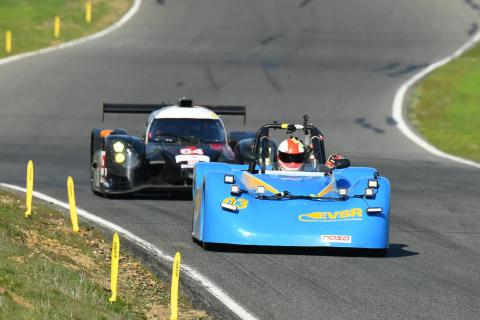
About 40 minutes into the annual 25 Hours of Thunderhill, a sleek blue sports racer glides into pit lane, its unruffled silence signaling its electric power. As five crew members jack the chassis and lift the one-piece body, two others slide bright yellow dollies under the spent battery packs on either side of the cage. At 40 seconds, the old batteries have been disconnected and rolled away. New batteries are wheeled into place; the body is lowered and fastened, and at 1 minute 57 seconds the Entropy EVSR rejoins the race.

A full day and 35 pit-stop battery swaps later, Entropy Racing of Sacramento, Pennsylvania, has done what has never been done before: “Run a significant endurance race at pace,” beamed owner Charlie Greenhaus, “with live stops in pit lane to change batteries.” The team finished 29th out of 37 starters in last year’s endurance race, despite a half-hour layover caused by motor-cooling issues, which the team has since resolved.

2
Entropy Racing’s EVSR, an electric-powered sports racer based on a Sport Renault, successfully competed at the 25 Hours of Thunderhill in 2021, the first EV to “run a significant endurance race at pace, with live stops in pit lane to change batteries,” said Entropy’s Charlie Greenhaus.

It was a big accomplishment for a little company, one that Greenhaus described as “the very small end of small business.” Entropy Racing has never employed more than five people, and currently consists of Greenhaus, a mechanic, and a part-time marketing manager. Yet this tiny power pack has not only pioneered electric vehicles for endurance racing, but proven, absolutely, their viability in hill climbs, autocross, and shorter road-course events as well.

Keeping Things Together

A provider of racing services since 1989, Greenhaus chose the name Entropy because “it’s how everything falls apart and stops moving—and my job was to counteract that.” Road racing “was always our primary focus, with a large part of our business being racing rentals”—in the beginning mostly small imports—“transitioning into sports racers over the winter of 1996–1997.” That’s when SCCA discontinued the Sport Renault series, and Greenhaus “started buying them off the walls and out of the ditches.” By 2000, Entropy owned 16 Sport Renaults and promoted its own race series while continuing to campaign its own team. 

All that changed in 2013 when a customer requested a high-performance electric road car. Greenhaus ultimately vetoed the idea, “due to weight-vs.-range limitations at the performance level desired.” However, “upon further discussion, we decided to partner on an electric sports racer,” based on the readily available Sport Renault chassis.

3
While Entropy Racing has built three EVSRs and has two rollers in its Pennsylvania shop, owner Charlie Greenhaus hesitates to characterize the business as a manufacturer. “We’re more like a prototype developer.”

Off-the-shelf parts controlled costs, as did a very targeted approach to development. “We knew range and motor temperature were going to be our first big challenges,” Greenhaus explained, and so the team didn’t spend a lot on, say, the Renault’s existing brakes. “Of course, those priorities changed constantly as we solved one problem, only to find another.”

By mid-2015, Entropy had built three Electric Vehicle Sports Racers, or EVSRs. A second-generation model followed in 2020. Greenhaus described it as “evolutionary rather than revolutionary. It retains the same suspension as the Gen 1 car but has a redesigned safety cage that relocates the driver, as well as a completely redesigned body and”—most significantly—“a battery support structure that allows the rapid replacement of the battery packs.” At 1,850 pounds, it’s about 150 pounds lighter than the Gen 1 model. When we spoke in July, Entropy had built three examples, “and we have two more rollers in the shop.

“It would probably be a stretch to call us a manufacturer,” Greenhaus continued. “We’re more like a prototype developer. We have the platform and design to do a larger run, but we haven’t expanded to that level of production.”

Dissuading the Doubters

Beyond the small size of the Entropy enterprise, “the biggest challenge” to scaled-up production has been “hurdles with the sanctioning bodies: Who are you going to race with? Early in our development we ran into a lot of skeptics and some negative comments,” Greenhaus explained. “We had a client out on the West Coast whose region flat-out said, ‘No, we’re not interested. We won’t allow it. We don’t want any part of it.’”

Todd Reid is Entropy’s lead driver; he recalled a regional event in New Jersey where the other drivers were so convinced the EVSR would block traffic that, to appease them, he agreed to start at the back of the pack. “Out of 25 cars, I went from last to seventh,” he said. Reid qualified for position in the next two races and won both of them. “Then there was no more, ‘Boo-hoo, you’re going to hold us up. You better stay out of the way.’”

Gradually, the closed minds started to open. “In the beginning,” Greenhaus recalled, “we did a lot with the New Jersey Region of the SCCA, which was instrumental in obtaining national approval for safety and regional competition. In the last two years we’ve run a tremendous amount with the DC Region, which created the classes Electric Modified 1 and 2, depending on power output, and grouped the cars with Spec Racer Ford.” 

EVSRs have also competed in the DC Region’s Sprint Bracket Series, “which is structured somewhat like bracket drag racing: You hit your target time, or you get bumped to the next class.” Greenhaus himself drove an EVSR to the series championship in 2021, defeating 68 other cars, and the Entropy team was solidly in third place for the 2022 series at print time.

“We’ve also run with NASA Mid-Atlantic and Northeast, and obviously with NorCal for the 25 Hours, and with the New Hampshire Sports Car Club for the Mt. Washington Hillclimb,” Greenhaus continued. “We’ve run the Pikes Peak International Hill Climb twice. We’ve run hundreds of sprint races, and we have a 95%-plus finishing record. As we’ve finished more races—and won a good number against gas cars—we have become accepted as another car on the grid. That was always the mantra of our team: ‘a good race car that happens to be electric.’ These cars are not built for any specific surface, series, or venue. Unlike Formula E, we race against ICE cars on an even playing field, and we don’t make any changes to the course or race to do so.” 

Nuts and Volts

Greenhaus readily admits that Entropy did not invent the battery-swap concept. The idea dates back at least to 1968, when Battronic delivery vans (built in Boyertown, Pennsylvania) promised a battery exchange in five minutes. Greenhaus acknowledged a “24 Hours of Lemons” team that had modified a Nissan Leaf so that they could swap batteries in the paddock and be back on the track in 30 minutes. “I don’t discredit that effort within context, but that isn’t racing.”

Entropy configured its dual 350-pound battery packs using off-the-shelf lithium ferrous phosphate (LFP) cells. “They are safer and more stable than lithium-ion cells,” said Greenhaus, which can burn so hot on impact that most tracks “don’t have the fire-suppression equipment for them.” When overtaxed LFP cells did catch fire during testing, Greenhaus calmly extinguished the flames with less than three gallons of water.

4
Prior to competing in the 25 Hours of Thunderhill, the Entropy Racing team practiced their pit stops at Summit Point Motorsports Park, seen here. Hot-swapping the batteries during the race took about 2 minutes; now, the team has it down to 1:30–1:45. 

Furthermore, while LFP batteries weigh 30–40% more than equivalent lithium-ion units, they cost less, and do not require a battery management system. And their discharge characteristics are especially good for racing. “Your first lap will be your fastest, because they start at 3.2 to 3.3 volts and drop almost immediately to 3.0 volts; but then they stay at 3.0 volts until they are 80–85% discharged.” 

Each of the two battery packs on an EVSR consists of 25 cells and can deliver a maximum of 29 kWh, “or 25 or 26 at full chat,” Greenhaus added. Motors and controllers are cataloged items from EV West, albeit modified to improve cooling and “tweaked” in other ways Greenhaus would rather not share.

With batteries accounting for 700 of the EVSR’s 1,850 pounds, the car is “exceedingly well balanced. We can put the weight wherever we want, and we usually run about 53% rear weight bias. Also, with the batteries on either side of the car and just 3 inches off the ground, the roll center is low, and we get a lot of grip with our inside wheels.”

“The three heaviest components,” Reid added, “the batteries, the driver, and the motor,” are at or below hub level, with the batteries below the axles and outboard. “The first time I took an EVSR into a high-speed corner—turn 9–10 at Summit Point—I thought, ‘Damn, I could have gone faster.’ And the next time I went through, I thought, ‘Damn, I could have gone faster.’” When racing against ICE cars, “you just have to believe that you can go 5 mph faster, or 7 mph faster, and it’s going to stick.”

5
The EVSR uses off-the-shelf lithium ferrous phosphate (LFP) battery cells and motor controllers from EV West. The LFP batteries are heavier than lithium-ion but cost less, and a battery fire can be extinguished using water. 

Reid met Greenhaus some 30 years ago, when Entropy was providing trackside service for NASA Northeast. In 2011, Reid’s vintage Lotus 7 suffered a devastating rearend collision, so bad that Reid feared the car would need a new chassis. But Greenhaus cut and welded the damaged frame, and, afterward, Reid took the car to Summit Point and shaved half a second off of his best previous time.

Similarly, Steve Hanford met Greenhaus when his racing Miata needed mending: In the mid-1980s, Entropy sorted out a badly botched suspension installation, then rebuilt a blown engine, and has maintained Hanford’s race cars ever since.

Hanford described the EVSR as “a momentum car. The chassis is terrific. If you pedal hard and don’t hit the brakes a lot, you can keep up with much bigger, higher-horsepower cars.”

Even on a wet track, the EVSR remains exceptionally stable. “The power delivery is linear,” said Greenhaus. “There’s no shifting, so you don’t have those transitions and shock loads.” Furthermore, “rain makes cooling a non-issue.” 

Hanford sees another advantage in the EVSR’s relatively quiet operation. “You can definitely hear it, but it’s quieter than a gas car. You hear the tires more, you can hear them talk at the limit, in a way that you may or may not be able to hear in a gas-powered car. You are also more conscious of the cars around you: You can hear them accelerating and decelerating; you hear their tires reacting. So if you are trying to beat someone into a corner, you know if they are struggling or not.”

Reid added that the EVSR’s relative silence could be “a big deal” at tracks where the surrounding population has complained about noise.

Extending the Range

Since Thunderhill last year, Entropy has replaced its hydraulic jacks with faster-acting air jacks. The crew has gained experience, too, dropping battery change times down to 1:30, or 1:45 at most. “That’s faster than most cars can refuel,” noted Reid, reminding us that most amateur racing bans pressurized fuel feeds and NASCAR-style dump cans. “If you’re doing a driver change, it’s conceivable that the battery swap could be finished before you are done getting into the car, plugging in your helmet, closing all your belts, and putting on your arm restraints.”

Despite this, the need for more frequent pit stops still adds up to a net disadvantage. “When we ran enduros in gas-powered cars,” Hanford recalled, “our fuel window was about an hour to an hour and 15 minutes. In June, when we ran the EVSR in a 100-minute event at New Jersey Motorsports Park, we had three pit stops, so that’s 35 minutes, give-or-take. I finished sixth or seventh, and the guy right in front of me ran slower average lap times, but had fewer pit stops—and that gave him a couple more laps. We need a jump in battery technology to where we can run an hour, the same as a gas-powered car. That would make all the difference.”

6
“The future of motorsport is going to be more electric,” Entropy Racing’s Charlie Greenhaus predicted. “At hill climbs and drag races, EVs are already dominant.”

But Reid brought us right back to what Entropy has accomplished: “Nobody but nobody else is campaigning an electric endurance race car. No one else can run a 25-hour race without being given anything special—or without having two or three cars to cycle through. We are it.”

“We have the only viable EV in the world that has been run continuously, at a competitive pace, in an endurance race,” Greenhaus added. “There are some really good [electric] cars out there, and some really quick cars, but I haven’t heard of any of them running more than one or two races a year. And no EV, beside ours, has ever run an endurance race in any meaningful way.” 

Future Shock?

Still, Greenhaus believes that Entropy Racing has taken the EVSR project about as far as it can. “We’ve done everything we’ve set out to achieve,” he claimed. “We don’t have any more performance goals to meet. We’re at the point where we we’re hoping to partner with somebody, or to pass the program along to someone who has the marketing and promotional capability to take it to another level.”

Greenhaus clearly believes that “the future of motorsport is going to be more electric. At hill climbs and drag races, EVs are already dominant. I’d be surprised if we ever see an IC engine beat the Volkswagen I.D. R’s time at Pikes Peak. And the I.D. R’s record on the Goodwood hill was just bested by the new electric racer from McMurtry Spéirling.”

But Greenhaus does question how million-dollar, 700–1,000-hp exotics can bring electric power to grassroots road racing. “If a major manufacturer comes in and spends untold amounts of money, who is going to race against them? Look at Trans Am: The TA1 fields are tiny, while the TA2 fields are full. The reasons for that are finance and accessibility.” 

Then again, there’s the matter of range vs. weight. “We’re running anywhere from 150–200 hp, and at 150 hp we can get a 25–30-minute run on a 29 kW battery pack,” Greenhaus added. The first full field of electric road racers, he predicted, will consist of cars rated 250 hp or less.

Ultimately, however, the EVSR program has been less about converting motorsports to electric power than it is about building an electrically powered, relatively affordable race car that can run with—and win against—combustion-engined competitors with little or no special accommodation. “It’s a race car that happens to be electric,” Greenhaus said. “While it would be nice to see a full field of electric cars, I’m more proud of the fact that our cars don’t have to be set aside. The proof of the EVSR as a viable race car is that we don’t have to have our own private playground with our own little race track. We go to Summit Point or Lime Rock or Watkins Glen, and we line up and grid and we race like every other car, electric or diesel or whatever. It’s just another race car. And we’re going racing.”

October 2022
By
John F. Katz

Give In-Take

Submitted by jeffreyc on Thu, 09/15/2022 - 13:56


In the realm of custom manifolds, a good compromise may just be the best power solution.

“There’s a lot of power in the intake manifold, and that is why we build custom intakes,” said Tony Bischoff of BES Racing Engines, Guilford, Indiana. “The intake itself—with runner length, taper, plenum design, and such—is very critical to making the engine operate in the power band that you want it to run. It’s almost more critical than the camshaft selection.”

Race engines are becoming more ‘one-of-a-kind’ these days, even those built from a popular and common engine platform. As engine builders modify cylinder heads, experiment with deck heights, and become more daring with power adders, a custom intake may be required to complete the game plan. Intake design has become both a science and an art for some shops, and there’s no shortage of information exchange when building one for a specific race application.

“We have a four-page data sheet that every manifold customer has to fill out,” said Keith Wilson of Wilson Manifolds, Ft. Lauderdale, Florida. “We build the manifold to their combination. We can narrow down every spec to what we need to build.”

“Everybody seems to want something different,” added Taylor Lastor of TRE Racing Engines, Cleveland, Texas, a shop that advertises that every one of its sheetmetal intake manifolds is custom made for each application. “We’ve done them for just about anything you can think of.”

The majority of custom intake builds are for popular domestic V8 platforms, although a few of the import straight-six engines—such as those from BMW and Toyota—are gaining strong support in the market. Even late-model supercharged V8 engines are drawing interest from custom designers to increase power and improve the looks of the induction system.

Jeff Smith of Late Model Throttle in Waukesha, Wisconsin, specializes in designing unique billet-aluminum products. He understands that there is a small but willing clientele who will spend $7,000-plus on a full-billet intake with an intercooler, but he also wants to take advantage of off-the-shelf components to bring the price down and still deliver improved performance.

2
Late Model Throttle specializes in designing unique billet-aluminum products, including custom air boxes to fit on supercharged late-model engines. 

“There’s not a lot of nice-looking intercoolers for the Hemi,” noted Smith. “So, my plan is to make the lower piece to fit the Hemi and then have a LS Holley Hi-Ram bolt pattern on top. My friend Ron at Sheer Fabrication makes a billet air-to-water intercooler for turbo applications that fits the Hi-Ram. I’ve seen stuff fabricated for the Hemi world, so I’m sure the owners would love to see a billet one instead.”

Smith has a Hemi engine in the shop that he’ll measure using a laser scan and a CMM (coordinate measuring machine) to confirm the dimensions. One objective is to keep the profile as low as possible to allow the largest intercooler to fit under the hood. The Hi-Ram top would also fit on the intercooler to keep the cost in check. 

“I could also do a custom lid with an elbow, or whatever was needed,” added Smith, noting that many of the custom intakes with integrated intercoolers for the Hemi haven’t been very attractive for a $50,000 engine. “People like things to look nice when they open the hood. It’s not just all dyno numbers.”

New designs don’t always make power. Smith designed a new billet lid for the supercharged Hellcat Hemi engine with a beautiful CNC-machined honeycomb pattern. All the dimensions and design cues looked like it would improve power. He had already designed a billet lid for the Ford Mustang GT500 that picked up 35 horsepower on a chassis dyno, and he leveraged many of those ideas.

“I had a friend test the Hellcat lid and he lost horsepower,” he said. “I plan to test it again in my shop. You do spend a lot of time, money, and engineering on something that looks good on the computer but doesn’t always come out right in the real world. Still, it’s a cool project, and some people will want it whether or not it makes horsepower. But for me personally, as a performance shop and as a CNC enthusiast, I have a hard time selling something that loses horsepower.”

A post-test diagnosis revealed a couple of areas where Smith can make design changes to reduce turbulence and increase the air speed, so more development will follow. 

Experience vs. New Technology

Testing, changes, and more testing seem to be the foundation of most intake manifold development. Advances in computer programing have led to computational fluid dynamics (CFD) software that is designed to help engineers analyze airflow and experiment with designs before committing to a CNC program.

The majority of racing intakes, however, are designed based on experience.

“We have a basic CFD program, but to really do CFD at a Formula 1 level you need programs, engineers, and computers that are quite expensive,” said Wilson. “Plus, it takes so much data input to get a real answer that it’s not feasible for every job. We do a little CFD, but most of the design is from experience and formulas that we’ve proven.”

3
Note the precise transformation from the round throat in the plenum to the oval at the cylinder head port designed into this custom sheet-metal intake from M&M Competition Engines. CAD and computational fluid dynamics help some manifold manufacturers with their designs, but M&M relies on its years of experience to help customers make power, said Tim Linder.

“There’s probably a mathematical formula, but for us it’s experience over the years,” said Tim Linder of M&M Competition Engines, Franklin, Indiana. 

“I use experience, although we do use CFD occasionally,” said Bischoff. “My cylinder head guys know more about that than I do. I have a simple chart, and for the most part it holds true.”

Three of the leading key factors in manifold design—especially tunnel-ram-style intakes—are runner length, runner shape, and plenum volume. Conventional wisdom said a longer runner will help with low-end torque while a shorter runner improves high-rpm performance. Optimum runner shapes tend to start as a round throat in the plenum and transition to the shape of the intake-port opening at the base plate. Plenum volume is usually tied to engine displacement in a naturally aspirated (NA) engine, while boosted engines have their own formula.

Overall, these dimensions have to work with each other to achieve ideal power for the intended rpm range, and there will be compromises that the engine builder must choose between.

“I think the biggest thing to emphasize is there are often trade-offs based on the application. We always want to utilize pulse tuning, ram-effect, and optimize plenum size, but the manifold also needs to fit,” said David Visner of Visner Engine Development, Kentwood, Michigan. “For example, if you have a small-tire boosted car, the better trade off may be to have a larger plenum and runners that are technically too short. The development of these manifolds is a work in progress. We are just trying to learn more and build better stuff all the time.”

4
Visner Engine Development builds more than 100 intake manifolds a year and will leverage previous designs in coming up with the correct intake for a specific application. The shop may need the engine long-block to measure critical dimensions before entering the project into CAD.

“On a nitrous motor, we tend to make the plenums somewhat smaller because they usually come up against a real tight converter on the brake,” said Linder. “And if you make the plenum as big as you would for an NA motor, a lot of times, they would sneeze and cough up against the brake and not leave clean. So sometimes it’s things like that, that we have learned over the years. For us, everything is more about notes from feedback and stuff that’s worked in the past versus a mathematical formula.”

Conducing A-B tests on intake manifold design can get expensive if a new one is built with only a slight variance in the dimensions. It’s certainly more difficult than changing camshafts. Yet, lessons can be learned. BES worked with a 410-cubic-inch NA engine used in truck pulling, and the customer wanted more rpm.

“We shortened the runners a quarter-inch and gave it another 200 rpm more usable power without sacrificing any peak torque,” recalled Bischoff. “Below peak torque it dropped, but an engine really operates efficiently at no more than a 1,500-rpm range. That was a LS engine, and it’s more critical in a NA engine. But a quarter of an inch can make a difference.”

Drag racers are driving much of the innovation in the intake market with increasing use of boost and freedom to use nitrous oxide when rules permit. They also have a choice between EFI or carburetors in chasing quicker times.

“Drag racers have gone to a lot more boost and fuel injection,” noted Wilson. “You can be a little more creative, but you still have to worry about puddling fuel and getting fuel vaporized into the cylinder. But we’ve also worked with NASCAR and IndyCar teams, so we have a very good understanding of where and how fuel enters the combustion chamber.”

5
The two-piece F16 intake manifold for LS7 and LS3 cylinder heads from Frankenstein Engine Dynamics is extremely flexible, as it can be shipped in one of 64 different variations to the engine shop. Shown is the dual 90-mm throttle body setup with 16 injectors—eight in the runners and eight in the plenum.

“A carbureted naturally aspirated manifold is about keeping a strong signal to the carburetors with plenum sizing along with runner length and taper,” added Visner. “EFI manifolds also rely on runner sizing but can tolerate larger plenums. Front entry manifolds have issues with the Helmholtz Effect, which creates pressure drops on the front cylinders. This makes the entry and plenum shape very important. With experience, we learn whether it’s more important to oversize the plenum a little bit to slow down the air speed to help hole-to-hole distribution issues, or to target pulse length tuning for ram effect.”

“With EFI, you don’t have the signal to the carburetor, which is a big difference,” noted Lastor. “More guys are going to front entry on their EFI manifold, and also for nitrous. It’s a different way, compared to throttle bodies on top of the plenum. Pro Stock did it, so they’re thinking they want to.”

Bischoff recalled a LS engine with a pair of four-barrel carbs that was in the shop for an EFI conversion. There were two manifolds to test.

“What worked for carbs isn’t necessarily going to work with EFI,” said Bischoff. “The shorter, larger runner made more power with a carb, and it was exactly the opposite with the fuel injection. It just shows that you’re tuning waves, and the charge isn’t as heavy in the plenum area and at the start of the runner with the EFI in relation to carburetion.”

Another type of forced induction that may require a custom intake is a supercharger. “An unusual one is a manifold for a Roots-style blower. There’s nothing crazy about them, they just require a lot more bracing,” said Linder. “Trying to get a sheetmetal manifold strong enough to survive under a 14-71 blower is difficult.”

Frankenstein Engine Dynamics in Weatherford, Texas, offers billet intake manifolds, but they’re designed with a cost-cutting strategy that also allows for some customization.

6
Brodix doesn’t offer custom work, but many of its castings are shipped to cylinder head shops for custom porting or to nitrous companies for custom plumbing. This Brodix Big Duke intake is set up with three stages of squeeze by Nitrous Express.

“We try to make all of our manifolds modular, which allows us to put together the best combination of pieces,” explained Jesse Meagher. “It becomes a semi-custom intake where we might have runners suited to a particular cylinder head and rpm range. And we may have a plenum suited to a certain displacement. That allows us to manufacture manifolds at a higher volume and keep the price down.”

The company will still work with a customer seeking a one-off intake for a specific application, although Meagher admitted, “we don’t do a lot of that because the cost and time are more suited to smaller companies.” 

Customers may have a few options with a Frankenstein billet intake, such as throttle body size. When Frankenstein does work on a custom intake, it will leverage the R&D into production intakes.

“We already have our cast products in production right now. We just finished developing a two-piece small block LS/LT spider-style manifold that is going to have a large variety of tops to support carburetors or different throttle bodies,” said Meagher. “We’ll have billet elbows for the ProCharger guys. We’ve taken our modular approach to the casting realm. Now, you can get a two-piece cast base, and I have four or five different cast-top options that allow me to mix and match to give the best of both worlds.”

Right now, Frankenstein is developing a proprietary cylinder head/intake manifold package that will fit the rules of an unspecified NHRA class. “We’re defined by the rules of the class, and it’s up to us to explore all of the gray areas and loopholes that we can,” said Meagher. “They’ve made some recent changes to the class, so it’s opened up quite a bit. It allows us to take aspects of many different projects over the years and combine them into something that was previously very restrictive in terms of things like valve angle and general engine layout. This customer presents us with a great opportunity to combine different successes in different types of engine platforms and roll them into one neat little package.”

Customer Mods

There are other major players in the cylinder-head business that manufacture intakes but don’t have a custom shop to develop billet or sheetmetal intakes for specific one-off applications. They offer production cast intake manifolds designed to complement unique features on their cylinder heads and will leave additional modifications up to customers.

“We’re struggling just to keep up with current orders,” said Mark Fretz of Brodix, Mena, Arkansas, adding that shortages in the intake market increased the demand at his plant by up to four-fold in some applications. “Most of the product that leaves us will go to a head-porting shop where they cut them in half, port them and weld them back together. We also supply manifolds to the nitrous companies so they can plumb them.”

Michael Green at Pro-Filer Performance Products in New Carlisle, Ohio, said some of the company’s cast-aluminum intake manifolds were engineered with custom design cues. “With our big block Chevy tunnel-ram manifolds we’re able to provide a manifold that will make the power of a custom sheetmetal intake for a fraction of the price,” said Green, noting that versions are available that cover standard and spread-port heads along with different deck heights. Pro-Filer and Wilson even collaborated on a small block Chevy single-plane intake for conventional 23-degree heads. “We make it, Wilson designed it.”

Companies will leverage other types of teamwork to improve their products. Wilson’s engineers are in contact with racers and often compare notes and test results.

7
This fully customized intake manifold from BES is equipped with EFI and six stages of nitrous. “There’s a lot of power in the intake manifold, and that is why we build custom intakes,” said Tony Bischoff.

“We’re not under the illusion that teams will bolt on an intake and be happy with it,” said Wilson Manifolds engineer Robbie Mansfield. “They’re going to compare it against everything they’ve ever run.”

 Some shops are scaling back their custom intake business. According to Bischoff, BES is building custom intakes only for customer engines built in the shop. Lastor noted that TRE’s turnaround time is now six to eight weeks for a custom intake but may take longer for unusual applications.

“Some of the older engines, like the Ford FE, they’re harder to do,” said Lastor, adding that sourcing raw materials at the right price remains inconsistent.

In the end, the definition of a custom intake manifold in today’s race market can be as glamorous as a full billet piece that shines like a diamond and has precise dimensions that were calculated by an expensive CFD program. Or it could be as blue-collar as an off-the-shelf cast intake found at a swap meet but is now in the hands of an experienced head porter. Yet, the objective is the same for both.

“Some people just don’t realize the power they’ve left on the table with the wrong intake manifold,” concluded Wilson.

Sources

BES Racing Engines
besracing.com

Brodix
brodix.com

Frankenstein Engine Dynamics
frankensteined.net

Late Model Throttle
latemodelthrottle.com

M&M Competition Engines
mmcompetitionengines.com

Pro-Filer Performance Products
profilerperformance.com

TRE Racing Engines
treraceengines.com

Visner Engine Development
visnerengine.com

Wilson Manifolds
wilsonmanifolds.com

October 2022
By
Mike Magda

Collaborative Effort

Submitted by jeffreyc on Thu, 09/15/2022 - 13:04


Producing customized exhaust solutions requires a team-oriented approach between component manufacturers and their customers that begins with just the right questions about where—and how— each pipe is going to fit

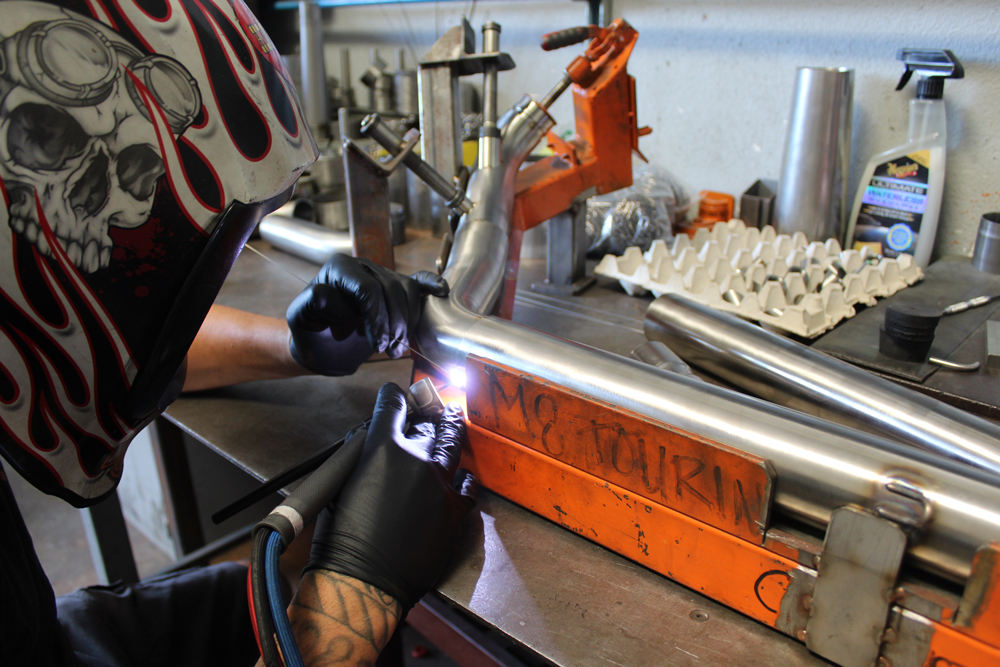
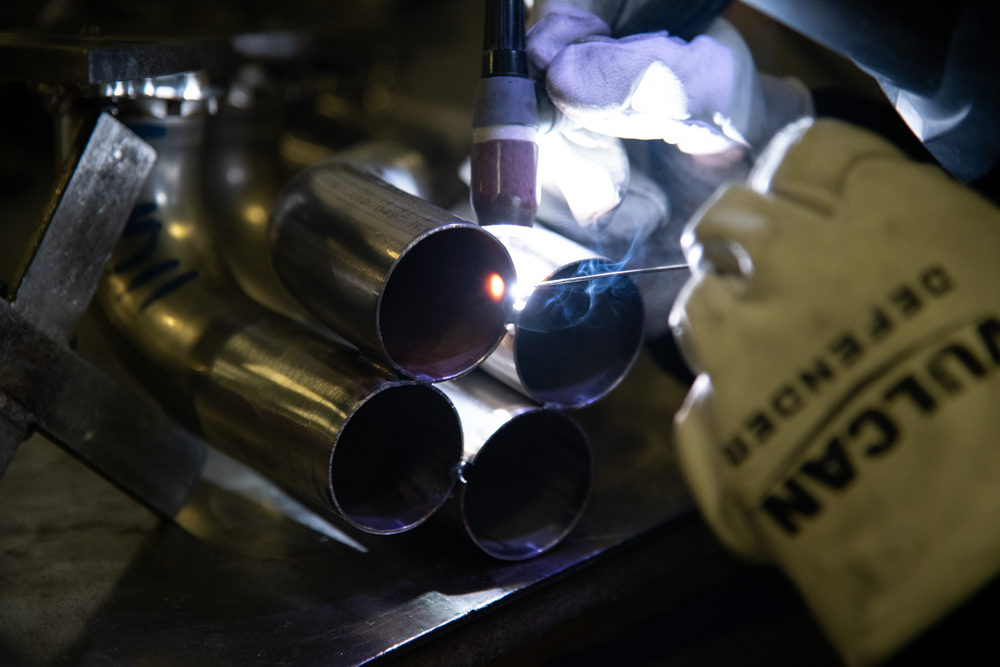
Left by themselves, the pieces that go into exhaust systems for racing or other high-performance applications are both basic and esoteric. Most everybody starts with pretty basic pieces of flat or tubular steel. To the uninitiated, the process of getting the perfect exhaust system is a little like trying to make spaghetti out of wheat grains. 

For a visually simple component, creating a custom performance exhaust system is first an exercise of making it fit into a precisely measured location, squeezing into a frame that could be a short-track Late Model, a dragster, or even a pro-level pulling tractor. The packaging consideration will determine which tubes, bends, and flanges that exhaust supplier presses into service for the project.

That’s not all. The operative word in this idea is “performance,” which means that the supplier—and the end customer—must have a firm idea of what the custom installation needs to help the muscle engine scream with power. Exhaust system design demands close collaboration between supplier and customer, and a built-in evaluation process that helps determine whether the combination of parts is really going to work. For that to happen, the end customer, who could be a race engineer or a serious hot rodder, has to somehow convey the space on the vehicle where the exhaust is going to fit.

2
To design its exhaust systems, Burns Stainless uses a program called X-Design, which evaluates engine parameters—bore, stroke, compression ratio, cam specs, and more—to determine tube length, tube size, and collector and exhaust size. “We talk with the customer to make sure we have the proper data, and then design the header,” said Vince Roman.

That packaging decision, and its effect on end performance, is what the testing process for these components is all about. At one time, it was largely limited to eyeball engineering and pure guesswork. Smart suppliers in today’s aftermarket industry work hand-in-glove with their customers to create intelligent exhaust solutions, even on a chassis-by-chassis or car-by-car basis. It’s all about process, starting with the critical questions about which pipe’s going to fit where, and how.

At Burns Stainless in Costa Mesa, California, Vince Roman has a technology-driven technique for assuring that a custom exhaust design proposal is viable, also relying significantly on input from the intended end customer.

“Our customers are very unique,” Roman said. “We sell to customers who have custom engines installed in custom chassis, including some things from the Harley-Davidson market. Our components have to work on their unique, one-off system. There’s no dyno testing for that. But what we have done is put together a program called X-Design, which is a parametric design model. We’re looking at bore, stroke, compression ratio, camshaft specs, port sizes, power, and rpm targets. The program specifies primary tube length, tube size, whether or not to run a step header, along with collector and exhaust size. Usually, we talk with the customer to make sure we have the proper data, and then design the header. 

“Our predominant customers are drag racers, Pro Stock to Top Sportsman, but we also have boat racing, tractor pulling, road racing, and so forth,” Roman continued. “Usually, the customer or fabricator deals with packaging issues. We determine tube size, tube length, collector size, and exhaust size, and then we put together a kit with flanges, collectors, and bends that builds to their particular packaging constraints.”

Modeling Success

The onrush of technology has taken most of the guesswork out of the evaluation process. In many cases, it has also eliminated or limited the onetime standard need of dyno-testing the engine with a variety of exhaust pieces hanging from it. Current engineering software allows the evaluation and testing procedure to take place even if the customer and supplier are divided by a continent. That’s how Ultimate Headers of Berea, Ohio, handles the challenge. 

3
Burns Stainless customers “are very unique,” Vince Roman said. “We sell to customers who have custom engines installed in custom chassis. Our components have to work on their unique, one-off system.”

“In many cases—and I’ll use Art Morrison Enterprises as an example—they will create a model of a chassis with an engine and steering components installed,” Jim Browning Jr. said. “They send that to us, and we then design a header in SolidWorks. I’ll send them a solid model back, see if everything works, then build the first one. It’s done in engineering software that has the complete header designed and packaged, which they can fit back into their model to see if it works. We’ve done this with customers including Art Morrison, Roadster Works, and Speedtech Performance.

“From start to finish, the process usually takes about two days when I have all the data,” Browning continued. “I don’t flow bench test everything. Quite frankly, they’re all very similar in the overall package. There’s not that much of a variation in them. We’re usually looking at 1 7/8-inch primaries, 3/8-inch collector, and it’s got to fit. We’re not building race car parts where we’re looking for 1–2 more horsepower. Our customer base is pro touring, autocross, so we never get complaints from those customers about horsepower.” 

One ongoing project at Ultimate Headers is the development of a long-tube header for a Fox-body Mustang, using the new Ford 7.3 Godzilla engine. It’s a performance version of Ford’s existing Super Duty truck engine being designed by Willis Performance Enterprises, where the final Ultimate Headers long-tube design will eventually be tested on a dyno.

Manufacturing to Customer Designs

“Our business is mainly the processing type,” explained Gavin Lau of Jiawen Performance Industries in Shanghai, China. “In other words, it is processed and manufactured according to the requirements of the customer’s drawings or samples. That’s even true for the OEM customers that we have now. 

“The general operation process is that they send us the designed drawings or hand-designed samples, and we produce new samples according to their drawings or their samples,” Lau continued. “They test all samples by themselves, and after passing the test, then tell us that we can produce the order. If the test fails, they will tell us what needs to be modified, and then we will remake the sample and send it to the customer until the sample is ultimately confirmed and approved. In the whole process, product design and development, testing, and after-sales service are the responsibility of the customers themselves. We just process and produce their own designed products for them.”

4
Much of the design—and even testing—of today’s performance exhaust systems is done by computer. At Ultimate Headers, design is done in SolidWorks. “I’ll send [the customer] a solid model back, see if everything works, then build the first one,” said Jim Browning Jr. 

Utilizing a supplier’s customer base as the foundation for testing new components is the strategy of Specialty Products Design (SPD) in Rancho Cordova, California, which started out building specialized systems for Late Model oval racers before adding components for NASCAR’s then Busch and Winston Cup applications. Now primarily focused on drag racing, but with other specialties including exhausts for air racing, SPD practices exhaust building across broad disciplines, always with an eye on maximizing performance. 

“In real time, most of us are not inventing anything new anymore,” Chris Hill said. “They’re projects now that establish the performance difference between running a four-into-one collector and a tri-Y collector. In most cases, we’re utilizing customers as the basis of our testing—trying different setups on our existing customers. Oftentimes, it’s changing from four-into-one to four tubes into two tubes into one collector. There are benefits for each, but each changes because of mechanical changes inside the engine, such as cam and valve timing. It becomes a collaboration between us and the engine builders. We’ve already developed relationships with our customers in terms of buying products.

“We’ve been here at SPD since the early 1990s,” Hill added. “There was a time when everyone started running crate motors. We worked with two or three engine builders for Late Models in the Midwest to come up with a system for them that worked very well. Eventually, they made the headers that we were building for the vehicles running because there was that much benefit in them based on the time that we’d put in with the engine builders. They had 25 to 30 horsepower extra with these exhausts.”

Money-Saver

The business model at Performance Tube Bending (PTB) of Irwindale, California, is a little bit different because the company no longer produces its own brand of exhaust components for the aftermarket, which it once did by selling a Lexus-specific exhaust system under the PTS brand. At PTB, components are now produced to match the packaging and performance parameters that the customer has determined on his or her own. 

“We have very limited product. We private-label and make whatever the customer has designed and tested,” Jim Renella said. “We don’t make or sell an aftermarket exhaust system. We had the Lexus system we designed under the brand of PTS.

5
Jiawen Performance Industries manufactures exhaust components “according to the requirements of the customer’s drawings or samples,” said Gavin Lau. The system’s design and development, testing, after-sales service, and so on, are the responsibility of the customers.

“We’re old school. We do it here the trial-and-error way,” Renella continued. “We don’t stray too far from OEM. Obviously, the mandrel bending process helps the performance because it doesn’t limit airflow. OEMs can have crush bending, which also interferes with airflow, so we can help by creating an exhaust system for the customer that’s mandrel bent instead.

“I prefer to work with prototypes that I fixture and duplicate from beginning to end,” he said. “I try to provide the components in the sense of providing a merged collector versus two-tubed. I always try to help every customer in the least costly manner to manufacture their exhaust or eliminate compound bends, so they won’t have to deburr and weld. That will help the customer save money. We’re a one-stop shop for the fabricator, who can buy exhaust sensors and flanges from us. If a guy’s building a hot rod, he can buy our bends. We have street rod builders and fabricators, plus local race teams. We’ve got a lot of hot rod shops that come here and purchase from us.” 

Sources

Burns Stainless
burnsstainless.com

Jamo Performance Exhaust
jamoperformance.com

Jiawen Performance Industries
jiawen.en.china.cn/

Performance Tube Bending
ptbtubebending.com

Specialty Products Design
spdexhaust.com

Ultimate Headers
ultimateheaders.com

October 2022
By
Jim Donnelly

From the Editor

Submitted by jeffreyc on Thu, 09/15/2022 - 12:50


Two things I think while looking ahead to one of my favorite stops on the ARCA West Series schedule—The Bullring at Las Vegas Motor Speedway—later this month: 

1) I think the matter of legalized gambling in motorsports, despite the buy-in of major operators like NASCAR and the Indianapolis Motor Speedway, will remain something of a seesaw issue, at least for the near future. There’s simply no clear-cut consensus at this point. Much of that is due to fragmentation: Racing is a multi-tiered enterprise—we often look at it as a pyramid, with the top levels occupied by the likes of F1, IndyCar, and NHRA pro teams, and the broader, more inclusive and attainable rungs represented by your Saturday night oval trackers, outlaw drag racers, amateur road coursers, and so forth. When it comes to support for sanctioned wagering, opinions are as varied as the sport’s tracks, cars and competitors themselves, which we discovered in this month’s Special Report “Let It Ride?” produced by contributor Steve Statham. The piece, which begins on page 40, explores attitudes on betting the races from multiple perspectives, including drivers and team owners, track and event operators, gaming interests, and more. Perhaps the best indicator of how divided opinions actually are came from the usually unwavering promoter Donald “Duck” Long, who told us: “I can’t really say that I’m for or against it. I hate to be neutral, usually I’m black and white on something. It could benefit the sport on the one side, but then on the other side there are a lot of people who don’t like gambling.” We invite you to review our story, consider all sides, and draw your own conclusion(s).

2) I think the comparison of electric-vehicle conversions to “the early LS swap market” is one of the best characterizations yet of this emerging segment. In the motorsports space, a handful of companies have taken up positions on the front lines of efforts to both optimize performance and demystify the science behind EV systems management. Mainstream acceptance will hinge, in large part, on these operators’ ability to win over hearts and minds. To that end, category leaders AEM EV, EV West, Legacy EV, and Zero Labs recently spoke with writer Bradley Iger for his feature article “Conversion Factor,” which examines the capabilities of gas-to-electric competition vehicles and how leading suppliers are refining their processes while tackling challenges like excess heat mitigation and voltage isolation (in the event of an on-track incident). EVs still represent just a small fraction of vehicles on American roads—somewhere in the low single digits as of this writing. But the tech is racing forward, miles ahead of where it stood only a few years earlier. And enthusiasts are taking note, as Legacy EV’s Mavrick Knoles described the draw for Iger, whose article, which begins on page 78, we highly recommend: “We’ve heard countless stories about people being hesitant about the technology and then going for their first spin in a Tesla in Ludicrous Mode. I think that EVs feel like the future for many folks, and they want to embrace the next wave of technology. We’ve spent so much time perfecting the gas engine, and now we’re kind of starting fresh with EVs. A lot of people are saying to themselves, ‘Okay, now how can I further optimize the performance of this?’ That’s where people start to get really excited.” 

October 2022
By
Dan Schechner, Editor

From the President

Submitted by jeffreyc on Thu, 09/15/2022 - 12:28


It Is PRI Show Season

The leaves are turning color, racers are making their final push toward a championship, and sanctioning bodies are winding up another amazing year of motorsports across America. For the team at PRI, we are putting the finishing touches on what is shaping up to be a landmark PRI Trade Show for you. Your 2022 PRI Show is going to be a banger. We are hearing great things from all corners of our universe, and the word is all the same: “See you in Indy!” With that as an introduction, here are just a few of my favorite things about the PRI Show:

1. Networking: For years, my best friend Mike Galimi has referred to PRI as “The World Series of Bench Racers” or something to that effect. His point has always been that PRI is the only real chance we have as racers to park the cars for a few days, meet up with our friends (and make new friends), and strategize about what could have been and how we are going to do it better for the following season. You have known this for years, but PRI gives you a distinct advantage in the marketplace. PRI allows great racing minds to come together, build our business, and explore opportunities. 

2. Exhibitors: Our exhibitors are the stars of the Show, and PRI 2022 will feature more than 1,000 manufacturers of race parts from all over the globe. From specialty shops that have been built from a one-person garage effort to the largest manufacturers in the industry, PRI will have them back in Indianapolis. And, yes, Chevrolet Performance (my alma mater) will be at PRI. 

3. New Cars: The diversity of new cars debuting at PRI always impresses me. You just never know what is going to happen and what cars/trucks/tractors will be brought out. There is also such a diverse mix of race vehicles, you end up sharing knowledge across racing genres. Watch for big-name racers to be strutting their new designs at PRI 2022. 

4. Track Operators, PromotErs and Sanctions (TOPS) Workroom & Lounge: PRI has been the home of the world’s biggest racing sanctioning bodies, tracks, and promoters for decades. Just recently, we combined all these folks into one massive group of racing industry leaders and gave them their own space to spend time in. We did this so that we could help you accelerate the development of new tracks, sanctioning bodies, and events. If this is your business, I invite you to take advantage of the TOPS Lounge. 

5. PRI Education Series: We have a number of exclusive educational opportunities for you at PRI 2022. If you are hungry to understand how to improve your game in the racing industry, these are the seminars that will change your life. From engine parts assembly, head porting, marketing, managing your sponsorships, and so much more…PRI Education is a trade show all within itself. 

6. Racing Media: I have always had a soft spot for members of the racing media. Having come from this community, I worked very closely with them while at Chevrolet to help promote performance cars, racing, and race parts. The racing media has changed over the last decade with fractured outlets and everyone being their own influencer. At PRI, our media members shine as they have a chance to break huge stories, share their best tips on our Content Creation stage, and even hand out awards through our Media Industry Awards program. 

7. PRI Surprises: As an attendee of PRI for more than 20 years, I was always amazed at how PRI was able to do things that no other trade show or venue could pull off. Now, behind the scenes, I see this team in action, and they are all prepared to go above and beyond to blow away expectations of what your PRI experience will be like. This year will continue that tradition with surprise parts, cars, and people that you will not see anywhere else. 

Thank you for your support of the PRI Show. We love producing the world’s largest racing trade show, and we cannot do it without you. So, get registered at performanceracing.com/trade-show/attend, make your travel plans, and I look forward to seeing you at the PRI Grand Opening Breakfast on December 8, in Indy.

October 2022
By
Dr. Jamie Meyer

Stop Doing That…Do This Instead: Nitrous Oxide

Submitted by johnc on Thu, 09/15/2022 - 11:13
image 1

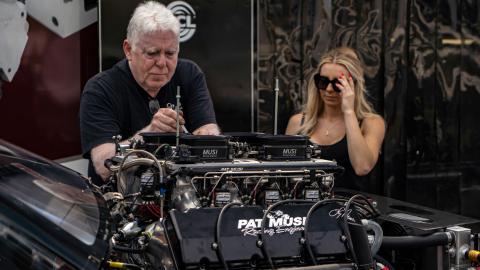
Pat Musi, at left, of Musi Racing Engines cautioned against exceeding the saturation point with too much nitrous. “The excess gets locked in the plenum and starts jumping holes,” he explained. “You have to be on your game and pull nitrous out of certain holes. It really gets touchy.”


From avoiding too rich a mixture to always knowing your saturation point, three top race engine builders share the do’s and don’ts for quick add-on horsepower.

While a fine-tuned nitrous oxide system can make a racing engine happy, a poorly maintained or tuned system is no laughing matter.

Nitrous oxide is a relatively inexpensive way to boost horsepower, but there is a fine line between the right amount and too much, the latter of which can severely damage your engine.

So, to help shed light on the matter we enlisted three top race engine builders for some of the do’s and don’ts when using this power enhancer: Scott Shafiroff of Shafiroff Race Engines in Bohemia, New York; Gene Fulton of Fulton Competition Race Engines in Spartanburg, South Carolina; and Pat Musi of Musi Racing Engines in Mooresville, North Carolina.
 

A Kiss Is All You Need

Shafiroff believes a “kiss” of nitrous to just one cylinder may be all the engine needs to get that extra boost of horsepower. “I tell customers, you might want to kiss, kiss one cylinder,” Shafiroff explained. “Just one cylinder at a time. Just a smidgen to see if you are going in the right direction. Once you find that happy spot, you aren’t going to improve performance a lot, but you are going to risk a lot.

“If a guy is smart and goes to an engine builder like us, I give them a base tune-up that they know the engine is going to be happy with right off the bat. He can just kiss it a little bit to where it will be happy in his car, and then he doesn’t have to touch it.

“It’s very risky in all these multiple, multiple stages when you are trying to go really fast, you never get a handle on it, and then you can hurt a lot of parts,” he continued.

“It’s really up to what you want the nitrous to do. If you want a fast bracket motor, like in Top Sportsman and Top Dragster, just find that sweet spot and stay with it. It’s not going to let you win more races if you make the thing 200 hp or 300 hp faster; what’s going to win races is consistency, to where you can run it all the way and not hurt it. Then, work on everything around the engine to make it more consistent and go a little quicker,” Shafiroff concluded.
 

There’s Such a Thing as Too Rich

Fulton believes today’s nitrous systems are more restrictive than the jets because of the controls that are built into the system. That is why he never recommends running a rich mixture because it can create havoc in the engine without increasing the speed.

“Any system should be designed where if you are controlling the flow with the jet pressure over the orifice, the jet should be the restriction in the system if you are going to tune it by the jets,” Fulton explained. “All of them think they are tuning it by the jet.

“About 50% of the nitrous that a motor will take does about 90% of what nitrous is going to do. They are putting so much in it, the tuning gets more critical, more critical, and more critical the more you put into it. It has to be more accurate, more accurate, more accurate.

“Well, a lot of them are inaccurate,” Fulton added.

“Even if it’s accurate, about 50% of the nitrous you are going to put in it does about 90% of what nitrous will do,” he repeated for emphasis. “They put way more in it for a very miniscule gain.

“In racing, an inch will win, but it gets crazy,” Fulton concluded.

image 2
According to Scott Shafiroff of Shafiroff Race Engines, racers and engine builders shouldn’t try to “fix a car problem with a nitrous tune-up—it usually doesn’t end well.” He added, “It takes a pretty big change in a nitrous package to make an improvement of more than a couple hundredths.”


Always Know the Saturation Point

Musi has been building nitrous engines for more than 50 years and stresses the saturation point to his customers. Exceeding that saturation point with too much nitrous will force the nitrous into areas of the engine where it doesn’t belong.

“When you get to the saturation point of what that motor will actually pull into charge, the excess gets locked in the plenum and starts jumping holes,” Musi explained. “You have to be on your game and pull nitrous out of certain holes. It really gets touchy.

“Cubic displacement plays a big part of it depending on the size of the engine, what the intake valve will pull in during an intake stroke. Whatever is left, if you have too much nitrous in, it will get in the plenum, jump to another hole that is opening, and that is where the burnup starts.

“It’s a delicate deal,” Musi emphasized.
 

Finding a Happy Spot

In the never-ending search for speed, the problem may be with the chassis setup of the car and not the horsepower of the engine, according to Shafiroff.

“Don’t fix a car problem with a nitrous tune-up,” he said. “It usually doesn’t end well.

“Find that happy spot where the motor is happy, and the plugs look good, and the plugs are happy, and the cylinder looks good, and work around it on the chassis and the car and get the car as fast it as it can be. It takes a pretty big change in a nitrous package to make an improvement of more than a couple hundredths. If you are trying to go three- to four-tenths quicker, then you need a bigger system. But you have to find that happy spot and stick with it.

“You shouldn’t be changing that stuff every week searching for power because you are going to mess it up. It’s a risky procedure doing that,” Shafiroff concluded.
 

Pay Attention to The Bottom End

While many racers are looking for top-end speed with nitrous, the bottom end of the engine really roars to life with extra torque.

“Nitrous is very good for the average guy to boost his power,” Fulton said. “It’s going to boost the horsepower up, but what it does to the torque of the engine is what makes it so fast. If it adds 200 hp to the motor, the bottom end will act like it’s 400 hp stronger. The bottom end is way stronger than the peak horsepower. It’s 400 hp better at bottom to mid-range and 200 hp at top.

“They think it’s 200 hp, but really, it’s more like 300 hp,” Fulton added.

image
While nitrous will boost up horsepower, its impact on engine torque is where the speed is really felt. “If it adds 200 hp to the motor, the bottom end will act like it’s 400 hp stronger,” said Gene Fulton of Fulton Competition Race Engines. “The bottom end is way stronger than the peak horsepower.”


The Consequences of Laziness

A properly maintained nitrous system will keep the engine happy. But a neglected system can be a sign of laziness, and that leads to sluggish performance.

“A lot of it becomes maintenance,” Musi explained. “The guy leaves nitrous solenoids activated with no nitrous. The coils are burned up. They don’t maintain their plungers.

“Peter Paul is the biggest manufacturer of all the solenoids. It’s not a secret. Everybody has the same parts, but they don’t maintain their stuff. They think it will run forever, and it won’t. You are talking about opening a Teflon plunger against 1,000 pounds of bottle pressure. Everything is sized depending on what you are doing.

“Most of the time, the poor setups just won’t run correctly,” Musi continued. “It would boil down to clogged-up jets or a bad coil or solenoid. Ninety-nine percent of it is self-inflicted, poor maintenance.

“If you take all the fuel away from a nitrous engine, it just won’t burn up. I’ve seen timing marks move, crank triggers to bolts come loose and fall down to advanced timing. Dumb stuff, but it just comes down to maintenance,” he concluded.

SOURCES

Fulton Competition Race Engines
facebook.com/Fulton-Competition-Race-Engines-193027214119824/

Musi Racing Engines
musiracing.com

Shafiroff Race Engines
shafiroff.com

October 2022
By
Bruce Martin

Ask the Experts: Sprint Car Fire Suppression Systems

Submitted by johnc on Thu, 09/15/2022 - 10:21
image 1

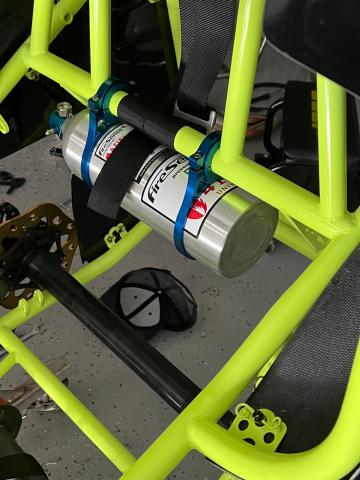
SPA Technique was the first company to receive the new SFI 17.3 certification for its FireSense Plus sprint car fire suppression system. While its 4 Fire suppression agent is sourced from Denmark, the rest of the system consists of components made in the US.


Beginning next season, these units will be required on all World of Outlaws sprint cars. And manufacturers are already one lap ahead with development and product solutions.


Earlier this year, the World of Outlaws announced that “by the first WoO racing event of 2023, fire suppression systems will be required on all World of Outlaws Sprint Series competitors.” The sanctioning body’s Sprint Car Safety Council worked with SFI to set up product parameters and testing requirements for what would become SFI Spec 17.3, for “Single Seat Open Wheel Front Engine On Board Fire Suppression Systems.”

Unlike the 17.1 spec, the sprint car systems focus solely on the driver. “They weren’t worried about spraying anything on the engine or the fuel tank,” explained Dan List of SPA Technique, Indianapolis, Indiana. “They just want to spray down the driver to get good fire-out and give them enough time to get the driver out of the car.”

In addition, 17.3 mandates the system must be activated either thermally or manually, and it must work regardless of the car’s orientation, in recognition of the fact that sprint cars don’t always land on their wheels after an accident.

SPA Technique was the first company to receive the new 17.3 certification for its FireSense Plus system. The spec requires a five-pound bottle of suppression agent; SPA Technique uses an agent sourced from Denmark called 4 Fire Universal. All other components for the system are sourced in the USA. With SPA’s AM block, the suppressant sprays out of the same nozzles whether the system is activated manually or thermally.

4 Fire has the same fire-out times in tests as a halon replacement like Novec, List said, but it prevents re-ignition, which can occur “once the percentage of Novec in the air is too low. Since a sprint car is more open than a sedan type of car, I was concerned that percentage could get too low too fast. And because the engine is so close to the driver, the possibility of re-ignition would be higher than a lot of other cars.”

Though SFI keeps testing results private, SPA Technique posted video of its SFI tests on YouTube. “For the two automatic tests, we had a fire-out time of 1 and 1.3 seconds (10 second maximum) and discharged 4.98 pounds of agent (4.75 pounds minimum),” List said. “For the manual activation test with the bottle upside down and an obstruction in the way, we had fire out in 3.5 seconds (10 second maximum) and discharged 4.98 pounds (3.4 pounds minimum).”

Jim Morris of Lifeline Fire & Safety Systems in Coventry, United Kingdom, said his company is “fully aware that a fire suppression system for 99.9% of racers is ballast in the car, and it does one thing: It makes you go slightly slower, it doesn’t make you go faster. So our mindset has always been, give them the best performing, lightest weight possible fire suppression system they can have.” The Zero 360 system Lifeline developed for sprint cars has been in the works for nearly a year, and when we spoke with Morris in mid-July, SFI testing was just days away.

The system consists of a 5-pound bottle filled with Novec 1230 and a nozzle attached directly to the bottle, a feature that helps it fit in the tight confines of a sprint car cockpit. “The bottle mounts just under the seat on the down tube,” explained Tyler McQuarrie of Lifeline. “The nozzle is pointed toward the area in a sprint car where 90% of the fires start—the fuel line and the fuel pump that are right under the driver’s left leg. Mounting it on the down tube takes just four Allen screws, so installation is very, very easy.”

The nozzle incorporates “valve mechanisms and some of the triggers that cross over from our traditional FIA road racing systems in terms of the compression discharge technology we use, the ability for the system to operate in any orientation,” Morris said. He described the Novec suppression agent as “a three-dimensional suppressant. It does not need sight of the fire to extinguish it, whereas a foam-based system or a water-based system absolutely has to see the fire in order for it to work.”

image 2
Safecraft Safety Systems has sold its Model SC sprint car fire suppression system for about three years. It was “designed with sprint cars specifically in mind, with a slim, compact design crucial to making this work for our sprint car customers,” said Johanna Higginbotham.


Lifeline has been selling the system since the beginning of the year. Lifeline’s James Clay said he was “pleasantly surprised” that “the uptake and demand for this has been tremendous, even without the homologation. People have been waiting for something to trigger an appropriate system that will fit in their car and accomplish what they want to accomplish.”

Safecraft Safety Systems of Martinez, California, has sold a sprint car system “for roughly three years,” said Johanna Higginbotham. It was “designed with sprint cars specifically in mind, with a slim, compact design crucial to making this work for our sprint car customers.” The Model SC is available in 3- and 5-pound bottles filled with Novec 1230 and capped with an activation head “that is narrower than other models we offer. This system also deploys at any orientation to accommodate race conditions. Most importantly, the thermal activation provides ultimate security for the driver if they are unable to activate the system themselves.” The Model SC is sold with “slim roll bar mounting brackets that effectively use what little space there is” in a sprint car, she added.

While the new SFI spec calls for a fire suppression system, Higginbotham said “having both an installed system and a handheld extinguisher is not uncommon. There is no such thing as too much fire suppression.”

SOURCES

Lifeline Fire & Safety Systems
lifeline-fire.com

Safecraft Safety Systems
safecraft.com

SPA Technique
spatechnique.com

October 2022
By
Drew Hardin

2022 Race Track Business Conference (RTBC) Set For PRI Trade Show

Submitted by laurap on Wed, 09/14/2022 - 20:17
Race Track Business Conference (RTBC) logo


National Speedway Directory has announced the 11th annual Race Track Business Conference (RTBC) will take place at the Indiana Convention Center in Indianapolis, Indiana, on Wednesday, December 7—the day before the 2022 Performance Racing Industry (PRI) Trade Show on December 8–10.

The one-day event is designed for industry leaders to “collaborate, analyze, and conceptualize around the business of motorsports.” Hosted by Tim Frost, this year’s conference will feature eight educational sessions and a keynote, with topics and speakers to be announced over the next few weeks.

Reasons to attend RTBC 2022 include:

  • Gain insights from experts and educational opportunities. Hear new experiences and how successful track owners, operators, promoters and more view the current economic challenges of our industry. Insights from organizers of actual events and motorsports facilities. Gain exposure to new ideas and trends that will help you succeed.
  • Encounter new vendors and suppliers. Meet with a wide range of professionals from every form of racing. 
  • Network with peers. 
     

There is a $250 fee to attend this event. For more information, visit racetrackbusinessconference.com or contact Tim Frost at 847-853-0294 or twfrost@speedwaysonline.com.

To register for the 2022 PRI Trade Show, visit performanceracing.com/trade-show/attend.

September 2022

Indoor Auto Racing Series Announces Partial 2023 Schedule

Submitted by laurap on Wed, 09/14/2022 - 18:32
Indoor Auto Racing Series logo

Officials with the Indoor Auto Racing Series have announced some race dates for the 2023 season, which kicks off with the Ironton Global-sponsored Allentown Indoor Races at the PPL Center in Allentown, Pennsylvania, on January 6–7. This race will feature the series’ three main divisions: TQ Midgets, Slingshots, and Champ Karts. 

Following will be the 20th running of the NAPA Know How Atlantic City Race Weekend in Atlantic City, New Jersey, on January 27–28. There, drivers will have two opportunities to earn the TQ Midget Gambler’s Classic trophy, thanks to a special Friday night feature that makes up for a 2021 event canceled due to COVID-19 restrictions. 

Plans for the return of the East Coast Indoor Dirt Nationals at the CURE Insurance Arena in Trenton, New Jersey, are also being finalized, with an announcement expected in the coming weeks.

In addition, officials have announced the series will not return to the Exposition Center on the New York State Fairgrounds in Syracuse, New York, in 2023. This is “due to building issues which have caused a number of other events to be canceled inside the newly constructed center. State officials hope to have the issues resolved so that all the events can return for the 2024 season.”

For more information, visit indoorautoracing.com.

September 2022