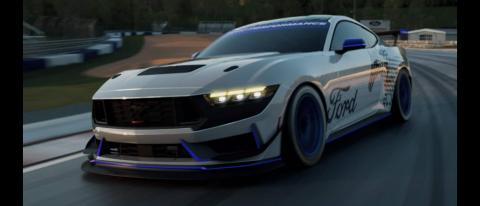
From training rigs to engineering studies, simulators have become commonplace in racing. As more motorsports organizations look to leverage the increasingly sophisticated technology, it’s poised to become an integral development tool for a variety of applications in the real world.
Simulators have long been used by teams in the top tiers of auto racing to help drivers hone their skills when they’re not on-track, but recent advances have opened up their potential use to a much wider range of possibilities.
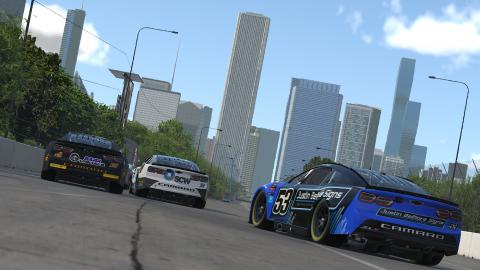
NASCAR has been one of the technology’s most ardent proponents, not only creating the eNASCAR platform for esports competitors—some of whom have used their online racing success as a pathway into racing careers in the real world—but also for uses that have changed the organization’s approach to development challenges faced outside of the virtual space. For instance, the track used at the Busch Light Clash at the LA Coliseum earlier this year was developed and tested in simulation to prove its feasibility long before construction began. Likewise, the 12-turn, 2.2-mile street course that will see racers from the NASCAR and IMSA series blasting through the streets of downtown Chicago in 2023 was actually originally designed for the eNASCAR Pro Invitational Series.
These advances in simulation technology within the motorsports realm haven’t come by way of state-of-the-art military training equipment or highly bespoke software, but from a subscription-based online racing simulator for Windows PCs called iRacing.
“When we started the company back in 2004, the goal was to create a racing simulation that was truly authentic,” explained Steve Myers of iRacing, Chelmsford, Massachusetts. “The person who was really instrumental in taking it to that next level was [NASCAR’s] Ben Kennedy. He’s the guy who was willing to take chances and look at things through a different lens to see how that could benefit him and his company. He looked at it from a driver’s perspective first, as a way to learn tracks. I remember him telling a story about how he was going to a race at Five Flags Speedway, and he was using a spray-painted mark on the track as a reference point in the simulator, and then he went to the real track and ended up using that exact same mark as a reference point in the real world. I think that really resonated with him.”
Over the years, iRacing’s modeling capabilities have reached a level of sophistication that has allowed engineers to use the service as a test bed of sorts. “When NASCAR was working on the Next Gen car, its R&D department used iRacing as a way to help make decisions about the development of the car,” Myers added. “That naturally progressed into the realization that they could use iRacing to prototype ideas for changes to tracks, and that they could have a design completed before they ever moved a shovel-full of dirt.”
Mike Burch of Speedway Motorsports in Concord, North Carolina, noted that the granularity of iRacing’s modeling data has moved simulations from a general approximation of a vehicle in an environment to a faithful virtual representation that can be relied on when the rubber actually meets the pavement.
“It’s not just simulating the traction of the asphalt and all of the physical properties of the track,” he explained. “The cars’ dynamics have become much more accurately simulated, and it’s also able to simulate things like atmospheric conditions. It gives you a very accurate idea of how all of these pieces are going to interact on track. We just finished a project in Atlanta with the team at iRacing where we put some ideas into the virtual world and had drivers compete on that layout to see how it raced. We learned a lot and made a number of changes to real-world courses as a result—some subtle, some not so subtle. After a few races there it’s clear that we’ve hit on something. The racing has been really exciting. A lot of the credit goes to the fact that we were able to go in and test it out before we spent the time and money to start moving the dirt.”
Both Myers and Burch see this approach as a model for future track development, but the potential doesn’t stop there. “Another project we’re working on is something that actually started out as a tool for our vehicle dynamics engineers to use,” Myers said. “We’ve been developing this as a way for them to take measurements of the cars and plug them into the tool to generate these car models for the simulator. What I realized as we were building this was that it has a practical real-world use for race teams and manufacturers who might want to build their own cars within iRacing and test various concepts privately within the simulation. This will allow the teams to literally build out the entire car. All of it can be custom built by them to match the specifications of their equipment. So it is not about just having to rely on what we have already built; it provides them with the tools they need to build it themselves.”
Future Impact
Meanwhile, Burch pointed out that these new abilities could have a profound effect on motorsports development down the road. “It really comes down to the accuracy of the data,” he said. “When we started licensing our facilities with iRacing for the sim, it used to be a matter of inches. Now it’s a matter of millimeters, and it’s only going to get better. At this point we can virtually build the cars, and it’s not like, ‘OK—let’s scan the outside and give it these characteristics.’ It’s, ‘Let’s build a virtual engine out of virtual parts.’ It’s not a ‘mass’ of a car anymore, it’s actually made up of thousands of individually simulated components, and you change the individual aspects of those components to see how it affects the behavior of the car, and how multiple cars of that configuration race together.”
He added that the ability to develop both the track and the car in simulation offers many new possibilities. “It’s something where you could also kind of reverse-engineer it,” Burch continued. “We could say, ‘OK—we’ve got this track, but what’s the optimum car to race on this physical layout? What other types of racing might be interesting on the Roval at Charlotte, or at Sonoma, or on the half-mile at Bristol?’”
As the technology continues to mature and becomes more accessible over time, Burch expects it to find its way into increasingly affordable levels of motorsports. “Eventually this stuff will get down to the hobbyist racer.”
Electric vehicles could become the next big thing in racing, yet barriers to their success persist. So we asked racers, sanctioning bodies, track operators, and others about where EV racing is working, where it’s not, and why.
There is no simple way to characterize the state of EV racing in the US.
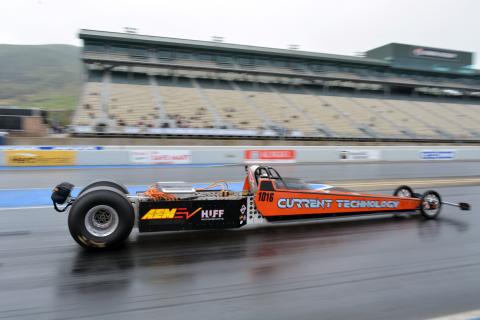
On one hand, EV race vehicles have achieved some notable benchmarks. The overall record up the Pikes Peak International Hill Climb, 7:57.148, was set by an electric-powered Volkswagen I.D. R in 2018. Steve Huff, the first to break the 200-mph mark in an electric dragster, continues to go faster and quicker…and ran nearly 203 mph this summer. Holley’s High Voltage Experience, a multi-discipline event with drag racing, autocross, and road-course hot lapping, had “incredible” turnout this year, said Lawson Mollica of AEM EV, Hawthorne, California, a Holley brand with a diverse array of products in the EV performance space.
Then there are areas where progress in the EV racing segment is anywhere from slow-moving to practically nonexistent. For example, drag strips that have opened their bracket programs to EVs have had few, if any, entrants.
“From what I see talking to other guys out here on the East Coast, it’s not doing good at any tracks out this way, with little or no participation whatsoever,” said Wayne Delmonte of Lebanon Valley Dragway, West Lebanon, New York.
John Bisci Jr. of World Wide Technology Raceway in Madison, Illinois, noted, “We do have some Tesla owners who come to our street-legal racing nights and make one or two ‘fun’ passes down the track, then park in the car show/display area. But the actual organized racing class has had no takers.”
Todd Payne, a longtime bracket racer from Yadkinville, North Carolina, said his daily-driven 2014 Tesla Model S P85D has almost always been the only EV entered at the NHRA and IHRA Summit Series programs at his local tracks. What’s more, he told us, his fortunes have swung wildly. He went to the 2021 IHRA Summit SuperSeries World Finals in Memphis and made it to the final four in eliminations thanks to his quick reaction times and the Tesla’s remarkable consistency. Yet he was outright banned from an independent drag race because the organizers “didn’t understand the car.”
The Mint 400 opened to EV participants in 2021 but so far no one has entered, despite “really aggressive outreach,” said Matt Martelli of the Terranaut Media Group, Vista, California, which puts on the desert race outside of Las Vegas, Nevada. He acknowledged that “there are a lot of challenges specific to off-road that are unique,” from range-taxing race distances to lack of infrastructure in remote areas. But, he added, “we want to be very proactive in helping new technology. If it requires us to modify our race, our race course, whatever, we’re open to that. We want to get the conversation going to all the different EV manufacturers and product manufacturers to let them know we are amenable and interested in working with them.”
The acceptance of EV racing in the US has been slow, “but if you consider the hockey-stick trajectory of EV racing elsewhere in the world, combined with the mass adoption and rollout of EVs at the OE level, it is not going to be long before EV racing takes a foothold here,” said our source from AEM EV.
The reluctance to accept EVs as legitimate race vehicles seems to be a US-only phenomenon. When asked for examples of where EV racing is strong, Mollica mentioned several series, from Formula E to FIA Rallycross and the Dakar Rally, that take place in Europe and South America. “Here in the US, people are trying to figure out rules and safety. EV adoption abroad happened faster than it has here, and they have a head start on the racing. A lot can be learned by studying what they are doing right. But if you consider the hockey-stick trajectory of EV racing elsewhere in the world, combined with the mass adoption and rollout of EVs at the OE level, it is not going to be long before EV racing takes a foothold here.”
To his point, in some respects the state of EV racing in the US can be attributed to it is still in its early days. But there are factors that need to be addressed before EVs can be fully accepted into the racing fold.
Safety Concerns
In its 2022 Summit Racing Series rules, the NHRA allows 2014–current EVs with unaltered frames, unibodies, and safety systems to run the quarter-mile no quicker than 9.00 seconds and no faster than 150 mph. “A normal race car,” Delmonte pointed out, “can only go 9.99 at 135 before it has to get into chassis certifications and a license for the driver.”
The rule makes it easier for street-driven EVs to race, and as Payne pointed out, “I’ve got 10 airbags and antilock brakes going for me. They say if you don’t modify the car, you can run it because you’re safer than half of them out there.”
That’s not what concerns Delmonte, however. “Most of the guys who are coming in with Teslas are not racers, they’re just guys who can afford a Tesla and want to see how fast it can go. They have no experience on the race track. It doesn’t matter if you’re in a 15-second car or a 9-second car, you still need experience to know what you’re doing and where you’re at.
“I get that these cars have airbags in them, but it’s not only that car you have to worry about, it’s the car going down track with them,” Delmonte added. “That could be an 11-second car that’s not required to have all the fancy safety gear, and now a car just hit them doing 150 mph with electric batteries and stuff in it. I think it is a very unsafe racing atmosphere.”
Delmonte said his Lebanon Valley safety crew “is trained in electric cars, but not every track has that luxury. An accident with an electric car is not like a normal accident. There are protocols that have to be taken. Where to cut the wires is different with every car, so you have to find out where to cut, what to touch, and what not to touch.”
When asked if he would continue to participate in the EV racing program, Delmonte said, “As a track operator, I have the option of not competing in the EV class. We don’t have to do it, but we want it to grow, to get more people to come to the race track. The younger community isn’t going to buy a muscle car or a dragster and come racing. A lot of them are buying electric cars these days. It’s just a change of times, and you need to keep people coming to the track, to try new racing opportunities. But as far as safety goes with these really fast cars right now, I don’t feel we are there yet.”
Mollica agreed that “educating track safety teams on how to respond to various scenarios when they occur in EV classes will further speed up adoption. It is not uncharted territory, which is great. There are lots of case studies and existing, proven protocol for these things. Further, if good rules are enforced, the cars are very safe, despite the high-voltage systems that are used to propel them.”
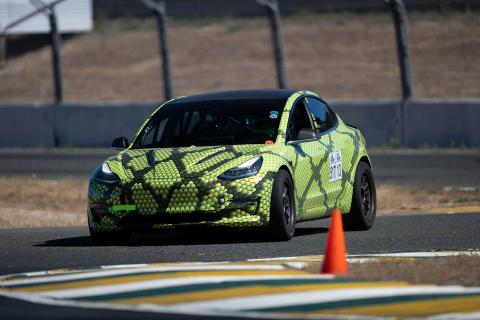
In the road racing segment, Brett Becker of National Auto Sport Association (NASA) in Las Vegas, Nevada, said most of the EVs—largely Tesla Model 3s—at NASA events are in the HPDE or Time Trial run groups, which do not have the same safety equipment regulations as cars doing wheel-to-wheel racing. “One of the developments in our Time Trial classes over the years is that they’re mostly full-cage race cars now in almost all the classes, whereas 10 years ago there were a lot of street cars in that class.” Mounting a roll cage in a Tesla “presents a challenge,” he said, “of welding in a car with all that juice in them. I don’t know how it’s done, but I know it’s not easy.”
EVs face challenges in off-road racing that are specific to the discipline, admitted Matt Martelli, whose Terranaut Media Group puts on the Mint 400 desert race. But, he added, “we want to be very proactive in helping new technology.”
When asked if EVs were competing in NASA’s sprint races, Becker said, “I know of none.” There was a notable EV entry in the 2021 25 Hours of Thunderhill, an electric-powered Sports Racing car built by Entropy Racing of Sacramento, Pennsylvania. The EVSR could compete in a long-distance event because its lithium ferrous phosphate batteries were designed to be hot-swapped during a pit stop, a two-minute task that had to be repeated about every 30 minutes. Those batteries are “heavier and cheaper” than lithium ion, Becker said, and they’re also “easier to extinguish in a fire, because they’re still extinguishable with water.” (The EVSR team finished the race in 29th place overall. Turn to page 104 for a profile of Entropy Racing.)
Acceptance
Cutting a new path is never easy for a pioneer, and some of the EV racers we spoke with have experienced their share of trials. Payne said he and his Tesla have been met with much distrust, from fellow racers and even race organizers who think the Tesla has electronic devices that allow him to cheat. The organizer who banned the car told Payne, “it’s a different animal, and we don’t understand it,” he recalled. “They talked about the traction control and the launch mode, and how there’s no way to police the computer in the car. My response was, ‘do you really think I’m going to tamper with my car?’ It’s just like your smartphone. You can’t go tampering with it or you’re going to get blocked or bricked. Same thing with a Tesla. You can’t go in and mess with stuff and mess up your warranty.”
He also recalled one track owner “giving me the stink-eye” when he tried to plug in between rounds. “They think I’m robbing them of power, that their power bill is going to be $300 if I plug in for one race,” he said. Payne now takes a generator for power top-ups, but he pointed out, “if we could get 50-amp chargers at the tracks, that would help us. And we need to tell the track owners that these things can only suck so much power. You might be talking $5 charging all day long.”
Steve Huff’s quest for 200 mph began when he debuted the dragster at the 2017 SEMA Show, “and the struggle started then. We were wondering, ‘Is anybody going to care when we go 200? Is it going to be a unique thing that happens once? When is the industry going to catch up with us? When are the recognized names in the performance industry going to get involved?’”
Response to the Holley High Voltage Experience “has been incredible from a participant and vendor standpoint,” said a company source at AEM EV. Car count in 2022 was “significant for a new series, and we had a big increase in custom EV conversions over the inaugural event.”
Some of those questions have been answered. Competing against Don Garlits to be the first EV dragster to 200 drew national attention, and AEM provided much-needed technical assistance starting in 2019. “With their products, we finally had the data acquisition that we needed,” Huff said.
When he felt the car was ready, Huff purposely timed his record attempt for May 2020, since “there was no motorsports news going on” during those early months of the COVID-19 pandemic. Even so, hitting the number “made international news in Asia and Europe much more than it did in the US,” he said. To this day, even when “Big Daddy” Don Garlits himself is lining him up for exhibition passes, reaction is mixed.
“Garlits and I were at the Gatornationals this year, and on the line we could hear the crowd boo. Yes, we also heard a lot of applause, but there’s also that other factor. I don’t know that the two are going to mix really well.”
By “the two,” Huff was referring to the pro- and anti-EV camps he encountered while shooting for 200 mph.
“Most of the interest in the electric car comes from people 30 years old and younger,” he explained. “They have a lot of interest, but they’ve never been to a race before. They’re new racing fans.”
Huff has created educational programs about EVs, from K–8 STEM classes to hosting University of Wyoming engineering students who work on a Formula SAE team. “For the second time in three years they’re flying 15 of their students up here (Huff Motorsports is based in SeaTac, Washington) for a four-hour lecture, Q&A, and a tour of my shop. That never happened with my Top Fuel Harleys, hydroplane, land speed bikes, or any car I’ve ever raced or owned.”
Pictured here, from left, are Don Garlits, the first dragster driver to reach 200 mph (in 1964) and Steve Huff, the first EV dragster driver to hit 200 mph (in 2020), at the NHRA Gatornationals. Garlits’ notoriety has helped draw attention to the quest for a 200 mph EV pass—and EV racing in general.
On the other side are race fans who are anti-EV for reasons that range from a lack of understanding of the technology, to a fear that EV racing will somehow replace traditional ICE-powered vehicles, to hating the fact that EVs “don’t make noise.”
“That’s the challenge now, that we don’t make noise,” Huff admitted. “Crowds don’t like that. I’m a little surprised that today’s racing audience is less impressed with the technology and more impressed with the noise. I would have thought there would be more interest in the development story, in how to do this.” To try to appease fans, “I give them huge burnouts since I can’t give them noise.
“This is not a political thing for me,” he added. “People want to turn it into something political, but it has nothing to do with that. I did not do this to save gas. This was done because there was a race, and I wanted to win that race. It was a quest to see who could put their name in the history books. If it was a noise contest, I would have done everything I could to win the noise contest.”
Noise, in fact, is hurting race tracks, a fact that both Huff and Mollica emphasized.
“There’s a reason there are only two races a year at Pomona right now, a reason tracks are being shut down all over the place, and that’s noise,” Mollica said. “Since these are quieter, it eliminates the argument of, ‘You can’t race here because it’s too loud.’ How much more opportunity does that open to legally race in an urban environment? We all know what happens if you can’t race in a legal environment now. It all goes to the streets. Which is what we don’t want. Now, the quieter part of EV racing is not a detriment, it’s an advantage.”
“The next generation doesn’t care about noise, they care about the performance,” Huff said. “I have a 200-mph car that I drive to the starting line, I drive back from the finish line, and drive it into the trailer. It’s a hot rod, a 2,000-horsepower dragster. It won’t shock you; it’ll blow you up. It’s dangerous, it’s fast, it’s expensive, it has everything we look for in a challenge and race car. It’s super cool, and it’s made racing fun again.”
Todd Payne’s gray Tesla is pictured above at the 2021 IHRA Summit SuperSeries World Finals in Memphis. Payne’s skill at the tree and the Tesla’s remarkable consistency make them a formidable team in bracket race competition.
When asked if traditional race fans could ever embrace EV racing, Mollica was optimistic. “I’ve made the analogy that the flathead Ford guys shunned the small blocks, and carbureted guys shunned EFI, and small block and big block guys shunned the LS and Mod motors, and the domestic guys shunned the imports, and so on. That’s part of car culture. What I do believe is that over time, a level of respect was attained regardless of the camp you are in. You have to remember that people who shout the loudest are usually most resistant to change, but that doesn’t mean that they speak for an entire niche.”
Mollica himself speaks from experience. His own roots were in traditional American V8s, and he was skeptical of the performance potential of import cars until he learned more about them. Likewise, “I didn’t like EVs when they came out. Then I got a ride in a Tesla, and it changed my mind. Now, we make electronics so that enthusiasts can take a chassis they are passionate about, electrify it, and race it, drive it all the time, or both. That’s really what this is all about. It’s hot rodding, just a new type. If you don’t believe me, rent a Tesla or Mach-E, mash the pedal, and then envision that performance in your passion project and tell me if I am wrong.”
The components are different and so is the fuel, but EV performance companies share the spirit of innovation—and some of the same techniques—that their gas-engine predecessors pioneered.
They are practices rooted in automotive history: Want to make a car go faster? Swap in a more powerful motor from a heavier car. If that motor isn’t making enough power, innovate. Build the parts needed to increase its performance, test those parts, and if that doesn’t work, try again. That’s how hot rodding began in the years before and after World War II, when men like Vic Edelbrock Sr., Ed Iskenderian, Stuart Hilborn, and many more used ingenuity and their own two hands to make speed parts, and in the process gave birth to the performance aftermarket.
“We get a lot of flak from the hardcore gasoline world for being electric,” said Eddy Borysewicz of reVolt Systems, Oceanside, California, which offers electric conversion systems using refurbished Tesla motors. “But the real hot rod guys say, ‘That’s exactly what we did in the 1950s. There’s no difference with what you’re doing to what we were doing, ripping motors out of high-powered sedans and putting them in lighter cars.’ So we coined the phrase, ‘Hot Rodding 2.0,’ as our shop motto. We’re dedicated to the art of preserving hot rodding.” That dedication includes testing at the Bonneville Salt Flats, where the Team Vesco streamliner, with a twin-motor reVolt system on board, set the EV speed record in 2021 at 353.870 mph.
We recently spoke with Borysewicz and several other performance EV pioneers to learn about what’s new in this growing segment of motorsports and opportunities there may be for aftermarket businesses to participate.
Batteries Not Included
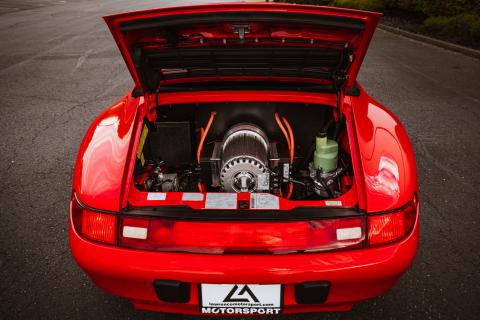
“Our system was designed to be as minimally invasive on the vehicle as possible,” said Borysewicz about the reVolt conversion. “Four bolts hold the motor system in, two for the front and a TH400 standard mount for the tailshaft.” The systems are based on 400kW Tesla S motors that produce approximately 533 horsepower and 800 lbs.-ft. of torque at the yoke. They are salvaged from wrecked cars and re-machined, as reVolt mounts the motor longitudinally rather than in the factory transverse orientation. The drive system mounts in the vehicle’s transmission tunnel and connects to a driveshaft that powers the rear wheels.
“We do the whole batteries-not-included thing,” Borysewicz said about the package. It comes with “the entire control system, the inverters, the motor, the reduction boxes, and the 1350-style output yoke. It comes pre-wired with a generic wiring harness. You can put your throttle pedal in, mount your controllers under the dash, and it’s basically turnkey ready for batteries. Once you put a 400-volt system on top of it, you literally turn the key on and go.”
Revolt Systems’ Tesla conversion was designed to be “as minimally invasive on the vehicle as possible,” said Eddy Borysewicz. “Four bolts hold the motor system in, two for the front and a TH400 standard mount for the tailshaft.” This photo shows the Tesla motor going into Borysewicz’s personal 1965 Mustang.
The weight of the system is a non-issue for most vehicles. Borysewicz said, “A typical old-school cast-iron block with the transmission weighs around 700 pounds. With the radiator, fuel, fuel tanks, and all the other stuff that goes in there you’re at around 1,000 pounds. We just did a conversion on a 1980 GMC pickup for the Holley High Voltage Experience that we called the Hillbill-e Deluxe. The motor weighed 300 pounds, the battery 700, so it was a dead even swap. And the best part was, we could choose where to put the batteries and shift the weight backwards. That truck was extremely nose-heavy when stock, but after we put the batteries in, we were at a 49/51 split. It’s nice to choose where to put the batteries, spread them out evenly between the axles, so you don’t have all this weight in one spot.”
As for sourcing the batteries, “no one on an aftermarket level is making a pre-built battery pack that’s brand new,” Borysewicz explained. “It’s still a custom thing. People are going to junkyards, pulling Teslas apart, and using all these different types of lithium-based chemistry to get their EVs working, so it’s still kind of the Wild West. We are starting to see new products that are designed just for aftermarket EVs, but the battery pack is the hardest part of this whole equation.
“For the PRI companies, there’s such an untapped market here,” Borysewicz continued. “EVs are not going away. As we evolve this, there are going to be more and more people interested in souping up their motors, and there’s a huge void with batteries in the aftermarket. No one’s cornered that yet. There’s a whole, brand new market here, untouched, fresh, just ready to be taken.”
Exciting Classes
One of the prominent companies involved in EV conversions is AEM EV in Hawthorne, California. AEM’s specialty is making the componentry that enables and simplifies a conversion, from vehicle control units (VCUs) to digital dashboard displays. “Our system is fully integrated and uses the VCU as a central point of control for the battery management system, power distribution unit, combined charging unit, and more, to optimize a vehicle for exactly the type of racing you want to do,” said Lawson Mollica. “While plenty of people will take their OE EVs to the track and be competitive [see below], we see conversions as taking over to create the most exciting classes of EV racing.”
AEM was instrumental in Steve Huff’s quest to be the first to run 200 mph in an electric dragster. When Huff started building the car in 2017, “we had motors, batteries, and controllers, but there really wasn’t anything that would let those things talk to one another, no center piece where all the inputs and all the outputs go,” Huff recalled. In 2019, AEM came aboard “with a great computer, a VCU that would allow us to control not just two motors, but four. Once we put four motors in the car, we went 200 mph in May 2020.”
The custom-wound axial dual-stack motors from Phi-Power utilize Cascadia controllers and inverters and are powered by a custom-built lithium-cobalt-polymer battery from High Tech Systems. The 5P/192S battery produces 800 volts, 2,000 amps, and an estimated 2,400 horsepower and 2,000 lbs.-ft. of torque. Huff Motorsports’ e-Spec Racecars built the custom, 240-inch-wheelbase chassis, which is NHRA certified to 6 seconds.
“When Steve realized he needed to double the motors, with the electronics he was using he would have needed two independent electronic systems to run the two sets of motors,” Mollica explained. “Neither would talk to one another.” The system AEM created “eliminated all that redundancy and removed a ton of potential weight that would have been added to the car just in wiring alone.”
John Romero, AEM’s director of product development, nicknamed that VCU “the adult in the room,” Mollica said. “Not only is it doing the torque management and all the things needed to get down the track, but his batteries, which are not cheap, are integrated with the battery management system. If they aren’t up to temperature or don’t have the voltage he needs, it will de-rate to protect the batteries so they won’t burn up. So in addition to not only helping him achieve his record—which he broke at the Holley High Voltage Experience and broke again at NHRA Seattle—the system is protecting his investment as well and keeping him safe.”
Mollica sees potential at the sportsman levels as well. “Once you build an EV conversion, the cost of maintenance is a fraction of what it takes to maintain a high-performance ICE vehicle, which means more money for travel and events.” As a proof-of-concept, AEM has a development vehicle it calls the Testang, an S197 Mustang GT powered by a Tesla motor. “It clicks off mid-11-second passes at around 120 mph on street tires, rips through a long autocross at a respectable clip, and has about 80 miles of range for commuting, more if we add more battery. It’s also registered as an EV in California and is street legal. We couldn’t do that with a blown S197 with all the trimmings it would require to achieve that same performance. With EV, the everyman and everywoman enthusiast can have their cake and eat it, too.”
The Open Wheel Experience
“This is not just a hobby,” Dave Evans said of the Formula Mazda that he and his son, Broch, both of Broch Evans Motorsport in Austin, Texas, have converted to electric power. “We wanted to build an entry-level, meaning crossover, car. If you’re a good karter, or you’re a good automobile racer and you want to move into open wheel, and electric is attractive to you, this would provide you with that open wheel experience.” Since the car doesn’t require shifting, “it simplifies things,” he added. “Broch is a professional coach. He can teach a student how to right-foot throttle/left-foot brake and steer this car, and learn to drive the racing line, very quickly. That can be challenging when you’re trying to shift and do everything else when first learning.”
A turning point in Steve Huff’s quest to be the first to 200 mph in an EV dragster came when AEM EV provided a vehicle control unit (VCU) for the rail. “That VCU would allow us to control not just two motors but four,” Huff explained. “Once we put four motors in the car, we went 200 mph.”
The Formula Mazda is powered by a Gen 2 Nissan Leaf motor, partly because “it’s a very well understood motor,” Evans said, and also because they’re available from a wrecked Leaf for $1,000–$1,500. The motor, controllers, and batteries are tucked into the Formula Mazda chassis with the heavy-duty suspension.
The electric components add about 200 pounds to the car, Evans estimated. “I think we can get it down a little bit. In the prototyping we have steel battery trays that we’ll replace with aluminum.” But the weight is within the design spec of the chassis, he said, and also the brakes, which are made for the Miata.
The pair faced multiple challenges incorporating the electric powertrain into the Formula Mazda, not the least of which was packaging. “In an open wheel car, there’s literally no room on the car for anything,” Evans said. “Everything on the chassis has already been designed to go there.” What helped was Broch Evans’ skill in CAD and the availability of a 3D printer.
“3D printing of componentry turned out to be important for two reasons,” Dave Evans explained. “It allowed us to prototype quickly, to see what fit and what didn’t, and then build what fit, and to be able to do that in-house for a few bucks instead of sending things out.”
The Testang is a Tesla-converted S197 Mustang that AEM EV built as a development vehicle. It’s an 11-second drag strip car, a respectable autocrosser, and has about 80 miles of range for commuting. “It’s also registered as an EV in California and is street legal,” said a company source. “We couldn’t do that with a blown S197 with all the trimmings it would require to achieve that same performance.”
The only Nissan component in the car is the motor. The Leaf VCU is from Thunderstruck, while Electric GT supplied the battery management and high-voltage systems. (Many of the BMS components were made by the Australian manufacturer Zeva, which is now out of business; Evans said similar components are available from Thunderstruck and Orion.) Power comes from four 5.5-kWh lithium-ion Electric GT OX battery modules. EV West provided the maintenance switch for the main high-voltage circuit and the auxiliary contactors for battery safety, and Dave and Broch designed a proprietary pre-chilling system to control battery pack temperatures. All the CAN control systems—the heads-up display with GPS and data logger, the power distribution unit, and analog transducers—came from AEM EV.
Safety equipment onboard includes a fire suppression system from SPA Technique specific to the lithium-ion batteries, and LED indicators that alert the driver and course workers to problems with the electrical system. “Any faults that trigger engine shutdown or isolation shutdown result in those lights being illuminated,” Dave Evans said. “There’s also a specific exit protocol from the car. The driver literally hops out. You don’t step out while holding things.”
The electric Formula Mazda drives with “a different feeling altogether,” Broch Evans said. “The throttle response is dead smooth, and you can go from 0 to above 100 mph with no clutch. When you put your foot down on the throttle, it keeps you pressed back the entire time, one constant feeling of acceleration.” The extra weight isn’t a detriment; in fact, because it sits low in the car it lowers its center of gravity, “so it holds itself in the corners.”
Both Broch and Dave race with the SCCA through the US Majors series (Broch won the 2020 US Majors Tour Southern Conference championship in an ICE-powered Formula Mazda), and when they showed the sanctioning body the electric prototype, “they said, ‘Wow, we didn’t think anybody was going to build open wheel,’” Dave Evans recalled. “They were out writing rules for it as soon as they saw it. They now have a full rule set, and we will be participating in the Solo Nationals as a first exhibition and then we’ll exhibit at the SCCA National Championship Runoffs at Virginia International Raceway.”
Broch Evans Motorsport is bringing electrification to open wheel racing with its Nissan Leaf-powered Formula Mazda. After making some exhibition runs at SCCA events in 2022, the plan is to “have this ready for next year and a set of cars on track,” said Dave Evans. The SCCA was “writing rules for it as soon as they saw it.”
The goal, he said, “is to have this ready for next year and a set of cars on track.” The battery packs should provide “a very intensive 15-minute open wheel experience followed by a 90-minute to 2.5-hour recharge, which fits really well within the SCCA’s daily race schedule.”
They estimate the price for a turnkey car at around $75,000. Overall operating costs will likely be lower than for an ICE Formula Mazda, not only because of the lack of fuel bills but also because a replacement motor will be a fraction of the cost of an engine rebuild, Dave Evans said.
“With battery technology always improving, one of the things we’re going to see in the near future with EV technology is a huge increase in quality with a decrease in pricing,” Broch Evans predicted. “We may start at $75,000, but it is something you could be able to do with much less with better technology.”
“With the work that Nissan is doing with their solid-state batteries, the weight comes down, the temperature requirements start to go away, the charging times are faster, and cost comes down,” Dave Evans added. “And while we can talk about how everything in the future is going to be amazing, we are building this car for EV fans who want to race today.”
Racing OE EVs
Setting up an EV street car for racing is “fairly straightforward,” Mollica said, largely because there’s little that can be done to modify the factory powertrain. “The way the CAN bus networks are integrated, typically if you try to introduce something over that network and it doesn’t readily identify it, it just bricks the car. I’m sure the code will get cracked one day, but when it gets cracked, how do you keep the over-the-air updates from undoing that?”
The powertrain may be off-limits, but “if you know how to set up a car, you can set up an EV,” Mollica said. “Use corner weights, figure out where the weight is, figure out where your load points are. Get the right wheel and tire combination, the right suspension, so you make the right adjustments. Put the right aero on it. Take as much weight out of it as you can. Do all the stuff racers do and go have a good time.”
MLe Racing and Cascadia Motion worked with Ford Performance on the build of the Mustang Cobra Jet 1400. The companies collaborated with AEM EV to develop a data and control system for the two dual-stack Cascadia motors. “That car runs 8.12 at 171.97,” an AEM EV spokesman said. “It’s a beast.”
Bracket racer Todd Payne runs his daily-driven 2014 Tesla S P85D in the IHRA Summit SuperSeries at tracks near his Yadkinville, North Carolina, home, and went all the way to the World Finals in Memphis in 2021. Other than “taking any knick-knack stuff out of the car to lighten it up just a little,” the only modification he has made is to match the size of the Tesla’s tires front and rear. The AWD car came with staggered wheels and tires; Payne replaced the narrower, 245/20 front tires with 265/20s spec’d for the rear. That helped eliminate wheel spin, and he has experimented with tire pressure to slow down his launch to keep him from red-lighting.
“The tire pressures are really weird, almost backwards from what you would have to do for a rear-wheel-drive car,” Payne said. “I add tire pressure to slow down my reaction. Now I’m running almost the stock pressure. That’s strange, but it is four-wheel drive, and you have to think if you flatten the tires, you’re adding grip, and it could make it launch faster because it hits so hard.”
Payne considered running slicks on the Tesla, “but then I’d have to change all four tires every time I drove the car to work.” As it is, he drives the Tesla fully stickered, with the dial-in still written on the window.
As electrification sees greater adoption on the street and on the race track, interest in ICE to EV changeovers continues to grow. Although the technology still has its limitations, the advantages it offers in certain racing disciplines are undeniable, and it’s only going to get better from here.
With automakers continuing to pour billions of dollars into the development and manufacture of electric vehicle platforms, public interest in EV technology continues to grow in turn. The tech’s increased visibility has also brought increasing awareness to EV conversions, a fledgling industry that has greatly benefited from those OEM-backed development efforts. Once a niche populated by a small group of tech-savvy DIY hot rodders, EV conversions are becoming more sophisticated and capable by the day, and they’re convincing an increasing number of competitors to ditch ICE powertrains in their mothballed race cars for electric motivation.
As EVs become a greater presence in brand portfolios and top-tier models continue to tout increasingly impressive performance figures, the inherent benefits of the technology are becoming more widely understood as well. Yet EVs remain a topic of heated debate in the realm of motorsport. While it’ll likely be some time before we see a grid powered solely by electricity at the 24 Hours of Le Mans, it’s important to note that there are formats where the tech is ready for prime time right now. Perhaps even more important, there’s plenty of evidence that indicates that the early adopters of today could become the front-runners of tomorrow.
“We can’t put our head in the sand and just ignore this,” explained Lawson Mollica of AEM EV, Hawthorne, California. “The public certainly isn’t—the Ford F-150 Lightning and Hummer EV are sold out for their introductory years, and dozens of new electrified models with performance intent are coming over the next few years. I think we kind of have to look at this like the early LS swap market. It really wasn’t that easy to do early on, and you had to solve a lot of problems along the way. But over time, the market matured and the problems were solved. That’s how we see the progression of this segment going as well.”
Although the majority of the focus in the ICE to EV conversion market is currently aimed at street applications, more and more teams are starting to take notice of what the tech is capable of.
“I think you have to approach this from the requirements of the discipline,” said Michael Bream of EV West, San Marcos, California. “There are situations where an electric isn’t going to stand up against its gasoline counterpart right now. But you also have to consider the fact that the record at Pikes Peak is currently held by an electric vehicle.”
Excess heat is the enemy of EV performance, and managing it still remains a challenge today, said Michael Bream of EV West. For racing that requires sustained power output for long amounts of time, he suggests over-engineering the powertrain and dialing it back is likely the best solution.
Targeted Advantages
While the earliest EV conversions were about technical curiosity and experimentation more than anything else, Mavrick Knoles of Legacy EV in Tempe, Arizona, told us that performance is the biggest driver in today’s market.
“We’ve heard countless stories about people being hesitant about the technology and then going for their first spin in a Tesla in Ludicrous Mode. I think that EVs feel like the future for many folks, and they want to embrace the next wave of technology. We’ve spent so much time perfecting the gas engine, and now we’re kind of starting fresh with EVs. A lot of people are saying to themselves, ‘Okay, now how can I further optimize the performance of this?’ That’s where people start to get really excited.”
The current limitations of the technology may keep battery-powered vehicles out of endurance racing and other motorsports disciplines that require long periods of sustained output for the foreseeable future, but EVs can shine in other competitive disciplines right now. “You don’t need a massive battery and tons of cooling to do formats like drag racing and autocross,” said Adam Roe of Zero Labs, Gardena, California. “There are EVs out there with 14 kWh batteries and a thousand horsepower. There’s a lot of things that you get from an EV powertrain that you can’t replicate with a gas vehicle, and the main one is efficiency. You have 85% or more of the energy in an electric vehicle being converted to usable power, whereas you might see 15% with an internal combustion engine. Although gasoline has great energy density, a lot of it is lost to noise and heat.”
Bream also cited another potential advantage of EVs that may not be obvious at first glance. “A race, for all intents and purposes, is a moving auto show. If you want people to look at your car and the sponsors that are on it, electric is currently the best choice for that,” he explained. “I think what’s driving this current trend of ICE to EV conversions is an overall excitement around electrification. So if you’re trying to get a million views on your video, there’s so much interest in electric that you’re going to have a better chance of getting that kind of attention with an EV build.”
Getting Race-Ready
Today’s street-car EV conversions often showcase the ‘wow factor’ of instant torque delivery and scratch the itch of general curiosity about the technology. That allows those conversions to focus on drivability and achieving an agreeable combination of range, performance, and cost. But as in the ICE world, EVs built for racing tend to balance priorities differently.
“Torque management is key,” said Mollica. “Electric motors provide prodigious amounts of torque. And while that sounds really cool from a performance standpoint, it doesn’t equate to fast on the track if you can’t make it stick. That’s where we really focus our efforts—the software that allows you to manage that.”
AEM EV’s VCUs, or vehicle control units, essentially serve as a bridge between the EVs’ various powertrain systems. Integrating everything together into one interface makes tuning much more straightforward than it has been in the past. “You have a lot of different systems that aren’t really talking to each other, and that’s where the VCU is a game-changer,” Mollica said. “For instance, our battery management system monitors the batteries and does all of the features that a battery management system should do, but it’s programmed through our VCUs. The same goes for our power distribution units. So not only is the VCU controlling what’s going out based on the data it’s bringing in, but it’s also seeing everything that’s coming across the bus. It can do passive balancing, it can tell you if you have a bad cell, it can tell you what your temperatures are, and on and on. So if you give it the beans, the VCU can, for instance, take that information and determine if it needs to de-rate the power output to prevent you from damaging something.”
AEM EV’s vehicle control units (VCUs) integrate the EV’s various powertrain systems into one interface, making tuning much more straightforward than it has been. “You have a lot of different systems that aren’t really talking to each other, and that’s where the VCU is a game-changer,” said a company source.
As with internal combustion powertrains, excess heat is the enemy of EV performance, and managing it still remains a challenge today. “The problem isn’t the size of the radiator, or the water pump, or the fan,” said Bream. “We know how to dissipate heat. The problem is that the current drive components that people are using weren’t engineered to wick the heat out of them at those higher power levels. You could have the best cooling device in the world on a Tesla motor, but if you run that motor hard for about two to three minutes, you’re going to start going into thermal cutback. The internal water passages and the surface area aren’t big enough to dissipate heat like that.”
Bream noted that with his team’s Bonneville EV land speed car, they pre-chill the motor with ice for 20 minutes before every run to maximize its potential. For racing that requires sustained power output for long amounts of time, he suggests that over-engineering the powertrain and dialing it back is likely the best solution for the time being.
“Inherently, I think the engineering has to take an approach that maximizes getting heat out of the internals in these components, and racing just isn’t a big enough niche yet,” he explained. “The systems that are doing these high continuous loads are commercial systems that you’d find in things like electric buses. So they exist, but you’re not going to use a bus motor in a race car because it weighs a thousand pounds or something like that. If you wanted to build an EV race car for a road racing application right now, the recipe is to get an extremely lightweight car that’s very aerodynamic, put in an electric motor that’s rated for, say, four times as much power as you need, and dial the output back electronically so it doesn’t have to work as hard. That’s the only way to do this type of performance continuously right now.”
Meanwhile, others continue to look for ways to adapt more traditional cooling systems to these powertrains to help mitigate heat issues. Roe noted that while the batteries are the main concern, there are other components that need to be taken into account as well. “Thermal management needs to be focused on your inverter and the motor, too. We use two radiators on our vehicles, and we have two connected systems for cooling so those systems can focus on different jobs. I’ve seen layouts where people have the batteries, the motors, and the inverter all on the same circuit, and the problem with that is that your cooling reservoir will just cook because in that setup you are going from hot, to hotter, to hottest. In order to maximize efficiency you need as short of a run as possible and cycle it as much as possible. And it’s a good idea to have a backup pump in the system—pumping capability is not something you want to suddenly be without,” he said.
Knoles also pointed out that the cooling requirements of powertrain components can differ. “You need to know what the operating specs are for the battery you’re using,” he said. “It’s something that tends to get overlooked in the industry, and some chemistries are much stouter than others. Some batteries run at peak efficiency at 120 degrees Fahrenheit, so the cooling system might not have to work as hard as you’re expecting to keep those batteries where they want to be. Meanwhile, with the inverter you’re converting DC current to AC current, so the more power you’re sending to the motor, the hotter that inverter is going to get. Those differing system demands typically need to be regulated independently.”
“What’s driving this current trend of ICE to EV conversions is an overall excitement around electrification,” EV West’s Michael Bream said. “If you’re trying to get a million views on your video, there’s so much interest in electric that you’re going to have a better chance of getting that kind attention with an EV build.”
The specifics of EV race car safety components are usually going to be dictated by the rule set of the sanctioning body a racer is competing with, but expect a kill switch to be part of the mix regardless. “You basically need isolation management; your high-voltage battery needs to remain isolated from the metal in your 12-volt chassis system,” said Bream. “You see this in Formula 1 and Formula E—you have a component that looks for voltage isolation within the chassis, and that system will give you a visual cue, like a bright green or bright red light, which indicates whether or not the high-voltage system is still properly isolated after an incident. In terms of controlling that kind of thing, it’s a hundred times easier to turn off electricity than it is to shut down a fuel line or to stop a liquid that’s not containable. An inertia switch can turn off a fuel pump, but you still have all the fuel in the lines that can drain out. An EV’s version of that inertia switch is called a contactor, and it’s an electromechanical device, so it literally operates at the speed of light.”
Cost Benefits
EV conversions can cost anywhere from about $40,000 in parts and labor for a basic powertrain swap to well into six-figure territory for a bespoke solution that’s designed for hardcore competition. While that’s a sizable chunk of change to initially drop, there are cost benefits to be had once the job is completed.
“There’s a bigger up-front investment with EV development, but as with an electric vehicle on the street, the operating costs go way down,” said Mollica. “You don’t have multiple fluids to change, multiple gear sets to service, and all of these different types of things that can break. It’s also easier on the braking system. As long as you’re not destroying components, the biggest concern is the batteries at that point. If you maintain them properly, they’re going to last quite a while.”
Looking into the future, Bream posits that the racers who choose to adopt this technology while it’s still in its infancy will likely have an advantage in the long term. “You have to be cognizant of current events,” he said. “The winds are starting to shift, and a lot of businesses that are interested in sponsorships are becoming more aware of the footprint. I don’t think it’s a stretch to say that some of these large companies that are throwing around sizable amounts of money want to align themselves with future technologies, cleaner technologies. Because they’re the ones that are going to survive.”
Tracking legal, legislative, and regulatory developments impacting the racing and performance industry.
Performance Racing Industry’s Washington, DC-based advocacy team, along with race track ambassador Tom Deery, work nonstop to protect and promote tracks, sanctioning bodies, and motorsports businesses around the nation. This month we are tracking several initiatives, including a new partnership with NHRA superstar Antron Brown to support vital legislation, a new appointment aimed at boosting PRI’s political action committee (PAC) efforts, and an update on a PRI-opposed rule to phase out the sale of new diesel- or gas-powered cars in California.
NHRA Top Fuel Champion Antron Brown Partners With PRI, Testifies In Senate Hearing
NHRA Top Fuel champion Antron Brown testified before the Senate Environment and Public Works Committee when it considered the passage of the Recognizing the Protection of Motorsports (RPM) Act on September 7, in Washington, DC.
Brown—a professional NHRA team owner and driver who has won multiple Top Fuel Championships—began his racing career about 40 years ago when he and his family modified street-legal motorcycles into dedicated race bikes. Like Brown, most of America’s 100,000-plus racers begin competing in modified street vehicles as a cost-effective way to go racing.
Today, however, modifications are at risk from the Environmental Protection Agency (EPA), which maintains the position that it is not legal to convert production vehicles into race vehicles. Enter the RPM Act, designed to protect racing. (For more background information, visit saveourracecars.com.)
Antron Brown
“The RPM Act is essential to the racing community, particularly for grassroots racers who are just getting started,” said Brown. “It’s imperative that we protect the ability for young men and women to be able to compete at the track. The RPM Act will give racers the assurance they need to continue this American tradition.”
Brown was joined by his sons Adler and Anson, who compete in NHRA’s Junior Drag Racing Series, and his wife, Billie Jo. He shared details about his family’s personal journeys in motorsports, which includes four generations of Brown family members competing on the track. “I owe a lot to motorsports; there are many great lessons that come from racing,” said Brown. “I’m urging Congress to help protect motorsports and ensure that it remains a viable pastime for all Americans by passing the RPM Act.”
Brown’s testimony follows racing legend Richard Petty’s support for the RPM Act when he and SEMA CEO Mike Spagnola recently sat down with key lawmakers in DC to advocate for the legislation. PRI will continue to provide updates on the progress of passage of the RPM Act.
Wade Kawasaki Named Executive Director of SEMA and PRI Political Action Committees
The SEMA Board of Directors has appointed industry veteran Wade Kawasaki to serve as the first Executive Director of SEMA’s and PRI’s respective political action committees. In this new volunteer role, Kawasaki will oversee each PAC’s Board of Directors and fundraising efforts, reporting to the SEMA Board of Directors.
“The Performance Racing PAC is the first line of defense against anti-racing legislation,” said Samantha Large, PRI and SEMA PAC Manager. “The more people that support the PAC, the more we can get done in Washington. You may not care about politics, but politics cares about you. In other words, the racing community should pay attention to politics because there is a lot going on in Washington that will impact the future of motorsports.”
Wade Kawasaki
By law, PRI and SEMA may not use their funds to contribute to federal political candidates. However, each organization’s PAC allows its members to contribute personal funds that are used to help elect lawmakers who support its positions and initiatives.
Since its formation in 2021, the Performance Racing PAC has raised more than $50,000 for the lawmakers and candidates who support racing.
For more information, visit saveourracecars.com or contact PRI and SEMA PAC Manager Samantha Large at samanthal@sema.org.
California To Ban Sales Of New ICE-Powered Cars By 2035
The California Air Resources Board (CARB) has voted to finalize a PRI- and SEMA-opposed rule to implement California Governor Gavin Newsom’s 2020 executive order to phase out the sale of new diesel- or gas-powered cars in the state by 2035. The rule requires 35% of new cars, SUVs, and small trucks sold to be zero-emissions starting in 2026, increasing to 68% in 2030, and 100% in 2035. The rule also sets durability, warranty, and other provisions for zero-emissions vehicles.
“[We] believe that Californians should not be directed toward a specific technology, but rather be allowed to choose the type of vehicle technology that best serves them,” said PRI and SEMA CEO Mike Spagnola. “While electric vehicle technology expands clean transportation options, [we] will continue to advocate on behalf of the industry that has helped make the internal-combustion engine (ICE) a reliable, affordable, and clean option for millions of consumers.”
Between 1980 and 2020, the combined emissions from the six most common air pollutants dropped 78%, thanks in large part to advancements in cleaner ICE technology, which continues to improve.
The newly adopted regulations could lead to 17 other states that have often followed all or part of California’s previous clean-car rules adopting similar proposals.
We will continue to provide updates on this story as they occur. For more information, contact Caroline Fletcher at carolinef@sema.org.
Sports betting is becoming legal across much of the nation. Here’s how the motorsports industry is gearing up to catch the wave.
Life is a gamble, especially in motorsports. Every time drivers suit up, they are playing the odds—calculating their chances to win, while not letting themselves get distracted by the odds of making it to the end of the race unscathed. Increasingly, though, fans are now able to have some skin in the game, with the ability to wager on the action taking place on the track. Over the past four years, a growing number of states have legalized sports betting. The motorsports industry is in the unaccustomed position of being a backmarker as stick-and-ball sports rush to embrace the gambling wave. But legal sports betting will soon be coming to a track near you...if it isn’t already.
What has changed? In decades past, encouraging gambling was seen as unwise public policy, as gambling had a (mostly earned) reputation for preying on the most vulnerable as well as inviting corruption. Sports betting had long been corralled into gambling outposts like Nevada.
Consequently, most wagering on sporting events went underground. In the motorsports world, betting has thrived in late-night contests conducted away from the bright lights of the authorities, although if the volume of YouTube street/grudge racing videos is any indication, there is big money changing hands, and the gamblers aren’t working too hard to conceal it.
More and more, however, motorsports fans will not need to conduct their wagering in the shadows, as states have had a change of heart on the issue of gambling. Over time, the pot of potential tax revenue that gambling generates has proven irresistible to state legislatures. Once lotteries were adopted by most states, the moral high ground was ceded, and arguments against legalized sports betting sounded increasingly hollow.
What opened the floodgates for the current round of legalized sports betting was a 2018 Supreme Court decision that ruled in Murphy vs. National Collegiate Athletic Association that the Professional and Amateur Sports Protection Act that outlawed most sports betting was unconstitutional, thus freeing states to set their own rules. The process of legalizing and regulating sports betting has been working its way through state legislatures ever since.
As it stands today, some states allow in-person-only betting, but most are legalizing online sports betting as well. Indiana, Iowa, and Pennsylvania were early adopters of online sports betting in 2019. Colorado and Illinois joined the party in 2020. Arizona legalized sports betting in April 2021, even going as far as to allow in-stadium sportsbooks. Louisiana legalized online sportsbooks in January 2022, as did New York. Arkansas legalized sports betting in February 2022. Ohio is set to go legal on January 1, 2023.
Other states either have sports betting on the ballot for voters to decide in upcoming referendum elections (California) or have legislation working its way through the process (Massachusetts). In Florida, legislation allowing sports betting was signed into law, although that law is tied up in legal challenges that may not be untangled until 2023.
Legal sports betting is growing, and it’s reaching the top levels of motorsports. Earlier this year, the Indianapolis Motor Speedway signed with Caesars Sportsbook, and as part of that partnership a new betting lounge was opened in Pagoda Plaza at the Speedway.
Even as legalized sports wagering becomes more commonplace across the US, it still likely won’t be nationwide. Some states, such as Utah, Hawaii, and South Carolina, for historic, religious, or cultural reasons, won’t allow legalized gambling of any sort. Texas is the big prize still on the board for the gaming industry, but the state has historically been hostile ground for gambling interests. Despite high-profile backing by the state’s major league sports teams, the last attempt in the 2021 legislative session to legalize gambling went nowhere. Adding to the challenge is the fact that making sports betting legal would require an amendment to the state constitution.
Still, the trend is clear, and that trend shows more sports betting. The American Gaming Association (AGA) has a Revenue Tracker that collects data from brick-and-mortar casinos as well as Internet-based sportsbooks and casinos. “Despite macroeconomic challenges and increasingly tougher year-over-year comparisons, March, April, and May 2022 have been the three best gaming months in industry history—each surpassing gaming revenue of $5 billion,” the AGA stated in its May 2022 Revenue Tracker report.
Of that total, sportsbooks account for a growing percentage. “Land-based and online sportsbooks generated $555.0 million in May revenue from commercial operations in 26 states. This is a 78.2% gain from 2021 when commercial sports betting markets were live across 20 states and the District of Columbia compared to 30 states and DC today. (More states are legalizing sports betting, but not all are going active or reporting at the same time, which accounts for the varied reported number of states above.) Through the first five months of 2022, commercial sports betting revenue stands at $2.70 billion, 78.0% ahead of the same period last year,” the AGA reported.
Certainly, the top levels of American motorsports appear to be on board with the expansion of sports betting. In May, the Indianapolis Motor Speedway (IMS) announced that it had signed with Caesars Sportsbook to be an Official Sports Betting Partner of the Indy 500 and IMS. As part of that partnership, a new betting lounge was opened in Pagoda Plaza at the Speedway.
Take a trip to NASCAR’s website and you’ll find a BetCenter page that includes a Betting 101 tutorial for beginners, betting odds for the drivers, sports betting calculators, and links to sportsbook apps. For NASCAR races, sportsbooks typically offer bets on futures, which is who will win the race, or driver matchups, or group matchups. Even individual teams are getting involved. In 2021, Richard Childress Racing (RCR) became the first NASCAR team to form a partnership with a sports betting operator when it signed a deal with BetMGM.
Betting on racing is not new; what is new is the number of states around the country that have legalized sports betting. It’s not yet as popular in motorsports as it is among stick-and-ball sports, but the trend is growing, from the grassroots to the highest levels of the sport.
Call or Fold
The Big Boys may be making moves in the wagering field, but support for sports betting on racing is uneven. In many states, the laws and regulations are new and untested, and the gambling infrastructure is not yet fully in place. For every RCR ready to dive in, there are other organizations taking a more cautious approach. Knoxville Raceway in Knoxville, Iowa, is a sprint car hotbed where the action is fast and furious. But when it comes to sports betting, “We’re definitely taking a ‘wait and see’ attitude,” stated John McCoy of Knoxville Raceway. “If it does come up, we would take a look at it, of course.”
Donald Long of Duck X Promotions in Zephyrhills, Florida, promotes races in Georgia and Alabama, two states where sports betting is not yet legal, so it is not a front burner issue. Even so, Long said he has been contacted by gaming interests pitching their programs and establishing networks. He’s open to the idea but can’t entirely set aside the shadier aspects of betting on sports.
“I can’t really say that I’m for or against it. I hate to be neutral, usually I’m black and white on something,” he said. “It could benefit the sport on the one side, but then on the other side there are a lot of people who don’t like gambling. There are a lot of Christians and others who might be completely against gambling. Then you have the companies that are represented.”
Winlight Bets formed a sports betting mobile app for drag racing fans two years ago. Drag racing presents an opportunity “to bet every 45 seconds to a minute, which is ultimately really pretty exciting to do,” said Rex Simmermaker. The Fast Brackets podcast announced Winlight Bets at last year’s PRI Trade Show, at left.
It’s also the case that some forms of motorsports are probably better fits for wagering than others. Winlight Bets, a sports betting mobile app for drag racing fans, was formed two years ago and was set to go live as we were assembling this article.
“What we believe is that there is a real opportunity in the drag racing market specifically, and also in the grassroots motorsports, to incorporate legalized gaming so that it assists all of motorsports,” said Rex Simmermaker of Winlight Bets. “In our case specifically, drag racing gains more eyeballs, more interest, and then turns revenue back into the tracks, the associations, and the racers themselves.”
Simmermaker believes there is a lot more at stake than merely the injection of more money into the sport, however. “There’s a really fluid arc of what is called ‘fan interaction.’ And the ultimate end of fan interaction is sports wagering,” he said. “That’s the ultimate interaction you can have with an event—your hard-earned US dollars being wagered on the event.
“At the beginning of that arc is what is called the ‘free-to-play’ model,” Simmermaker continued. “There’s fantasy sports, there’s a lot of free-to-play opportunities that allow you to have fan interaction. At this point, Winlight Bets is merely a fan interaction model that allows fans and drivers themselves to have interaction with the event. Legally what we have operating is a free-to-play model. Ultimately, we will get to a legalization of it, which will in turn allow us to push some of the handle back to the tracks, associations, and racers themselves. We’ve got a detailed plan to do that. Today, it all revolves around the fan interaction model, which starts with the free-to-play.”
What makes drag racing such fertile ground for sports wagering? “Drag racing is really the slot machine of sports betting,” Simmermaker said. “It is a chance to bet every 45 seconds to a minute, which is ultimately really pretty exciting to do. There are going to be options for us in the grassroots motorsports world, but because my history and experience is around drag racing, we started there. We know there is huge opportunity, given the fanbase and the amount of illegal action that has already taken place.
“It all revolves around the fact it is fast action, and your reward is pretty quick in the process. What we know in the gaming world is that legalized gaming is spiking. The industry says there is going to be a 40-times increase over the next 10 years in sports gaming, and 70% of that is going to be in what’s called the ‘in-game play,’” which is also referred to as in-play or live betting.
“Legal sports betting is just like going to a horse race,” said three-time NHRA Top Fuel champion Antron Brown. “It just brings more awareness, it brings a lot more people into the sport because they feel they are a part of it, because they have part of the stakes.”
“Well, drag racing, every pass is in-game play,” he continued. “We’re already to where all the major sportsbooks want to get with other sports. Major sportsbooks will ultimately get to where they can bet on whether it’s a pass or run every play. We already have that in drag racing. Every minute you’re going to be able to get rewarded or have another opportunity to earn your money back.”
Simmermaker has a vision for how the wagering ecosystem could look once sports wagering is hitting on all cylinders. “First off, they’re going to increase their fan interaction and the fan experience in general,” he said. “What I accepted as a fan 20 years ago isn’t acceptable today as a fan. We are demanding better as fans. You take a look at a local drag strip that gets 500 people showing up on a Saturday night. And you allow them to have gaming on their action—we have the technology to do that today. That could easily double their gate. So they have 1,000 people walk through the door because not only can they watch great action, but they can be involved with it and maybe make a few bucks. People love that. Now you take a local drag strip that counts on a 500-person gate, and they get it to 1,000, that’s a difference maker for that track. I really believe that legalized gambling is the answer from that standpoint.”
Antron Brown is a three-time NHRA Top Fuel champion and owner of AB Motorsports, and he also sees the potential for increased fan engagement that sports wagering could bring. “I think legal sports betting is just like going to a horse race,” he said. “It just brings more awareness, it brings a lot more people into the sport because they feel they are a part of it, because they have part of the stakes. It’s not just the teams winning the races or the prize money—you have people on the side who are rooting for their favorite team or the best team that they think can win on odds. It’s like bringing fantasy football to the drag strip.”
Few businesses willingly turn their backs on increased customer engagement and new revenue streams, but not all the stakeholders in motorsports will be eager to cozy up to the gaming industry. Jhonnattan Castro competes in the Formula Drift series and races primarily in the US. He’s from the Dominican Republic, where gambling is a thorny issue, and he’s not convinced a coat of legality is going to improve gambling’s reputation anytime soon.
“Gambling is something that I’m not sure I feel comfortable with. Does it help motorsports? I believe it can help, sure, it can give options to people,” Castro said. “But I’m not sure I agree with it.”
Long of Duck X Productions sees sponsor communication as crucial for any tracks or organizations that sign on with sportsbooks. “I’m sure that it could cause problems,” he said. “Let’s say I get on board, but you might have somebody else out there, let’s say Mickey Thompson, Summit, or whoever, maybe they don’t want to support gambling. That could definitely cause some problems. If you have people for and against it, you know how that goes sometimes, people will get a little hurt about it. It would definitely be one of those things where you almost want to run that by all of your title sponsors.”
Brown has a more optimistic take on sponsor acceptance of legalized sports betting. “I believe that manufacturers and sponsors that are all involved on race teams, their full mindset is the same thing—to win,” he said. “They are out there to win on Sunday and sell on Monday, and from that perspective, they’re not going to think about the wagering or the betting.
“But for all of us as competitors, we’re going out there to win,” Brown continued. “Win, lose, or draw, we work hard, we put the time in just like a professional football team or baseball team. They have wagering and betting on that, but that never changes the outcome of the game from anybody’s standpoint. For ours, it’s going to be the same thing. We’re going to race hard, but I think the betting and wagering is going to bring more excitement to the fanbase, where they can feel more involved and have some stakes in the game.”
Betting among fans in the stands may never go away, but the trend toward legalizing sports betting will give fans more opportunities to get in on the action, both in-person and online. Many view the trend as good for motorsports, as it could increase engagement and potentially draw more fans to race venues. Others are concerned about its downsides.
Game or Vice?
The potential downsides to normalized betting in motorsports aren’t hard to imagine. Whenever big money is at stake, there can be temptation to throw a race. Team orders can suddenly be viewed with suspicion, or big money interests could start to exert pressure on a series or team. Shady operators could take the money from fans and run. “I think any time there’s a possibility for some unknown to happen, it could,” McCoy said.
“The sponsors we work with are very connected to younger people,” said Castro. “They want to do things right. And betting is something that I don’t think is right for young people.”
Policing the real or perceived corruption that legal gambling could generate is crucial for Long. “If I knew that it wouldn’t change the outcome, okay,” he said. “There’s always somebody trying to make some side hustle, and that’s what concerns me. I wouldn’t want it to change the integrity of the sport.”
Brown believes an educational initiative would be a good plan to introduce alongside any sports betting partnerships in racing. “The downfalls would be the same that you would have with any other type of gambling,” he said. “You see people out there gamble more than what they have, that people get in over their head. It’s just like anything else where moderation is important. You need to put some awareness out there and make people aware of the effects of getting addicted to gambling. Besides that, I think it will make it fun, it will raise the stakes, it will bring a lot more interest and eyeballs on our sport.”
Simmermaker at Winlight Bets has factored in the concerns about corrupting influences in sports betting while creating the app and will be using all the tools of technology to neutralize it. “Utilizing tech that simply wasn’t around five to 10 years ago, we can notice trends in how people bet,” he explained. “For instance, if a guy who typically bet $20 on a race and did that every other weekend, and then walked in and put down $10,000 on a race, that would be a flaggable event and we may not let that bet go down. Similarly, we can look at the handle and we can limit it to, say, we’re only going to allow 50% of the handle to be bet. And any bet above that is going to be flagged or disallowed. There are great compliance groups in the major sportsbooks that really have this stuff down.”
One aspect of legalized sports betting that might reassure the industry is that not all of the push is coming from giant casino interests. Some of the movement is coming from people with deep ties to racing culture. “What’s really important to me, the reason I started Winlight Bets, is to grow the sport and to help and enhance the sport. I worry about all of motorsports in the sense of ‘death by a thousand paper cuts,’” Simmermaker said. “Nothing we do at Winlight Bets will risk the reputation of drag racing or any other motorsport.”
Ultimately, betting on competitions seems to be an almost natural impulse for the human race, and will continue, legally or not. Whether sports wagering can vault motorsports to the next level of fan popularity will be decided in the next few years. “I’ve never really seen attitudes change; it’s always been there, especially from a standpoint of a fan where they might do their own little wagers in the stands, a dollar here or a dollar there,” Brown said. “But it’s always brought excitement, it’s always been part of sport even since I was at an early age watching it as a little kid.”
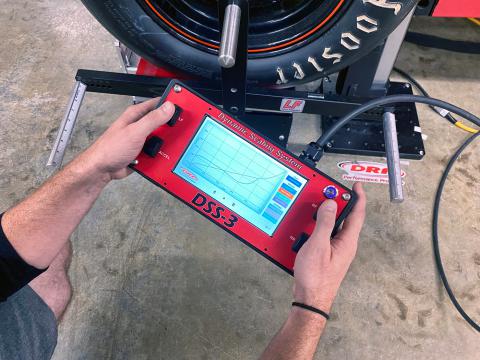
Measuring the rate of wheel load increase on a pull-down fixture is called the wheel load curve, which indicates the likelihood of grip loss.
A proven system for gathering and analyzing data will help determine the best adjustments for your vehicle.
Like building a race-winning engine, race car handling is very complex. Teams struggle to master chassis setup week in and week out all over the world and in all types of racing applications. This is because many drivers don’t even know what a good handling race car should feel like. All they know is that it’s a battle. And, when teams “hit it” and find a good setup, they often can’t repeat it after the car gets damaged. Setup work becomes a little like “black magic” at that point.
But setup work shouldn’t be a battle. And it’s not black magic. The problem is we’ve all been guilty of taking shortcuts. Rather than taking the time to analyze data to find the appropriate solution, we call “our guy” and ask what to do. I often ask, “What would happen if you ran your business like you run your race team?” The answer: You would go out of business (or, at the very least, make a lot less money).
Like your business, your race team needs a system—a proven approach to gathering and analyzing data with processes to implement the setup adjustments needed.
Where To Begin?
Chassis setup can be broken into two categories: balance and wheel positions. The crew chief’s job is to set up the race car to obtain the optimum balance for the driver and the optimum wheel positions for the track and tire. Let’s dive a bit deeper into these topics.
Vehicle balance: The race car’s balance, which determines how the car rotates and maintains traction through turns, is driver-dependent ranging from loose (oversteer) to tight (understeer). Spoiler alert: If you put a driver with a preferred balance in an identical car with the opposite balance, the driver won’t be happy (or win).
Dynamic vs. static balance: Traditional setup procedures measure the vehicle’s balance on wheel scales at ride height (natural relaxed position of the suspension). This is effective, but it requires tremendous discipline. This is because you can adjust the balance statically to whatever you want it to be, but that doesn’t take into account important factors such as spring rate, dynamic platform, bump stop loads, sway bar loading, droop limiters, and binds. This is why you can have two cars with the same static wheel weights and percentages in the shop but handle completely different at the track.
Another option is to measure the vehicle’s balance in a loaded state, like it would be on the track. Many providers, including DRP Performance Products, do this by using a pull-down fixture to motion the chassis to a position it would see on the track at certain points, such as corner entry and apex. This allows providers to measure the vehicle’s balance at that point, taking all the factors mentioned above into account. You get a picture of the true balance of the car at that point. You’re measuring the results of your inputs, not just the inputs themselves.
Using a spring load machine allows the user to set the static and dynamic spring loads, expediting the setup process.
What’s Missing?
Common feedback providers hear on dynamic scaling is: “But you can’t induce all the forces that are happening on the track, so your numbers aren’t right.” And you’re right—you can’t mimic every force that’s happening on the track. The good news, though, is you don’t have to. Think of the pull-down fixture as an engine dyno. When you dyno your engine, you’re not accelerating the car just like the driver does. The airflow is not just like it is on the track. The G loads are not there, the engine angles are not shifting as they do on the track. But what you do have is a good, consistent way to measure how much horsepower your engine is making in a controlled environment. That’s what the pull-down fixture does: It allows you to measure the balance of the car, under loads very similar to the track, in a controlled, repeatable environment. Like the engine dyno, it allows you to make adjustments and see how the adjustments will affect the car—all before you get to the track.
Wheel Positions
The other important set of handling inputs are the wheel positions. There’s nothing more important on a race car than the tires. You can work on balance the rest of your career, but if you don’t get the tires pointed in the right direction, you’re not going to have a good handling race car.
Wheel positions include toe, rearend position, camber, caster, stagger, tread width, and more. Like vehicle balance, wheel positions are best measured dynamically as well. Wheel positions, however, are adjusted to what the tire needs to make the most grip. This will vary depending on the tire and track condition. Higher banking, higher grip tracks will need higher camber and air pressures. Smaller, flatter tracks will need less camber and air pressure, but more rear steer.
Spring rate affects platform, which is an important component of balance and wheel positions.
The Ideal Situation
With the technology available today, a short-track team can show up at the track, unload fast, and make only minimal adjustments with all the work done in the shop. Adjustments are pre-determined, and guessing is eliminated. DRP recently had a customer who had top-of-the-line equipment but had resorted to some shortcuts in the setup process. In the busyness of race season, this person failed to test changes in the shop. At the track, the changes weren’t bad if the track had grip. As soon as the grip was lost, the car went from decent to junk. Back at the shop, after testing the setup on a pull-down fixture, this customer found the left front was more than 500 pounds lighter than it should have been, and the rearend had negative steer. No wonder the car got tight! This racer optimized the right rear travel, added some travel to the left front, and had a completely different race car. That’s to say the bad weekends could have been avoided with proper testing.
The Bottom Line
Everything on the race car works together as a system. You need the tires at optimum position and the loads balanced to the feel the driver wants. With the right measurements and the right system to interpret them, you can come really close to mastering the art of chassis setup...and do it in the comfort of your own shop.
Lynnie Doughton is the chief steward of DRP Performance Products based in Bassett, Virginia. DRP manufactures advanced setup equipment and premium low drag hub components for the automotive racing industry. With more than 30 years of full-time racing experience, Doughton is passionate about making it easier to race competitively, growing car counts, and prospering our sport.
This trailblazer leads by example, establishing an IndyCar team featuring women in prominent roles—including the driver—and working to bring greater diversity to all aspects of motorsports.
Beth Paretta didn’t set out to be a revolutionary. She studied broadcasting and film in college, and then went to work in the hustling environment of new car sales at auto dealerships. From there she climbed the ladder in business development at Volkswagen of America, then Aston Martin, and finally Fiat Chrysler Automobiles, where she ran marketing and operations for the company’s Street and Racing Technology (SRT) division and its racing programs.
It was there, working simultaneous efforts in NASCAR, Trans-Am, and IMSA, that she really learned the business of racing. Under her direction, SRT teams won three national championships in GTLM, Trans-Am, and the NASCAR Xfinity series. In that role, she made the connections needed for her next big idea—to run her own IndyCar team and set an example for all of racing. After an initial effort in 2015–2016, she’s back with a whole new team this year, consisting of about 70% women, including Simona De Silvestro in the driver’s seat.
We recently sat down with Paretta to ask how she got here, how she finds value in diversity, and where it’s all headed.
PRI: How did you get to where you are today?
Paretta: In high school and through college and grad school, I worked in the Alpine skiing business. But when I graduated, I didn’t want to work in something dependent on the weather, so I pivoted to my other love: cars. I literally walked into a dealership and asked for a job. I remember saying to the general manager that I’d like to learn how this business works, so I would come in on my days off and sit next to the service manager and the parts man.
One day an Audi factory rep came in. I mentioned that I was trying to learn all the facets of the car business, and he asked for my resumé. Two weeks later I had an interview for a job with Volkswagen Credit. They plucked me out of obscurity to go work on the finance side. This gave me a fantastic foundation because I learned it all from the ground up. From there I went to Aston Martin, and then I got hired to run marketing and operations for Fiat Chrysler’s SRT division. That job involved overseeing motorsports.
I wound up changing the way that we were supporting the NASCAR program internally, and we won the championship with Team Penske in 2012. That was Roger Penske’s first Cup championship, and it was the first time Dodge had won since 1975. It was a big deal!
Consistency is the goal of Beth Paretta’s IndyCar team, she said. “I want to have a multi-year full-time team because that’s the only way you’re going to get results. Stability leads to success in racing.”
PRI: A lot of people work at the highest levels of the auto industry and even manage racing programs, but forming your own IndyCar team is a huge step. Why did you do it?
Paretta: It’s funny because somebody asked me, what made you think you could do this? And I don’t mean to sound dismissive, but it literally never occurred to me that I couldn’t. The idea started with the Indy 500 because you can do it as a one-off race. That uniqueness was the spark of the idea, but it’s no different than running any other business, really.
PRI: The unique thing about your team is the number of women you employ. Tell me about that.
Paretta: I saw firsthand that there weren’t a lot of women involved in racing, but I knew there was room for more. I also saw that car companies were lamenting a serious talent shortage. Engineers were retiring at a faster rate than they were being backfilled. A lot of institutional knowledge was going out the door.
That’s when I connected the idea of using racing to solve the problem. We need to get more people to want to do this for a living. How do we do that? What if we start talking about skills and technical careers to kids? Yes, racing is a sport but we can use it to get your attention, and you can use these skills to make a living.
Then someone asked me about a women’s team for the Indy 500. Since it could be a one-off, I thought, “Why not figure out how I can make this work?” So I left Fiat Chrysler to work full time on making it happen.
PRI: You got early support from Roger Penske.
Paretta: I’ve known Roger a long time, so when he bought the IndyCar series and announced this diversity push, I called him. My intention was to start an LMP3 team, then move to Indy Lights, and then IndyCar, to properly grow. But then I met with Roger and told him what I was thinking. He asked me, “Why not just do IndyCar now? Let’s work together.”
PRI: Do you think you would’ve gone for a women’s team without that diversity push?
Paretta: Yes. When I was trying to do the Indy 500 in 2016, it was supposed to be a majority women’s team. That was always the plan. I wanted to use the team to showcase the many roles women can have on a team. I knew women respond to seeing other women, so our team is meant to be a visible example. IndyCar’s diversity push made it easier to have the conversation, but I was already working on this.
“We’re going to be a curiosity,” Beth Paretta admitted about her IndyCar team with a female majority. “There’s going to be people staring at you while you’re at work. Drivers are used to that, but mechanics and engineers aren’t used to being stared at.”
PRI: Driving race cars is very glamorous, but it’s good to hear you talk about bringing new people into every job on the team.
Paretta: Everyone says there’s no people. Well, are you investing in new people? Because it’s actually your responsibility to do that. We hire men, women, whatever. I don’t care if you’ve got stripes or leopard spots. If you’re good, we’ll hire you, and you could have a 30-year career.
If you have that passion and that love for racing, there’s a place for you in this sport. This is why Lyn St. James and I started Women in Motorsports North America (WIMNA), to try to profile all the jobs. How about running a race track? We don’t talk about the layers of racing, like being an official or being safety personnel. All of those things make the show happen, and all of those people love racing as much as we do.
PRI: Do you think being a woman has helped you in your career?
Paretta: I think in some ways being a woman has helped me only in that you remember me. I used to joke about this when I was at Aston Martin. In a given day you might meet 10 Daves and you met one Beth. Don’t get me wrong—I have to be able to do the job. I have to know my stuff. Being a diversity candidate might get you an interview, but it’s not going to allow you to keep a job. At the end of the day, especially on a race team, you can’t phone it in.
PRI: What goals do you have for your team?
Paretta: My goal for our team is to run full-time because that’s the only way we’re going to get results. You can have small lineup changes here and there, but it’s the consistency on track that only comes with time that leads to success in racing. I always say, I don’t want my team to be 100% women. I want women on 100% of the teams. I want to see more women and more people of color on all the teams.
PRI: How can the racing industry support WIMNA?
Paretta: We’re going to have a jobs board. If you’re looking for talent, come to us! We can help you create a job posting and try to direct people your way.
We’re also mentoring young women. If we ask you if someone within your organization can do a mentoring session, please say yes because we’re trying to reach high school students who are considering getting into the sport and young people who are just finishing university or are early in their career and might want to make a pivot.
Another thing we hope to do is offer microloans. Let’s say you want to hire somebody as a junior engineer at your race team. Your team is based in Indianapolis, but they live in Seattle. They need to move, but they need to break their lease and get a new place and pay their first month’s rent. Literally, giving somebody a small loan or grant of $5,000 could ease their burden and change their life. Things like that are low-cost solutions that would really help someone on their journey.
WIMNA is really meant to be a resource for information. If you’ve got a program within your organization that you want us to highlight, let us know so we can help you get the word out. And if you’re inclined to support us, we are a nonprofit, so you can donate directly.
Simona De Silvestro is the driver on Paretta’s IndyCar team. She’s seen here at the Sonsio Grand Prix at Road America in June.
PRI: What are the big challenges to make all that happen?
Paretta: Getting the word out. We want women to share their knowledge and experiences, to help younger women navigate the early years of their career. Answering questions like: What happens if you take a break to have children? Do you leave for a couple of years? Do you go back and forth in between? Those are real considerations for people, and it helps to talk about it with people who have gone through it. There are three women on my team right now who are new moms. Between them, they have an 8-month-old, a 9-month-old, and a 10-month-old. One of the women is nursing. So this weekend, at the race track, we had to find a place for her to pump and freeze her breast milk. The team had to solve for that and we did, and at first, I don’t think any of the guys on the team knew that was going on, but we got it sorted. Women are resourceful.
PRI: Let’s imagine a future where WIMNA is completely successful. What will that look like?
Paretta: I think just more women on all teams across all roles, across all series working at all tracks. Let’s just get more good talent! This isn’t about women at the expense of men. I’m always very careful to remind people of that. It’s not about taking someone else’s seat at the table. It’s about building a longer table. We’re better together. Case in point: I’m not trying to replace a team. We’re an additional team.
It’s funny, last year I got a note from a guy that said, “Okay. So you’re saying if a woman and I apply to your team and we’re both equally qualified, she’s going to get hired before me?”
I said, “Yes.”
He said, “Well, that’s not fair. That’s bullshit.” I said, “Now you know how we feel.”
This is literally the stuff that’s been happening for hundreds of years. The way that you felt in the pit of your stomach and you were angry; sit with that for a second. That’s literally how we’ve been living. So many people are blind to the fact that this actually has happened. That’s why there’s been anger, frustration, disappointment.
Roger Penske, at right, was an early supporter of Beth Paretta’s efforts to build a race team staffed primarily by women. His diversity push for IndyCar prompted her to start the conversation, and he encouraged her to jump straight into IndyCar.
PRI: Has the IndyCar organization been welcoming to you?
Paretta: IndyCar has welcomed us. We have seen the data from last year of the uptick in women viewers as well as those who said that they’ve been fans for less than 12 months. You can draw a pretty easy dotted line from that to our entry in the series. So, viewership is up. Does that help Ganassi and Andretti and Penske? Of course.
PRI: If you could write your future Wikipedia entry, what would be the first sentence?
Paretta: I would probably lie about my height! Seriously, I would just say, automotive and motorsport professional who endeavors to make it better for everybody.
PRI: And won the Indy 500 along the way?
Paretta: Listen, if I can kiss those bricks again, that would be amazing. I’ve kissed the bricks in NASCAR and IMSA. If I could kiss them in an Indy car, that would be quite the trifecta! So it would say, Beth Paretta, three-time brick kisser!
“IndyCar has been a welcoming experience,” claimed Paretta Autosport team owner Beth Paretta, “and we couldn’t do it if it wasn’t.” She is seen here at right, with driver Simona De Silvestro, center, and Ed Carpenter, left, at the Honda Indy 200 at Mid-Ohio in July.
PRI: What leadership traits have you learned along the way that you incorporate into your day-to-day interactions with your team?
Paretta: I try to always be available to my team, so they know that I’m there to support them, to make sure that they have the tools they need and that they’re given clear direction. I’m not a micromanager by any means, but it’s that idea that you know that I’m there if you need me.
Last year with our team, some of the women hired were completely new to racing; completely green. The elephant in the room was that our team was going to be a curiosity. There may be people staring at us while we’re at work. Drivers are used to that, but mechanics and engineers are not. Also, we’re carrying the weight of the gender on our shoulders. If you make a mistake in the Indy 500, it’s like, do we deserve to be there? Literally, if we drop a gun and the Andretti team drops a gun, it’s the same mistake, but obviously there’s this added pressure. So, I’m definitely a bit of a mother hen and protective of our people!
PRI: Is there anything that I haven’t asked that you would want to say?
Paretta: If I look back at my career, there were three times when I was being hired where in the interview, people said, “We’re going to take a chance on you,” like I was a risky bet. It’s funny because I know I was never the risky bet. The point is sometimes, taking what you might think is a risk isn’t really a risk; you just have to be willing to do it. Hire someone who doesn’t look like you. As long as the interest and the passion is there and they have the aptitude to learn, teach them the skills. I would tell anybody reading PRI Magazine, “You’re building parts in your race shop, why not build some people too?”
Detroit, Michigan-based Ford has revealed the all-new seventh generation Ford Mustang, described by the automaker as “the most exhilarating and visceral yet, from its fighter jet-inspired digital cockpit to new advanced turbocharged and naturally aspirated engines to its edgier yet timeless exterior design.”
“Investing in another generation of Mustang is a big statement at a time when many of our competitors are exiting the business of internal combustion vehicles,” said Jim Farley, CEO of Ford Motor Company. “Ford, however, is turbocharging its ICE growth plan, adding connected technology, opinionated derivatives, and hybrid options to our most profitable and popular cars—all in the Ford Blue family—on top of investing $50 billion in electric vehicles through 2026.”
In addition, Ford has announced GT3 and GT4 versions of the seventh-generation Ford Mustang, which are scheduled to race in IMSA.
The Mustang GT4 will be eligible to compete in 2023 in the IMSA Michelin Pilot Challenge’s Grand Sport (GS) class and in the new IMSA VP Racing SportsCar Challenge’s GSX class. The Mustang GT3 is set for IMSA WeatherTech SportsCar Championship competition in the GTD PRO and GT Daytona (GTD) classes starting in 2024.
Likewise, a new version of the Mustang will debut next season in the Australian Supercars series, and in coming years, newly designed models will debut in the NASCAR Cup series and NHRA Factory X racing.
The Fédération Internationale de l’Automobile (FIA)—the international motorsports association based in Paris, France—has appointed US-born Natalie Robyn as its first-ever CEO.
“I am delighted to be appointed the first-ever CEO of the FIA at such an important and exciting time for the Federation,” Robyn said.
Robyn, an international executive, holds over 15 years of experience in both the automotive and financial sectors. Prior to joining the FIA, Robyn had a variety of senior management positions at Volvo, Nissan, and Mercedes-Benz Group AG, formerly named DaimlerChrysler.
In this new role, she will be responsible for “the successful operation and financial performance of an integrated and aligned FIA administration, as well as driving the overall strategy to deliver the leadership’s vision of reform the Federation,” officials from the FIA stated in a release.
Natalie will also help develop new commercial growth plans to increase and diversify the FIA’s revenue streams.
“[Natalie] has a proven track record of delivering diversification and growth, as well as developing executive leadership capabilities, which will be an extremely valuable asset to the FIA and our Members, and I welcome her to the team,” said FIA President Mohammed Ben Sulayem.
In addition, the FIA has also announced the creation of a new FIA Presidential Awards program to honor and celebrate its FIA Member Clubs. For more information on the FIA President’s Awards, visit the announcement here.
 MEMBERSHIP LOGIN