Total Seal, Melling, and the National Hot Rod Association (NHRA)—all PRI Members—have volunteered to host “React4Racing” at the 2022 PRI Show. As a part of the Save Our Racecars initiative, React4Racing gives PRI Show attendees the opportunity to test their reaction times against some of the best race car drivers in the industry.
Total Seal and Melling will have two Pro Stock race cars next to each other at their booths at the 2022 PRI Trade Show. Set up in each booth will be Christmas Tree replicas, allowing PRI Show attendees to learn more about Performance Racing PAC while testing their reaction times against professional NHRA drivers.
“This group of PRI Members are going above and beyond for the racing industry, and the fact that they are willing to dedicate their own time and booth space to make this happen, demonstrates just how important the Save Our Racecars initiative is to the industry,” said PRI President Jamie Meyer. “I will definitely be stopping by to test my own reaction time!”
“When I heard about Save Our Racecars, I knew we had to get involved and find a way to help,” said Total Seal’s Lake Speed. “Fortunately, the guys at Melling are straight across the aisle from us at PRI, so that’s how we developed the idea for React4Racing. We can’t wait to see it launch at this year’s PRI Show”.
“The idea for React4Racing started at last year’s PRI Show,” said Melling’s Mike Osterhaus. “We believe it will be a great way to increase awareness for the Save Our Race Cars initiative. Even though we are competitors on the track, we are friends off it who are working together and committed to protecting the racing community. We look forward to seeing everyone at the PRI Show.”
The Performance Racing PAC helps elect lawmakers who support the racing industry’s positions and priorities. All eligible PRI Individual Members at the PRI Show will have the opportunity to participate in React4Racing, which is taking place at the Total Seal and Melling booths from December 8–10, during the 2022 PRI Show in Indianapolis, Indiana.
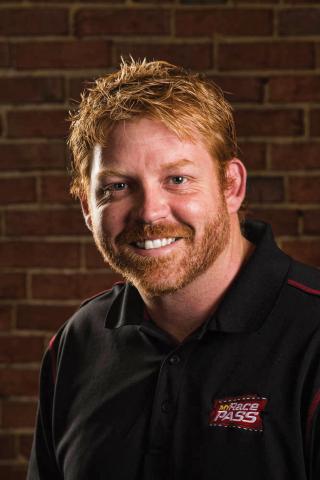
“It’s all about fan engagement,” said Josh Holt about MyRacePass.com, a one-stop digital assistant for racers, track operators, series organizers, and race fans.
This one-stop clearinghouse for digital services connects race promoters, sanctioning organizations, drivers, and even race fans.
Few people who haven’t actually done the work can have a full appreciation of what a track or series operator has to face on a weekly basis. A promoter has to sign in racers, get scoring procedures in place, create race lineups, issue results and press releases, and sell merchandise. All at once. It can be frustrating and intimidating. To all that, now add the racers who want to market themselves, connect closely with fans and, again, sell T-shirts and things to pay the bills. Wouldn’t it be great if a digital clearinghouse existed to do all these things at once?
Thanks to three guys who came off the prairie, it already does. MyRacePass—or to use its online handle, MyRacePass.com—is an entrepreneurially driven, one-stop mega-market of digital assistance for racers, track operators, series organizers and yes, just plain fans. This PRI Founding Member traces its roots back to 2008, when three oval-track fans who liked technology began piecing together a service to create websites for drivers. That trio is Josh Holt, Zach Calmus, and Ross Van Eck, who today offer a one-stop clearinghouse for digital services at MyRacePass out of Lincoln, Nebraska, on what today has come to be known as the Silicon Prairie.
“Eighty percent of the race series in the United States were touched by MyRacePass last season alone,” Holt said. “We have the World of Outlaws, the Lucas Oil Late Model Dirt Series, and USMTS. At the end of the day, we’re a software company. We do everything from race management systems to online ticketing to building websites, and we try to be essentially the suite for grassroots tracks, racers, and motorsport operators. We try to make things more efficient for promotors and scorers, with fan engagement as a byproduct. We want to get fans engaged in what’s in front of them.”
MyRacePass, and its partners, essentially started out custom-building driver websites under the name Driver Website in 2008. Within four years, the partners learned to expand their marketing when Holt, who raced karts and winged sprint cars, took over operation of Rock Rapids Speedway in Rock Rapids, Iowa. That was when the partners realized that track operations could also benefit from a menu of digital assistance, which in 2014 proved to be the real birth of MyRacePass as it exists today.
The digital services it offers include real-time timing and scoring, competitor sign-in, pit assignments, schedules, ticketing, point standings, results, and merchandise sales, all constantly updated, most recently through the MyRacePass app that’s available for download through the Apple and Google stores. The digital services have the capability of being linked to individual driver websites, which MyRacePass also creates, or sites for sanctioning groups or touring series. In many cases, fans can shop for a driver T-shirt or cap while perusing just-updated results or standings that MyRacePass prepares and constantly revises.
That type of race-management and statistical software support is what MyRacePass does constantly. Holt explained, “What we’re doing here is taking the people in the scoring tower and essentially turning them into marketing people for the track. Our race management software evolved to the point where promoters could use it for online registration, even pre-COVID-19, doing lineups, handling results, payouts, and point totals, which are also tied to the driver websites. We have a very wide lineup of available tools for ticket sales and apparel orders. Fans can go to the track or driver website and buy what they want, get it in two weeks, and the profits go to the track or the driver.
The digital services for tracks offered by MyRacePass.com include timing and scoring, competitor sign-in, pit assignments, schedules, ticketing, point standings, results, and merchandise sales.
“I like to use Friday-night high school football as an example,” Holt explained. “It’s all about fan engagement. That’s what we’re trying to do, make it more efficient and as fast as possible.”
Holt added that in today’s environment, any business faces multiple challenges, but he cited the ongoing evolution of motorsports as the most enduring. “Things change in motorsport. Things change in safety, in technology, and at MyRacePass, we want to be able to roll out updates to our software. The last two years, COVID-19 taught us a lot, but for us, the biggest thing is just how we manage change. Online ticketing was big for us because during COVID, there were speedways that weren’t allowed to exchange cash. That opened eyes that as an industry, we’re able to do things in different ways, and as a software company, we’re trying to stay ahead of that. There were some states that didn’t like the lineup board, but with the MyRacePass app, they can look at the lineup from their trailer.”
What concerns Holt most about industry health isn’t a specific single issue, but rather, the industry’s ongoing ability to adapt to change at a dizzying pace. “I don’t know if it’s a concern, but making sure the promoters are open to ideas of change is important, just to make sure that all of us, regardless of the part of the industry, are able to adapt,” he explained. “There’s more racing, more mid-week events, and yet we’re dealing with tire shortages and other shortages. Racers will always find a way. The biggest question is always, ‘What’s next?’”
Holt said that becoming a PRI Founding Member has represented a substantial investment for MyRacePass, which in turn represents a dedication to maintaining a long-term, serious presence in the industry. “The PRI Show is the show for motorsports,” he said. “I support PRI and the things it’s doing, like the lounge for promoters where they can learn the newest and greatest things. PRI for us was a 10-year commitment. It’s a way to show the industry that I have that kind of commitment, as well. I wanted to be a Founding Member to show the level of commitment I have to the business, that we’re here to stay and we want to grow that industry. It’s all about introducing people to people.”
In addition to Membership, the ability to attend the PRI Trade Show has been beneficial in helping MyRacePass line up contacts with tracks, racers, and series. “We’ve been going to the Show since 2014,” Holt said. “In motorsports, that’s the show, no matter what your level. When you think trade shows, there’s only one. If you need to talk to certain people in this industry, you can do it at PRI.”
That kind of close contact has taken MyRacePass toward its next frontier of expansion, into drag racing. By his own admission, all three partners were neophytes when it comes to straight-line competition. Holt gave copious credit to Michelle Lackey Maynor, who operates a drag strip and asphalt oval at Alaska Raceway Park in Palmer, Alaska, with helping them translate their firm’s software catalog into protocols that can benefit drag racers and drag strip operators.
“Michelle has helped us greatly,” Holt said. “It’s no secret that we’re going into drag racing next. We want to help the quarter-miles, the eighth-miles, the Saturday-night tracks, and we’re learning how to get more eyeballs on them. That’s what we’re excited about now.”
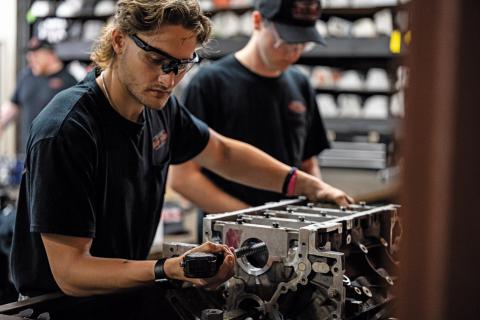
With a focus on high-performance powerplants for traditional hot rods, circle track racing, and the drag strip, this family owned and operated custom shop specializes in the development and production of hardcore speed parts that aren’t available elsewhere. Their engineering expertise keeps Nostalgia racers coming back for more.
By the early 1970s, Ross Lombardi had decided that he was done dealing with substandard workmanship. After years of competing in Oldsmobiles at drag strips in and around Ohio, Lombardi had become known for developing his own race-winning powerplants. That reputation had earned him enough of a following at the track and on the street to start a fledging operation behind his home.
“He just couldn’t get the work done the way he wanted it, so initially he started buying equipment for his own use,” said Ross’s son, Tony Lombardi, who has overseen the day-to-day operations at Ross Racing Engines since 2010. “That was basically the shop’s inception. Not long after that he started doing work for other racers, and suddenly it was a full-time job.”
Now operating out of a 4,000-square-foot facility in Niles, Ohio, Ross Racing Engines has evolved into a true custom shop, building high-performance engines for everything from NHRA dragsters and Super Late Model circle track cars to vintage street machines and boats. The common thread, as Tony explained, has always been the demand for something above and beyond the norm.
“We’ve always worked on a wide range of engines, and we’ve never shied away from developing our own solutions. When my dad started this shop, he was racing Chevrolets, but prior to that he was racing early Oldsmobiles—when I say early, I’m talking the stuff from the late 1940s to the early 1960s. In the mid-1990s when we started to restore his ’49 Club Coupe, we noticed that you just couldn’t find anything for those types of vintage engines. As racers tend to do, we decided that if we couldn’t buy something, we’d just make it instead. So we started to dabble with manufacturing parts, and it just kind of snowballed from there.”
After racing Super Late Models for nearly 25 years, Tony Lombardi switched to Nostalgia drag racing in 2010. “I wanted to do something with my dad,” Ross Lombardi, Ross Racing Engines’ founder. “His heart has always been in the drag race world.”
Creating A Niche
While Ross Racing Engines has always worked on a diverse range of projects, over time the shop has increasingly gravitated toward the nostalgia market. The Lombardis’ deep well of knowledge about early high-performance engines certainly contributed to that, but Lombardi said that other factors came into play as well.
“I ran Super Late Model on dirt for nearly 25 years, but when I took on a larger role at the shop in 2010, I decided to go drag racing instead,” he explained. “Stock car racing is like another full-time job, and it just wasn’t feasible to run the shop and do that at the same time. But I wanted to keep racing, and I wanted to do something with my dad—his heart has always been in the drag race world.”
Tony Lombardi races his Oldsmobile-powered dragster in the Nostalgia Drag Racing League’s Pro 7.0 class. In fact, he noted, “we’ve been in the 6.60s at 204 mph with it.”
Around that same time, the global recession was wreaking havoc on the racing efforts of competitors across virtually all motorsports disciplines, but the younger Lombardi noticed that a few segments were largely immune to economic fluctuations. “The Saturday night guys and racers like that got wounded pretty badly, so we started playing around with a lot more vintage engines at that point,” he said. “At the end of the day, that type of customer just isn’t as affected by those kinds of shifts.”
That led Ross Racing Engines to become a go-to shop not only for vintage racers, but also discerning enthusiasts of traditional hot rods. “It was something we were already doing here and there, but it became a greater focus for us at that point,” he added. “These types of hot rod builds tend to be a little more hardcore, and they have hardcore engines to match. A lot of the clientele are ex-racers who know what they want and what they’re getting into. These are folks who’re a little bit older and now have the means to play around with the cars that they wanted when they were kids.”
For decades, Ross Racing Engines has been a dealer for high-end engine components from the likes of Brodix, Crower, and Diamond Pistons; over time, the shop has also fleshed out its own product line to address gaps in the market. “We build stuff like early Hemis, early Oldsmobiles, the Buick Nailheads, and the early OHV Cadillac V8s, and when you get into vintage engines like these, there are some items you just can’t find,” Lombardi said. “So about 15 years ago, we came out with a cylinder head for the early Olds engines. Not long after that we did a roller rocker setup for them, and now we do stroker crankshafts, H-beam rods, forged pistons, hydraulic roller setups, solid roller cams; the list goes on. You can now build an early Olds engine just like you’re building a small block Chevy without using anything from General Motors.”
Lombardi also noted that the shop doesn’t sell partial engines, and while many of these builds are destined for motorsports use, there’s a strong focus on creating combinations that can deliver long-term reliability. “While we sell parts, all of our engines go out the door after they’ve been on the dyno—everything is turnkey. It’s all built to be driven, so longevity is a priority for us. For example, I’ve got a blown 371 Olds in my Model A with about 50,000 miles on it now. We annually drive from here in Ohio to my buddy’s shop in Austin, Texas. It’s a 3,600-mile round trip, and that engine has done the trip six times.”
Ross Racing Engines’ Ohio location is an easy drive to several stock car and sports car tracks, as well as four drag strips. That enables the shop to maintain a presence at a variety of different racing events.
Ross Racing Engines’ manufacturing endeavors also span into other aspects of vintage powertrains. “We do some transmission adapters and things like that,” Lombardi said. “With a lot of these engines, there’s no way to put a modern transmission behind them. We CNC out a lot of parts, so we decided to develop a nice package that would help to make these engines a little more user-friendly.”
The shop has a CNC cylinder hone, four-axis milling machines, and other specialized equipment that allows them to do the vast majority of this work in-house. “We’re pretty self-sufficient, and we’ve always helped out other local shops with jobs that are beyond their capability. At this point the only thing we don’t do here is heat-treating.”
While Lombardi uses Facebook and Instagram to get the word out about what projects the shop is working on, he told us that the shop’s following has traditionally come from word-of-mouth recommendations. He also said that their close proximity to a number of different race tracks helps the shop maintain a presence at a variety of different events. “This part of Ohio is kind of a hub. We can race stock cars on pavement or dirt three nights a week within about a hundred-mile radius of here. There’s also two sports car courses within an hour and a half of here. And as far as drag strips, well, we’ve got two that are less than an hour from here, and another two that are less than two hours from here.”
Those drag strips provide Lombardi with ample opportunity to showcase what his Olds-powered front-engine dragster is capable of, a car he’s been campaigning in the Nostalgia Drag Racing League’s Pro 7.0 class since 2015. “It’s the quickest and fastest early Olds out here. We’ve been in the 6.60s at 204 mph with it, which is pretty damn good for that type of motor,” he noted. “When I decided I was going to go drag racing, I initially planned to build an AA Gas car or something like that. But I realized that once you shut the hood on a Willys, you don’t really know what’s powering it. We had put together this really cool hand-built motor, so I decided to go with a dragster because that would allow it to be out in the open where people could see it.”
The Hands-On Approach
Back in 2008, Ross Racing Engines had roughly half a dozen employees, but these days it’s a simpler operation. “My dad still comes in every day, so there’s one other employee,” he quipped. “Over time folks moved on to other things, and we just never replaced them.”
He said that it can be tough to find good people, and sometimes it can be more of a hassle than it’s worth. “What my dad did and what I’ve tried to do in the past is find people that we’d like to train. We didn’t want to bring in someone else’s bad habits, and we tend to be picky about how we want things done.”
Ross Racing Engines has become a go-to shop not only for vintage racers, but also traditional hot rod enthusiasts. “It was something we were already doing here and there, but it became a greater focus for us,” Tony Lombardi said.
That’s led to a workload that keeps Lombardi at the shop seven days a week when he’s not at the races, but he expects equipment upgrades, like the shop’s forthcoming five-axis CNC machine, to improve production efficiencies while also expanding their capabilities. “When you’re trying to do things like ‘drive around a corner’ in an intake port, you really need to have a five-axis machine.”
The Lombardis’ commitment to their products has led customers like Bob Hilton—a former nitro drag racer who now campaigns a Top Fuel dragster in the NHRA Heritage Series with his son Tyler at the helm—to rely on Ross Racing Engines to keep the team’s engine program ahead of the competition.
“We build a lot of traditional hot rods as well, so we originally got hooked up with Ross Racing Engines through that, and then the drag racing stuff came later,” Hilton said. “Tony works one-on-one with his customers, and the results are phenomenal. These days, any time our car goes to the races, he comes along with us. Honestly, I don’t think I could run it without him.”
PRI President Dr. Jamie Meyer and SEMA Chairman of the Board James Lawrence walking toward the US Capitol
The 2022 midterm election will be held on Tuesday, November 8, and it’s important to know which candidates support racing when going to the polls or voting early. The balance of power in both the U.S. House of Representatives and U.S. Senate is up for grabs this Fall, and the racing community has a chance to shape the outcome of this election. Many races will be decided by less than a couple hundred votes, so please make a plan to vote in this vital election.
When casting your vote, consider the lawmakers that have stood up for the interests of racers and motorsports parts businesses, like those that have supported the Recognizing the Protection of Motorsports Act (RPM Act), H.R. 3281 and S. 2736. This bipartisan bill—which PRI has lobbied for extensively—guarantees the right to modify street cars, trucks, and motorcycles into dedicated race vehicles and safeguards the industry’s right to offer parts that enable racers to compete.
To see a list of lawmakers that have publicly supported the RPM Act and are up for re-election in the midterms, visit saveourracecars.com/vote-racing.html.
PRI’s Vote Racing page also allows you to see voter information; a list of candidates in your region; elected officials that represent you at the federal, state, and local levels; and it provides information on how you can vote early or by absentee ballot.
For more information, visit here or contact erics@sema.org.
What does motorsports look like around the globe? Surprisingly familiar, as we discovered in visits with retailers and service providers from Europe, Australia, South America, and the Middle East.
For all its diversity—with differences in culture, climate, and geography, to name a few—the world truly is a small place. Especially when it comes to racing. The appeal of going fast is nearly universal, as is the satisfaction of going faster than whoever is next to you.
How to beat the next guy or gal to the finish line is also remarkably universal, as we discovered after speaking with racing and performance retailers and shop operators around the world. When we asked which products and companies were favored among their customers, the lists we received included several very familiar names, no matter if the vehicles in competition were being driven on asphalt, sand, snow, or some other surface. Some of that preference had to do with the cachet of US-made components. But more often, it was the quality, reliability, and performance potential of American speed parts that made them attractive to racers the world over.
Australia
American Speed is a retail and wholesale business situated in a 5,000-square-foot warehouse in Moorabbin, Victoria (a suburb of Melbourne). “We supply brands that are used in everything from street cars to the weekend racer,” said Fred Solazzo. “Our market demographic is no longer the serious drag racer, dirt track racer, or circuit racer, but more the folks who are club racers or street car owners who drag race at street meets held at a local drag strip.”
The “hardcore racers,” he said, “often source their products, such as custom pistons, fuel systems, engine blocks, etc., directly from US-based manufacturers and suppliers. Our professional circuit track racers, such as V8 Supercars teams, predominantly manufacture their own products within their own facilities, much the same as your NASCAR teams would.”
American Speed, a retail and wholesale performance supplier near Melbourne, Australia, operates out of a 5,000-square-foot warehouse. It also promotes its business by attending car shows, including the prestigious MotorEx at the Melbourne Showgrounds.
Solazzo imports performance products from the US and Germany. His most popular products include Borla exhaust systems and mufflers, Injen cold air intake kits, and components from American Racing Headers, Edelbrock, COMP Cams, Mantic Clutches, DW (DeatschWerks), Ferrea, Eagle, and Boundary Engineering, plus Vogtland sport suspension kits and coilover kits from Germany.
“We here in Australia are basically the same as the US when it comes to the variety of motorsport options,” Solazzo said. “Where we are, based in Victoria, we have two fantastic road circuits, Sandown and Phillip Island. We have just one drag strip left here in our state, and it is miles away from much of Melbourne. On a national basis, most of our states have at least one drag strip and a number of great circuit racing tracks, with the most popular circuit track being Bathurst, which attracts race teams from around the globe.”
One difference he has seen between the two countries has to do with racing sponsorship. “Sponsoring racers, especially drag racers in Australia at any level, is certainly different from what I have seen in the US. Here we have found that many are happy to get your product as a freebie but give very little back in the way of product endorsement or promotion of your brand. As such, many performance parts suppliers or brands have pulled away from sponsorship of drag racers and lower ranking circuit racers.”
Solazzo promotes American Speed by attending “a number of shows,” but he acknowledged that “the pandemic killed that for all shows the past two or so years. This year we displayed once again at MotorEx here in Victoria. The show attracts show cars, street cars, and race cars.”
Car shows weren’t the only aspect of his business affected by the pandemic. “For us and many others, importing has become an extremely expensive business,” he explained. “The pandemic has made it extremely hard, with manufacturers in the US constantly being short of product, manufacturing delays, massive cost increases, and shipping delays.”
Borla is just one of the American companies that American Speed imports products from. Its customers are “the folks who are club racers or street car owners who drag race at street meets held at a local drag strip,” said Fred Solazzo.
As an example of the challenges he faces, he told us about a “load of product we had ready back in mid-February of this year. We had already made payment. Our shipping brokers tried to secure a 40-foot container so the products could be loaded and shipped to a port in the US. Then they make a booking with shipping lines in order to get vessel space. Once vessel space is confirmed, they send a container to be loaded. It took 10 weeks to finally get a booking and have the container loaded onto a vessel. Add to that a minimum of a four- to five-week sailing time to Australia. We then get hit with a further week for quarantine due to the brown stink bug that is prevalent in the US that time of year. So our money has been sitting out with zero return for five to six months. Prior to the pandemic, shipping times were like two- to three-week delays in the US and four weeks sailing time.”
Europe
For perspective on the European racing market, we received feedback from two Scandinavian companies.
“American cars have always had a strong foothold in Sweden,” said William Hansen of Hansen Racing, Stockholm, Sweden. “In the early 1950s, hot rods were built from American models in Sweden. Swedes got inspiration and guidance for the car hobby via American car magazines that were sold in Sweden. Some enthusiasts went over to the USA themselves to check out the latest in the industry and brought the information with them to inspire other Swedes.”
In 1966, Carl, Sessan, Zefir, and Mistral Hansen founded Hansen Racing in a basement shop in Östermalm, Sweden. “Carl’s founding ideals have remained within the company,” Hansen said, “and we have continued selling performance and replacement parts with high service and expertise for American cars.” He is among the third generation of Hansens running the company, with relatives Ken and Ted.
Hansen Racing today is part of Hansen Group, which has become “one of Europe’s largest and leading distributors of car parts and accessories for American vehicles,” Hansen said. The team consists of 70 employees, and the company’s 150,000-square-foot warehouse stocks more than 60,000 part numbers.
Hansen Racing works with “all the top-brand suppliers in the US,” including Aeromotive, ARP, Auto Meter, EBC Brakes, Edelbrock, Energy Suspension, Ford Performance, FiTech, Holley, K&N, Lokar, Magnaflow, Moroso, Painless Wiring, PerTronix Ignition, Powermaster, and Scat. Orders are consolidated in Atlanta, Georgia, and shipped in 40-foot containers on a weekly basis to the Hansen warehouse. “Availability and service are key for the operation, and our logistics allow us to replenish inventory and provide fast deliveries.” When necessary, Hansen places orders by air freight daily from the US.
Hansen Racing of Stockholm, Sweden, is part of Hansen Group, which has become “one of Europe’s largest and leading distributors of car parts and accessories for American vehicles,” said William Hansen. “With more than 700 retailers, Hansen Racing offers customers easy access to a wide range of products.”
“There are all kinds of branches within Swedish motorsport,” Hansen said. “Here you can find everything from formula car racing to beginners in karts.” He said Folk Racing, or Folkrace in Swedish, “is one of the most popular. It’s an inexpensive, entry-level form of Nordic rallycross that originally comes from Finland. It was developed to meet the demands of amateurs to compete in car races. Thanks to its rules, finances can never be the deciding factor in who wins. In addition, there are no qualifications or other obstacles that exclude those who want to participate in the competition.”
Drag racing “is also very popular. The first official race in Sweden was held back in 1968. Today, drag racing has many spectators, and competitions are being held from ‘street’ cars to Top Fuel dragsters.” For its racing customers, Hansen offers a wide range of performance products, as well as accessories, spare parts, and safety gear.
The pandemic was challenging for Hansen Racing, “with both changing consumption patterns and transportation options. As countries shut down, production in factories and ports decreased. As a result, the shipping companies reduced the number of vessels to reduce their financial losses. We felt this as most of the goods we import are transported on sea. When production resumed, shipping companies still had lower capacity, which led to major imbalances in the container flow. This caused prices and delivery times to increase.”
Air freight was also “greatly affected. Passenger flights, on which a large part of the goods is normally transported, came to an abrupt stop due to the pandemic. The reduced capacity also increased prices significantly.” In 2022 Hansen said the company is experiencing increased fill rates on orders and faster deliveries, “but prices remain high.”
Norway’s Aarnes AS Amerikanske Bildeler has a long history with drag racing, said Anders Back. Four of its employees are active drag racers, and it sponsors a total of eight teams in Norway, including Small Tire competitors Alice Hauge (near lane) and Andreas Ruud.
Norway’s Aarnes AS Amerikanske Bildeler was founded in 1954 as an engine shop, said Anders Back. In 1975, the company’s main business shifted to selling car parts for American cars only, and the engine part of the company was sold.
“Today, we have 14 employees,” Back said, including 10 in sales and two at the warehouse. “Our main business is the typical service parts, such as brake parts, oil, filters, suspension parts, etc. But we also sell a lot of performance parts for road cars and in motorsports. We are the distributor of many famous motorsports brands from the USA, such as Holley, MSD, Allstar, Edelbrock, Racepak, Earl’s fittings, Moroso, Lucas Oil, Rislone, Pennzoil, Quaker State, Simpson, and many more. If we don’t have it in stock, we provide it from one of our US suppliers.”
Back said those brands are popular in Norway “for many reasons. They are old, established brands in the USA, good quality, and they are promoted on car shows on TV all the time.” Aarnes buys most of its parts “directly from the big companies in the USA, but we also have a cooperation with Motor State and Keystone. They are big within the racing parts arena.
“We meet our customers’ needs by having the ‘basic’ parts in stock,” Back continued, “but we also supply parts from our suppliers in the USA weekly in the racing season.” He admitted that “it is almost impossible to have everything in stock,” and that was a particular problem during the pandemic. “Our suppliers did not have the materials to make parts with.” The situation “has gotten better now, but we can still see problems.”
The company has a long history of experience with drag racing, Back said, “and four of our employees are active drag racers today.” He is one of them, racing a Top Sportsman C5 Corvette. “Our company has for many years been sponsoring drag racers and is today one of the main sponsors of Norway’s only drag racing strip, Gardermoen Raceway. We are also sponsoring eight drag race teams in Norway,” including his Corvette and Thorbjørn Back’s Top Sportsman C2 Corvette.
Middle East
Saif Beljaflah said his Underground Performance Garage in Dubai, UAE, has been in business since 2012, “and it is very popular in the Middle East. I get cars from all around the Gulf area. We build high-horsepower engines, race half-mile races and drag races.” His was the first shop to build a Nissan Patrol drag car “that hit 7.20 at 190 mph in the quarter (4.4 in the eighth mile). That was a world record, which got me a lot of media in the region.” He also built a 2,160-hp Patrol engine “from a cast block with a manual gearbox” that ran 198 mph in a half-mile race.
Nissan’s Patrol SUV is the most popular vehicle in his area, and its 4.8-liter six-cylinder engine “is easy to modify, easy to fix, and it’s multi-use. In off-road and drag racing we love this engine because it can be super quiet and very smooth—driving like stock—even with 1,400 horsepower. It makes super sleeper cars. One car can do camping and off-roading during the weekend, and on the way back home it can race a Ferrari. Or be a family car if needed. That’s the beauty of it.” Also popular are full-size American pickups like the Chevrolet Silverado, and cars such as the Nissan GT-R; hot four-cylinder cars include the VW Golf.
The preferred form of motorsports in Beljaflah’s area are sand drag racing and half-mile racing. Traditional drag racing is “very low profile” and less attractive to younger enthusiasts, “so most modified cars are mostly street users.”
The Nissan Patrol SUV is a favorite among customers of the Underground Performance Garage in Dubai, noted Saif Beljaflah. Its 4.8-liter six-cylinder engine “is easy to modify, easy to fix, and it’s multi-use.” This twin-turbo engine was built for a daily-driven Patrol; Beljaflah has squeezed as much as 2,160 horsepower out of the engine for racing.
Beljaflah said “we trust a few brands” at his shop “for their long-life products.” Among them are Garrett, Turbosmart, Tial, HKS, GReddy, Precision Turbo, Albins (for its gearboxes), OS (clutches), Vibrant Performance, K&N, Aeromotive, Diamond Pistons, and CP-Carrillo.
“Racing parts from the USA are mostly not profitable to sell due to high shipping charges,” Beljaflah said, “and racing parts shops here are lowering prices as much as they can to compete with each other, which hurts us. I buy my products from USA directly with no margin to sell. After the pandemic we are short of many products, like pistons and engine gaskets, etc. As soon as we can buy a big quantity, I buy it for the season, as our season is only during the winter, October to April.”
Beljaflah said he wishes the brands he buys from would “remove dealers from our area and make it a vibrant, non-dealer, distributor-only option for shops that have a license and can buy in quantity. That would make me a 30% profit on my sales.”
LATIN America
“With offices in California, Peru, and Colombia, ASAP Trading USA partners with US-based companies to represent and sell performance, racing, and off-road products in Latin America and the Caribbean. “We offer personalized attention, service, and negotiate good prices for the importers in the region,” said Ricardo Rebaza. “In the case of Motor State Distributing we work with their internal sales to offer dealers in the region volume pricing. With the manufacturers we represent, we make sure to establish pricing specifically for market. Finally, those brands we distribute are priced taking in consideration shipping, taxes, and duties that importers in our region would have to pay.”
Rally, road racing, drag racing, and drifting are the most popular disciplines in their region, Rebaza said. The parts racers ask for specifically include brake components, fuel systems, driveline components, brake fluid, and fittings from brands that include Allstar Performance, Wiseco and JE Pistons, Fuelab, Cometic, and Redhorse Performance among others.
Of all the companies we spoke with, ASAP Trading USA seemed the least affected by pandemic constraints. “Since June 2020, we’ve seen a significant sales increase in the region,” Rebaza said. “Our biggest problem for importers in the region was product availability in the US, since some products had, and still have, a significant backorder and delays in shipping. Things have improved in 2022. There are fewer stock shortages.”
As motorsports and automotive design continues to evolve, educators across the country are laying the groundwork for the next generation of fabricators, tuners, engine builders, and machinists with new outreach strategies as well as a sharper focus on the latest in-demand skills and technologies.
Racing is getting increasingly high-tech across all levels and disciplines, and the demand for specialized skillsets has never been greater. To reach potential students, trade schools have been modernizing their curriculums to stay on top of the latest developments and bringing awareness to the platforms where these folks are already consuming information.
But different organizations have different goals for their programs. While some are primarily focused on job placement soon after graduation, others intend to provide their students with a broader scope of knowledge that will allow them to identify their specific vocational interests within automotive performance and pursue those further.
These differing approaches impact not only a school’s curriculum, but also the inherent designs of their automotive programs and the strategies that they employ in order to get the word out about what they have to offer.
Lanier Technical College
“Our goal is to expose our students to every aspect of being on a race team,” explained John M. Leverett, the director and instructor for the Lanier, Georgia-based school’s Motorsports Vehicle Technology program. “Our program is kind of road racing-centric, but we do also cover aspects of drag racing and other disciplines.”
At the introductory level, Lanier’s program covers a wide scope of topics that range from safety equipment training to programming engine management systems and the use of data acquisition systems, along with engine building, dyno testing, and fabrication. “In addition to contemporary tube notching and bending, we even try to keep some of the old-world traditions like the English wheel alive,” he noted. “Those skills are disappearing fast, and there’s still a demand for it in racing. There are so many different layers to motorsport, and while we can’t make these students experts at every single aspect, we can expose them to all of it to get a better idea of what they want to focus on.”
Students at Lanier Technical College’s Motorsports Vehicle Technology program are exposed to a variety of racing disciplines, from production-based platforms like Spec Miata to open wheel, drag racing, and circle track cars.
As the former chief engineer for sportscar manufacturer Panoz, Leverett’s background in road racing has helped shape the school’s program, and its close proximity to tracks like Road Atlanta and Atlanta Motorsports Park has played into that as well. In the lab, students have access to production-based racing platforms like the Spec Miata and FR500S Mustang as well as open wheel single-seaters. “We place a lot of our students in IMSA, and there’s just so much road racing going on here in general,” he added. “My job board is packed with opportunities in that realm.”
He noted that other faculty members in the program have backgrounds in drag racing and circle track as well; and with stock cars and vintage gassers among the fleet of project vehicles in the lab, other disciplines are well represented within the program. “We’re able to place students in NASCAR, in drag racing, and other areas of motorsport, but the majority of them end up in road racing. There’s a huge demand at the ‘semi-professional’ level right now. There are a lot of folks who’re putting a lot of money into it, and there are a lot of teams who have stepped up to support them.”
Over recent years, the curriculum has evolved to include a stronger emphasis on technologies like data acquisition, along with EV and hybrid powertrain components, the latter of which is already in use in IMSA racing. “Everything has had to evolve to reflect what’s out there now,” he said. “Data acquisition is basically mandatory now—you’re at least going to have an AiM system in a car. And bringing the hybrid tech in is really important to us. Next year our students will be interning with IMSA teams that are campaigning cars with hybrid technology, so we needed to get that into the curriculum as soon as possible.”
Similarly, while the program’s engine building course focused mainly on American V8s in the past, recent updates were made to provide students with a broader understanding of contemporary powertrain setups. “Now there’s a stronger emphasis on engine platforms like the Mazda MZR, which we were able to get from Formula Enterprise cars when they changed the engine spec for the series,” Leverett said. “These smaller displacement engines are becoming a greater and greater presence within motorsport and elsewhere. We also spend a lot more time talking about forced induction since that has become a huge part of the current crop of engine combinations.”
The majority of Lanier Technical College’s Motorsports Vehicle Technology students get placed in road racing positions, said John M. Leverett, the program’s director. “There’s just so much road racing going on here in general. My job board is packed with opportunities in that realm.”
As a state-run program, Lanier’s Motorsports Vehicle Technology curriculum sees many in-state students coming in directly from high school. For those students, a two-year associates degree can be had for less than $8,000. Some also come in by way of the GI bill, while others have transferred in from four-year schools after realizing that they wanted to make cars go fast.
“Our motorsport program is relatively unique in the country, so there’s a national appeal,” Leverett said. “We’ve been getting more and more students from out of state coming into the program when they discover it.”
That discovery is often made through word-of-mouth, since most of this non-profit school’s marketing is focused on local enrollment. “The only practical way we can get the word out about our program on a national level is through social media platforms like Facebook and Instagram,” he said. “But word-of-mouth also goes a long way in motorsports—it’s just how this industry works.”
WyoTech
Along with WyoTech’s general automotive curriculum, the school in Laramie, Wyoming, offers two specialty programs that are specifically catered toward performance. After students complete the school’s automotive technology core program, they can opt to focus on performance-related topics through the Street Rod program, which gives students an overview of bodywork and fabrication, and the High-Performance Power Trains program, which provides greater insight into tuning engines for peak power and efficiency. WyoTech’s format deviates substantially from schools like Lanier in that the school takes nine months to complete from start to finish, and primary educational goals are different.
“The idea is to get these students prepared for a job in the automotive industry right after they complete the program,” explained Ashley Chitwood of WyoTech. “There’s an unprecedented demand right now. We can’t guarantee jobs to these students, but if you can’t find work in this industry after graduation, you’re probably doing something wrong.”
Chitwood noted that many of WyoTech’s students are also interested in starting companies of their own, so the school also offers courses that focus on the fundamentals of operating a business. “They have access to all of these different things, but each student has their own path.”
At WyoTech, the emphasis “is to get students prepared for a job in the automotive industry right after they complete the program,” said Ashley Chitwood. The school takes nine months to complete, and students can choose between programs that focus on bodywork and fabrication, or engine tuning.
Those primary goals also impact the school’s curriculum, which is less about the technology that’s coming down the road and more about what’s in use right now. “EV is a conversation that has come up a lot in our program advisory committees,” she said. “We have people from the industry come in and discuss the curriculum with us, and that allows us to better understand what the industry needs right now. EV is a hot topic in the media right now, but we have to weigh that against the fact that these kids are going to be getting jobs in the next nine months. There are components of our automotive technology core program that cover the basics around EVs and electrification, but we have to consider what skills and knowledge they’re going to need to have to do the duties that are required today.”
As the school requires a full-time commitment, the majority of WyoTech students enter the program directly after high school, and the organization sees interest from across the country. “We have so many students interested in automotive performance right now that we’re booking out these classes a year in advance,” Chitwood said. While some students cover tuition through the GI bill, many are reliant on their parents to foot the bill, so WyoTech’s marketing strategies are just as much about engaging mom and dad as they are about the prospective students. “The families are starting to see that there are lucrative pathways in trade schools.”
At the same time, WyoTech is also focused on reaching those would-be students where they’re already engaged. “The older strategies don’t work anymore,” she noted. “It’s quickly shifting away from things like Google Ads—these 14- to 18-year-old kids aren’t consuming information that way. Many of our students hear about us through TikTok. Currently we’re not spending money there, but we are producing content for that platform as well as Instagram and Snapchat. I think what we’ve learned is that you can’t be so prescriptive about your marketing approach anymore. It has to be authentic and relatable. Some of it has nothing to do with what we offer in the shops, but what they see is that we have fun. They see that we have standards and professionalism codes, but that we also have a personality.”
As for how WyoTech’s curriculum will evolve in the coming years, Chitwood expects computer engineering and software development to take on a greater role. “The more technology we put into these vehicles, the more tech-savvy people we’re going to need, and the more these students will benefit from those skills. I don’t think this shift will happen suddenly, but it’s something that we can adapt our programs to over time as that changes.”
South Georgia Technical College
SGTC instructor Kevin Beaver tells us that the motorsports program’s primary goal is to establish foundational knowledge that gives its students the opportunity to figure out which aspect of motorsports they want to pursue further. “We are trying to place them in a job, but motorsports covers such a wide range of different things,” he said from the Americus, Georgia, campus. “That makes it tough for us to teach them everything, but the objective is to give them the skills they need to seek out an entry-level position in the field that they’re most interested in.”
The program’s introductory courses are designed to expose students to all the major systems of a race car. “We’ll go over things like different types of racing engines, chassis, braking systems, fueling, and so on,” he said. “After that we look more specifically into the electronics, which covers topics like wiring, multi-spark boxes, and data acquisition.”
Motorsports is so diverse, “that makes it tough for us to teach them everything,” said Kevin Beaver of South Georgia Technical College. Instead, the school’s objective is “to give them the skills they need to seek out an entry-level position in the field that they’re most interested in.”
From there the students move onto a machine tool course, which provides them with hands-on education with lathes, mills, band saws, drill presses, and other manually operated machining equipment. An introductory elective course also provides students with access to CNC machines. Completing these machining courses earns those students Technical Certificates of Credit, a certification standard recognized by prospective employers in the industry. The school’s motorsports program also covers engine building and other elements of the powertrain as well as fabrication and welding, and the completion of the latter will also earn those students a TCC.
“The one that’s probably the most fun for them is my race car preparation and testing class,” he said. “That covers everything from how to properly hook up a trailer and strapping a car down to timing and understanding how to adjust to track conditions.” The school’s projects largely focus on drag racing and circle track builds, both racing disciplines that have seen significant evolution in recent years.
“Georgia recently did a state-wide curriculum update, and for us that was about adding some things and taking out what was becoming obsolete,” he explained. “The technology has changed, so we’ve updated our equipment accordingly. For example, before we were using basic timing systems, and now we’re looking at more advanced data acquisition systems that give you this wide range of information. At this level it’s really about giving these students the opportunity to learn how to operate these systems rather than using them to make the car better.”
Beaver noted that as a state-run school, SGTC’s marketing budget is fairly modest, so social media plays a significant role in bringing awareness to their program. “We don’t advertise on national television or anything like that. Word-of-mouth is important, and we also go out to track events, shows—anything car-related where we can have a physical presence locally. We’ll often have a booth set up with a motion simulator that people can try, and that seems to generate a fair amount of interest.”
Over the coming years he expects the program to include a stronger emphasis on automated machining processes as well as engine tuning software platforms like HP Tuners. “That’s where a lot of motorsports is going, so we need to make sure that the curriculum stays relevant.”
Alfred State College of Technology
While some of the students in Alfred State College’s motorsports technology program use it as a route into furthering their mechanical engineering or technical management educational paths, program instructor Andrew B. Smith said that roughly two-thirds of his students are looking to get jobs on race teams or at high-performance shops once they’ve completed their courses at the Alfred, New York-based school. “We have a number of former students working within IMSA, while others are in rally and various other forms of motorsport.”
The two-year program’s initial focus is on the fundamentals, familiarizing students with the key systems of a race car and understanding how they work with hands-on experience in the lab. “Some of that lab work is done out at the track,” Smith noted. “We’ve kind of partnered with American Endurance Racing to allow these students to be pit marshals at the events. Some of them have never been to a race track before entering the program, and most of them have never been involved in any kind of endurance racing before. It not only helps them get a better sense of the racing environment, it also allows them to network with people in the industry. A lot of folks who work for IMSA also race at these events.”
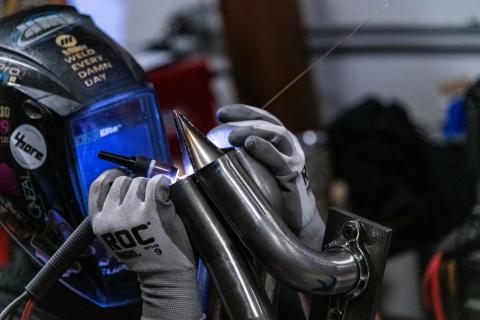
The second year of the program brings a stronger emphasis on motorsport-specific topics like fabrication and welding. “That goes right through TIG welding of aluminum,” Smith noted. “The motorsports fabrication course really shows them how to apply those skills—how to make roll cages, control arms, tube chassis, and exhaust parts. They also learn about destructive and non-destructive testing as well as familiarization with metallurgy and working with composites like carbon fiber.” The chemicals involved in motorsports adhesives, thread sealers, and locking compounds are part of the curriculum as well. The program also offers courses that cover chassis design, car setup, and race suspension dynamics, while others focus on important aspects of motorsports that happen outside of the car—like creating an effective sponsorship proposal.
Two-thirds of the students at Alfred State College’s motorsports technology program are looking to get jobs on race teams or at high-performance shops, said program instructor Andrew B. Smith. “We have a number of former students working within IMSA, while others are in rally and various other forms of motorsport.”
“In the senior year we also teach them some aspects of high-performance driving,” Smith said. “Right here on campus we do a little bit of rallycross for vehicle control, we do some autocross, and we also get them behind the wheel of the Electric Vehicle Sports Racer race car. We feel that it’s important to make sure that these students understand what’s coming with electric powertrains.”
Most of the program’s students are recent graduates from in-state high schools, but the program also sees interest from folks across the country. Part of the appeal of the program stems from Smith’s recent efforts to modernize the curriculum. “Hybrid powertrains are becoming a much bigger part of top-level racing, and one of the big shifts we’ve seen in recent years is that prospective students are asking us if our program includes hybrid and EV technology,” he added.
To meet demand, the school now offers a standalone section course on hybrid powertrains, and the motorsport program has replaced its aging fleet of hybrid project vehicles with newer ones to provide students with contemporary hardware. “These hybrids, along with the electric race cars that we have in the lab, provide these students a better understanding of how these kinds of vehicles are built and programmed, how temperature is managed, and how the battery technology works.”
Like other state-run programs, Alfred State College’s marketing efforts rely largely on word-of-mouth, and students are encouraged to actively engage with the program on social media platforms. “The Facebook page has gained some traction over the past few years, and we also have a small presence on platforms like Instagram and Snapchat,” said Smith. “Lately people have been telling us that they found us by doing an Internet search for ‘Motorsports education in the United States.’ That seems to be working fine for the level that we’re at now. But as enrollment demand continues to increase, I think we’ll eventually reach that next step of growth, and at that point it’ll be necessary to expand those strategies in order to maintain those numbers.”
Suppliers are producing PPE for engine builders, fabricators, machine operators, and more that incorporate form and function in line with expectations for performance and a professional appearance.
Professionalism is more than simply doing the job right—it’s about looking the part, too. Even old-school engine builders got the message early on and can be seen in vintage photos with monogramed button-down shirts, or at least T-shirts with a classy logo. Race teams also learned long ago that colorful pit uniforms draw fans and have a positive impact on sponsors seeking brand promotion.
That trend is now crossing over into personal protective equipment (PPE) for the shop.
“Style absolutely comes into play,” said Chase Rutti of Lincoln Electric, Cleveland, Ohio, which offers protective jackets, headgear, and gloves designed just for welders. “Ultimately, welding PPE is a personal protective product, and the key word there is personal. If you look back 15 years, pretty much all welding PPE was green, because that was the natural color of that fabric, and style was not considered. As the workspace has progressed, style has come into play.”
Leveraging his background in graphic design and print-shop experience in addition to being a fabricator, Justin Voss of Defiant Metal in Las Vegas, Nevada, has designed welding gloves with a distinct style because personal image is becoming more important to workers in this segment.
“I wanted to make gloves with more form, as well as function,” he said. “I don’t feel that exists right now. More people are just making PPE and that’s it. I’m trying to add style and also make high-quality gear.”
Even safety eyewear is becoming more in tune with today’s latest generation of mechanics.
The most popular products in IsoTunes’ line of protective earbuds are from the Pro and Free product lines, said Eric Murphy. “The Pro family [shown here] is designed for maximum durability, maximum battery life, and maximum noise reduction.”
“It’s always a matter of preference and style,” said Martha Bobadilla of SAS Safety Corp., Long Beach, California, a manufacturer of disposable safety gloves and numerous other PPE items, including protective eyewear. “We always try to come out with stylish eyewear. We’re working on new designs right now because the trend is always changing. We have a younger generation that’s coming up to become mechanics, and fashion always tends to change over time.”
There are some segments of the PPE industry that serve motorsports where style isn’t a concern. Protective coveralls and respirators for painters, along with nitrile gloves, aren’t going to make fashion statements. Hearing protection is another PPE category that isn’t receiving fashion makeovers. Instead, the latest in technology and other priorities are driving new designs in earbuds for industrial and sporting applications.
“Earbuds are ultra-lightweight and will stay cool in a hot environment,” said Eric Murphy of Haven Technologies, Carmel, Indiana, the parent company of IsoTunes, a manufacturer of earbuds and other hearing-protection products. “Contrary to over-the-ear muffs, which can get pretty hot, earbuds allow the user to stay pretty cool. Also, they don’t get in the way of the user.”
Following is a sampling of PPE equipment, including protective gear for welders, ear and eye protection, disposable nitrile gloves, and shop aprons ideally suited to specific work environments.
Ear Protection
Most race shops and garages are not acoustically forgiving when it comes to loud and insufferable noises radiating off walls. The problem isn’t just open headers on a 1,500-horsepower engine. Power hammers, air compressors, grinders, impact wrenches, and the like will drive most mechanics batty in a short time if they can’t filter out loud and obnoxious racket.
Even when required by company or governmental regulations, ear protection of the past meant the venerable orange soft-foam ear plugs that are supposed to compress and then expand to the shape of the ear canal to block off noise. These work in some ears but don’t last long. The scratchy pine-tree plastic versions are more durable but don’t block much noise. Over-the-ear muffs are quite effective, yet quite cumbersome.
For years, race car drivers had custom-molded earpieces, not only to reduce outside noise but also serve as an earphone for the car radio. Now mechanics in the shop are following that same trend. The earpiece cuts down the noise levels and allows the user to listen to music or use the cell phone.
“We actually deal with a lot of race shops and machine shops,” said Ben Jones of Southern Adrenaline (SA) in Euless, Texas. “We can make a custom hearing protection that a person can wear every day.”
A representative from SA will visit a shop to capture an impression of the user’s ear. Depending on budget and time restraints, turnaround time is between a few days and three weeks. The company uses a medical-grade silicone to make the earpiece, either in a solid form for full protection or with filters to hear at a safe rate.
“We can also add audio tubes for sound,” said Jones.
The material does not change shape, so the earpieces can be worn and cleaned on a regular basis. The company also offers a number of off-the-shelf earbuds with different designs and price points. Some are electronically active and automatically cancel out sudden loud noises. Others are fitted with Bluetooth technology.
For a race shop setting, awareness of the surroundings can be critical to personal safety.
“Aware technology is a new thing that we’ve really piloted,” said Murphy. “There are two products there, Pro Aware and Free Aware. They work like a hearing aid. You’re able to hear everything around you, but then it cancels out loud impulse noise that’s over the 85-decibel threshold. It still protects your ears from harmful noise in the environment but allows you to hear what’s going on around you.”
The Earasers by InEarz Sport are “ear filters,” said Martin Nardini. They’re designed “to filter the sound coming into the ear and focus on reducing noises most harmful to your ear while maintaining the ability to hear naturally, especially in the voice range.”
Free Aware is the cord-free version of Pro Aware and more expensive. Both are Bluetooth equipped. IsoTunes also offers Pro and Family versions without the Aware technology at a lower price point.
“Our two most popular products are from the Pro and Free families,” added Murphy. “The Pro family is designed for maximum durability, maximum battery life and maximum noise reduction. The Free family is designed to be true wireless and minimal. It’s the closest you can get to just wearing earplugs themselves.”
The Earasers motorsports hi-fi earplugs manufactured by InEarz Sport in Casselberry, Florida, are designed to provide optimum hearing protection around racing environments.
“It’s an ear filter, that’s what I like to call it,” said Martin Nardini. “It’s designed to filter the sound coming into the ear and focus on reducing noises most harmful to your ear while maintaining the ability to hear naturally, especially in the voice range.
“If you’re working in a shop and you want to tone down the loudness of the machines, you still need to be able to hear people talking to you,” continued Nardini. “You don’t want to be so shut off from the world that it hinders your ability to be safe.”
The Earasers come in four sizes to match up with a wide variety of ear canal shapes and dimensions, but the actual shape of the earplug is patented.
“The only thing you’ll find more comfortable than an Earaser is a custom-molded ear plug, which is more expensive when you’re talking about filtered ones,” said Nardini. “It originally was designed as a tip for a hearing aid, and people are wearing them for 15 hours a day, seven days a week. It basically uses a large area of contact within the ear canal to create the seal. It doesn’t press against your year, creating pressure points.”
Nardini said that decades of working in the hearing-aid industry have identified certain frequencies that are harmful to hearing, and the Earaser can control those levels using membrane filters. The earplugs are washable, and the silicone sleeve is replaceable.
“We have a number of motorcycle shops that use them already, and then a number of machine shops and manufacturing facilities,” added Nardini.
Aprons and Finger Gloves
Made in the USA is a strong selling point for many products, and Goodson Tools and Supplies, based in Winona, Minnesota, is boasting that its heavy-duty shop apron is all domestic.
“A lot of people complain they don’t want anything from China, or anything made overseas,” said Richard Orlikowski. “The material that we have is 100% USA-made for our shop apron. It’s heavy duty but made from a lighter-weight denim material that resists a lot of the oils and greases found in a shop.”
Style and fashion are design elements not usually found in a shop apron that’s constructed from a simple black denim. They’re designed to be worn in front of a Bridgeport, not a Weber grill, as there are top pockets for a micrometer or other instruments and large pockets for tools and work materials. Orlikowski said the apron is easy to clean and allows easy movement.
Goodson Tools and Supplies offers a magnetic finger glove for mechanics working in tight quarters. “There’s an earth magnet right in the finger, so you can have any magnetic metal object right at the fingertip,” said Richard Orlikowski.
“You don’t want your shop apron too stiff to where you can’t bend over and get stuck, like with a rubber apron,” said Orlikowski, noting that this product is a perfect shop gift. “It’s flexible enough to move, to be able to bend, to get to the parts and pieces that you need.”
Goodson also offers a magnetic finger glove for mechanics working in tight quarters. “It helps when putting in valve keepers or starting a nut in a limited space,” said Orlikowski. “There’s an earth magnet right in the finger, so you can have any magnetic metal object right at the fingertip. You don’t have to worry about dropping it in an oil pan or cylinder. You can use it for installing or retrieval.”
Nitrile Gloves
Disposable rubber gloves are actually regulated by the Food and Drug Administration, so there are standards for different applications—which is helpful for the racing industry because comparisons can be made between different thicknesses and materials to suit a specific chore.
“Mechanics in motorsports want something durable. They want the gloves to hold up to the chemicals they’re working with, like gasoline, alcohol, and other fuels,” said Bill Whiting of Atlantic Safety Products, Pittsfield, New Hampshire. “Nitrile gloves vary from 2 mil to about 15 mil. What we’ve found is the right thickness is a 6 mil. That’s thick enough to where it’s going to hold up to snags and not tear. But you also don’t lose your dexterity. You can feel starting a nut or handling small items.”
Atlantic Safety Products offers four different brands of disposable gloves: Black Lightning, Red Lightning, Orange Lightning, and InTouch. All can be used by the automotive industry.
“The InTouch is a 5 mil, so it’s a little thinner and geared toward shops that maybe handle only oil or they have a lot of technicians and are trying to save a nickel,” added Whiting. The Red Lightning is an industrial glove that reduces exposure to latex allergies. The Orange Lightning is made to match the skin’s natural pH levels for improved comfort. The Black Lightning is also designed to match the skin’s pH level and has a unique formula to reduce excess perspiration.
Over at SAS, there are two brands of nitrile disposable gloves popular with the automotive industry: the 7-mil thick Raven, which is black, and the 8-mil Astro-Grip that comes in orange.
“The Raven is our number-one glove for mechanics,” said Bobadilla. “We also have the Astro-Grip that has a texture to it. If the user is handling oils or fluids, the Astro-Grip is very good for those applications.”
Welding Gloves and Jackets
“I’ve always liked the Steampunk movement because they’re very complicated mechanical structures. There’s a lot of brass and gold,” said Voss. “It’s Victorian style with mechanical engineering, and that’s always appealed to me.”
The designs behind Voss’s welding gloves at Defiant Metal clearly draw on those styling cues. The TIG gloves are made from goatskin, and the MIG gloves are made from black cow leather and brown split cowhide. Both are constructed with double-row Kevlar stitching. In addition to the bold black models, there are white and pink versions available. Youth sizes are also offered. For additional protection, single-layer Kevlar sleeves will help protect against burns and cuts.
“I mostly do TIG personally, so I have more variety in the TIG gloves,” said Voss. “Also, it’s not on the website yet, but I have a fabrication glove coming. It’s a simple glove for handling metal or other types of fabrication work. It doesn’t have any padding, and it’s more for cut resistance.”
Lincoln Electric’s extensive lineup of welding gloves offers a wide variety of colors, styles, and sizes. There are so many choices that one model is dedicated to ship building, and there are versions designed for women and stick welding.
“I wanted to make gloves with more form, as well as function,” said Justin Voss of Defiant Metal. “I don’t feel that exists right now. More people are just making PPE and that’s it. I’m trying to add style and also make high-quality gear.”
“The most applicable ones for automotive and motorsports will be the two MX series gloves. In particular, the MX series premium TIG glove,” said Rutti.
The MX series premium TIG glove is constructed with Durahide suede, top-grain cowhide and split-leather cowhide. It features Kevlar stitching and an elastic wrist band. The MX series premium MIG glove is made from Durahide cowskin leather and is both ANSI A4 cut resistant and ANSI 5 puncture resistant.
“The TIG glove will be more form fitting because it doesn’t have a liner,” noted Rutti. “The MIG glove is used with a higher amperage welding process, so it needs an inner liner to improve thermal protection.”
Lincoln Electric offers both welding jackets and protective sleeves but recommends the jacket if the sleeves are not used with a flame-retardant shirt.
“Candidly, we do see a lot of welders just wear sleeves. That is not something that we would recommend due to the potential safety concerns,” said Rutti. “A flame-retardant product is actually treated with a solution that extinguishes fire. All of our flame-retardant jackets comply with ASTM D6413, which is a FR compliance standard. The black FR K3113 welding shirt and the K2985 jacket will be the two most popular items for automotive.”
Eyewear
SAS offers a wide range of eye protection under numerous brands and lines. Some are standard safety glasses and others are in the goggle category. They’re available in numerous colors, and some are fitted with LED lights.
“All of our eyewear has an anti-fog coating and meets current ANSI Z87.1 standards for impact protection,” said Bobadilla.
Over at Lincoln Electric, numerous styles are available, including those designed for women. “I would say that for automotive, it’s not any unique variable that would drive safety glass purchases,” said Rutti. “There are different types of lenses designed for either indoors or outdoors. Normally, automotive is going to want something that’s really lightweight with anti-scratch and anti-fog coatings.”
There are certain applications where a standard welding helmet won’t fit, such as when working on a roll cage. In these cases, Lincoln Electric’s ArcSpecs offers a much lower profile and is lighter weight, and a modular LED light can attach to the top of the goggles. It is separately powered and has an auto mode, so when the welding starts, the light automatically turns off.
Perhaps the most adventurous product in this category is the ArcSpecs head covering from Lincoln Electric. It features LED-equipped welding goggles, impact-resistant face guard and fire-resistant cloth balaclava.
“One of the primary industry applications that we developed this product for was automotive,” said Rutti. “It has a much different form factor than a traditional welding helmet. It really lends itself to low profile and is unique in welding environments, such as an automotive roll cage. Oftentimes, a standard welding helmet just won’t fit. This is a much lower profile, and also a lighter weight. Another unique aspect is a modular LED light that attaches to the top of the goggles. It is separately powered and has an auto mode. When the welding starts, the light automatically turns off.”
Extras
Many of the sources from the manufacturers interviewed offer additional products designed to protect users in automotive or racing situations. For painters, SAS has polypropylene coveralls designed to breathe more and reduce heat stress while protecting against dry particulates and solvent-based paints. The company also has a diverse range of respirators.
For welders, Lincoln Electric has a line of caps, bandanas, and beanies that protect the head from hot splatters and provide comfort when the helmet is in place. Style is also important for those shopping this product category as the different designs can make a personal statement.
“We’ve continued to broaden some of the patterns,” said Rutti. “We definitely see individuals trying to express interests, whether it’s from a genre, things that they value, or just things that they think look good.”
A racing livery showcases a team’s sense of style while also serving a vital marketing function. Its presentation can convey a lot about a competitor’s racing program without saying a word.
It’s no coincidence that some of the most iconic race cars in motorsports history are closely associated with their liveries. Machines like the Gulf GT40 and the Marlboro F1 cars of the 1980s endure in our collective minds not only because of their success on the track, but because of their unique, eye-catching aesthetics.
Race car graphics packages give competitors an opportunity to stand out in the field regardless of their position while also putting their sponsors front and center. But as these designers note, it’s the execution of these designs that determines whether or not they’re going to make a lasting impression.
Wrap Tech Signz
Dalton Cook of Wrap Tech Signz in Columbus, Georgia, said that the focal point for any race car graphics package should be the number and the sponsors. “That’s all about contrast—the more contrast you can create, the more your eye is drawn to the elements that are emphasized by that contrast. And layering plays a big part there. Layers allow you to plot out how you’re going to create that contrast.”
Cook said that digital printing has given designers increased freedom in that regard, allowing for much more intricate layouts than physically layered vinyl does. But there’s also a point where complexity can work against the core goals of the design. “Digital printing lets you just add and add to a design. The problem is that the more you pile on to a design, the more you start to blur the focus of it. Less ultimately feels like more because it ends up looking cleaner.”
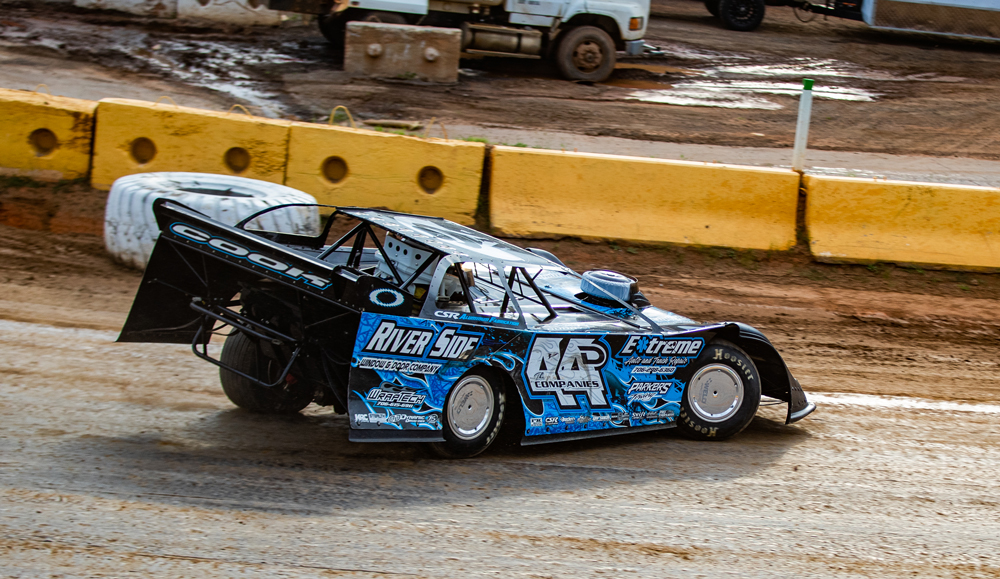
There are only three colors on the car, but “you get the perception that there’s a lot more because of the various shades, fading, and texturing,” said Dalton Cook of Wrap Tech Signz.
That’s why color choice is a key element in the design process. “Maximum contrast is going to be white with a black outline,” he said. “Of course, other colors can look good as well, but they won’t be as visible from a distance. So you have to balance that out with the style and appearance that the client wants. That’s why so many commercial signs look relatively plain—they’re going for maximum visibility.”
Strategic use of shadowing can also help specific elements of a design stand out. “Soft shadows give the design a sense of dimensional depth,” said Cook. “That can make something look like it’s raised up in comparison to the features around it. If you do it correctly, it can create this ‘glow’ effect that really emphasizes the contrast that you’re creating.”
From there it’s about adding creative flourishes in order to give the design some personality. When they are done right, these elements can provide benefits that go beyond maximizing sponsorship visibility. “It can help create an identity for the car and the team, and it can say a lot about how professional their program is,” he emphasized. “That can help a team attract new fans, new sponsors, and bring in other opportunities. Your performance on track is one part of it, and your appearance is another. All of it serves as a description of you as an individual. So you have to treat every design like it’s going on a car in top-tier competition.”
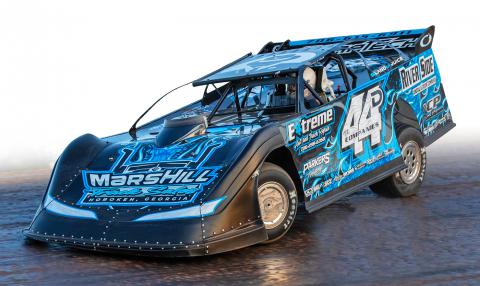
Cook cited this graphics package that he created for a Super Late Model car as a good example of these principles. “The reason that I really like this particular design is because it delivers a little bit of everything. It’s clean and easy to read from a distance, but as you get closer to it, you start to see a lot of additional details that give it that ‘wow factor.’ And while the car is essentially blue, black, and white, you get the perception that there’s a lot more than that going on because of the various shades, fading, and texturing.”
For this design, Cook also used flames to provide some additional visual flair, but he said that it’s an effect that comes with some significant aesthetic risk. “Flames can look really good, or they can look really bad. Part of the challenge there is that I didn’t have a ton of extra room to work with, and in order for flames to look good, you have to be able to see a lot of the different components of the flame—the way it curves, the points, and the general flow of it. In some ways I had to work backwards on this one; I put the logos and everything else on the car before I began working on getting the flame layout because I wanted to make sure it would look right around those elements.”
While he said that a customer’s initial reaction can be a good measure of whether or not a design is effective, time is usually the ultimate judge. “Marketing is about establishing a brand identity,” confirmed Cook. “If a team has a specific look for their car and then they decide to change everything up for the following season, they’re not really solidifying that brand identity. The end game here is to design something that the teams don’t want to change.”
FireStorm Graphix
Since visual impact is one of the main priorities for any race car graphics package, Matt Lachance of FireStorm Graphix in Nashua, New Hampshire, said he and his team usually work with their clients to establish a color palette in the early stages of a project and develop the design from there. “We don’t like to have too many colors on a car—it starts to look like a bowl of Froot Loops,” he quipped.
“Limiting the range of colors allows us to find a few that will complement each other and make that visual impact that we’re looking for. If you look at some of these wraps—especially on dirt track cars—the ones that stand out tend to be color coordinated from front to back. A good design will allow the car to stand out in the field, and visually striking graphics packages will get noticed. That’s good for the existing sponsors, and it can help generate interest from new ones as well. If a design is well executed, it can add a certain level of professionalism to the look of a team.”
Key to integrating the hood logo into this E46’s design was to make it “look like it was always part of the larger package” while also making it “easily read from a distance,” said FireStorm Graphix’s Matt Lachance.
Lachance cited a design that FireStorm created for a customer who is campaigning a BMW E46 coupe in a club road racing series in Canada. “He came to us and said, ‘The car is gold, and I don’t want to wrap the whole thing.’ So the next step was to figure out what colors would complement that base color.” The client also noted that he wanted some green elements in the design, so the team at FireStorm decided to incorporate some gray to balance things out—a neutral tone that wouldn’t clash with the other hues.
He said that FireStorm was given more or less free rein in terms of the general design of the graphics package, and most of the tweaks that were made during development were focused on bringing attention to the sponsors. “There was a bit of work involved to incorporate the R and L of his main sponsor’s logo based on their original design, and he added a few sponsors along the way that we integrated into the design of the wrap as well. The OXBO logo on the hood is a good example of that—there wasn’t a hood graphic planned originally, so we just needed to find a way to integrate that logo and a graphic in a way that blended in with the rest of the design. The key was to integrate it in a way that made it look like it was always part of the larger package while also making the logo prominent enough to be easily read from a distance.”
When it comes to design, sweating the details tends to pay off. In the case of this E46, the effectiveness of the graphics package brought a tangible, direct benefit to the client’s racing program. “He came back to tell us that his sponsors were so pleased with the look of the car, and the exposure that it offered for their businesses, that they decided to sign on for another season. So it’s clear that the design had a positive impact for everyone involved.”
RVA Graphics and Wraps
For the designers at RVA Graphics and Wraps in Richmond, Virginia, each motorsports-related project starts with a conversation with the client about what they’re looking to achieve with their branding. “Everybody’s goal is a little bit different in that regard,” said Caitlin Olszewski. “It could be a traditional sponsorship, a charity they’re looking to bring attention to, or some other kind of messaging. And you might have different goals for the design on different parts of the car, so it’s important to really get a sense of what the team is trying to accomplish.”
From there the discussion shifts to whether the client wants the entire car wrapped or just sections of it. “With a full wrap you really have to consider the body lines of the car,” she noted. “When I’m watching a race, it’s obvious to me which teams took that approach and which ones just adapted a pre-existing paper template. At the end of the day, a template just isn’t going to stand out in the crowd.”
The large logos on the side of this E30 endurance racer “are positioned diagonally to draw your eye in,” said Caitlin Olszewski of RVA Graphics and Wraps.
Effective race car graphics packages, according to Olszewski, can not only make a team appear more professional, they can establish an aesthetic with a lasting identity. “If you think about Jeff Gordon’s car, you automatically think the DuPont logo and the color scheme. That branding longevity is incredibly valuable to a sponsor.”
That’s why RVA usually tries to integrate sponsor logos in a way that makes them a fundamental part of the overall design. “That prevents it from looking like an afterthought,” she said. “So it’s really about the placement and balance of those various elements, and we more or less work in tiers across the vehicle in order to make it look like one cohesive design.”
The target audience comes into play here, too. “There are people who’re going to see the car from the stands, and there are also people who’re going to get up close and personal with the car. So you have to be strategic about placement in terms of what is going to be readable on the car in different contexts,” she added.
Hood stripes follow the BMW’s character lines and draw the eye to the RVA Graphics’ logo, “which really helps the car get noticed on the track,” Caitlin Olszewski said.
While font choice plays heavily into legibility, the elements surrounding it can be a factor as well. “You have to make sure that you have complementary colors, and you have to be measured about elements like stripes, gradients, and halftone effects if there’s going to be text on top of it. You have to mute the background and get rid of the noise to ensure that the text can be read quickly. High contrast equals high visibility.”
Olszewski pointed to the design on this RVA-sponsored E30 BMW endurance racer as an example. “Right away you can see a lot of elements that associate it with our brand—the orange-green-black color scheme, along with the large logos on the side panels that are positioned diagonally to draw your eye in. That’s prime real estate because that’s what spectators are going to see the most of as the cars travel around the track.”
Using the car’s character lines as a design guide makes the graphics look tailored to that particular body, and that distinctive aesthetic naturally draws more attention to the car—along with specific elements on it. “The stripes help to highlight those lines,” she explained. “For example, on the hood there are two sets of stripes that follow the character lines and draw your eye to the RVA Graphics logo. Design elements like that really help the car get noticed out on track. People frequently come up to us at races and ask about how they can get help with their graphics packages after they’ve seen the car. It’s a great compliment.”
Entertaining racing is only one piece of the puzzle—IT TAKES A broad-based APPROACH, AS WE learned from the promoters behind five successful events.
Although exciting competition is a core pillar of any well-attended motorsports event, that alone doesn’t guarantee lasting success. In an age where an array of media is constantly vying for our attention, it takes a broader consideration of the design, format, and promotional strategies to break through the noise of everyday life and connect with the right audience.
“I think the days of just opening the gates and expecting to pack the stands are long gone,” said Kelley Carlton, the events manager for Screven Motor Speedway in Sylvania, Georgia. “You have to use everything that’s available to you because you are competing with so many other things now. People have a thousand different options for entertainment now, so you have to really put in the effort to bring attention to your event. Once they are there, you have to make sure the event itself is memorable for the right reasons.”
To get a better understanding of how successful efforts maintain their momentum, here’s a behind-the-scenes look at five events that have enjoyed sustained interest year after year, with some insight from the folks who help make that happen.
Jim and Joanne Ford Classic
Over the years, this end-of-the-season bash has become an institution at Fremont Speedway in Fremont, Ohio. Held annually in early October since 2008 and named in honor of the folks who resurrected the track 22 years ago, the two-day event has become something of a going-away party for racers and fans alike.
“It’s in the fall, so the campgrounds across the street are packed,” explained promoter Brian Liskai. “There’s plenty of tailgating going on, and we bring in bands after the races for the fans to enjoy. There’s Halloween decorations, there’s a queen’s contest—a lot of different things are going on besides the racing itself.”
The Jim and Joanne Ford Classic, the championship weekend for the All Star Circuit of Champions series, also marks the end of the season at Ohio’s Fremont Speedway. “So we turn it into a big party,” said Brian Liskai. Tailgating, Halloween decorations, a queen contest, and post-race music are among the weekend’s attractions.
The event serves as the championship weekend for the All Star Circuit of Champions series and brings together 410 sprint cars, 305 sprint cars, and dirt truck division racing. “With winter on the way, it gives everyone in Northwest Ohio and Indiana one last opportunity to get out to the track and enjoy an outdoor race before the end of the year,” Liskai said. “So we turn it into a big party.”
While the format of the competition has stayed fairly consistent, the show itself has grown and evolved over time. “We’ve done cancer fundraisers, auctions, and kickball tournaments where fans and racers have put together teams. As the show has grown, we’ve expanded the campgrounds and upgraded the amenities to accommodate that. It’s a really welcoming environment.”
With an event of this scope, the logistics and promotion go well beyond regular facility maintenance and traditional marketing methods. “Getting the bands booked, putting together the parties on the campgrounds—all of that organization needs to be done properly for the show to go smoothly,” Liskai explained. “You also have to make sure the concession stands have what is needed, but you also don’t want to over-stock them, so it is kind of a challenge in that way. But every year we learn more about what we need to do to continue making the show bigger and better.”
Liskai told us that while they still do ads on local TV and radio, social media has become a much bigger part of their larger promotional strategy. “Our Facebook page has gotten pretty big, and we use Instagram and Twitter regularly to get the word out as well. We do a lot of live videos on those platforms to further engage with the fans, and it helps.”
He also noted that since it’s the last event of the season for many teams, the show also attracts teams who might want to provide a driving opportunity to a crew member who doesn’t normally have a chance to get behind the wheel. “Some teams will put an extra car together so they can give someone on the team or a family member a chance to compete,” Liskai said. It doesn’t hurt that there’s a decent chunk of change up for grabs, too. “We pay $10,000 to win on Saturday, so you never know who might show up.”
Winter Freeze
Also in its 14th year running, Winter Freeze at Screven Motor Speedway is a two-day show held every February that’s timed to match up with the Georgia and Florida Speedweeks events. “Speedweeks is big in both the dirt and asphalt racing worlds, and there’s an annual pilgrimage of racers and fans from the north that make their way south for the Florida show,” Carlton explained. “That means they have to drive right through Georgia to get there. So [Screven Motor Speedway owner] Redd Griffin saw an opportunity to have a Speedweeks-related show that would give those folks coming down I-95 something to do for a couple of days before things start up in Florida.”
While dirt super late model racing has always been a key component of Winter Freeze, Carlton said that the event has evolved over the years to incorporate other platforms as well. “Our big Sport Compact Dirt Racing Association (SCDRA) series event used to be in November, but we moved it over to this show and it has really taken off. We’ve grown the purse by a thousand dollars every year—when it started it was $5,000 to win, and this year it will be $19,000.”
Kelley Carlton said Screven Motor Speedway’s big Sport Compact Dirt Racing Association series event “has really taken off” since it was moved to the busy Winter Freeze weekend. Dramatically increasing the purse was a big factor, too.
With stakes that are normally unheard of in this type of racing, the event attracts front-wheel-drive racers from all across the country. “There’s just no other event out there that’s paying this amount of money to this front-wheel-drive class. For the last six years or so, it’s been in excess of a hundred cars every time, and this year we set a record with 123 cars signed up for the event.”
Beyond the dirt late model and SCDRA races, the event also includes crate late model, street stock, Road Warrior, and Cop Stock racing, the latter of which pits racers against one another in decommissioned police cruisers. “That’s a neat little class that’s also growing,” Carlton said. “Racers can just go to a police auction and buy an old Crown Vic, take out the glass, add some safety equipment, and go racing. The cars are otherwise stock, so the affordability and fun of it is a big draw.” That emphasis on accessibility has helped to guide much of the evolution that Winter Freeze has seen over the years.
“The SCDRA stuff is kind of a working man’s class,” said Carlton. “These racers are usually spending between $4,000 and $12,000 to build a car to go racing, whereas classes like street stock are going to cost quite a bit more. At most places, these front-wheel-drive guys are racing for $250 or $300, if that. We wanted to help change the perception of this type of racing, and the racers are improving their programs in turn. To have this amount of money involved is unique, and I think that has helped attract competitors from all over to come out for this.”
With live bands, on-site camping, and a rotating roster of attractions, the event takes on a carnival-like atmosphere for the fans. Logistics and planning for the event begin months ahead of time, as does the promotion of it. “We use billboards, print advertising, and we also do some stuff on news sites like Dirt on Dirt,” he said. “We also do some radio and TV ads, but social media and email seem to get the biggest response. We have about 25,000 addresses of drivers and fans on our mailing list, and we get a lot of feedback from that. And, of course, social media is crucial because just about everyone is on there every day.”
He added that Griffin’s approach has factored into the show’s success, along with the efforts of the facility’s staff. “Redd is a very racer-oriented guy; he makes sure they’re being heard and taken care of. It helps that we have great people working for us, too. Someone might not remember a particular race from an event, but they’ll probably remember the people from the event and how they were treated.”
Crash-A-Rama
After its inaugural event on Memorial Day in 2006, Crash-A-Rama at Lake Erie Speedway in North East, Pennsylvania, soon became so popular that they added a second annual date in May two years later. The Night of Destruction-style show includes skid plate racing in compact, front-wheel-drive cars, demolition derbies, and other high-impact entertainment that attracts fun-loving racers, motorsports fans, and families that are looking for something to do that is far more exciting than just watching the latest movie. “We do a lot of shows here that aren’t traditional racing—drift events, monster truck shows, and that sort of thing,” said Lake Erie Speedway General Manager AJ Moore. “We don’t mind seeing some contact at this particular one.”
Lake Erie Speedway’s Crash-A-Rama became so popular after its 2006 inaugural event that a second annual date was added soon after. “We do a lot of shows here that aren’t traditional racing—drift events, monster truck shows, and that sort of thing,” said AJ Moore.
In recent years, the event has evolved to include side acts like freestyle motocross exhibitions as well as spectator drags. The latter allows race fans in street cars to compete against one another in a short wheel-to-wheel race on the oval track for a few bucks and no shortage of bragging rights. “The core events haven’t really changed over the years, but we’re always adding new things to keep it fresh,” Moore said. “Last year we added a Hoods Up race as well.” In that event, a large field of FWD compact cars have their hoods and trunk lids pinned up, and drivers only have a small hole to see through in order to navigate through the inevitable chaos. “Little additions like that bring back the people who have been to a Crash-A-Rama event before because it’s something new for them to check out.”
Moore noted that it takes quite a bit of detailed planning to ensure that a night with so many different events goes smoothly. “I feel like there are some people who think that you pull a string, and everything just happens,” Moore quipped. “But there is a lot to it, and you need to have everything in place from the moment a fan reaches your parking lot. Beyond ticket scanning and security, there is a lot that goes into the food and beverage side as well as the tech inspection of the cars. Even though it is Crash-A-Rama, there are still some rules that need to be followed.”
In terms of marketing, he said that the track has put less of an emphasis on radio and TV advertising in recent years, opting to shift those efforts toward social media platforms like Facebook, Instagram, and TikTok. “Getting new videos out on a consistent basis has really helped us get the message to different demographics,” Moore said. “Once you have them there at the track, you can promote the other events.”
Summer Showdown
“In the 1980s and early 1990s, the track used to host the Washington 500,” explained Doug Hobbs of Evergreen Speedway, Monroe, Washington, and president of High Road Promotions. “That event brought in Cup drivers, and no one else in the Northwest had a winning purse of $25,000 or more at the time. So when we took the track over in 2011, I wanted to bring in a signature event that could recapture some of that notoriety.”
Held on the third week of July since 2012, Summer Showdown was a success straight out of the gate, attracting racers and fans alike for Super Late Model, Pro Late Model, street stock, and mini stock racing. “I think for us it was really about sitting down and considering what motivates drivers and tying in a lot of different promotions around it,” he said. The two-day event puts the Super Late Model and Pro Late Model races on an oversized 5/8-mile track, while the supporting classes compete on Evergreen’s 3/8-mile oval.
With the racing divided between two tracks at the facility, Hobbs wanted to create a carnival atmosphere that would keep fans entertained regardless of where they were on the grounds. “Over the years we’ve set up go-karting tracks, brought in live music—things like that. And we always make sure that we have things for the kids to have fun with on the midway.”
Each year, the organizers at Evergreen Speedway review the event’s format to see where refinements can be made to maximize its value to fans and racers alike. “We try to get feedback from the drivers and look at what classes the fans are going to want to see,” he said. “Some years we’ve gone with more touring and less of our weekly support NASCAR classes. But you also want to try to keep as many of your upper divisions at the marquee event as you can. We always want to make sure we’re headed in the right direction with that balance.” Evergreen Speedway also offers two-day VIP packages for the event, which include reserved seating, dinner, a swag bag, and a meet-and-greet with the top drivers at the event.
Hobbs noted that while targeted advertising on social media and mobile apps has been effective for Evergreen Speedway, they’ve also partnered with CBS to create Home Track Heroes, a two-hour weekly television special that puts the facility’s events front-and-center. “It’s a replay show that airs every Sunday night,” he explained. “In the lead-up to marquee events, we try to use that show to get drivers who might want to come on for an interview or to talk about upcoming races. We do that for all of the classes, from the four-cylinder Hornets to the Super Late Models.”
Evergreen Speedway also invests in traditional advertising on radio, television, and at sporting events, and last year Hobbs partnered with FloRacing to live-stream their races. “You have to have a strong presence out there to remind people,” he added. “There’s a lot of competition for the entertainment dollar now.”
Sprint Car Smackdown
Held on the third week of August since 2012, Sprint Car Smackdown at Kokomo Speedway in Kokomo, Indiana, is the track’s marquee event for 410 non-wing sprint cars. The three-day, USAC-sanctioned show offers drivers attractive payouts, with $5,000 going to the winners of the Thursday and Friday night races, while this year’s A-main winner Kyle Cummins earned $15,000 plus a $20,000 bonus for leading all 40 laps of Saturday’s feature race. Even though a premier USAC race brings with it a built-in fanbase, the organizers at Kokomo Speedway have sought to ensure that all attendees would be entertained throughout the duration of the event.
While Kokomo Speedway has used radio and newspaper ads to get the word out about the Sprint Car Smackdown to local fans, Jill Demonbreun said that social media platforms and streaming services have brought more attention to the show. “Racing fans pay more attention to content like that.”
“We do karaoke the first night, a band on the second night, and we’ve got charity kickball games, cornhole tournaments, and other activities as well,” said Kokomo Speedway co-owner Jill Demonbreun. “It’s a big event for us, so we have a lot of stuff going on.”
Over the years the show has continued to attract racers thanks to ever-increasing prize purses—the winner of next year’s finale will receive a $20,000 payout—while auctions for racing memorabilia and drawings for prizes like golf carts have helped to attract so many new fans that campground parking has become a sought-after commodity. While the track has used radio and newspaper ads to get the word out about the event to local fans, Demonbreun said that social media platforms and streaming services have brought more attention to the show. “Racing fans pay more attention to content like that,” she explained. “While we also use Instagram and Twitter, I feel like Facebook is where we get the most engagement. And anything that USAC does at our track is on FloRacing, so that helps as well.”
The Sprint Car Smackdown at Kokomo Speedway is the track’s marquee event for 410 non-wing sprint cars. This year’s A-main winner, Kyle Cummins, earned $15,000 plus a $20,000 bonus for leading all 40 laps of Saturday’s feature race.
She noted that they’ve made a concerted effort to reinvest back into the track in recent years as well. “We put new Musco lighting in recently, and we put new bleachers on the back stretch that added seating for roughly 1,500 more people over there. And we’re planning to re-do the front stretch next season, along with some other planned renovations. We want to keep improving the facility so we can continue to do bigger and bigger events here.”
USAC Racing has announced that the 2023 season for the USAC AMSOIL Sprint Car National Championship will open February 16–18, during the 14th annual Winter Dirt Games at Bubba Raceway Park in Ocala, Florida.
The event, which will serve as USAC’s only visit to the Sunshine State, will feature three nights of racing, with Thursday and Friday paying $5,000-to-win followed by the $10,000-to-win feature on Saturday night.
“We are honored to be able to start the USAC season at Bubba Raceway Park in 2023,” Bubba Raceway Park general manager Tom Bean said to USAC. “We’ve been able to grow this event and we look forward to improving on it and again making this a destination for USAC Sprint Car fans in February.”
The complete 2023 schedule is set to be announced at a later date.
For more information, including points format and program features, visit the USAC announcement here. For more information, visit usacracing.com.
 MEMBERSHIP LOGIN