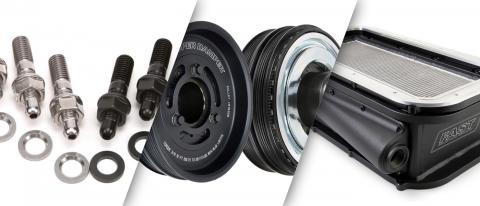
ARP’s accessory studs feature a rounded nut starter nose and are useful in a variety of applications, including securing bellhousings, carburetors, distributors, headers, timing covers, valve covers, and more.
“Saving time is important, and using these studs for attaching headers, oil pans, and other components makes for quicker race car servicing,” said Chris Raschke. “Using studs lets you accurately position the gaskets and hold them in place, while the special nose design makes for faster nut installations and no worry about cross threading. Both features are time savers.”
The studs are available in either polished stainless steel or 8740 chromoly finished in black oxide. They’re nominally rated at 180,000 psi tensile strength, which is 20% stronger than Grade 8 hardware. The kits come with washers and are available with either hex or 12-point nuts.
“The choice between polished stainless steel or black oxide chromoly is basically aesthetics,” noted Raschke. “Both are rated at 180,000 psi. Of course, stainless steel is virtually impervious to the elements. So, that’s an important benefit, especially for marine and salt-flat environments.”
M8 and M10 metric studs are offered in a variety of lengths and are commonly used for intake and exhaust manifolds in sport compact applications. —Mike Magda
Here’s an easy solution to cool the air charge on a boosted LS engine. This FAST LSXHR air-to-water intercooler fits between the base and the top of a hi-ram style intake manifold, such as the composite FAST LSXHR 103-mm model.
“It’s for heads-up and grudge racers with turbos or a centrifugal supercharger,” said David Page.
The intercooler features large AN-16 water inlet and outlet fittings. With other styles, the intercooler is mounted remotely, which requires extensive plumbing. The FAST intercooler location minimizes under-hood piping and simplifies the installation. Intense engineering went into designing the intercooler for performance applications.
“Having the water flow from right to left along the intercooler’s longer, 16.4-inch side exposes the water to as many internal tubes and the shortest path as possible,” said Page. “The average inlet temperature in testing was 272 degrees F, and the average outlet air temp was 83.8 degrees F with a loss of less than one psi across the intercooler.”
The welded billet intercooler comes in a black powdercoat finish and features O-ring sealing on both air and water sections. Additional components needed for the installation include reservoir, plumbing, pump, and short runner stacks for the FAST intake. —Mike Magda
An ATI Super Damper is now available for the GM L8T truck and Gen V Ecotec3 applications. The L8T is heavily sought out by boost-crazy LS racers because of the extremely strong bottom end designed into the structure.
“This damper controls crankshaft torsional twist over a much wider rpm range than the OEM and other style dampers,” said JC Beattie Jr. “It’s American made and SFI approved for years of worry-free running.”
The 7.480-inch damper is constructed with an aluminum shell and features a four-groove belt drive in the outer shell. This damper requires a bolt-on front pulley. Users can run a six-groove belt on any of the pulleys starting in the groove closest to the engine.
ATI offers a variety of front-drive pulleys in OEM diameter in under- and over-driven sizes, starting with 6.773-inch up to 9.770-inch diameter. Part number 917306 is the direct replacement for the GM factory part that comes on the 6.6L L8T crate engine.
The damper comes with laser-etched timing marks, a single 3/16-inch keyway, and 4140 heat-treated hub. —Mike Magda
Modern firepower in a classic GM G-body platform has always been a popular street-performance and weekend warrior option. Now those racers with Holley EFI and viewing the company’s 12.3-inch digital display can use a Classic Dash bolt-in panel to achieve a factory appearance while keeping tabs on the fuel system.
“Racers like the new 12.3-inch Holley screen because it’s easy to read, and they can tailor the display to show those readouts that are most important,” said Greg Wambold. “The widespread acceptance of this large screen has prompted Classic Dash to develop dash panels for many applications, and we will continue to do so.”
With a large 1280 x 480 pixel high-resolution display, the Holley screen can be used to tune Holley Dominator, HP, Terminator X, and Sniper EFI systems. The unit can be programmed to monitor up to 238 functions, including a GPS speedometer.
The panels are manufactured in-house at Classic Dash’s facility in Nevada using UV-resistant ABS composite material. The panels are easily installed using common tools. Other applications include popular Chevy/GMC and Ford vintage trucks. A universal panel is available for fabricators building unique vehicles. Classic Dash also manufactures panels to accommodate other Holley, Racepak, Auto Meter, and AEM electronics in addition to analog gauges. —Mike Magda
An engine explosion of any kind is one of a racer’s worst nightmares, knowing that debris can injure spectators or cause damage. A Stroud Safety containment blanket for a ProCharger centrifugal supercharger is a useful step to help ensure that damage is limited.
“This was developed in-house to safely contain impeller and housing parts from a failure on the race track,” said John Gentry. “Without a blanket, damages could occur to body panels, fuel lines, fuel cell, tires, as well as leaving debris on the race track.”
The blanket wraps around the supercharger to protect engine components under the hood in case of a failure. It features Kevlar straps and has SFI 4.1 certification.
“The motivation for this product is just to keep the racer on the track, and the person in the other lane safe,” said Gentry.
Stroud also offers SFI-approved turbocharger blankets for both the hot and cold sides. —Mike Magda
Eagle Specialty Products has introduced a new billet center-counterweight crankshaft for GM LS engines.
“Crankshafts for Chevy LS are nothing new, but this is an important twist on what’s available,” said Alan Davis. “Eagle’s center-counterweighted crank will fit in a factory LS block without modification or clearancing around the number-three main that is typically required for other center-counterweighted cranks.”
The Eagle crankshaft is machined from 4340 billet steel. It is not a forging due to limited production quantities. The 4340 steel is the same high-nickel chromoly material used in all Eagle crankshafts, and it includes the same heat-treatment, nine-step salt bath nitriding, shot peening, and micro-polished journals.
“Center counterweights are very important for stability and reducing flexing in very high-horsepower and high-rpm applications,” added Davis.
The center-counterweight LS crankshafts will be available in 3.662- and 4.000-inch strokes. Also, reluctors are available in either 24- or 58-tooth. The main journals measure 2.559-inch with the rod journals at 2.100-inch. Weight is around 56 pounds. —Mike Magda
Aviaid is expanding its line of remote oil-filter adapters to include CNC-machined billet aluminum models for three popular sizes of OEM and aftermarket spin-on filters.
“Space considerations are important in setting up an efficient lubrication system. Remote adapters let you position the filter for easy access,” said John Schwarz. “Many racers also like the idea of using the more modern, small-diameter racing filters.”
For vintage applications, Aviaid is offering original Traco cast-aluminum adapters for the standard Chevrolet 3 5/8-inch filters. Traco engines were popular in the 1960s with Can-Am and Trans-Am racers.
Also, Aviaid manufactures special billet aluminum remote pressure regulators with mounts to accommodate 3 5/8-inch or 4 1/2-inch diameter filters. They come with a pair of 1/8-inch NPT female ports for use with oil pressure and oil temperature gauges. Plus, there are taps for accessories like a valve-spring oiler, turbo feed, etc.
The larger regulator for HP6 filters comes with a choice of 1 1/2x12 or 1 1/2x16 threads, AN-12 in/out ports, and an AN-10 bypass. The HP4-sized adapter comes with 13/16x16 thread, utilizes AN-10 line ports (plus AN-06, AN-10, or AN-12 hose adapters) and has an AN-8 bypass. They are designed for O-ring seal fittings. Two pressure-relief springs are included. —Mike Magda
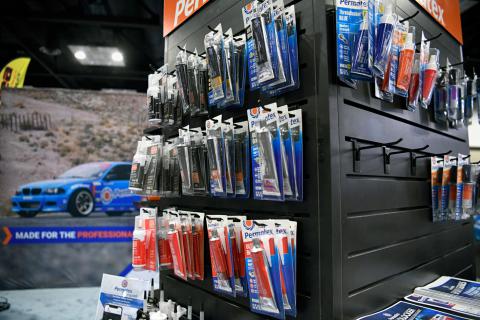
When choosing the right sealant, there’s a significant difference between the needs of a street car and a race car, said Eric Seibold of Permatex. “With a street car, you’re sealing components with the expectation of never touching them again. But racers are in and out of those components much more often. That should change the product selection.”
Advanced formulations can provide long-lasting seals and make servicing easier, but the appropriate tool must be selected for the job.
The difference between one sealant and another may seem relatively inconsequential at first glance, but the end results can have a substantial impact on a race program. Most obvious are the hassles that leaks can cause while going through tech inspection, or the potential problems that seal failures can cause out on track. But it’s also important to consider that sealant design has evolved significantly over time. These improvements have not only yielded products that are more use-case-specific, but they’ve also kept these formulas in line with the evolutionary changes seen in the components that they’re being used with. As a result, specificity has taken on greater importance.
“One thing we often see is that people find something they like, and they want to stick with it forever,” said Rene Levy of Henkel Canada Corp., Mississauga, Ontario, Canada, which makes the Loctite brand. “‘I’ve used this sealant for 20 years, and it’s always worked great. So why should I change?’ But the issue is that, while that may have worked fine on the engine that they were using it on back in the day, the materials in today’s components are vastly different than they were in the past. If you’re not keeping up with technology, you’re introducing a greater potential for failures.”
As Eric Seibold of Permatex in Solon, Ohio, explained, a heedless approach can also make things harder than they need to be. “One of the significant differences between a street car application and a racing application is that, with a street car, you’re usually sealing up two components with the expectation of never touching it again. You want to do the job once and be done with it. But generally speaking, racers are in and out of those components much more often. That should change the product selection.”
It’s important to consider the operating temperature range of the components the sealant will be used on, said Loctite’s Rene Levy. “There are products that will work fine on valve covers or oil pans, but you’d want to use a different product for an exhaust flange because the operating temperatures that it’s going to see are much higher.”
Seibold told us that if components involve a separate gasket, a gasket sealant should be used, not an RTV silicone product. “It’s one of the biggest mistakes we see people make. There’s a difference between a gasket sealant and a gasket maker. For a racing application, you’d want to use a non-hardening gasket sealant because it acts almost like Velcro—it holds the gasket in place and seals well, but when you want to remove it in the future, it can be easily peeled off. If you use RTV silicone, you likely won’t be able to use that gasket again, and that can get expensive if you’re opening up that engine every week.”
Choosing the wrong product can increase the likelihood of a leak as well. “RTV silicones are extremely thick, so if you don’t apply them evenly, you could introduce high and low points on the gasket,” Seibold added. “Gasket sealants are much thinner, and they’re designed to spread much more evenly. In some cases, they’re even self-leveling.”
Beyond serviceability and seal quality, Levy said that it’s important to consider the operating temperature range of the components that the product is going to be used on. “Every product has a heat range that it’s designed to work within, and you have to make sure you’re operating within that window. In terms of heat, there are products that will work fine on valve covers or oil pans, for example. But you’d want to use a different product for an exhaust flange because the operating temperatures that it’s going to see are going to be much higher.”
Seibold noted that with silicone products, there are essentially three universally color-coded types of products: black, grey, and red. “Black silicones are stretchy and flexible, and they’re designed to be used primarily where you have dissimilar materials—like if you have a steel pan mating with an aluminum block, for instance. Those two materials have different expansion and contraction rates, so you want that flexibility in the silicone. The black silicones also have the highest oil resistance, so that also makes them ideal for components like oil pans and valve covers.”
Grey silicones, on the other hand, are very rigid and are designed to hold components of the same type of material as securely as possible. “Those are made for places that will see a lot of vibration, but you really want the silicone to hold in place,” Seibold continued. “These also have the highest resistance to coolants, so it’s good for things like water pumps and thermostats. But if you use a very rigid silicone in an area where you actually need flexibility because the parts are moving around a bit, it’s going to try to hold them in place, and that can cause cracks in the silicone, which can potentially introduce a leak. So you have to really consider where you’re using it.”
Red silicone is used in high-temperature applications. “It’s not only sustained high-temperature, it’s also what I’d call ‘thermal cycling,’” he said. “A turbo, for instance, isn’t hot all of the time—it has bursts of heat. The red silicones are designed to expand and contract at the rate required to handle those big temperature fluctuations.”
How the product is applied, and how the components are fastened back together, can impact the end result, Levy emphasized. “When it comes to surface preparation, cleaner is better, but we’re not looking for perfection. Our products will tolerate some surface contaminants, within reason, so I generally tell people to just do the best that they can. In terms of fastening the components back together, use the OEM-recommended torque values where you can. That engineering is done for a reason.”
Space constraints can limit the size of a remote cooler “depending on where it’s going,” said Derale’s Cameron Brandt. “Engine oil you can’t over-cool, so whatever you can fit in the space available will be perfect.”
Racing is hot business. A remote cooler will increase cooling capacity for vital fluids and offers a variety of mounting options.
“The name of the game is surface area.”
In a nutshell, Tom Longo of Derale Performance in Los Angeles, California, described one of the two main benefits of installing a remote cooler for engine oil, transmission fluid, or any other drivetrain-related liquid prone to overheating in racing’s extreme environments.
“The main thing a remote cooler does is provide increased surface area for a high-temperature fluid to have contact with the air to remove heat,” added Derale’s Cameron Brandt.
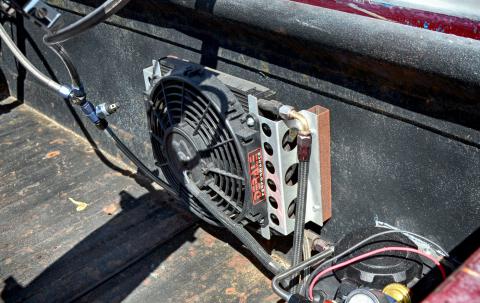
The other benefit? “If you’re strapped for space in the front of your vehicle, a remote cooler can be mounted, well, remotely, to add extra cooling capacity in a different location,” explained Ryan Salata of PROFORM, Warren, Michigan. With an auxiliary fan attached to provide airflow, the cooler can be mounted anywhere, “even under the vehicle.”
“It doesn’t matter how fast you’re going or how slow you’re going, it’s going to get the same amount of airflow,” Longo pointed out. “That’s the main benefit of a remote cooler versus a ram-air cooler. It has its own airflow source.”
Cooler Sizing
Most remote coolers, including those made by Derale and PROFORM, are marketed based on external dimensions and also on how many cooling rows the unit has to pass fluid through. Both companies offer coolers that range from 10 to 40 rows.
“Most guys try to get the biggest secondary cooler they can that will fit,” Salata said. “Our 12- to 16-row coolers are the most popular, but if you can fit the 40-row, do it.”
“Space constraints can limit the size of the cooler depending on where it’s going,” Brandt agreed, “but the more rows you have, the more surface area you’re pulling heat from. Engine oil you can’t over-cool, so whatever you can fit in the space available will be perfect.”
Sizing a transmission cooler is a little more complex, Longo said. “We look at a number of different factors, including the converter, stall speed, vehicle weight, horsepower, gear ratios, and other things.”
Most racers “try to get the biggest secondary cooler they can that will fit,” said Ryan Salata of PROFORM. “Our 12- to 16-row coolers are the most popular, but if you can fit the 40-row, do it.”
“For drag race applications, we will usually upsize the cooler if the car is using a trans brake,” Brandt said. “That way if you get caught sitting on the brake, you don’t burn down the transmission.”
If a racer has any questions about sizing an ATF cooler, “we recommend calling us,” Longo said. “The techs working in the department know what works and what doesn’t for similar configurations.”
The number of rows is important, as is their design. Many coolers have rows made of tube-and-fin construction, while coolers with stacked plate, or plate-and-fin, rows are becoming more popular. “Tube and fin is the traditional affordable design with straightforward construction,” Brandt said. “It’s going to hold more fluid. But the main benefit of going with a stacked plate design is that it gets the fluid really thin to go through that plate, so you get a lot more surface contact. The efficiency goes up a lot.”
Mounting Tips
Mounting a remote cooler is very straightforward. All of PROFORM’s coolers, and many of Derale’s coolers, come with built-in mounting brackets. “You pretty much take it right out of the box and bolt it up to the floor pan, inner fender, anywhere you’re planning to mount it,” Brandt said. “They are more or less set up to go out of the box.”
“It can be as simple as two cross braces that meet our mounting surfaces and you’re done,” Longo said. “It’s relatively easy for a racer to install a remote cooler, as most have some sort of a tube chassis or a roll cage to mount them to.”
One caveat mentioned in PROFORM’s installation instructions is to be wary of mounting the cooler to chassis or frame-rail components that may flex during vehicle operation, as that could lead to leaks or cooler failure. PROFORM recommends the use of rubber isolation mounts for installation.
Derale’s inline thermostat automatically turns on the fan or, in this case, fans, to maintain 180-degree temperatures. Derale’s Tom Longo called the thermostat “automatic and super reliable.”
The coolers from both of these companies that are fitted with fans also come with thermostats to control their use. “We pioneered the thermal switch in the 1990s,” Longo said of Derale’s inline thermostat, which automatically turns on the fan to maintain 180-degree temperatures. “It’s an important piece of the puzzle. How else do you turn it on otherwise? A lot of guys want to run it to a manual switch, but if you do that, you can forget to turn it on. This is automatic and super reliable.”
As for hoses and fittings to connect the cooler, “we sell thousands and thousands and thousands of remote coolers, and probably the majority are using rubber hoses,” Longo said. Years ago, Derale struck a deal with Goodyear to supply “high-pressure, high-temperature rubber hose that would be sufficient for anything we’d throw at it.” However, “most racers aren’t putting on rubber hoses. It depends on the type of racing, and some classes require more braided lines than others, but anything in the middle to high end from us is coming with AN fittings on it. AN fittings are going to make a better seal, but the cooler will be just as efficient either way.”
As a category, “remote coolers is our largest growing segment, and it has been for many years,” Longo said. “Race cars spend a lot of time in the pits, they’re at the start line, they’re in cautions. There are a lot of times when they’re not running at full speed. The beauty of a remote cooler is that you’re getting maximum airflow at any vehicle speed. You’re constantly maintaining temperature no matter what.”
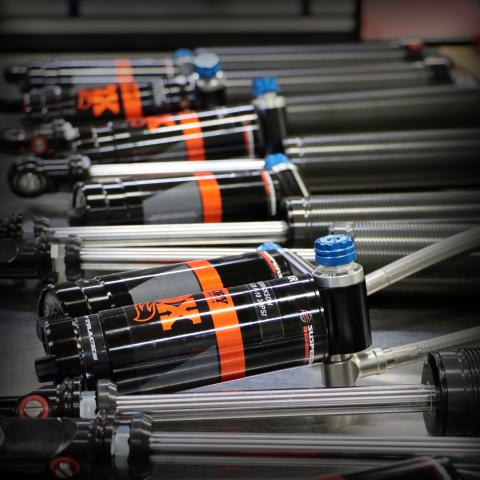
Using input from sources as diverse as rulebooks, team requests, and computational fluid dynamics, shock absorber manufacturers continue to develop new products to meet racers’ needs.
Traditionally, racing drives innovation. Developments in the quest for greater speed, handling, safety, and reliability are typically born in race shops and on track and then eventually find their way to the transportation sector.
To a certain degree, the reverse is happening in the realm of shock absorber development. Cutting-edge damper technology—electronically adjusted shocks, active aero shocks, composite shocks—are found on some of the world’s most advanced sports cars but are not allowed by most race sanctioning bodies.
“Honestly, some of these hypercars are more advanced than the race cars,” said Aaron Lambert of Penske Racing Shocks, Reading, Pennsylvania. “They have the adaptable suspension that can be controlled electronically. You can interlink them front-to-back, side-to-side. But Formula 1 and other racing series have pretty much banned all interlinked suspensions, so you lose that advantage.”
With OE and aftermarket divisions, Bilstein has “extensive experience with electronic dampers within those lines,” said Keith Robertson with Bilstein’s US division in Mooresville, North Carolina. Yet “since the circle track market prohibits them, we do not have applications active or planned with the capabilities. Bilstein saves that technology for the cars spectators drive to the race tracks.”
“Much of this technology is just not legal” in racing, added Josh Slade of RE Suspension, Mooresville, North Carolina. “We don’t really see that on the motorsports side until you get to the Formula cars and higher tiers like that.” Slade, in fact, characterized recent shock absorber development as “pretty stagnant. The last thing that was really revolutionary and ground-breaking was more than 10 years ago, with Penske and the Inerter.”
“That was the last big development,” said Lambert of the Inerter shock. Engineered by Penske with McLaren for Formula 1, it contains an internal flywheel that creates energy as the main shaft is displaced. “Essentially, the flywheel is forcing the suspension to continue to work, kind of like a supercharger for your suspension,” he explained. “Formula 1 banned it when the new car came out, which forced teams to find other ways to get that advantage. IndyCar and drag racing still allow them, so we do some development there, but it’s very specific for those markets.”
Penske developed the Inerter shock absorber with McLaren for Formula 1, but “since then it’s been banned in almost all forms of motorsports, including Formula 1,” said Aaron Lambert. “IndyCar and drag racing still allow them, so we do some development there, but it’s very specific for those markets.”
“At least in the circle track side of the racing industry, there’s a general stability in the ‘footprint’ of the dimensions of the shocks,” Robertson noted. “Car builders may play around with the mounting points and angles, but generally your lengths and mounting styles tend to be similar. As such, more of the focus can be on the tuning capabilities. That’s often a ‘cat and mouse’ game, since the chassis builders are constantly evolving their product as well. Sometimes we can hit the moving target with a simple valve stack adjustment, and sometimes it takes some new technology. We need to be willing to try both.”
Shock makers may feel stymied by the limitations put on them by sanctioning body rulebooks, but those rules “are simply a framework,” Robertson added. “The key to success is finding those nuggets of innovation within the details not specified in the black-and-white print.”
Product Innovation Trends
Ben Baker of AFCO Racing Products in Boonville, Indiana, agreed that “as a whole, in the last 10 years, there’s been very little difference between all the different shock manufacturers, both in piston design and valving. Everybody’s gotten smarter, and we’re narrowed down in a pretty small box right now.” The changes that are made can be driven “by the racers, and what we see as market trends, issues we run into in the field. Some ideas come from the shock tuners we work closely with.”
But, he added, “trends in chassis setup influence us more than anything.” In the dirt late model world, “15 years ago, if you traveled the right front 3 inches, you had more than enough travel than you could ever want. In today’s world, if you don’t have 5 inches, you’re in the way. We have to accommodate springs, two-stage kits, bump stops, and all these different things that we do today. All of that goes into the whole shock design.”
Slade, too, said dirt late model racing “is the market that is driving the most changes, as they need different things to get all the travel they’re looking for. But they’re asking for a lot of different things than what they have had in the past.” For example, RE Suspension developed dual-spring sliders and lock-out nuts in two different heights for all the major shock brands “based on racer demand,” he said. “This is one of many products we developed with the racer to help accomplish what they are trying to do.”
For AFCO, keeping up with the changes in drag race chassis setup has also spurred new thinking, Baker said. “We used to run a lot of drag cars in what we call squat—the car would squat when it would launch. In today’s world, we put a lot of anti-squat in them to where we try to make them really separate hard. As traction ramps up, and horsepower ramps up, and as the tires get better, and the track prep gets better, we have to get more aggressive with shock valving and shock design to accommodate that kind of power and that kind of force separating the car apart.”
“In the last 10 years, there’s been very little difference between all the shock manufacturers, both in piston design and valving,” said AFCO’s Ben Baker. “Everybody’s gotten smarter.” Changes that are made are driven “by the racers, and what we see as market trends.”
“Drag racing in general has been a big learning curve,” said Lambert. “The Pro Mod and Pro Stock clutch packages have become quite a bit different. The way they deliver the power is much more efficient, which means your suspension’s working even harder. That’s a constant change between what they’re doing with motors, how efficient they’re making them power-wise, to how the drivetrains transfer that power. Every time a team finds ways to get power more efficiently to the rear wheels, it ends up changing what you’re doing with the shocks and how to adjust them.
“That’s where the shock setups really come from,” he added. “As these chassis builders continue to evolve and change things, we just try to keep up with what they’re after.”
The Name of the Game
For those markets that drive design innovations, “adjustability is always the name of the game,” said Robertson. “Manual adjustments on the shocks have been around for a long time, but the offerings with more distinct tuning capabilities, like the Bilstein EVO RT and EVO RX five-way adjustables, are setting new standards.”
There’s no question that external adjusters have made shock tuning easier. But, cautioned Christer Lööw of Öhlins USA in Hendersonville, North Carolina, “in a lot of race series, as you go down in the classes, a lot of them are limited to using two external adjusters.”
Öhlins had a situation where it needed to adapt an existing damper to fit the TCR touring rules. The damper had compression and rebound adjusters “and a blow-off valve as an additional adjuster for when they’re hitting curbs.” In some series that was considered a three-way adjustable damper and not allowed, “so we had to develop a new blow-off that was not externally adjustable just to meet the rules.”
Robertson also noted that “there’s been a lot more market interest in ways to optimize the damping characteristics at different points of shock travel. It’s no longer just thinking about the velocity of the shaft, but also where the shaft is in its range of travel and what it’s being asked to do at that point.”
Penske, too, is developing new ways of affecting damping forces along the shaft’s travel. “Regressive technology is big for us,” said Lambert, referring to internal shock components “that allow us to tune a regressive curve a little more freely and apply that to different forms of racing.”
By regressive, Lambert is referring to a damping curve that is what Penske calls “the next level” beyond a digressive-style curve (and the opposite of a traditional progressive damper). The regressive tuning enhances a digressive shock’s ability to offer firm low-speed damping while reducing high-speed forces to not upset a chassis over high-speed bumps. Per a technical blog Lambert authored, the regressive shocks “become even softer at higher velocities than at low velocities.”
Penske introduced this technology “in Formula 1 years ago,” Lambert said, “and then we redesigned that packaging and came out with different pistons so we’re running it in dirt late model, sports cars, Indy cars, even motorcycles.”
Trickle Down
Many of the manufacturers we spoke to take higher-end technological advancements and apply similar strategies to lower-tier racing series. The technology behind Öhlins’ TTX product line, a sophisticated twin-tube system that completely separates compression and rebound adjustments, “was designed for Indy car racing at first, back when it was CART,” Lööw said. “That technology has since trickled down, and now you can buy it for everything from track-day cars to motorcycles.”
Bilstein’s AS2-R Series shocks “were designed parallel to when we were breaking into the dirt late model market,” Robertson said. “As triple-adjustable reservoir shocks, these took a significant amount of testing and research to dial in the valving setups. With the working knowledge that was gained during that process, we did an analysis of our applications offered for the lower divisions that use the non-adjustable shocks, like the SZSL and SMX Series, and revamped our valving options to give the best options available.”
Bilstein also has the advantage of an OE division that can sometimes influence race damper design, Robertson said. “Our 46-mm digressive piston is a staple piece in many of our applications. It utilizes a check valve system that allows for a larger, regulated flow on one side of the piston, usually compression, but then restricts it on the opposite movement. Our OE division created this design to give a new level of comfort to street vehicles, but on the motorsports side it gave a totally new range of tuning. That same check valve system is now utilized in our linear/digressive motorsports piston design, and we also have another piston in the works that will share the same technology.”
Computer Tools
As with everything in the racing and performance industry, computerized design and production tools are taking on a bigger role in shock development. For example, every one of the companies we spoke with utilizes additive manufacturing in its design and R&D processes.
“It allows us to do different flow paths and things that you normally can’t machine,” said Lambert. “We haven’t seen it cross into the majority of our other markets, but I would say in the next three to five years you’re probably going to see a big push on the additive side. As it’s becoming more and more available throughout markets, it’s bringing the costs down and making it more readily available.”
To date, these companies are using additive manufacturing just for development and prototyping. “We typically won’t race them,” said Baker, as “the materials we use aren’t strong enough to do that. But there are certainly cases where a 3D-printed part helps fast-track an idea.”
Shock manufacturers are making greater use of computerized R&D, design, and manufacturing tools, from CAD to computational fluid dynamics. The use of additive manufacturing is growing, as well. Bilstein “utilizes 3D printers to create plastic prototypes for fitment and concept analysis,” said Keith Robertson, though “we do not currently use metal 3D printing technology.”
Lambert, though, predicted “there will be parts we’re actually going to be racing. Possibly by 2024 there will be some additive manufacturing parts that are out in the racing world. And usually, a few years after that you see them trickle down into the vast majority of racing markets, whether that be a piston or an actual structural piece.”
Beyond additive manufacturing, “we have way more computer tools easily available now, like FEM (finite element method) and CFD (computational fluid dynamics), that we’re using when we’re designing the internals of a shock,” Lööw said. “We can use CFD to simulate the flow of the oil within a damper. That’s driving a lot of the design work.”
The manufacturers aren’t the only ones using computers more often. Lööw said race teams “are more educated about what they want. They do more computer simulation work,” which results in “more specific requirements. Maybe that, in turn, is driving the want for more adjustable dampers to meet their needs.”
These teams are also asking for more data from Öhlins “that they can feed back into their simulations. We have the VRP, Valving Reference Program, which is software that predicts what kind of damping forces you would get for a certain valving. You put in what valve combination you have inside a damper, and where you put your clickers, and it would produce a theoretical damping curve. They can then feed that into their simulation to see if a clicker setting would be any good for a particular simulation. They can run sweeps on the clickers from this software, feed that data into their simulation, and take which clicker setting they should start the race weekend. It’s driving the damping design to be more flexible, for them to be able to run through all this stuff in a simulation, and match what they feel would be the best.”
Computer simulation only goes so far, Lööw added. “In the end we have to test it.” Among Öhlins’ verification tools is a seven-post shaker rig, “kind of between pure computer simulation and going on the track. We can put a car on there and simulate any given track, simulate downforce, roll, braking forces, all that. Then we can, let’s say, run a perfect qualifying lap, run that hundreds of times over a test in the exact same way. That way we can pick up tiny improvements in damping.”
By “tiny,” he means changes that might shave five-hundredths of a second from a lap. “You wouldn’t be able to detect that on the track with everything that’s changing—tires wearing, temperatures, and fuel levels changing—but you can find that here.” Add up a few of those tiny changes “and now all of a sudden you have a tenth or two of improvement. Keep doing this and before you know it, you have gained a second or more. Some of these changes would have been hard or impossible to verify on the track individually.”
New Products
Several of these companies had just or were about to release new racing shock products.
As we spoke with Baker, he was assembling some new AFCO 81 Series shocks, which were released in April. These are “stock-mount gas shocks that are internally gas pressurized. You can fill the gas chamber through the floating piston. IMCA Hobby Stock rules don’t allow any external fill ports, and they have very specific length rules as well, so these have been tailor-made to their length rules.”
A second new shock series, due out in June, consists of “steel-body, take-apart shocks, bearing-to-bearing, kind of like our 74 or 84 Series,” Baker said. “This particular shock is going to have a base valve internally, so we don’t have to run exceptionally high gas pressures to make the shock not cavitate. The gas pressure typically takes feel away from the driver, so we’re trying to minimize that gas pressure.”
The verification tools used by Öhlins include a seven-post shaker rig, which Christer Lööw described as “kind of between pure computer simulation and going on the track.” Small improvements in damping, which can shave increments of a second off a lap time, can be verified on the rig. Add them up “and before you know it, you have gained a second or more.”
For the asphalt late model market, Bilstein just released “seven new shocks based on our AS2 and XVA Series offerings that are developed for the Late Model stock/LMSC market,” Robertson said. “For Northeast modifieds—big block, 358, and sportsman—we’ve released 16 new race-ready shocks based on the AS2 (for big block, 358) and SN2 Series (for sportsman).”
Robertson explained that “each new part release can have its own unique scenario based on the market we’re trying to reach. In the case of the modifieds, there’s both a series variation (XVA and SN2) to meet the rules specifications of different divisions and then also two sets of shocks within each of those series that are valved up specifically for each corner and ready to race. This gives our catalog dealers race-winning options they can sell right off their shelf. On the late models we also have two different series to meet rules requirements, but those are actually dry kits (no oil, nitrogen, or valve stacks) that are geared toward the shock tuners so they can build to their customers’ specific needs.”
Öhlins has just released a new two-way adjustable TTX Advanced Trackday kit for the Porsche 992 GT3, Lööw said. The aluminum, two-way adjustable shocks are upgradeable to three- or four-way adjustability, and they utilize the factory top mounts. “The nice thing about it is, we have a version of it where they can retain their nose-lift system so they can still pull over a curb without hitting the ground.”
Final Thoughts
“One of my biggest pet peeves in racing in general, not just shock related but parts in general, is that a lot of people today think you buy speed,” said Baker. “If it costs more, they think it has to go faster, and that is definitely not the case. If the car is not right in general, I don’t care if you put a $100 or $10,000 shock on it, it’s not going to go.”
As a company, AFCO “has always taken a lot of pride in having good, reliable, fast parts, but we try not to strangle a racer to death with pricing,” Baker added. “That’s something we definitely battle. They think we can’t be as fast as another shock because it’s $100 cheaper.”
Looking at the racing shock market as a whole, RE Suspension’s Slade believes “it’s getting harder and harder to make any big changes. When you look at where we started, with an old-school emulsion shock, to where we are now, that’s a huge advancement. But the products that these companies are releasing for the most part are really good, really reliable. You can take shocks from any one of the big-name manufacturers and win races with them on a regular basis. That’s different now compared to years past. You used to have one company that was pretty dominant, and it would kind of go in waves. It does a little bit still, but on a weekly basis, you see a much wider variety of what’s winning. Right now, everybody’s on their A game.”
Despite facing significant challenges on several fronts, these companies continue to thrive in a highly nuanced segment where parts scarcity and cost concerns have always been part of the deal.
Vintage racing clubs, sanctioning bodies, and other related organizations continue to see sustained interest in niche segments, while the roster of eligible platforms expands, and class structures change in turn. Increasingly, vintage race shops have become a crucial element in the overall health of the sport.
Some focus on the stewardship of iconic racing machines and the high expectations of discerning clientele, while others are tasked with breathing new life into vehicles that may not have seen track time in decades. Although much of the latter can be attributed to the fact that more and more platforms are becoming “vintage” by definition with each passing year, there are other factors that have played key roles in reshaping this segment of the racing landscape over the past decade.
“One of the big things is that there are a lot of people who have built collections and have a lot of vintage racing experience who are starting to age out of the sport,” said Scott Drnek of Virtuoso Performance in Hayward, California. “Part of the reason that’s important is because most vintage racers buy the cars that resonate with them, specifically. So while someone in their early 60s might prefer F1 and sports prototype cars from the 1970s, that might not be the case for someone who is currently in their 40s. At least half of the people who are now coming into vintage racing aren’t particularly interested in the older cars. A Jim Clark Lotus might not mean much to them because their heroes are Mario Andretti and Alain Prost.”
Drnek added that the rising values of many vintage race cars has contributed as well. “Because many of these cars have gone up so much in value over the past 10 years or so, some of the owners just aren’t racing them anymore. When they originally bought it, it might’ve been a $50,000 car. But now it’s a half-million-dollar car, and their personal economy just hasn’t appreciated at the same rate. Consequently, the prices of entry-level vintage cars have also gone up. Twenty or 30 years ago, people might’ve seen vintage racing as a less-expensive alternative to SCCA or NASA. That’s really no longer the case.”
“Part of the historical value of a car with an unusual or rare drivetrain is that unusual or rare drivetrain, so you have to develop some strategies to keep it going,” said Michael Clifford of Michael’s Vintage Racing. “You have to plan ahead. It’s always a good idea to make spares before you need them.”
As Michael Clifford of Michael’s Vintage Racing in Scottsburg, Virginia, pointed out, these developments have changed the look of today’s vintage racing events. “We’re seeing a lot more cars from the mid-to-late 1970s and early 1980s than we were just a few years ago—BMW E30s, Porsche 944s, first-generation Mazda Miatas, and things like that. Depending on the event that we’re at, we can see anything from the 1950s and 1960s-era cars that everyone’s used to seeing at vintage racing events all the way up to virtually new GT and prototype cars.”
Keeping such an eclectic mix of vehicles race-ready requires a specialized approach to each platform, along with the needs of the drivers who are piloting them. As a result, the shops that focus their efforts on the vintage racing market tend to adopt a strategy that’s purpose-built for the segment that they serve.
Reviving The Past
When Steve Lathrop founded Citation Engineering in 1974, his goal was to put competitive Formula cars in the hands of more racers. Over the years, the Zionsville, Indiana-based company designed and produced cars that have won a dozen SCCA national championships across Formula Vee, Formula Ford, Formula Continental, and Formula Super Vee. Although interest in these classes fluctuated throughout the ensuing decades, Lathrop said that the recent rise of vintage racing has put a spotlight on these cars once again.
“Some of them never really retired. There are some guys who just kept the same car throughout the years,” observed Lathrop. “But with the onset of vintage, a lot of people are going around checking the garages and the barns, and are bringing some of these cars back out. They’re fetching a lot more money than they were when they were brand new.”
He told us that these days, Citation Engineering is more of a design firm than a traditional race shop, and there’s a good reason for that. “I’m seeing all of these cars for a second time—it’s a hell of a deal,” he said with a laugh. “Part of the reason is that some of the parts that these cars were originally built with just aren’t available anymore, so we’re trying to keep these things alive by redesigning parts of the car to work with components that are obtainable today. For example, the front uprights on the Z10 were originally from the VW Fastback, and we also used the spindle and bearings from the first-generation Golf. These parts are really hard to find today, so we’re making new uprights that accept the spindles from a third-generation Golf.”
Citation Engineering is also updating other elements of the cars to bring them into compliance with contemporary safety standards. “The rollbar rules have changed dramatically,” he said, “so we’re sending out drawings that explain how to modify the existing cars to meet the new rules. The big challenge is that we want to run the original bodywork on cars like the Formula Vee, and to build out the cage to modern standards, the bodywork requires some changes in order to make it fit. We’re also doing similar design work to put modern fuel cells in these cars without having to move the driver forward in the car. The generic wedge cells that people are using will move the driver forward about five inches at the shoulders, and I consider that to be an unsafe position because of the additional distance it puts between the driver and the rollbar.”
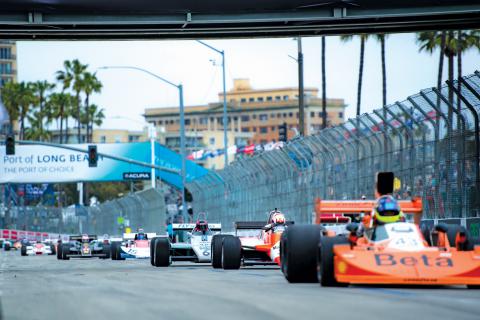
The “arrive-and-drive” customer experience now goes beyond just car prep, said Scott Drnek of Virtuoso Performance, which maintains these cars spotted at the Acura Grand Prix of Long Beach. “It’s turned into more of a family experience, which causes you to re-evaluate the experience you’re presenting to your clients. You can’t just show up with a car that works anymore.”
Serving The Market
While Citation Engineering focuses on updating the designs of the cars in order to make them easier to maintain and safer to run, outfits like Virtuoso Performance and Michael’s Vintage Racing often work more directly with the end user on a long-term basis. As Drnek noted, the services of vintage racing shops that offer “arrive-and-drive” customer experiences go well beyond preparing the car for competition. Transportation of the vehicle to and from events, trackside assistance, maintenance, and even hospitality are typically intrinsic elements of this holistic offering.
“All of our stuff is done in-house—engines, gearboxes, paint, and everything else,” Drnek said. “We have cradle-to-grave responsibility for these cars. And we use our experience and engineering knowledge to make engines that, in-period, might’ve lasted three hours at 12,000 rpm, now last four hours at 10,500 rpm. We can remove some reciprocating mass, we have more advanced materials and coatings, and we have better heat-treatments. You can’t just dial the engine back a little and call it good. If the engine was meant to run at 12,000 rpm, it probably didn’t start making power until about 9,000 rpm. You have to look at the whole package and consider things like cam profiles, compression ratios, fuel delivery—all of it.”
Beyond the durability expectations of his clients, Drnek noted that keeping these rare, historically significant engines intact is crucial for pragmatic reasons as well. “On a lot of these projects, the castings are simply irreplaceable,” he said. “If you’re racing a car that’s powered by a small block Chevy and you put a rod in the side, it’s a $5,000 inconvenience. A block for a V12 Alfa Romeo F1 engine costs 20 times that. So you spend a lot of time doing everything you can to prevent the potential for catastrophic failure.”
Citation Engineering is more of a design firm than a traditional race shop, as “some of the parts that these cars were originally built with just aren’t available anymore,” said Steve Lathrop. “So we’re trying to keep these things alive today by redesigning parts of the car to work with components that are obtainable today.”
This zero-hassle imperative has also come from the changing expectations of vintage racing clients, he said. “The easiest way to understand our business model is to think about the way wealthy folks own horses. They don’t have a dually or a trailer. They have people, and they have a horse. In our case, the horse is the car, and we are our clients’ people. The cars are stored in our facility, and our clients tell us when and where they want to race them. They show up and the car is there, prepped and tested, and their driving gear is there cleaned and ready to go. Their wife’s favorite chardonnay is in the refrigerator, and we know what they like on their sandwiches. We put the whole experience together. Twenty years ago, this was a way for guys to get out of the house for a weekend with a legitimate excuse to go hang out with their buddies and race cars. But that’s changed. Today they want to bring their wife or girlfriend, they want to bring their kids. It’s turned into more of a family experience. As a business, that causes you to re-evaluate the experience that you’re presenting to your clients. You can’t just show up with a car that works anymore.”
Just like any professional race team at a major event that works through the night, here Virtuoso Performance is seen making repairs on a 2013 Oreca FLM09 LMPC car that ran as part of a support race with the 2019 US Grand Prix at Circuit of The Americas.
When it comes to sourcing hard-to-find parts, Clifford said that there are a few different tactics that can minimize headaches. “Part of the historical value of a car with an unusual or rare drivetrain is that unusual or rare drivetrain, so you have to develop some strategies to keep it going. Ideally, if you’re working with something that’s impossible to get if it breaks, you’d at least want to photograph and measure, and if you can, do a CAD scan of the components. That way you have something to work with if that component gets vaporized at some point in the future. In most cases, there’s a lot of information already available by now—blueprints at the very least, or historical knowledge bases. If none of that exists, which is something you’d want to research ahead of time, you have to plan ahead. In situations like that, it’s always a good idea to make spares before you need them.”
Maintaining Momentum
Although myriad different elements will play into the trajectory of the vintage racing market over the coming years, everyone seems to agree that keeping a steady flow of talent coming into the segment is paramount.
“So many modern series are moving to spec cars,” said Lathrop. “That can make life easier for a team—they can run five or six cars, and all they really need is a chief mechanic; they don’t have to have an engineer for each car. But I think the bespoke nature of vintage racing is attractive to people who’re looking for something that’s a little more unique, and the engineering itself plays more heavily into a team’s competitiveness. But that requires engineers who understand the platforms.”
Drawing younger talent into vintage racing—as drivers and mechanics—is paramount in keeping the sport vital. “I think better PR would go a long way,” said Michael Clifford of Michael’s Vintage Racing, seen here. “It would be nice to see a more concerted and unified effort to spread awareness about the cars.”
Those individuals are getting increasingly more difficult to find, Drnek said. “We’ve got to figure out a way to draw young talent. Part of it is a social issue; over the past 20 years or so, a stigma has been created against working with your hands. At first you might say, ‘Oh, that doesn’t seem like such a big deal.’ But that changes when you try to hire a plumber, or you need to get your fence fixed. One thing we’ve noticed with younger folks who’ve, for instance, gone through BMW’s Step program is that all they’ve learned to do is use a diagnostic computer and replace whatever the OBD system is telling them is broken. Maybe they’ve been at a dealership for a few years, and now they’ve gotten used to being the smart guy in the shop who all of the younger techs come to for help. But then they come here, and they discover that there’s no diagnostic port, there’s no wiring diagram, and there is no manual. You just have to figure it out the hard way. You have to understand how these systems work, then you have to understand how they fail, and then you can figure out what you’ve got to do. As you can imagine, that’s not the easiest sell.”
And as Clifford emphasized, part of the problem is that vintage racing simply is not reaching young people as effectively as it could be. “I think better PR would go a long way,” he said. “Most of the people running these cars aren’t particularly concerned about advertising the sport because they’re doing it for fun and they’re not really looking at the big picture. So it would be nice to see a more concerted and unified effort to spread awareness about the cars. The cars really do the heavy lifting here—they look cool, they sound cool, and they’re fun to watch. We just have to make people aware of them.”
As older drivers hang up their helmets and more modern vehicle platforms begin qualifying for the category, vintage race organizers are developing strategies to maintain the spirit of the sport while also attracting a new generation of competitors.
Defining vintage within the context of motorsports has always been a highly subjective endeavor. Some picture the pre-war single-seater beasts that ran at Indianapolis when it was still paved with bricks, while others point to the heyday of production-based Trans Am racing in the late 1960s. There are also those who take a more pragmatic view, considering vintage to be essentially any platform that has aged out of the series for which it was originally intended.
All of these definitions are correct, and here in the United States, each is represented in some form under the banner of vintage racing today. But regardless of one’s viewpoint, time continues to march forward, and a number of different factors in today’s world are changing the landscape of vintage racing.
“These days you can’t pick up a race-prepped Datsun 510 for less than $50,000,” noted Jeanette Bourke of the Vintage Auto Racing Association (VARA), Chino Hills, California. “For a lot of people, that just isn’t achievable. But it isn’t just about what’s affordable—it’s also about what’s available. We don’t want to make this type of racing exclusive for people who’re over a certain age and have a certain amount of disposable income. We want everyone who is interested in racing with us to be able to do so.”
But as Vintage Motorsports Council (VMC) president John Bechtol explained, that’s not necessarily the primary objective of every vintage racing organization. “Each VMC member group has its own definition of what constitutes a vintage or historic race car. Some groups won’t take anything newer than the early 1960s. We also have several groups that will take cars that are five years old or older under some circumstances, which means that a race car from 2018 would be eligible to run. There’s a wide disparity in terms of what these organizations will allow, and a lot of that comes down to the ethos and goals of each particular organization.”
The Contemporary Look Of Vintage Racing
Part of what makes defining vintage a tricky endeavor within the context of motorsports is that the qualifications differ dramatically depending on who you ask. Often the motivation to get involved in vintage racing comes from a desire to campaign the types of cars that drivers lusted after in their youth. As a result, the criteria have naturally become more modern over time.
The definition of a “vintage” race car is a moving target, not only because the various vintage racing organizations have different rules and goals, but also because as time marches on, even today’s race cars will become “vintage” in a few years.
“When I came in at SVRA in 2012, the common definition for vintage racing was 1972 or older,” said Tony Parella of the Sportscar Vintage Racing Association, Southlake, Texas. “But my definition of vintage was different almost from the start. We believed that keeping an arbitrary year of 1972 or older wouldn’t work for our business model and our goal of becoming a national player. To us it was like, ‘What’s the magic of 1972?’ And secondly, if you want to attract new, younger people to the sport, it has to be in a car that they can relate to.”
Under Parella’s leadership, SVRA’s race calendar has expanded from just three annual race events in 2012 to nearly two dozen across the country today, with the series visiting iconic tracks like Laguna Seca, Sebring International Raceway, Road Atlanta, and Lime Rock Park. SVRA racers share the paddock with competitors in the Trans Am and SCCA Pro series at these events, both of which run alongside the vintage races on those weekends as part of the SVRA SpeedTour.
SVRA’s class structures have also evolved significantly over the years. Cars are divided into classes within 13 different race groups, but Parella is quick to point out that this classification is not determined by lap times.
“Pretty much right from the get-go, we made our criteria for vintage five years or older,” he explained. “So today, in 2023, we would accept anything that’s 2018 or older without question, and we’d have a class for it—that’s where the 13 race groups come from. But we also still wanted to pay homage to the 1972 and older cars that have been prepared to their original racing specifications, so we created the Gold Medallion program.”
Gold Medallion applicants are put through an extensive certification process, and those who are accepted into the program are given a special logbook and dash plaque, which acknowledges that the car is prepared as it would have been raced in that era. SVRA also has general classes for vehicles that are similarly prepared but benefit from upgrades that provide a performance improvement—like swapping out drum brakes for discs or installing a dry sump oiling system—while cars with significant development and race prep well above and beyond their original configuration are typically placed in the GT class.
When Tony Parella joined SVRA in 2012, “the common definition for vintage racing was 1972 or older,” he said. Since then, the SVRA changed its criteria to five years or older, and under Parella’s leadership, its race calendar has grown to nearly two dozen events across the country.
“We have similar looking cars out in the same run group, but there are different classes within that group. It’s as fair as we can make it when we’re covering a hundred years of cars and so many different variations,” Parella explained. “Over the first few years we tried different recipes as we figured out what made the most sense for our business, and we feel this is the right approach in order to do this on a national level. My goal with this company is to remove the barriers of racing as much as possible for anybody who wants to compete, make it fair and consistent, and make it as safe as you can make racing be.”
Bourke offered a similar perspective regarding VARA’s approach to vintage racing. “If you bring a car, we will find somewhere for you to race it,” she said. “People initially show up for the racing, but I think it’s the camaraderie that keeps bringing them back. We really focus on being inclusive, and that doesn’t offend others because everyone has their clearly defined classes. The vintage Volvos and Triumphs in the small-bore group are still going to get their classifications and everything like that, and then the first-generation Mazda Miatas have their own race. It’s quite fun to see the Austin-Healey Sprites and Miatas racing against each other—different classifications, but they’re all out there having a good time.”
In that spirit, VARA has given a home to a number of race cars that have been orphaned by various circumstances. Early first-generation Mazda Miatas, for example, are equipped with a 1.6-liter inline four-cylinder engine, but a more powerful 1.8-liter engine replaced it just four years into the car’s production run. These 1.6-liter cars would not be competitive in the SCCA’s popular Spec Miata class, but VARA’s class structure has given these late 1980s and early 1990s sports cars a new venue to compete in. “We have four of them racing with us now,” said Bourke. “These cars can be picked up cheaply, and they don’t need a lot of maintenance to keep them on track. These are cars that people under 30 years old can afford to get into, and they can do most of the work on them if they have some basic automotive knowledge.”
Meanwhile, cars like the BMW 2002 and Datsun 510—which Bourke describes as breakthrough platforms for VARA—are now enjoying intense competition and strong sponsorship support. “Ten years ago, it would have been a dream for a sponsor such as Toyo to do a five-race series like the Toyo Challenge 2.5. With a little bit of work, hopefully these Miatas and E30s will build up a similar following.”
For Boston, Massachusetts-based Vintage Racer Group (VRG), which was founded in 2004, the first significant eligibility expansion took place “at least 10 years ago, when cars up to 1979 were granted admission,” said president John Wood. About six years later, the standard shifted again to include 1989 and older production vehicles. “When we expanded [it] through 1989, we didn’t really know what was going to happen,” Wood recalled. “We figured that probably a bunch of first-gen Miatas would show up, that we would start to see a bunch of Volkswagen Golfs, some Nissans, maybe even some early Hondas.
“Well, we have seen a couple of those cars, but it wasn’t in large quantities,” he continued. “The vast majority of cars that make up most of our grids are still from the 1960s and 1970s. You see some 911s, you see the Bugeye Sprites, the MGAs. We see Alfa GTVs—both the early GTVs that most people think of, as well as the later ones that had the straight six in them. We do have some from the 1950s and some from the 1980s, but it’s clearly dominated by the 1960s and 1970s.”
“We don’t want to make this type of racing exclusive for people who’re over a certain age and have a certain amount of disposable income,” said VARA’s Jeanette Bourke. “We want everyone who is interested in racing with us to be able to do so.”
Similar to VARA’s Bourke, Wood cited “the camaraderie element” as a key component of VRG’s operations. “When these guys come off the track and they get back in the paddock, they go find each other, the people they were racing wheel-to-wheel with,” he said. “They laugh about it—they talk about different turns and where passes were made. And they’ll jokingly say things like, ‘I’m coming for you in the next session!’”
As to VRG’s level of competitiveness, “everything about it is formal in terms of a pace lap, cars side-by-side when the green flag drops—there’s no doubt it’s real, competitive racing,” Wood said. “But we also put a strong emphasis on situational awareness, knowing who’s around you at all times, making good decisions about when and where to execute a pass…. Everybody recognizes that the fun is drifting the car around turns and racing for whatever position with one of your friends, and then doing it all over again the next session.”
Keeping It Real
While VRG, VARA, and SVRA are casting a wide net over road racing, Mark O’Day of the Vintage Sports Car Club of America (VSCCA) said the New Britain, Pennsylvania-based organization chose a different tack from the outset. “VSCCA is essentially a vintage club that also runs races. We also run hill climbs and rallies mainly for fun, and we have social gatherings. Racing is what people tend to think of the most, but there’s a strong social element to what we do as well.”
Established in 1958, VSCCA’s initial cut-off point for vehicle model years was 1954, and that was eventually extended to 1960. “Even then, some cars weren’t allowed,” O’Day said. “There were a lot of Bugattis, old Ferraris, and things like that. Things like MGs weren’t eligible.”
Recent years have seen the club loosen the reins, but only slightly. “Eventually the MG-Ts and MGAs became eligible,” he continued. “If it was something like a Porsche 356—a design that debuted in the 1950s and continued into the early 1960s—those became eligible as well. We also started to allow Formula Juniors, SCCA sedan-class cars, and small-displacement sports racers up to 1965, along with some rare cars between 1965 and 1970, based on approval.”
“Each VMC member group has its own definition of what constitutes a vintage or historic race car,” said John Bechtol. “There is a wide disparity in terms of what these organizations will allow, and a lot of that comes down to the ethos and goals of each particular organization.”
VSCCA occasionally gives the green light to early-to-mid 1970s cars, too, but that’s about as modern as it gets. Notably, the club does not allow Porsche 911s, a decision that has more to do with performance than rarity or provenance.
“For example, there’s a couple of guys who race 1973 Alfa Romeo GTVs with us,” said O’Day. “They’re not highly modified cars. They have racing equipment on them, but they’re not like an Alfa GT-A or something like that—they’re still street-legal, so they fit in very well with cars like the late 1950s Alfa Romeo Giuliettas in terms of their capability. That’s something we’re very mindful of. We don’t want someone to come in with a car that just leaves everyone else behind. With this club it’s not about winning. We don’t provide trophies and we don’t have season standings. We don’t even have timing and scoring at some of our events. But some people are very competitive despite those circumstances, and we don’t want them to feel like they need to modify their cars or get faster cars. That’s kind of the trap that we’re trying to avoid falling into: As you allow newer and newer cars, the older cars get left behind, and then people stop running them. Suddenly you’re just left with a bunch of newer cars.”
O’Day said the VSCCA is more about celebrating the cars and enjoying them rather than pushing these rare machines to their dynamic limits. “The events are not huge,” he added. “We’ll typically get somewhere between 70 and 90 entrants for a race event. There are a lot of people in the club who have been doing this for a very long time, and a lot of good friendships have been made as a result. It’s every bit as much of a social experience as it is about getting your car out there.”
Bechtol pointed out that these two distinct approaches tend to complement one another within the realm of vintage racing, allowing would-be participants to choose a club that really caters to their interests as an owner and driver. “Some groups need to fill a grid. They typically don’t have spectators, and there are bills to pay, so those groups are inclined to allow a broad range of cars to participate. On the other side of the coin, there are groups that are more show-focused. They have spectators at their events, and they have sponsors that are more likely to require cars that look and act like they did back in the day. Both approaches have their place.”
Connecting With Younger Drivers
Vintage racing tends to be associated with an older demographic, but as those competitors eventually retire from the sport, there is an inherent need to engage with a new group of drivers. Jeanette Bourke of Vintage Auto Racing Association (VARA) in Chino Hills, California, said that this necessity has informed much of the series’ outreach strategy.
“The hill climb events and high-performance driving schools that we offer are part of that,” she explained. “Holding the schools at race weekends instead of by themselves allows these drivers to see the cars out there in competition and make the connection that, for a little more money, they could be doing that, too. It’s widening their perception of what vintage racing is, and what is feasible for them.”
Several vintage racing groups, including VARA, are actively reaching out to engage with younger drivers.
VARA’s hill climb events are open to all types of cars, and since the cars are sent out on track one at a time, no competition license is required in order to participate. With minimal barriers to entry, VARA spreads the word to enthusiasts through a targeted use of social media and video platforms. “Facebook is still part of it, but we’re mainly focusing on Instagram, Tik Tok, and YouTube. And we’re always at Cars and Coffee events. Where people are interested in cars, that’s where we’re going to be,” said Bourke.
In addition to the organization’s strong social media presence, Sportscar Vintage Racing Association (SVRA) in Southlake, Texas, livestreams its events to connect with those who can’t be at the races in person. “When I came on (in 2012), SVRA didn’t even have a Facebook page,” said Tony Parella. “Last year we had 50-million impressions and 3.2-million engagements across our social media accounts. Facebook, Instagram, and Twitter are all part of our strategy. But YouTube is where our biggest growth is right now because we have SpeedTour TV, which streams our events so that fans, friends, and family can check them out, whether that’s an SVRA race, a Trans-Am race, or something else.” —Bradley Iger
SOURCES
Sportscar Vintage Racing Association (SVRA) svra.com
The Vintage Sports Car Club of America (VSCCA) vscca.org
The Alpine Elf Endurance Team--the racing team based in France--has revealed the A424 Beta, the precursor to its Hypercar that will compete in the premier category of the FIA World Endurance Championship (WEC) beginning in 2024.
The product of close collaboration between the Alpine and motorsports company Oreca, the LMDh prototype reaffirms the brand's DNA while foreshadowing its future. It features a V6 single turbo engine configuration, an Xtrac gearbox, ventilated carbon disc brakes, six-piston one-piece calipers and Michelin tires.
Officials with the Off-Road Motorsports Hall of Fame (ORMHOF)--based in Reno, Nevada--have announced its class of 2023 includes Jeff Cummings, Scott Douglas, Evan Evans, Helen Fields, Scot Harden, Mary McGee, Tommy Morris, Lee Sieck and Russ Wernimont.
For inductee bios, photos and more, visit the ORMHOF announcement here.
The ORMHOF Class of 2023 will be celebrated at the Off-Road Motorsports Hall of Fame Induction & Awards Gala, presented by 4 Wheel Parts, on Saturday, September 9, at the South Point Hotel Casino & Spa in Las Vegas, Nevada.
Tickets and sponsorship opportunities are available for the Gala. For more information, visit ormhof.org.
What can be revealed by performing a used engine oil analysis.
With the cost of engines increasing and the lead time on parts getting longer, there may be no better time to start utilizing used oil analysis to protect these valuable assets.
Used oil analysis quickly and easily reveals the health of an engine. By taking a three-ounce sample of used oil from your engine, the experienced analyst can determine the amount of wear, metals, fuel dilution, and other contaminants in the oil. In fact, every Formula 1 team analyzes their oil at the race track to know when an engine or gearbox should be changed.
The process is as simple as capturing the sample in the bottle provided in the oil analysis kit, completing a form with the details of the sample, dropping the sample in the mailbox, and reading the report that comes via email. Those results can come in as soon as three days if needed. If everything in the report has green check marks, then you are good to go. If not, then you know where to look for a potential problem. It is that easy and effective.
How can used oil analysis pay for itself? By detecting particles and contaminants that are smaller than 10 microns (a human hair is 40 microns in diameter), used oil analysis can see things that we can’t with our eyes.
Dennis Borem from PME is seen here putting together Lake Speed’s Ford C-3 NASCAR engine. A freshening and contemporary fluids helped it to make more power than it did 20 years ago but didn’t answer the question of why it overheated. Used oil analysis provided clues.
Because motor oil moves all through the engine, picking up “souvenirs” along the way, used oil analysis takes advantage of that fact and counts these souvenirs, so it can tell us, for example, if the bearings are wearing by counting the parts per million of the bearing materials (copper, tin, and lead) in the used oil.
In fact, a recent oil analysis revealed why one of my dad’s (Lake Speed) old engines had overheated during a vintage stock car race at Daytona in 2003. It also helped explain a corresponding loss of 200-plus horsepower when we revisited the engine last summer.
Case Study:
Dad’s Engine
Even though he was able to nurse it home for the win, my dad and his team knew that his Ford C-3 NASCAR engine was in rough shape.
As mentioned, last summer we came across the dyno sheets for that engine, and I couldn’t help wondering if it would still run after sitting for two decades. And if it did, how much power would it make?
The dyno sheets from 20 years ago showed the engine made a peak of 690 hp at 7,800 rpm. When we put it back on the dyno last year it only made 477 hp at 7,700 rpm, and it “pegged the needle” on the blow-by gauge.
So, it was indeed damaged. But where did more than 200 hp go?
We took the engine off the dyno and pulled it apart that day, but we couldn’t find any “smoking gun” that would explain why the engine had overheated or why it had lost so much power.
Our next line of attack was to see whether a refresh would bring the engine’s power back. Although we kept the same heads, manifold, block, crank, and rods, we did “modernize” the hone, pistons, pistons rings, and valvetrain. We also ditched the old conventional 20W-50 oil for a modern 5W-20 synthetic racing oil.
Because oil moves throughout the engine, picking up particles and contaminants along the way, analyzing that oil can point to potential trouble spots. Here, it prevented a bearing failure by detecting this premature wear caused by debris
After some honing work to create the specific plateau finish required for our TiN coated rings, we put our engine back on the dyno, installed some break-in oil, and began the break-in process to properly seat the piston rings.
After 30 minutes and a few break-in pulls, the engine was making more than 750 hp. With a few more tweaks—race carburetor, race fuel, and race oil—the engine belted out 778 hp at 7,600 rpm!
Not only had we recovered the lost 200-plus horsepower, we gained almost 90 hp over the original build. But we still didn’t know why the engine had overheated in the first place.
Fortunately, we took used oil samples from that dyno session—one from the break-in oil and another from the race oil. The analysis of those samples revealed the culprit of the overheating: We found water in both samples, and the amount of water was increasing with each sample.
The crazy thing was that no water was visible in the oil, and the blow-by was very low. However, we trusted the used oil analysis data, so we investigated the likely areas of the leak.
In the intake runner of cylinder number 3, we found a small crack that would only show up when the cylinder head was torqued down on the engine block. Now that we found the crack and fixed the leak, we had to go back to the dyno one more time.
Analysis of the oil in Lake Speed’s NASCAR Ford showed water in the oil, which came from a tiny crack in one of the intake runners. The engine is now back from the dead and making more power than ever.
With everything fixed, the engine made 791 hp at 7,800 rpm. Our used oil analysis had detected water levels that we could not see when we changed the oil on the dyno. This simple test not only prevented overheating the engine again, it also saved us a bunch of money. We were about to buy a new radiator, which was not necessary. Having data saved the day and a bunch of dollars!
Additional Applications
Beyond catching a coolant leak, I’ve seen used oil analysis detect the initial stages of cylinder scuffing when no other test showed that problem.
Porsche engines from the 2000 to 2020 era came from the factory without traditional iron liners or a Nikasil plating. These Alusil (aluminum and silicon alloy) cylinders can suffer from bore scoring. When this happens, the engine will eventually begin using oil, smoking, and ultimately fail the cylinder/piston interface. By taking samples of the used oil and applying trend analysis, cylinder bore scoring can be detected. When the levels of aluminum and silicon begin to rise together, that’s the sign bore scoring has begun. By catching it early, the bore scoring can be dealt with before the engine is destroyed.
I’ve seen oil analysis save a championship in a series that uses sealed engines. Because the engines are sealed and can’t be opened for inspection between races, used oil analysis provides a faster and effective health check for these engines. A few years ago, the trend analysis showed an increase in iron, aluminum, and chromium from a sealed engine customer. Those materials indicated abnormal piston and liner wear. Based on the used oil analysis results, the team didn’t run that engine in the next race. Utilizing the results, the team was able to have the engine inspected, and that inspection revealed a failure was in progress. If the team had used the engine again, it would have failed and cost that team the series championship.
That three-ounce sample and $100 expedited analysis saved a $35,000 engine and a championship paycheck. I’d say that’s a good investment and great practice to add to your maintenance program.
The son of a former NASCAR driver and World Karting Champion, Lake Speed, Jr. holds both STLE CLS and OMA 1 Certifications. While working for the Joe Gibbs Racing NASCAR team, he led a development team that employed the science of tribology to NASCAR engines and drivetrains. Following the sale of Joe Gibbs Driven Racing Oil (now known as Driven Racing Oil), Speed moved to Total Seal piston rings to continue the application of tribology for the purpose of improving engine efficiency.
 MEMBERSHIP LOGIN